




What Are the 25+ Best Security Automation Tools Across Every Category in 2026?
Security operations in 2026 runs on a paradox: organizations have more tools than ever, yet most SOC teams still drown in noise they can’t act on fast enough. The ISC2 2025 Cybersecurity Workforce Study, surveying a record 16,029 professionals, found that 59% of organizations now report critical or significant skills shortages, a 15-percentage-point jump from the year before. Meanwhile, studies consistently show that around 83% of daily security alerts turn out to be false alarms, and over 40% of security professionals say their tools don’t provide enough context to act. The math doesn’t work: more alerts, fewer people, and tools that generate noise instead of outcomes.
⚠️ The Real Problem Isn’t Tool Count, It’s Operational Fragmentation
Here’s what actually breaks in practice. A mid-market company running CrowdStrike on endpoints, Splunk for logs, Okta for identity, and a separate cloud console for AWS has four separate views of the same environment and zero unified understanding. When a behavioral alert fires at 2:41 AM, someone has to manually correlate across all four, figure out whether the flagged PowerShell execution was an IT admin or an attacker, and decide how to respond. That “someone” is often a Tier 1 analyst on the 14th critical alert of the week, investigating what turns out to be another false positive.
This is the landscape that security automation tools are supposed to fix. But the category itself has fractured into so many sub-segments, including SOAR, SIEM, XDR, vulnerability management, email security, compliance automation, and AI SOC, that choosing the right combination has become its own operational challenge.
📊 Seven Benefits Driving Automation Adoption
Before mapping tools to categories, it’s worth being explicit about what automation should deliver when it’s working:
- Alert noise reduction — Filtering, deduplicating, and enriching alerts so analysts see confirmed signals, not thousands of “maybes.”
- Faster mean time to respond (MTTR) — Automating the mechanical investigation steps (log pulls, enrichment queries, threat intel lookups) that eat 60%+ of analyst time.
- 24/7 coverage without 3x headcount — Extending monitoring and triage into off-hours without hiring three full shifts of analysts.
- Cross-tool correlation — Connecting dots across endpoints, identity, cloud, and network so context lives in one place.
- Compliance evidence generation — Automatically producing audit trails, control evidence, and monitoring reports for SOC 2, HIPAA, ISO 27001, and GDPR.
- Reduced analyst burnout and turnover — Security analysts average roughly 18 months before turnover from alert fatigue; automation that removes grunt work directly impacts retention.
- Scalable security ROI — Getting measurable outcomes from existing tool investments instead of layering on net-new spend.
Our Evaluation Criteria
For this report, we analyzed 25+ security automation tools and platforms spanning seven operational categories. Each tool was assessed across five key areas:
- Security Operations Capability — Depth of automation for detection, investigation, triage, and response workflows
- Integration Breadth & Vendor Flexibility — Number of supported integrations, openness to existing stacks, and absence of vendor lock-in requirements
- AI/ML Maturity — Whether the tool uses behavioral analytics, machine learning, or agentic AI for detection and investigation, and whether those capabilities are observable and auditable, not black-box claims
- Scalability & Deployment Model — Suitability for organizations ranging from 50-person startups to 5,000+ employee enterprises; cloud-native, hybrid, and on-prem support
- Pricing Transparency & Commercial Model — Published pricing, predictable cost structures, and absence of hidden “contact sales” gates
Who This Guide Is For
This landscape guide is designed for:
- CISOs and Security Directors evaluating which automation categories to invest in next, based on current SOC maturity
- IT Directors and CTOs at mid-market companies (50–1,000 employees) balancing limited headcount against growing compliance and threat exposure
- PE Operating Partners assessing portfolio company security posture and identifying where automation reduces operational risk
- SOC Managers and Analysts looking to map tool capabilities against daily operational pain points, including alert fatigue, triage bottlenecks, and off-hours coverage gaps
If your organization is building, expanding, or restructuring its security automation stack, the tools below represent the categories and platforms most frequently evaluated during procurement in 2026.
🎯 Buyer-Profile → Category Mapping
Not every organization needs every category. The right automation investment depends on three factors: your SOC architecture (in-house vs. outsourced, cloud vs. on-prem), your team size, and your primary pain point. The matrix below maps buyer profiles to the categories that deliver the highest immediate impact.
| Buyer Profile | SOC Architecture | Team Size | Primary Pain Point | Start With These Categories |
|---|---|---|---|---|
| CISO, enterprise | In-house SOC, hybrid infra | 20+ security staff | Alert fatigue, tool sprawl | AI SOC / Hyperautomation → SOAR → SIEM |
| IT Director, mid-market | Outsourced or hybrid SOC | 2–10 security staff | No 24/7 coverage, compliance gaps | AI SOC / Hyperautomation → Compliance Automation → XDR |
| CTO, SaaS startup | No internal SOC | Solo or shared IT | Need everything, budget-constrained | AI SOC / Hyperautomation → Compliance Automation → Email Security |
| PE Operating Partner | Varies across portfolio | Varies | Inconsistent posture, audit risk | Compliance Automation → AI SOC / Hyperautomation → Vulnerability Mgmt |
| SOC Manager, large org | In-house SOC, cloud-first | 10–20 analysts | Triage bottlenecks, analyst burnout | SOAR → SIEM → XDR |
💡 A Note on Category Convergence
One pattern worth calling out: the lines between SIEM, SOAR, and XDR are blurring fast. Palo Alto’s XSIAM merges SIEM and SOAR into one platform. Microsoft Sentinel includes built-in SOAR via Logic Apps. CrowdStrike’s Falcon platform bundles EDR, XDR, and threat intelligence. This convergence is real, but the operational problems each category solves remain distinct. A SIEM that bolts on SOAR playbooks is not the same as a purpose-built orchestration engine, and an XDR that adds log management is not a replacement for a mature SIEM deployment.
Adjacent categories like IAM (Identity and Access Management), AppSec, and configuration management show up as features within these primary seven, not as standalone automation categories for this analysis. If you’re evaluating Okta, CyberArk, or Snyk, those are critical tools, but they solve identity, privilege, and code-level problems rather than SOC-level automation.
🔧 The Seven Categories of Security Automation
The tools in this guide fall into seven operational categories. Each category addresses a distinct layer of the security operations workflow, from detection and correlation to response, compliance, and proactive threat hunting. Below is a navigable breakdown with the tools mapped to each category, ordered from the most advanced (AI-native, full-lifecycle automation) to the most targeted (single-function automation).
🧠 Category 1: AI SOC / Hyperautomation
Full-lifecycle security automation has entered a new phase. AI SOC platforms don’t just generate alerts; they reason across tools, correlate signals, and take action. The defining differentiator here is human + AI collaboration: AI handles the mechanical investigation grunt work while experienced analysts handle edge cases, context, and business judgment.
Why This Category Exists Now
Traditional SOAR required playbooks. Traditional MDR required alert escalation. AI SOC platforms collapse both into a single system that triages, investigates, and responds, with human oversight at decision points, not at every step. The SOAR market alone hit $2.47 billion in 2024 and is expected to reach $6.16 billion by 2030 at a 14.7% CAGR. However, standalone SOAR tools are increasingly being absorbed into unified platforms where automation is a native feature, not a bolt-on.
| Provider | Best For | Key Strength | Compliance |
|---|---|---|---|
| UnderDefense MAXI ⭐⭐⭐⭐⭐ | Mid-market teams needing 24/7 AI + human response without building an internal SOC | Vendor-agnostic integration (250+ tools), ChatOps user verification, $11–15/endpoint/month | SOC 2, HIPAA, ISO 27001, GDPR, PCI DSS (forever-free compliance kits) |
| Radiant Security ⭐⭐⭐⭐ | SOC teams wanting to automate 100% of alert triage without pre-built playbooks | Adaptive AI engine, no-training-required alert coverage, flat-rate pricing | SOC 2, HIPAA (log management included) |
1. UnderDefense MAXI — Best for Mid-Market Teams Seeking AI-Powered MDR with Dedicated Human Analyst Response
✅ Overview
UnderDefense is a managed cybersecurity provider that delivers what most MDR vendors promise but structurally can’t: a unified AI SOC paired with dedicated human analysts who own security outcomes, not just alert escalation. The Under Defence MAXI platform combines AI-driven detection with concierge analyst expertise across your existing security stack, with no rip-and-replace, no proprietary agent requirements, and no black-box investigation.
Here’s the operational reality: most security teams don’t have 20 analysts to staff a SOC around the clock. They have 2–5 people who are juggling alert triage, compliance prep, tool management, and incident response simultaneously. UnderDefense was built for exactly that scenario, to give lean teams enterprise-grade detection and response without the enterprise-grade headcount.
🛡️ Core Services
- 24/7 Managed Detection & Response (MDR) with 2-minute alert-to-triage and 15-minute escalation for critical incidents
- AI-driven alert triage that reduces customer-facing alerts by 99% through custom detection tuning
- ChatOps user verification — analysts confirm suspicious activity directly with affected users via Slack, Teams, or email
- Vendor-agnostic integration across 250+ security tools (CrowdStrike, Splunk, SentinelOne, Microsoft Defender, Okta, and more)
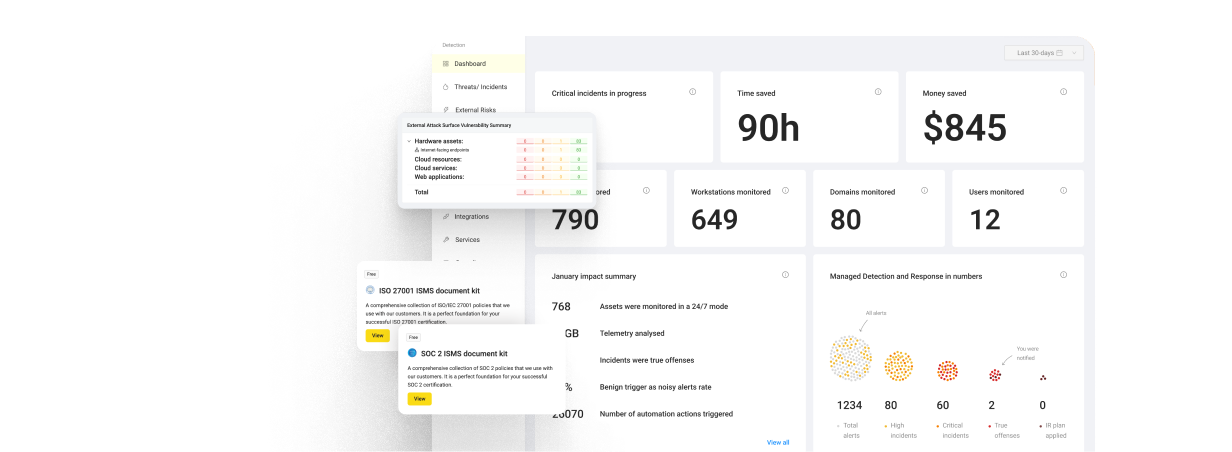
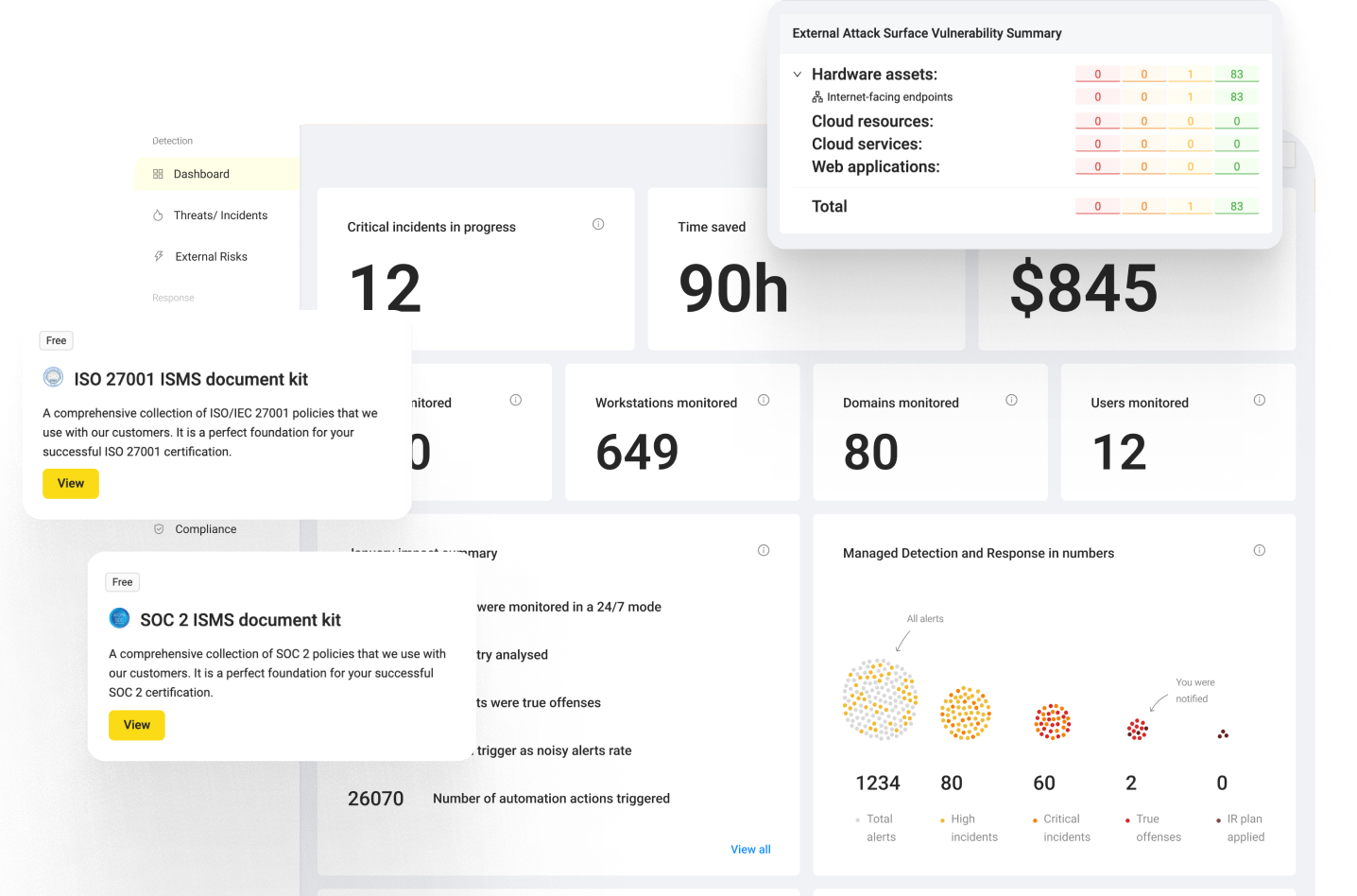
- Forever-free compliance kits for SOC 2, HIPAA, ISO 27001, GDPR, and PCI DSS
💡 Why Companies Consider UnderDefense
The core differentiator is what we call the “Concierge Response” model. When traditional MDR providers detect a suspicious login at 2:47 AM, they send you a ticket: “Suspicious login detected — please investigate.” You wake up, log in, spend 45 minutes triaging, and discover it was your IT admin running a legitimate script from a hotel. That’s not managed detection and response but managed alert forwarding.
UnderDefense’s approach is structurally different. When MAXI flags a behavioral alert, our analysts reach out directly to the affected user via Slack or Teams to verify: “Did you authorize this OAuth app grant at 2:41 AM?” If the user confirms, the alert is closed with documented context. If not, containment happens immediately: compromised credentials revoked, endpoints isolated, and lateral movement blocked, before your team even opens their laptop.
🎯 Ideal Customer Profile
- Organizations with 50–1,000 employees and 1–5 security staff
- Companies already invested in CrowdStrike, Splunk, SentinelOne, or Microsoft Defender who want to operationalize those tools, not replace them
- Compliance-driven organizations handling customer data under SOC 2, HIPAA, or ISO 27001 requirements
- PE portfolio companies needing standardized security operations across multiple entities
💰 Commercial Model
Transparent, published pricing: $11–15 per endpoint per month. No hidden fees, no “contact sales” pricing walls. Engagements include a 30-day turnkey onboarding with custom detection tuning, ongoing 24/7 monitoring, dedicated analyst assignment, and compliance kit access. This is a deliberately different approach from vendors like Arctic Wolf ($96K median annual contract) where pricing requires a sales conversation before you can even budget.
⏰ When to Shortlist
Shortlist UnderDefense if you need 24/7 security operations that work with your existing stack, want transparent pricing you can model in a spreadsheet, and need analysts who verify alerts and contain threats, not just escalate tickets back to your team. Particularly strong for organizations that have already invested in security tools but lack the operational capacity to make them effective around the clock.
📊 Customer Reviews
“The best recommendation for Underdefense MDR security is that you will forget that you have it because it works seamlessly in the background. Setup was fast, communication is clear, and the team is always on top of things.”
— Verified User, Mid-Market Under Defence G2 – Verified Review
“We needed a partner who could work with our existing CrowdStrike and Splunk investment, not replace it. UnderDefense integrated in under 30 days and immediately started closing alerts our team didn’t have time to investigate.”
— Verified User, IT Security Under Defence G2 – Verified Review
2. Radiant Security — Best for SOC Teams Automating 100% of Alert Triage Without Playbooks
✅ Overview
Radiant Security launched the industry’s first Adaptive AI SOC platform in 2025, designed to dynamically triage, investigate, and respond to 100% of alerts from any security source, without requiring pre-built playbooks or training. Where traditional SOAR tools need someone to build and maintain automation workflows, Radiant’s AI engine adapts to any alert type automatically. This makes it particularly appealing for SOC teams drowning in alert volume but lacking the engineering resources to build custom playbooks.
🛡️ Core Services
- AI-driven alert triage that eliminates up to 98% of false positives
- Adaptive investigation engine — no training required; dynamically adapts to any alert type from any vendor
- One-click response actions directly from case management
- Built-in log management with unlimited logging and real-time querying at a fraction of traditional SIEM costs
💡 Why Companies Consider Radiant Security
Radiant’s pitch is straightforward: analysts should review 1–3 high-fidelity alerts per day while AI handles everything else. The platform is fully vendor-agnostic and requires no training. It adapts to any alert from any security source based on continuous security research, not pre-trained use cases. For SOC managers tired of maintaining hundreds of SOAR playbooks that break every time a vendor updates their API, that’s a meaningful architectural difference.
🎯 Ideal Customer Profile
- SOC teams with 3–15 analysts looking to scale coverage without scaling headcount
- Organizations with multi-vendor security stacks generating high alert volumes
- Teams frustrated with SOAR playbook maintenance and seeking autonomous triage
- Mid-to-large enterprises wanting flat-rate, predictable security automation pricing
💰 Commercial Model
Radiant operates on a flat-rate pricing model designed to scale response without scaling cost. Built-in log management reduces the need for separate SIEM investments, positioning the total cost of ownership lower than traditional SIEM + SOAR stacks.
⏰ When to Shortlist
Shortlist Radiant if your SOC team is overwhelmed by alert volume, you’ve outgrown manual playbook maintenance, and you want an AI-first triage system that requires zero training or configuration. Best suited for organizations that already have detection tools but need to automate what happens after the alert fires, without the engineering overhead of traditional SOAR.
⚙️ Category 2: SOAR (Security Orchestration, Automation & Response)
Workflow automation engines that connect disparate security tools, execute playbooks, and orchestrate incident response sequences. SOAR platforms don’t detect threats; they automate what happens after detection. The value prop: turn a 45-minute manual investigation into a 90-second automated enrichment and containment sequence.
The Operational Reality of SOAR in 2026
Here’s what I’ve seen across hundreds of security operations engagements: SOAR tools are powerful when you have the engineering talent to build and maintain playbooks. The problem is that most mid-market teams don’t. They buy a SOAR platform, build 15 playbooks, and then those playbooks break when a vendor updates an API or a new alert type shows up that nobody anticipated. SOAR is increasingly converging with XDR and SIEM. Standalone SOAR tools are being absorbed into unified platforms where automation is a native feature rather than a bolt-on.
| Provider | Best For | Key Strength | Compliance |
|---|---|---|---|
| Cortex XSOAR ⭐⭐⭐⭐ | Palo Alto-centric enterprises needing deep marketplace integrations | 900+ integrations, war room collaboration, XSIAM integration | SOC 2, PCI DSS, HIPAA (through Palo Alto ecosystem) |
| Splunk SOAR ⭐⭐⭐⭐ | Large enterprises with complex, multi-vendor stacks and Splunk SIEM | Extensive third-party integrations, visual playbook editor | SOC 2, HIPAA, PCI DSS (Splunk ecosystem) |
| Swimlane Turbine ⭐⭐⭐⭐ | Complex data ingestion and “System of Record” needs | 25M actions/day capacity, low-code automation, secondary data processor | SOC 2, HIPAA, FedRAMP |
| Tines ⭐⭐⭐⭐ | Developer-friendly teams wanting no-code/low-code automation | Intuitive workflow builder, vendor-neutral, fast deployment | SOC 2, ISO 27001 |
| Chronicle SOAR ⭐⭐⭐⭐ | Google Cloud-centric environments | Native Google Security Operations integration, cloud-scale | SOC 2, ISO 27001, FedRAMP |
| Torq ⭐⭐⭐⭐ | Hyperautomation-focused teams at scale | AI-driven workflow generation, enterprise-grade scalability | SOC 2, ISO 27001 |
3. Cortex XSOAR (Palo Alto Networks) — Best for Palo Alto-Centric Enterprises Needing Deep Marketplace Integrations
✅ Overview
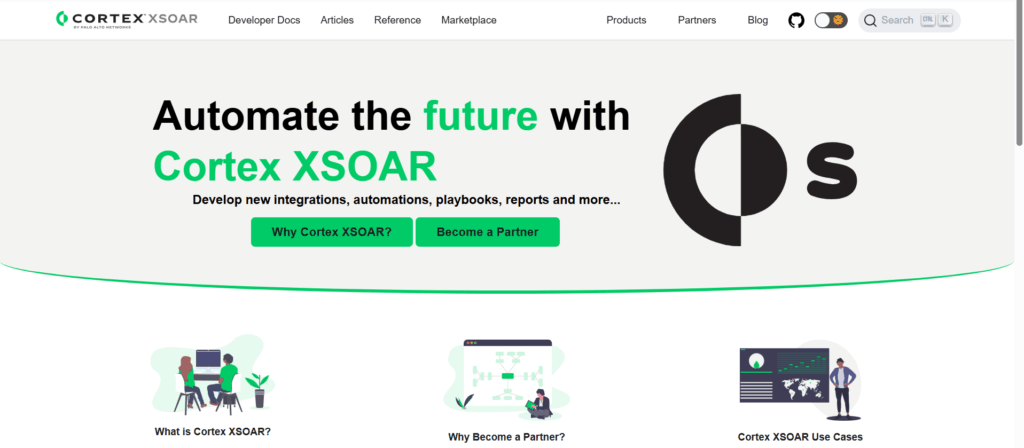
Cortex XSOAR (formerly Demisto) is Palo Alto Networks’ SOAR platform, designed to centralize incident management, automate response workflows, and orchestrate actions across security tools. With 900+ integrations through its marketplace, XSOAR is the deepest integration library in the SOAR category, making it the natural choice for enterprises already invested in the Palo Alto ecosystem.
🛡️ Core Services
- 900+ marketplace integrations with pre-built content packs
- Visual playbook editor with drag-and-drop automation
- War room collaboration for real-time incident investigation
- XSIAM integration for AI-driven alert grouping and incident management
- Case management with full audit trail and compliance documentation
💡 Why Companies Consider Cortex XSOAR
XSOAR’s marketplace is its moat. If you’re running Palo Alto firewalls, Prisma Cloud, and Cortex XDR, the integration depth is unmatched. The war room feature enables real-time analyst collaboration during active incidents, a genuinely useful capability when you’re dealing with a multi-stage attack and need cross-team coordination.
🎯 Ideal Customer Profile
- Enterprises heavily invested in Palo Alto’s security ecosystem
- SOC teams with 10+ analysts and dedicated automation engineers
- Organizations needing deep marketplace integrations across hundreds of tools
- Large enterprises requiring enterprise-grade case management and compliance documentation
💰 Commercial Model
Enterprise subscription pricing tied to Palo Alto’s broader platform licensing. Expect significant professional services costs for initial playbook development and integration. XSOAR requires technical expertise for deployment and ongoing maintenance. This is not a turnkey solution for lean teams.
⏰ When to Shortlist
Shortlist Cortex XSOAR if you’re already a Palo Alto shop and have dedicated automation engineers to build and maintain playbooks. If you’re a mid-market team with 2–5 security staff, the deployment complexity and ongoing maintenance requirements may exceed your operational capacity.
4. Splunk SOAR — Best for Large Enterprises with Complex Multi-Vendor Stacks
✅ Overview
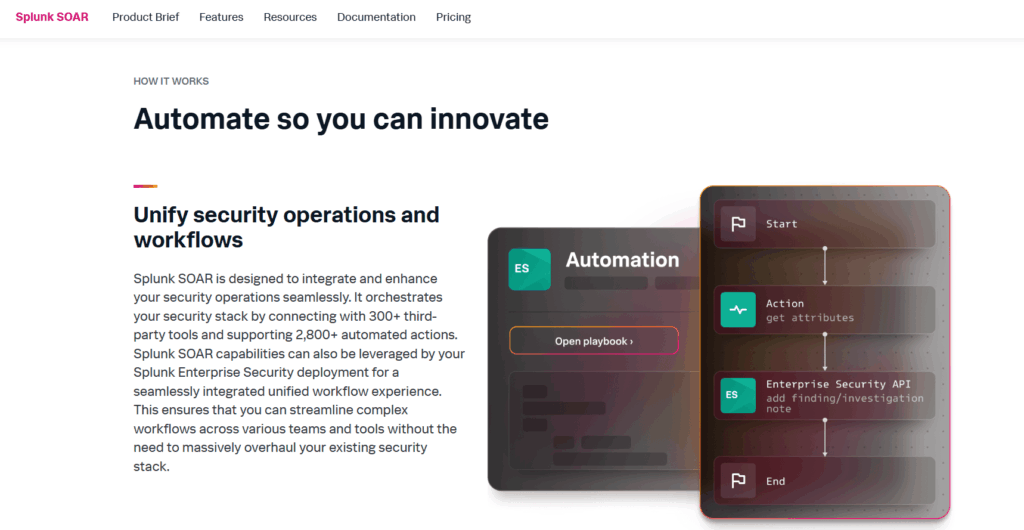
Splunk SOAR (formerly Phantom) is one of the most established SOAR platforms in the market, offering powerful data analytics integration, extensive third-party connections, and robust incident response playbook automation. Ranked #2 in SOAR mindshare with an 8.0% share, Splunk SOAR’s strength is its tight integration with Splunk Enterprise Security, making it the default automation layer for Splunk SIEM customers.
🛡️ Core Services
- Visual playbook editor for automated response workflows
- Extensive third-party integrations across security, IT, and DevOps tools
- Advanced UEBA based on AI and machine learning
- Native Splunk SIEM integration for unified detection-to-response
- Community-contributed playbooks and content packs
💡 Why Companies Consider Splunk SOAR
If your organization already runs Splunk as its SIEM, adding SOAR creates a seamless detection-to-response pipeline. The visual playbook editor is more intuitive than XSOAR’s for non-developer users, and the community marketplace provides pre-built automation for common use cases.
🎯 Ideal Customer Profile
- Large enterprises running Splunk Enterprise Security as their primary SIEM
- SOC teams needing visual playbook design without heavy coding requirements
- Organizations with complex, multi-vendor stacks requiring broad integration coverage
💰 Commercial Model
Splunk SOAR carries a higher setup cost due to its extensive feature set, with pricing tied to Splunk’s broader enterprise licensing. ROI is strongest for organizations already invested in the Splunk ecosystem.
⏰ When to Shortlist
Shortlist Splunk SOAR if you’re a Splunk SIEM customer and want to add automation to your existing detection workflows without introducing a separate vendor. Be aware that the deployment process requires technical expertise and that you’re adding to Splunk’s already-significant licensing costs.
5. Swimlane Turbine — Best for Complex Data Ingestion at Enterprise Scale
✅ Overview
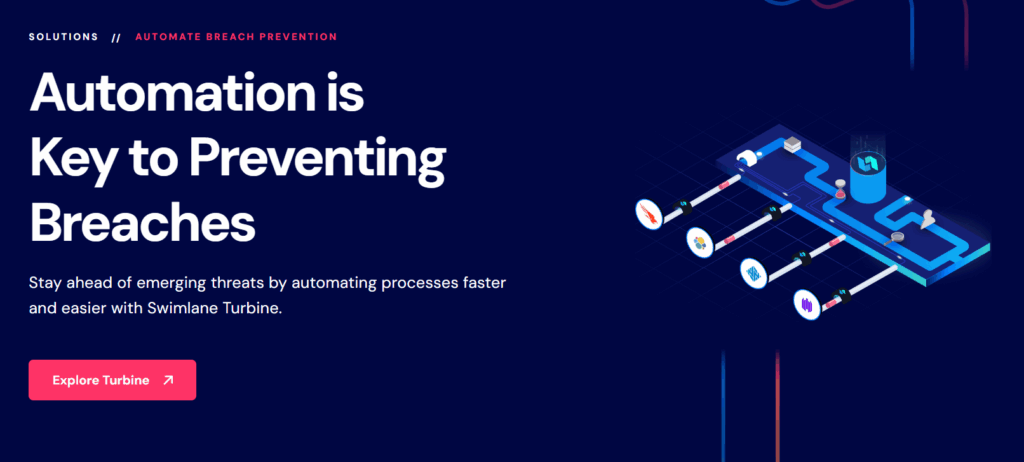
Swimlane has evolved from a standard SOAR into a low-code automation platform that emphasizes data ingestion. Their Turbine architecture can execute 25 million actions per day, 10x faster than competing platforms, and can ingest telemetry that might not even be in your SIEM, effectively acting as a secondary data processor.
🛡️ Core Services
- Low-code automation platform with drag-and-drop workflow builder
- 25 million daily actions capacity with enterprise-grade scalability
- Secondary data ingestion beyond what your SIEM captures
- Generative AI integration for workflow assistance
- FedRAMP authorization for government and regulated industries
💡 Why Companies Consider Swimlane
Swimlane Turbine’s sweet spot is organizations dealing with data sources that their SIEM can’t ingest or where SIEM ingestion costs are prohibitive. If you’re paying per-GB for Splunk and need to automate workflows against data that’s too expensive to put into your SIEM, Turbine can ingest and act on that telemetry directly.
🎯 Ideal Customer Profile
- Large enterprises with data ingestion needs exceeding SIEM capacity
- Government and defense organizations requiring FedRAMP compliance
- SOC teams needing high-throughput automation (millions of daily actions)
💰 Commercial Model
Enterprise pricing based on organizational scale and automation volume. Competitive against SIEM ingestion costs when used as a secondary data processor.
⏰ When to Shortlist
Shortlist Swimlane Turbine if you’re dealing with data ingestion at scale, need FedRAMP compliance, or want a “System of Record” approach where automation and data processing converge in one platform.
6. Tines: Best for Developer-Friendly Teams Wanting No-Code Automation
✅ Overview
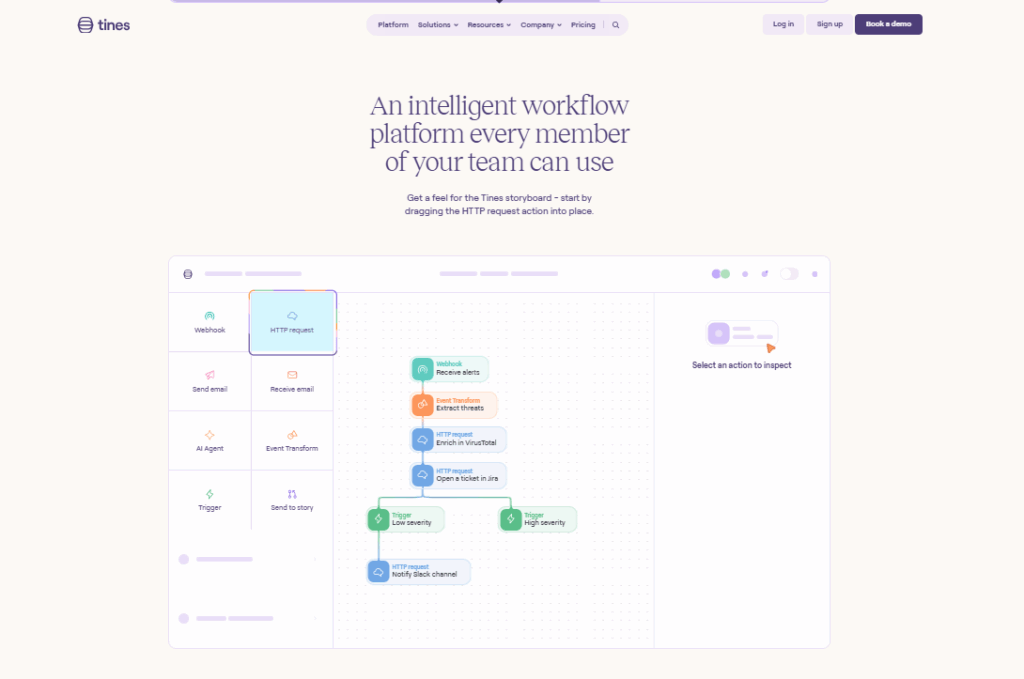
Tines takes a fundamentally different approach to SOAR: instead of marketplace-driven integration packs, it provides a vendor-neutral, no-code workflow builder that lets security teams design automation from scratch. Ranked with an average 9.0 rating on PeerSpot, Tines is favored by teams that want flexibility over pre-built content.
🛡️ Core Services
- No-code/low-code workflow builder with drag-and-drop design
- Vendor-neutral architecture, no proprietary lock-in
- Detailed documentation and live chat support
- Community library of shared automation stories
- Scheduling capabilities and streamlined task management
💡 Why Companies Consider Tines
Tines appeals to engineering-minded security teams who want to build custom automation without being constrained by a vendor’s marketplace. The setup is straightforward compared to XSOAR or Splunk SOAR, making it ideal for smaller teams that can’t dedicate months to deployment.
🎯 Ideal Customer Profile
- Security teams with engineering or DevOps backgrounds
- Smaller SOCs (3–10 analysts) wanting fast, flexible automation
- Organizations that prefer building custom workflows over using pre-built playbooks
💰 Commercial Model
Lower cost than enterprise SOAR platforms, with quick deployment leading to faster ROI. Pricing is competitive for mid-market, though noted as higher compared to some open-source alternatives.
⏰ When to Shortlist
Shortlist Tines if your team thinks in workflows and APIs rather than pre-built playbooks, and you want a clean, developer-friendly automation layer that deploys in days rather than months.
7. Chronicle SOAR (Google): Best for Google Cloud-Centric Environments
✅ Overview
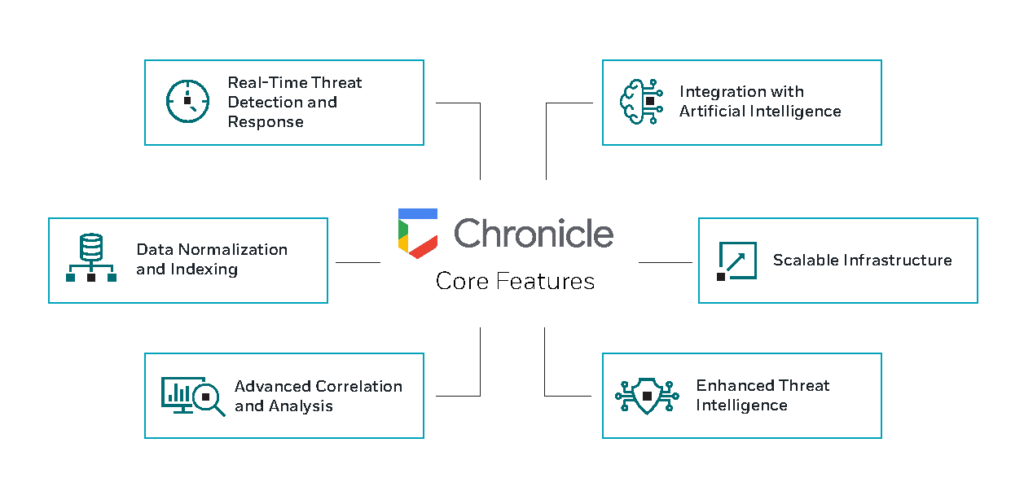
Chronicle SOAR integrates natively with Google Security Operations (formerly Chronicle SIEM), creating a unified detection-to-response pipeline for organizations invested in Google Cloud Platform. The platform leverages Google’s infrastructure for cloud-scale automation and threat intelligence enrichment.
🛡️ Core Services
- Native Google Security Operations integration
- Cloud-scale playbook execution
- Threat intelligence enrichment from Google’s datasets
- Pre-built integrations for common security tools
- Case management with investigation workflows
💡 Why Companies Consider Chronicle SOAR
If your SIEM is Google Chronicle and your infrastructure is GCP, Chronicle SOAR is the lowest-friction automation layer. The integration depth with Google’s threat intelligence and security data lake provides enrichment capabilities that third-party SOAR tools can’t match in a Google-native environment.
🎯 Ideal Customer Profile
- Organizations running Google Security Operations as their primary SIEM
- GCP-centric environments needing native automation
- Teams wanting Google’s threat intelligence integrated into response workflows
💰 Commercial Model
Bundled with Google Security Operations licensing. Cost-efficient for existing Google Cloud customers; less compelling as a standalone SOAR purchase.
⏰ When to Shortlist
Shortlist Chronicle SOAR if your security operations are built on Google’s ecosystem. If you’re multi-cloud or vendor-diverse, the Google dependency may limit flexibility.
8. Torq: Best for Hyperautomation at Enterprise Scale
✅ Overview
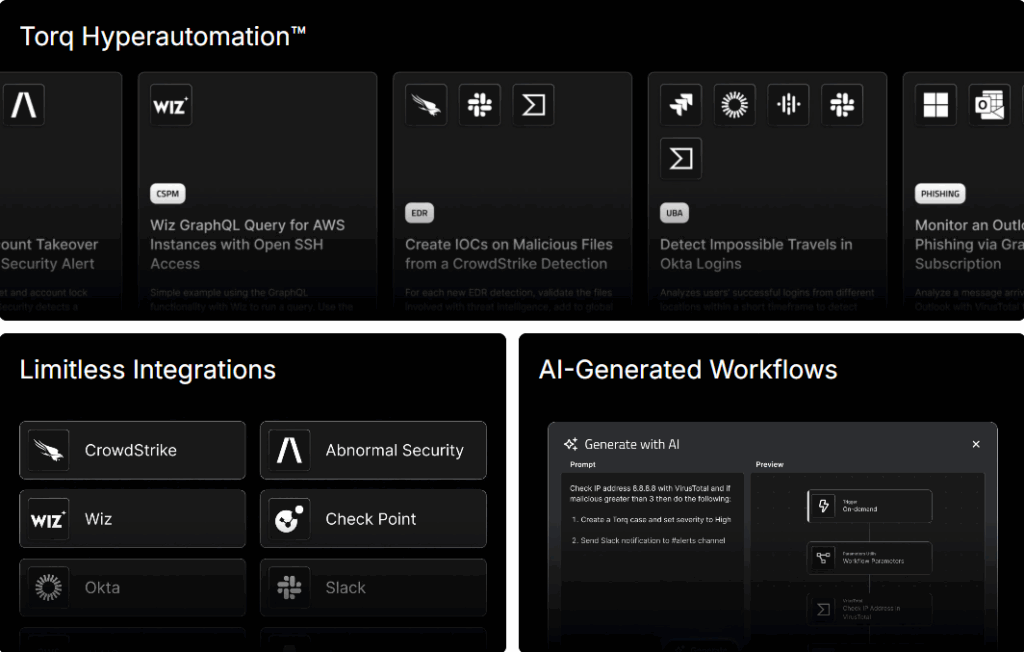
Torq positions itself as a hyperautomation platform for security, using AI-driven workflow generation to accelerate playbook development and execution. The platform targets enterprise-scale security operations teams that need to automate thousands of workflows across complex environments.
🛡️ Core Services
- AI-driven workflow generation for accelerated playbook creation
- Enterprise-grade scalability for high-volume environments
- No-code workflow designer with AI assistance
- Broad integration library across security, IT, and cloud tools
- Real-time analytics on automation performance
💡 Why Companies Consider Torq
Torq’s AI-assisted workflow generation reduces the time from “we need a playbook” to “the playbook is running,” a meaningful advantage when your SOC needs to respond to new threat types faster than your automation engineers can build. The platform handles enterprise scale without the performance degradation that some legacy SOAR tools exhibit at high volumes.
🎯 Ideal Customer Profile
- Enterprise SOC teams managing thousands of automation workflows
- Organizations wanting AI-assisted playbook creation to reduce engineering burden
- Security operations at scale (1,000+ endpoints, multi-cloud, multi-vendor)
💰 Commercial Model
Enterprise pricing based on scale and workflow volume. Positioned as premium SOAR for high-throughput environments.
⏰ When to Shortlist
Shortlist Torq if your organization operates at enterprise scale and needs AI-assisted workflow creation to keep up with evolving threats. Best for mature SOC teams that have outgrown basic SOAR but need more flexibility than XDR-native automation.
📊 Category 3: SIEM (Security Information & Event Management)
The central nervous system of security operations: log collection, correlation, threat detection, and compliance reporting. Modern SIEMs layer behavioral analytics (UEBA) and machine learning on top of traditional rule-based detection. The critical decision here isn’t just which SIEM, it’s who owns the data and the business logic.
The Data Ownership Question
This is where I get blunt: if your correlation rules, custom detections, and automation live inside a vendor’s proprietary system, switching providers means starting from zero. Before you evaluate SIEM features, ask yourself, who owns your security data, and what happens to your detection logic if you leave? That single question eliminates more bad vendor choices than any feature comparison table.
| Provider | Best For | Key Strength | Compliance |
|---|---|---|---|
| Splunk Enterprise Security ⭐⭐⭐⭐⭐ | Large enterprises needing maximum search flexibility and on-prem/hybrid deployment | SPL query language, massive integration ecosystem, mature analytics | SOC 2, HIPAA, PCI DSS, ISO 27001, FedRAMP |
| Microsoft Sentinel ⭐⭐⭐⭐ | Azure/M365-native organizations seeking cloud-native SIEM | Native Azure integration, cost-efficient for Microsoft shops, Copilot AI | SOC 2, HIPAA, ISO 27001, FedRAMP |
| IBM QRadar ⭐⭐⭐⭐ | Regulated industries needing on-prem deployment with strong compliance | Offense-based correlation, robust compliance reporting, on-prem maturity | SOC 2, HIPAA, PCI DSS, GDPR, FedRAMP |
| Exabeam ⭐⭐⭐⭐ | Organizations prioritizing user behavior analytics (UEBA) | Advanced UEBA, automated timeline construction, behavioral baselines | SOC 2, HIPAA, PCI DSS, ISO 27001 |
| Elastic Security ⭐⭐⭐⭐ | Teams wanting open-source transparency and flexible deployment | Open-source core, ELK stack integration, unlimited data at predictable cost | SOC 2, HIPAA, ISO 27001 |
9. Splunk Enterprise Security: Best for Large Enterprises Needing Maximum Search Flexibility
✅ Overview
Splunk Enterprise Security remains the benchmark SIEM for organizations that need deep, flexible data analysis across massive volumes of security telemetry. The SPL (Search Processing Language) query language gives analysts unmatched power to investigate incidents, build custom detections, and create compliance dashboards. If you need to search anything across your security data, Splunk can do it.
🛡️ Core Services
- SPL-based search with unmatched query flexibility
- Risk-based alerting that reduces alert noise by scoring entity risk
- Massive integration ecosystem supporting hundreds of data sources
- Enterprise Security Content Update (ESCU) for continuously updated detection content
- Hybrid deployment options, cloud, on-prem, or hybrid
💡 Why Companies Consider Splunk
Splunk’s flexibility is its greatest strength and its greatest cost driver. You can search, correlate, and visualize essentially any data, but that flexibility comes with significant ingestion-based pricing that can scale unpredictably. Organizations that master Splunk gain a genuinely differentiated security analytics capability; those that don’t end up paying premium prices for a glorified log storage tool.
🎯 Ideal Customer Profile
- Large enterprises (1,000+ employees) with dedicated Splunk administrators
- Security teams needing advanced threat hunting and custom detection engineering
- Organizations with complex hybrid environments requiring flexible data ingestion
💰 Commercial Model
Splunk pricing is notoriously complex, typically based on daily data ingestion volume (GB/day), which can lead to unpredictable cost growth. The Cisco acquisition is shifting some models toward entity-based pricing, but expect significant TCO analysis before committing. For a detailed breakdown, see our managed SIEM pricing guide.
⏰ When to Shortlist
Shortlist Splunk if your team has the expertise to leverage SPL and you need maximum analytical flexibility. Be prepared for non-trivial licensing costs and ensure you model data growth projections before signing.
10. Microsoft Sentinel: Best for Azure/M365-Native Organizations
✅ Overview
Microsoft Sentinel is a cloud-native SIEM built on Azure, offering native integration with the Microsoft 365 ecosystem. For organizations already invested in Microsoft E5 licensing, Sentinel provides cost-efficient log ingestion for Microsoft data sources and increasingly sophisticated AI-driven analytics through Copilot for Security.
🛡️ Core Services
- Cloud-native architecture with elastic scalability
- Native M365/Azure integration, free ingestion for many Microsoft data sources
- Copilot for Security AI assistance for investigation and detection authoring
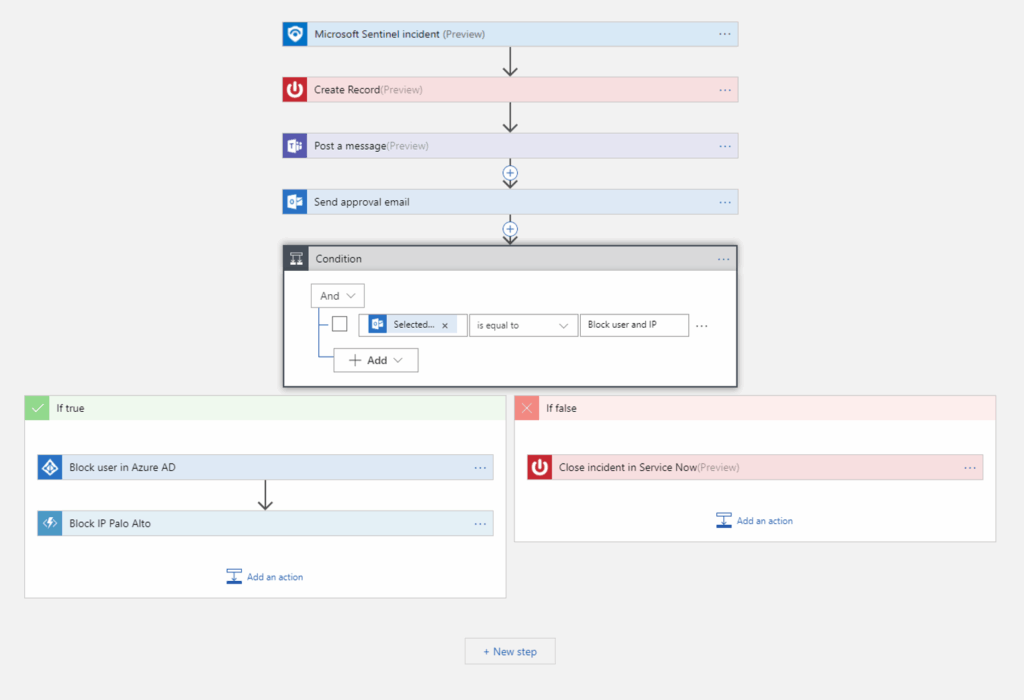
- Logic Apps automation for response orchestration
- UEBA and ML-based anomaly detection
💡 Why Companies Consider Sentinel
The cost math is simple: if you’re an E5 Microsoft shop, a significant portion of your log ingestion is already covered. Sentinel eliminates the need to pay twice for data you’re already generating within the Microsoft ecosystem. Copilot for Security adds AI-assisted investigation that genuinely reduces analyst time for common alert types.
🎯 Ideal Customer Profile
- Microsoft-centric organizations (Azure infrastructure, M365, Entra ID)
- Mid-market companies wanting cloud-native SIEM without on-prem infrastructure
- Teams looking for cost-efficient SIEM for Microsoft-generated telemetry
💰 Commercial Model
Pay-as-you-go based on data ingestion, with significant discounts for Microsoft data sources already included in E5 licensing. Predictable for Microsoft shops; can become expensive for non-Microsoft data source ingestion.
⏰ When to Shortlist
Shortlist Sentinel if your infrastructure is primarily Microsoft and you want to leverage existing E5 licensing investments. If you’re multi-cloud or multi-vendor, evaluate carefully, as non-Microsoft data ingestion costs can erode the pricing advantage quickly. Many organizations in this position benefit from pairing Sentinel with a managed SIEM provider that can optimize detection rules and reduce wasted ingestion spend.
11. IBM QRadar: Best for Regulated Industries Needing On-Prem Maturity
✅ Overview
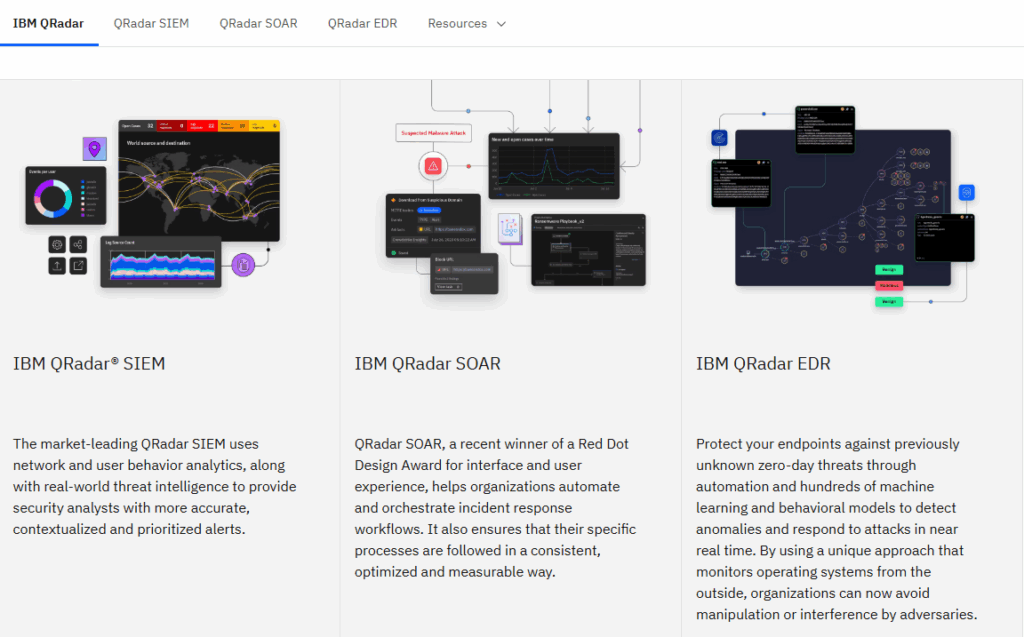
IBM QRadar is a legacy SIEM with deep roots in regulated industries, including banking, healthcare, and government. Its offense-based correlation engine groups related security events into prioritized offenses, and its compliance reporting capabilities are among the most mature in the market.
🛡️ Core Services
- Offense-based correlation that groups related events into actionable incidents
- On-prem and cloud deployment options
- Robust compliance reporting for regulated industries
- QRadar Advisor with Watson for AI-assisted investigation
- Network flow analysis for network-layer visibility
💡 Why Companies Consider QRadar
QRadar’s sweet spot is regulated industries that require on-prem deployment, mature compliance reporting, and proven enterprise scalability. The offense-based correlation model reduces alert noise effectively, and QRadar’s compliance capabilities have been battle-tested across banking, healthcare, and government environments for over a decade.
🎯 Ideal Customer Profile
- Regulated industries (banking, healthcare, government) requiring on-prem SIEM
- Existing IBM customers leveraging QRadar’s ecosystem
- Organizations needing audit-ready compliance reporting out of the box
💰 Commercial Model
Enterprise pricing based on events per second (EPS) and flows per minute. IBM’s licensing model has been criticized for complexity, but total cost is generally predictable for stable environments.
⏰ When to Shortlist
Shortlist QRadar if you’re in a regulated industry requiring on-prem SIEM with mature compliance capabilities. Be aware that IBM has been transitioning QRadar’s architecture, so evaluate the current roadmap carefully during procurement.
12. Exabeam: Best for UEBA-First Security Operations
✅ Overview
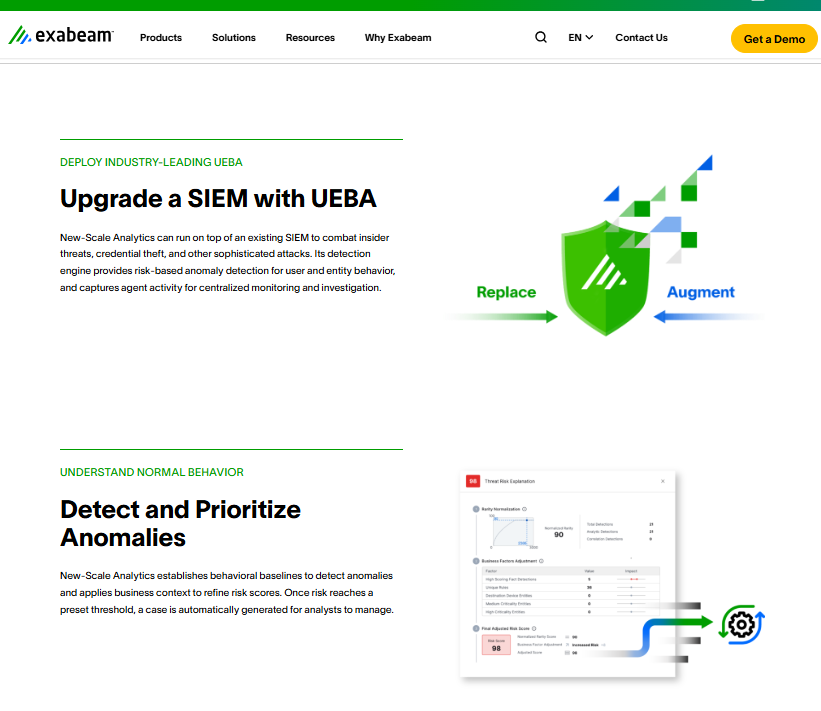
Exabeam differentiates through its behavioral analytics engine, which automatically constructs user and entity activity timelines and baselines normal behavior to detect anomalies. For organizations where insider threats and credential-based attacks are primary concerns, Exabeam’s UEBA-first approach offers detection capabilities that traditional rule-based SIEMs miss.
🛡️ Core Services
- Advanced UEBA with automated behavioral baselines
- Automated timeline construction for investigation acceleration
- Smart Timelines that reconstruct user activity across sessions
- Pre-built detection models for common threat scenarios
- Cloud-native and on-prem deployment options
💡 Why Companies Consider Exabeam
If your primary threat concern is compromised credentials or insider threats, Exabeam’s behavioral baselines catch anomalies that signature-based detection misses entirely. The automated timeline feature genuinely reduces investigation time by reconstructing exactly what a user did, across which systems, in what sequence.
🎯 Ideal Customer Profile
- Organizations prioritizing insider threat detection and credential-based attack prevention
- Security teams wanting automated investigation with behavioral context
- Mid-to-large enterprises needing UEBA as a core SIEM capability
💰 Commercial Model
Subscription-based pricing. Exabeam has repositioned as a cloud-native platform, with pricing models designed to compete with Splunk and Sentinel on total cost of ownership.
⏰ When to Shortlist
Shortlist Exabeam if insider threats and credential compromise are your primary detection priorities and you want behavioral analytics as a native capability rather than a bolt-on. For organizations that need UEBA and 24/7 analyst coverage to act on those behavioral detections, pairing Exabeam with a managed detection and response provider closes the gap between detecting anomalies and responding to them.
13. Elastic Security: Best for Open-Source Transparency and Flexible Deployment
✅ Overview
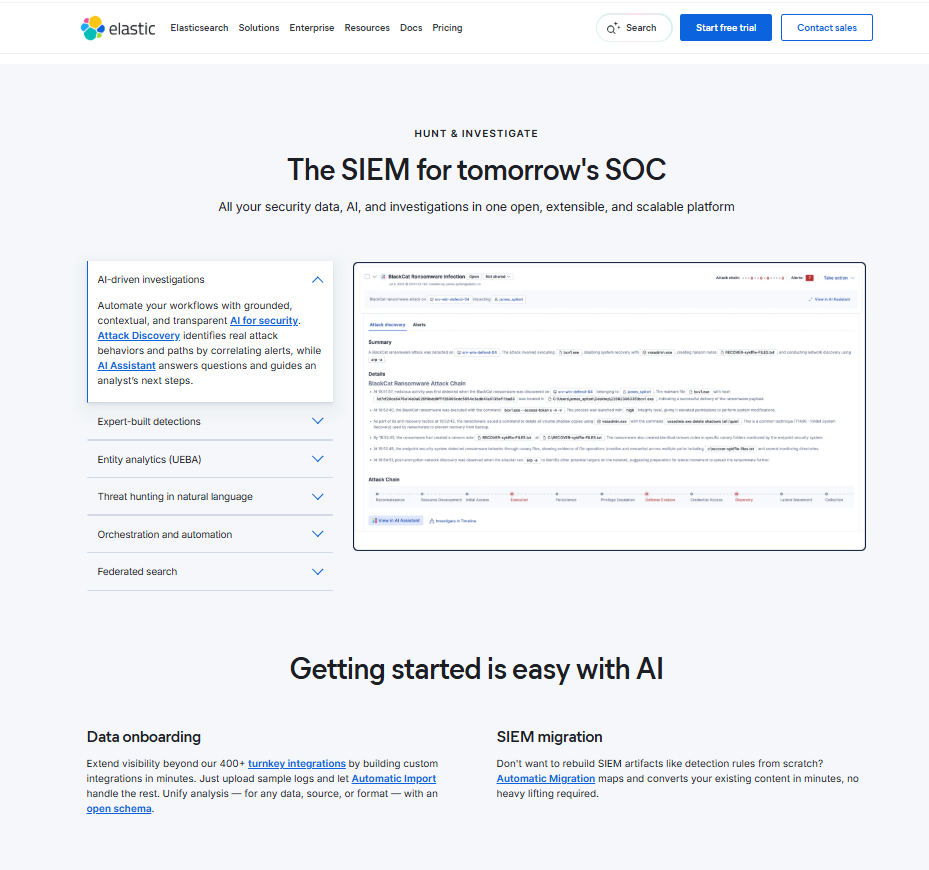
Elastic Security builds on the open-source ELK (Elasticsearch, Logstash, Kibana) stack to deliver SIEM capabilities with full data transparency and flexible deployment. For organizations that want to own their detection logic, avoid vendor lock-in, and control data residency, Elastic offers a fundamentally different model from proprietary SIEMs.
🛡️ Core Services
- Open-source core with transparent detection rules
- Unlimited data ingestion at predictable, resource-based pricing
- ELK stack integration for custom analytics and visualization
- Pre-built detection rules mapped to MITRE ATT&CK
- Flexible deployment, cloud, on-prem, or self-managed
💡 Why Companies Consider Elastic
Elastic’s proposition is data ownership and pricing predictability. Unlike Splunk’s GB-based pricing, Elastic charges based on compute resources, meaning you can ingest unlimited data without surprise cost spikes. For security teams choosing a SIEM, the open-source transparency means you can audit, modify, and port your detection logic without vendor dependency.
🎯 Ideal Customer Profile
- Organizations with engineering teams comfortable managing ELK infrastructure
- Companies prioritizing data ownership and vendor-independence
- Teams needing predictable SIEM pricing at high data volumes
💰 Commercial Model
Resource-based pricing (compute and storage) rather than data-volume pricing. The self-managed option is free; Elastic Cloud provides managed hosting with tiered pricing.
⏰ When to Shortlist
Shortlist Elastic if data ownership, open-source transparency, and predictable pricing are non-negotiable. Expect higher operational overhead for self-managed deployments, as you’ll need engineers who understand Elasticsearch at depth.
🛡️ Category 4: XDR / EDR (Extended & Endpoint Detection and Response)
Threat detection and response focused on endpoints, extending into network, cloud, and identity telemetry. XDR platforms unify visibility across multiple attack surfaces and automate response actions, isolating endpoints, killing processes, and blocking lateral movement.
The Missing Piece in XDR
Here’s the gap nobody talks about: XDR sees threats but often misses organizational context. Knowing that a PowerShell script ran is detection. Knowing whether your IT admin or an attacker ran it requires human verification. This is exactly the gap that AI SOC platforms like Under Defence MAXI fill, layering organizational context and direct user verification on top of your existing XDR investment.
| Provider | Best For | Key Strength | Compliance |
|---|---|---|---|
| CrowdStrike Falcon ⭐⭐⭐⭐⭐ | Endpoint-first organizations needing best-in-class threat intelligence | Lightweight agent, threat intelligence leadership, MITRE ATT&CK coverage | SOC 2, HIPAA, PCI DSS, FedRAMP |
| Microsoft Defender XDR ⭐⭐⭐⭐ | Microsoft-centric environments wanting native integration | Native M365 integration, Copilot AI, cost-efficient for E5 customers | SOC 2, HIPAA, ISO 27001, FedRAMP |
| SentinelOne ⭐⭐⭐⭐ | Organizations prioritizing autonomous endpoint remediation | Autonomous rollback, AI-driven containment, competitive pricing | SOC 2, HIPAA, PCI DSS |
| Cortex XDR ⭐⭐⭐⭐ | Palo Alto ecosystem customers needing unified endpoint-to-network | XSIAM integration, proprietary data stitching, attack chain reconstruction | SOC 2, HIPAA, PCI DSS, FedRAMP |
| Trend Micro Vision One ⭐⭐⭐⭐ | Multi-layered security environments needing unified visibility | Cross-layer detection, email-to-endpoint correlation, competitive mid-market pricing | SOC 2, HIPAA, PCI DSS, ISO 27001 |
14. CrowdStrike Falcon: Best for Endpoint-First Organizations Needing Best-in-Class Threat Intelligence
✅ Overview
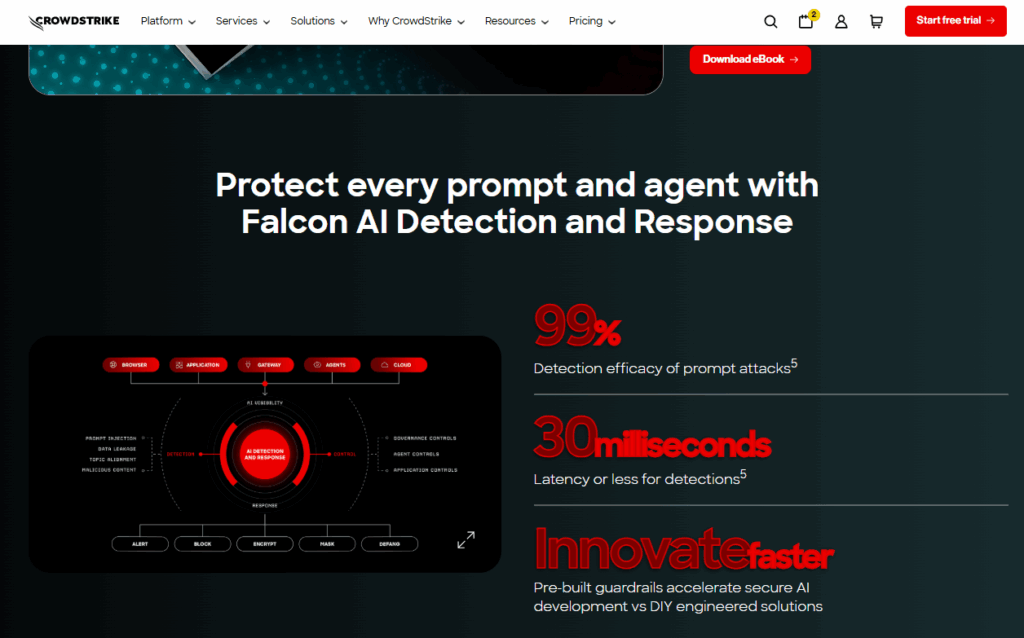
CrowdStrike Falcon is the market leader in endpoint detection and response, built on a lightweight, cloud-native agent that delivers real-time threat intelligence, behavioral analytics, and automated containment. CrowdStrike consistently leads in MITRE ATT&CK evaluations and provides the deepest endpoint threat intelligence in the market.
🛡️ Core Services
- Lightweight cloud-native agent with minimal endpoint impact
- Real-time threat intelligence from CrowdStrike’s Threat Graph
- Behavioral analytics and IOA detection (Indicators of Attack)
- Automated containment, network isolation, process kill, quarantine
- OverWatch managed threat hunting (premium add-on)
💡 Why Companies Consider CrowdStrike
CrowdStrike’s endpoint detection depth is genuinely best-in-class. The Threat Graph processes trillions of security events daily, providing detection fidelity that smaller vendors can’t match. The lightweight agent architecture means minimal performance impact on endpoints, a real consideration when you’re deploying to 10,000+ machines.
The limitation is scope: CrowdStrike sees endpoints extremely well but doesn’t provide the organizational context needed for full incident response. When Falcon flags a suspicious login, someone still needs to determine if it’s a threat or a legitimate user. This is why many CrowdStrike customers pair Falcon with an MDR provider like UnderDefense, keeping CrowdStrike’s detection depth while adding the human verification and response layer that pure EDR can’t provide. For a deeper look at this pairing, see the case study where UnderDefense detected threats faster than CrowdStrike OverWatch.
🎯 Ideal Customer Profile
- Organizations prioritizing endpoint protection as their primary security investment
- Companies with 500+ endpoints needing scalable, cloud-native EDR
- Security teams wanting best-in-class threat intelligence for advanced threat detection
💰 Commercial Model
Per-endpoint subscription pricing. CrowdStrike’s modular approach means pricing varies significantly based on which modules you enable (Prevent, Insight, Discover, OverWatch). Expect enterprise-tier pricing for comprehensive coverage. For a full breakdown, see our CrowdStrike pricing guide for 2026.
⏰ When to Shortlist
Shortlist CrowdStrike Falcon if endpoint protection and threat intelligence are your top priorities and you have (or plan to add) complementary tools for SIEM, compliance, and response orchestration.
15. Microsoft Defender XDR: Best for Microsoft-Centric Environments
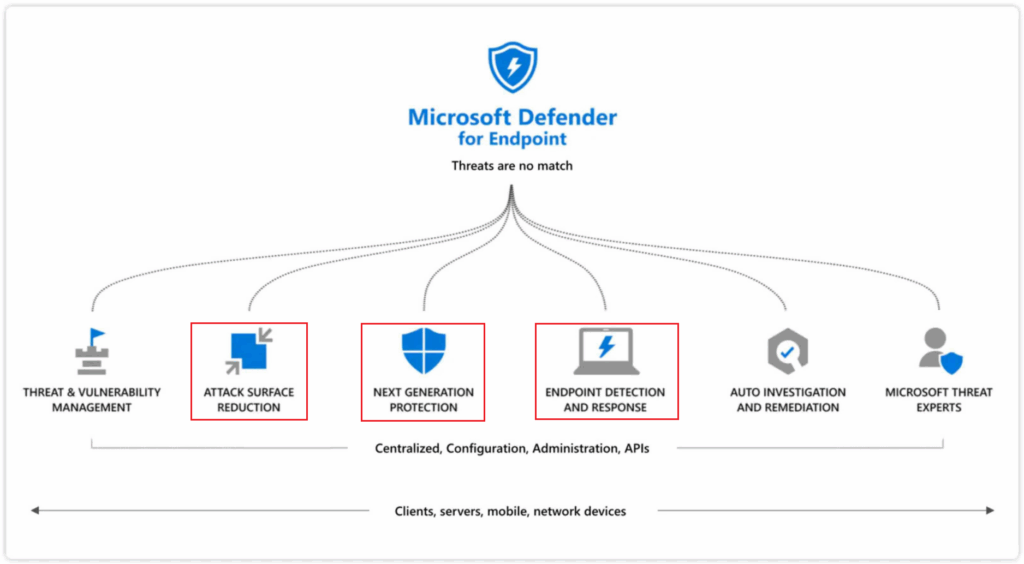
✅ Overview
Microsoft Defender XDR unifies endpoint, identity, email, and cloud application protection for organizations deeply invested in the Microsoft ecosystem. For E5 license holders, Defender XDR provides substantial security coverage at no additional per-endpoint cost, making it the cost-efficiency leader for Microsoft-native environments.
🛡️ Core Services
- Native M365/Azure/Entra ID integration for unified detection
- Copilot for Security AI-assisted investigation
- Automated attack disruption across identity and endpoint
- Email protection through Defender for Office 365
- Identity threat detection via Entra ID integration
💡 Why Companies Consider Defender XDR
The cost math: if you’re already paying for Microsoft E5, Defender XDR is included. For Microsoft-heavy organizations, this eliminates the need for separate endpoint, email, and identity security tools, consolidating coverage under a single platform at an effective incremental cost of zero.
🎯 Ideal Customer Profile
- Microsoft E5 customers wanting to maximize existing license investment
- Organizations with primarily Microsoft infrastructure (Azure, M365, Entra ID)
- Mid-market teams wanting consolidated security without additional per-endpoint costs
💰 Commercial Model
Included in Microsoft E5 licensing. Standalone licensing available but less cost-efficient than the bundled approach.
⏰ When to Shortlist
Shortlist Defender XDR if you’re a Microsoft E5 customer and want to leverage included security capabilities before investing in additional point solutions. For organizations that need 24/7 monitoring and response on top of Defender’s detection, pairing with an MDR for Microsoft 365 provider ensures alerts get investigated and contained around the clock, not just during business hours.
16. SentinelOne: Best for Organizations Prioritizing Autonomous Endpoint Remediation
✅ Overview
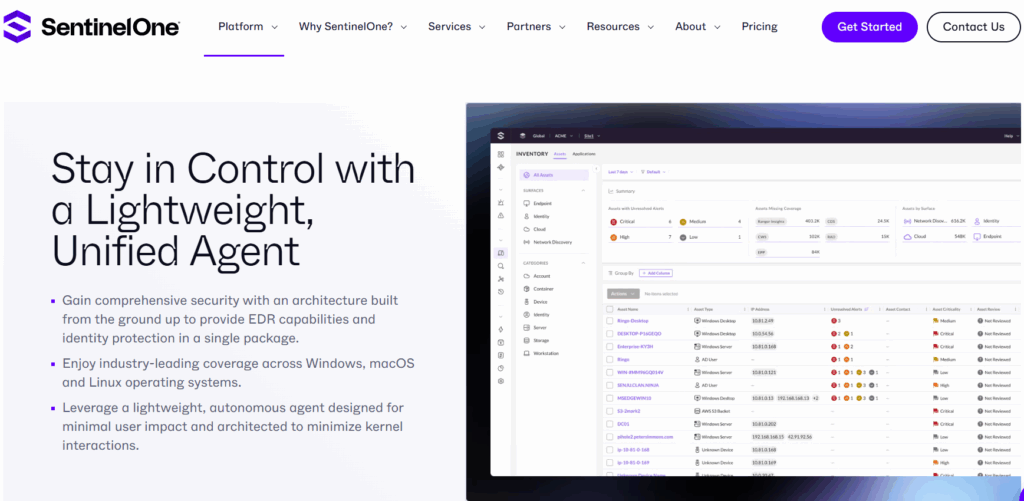
SentinelOne’s Singularity platform differentiates through autonomous remediation: the ability to automatically detect, contain, and roll back threats at the endpoint without human intervention. For organizations that need speed-of-machine response and can accept automated containment decisions, SentinelOne offers the fastest path from detection to remediation.
🛡️ Core Services
- Autonomous rollback to restore endpoints to their pre-attack state
- AI-driven detection and containment without human intervention
- Storyline technology for automated root cause analysis
- Cross-platform coverage across Windows, macOS, Linux, and Kubernetes
- Ranger network discovery for IoT and unmanaged device visibility
💡 Why Companies Consider SentinelOne
SentinelOne’s autonomous remediation genuinely reduces time-to-containment to near-zero for threats it can classify confidently. The rollback capability, restoring an endpoint to its pre-infection state, is a unique differentiator that eliminates the need for manual reimaging in many scenarios.
The trade-off is the same one that applies to every XDR tool: autonomous response works well for known threat patterns but struggles with ambiguous, context-dependent scenarios. When a SentinelOne agent flags a script execution, it can contain it instantly. Determining whether that script was a legitimate admin action or an attacker still requires human judgment. This is why many SentinelOne customers layer a managed EDR service on top, keeping SentinelOne’s speed while adding the investigative depth that pure automation can’t deliver. For a detailed comparison, see our analysis of CrowdStrike vs. SentinelOne.
🎯 Ideal Customer Profile
- Organizations prioritizing autonomous, speed-of-machine endpoint response
- Teams needing cross-platform coverage including Linux and Kubernetes
- Companies wanting automated rollback as an alternative to manual remediation
💰 Commercial Model
Per-endpoint subscription pricing, generally competitive with CrowdStrike. Tiered packages (Singularity Core, Control, and Complete) offer increasing automation capabilities at each level. For a full breakdown, see our SentinelOne pricing guide for 2026.
⏰ When to Shortlist
Shortlist SentinelOne if autonomous remediation and rollback are priorities, and you’re comfortable with automated containment decisions on endpoints.
17. Cortex XDR (Palo Alto Networks): Best for Palo Alto Ecosystem Customers Needing Unified Endpoint-to-Network Detection
✅ Overview
Cortex XDR extends Palo Alto’s endpoint protection into a unified detection platform that stitches together endpoint, network, and cloud data. For organizations running Palo Alto firewalls and Prisma Cloud, Cortex XDR provides unmatched correlation across these data sources.
🛡️ Core Services
- XSIAM integration for AI-driven alert grouping
- Proprietary data stitching across Palo Alto’s security products
- Automated root cause analysis with visual attack chain reconstruction
- Behavioral analytics across endpoint, network, and cloud
- Managed threat hunting through Unit 42
💡 Why Companies Consider Cortex XDR
Cortex XDR’s data stitching is its differentiator: it correlates firewall logs, endpoint telemetry, and cloud events into a unified attack narrative. If you’re already running Palo Alto firewalls, the integration depth is unmatched. The XSIAM platform, which includes Cortex XDR, uses AI-driven analytics to group related alerts into incidents, reducing the volume analysts need to investigate.
🎯 Ideal Customer Profile
- Organizations running Palo Alto next-gen firewalls and Prisma Cloud
- Enterprise SOC teams wanting unified endpoint-to-network detection
- Palo Alto ecosystem customers consolidating security vendors
💰 Commercial Model
Enterprise pricing bundled with Palo Alto’s broader platform. Expect significant investment in the Palo Alto ecosystem to maximize Cortex XDR’s data-stitching capabilities. Standalone deployment without Palo Alto firewalls reduces the correlation advantages substantially.
⏰ When to Shortlist
Shortlist Cortex XDR if you’re invested in Palo Alto’s ecosystem and want unified detection across endpoint, network, and cloud within a single vendor. If you’re multi-vendor, the proprietary data-stitching benefits diminish.
18. Trend Micro Vision One: Best for Multi-Layered Security Environments at Mid-Market Pricing
✅ Overview
Trend Micro Vision One provides cross-layer detection and response across email, endpoint, server, cloud, and network. The platform’s strength is correlating signals across multiple attack surfaces, connecting a phishing email to endpoint compromise to lateral movement in a single investigation view.
🛡️ Core Services
- Cross-layer detection across email, endpoint, server, cloud, and network
- Attack surface risk management for proactive vulnerability identification
- Automated response playbooks across all protection layers
- AI-powered threat intelligence from Trend Micro’s research team
- Competitive mid-market pricing compared to CrowdStrike and Palo Alto
💡 Why Companies Consider Vision One
Vision One’s email-to-endpoint correlation is particularly strong: it can trace a phishing email to malicious attachment to endpoint compromise to lateral movement in a single timeline. For mid-market organizations that need multi-layer protection without enterprise-tier pricing, Vision One offers comprehensive coverage at a competitive price point.
🎯 Ideal Customer Profile
- Mid-market organizations needing cross-layer detection without enterprise pricing
- Companies wanting email, endpoint, and network protection from a single vendor
- Organizations with hybrid environments (on-prem and cloud) needing unified visibility
💰 Commercial Model
Subscription-based, generally priced below CrowdStrike and Palo Alto for comparable coverage. Tiered packaging available.
⏰ When to Shortlist
Shortlist Vision One if you need cross-layer detection and response at mid-market pricing and want a single vendor covering email through endpoint to network.
🔍 Category 5: Vulnerability Management
Continuous discovery, assessment, and prioritization of vulnerabilities across infrastructure, applications, cloud workloads, and containers. Modern vulnerability management goes beyond scanning: it uses risk-based prioritization to focus remediation on the exposures that attackers can actually exploit, not just the ones with the highest CVSS score.
Why Risk-Based Prioritization Changes Everything
Here’s the operational problem: a typical enterprise vulnerability scan returns thousands of findings. Without risk-based context, your team patches based on CVSS score, which tells you how bad a vulnerability could be but nothing about whether it’s actually exploitable in your environment. The tools below solve this by combining vulnerability data with attack surface context, threat intelligence, and asset criticality to answer the question that actually matters: which vulnerabilities should we fix first?
| Provider | Best For | Key Strength | Compliance |
|---|---|---|---|
| Tenable One ⭐⭐⭐⭐⭐ | Enterprises needing unified exposure management across infrastructure, cloud, and identity | Deepest traditional infrastructure coverage, risk-based prioritization, exposure analytics | SOC 2, HIPAA, PCI DSS, ISO 27001 |
| Qualys VMDR ⭐⭐⭐⭐ | Organizations wanting integrated vulnerability management with compliance and patch management | All-in-one vulnerability, compliance, and patch management from a single agent | SOC 2, HIPAA, PCI DSS, ISO 27001, FedRAMP |
| Rapid7 InsightVM ⭐⭐⭐⭐ | Mid-market teams wanting live vulnerability dashboards and IT-friendly remediation workflows | Live dashboards, remediation project tracking, InsightConnect integration | SOC 2, HIPAA, PCI DSS |
| Beagle Security ⭐⭐⭐⭐ | Teams needing continuous, agentic AI penetration testing for web applications and APIs inside their CI/CD pipeline | Authenticated testing behind 2FA and OAuth flows, multi-role access control coverage, GraphQL and REST API testing | SOC 2, ISO 27001, HIPAA, PCI DSS |
19. Tenable One: Best for Unified Exposure Management Across Infrastructure and Cloud
✅ Overview
Tenable One is the industry’s most comprehensive exposure management platform, unifying vulnerability data across traditional infrastructure, cloud environments, identity systems, and web applications into a single risk view. Tenable pioneered the vulnerability management category and continues to lead on infrastructure scanning depth and risk-based prioritization.
🛡️ Core Services
- Unified exposure management across infrastructure, cloud, identity, and web apps
- Risk-based prioritization using Vulnerability Priority Rating (VPR)
- Lumin exposure analytics for board-level risk communication
- Cloud security posture management through Tenable Cloud Security
- Active Directory security for identity vulnerability detection
💡 Why Companies Consider Tenable One
Tenable’s VPR scoring goes beyond raw CVSS to factor in actual exploit activity, threat intelligence, and asset context. For organizations managing thousands of assets across hybrid environments, this risk-based approach cuts through the noise and focuses remediation effort where it matters most. The Lumin dashboards translate technical vulnerability data into executive-level risk metrics, making it easier to communicate security posture to the board.
🎯 Ideal Customer Profile
- Enterprises with large, hybrid infrastructure (on-prem, cloud, and OT)
- Security teams needing risk-based vulnerability prioritization at scale
- Organizations requiring executive-level exposure analytics for board reporting
💰 Commercial Model
Asset-based subscription pricing. Tenable One bundles multiple products (Nessus, Cloud Security, Identity Exposure, and Lumin) into a platform license, which reduces cost compared to purchasing individually but represents a significant investment for mid-market organizations.
⏰ When to Shortlist
Shortlist Tenable One if you need comprehensive exposure management across hybrid environments and want risk-based prioritization that goes beyond CVSS scores. Pair with a penetration testing program to validate that your prioritization models align with real-world exploitability.
20. Qualys VMDR: Best for Integrated Vulnerability, Compliance, and Patch Management
✅ Overview
Qualys VMDR (Vulnerability Management, Detection, and Response) provides end-to-end vulnerability lifecycle management from a single cloud-native agent. The platform’s differentiator is the integration of vulnerability scanning, compliance assessment, and patch management into one workflow, eliminating the handoff gaps between “finding a vulnerability” and “fixing it.”
🛡️ Core Services
- Single-agent architecture for vulnerability scanning, compliance, and patching
- TruRisk scoring for risk-based vulnerability prioritization
- Integrated patch management with automated deployment
- Compliance assessment for CIS benchmarks, PCI DSS, and HIPAA
- Cloud and container security for multi-cloud environments
💡 Why Companies Consider Qualys
Qualys’s single-agent approach solves a real operational problem: in most organizations, vulnerability scanning and patch management are separate tools managed by separate teams. Qualys closes that gap by letting you discover, prioritize, and remediate vulnerabilities from the same platform. For compliance-heavy environments where demonstrating patching cadence is a regulatory requirement, this integration eliminates weeks of manual evidence gathering.
🎯 Ideal Customer Profile
- Organizations needing integrated vulnerability scanning and patch management
- Compliance-driven environments (PCI DSS, HIPAA, CIS) requiring audit-ready evidence
- IT teams wanting to reduce the scan-to-patch lifecycle from weeks to days
💰 Commercial Model
Subscription pricing based on asset count and modules selected. The VMDR platform bundles scanning, prioritization, and patching, making it cost-competitive when replacing separate vulnerability and patch management tools.
⏰ When to Shortlist
Shortlist Qualys VMDR if integrated vulnerability and patch management is a priority, and you want compliance assessment built into the same workflow. Particularly strong for organizations where the gap between “vulnerability discovered” and “patch deployed” is measured in months rather than days.
21. Rapid7 InsightVM: Best for Mid-Market Teams Wanting Live Dashboards and IT-Friendly Remediation
✅ Overview
Rapid7 InsightVM provides live vulnerability dashboards with real-time risk scoring and remediation project tracking. The platform is designed to bridge the gap between security teams who find vulnerabilities and IT teams who fix them, with built-in remediation workflows and integration with IT ticketing systems.
🛡️ Core Services
- Live dashboards with real-time vulnerability and risk data
- Remediation project tracking with IT team workflow integration
- InsightConnect integration for automated response workflows
- Container and cloud workload scanning
- Risk scoring that factors in threat intelligence and exploit availability
💡 Why Companies Consider Rapid7
InsightVM’s remediation project feature is genuinely useful for organizations where the security-to-IT handoff is the bottleneck. You can create remediation projects, assign them to IT teams, track progress, and measure patching velocity, all from within the platform. For mid-market organizations where security and IT are the same team (or overlapping teams), this reduces the coordination overhead significantly. For a broader look at Rapid7’s ecosystem and competitive landscape, see our analysis of Rapid7 alternatives in 2026.
🎯 Ideal Customer Profile
- Mid-market organizations where security and IT share remediation responsibility
- Teams wanting live vulnerability dashboards for real-time risk visibility
- Organizations needing IT-friendly remediation workflows with progress tracking
💰 Commercial Model
Asset-based subscription pricing. InsightVM is available as a standalone product or as part of Rapid7’s broader Insight platform, which includes SIEM (InsightIDR) and SOAR (InsightConnect).
⏰ When to Shortlist
Shortlist InsightVM if the security-to-IT remediation handoff is your primary bottleneck and you want live dashboards that both teams can use to track progress.
22.Beagle Security: Best for agentic AI penetration testing on your web applications and APIs
✅ Overview
Beagle Security is an agentic AI-driven penetration testing platform built for web applications and APIs. It runs automated pentests against your application surface on a schedule you control, tests behind authenticated login flows including TOTP-based 2FA, and integrates directly into your CI/CD pipeline so security testing keeps pace with your release cycle rather than falling behind it. Where a traditional pentest engagement gives you a point-in-time report, Beagle Security runs continuously, tracking how your application’s security posture changes as your codebase does.
🛡️ Core Services
- Agentic AI penetration testing across web applications, REST APIs, and GraphQL endpoints against 3,000+ test cases covering the OWASP Top 10 and business logic vulnerabilities
- Authenticated testing for complex login flows including TOTP-based 2FA, OAuth, and session-based authentication, covering the application surface that unauthenticated scanners never reach
- Multi-role testing that checks access control behavior across different user privilege levels, surfacing horizontal privilege escalation issues that single-user testing misses
- CI/CD pipeline integration with GitHub, GitLab, Bitbucket, and other major build platforms
- Compliance-mapped reporting for ISO 27001, HIPAA, and PCI DSS, giving security and compliance teams structured evidence of regular application-layer testing
💡 Why Companies Consider Beagle Security
Beagle Security’s core differentiator is that it tests how your application actually behaves under attack conditions, not just what vulnerabilities exist in your infrastructure. Because it runs inside your CI/CD pipeline, every release gets tested rather than a snapshot of the application at a single point in time. It also goes past the login screen: support for TOTP-based 2FA, OAuth, and multi-role testing means Beagle Security covers the authenticated surface where access control and privilege escalation issues actually live. For teams shipping web applications and APIs on continuous release cycles, this closes the gap that annual manual pentests leave open for most of the year.
🎯 Ideal Customer Profile
- SaaS product and engineering teams shipping web applications and APIs on a continuous release cycle
- DevSecOps programs integrating DAST into the pipeline alongside SAST and SCA
- Security teams pursuing SOC 2, HIPAA, or PCI DSS certification that need documented evidence of regular application-layer security testing
- Organizations running GraphQL or REST APIs as primary attack surfaces
💰 Commercial Model
Plans start with a free tier, followed by Essential at $119/month and Advanced at $359/month, with Enterprise on a custom quote. A 14-day free trial gives full access to Advanced plan features including one complete penetration test, with no credit card required.
⏰ When to Shortlist
Consider Beagle Security if your team needs an agentic AI penetration testing platform that tests your web applications and APIs continuously rather than once a year. It is the right fit if your release cycle moves faster than your current security testing can track, if your stack includes GraphQL APIs or multi-role applications that generic scanners do not adequately cover, or if you need compliance-mapped penetration testing reports without the cost and scheduling overhead of recurring manual engagements.
📧 Category 6: Email Security Automation
Automated detection and response for phishing, business email compromise (BEC), account takeover, and social engineering attacks delivered via email. With 88% of breaches involving human error and email remaining the #1 initial access vector, email security automation is the highest-ROI single-category investment for organizations without mature SOC capabilities.
Why Email Security Deserves Its Own Category
Email is where most attacks start, period. The Verizon DBIR consistently shows that phishing and BEC account for the majority of initial access vectors. Organizations that automate email security, detecting and quarantining malicious messages before users interact with them, eliminate the most common entry point for ransomware, credential theft, and data exfiltration.
| Provider | Best For | Key Strength | Compliance |
|---|---|---|---|
| Abnormal Security ⭐⭐⭐⭐⭐ | Organizations needing behavioral AI for BEC and account-takeover detection | Behavioral AI baselines, account-takeover detection, API-native M365/Google integration | SOC 2, HIPAA |
| Proofpoint ⭐⭐⭐⭐ | Enterprises needing advanced threat intelligence and URL/attachment sandboxing | Threat intelligence depth, URL/attachment sandboxing, DLP integration | SOC 2, HIPAA, PCI DSS, GDPR |
| Mimecast ⭐⭐⭐⭐ | Organizations wanting comprehensive email security with continuity and archiving | Email continuity, archiving, awareness training, URL protection | SOC 2, HIPAA, GDPR |
| Microsoft Defender for Office 365 ⭐⭐⭐⭐ | Microsoft-centric organizations wanting native M365 email protection | Native M365 integration, cost-efficient for E5 customers, Safe Links/Attachments | SOC 2, HIPAA, ISO 27001, FedRAMP |
23. Abnormal Security: Best for Behavioral AI-Driven BEC and Account-Takeover Detection
✅ Overview
Abnormal Security uses behavioral AI to detect email threats that traditional gateway solutions miss, particularly business email compromise (BEC) and account takeover attacks. Instead of relying on known signatures or blocklists, Abnormal builds behavioral baselines for every user, vendor, and communication pattern in your organization, and flags deviations that indicate social engineering or compromised accounts.
🛡️ Core Services
- Behavioral AI detection for BEC, phishing, and social engineering
- Account-takeover detection through behavioral anomaly analysis
- API-native integration with Microsoft 365 and Google Workspace
- VendorBase for third-party email threat assessment
- Automated remediation with one-click message retraction
💡 Why Companies Consider Abnormal
Traditional email gateways catch known threats: malware attachments, known malicious URLs, and blocklisted senders. What they miss are the text-based social engineering attacks, the CFO impersonation requesting a wire transfer, or the vendor email from a compromised account requesting a payment routing change. Abnormal’s behavioral approach catches these because it understands how your CFO normally communicates and flags deviations from that baseline.
🎯 Ideal Customer Profile
- Organizations with high-value email targets (finance, executives, legal)
- Companies experiencing or concerned about BEC and vendor email compromise
- Microsoft 365 or Google Workspace environments wanting API-native protection
💰 Commercial Model
Per-mailbox subscription pricing. Abnormal’s deployment is fast (API-based, no MX record changes) and typically shows value within the first week by surfacing threats that existing tools missed.
⏰ When to Shortlist
Shortlist Abnormal if BEC and account takeover are your primary email security concerns and you want behavioral detection that goes beyond signature-based filtering.
24. Proofpoint: Best for Enterprises Needing Advanced Threat Intelligence and Sandboxing
✅ Overview
Proofpoint is the market leader in enterprise email security, offering the deepest threat intelligence, the most comprehensive URL and attachment sandboxing, and integrated data loss prevention (DLP). For large enterprises with sophisticated threat landscapes, Proofpoint provides the most mature email security platform available.
🛡️ Core Services
- Advanced threat intelligence from Proofpoint’s global sensor network
- URL and attachment sandboxing for zero-day threat detection
- Data loss prevention (DLP) integrated with email security
- Security awareness training for phishing simulation
- Email encryption and compliance for regulated industries
💡 Why Companies Consider Proofpoint
Proofpoint’s threat intelligence depth is its moat. The platform processes billions of emails daily and maintains one of the largest threat intelligence datasets in the industry. URL sandboxing rewrites links and detonates them in a sandbox environment, catching zero-day threats that signature-based tools miss. For enterprises where email-borne threats represent an existential risk, Proofpoint’s layered defense is the most battle-tested option.
🎯 Ideal Customer Profile
- Large enterprises (1,000+ employees) with sophisticated threat landscapes
- Regulated industries needing email DLP and encryption
- Organizations wanting integrated security awareness training alongside email protection
💰 Commercial Model
Per-user subscription pricing with tiered packages. Enterprise-tier pricing reflects the depth of threat intelligence and sandboxing capabilities. Expect significant investment for full-featured deployment.
⏰ When to Shortlist
Shortlist Proofpoint if you need enterprise-grade email security with the deepest threat intelligence and sandboxing in the market. Be prepared for enterprise-tier pricing and deployment complexity.
25. Mimecast: Best for Comprehensive Email Security with Continuity and Archiving
✅ Overview
Mimecast provides a comprehensive email security platform that combines threat protection, business continuity, archiving, and awareness training. The platform’s differentiator is its breadth: instead of focusing solely on threat detection, Mimecast ensures email keeps working during outages, maintains compliance-ready archives, and trains users to recognize threats.
🛡️ Core Services
- Email threat protection with URL and attachment scanning
- Email continuity to maintain access during outages
- Compliance archiving with eDiscovery and retention policies
- Security awareness training with phishing simulations
- Brand protection through DMARC management
💡 Why Companies Consider Mimecast
Mimecast’s value proposition is consolidation: instead of buying separate tools for email security, continuity, archiving, and training, you get all four from a single vendor. For organizations in regulated industries where email archiving and eDiscovery are compliance requirements, Mimecast eliminates the need for separate archiving solutions.
🎯 Ideal Customer Profile
- Organizations needing email security, continuity, and archiving from a single vendor
- Regulated industries requiring compliance-ready email archiving
- Companies wanting integrated awareness training alongside email protection
💰 Commercial Model
Per-user subscription pricing with bundled packages. The all-in-one approach can reduce total cost compared to purchasing separate email security, archiving, and training tools.
⏰ When to Shortlist
Shortlist Mimecast if you need email security, continuity, and archiving consolidated into a single platform, particularly in regulated environments with compliance archiving requirements.
26. Microsoft Defender for Office 365: Best for Native M365 Email Protection
✅ Overview
Microsoft Defender for Office 365 provides native email security for Microsoft 365 environments, including Safe Links, Safe Attachments, and anti-phishing policies. For E5 license holders, Defender for Office 365 is included at no additional cost, making it the default starting point for Microsoft-centric organizations.
🛡️ Core Services
- Safe Links for real-time URL scanning and detonation
- Safe Attachments with sandbox analysis
- Anti-phishing policies with impersonation detection
- Automated investigation and response (AIR) for email-borne threats
- Attack simulation training for phishing awareness
💡 Why Companies Consider Defender for Office 365
The math is straightforward: if you’re an E5 customer, Defender for Office 365 is already included. The protection is solid for common threat types, and the native M365 integration means zero deployment friction. For organizations where email security is one piece of a larger Microsoft security strategy, Defender provides good foundational coverage.
🎯 Ideal Customer Profile
- Microsoft 365 E5 customers wanting to maximize included security capabilities
- Organizations with primarily Microsoft-based email infrastructure
- Teams wanting native integration with Microsoft Defender XDR for cross-domain investigation
💰 Commercial Model
Included in Microsoft 365 E5 licensing. Plan 1 and Plan 2 available as add-ons for lower-tier licenses.
⏰ When to Shortlist
Shortlist Defender for Office 365 if you’re already an E5 customer and want solid email protection without additional vendor complexity. For organizations facing sophisticated BEC or targeted phishing campaigns, consider layering Abnormal Security on top for behavioral detection that Defender’s signature-based approach may miss.
📋 Category 7: Compliance Automation
Continuous monitoring and evidence collection for regulatory frameworks: SOC 2, ISO 27001, HIPAA, GDPR, PCI DSS, and DORA. These platforms automate the painful parts of compliance, including control mapping, evidence gathering, gap analysis, and auditor communication. For SaaS companies facing enterprise customer security questionnaires, compliance automation often pays for itself on the first deal it unblocks.
The ROI of Compliance Automation
Here’s the math we see with mid-market clients: a manual SOC 2 audit preparation takes 200–400 hours of internal effort. Compliance automation platforms reduce that by 60–80%, freeing up your security team to focus on actual security work instead of screenshot collection. For organizations managing multiple frameworks simultaneously (SOC 2 and ISO 27001 and HIPAA), the cross-mapping capabilities eliminate the duplication that makes multi-framework compliance feel impossible with a small team. UnderDefense provides compliance services alongside forever-free compliance kits for teams that need both automation and expert guidance.
| Provider | Best For | Key Strength | Frameworks Supported |
|---|---|---|---|
| Vanta ⭐⭐⭐⭐⭐ | SaaS companies needing broadest framework coverage and market-leading integrations | 35+ frameworks, 300+ integrations, Trust Center for customer-facing compliance | SOC 2, ISO 27001, HIPAA, GDPR, PCI DSS, DORA, and 30+ more |
| Drata ⭐⭐⭐⭐ | Organizations wanting the best user experience and continuous monitoring dashboards | Intuitive UI, continuous monitoring, automated evidence collection, and auditor workflows | SOC 2, ISO 27001, HIPAA, GDPR, PCI DSS |
| Secureframe ⭐⭐⭐⭐ | Companies needing AI-powered compliance with strong remediation guidance | AI-driven compliance, remediation recommendations, multi-framework cross-mapping | SOC 2, ISO 27001, HIPAA, GDPR, PCI DSS |
| Sprinto ⭐⭐⭐⭐ | Startups wanting fast time-to-compliance at competitive pricing | Rapid deployment, startup-friendly pricing, and built-in risk management | SOC 2, ISO 27001, HIPAA, GDPR |
27. Vanta: Best for Broadest Framework Coverage and Market-Leading Integrations
✅ Overview
Vanta is the market leader in compliance automation, supporting 35+ frameworks with 300+ integrations for automated evidence collection. The platform’s Trust Center feature lets organizations share their compliance posture directly with customers and prospects, turning compliance from a cost center into a sales enablement tool.
🛡️ Core Services
- 35+ compliance frameworks with automated control mapping
- 300+ integrations for continuous evidence collection
- Trust Center for customer-facing compliance communication
- Vendor risk management for third-party assessment
- Automated policy generation with AI-assisted drafting
💡 Why Companies Consider Vanta
Vanta’s framework breadth is its moat. If you’re pursuing SOC 2 today, ISO 27001 next quarter, and HIPAA next year, Vanta’s cross-mapping ensures that evidence collected for one framework carries over to the others. The Trust Center is a genuine sales enablement tool: instead of responding to 50-page security questionnaires manually, you share a live compliance dashboard that auto-updates with your current posture.
🎯 Ideal Customer Profile
- SaaS companies pursuing multiple compliance frameworks
- Organizations facing frequent enterprise customer security questionnaires
- Companies wanting compliance-as-a-sales-enablement through Trust Center
💰 Commercial Model
Subscription pricing based on company size and framework count. Vanta’s pricing has increased as it’s moved upmarket, but remains competitive for the framework breadth provided.
⏰ When to Shortlist
Shortlist Vanta if you need multi-framework compliance automation with the broadest integration library and want Trust Center for customer-facing compliance communication. For a deeper look at building a compliance roadmap, see our regulatory guide.
28. Drata: Best for User Experience and Continuous Monitoring Dashboards
✅ Overview
Drata provides compliance automation with the best user experience in the category. The platform’s continuous monitoring dashboards give real-time visibility into compliance posture, with automated evidence collection and auditor-ready reporting that reduces manual audit preparation significantly.
🛡️ Core Services
- Continuous compliance monitoring with real-time dashboards
- Automated evidence collection across 100+ integrations
- Auditor-ready reporting with direct auditor portal access
- Risk assessment workflows with automated scoring
- Personnel management for onboarding/offboarding compliance
💡 Why Companies Consider Drata
Drata’s user experience is genuinely best-in-class in the compliance automation category. The dashboards are intuitive, the setup is straightforward, and the continuous monitoring provides confidence that your compliance posture hasn’t drifted since your last audit. For teams where the person managing compliance isn’t a dedicated GRC analyst, Drata’s usability reduces the learning curve substantially.
🎯 Ideal Customer Profile
- Organizations wanting intuitive compliance management without GRC expertise
- Companies pursuing SOC 2 or ISO 27001 for the first time
- Teams wanting continuous monitoring to prevent compliance drift between audits
💰 Commercial Model
Subscription pricing based on company size and framework count. Competitive with Vanta, with some customers preferring Drata’s user experience and onboarding speed.
⏰ When to Shortlist
Shortlist Drata if user experience and continuous monitoring dashboards are priorities, particularly for organizations pursuing their first compliance certification.
29. Secureframe: Best for AI-Powered Compliance with Strong Remediation Guidance
✅ Overview
Secureframe differentiates through AI-powered compliance assistance, with automated remediation guidance that tells you not just what is out of compliance but how to fix it. The platform’s multi-framework cross-mapping is particularly strong, making it efficient for organizations managing SOC 2, ISO 27001, and HIPAA simultaneously.
🛡️ Core Services
- AI-driven compliance guidance with automated remediation recommendations
- Multi-framework cross-mapping for efficient evidence reuse
- Continuous monitoring with automated alerting on compliance gaps
- Vendor risk management and third-party assessment
- Employee security training with compliance tracking
💡 Why Companies Consider Secureframe
Secureframe’s remediation guidance is its differentiator. While most compliance tools tell you “this control is failing,” Secureframe tells you “this control is failing, and here’s the specific configuration change needed in your AWS account to fix it.” For lean teams without dedicated GRC analysts, that level of actionable guidance reduces the time from “compliance gap identified” to “compliance gap resolved.”
🎯 Ideal Customer Profile
- Organizations wanting AI-powered remediation guidance alongside compliance monitoring
- Companies managing multiple frameworks and needing efficient cross-mapping
- Lean teams without dedicated GRC analysts who need actionable, not just diagnostic, compliance tools
💰 Commercial Model
Subscription pricing based on company size and framework count. Competitive pricing with strong emphasis on fast time-to-value.
⏰ When to Shortlist
Shortlist Secureframe if you need AI-powered remediation guidance and multi-framework cross-mapping, particularly for teams where compliance is owned by security or IT generalists rather than dedicated GRC staff.
30. Sprinto: Best for Startups Wanting Fast Time-to-Compliance
✅ Overview
Sprinto is designed for startups and growth-stage companies that need to achieve compliance fast, often to unblock enterprise sales deals. The platform’s rapid deployment, startup-friendly pricing, and built-in risk management make it the fastest path from “we need SOC 2” to “we have SOC 2.”
🛡️ Core Services
- Rapid compliance deployment with guided onboarding
- Built-in risk management with automated risk assessment
- Automated evidence collection with continuous monitoring
- Auditor coordination with built-in auditor marketplace
- Startup-friendly pricing with transparent packaging
💡 Why Companies Consider Sprinto
Sprinto’s value proposition is speed-to-compliance. If you have an enterprise deal waiting on SOC 2 certification, Sprinto is designed to get you there in weeks rather than months. The built-in auditor marketplace reduces the friction of finding and coordinating with an audit firm, and the guided onboarding means you don’t need compliance expertise to get started.
🎯 Ideal Customer Profile
- Startups needing fast SOC 2 or ISO 27001 certification to close enterprise deals
- Growth-stage companies with limited compliance budget and no dedicated GRC team
- Organizations wanting the simplest possible path to initial certification
💰 Commercial Model
Startup-friendly pricing that scales with company size. Among the most affordable options in the compliance automation category, making it accessible for seed and Series A companies.
⏰ When to Shortlist
Shortlist Sprinto if you’re a startup or early-stage company that needs compliance certification fast, at a price point that doesn’t consume your entire security budget. For organizations that need ongoing compliance monitoring beyond initial certification, evaluate whether Sprinto’s feature depth scales with your needs as you grow.
Q2. How Were These Tools Evaluated? (Selection Methodology & Star Ratings)
Picking the right security automation tool shouldn’t come down to who has the best marketing deck or the slickest demo. So let me walk you through exactly how we evaluated every tool in this guide, the criteria, the weightings, and the scoring system, so you can audit our methodology the same way you’d audit a vendor claim.
⚙️ Five Weighted Evaluation Criteria
We scored each tool against five criteria that reflect what actually matters in operational security, not feature checklists, but outcomes:
| Criteria | Weight | What It Measures |
|---|---|---|
| Cross-Platform Integration | 25% | Number of native integrations, API flexibility, ability to work with existing SIEM/EDR/Cloud/Identity stack without forcing replacement |
| AI & Automation Depth | 20% | Quality of AI-driven triage, playbook automation, adaptive detection, and reduction of manual analyst workload |
| User Reviews & Market Validation | 20% | Aggregated G2, Gartner Peer Insights, and Clutch scores, weighted toward practitioner reviews, not marketing awards |
| Setup & Time-to-Value | 20% | Onboarding speed, deployment complexity, time from contract signing to operational detection |
| Pricing Transparency | 15% | Published pricing availability, predictability of costs, absence of hidden fees (professional services, data overage, add-on modules) |
Total = 100%. Every tool got the same evaluation framework.
⭐ Star Rating Scale
Each tool received a composite score (0–100) based on weighted performance across all five criteria. Here’s how scores map to star ratings:
| Score Range | Star Rating | Interpretation |
|---|---|---|
| 0–20 | ★☆☆☆☆ | Significant gaps across multiple criteria |
| 21–40 | ★★☆☆☆ | Narrow use-case fit, major limitations |
| 41–60 | ★★★☆☆ | Solid in category, notable tradeoffs |
| 61–80 | ★★★★☆ | Strong performer, minor gaps |
| 81–100 | ★★★★★ | Exceptional across all weighted criteria |
🏆 How Top Tools Scored
The rating distribution tells a clear story about where the market stands:
| Tool | Category | Star Rating |
|---|---|---|
| UnderDefense MAXI | AI SOC + MDR | ★★★★★ |
| Cortex XSOAR | SOAR | ★★★★☆ |
| Splunk Enterprise Security | SIEM | ★★★★☆ |
| CrowdStrike Falcon | XDR/EDR | ★★★★☆ |
| Microsoft Sentinel | Cloud SIEM | ★★★★☆ |
| SentinelOne Singularity | XDR/EDR | ★★★★☆ |
Why Practitioner Outcomes Over Vendor Marketing
Here’s where our methodology diverges from most “best of” lists. We didn’t weight brand recognition or Gartner Magic Quadrant placement. We weighted observable outcomes that security operators care about.
The SOAR market alone was estimated at $1.72 billion in 2024 and is projected to reach $4.11 billion by 2030 at a 15.8% CAGR, which means there’s no shortage of vendor marketing dollars flooding this space. That makes independent scoring criteria even more critical.
UnderDefense MAXI scored highest for three specific, verifiable reasons:
- Integration breadth: 250+ native integrations across CrowdStrike, Splunk, SentinelOne, Microsoft Defender, Okta, and more, vendor-agnostic by architecture, not by marketing claim.
- Pricing transparency: Published $11–15/endpoint/month with no “contact sales” walls, the only MDR provider in our evaluation where you can model costs in a spreadsheet before your first sales call.
- Time-to-value: 30-day turnkey onboarding with custom detection tuning, compared to 3–6 month deployment cycles for enterprise SIEM and SOAR platforms.
The bottom line: we scored tools the way a practitioner would evaluate them, by what they deliver operationally, not what they promise in a slide deck.
Q3. Which Category Matches Your Maturity? (SOAR vs. SIEM vs. XDR Decision Framework)
Most security leaders I talk to aren’t confused about what SOAR, SIEM, and XDR do. They’re confused about which one they need right now, given their current team, their existing tools, and where they’re headed in 12 months. That’s a maturity question, not a feature question.
📊 The 4-Stage Security Operations Maturity Model
Before you compare tools, figure out where you sit. Here’s the framework we use when advising CISOs and IT Directors on architectural decisions:
| Stage | Label | Characteristics | Typical Tools |
|---|---|---|---|
| 1 | Manual / Reactive | Alerts investigated manually, spreadsheets for tracking, no centralized visibility | Basic EDR, email alerts, ticketing system |
| 2 | Rule-Based | SIEM with static correlation rules, some scripted automations, partial coverage | SIEM (Splunk, Sentinel), basic EDR policies |
| 3 | Orchestrated | SOAR playbooks automate routine triage, integrated detection across endpoints + cloud | SOAR (Cortex XSOAR, Tines) + SIEM + EDR |
| 4 | AI-Autonomous | AI-driven triage across all telemetry, human oversight at decision points only, continuous response | AI SOC platform, unified detection + response |
✅ Self-Assessment Checklist
Answer honestly, no one’s grading you but your threat landscape:
- Do you have 24/7 analyst coverage, or do alerts queue overnight?
- Can your team correlate alerts across endpoints, identity, and cloud in under 5 minutes?
- Do you maintain automated playbooks, and how often do they break?
- What percentage of alerts require manual investigation before disposition?
- Can you measure your MTTR for critical incidents?
- Do you have a single pane of glass across all security telemetry?
- Are compliance evidence and security monitoring generated from the same data?
- Does your team spend more time on tool maintenance or threat investigation?
If you answered “no” to 5+ questions, you’re likely at Stage 1–2. That’s not a criticism, but the reality for most mid-market teams.
🔍 SOAR vs. SIEM vs. XDR: Architecture Comparison
| Dimension | SIEM | XDR | SOAR | AI SOC |
|---|---|---|---|---|
| Primary Function | Log aggregation & correlation | Unified detection across endpoints, cloud, network | Workflow orchestration & automated response | Detection + triage + response + human verification |
| Data Sources | Broad (any log) | Focused (endpoint, cloud, identity) | Depends on integrations | All of the above (250+ tools) |
| Automation Depth | Low (correlation rules) | Medium (built-in detection logic) | High (custom playbooks) | High (AI-driven, adaptive) |
| Compliance Value | Strong (log retention, audit trails) | Moderate | Low (operational, not evidentiary) | Strong (integrated compliance kits) |
| Best Team Size | 5+ analysts | 3–10 analysts | 3–5 engineers to maintain playbooks | 1–5 staff (augmented by external SOC) |
| Best Maturity Stage | Stage 2–3 | Stage 2–3 | Stage 3 | Stage 1–4 |
The decision tree is straightforward: if your primary gap is visibility, start with SIEM. If it’s detection, XDR. If it’s orchestration, SOAR. If it’s multiple gaps simultaneously, and for most lean teams, it is, the AI SOC model collapses all three into one operational layer.
🏢 Best Fit by Organization Size and Compliance Framework
| Org Size | Recommended Path | Why |
|---|---|---|
| SMB (< 100 endpoints) | AI SOC / Managed MDR | Can’t staff 24/7 SOC; needs turnkey detection + response |
| Mid-Market (100–1,000 endpoints) | AI SOC + existing SIEM/EDR | Has tools but lacks operational capacity to run them 24/7 |
| Enterprise (1,000+ endpoints) | SIEM + XDR + SOAR or AI SOC | May have internal SOC; needs orchestration layer or augmentation |
| Compliance Framework | Key Requirement | Tool Category Match |
|---|---|---|
| SOC 2 | Continuous monitoring evidence | SIEM or AI SOC with compliance kits |
| ISO 27001 | Risk management + incident response documentation | AI SOC or SIEM + SOAR |
| HIPAA | PHI access monitoring + breach notification | SIEM + MDR or AI SOC |
| PCI DSS | Log monitoring + vulnerability management | SIEM + vulnerability scanner |
| NIS2 | Incident reporting within 24 hours | AI SOC with sub-hour MTTR |
How UnderDefense Spans the Maturity Spectrum
Here’s what makes the AI SOC model structurally different from buying separate SIEM, XDR, and SOAR tools: it spans detection, orchestration, and response in a single platform, and it accelerates organizations from Stage 1–2 to Stage 4 operational maturity in 30 days, not 6 months.
We built UnderDefense MAXI specifically for teams that have the tools but lack the operational capacity. It integrates with the CrowdStrike, Splunk, or Sentinel you already own, adds AI-driven triage and 24/7 human analyst coverage, and includes forever-free compliance kits for SOC 2, HIPAA, ISO 27001, GDPR, and PCI DSS.
“Underdefense is a great choice for teams like ours that are short on resources. It automates many tasks, plus, with 24/7 monitoring, we know we’re always protected. The platform seamlessly integrates our existing security tools, simplifying management.”
— Inga M., CEO UnderDefense G2 Verified Review
“UnderDefense has changed our approach to cybersecurity. At first, we hired them for managed SIEM service, but after they demonstrated the value of MDR, our management was motivated to act on it.”
— Yaroslava K., IT Project Manager UnderDefense G2 Verified Review
“Arctic Wolf provides solid detection and response capabilities, but overly relies on the client’s team for remediation, which really hurts the value of the service.”
— VP of Technology, Services Arctic Wolf – Gartner Verified Review
Q4. What Does Security Automation Cost, and How Do You Prove ROI to the Board?
Let’s talk money, because security budgets get approved or killed based on whether leadership can see the math. Here’s what security automation actually costs across categories, where the hidden expenses live, and how to build an ROI case that gets a CFO to say yes.
💰 Pricing Ranges by Category
| Category | Annual Cost Range | Pricing Model |
|---|---|---|
| SOAR | $30K–$300K+/yr | Per-action, per-user, or platform license |
| SIEM | $20K–$500K+/yr | Per-GB ingested (watch for overages) |
| XDR | $3–$15/endpoint/mo | Per-endpoint subscription |
| Vulnerability Management | $5K–$150K+/yr | Per-asset or per-scanner |
| Email Security | $2–$8/user/mo | Per-user subscription |
| Compliance Automation | $10K–$50K+/yr | Per-framework or platform tier |
⚠️ Hidden Costs That Kill Budgets
The sticker price is rarely the real price. Watch for these:
- Professional services: SIEM and SOAR deployments often require $50K–$150K in implementation consulting.
- Data overage charges: SIEM vendors charge per-GB. One misconfigured log source can double your monthly bill overnight.
- FTE cost: A single SOC analyst costs $70K–$120K+ annually (Tier 1–3), and you need at least 5 to staff 24/7 coverage.
- Playbook maintenance: SOAR platforms need engineering resources to build and maintain automations, with 0.5–1 FTE dedicated to playbook upkeep being common.
⏰ Before/After Workflow Transformation
This is where ROI becomes tangible. Here are three workflows where automation dramatically changes the operational math:
| Workflow | Before (Manual) | After (Automated) | Time Savings |
|---|---|---|---|
| Phishing alert triage | 45 min/alert (analyst investigation, user outreach, disposition) | 3 min (AI enrichment + ChatOps user verification) | 93% reduction |
| Vulnerability patching cycle | 14 days (scan → ticket → prioritize → remediate → verify) | 48 hours (automated prioritization + orchestrated patching) | 86% reduction |
| Compliance evidence gathering | 80 hours/quarter (manual screenshots, log pulls, spreadsheet mapping) | Continuous (automated evidence collection + real-time dashboards) | 90%+ reduction |
📊 The 4-Variable ROI Formula
When you present to the board, use these four variables, as they translate security operations into financial language:
- Analyst Time Savings: Hours recovered per week × hourly analyst cost × 52 weeks
- MTTR Reduction: Faster containment = lower breach impact. IBM’s Cost of a Data Breach Report consistently shows organizations with sub-200-day detection save $1M+ versus those above 200 days.
- False Positive Elimination: Every false positive costs ~45 minutes of analyst time. Reducing false positives by 80% across 500 alerts/week = massive labor savings.
- Compliance Automation: Manual audit prep costs $30K–$80K/quarter in staff time. Automating evidence collection can cut this by 60–80%.
✅ Worked Example: 500 Endpoints, 5-Person SOC
Here’s the math for a mid-market company:
| Cost Component | Without Automation | With AI SOC (UnderDefense) |
|---|---|---|
| SOC staffing (5 analysts × $90K avg) | $450,000/yr | $180,000/yr (2 analysts + UnderDefense) |
| SIEM license (500 endpoints) | $80,000/yr | $0 (included in MDR) |
| SOAR platform | $60,000/yr | $0 (included in MDR) |
| Compliance tools | $25,000/yr | $0 (forever-free compliance kits) |
| UnderDefense MDR | $0 | ~$99,000/yr ($11–15/endpoint × 500 × 12) |
| Total | $615,000/yr | ~$279,000/yr |
| Annual Savings | ~$336,000+ |
That’s before factoring in reduced breach risk, faster MTTR, and lower employee turnover from reduced alert fatigue.
💸 Board-Ready Summary Template
When presenting to non-technical leadership, frame it in three sentences:
“We currently spend $615K annually on security tools and staffing that still leave us with overnight coverage gaps and 14-day vulnerability remediation cycles. By consolidating to an AI SOC model at $279K/year, we eliminate the coverage gap, reduce incident response time from hours to 30 minutes, and include compliance automation that currently costs us $25K+ separately. Net savings: $336K/year with measurably better security outcomes.”
How UnderDefense Fits the Math
At $11–15/endpoint/month, UnderDefense MAXI covers detection, response, and compliance, versus the $40–60+ per endpoint you’d pay combining separate XDR, SIEM, SOAR, and compliance tools. The pricing is published, predictable, and includes 24/7 analyst coverage, with no “contact sales” surprises, no data overage charges, and no professional services fees for onboarding.
That pricing transparency matters because it lets you build a board-ready business case before your first vendor call, something you simply can’t do with providers like Arctic Wolf ($96K median annual contract, unpublished per-endpoint rates) or enterprise SIEM platforms where the real cost only appears after professional services scoping.
🔒 Vendor Lock-In: The Hidden Risk Nobody Budgets For
The biggest cost of a commercial security tool isn’t the license, but the exit cost. Proprietary log formats, forced stack replacement, multi-year contracts with auto-renewal traps, and data that you can’t export without professional services engagement.
Risk factors to evaluate before signing:
- Proprietary data formats: Can you export your detection logic and historical data in standard formats (CEF, JSON, OCSF)?
- Forced stack replacement: Does the tool require you to rip out your current SIEM or EDR?
- Contract structure: Is there a 60-day cancellation window buried in fine print?
- Migration cost: What does it cost in time and money to leave?
UnderDefense MAXI operates as a vendor-agnostic, Tier 3–4 AI platform that integrates with your existing tools, including Splunk, Sentinel, CrowdStrike, SentinelOne, Elastic, and 250+ others, without requiring stack replacement. It’s also OSS-compatible: if you’re running Wazuh or Elastic, we layer AI-driven investigation and human verification on top of what you already have.
Q5. How Do AI Capabilities Differ, and When Should You Choose Open-Source?
Not all “AI-powered” security tools are created equal. The label gets slapped on everything from a static rule engine with a marketing upgrade to genuinely autonomous investigation agents. Before you evaluate any tool on this list, you need a clear framework for what “AI” actually means in operational terms, because the gap between “ML-enhanced correlation” and “agentic investigation” is the difference between faster alerts and faster outcomes.
🔍 The 4-Tier AI Maturity Model for Security Automation
| Tier | Label | What It Does | Example Tools |
|---|---|---|---|
| Tier 1 | Rule-Based | Static if/then logic, regex matching, signature detection | Wazuh, StackStorm, basic SIEM correlation |
| Tier 2 | ML-Enhanced | Statistical anomaly detection, behavioral baselines, supervised models | Splunk UBA, Elastic ML, Microsoft Sentinel |
| Tier 3 | AI-Assisted (NLP) | Natural language alert summarization, guided investigation, chatbot triage | Cortex XSOAR + AI, CrowdStrike Charlotte AI |
| Tier 4 | Agentic AI | Autonomous investigation workflows, multi-step reasoning, cross-tool correlation, human-verified decisions | UnderDefense MAXI, Radiant Security |
⚠️ Three Questions to Ask Every Vendor
Before signing anything, ask your shortlisted vendors these questions and demand observable proof:
- Does your AI learn from my environment specifically, or just a generic model? (Environment-specific training catches the threats that generic models miss.)
- Is the AI autonomous or advisory? Can it take containment actions, or does it only recommend them for my team to execute?
- Can you show me quantified alert reduction? Not a marketing claim, but actual before/after data from a comparable deployment.
If a vendor can’t answer all three with evidence you can verify, their “AI” is marketing, not architecture.
✅ Open-Source Alternatives: When They Work, When They Don’t
| Tool | Category | Strength | Limitation | Best For |
|---|---|---|---|---|
| Shuffle | SOAR | Visual playbook builder, strong API connectors | No native detection; requires SIEM integration and dedicated automation engineer | Teams with SOAR experience wanting low-cost orchestration |
| TheHive + Cortex | IR Platform | Excellent case management, enrichment via Cortex analyzers | Manual setup; no real-time detection or 24/7 monitoring | IR teams needing structured investigation workflows |
| Wazuh | SIEM/XDR | Host-based IDS, file integrity monitoring, compliance dashboards | Rule-based only (Tier 1); requires tuning expertise and ongoing maintenance | SMBs needing free host monitoring with compliance checkboxes |
| Elastic Security | SIEM | Powerful search, detection rules, scalable architecture | Operational overhead is significant; security-specific features lag behind Splunk | Teams already running ELK for observability |
| StackStorm | Automation | Event-driven orchestration, strong DevOps integration | Steep learning curve; no security-specific playbooks out-of-box | DevOps-heavy teams adding security automation |
| Tracecat | SOAR | Modern UI, AI-native automation, fast-growing community | Early-stage; limited integrations compared to commercial alternatives | Early adopters comfortable with emerging tools |
Open-source works when you have dedicated engineers to build, maintain, and tune. It breaks when your team is already stretched thin, and the “free” tool costs $150K/year in analyst time to keep running.
🔒 Vendor Lock-In: The Hidden Risk Nobody Budgets For
The biggest cost of a commercial security tool isn’t the license but the exit cost. Proprietary log formats, forced stack replacement, multi-year contracts with auto-renewal traps, and data that you can’t export without professional services engagement.
Risk factors to evaluate before signing:
- Proprietary data formats: Can you export your detection logic and historical data in standard formats (CEF, JSON, OCSF)?
- Forced stack replacement: Does the tool require you to rip out your current SIEM or EDR?
- Contract structure: Is there a 60-day cancellation window buried in fine print?
- Migration cost: What does it cost in time and money to leave?
UnderDefense MAXI operates as a vendor-agnostic, Tier 3–4 AI platform that integrates with your existing tools, including Splunk, Sentinel, CrowdStrike, SentinelOne, Elastic, and 250+ others, without requiring stack replacement. It’s also OSS-compatible: if you’re running Wazuh or Elastic, we layer AI-driven investigation and human verification on top of what you already have.
Q6. How Do You Implement Security Automation Without It Becoming Shelfware?
Here’s a scenario that plays out more often than any vendor will admit: A mid-market company spends $200K on a SOAR platform. Six months later, 3 out of 50 playbooks are active. The remaining 47 sit untouched, half because they were built for a generic environment, half because nobody on the team has time to maintain them. The CISO is now explaining to the board why the “automation investment” hasn’t reduced headcount or improved MTTR. Sound familiar?
❌ Why Automation Projects Fail
The root causes are predictable and almost always the same:
- Automating before standardizing: You can’t automate a process that doesn’t exist. If your phishing response workflow lives in someone’s head, codifying it into a playbook just codifies the inconsistency.
- Vendor-misaligned playbooks: The platform ships 200 templates, but none match your actual tools, naming conventions, or escalation paths.
- No baseline metrics: Without knowing your current MTTR, false positive rate, or triage time, there’s no way to measure whether automation improved anything.
- The “set it and forget it” myth: Automation requires ongoing tuning. Threat landscapes change, tools update APIs, and organizational context shifts quarterly.
⏰ The Phased Rollout That Actually Works
| Phase | Timeline | Focus | Key Actions |
|---|---|---|---|
| Phase 1: Baseline + Quick Wins | Days 1–30 | Measure and standardize | Document top 5 alert types by volume; establish MTTR/false positive baselines; automate 2–3 high-frequency, low-risk playbooks (e.g., phishing URL detonation, asset enrichment) |
| Phase 2: Expand + Integrate | Days 31–90 | Connect the stack | Integrate SIEM, EDR, identity, and ticketing; expand to 8–12 playbooks covering 80% of alert volume; define auto-execute vs. human-approval boundaries |
| Phase 3: AI Triage + Optimization | Days 91–180 | Scale intelligently | Enable AI-assisted triage for Tier 1 alerts; measure alert reduction; optimize detection rules based on 90 days of operational data; rotate analysts from triage to threat hunting |
✅ Human-in-the-Loop: Drawing the Line
Not every action should be automated. Here’s a practical framework:
Auto-execute (no human needed): Alert enrichment, context gathering, IP/hash reputation lookups, ticket creation, low-severity containment (e.g., quarantine known malware hash)
Human-approval required: Endpoint isolation in production, user account suspension, firewall rule changes affecting business-critical services, executive-level incident escalation
📋 8 Critical Vendor Evaluation Questions
- What’s your average deployment time from contract to first detection?
- How many playbooks are active out-of-box vs. require custom development?
- Do you provide professional services for playbook tuning, and at what cost?
- Can I see a documented before/after MTTR comparison from a similar-sized customer?
- What happens to my detection logic if I leave your platform?
- How do you handle API changes from integrated tools?
- What’s the analyst-to-customer ratio for my tier?
- Who owns the tuning, your team or mine?
UnderDefense eliminates the shelfware problem by design. Our 30-day onboarding doesn’t just deploy sensors. We baseline your environment, build custom detection tuning for your specific stack, and assign dedicated concierge analysts who handle ongoing optimization. No rip-and-replace required. No 47 unused playbooks gathering dust.
“Started out well but over the years the service has consistently not met expectations. Analysts provide little context, and when asked for more information in the investigation nothing is ever provided or even communicated.”
— CISO, Manufacturing Arctic Wolf – Gartner Verified Review
“The product was oversold and underdelivered… support doesn’t seem to understand their products, we’ve gotten so many conflicting responses to issues that I can’t count them anymore.”
— Information Security Officer, Banking Alert Logic – Gartner Verified Review
“Despite the capabilities of the technical platform and the strength of the analysts providing the service, there is still a limit to the environmental/organizational knowledge inherent in the service.”
— Verified User in Computer Software, Mid-Market Expel – G2 Verified Review
Q7. Ready to Automate Your SOC? Get a Personalized Security Assessment
Most organizations need capabilities across 2–3 security automation categories, including detection, orchestration, and compliance, but lack the staff to operate them all as separate tools. That’s not a tooling problem but an architecture problem. And the solution isn’t buying more tools but unifying what you already have under a system that can detect, investigate, and respond with context.
✅ The Proof Is in the Outcomes
We built UnderDefense to be measured by results, not promises. Here’s what we’ve documented across 500+ MDR deployments:
⏰ Detected threats 2 days faster than CrowdStrike OverWatch in a head-to-head case study, because AI-driven detection without organizational context still leaves gaps only human analysts communicating directly with users can close.
⏰ 9-minute mean time to respond for a US government organization, from alert to containment, not alert to ticket creation.
✅ 100% ransomware prevention record across all MDR clients over 6 years, because detection without response is just expensive alerting.
✅ 99% alert noise reduction through custom detection tuning and direct user verification, so your team reviews confirmed incidents, not thousands of maybes.
💰 What You Get with a Free Assessment
This isn’t a sales call disguised as consulting. A personalized SOC Automation Assessment maps your current maturity against the framework in this guide and identifies the 3–5 highest-impact automation opportunities specific to your environment, stack, and team size.
⭐ Why Security Leaders Trust UnderDefense
This analysis is grounded in documented case studies, G2 Spring 2025 rankings (12 badges across MDR, Incident Response, and System Security), and operational outcomes across 500+ MDR deployments protecting 65,000+ endpoints globally. UnderDefense is recognized as the #1 managed SIEM provider by CompariTech, a Gartner Market Guide-recognized vendor, and a finalist for the 2025 SC Awards Best MDR Service.
The question isn’t whether you need security automation but whether your current approach can match the speed, scale, and sophistication of today’s threats, because threat actors have already weaponized agentic AI, and they’re not waiting for your next budget cycle.
1. What are the main categories of security automation tools, and which one should I start with?
Security automation tools in 2026 span eight distinct categories, each addressing a structurally different automation need:
-
AI SOC & MDR Automation — outsourced 24/7 detection and response with AI triage + human analysts
-
SOAR Platforms — playbook orchestration and workflow automation for in-house SOC teams
-
SIEM with Built-in Automation — log correlation, AI-powered alerting, and native analyst workflows
-
XDR/EDR Platforms — unified endpoint, identity, cloud, and network detection
-
Vulnerability Management Automation — continuous scanning with risk-prioritized remediation
-
Email Security Automation — AI-driven phishing and BEC prevention
-
Compliance & GRC Automation — continuous control monitoring and evidence collection
-
Configuration & Identity Management — policy-as-code and access lifecycle governance
Where you start depends on your operational reality. SMBs without an internal SOC should begin with AI SOC & MDR (Category 1). Mid-market teams drowning in alerts benefit from MDR + lightweight SOAR. Enterprises with mature SOCs (10+ analysts) should layer SOAR + SIEM + XDR. We built a buyer routing matrix that maps seven buyer profiles to their recommended starting category — it cuts through the noise of evaluating 28 tools simultaneously.
2. How much do security automation tools cost, and what pricing models should I expect?
Pricing varies dramatically by category and vendor maturity. Here’s what we see across the 28 tools evaluated:
-
AI SOC & MDR: $11–$15/endpoint/month (UnderDefense MAXI, published) to $60K–$150K+/year (Arctic Wolf, Expel) depending on asset count
-
SOAR Platforms: Free tiers exist (Tines Community Edition) up to $50K+/year for enterprise (Tines, Torq, Swimlane — all require direct engagement)
-
SIEM: Pay-as-you-go ingestion-based (Microsoft Sentinel, Sumo Logic) or free-tier serverless (Elastic Security)
-
XDR/EDR: Per-endpoint pricing from $179.99/endpoint (SentinelOne) to enterprise-only quotes (CrowdStrike, Palo Alto)
-
Compliance/GRC: Starting at $375/month (Vanta) to $7,500/year (Drata)
The hidden cost trap is vendor lock-in: proprietary-stack MDR providers force you to abandon existing tool investments, effectively doubling your total cost of ownership. We publish transparent MDR pricing specifically because opaque “contact sales” models make it impossible for security leaders to build accurate board-level budgets.
3. What is the difference between SOAR and MDR, and do I need both?
SOAR and MDR solve fundamentally different problems, and confusing them is the most expensive mistake we see security leaders make.
SOAR (Security Orchestration, Automation & Response) automates playbooks and orchestrates response across your existing tools — but it requires in-house analysts to build, maintain, and operate those workflows. SOAR gives your team superpowers; it doesn’t replace your team.
MDR (Managed Detection & Response) provides the human analysts and AI-driven detection as a service. MDR brings the team you don’t have and handles triage, investigation, and response 24/7.
Do you need both? It depends on your SOC maturity:
-
No internal SOC → Start with MDR only (Category 1)
-
Lean team (2–3 analysts) → MDR + lightweight SOAR
-
Mature SOC (10+ analysts) → SOAR as the primary platform, with MDR for after-hours coverage
Organizations that buy SOAR without analysts to run it end up with shelfware. Organizations that buy MDR without understanding their integration needs end up with black-box alert escalation. We designed our managed detection and response to work alongside — not replace — your existing automation investments.
4. Can security automation tools integrate with my existing security stack, or do I need to rip and replace?
This is the single most important architectural question to ask every vendor before signing a contract. The answer splits the market in two:
Vendor-agnostic tools — these integrate with your existing SIEM, EDR, cloud, and identity tools without requiring replacement. Examples include UnderDefense MAXI (250+ integrations), Expel (160+ integrations), Tines (REST API for any tool), and Torq (native hyperautomation connectors).
Vendor-locked tools — these require you to adopt a proprietary stack or agent. Arctic Wolf requires its proprietary sensor architecture. CrowdStrike Falcon delivers maximum value only within the Falcon ecosystem. Splunk SOAR is purpose-built for Splunk Enterprise Security environments.
Neither model is inherently wrong — but the cost implications are massive. Ripping out a $200K/year SIEM investment to adopt a proprietary MDR stack effectively doubles your migration cost and creates a 6–12 month vulnerability gap during transition.
We built MAXI to work with the tools you already own — CrowdStrike, Splunk, SentinelOne, Microsoft Defender, Okta — because your security investments should compound, not depreciate when you add a new vendor.
5. How do I calculate ROI for security automation tools to justify the investment to my board?
We use a straightforward formula that security leaders can present in CFO-ready language:
Security Automation ROI = (Cost of Manual Operations + Breach Risk Reduction) – Total Automation Investment
Here are the inputs we recommend quantifying:
-
Analyst time savings: If your team spends 10–15 hours/week on manual alert triage, and automation reduces that by 90%, calculate the recovered FTE cost
-
Breach risk reduction: IBM’s 2024 data shows organizations with security AI and automation saved an average of $2.22 million per breach vs. those without. Apply your organization’s breach probability (industry-specific)
-
MTTR improvement: Reducing mean time to respond from days to minutes has a direct financial impact on breach scope containment
-
Compliance cost avoidance: Automating SOC 2 or ISO 27001 evidence collection can save $50K–$150K/year in audit preparation and consultant fees
One of the strongest documented data points: a U.S. federal agency deployed Swimlane Turbine and saved $40 million in staff hours over five years. Our own clients typically see security automation cost payback within the first 90 days through alert noise reduction alone.
6. What is the difference between rule-based, ML, and agentic AI in security automation tools?
The AI capability tier of a security automation tool determines what it can do without human intervention. We categorize them into three tiers:
-
Rule-based (Tier 1): Signature and threshold-based automation. “If X happens, do Y.” Examples: HashiCorp Sentinel policy enforcement, basic SIEM correlation rules. Predictable but brittle — requires constant manual tuning as threats evolve.
-
ML / Machine Learning (Tier 2): Statistical detection and behavioral correlation. The system learns baselines and flags anomalies without explicit rules. Examples: Elastic Security, Qualys VMDR, Proofpoint. Better at unknown threats, but still escalates to humans for investigation and response.
-
Agentic AI (Tier 3): Autonomous AI agents that execute multi-step investigation and response chains without human intervention for routine work. Examples: UnderDefense MAXI, Swimlane Turbine (Hero AI), Torq (Agentic Builder), CrowdStrike Falcon, Microsoft Sentinel (AI agents).
The practical difference: a rule-based system fires an alert. An ML system enriches the alert with context. An agentic system investigates, verifies with the affected user, and contains the threat — while your team sleeps. We designed our AI SOC at Level 3 agentic automation for triage, phishing, and endpoint containment, with human analysts handling the edge cases that AI still gets wrong.
7. Which security automation tools are best for compliance-driven organizations (SOC 2, ISO 27001, HIPAA)?
Compliance-driven organizations need automation at two layers: the compliance framework itself and the security operations that generate audit evidence.
For compliance framework automation (GRC):
-
Drata (4.8/5 G2) — Best for mid-market, starting at $7,500/year with 100+ integrations
-
Vanta (4.6/5 G2) — Most accessible entry point at $375/month
-
Anecdotes — Best for enterprise-scale, multi-framework environments
For security operations that produce compliance evidence:
-
UnderDefense MAXI — Bundles free compliance kits (SOC 2, ISO 27001, HIPAA, GDPR, PCI-DSS) alongside MDR
-
IBM QRadar SOAR — Supports 200 privacy and data protection regulations
-
Microsoft Sentinel — FedRAMP-compliant with SOC 2 and ISO 27001 certifications
The critical insight: buying a GRC tool without automated security operations means you’re manually generating the evidence that GRC tools are supposed to automate collecting. We include forever-free compliance kits with every MDR engagement because compliance without continuous security monitoring is a paper exercise.
8. How long does it take to deploy security automation tools, and what should I expect during onboarding?
Deployment timelines vary dramatically, and underestimating onboarding complexity is the #1 reason security automation projects fail in Year 1.
Typical deployment timelines by category:
-
AI SOC & MDR: 2–4 weeks (UnderDefense: 30-day turnkey deployment) to 8–12 weeks (Arctic Wolf, due to proprietary sensor deployment)
-
SOAR Platforms: 4–12 weeks for basic playbook activation; 6–12 months for full enterprise orchestration with custom integrations
-
SIEM: 2–6 months depending on data source complexity and ingestion volume tuning
-
XDR/EDR: 1–4 weeks for agent deployment; ongoing tuning required for 3–6 months
-
Compliance/GRC: 2–8 weeks for initial framework setup; ongoing evidence collection automation
What trips teams up:
-
SOAR platforms that require dedicated automation engineers (Splunk SOAR, Cortex XSOAR) have 3–6x longer time-to-value than no-code alternatives (Tines, Torq)
-
MDR providers requiring proprietary stack migration create 3–6 month vulnerability gaps
-
SIEM deployments that underestimate log source complexity routinely overrun by 100%+
We designed our onboarding process to deliver production-ready detection within 30 days — with custom detection tuning — because every week without coverage is a week of unmonitored risk.