




Q1. What Are the 8 Best Managed SIEM With Detection Engineering Included in 2026?
The eight strongest managed SIEM providers with detection engineering included in 2026 are UnderDefense, Arctic Wolf, Expel, ReliaQuest, Red Canary, Deepwatch, eSentire, and Dropzone AI. They differ on one axis buyers rarely test: whether rules are written specifically for your environment and maintained continuously, or whether a prebuilt content pack is enabled once and called tuning.
Talk to a SIEM expert about fewer false positives.
The gap nobody sold you on
Most teams I talk to bought a SIEM 18 to 24 months ago. The license is live. The dashboards look busy. But the detection engineer who was supposed to write the rules never got hired.
So the platform still runs on default, vendor-shipped detections. Those catch the loud, obvious stuff. They miss the quiet lateral movement that actually hurts you.
Here is why that matters. In our incident work, and echoed across public breach research, attackers move fast once inside. The median “breakout” time (attacker landing to lateral movement) sits under an hour, and the fastest documented cases run in under a minute. A default ruleset that was never tuned to your environment is not untidy. It is a real liability against that clock, which is why a proper managed SIEM engagement matters.
How we scored these eight
I scored every provider on the same question: do they write and maintain custom detections against your environment, or do they enable a content pack and call it done? “Detection engineering included” means someone owns the rule logic, tests it, versions it, and updates it as your stack changes.
The eight below all offer managed detection with real engineering muscle. Where they split is ownership. Who writes the rule, who tunes it, and who owns the data and logic when the contract ends, a theme we cover in our guide on avoiding vendor lock-in.
The other thing I look for is contract language. “Included” is a word that means nothing until it is written into the SOW with named deliverables. My advice to every buyer: make “included” enforceable on paper before you sign, and use a structured SIEM buyers guide to pressure-test each response.
Managed SIEM Providers at a Glance
| Provider | Best For | Key Strength | Compliance |
|---|---|---|---|
| UnderDefense ⭐⭐⭐⭐⭐ | Mid-market teams that own their SIEM and want custom rules written for them | Detection Logic as Code (versioned, unit-tested rules); customer-owned rules and data | SOC 2, HIPAA, ISO 27001, PCI DSS, and GDPR |
| Arctic Wolf ⭐⭐⭐⭐ | Lean teams wanting a fully outsourced SOC via a Concierge model | Platform-native detection content, dedicated Concierge team | SOC 2, HIPAA, and PCI DSS |
| Expel ⭐⭐⭐⭐ | Cloud-heavy teams wanting transparency into analyst decisions | Transparency-forward managed detection, broad integrations | SOC 2, HIPAA, and PCI DSS |
| ReliaQuest ⭐⭐⭐⭐ | Enterprises wanting an agentic detection-engineering teammate | GreyMatter platform automation across SIEM and EDR | SOC 2, PCI DSS, and GDPR |
| Red Canary ⭐⭐⭐⭐ | EDR-centric teams wanting deep detection content on their telemetry | Detection-content depth, strong threat-hunting team | SOC 2, HIPAA, and PCI DSS |
| Deepwatch ⭐⭐⭐⭐ | Splunk-centric shops needing managed detection at scale | Splunk-native managed detection engineering | SOC 2, HIPAA, and PCI DSS |
| eSentire ⭐⭐⭐⭐ | Teams prioritizing fast, response-led containment | Threat-response-led detection engineering, Atlas platform | SOC 2, HIPAA, and PCI DSS |
| Dropzone AI ⭐⭐⭐⭐ | Teams wanting AI-native autonomous alert investigation | AI-native autonomous investigation of alerts | SOC 2 |
1.1 UnderDefense: Detection Logic as Code, Customer-Owned Rules and Data
Overview
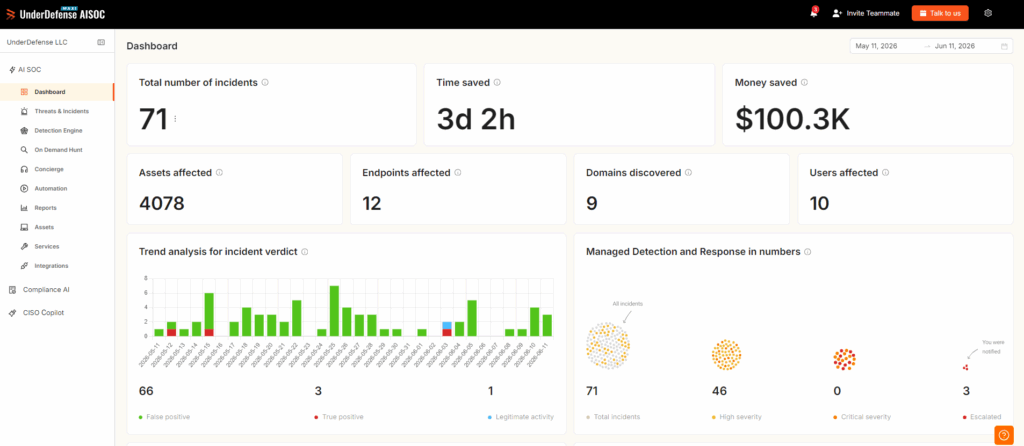
UnderDefense runs your SIEM and writes the custom detections your environment actually needs, rather than enabling a stock content pack and calling it tuning. We built our approach around a simple idea: your rules and your data should stay yours. The detections we write are versioned and unit-tested, an approach we call Detection Logic as Code. Our Agentic AI SOC, UnderDefense Agentic AI SOC, pairs that automation with human analysts who own the response outcome.
Core Services
- Managed SIEM with custom detection engineering (rules written and maintained against your environment)
- 24/7 monitoring and alert triage through the UnderDefense Agentic AI SOC platform
- Incident response with human analyst escalation and clear next steps
- Penetration testing and vulnerability validation
- Compliance readiness support (SOC 2, HIPAA, ISO 27001, PCI DSS, and GDPR) and virtual CISO advisory
Why Companies Consider UnderDefense
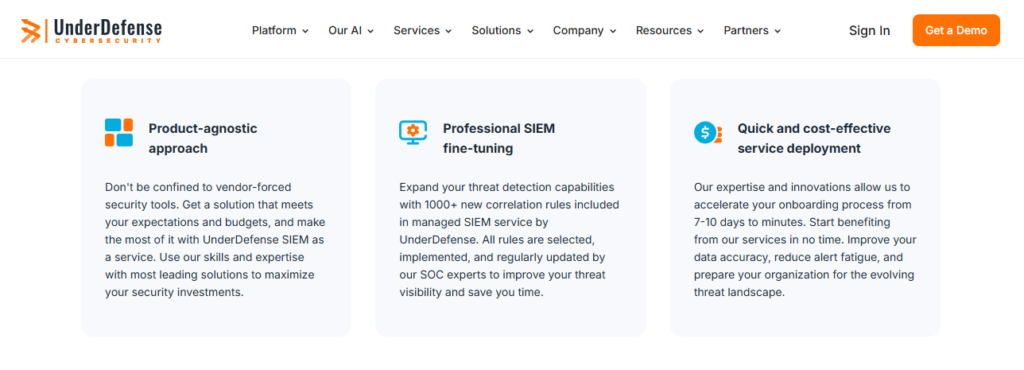
Teams pick us when they already own a SIEM but have nobody to write the rules. We work vendor-agnostic, so you keep your existing tools and your data. One reviewer summed up the reason people move to our MDR service: the noise dropped and the alerts started meaning something.
“The biggest win for me was getting actual control over our security alerts. Before the guys from UD stepped in, we were getting bombarded with alerts from all our security tools. Their team cleaned up our configurations and got the noise under control within the first week.”
– Verified User in Marketing and Advertising, UnderDefense G2 – Verified Review
Ideal Customer Profile
Best suited for:
- Mid-market teams (roughly 50 to 1,000 employees) that own a SIEM but lack a detection engineer
- Compliance-driven organizations that need 24/7 coverage without building an in-house SOC service
- Teams that want to keep their SIEM and data ownership and avoid vendor lock-in
Commercial Model
UnderDefense operates on a subscription model that layers onto your existing SIEM and security tools. Engagements start with configuration cleanup and rule tuning, then move into continuous monitoring, detection engineering, and incident response. You can review the managed SIEM price to see how the model lands, and reviewers repeatedly flag that the value arrives without the usual overselling.
When to Shortlist
Shortlist UnderDefense when you have a SIEM sitting on default rules, need custom detections written and maintained, and want a partner who owns the response outcome rather than just forwarding alerts. Teams preparing for a SOC 2, HIPAA, or ISO 27001 audit often include our compliance services during the RFP stage.
Customer Reviews
“It’s reassuring to know they’re always watching for threats, and it doesn’t cost a fortune. The platform works really well with our other security tools, and we really appreciate that we can customize the threat detection to focus on our specific needs.”
– Serhii B., Chief Information Security Officer, UnderDefense G2 – Verified Review
“Their expert management of our SIEM has added to the value of our security investments and tools. At first, we hired them for managed SIEM service, but after they demonstrated the value of MDR, our management was motivated to act on it.”
– Yaroslava K., IT Project Manager, UnderDefense G2 – Verified Review
1.2 Arctic Wolf: Concierge Model, Platform-Native Detection Content
Overview
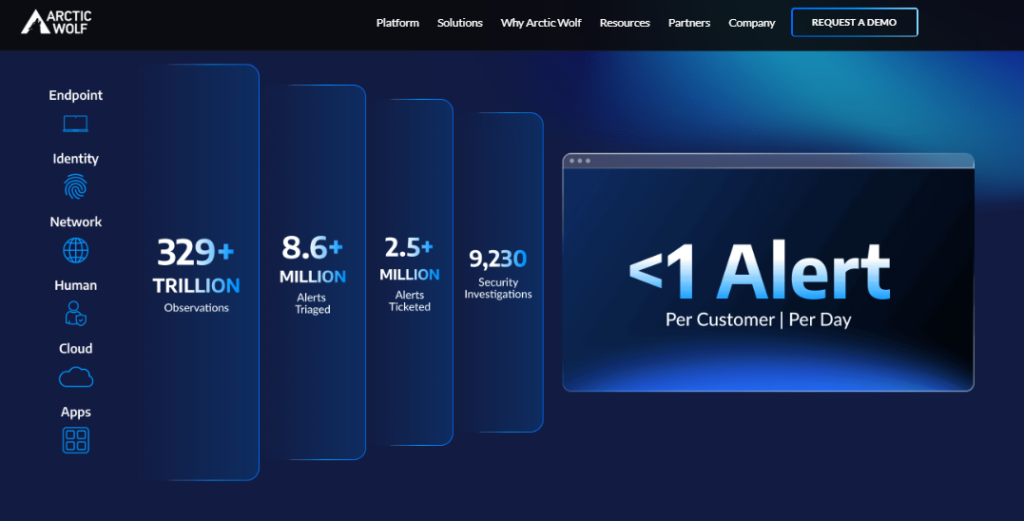
Arctic Wolf delivers a fully outsourced Security Operations Center experience for organizations that want enterprise-grade coverage without building an internal team. The company pairs its platform with a Concierge Security model, so customers get a dedicated security team rather than software alone. Detection content is largely platform-native, which is a strength for standardized environments and a structural trade-off for teams wanting deep, environment-specific rule ownership.
Core Services
- 24/7 Managed Detection and Response through a dedicated Concierge team
- Platform-native detection content and log monitoring
- Cloud and endpoint monitoring
- Vulnerability and risk management
- Compliance readiness support (SOC 2, HIPAA, and PCI DSS)
Why Companies Consider Arctic Wolf
Many lean teams lack the budget or hiring pipeline to run an internal SOC. Arctic Wolf positions itself as an operational partner and handles the day-to-day monitoring, which appeals to teams moving from reactive tools to a managed service. For readers comparing the category, our roundup of Arctic Wolf alternatives adds useful context.
Ideal Customer Profile
Best suited for:
- Companies with 50 to 1,000 employees wanting a fully outsourced SOC
- Security-lean teams that value a dedicated Concierge model
- Standardized environments where platform-native content fits well
Commercial Model
Arctic Wolf typically uses a subscription structure aligned with organization size and monitored assets. Note that some buyers flag a 60-day renewal notice window rather than the more common 30 days, so read the contract terms before signing.
When to Shortlist
Shortlist Arctic Wolf when you want a hands-off, fully managed SOC and your environment is fairly standardized. Weigh the trade-off honestly: where you need custom rule authorship or hands-on remediation ownership, buyers report the model leans on your team.
Customer Reviews
“Arctic Wolf provides solid detection and response capabilities, but overly relies on the client’s team for remediation, which really hurts the value of the service.”
– VP of Technology, Arctic Wolf Gartner – Verified Review
“This is not an extension of our security team as was originally sold. Some alerts are just a regurgitation of Microsoft alerts which means duplicates. We receive alerts, but not necessarily a clear path to resolution.”
– Sr. Cybersecurity Engineer, Arctic Wolf Gartner – Verified Review
1.3 Expel: Transparency-Forward Managed Detection
Overview
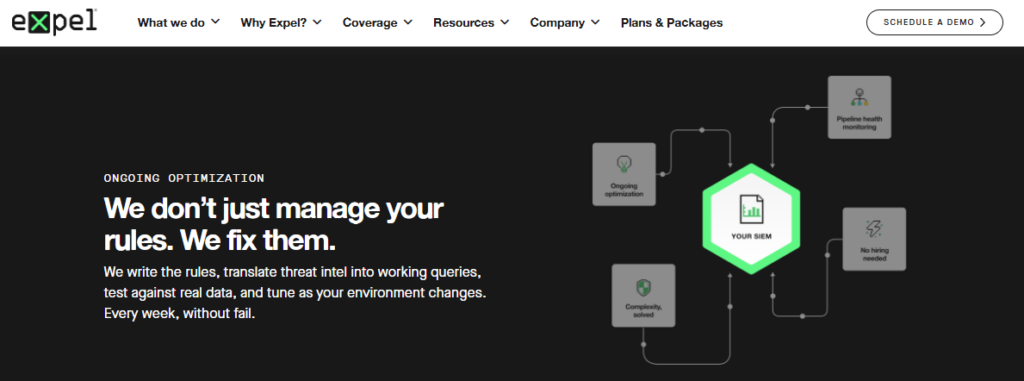
Expel built its name on transparency. Customers can see how analysts reach a decision, rather than getting a closed verdict. That openness is the draw, and the structural trade-off is that Expel remains an external provider, so it leans on your team for environment-specific context.
Core Services
- 24/7 managed detection and response across endpoint, cloud, and SaaS
- Transparency-forward analyst workflows you can observe
- Broad API integrations across security tools
- Alert triage and automated filtering
- Cloud detection content
Why Companies Consider Expel
Lean SOC teams pick Expel to act as a force multiplier. It handles first-line triage, so internal staff focus on higher-order work. One reviewer called that force-multiplier effect the primary benefit, though teams weighing options often compare it against a dedicated MDR service.
Ideal Customer Profile
Best suited for:
- Cloud-heavy and SaaS companies with 51 to 1,000 employees
- Small internal SOC teams wanting first-line triage handled
- Teams that value visibility into analyst reasoning
Commercial Model
Expel runs a subscription model priced around monitored data sources and environments. Onboarding is fairly straightforward, though some reviewers note integration documentation can lag when upstream tools like Google or Microsoft change, a common theme in our integration guidance.
When to Shortlist
Shortlist Expel when transparency into detection decisions matters and your environment is cloud-first. Weigh the trade-off: reviewers report the service still needs frequent engagement from your team, because organizational knowledge does not always stick.
Customer Reviews
“Overall, Expel has done a great job of keeping up with our environment in terms of triaging and dispositioning alerts that come into the service. Despite the capabilities of the technical platform and the strength of the analysts, there is still a limit to the environmental/organizational knowledge inherent in the service.”
– Verified User in Computer Software, Expel G2 – Verified Review
“Lack of support for EKS in AWS GovCloud. This was promised to us before we signed our contract, but later was removed from the roadmap. GovCloud is an essential part of our business, and this lack of support leaves a large gap in our monitoring and alerting.”
– Verified User in Manufacturing, Expel G2 – Verified Review
1.4 ReliaQuest: GreyMatter Agentic Detection-Engineering Teammate
Overview
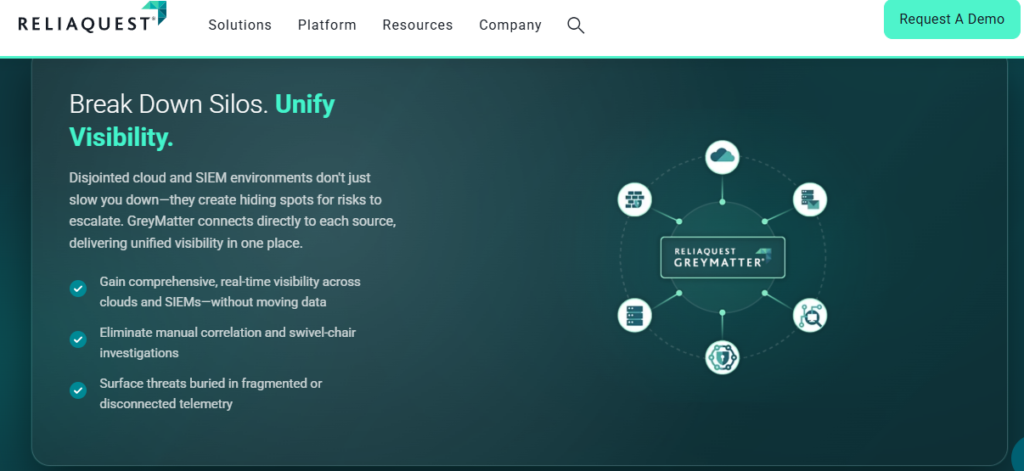
ReliaQuest positions its GreyMatter platform as an agentic teammate that automates detection engineering across your existing SIEM and EDR. The pitch is force-multiplication for large security teams. The structural trade-off is that value depends heavily on the maturity of the tools GreyMatter sits on top of.
Core Services
- GreyMatter platform for detection automation across SIEM and EDR
- Threat hunting and detection engineering support
- Automated response actions and playbooks
- Attack surface and exposure management
- 24/7 monitoring
Why Companies Consider ReliaQuest
Enterprises with established tooling pick ReliaQuest to squeeze more value from what they already own. GreyMatter aims to unify telemetry and automate repetitive detection work, which appeals to teams drowning in tool sprawl. Buyers comparing this category often review the ReliaQuest alternatives before deciding.
Ideal Customer Profile
Best suited for:
- Enterprises with mature, multi-vendor security stacks
- Large SOC teams wanting automation across existing tools
- Organizations focused on exposure and attack-surface management
Commercial Model
ReliaQuest uses an annual subscription tied to your environment and data sources. Engagements center on the GreyMatter platform layered over your current SIEM and EDR.
When to Shortlist
Shortlist ReliaQuest when you run a mature, multi-tool enterprise stack and want automation stitched across it. It fits large teams better than lean ones, since the value scales with the tooling underneath.
1.5 Red Canary: Detection-Content Depth on Your Telemetry
Overview
Red Canary is known for deep detection content and a strong threat-hunting team, especially on endpoint telemetry. That depth is the strength. The structural trade-off surfaces when your environment spans beyond its strongest integrations, where coverage can thin out.
Core Services
- Managed detection and response with deep detection content
- 24/7 SOC monitoring and threat hunting
- Endpoint-focused telemetry analysis (strong CrowdStrike integration)
- Cloud and identity alerting
- Automation for end-user teams
Why Companies Consider Red Canary
EDR-centric teams pick Red Canary to cut SIEM noise and get high-quality detections on endpoint data. Reviewers repeatedly praise the threat-hunting and IR teams as a genuine strength, and readers often pair this with a broader review of threat hunting tools.
Ideal Customer Profile
Best suited for:
- Endpoint-heavy teams (1,000+ employees common)
- Organizations wanting deep detection content and threat hunting
- Teams comfortable pairing Red Canary with an internal SOC
Commercial Model
Red Canary runs a subscription model aligned with monitored endpoints and data sources. Onboarding is generally reported as easy, though some buyers want richer integrations beyond CrowdStrike.
When to Shortlist
Shortlist Red Canary when endpoint detection depth is your priority and you have internal staff to fill gaps. Weigh the trade-off: reviewers report detection gaps during penetration tests and limited SIEM alert-ingestion integrations.
Customer Reviews
“The IR team and detection engineers here are truly outstanding. Over the past few years, we’ve undergone several external penetration tests, and during these assessments, Red Canary was not able to identify the malicious activity while the tests were ongoing. Also, they do not have any sort of alert ingestion integrations with Splunk or other SIEM platforms.”
– Verified User in Insurance, Red Canary G2 – Verified Review
“There have been several instances where we expected RC to identify an issue and no alert was surfaced. Because of this, senior leadership feels, at times, that RC isn’t the right partner for us. I think this is due to differences in methodology.”
– Mike S., Information Security Manager, VP, Red Canary G2 – Verified Review
1.6 Deepwatch: Splunk-Centric Managed Detection
Overview
Deepwatch delivers managed detection built tightly around Splunk. For Splunk-centric shops, that alignment is the strength. The structural trade-off is the same alignment: value concentrates where Splunk is the backbone, which narrows the fit for teams standardized on other SIEMs.
Core Services
- Splunk-native managed detection engineering
- 24/7 monitoring and threat detection
- Dedicated squad model for customer engagements
- Threat hunting and detection tuning
- Compliance-oriented reporting
Why Companies Consider Deepwatch
Teams already invested in Splunk pick Deepwatch to run detection on top of that investment. It appeals to organizations that want managed detection without abandoning their SIEM of choice, and many first review our MDR for Splunk approach.
Ideal Customer Profile
Best suited for:
- Splunk-centric organizations at mid-market to enterprise scale
- Teams wanting managed detection engineering on Splunk
- Compliance-driven organizations needing continuous monitoring
Commercial Model
Deepwatch uses a subscription model aligned with data volume and monitored sources, typically layered on your Splunk environment. Engagements include a dedicated squad and ongoing detection tuning.
When to Shortlist
Shortlist Deepwatch when Splunk is your backbone and you want managed detection engineering built around it. If you are moving off Splunk or run a mixed SIEM estate, weigh how much of the value carries over.
1.7 eSentire: Threat-Response-Led Detection Engineering
Overview
eSentire leads with fast containment through its Atlas platform. Response speed is the strength here. The structural trade-off is that a response-led model puts a premium on the provider’s playbooks, which may not always match your environment’s unusual activity.
Core Services
- Threat-response-led managed detection and response
- Atlas platform for detection and automated containment
- 24/7 SOC monitoring and threat hunting
- Endpoint, network, and cloud coverage
- Incident response and digital forensics
Why Companies Consider eSentire
Teams that prioritize fast containment pick eSentire for its response-first posture. The promise is quick action on confirmed threats, which reduces dwell time when a real incident lands, and it complements a strong incident response capability.
Ideal Customer Profile
Best suited for:
- Mid-market to enterprise teams prioritizing rapid containment
- Organizations wanting response-led MDR over monitoring-only
- Teams comfortable with a platform-driven playbook approach
Commercial Model
eSentire runs a subscription model tied to monitored assets and coverage scope. Engagements center on the Atlas platform with 24/7 SOC support and defined response actions.
When to Shortlist
Shortlist eSentire when fast, response-led containment is your top priority. Weigh whether a standardized playbook approach fits an environment with a lot of nonstandard activity that needs custom judgment.
1.8 Dropzone AI: AI-Native Autonomous Investigation
Overview
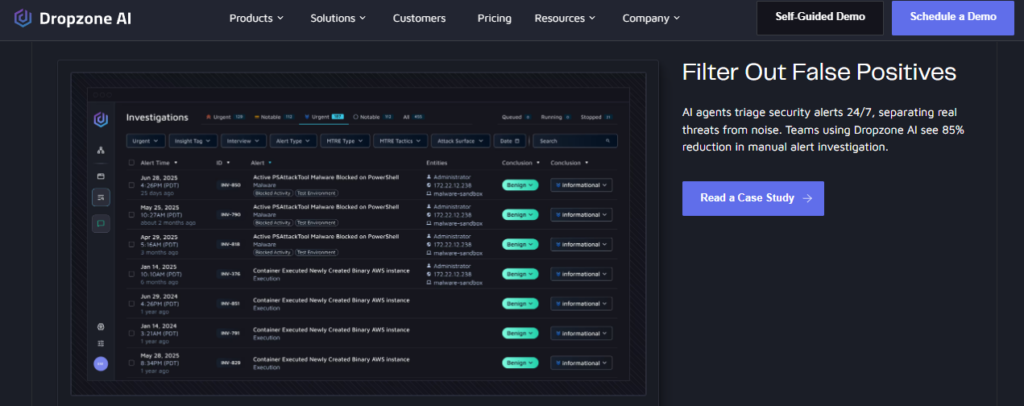
Dropzone AI takes an AI-native approach, using autonomous agents to investigate alerts end to end. Speed and scale on alert triage are the strength. The structural trade-off is that a young, AI-first model still needs human oversight for edge cases and high-stakes decisions.
Core Services
- AI-native autonomous investigation of security alerts
- Automated alert triage and context gathering
- Integration with existing SIEM and security tools
- Investigation reports with reasoning traces
- Analyst-augmentation workflows
Why Companies Consider Dropzone AI
Teams buried in alerts pick Dropzone AI to automate the investigation grunt work. The draw is scaling triage without hiring, so analysts spend time on decisions rather than data gathering, which mirrors the goal of easing alert fatigue.
Ideal Customer Profile
Best suited for:
- Lean SOC teams overwhelmed by alert volume
- Organizations wanting to augment analysts with AI investigation
- Teams comfortable adopting a newer, AI-first vendor
Commercial Model
Dropzone AI uses a subscription model that layers onto your existing SIEM and tooling. Engagements focus on automating investigation rather than replacing your response function.
When to Shortlist
Shortlist Dropzone AI when alert-investigation volume is your bottleneck and you want AI to handle first-pass triage. Weigh the trade-off honestly: an AI-native model scales routine work well, but humans still own the edge cases and the final call.
Where UnderDefense fits across this list
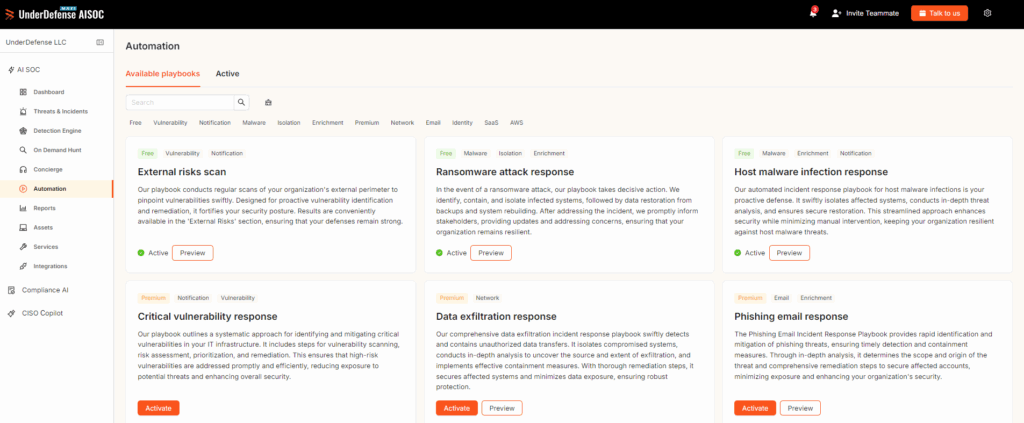
Here is my honest read after sitting inside this work for years. Most of these providers are strong at one layer: endpoint depth, Splunk alignment, transparency, or AI triage. Where we built UnderDefense differently is ownership. We write custom detections against your environment, keep your rules and data yours, and pair automation in UnderDefense Agentic AI SOC with human analysts who own the response outcome. If a test uncovers a gap, the Agentic AI SOC watches it, and our compliance and vCISO work documents it. That chain is the value, and you can audit every step.
Q2. How Were These Providers Selected and Scored?
Each provider was scored on five weighted criteria: Custom Detection Development (30%), Rule Ownership and Portability (20%), Maintenance and Decay Management (20%), Validation and Testing Rigor (15%), and Pricing Transparency (15%). Scores map to stars, so 0 to 20 earns one star, 21 to 40 earns two, and so on. This rewards vendors that write and keep detections current for you, rather than those that toggle prebuilt content on.
Why a visible rubric matters
Here is the problem every buyer hits. From a vendor website, you cannot tell real detection engineering from content-pack enablement. Both say “detection engineering included,” and the words carry no information.
So I built the scoring around one objective test: is the detection logic treated as software? If rules are versioned and portable, the claim is auditable. If they live as black-box console artifacts, it is not, which is a core theme in our guidance on avoiding vendor lock-in.
The weighted criteria
| Criterion | Weight | What it measures |
|---|---|---|
| Custom Detection Development | 30% | Whether rules are written for your environment or a prebuilt pack is enabled. Includes whether a request-driven detection actually gets built. |
| Rule Ownership and Portability | 20% | Whether you keep the rules and data if the contract ends, or lose them at the vendor’s door. |
| Maintenance and Decay Management | 20% | Whether detections are tuned and updated as your stack changes, so coverage does not rot. |
| Validation and Testing Rigor | 15% | Whether rules are tested against simulated attacks before they go live. |
| Pricing Transparency | 15% | Whether the commercial model and “included” scope are clear on paper. |
Where UnderDefense lands
UnderDefense earns five stars on this rubric. We treat detections as Detection Logic as Code (versioned, unit-tested rules), keep your rules and data yours, and validate them against adversary simulation tooling like Caldera and Ransomware Monkey (open-source attack-emulation tools). I could be accused of scoring my own house well, so the fair test is this: ask any vendor to show you the rule as code, prove you keep it at exit, and demo the validation run. If they can, they earn the stars too. Buyers can pressure-test each provider with a structured set of managed SIEM evaluation questions.
Q3. What Does “Detection Engineering Included” Really Mean, and What Does It Involve?
“Detection engineering included” is the most oversold phrase in managed SIEM. Delivery ranges from custom rules written and maintained against your environment down to a vendor enabling a prebuilt content pack. Genuine detection engineering means threat-modeling your environment, authoring rules mapped to MITRE ATT&CK, testing them against simulated attacks, tuning false positives, and maintaining them as you change. It is a continuous lifecycle, not a one-time engagement.
Why the phrase carries no information
Every vendor claims detection engineering. When everyone says it, the words stop meaning anything to a buyer.
So the useful question is not “do you include it?” It is “show me how you deliver it.” That reframe separates the real work from the sales copy, and it is the lens we bring to our managed SIEM engagements.
The delivery spectrum
The claim spans a wide range, and both ends use the same words:
- Custom development: rules written for your specific environment, versioned, and maintained over time.
- Content-pack enablement: a prebuilt library toggled on once, with light tuning, then called done.
The gap between those is enormous. One adapts to your risk; the other assumes your environment looks like everyone else’s.
The actual lifecycle
Real detection engineering runs a repeatable loop. Here is the working model:
- Model the threats specific to your environment and crown-jewel assets.
- Author rules in the right language (Sigma, KQL, SPL, YARA-L, or EQL) mapped to MITRE ATT&CK, the industry catalog of attacker techniques.
- Validate each rule against simulated attacks before trusting it.
- Tune out false positives, so analysts are not buried in noise.
- Maintain and update rules as your stack, cloud, and identity change.
What this means for you
Here is the part the category avoids saying out loud. If your detection engineering is wrong, an AI SOC is a faster way to be wrong. Automation faithfully executes the underlying brokenness, so bad rules just fail at scale, a risk we unpack in our human-in-the-loop SOC design work.
That is why I think of it as foot soldiers and generals. Automation drafts and executes the routine work, and humans gate the judgment calls. At UnderDefense, Detection Logic as Code is the mechanism that makes this lifecycle systematic rather than artisanal. Now you can judge a real lifecycle from a one-off engagement by asking who maintains the rules next quarter.
Q4. How Do the 8 Vendors Compare on Detection Engineering?
Across the eight, detection engineering is delivered very differently. Some write and version custom rules you keep, others enable platform content packs governed by their own console, and AI-native entrants now draft and tune detections through agentic teammates. The reliable differentiators are rule ownership at contract end, committed update cadence, and whether a request-driven detection carries a service-level agreement (SLA, a contractual response commitment).
The comparison at a glance
| Provider | Custom vs Content-Pack | Rule Ownership at Exit | Maintenance Model | Transparency |
|---|---|---|---|---|
| UnderDefense | Custom (Detection Logic as Code) | You keep rules and data | Manual fine-tuning, validated via Caldera and Ransomware Monkey | Rules visible as code |
| Arctic Wolf | Platform content, console-bound | Tied to their platform | Vendor-managed within console | Changes go through their engineering team |
| Expel | Content plus custom detections | Provider-hosted | Analyst-tuned, human plus automation | Transparency-forward workflows |
| ReliaQuest | Content plus GreyMatter automation | Platform-governed | Agentic teammate drafts, human reviews | Platform-mediated |
| Red Canary | Deep content on your telemetry | Provider-hosted | Vendor detection engineering | Detailed detection reporting |
| Deepwatch | Splunk-native content | Lives in your Splunk | Dedicated squad tuning | Splunk-visible |
| eSentire | Response-led content (Atlas) | Platform-governed | Vendor-managed playbooks | Platform-mediated |
| Dropzone AI | AI-drafted investigation | Layered on your tools | Autonomous agent, human oversight | Reasoning traces exposed |
What the delivery model actually costs you
A console-bound model means every rule change routes through the vendor’s engineering team. That is a real trade-off, and one Arctic Wolf customers describe directly.
“Anything you want to look at or changes you need to make in the product must go through their engineering team. As an MSP, this is a horrible way to do business for us.”
– Matt C., Manager, Cybersecurity Services, Arctic Wolf G2 – Verified Review
The seam between ownership and operation is where vendors split. Ownership means you keep the rules and data. Operation means the vendor does the work. You want both, and many models give you only the second, which is why teams review our MDR service against that standard.
The context gap in external models
Even strong providers hit a ceiling on environment knowledge, since they sit outside your walls. That surfaces as repeated requests back to your team for context.
“Despite the capabilities of the technical platform and the strength of the analysts providing the service, there is still a limit to the environmental/organizational knowledge inherent in the service. This leads to a fairly frequent need for engagement with our internal team.”
– Verified User in Computer Software, Expel G2 – Verified Review
Methodology differences can also leave gaps that only surface during a real test, which is why validation matters as much as any penetration testing exercise.
“There have been several instances where we expected RC to identify an issue and no alert was surfaced. Because of this, senior leadership feels, at times, that RC isn’t the right partner for us.”
– Mike S., Information Security Manager, VP, Red Canary G2 – Verified Review
How UnderDefense fits the seam
We built UnderDefense to close that ownership-operation seam. You keep your rules and data, we do the detection engineering as code, and we validate coverage with adversary simulation (roughly 96% MITRE ATT&CK coverage and 215 integrations). ✅ Vendor-agnostic, so you keep your SIEM. ✅ Human analysts own the response outcome. ❌ Console-bound models make you route every change through their team. ✅ Request-driven detections carry a real commitment. This replaces an unfilled detection-engineer requisition and a separate content subscription, rather than adding another tool to the pile, and the automation runs inside UnderDefense Agentic AI SOC. Customers describe the shift plainly.
“Their expert management of our SIEM has added to the value of our security investments and tools.”
– Yaroslava K., IT Project Manager, UnderDefense G2 – Verified Review
Q5. What Do Default Rules Miss, and Why Do Custom Detections Decay?
Default rulesets detect generic attacks, so they miss your business logic, custom apps, and identity topology (how your users, roles, and login providers are wired). Worse, detections decay. As you add apps or change identity providers, rules go blind or noisy, so a one-time tuning engagement is not detection engineering. Mature programs validate detections by attacking themselves with tools like Caldera and Atomic Red Team before they are needed.
What default rules actually miss
Here is a real pattern. In edge-appliance breaches, attackers send a crafted request that slips past both EDR (endpoint detection) and the SIEM, because the initial phase looks like ordinary traffic. A default rule was never written for your specific app, so nothing fires.
The 2025 Verizon DBIR shows edge-device and credential exploitation climbing as an entry path. Default content assumes your environment looks like everyone’s, and it fits everyone and no one, a gap our threat detection tooling is designed to close.
Why custom detections decay
Detections rot because your environment moves. You add a SaaS app, swap identity providers, or open a new region, and a static rule goes blind or starts screaming false positives.
One bad login from Thailand or Singapore can look malicious or benign, depending on context nobody updated. So maintenance needs drift detection and a tuning feedback loop, rather than a rule set live and forgotten, which is central to how we run managed SIEM.
Proving a rule works before an incident does
You should require validation, meaning someone attacks your detections on purpose. Purple teaming (offense and defense working together) mapped to MITRE ATT&CK tells you a rule fires before a real attacker tests it for you, an approach that complements regular penetration testing.
At UnderDefense, we validate detections during onboarding with Ransomware Monkey and Caldera, and we run a tuning feedback loop through employee ChatOps that removes around 99% of false positives. Because we treat rules as Detection Logic as Code, a bad rule gets rolled back like a code deploy. Think of the old M&M network model (hard shell, soft center); validated, maintained detections are what keep the center from staying soft. Customers feel that tuning loop directly.
“Their team cleaned up our configurations and got the noise under control within the first week. Now when we get an alert, we know it’s something worth looking into.”
– Verified User in Marketing and Advertising, UnderDefense G2 – Verified Review
“False positives have become a rarity, ensuring that our team’s focus remains on genuine threats.”
– Valeriia D., Marketing Specialist, UnderDefense G2 – Verified Review
My open question: how many teams have ever watched their own detections get attacked? If the answer is never, the coverage is a guess.
Q6. Should You Build In-House or Buy Managed Detection Engineering?
Building in-house means roughly $124,163 per loaded engineer, months of ramp, and key-man risk on a role you already cannot fill. Round-the-clock coverage across five people runs near $620,815. Buying managed detection engineering converts that allocated-but-unfilled budget into continuous coverage, and you still own the rules and data. Buy the operation, keep the asset.
The real cost of building
The sticker price of a detection engineer is not the real number. Loaded cost (salary, benefits, tooling, and overhead) lands around $124,163 per person per year.
Then comes ramp time and key-man risk. One person carries your institutional memory, and if they leave, the coverage leaves with them. Hiring and retention in security stays brutally hard, which is why many teams weigh the build-versus-buy decision carefully.
The buy path and the ownership split
Buying flips allocated headcount into continuous service. The distinction I care about is own versus operate: you buy the operation, and you keep the rules and data as the asset, an idea we detail in our MDR service.
The 2025 IBM Cost of a Data Breach report found organizations using security AI and automation extensively saved about $1.9M per breach on average. That is a cleaner ROI frame than trying to prove a breach you prevented, which is proving a negative.
A one-page CFO map
Use the NIST Cybersecurity Framework (a common standard of security functions) as a budget map. It lets you show a CFO where each dollar buys coverage, in language finance already trusts, and it pairs well with our 2026 cybersecurity budget playbook.
At UnderDefense, we frame this as replacing an unfilled requisition and a separate detection-content subscription, with roughly 99% noise reduction inside a 30-day onboarding as the time-to-value anchor. One reviewer put the economics plainly.
“We needed round-the-clock monitoring for compliance reasons, but building our own SOC wasn’t realistic with our budget and the current hiring market. UnderDefense fills that gap without us having to hire a full team.”
– Verified User in Marketing and Advertising, UnderDefense G2 – Verified Review
Q7. What Should You Require in Your Detection Engineering Contract?
Require nine things in the contract: custom rules for your environment (not only content packs), rule ownership and portability at termination, a committed detection cadence per quarter, an SLA on request-driven detections, maintenance and drift obligations, a tuning feedback loop, pre-deployment testing evidence, full rule transparency, and clarity on included versus professional-services scope. This is a starting point for your counsel, not vetted legal language.
The nine clauses to require
Here is a copy-ready skeleton. Adapt each line with your legal team.
- Custom development. Require rules written for your environment. Sample: “Provider shall author detections specific to Customer’s applications, identity topology, and business logic.”
- Ownership and portability. Require the asset at exit. Sample: “Upon termination, all correlation rules, integrations, and detection logic remain in Customer’s SIEM in exportable form.”
- Committed cadence. Require a rate. Sample: “Provider shall deliver a minimum of X new or updated detections per calendar quarter.”
- Request SLA. Require a clock on ad-hoc detections. Sample: “Provider shall acknowledge detection requests within X hours and deliver within Y business days.”
- Maintenance and drift. Require upkeep. Sample: “Provider shall monitor for detection drift and remediate degraded rules within the agreed window.”
- Tuning feedback loop. Require noise reduction. Sample: “Provider shall operate a documented false-positive tuning process reviewed monthly.”
- Testing evidence. Require proof. Sample: “Provider shall supply pre-deployment validation results (for example, adversary-simulation output) for each detection.”
- Transparency. Require visibility. Sample: “Customer shall have read access to all detection logic and its version history.”
- Scope clarity. Require the line. Sample: “The SOW shall state which detection work is included versus billed as professional services.”
The load-bearing clause: the exit audit
If I could keep only one, it is the exit clause. Ask directly: “If we terminate, do all rules, integrations, and detection logic remain in our SIEM?”
Some vendors will not agree, because keeping your institutional memory is their retention model. A console-bound rule you cannot export is a lock-in you signed for, which is exactly the friction described in our work on avoiding vendor lock-in.
“Anything you want to look at or changes you need to make in the product must go through their engineering team.”
– Matt C., Manager, Cybersecurity Services, Arctic Wolf G2 – Verified Review
A 30/60/90-day time-to-value view
Set milestones so “included” becomes measurable:
- Days 0 to 30: onboarding, integrations live, and initial noise reduction (we target around 99%).
- Days 31 to 60: first custom detections authored, validated, and tuned to your environment.
- Days 61 to 90: cadence steady, drift monitoring running, and response commitments in effect (2-minute Alert-to-Triage and 15-minute escalation for critical incidents).
UnderDefense meets that exit clause by design, because Detection Logic as Code is portable and versioned, so you keep your rules and data when the contract ends. That is the seam I would test hardest in any RFP, and it is worth raising when you first talk to our team.
See tuned SIEM triage in action.
1. What does detection engineering included actually mean in a managed SIEM?
We think it is the most oversold phrase in managed SIEM, because delivery ranges from custom rules written and maintained against your environment down to a vendor toggling on a prebuilt content pack. Both ends use the same words, so the phrase carries no information on its own.
Genuine detection engineering means we threat-model your environment, author rules mapped to MITRE ATT&CK, validate them against simulated attacks, tune out false positives, and maintain them as your stack changes. It is a continuous lifecycle, not a one-time engagement.
- Custom development: rules written for your apps, versioned, and maintained over time.
- Content-pack enablement: a prebuilt library switched on once with light tuning.
The useful question is never whether a vendor includes it, but how they deliver it. When you evaluate our managed SIEM service, ask us to show a rule as code, prove you keep it at exit, and demo the validation run.
2. How should we score managed SIEM providers on detection engineering?
We score providers on five weighted criteria so you can separate real engineering from content-pack enablement.
- Custom Detection Development (30 percent): whether rules are written for your environment or a pack is enabled.
- Rule Ownership and Portability (20 percent): whether you keep the rules and data if the contract ends.
- Maintenance and Decay Management (20 percent): whether detections are tuned as your stack changes.
- Validation and Testing Rigor (15 percent): whether rules are tested against simulated attacks first.
- Pricing Transparency (15 percent): whether the commercial model and included scope are clear.
The objective test underneath is simple: is the detection logic treated as software? If rules are versioned and portable, the claim is auditable. If they live as black-box console artifacts, it is not. We built a structured set of managed SIEM evaluation questions so you can pressure-test any provider against this rubric during procurement, rather than trusting the marketing copy on a vendor website.
3. Why do default SIEM rules miss real attacks?
Default rulesets detect generic attacks, so they miss your business logic, custom applications, and identity topology (how your users, roles, and login providers are wired). A default rule was never written for your specific environment, so nothing fires when it matters.
Consider edge-appliance breaches. Attackers send a crafted request that slips past both endpoint detection and the SIEM, because the initial phase looks like ordinary traffic. The 2025 Verizon DBIR shows edge-device and credential exploitation climbing as an entry path.
- Default content assumes your environment looks like everyone else’s.
- It fits everyone and no one at the same time.
- Only custom detections cover your crown-jewel assets.
This is exactly why we pair custom rule development with continuous threat detection tooling tuned to your actual attack surface. The goal is coverage that reflects how your organization really operates, rather than a generic library that leaves the gaps attackers look for first.
4. Why do custom detections decay over time?
Detections rot because your environment keeps moving. You add a SaaS app, swap identity providers, or open a new region, and a static rule goes blind or starts screaming false positives. A one-time tuning engagement is therefore not detection engineering.
Context is the culprit. One login from Thailand or Singapore can look malicious or benign, depending on context nobody updated. Without drift detection and a tuning feedback loop, coverage silently degrades between the day you signed and the day you get breached.
- New apps and integrations change what normal looks like.
- Identity-provider changes break correlation logic.
- Unmaintained rules generate noise that buries real alerts.
We run continuous maintenance as part of our MDR service, treating rules as Detection Logic as Code so a degraded rule can be rolled back like a bad code deploy. That is what keeps detection coverage current instead of a set-and-forget artifact that ages badly the moment your stack evolves.
5. Should we build detection engineering in-house or buy it?
We frame this as an own-versus-operate decision. Building in-house means roughly 124,163 dollars per loaded engineer, months of ramp, and key-man risk on a role you probably already cannot fill. Round-the-clock coverage across five people runs near 620,815 dollars per year.
Buying managed detection engineering converts that allocated-but-unfilled budget into continuous coverage, and you still own the rules and data. You buy the operation, and you keep the asset.
- Build: high fixed cost, ramp time, single point of failure.
- Buy: continuous service, retained ownership, faster time to value.
The 2025 IBM Cost of a Data Breach report found organizations using security AI and automation extensively saved about 1.9 million dollars per breach. We walk through the full economics in our analysis of the build-versus-buy decision, so you can show a CFO where each dollar buys coverage in language finance already trusts.
6. What should we require in a detection engineering contract?
We recommend requiring nine things, and treating this as a starting point for your counsel rather than vetted legal language.
- Custom rules written for your environment, not only content packs.
- Rule ownership and portability at termination.
- A committed detection cadence per quarter.
- An SLA on request-driven detections.
- Maintenance and drift obligations.
- A documented tuning feedback loop.
- Pre-deployment testing evidence.
- Full rule transparency and version history.
- Clarity on included versus professional-services scope.
If we could keep only one clause, it is the exit audit: ask directly whether all rules, integrations, and detection logic remain in your SIEM in exportable form if you terminate. Some vendors will not agree, because keeping your institutional memory is their retention model. Our guidance on avoiding vendor lock-in explains why a console-bound rule you cannot export is a lock-in you signed for.
7. How do we validate that a provider's detections actually work?
We think you should require validation, meaning someone attacks your detections on purpose before a real adversary does. Purple teaming (offense and defense working together) mapped to MITRE ATT&CK tells you a rule fires when it should.
Our own process validates detections during onboarding with Ransomware Monkey and Caldera, then runs a tuning feedback loop through employee ChatOps that removes around 99 percent of false positives.
- Attack simulation confirms coverage before an incident.
- A tuning loop keeps noise low so analysts focus on genuine threats.
- Detection Logic as Code lets us roll back a bad rule cleanly.
This is the same rigor we bring to penetration testing, because a detection you have never seen fire is a guess, not coverage. Our honest question for any team is simple: how many of your current detections have you actually watched get attacked and prove they work under realistic conditions?
8. How do the leading managed SIEM providers compare on detection engineering?
Across the field, detection engineering is delivered very differently. Some providers write and version custom rules you keep, others enable platform content packs governed by their own console, and AI-native entrants draft and tune detections through agentic teammates.
The reliable differentiators are consistent across every vendor we assessed.
- Rule ownership at exit: do you keep the rules and data, or lose them at the vendor’s door?
- Committed update cadence: is maintenance contractual or best-effort?
- Request SLA: does a requested detection carry a real commitment?
Console-bound models route every rule change through the vendor’s engineering team, which customers describe as a real operational drag. We built our approach to close the ownership-operation seam, with vendor-agnostic coverage, human analysts owning the response outcome, and detections you keep. Our roundup of the best managed SIEM providers for 2026 breaks down where each option lands on these axes so you can shortlist with confidence.