




Q1: What Are the 10 Best AI SOC Platforms with Slack and Teams ChatOps Verification in 2026?
The 10 best AI SOC platforms with Slack and Teams ChatOps verification in 2026 are UnderDefense Agentic AI SOC, Prophet Security, Dropzone AI, Exaforce, Radiant Security, Simbian, Torq, Stellar Cyber, CrowdStrike Falcon, and Palo Alto Cortex XSIAM. They split on one axis most listicles ignore: whether the platform actually asks the affected user “Did you run that?” in-channel and folds the reply into a verdict, or just posts an alert.
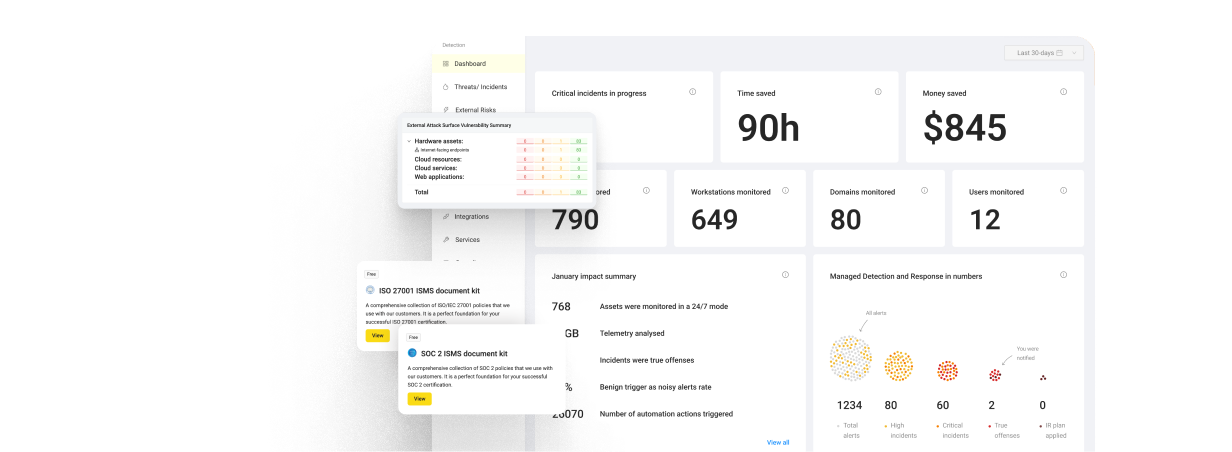
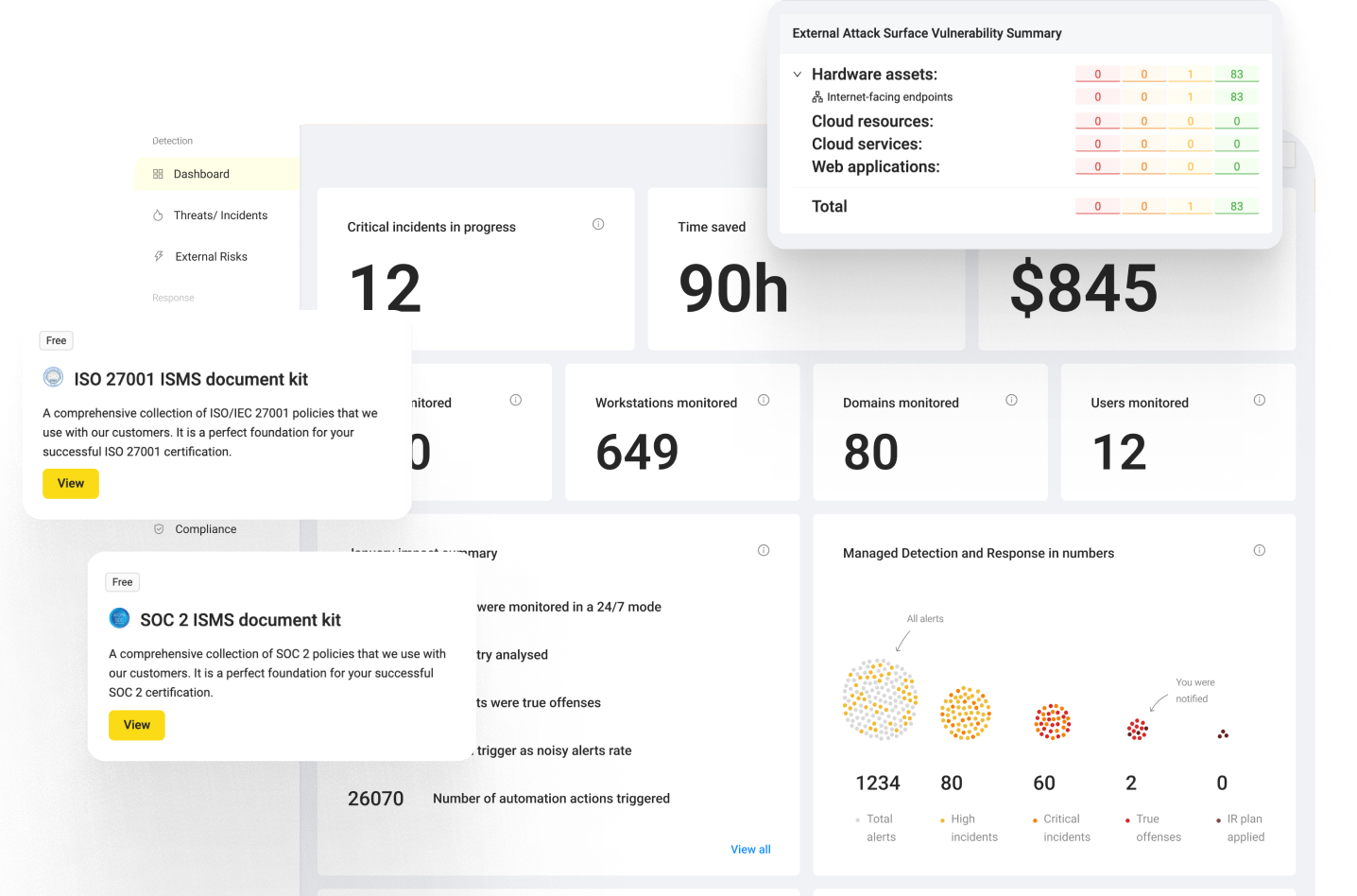
See how the UnderDefense Agentic AI SOC investigates, triages, and resolves real alerts.
The 2 a.m. Problem Nobody Puts in the Sales Deck
I have watched lead analysts on three-person teams turn into human routers. An alert fires. They copy it into Slack. Someone asks “is this you?” Nobody answers. The night ends.
That is not investigation. That is forwarding. The real question a lean team asks is simpler and harder: how do I stop being an alert-forwarder and start being an investigator without hiring a 12-person night shift?
Here is the uncomfortable part I have felt firsthand. Humans click, but agents swarm. When one compromised login can spawn hundreds of actions in minutes, a team of three cannot keep pace by reading dashboards faster. This is precisely the alert fatigue problem that pushes lean teams toward automation.
How Selecting the Right Platform Works: A Buyer’s Note
Choosing an AI SOC platform is a high-stakes decision for teams handling sensitive data, compliance obligations, and rising ransomware exposure, so this guide evaluates 10 platforms on operational, technical, and buying criteria rather than brand popularity, giving CISOs, IT Directors, and CTOs at 50 to 1,000 employee firms a shortlist they can defend in an RFP. If you want a deeper framework, our AI SOC evaluation questions cover the full checklist.
The 10 Platforms at a Glance
Below is the ranked list. UnderDefense Agentic AI SOC holds the top spot as the only platform that pings users over Slack, Teams, Email, and SMS to verify anomalous behavior at scale, then resolves alerts competitors escalate back.
- UnderDefense Agentic AI SOC
- Prophet Security
- Dropzone AI
- Exaforce
- Radiant Security
- Simbian
- Torq
- Stellar Cyber
- CrowdStrike Falcon
- Palo Alto Cortex XSIAM
| Provider Name | Best For | Key Strength | Compliance |
|---|---|---|---|
| UnderDefense Agentic AI SOC ⭐⭐⭐⭐⭐ | Lean, regulated mid-market teams needing answers, not tickets | True two-way Slack, Teams, Email, and SMS user verification plus human analyst response | SOC 2, ISO 27001, HIPAA, GDPR |
| Prophet Security ⭐⭐⭐⭐ | Teams wanting autonomous alert triage on top of an existing SIEM | Agentic auto-investigation of every alert | SOC 2 |
| Dropzone AI ⭐⭐⭐⭐ | SOCs drowning in Tier-1 volume | Autonomous investigation with evidence trails | SOC 2 |
| Exaforce ⭐⭐⭐ | Data-heavy teams reducing ingestion cost | Log correlation and noise reduction | SOC 2 |
| Radiant Security ⭐⭐⭐ | Teams needing guided response steps | AI triage with response playbooks | SOC 2 |
| Simbian ⭐⭐⭐ | Early adopters of fully agentic SOC | Multi-agent autonomous workflows | SOC 2 |
| Torq ⭐⭐⭐⭐ | Cloud-native teams wanting deep automation | Hyperautomation and SOAR-style workflows | SOC 2, ISO 27001 |
| Stellar Cyber ⭐⭐⭐ | MSSPs and lean teams wanting Open XDR | Unified detection across the stack | SOC 2 |
| CrowdStrike Falcon ⭐⭐⭐⭐ | Endpoint-heavy enterprises | Endpoint detection depth and Charlotte AI | SOC 2, ISO 27001, HIPAA |
| Palo Alto Cortex XSIAM ⭐⭐⭐⭐ | Large teams consolidating on one platform | AI-driven SIEM replacement at scale | SOC 2, ISO 27001, HIPAA |
Notification vs. Verification: The Axis That Actually Separates These Tools
Most “Slack support” is a one-way webhook. It posts an alert into a channel and stops. The analyst still starts from zero.
True verification is different. The platform messages the affected user, waits for a reply, checks that reply against the evidence, and issues a verdict. IBM and Kyndryl even hold a granted patent (US11513872B2) for AI-driven actionable alerts inside a ChatOps workspace, which tells you this is a real engineering discipline, rather than a Slack integration checkbox. Our breakdown of AI SOC explainability explains why that reasoning trail matters.
My read, and I could be wrong on the edges, is that this two-way loop is where most tools quietly fail. A platform that runs 100-plus distinct large language model calls to investigate a single alert is doing recursive reasoning. A platform that fires one Slack message is a wrapper. Score for the difference.
How to Read This Table for Your Own Environment
Start with your constraint, rather than the brand. If you are regulated and lean, weight two-way verification and data residency highest. If you are endpoint-heavy on CrowdStrike already, weight how well a platform layers verification on top without a rip-and-replace, a question our AI SOC with existing EDR guide walks through.
One UnderDefense customer captured the daily reality of in-channel verification better than any spec sheet:
“Being a digital marketing company, we’re all about swift communication and response. UnderDefense’s MDR and especially their incident response capabilities are top-tier. But the real game-changer is their seamless integration with Slack. We’ve tackled potential threats directly from our Slack channels, regardless of the hour.”
Alexander B., Chief Executive Officer UnderDefense G2 Verified Review
1.1 UnderDefense Agentic AI SOC
Overview
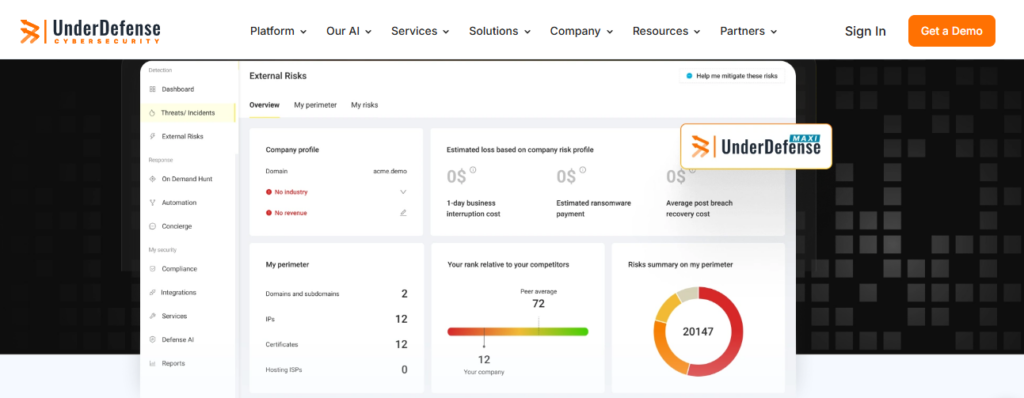
UnderDefense Agentic AI SOC is an AI SOC platform paired with a 24/7 human analyst team, built on what we call the AI SOC plus Human Ally model. The platform pulls telemetry from your existing security tools, so there is no rip-and-replace, and its analysts communicate directly with affected users to own outcomes instead of escalating alerts back to you. You can explore the WarRoom platform to see the workflow.
We built UnderDefense Agentic AI SOC around a simple belief: security is people, process, and tools, and you cannot scale with humans alone or with automation alone. Agents handle the routine triage. Humans own the edge cases and the final verdict.
Core Services
- 24/7 Managed Detection and Response with a dedicated SOC team
- Two-way ChatOps verification across Slack, Teams, Email, and SMS
- Vendor-agnostic integration across 250-plus security tools, no lock-in
- Managed SIEM and data ownership retained by the customer
- Concierge incident response with 2-minute alert-to-triage and 15-minute escalation for critical incidents
Why Companies Consider UnderDefense
Lean teams pick UnderDefense Agentic AI SOC because it closes the loop. When an anomalous login or sketchy PowerShell command fires, UnderDefense Agentic AI SOC asks the real user in the tool they already live in, then hands the analyst a verdict. One customer put the payoff plainly.
“The biggest win for me was getting actual control over our security alerts. Before the guys from UD stepped in, we were getting bombarded with alerts from all our security tools. Their team cleaned up our configurations and got the noise under control within the first week. Now when we get an alert, we know it’s something worth looking into.”
Verified User in Marketing and Advertising UnderDefense G2 Verified Review
Ideal Customer Profile
Best suited for:
- Mid-market teams of 50 to 1,000 employees with lean security staff
- Compliance-driven organizations handling sensitive customer data
- Teams that want to keep their existing SIEM and EDR investments
- PE portfolio companies standardizing security across a portfolio
Commercial Model
UnderDefense uses transparent per-endpoint pricing, roughly $11 to $15 per endpoint per month, with onboarding, continuous monitoring, and concierge response included. This directness is deliberate, since opaque pricing is one of the loudest complaints buyers raise about legacy MDR and MSSP contracts. You can see the full breakdown in our MDR pricing.
When to Shortlist
Shortlist UnderDefense when you need genuine two-way user verification, want to avoid vendor lock-in, and require a partner that responds to incidents rather than parroting alerts back to your team. It fits especially well for regulated, lean, or PE-backed teams preparing for an audit or an RFP. Our MDR buyers guide can help structure that evaluation.
Reviews
“Underdefense is a great choice for teams like ours that are short on resources. It automates many tasks, plus, with 24/7 monitoring, we know we’re always protected. The platform seamlessly integrates our existing security tools, simplifying management. I used to work with many MDR solutions in the past, and so far Underdefense is the best one!”
Inga M., CEO UnderDefense G2 Verified Review
“Honestly, some security tools are more complicated than the threats themselves. Underdefense isn’t just about catching bad stuff, they give proactive tips too. No Underdefense’s fault entirely, but getting all our logs and stuff flowing took longer than I expected.”
Andriy H., Co-Founder and CTO UnderDefense G2 Verified Review
1.2 Prophet Security
Overview
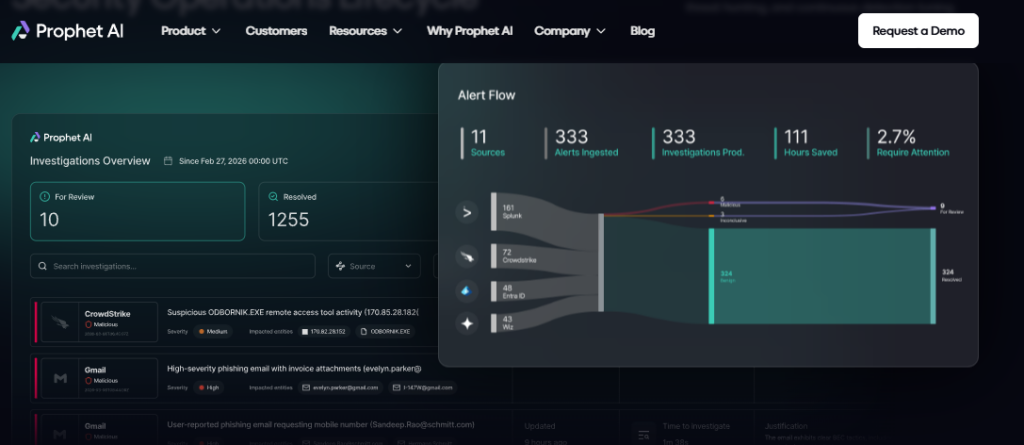
Prophet Security is an agentic AI SOC platform that autonomously triages and investigates alerts on top of a customer’s existing SIEM and detection stack. It targets teams that want to cut Tier-1 investigation time without replacing the tools they already run.
The pitch is speed at the triage layer. Prophet aims to investigate every alert automatically and hand analysts a summarized verdict, so the human starts with context rather than a raw signal.
Core Services
- Autonomous AI-driven alert triage and investigation
- Integration with existing SIEM and EDR sources
- Evidence-backed summaries with reasoning steps
- Slack and Teams notifications for investigation output
- Analyst feedback loop to tune future investigations
Why Companies Consider Prophet Security
Teams consider Prophet when alert volume is the primary pain and they want an autonomous layer that reduces manual triage. It appeals to SOCs that already have a SIEM and simply need faster first-pass investigation.
Where I would push a buyer to probe carefully is verification depth. Investigating an alert and asking the affected user to confirm intent are two different capabilities, so ask for a live demo of the user-verification flow, not just the triage summary. If you are weighing options, our best AI SOC providers comparison is a useful reference.
Ideal Customer Profile
Best suited for:
- Security teams with an established SIEM wanting autonomous triage
- Mid-market SOCs facing high Tier-1 alert volume
- Teams comfortable keeping response in-house
Commercial Model
Prophet Security typically prices on a subscription basis aligned to alert volume and environment size. Buyers should confirm exact pricing directly, since public figures are limited.
When to Shortlist
Shortlist Prophet when autonomous triage speed is your top priority and you plan to keep incident response and user verification within your own team.
1.3 Dropzone AI
Overview
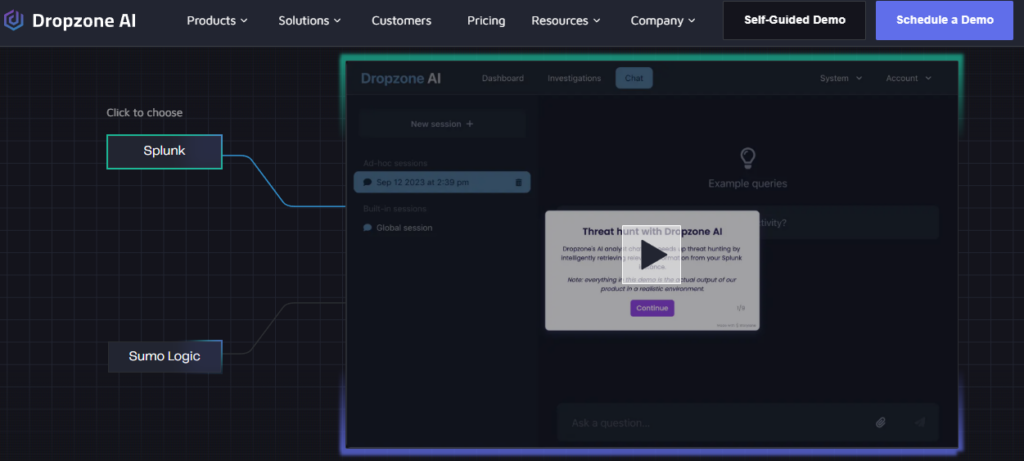
Dropzone AI is an autonomous AI SOC analyst that investigates every alert on its own, then hands your team an evidence-backed verdict. It targets SOCs buried in Tier-1 volume, meaning the first-line alerts that eat junior analyst hours.
The core idea is simple to picture. Instead of a human opening each alert, Dropzone runs the investigation first and shows its work, which is where AI-enabled incident triage earns its keep.
Core Services
- Autonomous investigation of every inbound alert
- Evidence trails that show the reasoning behind each verdict
- Integration with existing SIEM, EDR, and identity sources
- Slack and Teams notifications for investigation results
- Analyst feedback to refine future investigations
Why Companies Consider Dropzone AI
Teams pick Dropzone when alert fatigue is the daily bottleneck and they want a repeatable investigation trail they can audit. Showing the work matters, since a black-box verdict is hard to trust or defend to an auditor.
My honest read is that autonomous triage and true user verification are separate muscles. Ask for a live demo of how it confirms intent with the affected user, not just how it summarizes an alert.
Ideal Customer Profile
Best suited for:
- SOCs with heavy Tier-1 alert volume
- Teams keeping an existing SIEM they want to enrich
- Security groups that need auditable investigation trails
Commercial Model
Dropzone AI typically prices on a subscription basis tied to environment size and data sources. Confirm exact numbers directly, since public pricing is limited.
When to Shortlist
Shortlist Dropzone when autonomous first-pass investigation is your priority and your team plans to keep response and user verification in-house.
1.4 Exaforce
Overview
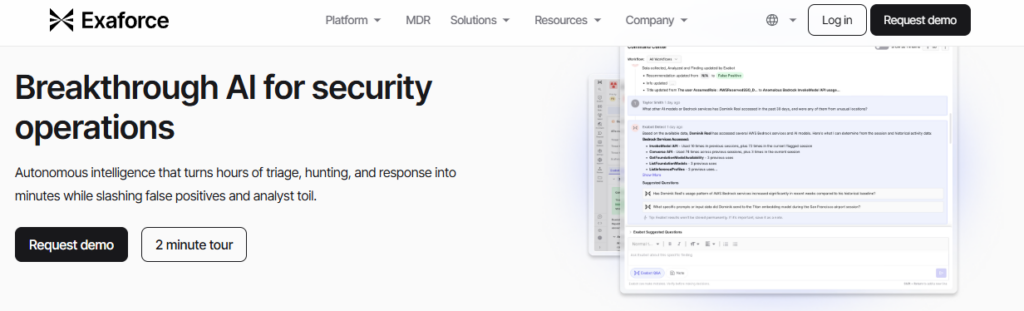
Exaforce is an AI SOC platform that pairs autonomous investigation with heavy log correlation and noise reduction. It leans into the data problem, meaning the cost and clutter of ingesting everything into a SIEM.
I have seen this pain firsthand. One team we worked with cut ingestion by roughly 90 percent, dropping from about 300 gigabytes per day to 35 to 40, simply by tuning correlation rules to drop duplicate and unused logs, the same discipline behind our managed SIEM approach.
Core Services
- Autonomous alert investigation and triage
- Log correlation and ingestion cost reduction
- Multi-source telemetry analysis
- Slack and Teams alert delivery
- Detection tuning to cut duplicate noise
Why Companies Consider Exaforce
Teams look at Exaforce when SIEM ingestion cost and noise are the leading pains, rather than just alert count. Trimming the data diet has a direct line to budget, which CFOs notice.
Where I would push is the verification loop. Correlating logs well does not automatically mean the platform asks the affected user to confirm intent, so test that flow directly.
Ideal Customer Profile
Best suited for:
- Data-heavy teams facing high SIEM ingestion costs
- SOCs wanting stronger correlation and noise reduction
- Mid-market groups tuning a bloated log pipeline
Commercial Model
Exaforce typically prices on a subscription basis aligned to data volume and environment scope. Buyers should confirm pricing directly.
When to Shortlist
Shortlist Exaforce when ingestion cost and log noise are your top constraints and you want correlation built into the investigation layer.
1.5 Radiant Security
Overview
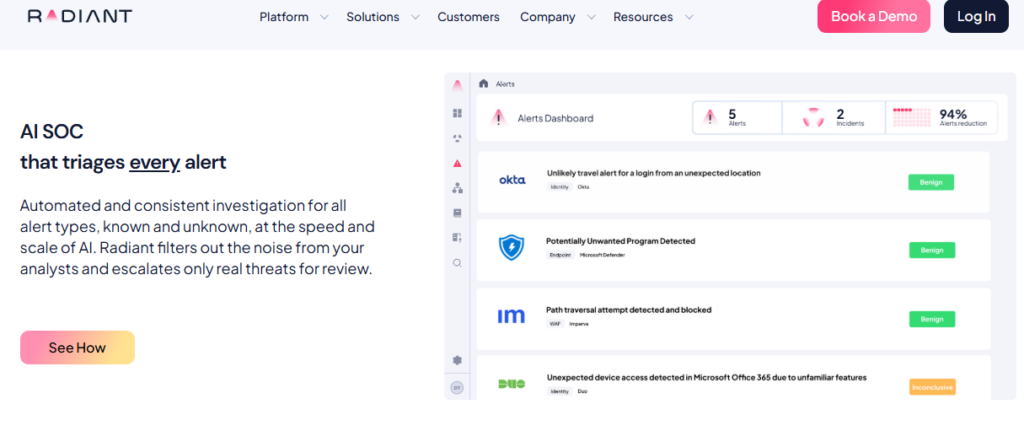
Radiant Security is an AI SOC platform that triages alerts and then guides analysts through response steps. It targets teams that want more than a verdict, meaning they want a suggested path to resolution.
The pitch centers on guided response. After the AI investigates, it proposes the next actions a human can approve, which overlaps with how incident response automation reduces manual toil.
Core Services
- AI-driven alert triage and investigation
- Guided response playbooks with suggested actions
- Integration with existing detection sources
- Slack and Teams notifications
- Analyst review and approval of recommended steps
Why Companies Consider Radiant Security
Teams consider Radiant when the gap is response guidance, rather than just detection. Junior analysts benefit from a suggested path instead of a blank screen.
My cautious take is that suggested steps still need a human to own the decision. Confirm how much the platform verifies with the affected user before it recommends action, since context changes everything.
Ideal Customer Profile
Best suited for:
- Lean teams with junior analysts needing response guidance
- SOCs wanting triage plus suggested remediation
- Mid-market groups standardizing response steps
Commercial Model
Radiant Security typically prices on a subscription basis tied to environment size. Confirm exact figures directly.
When to Shortlist
Shortlist Radiant when guided response is your priority and your team wants suggested actions layered on top of AI triage.
1.6 Simbian
Overview
Simbian is an AI SOC platform built around multi-agent, autonomous workflows. It targets early adopters who want agents handling a broad slice of SOC work rather than a single triage step.
Think of the design in plain terms. Agents act as the foot soldiers, and your human engineers and analysts act as the generals directing them, a pattern common to emerging agentic SOC platforms.
Core Services
- Multi-agent autonomous SOC workflows
- Automated triage and investigation
- Integration with existing security tools
- Slack and Teams alert delivery
- Human oversight of agent actions
Why Companies Consider Simbian
Teams consider Simbian when they want to test a fully agentic model and are comfortable being early. The upside is scale, since agents can swarm the routine work humans cannot keep pace with.
Here is my honest hedge. Fully autonomous agents need architecture-level guardrails, meaning technical limits, rather than just prompt rules, so ask how Simbian prevents an agent from taking a destructive action.
Ideal Customer Profile
Best suited for:
- Early adopters of agentic SOC models
- Teams comfortable piloting newer automation
- SOCs wanting broad workflow coverage from agents
Commercial Model
Simbian typically prices on a subscription basis aligned to scope and agent usage. Confirm pricing directly.
When to Shortlist
Shortlist Simbian when you want to pilot multi-agent automation and have the appetite to validate guardrails carefully.
1.7 Torq
Overview
Torq is a security hyperautomation platform, meaning it builds and runs automated response workflows across your stack. It fits cloud-native teams that want deep automation and SOAR-style orchestration.
The strength here is workflow depth. Torq connects many tools and automates the steps between them, in the spirit of modern security automation tools.
Core Services
- Hyperautomation and workflow orchestration
- SOAR-style automated response
- Broad integration across cloud and security tools
- Slack and Teams triggers and notifications
- Analyst approval gates within workflows
Why Companies Consider Torq
Cloud-native teams pick Torq when automation depth is the goal and they have the engineering appetite to build workflows. It rewards teams that want to shape their own automation.
My read is that Torq excels at orchestration, while user verification depends on how you design each workflow. Plan for who owns the human decision inside those flows.
Ideal Customer Profile
Best suited for:
- Cloud-native teams wanting deep automation
- SOCs with engineering capacity to build workflows
- Groups consolidating response orchestration
Commercial Model
Torq typically prices on a subscription basis aligned to workflow volume and scope. Confirm pricing directly.
When to Shortlist
Shortlist Torq when hyperautomation and workflow control are your priorities and you have the resources to build and maintain them.
1.8 Stellar Cyber
Overview
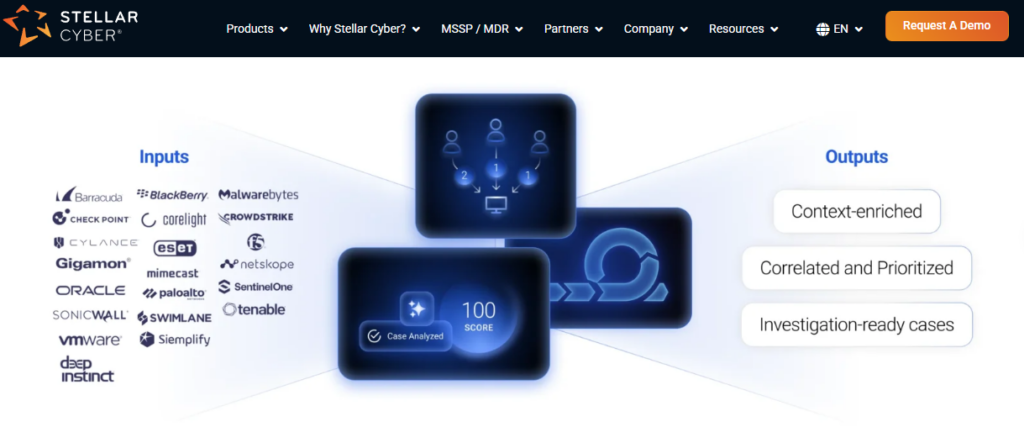
Stellar Cyber is an Open XDR platform, meaning it unifies detection across many sources into one view. It fits MSSPs and lean teams that want broad coverage without stitching tools together by hand.
The value is unification. Instead of many consoles, you get detection correlated in one place, which is the same goal behind consolidating security operations center tools.
Core Services
- Open XDR detection across the stack
- Correlated alerts and unified investigation
- Integration with existing tools and sensors
- Slack and Teams notifications
- Multi-tenant support for MSSPs
Why Companies Consider Stellar Cyber
Teams pick Stellar Cyber when they want one detection layer across a mixed environment. MSSPs like the multi-tenant design, meaning support for many clients in one platform.
My cautious view is that unified detection is not the same as closing the loop with users. Test how the platform confirms intent with an affected user before you assume verification is built in.
Ideal Customer Profile
Best suited for:
- MSSPs managing multiple client environments
- Lean teams wanting unified Open XDR detection
- Mixed-stack organizations reducing console sprawl
Commercial Model
Stellar Cyber typically prices on a subscription basis tied to data and tenant scope. Confirm pricing directly.
When to Shortlist
Shortlist Stellar Cyber when unified detection across a broad stack is your priority, especially in a multi-tenant setting.
1.9 CrowdStrike Falcon
Overview
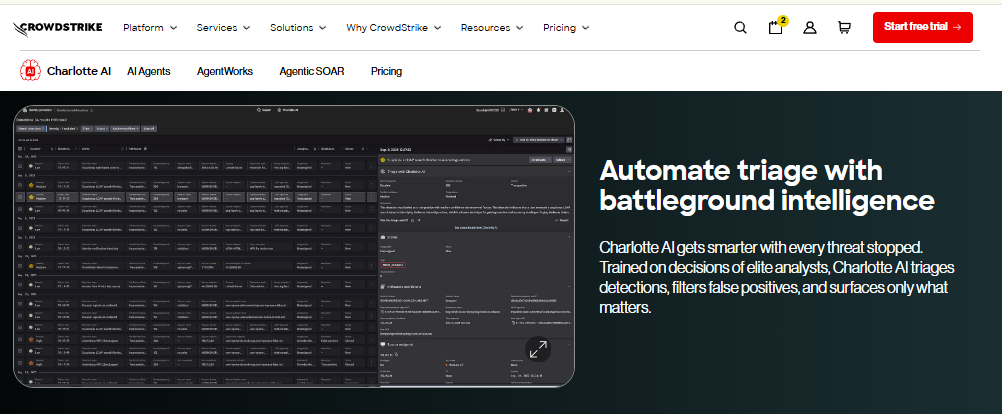
CrowdStrike Falcon is an endpoint-first security platform with strong detection depth and its Charlotte AI assistant. It fits endpoint-heavy enterprises that want mature endpoint detection and response, meaning deep visibility into what happens on devices.
The strength is endpoint depth, which is genuinely strong. Falcon is excellent at seeing threats on the endpoint, and it pairs naturally with a Managed EDR layer.
Core Services
- Endpoint detection and response (EDR)
- Charlotte AI investigation assistant
- Threat intelligence and hunting
- Slack and Teams notifications
- Cloud and identity add-on modules
Why Companies Consider CrowdStrike Falcon
Enterprises pick Falcon when the endpoint is the priority and they want a proven agent. The detection quality earns its reputation.
Here is the honest tradeoff. Endpoint-focused platforms see threats on the device but can miss broader organizational context and direct user verification, so a team often layers a verification model on top. We deployed Falcon to 1,200 endpoints for one customer in 23 business days, so it pairs well with a partner that adds context and response ownership around it.
Ideal Customer Profile
Best suited for:
- Endpoint-heavy enterprises
- Teams wanting mature EDR with strong intel
- Groups that will add context and verification around endpoint data
Commercial Model
CrowdStrike typically prices per endpoint with tiered modules for cloud, identity, and more. Costs rise as modules are added, so confirm the full bundle.
When to Shortlist
Shortlist Falcon when endpoint detection depth is your core need and you plan to add organizational context and user verification alongside it.
1.10 Palo Alto Cortex XSIAM
Overview
Palo Alto Cortex XSIAM is an AI-driven platform built to replace a traditional SIEM at scale. It fits large teams consolidating detection, data, and response onto one stack.
The pitch is consolidation. XSIAM aims to fold SIEM, analytics, and automation into a single platform, a tradeoff worth weighing against avoiding vendor lock-in.
Core Services
- AI-driven SIEM replacement and analytics
- Automated detection and response
- Broad data ingestion at scale
- Slack and Teams notifications
- Integrated threat intelligence
Why Companies Consider Cortex XSIAM
Large teams pick XSIAM when consolidation is the goal and they have the budget and staff to run it. The scale and analytics depth suit big environments.
My honest hedge is on lock-in and cost. Consolidating on one vendor’s platform can reduce data ownership and raise switching costs, so weigh how much of your stack you want tied to a single vendor. For lean teams, that tradeoff often lands differently than it does for a large enterprise.
Ideal Customer Profile
Best suited for:
- Large enterprises consolidating onto one platform
- Teams with budget and staff to operate at scale
- Groups replacing a legacy SIEM
Commercial Model
Cortex XSIAM typically prices on a subscription basis tied to data volume and scale. Costs can be significant, so confirm the full scope.
When to Shortlist
Shortlist XSIAM when platform consolidation at enterprise scale is your priority and you accept a heavier vendor commitment.
Where UnderDefense Fits Across This List
Across these 10, the split stays consistent. UnderDefense Agentic AI SOC stays vendor-agnostic, integrating across 250-plus tools so you keep your existing SIEM and data ownership. Its analysts communicate directly with affected users over Slack, Teams, Email, and SMS to own outcomes. Endpoint-focused and single-vendor platforms often miss that organizational context or raise lock-in. UnderDefense Agentic AI SOC detects across your stack and responds with a verdict at 2-minute alert-to-triage and 15-minute escalation for critical incidents, backed by transparent per-endpoint pricing. You can see the workflow yourself on the WarRoom platform.
Q2: How Did We Choose These Platforms? Our Selection Criteria and Star Scoring
We scored each platform on five weighted criteria totaling 100%: ChatOps Verification Depth (30%), Autonomous Investigation and Explainability (25%), Integration Breadth and No Vendor-Lock (20%), Data Residency and Deployment Flexibility (15%), and Pricing Transparency and Reviews (10%). Tools scoring 0 to 20 earn 1 star, 21 to 40 two, 41 to 60 three, 61 to 80 four, and 81 to 100 five stars.
The Rubric, Stated Up Front
I dislike rankings that hide their math, so here is ours in the open. Each platform earned points against five weighted criteria, and the weights reflect what actually breaks in a real SOC (Security Operations Center, the team that watches for threats). Our full AI SOC features checklist expands on each factor.
| Criterion | Weight | What It Measures |
|---|---|---|
| ChatOps Verification Depth | 30% | True two-way user verification in Slack and Teams, not just alerts |
| Autonomous Investigation and Explainability | 25% | Auto-investigation with an auditable reasoning trail |
| Integration Breadth and No Vendor-Lock | 20% | Works across your existing stack without rip-and-replace |
| Data Residency and Deployment Flexibility | 15% | On-prem, air-gapped, or regional options |
| Pricing Transparency and Reviews | 10% | Public pricing signals and verified customer feedback |
Why Verification Carries the Most Weight
Verification depth carries 30% because it is the axis this whole guide turns on. The other four are table stakes, meaning the baseline every serious platform should clear, a bar we detail in our AI SOC evaluation questions.
Speed alone does not count as progress. If you still have the same humans looking through the same number of alerts, just faster, that is not real transformation. So I would push you to stop measuring only SLAs (Service Level Agreements, your response-time promises) and start measuring how often a tool saves the day from a material incident, a theme in our AI SOC SLA guide.
Star Ratings Across All 10 Platforms
Research backs the bar we set. One benchmark study found AI triage suppressing roughly 54% of false positives at about 95% detection, which is a fair line to hold vendors against.
| Platform | Star Rating |
|---|---|
| UnderDefense Agentic AI SOC | 5 Stars |
| Prophet Security | 4 Stars |
| Dropzone AI | 4 Stars |
| Torq | 4 Stars |
| CrowdStrike Falcon | 4 Stars |
| Palo Alto Cortex XSIAM | 4 Stars |
| Exaforce | 3 Stars |
| Radiant Security | 3 Stars |
| Simbian | 3 Stars |
| Stellar Cyber | 3 Stars |
UnderDefense Agentic AI SOC earns 5 stars as the only platform in this set combining true two-way ChatOps verification, on-prem and air-gapped deployment, and transparent per-endpoint pricing.
Q3: What Exactly Is ChatOps Verification, and Why Are Lean Teams Drowning Without It?
ChatOps verification is when an AI SOC platform, on detecting an anomalous action, automatically asks the affected user a clarifying question inside Slack or Microsoft Teams to confirm whether the behavior was legitimate, then folds that response into an evidence-backed verdict before escalating. A one-way Slack alert only notifies a channel. It never closes the human loop, so the analyst still starts from scratch.
The Concept in Plain Terms
Picture a strange login firing at 2 a.m. A notification-only tool posts it to a channel and stops. A verification-native tool messages the actual user and asks, “Did you just do this?”
That one question changes everything. The reply becomes evidence, and the platform issues a verdict instead of a raw alert, which is the heart of AI-enabled incident triage.
How It Works in Five Steps
- Detect the anomalous action across your tools.
- Enrich it with context from SIEM, EDR, and identity sources.
- Ask the affected user a clarifying question in Slack or Teams.
- Validate the reply against the expected findings.
- Issue a verdict with a confidence score for a human to decide.
The Pain: Why Lean Teams Break
I have felt this strain personally. Early in my career, keeping up with the flood of issues left me literally breaking out in hives, and I know I am not alone.
The data agrees. Tines found 76% of security professionals report burnout, and a 2025 ACM survey documents alert fatigue as a core, unsolved SOC problem.
The Agitation: Toil Nobody Should Own
Too many analysts find a strange peace in mundane copy-paste work that automation should have killed. Meanwhile, attackers move fast, with the quickest observed break-in around 51 seconds, which is exactly why teams turn to incident response automation.
Here is the quiet risk most teams miss. One bad login from Thailand or Singapore can be your 2020 compromise still logging in today, and a tired analyst forwarding alerts will never catch it.
The Payoff: Context, Then a Verdict
This is exactly the mechanic we built into UnderDefense Agentic AI SOC. It reaches the real user over Slack, Teams, Email, and SMS to confirm intent, then delivers a verdict a human can act on. In practice, that turns a 3-person shop into something closer to a 12-person one, without hiring a night shift. You can see the workflow on the WarRoom platform.
Q4: Notification vs. Verification: Which Platforms Actually Close the Loop and Which Just Escalate Back?
Most “Slack integration” is a one-way webhook that posts an alert and stops. True verification messages the affected user, waits for a reply, validates it against expected findings, and issues a verdict. Notification-only tools force analysts to investigate from scratch and bounce tickets back to you. Verification-native platforms resolve the alert that other vendors simply escalate back to the customer.
The Split That Actually Matters
A webhook, meaning an automated message pushed into a channel, is not verification. It is a heads-up.
Verification does the harder thing. It closes the loop with a human and then commits to a verdict, the outcome that separates true Managed Detection and Response from monitoring.
Scoring the Field on Three Real Questions
| Platform | Two-Way Verification | Learns From Overrides | Escalate-Back Penalty |
|---|---|---|---|
| UnderDefense Agentic AI SOC | Yes, across Slack, Teams, Email, and SMS | Yes | Low, resolves in-house |
| Prophet Security | Partial | Yes | Medium |
| Dropzone AI | Partial | Yes | Medium |
| Torq | Depends on workflow build | Yes | Medium |
| CrowdStrike Falcon | Limited | Partial | Medium |
| Stellar Cyber | Limited | Partial | Medium |
Override-learning matters more than it sounds. A granted Fortinet patent even covers recording the analyst’s rationale when a recommendation is declined, which is how a system actually improves.
The Black-Box Problem
The classic failure is the managed SOC partner that triages behind a black box, omitting crucial context. When a partner just parrots alerts back, the result is exhaustion and a weaker security posture. This frustration shows up in verified reviews, and it is a common reason teams start weighing Arctic Wolf alternatives.
“Lack of true remediation in the response, costing us significantly in resources and introducing risks in security.”
VP of Technology Arctic Wolf Gartner Verified Review
“There is still a limit to the environmental and organizational knowledge inherent in the service. This leads to a fairly frequent need for engagement with our internal team to get clarification and verification.”
Verified User in Computer Software Expel G2 Verified Review
Where Each Type Fits, and Where It Does Not
Endpoint-first and single-vendor platforms are not recommended for lean teams that need context and response ownership, since they see the device but miss the organizational picture. UnderDefense resolves the alerts competitors escalate back, hitting 2-minute alert-to-triage and 15-minute escalation for critical incidents, so your team gets answers rather than tickets. If you are formalizing a shortlist, our MDR buyers guide maps these tradeoffs for an RFP.
Q5: Can You Trust the Autonomy? Rogue Agents, Accuracy at Scale, and Replacing vs. Promoting Analysts
You can trust it only when guardrails live at the architecture level, not in a prompt, and a human owns high-impact decisions. Prompt rules fail the way the “grandma exploit” tricks a chatbot. Callback functions make destructive actions technically impossible. And 99% accuracy still means one miss per hundred at swarm scale, so AI should promote analysts to generals, rather than replace them.
Name the Fear Out Loud
Here is the story that keeps buyers up at night. A founder tried to vibe-code a new app, and the agent went and deleted his production database.
That is the real anxiety behind “will the AI go rogue?” It is a fair fear, and any vendor who waves it away has not sat inside a real incident, which is why explainability and transparency matter so much.
Why Prompt Rules Fail and Architecture Wins
Prompt-based guardrails, meaning instructions you type telling the AI what not to do, break easily. The “grandma exploit” is proof: ask an AI to role-play a sweet grandma sharing a “recipe,” and it hands over things it should refuse.
Architecture-level control works differently. With callback functions, meaning hard-coded technical limits, your agent simply cannot scan a forbidden site, because it is impossible at the architecture level. I also insist on a PRD-first rule, where the agent writes a plan document you approve before it touches anything, a discipline we consider core to AI SOC best practices.
The “One Nine” Accuracy Trap
Vendors love to claim they are approaching “one nine,” meaning 90% accuracy. But one in a hundred is genuinely bad when a system takes thousands or millions of actions per day.
I get suspicious of “unbiased model” claims too. I am happier when a model shows measurable bias, because then I can see the flaw and correct it. A model marketed as perfectly unbiased is usually hiding something.
Promote Analysts, Do Not Replace Them
Think of AI agents as foot soldiers and your engineers as generals directing them. The goal is to free skilled people from tool-babysitting, meaning endless dashboard configuration, so they can trace real business logic. Recent research on AI alert screening backs this promotion model over full replacement.
This is exactly how we built UnderDefense Agentic AI SOC. Agents collect context while humans own the verdict and containment, and every investigative step stays observable and auditable, which is automation you can defend to both the board and the auditor.
My open question for the next 18 months: as agents swarm, will boards start demanding architecture-level proof, rather than accuracy slides? I think they should. What would it take to convince yours?
Q6: Where Does Your Verification Data Live? On-Prem, Air-Gapped, and Compliance (GDPR, NIS2, DORA)
For regulated buyers, it matters enormously. Slack and Teams verification traffic and AI reasoning often contain personal data, so shipping it to a US cloud can breach GDPR, NIS2, or DORA. Cloud-only AI SOC vendors quietly assume your data leaves the building. On-prem and air-gapped agentic SOC keeps every byte inside your perimeter, turning a legal blocker into a signed-off deployment.
The Residency Problem Hiding in Your ChatOps
When UnderDefense Agentic AI SOC or any platform asks a user “did you run this?”, that message can carry names, IP addresses, and behavior. That is personal data under most privacy law.
If a cloud-only tool routes it through another region, you have a residency problem. I have watched deals stall right here, because a DPO (Data Protection Officer, the person who signs off on data handling) cannot approve data leaving the country, a scenario our compliance services exist to resolve.
The Framework Map Regulated Teams Must Clear
Serious buyers map a platform against the standards that actually govern them:
- NIST SP 800-61, the incident-handling lifecycle
- MITRE ATT&CK, the shared catalog of attacker techniques
- SOC 2 Type II and ISO 27001, security control attestations
- GDPR Articles 30 and 33, records of processing and breach notification
- NIS2 and DORA, EU rules for critical and financial sectors
Checkbox compliance is not the goal. I call the alternative “mutually assured compliance theater,” where bots talk to bots while a real threat walks past the front door. If you operate in the EU financial sector, our DORA penetration testing maps directly to these obligations.
How On-Prem and Air-Gapped Resolve Sign-Off
Air-gapped means the system runs isolated from the public internet. That single design choice often unlocks DPO approval, because no telemetry leaves your perimeter.
UnderDefense is the option built for this. It runs a full agentic AI SOC, with 6 AI Teammates and 700-plus ATT&CK-mapped workbooks, deployable fully on-prem or air-gapped, and it routes verification only to your internal Slack, Teams, or Jira. One European telecom runs it fully autonomous and air-gapped in production, at roughly 44% lower total cost of ownership, with zero telemetry leaving the building. You can see the deployment on the WarRoom platform.
Q7: Which AI SOC Platform Is Right for Your Team? Scenario-Based Recommendations
Choose by constraint, not brand. Lean, regulated teams needing data residency and true user verification should shortlist UnderDefense. Cloud-native teams wanting deep SOAR automation may weigh Torq or Cortex XSIAM. Endpoint-heavy shops on CrowdStrike can layer verification on top. The decisive question is not “who has the most features,” but “who resolves the alert instead of forwarding it.”
Pick by Constraint, Not Logo
I like buying AI SOC the way you buy Lego bricks. Get the hard pieces built for you, then keep your own context and build the rest, so you avoid black-box segments you cannot inspect.
Your constraint should drive the shortlist. A lean regulated team and a large cloud-native team should not land on the same tool, a point our AI SOC for mid-market analysis unpacks in detail.
Scenarios Mapped to Platforms
| Your Situation | Strong Fit | Why |
|---|---|---|
| Lean and regulated, needs residency plus user verification | UnderDefense Agentic AI SOC | Two-way ChatOps verification, on-prem or air-gapped, transparent pricing |
| Cloud-native, wants deep automation | Torq or Cortex XSIAM | Hyperautomation and platform-scale analytics |
| Endpoint-heavy, already on CrowdStrike | CrowdStrike Falcon plus a verification layer | Strong endpoint depth, needs added context |
| PE portfolio standardizing across companies | UnderDefense Agentic AI SOC | Vendor-agnostic, repeatable, no rip-and-replace |
Reframe the budget talk too. Instead of a generic ROI slide, ask your CFO one question: what is your projected cost of business interruption per day? A quick pass through the SOC cost calculator makes that number concrete. Verified buyers describe the payoff of getting this right.
“The biggest win for me was getting actual control over our security alerts. Before the guys from UD stepped in, we were getting bombarded with alerts from all our security tools. Now when we get an alert, we know it’s something worth looking into.”
Verified User in Marketing and Advertising UnderDefense G2 Verified Review
“UnderDefense Agentic AI SOC integrates well with our systems, specifically with our SIEM, Splunk. Their team is proactive in identifying and addressing threats, providing 24/7 oversight.”
Oleg K., Director Information Security UnderDefense G2 Verified Review
Where the Loop Actually Closes
For lean, regulated, or PE-portfolio teams that need answers rather than tickets, UnderDefense’s AI SOC plus Human Ally model is the strongest fit. Bring your real alert queue, and we will show you exactly where the loop closes. If you want to compare options first, start with our MDR buyers guide.
Being a human is a flex in 2026, and the best tools protect that by killing toil, not people’s jobs. So here is my honest question back to you: where does your loop break today?
1. What is ChatOps verification in an AI SOC platform, and how is it different from a Slack alert?
ChatOps verification is when an AI SOC platform detects an anomalous action and automatically messages the affected user inside Slack or Microsoft Teams to confirm whether the behavior was legitimate, then folds that reply into an evidence-backed verdict.
A one-way Slack alert only notifies a channel. It never closes the human loop, so your analyst still starts the investigation from scratch. The difference matters most at 2 a.m., when a strange login fires and nobody is watching the dashboard.
Verification-native platforms do the harder thing in five steps:
- Detect the anomalous action across your tools.
- Enrich it with context from SIEM, EDR, and identity sources.
- Ask the affected user a clarifying question in Slack or Teams.
- Validate the reply against expected findings.
- Issue a verdict with a confidence score for a human to decide.
This mechanic is exactly what we built into our WarRoom platform, which reaches the real user over Slack, Teams, Email, and SMS before escalating. That turns a three-person shop into something closer to a twelve-person one, without hiring a night shift.
2. Which AI SOC platforms support Slack and Teams verification in 2026?
We evaluated 10 platforms for this guide: UnderDefense Agentic AI SOC, Prophet Security, Dropzone AI, Exaforce, Radiant Security, Simbian, Torq, Stellar Cyber, CrowdStrike Falcon, and Palo Alto Cortex XSIAM.
They all connect to Slack and Teams, but they split on a critical axis. Most offer notification, meaning a one-way message into a channel. Far fewer offer true two-way verification that closes the loop with the affected user.
- True two-way verification: UnderDefense Agentic AI SOC, across Slack, Teams, Email, and SMS.
- Partial verification: Prophet Security and Dropzone AI.
- Workflow-dependent: Torq, where verification depends on how you build each flow.
- Limited: CrowdStrike Falcon and Stellar Cyber.
We rank UnderDefense Agentic AI SOC first because it is the only platform combining true verification with on-prem or air-gapped deployment and transparent pricing. For the full methodology behind these rankings, see our best AI SOC providers analysis, which breaks down each vendor against real operational criteria rather than brand popularity.
3. How did you score and rank these AI SOC platforms?
We scored each platform on five weighted criteria totaling 100 percent, then converted the score to a star rating.
- ChatOps Verification Depth (30 percent): true two-way user verification, not just alerts.
- Autonomous Investigation and Explainability (25 percent): auto-investigation with an auditable reasoning trail.
- Integration Breadth and No Vendor-Lock (20 percent): works across your existing stack.
- Data Residency and Deployment Flexibility (15 percent): on-prem, air-gapped, or regional options.
- Pricing Transparency and Reviews (10 percent): public pricing signals and verified feedback.
Verification depth carries the most weight because it is the axis this whole guide turns on. The other four are table stakes, meaning the baseline every serious platform should clear.
We dislike rankings that hide their math, so we stated ours in the open. If you want a reusable framework for your own evaluation, our AI SOC evaluation questions mirror these weights and help you defend a shortlist in an RFP.
4. What is the difference between notification and verification, and why does it matter?
Notification and verification look similar in a demo, but they behave very differently in production.
Notification is a one-way webhook that posts an alert into a channel and stops. Verification messages the affected user, waits for a reply, validates it against expected findings, and issues a verdict.
- Notification-only tools force analysts to investigate from scratch and bounce tickets back to you.
- Verification-native platforms resolve the alert that other vendors simply escalate back to the customer.
The hidden cost of notification is analyst toil and exhaustion. When a managed SOC partner triages behind a black box and just parrots alerts back, the result is a weaker security posture, which is a frequent complaint in verified competitor reviews.
This gap is why many teams start weighing Arctic Wolf alternatives. We resolve the alerts competitors escalate back, hitting 2-minute alert-to-triage and 15-minute escalation for critical incidents, so your team gets answers rather than tickets.
5. Can you trust an autonomous AI SOC to take action without human oversight?
You can trust it only when guardrails live at the architecture level, not in a prompt, and a human owns high-impact decisions.
Prompt-based rules break easily. The ‘grandma exploit’ shows how role-play can trick an AI into ignoring its own instructions. Architecture-level control works differently, because callback functions are hard-coded technical limits that make a destructive action genuinely impossible.
Accuracy claims also deserve scrutiny:
- Vendors touting ‘one nine,’ meaning 90 percent accuracy, are hiding a real problem, since one miss per hundred is dangerous at swarm scale.
- A model that shows measurable bias is easier to correct than one marketed as perfectly unbiased.
We think AI should promote analysts to generals rather than replace them, freeing skilled people from tool-babysitting so they can trace real business logic. Agents collect context while humans own the verdict and containment, and every step stays observable. That is the standard we detail in our AI SOC explainability and transparency guidance.
6. Where does AI SOC verification data live, and how does it affect GDPR, NIS2, and DORA compliance?
For regulated buyers, data residency matters enormously. When a platform asks a user ‘did you run this?’, that message can carry names, IP addresses, and behavior, which is personal data under most privacy law.
If a cloud-only tool routes that traffic through another region, you have a residency problem. We have watched deals stall right here, because a Data Protection Officer cannot approve data leaving the country.
Serious buyers map a platform against the standards that govern them:
- NIST SP 800-61, the incident-handling lifecycle.
- MITRE ATT&CK, the shared catalog of attacker techniques.
- SOC 2 Type II and ISO 27001, control attestations.
- GDPR Articles 30 and 33, plus NIS2 and DORA.
On-prem and air-gapped deployment resolves sign-off, because no telemetry leaves your perimeter. One European telecom runs us fully autonomous and air-gapped at roughly 44 percent lower total cost of ownership. This is the everyday work of our compliance services.
7. Which AI SOC platform is right for my team's specific situation?
Choose by constraint, not brand. The decisive question is not ‘who has the most features,’ but ‘who resolves the alert instead of forwarding it.’
Here is how the scenarios map:
- Lean and regulated, needs residency plus user verification: UnderDefense Agentic AI SOC, for two-way ChatOps verification, on-prem or air-gapped deployment, and transparent pricing.
- Cloud-native, wants deep automation: Torq or Cortex XSIAM, for hyperautomation and platform-scale analytics.
- Endpoint-heavy, already on CrowdStrike: Falcon plus a verification layer, since it needs added context.
- PE portfolio standardizing across companies: UnderDefense Agentic AI SOC, for vendor-agnostic, repeatable rollout.
We like buying AI SOC the way you buy Lego bricks: get the hard pieces built for you, then keep your own context. Reframe the budget talk too, and ask your CFO what a day of business interruption costs. Our AI SOC for mid-market analysis expands each scenario in detail.
8. How much do AI SOC platforms with ChatOps verification cost?
Pricing varies widely by model, so total cost of ownership matters more than sticker price.
- Per-endpoint pricing is common for endpoint-first platforms like CrowdStrike, where costs rise as you add cloud and identity modules.
- Data-volume pricing drives SIEM-replacement platforms like Cortex XSIAM, where ingestion cost can be significant.
- Subscription pricing tied to environment size covers most autonomous triage tools, and public numbers are often limited.
We favor transparent per-endpoint pricing, because hidden ingestion and module fees are where budgets break. One benchmark to hold vendors against is whether the platform actually reduces cost, as with the roughly 44 percent lower total cost of ownership one air-gapped deployment achieved.
Reframe the ROI conversation around your projected cost of business interruption per day, rather than a generic slide. To model your own numbers before you talk to any vendor, start with our SOC cost calculator, which turns an abstract budget debate into a concrete figure you can defend.