




Q1. What are the 10 Best AI SOC Platforms that let you own your own SIEM Data Lake in 2026?
The 10 best AI SOC platforms that keep data in your own lake in 2026 are UnderDefense Agentic AI SOC, Microsoft Sentinel, Splunk (Cisco), Google SecOps, CrowdStrike Falcon Next-Gen SIEM, Palo Alto Cortex XSIAM, Exabeam New-Scale, Securonix, SentinelOne AI SIEM, and Panther. They differ most on one axis: whether the agentic AI runs against a data lake you own, on-prem, air-gapped, or in your own cloud, or forces your telemetry into a vendor black box.
See how the UnderDefense Agentic AI SOC investigates, triages, and resolves real alerts.
The Real Trap Nobody Puts in the Datasheet
I have watched a two-person security team stand up a SIEM for the first time and start breaking out in hives from the alert volume. That part is hard, but survivable. The part that quietly wrecks you comes two years later, at renewal.
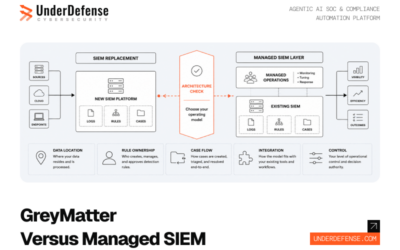
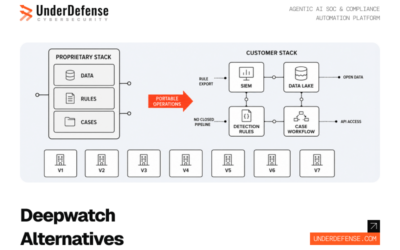
Here is what I have seen again and again. When a team makes a vendor switch, the business logic, the correlation rules, and the automation rules do not come with them. You rebuild everything from scratch. Your logs trained someone else’s model, and now that model walks out the door. This is exactly the scenario our guide on avoiding SIEM vendor lock-in was written to help teams sidestep.
That is the structural trap this list is built to expose. The question underneath “which AI SOC is best” is really this: how do I buy 24/7 AI-driven protection without surrendering sovereignty, predictable cost, or control of my own data?
A CISO once described what he actually wanted on a call with us. He said he wanted all the Lego bricks that make up the hard parts of an AI SOC, then the freedom to build his own platform on top. He did not want the black-box segment. That is the lens I used to rank every platform below.
The 10 Platforms, Ranked by Data Ownership
Each verdict below is about one thing: where your data lives, and who really controls it.
- UnderDefense Agentic AI SOC: Owns your lake fully. The only agentic AI SOC I have seen run on-prem or fully air-gapped, keeping logs and AI processing inside your walls.
- Microsoft Sentinel: Cloud-native data lake with 12-year retention and open Parquet format, but it lives in Azure, not on your own hardware.
- Splunk (Cisco): Powerful lake, but historically tied to ingestion-based pricing that punishes data volume.
- Google SecOps: Massive scale and cheap retention, yet your telemetry sits in Google’s cloud.
- CrowdStrike Falcon Next-Gen SIEM: Endpoint-strong, but the lake is CrowdStrike’s, and network plus SaaS context can lag.
- Palo Alto Cortex XSIAM: Strong automation, though it leans toward replacing your existing stack.
- Exabeam New-Scale: Good analytics lake, cloud-hosted, with limited on-prem flexibility.
- Securonix: Bring-your-own-cloud on Snowflake, so you can hold the storage layer yourself.
- SentinelOne AI SIEM: Singularity Data Lake is fast, but it remains a vendor-owned store.
- Panther: Detection-as-code on your own S3, strong for engineering-led teams that want ownership.
Master Comparison: Who Really Owns the Data
Read this table by starting with your hardest constraint, then scanning across. If you want a deeper framework, our rundown of the best AI SOCproviders expands on each vendor.
| Platform (Rating) | Owns Own Data Lake | On-Prem / Air-Gap | BYO AI Model | Works With Existing SIEM |
|---|---|---|---|---|
| UnderDefense Agentic AI SOC⭐⭐⭐⭐⭐ | Full (your cloud, on-prem, air-gapped) | Yes | Yes | Splunk, Sentinel, Chronicle, QRadar, Elastic |
| Microsoft Sentinel ⭐⭐⭐⭐ | Azure-hosted lake | Cloud-only | Limited | Microsoft-centric |
| Splunk (Cisco) ⭐⭐⭐⭐ | Vendor store | On-prem option | Limited | Splunk-centric |
| Google SecOps ⭐⭐⭐⭐ | Google cloud | Cloud-only | Gemini-tied | Partial |
| CrowdStrike Falcon ⭐⭐⭐⭐ | Vendor lake | Cloud-only | No | Endpoint-first |
| Palo Alto Cortex XSIAM ⭐⭐⭐⭐ | Vendor lake | Cloud-only | Limited | Rip-and-replace lean |
| Exabeam New-Scale ⭐⭐⭐ | Vendor lake | Cloud-only | No | Partial |
| Securonix ⭐⭐⭐⭐ | BYOC on Snowflake | Limited | Limited | Yes |
| SentinelOne AI SIEM ⭐⭐⭐⭐ | Singularity lake | Cloud-only | No | Endpoint-first |
| Panther ⭐⭐⭐ | Your own S3 | Cloud-native | Limited | Yes |
How to Read This Table Against Your Own Constraint
Start with the column that is non-negotiable for you. If logs cannot legally leave your jurisdiction, the On-Prem / Air-Gap column filters your shortlist in seconds. If you already own Splunk or Sentinel, the last column matters most, because rip-and-replace burns budget you do not need to spend. Teams weighing this trade-off often start with our walkthrough of running an AI SOC on your existing SIEM.
My honest read is that most buyers over-index on AI features and under-index on ownership. The features converge within 18 months. The data-control decision follows you for years.
Where UnderDefense Fits
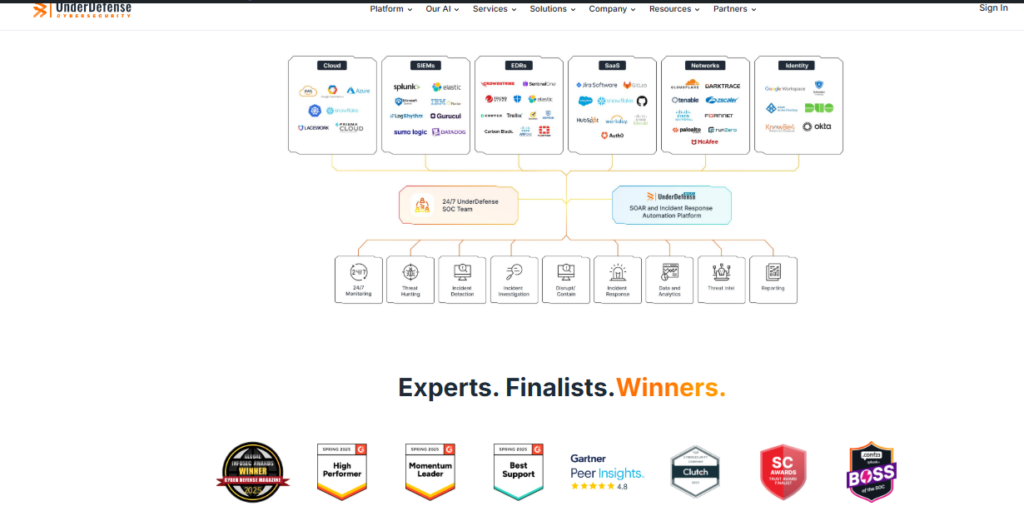
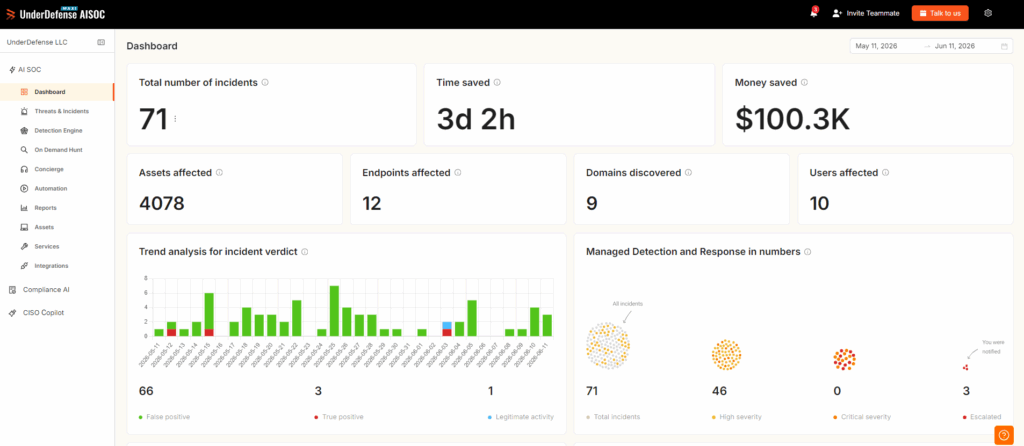
At UnderDefense, we built Agentic AI SOC around a single principle: your logs and AI data stay in your data lake. The platform ships with over 700 MITRE ATT&CK-mapped investigation workbooks that encode our SOC analysts’ real playbooks. It runs six AI Teammates with 200-plus agent skills on top of the SIEM you already own, so you keep your correlation rules instead of rebuilding them at renewal. You can explore the UnderDefense Agentic AI SOC platform or book a demo to see it against your own logs.
1.1 UnderDefense Agentic AI SOC, Best for Teams That Need a Full Agentic AI SOC Without Giving Up Data Ownership
Overview
UnderDefense Agentic AI SOC is an agentic AI SOC platform paired with a human analyst team, built for organizations that want 24/7 AI-driven detection and response without surrendering control of their data. The platform runs on top of your existing security stack, so you keep your logs, correlation rules, and data lake instead of migrating into a proprietary store. In 2026, UnderDefense launched what it describes as an on-premise agentic AI SOC, shipping with over 700 MITRE ATT&CK-mapped investigation workbooks that encode its analysts’ real playbooks.
Core Services
- Agentic AI SOC with six AI Teammates and 200-plus agent skills that investigate alerts autonomously
- 24/7 Managed Detection and Response with concierge human analyst support
- On-prem, air-gapped, or bring-your-own-cloud deployment that keeps data in your lake
- Vendor-agnostic integration across Splunk, Sentinel, Chronicle, QRadar, and Elastic
- Incident response, threat hunting, and compliance reporting (SOC 2, ISO 27001, and HIPAA)
Why Companies Consider UnderDefense
Most mid-market teams cannot hire a 24/7 SOC in today’s market, and building one is slow and expensive, which is why our AI SOC build-vs-buy analysis resonates with lean teams. Reviewers repeatedly point to two things: the platform layers onto tools they already trust, and the SOC team sends context, not just raw alerts. One reviewer noted the team cleaned up their alert noise within the first week and never asked them to rip and replace anything.
Ideal Customer Profile
Best suited for:
- Mid-market and scaling technology companies (roughly 50 to 1,000 employees)
- Regulated organizations in healthcare, finance, and PE portfolio companies
- Security-lean teams needing 24/7 coverage without a full internal build
- Buyers with data-residency or air-gap constraints
Commercial Model
UnderDefense uses transparent per-endpoint pricing, typically in the range of $11 to $15 per endpoint per month, with onboarding support and ongoing analyst advisory included. This contrasts with the ingestion-based models that make costs spike as data volume grows. You can compare figures in our AI SOC pricing guide.
When to Shortlist
Shortlist UnderDefense when you want autonomous investigation running against your own data lake, you need concierge response rather than alert-only escalation, or data sovereignty rules out cloud-only vendors during your RFP.
Reviews
“The biggest win for me was getting actual control over our security alerts. Before the guys from UD stepped in, we were getting bombarded with alerts from all our security tools. Their team cleaned up our configurations and got the noise under control within the first week. The platform itself is straightforward, it pulls in data from all our existing security tools, so we didn’t have to rip and replace anything.” Verified User in Marketing and Advertising, Small-Business UnderDefense Agentic AI SOC G2 Verified Review
“UnderDefense Agentic AI SOC integrates well with our systems, specifically with our SIEM, Splunk. Their team is proactive in identifying and addressing threats, providing 24/7 oversight.” Oleg K., Director Information Security, Mid-Market UnderDefense Agentic AI SOC G2 Verified Review
1.2 Microsoft Sentinel, Best for Microsoft-Centric Enterprises Wanting a Cloud-Native Security Data Lake
Overview
Microsoft Sentinel is a cloud-native SIEM that in 2025 became generally available with a purpose-built security data lake, storing a single copy of security data in open Parquet format with retention up to 12 years. It centralizes Microsoft Defender, Microsoft 365, Entra ID, and third-party logs, then layers KQL queries and Python-based Jupyter notebooks on top for analytics and forensics. For teams already living inside Azure and Microsoft 365, it removes the old trade-off between coverage and cost.
Core Services
- Cloud-native SIEM with an integrated, fully managed security data lake
- Two-tier storage: a high-performance analytics tier and a low-cost lake tier
- KQL querying plus Jupyter notebooks for machine-learning analytics
- Native integration with Microsoft Defender XDR and Security Copilot
- Long-term retention up to 12 years with a single copy of data
Why Companies Consider Microsoft Sentinel
Teams standardized on Microsoft get deep native visibility with almost no connectors to build. The data lake tier lets them retain far more telemetry cheaply, which matters for threat hunting and compliance. The AI story is tightly coupled to Security Copilot, which appeals to organizations already investing in that ecosystem. For teams running it as a service, our MDR for Microsoft 365 offering adds analyst coverage on top.
Ideal Customer Profile
Best suited for:
- Enterprises heavily standardized on Azure and Microsoft 365
- Teams wanting long retention without managing storage infrastructure
- Organizations comfortable with cloud-hosted, region-bound data residency
Commercial Model
Sentinel uses consumption-based pricing, historically billed per gigabyte ingested (around $4.30 per GB pay-as-you-go in some regions), with commitment tiers to reduce cost. The data lake tier adds cheaper long-term storage, but the model still rewards careful ingestion tuning. Data residency is tied to the Azure region you choose, and it remains cloud-only.
When to Shortlist
Shortlist Sentinel when your estate is Microsoft-first, you want a managed lake without running your own storage, and cloud-hosted residency satisfies your compliance obligations. It is a weaker fit when you need on-prem or air-gapped processing, a scenario our managed SIEM service supports directly.
Reviews
Microsoft Sentinel carries a strong aggregate rating across 293 verified reviews on G2, where users praise its scalability and native Microsoft integration. Buyers evaluating it should note the recurring theme in independent pricing analysis that per-GB ingestion cost is the main budgeting challenge.
1.3 Splunk (Cisco), Best for Data-Heavy Enterprises Needing Deep Search Across a Mature Data Lake
Overview
Splunk, now part of Cisco, is one of the most established SIEM and data-analytics platforms in security. It excels at ingesting, indexing, and searching massive volumes of machine data, then layering detection and dashboards on top. Splunk Enterprise Security adds correlation, risk-based alerting, and a growing set of AI-assisted analytics for large SOCs. For teams running it as a service, our MDR for Splunk offering adds analyst coverage on top.
Core Services
- SIEM with deep search and correlation across huge data volumes
- Risk-based alerting and threat detection via Enterprise Security
- On-prem, cloud, and hybrid deployment options
- SOAR automation through Splunk SOAR
- Broad app ecosystem and integrations
Why Companies Consider Splunk
Large teams pick Splunk when they need to search everything, fast, at scale. Its query language and dashboards are hard to beat for forensic depth. Reviewers consistently praise its power, then flag the same trade-off: cost climbs with data volume.
Ideal Customer Profile
Best suited for:
- Large enterprises with mature SOC teams
- Data-heavy environments needing deep forensic search
- Organizations wanting on-prem control over their index
Commercial Model
Splunk historically prices on data ingestion, so costs scale with the volume you send in. Workload-based pricing exists, but reviewers still describe budgeting as a constant discipline. This is the ingestion tax that pushes teams toward tuning their pipelines hard, a pattern we break down in our guide on avoiding SIEM vendor lock-in.
When to Shortlist
Shortlist Splunk when forensic depth and search power outrank cost sensitivity, and you have the team to tune ingestion. It is a weaker fit for lean teams that need predictable pricing.
Reviews
“It’s expensive, especially since pricing is based on data ingestion. Costs can climb quickly as your environment grows.” Verified User Splunk Enterprise Security G2 Verified Review
“High and Unpredictable Costs: The pricing (whether based on data ingestion volume or “Workload” compute units) scales rapidly. If you don’t aggressively filter, costs balloon.” Verified User Splunk Observability Cloud G2 Verified Review
1.4 Google SecOps, Best for Cloud-First Teams Wanting Massive Retention at Low Cost
Overview
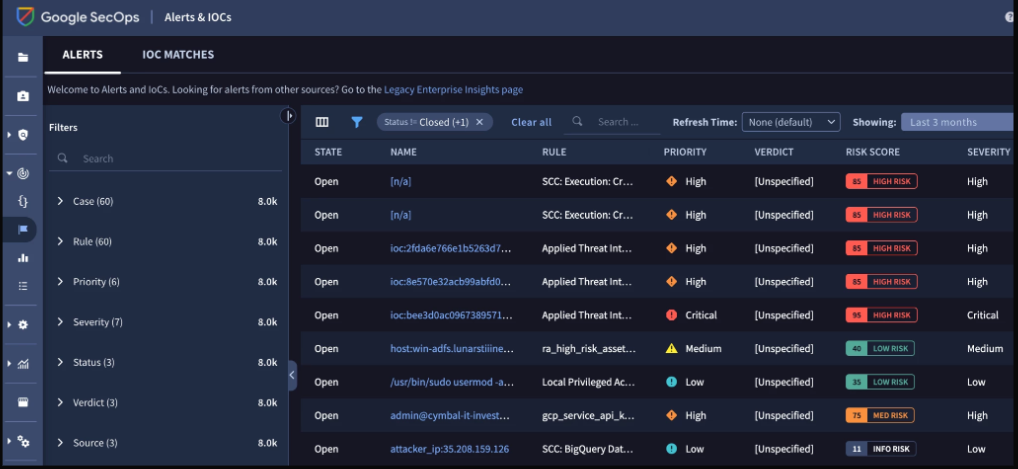
Google SecOps, built on the former Chronicle platform, is a cloud-native SIEM designed for petabyte-scale telemetry. It decouples storage from search, so you can retain years of data affordably. Its detection engine and Gemini-based AI assist analysts with investigation and threat hunting.
Core Services
- Cloud-native SIEM with petabyte-scale ingestion
- Long retention at flat, predictable pricing
- Gemini AI for investigation and summarization
- Curated detections and threat intelligence from Google and Mandiant
- YARA-L detection language for custom rules
Why Companies Consider Google SecOps
Teams drowning in log costs like the flat, capacity-based pricing model. The Mandiant threat intelligence is a genuine differentiator for detection quality. My honest read is that the AI assist is strong for summarization, though it keeps your telemetry inside Google’s cloud. Teams weighing this trade-off often start with our walkthrough of running an AI SOC on your existing SIEM.
Ideal Customer Profile
Best suited for:
- Cloud-first and Google Cloud-heavy organizations
- Teams needing long retention without per-GB pain
- SOCs wanting curated, intelligence-led detections
Commercial Model
Google SecOps typically prices on ingested data capacity rather than pure per-GB, which smooths budgeting. Data resides in Google Cloud, so residency depends on region selection. It remains a cloud-only model.
When to Shortlist
Shortlist Google SecOps when you want massive retention, curated detections, and cloud-native scale, and cloud residency meets your compliance needs.
1.5 CrowdStrike Falcon Next-Gen SIEM, Best for Endpoint-Led Teams Extending EDR into SIEM
Overview
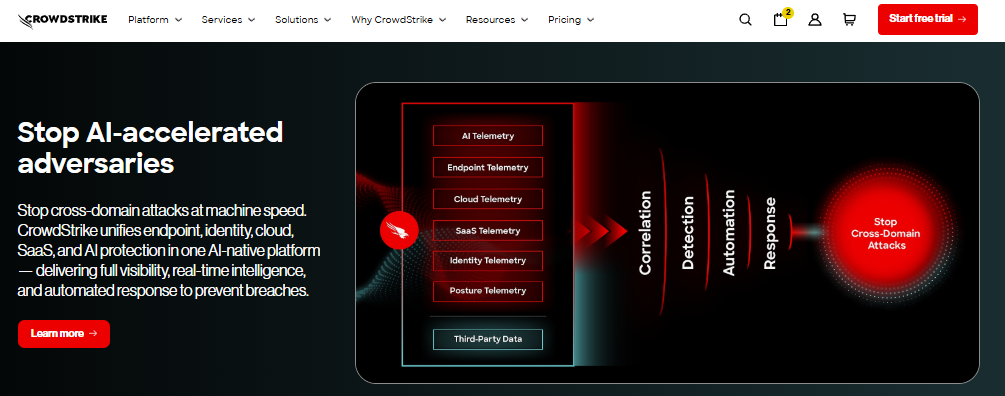
CrowdStrike Falcon Next-Gen SIEM extends the company’s dominant endpoint detection and response (EDR) platform into a broader SIEM. EDR means software that watches endpoints for malicious behavior and responds. Falcon is strong at stopping fast attacks, with the Charlotte AI assistant adding triage automation on top.
Core Services
- Next-Gen SIEM built on the Falcon platform
- Industry-leading EDR and threat intelligence
- Charlotte AI for automated triage
- Cloud and identity threat detection
- Managed threat hunting via Falcon OverWatch
Why Companies Consider CrowdStrike
Falcon is genuinely excellent at endpoint protection and zero-day defense. Reviewers repeatedly call its machine learning best-in-class for unknown threats. The trade-off I see: the data lake is CrowdStrike’s, and network plus SaaS context can lag behind endpoint strength. When endpoint coverage needs analyst backing, our Managed EDR service closes that gap.
Ideal Customer Profile
Best suited for:
- Endpoint-first organizations already on Falcon
- Teams wanting strong EDR extended into SIEM
- SOCs valuing threat intelligence and managed hunting
Commercial Model
CrowdStrike prices per module and per endpoint, with bundles that grow as you add SIEM and cloud coverage. It is cloud-only, with data held in CrowdStrike’s platform.
When to Shortlist
Shortlist CrowdStrike when endpoint protection is your top priority and you want to consolidate onto one vendor. It is a weaker fit when data ownership or on-prem processing is mandatory.
Reviews
“Has the best leading industry EDR for detection and prevention. Easy-to-use event search and customized queries. Comprehensive logs for forensics analysis.” Verified User CrowdStrike Falcon G2 Verified Review
“Support takes a long time to respond. Support does not necessarily answer your ticket, sometimes they tell you to refer to your TAM team. Chat wait times can be long.” Verified User CrowdStrike Falcon G2 Verified Review
1.6 Palo Alto Cortex XSIAM, Best for Automation-First SOCs Consolidating onto One Platform
Overview
Palo Alto Cortex XSIAM is an AI-driven security operations platform that unifies SIEM, SOAR, EDR, and attack surface management. SOAR means security orchestration, automation, and response, the tooling that automates repetitive analyst work. XSIAM leans hard into machine-led automation to shrink manual triage.
Core Services
- AI-driven SIEM with built-in automation
- Native EDR, SOAR, and threat intelligence
- Automated incident stitching and response
- Attack surface management
- Analytics across endpoint, network, and cloud
Why Companies Consider Cortex XSIAM
Teams tired of stitching tools together like the single-platform automation story. The incident-stitching engine reduces manual correlation work meaningfully. My concern is that the model leans toward replacing your existing stack rather than layering onto it, a decision our AI SOC build-vs-buy analysis helps teams weigh.
Ideal Customer Profile
Best suited for:
- Palo Alto-heavy organizations consolidating tools
- Automation-first SOCs reducing manual triage
- Larger teams comfortable with platform migration
Commercial Model
Cortex XSIAM prices on ingestion and modules, with costs that grow as you consolidate more functions. It is cloud-delivered, with data in the vendor platform.
When to Shortlist
Shortlist Cortex XSIAM when automation and consolidation are your priority and you are willing to migrate. It is a weaker fit for teams committed to keeping their current SIEM.
1.7 Exabeam New-Scale, Best for Teams Prioritizing User Behavior Analytics
Overview
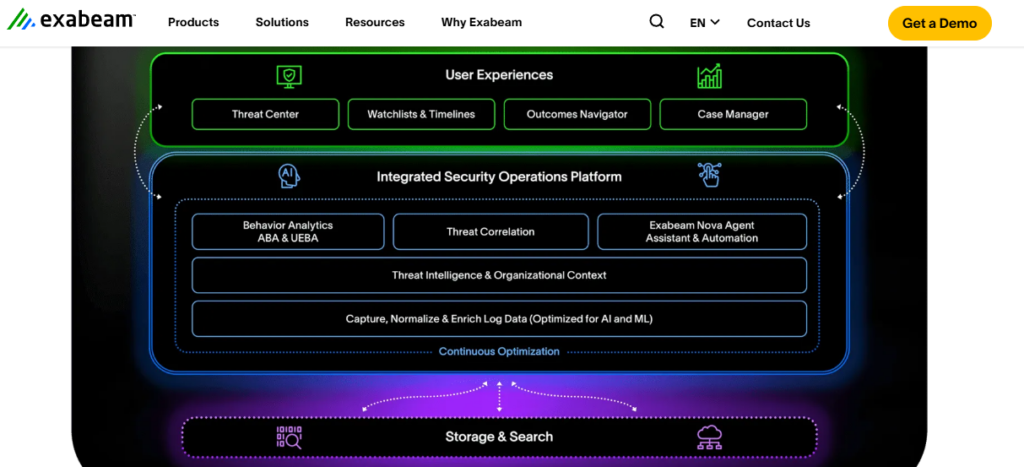
Exabeam New-Scale is a cloud-native SIEM known for user and entity behavior analytics (UEBA). UEBA means detection that baselines normal user behavior, then flags anomalies like a stolen credential. Exabeam builds timelines that stitch scattered events into a single narrative for analysts.
Core Services
- Cloud-native SIEM with strong UEBA
- Automated event timelines for investigation
- Prebuilt detection and correlation content
- Log management at scale
- AI-assisted analytics
Why Companies Consider Exabeam
Exabeam shines at catching insider threats and compromised accounts through behavior baselining. As the brief notes, one bad login from Thailand or Singapore can be your 2020 compromise still logging in today. Behavior analytics is built to catch exactly that pattern, and it complements the always-on 24/7 coverage lean teams often lack.
Ideal Customer Profile
Best suited for:
- Teams focused on insider and credential threats
- Organizations wanting automated investigation timelines
- SOCs comfortable with a cloud-hosted lake
Commercial Model
Exabeam prices on a mix of users and data volume, with cloud-hosted storage. On-prem flexibility is limited compared to legacy options.
When to Shortlist
Shortlist Exabeam when behavior analytics and insider-threat detection are your priority. It is a weaker fit when you need full on-prem data ownership.
1.8 Securonix, Best for Teams Wanting Bring-Your-Own-Cloud Data Ownership
Overview
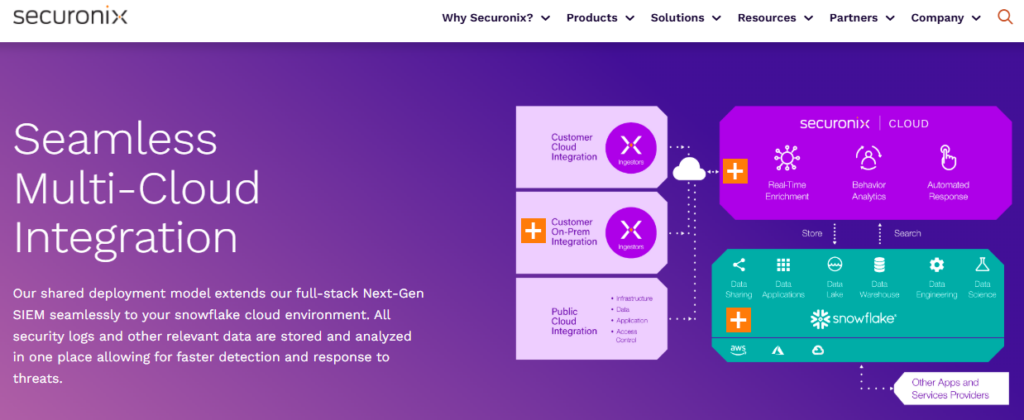
Securonix is a cloud-native SIEM that pioneered bring-your-own-cloud (BYOC) storage on Snowflake. BYOC means the security analytics run against a data lake you own and control, rather than a vendor’s locked store. This gives Securonix a genuine data-ownership edge in this list.
Core Services
- Cloud-native SIEM with BYOC on Snowflake
- Strong UEBA and threat detection
- Long retention in your own storage
- Automated response and case management
- Threat intelligence integration
Why Companies Consider Securonix
Teams that want to hold their own storage layer like the Snowflake BYOC model. It separates the analytics engine from the data you own, which reduces lock-in. My read is this is one of the few platforms taking data sovereignty seriously at the storage layer, an approach that pairs well with a fully managed SIEM service.
Ideal Customer Profile
Best suited for:
- Organizations already invested in Snowflake
- Teams prioritizing data ownership and retention control
- SOCs wanting UEBA with reduced lock-in
Commercial Model
Securonix prices on identities and data, with storage costs sitting in your own Snowflake account under BYOC. This gives more cost transparency at the storage layer.
When to Shortlist
Shortlist Securonix when data ownership through BYOC is a priority and you use Snowflake. On-prem and air-gapped options remain limited.
1.9 SentinelOne AI SIEM, Best for Speed-Focused Teams Wanting Autonomous Endpoint Response
Overview
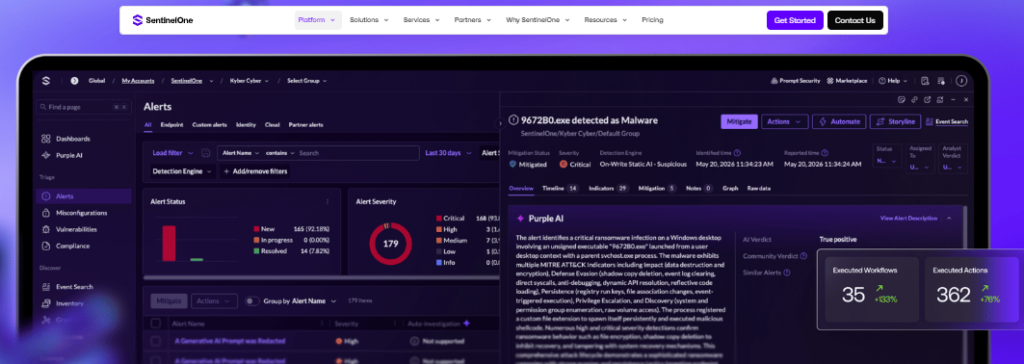
SentinelOne AI SIEM is built on the Singularity Data Lake and the company’s autonomous endpoint platform. It is known for fast, machine-speed detection and rollback of attacks. The Purple AI assistant adds natural-language investigation across the data lake.
Core Services
- AI SIEM on the Singularity Data Lake
- Autonomous EDR with one-click rollback
- Purple AI for natural-language investigation
- Cloud and identity threat detection
- Fast ingestion and search
Why Companies Consider SentinelOne
SentinelOne is genuinely fast, and reviewers praise its deep visibility and zero-day detection. The autonomous rollback feature is a real operational win during ransomware. The trade-off: the Singularity lake remains a vendor-owned store, which our explainability and transparency guide flags as a key evaluation point.
Ideal Customer Profile
Best suited for:
- Speed-focused teams wanting autonomous response
- Endpoint-led organizations extending into SIEM
- SOCs valuing natural-language investigation
Commercial Model
SentinelOne prices per endpoint and per module, cloud-delivered, with data in the Singularity lake.
When to Shortlist
Shortlist SentinelOne when autonomous endpoint response and speed are your priority. It is a weaker fit when on-prem data ownership is required.
Reviews
“SentinelOne prices correctly with features that actually help detect 0-day vulnerability with deep visibility.” Verified User SentinelOne Singularity G2 Verified Review
1.10 Panther, Best for Engineering-Led Teams Wanting Detection-as-Code on Their Own S3
Overview
Panther is a cloud-native SIEM built for security engineers who want to write detections as code. Detection-as-code means writing, version-controlling, and testing rules in Python, the same way software teams manage code. Panther runs against your own S3 data lake, giving strong ownership.
Core Services
- Detection-as-code in Python
- Data lake on your own S3 storage
- Real-time and scheduled detections
- Broad log source support
- Version-controlled, testable rules
Why Companies Consider Panther
Engineering-led teams love treating detections like software: reviewed, tested, and deployed through CI/CD. Running against your own S3 keeps ownership in your hands. My read is Panther is a strong fit for teams with real engineering muscle, less so for lean teams wanting turnkey coverage that a managed SOC service provides.
Ideal Customer Profile
Best suited for:
- Engineering-heavy security teams
- Organizations wanting detection-as-code workflows
- Teams that already run their own S3 data lake
Commercial Model
Panther prices on data volume, with storage in your own S3 account. This keeps the storage layer under your control.
When to Shortlist
Shortlist Panther when detection-as-code and S3 ownership fit your engineering culture. It is a weaker fit for teams needing managed analyst response.
Where UnderDefense Fits Across This List
Looking across all 10, the pattern I keep seeing is a fork. Some platforms give you data ownership but leave you to run everything yourself. Others give you managed help but hold your data in their store.
We built UnderDefense Agentic AI SOC to close that fork. You keep your logs and AI data in your own lake, on-prem or air-gapped if you need it, while our six AI Teammates and human analysts own the outcome rather than just escalating alerts. It layers onto the SIEM you already run, so your correlation rules survive a vendor change. You can see how the UnderDefense Agentic AI SOC platform works here, or book a demo to watch it run against your own data lake.
Q2. How were these AI SOC platforms selected and scored? (Our Selection Criteria)
Each platform was scored on five weighted criteria: Data Sovereignty and Ownership (30%), Agentic Investigation Depth (25%), Works-With-Your-Existing-Stack / No Lock-In (20%), Compliance and Deployment Flexibility (15%), and Pricing Transparency (10%). Scores map to stars: 0-20% earns 1 star, 21-40% earns 2, 41-60% earns 3, 61-80% earns 4, and 81-100% earns 5. UnderDefense earns 5 stars for keeping data in your lake with full agentic capability.
Why These Five Criteria, and Not Feature Checklists
I built this rubric around the anxiety I hear most from buyers, which is fear of losing control, not fear of missing a feature. So the weights follow the reader’s real risk. Data ownership, investigation depth, and freedom from lock-in carry the most weight, because those decisions follow you for years, a point we expand in our AI SOC evaluation questions.
Alert-fatigue research reinforces this. A 2025 ACM Computing Surveys review of security operations found that raw alert volume, not tool count, is the core operational failure point in modern SOCs. That is why investigation depth outweighs surface features here, a theme we cover in our breakdown of alert fatigue in cybersecurity.
The Weighted Scorecard
Here is exactly how the 100 points break down, and how they convert to stars.
| Criterion | Weight | What It Measures |
|---|---|---|
| Data Sovereignty and Ownership | 30% | Do your logs and AI data stay in a lake you own? |
| Agentic Investigation Depth | 25% | Does AI investigate autonomously, or just summarize? |
| Works-With-Your-Stack / No Lock-In | 20% | Does it layer onto your SIEM, or force replacement? |
| Compliance and Deployment Flexibility | 15% | On-prem, air-gap, and framework coverage |
| Pricing Transparency | 10% | Predictable cost, not ingestion surprises |
Star bands: 1 star (0-20%), 2 stars (21-40%), 3 stars (41-60%), 4 stars (61-80%), and 5 stars (81-100%).
What We Deliberately Did Not Score
We did not weight raw vendor brand size or marketing reach. Being large does not mean your data stays yours. I might be wrong for some buyers here, but a big logo is a weak proxy for control.
We also refused to score “breaches prevented.” Proving breach prevention is a trap, because you cannot cleanly prove a negative. If you had no breach last quarter, no single tool can honestly claim the save. So we scored auditable capability instead of unprovable outcomes, an approach we detail in our guide to AI SOC explainability and transparency.
Where UnderDefense Lands
UnderDefense scores 5 stars mainly on the criteria buyers underweight until renewal day. Its transparent per-endpoint pricing, roughly $11 to $15 per endpoint per month, drives full marks on Pricing Transparency, which you can verify against our published MDR pricing. Its 250-plus integrations and layer-on-top model earn top marks on No Lock-In, since your correlation rules survive a vendor change.
Q3. What does data sovereignty mean for an AI SOC, and why does owning your data lake matter?
A data-sovereign AI SOC runs autonomous investigations inside your own infrastructure, keeping every log and AI action within your data lake and jurisdiction, so no telemetry leaves the perimeter. It matters because security logs contain personal data, so the moment they hit a vendor’s cloud model you inherit GDPR Article 30/33, Schrems II, NIS2, and DORA exposure. IBM found that 97% of AI-related breaches involved organizations lacking proper AI access controls.
Data Lake vs Vendor Store, in Plain English
A data lake is a big, cheap store where you keep raw security logs in an open format you control. A proprietary SIEM store is the opposite: your logs get copied into a vendor’s locked system, priced by how much you send in. Understanding this split is central to avoiding SIEM vendor lock-in.
The difference shows up in how you query. “Structure on Read” means you keep raw data and shape it only when you search. “Structure on Ingest” means you pay to format and store everything upfront, whether you ever use it or not.
The Ingestion Diet
I have watched teams cut their log ingestion by roughly 90% just by tuning correlation rules. One went from 300 gigabytes per day down to about 35 to 40 gigabytes per day, simply by dropping crap, unused, and duplicate logs. That is real money back, and it only works when you own the pipeline. Our managed SIEM service builds this tuning discipline in from day one.
Owning the lake makes this tuning yours to control. In a vendor black box, that lever is theirs, not yours.
Why Sovereignty Became a Legal Question
Security logs are personal data. They hold usernames, IP addresses, and device identifiers. The moment that telemetry hits a US-based AI model, you inherit real obligations: GDPR Article 30 (records of processing), Article 33 (breach notification), Schrems II (cross-border transfer), plus NIS2 and DORA for regulated sectors. This is exactly where our compliance services help teams stay audit-ready.
The numbers make the stakes concrete. IBM’s 2025 report, measured across 600 organizations, found 97% of AI-related breaches hit firms without proper AI access controls, and 63% had no AI governance policy at all. Shadow AI added about $670,000 per breach, while organizations with extensive AI security and automation saved around $1.76 million per incident.
The Monday Question to Ask Legal
Before any proof of concept, ask one question: where exactly does this platform process our logs, and can it stay in-region or on-prem? If the honest answer is “our cloud, our model,” you have a data-residency problem to solve before you sign.
I have spent much of 20 years doing PCI work, walking into rooms where nobody wanted the auditor there. What I have seen too often is “mutually assured compliance theater,” where both sides use AI to fake their way through questionnaires. Sovereignty ends that game, because you can show real records instead of performing them.
Where UnderDefense Fits
We built UnderDefense Agentic AI SOC on one principle: your logs and AI data stay in your data lake. It can run EU-hosted, self-hosted, or fully air-gapped, so your telemetry never has to leave your jurisdiction. That gives you a clean GDPR Article 30 processing record, which is the direct answer to the cloud-only disqualifier. You can see how the UnderDefense Agentic AI SOC platform is deployed.
Q4. What separates a real agentic AI SOC from a “GPT wrapper,” and can it keep up with attacker speed?
A real agentic AI SOC runs a recursive, multi-agent investigation, using agents that classify, gather evidence, validate, and synthesize a verdict, sometimes firing over 100 large language model calls to close a single alert. A GPT wrapper is one model that summarizes alerts faster without eliminating the work. With median adversary break-out at 48 minutes and the fastest recorded at 51 seconds, only lake-native investigation hits that window without black-box latency.
Multi-Agent vs a Single Model
Think of it like a team, not a tool. An agentic system runs many specialized agents that hand work to each other, the way foot soldiers report to generals. A GPT wrapper is one soldier doing everything, faster, but still alone. We break this architecture down further in our explainer on agentic SOC platforms.
The tell is depth. A genuine agentic SOC makes over 100 distinct language model invocations to autonomously investigate one alert. That recursive reasoning is what actually replaces Level 1 and Level 2 triage work, rather than speeding up a human doing the same clicking.
Speed Is the Whole Game
Attackers move fast now. The median break-out time, meaning how long before an intruder moves from the first machine to the rest, is 48 minutes, and the fastest recorded was 51 seconds. A black-box tool that ships your data out for triage adds latency you cannot afford, which is why AI SOC investigation speed is a make-or-break criterion.
Speed also catches slow-burn threats. As one operator put it, one bad login from Thailand or Singapore can be your 2020 compromise still logging in today. Lake-native investigation spots that pattern without waiting on an external round trip.
Faster Is Not the Same as Transformation
Here is the standard read I think gets it backwards. If you still have the same humans looking through the same number of alerts, just doing it faster, that is not transformation. That is a faster way to be wrong.
Real transformation eliminates whole classes of work. And accuracy matters more than the demo suggests. A 1% error rate sounds fine until you take thousands or millions of actions a day, at which point it is genuinely bad.
POC Questions That Expose Wrappers
When you test a vendor, ask these:
- Show me the investigation trail for one alert. How many reasoning steps ran?
- Is the verdict auditable, or just a confidence score you cannot inspect?
- Does investigation run against my lake, or ship data out first?
- What classes of work does this fully remove, not just speed up?
Where UnderDefense Fits
UnderDefense Agentic AI SOC runs six AI Teammates, each owning a role: classify the alert, select the right indices, gather evidence, validate findings, synthesize a verdict, then route it to Teams or Jira. That pipeline drives 99% noise reduction, 2-minute alert-to-triage, and a 15-minute escalation for critical incidents. Humans click, but our agents swarm, and our analysts stay the generals who own the outcome. You can explore the full Agentic AI SOC AI platform to watch that workflow run.
Q5. What do real users say about these AI SOC platforms?
Reviewers punish two things: black-box tickets that come back “without clear answers,” and over-automation with no insight. They reward platforms whose analysts explain every step and talk to affected users directly. UnderDefense’s 12 G2 badges, Best Support recognition, and near-zero churn reflect the transparency gap that dissatisfied ReliaQuest, Red Canary, and Arctic Wolf customers are trying to escape.
The situation: a director drowning in answer-less tickets
Let me tell you what I hear most on intro calls. A security director has the tools. They have the dashboard. What they do not have is answers.
The ticket comes in, gets “escalated,” and lands right back in their lap. Nobody tells them what it means. They still have to investigate it themselves, a pattern we unpack in our breakdown of alert fatigue in cybersecurity.
I might be wrong on this, but from what surfaces when you actually run a SOC, that is the real pain. It is not too few alerts. It is alerts with no verdict attached.
The complication: over-automation and junior-analyst gaps
The standard read says “more automation fixes this.” My current read is the opposite. Over-automation without a human on the other end just closes tickets faster without telling you why.
This is exactly where switchers get frustrated with certain providers:
- ReliaQuest leans so hard on AI and automation that “all tickets are coming back to customers without clear answers,” with weak concierge support and analysts who stay at arm’s length from your users.
- Red Canary “was acquired, reduced support,” with weak concierge access and long onboardings, and it stays primarily endpoint-focused.
- Arctic Wolf gets flagged for vendor lock to its own SIEM and thin reporting transparency, which leaves customers doing manual work anyway. We cover credible Arctic Wolf alternatives for teams weighing a switch.
I want to be fair here. These are capable companies. The gripe is architectural, not personal. When the model discourages analysts from talking to your people, context dies.
The resolution: what transparent concierge response looks like
Here is the part I care about. Being a human is a flex in 2026. There is a strange zen in doing the mundane, careful work of copying evidence, checking with a real person, and closing the loop.
At UnderDefense, our analysts ping affected users directly over Slack, Teams, Email, or SMS to get the context competitors escalate back to you. We call it ChatOps. It is the difference between “here is an alert” and “we talked to Dana in finance, that login was her, you are clear.” This is the human layer that defines our MDR service.
That shows up in the reviews:
“The biggest win for me was getting actual control over our security alerts. Their team cleaned up our configurations and got the noise under control within the first week. When they escalate something, they include the context we need.” Verified User in Marketing and Advertising, Small-Business UnderDefense G2 Verified Review
“They have an exceptionally talented team who is very engaged. If I had to pick a single word, I would call them proactive.” Yaroslava K., IT Project Manager UnderDefense G2 Verified Review
Not everything is perfect, and I would not trust a wall of 5-stars anyway:
“No Underdefense’s fault entirely, but getting all our logs and stuff flowing took longer than I expected.” Andriy H., Co-Founder and CTO UnderDefense G2 Verified Review
The aggregate picture
Across G2, Gartner, and Clutch, the pattern holds: praise for transparency, responsiveness, and working on top of the customer’s existing stack.
UnderDefense earned 12 G2 badges in Spring 2025 including Best Support, a 2025 Global Infosec Award for MDR Service, and an SC Awards finalist spot.
Internally, the number I trust most is loyalty: zero customer churn, plus a documented case detecting threats two days faster than CrowdStrike OverWatch and a clean ransomware-prevention record across our clients.
Here is the question I am sitting with. If transparency is what buyers reward and black boxes are what they flee, why does half the category still hide the analyst behind a ticketing queue? I would rather show you the work than tell you it happened.
Q6. Can you run a genuine agentic AI SOC on-prem or air-gapped while still working with your existing SIEM?
Yes, but almost no vendor offers it. Most “AI SOC” tools assume your data goes to their cloud or quietly re-ingest it into a proprietary store. A genuine on-prem or air-gapped agentic SOC runs the full multi-agent stack inside your own Kubernetes with a self-hosted model and zero telemetry egress, while working on top of the Splunk, Sentinel, Chronicle, QRadar, or Elastic you already own.
The switching-cost trap nobody warns you about
Start with the thing that bites people. When you rip out one platform for another, the business logic does not come with. The correlation rules, the automation rules, and the tuning your team built over years are gone. This is the core of avoiding SIEM vendor lock-in.
I have written well over 10,000 lines of PowerShell in my career. One unexpected character once cascaded into a full-on outage. That is the felt reality of detection logic: it is fragile, hard-won, and yours.
So when a vendor says “just switch,” what they are really saying is “rebuild everything.” That is a hidden cost most RFPs never price.
The industry’s baked-in assumption
Every cloud AI SOC pitch has one assumption welded into it: your security data goes to their cloud. Your logs, identities, and investigations leave your building and get processed by models you cannot audit.
For a growing slice of the market, that is not a trade-off. It is a disqualifier. GDPR after Schrems II, DORA, critical-infrastructure rules, and air-gapped defense work all say the same thing: the data stays home. Our guide to AI SOC deployment models maps each option to these constraints.
A real deployment, not a roadmap slide
In May 2026, we shipped general availability of on-prem and air-gapped deployment for our Agentic AI SOC. A European telecom operator now runs fully autonomous AI investigations on its own hardware, in its own data center, with no telemetry leaving its infrastructure, at 44% lower total cost of ownership than a DIY cloud-AI build. This is production, not a pilot.
Here is the augment-versus-replace contrast that matters:
| Dimension | Augment (UnderDefense) | Replace (typical vendor) |
|---|---|---|
| Your SIEM | Works on top of Splunk, Sentinel, Chronicle, QRadar, and Elastic | Rip-and-replace into proprietary store |
| Correlation rules | Stay yours, versioned as code | Lost in the switch |
| Data location | Inside your perimeter, air-gap capable | Sent to vendor cloud |
| AI model | Bring your own (Azure AI Foundry, AWS Bedrock, or self-hosted) | Vendor-controlled, often unauditable |
The platform ships with 700+ MITRE ATT&CK workbooks, 250+ integrations, six specialized AI teammates, and deploys in under five minutes on prepared infrastructure. You can review the full breadth of Agentic AI SOC integrations before you scope a deployment.
Why sovereign safety is engineered, not promised
Here is my conviction: safety you can prove beats safety you are told about. We treat detection as code, written in Python, versioned, unit-tested, and deployed through CI/CD. That is the governance layer that lets you trust AI in production, an approach we detail in our AI SOC explainability and transparency resource.
Architecture-level controls make certain actions simply impossible. Using callback functions, an agent physically cannot reach a domain it is not allowed to touch. Not “policy says no,” but impossible at the architecture level.
I have watched a vibe-coded agent go and delete someone’s production database. That is the cautionary tale. Autonomy without hard guardrails is not innovation, but a liability.
Customers feel the difference when the SIEM stays theirs:
“UnderDefense Agentic AI SOC integrates well with our systems, specifically with our SIEM, Splunk. Their team is proactive in identifying and addressing threats.” Oleg K., Director Information Security UnderDefense G2 Verified Review
“It pulls in data from all our existing security tools, so we didn’t have to rip and replace anything.” Verified User in Marketing and Advertising UnderDefense G2 Verified Review
The prediction I am sitting with: in 18 to 24 months, “where does my data get processed” will be the first question on every RFP, not the last. We built for that world early because our regulated customers demanded it. See how our SOC service keeps every byte inside your perimeter.
Q7. How should you choose the right AI SOC platform for your data-sovereignty needs?
Start with your hardest constraint, not the feature list. If logs cannot leave your jurisdiction, filter for on-prem or bring-your-own-model first. If you own Splunk or Sentinel, filter for augment-not-replace. Then score each shortlist vendor on data ownership, agentic depth, and pricing transparency.
Lead with the constraint, not the demo
Most buyers start with a feature grid. I would flip it. Your hardest constraint eliminates most of the market in one move, so name it first.
If you are under GDPR, DORA, or air-gap rules, “cloud-only” vendors are already out. No demo changes that. If you own a SIEM you love, “rip-and-replace” vendors are out too. Our AI SOC evaluation questions help you formalize this filter.
Constraint-first shopping saves months. It turns a field of 30 into a shortlist of 3 before anyone books a call.
Map your scenario to a shortlist
Here is the rough map I use with teams:
- Regulated (finance, healthcare, telecom): filter for on-prem or air-gapped, self-hosted model, and auditable decisions. Sovereignty is the gate, which is why we offer MDR for financial services.
- PE portfolio operator: filter for multi-entity deployment, consolidated board reporting, and flexible engagement across companies with different stacks.
- Scaling tech company: filter for augment-not-replace, fast time-to-value, transparent per-endpoint pricing, and compliance support bundled in. Compare against published MDR pricing.
- Air-gapped or classified: filter for zero external connectivity and self-hosted model inference, full stop.
The five questions to ask every vendor
Ask these before you look at a single dashboard:
- Where exactly is my data processed, and does any telemetry leave my perimeter?
- What trained your model, and can I bring my own or self-host it?
- What happens to my correlation and automation rules if I leave?
- Do your analysts talk to my affected users, or just escalate tickets back to me?
- Is your pricing transparent per endpoint, or hidden behind “contact sales”?
And one for your own side of the table. Skip the ROI slide. Instead, ask your CFO a sharper question: what is your projected cost of business interruption per day? That number reframes the whole budget conversation.
One more contrarian note I stand by. I am happy if my model shows me its biases, because then I can measure what it is doing wrong and adjust it. The true danger is an unbiased-looking black box you cannot inspect. Measurable, auditable, sovereign AI beats confident opacity every time.
A free move for Monday morning
You do not need a contract to start. Run an OAuth shadow-IT hunt this week. Pull the list of third-party apps with access to your Google Workspace or M365 and see what is quietly reading your mail and files. It costs nothing and usually surprises people.
For teams where the data genuinely cannot leave the building, we will scope an on-prem agentic SOC proof of concept against your own data lake. No pitch, just the work. That is the honest test of any vendor, ours included. If you want to start that conversation, contact us with what you are protecting.
The question I would leave you with: if you scored your current provider on those five questions today, how many could they actually answer? Send me your shortlist and I will tell you where the gaps are.
See how UnderDefense Agentic AI SOC resolves a real incident on your stack.
1. What does it mean for an AI SOC to let you own your own SIEM data lake?
It means the AI runs its investigations against a data lake you control, keeping every log and AI action inside your infrastructure and jurisdiction, rather than copying telemetry into a vendor’s proprietary store.
A data lake is a large, low-cost store where you keep raw security logs in an open format you own. A proprietary SIEM store is the opposite: your logs get pulled into a vendor’s locked system, priced by how much you send in.
Owning the lake gives you three practical wins:
- You keep the pipeline-tuning lever, so you can cut ingestion volume and cost yourself.
- Your correlation and automation rules survive a vendor change instead of being rebuilt from scratch.
- Your telemetry never has to leave your region, which keeps you clean on GDPR Article 30 records of processing.
We built UnderDefense Agentic AI SOC on this single principle: your logs and AI data stay in your data lake, whether that is your cloud, on-prem, or fully air-gapped.
2. Which AI SOC platforms actually let you keep your own data lake in 2026?
Across the ten platforms we evaluated, only a few keep the storage layer genuinely under your control.
- UnderDefense Agentic AI SOC: full ownership, running in your cloud, on-prem, or air-gapped.
- Securonix: bring-your-own-cloud on Snowflake, so you hold the storage layer.
- Panther: detection-as-code on your own S3 data lake.
The rest, including Microsoft Sentinel, Splunk, Google SecOps, CrowdStrike Falcon, Palo Alto Cortex XSIAM, Exabeam, and SentinelOne, store your telemetry in a vendor-hosted lake, usually cloud-only.
The practical filter is simple: start with your hardest constraint. If logs cannot legally leave your jurisdiction, the on-prem and air-gap column narrows your shortlist in seconds. If you already run Splunk or Sentinel, prioritize platforms that layer on top rather than force a rip-and-replace.
We break down each vendor’s ownership model and trade-offs in our guide to the best AI SOC providers, so you can match a platform to your specific residency and lock-in needs.
3. Why does data sovereignty matter so much for an AI SOC?
It matters because security logs are personal data. They contain usernames, IP addresses, and device identifiers, so the moment that telemetry hits a vendor’s cloud model, you inherit real legal obligations.
Those obligations include GDPR Article 30 (records of processing), Article 33 (breach notification), Schrems II (cross-border transfer), plus NIS2 and DORA for regulated sectors.
The numbers make the stakes concrete. IBM’s 2025 report, measured across 600 organizations, found that 97% of AI-related breaches hit firms without proper AI access controls, and 63% had no AI governance policy at all. Shadow AI added roughly $670,000 per breach.
A data-sovereign AI SOC runs autonomous investigations inside your own infrastructure, so no telemetry leaves the perimeter. That gives you a clean processing record instead of a residency problem to solve after you sign.
Our compliance services help teams turn sovereignty from a checkbox into an auditable, provable control.
4. What separates a real agentic AI SOC from a GPT wrapper?
A real agentic AI SOC runs a recursive, multi-agent investigation. Specialized agents classify the alert, gather evidence, validate findings, and synthesize a verdict, sometimes firing over 100 language model calls to close a single alert.
A GPT wrapper is one model that summarizes alerts faster without eliminating the underlying work. The tell is depth:
- An agentic system behaves like a team, with agents handing work to each other.
- A wrapper is one component doing everything faster, but still alone.
- Only recursive reasoning actually replaces Level 1 and Level 2 triage, rather than speeding up a human doing the same clicking.
Speed is the whole game. Median adversary break-out time is 48 minutes, and the fastest recorded was 51 seconds, so a black-box tool that ships your data out for triage adds latency you cannot afford.
We explain how multi-agent architecture works in our overview of agentic SOC platforms, including the POC questions that expose wrappers quickly.
5. Can you run a genuine agentic AI SOC on-prem or air-gapped?
Yes, but almost no vendor offers it. Most AI SOC tools assume your data goes to their cloud, or they quietly re-ingest it into a proprietary store.
A genuine on-prem or air-gapped agentic SOC runs the full multi-agent stack inside your own Kubernetes, with a self-hosted model and zero telemetry egress, while working on top of the Splunk, Sentinel, Chronicle, QRadar, or Elastic you already own.
This is production, not a roadmap slide. In May 2026, we shipped general availability of on-prem and air-gapped deployment. A European telecom operator now runs fully autonomous AI investigations on its own hardware, with no telemetry leaving its infrastructure, at 44% lower total cost of ownership than a DIY cloud-AI build.
Sovereign safety is engineered, not promised:
- Detection is written as code, versioned, and unit-tested.
- Architecture-level controls make forbidden actions physically impossible.
See how we deliver this through our SOC service, which keeps every byte inside your perimeter.
6. How does an AI SOC that works with our existing SIEM avoid vendor lock-in?
It avoids lock-in by layering on top of the SIEM you already run, so you never rip out and rebuild your detection logic.
The switching-cost trap is the part most RFPs never price. When you replace one platform with another, the business logic does not come with it:
- Correlation rules built over years are lost.
- Automation rules and tuning have to be recreated from scratch.
- Your logs effectively trained someone else’s model, which then walks out the door.
An augment-not-replace platform keeps your correlation rules as versioned code, keeps data inside your perimeter, and lets you bring your own AI model instead of accepting a vendor-controlled, unauditable one.
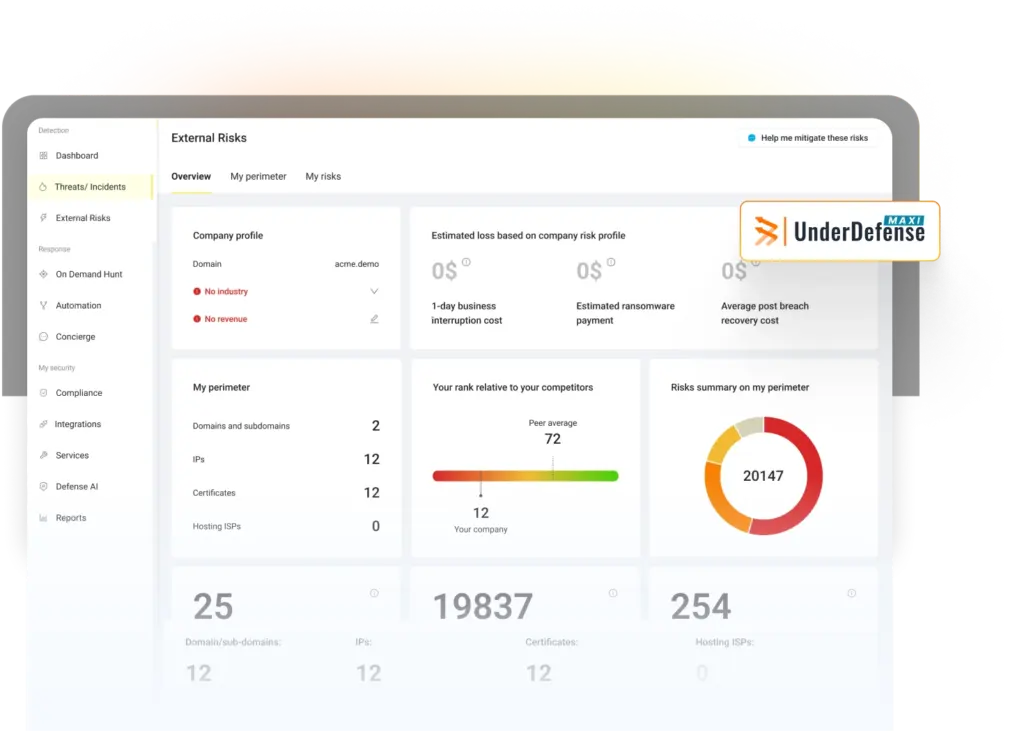
UnderDefense MAXI ships with 250-plus integrations and works on top of Splunk, Sentinel, Chronicle, QRadar, and Elastic, so a vendor change never erases years of tuning. We go deeper on this in our guide to avoiding SIEM vendor lock-in.
7. How is AI SOC pricing structured, and why does transparency matter?
Pricing splits into two broad models, and the difference shows up sharply at renewal.
- Ingestion-based pricing: used by many legacy SIEMs, where cost scales with the data volume you send in. Reviewers repeatedly flag that costs balloon as environments grow.
- Transparent per-endpoint pricing: a predictable model that does not punish you for retaining more telemetry.
We use transparent per-endpoint pricing, typically in the range of $11 to $15 per endpoint per month, with onboarding support and analyst advisory included. That contrasts with ingestion models that make costs spike as data grows.
Transparency also changes the budget conversation. Instead of debating an ROI slide, we tell teams to ask their CFO a sharper question: what is your projected cost of business interruption per day? That number reframes the whole spend.
You can review the exact tiers on our MDR pricing page before you shortlist.
8. How should we choose the right AI SOC platform for our sovereignty needs?
Start with your hardest constraint, not the feature list. Your toughest requirement eliminates most of the market in one move, so name it first.
Here is the map we use with teams:
- Regulated (finance, healthcare, telecom): filter for on-prem or air-gapped, self-hosted model, and auditable decisions.
- PE portfolio operator: filter for multi-entity deployment and consolidated board reporting.
- Scaling tech company: filter for augment-not-replace, fast time-to-value, and transparent pricing.
- Air-gapped or classified: filter for zero external connectivity and self-hosted inference.
Then ask every vendor five questions: where is my data processed, what trained your model, what happens to my rules if I leave, do your analysts talk to my affected users, and is your pricing transparent per endpoint?
Our AI SOC evaluation questions turn this constraint-first method into a repeatable scorecard.