




Q1: What Is an AI SOC, and Why Is the Traditional SOC Model Failing Security Leaders in 2026?
⚠️ The Broken Status Quo
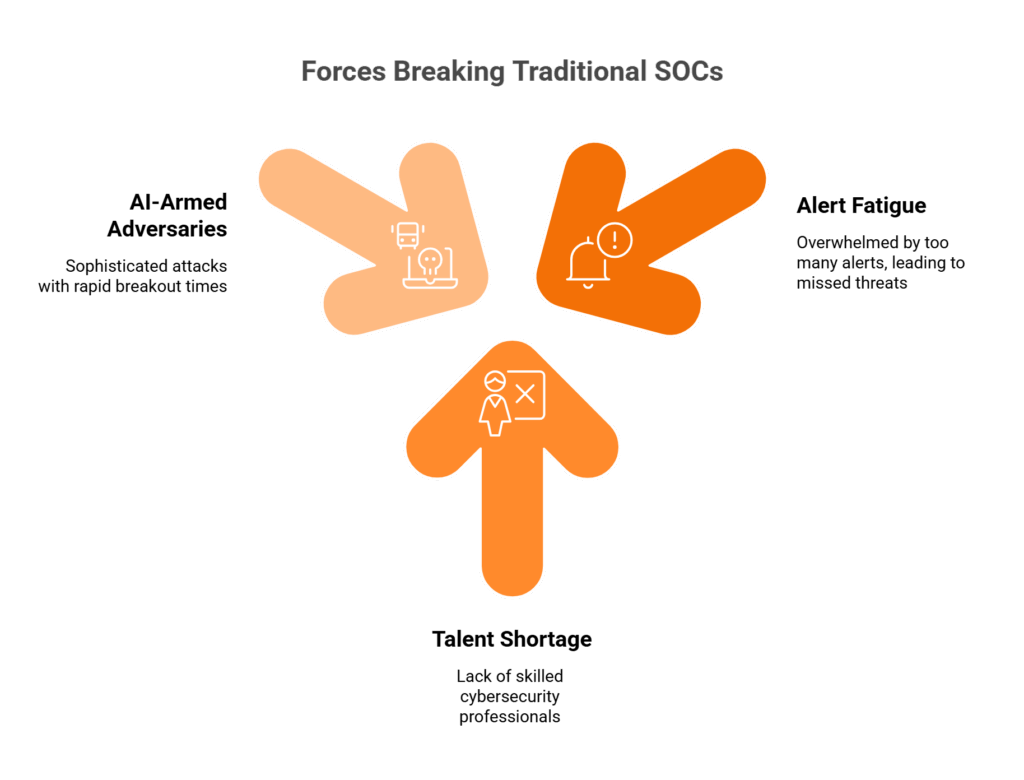
Here’s the reality most vendor pitch decks won’t show you: attackers weaponizing agentic AI now achieve breakout times measured in minutes, while traditional SOCs still operate at human speed. The average enterprise manages 50 to 70 security tools generating thousands of alerts daily, yet only a fraction are true positives. Meanwhile, the global cybersecurity workforce gap has hit 4.8 million unfilled roles, a 40% increase in just two years. Security leaders face three converging forces: alert fatigue, talent shortage, and AI-armed adversaries. These forces make the traditional SOC model structurally incapable of keeping pace.
🔍 Critical Distinctions That Matter
Let me draw two distinctions most articles miss. First: “AI in the SOC,” bolting ML features onto your existing SIEM or SOAR, is not the same as a true “AI SOC.” An AI SOC is a purpose-built agentic architecture where AI orchestrates the full investigation lifecycle, from triage through enrichment to response. Second: AI SOC versus SOAR. SOAR follows rigid if-then playbooks that break the moment a novel attack pattern appears. An agentic AI SOC reasons dynamically across data sources, adapting investigation paths in real-time. Traditional MDR providers like Arctic Wolf operate as opaque alert factories. You see what was detected, but not why it matters. Legacy MSSPs offer monitoring without intelligence: checkbox coverage based on rigid playbooks rather than real-time threat context.
The AI-Era Thesis
Detection without response is noise. Response without context is risk. In the AI era, the competitive advantage is not having security tools but having a system that can reason across them. Google Cloud’s 2026 Cybersecurity Forecast envisions the “Agentic SOC,” where analysts direct AI systems that correlate data, summarize incidents, and map threats to MITRE ATT&CK. This shifts the analyst’s job from manual correlation to strategic validation.
✅ UnderDefense MAXI: AI SOC + Human Ally
This is exactly the model we built at UnderDefense. UnderDefense MAXI‘s agentic AI automates investigation grunt work: automated context collection, multi-system correlation, and structured investigation reports generated in seconds. It integrates vendor-agnostically with 250+ existing tools without forcing replacement. ChatOps user verification reaches affected users directly via Slack, Teams, email, or SMS. Detection Logic as Code means detection rules are written in Python, versioned, unit-tested, and deployed via CI/CD. Every AI step is observable and auditable, with no black boxes. The core philosophy: AI collects context, you decide.
Proof That Backs the Promise
UnderDefense achieves 2-minute Alert-to-Triage with enrichment and context automation, 15-minute escalation for critical incidents, 96% MITRE ATT&CK coverage, and zero ransomware cases across all MDR clients in 6 years. Because an AI SOC without a human ally is just expensive alerting.
“Not having to worry about ransomware, alert overload and reporting. Getting a clear view of my security posture, where the threats are coming from and how they are handled. They literally took care of all our problems.”
— Arlin O., Enterprise UnderDefense G2 – Verified Review
“Started out well but over the years the service has consistently not met expectations. The issues that we have experienced has greatly outweighed the benefits.”
— CISO, Manufacturing Arctic Wolf – Gartner Verified Review
Q2: What Are the Core Components and Agentic Architecture Powering a Modern AI SOC?
What “Agentic” Actually Means
“Agentic” is not marketing fluff. It describes AI agents that autonomously execute multi-step investigation workflows: query SIEM, pull logs, enrich with threat intel, correlate across systems, and generate structured reports. The mesh agentic approach orchestrates multiple AI techniques: LLMs for reasoning, ML for behavioral detection, statistical analysis for anomaly scoring, and graph analytics for lateral movement tracing. These techniques are applied dynamically per incident based on alert type, severity, and available context. Contrast this with SOAR’s rigid “if-then” playbook model that breaks on novel attack patterns. Agentic architecture adapts; SOAR scripts don’t.
The 7 Core Building Blocks
| # | Component | Function |
|---|---|---|
| 1 | Agentic AI Orchestration Layer | Multi-agent system coordinating investigation workflows, decision routing, and confidence scoring |
| 2 | Unified Operational Data Layer | Single normalized data fabric ingesting endpoint, identity, cloud, network, SaaS, and email telemetry |
| 3 | Multi-Layer AI Detection Engine | Supervised ML (known threats) + unsupervised ML (behavioral anomalies) + deep learning (advanced persistent threats) |
| 4 | Hyperautomation & Response Orchestration | Automated containment: credential revocation, endpoint isolation, firewall rule updates, triggered by AI with human validation |
| 5 | Native Case Management | AI-generated investigation timelines, evidence chains, and audit trails |
| 6 | Open Ecosystem & Model Context Protocol (MCP) | Standardized integration framework enabling plug-and-play connectivity without custom API development |
| 7 | Human Analyst Collaboration Interface | ChatOps, escalation workflows, and direct user verification channels |
⏰ How an Alert Moves Through the Stack
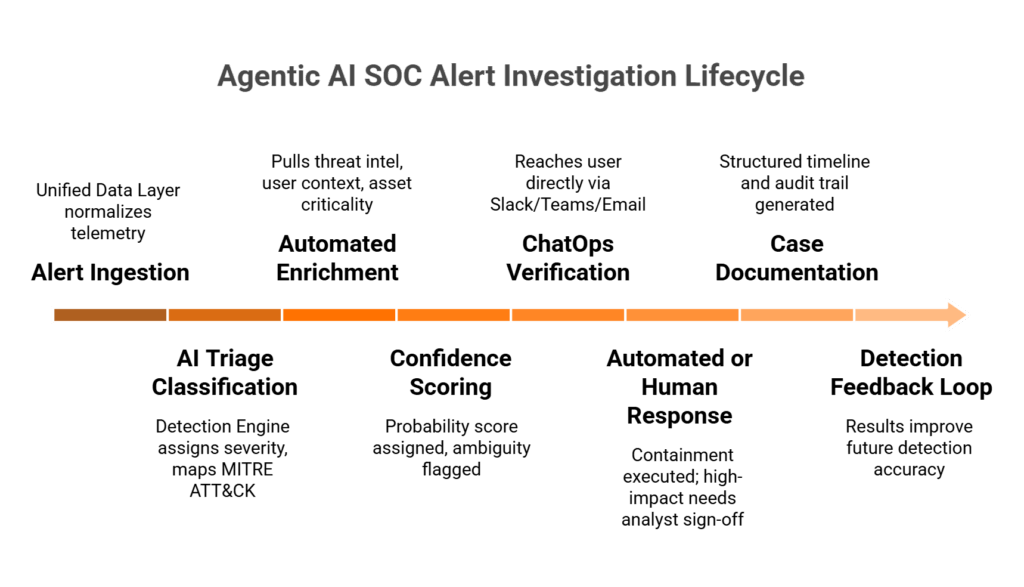
Here’s the lifecycle you should be able to trace in any AI SOC worth evaluating:
- Alert ingestion → Unified Data Layer normalizes telemetry from endpoints, identity, cloud, and SaaS
- AI triage & classification → Detection Engine assigns severity, maps to MITRE ATT&CK techniques
- Automated enrichment & correlation → Orchestration Layer pulls threat intel, user context, asset criticality, and historical behavior
- Confidence scoring → AI assigns a probability score and flags ambiguity
- ChatOps user verification → If behavioral context is needed (“Did you authorize that OAuth grant?”), the Collaboration Interface reaches the user directly
- Automated or human-approved response → Hyperautomation executes containment; high-impact actions require analyst sign-off
- Case documentation → Case Management generates a structured timeline and audit trail
- Detection feedback loop → Results feed back into the Detection Engine to improve future accuracy
📌 Key Terminology for Decision-Makers
| Term | Definition |
|---|---|
| GenAI | Generative AI for natural language investigation summaries and reporting |
| Agentic AI | Autonomous, goal-directed AI agents that execute multi-step tasks |
| Multi-Agent Systems | Coordinated teams of specialized AI agents working in parallel |
| Hyperautomation | End-to-end process automation beyond traditional SOAR capabilities |
| SOAR | Legacy playbook-based orchestration, rigid and rule-dependent |
| XDR | Extended detection and response across multiple security domains |
| ITDR | Identity threat detection and response |
| MCP | Model Context Protocol, standardized framework for tool integration |
UnderDefense MAXI: Full Agentic Architecture, Your Stack
UnderDefense MAXI implements this complete agentic architecture as a unified security operations layer on top of any existing SIEM or XDR, preserving customer stack ownership, supporting deployment in customer-specific cloud environments (Azure, GCP, AWS, Oracle), and ensuring every investigative step is observable, auditable, and transparent. Detection Logic as Code means detection rules are written in Python, versioned, unit-tested, and deployed via CI/CD. This is the foundation for AI-driven SOCs that enterprises can govern with confidence.
Q3: What Are the 5 Core Capabilities That Define a True AI SOC?
Capability 1: Autonomous Alert Triage & Investigation
AI agents ingest raw alerts, auto-enrich with threat intelligence and organizational context (user role, asset criticality, historical behavior), correlate across multiple data sources, and produce structured investigation reports, all within minutes, not hours. The benchmark: triage time drops from 30 to 45 minutes per alert to under 2 minutes. The distinction matters. Agentic triage reasons about alert context, weighing factors like whether the flagged user is a VIP, whether the device is production-critical, and whether the behavior pattern has precedent. Rule-based filtering simply pattern-matches against signatures and misses everything else.
Capability 2: Behavioral Anomaly Detection & Predictive Analytics
Multi-layer AI detection combines supervised ML (known threat patterns) with unsupervised ML (behavioral baselines) to catch threats that signature-based tools miss: insider threats, zero-days, and living-off-the-land attacks. User and Entity Behavior Analytics (UEBA) establishes behavioral baselines per user and entity, then flags deviations with confidence scores. Predictive analytics identifies pre-attack indicators, such as reconnaissance patterns and privilege escalation sequences, before full attack execution begins. This is where the AI SOC earns its keep: catching what static rules never will.
Capability 3: Automated Incident Response & Containment
AI-orchestrated response actions execute at machine speed: endpoint isolation, credential revocation, firewall rule updates, session termination, and MFA enforcement. The critical distinction here is human-in-the-loop validation for high-impact actions (isolating a production server) versus full automation for low-risk containment (blocking a known malicious IP). Benchmark: MTTR improves from hours or days to under 15 minutes for critical incidents. As one CISO I worked with put it during a podcast: “I just can’t automate everything… got to have both really to get to a resilient solution.” That balance between speed and judgment is what separates a mature AI SOC from a reckless one.
Capability 4: Threat Intelligence Integration & Correlation
Automated ingestion and correlation of multi-source threat intelligence, including OSINT, commercial feeds, dark web monitoring, and ISAC sharing, with internal telemetry. AI agents map indicators to MITRE ATT&CK techniques, identify campaign attribution, and prioritize alerts based on threat actor relevance to the organization’s industry and geography.
Capability 5: AI-Driven Case Management & Reporting
Automated investigation timelines, evidence chains, and compliance-ready incident reports generated in natural language. Executive threat reporting with risk scoring, trend analysis, and board-ready dashboards. AI-generated post-incident reviews with detection rule improvement recommendations turn every incident into a stronger detection posture.
✅ UnderDefense: All 5 + the Context Gap Closer
UnderDefense MAXI delivers all 5 capabilities through a single unified platform, with the unique addition of ChatOps user verification that closes the context gap no other AI SOC addresses. When behavioral alerts need human confirmation (“Did Jane authorize that OAuth app at 2:41 AM?”), our analysts reach out directly via Slack, Teams, or email, solving alerts that competitors simply escalate back to your team.
Q4: Where Does AI SOC Deliver the Most Impact? Real-World Use Cases Across Threat Vectors
📧 Use Case 1: Phishing & Email Security Automation
It’s 9:47 AM. An AI-generated phishing email bypasses your email gateway. It’s grammatically perfect, spoofs your CFO’s writing style, and links to a pixel-perfect login page on a lookalike domain. A finance team member clicks and enters credentials. Here’s what should happen next: the AI SOC detects credential submission to a non-corporate domain in real-time, automatically revokes the session, sends a ChatOps verification to the user (“Did you enter credentials on this site?”), enforces a password reset, and traces the forensic email chain to identify other recipients. Total time from click to containment: minutes, not hours.
🔒 Use Case 2: Ransomware Detection & Containment
It’s 2 AM on a Tuesday. Ransomware begins encrypting file shares. The AI SOC detects anomalous file access patterns within seconds. Hundreds of file modifications per minute from a single endpoint is not normal behavior. Automated response: isolate the affected endpoint, block lateral movement paths, preserve forensic evidence, and alert the incident response team with a full attack timeline. No human needed to wake up and start triaging from scratch.
⚠️ Use Case 3: Insider Threat Detection
A departing employee begins exfiltrating sensitive data to personal cloud storage. The AI SOC’s UEBA flags behavioral deviations: unusual data access volume, off-hours activity, and repositories outside the normal scope. ChatOps verifies with the employee’s manager. DLP policy enforcement triggers automatically. This is where organizational context matters: the AI knows this person submitted their resignation last week.
☁️ Use Case 4: Cloud Security Monitoring
A misconfigured S3 bucket exposes sensitive data. Simultaneously, a compromised service account spins up crypto-mining instances. The AI SOC correlates cloud security configuration alerts with IAM anomalies, auto-remediates the configuration drift, and revokes compromised service account tokens. Two threats, one correlated response.
Use Case 5 & 6: Compliance & Executive Reporting
The AI SOC continuously maps security events to compliance requirements (SOC 2, HIPAA, PCI-DSS), auto-generates evidence artifacts, and flags control failures in real-time, rather than discovering them during annual audits. For executives, AI generates board-ready risk summaries, attack trend analysis, and ROI dashboards with natural language explanations.
✅ UnderDefense Across All 6 Scenarios
This is where our architecture shows its teeth. UnderDefense MAXI ingests CrowdStrike endpoint alerts + Okta identity signals + Splunk logs + cloud-native security findings into a single correlating AI layer. ChatOps verification resolves ambiguous behavioral alerts across all use cases. Our concierge analyst team provides the organizational context that pure AI cannot. They know your VIPs, your technical users, and your critical assets.
“Their SOC team is responsive and knows their stuff. When they escalate something, they include the context we need to understand the issue quickly. We’re not wasting time piecing together what happened from different systems anymore.”
— Verified User, Marketing and Advertising UnderDefense G2 – Verified Review
“We received little value from Arctic Wolf. The product offered little visibility when we were using it… Anything you want to look at or changes you need to make in the product must go through their engineering team.”
— Matt C., Manager, Cybersecurity Services Arctic Wolf – G2 Verified Review
UnderDefense maintains a 100% ransomware prevention record across 500+ MDR clients over 6 years, detected threats 2 days faster than CrowdStrike OverWatch in documented case studies, and reduces customer-facing alerts by 99% through custom detection tuning. Because use cases are not theoretical when your analysts verify every suspicious action with the humans involved.|
Q5: AI SOC Maturity Model: Where Does Your Organization Stand, and How Do You Progress?
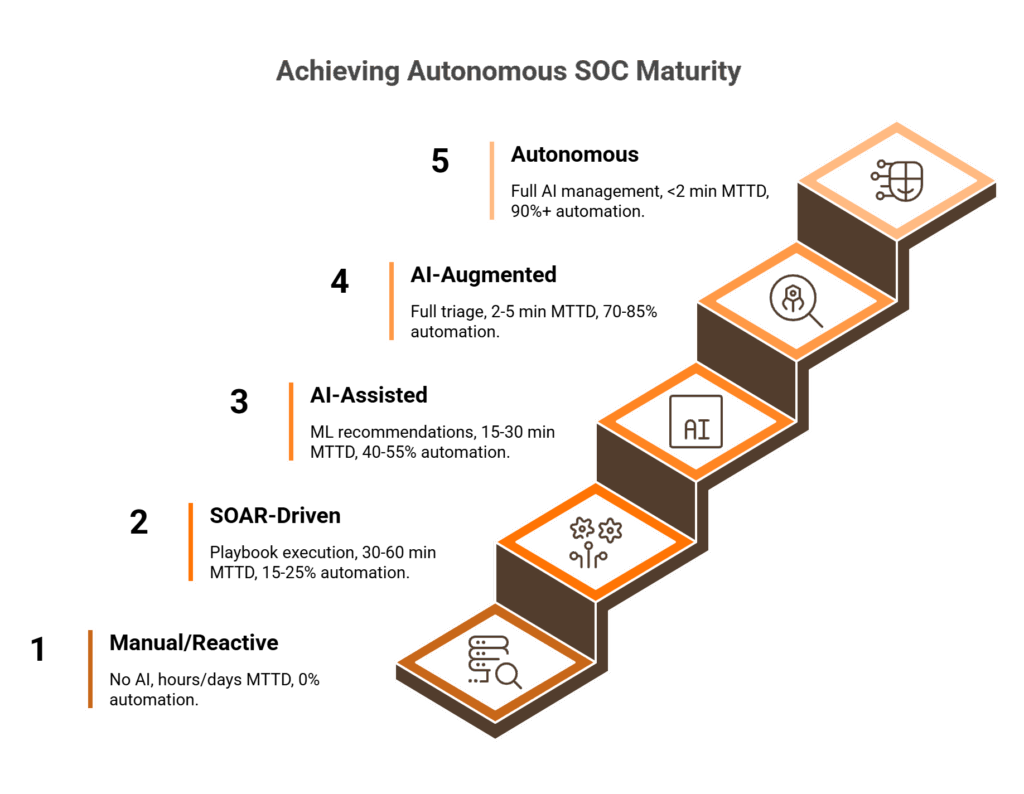
Most security teams I talk to know they need to modernize their SOC. What they lack is not motivation but a framework for measuring where they are today and what “better” actually looks like in concrete, operational terms. So here’s a 5-level AI SOC maturity model we use internally and with customers to benchmark reality, not aspirations.
📊 The 5-Level AI SOC Maturity Model
| Level | AI Role | Human Role | Key Metrics (MTTD / MTTR / Automation Rate) | Technology Required |
|---|---|---|---|---|
| 1 — Manual/Reactive | None | Human-only triage; analysts investigate every alert | Hours / Days / 0% | SIEM with basic rules |
| 2 — Automated (SOAR-Driven) | Playbook execution for known scenarios | Analysts manage playbooks; handle novel threats manually | 30–60 min / Hours / 15–25% | SIEM + SOAR |
| 3 — AI-Assisted (Copilot + ML) | ML-based detection; AI recommends next steps | Analyst makes all decisions; AI reduces noise | 15–30 min / 30–60 min / 40–55% | SIEM + SOAR + ML detection engine |
| 4 — AI-Augmented (Agentic Triage) | Agentic AI handles full triage, investigation, and recommends response | Human validates critical decisions; auto-containment for low-risk | 2–5 min / <15 min / 70–85% | Agentic AI platform + ChatOps + Detection as Code |
| 5 — Autonomous (Full Lifecycle) | AI manages detection, investigation, response, and continuous tuning | Human oversight on exceptions only; proactive threat hunting | <2 min / <5 min / 90%+ | Full AI SOC with adaptive learning + human ally |
✅ Self-Assessment Checklist: Score Yourself Honestly
Answer yes or no to each:
- Do you have 24/7/365 automated alert triage?
- Can your system correlate alerts across endpoint, identity, cloud, and SaaS in under 2 minutes?
- Does your SOC verify suspicious user activity directly (via ChatOps) before escalating?
- Are your detection rules versioned and deployed via CI/CD?
- Can you contain a critical threat within 15 minutes of detection?
- Does your security monitoring auto-generate compliance evidence?
- Can your SOC operate at consistent quality during nights/weekends without degradation?
- Does your AI explain its investigation reasoning in auditable steps?
- Can your team focus on strategic security vs. being consumed by triage?
- Do you have direct access to Tier 3–4 analysts, not just ticket-based support?
📌 Score Interpretation
| Score | Maturity Level | What It Means |
|---|---|---|
| 8–10 ✅ | Level 4–5 | Your SOC is operating at advanced maturity. Focus on optimization and proactive hunting. |
| 5–7 ⚠️ | Level 3 | Critical gaps exist in automation or response speed. You’re likely missing threats or burning out analysts on noise. |
| 2–4 ❌ | Level 2 | Coverage gaps are real. Reactive processes dominate, and consistent quality is a struggle. |
| 0–1 ❌ | Level 1 | Your SOC is fully manual. Breach risk is elevated, and scaling is nearly impossible without architectural change. |
⏰ How UnderDefense MAXI Accelerates Maturity
Here’s how we map UnderDefense MAXI to each progression step:
- Level 1 → 3: Turnkey 30-day onboarding with custom detection tuning, 250+ tool integration, and 99% noise reduction from day one. No stack replacement required.
- Level 3 → 4: Agentic AI investigation with ChatOps user verification and Detection Logic as Code. Your detection rules become auditable, version-controlled artifacts.
- Level 4 → 5: Adaptive learning across our customer base, proactive threat hunting with 96% MITRE ATT&CK coverage, and continuous detection improvement driven by real-world attack telemetry.
Most UnderDefense customers progress from Level 1–2 to Level 4 within 30 days of onboarding. Because AI SOC maturity shouldn’t require a 12-month transformation program when the right architecture and expertise are already built.
“UnderDefense has changed our approach to cybersecurity. At first, we hired them for managed SIEM service, but after they demonstrated the value of MDR, our management was motivated to act on it. Now, with their security monitoring and incident response we know our endpoints are well-protected.”
— Yaroslava K., IT Project Manager UnderDefense G2 – Verified Review
“Their team cleaned up our configurations and got the noise under control within the first week. Now when we get an alert, we know it’s something worth looking into.”
— Verified User in Marketing and Advertising UnderDefense G2 – Verified Review
Q6: What Is the Real ROI of an AI SOC: Benefits, Metrics, and a Calculation Framework for Your CFO?
I’ve sat in enough board meetings to know that “better security” is not a budget justification. CFOs want numbers: cost savings, risk reduction, and a timeline to value. Here’s the framework I use to make the AI SOC business case concrete and auditable.
📊 Quantified Benefits with Before/After Benchmarks
| Metric | Before (Manual SOC) | After (AI SOC + Human Ally) | Operational Impact |
|---|---|---|---|
| MTTD (Mean Time to Detect) | Hours to days | Minutes | Threats caught before lateral movement |
| MTTR (Mean Time to Respond) | Days | <15 min for critical incidents | Containment before damage spreads |
| Alert Triage Time | 30–45 min/alert | <2 minutes | 15x analyst efficiency gain |
| False Positive Rate | 70–90% of alerts | Reduced by 70–80% (up to 99% with custom tuning) | Team focuses on real threats |
| Alert Volume per Analyst | 50–100/day | 250–500/day (3–5x capacity increase) | Fewer hires needed to scale |
| Analyst Retention | 18-month avg. tenure | Reduced burnout; strategic work increases | Lower recruiting/training costs |
| Compliance Audit Prep | Weeks of manual evidence gathering | 60–70% reduction via auto-generated artifacts | Faster audits, fewer penalties |
💰 ROI Calculation Framework
Formula:
ROI = [(Annual Cost Savings + Risk-Adjusted Value) − Annual AI SOC Investment] / Annual AI SOC Investment × 100
Breaking down each variable:
- Annual Cost Savings = (Analyst Hours Saved × Fully Loaded Hourly Rate) + (Avoided Hires × Annual Salary + Benefits + Training + Recruiting) + (Tool Consolidation Savings)
- Risk-Adjusted Value = (Breach Probability Reduction × Average Breach Cost) + (Dwell Time Reduction × Hourly Incident Cost) + (Compliance Penalty Avoidance)
- Annual AI SOC Investment = Platform Licensing + Integration/Onboarding + Change Management + Ongoing Optimization
💸 Worked Example: Mid-Market Organization (1,000 Endpoints)
| Cost Component | Manual SOC | AI SOC + Human Ally |
|---|---|---|
| Analyst Staffing (6 FTEs × $130K fully loaded) | $780,000 | — |
| Security Tooling | $250,000 | Existing stack retained |
| Training / Turnover Costs | $80,000 | — |
| Annual Manual SOC Total | $1,110,000 | — |
| AI SOC Platform + Analyst Services ($11–15/endpoint/month) | — | ~$180,000–$200,000 |
| Direct Annual Savings | — | ~$900,000+ |
Add Risk-Adjusted Value: 15% breach probability reduction × $4.88M average breach cost (IBM 2024) = $732K risk-adjusted value.
3-Year Cumulative ROI: 830%+
📌 10 KPIs to Track AI SOC Success
| KPI | Measurement Cadence | Target Benchmark |
|---|---|---|
| Alert-to-Triage Time | Weekly | <2 minutes |
| MTTD | Weekly | <5 minutes |
| MTTR (Critical) | Weekly | <15 minutes |
| False Positive Rate | Monthly | <5% post-tuning |
| Automation Rate | Monthly | >80% alerts resolved without human |
| MITRE ATT&CK Coverage | Quarterly | >95% |
| Analyst Time on Strategic Work | Monthly | >60% |
| Compliance Evidence Auto-Generation | Quarterly | >80% of controls |
| Cost Per Protected Asset | Quarterly | $11–15/endpoint/month |
| Net Alert Volume Reaching Humans | Weekly | <1% of raw alerts |
How UnderDefense Delivers Measurable ROI
UnderDefense customers document 830% ROI over 3 years, 2-minute Alert-to-Triage replacing hours of manual investigation, 99% noise reduction, and $11–15/endpoint/month transparent pricing with no hidden costs. Because ROI shouldn’t be theoretical when measurable results begin within 30 days of onboarding.
“UnderDefense is surprisingly affordable considering the level of protection we get. Their proactive threat hunting and rapid response have saved us from incidents that could have been incredibly costly.”
— Verified User in Program Development UnderDefense G2 – Verified Review
“As a CIO, my days are packed. I’m always looking for ways to optimize our operations, especially by automating those repetitive, time-consuming tasks… nothing is more reassuring than knowing we have solid defenses against ransomware.”
— Arlin O., Enterprise CIO UnderDefense G2 – Verified Review
Q7: AI SOC Platform Comparison 2026: How Do Leading Vendors Stack Up on Architecture, Capabilities, and Pricing?
If you’re evaluating AI SOC platforms right now, the first thing to understand is that not all “AI SOCs” are built the same way. The market has fragmented into four distinct architecture categories, and each comes with real tradeoffs that affect how well the platform works in your environment.
🔍 Four Architecture Categories
- Agentic AI Platforms: Autonomous multi-step investigation (UnderDefense MAXI, Conifers.ai, Prophet Security). Deepest investigation autonomy; requires trust calibration.
- Hyper-Automation Platforms: Advanced SOAR with AI layers (Torq, Swimlane). Familiar workflow paradigm; constrained by playbook rigidity.
- Detection-Focused Platforms: AI-enhanced SIEM/XDR (Stellar Cyber, Exabeam). Excel at alert quality; may lack response orchestration.
- AI SOC Analysts: Autonomous AI analyst agents (Dropzone AI, Simbian, D3 Security). Fast triage; narrower TDIR lifecycle coverage.
⚖️ Vendor-by-Vendor Assessment
- UnderDefense MAXI: Vendor-agnostic agentic AI + human ally. 250+ integrations, ChatOps verification, Detection as Code, transparent $11–15/endpoint/month pricing. Full TDIR lifecycle coverage with concierge analyst response.
- ReliaQuest GreyMatter: Strong AI autonomy and broad visibility. However, over-reliance on AI can return tickets without actionable answers; proprietary platform lock; opaque pricing.
- Arctic Wolf: Strong brand recognition and concierge teams. Proprietary SIEM lock-in means you must replace existing tools; no detection engineering customization; opaque $96K+ median annual contracts.
- Torq: Powerful hyperautomation engine. SOAR-centric architecture requires playbook-building expertise; less effective against novel, unplaybooked threats.
- Stellar Cyber: Open XDR with multi-layer AI detection. Good alert correlation; less autonomous investigation capability.
- Dropzone AI: AI SOC analyst for autonomous triage. Fast for known patterns; narrower coverage across the full TDIR lifecycle.
- Prophet Security: AI investigation focus with strong potential. Newer entrant with a less established enterprise track record.
- Simbian: Unified AI SOC platform. Promising architecture; limited enterprise deployments to date.
📊 Comprehensive Comparison Table
| Evaluation Criteria | UnderDefense MAXI | ReliaQuest | Arctic Wolf | Torq | Stellar Cyber | Dropzone AI |
|---|---|---|---|---|---|---|
| Architecture Type | Agentic AI + Human | Agentic AI | Proprietary MDR | SOAR + AI | Open XDR | AI Analyst |
| TDIR Lifecycle Coverage | ✅ Full | ✅ Full | ⚠️ Detect + Alert | ⚠️ Automate + Respond | ⚠️ Detect + Correlate | ⚠️ Triage |
| Integration (Vendor-Agnostic) | ✅ 250+ tools | ⚠️ Proprietary-leaning | ❌ Proprietary SIEM | ✅ Broad via API | ✅ Open XDR | ⚠️ Limited |
| Investigation Transparency | ✅ Auditable steps | ⚠️ Partial | ❌ Black box | ⚠️ Playbook-dependent | ⚠️ Partial | ✅ Explainable |
| User Verification (ChatOps) | ✅ Direct Slack/Teams | ❌ Not offered | ❌ Escalates to customer | ❌ Not native | ❌ Not offered | ❌ Not offered |
| Response Capability | ✅ Full containment | ⚠️ Partial | ⚠️ Alert + escalate | ✅ SOAR-driven | ⚠️ Detection-focused | ⚠️ Triage-focused |
| Detection Customization | ✅ Code-based (CI/CD) | ⚠️ Limited | ❌ Rigid, vendor-managed | ⚠️ Playbook-based | ⚠️ Template-based | ❌ Vendor-managed |
| Compliance Integration | ✅ Included (forever-free) | ⚠️ Separate | ❌ Separate product | ❌ Not included | ⚠️ Partial | ❌ Not included |
| Deployment Options | ✅ Cloud/On-prem/Hybrid | ✅ Cloud/Hybrid | ⚠️ Cloud-first | ✅ Cloud | ✅ Cloud/On-prem | ✅ Cloud |
| Pricing Transparency | ✅ Published ($11–15/ep) | ❌ Contact sales | ❌ Opaque ($96K+ median) | ❌ Contact sales | ⚠️ Partially published | ❌ Contact sales |
📋 Vendor Evaluation Checklist
Before committing to any AI SOC vendor, verify:
- Can it work with your existing SIEM/EDR/cloud stack without replacement?
- Is every AI investigation step observable and auditable?
- Can it contain threats, not just detect?
- Does it verify suspicious activity directly with affected users?
- Does it keep data in your environment?
- Are detection rules customizable via code?
- What is the documented onboarding timeline?
- Is pricing published and predictable?
- What is the MITRE ATT&CK coverage percentage?
- Can you validate during a parallel-run before full commitment?
🎯 Prescriptive Guidance
Choose ReliaQuest if you want maximum AI autonomy with large enterprise IT resources to manage the platform. Choose Arctic Wolf if starting from zero with no existing security stack. Choose Torq if your priority is SOAR modernization with AI layers. Choose UnderDefense MAXI if you want to protect existing security investments, need transparent auditable investigation workflows, and want analysts who verify alerts directly with users rather than escalating back to your team, all at published $11–15/endpoint/month pricing.
Q8: How Do You Implement an AI SOC? A 90-Day Migration Playbook with Compliance Mapping
Implementation is where most AI SOC projects either prove their value or fall apart. I’ve seen organizations spend months in “assessment mode” with consultants who produce beautiful slide decks and zero operational improvement. Here’s the 90-day playbook we use with customers: three phases, concrete milestones, and compliance mapping built in from day one.
Phase 1 (Days 1–30): Assessment & Integration
Key activities:
- Map current state: Document your security tool inventory, alert volumes, response workflows, and SLA baselines.
- Identify compliance requirements: Catalog evidence collection gaps across SOC 2, HIPAA, PCI-DSS 4.0, DORA, or NIS2 (whichever apply).
- Define human-AI decision boundaries: Which response actions can be automated? Which require human approval? Get this right upfront.
- Integrate the AI SOC platform: Connect existing SIEM, EDR, cloud, and identity stack. No rip-and-replace.
- Configure custom detection rules: Tune detection logic to your organizational context, not generic out-of-the-box rules.
- Establish parallel-run baselines: Document MTTD, MTTR, and false positive rates before the AI SOC takes over.
✅ Success criteria: All critical data sources ingested, baseline metrics documented, initial detection tuning complete.
⚠️ Common pitfall: Underestimating data quality requirements. Garbage in means AI garbage out. If your logs are incomplete or misconfigured, fix that first.
Phase 2 (Days 31–60): Pilot & Tuning
Key activities:
- Run AI SOC in parallel: Validate detection accuracy against your existing SOC operations before switching over.
- Tune detection rules: Analyze false positive/negative patterns and adjust. This is iterative; expect 2–3 tuning cycles.
- Train analysts on new workflows: Shift from manual triage to AI-supervised review. The role changes from “investigate everything” to “validate critical decisions.”
- Validate ChatOps verification: Test user verification workflows with real alerts via Slack/Teams.
- Begin compliance evidence auto-collection: Map AI SOC outputs to compliance framework controls.
- Establish feedback loops: Connect AI findings back into detection engineering for continuous improvement.
✅ Success criteria: False positive rate below target threshold, analyst adoption metrics positive, first compliance evidence artifacts generated automatically.
⚠️ Common pitfall: Skipping the parallel-run phase. You need validation before commitment. If a vendor won’t support parallel-run, that tells you something.
Phase 3 (Days 61–90): Scaling & Optimization
Key activities:
- Transition primary SOC operations: Move to the AI SOC platform as the primary detection and response engine.
- Decommission redundant tools: Where the AI SOC provides superior coverage, remove overlapping licenses to capture cost savings.
- Expand detection coverage: Add data sources and threat vectors beyond the initial deployment scope.
- Establish executive reporting cadence: Weekly, monthly, and quarterly dashboards for leadership and board visibility.
- Activate proactive threat hunting: Shift from reactive to proactive with dedicated hunting programs.
- Document rollback procedures: Always have a disaster recovery plan. Hope for the best; plan for the worst.
📋 Compliance Framework Mapping
| Framework | AI SOC Capability | Evidence Auto-Generated | Audit-Readiness Impact |
|---|---|---|---|
| SOC 2 Type II | Continuous monitoring, access control logging, incident response documentation | Monitoring logs, incident reports, access reviews | Continuous evidence vs. point-in-time snapshots |
| HIPAA | PHI access monitoring, breach notification workflows, audit trail generation | Access logs, breach timelines, notification records | Automated breach documentation |
| PCI-DSS 4.0 | Cardholder data environment monitoring, file integrity monitoring, log retention | FIM reports, log retention proof, monitoring evidence | Reduced manual evidence prep by 60–70% |
| DORA | ICT incident reporting, digital operational resilience testing, third-party risk monitoring | Incident reports, resilience test results, vendor risk assessments | Meets 24-hour incident reporting requirements |
| NIS2 | Essential entity security monitoring, incident notification, supply chain risk assessment | Monitoring evidence, notification records, supply chain audits | Notification within 24 hours with automated workflows |
⏰ Mid-Market Implementation Considerations
Organizations with 500–2,000 endpoints should focus on turnkey deployment models, prioritize vendor-agnostic integration to protect existing investments, and ensure the vendor provides dedicated onboarding resources, not self-service documentation.
We complete AI SOC migration in 30 days, including custom detection tuning, integration with your existing SIEM/EDR/cloud stack, compliance evidence automation for SOC 2/HIPAA/ISO 27001, and dedicated analyst onboarding. Our parallel-run approach lets you validate detection accuracy before you commit, and our 99% noise reduction is measured during onboarding, not promised after. Forever-free compliance kits are included with MDR, not sold as a separate add-on.
Q9: What Are the Adversarial Limitations of AI in a SOC, and How Do You Defend Against AI-Powered Attacks?
Here’s what most AI SOC vendors won’t tell you: AI in security introduces new attack surfaces that adversaries are already exploiting. Threat actors have weaponized agentic AI, moving faster, more automated, and paradoxically more effective despite requiring less skill. This is not a future problem but something happening right now.
⚠️ AI-Powered Attack Vectors You Need to Know
- AI-Generated Phishing & Deepfake Social Engineering: Perfectly crafted, context-aware phishing at scale. Voice deepfakes for vishing attacks. Video deepfakes for executive impersonation. The skill barrier for sophisticated social engineering has collapsed.
- Agentic Ransomware & Automated Attack Chains: AI that autonomously maps infrastructure, chains vulnerabilities, adapts lateral movement paths, and deploys ransomware with minimal human direction. What took threat actors days now happens in hours.
- AI-Driven Reconnaissance & Evasion: Automated asset discovery, vulnerability identification, and defense evasion using adversarial ML techniques that specifically target security AI models.
🔍 How Adversaries Attack AI SOC Systems Themselves
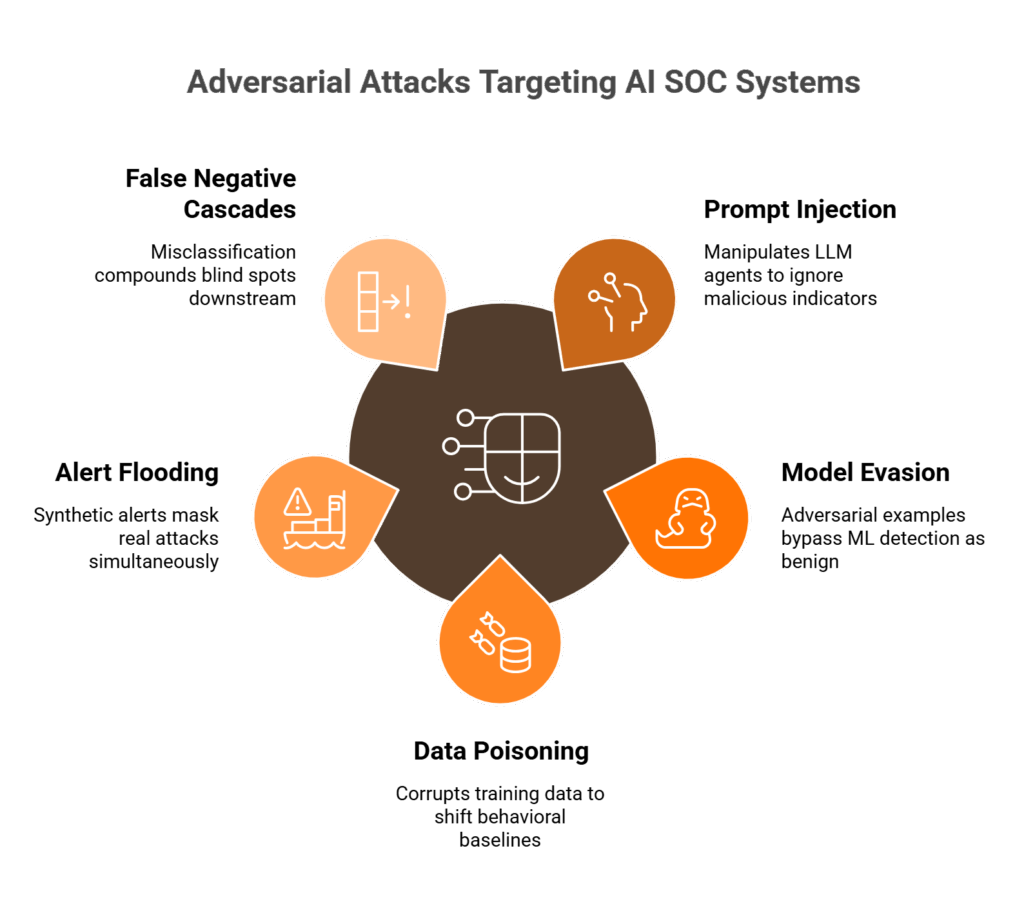
This is the part that gets uncomfortable. Five specific risks:
- Prompt Injection: Adversaries craft inputs that manipulate LLM-based investigation agents into ignoring malicious indicators or misclassifying threats.
- Model Evasion: Adversarial examples specifically designed to bypass ML detection models while appearing benign to automated classifiers.
- Data Poisoning: Gradually corrupting training data through low-and-slow attack patterns that shift behavioral baselines over time.
- Alert Flooding: Overwhelming AI triage capacity with massive volumes of synthetic alerts to mask real attacks executing simultaneously.
- False Negative Cascades: A single AI misclassification propagating downstream, creating compounding blind spots across correlated alert chains.
❌ Honest Limitations You Should Acknowledge
AI SOC is not infallible, and pretending otherwise is dangerous. Current limitations include:
- AI struggles with truly novel (zero-zero-day) attack patterns with no training data.
- Overconfidence in automation can create a false sense of security.
- Automated response actions may violate GDPR data handling rules or DORA requirements for human oversight.
- SEC cyber disclosure rules create liability when AI makes autonomous containment decisions without documented human authorization.
- Model drift requires continuous monitoring and retraining that most organizations underestimate.
✅ How the Human Ally Model Mitigates These Risks
Our architecture at UnderDefense addresses each adversarial limitation directly:
- Observable, Auditable AI: Every investigative step is documented and reviewable, preventing silent prompt injection manipulation. No black boxes.
- Human-in-the-Loop for All High-Impact Decisions: AI collects context and recommends; experienced analysts authorize containment actions on critical assets.
- Detection Logic as Code with Governance: Detection rules are versioned, unit-tested, and CI/CD deployed, preventing uncontrolled model drift.
- ChatOps User Verification: Closes the context gap that AI alone cannot resolve, catching social engineering that bypasses technical detection.
- On-Prem Deployment Options: Keeping data in the customer’s environment reduces data poisoning attack surface.
- Cross-Customer Adaptive Learning: AI improves detection across the entire customer base while maintaining data isolation, increasing resilience against novel attack patterns.
The honest answer is that no AI SOC is infallible, which is exactly why we built UnderDefense MAXI as an augmentation platform, not an autonomous decision-maker. AI finds patterns at machine speed; experienced analysts understand intent, context, and business impact. That combination, not AI alone, is why we maintain zero ransomware cases across all MDR clients in 6 years while documenting every investigative step for audit and compliance.
Q10: Will AI Replace SOC Analysts? The Human-AI Collaboration Model and the Future of Security Operations
No, AI will not replace SOC analysts, but it will fundamentally transform what analysts do. The role evolves from “alert triage operator” (Tier 1–2 manual investigation) to “security engineer-analyst” (detection engineering, threat hunting, AI supervision, strategic risk management). This is not job elimination but job elevation.
🔍 Where Human Judgment Remains Irreplaceable
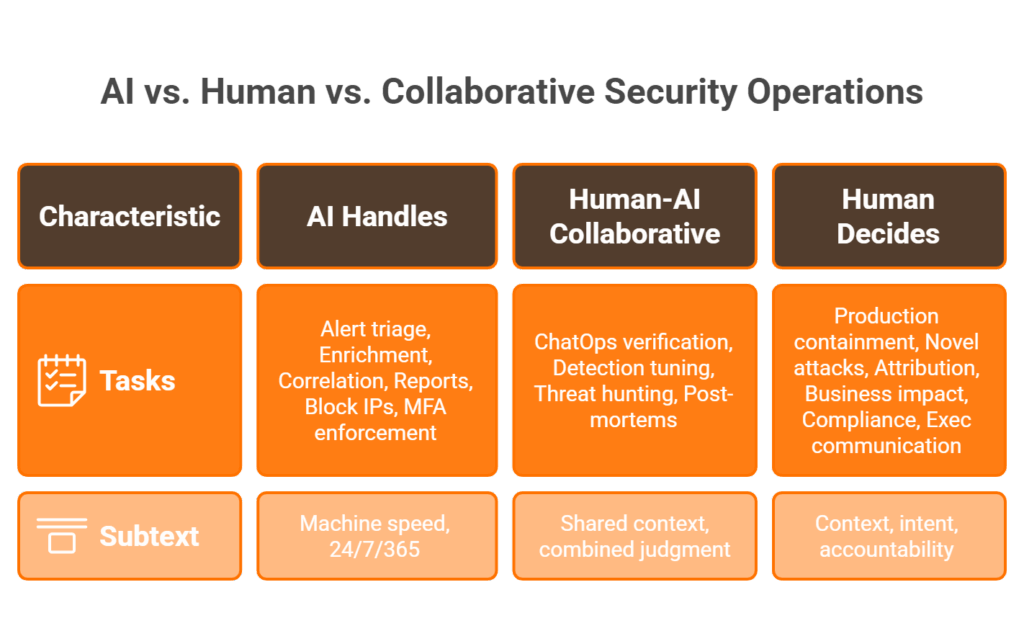
The trust calibration framework defines specific decision boundaries between AI autonomy and human authority:
AI handles: Alert triage, enrichment, correlation, investigation report generation, and low-risk automated response (blocking known malicious IPs, enforcing MFA).
Human decides: Containment actions on production systems, investigation of novel attack patterns, threat actor attribution and intent assessment, business impact evaluation, compliance-sensitive response actions, and communication with executives and regulators.
Human-AI collaborative: Behavioral alert verification (ChatOps), detection rule tuning, threat hunting hypothesis generation, and incident post-mortem analysis.
As one veteran CISO put it during a recent conversation: “I’ve found I just can’t automate everything. I can’t get to a fully lights-out automated security stack because we always run into situations that need human analysis.” That’s the operational reality, and it’s not changing anytime soon.
⏰ The Engineer-Analyst Evolution
The skill transformation is real and already underway:
| Current Tier 1–2 Skills | Future Engineer-Analyst Skills |
|---|---|
| Manual log review | Detection engineering (code-based) |
| Playbook execution | AI model oversight and tuning |
| Alert triage | Threat intelligence analysis |
| Ticket management | Security automation development |
| Single-tool investigation | Cross-domain investigation |
Organizations must invest in retraining programs, not headcount reduction. The talent gap shifts from “not enough analysts” to “not enough analysts with AI collaboration skills.” And this distinction matters for every security leader thinking about workforce planning over the next 3–5 years.
✅ UnderDefense’s Human Ally Model in Practice
We operationalize human-AI collaboration in a very specific way. AI agents automate investigation grunt work: context collection, multi-system correlation, and structured reports in seconds. Meanwhile, dedicated concierge analysts learn each customer’s org structure, VIPs, critical assets, and business context. They ask technical users about suspicious activity, loop in managers for security-impacting changes, and give special attention to alerts affecting high-value assets.
This is not generic outsourcing but a dedicated security team that knows your organization. The hybrid model works because, as we’ve seen across hundreds of deployments, the right feedback loop between AI triage and human expertise means Tier 1 escalations drop dramatically, freeing senior analysts for proactive and strategic work.
🔮 The Future Trajectory
Here’s what’s coming next in AI SOC evolution:
- Multi-Agent AI Systems: Coordinated teams of specialized AI agents (detection, investigation, response, compliance) working in concert. Gartner projects 70% SOC adoption by 2028.
- LLM Integration & Conversational SOC Interfaces: Natural language interaction with security data (“Show me all suspicious logins from departing employees this quarter”) replacing dashboard-surfing with conversational investigation.
- Post-Quantum Security Implications: AI SOCs will need to detect and respond to quantum-capable attack vectors as quantum computing matures, requiring new detection models for post-quantum cryptographic transitions.
The AI SOC of 2028 will look fundamentally different from today, but the human ally model ensures organizations evolve with the technology rather than being disrupted by it.
Q11: Is an AI SOC Right for Your Organization, and What to Ask Before Committing?
Committing to an AI SOC means choosing a security architecture that will define your threat response capability for years. The wrong choice locks you into proprietary tools that require ripping out your existing stack, returns alerts without actionable context, or replaces manual alert noise with automated alert noise. The right choice transforms security from a cost center into a strategic advantage.
❌ The Wrong Way to Decide
Security leaders commonly fall for flawed decision criteria:
- Brand recognition: “ReliaQuest raised $600M, they must be the best.” Capital raised ≠ operational outcomes.
- Feature count: “They support 200 integrations.” Integration count ≠ integration depth or stack preservation.
- AI hype: “They use agentic AI.” Everyone claims agentic AI now. The question is whether it’s auditable and what happens when it’s wrong.
- Cheapest option: Lowest platform cost often means highest hidden costs (integration services, onboarding delays, tool replacement, analyst burden).
The real question: “Can this vendor investigate threats with organizational context at machine speed, or just generate more alerts for your team to triage?”
✅ The Right Evaluation Framework: 7 Criteria
Score each criterion 0–2 points:
| # | Criterion | What to Look For |
|---|---|---|
| 1 | Vendor-Agnostic Integration | Works with your existing SIEM/EDR/cloud stack, or forces proprietary replacement? |
| 2 | Investigation Transparency | Is every AI step observable, auditable, and explainable? |
| 3 | Response Capability | Detect and notify only, or full containment and remediation? |
| 4 | User Verification | Contacts affected users directly via ChatOps, or escalates ambiguous alerts back to your team? |
| 5 | Data Sovereignty | Keeps logs and AI processing in your environment, or requires data export to vendor infrastructure? |
| 6 | Detection Customization | Detection rules as code (versioned, tested, CI/CD deployed), or rigid vendor-managed playbooks? |
| 7 | Onboarding Speed & Pricing | 30-day turnkey with published pricing, or 6-month deployment with opaque “contact sales” quotes? |
Score 10+ = genuine operational partnership. 7–9 = acceptable with trade-offs. Below 7 = you’re buying an alert feed, not managed detection and response.
📊 UnderDefense Scorecard
| Criterion | Score | Justification |
|---|---|---|
| Vendor-Agnostic Integration | ✅ 2 | 250+ integrations; works with existing stack |
| Investigation Transparency | ✅ 2 | Every AI step observable and auditable |
| Response Capability | ✅ 2 | Full containment + remediation; 15-min escalation for critical |
| User Verification | ✅ 2 | Only AI SOC with ChatOps direct via Slack/Teams/Email/SMS |
| Data Sovereignty | ✅ 2 | On-prem and customer cloud deployment options |
| Detection Customization | ✅ 2 | Detection Logic as Code, Python, CI/CD |
| Onboarding & Pricing | ✅ 2 | 30-day turnkey; published $11–15/endpoint/month |
| Total | 14/14 |
The real question is not which AI SOC has the most impressive demo or the largest funding round but which provider can investigate threats the way your best analyst would, at machine speed, 24/7/365, while keeping your existing security investments intact and every action transparent. Request a 30-day proof of value. We expect you to validate before you commit.
“UnderDefense’s ease of integration into our existing tech stack mirrors the positive aspects, enhancing our security without disrupting workflow.”
— CEO, Mid-Market Company UnderDefense G2 – Verified Review
“Being a digital marketing company, we’re all about swift communication and response. UnderDefense MAXI’s MDR and especially their incident response capabilities are top-tier. But the real game-changer is their seamless integration with Slack.”
— Alexander B., CEO UnderDefense G2 – Verified Review
Q12: Frequently Asked Questions About AI SOC
What is the difference between AI SOC and traditional SOC?
An AI SOC uses artificial intelligence, specifically agentic AI, ML detection, and automated investigation, to handle alert triage, enrichment, correlation, and initial investigation at machine speed. A traditional SOC relies on human analysts to perform these steps manually.
- AI SOC reduces alert triage from 30–45 minutes per alert to under 2 minutes.
- Traditional SOC quality degrades during nights, weekends, and staff turnover.
- AI SOC correlates across endpoint, identity, cloud, and SaaS simultaneously; traditional SOC does this sequentially.
UnderDefense MAXI combines AI-driven investigation with dedicated human analysts: automation handles speed, humans handle judgment.
Will AI replace SOC analysts?
No. AI will transform the SOC analyst role from manual alert triage to detection engineering, threat hunting, and AI oversight. The operational reality is that AI accelerates routine work, but novel threats, business context decisions, and compliance-sensitive actions still require human judgment.
- Gartner projects multi-agent AI adoption in SOCs will grow from 5% to 70% by 2028.
- The talent gap shifts to “analysts with AI collaboration skills.”
How much does an AI SOC cost?
AI SOC pricing ranges from $11–15/endpoint/month for transparent providers to $96K+ annually for opaque enterprise contracts. The real cost comparison is AI SOC investment vs. the $780K+ annual cost of staffing a 6-analyst manual SOC.
- UnderDefense publishes pricing at $11–15/endpoint/month with no hidden fees.
- 830% documented 3-year ROI for mid-market organizations.
How long does AI SOC implementation take?
Implementation takes 30–90 days depending on environment complexity, with initial value measurable within the first 30 days. A structured 3-phase approach (assessment, pilot, scaling) ensures detection accuracy before full commitment.
- UnderDefense completes turnkey deployment in 30 days, including custom detection tuning.
What is the difference between AI SOC and SOAR?
SOAR automates predefined playbooks for known scenarios: it executes what you’ve already programmed. AI SOC investigates autonomously, reasoning across multiple data sources to handle both known and novel threats. SOAR breaks on unplaybooked scenarios; AI SOC adapts.
- UnderDefense uses Detection Logic as Code (version-controlled, CI/CD deployed), going beyond rigid SOAR playbooks.
Does an AI SOC work with my existing SIEM and EDR?
Yes. A true AI SOC operates as an integration layer on top of your existing security stack, not a replacement. It should work with Splunk, Sentinel, Chronicle, CrowdStrike, SentinelOne, Microsoft Defender, and more.
- UnderDefense MAXI integrates with 250+ tools and deploys without requiring stack replacement.
✅ Your SIEM data and detection rules stay under your control.
What compliance frameworks does AI SOC support?
AI SOC platforms should auto-generate compliance evidence for SOC 2 Type II, HIPAA, PCI-DSS 4.0, ISO 27001, DORA, and NIS2. This reduces manual audit preparation by 60–70%.
- UnderDefense includes forever-free compliance kits with MDR, not sold as a separate add-on.
How does AI SOC handle zero-day threats?
AI SOC detects zero-day threats through behavioral analysis and anomaly detection rather than signature matching. When behavioral alerts need context, ChatOps user verification confirms whether the activity is legitimate.
- UnderDefense achieves 96% MITRE ATT&CK coverage through proactive threat hunting and adaptive detection.
What ROI can I expect from AI SOC?
Mid-market organizations document 830%+ ROI over 3 years when comparing AI SOC + Human Ally costs ($180–200K annually) against manual SOC costs ($1.1M+). Add risk-adjusted value from breach probability reduction, and the business case becomes compelling.
Is AI SOC safe from adversarial attacks?
No AI system is fully immune to adversarial attacks. Prompt injection, model evasion, and data poisoning are real risks. The mitigation is a human-in-the-loop architecture where AI investigates but humans authorize critical decisions, combined with auditable AI steps that prevent silent manipulation.
UnderDefense maintains zero ransomware cases across all MDR clients in 6 years through its Human Ally model.
1. What is an AI SOC, and how does it differ from a traditional SOC?
An AI SOC is a purpose-built security operations center where agentic AI orchestrates the full investigation lifecycle, from alert triage through enrichment, correlation, and response. Unlike a traditional SOC that relies on human analysts to manually investigate every alert (averaging 30–45 minutes per alert), an AI SOC compresses triage to under 2 minutes using autonomous multi-step investigation workflows. The critical distinction is that bolting ML features onto an existing SIEM or SOAR does not make it an AI SOC. A true AI SOC reasons dynamically across data sources and adapts investigation paths in real time, whereas SOAR follows rigid if-then playbooks that break on novel attack patterns. Traditional SOC quality also degrades during nights, weekends, and staff turnover, while an AI SOC maintains consistent coverage 24/7/365. We built UnderDefense MAXI as a unified agentic AI platform that integrates vendor-agnostically with 250+ existing tools, so you modernize operations without ripping out your current security stack.
2. What are the core components of an AI SOC architecture?
A modern AI SOC architecture is built on seven core building blocks working in concert. The Agentic AI Orchestration Layer coordinates multi-step investigation workflows, decision routing, and confidence scoring. The Unified Operational Data Layer normalizes telemetry from endpoint, identity, cloud, network, SaaS, and email sources into a single data fabric. The Multi-Layer AI Detection Engine combines supervised ML (known threats), unsupervised ML (behavioral anomalies), and deep learning (advanced persistent threats). Hyperautomation Response Orchestration triggers automated containment actions like credential revocation and endpoint isolation, with human validation for high-impact decisions. Native Case Management generates AI-driven investigation timelines and audit trails. The Open Ecosystem Model Context Protocol (MCP) enables plug-and-play connectivity without custom API development. Finally, the Human Analyst Collaboration Interface powers ChatOps, escalation workflows, and direct user verification. We detail these components in our SOC automation guide and operationalize all seven through our MAXI platform.
3. How much does an AI SOC cost, and what ROI can we expect?
AI SOC pricing varies widely across the market. Transparent providers publish rates at $11–15/endpoint/month, while opaque enterprise contracts can exceed $96K+ annually with hidden integration and onboarding costs. The real cost comparison is AI SOC investment versus the $780K+ annual cost of staffing a 6-analyst manual SOC (covering salary, tooling, training, and turnover). We document 830%+ ROI over 3 years for mid-market organizations with 1,000 endpoints, where the AI SOC + Human Ally model costs $180–200K annually compared to $1.1M+ for manual operations. Add risk-adjusted value from breach probability reduction (15% reduction × $4.88M average breach cost = $732K), and the business case becomes compelling. We publish our pricing at $11–15/endpoint/month with no hidden fees, and measurable results begin within 30 days of onboarding. You can estimate your own costs with our SOC cost calculator.
4. Will AI replace SOC analysts, or does human expertise still matter?
AI will not replace SOC analysts, but it will fundamentally transform the role from “alert triage operator” (Tier 1–2 manual investigation) to “security engineer-analyst” (detection engineering, threat hunting, AI supervision, strategic risk management). AI handles alert triage, enrichment, correlation, and low-risk automated response at machine speed. Humans remain irreplaceable for containment actions on production systems, novel attack pattern investigation, threat actor attribution, business impact evaluation, compliance-sensitive response actions, and executive communication. Gartner projects multi-agent AI adoption in SOCs will grow from 5% to 70% by 2028, and the talent gap shifts to “analysts with AI collaboration skills.” We operationalize this through our Human Ally model, where dedicated concierge analysts learn each customer’s org structure, VIPs, and critical assets. Learn more about this evolution in our article on whether AI kills or saves your SOC team.
5. How do you evaluate and compare AI SOC vendors in 2026?
We recommend scoring vendors across 7 criteria on a 0–2 scale: vendor-agnostic integration (works with your existing stack or forces replacement), investigation transparency (every AI step observable and auditable), response capability (full containment and remediation, not just detect-and-notify), user verification (contacts affected users directly via ChatOps), data sovereignty (on-prem and customer cloud deployment options), detection customization (detection rules as code with CI/CD deployment), and onboarding speed with published pricing. Score 10+ indicates a genuine operational partnership. Score 7–9 means acceptable with trade-offs. Below 7 means you are buying an alert feed, not managed detection and response. The market has fragmented into four architecture categories: agentic AI platforms, hyper-automation platforms, detection-focused platforms, and AI SOC analysts. Use our MDR buyers guide for a structured evaluation framework before committing to any vendor.
6. What are the adversarial risks of deploying AI in a SOC?
AI in security introduces five specific adversarial attack surfaces that threat actors are already exploiting. Prompt injection manipulates LLM-based investigation agents into ignoring malicious indicators. Model evasion uses adversarial examples designed to bypass ML detection models. Data poisoning gradually corrupts training data through low-and-slow attack patterns. Alert flooding overwhelms AI triage capacity with synthetic alerts to mask real attacks. False negative cascades propagate a single AI misclassification downstream, creating compounding blind spots. Beyond these, AI struggles with truly novel (zero-zero-day) attack patterns, automated response actions may violate GDPR or DORA requirements, and model drift requires continuous monitoring most organizations underestimate. The mitigation is a human-in-the-loop architecture where AI investigates but humans authorize critical decisions, combined with auditable AI steps that prevent silent manipulation. We address each risk directly through our AI in cybersecurity approach and observable, auditable AI architecture.
7. How long does AI SOC implementation take, and what does the migration look like?
Implementation follows a structured 90-day, 3-phase playbook. Phase 1 (Days 1–30) covers assessment and integration: mapping your current security tool inventory, integrating the AI SOC platform with existing SIEM, EDR, and cloud stack (no rip-and-replace), configuring custom detection rules, and establishing baseline metrics. Phase 2 (Days 31–60) focuses on pilot and tuning: running the AI SOC in parallel with existing operations, analyzing false positive/negative patterns through 2–3 tuning cycles, training analysts on new workflows, and validating ChatOps verification with real alerts. Phase 3 (Days 61–90) handles scaling and optimization: transitioning primary SOC operations, decommissioning redundant tools, expanding detection coverage, and activating proactive threat hunting. We complete turnkey deployment in 30 days with initial value measurable immediately, including compliance evidence automation built in from day one. The common pitfall is skipping the parallel-run phase: you need validation before commitment.
8. What compliance frameworks does an AI SOC support, and how does it automate evidence collection?
A properly architected AI SOC auto-generates compliance evidence for SOC 2 Type II, HIPAA, PCI-DSS 4.0, ISO 27001, DORA, and NIS2, reducing manual audit preparation by 60–70%. For SOC 2, it provides continuous monitoring logs, incident reports, and access reviews. For HIPAA, it delivers PHI access monitoring, breach notification workflows, and automated audit trails. For PCI-DSS 4.0, it covers cardholder data environment monitoring, file integrity monitoring, and log retention proof. For DORA, it meets the 24-hour incident reporting requirement with automated workflows. The key advantage is continuous evidence collection versus point-in-time snapshots, meaning your compliance posture is always audit-ready rather than scrambling before annual reviews. We include forever-free compliance kits with our MDR service, not sold as a separate add-on, and map AI SOC outputs directly to framework controls during onboarding.