




Q1. What Are the 12 Best AI SOC Platforms for a 3-to-5-Analyst Team in 2026?
The best AI SOC for a 3-to-5-analyst team layers onto your existing SIEM and EDR, autonomously triages Tier-1 alerts, and gives you a human ally for response, without a dedicated platform engineer. UnderDefense leads for lean teams that need vendor-agnostic integration and concierge response. Prophet, Intezer, and Dropzone follow for triage depth. The right pick depends on your stack and your compliance regime.
Choosing an AI SOC is a high-stakes call for a small team carrying real risk on a thin budget. Attackers now break in fast, and a five-person team cannot watch the queue at 3 a.m. For this guide, I looked at how each platform fits a team of three to five people who have no spare platform engineer to babysit a new tool. I evaluated the players named below only, drawn from the live 2026 market for AI SOC platforms.
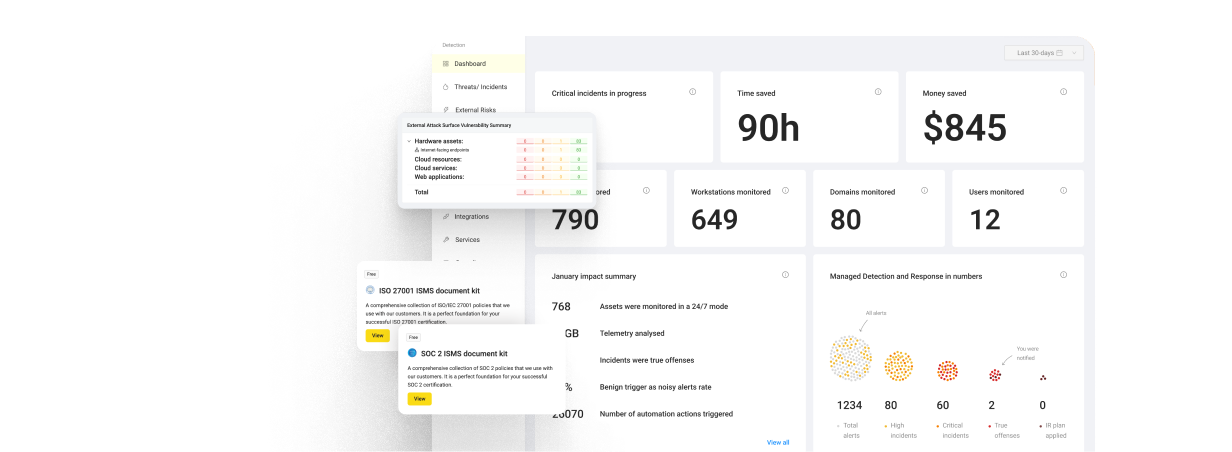
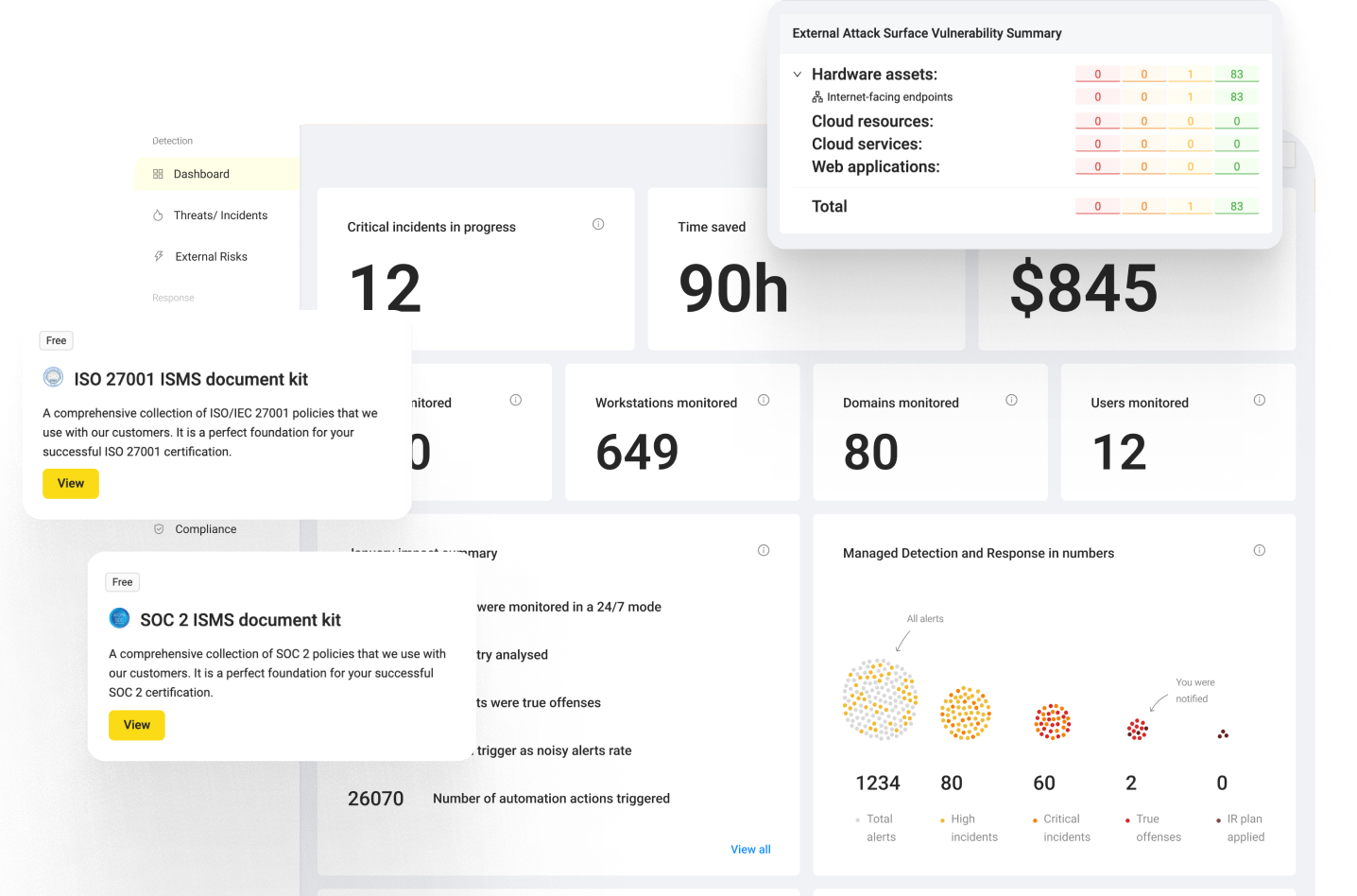
See how the UnderDefense Agentic AI SOC investigates, triages, and resolves real alerts.
Our Evaluation Criteria
Each platform was assessed across five weighted areas that decide success for a lean team:
- Detection-and-Response Autonomy (25%): does it triage, investigate, and help you respond, or just flag alerts?
- Vendor-Agnostic Integration (25%): does it sit on top of your current SIEM and EDR, or force a rip-and-replace?
- Small-Team Fit and Deployment Speed (20%): can a five-person team go live without a platform engineer?
- Pricing Transparency (15%): is the number public, or hidden behind a sales call?
- User Reviews (15%): what do verified G2 and Gartner buyers actually report?
Who This Guide Is For
This shortlist is built for CISOs, IT Directors, CTOs, and GRC leaders at scaling tech firms, mid-market enterprises, healthcare organizations, and PE portfolio companies. It suits teams of three to five analysts who want 24/7 coverage without hiring twelve people. If you are preparing an RFP or a proof of concept, these twelve platforms are the ones worth your shortlist.
The 12 Best AI SOC Platforms at a Glance
| Provider (Rating) | Best For | Key Strength | Compliance |
|---|---|---|---|
| UnderDefense Agentic AI SOC ⭐⭐⭐⭐⭐ | Lean 3-to-5-analyst teams needing detect and respond | AI SOC plus Human Ally, vendor-agnostic, transparent pricing | SOC 2, ISO 27001, HIPAA, and PCI DSS |
| Prophet Security ⭐⭐⭐⭐ | Autonomous alert investigation depth | Agentic AI that investigates every alert | SOC 2 |
| Intezer ⭐⭐⭐⭐ | Alert forensics and malware context | Deep forensic verdicts | SOC 2 |
| Dropzone AI ⭐⭐⭐⭐ | Autonomous Tier-1 triage | Hands-free alert triage at scale | SOC 2 |
| Stellar Cyber ⭐⭐⭐⭐ | Open XDR for MSSP-style teams | Vendor-agnostic Open XDR | SOC 2, and ISO 27001 |
| Simbian ⭐⭐⭐ | Multi-capability agentic coverage | Triage, investigation, response, and validation | SOC 2 |
| Torq HyperSOC ⭐⭐⭐ | SOAR-heavy automation teams | Autonomous workflow orchestration | SOC 2 |
| Radiant Security ⭐⭐⭐ | Guided triage and response | AI investigation with response plans | SOC 2 |
| Exaforce ⭐⭐⭐ | Data-lake-native triage | Reduces alert noise at ingest | SOC 2 |
| CrowdStrike Charlotte AI ⭐⭐⭐ | Existing Falcon customers | Deep endpoint context | SOC 2, ISO 27001, and HIPAA |
| Palo Alto Cortex AgentiX ⭐⭐⭐ | Cortex XSIAM customers | Autonomy plus tight platform controls | SOC 2, and ISO 27001 |
| Microsoft Sentinel plus Copilot ⭐⭐⭐ | Azure-centric teams | Native Azure and M365 telemetry | SOC 2, ISO 27001, and HIPAA |
Read this table for your own stack, not for a leaderboard. If you live in Azure, Sentinel plus Copilot starts closer to home. If you run on Falcon, Charlotte AI already sees your endpoints. If you want a platform that sits on top of everything you already own and adds humans who act, the vendor-agnostic options rise to the top. Below, I dig into each player in detail, starting with the two that anchor this list.
1.1 UnderDefense Agentic AI SOC: Best for Lean 3-to-5-Analyst Teams That Need Detect and Respond
Overview
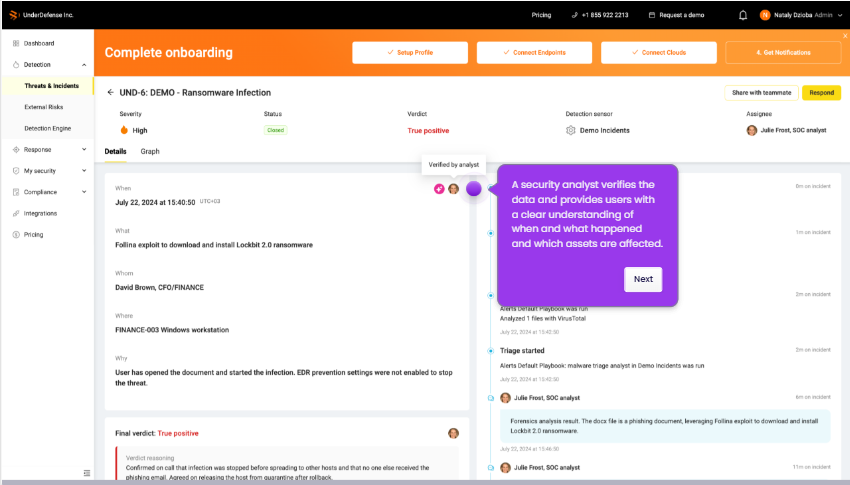
UnderDefense Agentic AI SOC is an AI SOC platform built around what we call the “AI SOC plus Human Ally” model. It pairs autonomous, AI-driven detection with a concierge analyst team that acts on incidents, not just escalates them. I built it for the exact team this guide serves: three to five people trying to cover a clock that never stops. The honest question every one of them asks me is simple. How do I provide 24/7 coverage without hiring twelve people?
The platform layers onto your existing security stack rather than replacing it. You keep your SIEM, your EDR, and your data. You can see the live UnderDefense Agentic AI SOC platform here.
Core Services
- 24/7 AI SOC with 2-minute Alert-to-Triage and 15-minute escalation for critical incidents
- Concierge Response, where our analysts contact affected users and act on the incident
- Vendor-agnostic integration across 250+ security tools, so you avoid vendor lock-in
- Proactive threat hunting and detection tuning to cut alert noise
- Compliance support for SOC 2, ISO 27001, HIPAA, and PCI DSS
Why Companies Consider UnderDefense
Most small teams do not lack alerts. They lack context and hours. In our experience running MDR across 500+ customer environments, the win is not a faster dashboard. The win is eliminating whole classes of triage work, so your people handle judgment calls, not noise. We tune your correlation rules first, which is often where the real coverage gap closes.
We also own outcomes. When something breaks at 2 a.m., our analysts step in as the “generals” directing the AI “foot soldiers,” so your team is not alone on the bridge call.
Ideal Customer Profile
Best suited for:
- Scaling tech firms and mid-market enterprises with 3-to-5-analyst teams
- Healthcare and PE portfolio companies with strict compliance needs
- Security-lean teams that want to keep their current SIEM and EDR investments
- Organizations moving from monitoring-only tools to detect-and-respond coverage
Commercial Model
UnderDefense uses transparent, published pricing, a deliberate contrast with the opaque contracts common in this space. You can see the number before a sales call in our MDR pricing. Onboarding includes noise tuning, integration of your existing tools, and a 30-day impact report that shows the coverage lift in plain terms.
When to Shortlist
Shortlist UnderDefense when you want one partner that both detects across your whole stack and responds with real analysts, without ripping out tools you already trust. Teams preparing for a compliance audit or reducing ransomware exposure often include us during the RFP stage.
Customer Reviews
“The biggest win for me was getting actual control over our security alerts. Before the guys from UD stepped in, we were getting bombarded with alerts from all our security tools. Their team cleaned up our configurations and got the noise under control within the first week. The platform itself is straightforward. It pulls in data from all our existing security tools, so we didn’t have to rip and replace anything.” Verified User in Marketing and Advertising, Small-Business UnderDefense G2 Verified Review
“Underdefense act as an extension of our team, so we don’t need additional resources, ensuring 24/7 protection. It also solved our problem of having separate security tools that didn’t work well together. Now, everything is connected and easier to manage.” Inga M., CEO, Mid-Market UnderDefense G2 Verified Review
“UnderDefense MAXI integrates well with our systems, specifically with our SIEM, Splunk. Their team is proactive in identifying and addressing threats, providing 24/7 oversight.” Oleg K., Director Information Security, Mid-Market UnderDefense G2 Verified Review
1.2 Prophet Security: Best for Autonomous Alert Investigation Depth
Overview
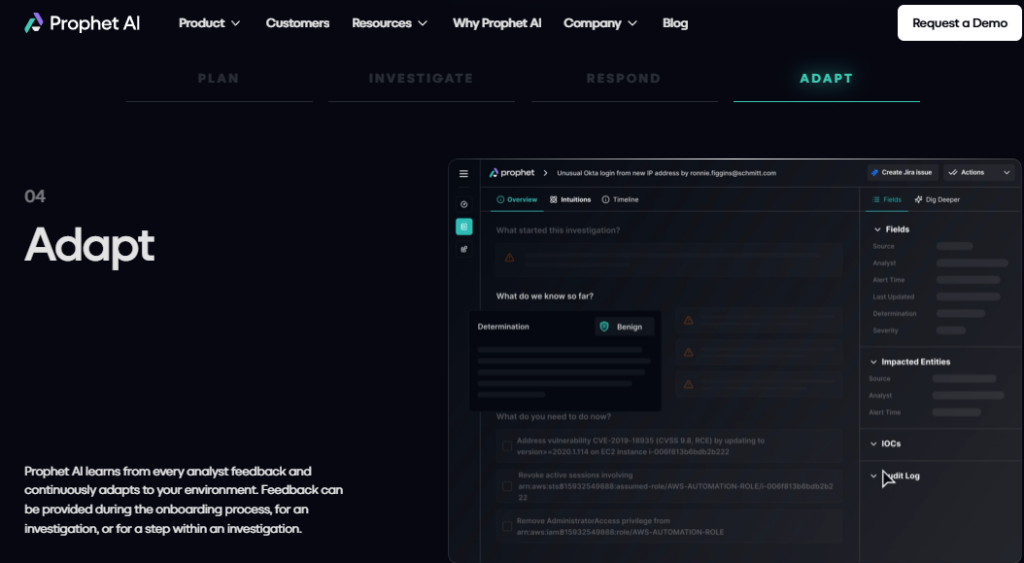
Prophet Security is an agentic AI SOC platform that autonomously investigates alerts, tunes detections, and hunts for hidden threats. It positions itself as an AI SOC analyst that works the queue for you, which appeals to small teams drowning in Tier-1 volume. The pitch is investigation depth, not just a triage label on each alert.
Core Services
- Autonomous investigation of security alerts end to end
- Detection tuning to reduce false positives over time
- Proactive threat hunting for hidden threats
- Integration with common SIEM and EDR sources
- Analyst-ready investigation summaries for faster decisions
Why Companies Consider Prophet
Small teams consider Prophet when the core pain is investigation time, not just alert ranking. The platform aims to hand analysts a finished story per alert, so a lean team spends its hours on decisions rather than evidence gathering. For a group that wants an AI “analyst” rather than a dashboard, that framing lands.
Here is my honest read, and I might be wrong. Investigation depth matters, but a small team still needs someone to act when the verdict says “contain now.” Autonomous investigation without response ownership can leave you back on the 3 a.m. bridge call alone, which is why incident response automation matters as much as triage.
Ideal Customer Profile
Best suited for:
- Small SOC teams overwhelmed by Tier-1 alert volume
- Teams that already have response muscle but need faster triage
- Organizations wanting an AI analyst layer on their existing SIEM
Commercial Model
Prophet Security uses a subscription model, with pricing typically scoped through a sales conversation rather than published rates. Buyers usually run a proof of concept to measure triage accuracy before committing.
When to Shortlist
Shortlist Prophet when autonomous investigation depth is your top priority and you already have a way to act on confirmed incidents. It fits teams that want to keep response in-house while offloading the investigation grind.
1.3 Intezer: Best for Alert Forensics and Malware Context
Overview
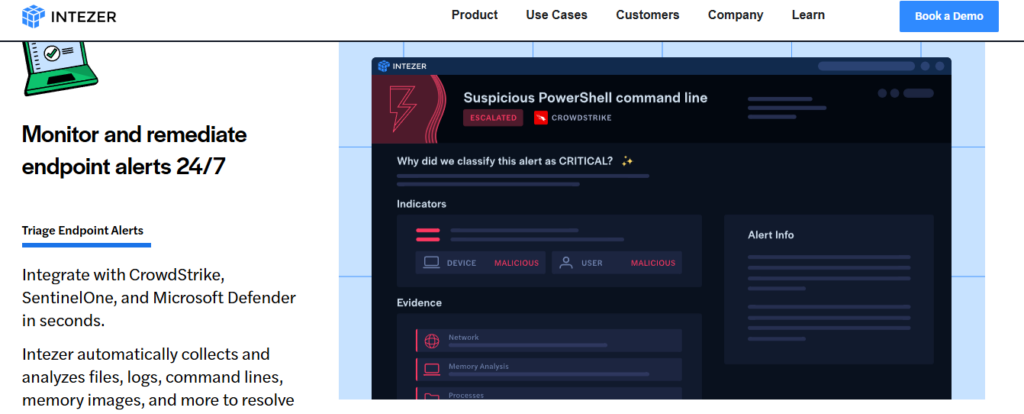
Intezer is an autonomous SOC platform known for deep alert forensics and malware analysis. It leans on code-level analysis to tell you what a threat actually is, not just that it fired. For teams chasing false positives, that verdict clarity saves real hours.
Core Services
- Autonomous alert triage with forensic verdicts
- Deep malware and code-level analysis
- Integrations with SIEM, EDR, and email security tools
- Threat intelligence enrichment
Why Companies Consider Intezer
Teams pick Intezer when malware verdicts and forensic depth matter most. The category standard treats triage as ranking, but Intezer treats it as evidence. That framing helps a small team defend its decisions in an audit, much like strong AI-enabled incident triage does.
Ideal Customer Profile
Best suited for:
- Teams handling frequent malware and phishing alerts
- SOCs needing defensible forensic verdicts
- Organizations with existing detection tools to enrich
Commercial Model
Intezer uses a subscription model, with pricing tied to alert volume and scoped through sales.
When to Shortlist
Shortlist Intezer when your alert mix is malware-heavy, and you value forensic proof over a simple triage label.
1.4 Dropzone AI: Best for Autonomous Tier-1 Triage
Overview
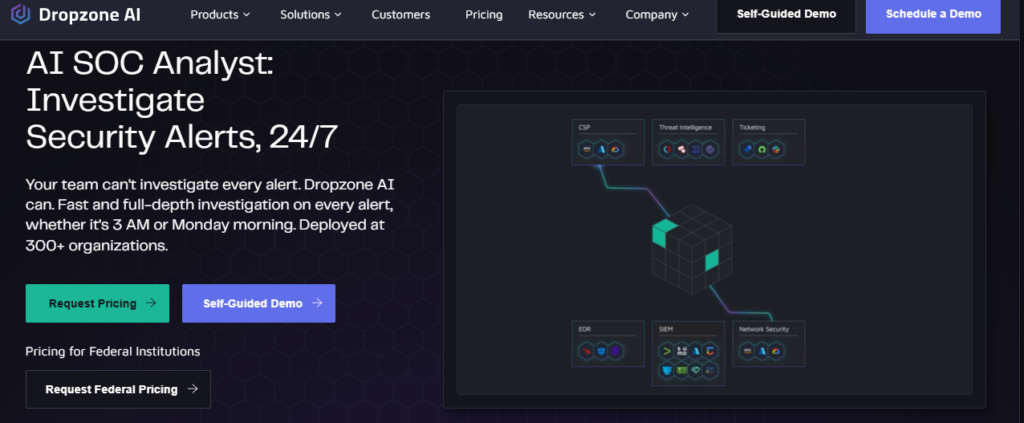
Dropzone AI is an AI SOC analyst that autonomously investigates every alert your tools generate. It aims to replicate the reasoning a human Tier-1 analyst uses, then hands your team a finished investigation. The appeal for lean teams is simple. It works the queue, so your people do not have to.
Core Services
- Autonomous investigation of every inbound alert
- Pre-built integrations with common SIEM, EDR, and cloud sources
- Full investigation reports with evidence and reasoning
- No-code deployment aimed at fast setup
Why Companies Consider Dropzone
Small teams pick Dropzone when alert volume, not investigation quality, is the bottleneck. It runs quietly in the background and only surfaces what matters. My honest read, and I could be off here, is that triage without owned response still leaves the hardest part on your plate at 2 a.m., which is where incident response automation earns its keep.
Ideal Customer Profile
Best suited for:
- Lean SOC teams buried in Tier-1 alert volume
- Teams with in-house response but no triage capacity
- Organizations wanting fast, no-code deployment
Commercial Model
Dropzone AI uses a subscription model, with pricing scoped through a sales conversation. Most buyers run a proof of concept to measure triage accuracy first.
When to Shortlist
Shortlist Dropzone when autonomous Tier-1 triage is the single biggest gap, and your team already handles response confidently.
1.5 Stellar Cyber: Best for Open XDR and MSSP-Style Teams
Overview
Stellar Cyber is an Open XDR platform that unifies detection across your existing tools. “Open XDR” means it correlates data from many vendors rather than locking you into one. That vendor-agnostic design appeals to teams that refuse rip-and-replace.
Core Services
- Open XDR correlation across multi-vendor telemetry
- Built-in NDR, SIEM, and UEBA capabilities
- AI-driven detection and automated response
- Multi-tenant support for MSSPs
Why Companies Consider Stellar Cyber
Teams choose Stellar Cyber to consolidate tools without giving up data ownership. The vendor-agnostic angle is real, which I respect. The tradeoff is that a small team still operates the platform itself, so you supply the humans, unlike a fully managed SOC service.
Ideal Customer Profile
Best suited for:
- Teams consolidating multiple point tools
- MSSPs serving several clients
- Organizations wanting Open XDR without lock-in
Commercial Model
Stellar Cyber uses a subscription model, priced by data volume or assets, and scoped through sales.
When to Shortlist
Shortlist Stellar Cyber when tool consolidation and vendor-agnostic correlation top your list, and you have staff to run the platform.
1.6 Simbian: Best for Multi-Capability Agentic Coverage
Overview
Simbian is an agentic AI SOC platform spanning four core capabilities: triage, investigation, response, and detection tuning. “Agentic” means AI agents act with some autonomy across each stage. The breadth is the pitch for teams wanting one system, not four.
Core Services
- Autonomous alert triage and investigation
- AI-assisted response actions
- Detection engineering and tuning
- Integrations across existing security tools
Why Companies Consider Simbian
Small teams like the idea of one agentic layer covering the full alert lifecycle. Breadth is attractive, but I would test each capability separately in a proof of concept. A platform that does four things can do one of them thinly, so lean on solid AI SOC evaluation questions during your review.
Ideal Customer Profile
Best suited for:
- Teams wanting broad agentic coverage in one tool
- SOCs standardizing on a single AI layer
- Organizations early in their AI SOC journey
Commercial Model
Simbian uses a subscription model, scoped through a sales conversation.
When to Shortlist
Shortlist Simbian when you want one agentic platform across triage, investigation, and response, and you can validate each stage.
1.7 Torq HyperSOC: Best for SOAR-Heavy Automation Teams
Overview
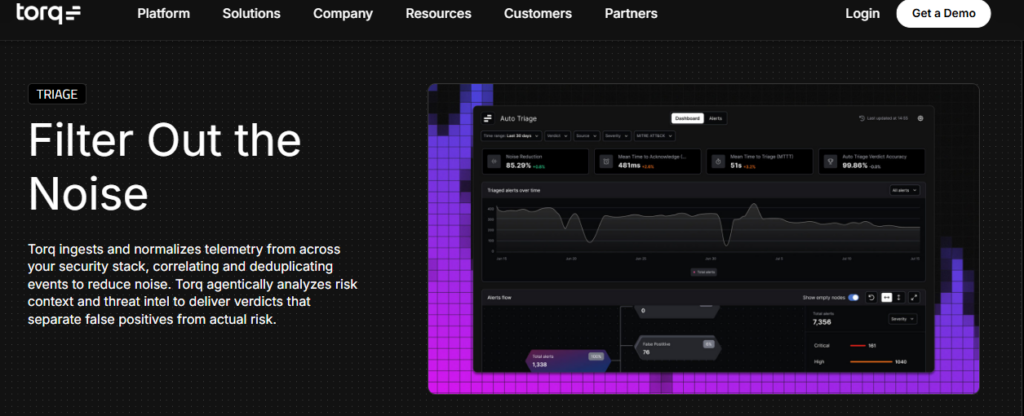
Torq HyperSOC is an AI-driven automation platform built on Torq’s SOAR roots. “SOAR” stands for security orchestration, automation, and response. It shines when your priority is automating repeatable workflows at scale.
Core Services
- AI-driven workflow orchestration and automation
- Autonomous alert handling and case management
- Broad integration library across security tools
- Human-in-the-loop controls for critical actions
Why Companies Consider Torq
Teams pick Torq when automation depth is the goal, and they have someone to build workflows. The power is real, but so is the setup cost. A three-person team without an automation engineer may struggle to unlock it, which is why some prefer ready-made security automation tools.
Ideal Customer Profile
Best suited for:
- Teams with heavy, repeatable SOC workflows
- SOCs with automation-building capacity
- Organizations extending existing SOAR investments
Commercial Model
Torq uses a subscription model, scoped through sales based on workflow volume and integrations.
When to Shortlist
Shortlist Torq HyperSOC when workflow automation is your top priority, and you have the skills to build and maintain it.
1.8 Radiant Security: Best for Guided Triage and Response
Overview
Radiant Security is an AI SOC platform that investigates alerts and generates response plans. It aims to guide a lean team from alert to action, not just flag the problem. That guided-response angle helps teams short on senior analysts.
Core Services
- Automated alert investigation and triage
- AI-generated response plans and recommendations
- Integrations with SIEM, EDR, and identity tools
- Noise reduction and false-positive filtering
Why Companies Consider Radiant
Teams choose Radiant when they need a guiding hand from detection to response. The response plans help, though the team still executes them. Guidance and owned action are different things, and small teams feel that gap when alert fatigue sets in.
Ideal Customer Profile
Best suited for:
- Junior-heavy teams needing guided response
- SOCs wanting investigation plus recommendations
- Organizations reducing alert fatigue
Commercial Model
Radiant uses a subscription model, scoped through sales.
When to Shortlist
Shortlist Radiant when guided investigation and response recommendations fill your biggest skills gap.
1.9 Exaforce: Best for Data-Lake-Native Triage
Overview
Exaforce is an AI SOC platform that reduces alert noise at the data layer. It processes telemetry in a data lake, then triages before alerts ever reach your team. For teams drowning at ingest, that upstream filtering matters.
Core Services
- Data-lake-native telemetry processing
- Autonomous triage and noise reduction
- AI-driven investigation of surviving alerts
- Integrations across cloud and security data sources
Why Companies Consider Exaforce
Teams pick Exaforce when the flood starts at ingest, not at the alert queue. Cutting noise early is smart engineering. Exaforce is newer, so I would weigh maturity and support alongside the architecture, and compare it against a proven managed SIEM approach.
Ideal Customer Profile
Best suited for:
- Cloud-heavy teams with high telemetry volume
- SOCs wanting upstream noise reduction
- Data-lake-centric security architectures
Commercial Model
Exaforce uses a subscription model, scoped through sales based on data volume.
When to Shortlist
Shortlist Exaforce when your noise problem starts at the data layer, and you want triage before alerts land.
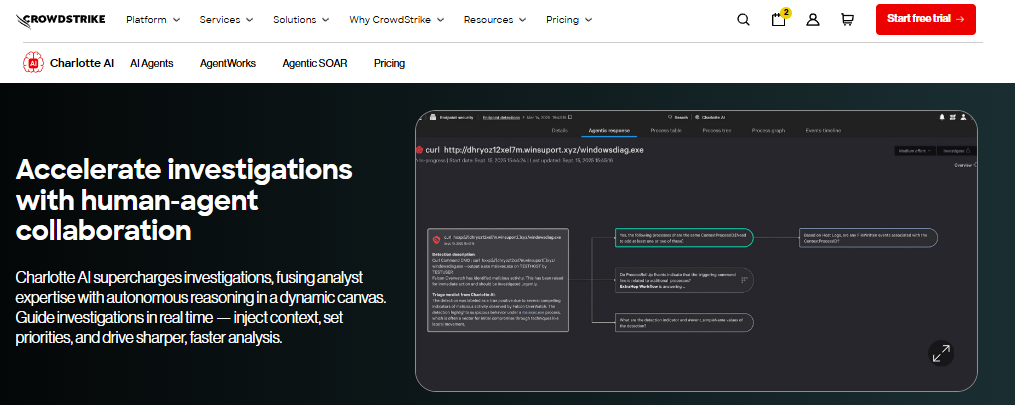
1.10 CrowdStrike Charlotte AI: Best for Existing Falcon Customers
Overview
Charlotte AI is CrowdStrike’s agentic AI layer inside the Falcon platform. It triages and investigates using the deep endpoint context Falcon already collects. For teams already on Falcon, that native context is the draw.
Core Services
- Agentic alert triage inside Falcon
- Endpoint-rich investigation and detection
- Natural-language query of security data
- Automated response within the CrowdStrike stack
Why Companies Consider CrowdStrike
Falcon customers adopt Charlotte AI to add autonomy without a new vendor. The endpoint context is genuinely strong. The tradeoff is scope. It sees threats on the endpoint deeply, but it misses broader organizational context and user verification across your other tools, a gap that broader managed EDR coverage helps close.
Ideal Customer Profile
Best suited for:
- Existing CrowdStrike Falcon customers
- Endpoint-centric security programs
- Teams standardizing on one platform vendor
Commercial Model
Charlotte AI is licensed as an add-on to Falcon, priced per module and scoped through CrowdStrike sales.
When to Shortlist
Shortlist Charlotte AI when you already run Falcon, and you want agentic triage inside that ecosystem.
Customer Reviews
“Crowdstrike is a very robust and reliable EDR tool. It is very easy to setup and use once you understand the console. The detection capabilities are top notch.” Verified User in Information Technology and Services CrowdStrike Falcon G2 Verified Review
“The console can be overwhelming at first, and the licensing model with separate modules gets expensive quickly as you add capabilities.” Verified User, IT Security CrowdStrike Falcon G2 Verified Review
1.11 Palo Alto Cortex AgentiX: Best for Cortex XSIAM Customers
Overview
Cortex AgentiX is Palo Alto Networks’ agentic AI layer inside the Cortex platform. It pairs autonomous action with tight, policy-driven controls. For teams standardized on Palo Alto, it slots into the existing stack.
Core Services
- Agentic triage and investigation in Cortex
- Automated response with guardrails and approvals
- Native integration with XSIAM and XDR data
- Policy-driven autonomy controls
Why Companies Consider Palo Alto
Cortex customers adopt AgentiX to add autonomy without leaving their platform. The controls are mature, which suits regulated teams. The tradeoff is that value concentrates for those already inside the Palo Alto ecosystem, so weigh it against a vendor-agnostic AI SOC approach.
Ideal Customer Profile
Best suited for:
- Existing Cortex XSIAM or XDR customers
- Regulated teams wanting strict autonomy controls
- Palo Alto-standardized security programs
Commercial Model
AgentiX is licensed within the Cortex platform, scoped through Palo Alto sales.
When to Shortlist
Shortlist Cortex AgentiX when you already run Cortex, and you want governed, agentic autonomy inside it.
1.12 Microsoft Sentinel plus Copilot: Best for Azure-Centric Teams
Overview
Microsoft pairs Sentinel, its cloud SIEM, with Security Copilot, its generative AI assistant. Together they triage and investigate using native Azure and Microsoft 365 telemetry. For Microsoft-heavy teams, the data lives right where you work.
Core Services
- Cloud-native SIEM with Sentinel
- Generative AI investigation via Security Copilot
- Deep Azure and Microsoft 365 telemetry
- Automation through Logic Apps and playbooks
Why Companies Consider Microsoft
Azure-centric teams adopt Sentinel plus Copilot to keep detection close to their existing data. The native integration is a real advantage. Two tradeoffs surface in practice. Sentinel’s consumption pricing can climb fast, and Copilot is licensed on top, so a lean team should model costs before committing, ideally against dedicated MDR for Microsoft 365.
Ideal Customer Profile
Best suited for:
- Microsoft and Azure-centric organizations
- Teams already licensing Microsoft 365 E5
- SOCs consolidating on the Microsoft stack
Commercial Model
Sentinel uses consumption-based pricing by data ingested, and Security Copilot is licensed separately by compute units.
When to Shortlist
Shortlist Sentinel plus Copilot when your world is Microsoft-first, and you can manage consumption costs carefully.
How to Read This List for Your Own Stack
Here is what surfaces when you actually run these platforms in a lean SOC. Most of them triage well, but triage alone leaves your team on the hook for response. The standard read treats “AI SOC” as one category, and that gets it backwards. The real fork is between tools that hand you a verdict and partners that own the outcome.
Working across 500+ customer environments, the pattern I see is consistent. AI handles the routine “foot soldier” work, and humans act as the “generals” for the edge cases. You cannot automate everything, and you cannot scale on humans alone. That is why we built the UnderDefense Agentic AI SOC platform as an AI SOC plus Human Ally rather than another dashboard, so a three-to-five-person team gets 24/7 coverage with 2-minute Alert-to-Triage and 15-minute escalation for critical incidents, on top of the tools you already own.
Q2. How Did We Select and Score These AI SOC Platforms?
We scored each platform across five criteria: Detection-and-Response Autonomy (25%), Vendor-Agnostic Integration (25%), Small-Team Fit and Deployment Speed (20%), Pricing Transparency (15%), and User Reviews (15%). Totals map to stars. 0-20% earns 1 star, 21-40% earns 2, 41-60% earns 3, 61-80% earns 4, and 81-100% earns 5. UnderDefense scores 5 stars for pairing autonomous triage with human concierge response.
Why These Five Weights
I built this rubric to reject “AI-washing,” the habit of slapping “AI” on a dashboard and calling it a SOC. So I weighted the two things that actually decide outcomes for a lean team. Autonomy and integration carry 25% each, because they determine whether the tool works your queue or just adds to it.
Integration gets heavy weight for a hard reason. Vendor lock-in is logic loss. When you switch platforms, your correlation rules and business logic do not come with you. I have watched a team’s MDR vendor rename the product and call it progress, while the customer rebuilt the SOC and the outcomes themselves. If this worries you, our guide on avoiding vendor lock-in is worth a read.
The Scoring Scale and Results
The score maps to a simple star band, so a skeptical CISO can audit our math. Every proof-of-concept should test these same axes on your own stack before you sign, using a clear set of AI SOC evaluation questions.
| Platform | Autonomy | Integration | Small-Team Fit | Pricing | Reviews | Stars |
|---|---|---|---|---|---|---|
| UnderDefense Agentic AI SOC | High | High | High | High | High | 5 stars |
| Prophet Security | High | Medium | Medium | Medium | Medium | 4 stars |
| Intezer | Medium | Medium | Medium | Medium | High | 4 stars |
| Dropzone AI | High | Medium | High | Medium | Medium | 4 stars |
| Stellar Cyber | Medium | High | Medium | Medium | Medium | 4 stars |
| Simbian | Medium | Medium | Medium | Low | Low | 3 stars |
| Torq HyperSOC | Medium | High | Low | Low | Medium | 3 stars |
| Radiant Security | Medium | Medium | Medium | Low | Low | 3 stars |
| Exaforce | Medium | Medium | Low | Low | Low | 3 stars |
| CrowdStrike Charlotte AI | High | Low | Medium | Low | High | 3 stars |
| Palo Alto Cortex AgentiX | High | Low | Low | Low | Medium | 3 stars |
| Microsoft Sentinel plus Copilot | Medium | Low | Low | Low | High | 3 stars |
UnderDefense earns 5 stars on the axes that matter to a small team. It scores top marks on vendor-agnostic integration, because UnderDefense Agentic AI SOC works like Lego bricks on the stack you already own. It also scores high on pricing transparency and on detect-and-respond autonomy, since the win we chase is “we saved your day,” not a green SLA on a slide.
Q3. What Exactly Is an AI SOC, and Why Do Small Teams Need One?
An AI SOC is an AI-driven layer that autonomously filters, prioritizes, correlates, and contextualizes alerts on top of your existing SIEM and EDR, so a small team stops drowning in the queue. “SOC” means Security Operations Center. For a three-to-five-analyst team, it closes the “speed mismatch,” where attackers break in within minutes while a 9-to-5 team sleeps. It owns Tier-1 triage, and humans own judgment.
The Four-Capability Spine
Think of an AI SOC as an analyst that never sleeps and never gets bored. It handles four screening jobs that grind human teams down: filtering noise, prioritizing what matters, correlating signals across tools, and adding context. These are the exact sub-tasks that cause alert fatigue, the burnout state where real threats hide inside thousands of false alarms.
Most platforms cover this spine to some degree, from triage through response. The pain it solves is brutal and familiar. A five-person team cannot read 10,000 alerts a day, so the important one slips through at 3 a.m. Faster AI-enabled incident triage is what closes that gap.
The Speed Mismatch, in Numbers
Here is why timing matters. Attackers now move fast, with breakout times measured in under an hour in modern breach data. Your team, meanwhile, goes home at 6 p.m. That gap is the whole problem, which is why 24/7 coverage matters so much.
I call the old model an M&M network. It has a hard shell and a soft center, so once an attacker cracks the outside, it is game over inside. An AI SOC watches the soft center around the clock, which no small human team can do alone.
What Humans Still Own
Automation handles the routine, but it does not make the hard call. Humans own judgment, verification, and the decision to contain a system that runs your business. This is exactly the “AI SOC plus Human Ally” model UnderDefense built, where integrated detection meets real response, rather than monitoring that just pings you. You can see how our SOC service handles this in practice.
Q4. Deployment Options and Integration Timelines: How Fast Can a Small Team Go Live?
AI SOC platforms deploy as SaaS (fastest), hybrid (data local, AI in cloud), or customer-hosted (full residency). HIPAA and PCI DSS often push toward hybrid or hosted, while SOC 2 and ISO 27001 are met by most SaaS options. A layer-on SaaS deployment can go live in days to a few weeks. The real timeline, though, is tuning noise. One team cut ingestion from 300 GB/day to 35-40 GB/day.
The Three Deployment Models
Your compliance regime usually picks the model for you. “Data residency” means where your logs physically live, which regulators care about deeply.
| Model | Data Residency | Compliance Fit |
|---|---|---|
| SaaS | Vendor cloud | SOC 2, and ISO 27001 |
| Hybrid | Data local, AI in cloud | HIPAA, and PCI DSS |
| Customer-hosted | Fully in your environment | HIPAA, PCI DSS, and NIS2 |
Mapping Models to Regulations
SOC 2 and ISO 27001, two common security audits, are satisfied by most SaaS deployments. HIPAA (health data) and PCI DSS (card data) often push regulated teams toward hybrid or hosted, so sensitive records stay put. NIS2, the EU security directive, adds pressure for local control in critical sectors, so map your needs early with an AI SOC deployment models review.
Whatever the model, insist on audit logs and RBAC spanning all three. “RBAC” means role-based access control, so only the right people touch the right data. Vendor-agnostic ingestion lets you keep regulated data where the rules require it, a core part of any solid managed SIEM setup.
Realistic Timelines and Effort
| Model | Time to Value | Engineering Effort |
|---|---|---|
| SaaS layer-on | Days to weeks | Low |
| Hybrid | Weeks | Medium |
| Customer-hosted | Weeks to months | High |
The Real Timeline Is the Noise Diet
Setup speed is a vanity metric. The honest timeline is how fast the platform tunes your noise. In one engagement, we cut ingestion by roughly 90%, from 300 GB per day to about 35-40 GB per day, which sharpened detection and cut cost. Getting the integration right upfront is what makes that possible.
Once tuned, routine triage can run in seconds with no human needed, freeing analysts for real decisions. UnderDefense treats the stack like Lego bricks, so you get the pieces you want in your own build. During one onboarding, that vendor-agnostic ingestion surfaced roughly $300k in fraud in week one, which is the kind of proof I trust over a fast install. Our SLAs stay concrete too, with 2-minute Alert-to-Triage and 15-minute escalation for critical incidents. You can see the UnderDefense Agentic AI SOC platform here.
Customer Reviews
“The speed of onboarding was a delightful surprise. In times where integrating new systems can take weeks, UnderDefense had us up and running in no time.” Valeriia D., Marketing Specialist, Mid-Market UnderDefense G2 Verified Review
“Setting everything up took some back and forth to get our tools properly integrated. Not really a complaint since it’s expected, but worth mentioning for others considering the service. You’ll need to dedicate some time upfront to get things configured properly.” Verified User in Marketing and Advertising, Small-Business UnderDefense G2 Verified Review
“UnderDefense Agentic AI SOC integrates well with our systems, specifically with our SIEM, Splunk. Their team is proactive in identifying and addressing threats, providing 24/7 oversight.” Oleg K., Director Information Security, Mid-Market UnderDefense G2 Verified Review
Q5. Detect-Only vs. Detect-and-Respond: What Autonomy Level Do You Need, and Is Your MDR Just “AI-Washing”?
Autonomy spans three levels: triage (rank the alerts), investigation (build the story), and response (contain the threat). Monitoring-only tools and many legacy MSSPs stop at alerts, handing a tired analyst context-free tickets at 3 a.m. Some vendors simply renamed old products without rebuilding the SOC. A three-to-five-analyst team needs detect-and-respond, meaning auditable multi-agent investigation plus a human ally who acts when a critical incident escalates.
The Three Levels of Autonomy
I think of AI agents as your foot soldiers and human analysts as the generals. Triage ranks the noise, investigation stitches the evidence into a story, and response contains the damage. Most tools stop at the first level and call it done, which is where deeper incident response automation separates the serious platforms.
Genuine autonomy runs many separate, auditable agents, not one model wearing a costume. Patented multi-agent triage designs show this direction clearly, with distinct agents handling distinct stages. The best agentic SOC platforms make each of those stages observable.
The Black-Box and AI-Washing Tell
Here is the pain. A monitoring-only MSSP (managed security service provider) triages behind a black box and often omits the context you need to act. You get a ticket, but not a decision.
There is a sharper tell for AI-washing. Ask whether the tool watches what your AI agents (Claude, Copilot, Cursor, or a custom agent) are doing in production. Most do not. If the same humans read the same alerts, only faster, that is not transformation. It is a tool-babysitting cottage industry, and stronger explainability and transparency is the honest antidote.
What Real Investigation Looks Like
Auditable investigation means you can see the trail: which agent looked at what, and why it reached its verdict. That is the “show, don’t tell” standard I hold us to. In a proof of concept, test it directly by asking the vendor to replay an investigation step by step, guided by clear evaluation questions.
At UnderDefense, our concierge analyst is the general who acts when a critical incident escalates, and we monitor modern AI-agent activity in production through our MDR service. Your MDR vendor renamed the product. We rebuilt the SOC.
“Before MaxiMDR, we were slightly overwhelmed with alerts and often unsure of how to prioritize or respond to them. Now, not only do we get alerts, but we also get clear guidance on how to handle them.” Valeriia D., Marketing Specialist, Mid-Market UnderDefense G2 Verified Review
“When they escalate something, they include the context we need to understand the issue quickly. We’re not wasting time piecing together what happened from different systems anymore.” Verified User in Marketing and Advertising, Small-Business UnderDefense G2 Verified Review
My open question for the next 18 months: how many “AI SOC” vendors will still refuse to show their investigation trail?
Q6. Will the AI Agent Go Rogue, and What Does an AI SOC Actually Cost?
No, the agent will not go rogue, if you govern autonomy at the architecture level rather than with a hopeful system prompt. That means RBAC, human-in-the-loop approval for destructive actions, audit logs, and callback functions that make dangerous operations impossible by design. On cost, a three-to-five-analyst subscription runs a fraction of hiring two more analysts for 24/7 coverage. One day of business interruption usually dwarfs the annual platform fee.
Safety Is Architecture, Not a Prompt
I have seen a “vibe-coded” agent delete a production database because nobody built a real guardrail. A polite prompt saying “please be careful” is not a control. Safety lives in the architecture.
Use callback functions that block dangerous actions outright. An agent literally cannot scan a forbidden domain if the architecture forbids it. That is impossible by design, and it beats hope every time, which is why sound AI risk management starts at the design layer.
The Agent as an Attack Surface
Here is the contrarian part. Your AI agent is itself an attack surface, vulnerable to prompt injection and data leaks. Treat it like any privileged user, with RBAC (role-based access control) and full audit logs, the same discipline you apply in MDR for AI.
If a vendor tells you their AI is unbiased, they are hiding something. The true danger is an “unbiased” model nobody inspects. At UnderDefense, the concierge analyst is the approval gate, so a human signs off before anything destructive runs.
The Real Cost Math
Pricing should be simple to reason about. A lean-team AI SOC subscription costs far less than hiring two more analysts for round-the-clock coverage. The math that matters is business survival, not a generic ROI slide, so model it with a SOC cost calculator.
Frame it against the cost of one day of business interruption. During one onboarding, we saved a client roughly $300k in the first three months from a fraud we discovered by accident. Opaque MSSP contracts hide the number until the sales call, while UnderDefense publishes transparent, flat pricing, so you can budget before you commit.
| What This Covers | Details |
|---|---|
| Built for | Lean 3-to-5-analyst teams |
| Pricing model | Transparent MDR pricing published in the open |
| See the number | Available before a sales call at the MDR pricing page |
“Its reassuring to know they’re always watching for threats, and it doesn’t cost a fortune. They catch and stop problems quickly, which is a huge relief.” Serhii B., Chief Information Security Officer, Mid-Market UnderDefense G2 Verified Review
“UnderDefense is surprisingly affordable considering the level of protection we get. Their proactive threat hunting and rapid response have saved us from incidents that could have been incredibly costly.” Verified User in Program Development, Mid-Market UnderDefense G2 Verified Review
Here is the question I keep chewing on. As agents get more autonomy in 2026, will “being a human in the loop” become the real premium feature?
Q7. How Do You Run a 30-Day AI SOC Proof of Concept?
Run a 30-day POC (proof of concept) scored on six criteria: triage accuracy and false-positive handling, investigation depth and audit trail, integration with your existing SIEM and EDR, human-in-the-loop and RBAC controls, deployment and compliance fit, and time-to-value. Baseline your current false-positive rate and analyst hours-per-alert first, so you can prove the lift. Ask each vendor whether “agentic” means one model or genuinely separate, auditable agents.
The Six-Criteria Checklist
Score every vendor on the same six axes, so the comparison stays honest, and lean on a structured MDR buyers guide as you go.
- Triage accuracy and false-positive handling
- Investigation depth and a replayable audit trail
- Integration with your existing SIEM and EDR
- Human-in-the-loop approval and RBAC controls
- Deployment model and compliance fit
- Time-to-value in the first weeks
One pointed question separates real platforms from repackaged ones. Ask whether “agentic” means a single model or genuinely separate, auditable agents, a distinction covered well in our take on autonomous SOC design.
Baseline First, Then Grab a Free Win
You cannot prove lift without a starting number. Baseline your false-positive rate and analyst hours-per-alert before day one. Otherwise, every vendor “improves” a metric you never measured, and alert fatigue quietly returns.
Here is a free quick win to run yourself this week. Do an OAuth shadow-IT hunt: find every website where employees clicked “log in with Google.” It is a rich source of unknown vendors, and it costs $0 to discover.
The best first step is low-risk and concrete. Run the 30-day POC with UnderDefense’s concierge onboarding through our SOC service, and judge us on week-one noise reduction, not a slide deck.
| What This Covers | Details |
|---|---|
| Scope | 30-day AI SOC evaluations for 3-to-5-analyst teams |
| What we show | The first week’s noise reduction on your own stack |
| Next step | Tell us what you’re defending on the contact page |
See how UnderDefense Agentic AI SOC resolves a real incident on your stack.
1. What is the best AI SOC for a 3-to-5-analyst team?
The best AI SOC for a lean team layers onto your existing SIEM and EDR, autonomously triages Tier-1 alerts, and gives you a human ally for response, without needing a dedicated platform engineer.
We evaluated 12 platforms across five weighted criteria, and the strongest fits for small teams share three traits:
- Vendor-agnostic integration so you avoid rip-and-replace
- Detect-and-respond autonomy, not monitoring alone
- Transparent pricing you can see before a sales call
UnderDefense leads for teams needing both detection and owned response, while Prophet, Intezer, and Dropzone follow for triage and investigation depth. The right pick depends on your stack and compliance regime.
Our take is simple. A five-person team cannot watch the queue at 3 a.m., so you need AI to own routine triage and humans to own judgment. That is the model behind our SOC service, built for teams that want 24/7 coverage without hiring twelve people.
2. What exactly is an AI SOC, and how is it different from a traditional SOC?
An AI SOC is an AI-driven layer that autonomously filters, prioritizes, correlates, and contextualizes alerts on top of your existing SIEM and EDR, so a small team stops drowning in the queue.
It handles four screening jobs that grind human teams down:
- Filtering noise and false positives
- Prioritizing what actually matters
- Correlating signals across tools
- Adding context for faster decisions
A traditional SOC leans almost entirely on human analysts working shifts, which does not scale for a three-to-five-person team. Attackers now break in within minutes, while a 9-to-5 team sleeps. That is the speed mismatch an AI SOC closes.
The difference is not the technology but the operating model. Automation owns Tier-1 triage around the clock, and humans own judgment and containment. We built our AI SOC around that split so routine work disappears and your analysts focus on real threats, not endless alert fatigue.
3. How fast can a small team deploy an AI SOC?
A layer-on SaaS deployment can go live in days to a few weeks, but the honest timeline is how fast the platform tunes your noise, not how fast it installs.
AI SOC platforms deploy three ways:
- SaaS for the fastest time to value
- Hybrid, keeping data local with AI in the cloud
- Customer-hosted, for full data residency
Setup speed is a vanity metric. In one engagement, we cut ingestion by roughly 90%, from 300 GB per day to about 35-40 GB per day, which sharpened detection and cut cost. That tuning is the real work.
During another onboarding, vendor-agnostic ingestion surfaced roughly $300k in fraud in the first week. We keep the SLAs concrete too, with 2-minute Alert-to-Triage and 15-minute escalation for critical incidents. You can see how the layered approach works on the UnderDefense Agentic AI SOC platform, which sits on top of the tools you already own.
4. Which AI SOC deployment model fits HIPAA and PCI DSS compliance?
HIPAA and PCI DSS often push regulated teams toward hybrid or customer-hosted deployment, so sensitive records stay where the rules require, while SOC 2 and ISO 27001 are met by most SaaS options.
Here is how the models map:
- SaaS: fits SOC 2 and ISO 27001
- Hybrid: fits HIPAA and PCI DSS by keeping data local
- Customer-hosted: fits HIPAA, PCI DSS, and NIS2 with full residency
Whatever the model, insist on audit logs and role-based access control spanning all three. Data residency, meaning where your logs physically live, is what regulators care about most.
Our vendor-agnostic ingestion keeps regulated data in place while still delivering AI-driven detection. For teams navigating audits, we pair this with dedicated compliance services so deployment choices and evidence requirements line up from day one, instead of surfacing as surprises during certification.
5. What is the difference between detect-only and detect-and-respond AI SOC platforms?
Detect-only tools stop at alerts, handing a tired analyst context-free tickets, while detect-and-respond platforms investigate, then act to contain the threat.
Autonomy spans three levels:
- Triage: ranking the noise
- Investigation: stitching evidence into a story
- Response: containing the damage
Many legacy MSSPs and monitoring-only tools stop at the first level. Some simply renamed old products without rebuilding the SOC underneath, which is the clearest tell of AI-washing.
A useful test: ask whether the tool watches what your AI agents in production are doing, and whether it can replay an investigation step by step. If the same humans read the same alerts, only faster, that is not transformation.
We think of AI agents as foot soldiers and human analysts as generals. Our concierge analysts act when a critical incident escalates, which is why our MDR service owns outcomes rather than just escalating tickets to your already-stretched team.
6. Will an autonomous AI SOC agent go rogue or take dangerous actions?
No, an AI agent will not go rogue if you govern autonomy at the architecture level, rather than trusting a hopeful system prompt.
Real guardrails include:
- Role-based access control limiting what the agent can touch
- Human-in-the-loop approval for destructive actions
- Audit logs for every step the agent takes
- Callback functions that make dangerous operations impossible by design
We have seen a vibe-coded agent delete a production database because nobody built a real control. A polite prompt is not a guardrail. Safety lives in the architecture.
There is a contrarian truth here too. Your AI agent is itself an attack surface, vulnerable to prompt injection and data leaks, so treat it like any privileged user. If a vendor claims their model is unbiased, they are hiding something.
At UnderDefense, the concierge analyst is the approval gate before anything destructive runs. We apply the same discipline in our MDR for AI work, treating agent activity as something to monitor and control, not blindly trust.
7. What does an AI SOC cost compared to hiring more analysts?
A three-to-five-analyst AI SOC subscription typically costs a fraction of hiring two more analysts for round-the-clock coverage, and one day of business interruption usually dwarfs the annual platform fee.
The cost comparison we walk clients through:
- Hiring: salaries, benefits, training, and burnout risk for 24/7 shifts
- Subscription: predictable platform cost plus concierge analyst coverage
- Downtime: the real number, measured per day of interruption
The math that matters is business survival, not a generic ROI slide. During one onboarding, we saved a client roughly $300k in the first three months from a fraud we discovered by accident.
Opaque MSSP contracts hide the number until a sales call, which we think is backwards. We publish transparent, flat pricing so you can budget before you commit. You can see it directly on our MDR pricing page, built specifically for lean teams weighing buy versus hire.
8. How do we run a 30-day AI SOC proof of concept?
Run a 30-day POC scored on six criteria, and baseline your current metrics first so you can prove the lift rather than trust a vendor’s claim.
Score every vendor on the same six axes:
- Triage accuracy and false-positive handling
- Investigation depth and a replayable audit trail
- Integration with your existing SIEM and EDR
- Human-in-the-loop and RBAC controls
- Deployment model and compliance fit
- Time-to-value in the first weeks
Before day one, baseline your false-positive rate and analyst hours-per-alert. Otherwise every vendor ‘improves’ a metric you never measured. Ask each one whether ‘agentic’ means a single model or genuinely separate, auditable agents.
A free quick win to try this week is an OAuth shadow-IT hunt: find every site where employees clicked ‘log in with Google.’ It costs nothing and surfaces unknown vendors. When you are ready to test with real telemetry, our team can scope it fast through our contact page, judged on week-one noise reduction.