





This guide compares 11 Alert Logic alternatives: CrowdStrike, Arctic Wolf, UnderDefense, Expel, Sophos, eSentire, Cisco, Check Point, Red Canary, Secureworks, and Rapid7.
See who fits your stack, what it costs, and how to prove it in a PoC.
What You’ll Take Away
- A shortlist of the top 11 Alert Logic competitors with plain-English pros/cons and when each one fits best.
- Realistic pricing ranges. Directional MDR benchmarks (≈$30K–$400K+/yr) with the key cost levers explained.
- A simple buyer checklist. What to verify in a PoC: minutes-to-containment, pre-authorized actions, clean integrations with your current tools, console UX, support quality, and contract/lifecycle clarity.
11 Alert Logic Alternatives in 2026
- CrowdStrike Falcon Complete
- Arctic Wolf (Concierge SOC)
- UnderDefense MDR
- Expel MDR
- Sophos MDR
- eSentire MDR
- Cisco XDR & MDR
- Check Point Infinity MDR/MPR
- Red Canary MDR
- Secureworks Taegis MDR
- Rapid7 Managed Threat Complete
Explore each Alert Logic alternative below: what it does best, where it may trail, real-world MDR pricing drivers, and when it’s the right fit for your stack.
1. CrowdStrike Falcon Complete
CrowdStrike’s Falcon Complete runs MDR natively on the Falcon stack: detections, hunting, and host-level actions happen inside one platform, with OverWatch threat hunting and coverage that now spans endpoints, identity, cloud workloads, and third-party next-gen SIEM data. The appeal is fast, decisive containment without stitching tools together.
CrowdStrike’s Falcon Complete Offerings:
- Falcon Complete MDR
- Falcon EDR/XDR platform
- Adversary OverWatch (24×7 hunting). Learn how we outpaced CrowdStrike OverWatch by two days to stop lateral movement and lower business risk.
- Identity Protection
- Cloud Security/Workload Protection
- Next-gen SIEM ingest; plus optional Falcon modules (e.g., Data Protection, Firewall Management, Device Control, Mobile, Forensics, Ranger).
Buyers often note two things before shortlisting CrowdStrike: pricing varies widely by modules and scope, and Falcon Complete is “expensive but includes instant IR.”
CrowdStrike Falcon Rating: 4.7/5 based on recent G2 reviews.
Expect CrowdStrike Falcon pricing to be around ~$70K–$400K+ per year (directional benchmark).
Get MDR Pricing Guide to Map Your Spend
Understand levers: endpoints, cloud/SaaS scope, retention.
2. Arctic Wolf: Concierge SOC
Arctic Wolf runs MDR as an operating rhythm: a named Concierge Security® Team, 24×7 monitoring, and documented runbooks across endpoint, identity, cloud, and network. It’s designed to reduce noise and turn reviews into changes (QBRs/cadence), not just close tickets. Recent updates fold in its Aurora platform and endpoint tech from the Cylance acquisition.
Arctic Wolf Offerings:
- Managed Detection & Response (MDR)
- Cloud Detection & Response (IaaS/SaaS)
- Aurora Endpoint Security (post-Cylance deal)
- Security Operations Bundles / Open-XDR platform
- Managed Risk (vuln/exposure)
- Managed Security Awareness (training/phishing)
- Incident Response (via Tetra Defense/Unit)
Many buyers call out predictable “flat(ter) fee” packaging vs data-ingest pricing, strong CST partnership, and to verify scope and first-line quality. Threads also notes it’s premium-priced and works best alongside an EDR you already run.
Arctic Wolf Rating: 4.8/5 (≈1,022 ratings) on Gartner Peer Insights.
Arctic Wolf MDR pricing typically lands around ~$30K–$320K+ per year (quote-based).
3. UnderDefense MDR (Tool-Agnostic, Outcome-First)
UnderDefense runs MDR on the tools you already own: fusing endpoint, identity, SaaS, cloud, and network into one incident story and acting in minutes under pre-approved ladders (isolate/disable/revoke) with audited rollback. They can augment your SOC or be it, focusing on measurable MTTR cuts, fast response, and red-teaming, making UnderDefense a strong alternative to Alert Logic.
UnderDefense Offerings:
- MDR on your stack (EDR/IdP/SaaS/Cloud/Network)
- Threat hunting & detection engineering (ATT&CK-mapped)
- DFIR & malware analysis surge
- Adversary emulation / pentesting
- Compliance evidence & control implementation (SOC 2/ISO 27001/HIPAA)
- SOAR/ITSM playbook authoring with bi-directional write-backs
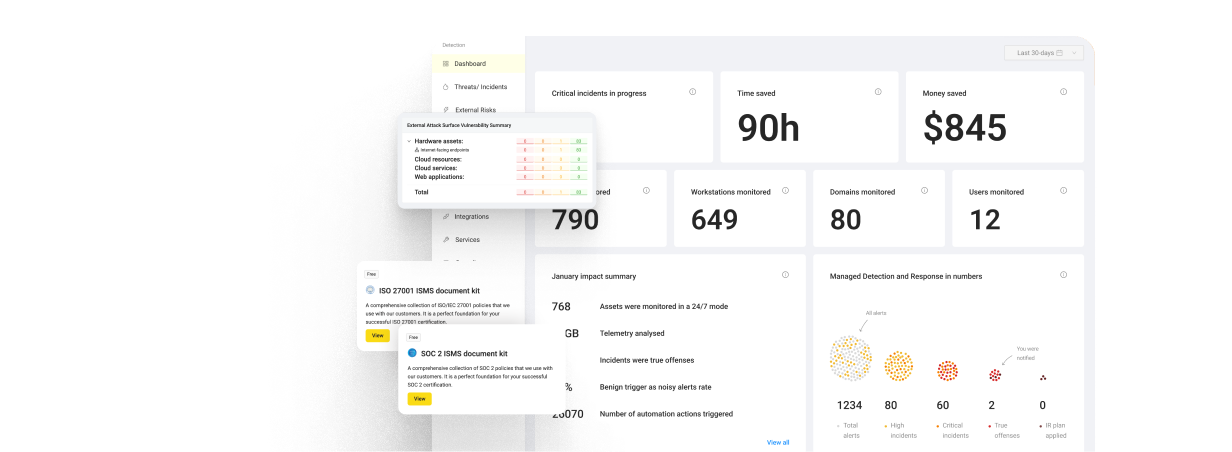
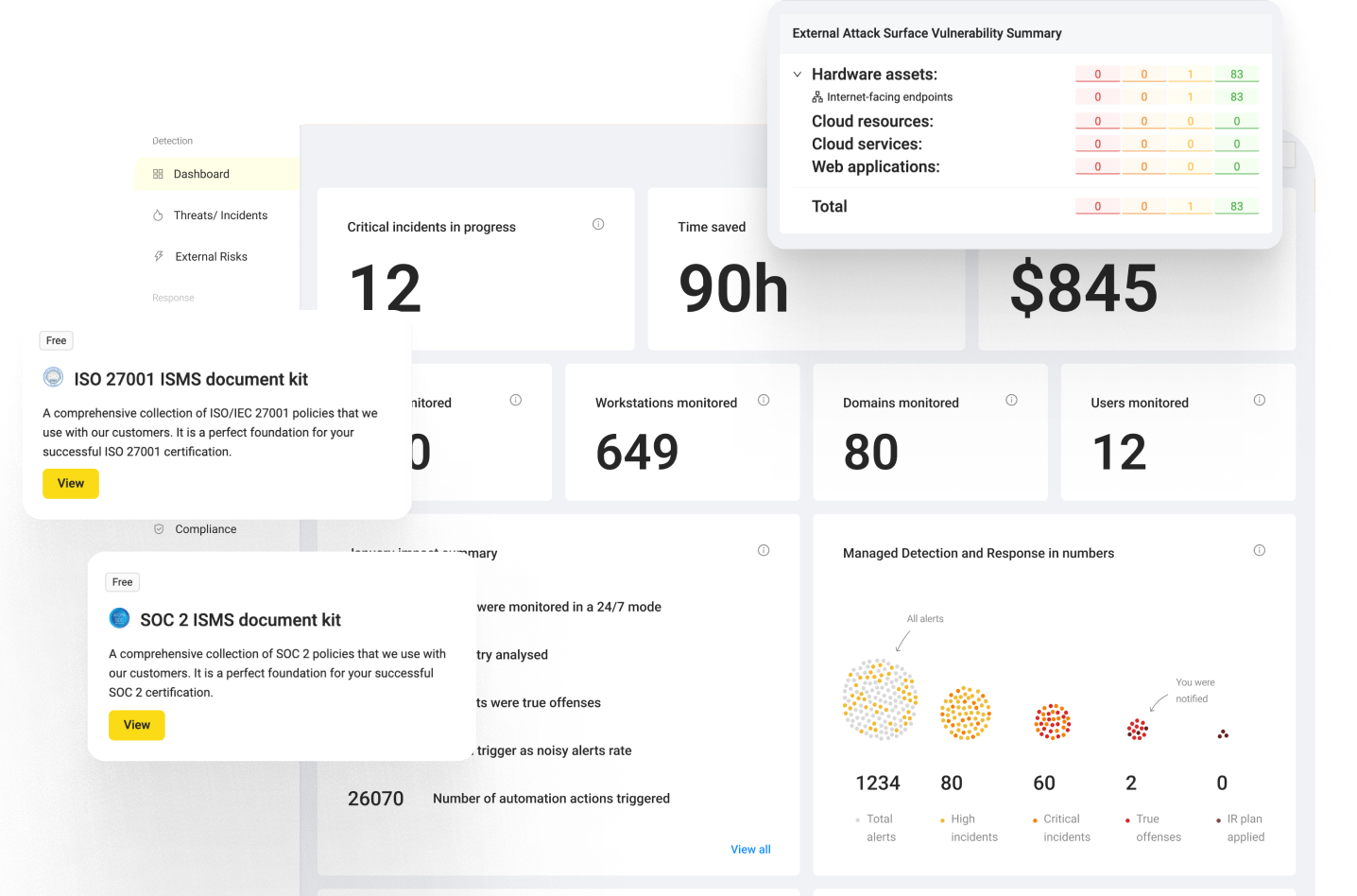
- UnderDefense MAXI platform: 360° visibility, 2-minute triage, ~15-min containment, 250+ integrations, auto evidence/compliance
UnderDefense MDR Rating: G2 shows UnderDefense at 5.0/5 (recent reviews)
UnderDefense MDR pricing typically lands around ~$60K–$240K+/year, quote-based. Get a tighter estimate, run your scope through the MDR Cost Calculator.
UnderDefense Proactive Hunt in Action
During a scheduled hunt at a top-10 U.S. gov-finance org, our analysts spotted successful VPN logins from atypical geos (Finland, Lithuania, Russia, U.K.) that slipped past “baseline” rules. We traced low-and-slow brute-force on default accounts, confirmed six abused VPN identities, and moved fast:
- blocked risky geos
- disabled accounts
- tightened MFA/VPN/password policies
- added new correlation rules
- and set recurring account audits/offboarding checks, turning a quiet foothold into a closed door.
Low-signal intrusions don’t trip default rules — people do. Proactive hunts plus tight, pre-agreed actions turned a stealth foothold into a clean exit, with durable fixes that cut repeat risk.
4. Expel MDR (Outcome-Focused, Vendor-Agnostic)
Expel delivers MDR through its Workbench platform with 24×7 analysts, integrating your existing tools to monitor endpoints, cloud, SaaS, identity, network, and email. The draw is fast triage, clear narratives, and remediation across stacks you already run—so you get outcomes without a rip-and-replace platform shift.
Expel Offerings:
- Managed Detection & Response (endpoints, cloud, SaaS, identity, network, email)
- Expel Workbench™ platform & 130+ integrations
- Threat hunting & detection engineering
- Vulnerability Prioritization
- Phishing (managed detection/response for email)
- Incident response & remediation guidance
Practitioners often highlight strong cloud/SaaS coverage and quick time-to-value via native integrations; they also note pricing can vary with scope and data volume.
Expel Rating: Gartner Peer Insights (MDR): 4.6/5 (140+ reviews).
Expel pricing for MDR is typically seen around ~$80K–$350K+ per year. It’s a pretty wide range; learn what MDR pricing hinges on here.
5. Sophos MDR (Tiered MDR on the Sophos Central Stack)
Sophos MDR wraps 24×7 analyst coverage around the Sophos Central platform: endpoint/server protection, XDR telemetry, email, firewall, and public-cloud signals flow into one console with “Essentials” and “Complete” service tiers. Buyers like the fast onboarding and clear narratives; the trade-off is that it runs best with other Sophos tools rather than a mixed-tooling estate.
Sophos Offerings:
- Managed Detection & Response (Essentials, Complete)
- Sophos XDR + Central (endpoint/server, telemetry & queries)
- Managed Email Security, Managed Firewall
- Cloud security posture & workload protection (AWS/Azure/GCP)
- Threat hunting & detection engineering
- Incident Response (Rapid Response retainer)
Admins often call out fast onboarding and clear analyst comms, but advise testing non-Sophos integrations and watching renewal math. Some customers say they left Sophos MDR when renewal got pricier or the service scope changed.
Sophos MDR Rating: Gartner Peer Insights (MDR): 4.8/5 (1,115+ reviews).
Sophos MDR pricing is commonly seen around ~$40K–$300K+/year.
Get the MDR Buyer’s Guide to Choose Confidently
Vendor-neutral scorecard to test coverage, minutes-to-contain, and cost levers.
6. eSentire MDR (Atlas XDR + 24×7 SOC)
eSentire pairs its Atlas XDR platform with a staffed SOC to monitor and respond across endpoint, network, log, identity, SaaS, and cloud. The pitch: fast triage, opinionated detections, and clear analyst narratives without forcing a rip-and-replace. Many programs use eSentire to consolidate signals and get outcomes while keeping their current tools.
eSentire Offerings:
- Atlas XDR platform & 24×7 SOC
- Managed Detection & Response (endpoint, network, log, identity, SaaS, cloud)
- Managed Risk / Exposure Management & Vulnerability Mgmt
- Digital Forensics & Incident Response (DFIR)
- Threat Intelligence & Hunting
- Phishing & Email Threat Protection
- Advisory services/tabletop exercises
Practitioners frequently highlight eSentire’s fast response and skilled analysts. Cautions: some report communication/escalation hiccups, a clunky console/portal UX, and higher pricing versus alternatives, worth validating during PoC.
eSentire Rating: 4.7/5 (233+ reviews) on G2.
eSentire MDR pricing commonly lands around ~$70K–$350K+ per year, quote-based.
7. Cisco XDR & MDR (Talos-backed, Stack-Bridging)
Cisco pairs its XDR platform with Talos intelligence and optional MDR to unify telemetry from Secure Endpoint, Duo, Umbrella, email, firewalls, and cloud. The appeal is broad stack coverage with threat intel baked in, plus IR via Talos. Best fit if you already run multiple Cisco controls and want one place to triage and act.
Cisco Offerings:
- Cisco XDR (tiers with native + third-party integrations)
- Talos Intelligence & Talos Incident Response (IR retainer/services)
- Secure Endpoint (EDR/XDR telemetry)
- Duo (MFA/zero trust), Umbrella (DNS/secure web), Secure Email, Secure Firewall/FTD, Secure Network Analytics/Stealthwatch
Many teams appreciate Cisco’s ubiquity in networking, but the feedback on the security portfolio is mixed: some cite Firepower/FTD not meeting expectations, and licensing/packaging complexity that can raise TCO.
Cisco ratings: Secure Endpoint – 4.5/5 on G2; Cisco XDR – 4.7/5 on G2.
Cisco XDR + MDR pricing commonly lands around ~$70K–$300K+ / year.
8. Check Point Infinity MDR/MPR
Check Point delivers managed security as part of its Infinity platform: Managed Detection & Response (MDR) and Managed Prevention & Response (MPR) operated by Check Point experts across network, endpoint, email/collab, cloud, and IoT. XDR/XPR correlates events, Unified Events gives one view, and Automated Response Playblocks drive cross-product actions. Best fit if you already run Quantum firewalls, Harmony endpoint/email, CloudGuard, and want 24×7 operations without rebuilding your stack.
Check Point Offerings:
- Infinity MDR/MPR (managed detection and prevention, 24×7 SOC operations)
- XDR/XPR correlation & Unified Events (single view across products)
- Automated Response Playblocks (cross-tool workflow automation)
- Quantum Network Security (NGFW/IPS/threat prevention)
- Harmony (Endpoint, Email/Collaboration, Mobile)
- CloudGuard (cloud posture/workload/CNAPP)
- ThreatCloud AI intelligence and Incident Response via Infinity services
Admins often advise a careful PoC: validate day-2 manageability (policy objects, SSL inspection, upgrades), watch for licensing/config complexity, and test support responsiveness for edge cases.
Check Point Rating: Gartner Peer Insights: 4.6/5 (≈70+ reviews)
Check Point MDR pricing is typically ~$50K–$250K+ per year, quote-based.
9. Red Canary MDR (Telemetry-First, EDR-Agnostic)
Red Canary layers 24×7 analysts and detections on top of the EDR you already run (CrowdStrike, Microsoft Defender, Carbon Black, SentinelOne), turning telemetry into clear narratives and guided response without forcing a platform swap. The appeal is quick time-to-value, strong hunting, and crisp incident write-ups your ops team can act on.
Red Canary Offerings:
- Managed Detection & Response (on your EDR/XDR)
- Threat hunting & detection engineering (ATT&CK-informed)
- Cloud/identity signal ingestion (Okta/Azure AD and more)
- Phishing/Email detection & response (M365/Google)
- IR support & investigation guidance (case narratives/playbooks)
Practitioners like the speed and narratives, but advise double-checking how scope (non-EDR sources, retention, 24×7 actions) maps to your estate and how pricing scales as you add surfaces; several MSPs also suggest watching for any packaging/road-map shifts now that Red Canary is part of Zscaler.
Red Canary Rating: G2 shows ~4.7/5 (≈120+ reviews).
Red Canary MDR pricing commonly lands around ~$50K–$280K+ per year, quote-based.
10. Secureworks Taegis MDR (CTU-backed, XDR-native)
Secureworks (part of Sophos since 2025) delivers MDR on its Taegis XDR platform, combining 24×7 analyst coverage with Counter Threat Unit (CTU) intel and detections across endpoint, identity, email, network, and cloud. The appeal is strong detection content and clear case narratives without forcing a wholesale tool swap, especially if you want XDR plus hands-on response under one roof.
Secureworks Offerings:
- Taegis ManagedXDR (endpoints/identity/email/network/cloud)
- Taegis XDR platform & CTU threat intelligence
- Vulnerability & exposure management (VDR)
- Digital Forensics & Incident Response (retainer/on-demand)
- Threat hunting & detection engineering
- Adversary emulation/tabletop exercises
Admins generally like Taegis’ integrations, but threads caution to be precise about scope and roles (XDR vs MDR vs ITDR) during rollout so expectations match deliverables.
Secureworks Rating: ~4.3/5 (90+reviews).
Secureworks Taegis MDR pricing typically falls around ~$60K–$320K+ per year, quote-based.
Get a Proactive MDR, Built Around Your Stack
UnderDefense offers 24/7 human-led protection, rapid containment, and zero rip-and-replace.
11. Rapid7 Managed Threat Complete (MDR + XDR/SIEM)
Rapid7 pairs 24×7 MDR with its Insight platform (InsightIDR, InsightVM, InsightCloudSec) to monitor endpoints, cloud, identity, network, and logs, then drive response through one console. The draw is tight MDR+SIEM linkage, opinionated detections, and quick time-to-value, especially if you want vulnerability and cloud posture tied into day-to-day investigations.
Rapid7 Offerings:
- Managed Threat Complete (MDR across endpoint/identity/cloud/network/logs)
- InsightIDR (XDR/SIEM), InsightVM (vuln mgmt), InsightCloudSec (cloud posture)
- Threat hunting & detection engineering
- Digital Forensics & Incident Response (retainer/on-demand)
- Phishing & email monitoring, adversary emulation/tabletops
Admins often warn to verify you’re not just paying for an “expensive alert forwarder”: push for clear action authority and measurable minutes-to-containment in the SoW. Some teams report rough edges or scope mismatches and ultimately migrate off Rapid7 for stack fit or cost reasons.
Rapid7 Rating: Gartner Peer Insights (MDR): ~4.6/5 (100+reviews).
Rapid7 MDR pricing commonly lands around ~$30K–$150K+ per year, quote-based.
Picking Alert Logic Alternative: Buyers’ Checklist
Cut through vendor decks and prove outcomes. Use this checklist to compare Alert Logic alternatives side-by-side.
What to verify | Why it matters | How to test in PoC | Red flags |
Scope & coverage (endpoint, identity, email, cloud, network, SaaS) | Gaps create blind spots | Map your assets → confirm each surface is monitored & in-scope 24×7 | “Add-on later,” or vague “best-effort” language |
Action authority (isolate/disable/revoke with rollback) | Detection without action = alert forwarding | Put pre-authorized playbooks in the SOW; simulate isolate-host & disable-user | “We’ll notify you” instead of taking action |
Minutes-to-containment (p50/p95) | Speed ends breaches | Require p50 ≤5m / p95 ≤15m on 3 incident types | No time SLOs; “depends on severity” |
Integration fit (your EDR/IdP/SIEM/SOAR/ITSM) | Avoid agent sprawl and swivel-chair ops | Connect your stack; validate bi-directional tickets & SOAR write-backs | CSV uploads, manual cut-and-paste, or one-way tickets |
Threat hunting cadence | Finds low-signal intrusions | Ask for a monthly hunt plan + sample hunt reports | “On request” only; no documented hunts |
Data ingest & retention (GB/day, days) | Major cost lever & investigation depth | Lock ingest caps and retention in the contract | Surprise overages; retention “subject to change” |
IR & surge support | Bad day readiness | Include DFIR retainer hours and rates | “Best-effort” IR; separate expensive SOWs |
Reporting & evidence exports | Compliance & board reporting | Export machine-readable evidence to your GRC/ITSM | PDFs only; no APIs/case export |
Support & escalation | Who picks up at 02:00? | Verify 24×7 paths, named CSM/SOC lead, and escalation ladder | Email-only support; no on-call escalation |
Exit & data ownership | Future flexibility | Confirm log/case export at the end of the term + kill-switch plan | Fees to export your data; 90-day notice traps |
Pick 2–3 finalists and force a bake-off with identical datasets, actions, and success SLOs. Tie pricing to the exact levers you validated, and include pre-authorized playbooks in the contract.
Swap Alert Logic for Outcomes: 24/7 Security Eyes & Muscle
Security shouldn’t feel complex. At UnderDefense, we shape defenses to your world, 24/7. We deliver outcomes on the stack you already own, giving you 360° visibility across endpoint, identity, SaaS, cloud, and network without a rip-and-replace.
How we run MDR:
- Minutes, not hours: ~2-minute alert-to-triage and ~15-minute containment with pre-approved actions and audited rollback.
- Built around your tools: We operate on your EDR/IdP/SIEM/SOAR and wire bidirectional workflows into ITSM.
- Noise crushed: False positives drop by ~99% as detections, hunts, and playbooks get tuned to your environment.
- Augment or own: Have a SOC? We accelerate it. Don’t? We are it. You keep ownership; we add velocity and judgment.
- Proven trust: Multi-year retention and ~98% CSAT from customers that measure us on p50/p95 minutes-to-action.
A quick proof:
One night, a global firm flagged “background noise.” It was a lateral movement. We tuned their signals, confirmed beaconing, contained affected hosts, tightened IdP/VPN policies, and shipped durable correlation rules. They were back to normal within a day, quieter and safer than before.
If this is how you want your Alert Logic alternative to run — owned by you, accelerated by us — bring us into your bake-off and let these results play out on your data.
Get Proactive MDR That Augments Your Team
UnderDefense hunts threats, responds in minutes, and protects you 24/7.