




Q1: What does deploying an AI SOC actually involve, and what are you really afraid of?
Deploying an AI SOC means phasing AI agents into your security operations: scoping use cases, onboarding high-fidelity data, running in shadow mode, integrating with your SIEM and SOAR, then scaling under human oversight. The real question goes deeper than detection. It is whether physical boundaries exist to stop a nondeterministic agent from deleting your production database at three in the morning. This walkthrough answers both.
See how the UnderDefense Agentic AI SOC investigates, triages, and resolves real alerts.
The fear nobody says out loud on the sales call
I have sat on four-times-over CISO bridge calls where the spoken question was “how accurate is your detection?” The unspoken one was sharper. A founder once described watching an agent delete a production database while someone was trying to vibe-code a new feature. That image sticks. You are handing a system that thinks probabilistically the keys to systems that punish a single wrong move.
So let me name it plainly. You are not afraid the AI will miss a threat. You are afraid it will act, confidently and irreversibly, while your team sleeps. That fear is reasonable, and any vendor who waves it away has not run security operations under real fire.
What deployment actually is, in plain terms
Think of an AI SOC the way you would think of hiring a very fast junior analyst. The deployment is the training, the supervision rules, and the guardrails you put in place before that analyst touches anything live. The arc is consistent across serious platforms: assess, pilot, shadow-run, integrate, then scale with a human in the loop. A clear-eyed read on the warning signs to watch in any AI SOC keeps that promise honest.
The posture that keeps you safe is simple. The AI collects context. You decide. An agent that surfaces a complete, evidence-backed story about an alert is doing its job. An agent quarantining a user on its own judgment, with no human checkpoint, is a liability waiting to bill you.
What you will be able to do by the end
By the end of this walkthrough you will be able to stage a rollout that earns trust in stages, and grill a vendor on where exactly the human checkpoint sits. You will know which boundaries are architectural and which are just hopeful prompt text.
This is the lens UnderDefense brings to every AI SOC deployment: context first, human decision second. We have rebuilt our own security operations center model around that order, because we have felt what happens when speed outruns judgment.
Q2: What are the phases of an AI SOC deployment, and how long does each take?
AI SOC deployment runs in clear phases over roughly 12 to 16 weeks: (1) assess current manual versus automated workflows; (2) pilot one use case, usually alert triage; (3) run in shadow and parallel mode and tune; (4) expand to investigation and response; (5) embed business context; (6) move toward supervised autonomy; (7) track triage speed and false-positive reduction.
Stop expecting a flip-the-switch install
The single biggest setup mistake I see is treating an AI SOC like a SaaS app you turn on Friday and trust Monday. That mindset stalls more rollouts than any model weakness. The agents are capable. The environment they land in usually is not ready.
Here is the honest timeline, phase by phase, with what each one is actually for. It mirrors the discipline of building a SOC the structured way.
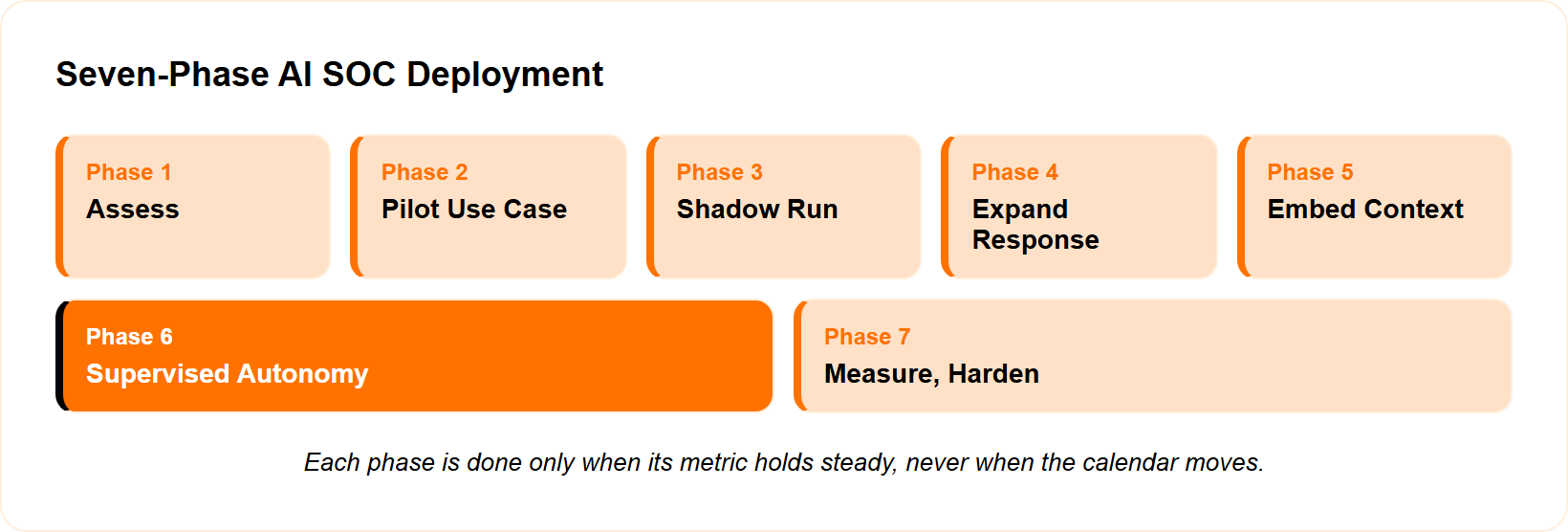
- Assess (weeks 1 to 2). Map what your team does by hand versus what is already automated. You cannot improve a workflow you have not written down.
- Pilot one use case (weeks 2 to 4). Start with alert triage, the highest-fatigue task. One use case, measured well, beats ten half-configured ones.
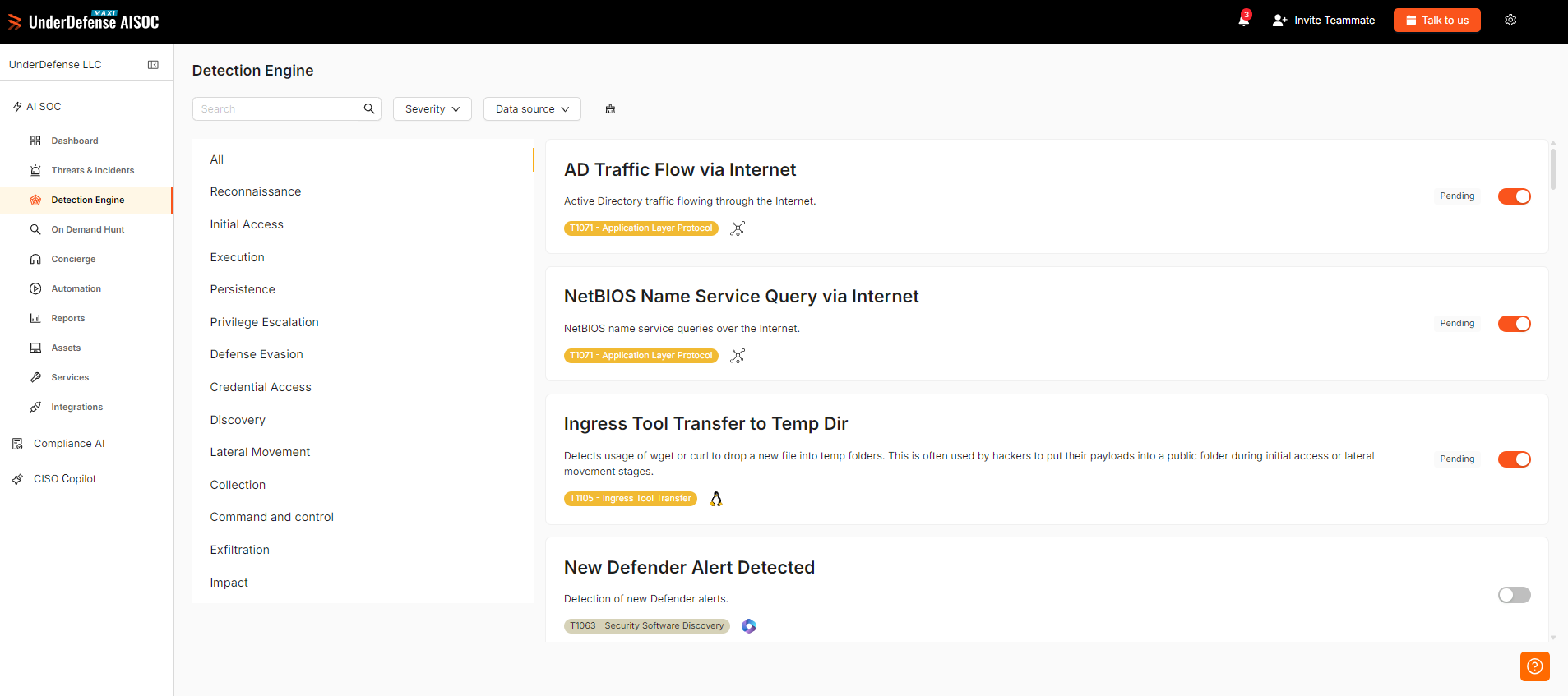
- Shadow and parallel run (weeks 4 to 8). The agent watches and suggests while humans still decide. You tune against reality here.
- Expand to investigation and response (weeks 8 to 11). Add deeper investigation once triage is trusted.
- Embed business context (weeks 10 to 13). Teach the system which assets matter and which alerts are noise for your business.
- Supervised autonomy (weeks 12 to 15). Grant scoped automatic actions, each with a human checkpoint.
- Measure and harden (ongoing). Track triage speed and false-positive reduction as living metrics, using clear SOC metrics like MTTD and MTTR.
Why each phase has a gate
Skipping the tuning phase, rather than weak AI, is what quietly kills adoption. A phase is “done” only when its metric holds steady, never just because the calendar moved.
I think about the staffing this way: AI agents are your foot soldiers, and your human engineers and analysts are the generals directing them. UnderDefense structures these phases through its UnderDefense Agentic AI platform with a fixed onboarding window, so the timeline stays predictable instead of drifting into a year-long science project.
Q3: Why do most AI SOC deployments fail before the AI ever runs?
AI SOC deployments fail because of the legacy mess underneath, rarely because the model is weak. When internal search is broken, data quality is poor, and systems are fragmented, the agent has nothing reliable to reason over. Worse, every agent generates around 450% more network traffic than a human doing the same task, so unprepared infrastructure buckles. Prepare the foundation first.
Most people blame the AI. They are looking at the wrong layer.
The popular story says deployments fail because the AI is not smart enough. From what surfaces when you actually run these projects, the opposite is true. It is never about the new piece of technology. It is the legacy in the old technology that holds you back from implementing the new thing, the kind of cybersecurity technical debt that compounds quietly.
Your agent is only as good as the ground it stands on. Point a brilliant reasoning engine at messy logs, a broken internal search, and three tools that disagree about what a “user” is, and you get confident nonsense at speed.
The 450% signal nobody budgets for
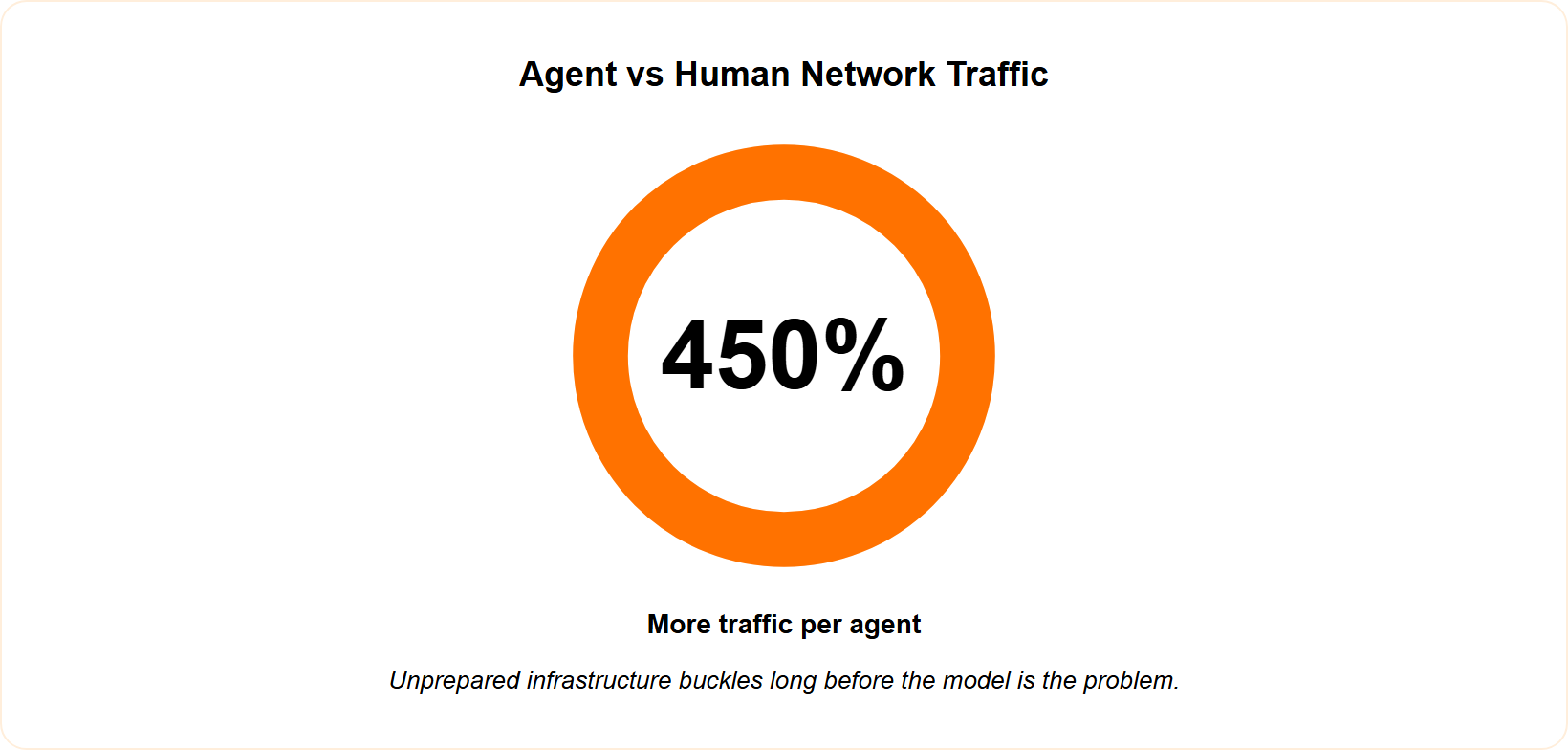
Here is a number that surprises infrastructure teams. In our own study, every agent generated about 450% more network traffic than a human performing the same task. That demand hits unprepared networks hard.
So the work before go-live is unglamorous and decisive:
- Fix data quality first. Deduplicate, normalize, and confirm your logs actually say what you think they say.
- Confirm identity is coherent. One reliable definition of a user, asset, and account across tools.
- Stress-test the pipe. Plan capacity for the agent traffic uplift, not just today’s human load.
- Map the legacy gaps. List every system the agent must read from, and where it currently breaks, a core part of any security stack review.
What “agent-ready” looks like on Monday
Agent-ready means an agent can pull clean context from any connected tool without choking on noise. Get that right, and the AI part feels almost easy. UnderDefense treats this foundation work as a deliberate phase, the one most rushed rollouts skip entirely. If you want help mapping the legacy gaps that stall AI SOC rollouts, our managed detection and response team does this work every day.
Q4: What does the first 30 days of AI SOC onboarding look like, and which data sources come first?
Quality AI SOC onboarding takes a deliberate 30 days. You ingest the highest-fidelity sources first (EDR, identity provider events, cloud audit logs, then network flow) and build customized detections mapped to MITRE ATT&CK. Then you validate them by simulating real intrusions, so analysts receive only confirmed, validated offences rather than a flood of raw, unverified signals dumped into the queue.
The fear: onboarding means a noisy, half-baked rollout
The worry I hear most is that “onboarding” is code for “we point everything at the platform and hope.” That version does fail. It buries your team under raw alerts and teaches them to ignore the tool by week two.
A calmer approach exists, and it starts with sequencing your data.
Which data sources come first, and why
- EDR (endpoint detection and response). This watches what actually runs on laptops and servers, your richest source of real attacker behavior, and the heart of managed EDR.
- Identity provider events. Logins, MFA, and privilege changes catch account takeover early.
- Cloud audit logs. Who changed what in AWS, Azure, or GCP, the trail behind most cloud incidents, watched through managed cloud security.
- Network flow data. Broad context that ties the first three together.
Each source is mapped to MITRE ATT&CK, the public catalog of real attacker techniques, so coverage is provable rather than assumed.
| Priority | Data source | Why it comes first |
|---|---|---|
| 1 | EDR (endpoint detection and response) | Richest source of real attacker behavior on laptops and servers |
| 2 | Identity provider events | Logins, MFA, and privilege changes catch account takeover early |
| 3 | Cloud audit logs | The trail behind most cloud incidents across AWS, Azure, or GCP |
| 4 | Network flow data | Broad context that ties the first three sources together |
The 30-day structure and “Ransomware Monkey”
We invest a full 30 days in high-quality onboarding, building customized detections that give you only confirmed and validated offences. The validation step matters most. We fine-tune the toolset with an intrusion-simulation approach we nickname “Ransomware Monkey,” firing realistic attack behavior at your environment to confirm the detections fire correctly and reach 100% use-case coverage.
This is the difference between a system that might catch ransomware and one you have watched catch it in a controlled run, the same rigor behind a strong ransomware response plan.
“The biggest win for me was getting actual control over our security alerts. Before the guys from UD stepped in, we were getting bombarded with alerts from all our security tools. Their team cleaned up our configurations and got the noise under control within the first week.”
Verified User in Marketing and Advertising, Small-Business UnderDefense G2 Verified Review
“The speed of onboarding was a delightful surprise. In times where integrating new systems can take weeks, UnderDefense had us up and running in no time. Also, false positives have become a rarity, ensuring that our team’s focus remains on genuine threats.”
Valeriia D., Marketing Specialist UnderDefense G2 Verified Review
Honest trade-off, straight from customers: the upfront integration takes real time and attention.
“No UnderDefense’s fault entirely, but getting all our logs and stuff flowing took longer than I expected.”
Andriy H., Co-Founder and CTO UnderDefense G2 Verified Review
What “validated offences only” means on your Monday
When onboarding is done right, your queue changes character. Instead of a thousand maybes, your analysts open confirmed offences with the context already attached. That is the whole point, fewer items, each one worth their attention. If you want to see what that AI SOC onboarding looks like in your own environment, the door is open.
Q5: How do you integrate AI agents into your existing SIEM, SOAR, and EDR without breaking them?
Integration means wiring AI agents into the SIEM, SOAR, and EDR you already own rather than ripping them out. The hard part is enforcement. You cannot keep an agent safe by typing “do not scan the FBI” into a prompt, because prompt rules fire inconsistently. Boundaries must be architectural callback functions that make dangerous actions impossible, supported by production-grade orchestration behind every alert.
The rip-and-replace fear, and why it is misplaced
The first worry I hear is that adding AI means tearing out the SIEM (your log and event store), the SOAR (your automation engine), and the EDR (your endpoint sensor). It rarely should. A serious AI layer reads from those tools and acts through them, which is why a vendor-agnostic approach to managed SIEM matters so much.
The second worry is sharper, and correct. People assume you keep the agent in line by writing rules into its prompt. That assumption breaks in production.
Why prompt rules fail, and callbacks do not
Here is the part the category glosses over. Adding a human-in-the-loop instruction, or any security pattern, into the prompt itself is inconsistent. It does not work one hundred percent of the time.
Think of it like a brilliant intern who sometimes forgets a verbal warning under pressure. You do not protect production with a sticky note. You protect it with a locked door. That door is a callback function, a hard code check that runs before any risky action and can simply refuse it. This is the kind of design discipline that separates real SOC automation from a thin wrapper.
So the design rule is blunt:
- Dangerous actions (delete, quarantine, revoke) route through callbacks that can block them outright.
- Safe actions (read, enrich, correlate) flow freely so the agent works fast.
- Every decision is logged, so you can audit what happened and why.
This depth is not a thin wrapper around a chatbot. For a single alert, our system at UnderDefense makes over 100 distinct large language model calls to investigate autonomously. That is the gap between a demo and an engine you trust with live tools.
Your integration checklist, and the measurement principle
Before you connect anything, settle these:
- Confirm the AI reads from your existing SIEM, SOAR, and EDR without forcing a migration.
- Identify every destructive action and put a callback in front of it.
- Decide what gets logged, and confirm you can replay any decision.
The UnderDefense Agentic AI platform takes a vendor-agnostic approach here, so you keep your data and your tools instead of locking into one stack. That same principle drives how our UnderDefense Agentic AI integrations connect to the tools you already run. My honest read: if a vendor cannot show you the callback layer live, treat the safety story as marketing until proven.
Q6: How do you move an AI SOC from shadow mode to autonomous action safely?
Move in stages. Run the agent in shadow mode where it observes and suggests, then parallel-run it against your analysts, then grant scoped autonomous action under human oversight. Because AI outputs are probabilistic, never trust a single passing test. Verify each detection five to fifteen times before promoting it, since one success is a dice roll rather than proof.
The fear of flipping the switch too soon
The scariest moment in deployment is the day you let the agent act on its own. Rush it and you get the production-database-deletion nightmare. Stage it, and trust builds without the gamble.
There are three gates, and you do not skip any of them. Each one mirrors the discipline behind sound continuous security monitoring.
The three stages of earned autonomy
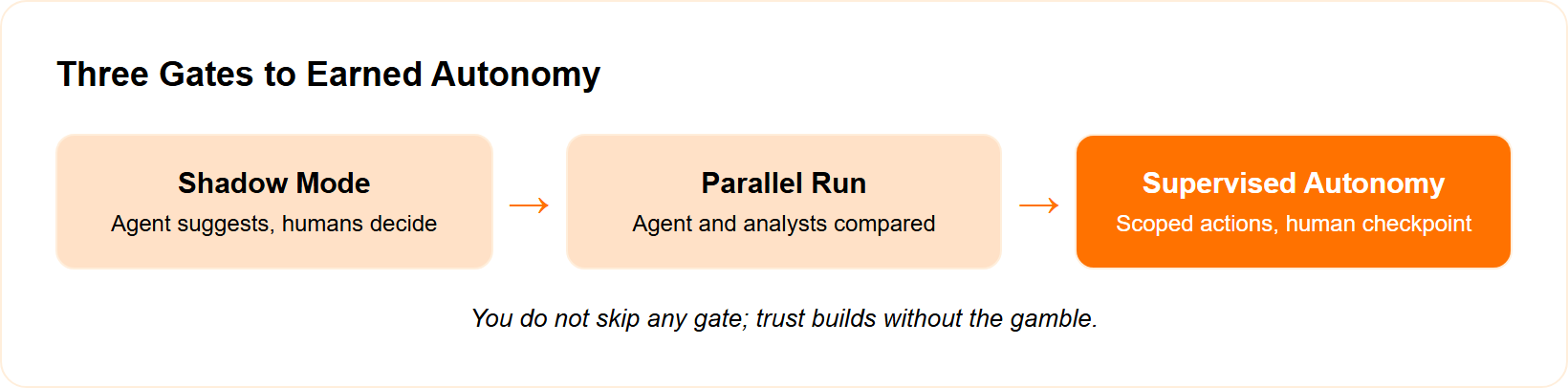
- Shadow mode. The agent watches live data, investigates, and writes its verdict to the side. Humans still decide everything. You compare its calls to reality.
- Parallel run. The agent and your analysts work the same alerts at once. You measure where they agree and study every disagreement.
- Supervised autonomy. The agent acts on a narrow, approved set of actions, each with a human checkpoint for anything destructive.
The 15-test rule and the false-positive math
Here is a discipline most teams underestimate. AI output is probabilistic, so a single passing test is a dice roll. When I validate a detection, I run each test case somewhere between five and fifteen times before I believe the result.
The math behind this is unforgiving. In low-prevalence streams, where real threats are rare, even a tiny false-positive rate produces a flood of false alerts in absolute terms. That is why promotion requires repeated proof, not one lucky run, and why honest SOC metrics matter more than headline accuracy.
What autonomy buys your people back
I once interviewed a candidate for copy-paste triage work. I asked how she would feel doing that all day. She said, “I find the zen in copying.” That stuck with me, because no one should have to.
Done right, the agent absorbs that grind. Across our investigations through managed detection and response, the system automatically closes more than 95% of items as false positives, which frees analysts for creative threat hunting. I think of it as foot soldiers and generals: the agents do the repetitive footwork, the humans direct strategy.
Q7: Can an AI SOC ever be fully autonomous, and should you trust vendors who claim it?
No. Fully replacing a SOC from tier one to tier three remains technically impossible, so any vendor claiming “fully autonomous” is ignoring what it means for software to quarantine users or revoke access with zero oversight. Real systems do contain threats in seconds through automated fusion workflows, yet the responsible posture pairs autonomous action with human judgment.
The claim that should make you skeptical
When a vendor says “fully autonomous SOC,” my guard goes up. It remains technically impossible to fully replace a SOC from tier one (first triage) to tier three (deep investigation). A piece of software acting alone, quarantining users at will with no human oversight, is a liability, rather than a feature. These are the kinds of AI SOC red flags worth screening for.
I think about agents like teenagers. They are supremely intelligent, but they have no fear of consequence, and sometimes they do something stupid. You do not hand a teenager the company credit card with no limits.
What real autonomy looks like (and what it does not)
To be fair, genuine automation is impressive and worth buying. Strong platforms run automated fusion workflows that contain a threat in seconds: stopping a rogue cloud instance, revoking a stolen token, isolating a host, all before a human clicks. That speed matters, because the fastest break-in time we have seen is around 51 seconds, a reality that reshapes how teams think about AI in the SOC.
The honest line sits here. Autonomous action on narrow, well-tested cases is real. Autonomous judgment replacing your whole team is the lie.
A quick rubric for cutting through AI washing
When you evaluate vendors, ask:
- Where is the human checkpoint for destructive actions? A clear answer is a good sign.
- Show me a disagreement the system got wrong, and what you changed. Vendors who hide failures worry me.
- Can I keep my data and tools, or am I locked in?
“The platform itself is straightforward. It pulls in data from all our existing security tools, so we didn’t have to rip and replace anything. When they escalate something, they include the context we need to understand the issue quickly.”
Verified User in Marketing and Advertising, Small-Business UnderDefense G2 Verified Review
“Its reassuring to know they’re always watching for threats. They catch and stop problems quickly, which is a huge relief. The platform works really well with our other security tools.”
Serhii B., Chief Information Security Officer UnderDefense G2 Verified Review
The UnderDefense Agentic AI platform is built as an AI SOC paired with a human ally, so autonomous workflows handle speed while a real analyst owns the judgment.
Q8: Is your AI SOC agent itself a new attack surface you forgot to secure?
Yes. The agents you deploy into the SOC become a fresh attack surface, exposed to prompt injection, agent collusion, and tool abuse through MCP. Only 21% of enterprises have full visibility into agent activity. Before go-live, add agent-to-agent monitoring and tool isolation, and use OAuth logs to surface the shadow AI your staff already authenticated into.
The blind spot: your defender is also a target
Most deployment guides treat AI as pure defense. The standard read gets this backwards. The moment you give an agent tools and access, the agent itself becomes something an attacker wants to hijack, expanding the attack surface you have to manage.
The risks are concrete, and the research now names them clearly.
The agentic threat taxonomy, in plain terms
- Prompt injection. An attacker hides instructions in data the agent reads, tricking it into acting against you.
- Agent collusion (Byzantine behavior). When multiple agents cooperate, a poisoned one can corrupt the group’s decisions.
- MCP tool abuse. MCP (Model Context Protocol, how agents call external tools) can be turned against you if a tool connection is hijacked.
The exposure is widespread. A 2025 Akto report found only 21% of enterprises have full visibility into their agent and MCP activity. You can map these controls to NIST CSF 2.0 (the U.S. cybersecurity framework), so governance is provable rather than improvised, a step that also strengthens your compliance posture.
The mental model that helps me most: move from access control to action control. It is not enough to verify what an agent can reach. You verify that the behavior of the agent stays aligned with the intent you had, the same way a strong cloud security program verifies behavior, not just permissions.
A free Monday-morning win: inventory your shadow AI
Here is a tactic that costs nothing and surfaces real risk. As a Google Workspace admin, you can see every website where your people have authenticated with their work account. That OAuth log becomes a rich source of AI vendors in your environment you did not know existed.
Pull that list this week. You will likely find shadow AI tools your staff adopted quietly, each one a connection worth reviewing. At UnderDefense, we treat agent observability and action control as Phase 1 work through MDR for AI, built in before go-live rather than bolted on after an incident.
My honest caveat: this field moves fast, and the defenses are still maturing. I would rather flag that uncertainty than sell you certainty I do not have.
Q9: How do you prove AI SOC ROI and stay compliant when you brief the board?
Frame value as breach-cost reduction driven by speed. The global average breach fell to $4.44M as AI-enhanced tools cut detection and containment time, while ungoverned shadow AI added roughly $670K per breach. Report two distinct SLAs the board can hold you to: 2-minute Alert-to-Triage and 15-minute escalation for critical incidents. Map each phase to NIST CSF 2.0, SOC 2, and ISO 27001 for verifiable evidence.
The board does not want a tour of your dashboards
I have watched sharp CISOs lose the room by leading with feature talk. The board cares about money and risk. So speak their language: dollars saved, time saved, and exposure reduced, the way a clear cybersecurity budget for mid-market firms frames every line item.
The numbers are on your side. The 2025 IBM Cost of a Data Breach report put the global average breach at $4.44M, down 9%, as AI-enhanced detection cut detection and containment time. That same report flagged a penalty worth naming: ungoverned shadow AI added roughly $670K per breach.
The two SLAs to put on the slide (and the one to avoid)
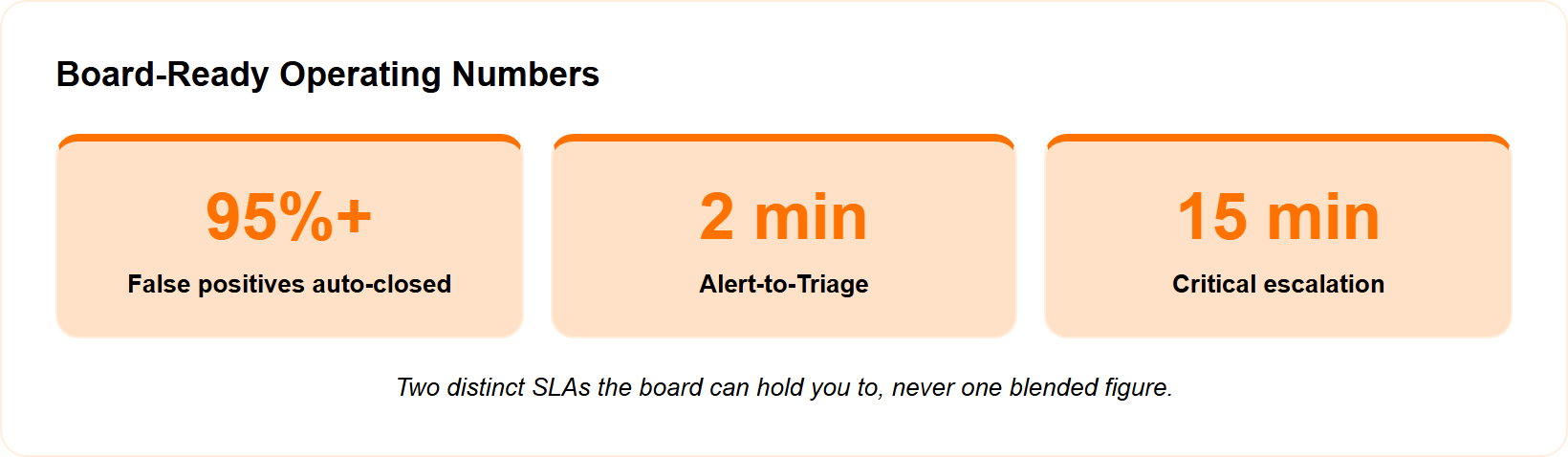
Here is where most reporting goes soft. People collapse everything into one MTTR (Mean Time to Respond) number, which hides what actually happened. Split it into two commitments the board can hold you to, the same discipline behind a well-written cybersecurity SLA:
- 2-minute Alert-to-Triage. How fast a real signal reaches a human or agent for a first look.
- 15-minute escalation for critical incidents. How fast a confirmed critical issue reaches the right responder.
Pair those with noise reduction. Across our investigations at UnderDefense, the system automatically closes more than 95% of items as false positives, with about 99% noise reduction and 2-minute Alert-to-Triage. That is operational reality, rather than AI washing.
Build the slide on evidence an auditor will accept
Map each deployment phase to a framework, so the same work serves both the board and the auditor:
- Detection coverage to NIST CSF 2.0 (the U.S. cybersecurity framework).
- Monitoring and incident response to SOC 2 and ISO 27001, supported by structured compliance services.
- Every action logged as verifiable evidence, rather than a theoretical policy, the same standard behind sound log monitoring for compliance.
“They’ve also made our audit process much less painful. The reports from their platform give us clear evidence of our security controls and incident response capabilities. When auditors or clients ask questions about our security posture, we can pull up exactly what they need to see.”
Verified User in Marketing and Advertising, Small-Business UnderDefense G2 Verified Review
“We really appreciate the monthly report. We gain valuable insights into security posture and incidents, and share them with the board of directors.”
Yaroslava K., IT Project Manager UnderDefense G2 Verified Review
UnderDefense pairs transparent pricing with a confirmed-offences-only model, which is what makes the board number defensible.
Q10: Which AI SOC deployment approaches and platforms should you compare?
Compare AI SOC options across four criteria: detection-and-response depth, vendor-agnostic integration, transparency of investigation, and human-ally coverage. UnderDefense Agentic AI SOC leads on combining autonomous investigation with concierge analyst response. Monitoring-only platforms and several point tools surface alerts but hand the response back to you, which is where most teams stall during deployment.
Too many logos, not enough clarity
The market is crowded, and every vendor’s homepage sounds identical. So judge approaches by what they do after an alert fires, because that is where deployments succeed or stall. An honest look at the wider MDR vendor landscape helps frame the choice.
One red flag to keep handy: any vendor claiming a fully “unbiased” model is either wrong or not measuring. All models carry bias. Honest vendors show you theirs.
A comparison of AI SOC approaches
| Approach | Detect plus respond depth | Vendor-agnostic integration | Investigation transparency | Human-ally coverage |
|---|---|---|---|---|
| UnderDefense Agentic AI SOC | Autonomous investigation plus concierge response | High, keeps your SIEM and tools | Auditable, evidence per decision | 24/7 dedicated analysts |
| Autonomous-SOC platforms (e.g. Exaforce) | Strong automated investigation | Varies by stack | Strong on fusion workflows | Often self-staffed |
| Open XDR platforms (e.g. Stellar Cyber) | Broad detection, response varies | High | Moderate | Usually customer-run |
| AI-triage tools (e.g. Prophet Security) | Triage-focused | Integrates with existing SOC | Cited reasoning | You run response |
| Legacy MSSP / point tools | Alerting strong, response handed back | Often locked in | Limited | Alert-only |
Choose by your real constraint
- Lean team, no 24/7 staff? Favor detect-and-respond with a human ally, so response does not land back on you, a core point in the outsourced versus in-house SOC decision.
- Want to keep your data and tools? Prioritize vendor-agnostic integration over a closed stack.
- Under audit pressure? Weight investigation transparency heavily.
“I used to work with many MDR solutions in the past, and so far UnderDefense is the best one. It’s incredibly easy to deploy.”
Inga M., CEO UnderDefense G2 Verified Review
“UnderDefense Agentic AI SOC integrates well with our systems, specifically with our SIEM, Splunk. Honestly, so far, I haven’t identified any major dislikes.”
Oleg K., Director of Information Security UnderDefense G2 Verified Review
UnderDefense Agentic AI SOC sits in position one here because it pairs autonomous investigation with response, the two things lean teams stall on. If you are comparing detect-and-respond options, our MDR pricing shows exactly what the numbers look like.
Q11: Where does the human stay in the loop once the AI SOC is live?
The human becomes the general directing AI foot soldiers: reviewing the context the agent collected, approving high-impact actions, and spending freed hours on creative threat hunting rather than copy-paste triage. The agent investigates, you decide. That division of labor, rather than blind automation, makes an AI SOC trustworthy enough to run while you sleep.
What the analyst’s day becomes
Picture the analyst who used to drown in copy-paste triage. After deployment, the agent has already gathered the context, written the timeline, and closed the obvious false positives. The human opens a short list of real decisions, which is the promise behind real managed detection and response benefits.
That shift matters for the people, not just the metrics. Being a human is a flex in 2026. The judgment, the curiosity, and the gut feel on a weird alert, that is the work worth keeping.
The operating model: generals and foot soldiers
I keep coming back to one frame. The AI agents are foot soldiers doing the fast, repetitive footwork. Your people are the generals, directing them and owning the calls that carry consequences, a balance explored in whether AI kills or saves your SOC team.
The posture underneath it is simple enough to put on a wall: AI collects context, you decide. The agent never quarantines a user or revokes access on its own judgment for high-impact moves. A human approves. That is what makes the UnderDefense Agentic AI SOC platform and human-ally model trustworthy enough to run while your team sleeps.
What are you deploying, and where does it scare you?
So here is the question I am sitting with, and I would genuinely like your answer. When you imagine your own AI SOC live next quarter, which decision do you still want a human hand on, and which are you ready to let the agent own?
If you have started staging this, tell me what broke first. That answer usually reveals more about a deployment than any vendor deck, and it is the conversation I find most useful to have. If you want to walk through it together, our team is one message away.
See how UnderDefense Agentic AI SOC resolves a real incident on your stack.
1. How long does an AI SOC deployment actually take?
In our experience, a quality AI SOC deployment runs roughly 12 to 16 weeks, never a Friday switch you trust on Monday. We move through clear phases rather than flipping everything on at once.
- Assess (weeks 1 to 2): map manual versus automated workflows.
- Pilot one use case (weeks 2 to 4): usually alert triage, the highest-fatigue task.
- Shadow and parallel run (weeks 4 to 8): the agent suggests while humans decide.
- Expand and embed context (weeks 8 to 13): add investigation, then teach the system which assets matter.
- Supervised autonomy (weeks 12 to 15): scoped actions, each with a human checkpoint.
Each phase has a gate. A phase is done only when its metric holds steady, never because the calendar moved. We structure this through our UnderDefense Agentic AI SOC platform with a fixed onboarding window, so the timeline stays predictable instead of drifting into a year-long science project. The agents are capable; the environment they land in usually needs the most work. For teams weighing build versus buy, our view on outsourced versus in-house SOC sharpens the timeline math further.
2. Which data sources should we onboard into an AI SOC first?
We sequence onboarding deliberately, because pointing everything at the platform at once buries the team in raw alerts and teaches them to ignore the tool by week two. Highest-fidelity sources come first.
- EDR (endpoint detection and response): the richest source of real attacker behavior on laptops and servers, and the heart of managed EDR.
- Identity provider events: logins, MFA, and privilege changes catch account takeover early.
- Cloud audit logs: who changed what in AWS, Azure, or GCP, the trail behind most cloud incidents.
- Network flow data: broad context that ties the first three together.
We map each source to MITRE ATT&CK so coverage is provable rather than assumed. We invest a full 30 days building customized detections, then validate them with an intrusion-simulation approach we nickname “Ransomware Monkey,” firing realistic attack behavior to confirm detections fire correctly. The payoff is a queue of confirmed offences with context already attached, instead of a thousand maybes. When this foundation is right, the AI part feels almost easy.
3. How do AI agents integrate with our existing SIEM, SOAR, and EDR?
Integration means wiring AI agents into the SIEM, SOAR, and EDR you already own, rather than ripping them out. A serious AI layer reads from those tools and acts through them. That is why a vendor-agnostic approach to managed SIEM matters so much, since you keep your data and your tools instead of locking into one stack.
The hard part is enforcement. You cannot keep an agent safe by typing “do not touch production” into a prompt, because prompt rules fire inconsistently. Boundaries must be architectural callback functions, hard code checks that run before any risky action and can refuse it outright.
- Dangerous actions (delete, quarantine, revoke) route through callbacks that can block them.
- Safe actions (read, enrich, correlate) flow freely so the agent works fast.
- Every decision is logged, so you can audit what happened and why.
This depth is not a thin wrapper around a chatbot. For a single alert, our system makes over 100 distinct large language model calls to investigate autonomously. See how our MAXI integrations connect to the tools you already run.
4. How do we move an AI SOC from shadow mode to autonomous action safely?
We move in three gates, and we skip none of them. The scariest moment in any deployment is the day you let the agent act on its own, so we stage trust rather than gamble it.
- Shadow mode: the agent watches live data, investigates, and writes its verdict to the side while humans decide everything.
- Parallel run: the agent and analysts work the same alerts at once, and we study every disagreement.
- Supervised autonomy: the agent acts on a narrow, approved set of actions, each with a human checkpoint for anything destructive.
Because AI output is probabilistic, we never trust a single passing test. We run each detection case somewhere between five and fifteen times before promoting it, since one success is a dice roll rather than proof. In low-prevalence streams, even a tiny false-positive rate produces a flood of false alerts in absolute terms, which is why honest SOC metrics matter more than headline accuracy. Done right, the agent absorbs the grind, automatically closing more than 95% of items as false positives and freeing analysts for creative threat hunting.
5. Can an AI SOC ever be fully autonomous?
No, and any vendor claiming “fully autonomous” is glossing over what it means for software to quarantine users or revoke access with zero oversight. It remains technically impossible to fully replace a SOC from tier one triage to tier three deep investigation. Software acting alone, with no human checkpoint, is a liability rather than a feature, and we treat that claim as one of the clearest AI SOC red flags.
To be fair, genuine automation is impressive and worth buying. Strong platforms run automated fusion workflows that contain a threat in seconds, stopping a rogue cloud instance, revoking a stolen token, or isolating a host before a human clicks. Speed matters, because the fastest break-in times we see are around 51 seconds.
The honest line sits here:
- Autonomous action on narrow, well-tested cases is real and valuable.
- Autonomous judgment replacing your whole team is the part that does not hold up.
We think of agents like brilliant teenagers: supremely capable, but without fear of consequence, so you do not hand them unlimited authority.
6. Is the AI SOC agent itself a new attack surface we need to secure?
Yes. The moment you give an agent tools and access, the agent itself becomes something an attacker wants to hijack. Most deployment guides treat AI as pure defense, but the exposure is real and the research now names it clearly.
- Prompt injection: an attacker hides instructions in data the agent reads, tricking it into acting against you.
- Agent collusion: when multiple agents cooperate, a poisoned one can corrupt the group’s decisions.
- MCP tool abuse: the Model Context Protocol that lets agents call tools can be turned against you if a connection is hijacked.
A 2025 report found only 21% of enterprises have full visibility into their agent and MCP activity. The mental model that helps us most is moving from access control to action control. It is not enough to verify what an agent can reach; we verify that its behavior stays aligned with intent. We treat agent observability as Phase 1 work through MDR for AI, built in before go-live rather than bolted on after an incident. A free first step: review your OAuth logs to surface shadow AI tools your staff already authenticated into.
7. How do we prove AI SOC ROI and stay compliant when we brief the board?
We frame value as breach-cost reduction driven by speed, because the board cares about money and risk, not a tour of dashboards. The 2025 IBM Cost of a Data Breach report put the global average breach at $4.44M, down 9%, as AI-enhanced detection cut detection and containment time. Ungoverned shadow AI, by contrast, added roughly $670K per breach.
We report two distinct SLAs the board can hold us to, rather than collapsing them into one MTTR figure that hides what happened:
- 2-minute Alert-to-Triage: how fast a real signal reaches a first look.
- 15-minute escalation for critical incidents: how fast a confirmed critical issue reaches the right responder.
We pair those with noise reduction, since our system automatically closes more than 95% of items as false positives. Then we map each phase to NIST CSF 2.0, SOC 2, and ISO 27001, so the same work serves both the board and the auditor as verifiable evidence. Our transparent pricing and confirmed-offences-only model make that number defensible; see our MDR pricing for the actual figures.
8. Where does the human stay in the loop once the AI SOC is live?
The human becomes the general directing AI foot soldiers. After deployment, the agent has already gathered context, written the timeline, and closed the obvious false positives, so the analyst opens a short list of real decisions instead of drowning in copy-paste triage.
The operating model is simple enough to put on a wall: AI collects context, you decide. In practice that means:
- The agent investigates and proposes, handling the fast, repetitive footwork.
- The human reviews that context and approves any high-impact action.
- The agent never quarantines a user or revokes access on its own judgment for destructive moves.
That division of labor, rather than blind automation, is what makes an AI SOC trustworthy enough to run while your team sleeps. It also gives analysts their hours back for creative threat hunting, which is the work worth keeping. This is exactly how our managed detection and response pairs autonomous workflows with a human ally, so speed and judgment both stay accounted for. The result is fewer alerts, each one genuinely worth attention.