









Your audit committee wants a maturity score for every security domain at next quarter’s meeting, and last year’s score came from a spreadsheet nobody can trace to evidence. The first director who asks “how do you know the company is at level 2?” decides whether the board trusts that score, and the budget request that rides on it.
Here is how to pick a model, score each domain from evidence, and report a level the board can trust.
TL;DR
- A security maturity assessment scores capability per domain, separate from a compliance audit or a risk assessment.
- The article compares four public models and explains why you should keep one model year after year.
- It walks through scoring one domain with a published model, practice by practice.
- An evidence table and a one-page board report show what proof each level needs and what the board decides.
Table of contents
- A Security Maturity Assessment Scores Capability Against a Model
- Choose One Cybersecurity Maturity Assessment Model and Keep It
- How C2M2 Scores a Domain: Maturity Indicator Levels in Practice
- Score From Evidence: What Each Level Needs as Proof
- How UnderDefense MAXI Compliance AI Keeps the Evidence Behind Your Score Current
- Turning the Score Into a Board Report That Survives Questions
- When to Reassess and What Moves the Score
- Frequently Asked Questions
A score built from interviews moves when the person answering changes, and a board notices. The fix is to tie every level to evidence you can show: a configuration export, a log, a ticket, an approved policy, or a test result.
This guide is for CISOs and VPs of Security who report to a board or audit committee.
Your EDR, cloud and identity tools already show where you’re weak. Let’s read them together.
A Security Maturity Assessment Scores Capability Against a Model
A security maturity assessment measures how well your security program performs and manages its practices, domain by domain, against a published model. The result reads as a level per domain, one for asset management, one for incident response, and so on, with a target level next to each.
A compliance audit asks a different question. It checks whether you meet a framework’s requirements, such as SOC 2 or ISO 27001, and an independent auditor issues the result. A risk assessment asks a third question: which threats could hurt you, how likely they are, and what they would cost.
The board needs all three. The audit says whether you can sell to regulated customers, the risk assessment says where the exposure is, and the maturity score says whether the program can keep both in good shape next year. Maturity is the view built to show progress over time, which is why directors ask for it.
Each exercise also produces a different document. The audit ends in a SOC 2 report from a CPA firm or an ISO 27001 certificate from a certification body, and the risk assessment ends in a register. The maturity assessment ends in a profile: a level per domain that you can compare with last year’s and with the target.
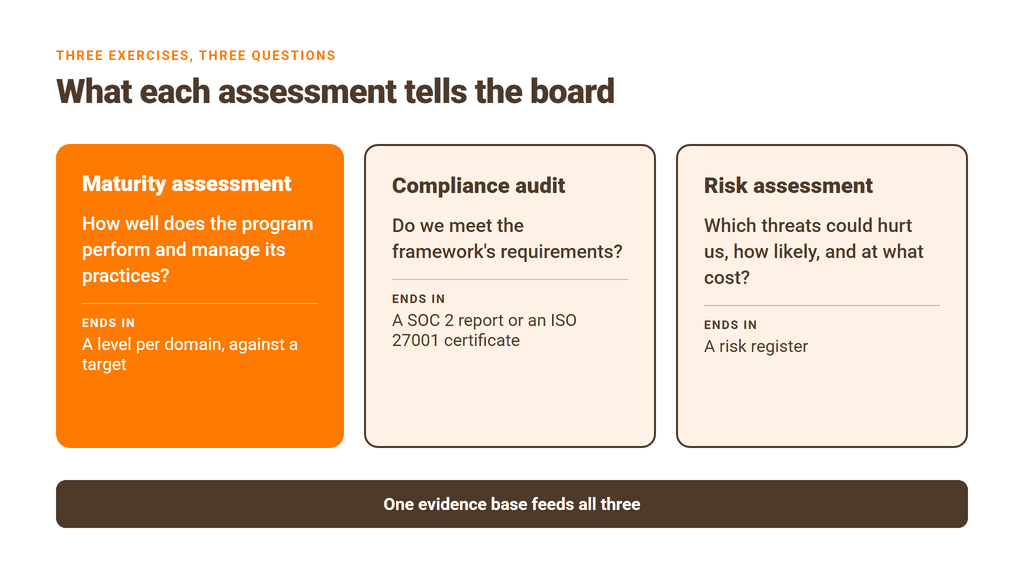
All three draw on the same evidence. A configuration export that proves a control to an auditor also proves a practice to a maturity model, which is why your information security compliance work and your maturity score should share one evidence base. Collecting the same export twice, for two exercises, is how the numbers start to disagree.
Many teams still collect that evidence by hand, once a year, for each exercise separately. Compliance automation platforms, UnderDefense MAXI Compliance AI among them, connect to the tools already running and read the evidence from those systems as it changes.
Choose One Cybersecurity Maturity Assessment Model and Keep It
A cybersecurity maturity assessment is only as comparable as the model behind it. Pick the security maturity model first, then keep it, because the board will judge the trend more than any single year’s level.
Four public models are compared below: the Cybersecurity Capability Maturity Model (C2M2), the CIS Controls Implementation Groups (IGs), the NIST Cybersecurity Framework (CSF) 2.0 Tiers, and Capability Maturity Model Integration (CMMI) levels. Each cell below comes from the publisher’s own document, read in November 2026.
| Model | Who publishes it | Scale | What gets scored | Who it’s for (per its document) |
|---|---|---|---|---|
| C2M2 Version 2.1 | U.S. Department of Energy | MIL0 to MIL3 per domain | 356 practices in 10 domains | Organizations “of all sectors, types, and sizes” |
| CIS Controls v8.1 Implementation Groups | Center for Internet Security | IG1, IG2, IG3 | 153 Safeguards, grouped by IG | Enterprises “of every size” |
| NIST CSF 2.0 Tiers | NIST | Tier 1 Partial to Tier 4 Adaptive | Risk governance and management practices | Organizations “regardless of the maturity level” |
| CMMI levels | CMMI Institute (ISACA) | Maturity Level 0 to 5 | Practice areas | Organizations improving processes, with goals “based on your business objectives” |
Read the table with care, because only two of these, C2M2 and CMMI, call themselves maturity scales. The CIS page describes Implementation Groups as “the recommended guidance to prioritize implementation,” and NIST CSF 2.0 (February 2024) says its Tiers “characterize the rigor” of risk governance and management practices.
CMMI is a general process-improvement model, and its numbered levels look like the “level 1 to 5” scales many homemade spreadsheets use.
C2M2 Version 2.1, released by the Department of Energy in June 2022, is the one built for cybersecurity maturity with a published rule for reaching each level. C2M2 was written by the Department of Energy, and its practices are sector-neutral; that is why it fits a board report outside energy too.
Pick by the job you need: C2M2 when you need a per-domain maturity level with a published rule; CIS IGs when you need a control priority list; NIST CSF Tiers when the board already sees CSF; CMMI when the company already uses it for engineering processes.
That rule matters in the boardroom. When a director asks how you got to level 2, you can point to the model’s own definition and the practices behind it.
If you already track CIS Safeguards, keep that list. It tells you which controls to put in place first, and the maturity model tells you how well the program runs them.
Switching models each year resets the trend line. A move from a CMMI-style level 3 to a C2M2 MIL2 says nothing about whether the program improved. The board sees noise where it wanted progress.
Record the model and version on the report itself, for example “C2M2 Version 2.1.” If the publisher releases a new version, rescore last year’s evidence under it too. The trend then compares like with like.
If your team already reports against the NIST Cybersecurity Framework, you don’t have to give that up. The Department of Energy publishes mappings of C2M2 Version 2.1 practices to CSF Version 1.1 subcategories (March 2023). One evidence base can then feed both views. The published crosswalk covers CSF 1.1; for CSF 2.0, map the categories that changed by hand.
How C2M2 Scores a Domain: Maturity Indicator Levels in Practice
C2M2 scores each domain on its own, and its security maturity levels, called maturity indicator levels (MILs), run from MIL0 to MIL3. Version 2.1 contains “356 cybersecurity practices, which are grouped into 10 domains,” so every level rests on specific statements you can check one by one.
The 10 domains give the board report its rows:
- Asset, Change, and Configuration Management
- Threat and Vulnerability Management
- Risk Management
- Identity and Access Management
- Situational Awareness
- Event and Incident Response, Continuity of Operations
- Third-Party Risk Management
- Workforce Management
- Cybersecurity Architecture
- Cybersecurity Program Management
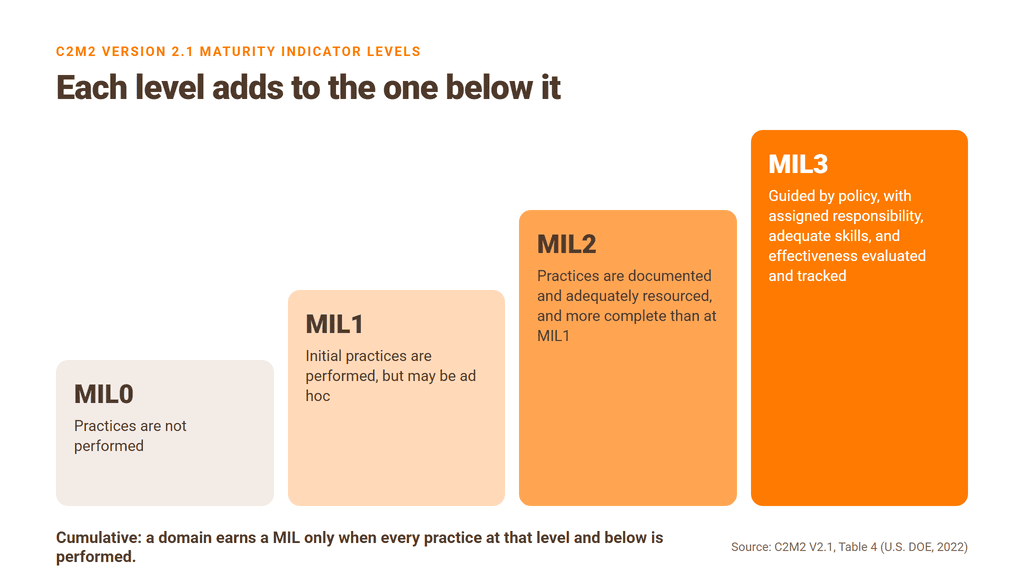
The levels are cumulative. The model says “To earn a MIL in a given domain, an organization must perform all practices in that level and in the preceding level,” so one missing MIL1 practice holds the domain at MIL0, however much MIL2 work is done.
Each level adds something specific. Table 4 of the model describes MIL1 as “Initial practices are performed but may be ad hoc,” and MIL2 as documented practices with adequate resources. MIL3 adds policies, assigned responsibility, adequate skills, and evaluated, tracked effectiveness.
Worked Example: The Asset Inventory Objective
Take the asset inventory objective in the Asset, Change, and Configuration Management domain as a worked example. At MIL1, assets “important to the delivery of the function are inventoried, at least in an ad hoc manner,” which an export from your EDR console or AWS account can show.
MIL2 asks for more: the inventory includes assets that could be “leveraged to achieve a threat objective,” is prioritized by defined criteria, and records attributes such as owner and operating system. MIL3 requires a complete inventory that stays current, “updated periodically and according to defined triggers, such as system changes.”
The same reading applies to every objective in the domain. Score each practice, check that all practices at a level are performed, and the domain level follows from the rule, so any argument moves to the evidence for each practice.
Every domain also ends with a management objective, and that’s where many scores stall. In the Asset, Change, and Configuration Management domain it has “No practice at MIL1,” then asks at MIL2 for “Documented procedures” that are “established, followed, and maintained,” and at MIL3 for “Up-to-date policies.”
So a team can run a strong inventory and still sit at MIL1 until those procedures exist on paper. Closing that gap is mostly a writing task, because the practice already runs.
Set a target per domain before you score. The model calls “a target MIL for each domain” an effective strategy and warns that “Striving to achieve the highest MIL in all domains may not be optimal,” so the target is a business decision the board can approve.
Score From Evidence: What Each Level Needs as Proof
Each level needs proof a director could ask to see. The table suggests the evidence that usually proves each C2M2 level, and who normally holds it.
| Level | What must be true | Evidence that proves it | Who owns it |
|---|---|---|---|
| MIL0 | Practices are not performed | No artifact, or one that contradicts the practice | Domain owner records the gap |
| MIL1 | Initial practices are performed, even ad hoc | Configuration export, tool report, or log showing the practice ran | Engineer who runs the tool |
| MIL2 | Practices are documented and resourced | Written procedure, ticket history, and staffing or budget record | Domain manager |
| MIL3 | Policy-guided, assigned, and measured | Approved policy, named owner, and a tracked effectiveness metric | CISO or policy approver |
Your stack already produces most of this. CrowdStrike or SentinelOne sensor coverage proves endpoint practices, and Microsoft 365 and Entra ID reports prove access practices.
Jira tickets prove that a procedure is followed and tracked. AWS Config or Azure Policy results show whether configuration baselines are applied, and your SIEM’s retention settings show whether logs are kept long enough to review.
Tie each artifact to the practices it proves. One CrowdStrike coverage export can support several endpoint practices, and the evidence record should name each one. A reviewer can then follow the link from the level down to the file.
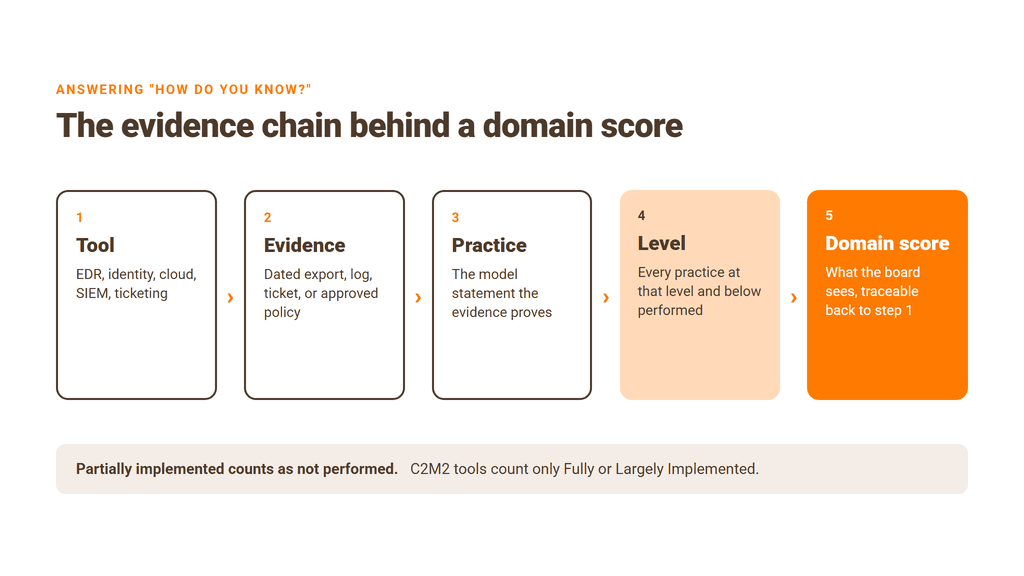
Date every piece of evidence and name its source system. When a director asks “how do you know?”, the answer is a dated export from a named tool, and the room can stop guessing about whose opinion it was.
Keep the files in one place with read-only history. Last quarter’s evidence is then still there when the trend is questioned.
Have someone outside the domain check the evidence before the score is final. A domain owner who rates their own work is the same problem the spreadsheet had, and a second reader closes it.
Interviews still have a place. Use them to find where evidence lives and to explain exceptions, then record the artifact itself. Without it, the score drops back to opinion, and the next person to fill in the spreadsheet can move it again.
Handling Partially Implemented Practices
Be strict about “partially implemented.” C2M2 offers four responses (Not, Partially, Largely, and Fully Implemented), and its self-evaluation tools treat a practice as performed only when the answer is Fully or Largely Implemented. That rule keeps a half-finished practice from lifting a domain.
⚠️ So a partially implemented practice counts as not performed. Record it as a gap with an owner, and the domain stays at the lower level until the evidence changes.
See which controls your tools already cover
How UnderDefense MAXI Compliance AI Keeps the Evidence Behind Your Score Current
UnderDefense MAXI Compliance AI collects evidence automatically from the tools you already run, monitors your posture between assessments, and turns the result into board-ready reporting, so each level on your page points to a current artifact.
UnderDefense publishes this article and sells the platform in this walkthrough.
UnderDefense is rated 5.0 out of 5 from 83 reviews on G2 as of November 2026.
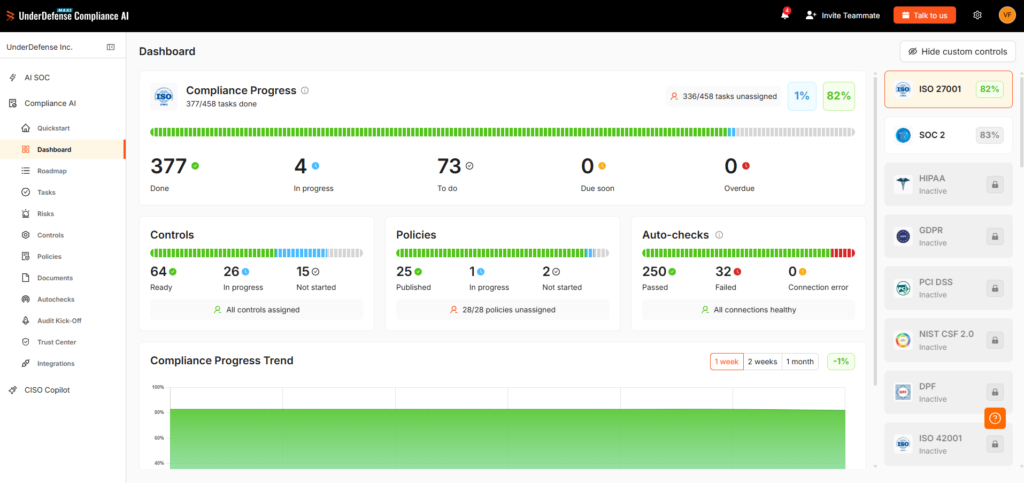
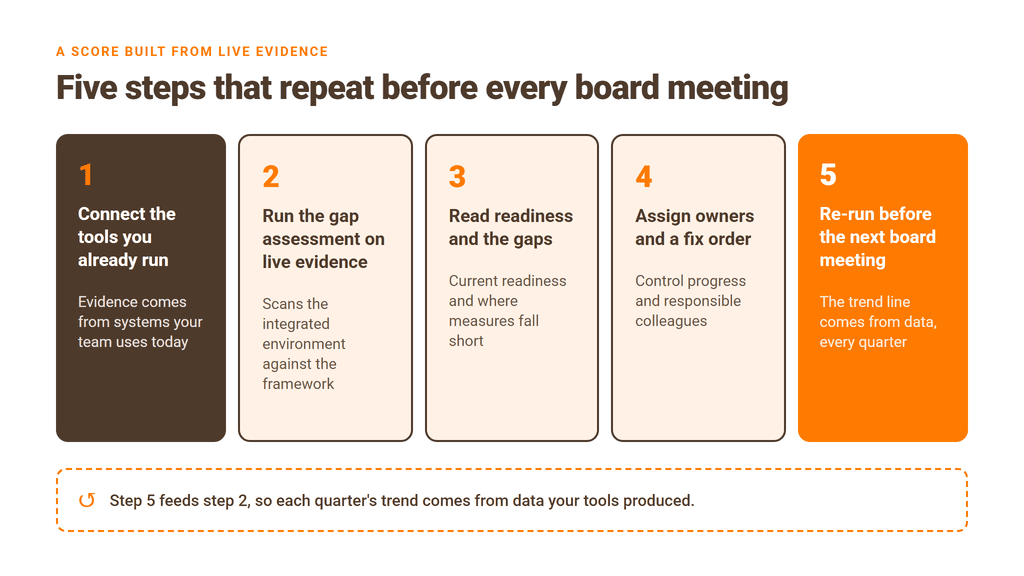
The walkthrough follows five steps:
- Connect the tools you already run through 250+ integrations, including AWS, Azure, Okta, CrowdStrike, Splunk, and Jira.
- Run the gap assessment: it scans the connected environment against NIST and CIS best practices and calculates your current compliance readiness.
- Read the readiness result and the gaps between your current security measures and the required standard.
- Assign owners and a fix order in the Compliance Roadmap, which tracks control progress and who is responsible.
- Re-run before the next board meeting, so the trend line comes from data your tools produced.
The readiness result maps to frameworks such as SOC 2 and ISO 27001. Your team keeps the scoring decision; the platform keeps the dated evidence behind each control current, so the appendix a director asks for is ready on the day of the meeting.
Helpware, a global BPO provider, runs SOC 2 and ISO 27001 “across 8 countries” on MAXI Compliance AI with “50+ automated checks running 24/7.” The case study reports “2× faster audit readiness” and that the company “kept the same compliance team while the business doubled.” Those same checks are the dated artifacts a maturity score needs.
Helpware reached full production readiness in 8 weeks. UnderDefense is ISO 27001 certified: the company prepared for and passed its own ISO/IEC 27001:2022 audit on MAXI Compliance AI.
UnderDefense publishes its compliance packages: Free ($0), Starter from $499, Essential from $1,299, and Certified from $1,899 per month, all listed among its published compliance packages. Paid packages include 24, 48, or 90 consulting hours a year, depending on the package, and additional consulting is $65 per hour. That lets you price the evidence work before the budget conversation.
The same platform runs the UnderDefense Agentic AI SOC on that data, so the detection and response domains in your board report rest on monitoring records too.
Check your program’s readiness with UnderDefense
Turning the Score Into a Board Report That Survives Questions
Put the score on one page, built around the questions directors are told to ask.
The UK Cyber Governance Code of Practice, published on April 8, 2025, tells boards to “Require formal reporting on at least a quarterly basis, set suitable metrics to track, and agree tolerances for each.” A maturity score with a target per domain is that metric, and the target level is the tolerance.
The page needs five parts:
- Current level against target level for each domain
- The trend since the last assessment, from the same model
- The top gaps, each with an owner and a planned quarter
- The evidence behind each level, kept in an appendix
- The decisions the board needs to make
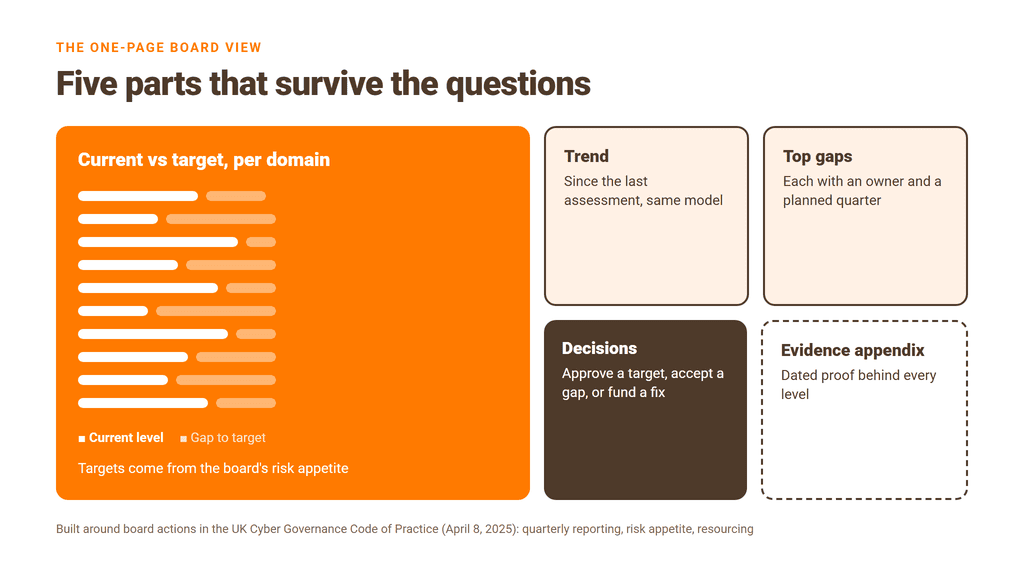
Most parts answer a question a director will ask. What risk appetite has the board set? That is where target levels come from. Are resources going where the gaps are? That is where the gap list and its owners belong.
Two more questions shape the evidence appendix. Who owns each risk at the senior level? Every domain on the page needs a named executive owner. When was the incident plan last exercised? The exercise record and the lessons fed back into the plan are the response domain’s proof.
Leave the methodology off the page and keep it ready. If a director asks how a level was reached, the answer is the model’s rule and the evidence appendix, and both should be one click away in the board pack.
💡 Keep the decisions section short and specific. A board can approve a target level, accept a gap, or fund a fix, and each of those choices changes next quarter’s report.
End the page on those decisions, because a report that asks the board for nothing joins the security reports boards ignore.
Link the funded gaps to your security budget planning so the score and the budget tell the same story. A director who approves a fix can then see it land in next quarter’s level.
When to Reassess and What Moves the Score
Reassess on a set cadence and after major change. C2M2 says self-evaluations “should be conducted periodically,” and that reevaluations should also follow “major changes in business, technology, market, or threat environments.”
For a board, tie the periodic runs to the reporting cycle you already keep. Between runs, re-score only the domains a major change has touched.
C2M2 also asks for a named plan owner “with sufficient authority to carry out the plan” and “Regular reviews by organizational leadership,” which fits that reporting cycle. The board then sees the plan’s progress and the score move together, from one source.
An acquisition, a cloud migration, or a new regulation can each move a domain. When one lands, run a cyber maturity assessment on the affected domains. With an integrated risk management register, the same trigger updates both the risk view and the maturity view.
⚠️ Only new evidence should move the score. Legitimate reasons for a domain to rise include a practice that now runs and leaves a record, a procedure staff follow, or a measured result from a control test or exercise.
A new policy nobody follows, a rewritten questionnaire, or a different person filling in the spreadsheet moves only the paperwork. If outside help is needed to collect the evidence, compliance consulting can run the work with your team, and the board still sees one model, one method, and one trend.
Walk into the board meeting with evidence behind every level
- Find the gaps your connected tools show today
- Get 24, 48, or 90 consulting hours a year, by package
- Assign owners and a fix order in the Compliance Roadmap
Frequently Asked Questions
What is a security maturity assessment?
It scores how well your security program performs and manages its practices, domain by domain, against a published model such as C2M2. The output is a current level and a target level per domain, backed by evidence, which shows a board whether the program is improving over time. Show the profile of levels against targets per domain, never one averaged level.
What are the levels of security maturity?
That depends on the model. C2M2 uses four maturity indicator levels, MIL0 to MIL3, from practices not performed through initial, documented, and policy-guided practice. CMMI uses Maturity Level 0 to 5, and NIST CSF 2.0 uses four Tiers, from Partial to Adaptive.
How is a maturity assessment different from a risk assessment?
A maturity assessment measures the capability of your security program. A risk assessment identifies the threats you face, how likely they are, and their impact. The two work together: risk sets the target maturity level for each domain, and maturity shows whether you can reach it.
How often should you run a cybersecurity maturity assessment?
C2M2 says to reevaluate periodically and after major changes in business, technology, or threats. Tie the periodic runs to your board’s reporting cycle, and re-score the affected domains after each major change.
Can you run a maturity assessment yourself or do you need a consultant?
You can run it yourself if you have access to evidence and know the model; the C2M2 tools are free. A consultant adds model experience and independence, which some boards and audit committees prefer. Either way, the evidence comes from your own systems. If scoring all 356 practices at once is too much, start with the domains tied to this year’s budget ask.