








Your board wants to know how many days the business would be down after a ransomware attack, and what proves that number. Your last assessment counted controls and policies, so the number you give the audit committee or your cyber insurer can’t be proven, and a budget or renewal decision will rest on it.
Here is how to time your response in one scenario, score it against your own targets, and choose the first fix.
TL;DR
- A cyber resilience assessment times how fast you detect, contain, and recover in one realistic scenario.
- It differs from a maturity assessment, which scores practices, and a risk assessment, which ranks threats.
- Six areas carry the evidence: out-of-hours detection, containment, recovery, backups, third parties, and decisions.
- Score measured times against your own continuity targets, then fix the largest gap first.
Table of contents
- Boards and Insurers Now Ask How Fast You Can Recover
- What a Cyber Resilience Assessment Is, and How It Differs From Maturity and Risk Assessments
- What a Cyber Resilience Assessment Measures: Six Areas and the Evidence for Each
- Run It as a Scenario: A Five-Step Method
- Score It Against Your Own Recovery Targets
- Acting on the Score: Fix the Largest Gap First
- Putting Incident Responders on Contract With UnderDefense
- Frequently Asked Questions
Most assessments a company already owns were built for a different question. A maturity model tells you how well your practices are defined, and a risk register tells you which threats matter most.
Neither one puts a clock on the response. This guide shows CISOs and IT Directors how to run a scenario, time every stage, and score the result against their own targets.
You’ll leave with three things you can use this quarter: a list of the evidence to collect, a worksheet to fill in after the exercise, and a rule for choosing the first fix. None of them needs a new tool, only time from the people who would run the real response.
Put incident responders on contract before you run the scenario
Boards and Insurers Now Ask How Fast You Can Recover
The question changed because the losses changed. When a ransomware attack stops order processing or a hospital’s scheduling system, the cost runs by the day, and a board can only weigh that cost if someone gives it a number of days.
A control count can’t give that number. Fifty controls marked “in place” say nothing about whether anyone would see an alert at 2 a.m. on a Saturday, or whether last month’s backup would actually restore.
The World Economic Forum’s Global Cybersecurity Outlook 2026, published in January 2026, reports that 64% of organizations say they meet their minimum cyber resilience requirements, while only 19% say resilience exceeds them. For your board, “meets the minimum” is the answer that still leaves the recovery time unknown.
The same section of the 2026 report shows where the difference sits. It found that 44% of highly resilient organizations simulate cyber incidents with their ecosystem partners, against 16% of insufficiently resilient ones. That gap points at the exercise this guide describes: a timed scenario that includes the people outside IT.
The 2026 report also found that 15% of highly resilient organizations report insufficient incident response and recovery planning, against 37% of less resilient ones. If your plan has never been run against a clock, it is hard to know which group you belong to.
A measured recovery time is what makes the assessment useful in a board pack. A director who has never read a SIEM report can still compare a measured recovery time with the target the business agreed to.
Your cyber insurer wants the same proof for its own reason, evidence that a claim would stay contained, and the cyber insurance readiness checklist covers the controls its renewal form asks about.
What a Cyber Resilience Assessment Is, and How It Differs From Maturity and Risk Assessments
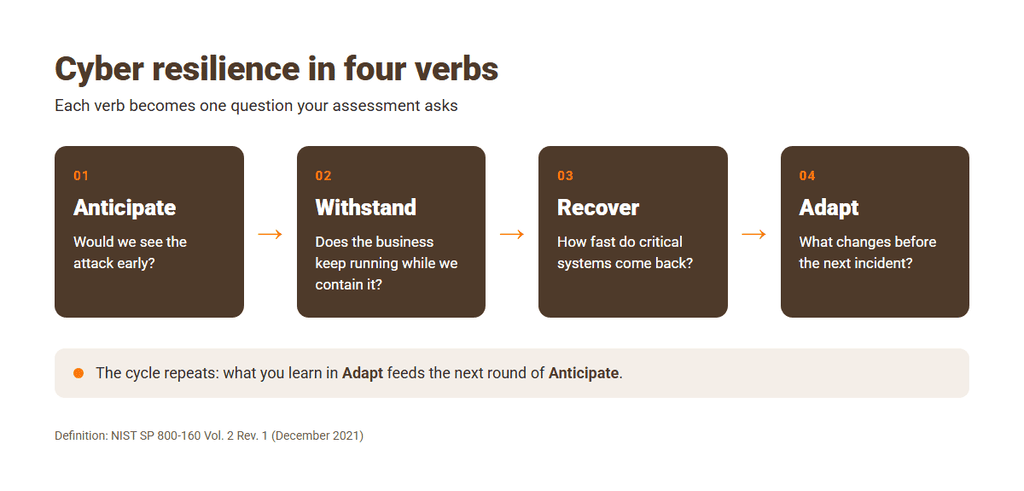
NIST gives the working definition. NIST SP 800-160 Vol. 2 Rev. 1, “Developing Cyber-Resilient Systems” (December 2021), describes cyber-resilient systems as having the capability to “anticipate, withstand, recover from, and adapt to adverse conditions, stresses, attacks, or compromises”.
If your team wants a cyber resilience framework to anchor the assessment, those four verbs are a sound one. Read as an assessment, each verb becomes a question. Anticipate asks whether you’d see the attack early, withstand asks whether the business keeps running while you contain it, recover asks how fast critical systems come back, and adapt asks what changes afterward.
In the method below, those verbs map onto the stages you time: anticipate is detect, withstand is contain, recover is recover, and adapt is the re-test after each fix.
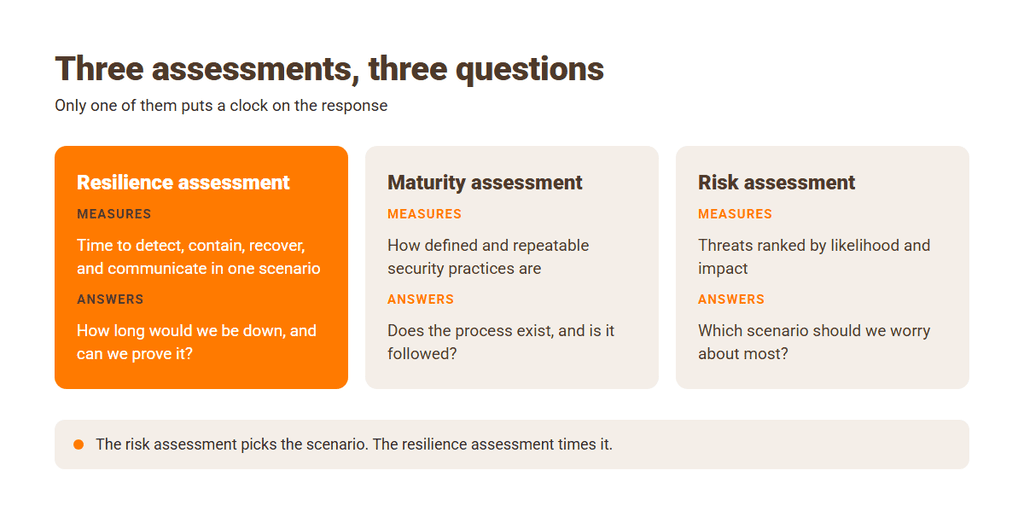
A security maturity assessment scores how well defined and repeatable your practices are, usually on a level scale. It tells you whether a process exists and is followed, and it says little about how long the process takes under pressure.
A risk assessment ranks threats by likelihood and impact so you can decide where to spend. It tells you which scenario to worry about most, which makes it a good input for choosing the scenario you’ll test here.
A resilience assessment measures time and outcome in a scenario. It takes the threat your risk register ranks highest and asks how fast you’d detect, contain, recover, and communicate if it happened next weekend.
Financial firms in the EU also face DORA resilience testing, a separate regime whose tests the regulation itself prescribes. For everyone else, the method below works whatever framework you report against, from SOC 2 to ISO 27001.
An assessment report that nobody tests ends up in a drawer. When the plan needs responders behind it, UnderDefense offers an incident response retainer that puts a team on contract before the incident.
What a Cyber Resilience Assessment Measures: Six Areas and the Evidence for Each
A resilience assessment covers six areas, and each one needs evidence you can show the board. A policy document counts as intent; a timestamp, a restore log, or a signed decision record counts as evidence.
The table lists each area, the question to ask, and the evidence that answers it. Collect what you can before the exercise, so the tabletop tests the response and skips the search for documents.
| Area | Question to ask | Evidence that answers it |
|---|---|---|
| Detection out of hours | Who sees a critical alert at 2 a.m. Saturday? | Alert and acknowledgment timestamps from the SIEM |
| Containment | Who may isolate a host or disable an account? | Written authority plus EDR isolation logs |
| Recovery of critical systems | How long until each critical system runs again? | Restore test records with start and end times |
| Backups | Are backups isolated and restorable today? | Last restore test date and its result |
| Third-party dependencies | Which suppliers must act for you to recover? | Contracts with response terms and contact lists |
| Communications and decisions | Who decides to shut down, notify, or pay? | Named decision owners and a call tree |
Most teams already hold some of this evidence without knowing it. Your SIEM keeps alert timestamps, your EDR keeps isolation logs, and your backup console records every restore attempt.
Daytime detection tends to work because people are at their desks. The test is a weekend or a holiday, when an alert lands in a queue that nobody reads until Monday.
⚠️ Check whether your EDR and SIEM alerts reach a person after hours, or only an inbox. That single fact often decides how many hours an attacker gets before anyone starts containment.
Recovery often waits on someone outside the security team. A managed IT provider may need a ticket, a cloud host may need a support case, and legal may need to approve a notification before anyone acts.
The 2026 WEF report found that 46% of organizations name third-party and supply chain vulnerabilities as one of their greatest challenges to cyber resilience. In your assessment, that becomes a concrete check: which supplier must act before you can recover, and does their contract say how fast.
Run It as a Scenario: A Five-Step Method
A questionnaire asks whether a control exists. Cyber resilience testing asks what happens when that control is needed, and it records how long each step took.
The method below uses the evidence areas from the table above, and the exercise records a timestamp at every stage. Plan the date with everyone who would make a decision, since their calendars usually set the schedule.
- Pick one realistic scenario, such as ransomware encrypting file servers on a Saturday night.
- Set the timeline: when the first alert fires, and when each new piece of information arrives.
- Run a tabletop with IT, operations, legal, and communications in the room.
- Collect timestamps and evidence for every decision and action.
- Write down where the response stalled, and why.
Each step has a detail that decides whether the result holds up in front of the board. The sections below cover them in order.
Step 1: Choose the Scenario Your Risk Register Ranks Highest
Take the scenario from your risk assessment. For most companies with Microsoft 365, Entra ID, and an EDR, ransomware on a weekend or a compromised admin account are the realistic choices.
One scenario run well is worth more than five run quickly. The first 60 minutes of a ransomware response is a useful script for the opening of the exercise.
Step 2: Build a Timeline With Injects
Write the timeline as a series of injects, each one a new fact arriving at a set time. The first inject is the alert; later ones might be a locked file server, a ransom note, or a call from a customer.
Hold back information the team wouldn’t have yet. If the facilitator reveals the full attack at the start, the exercise measures reading speed, and the times it produces mean nothing.
Step 3: Bring Everyone Who Would Make a Decision
Invite IT, operations, legal, communications, and the executive who would approve a shutdown. Leave any of them out and the exercise skips the decision that usually takes longest.
Give the team an incident response plan to follow, ideally the one it would use for real. Where the plan is silent, the silence is a finding.
Step 4: Record Timestamps as You Go
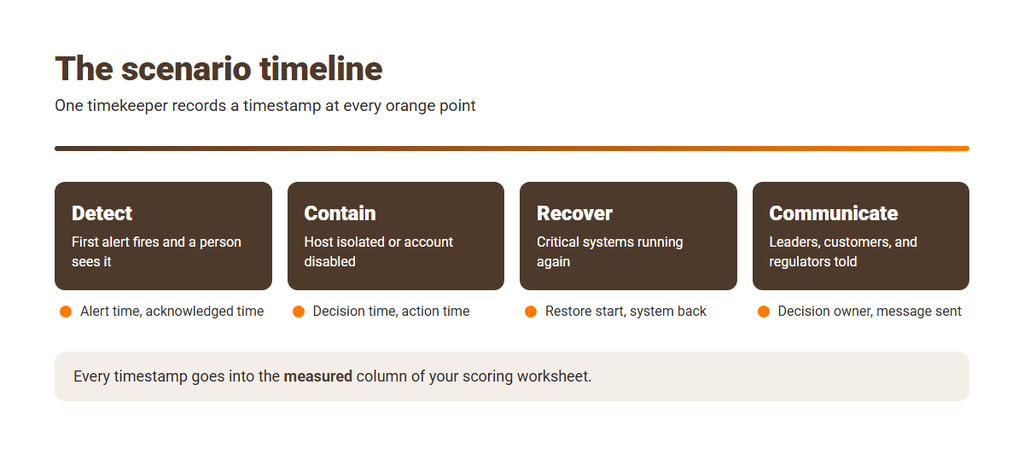
Appoint one person whose only job is the clock. They record when each inject arrived, when someone acknowledged it, when a decision was made, and who made it.
Collect evidence that would exist in a real incident: the alert record, the isolation command, the restore log. Without timestamps, the scoring step below has nothing to work with.
A tabletop times decisions; the detect, contain, and recover rows need a live test. Send a test alert on a Saturday night and log who acknowledges it, isolate a test host from the EDR console, and restore one critical system from backup with a stopwatch running.
Step 5: Write Down Where It Stalled
End the exercise with a short debrief while memory is fresh. For each stage, note where the team waited, who it waited for, and what was missing.
🔍 Typical stalls are a containment decision nobody felt authorized to make, a restore that needed a password only one person had, or a supplier with no after-hours number. These stalls are exactly what the board is asking about, and right now nobody has put a number on them.
Know when outside responders join your contain row
Score It Against Your Own Recovery Targets
The score compares what you measured with what your business needs. A benchmark from another company tells you about their systems and their tolerance for downtime, and neither matches yours.
Your targets come from documents you already have. The recovery time objective for each critical system sits in your business continuity plan, and the maximum tolerable downtime usually comes from the business owner of that system.
Fill in one row per stage after the exercise. The target and measured columns stay empty here because only your plan and your exercise can supply them.
| Stage | Your target | Measured in the exercise | Gap | Owner |
|---|---|---|---|---|
| Detect | ||||
| Contain | ||||
| Recover critical systems | ||||
| Communicate and decide |
The gap is the measured time minus the target. A positive gap means the stage took longer than the business can tolerate, and the owner is the person who will close it.
Here is the same worksheet filled in for a weekend ransomware scenario. It is an illustrative example, not a benchmark: the times show how to read the gaps, not what your targets should be.
| Stage | Target | Measured in the exercise | Gap | Owner |
|---|---|---|---|---|
| Detect | 30 minutes | 9 hours (the alert waited in an inbox overnight) | +8.5 hours | Security lead |
| Contain | 1 hour | 2 hours (the team waited for approval to isolate the file server) | +1 hour | IT manager |
| Recover critical systems | 24 hours | 30 hours (the restore needed a password only one admin had) | +6 hours | Infrastructure lead |
| Communicate and decide | 4 hours | 3 hours | -1 hour (met) | General counsel |
In this example, detection runs 8.5 hours over its target, so out-of-hours detection is the first fix, recovery comes second, and communication needs no work this quarter.
Where Each Target Comes From
Detection and containment targets rarely appear in a continuity plan, so set them with the people who own the response. Ask how long an attacker can stay active before the damage outgrows what the recovery target allows.
Recovery targets come from the continuity plan’s recovery time objectives. Communication targets come from your obligations: customer contracts, regulators, and frameworks such as GDPR and HIPAA set their own notification clocks, and legal can tell you which apply.
💡 Write each target down before the exercise starts. A target set after the team sees the measured time tends to move toward the result.
The worksheet gives the board a defensible answer: for this scenario, detection took this long, containment this long, recovery this long, against these targets. Every figure traces to a timestamp from your own tabletop or live test.
If a stage has no measured time because the exercise never reached it, record that as the finding. An untested recovery is a gap the board should hear about.
Acting on the Score: Fix the Largest Gap First
Every stage that runs over its target adds hours to the downtime the board sees. Start with the stage that adds the most: the largest positive gap. Improving a stage that already beats its target changes nothing the board will see.
Sort the worksheet rows by gap, largest first, and work down the list. The fixes below are the ones that most often sit at the top.
Detection out of hours. If the alert sat unread until Monday, the fix is coverage. That means a person who sees critical alerts around the clock, with authority to start containment, either in-house on a rota or through an outside team.
Containment authority. If the team saw the alert but waited for permission, write the authority down. Name who may isolate a host, disable an account, or take a system offline, and when they may do it without asking.
Untested restores. If recovery was a guess, schedule a real restore of one critical system. Time it from start to the system running again, and record the result where the next assessment can find it.
Unclear decision owners. If the exercise stalled on who decides to shut down or notify, name an owner and a deputy for each decision. Put both in the call tree, with numbers that work after hours.
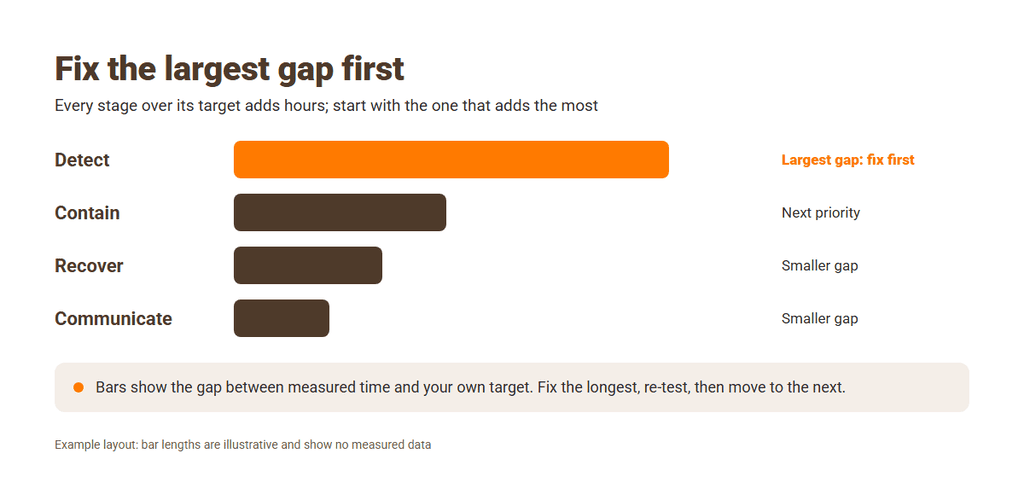
Avoid starting with the area that is easiest to improve. Buying a new tool for a stage that already meets its target makes the assessment look busier and leaves the recovery time where it was.
Hold off on broad programs, too, such as rewriting every policy. Those belong in a maturity plan, while the resilience score points to one specific bottleneck at a time.
Re-Test After Each Fix
Run the same scenario again after each major fix, with the same timekeeper and the same injects. The new measured time shows whether the fix worked, and the next-largest gap becomes the new priority.
Repeat the full assessment when something big changes: a new critical system, a merger, a new supplier, or a change in the team. The incident response life cycle ends with lessons learned for the same reason.
Putting Incident Responders on Contract With UnderDefense
When the board asks how fast you’d recover, the UnderDefense Incident Response Retainer gives you responders on contract and, from the retainer’s Standard tier up, an incident response plan tailored to your organization to test. Your team runs the exercise knowing who picks up the phone, and how fast, if the scenario becomes real.
UnderDefense is rated 5.0 out of 5 from 83 reviews on G2 as of November 2026.
Behind the retainer is a team of 40 incident response professionals, part of a company of 150+ people that was founded in 2017 and is ISO 27001 certified.
The retainer page lists three tiers, read on November 13, 2026. The retainer’s Standard tier adds an “Incident Response Plan tailored for your organization”, consultancy on improving incident readiness, and experts “up to 4-hour SLA remotely”.
The retainer’s Premium tier offers “up to 2-hour SLA remotely”, experts “onsite for you by request”, and prepaid hours you can repurpose. Basic sets terms and hourly rates agreed before an incident, with experts “up to 12-hour SLA remotely”.
For the worksheet, that SLA tells you when outside responders join the “contain” row, a number your team can plan around.
Get incident responders on contract with UnderDefense
UnderDefense’s incident response team handled an attack on a Swiss outdoor-equipment company that opened with over 3,000 unrelated emails. First response came in 5 minutes, escalated cases were handled in 14 minutes, and the threat was fully contained in 43 minutes, before ransomware deployed.
On your worksheet, 5 minutes is the detect row and 43 minutes is the contain row.
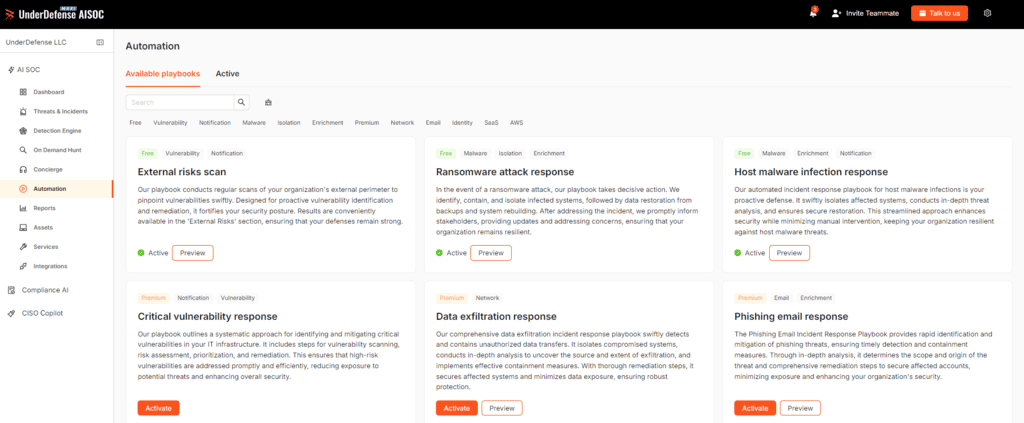
Teams whose slowest row is out-of-hours detection can add the UnderDefense Agentic AI SOC, which works on the SIEM and EDR they already run: AI agents investigate every alert, and analysts decide on escalation and containment. Its Standard tier includes a 40-hour incident response retainer.
For clients who also run the Agentic AI SOC, one founder on G2 described both the analyst relationship and the onboarding effort:
“The UnderDefense analyst assigned to our account knows our environments and reaches out when something actually requires our attention.” … “the onboarding required a few technical syncs to fine-tune detections to our stack” Daniel D., Founder, Small-Business (50 or fewer emp.), G2 review
Bring your last assessment, leave with the first fix
- Walk through the stage your last exercise found slowest
- Compare the Basic, Standard, and Premium retainer terms
- See what the Standard tier’s tailored incident response plan covers
Frequently Asked Questions
What is a cyber resilience assessment?
A cyber resilience assessment measures how fast your organization detects, contains, recovers from, and communicates about a serious incident. It uses a realistic scenario and compares the measured times with your own targets from the business continuity plan.
How is a cyber resilience assessment different from a security maturity assessment?
A resilience assessment times your response in a scenario, while a maturity assessment scores how well defined and repeatable your security practices are. Maturity shows whether a process exists; resilience shows how long it takes when it’s needed.
How often should you run a cyber resilience assessment?
Run it again after every major fix to confirm the gap closed, and whenever something significant changes, such as a new critical system, a merger, or a new key supplier. Your board or insurer may also set their own schedule.
What is CISA's Cyber Resilience Review?
The Cyber Resilience Review was a free CISA assessment of an organization’s operational resilience. In September 2026, CISA confirmed to Cybersecurity Dive that its regional staff would no longer perform it. Older versions of CISA’s free CSET tool can still walk an organization through the questions on its own.
Who should take part in a cyber resilience assessment?
Include everyone who would act or decide in a real incident: IT and security, operations, legal, communications, and the executive who would approve a shutdown. Key suppliers can join for the stages that depend on them.