








A customer’s security questionnaire asks for a penetration test report dated within the last 12 months, and all you have is scanner output. Finance asks why the company should pay for a test on top of the scanner, while procurement holds the contract until the report arrives.
Here is what each one proves and when you need both.
TL;DR
- Vulnerability assessment and penetration testing answer different questions: one lists known weaknesses, the other proves which ones chain into access.
- When a requester wants a dated penetration test report, scanner output answers a different question, so read their wording first.
- PCI DSS v4.0.1 sets both cadences, while ISO 27001 and SOC 2 name no mandatory test.
- How to run both without paying twice: scope the test from your latest scan, fix flaws on the U.S. Cybersecurity and Infrastructure Security Agency’s (CISA) exploited list first, and retest.
Table of contents
- What a Vulnerability Assessment and a Penetration Test Each Prove
- Vulnerability Assessment vs Penetration Testing Compared Side by Side
- What a Vulnerability Assessment Covers and Where It Stops
- What a Penetration Test Adds: Exploitation, Chaining, and a Report You Can Hand Over
- Which Test Your Auditor, Customer, or Insurer Is Asking For
- How to Combine Both Without Paying for the Same Finding Twice
- UnderDefense: Bring the Scan Output You Already Have to the Scoping Call
- What Each Costs and What Drives the Price
- Frequently Asked Questions
The two line items buy different evidence. A vulnerability assessment shows which known weaknesses exist across your estate on the day it ran, and a penetration test shows what someone could do with those weaknesses once they start combining them.
This guide is for IT Directors and CISOs who already run a vulnerability scanner and now face a request for a test report. It settles which test answers the person asking, what belongs in the scope and the report, and how often to run each one, with every interval traced to a published requirement or to your own risk assessment.
Find out which penetration test your customer’s questionnaire asks for
What a Vulnerability Assessment and a Penetration Test Each Prove
A vulnerability assessment is a scheduled review of your estate against known weaknesses: missing patches, weak configurations, and exposed ports. It runs wide, relies on tooling for most of the discovery, and ends with a ranked list your team can work through.
A penetration test is an authorized attack carried out by a qualified person. The tester picks a way in, exploits what they find, moves from one weakness to the next, and documents how far they got.
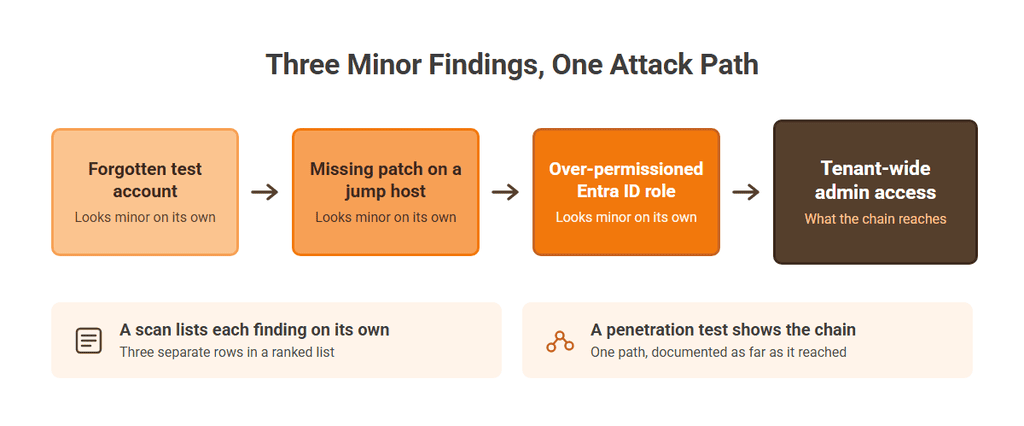
A forgotten test account, a missing patch on a jump host, and an over-permissioned Entra ID role might each look minor on its own. Chained together, they can end with tenant-wide admin access, and that chain is the finding a scanner has no way to report.
A Scan Is One Input to an Assessment
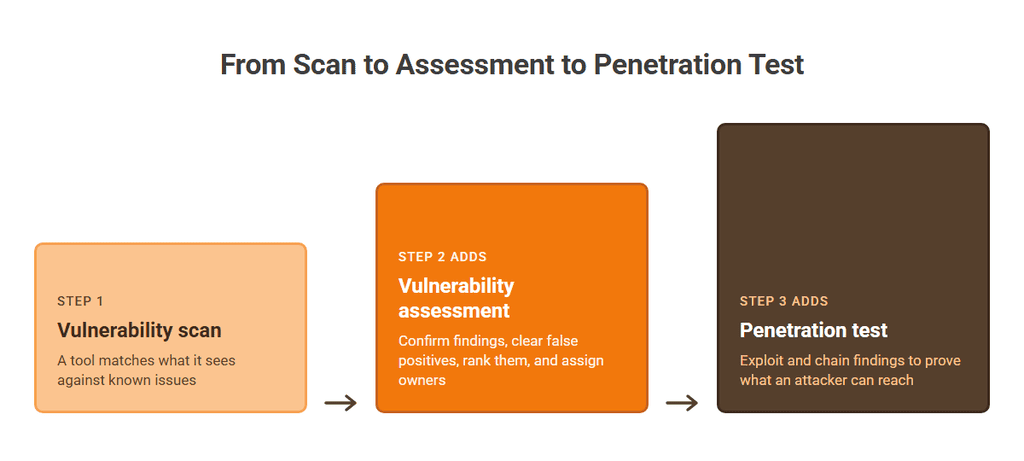
A vulnerability scan is the automated step: a tool compares what it sees with its database of known issues and reports the matches. An assessment takes that output and adds the work a tool can’t do.
That work means confirming findings, clearing false positives, ranking each item by how exposed and how important the system is, and assigning an owner. If the scanner report goes straight into a folder, you’ve run a scan, and if someone reviews, ranks, and assigns it, you’ve run an assessment.
That record is what an auditor wants to see. Keep the three terms apart: a scan is the automated step, an assessment adds review and owners, and only a test exploits.
What the Acronym Means on a Request Form
VAPT is shorthand for vulnerability assessment and penetration testing delivered together. Contracts and questionnaires use the acronym loosely, and a request for it can mean both sets of evidence or just the test report. One question to the requester settles which they mean.
Vulnerability Assessment vs Penetration Testing Compared Side by Side
The table below compares the two on the points a customer, an auditor, or your own finance team tends to raise. Read it by the evidence you need.
| Vulnerability assessment | Penetration test | |
|---|---|---|
| Goal | List known weaknesses across the estate | Prove what an attacker can reach |
| Method | Automated scans plus human review | Manual exploitation with supporting tools |
| Who runs it | Your team or an outside provider | A qualified, independent tester |
| Coverage | Wide: every asset in the scan range | Focused: the systems agreed in scope |
| Depth | Detects and ranks; rarely exploits | Exploits and chains findings |
| False positives | Common until a person reviews them | Few: each finding carries proof |
| Output | Ranked findings with owners | Report with attack paths and proof |
| What it proves | Known issues present on scan day | Access achievable during the test window |
| Who usually asks | Risk teams, auditors, PCI DSS assessors | Customers, auditors, insurers, PCI DSS assessors |
🔍 The last three rows carry most of the weight. If a customer wants to know that you find and fix known issues on a schedule, your assessment records answer them.
If they want to know whether someone could reach their data, only a test report speaks to that, because only a test tries. That’s usually the question behind a request for a dated report.
How fast your estate changes is the second deciding factor. A test report describes the systems as they stood during the test window, and every new workload, identity integration, or application release moves you further from what it proved.
Scheduled scans pick up newly published issues between tests. A change large enough to alter your attack paths is the signal to test again.
That gives you the answer for finance: the scanner pays for knowing what’s exposed across everything you own, and the test pays for evidence of what that exposure allows. Two questions settle the buying decision: what evidence does the requester need, and how much has changed since you last had it?
What a Vulnerability Assessment Covers and Where It Stops
An assessment covers breadth: every asset you can point a scanner at, checked against known issues, ranked, and tracked to closure. Its quality depends on two choices your team controls: how the scans run and how the results get ranked.
Authenticated and Unauthenticated Scans
An unauthenticated scan sees what an outsider sees: open ports, service banners, and exposed web applications. An authenticated scan logs in with credentials and reads installed software and configuration directly, which finds missing patches an outside view can’t confirm.
Most programs need both: unauthenticated scans show your external exposure, and authenticated scans give depth on internal systems. PCI DSS v4.0.1 (June 2024) Requirement 11.3.1.2 makes authenticated scanning mandatory for internal scans and has you document any system that can’t accept credentials.
Commercial vulnerability scanning tools typically support both modes, so check which one your scheduled jobs actually use. A job that quietly runs unauthenticated will miss the patches an assessor expects you to have found.
Coverage gaps are the other thing to check, since a scan only reports on the assets it knows about. Reconcile your scan ranges against cloud accounts, managed devices, and public DNS records, and use attack-surface tools if internet-facing systems may have slipped off the list.
Prioritizing by Exploitation Evidence
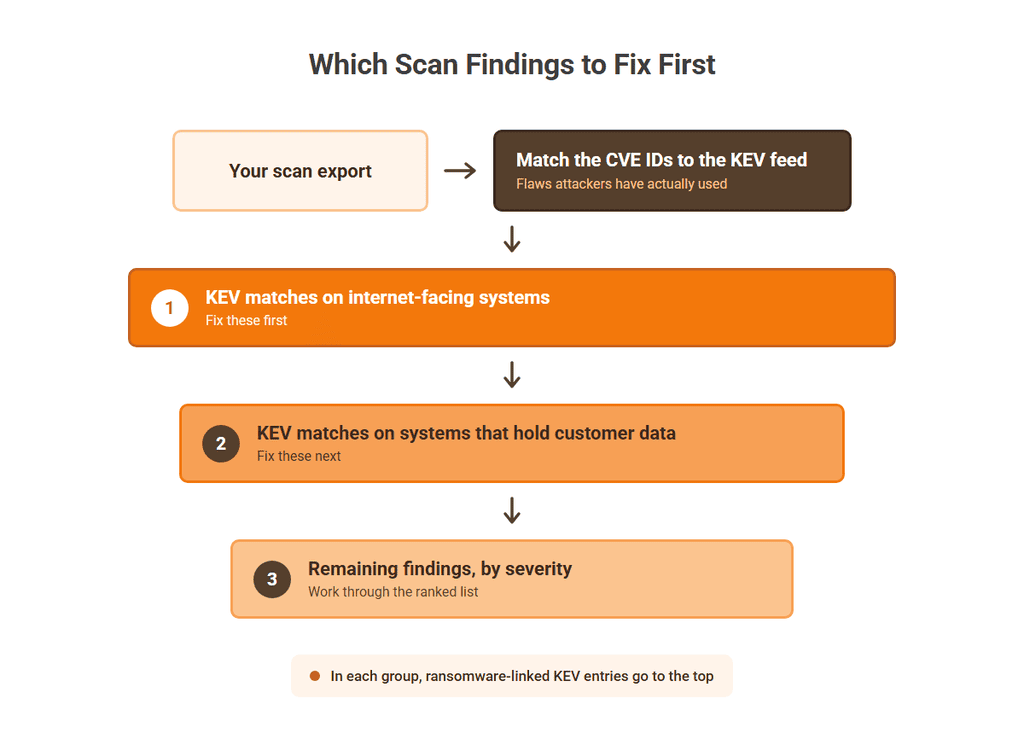
A long list only helps once it’s ranked. Severity scores describe how bad a flaw could be, while the Known Exploited Vulnerabilities (KEV) catalog from CISA records which flaws attackers have actually used.
As of November 6, 2026 (catalog version 2026.11.04), the KEV catalog lists 1,768 entries, with 245 added in 2025, 284 added so far in 2026, and 361 marked as known to be used in ransomware campaigns. That list is short enough to match against any scan export, and its ransomware-linked entries go to the top of each group.
CISA has already added more entries in 2026 than in all of 2025, so a scan export you matched last quarter needs matching again. The catalog is published as a downloadable feed your team can match against the CVE (Common Vulnerabilities and Exposures) IDs in a scan export.
Fix the matches on internet-facing systems first, then those on systems that hold customer data, with ransomware-linked entries at the top of each group, and work through the remaining severity-ranked list after that. Finance gets a clearer answer this way, because you can show why a given fix went first.
Where the Assessment Stops
Three limits matter when someone asks whether scanning is enough. A scanner reports each finding on its own and can’t show that three modest findings add up to admin access.
It also misses business logic: it won’t notice that changing an ID in a URL lets one customer open another customer’s invoices. The third limit surprises people most: a scanner looks for weaknesses and can’t tell you someone is already inside. A clean scan leaves the question of compromise open.
A business-licensing company in Colorado with about 100 employees found 11 critical servers already infected with Cobalt Strike, and UnderDefense took “less than 24 hours to move from detecting Cobalt Strike to removing the malware from 11 critical servers.”
What a Penetration Test Adds: Exploitation, Chaining, and a Report You Can Hand Over
A penetration test adds proof that a weakness can be used. Verizon’s 2026 DBIR, its annual Data Breach Investigations Report, says 31% of breaches now start with software vulnerabilities, beating stolen passwords as the top way attackers get in, across incidents between November 1, 2024, and October 31, 2025.
For you, that puts exploitable software flaws ahead of stolen passwords as the entry point to rule out first, and a test shows which of yours actually open.
The Four Test Types and What Each Answers
Match each test type to the question you’ve been asked, since each starts from a different position. A red team exercise answers a separate question, whether your defenders would notice a targeted attacker, and it sits outside this comparison.
1. External. The tester starts from the internet with no access and works against your perimeter: VPN gateways, public applications, and exposed admin panels. This is the closest match to a customer asking what anyone online could reach.
2. Internal. The tester starts inside, usually from a compromised laptop or an ordinary user account, and tries to move laterally. Internal network penetration testing sits here, along with Entra ID and Active Directory attack paths, and it shows what one phished account could become.
3. Web application. The tester works through login flows, session handling, and access between customer accounts. This is where business logic flaws surface, and SaaS customers often ask for it by name.
4. Cloud. The tester reviews and attacks identity roles, storage permissions, and network exposure in AWS or Azure. Read your cloud provider’s published rules for what customers may test before you sign the scope.
Rules of Engagement to Agree Before Testing
Get the rules in writing before anyone touches a system. They name who authorized the test, which systems are in and out of scope, when testing may run, and which actions are off limits, such as denial of service or changes to production data.
Add an emergency contact on each side and a rule for handling any data the tester reaches. A pentest preparation guide helps your team line up accounts, contacts, and change freezes ahead of kickoff.
What a Usable Report Contains
A requester reads the report to decide whether to trust you, so it has to stand on its own. Before you accept a final version, check that it includes these items:
- Test dates and the testing firm’s name, so the requester can check the 12-month window
- Scope: systems, accounts, test type, and anything excluded
- The method the testers followed
- An executive summary for leadership
- Each finding with its risk rating, proof of exploitation, and steps to reproduce
- The attack paths that show how findings chained together
- Remediation guidance for each finding
- Retest results showing which fixes held
A penetration testing report template gives you something to compare a vendor’s sample against before you buy. Ask for that sample early, and ask whether the requester will take a letter of attestation or wants the executive summary under NDA.
🔁 Retesting belongs in the same conversation. A report full of open findings raises fresh questions from the requester, and that’s the report you’d be sending back with the questionnaire.
Get a dated penetration test report for your next security questionnaire
Which Test Your Auditor, Customer, or Insurer Is Asking For
It depends on the requirement: PCI DSS v4.0.1 sets intervals for a scan and a test, ISO 27001 and SOC 2 mandate neither, and customers and insurers write their own terms. Start with the exact wording of the request, then match it to the requirement behind it. The table shows what each source says as of November 6, 2026.
| Requirement | Scan interval it sets | Penetration test it requires | Where it says so |
|---|---|---|---|
| PCI DSS v4.0.1 | Internal and external, at least every three months | Internal and external, at least every 12 months | Requirements 11.3.1, 11.3.2, 11.4.2, 11.4.3 |
| ISO/IEC 27001:2022 | Vulnerability management; no scan interval | Names no penetration test | Annex A 8.8 (technical vulnerabilities) |
| SOC 2 | Guidance only; no required interval | Given as one example in guidance | SOC 2 framework (AICPA Trust Services Criteria), guidance only |
| HIPAA Security Rule (current and proposed) | None in today’s rule; at least every six months if finalized | None in today’s rule; at least every 12 months if finalized | HHS proposed rule, Federal Register, January 2025 |
The rest of this section takes each source in turn.
PCI DSS v4.0.1
PCI DSS is the most specific of the four, and if card data is in play, PCI DSS penetration testing is a set requirement that scanner output can’t stand in for. Scans every three months mean four scan cycles a year to staff and budget, and external scans must come from an Approved Scanning Vendor listed by the PCI Security Standards Council.
Requirements 11.4.2 and 11.4.3 also call for a test at least every 12 months and after any significant infrastructure or application upgrade or change, run by a qualified and organizationally independent tester. A major release can bring that test forward, so plan it around your change calendar.
ISO 27001
ISO/IEC 27001:2022 covers the management of technical vulnerabilities in Annex A 8.8 and leaves the method to your risk assessment. Auditors commonly ask how you find, rank, and fix those vulnerabilities.
Many organizations choose ISO 27001 penetration testing as part of that evidence. The choice sits with you and your risk treatment plan, and the reasoning belongs on file.
SOC 2
SOC 2 requires no specific test. In the Trust Services Criteria (2017, with 2022 points of focus) from the American Institute of Certified Public Accountants (AICPA), a CC7.1 point of focus describes vulnerability scans and a CC4.1 point of focus gives penetration testing as one example of a separate evaluation.
Points of focus are guidance, yet auditors and customers often ask for a report anyway. Settle the question early with the certified public accountant (CPA) firm that issues your SOC 2 report, before the audit window opens.
The Proposed HIPAA Update
Today’s HIPAA Security Rule sets no scan or penetration test interval: it requires a risk analysis and a periodic technical evaluation, and leaves the method to you.
The HIPAA Security Rule update that HHS, the U.S. Department of Health and Human Services, proposed in January 2025 would set scans at least every six months and a test at least every 12 months, or more often if your risk analysis calls for it. As of November 6, 2026, it remains a proposal with no final rule.
For a healthcare team, two scan cycles and one test a year would become the floor if the rule is finalized. Treat the intervals as a planning signal and leave them out of any statement about current obligations.
Customers and Insurers
Customers and insurers set their own terms, which makes the contract, the questionnaire, or the insurance application the source. Before you reply, confirm five things with the requester:
- Whether scan output counts
- How recent the report must be
- Which systems it must cover
- Who may perform the test
- Whether a letter of attestation is enough
Those answers become the first draft of your scope.
How to Combine Both Without Paying for the Same Finding Twice
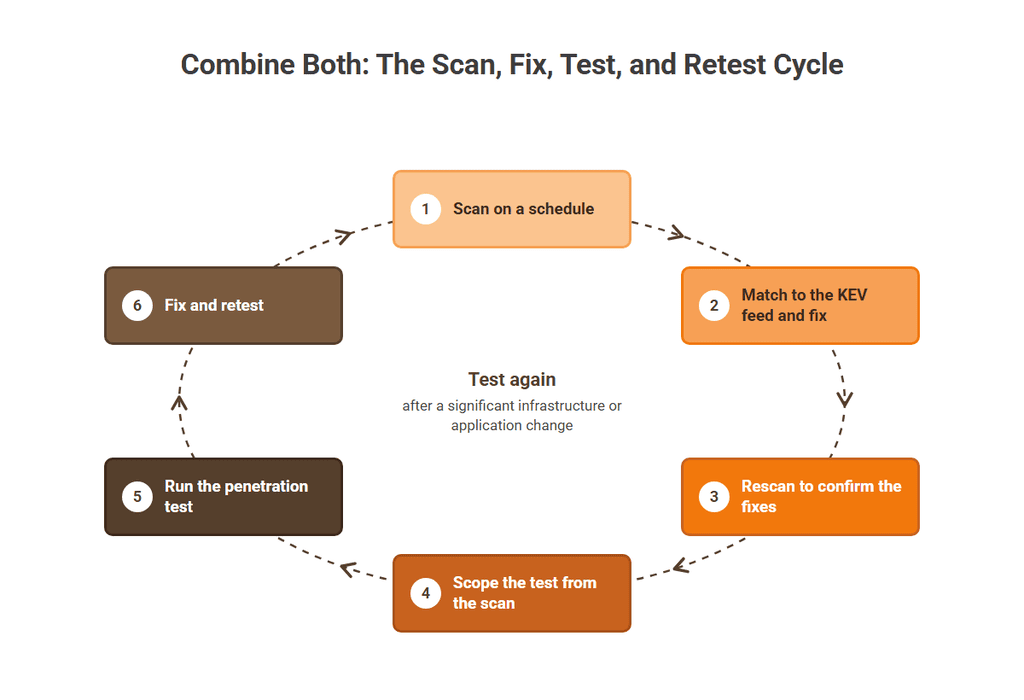
You pay twice when a tester spends billed time rediscovering what your scanner already listed. Hand over your latest results and that time goes to exploitation and chaining, the work your scanner can’t do. A combined program runs in this order:
- Scan on a schedule, every three months at minimum where PCI DSS applies, and on a schedule your risk assessment supports elsewhere
- Match findings against the KEV feed and fix listed items on exposed systems first
- Rescan to confirm those fixes held
- Scope the penetration test from the latest scan and give the tester the results
- Test at least every 12 months where a requirement or contract sets that interval
- Retest after fixes and file the result with the report
- Test again after a significant infrastructure or application change
Cadence stays honest when each interval traces back to a requirement or a contract clause. Where neither sets one, record how your risk assessment reached the interval you chose.
That record answers the auditor who asks and the CFO who wants to know why the line is in the budget. Both activities belong wherever exploited vulnerabilities meet your exposed systems, so spend there first.
🗂️ Keep the records together as you go. The scan history, the remediation tickets, the test report, and the retest result tell one story, and that story is what an auditor or customer wants when they ask how a finding got closed.
Writing a Pentest Scope From Scan Output
Your scan export already holds most of a scope. Start with its asset list and mark every system that is internet-facing, holds customer data, or carries a KEV-listed finding.
Those systems form the core of the test, and the requester’s wording decides what else joins them. Then add what the scanner couldn’t assess: login flows, access between customer accounts, Entra ID role paths, and cloud permissions.
Assign a test type to each group (external, internal, web application, or cloud), say how much the tester knows at the start (black box, gray box, or white box), and list exclusions. Gray box, with an ordinary user account and your scan output, fits most customer requests; choose black box only when the requester asks what an outsider with no knowledge could reach.
Include the requester’s exact sentence, so the tester can write a report that answers it.
UnderDefense: Bring the Scan Output You Already Have to the Scoping Call
UnderDefense runs external, internal, web application, and cloud penetration tests scoped from the scan output you already have, so the testers’ billed time goes to exploitation and chaining, and the report answers your requester’s exact question. Prices are published, so finance sees a number before the first call. (Disclosure: UnderDefense publishes this article.)
UnderDefense started in 2017 as a penetration-testing firm, and its engineers hold CEH, OSCP, and OSCE credentials. On one external test UnderDefense documented, three CVSS 10.0 flaws (CVE-2026-34908, CVE-2026-34909, and CVE-2026-34910) chained to root on an internet-facing UniFi appliance that was already running botnet malware, which monitoring had missed because the appliance had no agent and sent no logs.
Bring the scan output your team already has to the scoping call, plus the requester’s exact wording, so the scope covers the systems that customer asked about.
The published pentest prices are External Perimeter from $5,000 (up to 5 days), Standard from $8,000 (about 2 weeks), and Professional from $12,000 (3 to 4 weeks), so you can plan the report against the questionnaire’s deadline.
Standard is the first tier with manual testing, exploitation, the full technical report, a letter of attestation for ISO 27001, SOC 2, PCI DSS, and HIPAA, and a free post-remediation retest, so if your requester wants a test report or a letter, budget from Standard.
External Perimeter covers your internet-facing perimeter with a summary report and fits between full tests.
UnderDefense holds 5.0 out of 5 from 83 reviews on G2 as of November 2026, and on Clutch a VP of Security and Compliance at a legal tech company wrote of a gray-box test that “they were not just using tools to test.”
For clients who also run the UnderDefense Agentic AI SOC, pentest findings feed detection and SOC response, so your attack paths become things analysts look for.
Bring your scan output and get a test scope you can defend
What Each Costs and What Drives the Price
A scan program’s cost moves with assets, licensing, and review time, while a test’s price moves with scope, test type, depth, and retest terms. That split is also the short answer to the finance question: one line pays for ongoing coverage and the other pays for proof at a point in time.
On the scan side, add an Approved Scanning Vendor if PCI DSS applies. Staff time spent reviewing and fixing findings is the line budgets tend to leave blank, and you can estimate it from your own ticket history.
On the test side, scope means IP addresses, applications, APIs, and user roles, and depth means how much of the work is manual and how much the tester knows at the start. Check too whether the attestation letter is included.
Compare quotes on scope, test type, depth, and retest terms, since two vendors can price different work under one name.
Retest terms deserve their own line on the quote, because a vendor may include a retest or bill it separately. Ask which assets it covers and how long the offer stays open.
Budget for your side of the work too: someone has to prepare accounts ahead of the test and fix what the report finds. That time belongs in the same request to finance.
Bring your scanner output to a pentest scoping call
- Review your attack surface and what belongs in scope
- Choose between a vulnerability assessment and a penetration test
- Find out which report your requester needs: a summary, a full report, or a letter
Frequently Asked Questions
Is VAPT the same as a penetration test?
No. VAPT combines a vulnerability assessment with a penetration test and covers more than the test alone. If a request says VAPT, ask whether the requester wants both sets of evidence or only the penetration test report.
Can a vulnerability scan replace a penetration test for compliance?
No, where the requirement names a penetration test: PCI DSS v4.0.1 lists scans and penetration tests as separate requirements. ISO 27001 and SOC 2 name no mandatory test, though your auditor or customer may still ask for a report, so check their wording first.
How often should you run a penetration test?
Follow the requirement you’re under. PCI DSS v4.0.1 sets at least once every 12 months and after significant change, and the proposed HIPAA update would add a 12-month interval. Without a published requirement, use your contract wording, your risk assessment, and how fast your estate changes.
Does a penetration test include a vulnerability assessment?
Partly. Testers usually scan during reconnaissance, yet a test covers an agreed scope at one point in time and can’t stand in for a scheduled assessment across your whole estate. Keep both running and give the tester your latest results.
How much does a penetration test cost?
It depends on scope, test type, depth, and retesting, so compare quotes on the same assumptions. UnderDefense’s published starting prices are $8,000 for Standard, the first tier with manual testing, the full technical report, and a letter of attestation, and $12,000 for Professional; the $5,000 External Perimeter tier gives summary reporting for your internet-facing perimeter.