





TL;DR
- PCI DSS 4.0.1 makes you confirm your own scope every 12 months, or every 6 for service providers.
- Ground Labs finds stray card data and VGS removes it; the other seven tools test, scan, or evidence what stays in scope.
- Qualys and SecurityMetrics state Approved Scanning Vendor status, which quarterly external scans require.
- UnderDefense and VGS publish entry prices on their own sites; SecurityMetrics publishes an audit price range.
Table of contents
- Why Scope Comes Before PCI Compliance Software
- How These 9 PCI Compliance Tools Were Evaluated
- PCI Compliance Software Compared Side by Side
- The 9 Best PCI Compliance Software Tools, Reviewed
- What Scope Reduction Removes From the PCI Compliance Tools List
- Choosing PCI Compliance Solutions by Merchant Level
- Where to Start: Scope First, Then Evidence
- Frequently Asked Questions
Your next PCI DSS assessment starts with one question your assessor will not answer for you: which systems are in scope? Requirement 12.5.2 of PCI DSS 4.0.1 makes that the entity’s job, documented and confirmed at least once every 12 months, and every system on that list then needs scanning, logging, access reviews, and evidence.
The cost of getting it wrong is rising. In a February 2026 briefing, the Federal Reserve Bank of Kansas City found that merchants’ card-not-present fraud loss rate on single-message debit networks more than doubled between 2021 and 2023, from 5.4 to 12.8 basis points.
PCI compliance software is a wider category than most buyer lists admit. Some tools find card data, some remove it, some watch the payment page, some run the scans an acquirer requires, and some collect the evidence a Qualified Security Assessor (QSA) samples. This guide ranks nine in the order a scope-first program buys them, with one exception.
This guide comes from UnderDefense, which places its own UnderDefense MAXI Compliance AI first for the reasons in that entry and lists its limitations like everyone else’s. The guide is written for security leaders at payment processors, fintechs, banks, and retailers who validate with a Report on Compliance (ROC) or a full Self-Assessment Questionnaire (SAQ).
See how UnderDefense MAXI Compliance AI proves your controls

Why Scope Comes Before PCI Compliance Software
PCI DSS 4.0.1, published in June 2024, defines the cardholder data environment (CDE) as the people, processes, and systems that store, process, or transmit cardholder data, plus any system with unrestricted connectivity to them. The PCI Security Standards Council’s scoping supplement, version 1.1 from May 2017 and still referenced by the current standard, adds “connected-to” and security-impacting systems: anything with a communication path to the CDE.
Every system that lands in those categories inherits the requirements. Requirement 10.4.1 asks for daily review of security events and of logs from every system that stores, processes, or transmits card data, and since March 31, 2025, Requirement 10.4.1.1 requires automated mechanisms to do it. Internal and external vulnerability scans run every three months, and penetration tests cover the whole CDE perimeter.
So the size of the CDE sets the size of every tooling contract that follows. A file share where someone once exported card numbers adds monitoring, log collection, and scanning to a system that should never have held the data, and the PCI DSS audit guide on the UnderDefense blog shows how each extra system lengthens the assessment itself.
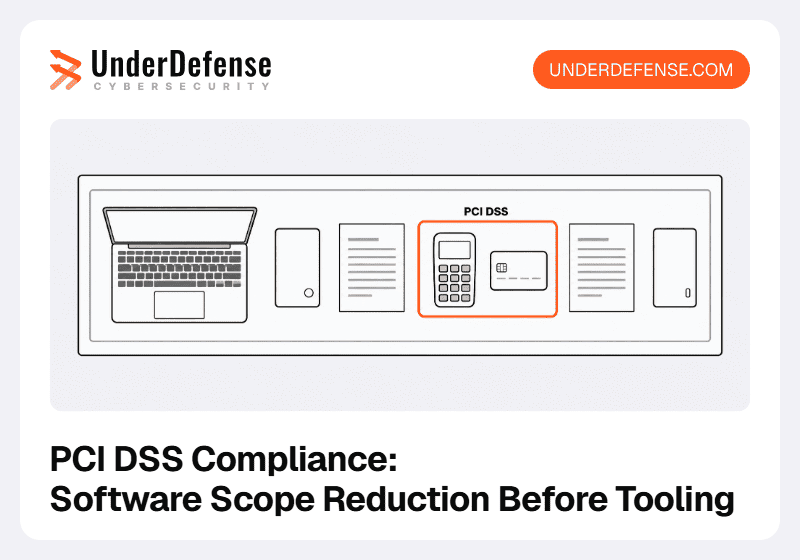
The supplement is candid about the limits. It says no technology “eliminates all PCI DSS requirements,” and that encryption or tokenization may reduce the size of the CDE. That is the order this guide follows: find the card data, remove what you can, then buy the tools that test and evidence what remains.
European data points the same way. The EBA and ECB’s 2025 report on payment fraud, published in December 2025, found that fraud losses on card payments with EU/EEA-issued cards reached €1.329 billion in 2024, up 29% year on year.
How These 9 PCI Compliance Tools Were Evaluated
Each vendor’s own website was read, along with any AWS Marketplace listing, in the first week of October 2026. Requirement mappings, QSA and ASV status, and prices are reported as each vendor states them.
Five questions decided whether a PCI DSS compliance software product made the list and where it sits:
- Where does it act on scope: finding card data, removing it, protecting the payment page, testing the systems that stay, or proving the controls work?
- Which PCI DSS 4.0.1 requirements does the vendor map its features to, by number?
- What validation role does the vendor state for itself, such as QSA, Approved Scanning Vendor (ASV) or PCI DSS Level 1 service provider?
- What evidence does it hand a QSA, and does that evidence show that a control ran in practice or only that it was configured?
- Does the vendor publish a price, on its own site or on AWS Marketplace?
The evidence question carried the most weight. Requirement 10 log reviews and Requirement 12.10 incident response are where assessors ask for a trail of real decisions, which a policy document cannot supply. Who produces those records changes what the assessor sees, as UnderDefense’s breakdown of SIEM compliance coverage shows.
Review-site ratings were left out, because G2 and Gartner Peer Insights could not be checked directly for every vendor here.
PCI Compliance Software Compared Side by Side
The table follows the ranking order, and “Scope role” shows where each tool acts in a scope-first program. The price column carries the lowest published figure, with its source in each entry.
| Tool | Best for | Scope role | PCI role it states | Main limitation | Published price (from) |
|---|---|---|---|---|---|
| UnderDefense MAXI Compliance AI | Proving logging and response controls | Evidence and 24/7 monitoring | Compliance platform plus PCI penetration testing | No ASV scans or card data discovery | $0 (Free package); paid from $499/month |
| Ground Labs Enterprise Recon | Mapping where PAN lives | Find card data | “QSA-ready” reporting | Discovery only | Not published |
| VGS | Tokenizing cards out of scope | Remove card data | PCI DSS Level 1 service provider | Card flows must route through its proxy | $1,000/month (Starter) |
| Feroot PaymentGuard AI | Requirements 6.4.3 and 11.6.1 | Protect the payment page | Maps to SAQ A-EP and SAQ D | Covers two requirements | Not published |
| Qualys PCI Compliance | ASV scans and technical controls | Test what stays in scope | Approved Scanning Vendor | Several modules to license | Not published |
| SecurityMetrics | Assessor, scanner, and monitoring combined | Assess, scan, and monitor | QSA and ASV | Most products quote only | PCI audit from $15,000 |
| ControlCase | Level 1 ROCs, managed year-round | Assess and manage | QSA | ASV status and 4.0.1 mapping not stated | Not published |
| Vanta | Guided SAQ and AOC completion | Evidence workflow | Compliance platform | ASV and QSA bought separately | $14,000/year (AWS, 1-20 employees) |
| Scrut Automation | PCI inside multi-framework GRC | Evidence workflow | Compliance platform | No price on its own site | $15,000/year (AWS, up to 20 employees) |
The AWS Marketplace figures cover the smallest headcount bands, so a regulated enterprise should expect a private quote from every vendor on the list.
The 9 Best PCI Compliance Software Tools, Reviewed
Each entry ends on a verdict naming who should shortlist the product and what to check before signing.
1. UnderDefense MAXI Compliance AI: Best for PCI Evidence Backed by 24/7 Monitoring
Best for: Proving logging and response controls
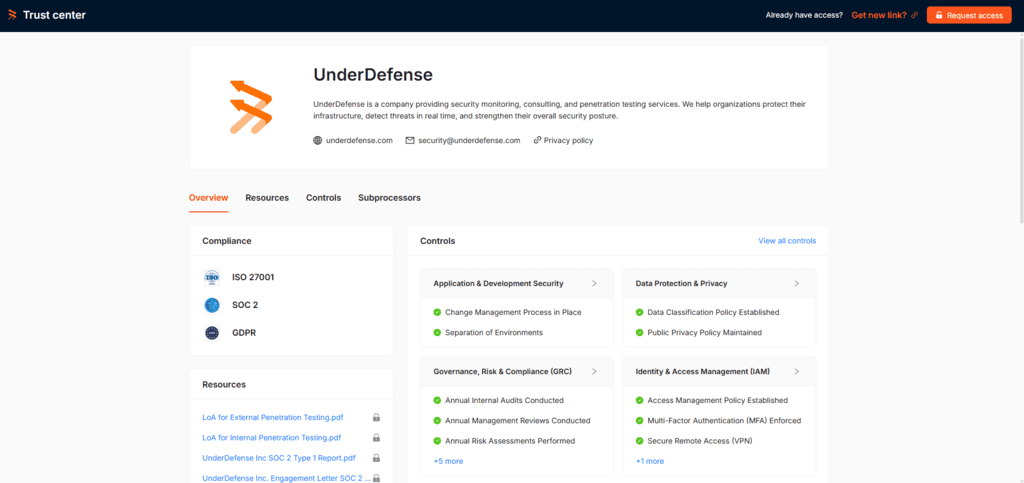
Overview: Most PCI tools leave three controls to you: audit log reviews under Requirement 10, intrusion detection under Requirement 11, and incident response under 12.10. A QSA sampling them wants to see what happened when an alert fired, who looked, and what they decided, and that is why UnderDefense MAXI Compliance AI ranks first here.
MAXI Compliance AI tests controls and collects evidence for PCI DSS, SOC 2, ISO 27001, HIPAA, and GDPR from the cloud, identity, code, and security tools you connect. UnderDefense reports 250+ integrations, and its PCI DSS checklists are mapped to version 4.0.1.
The same company runs the UnderDefense Agentic AI SOC, which investigates alerts on top of the SIEM and EDR you already own and records the reasoning behind every closed alert (sources checked, evidence, decision). The trail your QSA samples for Requirements 10 and 12.10 then builds up as a by-product of daily monitoring.
The monitoring side has a track record in a regulated financial setting. In an UnderDefense case study of a US government financial organization, one of the ten largest in its sector with an IT team of four, 12,500 alerts were identified, analyzed, and resolved in the first 11 months, 1,500 of them high or critical, and high and critical alerts were handled in 9 minutes.
Key features:
- Automated PCI DSS control checks run around the clock, so a firewall rule or MFA setting that drifts out of compliance is flagged within the day.
- Investigation records from the Agentic AI SOC, which UnderDefense reports triages an alert in about 2 minutes, give a QSA the trail behind each log review and escalation.
- PCI DSS 4.0.1 checklist templates track progress alongside SOC 2 and ISO 27001, so one control can serve several assessments.
- A Trust Center link shares your compliance documents with acquirers and enterprise customers through access requests.
- Security questionnaire automation drafts answers from your policies, up to 24 questionnaires a month on the Certified package.
- Internal, external, and cloud vulnerability scans on the Certified package, plus UnderDefense’s own PCI penetration testing, with free remediation retesting.
How it works in practice: Onboarding begins with the cloud accounts (AWS, Azure, or Google Cloud), identity provider, and code repositories behind your CDE, after which a gap assessment scores each framework you enabled. UnderDefense’s stated benchmark is 40% audit readiness within 40 minutes of connecting. That is a starting score, since its own estimates for full readiness range from 4 months on Certified to 18 months on Free.
The Agentic AI SOC then plugs into your existing SIEM, whether that is Splunk, Microsoft Sentinel, IBM QRadar, Elastic, or Google SecOps. Expect calibration: several G2 reviewers report that detection tuning took a few weeks to a few months.
Pricing: The compliance price list runs from $0 a month (Free) through $499 (Starter) and $1,299 (Essential) to $1,899 (Certified). The paid packages bundle 24, 48, or 90 consulting hours a year, additional hours cost $65, and the auditor pool opens from Starter up.
Pros: Published package prices, compliance evidence and 24/7 investigation from one vendor, PCI penetration testing from the same company, free package to test the workflow, SIEM stays in place
Cons: Its pages do not describe UnderDefense as a PCI SSC Approved Scanning Vendor, so quarterly external ASV scans need a separate provider. It has no card data discovery or tokenization, so it evidences the scope you have and does not shrink it. Questionnaire automation and vulnerability scans sit only in the Certified package.
How to start using it:
- Open a free account and connect the cloud accounts and identity provider behind your CDE.
- Enable PCI DSS and review the gap list against your current SAQ or ROC scope.
- Connect your SIEM so investigation records start building before your next assessment window.
- Check that the auditor you pick from the pool is on the PCI SSC’s list of Qualified Security Assessors.
- Share the Trust Center link with your acquirer or your largest customer once the core controls pass.
Why it’s a good PCI compliance software choice: It closes the gap between “the log review control exists” and “here is every alert we reviewed and what we did about it.” Few compliance platforms can produce the second half, because they do not run the investigation.
On G2, UnderDefense holds a rating of 4.9 out of 5 from 73 reviews (October 2026), and Valeriia K., a Chief Business Development Officer, wrote that “we can see the exact sequence of actions: which data sources were checked, what evidence was collected, and the specific reasoning behind the conclusion.”
Final verdict: Shortlist UnderDefense when Requirements 10, 11, and 12.10 are where your last assessment pushed back, and you want the compliance evidence and the monitoring from one vendor. Pair it with an ASV and, if you store cards, a tokenization or discovery tool from further down this list.
Need log review evidence a QSA will accept? Map your PCI gaps
2. Ground Labs Enterprise Recon: Best for Finding Card Data Before You Draw the CDE
Best for: Mapping where PAN actually lives
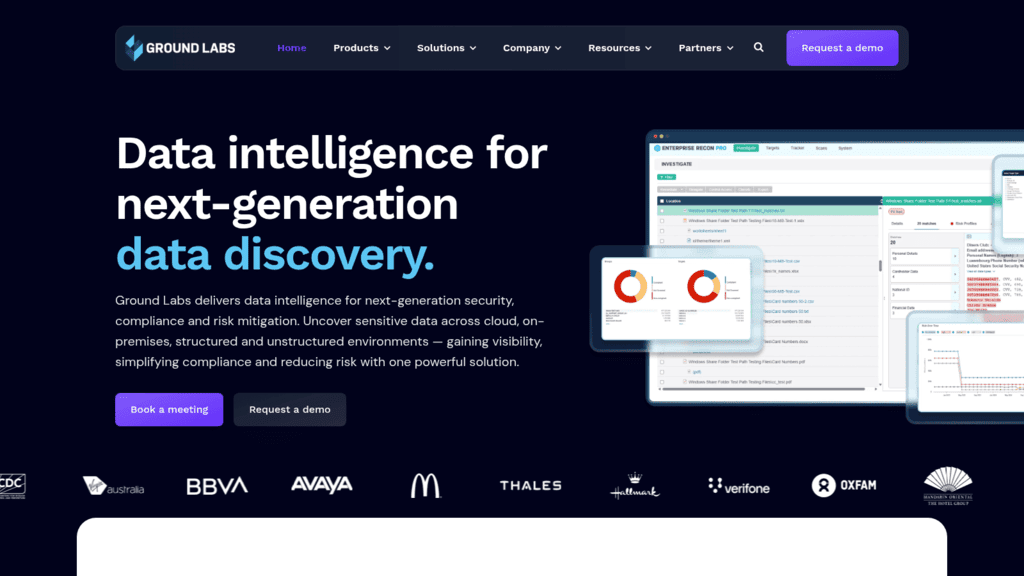
Overview: Enterprise Recon searches servers, endpoints, databases, cloud storage, and email for primary account numbers (PANs) and other sensitive data, then lets you remediate what it finds. Ground Labs’ PCI page says the product helps organizations “define their cardholder data environment and identify and manage rogue account data.”
That makes it the first purchase in a scope-first program. A QSA will ask how you know card data sits only where your network diagram says it does, and a discovery scan across file shares, mailboxes, and data stores answers with results.
Key features:
- Agent, agentless, API, and proxy scanning across Windows, Linux, macOS, FreeBSD, AIX, and Solaris, so legacy payment servers get scanned alongside cloud workloads.
- Cloud and SaaS coverage for AWS, Azure, Google Cloud, Microsoft 365, Google Workspace, and Salesforce, where exported card data tends to hide.
- Database scanning for Oracle, SQL Server, PostgreSQL, MySQL, MongoDB, and SAP HANA, including tables a developer once used for testing.
- OCR, audio, and DTMF tone detection, which finds card numbers in scanned forms and call recordings.
- Remediation actions to “redact, quarantine, encrypt, secure delete,” so a finding can be closed from the console.
Fit and setup: Enterprise Recon suits a regulated enterprise with a large, older data estate where card numbers may have leaked into spreadsheets, tickets, and backups. It comes in PCI, PII, and PRO editions, and Enterprise Recon Cloud runs in your own AWS instance. Tokenization, ASV scans, and payment page monitoring sit outside its scope.
Pricing: Ground Labs publishes no price, and its site routes buyers to a demo request.
Pros: Broad target coverage, finds PANs in images and audio, remediation built into the console, QSA-ready reporting
Cons: No published pricing. Ground Labs says QSAs trust its reporting, but its pages cite no PCI SSC program listing, so treat “QSA-ready” as a report format. Discovery tells you where card data is; shrinking the CDE afterwards still takes architecture work and a second product.
Why it earns a place here: Most tools on this list assume you already know your scope. Enterprise Recon is how you check that assumption before you pay to monitor it.
Final verdict: Run it before your scope confirmation under Requirement 12.5.2 and before you price anything else. The results tell you how big the rest of your tooling budget needs to be.
3. VGS: Best for Removing Raw Card Data From Your Systems
Best for: Tokenizing cards out of scope
Overview: Very Good Security (VGS) runs a data vault that captures card data at the network level and returns tokens, which VGS calls aliases, to your applications. Your systems store and pass the alias, and VGS holds the real PAN. The company states that it is a PCI DSS Level 1 service provider.
VGS’s PCI page says it “helps reduce PCI compliance scope by removing sensitive cardholder data from your systems entirely.” That is the vendor’s claim; your QSA decides what leaves scope, and the systems that call the vault still count.
Key features:
- Inbound and outbound proxies that swap card data for aliases in transit, so your application code never touches a raw PAN.
- A processor-agnostic vault, which lets you route the same stored card to more than one payment processor.
- Network tokens and an account updater as add-ons, which keep stored cards current when a bank reissues them.
- A PCI Compliance Subscription add-on covering Level 1 and Level 2 to 4 programs, plus a VGS-provided auditor option.
- Card attributes and VGS Compute add-ons for running logic on card data without pulling it back into your environment.
Fit and setup: VGS suits payment processors, fintechs, and platforms that store cards for recurring billing or route payments across processors. Rerouting live card flows through a proxy is an engineering project, whatever the vendor’s setup estimate. It suits less well a business whose own processes need raw PANs, and endpoint, logging, and vulnerability controls stay with other tools.
Pricing: VGS publishes a Starter package from $1,000 a month with a free trial to begin. The Growth package, which carries the add-ons above, is quote only.
Pros: Published entry price, Level 1 service provider status, removes PAN from your own databases, processor-agnostic routing
Cons: Card flows have to be re-architected through the proxy. VGS’s line that “PCI Level 1 is achievable in just 21 days” is the vendor’s own estimate, and your assessor still sets the timeline. Shared responsibility remains for every system that calls the vault.
What it is genuinely good at: Taking the card number itself out of your stack, which no compliance dashboard can do. Every system that only ever sees an alias is a system you can argue out of the CDE.
Final verdict: Shortlist VGS when you store cards and want your own databases out of the assessment. Get your QSA’s view of the target architecture before you sign, since their reading of scope is the one that counts.
4. Feroot PaymentGuard AI: Best for Payment Page Script Requirements
Best for: Covering requirements 6.4.3 and 11.6.1
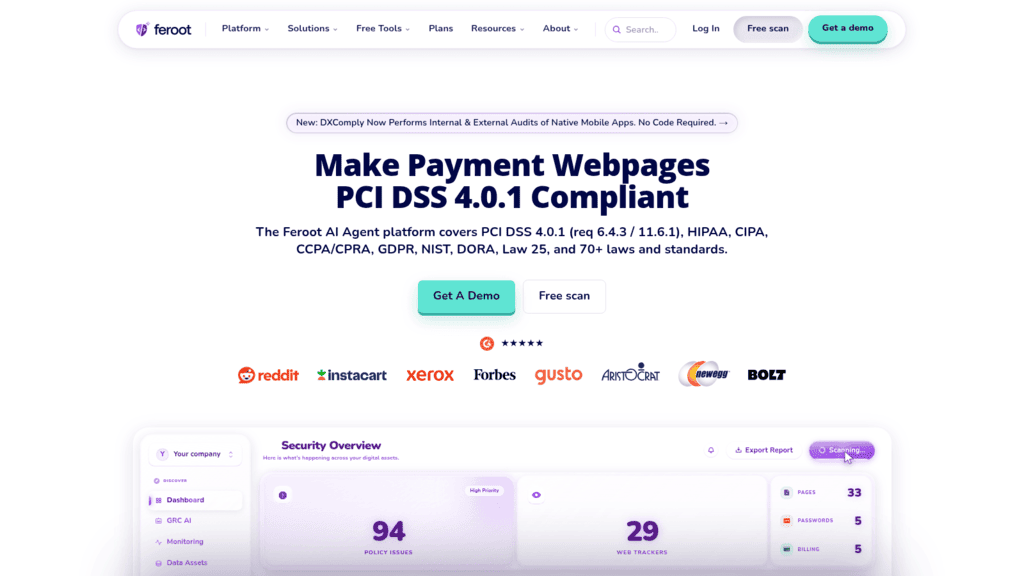
Overview: Feroot PaymentGuard AI inventories and monitors the JavaScript that runs on your payment pages. Feroot positions it for “continuous compliance, automated protection and tamper detection” against PCI DSS 4.0.1 requirements 6.4.3 (authorize, integrity-check, and justify every payment page script) and 11.6.1 (detect unauthorized changes to the page).
Both became mandatory on March 31, 2025, and they target skimming code injected into a checkout page, which steals card data without touching your servers. Feroot deploys through AI agents, a web crawler, or a script tag, and offers a free checkout scanner.
Key features:
- Payment page script inventory with authorization and justification records, which is the evidence 6.4.3 asks for.
- Change-detection baselining that flags a modified or new script, mapped to 11.6.1.
- Real-time behavioral analysis aimed at skimming, formjacking, and cardholder data exfiltration.
- Daily script inventories, change logs, and enforcement records delivered to your GRC tool and your QSA.
- SOC and SIEM integrations listed from the Assess tier up, so a tamper alert lands where your analysts already work.
Fit and setup: PaymentGuard suits retailers and processors with custom checkout pages or many third-party scripts on hosted ones, and Feroot maps it to SAQ A-EP and SAQ D. The Assess tier covers up to 10 websites or apps and 20 payment pages; Govern removes the payment page limit. It covers two requirements, so it sits beside a compliance platform and never replaces one.
Pricing: Feroot’s pricing page lists Assess, Govern, and Enterprise tiers with no dollar figures and asks for a demo to get “personalized pricing.” Enterprise scales to 5,000 websites and apps.
Pros: Built specifically for 6.4.3 and 11.6.1, QSA-ready evidence generated daily, free scanner to size the problem, SIEM integrations
Cons: No published price. Coverage stops at the browser, so discovery, logging, and access controls need other tools. Larger estates move to Enterprise quickly, because Govern caps you at 20 websites and apps.
Who should shortlist it: Any merchant whose checkout page loads scripts it does not fully control. It turns two of the hardest new requirements into a daily evidence file.
Final verdict: Buy it after you settle where card entry happens, since an iframe or redirect changes how many pages you need to watch. If you already use SecurityMetrics for scanning, compare its Shopping Cart Monitor first.
5. Qualys PCI Compliance: Best for Testing What Stays in Scope
Best for: ASV scans and technical controls
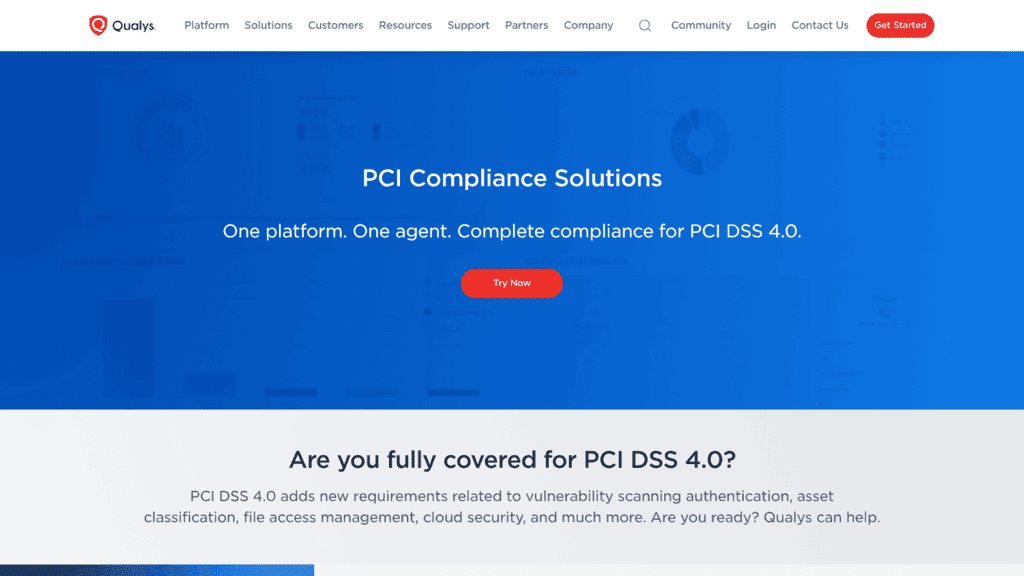
Overview: Qualys sells PCI compliance as a set of apps on one platform and one agent. Its PCI page states that Qualys VMDR “includes Qualys PCI ASV” and that “Requirements for external scanning can be met as Qualys is an Approved Scanning Vendor (ASV).”
Beyond scanning, Qualys maps its other modules to requirements by number and describes the set as “over a dozen applications” covering the technical requirements. That makes it the tool for whatever remains inside your CDE once scope work is done.
Key features:
- External ASV scans for Requirement 11.3.2, which PCI DSS requires at least once every three months.
- Internal vulnerability scanning and patch tracking on the same agent, which ties a failed scan to the missing patch.
- File integrity monitoring, which Qualys maps to Requirements 10.2.1.1 and 1.2.2.
- Policy Compliance checks for password, MFA, and privileged-account settings under Requirements 7 and 8.
- CyberSecurity Asset Management for the system component inventory that Requirement 12.5.1 asks you to keep current.
Fit and setup: Qualys suits enterprises that already run a vulnerability program and want ASV scans, FIM, and configuration audits on one agent across on-premises, cloud, and container CDEs. Its PCI page does not mention payment page scripts (6.4.3 and 11.6.1) or tokenization, so those need other tools.
Pricing: Qualys does not publish a price on its PCI page or pricing page; the PCI page leads to a free trial and the rest goes through sales.
Pros: Approved Scanning Vendor status stated on its own page, requirement-by-requirement module mapping, one agent for scanning and FIM, cloud and container coverage
Cons: Pricing goes through sales. The product ends at technical controls, so policies, SAQ completion, and evidence workflows need a GRC layer. The module count means a full PCI deployment is several products to license and run.
Why buyers shortlist it: Requirement 11.3.2 needs an ASV, and Qualys runs that scan from the same console as the internal scans under 11.3.1. One agent across the CDE also gives you one asset list to argue scope from.
Final verdict: Shortlist Qualys when vulnerability management is already your team’s discipline and you want the ASV scan from the same console. Pair it with an evidence platform for the paperwork.
6. SecurityMetrics: Best for One Vendor Across Assessment, Scanning, and Checkout
Best for: Assessor, scanner, and monitoring combined
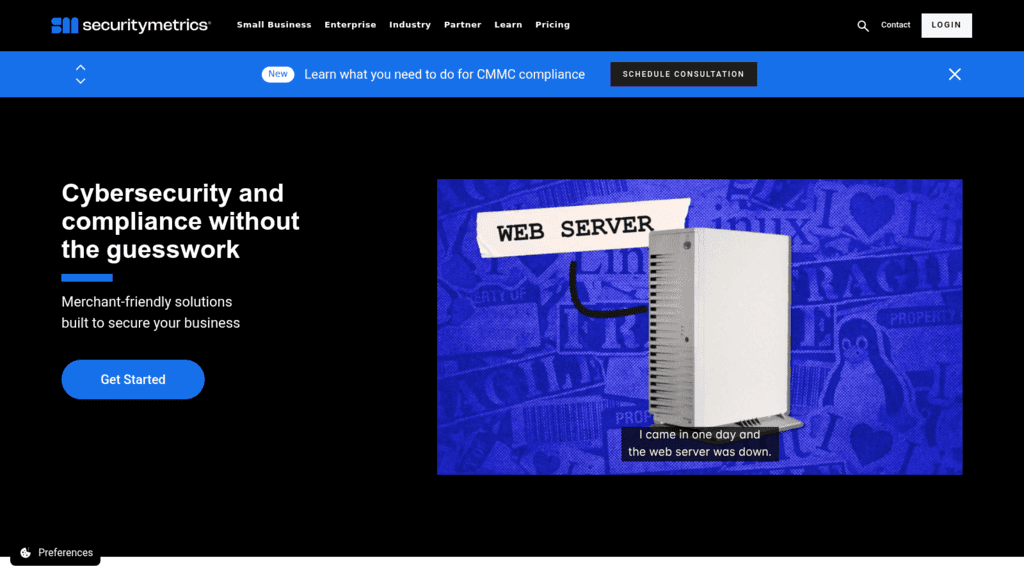
Overview: SecurityMetrics states that it is both a Qualified Security Assessor (QSA) and an Approved Scanning Vendor (ASV), and its product list reads like a PCI program in one catalog: assessments, ASV scans, internal scans, penetration testing, card data discovery, and checkout monitoring.
Its PCI DSS 4.0.1 assessments include an audit coordinator, “proper PCI scoping” and direct access to your QSA. It also runs acquirer-sponsored programs for small Level 4 merchants.
Key features:
- Shopping Cart Monitor simulates a checkout, inventories static and dynamically loaded JavaScript, and rescans on a schedule for page changes.
- ASV scanning with “unlimited rescans during your contract” on the ASV Scan product, which helps when a failed scan needs a quick retest.
- PANscan, which “locates unencrypted payment card data on your devices,” including magnetic stripe track data.
- QSA-led PCI DSS 4.0.1 assessments with software that tracks audit tasks.
- Penetration testing and forensic investigation from the same vendor, so testing and incident follow-up stay under one contract.
Fit and setup: SecurityMetrics suits merchants and service providers that want their assessor, scanner, and checkout monitoring from one firm. Before you combine services under one PCI compliance vendor, ask your acquirer and your internal audit team whether they accept the same company assessing controls that it also helps run.
Pricing: SecurityMetrics’ audit page says a PCI audit “can start at $15k” and complex audits “can cost $75k+,” depending on locations, parties, and network complexity. Scanning, Shopping Cart Monitor, and PANscan are quote only, and SMB packages are priced through your acquiring bank.
Pros: QSA and ASV status stated on its own pages, a product for 6.4.3 and 11.6.1, card data discovery included, published audit price range
Cons: Most product prices are quote only. The catalog is wide, so you may pay for a services relationship when you wanted software. The company calls itself “the only vendor with a Price Guarantee,” a claim you should test against competing quotes.
Its real strength: It covers card data discovery, ASV scanning, and payment page monitoring in one catalog, which no other vendor on this list does.
Final verdict: Shortlist SecurityMetrics when you want one PCI specialist to hold the assessment and the scans. Keep a separate evidence platform if you run other frameworks alongside PCI.
7. ControlCase: Best for QSA-Led Reports on Compliance
Best for: Level 1 ROCs, managed year-round
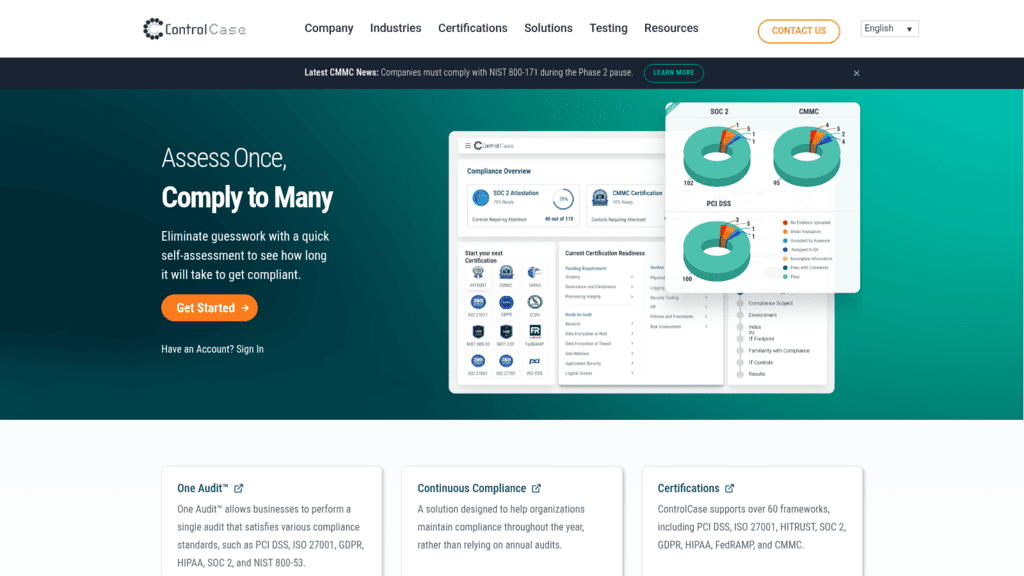
Overview: ControlCase is a certification and continuous compliance services firm. For PCI DSS it deploys “a PCI audit team of Qualified Security Assessors (QSAs)” and issues a Report on Compliance (ROC) at the end of its process, after gap analysis and a remediation phase with monthly status reports.
Its Continuous Compliance service wraps that assessment in year-round support: an automated evidence collection platform, quarterly reviews of what it calls “the 20-25 high impact/high risk components,” escalation letters, and consolidated status reports. ControlCase states that this reduces the effort of the final audit by “at least 25%,” and in April 2026 it acquired CyberNINES to expand into federal and CMMC work.
Key features:
- QSA-led PCI DSS assessments that end in a ROC, the validation document Level 1 merchants and service providers need.
- An evidence collection platform with connectors, used between assessments so the final audit starts from current data.
- Quarterly reviews of high-risk components, which catch drift before the annual on-site work.
- Bundled services in one package, including vulnerability assessment, penetration testing, sensitive data discovery, firewall ruleset reviews, and logging with automated alerts.
- One Audit, which combines PCI DSS with frameworks such as ISO 27001, SOC 2, and HIPAA in a single assessment.
Fit and setup: ControlCase suits Level 1 merchants and service providers that want a ROC plus a managed program around it, often across several frameworks. ControlCase says the platform deploys within 48 hours. Teams that want to run their own evidence platform get less control here than with the software vendors.
Pricing: ControlCase publishes no prices on its site, and engagements are quoted after scoping.
Pros: QSA assessments and continuous support from one firm, ROC delivered by the same team that tracked remediation, bundled testing services, multi-framework One Audit
Cons: No published pricing. The pages read do not state which PCI DSS version the platform maps to or whether ControlCase runs ASV scans itself, so ask both questions before you buy. Bundling the assessor with the remediation support raises the same independence question your audit committee may already ask.
Why it made this list: For a Level 1 entity, the ROC is the deliverable that matters, and ControlCase builds its software around getting there.
Final verdict: Shortlist ControlCase when you need a QSA and want the year between assessments managed too. Confirm the ASV arrangement and the platform’s 4.0.1 mapping in writing.
8. Vanta: Best for SAQ and AOC Workflows Across Several Frameworks
Best for: Guided SAQ and AOC completion
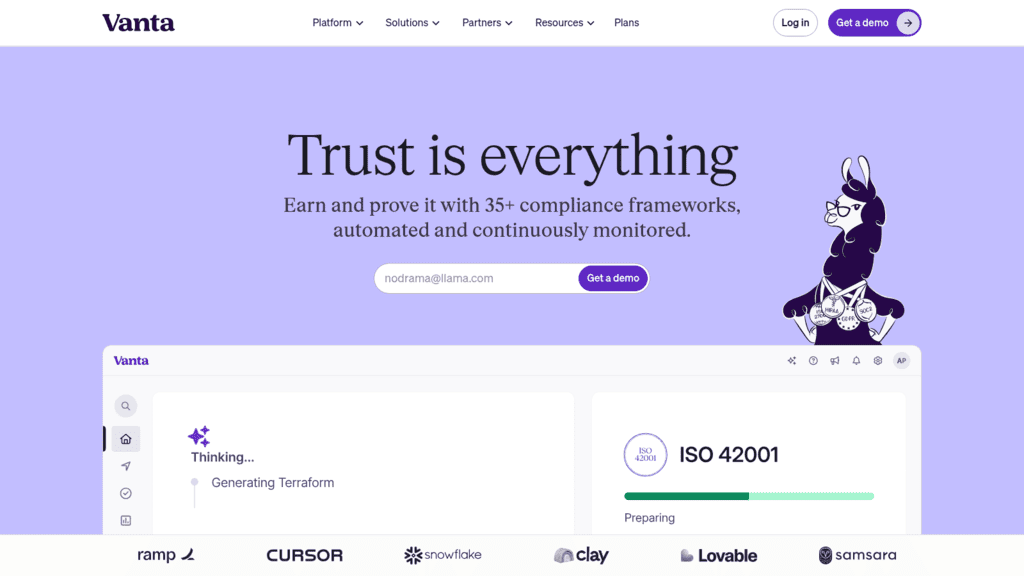
Overview: Vanta’s PCI DSS product, built for merchants and service providers, lists a scope and gap assessment that sets your compliance level, guided completion of the Self-Assessment Questionnaire (SAQ) and Attestation of Compliance (AOC), and preparation for ROC validation.
Vanta is clear about the boundary. Its FAQ says it “does not replace a Qualified Security Assessor,” and lists ASV scanning fees as a separate cost. The scope step is a questionnaire about your organization type and assessment path, so it picks the right SAQ more than it maps your network. Across its 35+ frameworks, PCI DSS evidence can be reused toward NIST CSF 2.0 and CMMC 2.0.
Key features:
- A scope and gap assessment that determines your PCI level and the controls you need.
- Guided SAQ and AOC completion that pulls in evidence the platform has already collected.
- ROC preparation with mapped controls and an auditor collaboration space.
- Access reviews that show who can reach the cardholder data environment, which feeds Requirements 7 and 8.
- Vendor risk management for the service provider oversight that Requirement 12.8 asks for.
Fit and setup: Vanta suits cloud-native fintech and SaaS companies validating by SAQ, or preparing a first ROC, alongside SOC 2 or ISO 27001. It integrates with AWS, Azure, and GCP, and Private Integrations bring in data from on-premises systems. The PCI page does not cover payment page scripts or card data discovery.
Pricing: Vanta’s site asks for a demo. On AWS Marketplace, 12-month plans start at $14,000 (Essentials), $21,500 (Plus), and $23,000 (Professional) for 1 to 20 employees, and every tier includes one framework.
Pros: Guided SAQ and AOC workflow, reuse of PCI evidence across other frameworks, wide auditor ecosystem, hybrid data through Private Integrations
Cons: ASV scans and the QSA are separate purchases. Each tier covers one framework, so PCI DSS plus SOC 2 means a second framework fee. Its PCI page does not state which PCI DSS version it maps to.
Why it’s a good PCI compliance software choice: It turns the SAQ from a spreadsheet exercise into a workflow tied to live evidence. Teams already using Vanta for SOC 2 add PCI DSS without a second platform.
Final verdict: Shortlist Vanta if you validate with an SAQ or an early ROC and already run other frameworks on it. Budget the ASV and QSA separately from day one.
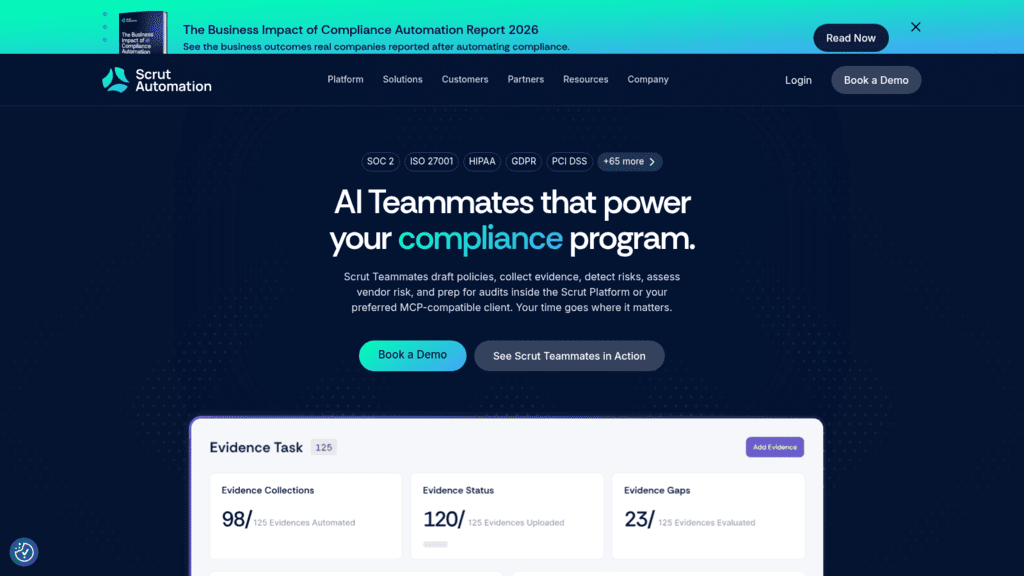
9. Scrut Automation: Best for PCI Alongside a Multi-Framework GRC Program
Best for: PCI inside multi-framework GRC
Overview: Scrut Automation maps prebuilt controls to PCI DSS and says it aligns “each control to the exact PCI DSS 4.0 clause it supports,” so evidence can be prepared for either an SAQ or a ROC path. Its continuous monitoring runs “hundreds of prebuilt tests,” with examples such as open ports, MFA enforcement, TLS configuration, and logging status.
Scrut adds people to the software. Its in-house PCI DSS experts help build an action plan and “advise on compensating controls where applicable,” and you can bring your own auditor or pick one from the Scrut Partner Network.
Key features:
- Controls mapped clause by clause to PCI DSS 4.0, with SAQ completion and attestation in the platform.
- Hundreds of prebuilt tests for settings such as open ports, MFA, and TLS.
- In-house PCI experts for action plans and compensating controls.
- Auditor choice between your own firm and the Scrut Partner Network, with audit projects run in the platform.
- Scrut Teammates AI agents for policy drafting and evidence collection.
Fit and setup: Scrut suits growing SaaS and fintech companies that need PCI DSS beside SOC 2, ISO 27001, or GDPR in one GRC tool, since access, logging, and incident evidence overlap heavily with GDPR compliance services work. Its homepage cites 150+ integrations and its PCI guide says more than 100, so check that your stack is covered. The PCI page does not mention ASV scanning, card data discovery, or payment page scripts.
Pricing: Scrut’s pricing page returns a 404 and the site quotes on request, with all features included and audit charges separate. On AWS Marketplace, a 12-month platform contract for up to 20 employees is listed at $15,000.
Pros: Clause-level PCI DSS mapping, in-house compliance experts, auditor choice, multi-framework coverage
Cons: No pricing on its own site. Integration and framework counts differ across its own pages. Scanning and payment page coverage need separate vendors.
Where it beats the alternatives: Compensating-control advice from in-house experts comes with the subscription, and PCI DSS accepts compensating controls when a requirement cannot be met as written.
Final verdict: Shortlist Scrut if PCI DSS is one framework among several and you want advisory help inside the subscription. Ask for the integration list for your exact stack.
Start a guided compliance walkthrough →
What Scope Reduction Removes From the PCI Compliance Tools List
Each scope move takes some systems or some questionnaire sections out of play, and with them part of the tooling bill, though none of them removes everything. The table below sets out what changes, based on the PCI DSS 4.0.1 standard, the SAQ A update of January 2025, and the PCI SSC’s P2PE and scoping guidance.
| Scope move | What changes | Tooling you can shrink | What still applies |
|---|---|---|---|
| Hosted payment page or iframe (SAQ A) | SAQ A dropped 6.4.3, 11.6.1, and the supporting 12.3.1 analysis in January 2025 | Payment page monitoring leaves the questionnaire | A new eligibility criterion: you confirm your site is not susceptible to script attacks; quarterly ASV scans under 11.3.2 |
| Validated P2PE solution | The PCI SSC says merchants using listed P2PE solutions have “fewer applicable” requirements | Controls on merchant systems that only see encrypted card data | SAQ P2PE controls and the provider’s listing |
| Tokenization through a vault | Systems that only hold tokens can leave the CDE if they have no route to card data or detokenization | FIM, log review, and scans on application databases | Every system that calls the vault, and the vault provider’s own compliance |
| Network segmentation | Segmented systems drop out of scope once the assessor verifies the controls | Agents and log collection on the corporate network | Segmentation penetration tests every 12 months, or every 6 for service providers |
| Data discovery and deletion | Stray PAN removed from file shares, tickets, and backups | Monitoring on systems that only held stray data | Incident response procedures for unexpected PAN under 12.10.7 |
Two of those rows need more care than vendors usually give them. The PCI SSC’s own announcement says the SAQ A changes “do not remove or diminish the underlying requirements” in PCI DSS, and Feroot’s guidance makes the related point that a hosted payment page still sits inside a parent page whose scripts can be attacked.
Segmentation is the other trap. Requirement 11.4.5 makes you test segmentation controls annually and after every change to them, and the tester must be organizationally independent, though not necessarily a QSA or ASV. UnderDefense’s PCI DSS penetration testing covers the CDE and the systems that can affect its security, and ends with a letter of attestation.
Discovery closes the loop. Requirement 12.10.7 asks for incident response procedures that start whenever PAN turns up where it is not expected, so a discovery scan both shrinks scope and feeds a process your incident response plan already has to include.
Choosing PCI Compliance Solutions by Merchant Level
Your validation route decides which category of tool you buy first. Visa sets merchant levels by annual Visa transaction volume per corporate entity, and Mastercard uses six million combined transactions as its own Level 1 line; both brands’ current program pages were read for this guide in October 2026.
Level 1 Merchants and Service Providers
Visa’s Level 1 covers merchants processing over 6 million Visa transactions a year, and it requires an annual ROC plus an Attestation of Compliance (AOC). Service providers carry tighter clocks: Requirement 12.5.2.1 asks them to confirm scope every six months, and 11.4.6 asks for segmentation tests on the same cycle, which the PCI penetration testing guide on the UnderDefense blog covers in detail.
At this level, start with an assessor relationship (ControlCase or SecurityMetrics), an ASV (Qualys or SecurityMetrics) and monitoring evidence for Requirements 10, 11, and 12.10, where UnderDefense fits. Add Ground Labs before your next scope confirmation if card data has spread beyond the CDE diagram.
Level 2 and Level 3 Merchants
Visa’s Level 2 covers 1 to 6 million transactions a year and Level 3 fewer than 1 million e-commerce transactions; both validate with an annual SAQ. Here PCI compliance solutions built around an evidence workflow, such as Vanta, Scrut, or MAXI Compliance AI, do most of the work, with an ASV for the quarterly external scans.
For e-commerce merchants, the payment page decision matters most. A hosted page or iframe changes which SAQ you file, and the January 2025 eligibility criterion still asks you to show your site resists script attacks, which is where Feroot or SecurityMetrics’ Shopping Cart Monitor come in.
Where to Start: Scope First, Then Evidence
Start with a discovery scan and a data-flow diagram, because together they answer Requirement 12.5.2 and tell you how many systems each later contract needs to cover. Decide next whether tokenization, P2PE, or a hosted payment page can take card data out of your own systems. Only then price the scanner, the PCI compliance software, and the assessor against the CDE that remains.
Price those three lines separately; Vanta’s own FAQ lists them as separate costs. Platform tiers also scale with headcount and the number of frameworks, a pattern laid out in UnderDefense’s compliance automation pricing breakdown. Every system you remove from the CDE is one fewer ASV target, one fewer log source to review daily, and one fewer asset for the assessor to sample.
For many regulated enterprises, the hardest controls to evidence are the operational ones: daily log reviews, intrusion detection, and a tested incident response process. Those need records of real investigations, which is the gap MAXI Compliance AI and the Agentic AI SOC were built to cover together.
Bring last year’s ROC findings for Requirements 10 and 12.10. Book an evidence walkthrough
Frequently Asked Questions
Is PCI compliance software enough to pass a PCI DSS assessment?
Software prepares you for the assessment, and people the PCI SSC qualifies do the validating. A QSA or an internal security assessor signs off the ROC, and quarterly external scans must come from a PCI SSC Approved Scanning Vendor. Budget the assessor and the ASV as separate lines from the software.
Does a hosted payment page take you out of PCI DSS scope?
It shrinks scope, and some requirements stay with you. A hosted page or iframe can make you eligible for SAQ A, which since January 2025 no longer lists Requirements 6.4.3 and 11.6.1. You must confirm your site is not susceptible to script attacks, and quarterly ASV scans under 11.3.2 still apply. Ask your acquirer which SAQ it accepts for your setup.
How often does PCI DSS scope have to be confirmed?
Merchants confirm scope at least once every 12 months and after any significant change, under Requirement 12.5.2. Service providers do it every six months under 12.5.2.1. It covers data flows, every location where account data lives, connected systems, segmentation controls, and third-party connections, and your assessor’s scoping check does not replace it.
What is the difference between a QSA and an ASV among PCI compliance companies?
A QSA is a firm the PCI SSC qualifies to assess your controls and sign a ROC. An ASV is a firm qualified to run the quarterly external vulnerability scans that Requirement 11.3.2 demands. Some PCI compliance companies are both: SecurityMetrics states both roles on its site. Check any firm against the PCI SSC’s published lists before you sign.
Which PCI compliance vendor publishes its prices?
On their own websites, UnderDefense publishes four compliance packages from $0 to $1,899 a month and VGS publishes a Starter plan from $1,000 a month. SecurityMetrics publishes a PCI audit range of $15,000 to $75,000 or more. Vanta and Scrut list entry prices on AWS Marketplace, while Ground Labs, Feroot, Qualys, and ControlCase quote on request.
Book a 30-minute
compliance readiness session
- See which SOC 2 or ISO 27001 controls your stack already passes
- Get a gap list with a named owner for every open task
- Get matched with an accredited audit partner within one business day