






Q1: Why does my SIEM generate so many false positives, is my team doing something wrong?
Your SIEM floods you with false positives because a correlation engine can only apply the generic rules and limited context it was given, and no vendor ships rules that already know your environment. This is not your team failing, and it is not a broken product. False positives are the predictable output of detection run without continuous tuning, environmental context, and a triage layer, which makes it a management problem rather than an inherent property of SIEM.
Talk to a SIEM expert about fewer false positives.
🧯 The scene most security managers know too well
Picture a three-person team on a Monday. Two thousand alerts sit in the queue. Everyone already knows most are junk, so they skim, close, and move on.
Nobody calls this a decision. It just becomes the rhythm of the week. I have lived that exact strain early in my career, standing up a SIEM in a shop where the tools generated far more alerts than any human could handle.
I still remember breaking out in hives because I could not keep up with the issues popping up on that dashboard. That was not weakness. That was a system handing one person an impossible volume.
⚙️ How a correlation engine actually behaves
A SIEM (Security Information and Event Management tool) is a correlation engine. It collects logs, matches them against rules, and fires an alert when a pattern hits.
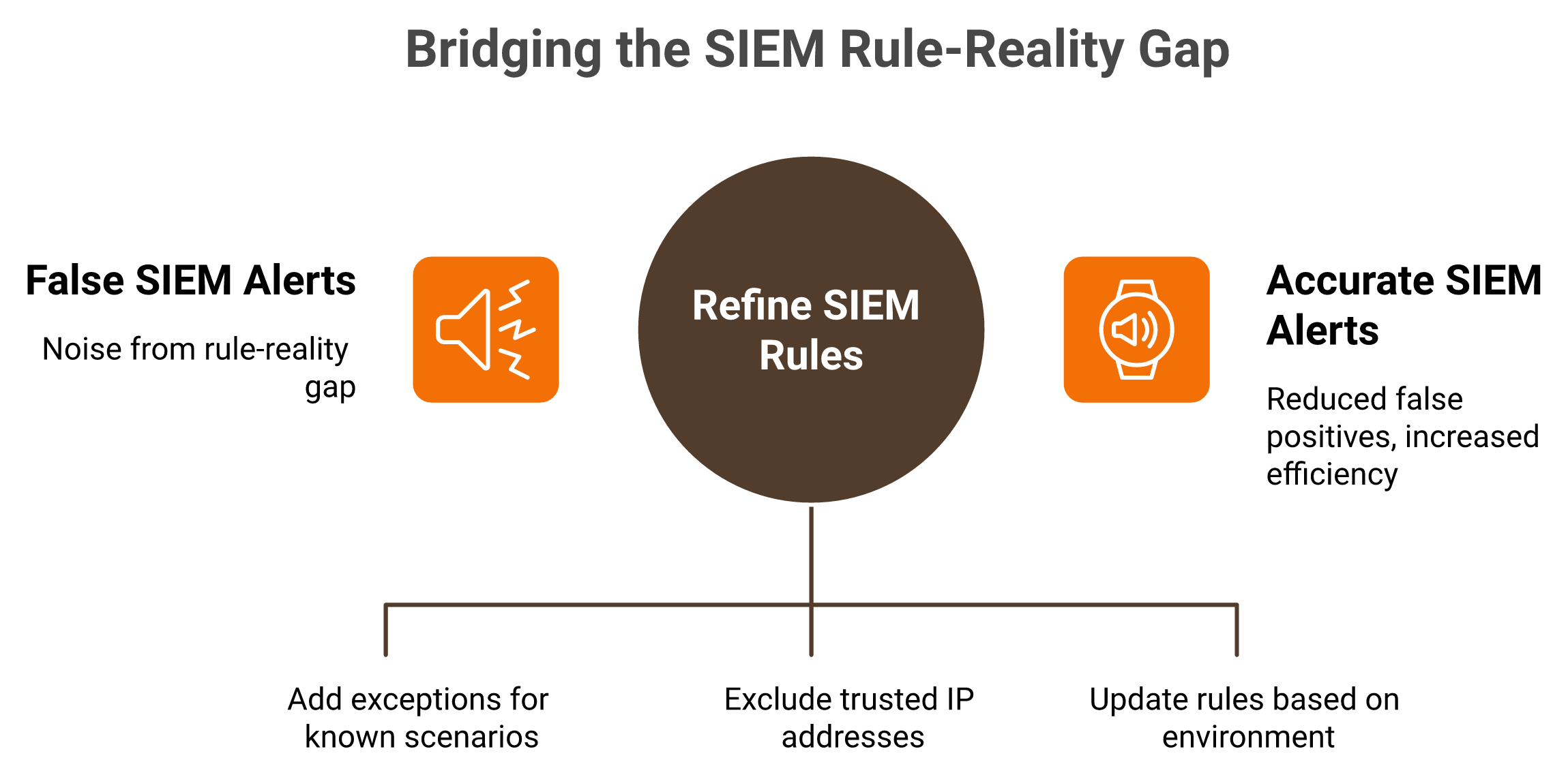
Here is the mechanism that matters. The engine can only apply the rules and the context you feed it. Give it a rule that says “flag any login from a new country,” and it will flag your traveling CFO with the same confidence it flags an attacker.
The engine is not wrong. It is doing precisely what it was told. The gap sits between the rule and the reality of your environment, and that gap is where false positives are born.
🔁 Why this is structural, not a personal failure
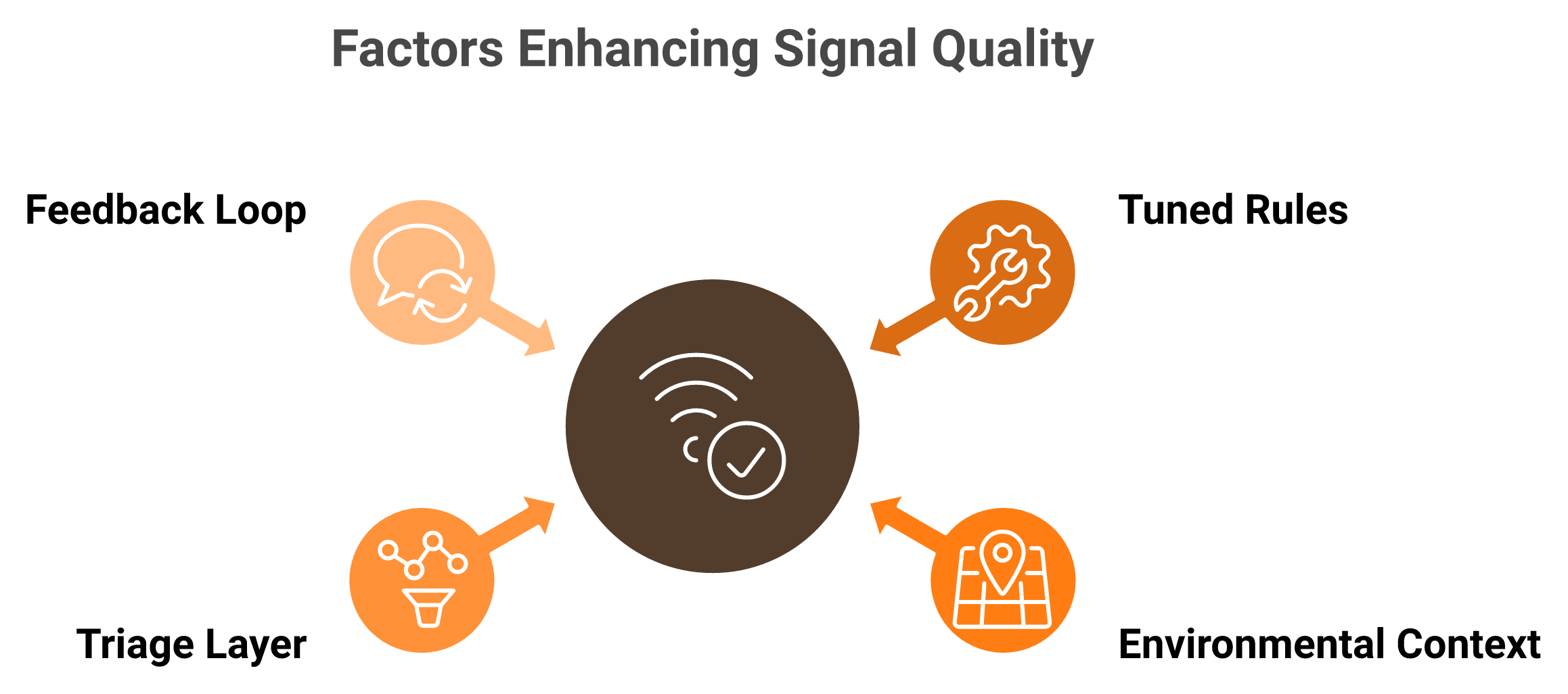
So the noise is not proof your team is bad at security. It is the visible output of detection operated without three things: continuous tuning, environmental context, and a triage layer that investigates before a human does. This is exactly the gap a managed SIEM practice is built to close.
Recurring false positives trace to overly aggressive rules, inaccurate baselines, and misconfigured data sources. Those are operating conditions, not character flaws.
One distinction will sharpen how you read your own queue. A false positive means the system should not alert on that behavior at all. A “positive benign” means a user did something genuinely odd that is worth tracking as risk, though it is not a threat yet. Mixing those two is how good signal gets buried with the trash.
🧭 What you will get from the rest of this piece
At UnderDefense, I have watched this pattern repeat across hundreds of environments, and the reframe lands the same way every time: the reader stops blaming the box or the team. My goal here is to hand you three things you can use.
- The real mechanism behind the noise, in plain terms.
- Self-help you can run this week without buying anything.
- The exact language to explain this upward to your CISO or CIO.
You are not failing at something everyone else has solved. You are running a system that was never finished after deployment, and that is a fixable condition.
Q2: Is alert fatigue actually inevitable, or is it fixable?
It is fixable, and the most rigorous evidence agrees. Analyst-feedback-driven models measurably reduce false positives over time, which means the fix is an operating loop rather than a better box. Noise feels inevitable mainly because most teams treat tuning as a one-time deployment task instead of a continuous practice. Our SOC service runs that loop as a daily discipline.
🧠 The belief almost everyone accepts
Most security people quietly believe alert fatigue is just the job. You drown, you cope, you build a tolerance. That belief feels earned, because every SIEM they have touched behaved the same way.
I understand why it sticks. When something breaks the same way everywhere, it starts to look like a law of nature instead of a shared bad habit.
🔬 Why that belief is wrong
Here is where the standard read gets it backwards. The academic work does not treat noise as fixed. Models trained on analyst feedback measurably reduce false positives over time.
Read that carefully. The fix is a loop, not a purchase. When analyst decisions feed back into detection logic, the same false positives stop recurring. That is an operating change any team can start, and it does not require ripping out your stack. The reason noise feels permanent is simpler than most vendors admit. Someone tuned the SIEM at deployment, and then nobody tuned it again. If you want the mechanics, our guide to alert fatigue walks through the same loop step by step.
🌀 The uncomfortable reframe
So inevitability is a symptom, not a truth. It is what a detection system does when the tuning practice went missing after go-live.
I will say the harder version out loud, because I have watched teams skip it. If your alerts are mostly garbage, automating their triage only makes you wrong faster. Bolting an AI layer onto a noisy SIEM means you are investing in a quicker way to be wrong, because the machine faithfully executes the same broken process at scale. This is the trap our UnderDefense Agentic AI SOC platform is engineered to avoid.
Most alerts today are lowest-hanging-fruit rules built on emergency patches and pattern matching. They lack the data-science foundations, things like statistical outliers, that separate real anomalies from routine oddness. That is a design gap, and design gaps get fixed.
If it is fixable, why does almost nobody fix it? Hold that question. The answer is about who has time to sustain the work, and I will come back to it directly later in this piece.
Q3: What are the real root causes behind SIEM false positives, and why do generic out-of-box rules misfire?
SIEM false positives trace to eight recurring causes: generic out-of-box rules built for a median environment, no environmental context, static thresholds that never adapt, tuning treated as a project rather than a practice, detection-content decay, log-source sprawl without enrichment, no triage layer before humans, and an absent feedback loop that lets the same false positives recur. Out-of-box rules misfire because they encode assumptions about an average network that is not yours.
🧩 Why default rules misfire first
Out-of-box rules are written for a median environment. They assume an average network, average users, and average hours. Your environment is none of those.
So a default rule that flags “odd-hours file access” trips every night on your backup service doing exactly its job. The rule is not broken. It just never met your infrastructure.
📋 The eight root causes, in plain terms
Here is the framework I use when I walk into a noisy environment. Each cause below comes with the mechanism and a concrete example.
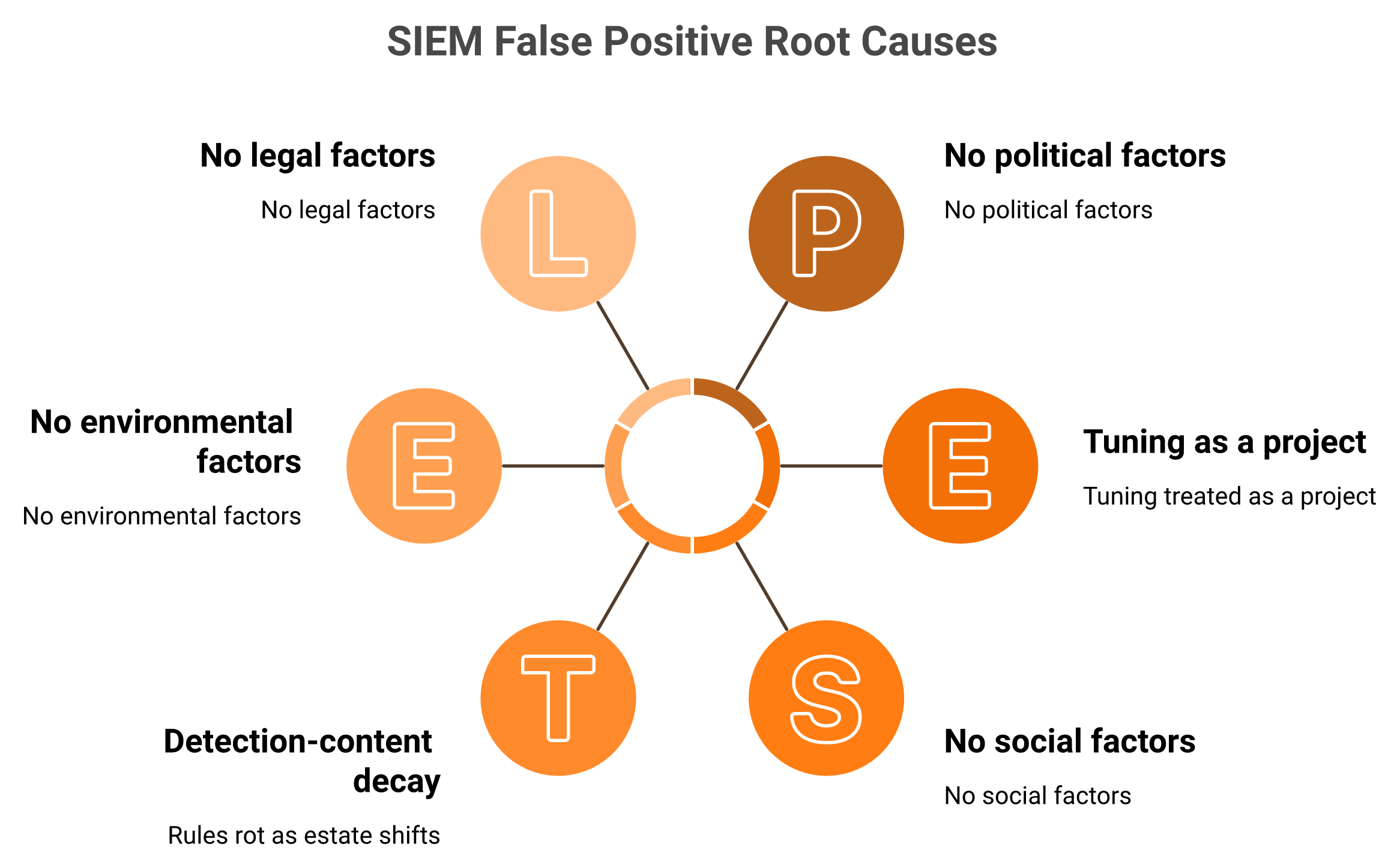
- 3.1 Generic out-of-box rules. Vendor defaults target a median network, so they misfire on your specifics. Example: a “new admin login” rule that fires on your rotating contractor accounts.
- 3.2 No environmental context. The engine cannot tell your backup job at 2 a.m. from an intruder. Both look like odd-hours activity without context.
- 3.3 Static thresholds. A fixed “100 logins per hour” limit made sense at launch, then your headcount doubled and the rule became a noise machine.
- 3.4 Tuning treated as a project. Someone tuned it at deployment, and nobody has since. The rules froze while the business kept moving.
- 3.5 Detection-content decay. Rules quietly rot as identity, SaaS, and infrastructure shift beneath them. A rule tied to a retired app keeps firing on its ghost.
- 3.6 Log-source sprawl without enrichment. More sources get ingested without the parsing to make them meaningful, so volume climbs while signal drops.
- 3.7 No triage layer. Every alert reaches a human because nothing investigates first. The queue is raw, not filtered.
- 3.8 Absent feedback loop. Analyst dispositions die in the ticket, so the same false positive returns next week, and the week after.
🎯 The wildcard trap, a worked example
Small rule choices create huge noise. Say you want to catch a specific bad file, malware.exe. If you write the rule with a star-dot-anything wildcard entry, you tell the SIEM to flag almost everything that looks vaguely similar.
The result is a flood, and the analysts on shift inherit it. That single wildcard can turn one clean detection into hundreds of daily false positives.
🔗 Root cause, fix, and the proof behind it
The fixes are not folklore. They are documented in patents and peer-reviewed work.
- Root cause: single-event rules with no context. Fix: score alerts using event provenance and lineage. Proof: a granted NEC patent describes triaging alerts by data-provenance chains rather than one-off heuristics.
- Root cause: over-inclusive rules nobody revisits. Fix: auto-adjust rule conditions from downstream feedback. Proof: a published Google patent describes automated security-rule updates driven by alert feedback.
I will be honest about the human side too. Our field has over-specialized into tool babysitting, a cottage industry of people who master one vendor’s dashboard instead of tracing root causes. I have seen teams tune Carbon Black for four years and still get pinged, because every new installer is a new hash the rule never saw. And I have seen an executive summary of 615 alerts reviewed, 611 false, and 4 real. That 611-to-4 ratio is the dirty work a detection system leaves on your desk when these eight causes go unmanaged. Tracing those root causes is the core of our managed SIEM engagements.
One more mental model worth keeping. A network is like an M&M, hard shell outside, soft center within. Once a single trusted identity, say a reception-desk login, is compromised, generic rules rarely catch the quiet movement inside that soft center, which is where continuous SOC coverage earns its keep.
Q4: What is all this noise actually costing me beyond wasted time?
The cost runs deeper than hours. When most alerts are false, your team learns to skim, and real threats get closed alongside the noise, so the dangerous part is the desensitization it trains rather than the volume itself. Add slower triage, analyst burnout, and attrition you cannot easily rehire for, and a noise problem quietly becomes a detection-coverage problem.
🌊 The situation: a small team, an endless queue
Picture a security manager, call her Dana, running detection for a 900-person company with a team of four. The queue never empties. Every day starts underwater.
Her people are competent. They are also tired, and tired people take shortcuts the system practically invites.
⚠️ The complication: skimming becomes the default
When most alerts are false, skimming stops being a shortcut and becomes the method. The brain learns that the next alert is almost certainly noise, so it stops looking hard.
That is the real cost, and it is not the wasted minutes. It is desensitization. A genuine signal arrives, looks like the other 600 that day, and gets closed as routine.
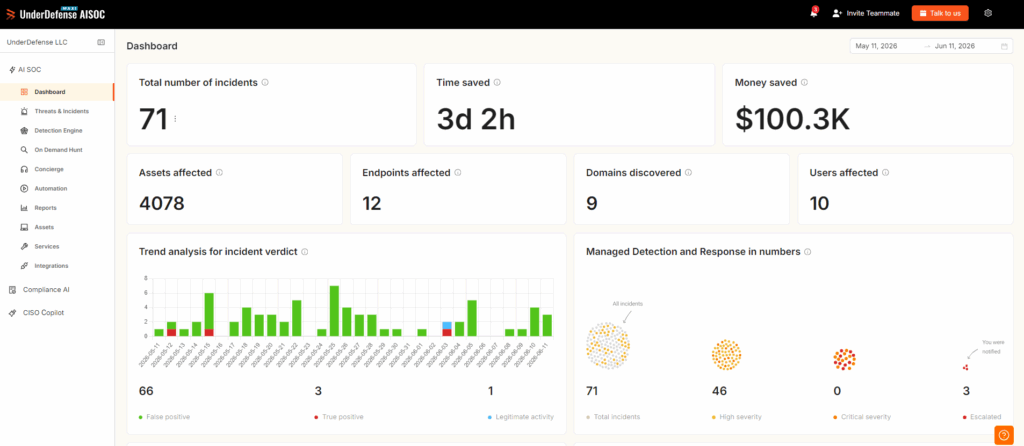
Industry research keeps finding the same pattern. Alert fatigue ties directly to missed detections and slower response, because overloaded analysts cannot investigate everything with equal care. A large share of alerts, around 63%, go uninvestigated in many SOCs. Numbers like these describe coverage risk, not just workload. Our incident response team sees the downstream effect firsthand.
🔍 Why the missed signal matters, without the fear
Let me ground this in something real rather than dramatic. In one breach I studied, attackers used a single crafted HTTP request against a web application to harvest more than ten credential pairs, never touching an endpoint.
The organization had strong tools in place, including endpoint and SIEM coverage. Yet the initial phase of that attack was fully undetected, because logs were not active on a pilot application. The signal was not drowned in noise there. It simply never entered the queue, which is the same coverage problem wearing a different hat. Regular penetration testing surfaces exactly these blind spots before an attacker does.
The point is mechanical, not scary. Noise trains people to miss, and gaps let things through. Both are operating conditions you can measure and manage.
💸 The resolution: reframe noise as coverage risk
So the honest accounting looks like this. Slower triage, because every real alert waits behind hundreds of fake ones. Burnout, because nobody sustains high alertness against a firehose. And attrition, because skilled analysts leave, and in this hiring market you cannot easily rehire them.
Slower detection and response consistently links to higher breach cost, which is the business translation of a noisy queue. That is the sentence you can carry upward, and it is the case our Agentic AI SOC is built to answer.
One customer put the emotional version better than any metric I could offer. They told us plainly, “We need more time, we want our time back.” That request is really a coverage-and-quality question in disguise, and it is the right one to bring to your leadership.
Q5: How can I reduce SIEM false positives myself this week?
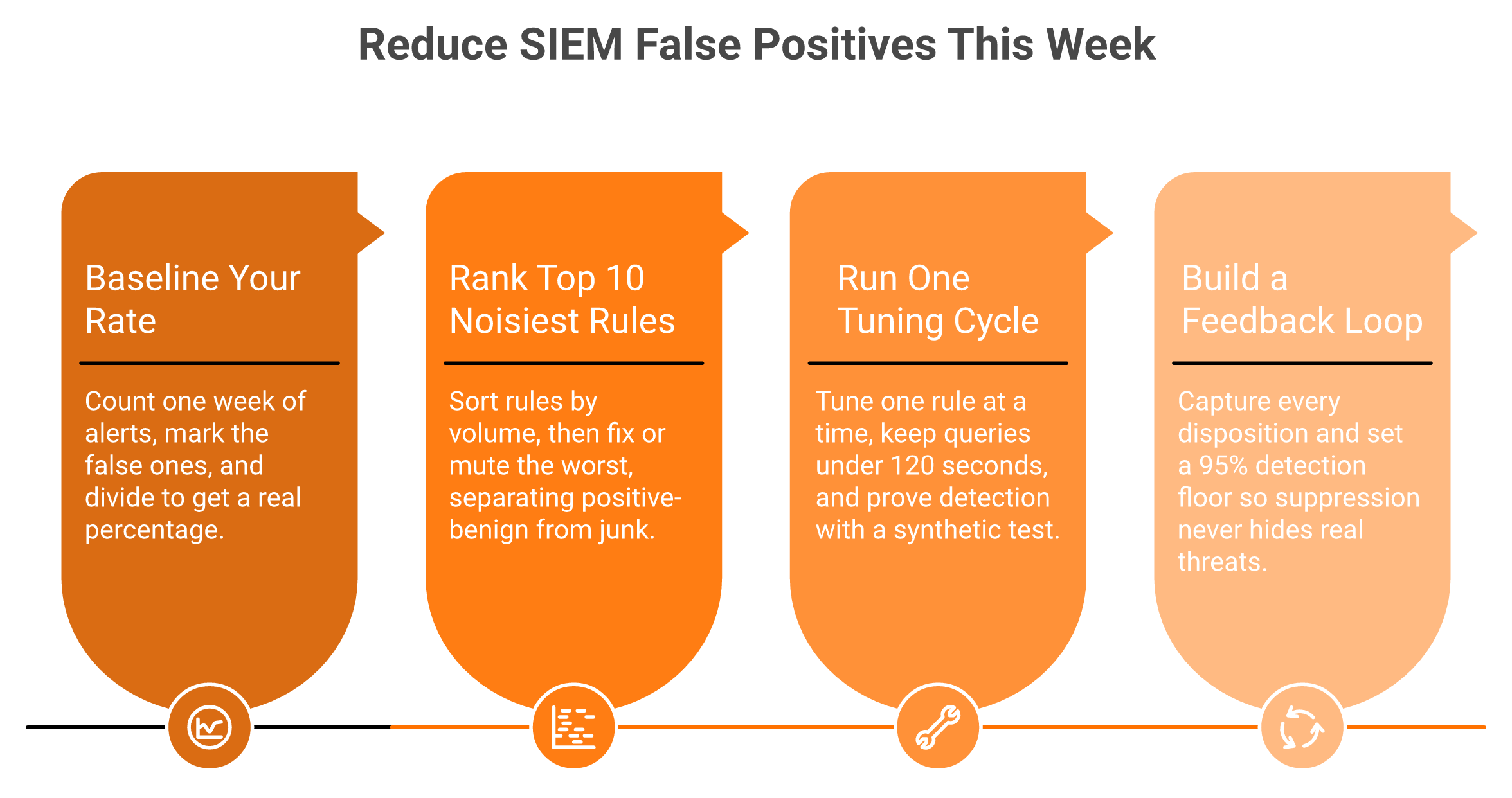
Start with four moves you can run this week without buying anything: baseline your false-positive rate so you have a real number; rank your ten noisiest rules and fix or mute the worst offenders; run one disciplined tuning cycle on those rules; and build a feedback loop so every disposition improves the next rule. Set a detection-rate floor of roughly 95% so suppression never quietly hides genuine threats, and measure signal quality rather than raw alert volume.
I have watched lean teams claw back hours in a single week with these steps. None of them need a vendor. Let me walk you through what I would actually do, in order. If you want the deeper mechanics, our alert fatigue guide covers the same loop.
📊 5.1 Baseline your false-positive rate first
You cannot fix a number you do not have. So before you touch a single rule, count your alerts for one week and mark how many turned out to be nothing.
Divide the false ones by the total. That is your false-positive rate.
Most teams I meet are shocked here. In one well-known analysis, tuning cut 266 million events down to just 41 real alerts, which shows how much of the flood is noise.
Expected outcome: a real percentage (often 90%+) you can track week over week.
🔟 5.2 Rank your ten noisiest rules
Pull the rules that generate the most alerts and sort them top to bottom. Your worst ten rules usually cause most of your pain.
Fix or mute the offenders. A rule that fires 500 times a week and is always benign is a rule stealing your attention.
Here I use one distinction that saves a lot of grief. Ask if each alert is a “positive benign” event, something real but harmless, or plain junk. Benign events you downgrade to risk-tracking; junk you mute outright.
Expected outcome: the worst 3 to 5 rules handled, cutting daily volume noticeably.
🔁 5.3 Run one disciplined tuning cycle
Take those top rules and tune them one at a time. Adjust the logic, test it, watch it for a day, then move to the next. This is the daily discipline behind our managed SIEM practice.
Keep query time tight. My rule of thumb is a 120-second limit; if a query takes longer than two minutes to run, it slows the analyst instead of helping them.
Prove the rule still works with a synthetic transaction. Generate a small, measurable test event, and confirm the source can still fire an alarm within two minutes or less. This is the “show, don’t tell” habit I trust more than any dashboard.
Expected outcome: each tuned rule fires less, yet still catches real activity.
⚠️ 5.4 Build a feedback loop with a detection floor
Every time an analyst closes an alert, capture why. That disposition should feed the next round of tuning.
This is where the safeguard matters. Set a detection-rate floor near 95% so suppression never hides a real threat. One study showed a tool holding 95.1% detection while removing 54% of false positives, proving you can cut noise without going blind.
Expected outcome: a living loop where signal quality climbs each week, not just alert counts falling. A dedicated SOC service keeps that loop running when your team cannot.
💰 Why signal quality beats alert volume
Chasing “fewer alerts” is the wrong scoreboard. A team can mute everything and hit zero alerts while missing the one that matters.
Measure how many alerts were real and actionable instead. That is the shift from counting noise to counting signal, and it changes how your team spends its day for the better.
Q6: If tuning works, why can’t a small in-house team keep it up?
Tuning works; the hard part is that it never stops. Every new SaaS app, identity change, and infrastructure shift reintroduces noise, so tuning competes with incident response, projects, and compliance for the same scarce hours on a small team. “Good” is not zero false positives, but a sustained, owned practice that most three-to-seven person teams struggle to staff week after week.
🧱 The real ceiling is sustainability, not skill
Your team is not failing at tuning. The operating model is simply under-resourced for a job that has no finish line.
I once interviewed a candidate for a repetitive analyst role. I asked how he felt about “copying all day long for the next five years,” and he told me he “finds the zen in copying”. Most humans do not, and burnout follows.
⏰ Three forces that break small-team tuning
- Decay is continuous. Your environment shifts daily, so tuned rules drift out of date almost as fast as you tune them.
- Team capacity is fixed. A three-to-seven person team has a hard cap on hours, and the SANS 2025 SOC Survey points to real staffing and retention pressure across the field.
- Tuning always loses the priority fight. When an incident hits or an auditor calls, tuning gets pushed. It is important, but rarely urgent.
Here is where I will admit something we got wrong early at UnderDefense. We used to treat tuning as a project with an end date. It is not. It is a practice, closer to boarding up doors during a zombie apocalypse than winning a match, because you do not win in security, you just keep the doors shut until sunrise. This is why so many teams eventually weigh an agentic AI SOC to reduce analyst burnout.
✅ What “good” realistically looks like
Aim for a stable, low false-positive band that you own and sustain, rather than a mythical zero. The honest read is that continuous tuning is a resourcing problem before it is a tooling one, and naming that is the first step to solving it. A MDR service exists precisely to carry that resourcing weight.
Q7: What does a managed operating model change, and how does it compare to tuning, SOAR, and AI scoring?
A managed operating model changes who owns the continuous work rather than just who watches the dashboard. Done well, it means detection engineering as an ongoing practice, environmental context maintained as your estate shifts, a triage layer that investigates before anything reaches your team, and clear ownership of the feedback loop. On the remediation ladder, tuning and aggregation reduce noise, SOAR and AI scoring accelerate handling, and a managed layer owns all of it end to end.
🧩 Managed means owning the continuous work
Think of your security stack as Lego bricks. Buying a tool hands you the bricks; a managed model means someone builds and rebuilds the structure as your business changes.
The four functions that actually shift are detection engineering, context upkeep, triage before a human sees it, and feedback ownership. Miss any one and you are back to a noisy inbox. Our comparison of managed SIEM, MDR, and MSSP breaks down who owns what.
🪜 Where each rung tops out
| Rung | What it does | Where it stops |
|---|---|---|
| Tuning | Cuts noisy rules | Manual, decays fast |
| Aggregation | Groups related alerts | Still needs a human to judge |
| SOAR | Automates set playbooks | Only handles what you scripted |
| AI scoring | Ranks alerts by risk | Ranks, does not investigate |
| Managed investigation | Owns detect-to-resolve | Depends on input quality |
A Rapid7 patent describes model-driven triage that is continuously retrained, which shows the direction of travel toward automated scoring. A separate NEC patent covers alert provenance tracking, useful context for judging whether a signal is real.
⚠️ The black-box failure mode to avoid
Here is the trap. Some managed providers triage behind a wall, hand alerts back with little context, and slow your investigation instead of speeding it. Buyers feel this, which is why our transparent investigations approach matters.
My simple litmus test is this: does the layer solve alerts or just escalate them back to you? At UnderDefense, I frame our AI agents as foot soldiers and our human engineers as generals, so the machine does the swarming work and people own the judgment. Own the logic, avoid the black-box segments. This is the heart of our SOC service.
Q8: Won’t an AI SOC just automate my noise faster, and what should I realistically expect?
Automation multiplies whatever signal quality you feed it, so pointing an autonomous responder at a noisy SIEM makes it confidently close false incidents faster rather than fewer real ones. Tuning and triage have to come first, because they are the input-quality gate. Set expectations accordingly: meaningful noise reduction builds over weeks of continuous engineering, measured by signal quality rather than by how many alerts simply disappear.
🤖 The naive view
The pitch sounds great: point AI at your alerts and watch them vanish. Many buyers expect instant magic on day one.
That expectation is where things go wrong. Speed without clean inputs is not a fix.
⚠️ Automation is a multiplier, not a filter
Feed automation garbage and it will faithfully and beautifully execute the underlying brokenness. A noisy SIEM plus fast automation just becomes a faster way to be wrong.
I will say the contrarian thing, even as someone selling an AI SOC. Large language models do not truly reason; at their core they regurgitate, so the real danger is a confident model closing a real incident because the inputs were bad. That is why tuning has to lead and automation has to follow. Our AI SOC guardrails exist for exactly this reason.
⏰ What to realistically expect
Set your sights on a sustained, low false-positive band that builds over weeks, not a headline number on day one. Research supports the direction: one method held 95.1% detection while suppressing 54% of false positives, and an active-learning approach averaged 93% false-positive reduction.
- Timeline: meaningful gains over weeks of continuous engineering, not overnight.
- Metric: track signal quality, not how many alerts disappeared.
- Sequencing: tuning enables triage, and a good managed layer then provides that triage on top.
⭐ What quality-inputs-first looks like in practice
Once the input-quality gate is respected, autonomous investigation earns its keep. Depth is the proof; we run 100+ distinct LLM invocations to autonomously investigate a single alert, which is recursive reasoning rather than a thin GPT wrapper. This is uplift for your people, not replacement of them. See how this plays out across real AI SOC incidents.
As one illustration of quality-inputs-first work, the UnderDefense Agentic AI SOC (platform) resolves noise through employee ChatOps confirmation (if you had time, you would ask the user yourself; you do not, so we do it for you), and runs two distinct SLAs: a 2-minute Alert-to-Triage and a 15-minute escalation for critical incidents. Being a human is a flex in 2026, because humans click while agents swarm.
So here is my closing question for you: if you switched on automation tomorrow, would it be acting on real signal, or just amplifying the noise you already have?
Q9: What does “good” realistically look like, and what should I do on Monday?
There is no universal “right” false-positive rate, but the direction is clear: a rate trending down against a baseline you actually measure, with your noisiest rules shrinking cycle over cycle. Expect improvement across weeks of continuous work rather than a single drop. The healthiest sign is that you have stopped counting alert volume and started measuring how many alerts were genuinely worth investigating.
📉 Realistic expectations, not a magic number
Stop hunting for a perfect percentage. “Good” is a false-positive rate that keeps falling against a number you wrote down last month. This is the outcome our managed SIEM practice is built to sustain.
Give it weeks, not a weekend. Faster, higher-quality detection ties directly to real cost savings, which is the payoff you are building toward. Most teams fight this fight with thin staffing, so patience here is realism, not weakness. Our breakdown of the cost of losing a detection engineer explains why that staffing pressure is so real.
Teams that get there stop dreading the queue. Directionally, I have seen noise drop close to 99% once the loop is running, and the room feels different. A continuous SOC service is what keeps that loop alive.
“The biggest win for me was getting actual control over our security alerts. Before the guys from UD stepped in, we were getting bombarded with alerts… Now when we get an alert, we know it’s something worth looking into.”
Verified User, Marketing and Advertising UnderDefense Agentic AI SOC G2 Verified Review
🧠 The metric shift to carry upward
Here is the mental model worth stealing: measure signal quality, not alert volume. A team can silence every alert and look “quiet” while missing the one that mattered.
So change the sentence you say to your CISO. Stop reporting “we handled 4,000 alerts” and start reporting “this share of alerts were real and worth investigating.” That framing survives a board meeting because it maps to risk, not activity. If you need help building that case upward, our virtual CISO support translates operations into board-ready language.
“It has significantly reduced the number of false positives, allowing our team to focus on real threats. We used to be swamped with alerts, but now we can swiftly identify and address actual vulnerabilities.”
Darina I., Customer Success Manager UnderDefense Agentic AI SOC G2 Verified Review
✅ Your Monday move
On Monday, run the baseline from earlier this week and write down one honest number: your current false-positive rate. Then rank your ten noisiest rules and share both upward as “here is our starting line.” Our alert fatigue guide walks through how to run that baseline.
That single act turns tuning from invisible toil into a tracked, fundable practice. It also gives your leadership the language to back the work when priorities compete, especially when paired with a clear security budget plan. When you are ready to hand off the ongoing work, our MDR service owns it end to end.
The question I keep sitting with is this: if you measured signal quality instead of alert volume for one quarter, how many of your “busy” weeks would turn out to be noise you were never paid to chase?
See tuned SIEM triage in action.
1. Why is my SIEM generating too many false positives?
Your SIEM floods you with false positives because a correlation engine can only apply the generic rules and limited context it was given, and no vendor ships rules that already know your environment. This is not your team failing, and it is not a broken product.
False positives are the predictable output of detection run without three things:
- Continuous tuning that keeps rules aligned with your estate.
- Environmental context that separates a backup job at 2 a.m. from an intruder.
- A triage layer that investigates before anything reaches a human.
Give a SIEM a rule that says flag any login from a new country, and it will flag your traveling CFO with the same confidence it flags an attacker. The gap sits between the rule and the reality of your environment, and that gap is where false positives are born.
We treat this as a management problem, not an inherent property of SIEM. Across hundreds of environments, we tune rules as a continuous practice through our managed SIEM engagements, so the noise keeps shrinking instead of returning.
2. Is alert fatigue inevitable, or can it actually be fixed?
It is fixable, and the most rigorous evidence agrees. Analyst-feedback-driven models measurably reduce false positives over time, which means the fix is an operating loop rather than a better box.
Noise feels permanent for a simple reason: someone tuned the SIEM at deployment, and then nobody tuned it again. When analyst decisions feed back into detection logic, the same false positives stop recurring.
We will say the harder version out loud. If your alerts are mostly garbage, automating their triage only makes you wrong faster, because the machine faithfully executes the same broken process at scale.
- Tuning is a continuous practice, not a project with an end date.
- Feedback loops let each disposition improve the next rule.
- Design gaps, like missing statistical outlier detection, get fixed.
The honest catch is that this loop competes for scarce hours on a small team. That is why we run it as a discipline through our SOC service, so tuning never loses the priority fight to incidents, projects, and audits.
3. What are the real root causes behind SIEM false positives?
SIEM false positives trace to eight recurring causes, and out-of-box rules misfire first because they encode assumptions about an average network that is not yours.
- Generic out-of-box rules built for a median environment.
- No environmental context to tell routine activity from a threat.
- Static thresholds that never adapt as headcount grows.
- Tuning treated as a project rather than a practice.
- Detection-content decay as identity, SaaS, and infrastructure shift.
- Log-source sprawl ingested without enrichment.
- No triage layer before alerts reach a human.
- An absent feedback loop that lets the same false positive recur.
Small rule choices compound this. A single overbroad wildcard can turn one clean detection into hundreds of daily false positives, and we have reviewed executive summaries showing 611 false alerts against just 4 real ones.
Tracing these causes to root, rather than babysitting a dashboard, is the core of our MDR service.
4. What is all this SIEM noise actually costing me beyond wasted time?
The cost runs deeper than hours. When most alerts are false, your team learns to skim, and real threats get closed alongside the noise, so the dangerous part is the desensitization it trains rather than the volume itself.
The honest accounting looks like this:
- Slower triage, because every real alert waits behind hundreds of fake ones.
- Burnout, because nobody sustains high alertness against a firehose.
- Attrition, because skilled analysts leave and cannot be easily rehired.
Industry research consistently links slower detection and response to higher breach cost, which is the business translation of a noisy queue. A large share of alerts go uninvestigated in many SOCs, and that describes coverage risk, not just workload.
In one breach we studied, the initial phase went fully undetected because logs were not active on a pilot application. The signal never entered the queue at all. Regular penetration testing surfaces exactly these blind spots before an attacker does.
5. How can I reduce SIEM false positives myself this week?
Start with four moves you can run this week without buying anything, then measure signal quality rather than raw alert volume.
- Baseline your false-positive rate. Count a week of alerts, mark how many were nothing, and divide to get a real percentage.
- Rank your ten noisiest rules. Fix or mute the worst offenders, separating positive-benign events from plain junk.
- Run one disciplined tuning cycle. Adjust one rule at a time, keep queries under 120 seconds, and prove detection with a synthetic transaction.
- Build a feedback loop. Capture every disposition and feed it back into the next round.
Set a detection-rate floor near 95% so suppression never quietly hides a genuine threat. Chasing fewer alerts is the wrong scoreboard, because a team can mute everything and still miss the one that mattered.
If sustaining this loop keeps losing to everything else on your plate, that ongoing work is exactly what our managed SIEM team carries every day.
6. If tuning works, why can't a small in-house team keep it up?
Tuning works; the hard part is that it never stops. Every new SaaS app, identity change, and infrastructure shift reintroduces noise, so tuning competes with incident response, projects, and compliance for the same scarce hours.
Three forces break small-team tuning:
- Decay is continuous. Your environment shifts daily, so tuned rules drift out of date almost as fast as you tune them.
- Team capacity is fixed. A three-to-seven person team has a hard cap on hours, and staffing pressure is real across the field.
- Tuning always loses the priority fight. When an incident hits or an auditor calls, tuning gets pushed.
The real ceiling is sustainability, not skill. Good is not a mythical zero, but a stable, low false-positive band that you own and sustain. Continuous tuning is a resourcing problem before it is a tooling one, which is why many teams weigh an agentic AI SOC to reduce analyst burnout.
7. What does a managed operating model change compared to tuning, SOAR, and AI scoring?
A managed operating model changes who owns the continuous work, rather than just who watches the dashboard. Done well, it means detection engineering as an ongoing practice, environmental context maintained as your estate shifts, a triage layer that investigates before anything reaches your team, and clear ownership of the feedback loop.
On the remediation ladder, each rung tops out somewhere:
- Tuning cuts noisy rules but is manual and decays fast.
- Aggregation groups alerts but still needs a human to judge.
- SOAR automates set playbooks but only handles what you scripted.
- AI scoring ranks alerts by risk but does not investigate.
- Managed investigation owns detect-to-resolve, depending on input quality.
The failure mode to avoid is the black box that triages behind a wall and hands alerts back with little context. Our litmus test is simple: does the layer solve alerts or just escalate them back to you? We favor transparent investigations, where AI agents do the swarming work and human engineers own the judgment.
8. Won't an AI SOC just automate my alert noise faster?
Automation multiplies whatever signal quality you feed it, so pointing an autonomous responder at a noisy SIEM makes it confidently close false incidents faster rather than fewer real ones. Tuning and triage have to come first, because they are the input-quality gate.
Set realistic expectations:
- Timeline: meaningful gains build over weeks of continuous engineering, not overnight.
- Metric: track signal quality, not how many alerts disappeared.
- Sequencing: tuning enables triage, and a good managed layer then provides that triage on top.
Even as a company selling an AI SOC, we will say the contrarian thing: models do not truly reason, so the real danger is a confident system closing a real incident because the inputs were bad. Once the input-quality gate is respected, autonomous investigation earns its keep, running deep recursive reasoning per alert with a 2-minute Alert-to-Triage and 15-minute escalation for critical incidents. See how this plays out on the UnderDefense Agentic AI SOC platform.