




Q1: AI SOC pricing in 2026: what does it actually cost, and why does the quoted price never match the invoice?
AI SOC platforms start around $36,000 a year (Dropzone AI, for 4,000 investigations) and run to roughly $50,000 a year (Prophet Security, for 5,000 investigations, plus $10 per overage investigation). The quoted subscription is the smallest line on the invoice. Once you add integration, overage, data residency, retention, and compliance surcharges, real first-year total cost of ownership (TCO, the full cost over the contract, not just the license) often lands at 4 to 7 times the sticker price for a mid-sized SOC.
See how the UnderDefense Agentic AI SOC investigates, triages, and resolves real alerts.
The budget-cycle moment nobody enjoys
Picture the scene I see every fall. A security director has a renewal deadline, a noisy stack, and a CFO who reads “cyber” as a generic cost center.
The CFO asks one fair question. What do we get for the money? One CISO framed the real decision to me plainly: of all the options for 24/7 monitoring, what is the dollar cost of each option, and what is the value you get back from each.
That question deserves a clean answer. Yet most vendor pages give you a starting price and a “contact sales” button.
Why the sticker price misleads
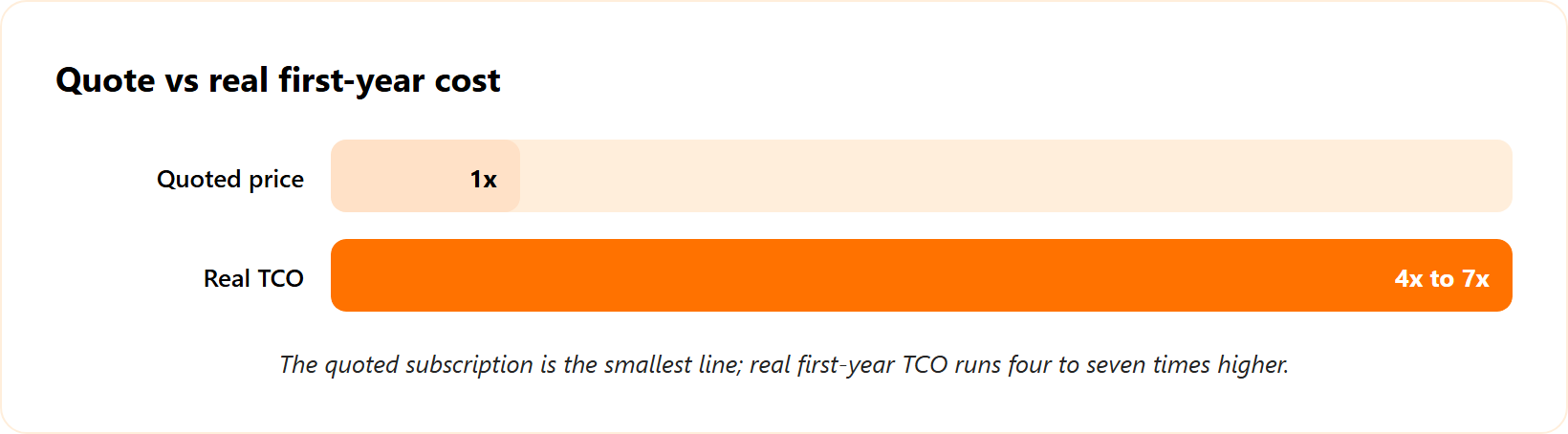
A starting price is a negotiating anchor, and a budget is something else entirely. Treat them as the same number and you will under-forecast.
Independent buyer analysis pegs the gap between the quoted price and true spend at 25 to 40 percent, driven by integration depth, retention rules, and support tiers. So the headline figure is where the conversation starts, well below where it ends. Our practical guide to MDR pricing breaks down where those gaps hide.
What you can do with this article
My goal here is narrow and practical. I want you to walk into a vendor call able to model true cost yourself, so no anchor sets your expectations for you.
We built UnderDefense Agentic AI SOC around that frustration. We publish transparent, outcome-tied pricing through the UnderDefense Agentic AI SOC platform and fold concierge analyst response into the same number, so the quote you see maps to the invoice you get. Boards are tired of technical metrics they cannot parse, and some security leaders are breaking through by translating cyber risk into financial exposure. The rest of this guide gives you that translation, line by line.
Q2: What exactly are you paying for in an AI SOC, and is it a product or a maturity model?
An AI SOC is a set of orchestrated AI agents that triage and investigate alerts the way an L1 or L2 analyst would. They pull context from your SIEM, EDR, and identity tools, correlate it, and produce a verdict. It behaves less like a product and more like a maturity model with painful prerequisites. Noisy, untuned alert sources hand their noise straight to the AI. You are paying for investigation capacity, not magic.
Concept: what “investigation” really means
Let me define the unit you are buying. An “investigation” is one full pass on one alert, from raw signal to a decision of malicious or benign.
That single pass is expensive under the hood. On a typical alert, a modern AI SOC can fire over 100 distinct large language model calls to investigate autonomously, and keeping that orchestration sane is genuinely hard.
Example: the agent assembly line
Academic work on agentic security describes a consistent pattern, a triage agent, then an investigator agent, then a verifier or critic agent that checks the reasoning. Think of it as an assembly line for one alert.
I find the cleanest mental model is military. AI agents are your foot soldiers, your human analysts are the generals directing them, and your senior people are special forces for the hard missions. If you want the fuller argument, we wrote about whether AI kills or saves your SOC team.
The prerequisite nobody prices
Here is the part vendors skip. An AI SOC inherits the quality of your detections.
If your alerts are weak, the AI cannot save you. A landmark study of SOC analysts found that close to 99 percent of alerts in some environments are false positives, so feeding that volume into a per-investigation engine simply industrializes the noise.
What to audit before you buy
So before signing, audit your own pipeline. Count your daily alert volume, your false-positive rate by source, and which detections fire most.
We built our MDR service to do that tuning work as part of onboarding, vendor-agnostic across your existing tools, so you are not paying per investigation against noise you never cleaned up. You pay for verdicts that mean something, rather than for an expensive way to reprocess junk.
Q3: Which AI SOC pricing model is right for you: per-investigation, per-endpoint, per-data, or flat fee?
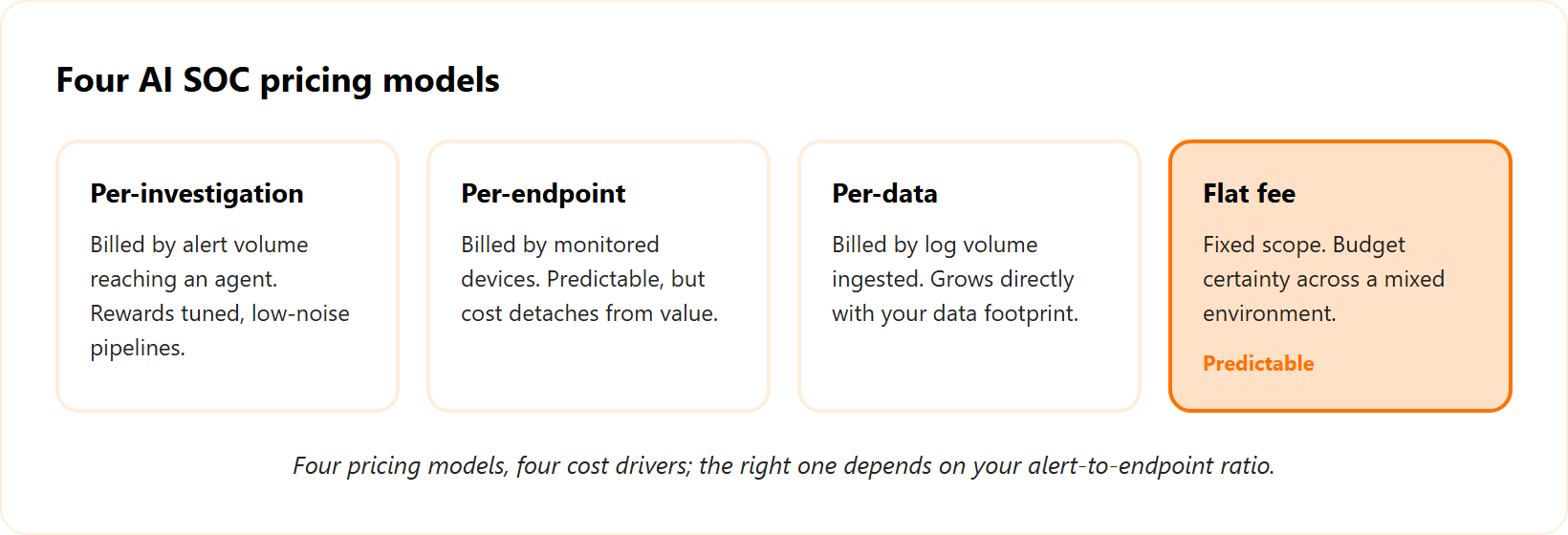
Four models dominate the market. Per-investigation or per-alert (Dropzone, Prophet), per-endpoint (most managed detection providers, at $119 to $440+ per endpoint per year), per-data or per-GB ingested (tied to your SIEM), and a flat platform fee. Per-investigation rewards clean alert pipelines and penalizes noisy ones, per-endpoint stays predictable but disconnects cost from value, and per-data grows with your data. The right model is whichever one your alert-to-endpoint ratio makes cheapest at scale.
The problem: the model matters more than the rate
Buyers fixate on the headline rate and ignore the model. That is backwards.
The model decides how your bill behaves when you grow, get breached, or have a noisy month. A low per-investigation rate is no bargain if your stack generates ten times the investigations you expected. Our SOC pricing page shows how a flat model behaves under load.
Compare the four models side by side
| Pricing model | Cost driver | Best fit | Hidden risk |
|---|---|---|---|
| Per-investigation | Alert volume that reaches an agent | Teams with tuned, low-noise detections | Noisy stacks multiply the bill |
| Per-endpoint | Headcount of monitored devices | Predictable, slow-growing environments | Cost detached from actual value delivered |
| Per-data (per-GB) | Log volume ingested | Small, stable data footprints | Penalizes growth and full visibility |
| Flat platform fee | Fixed scope | Budget certainty, mixed environments | Scope creep priced as add-ons |
The payoff: match the model to your reality
Now match it to your situation. A high-noise SOC should fix detections before accepting per-investigation pricing, or it pays retail for grunt work that tuning should have removed.
A clean SOC benefits from per-investigation, since low volume keeps the bill honest. A fast-scaling company adding endpoints monthly should fear per-endpoint creep. One buyer captured the trap well, complaining that vendors brag about cutting false positives, yet still hand you an event you have to action yourself. Weighing an outsourced SOC against an in-house build often settles the model question.
We price the UnderDefense Agentic AI SOC platform as detection plus concierge response together, so the verdict arrives already actioned rather than as one more ticket in your queue.
Q4: What are the hidden costs of an AI SOC that never appear on the pricing page?
The metered rate rarely covers the whole bill. The routine surprises are onboarding and integration fees, overage or burst rates ($10 per extra investigation), data-residency and single-tenant premiums, audit-trail retention extensions, and compliance-tier surcharges of 15 to 30 percent tied to SOC 2, ISO 27001, and NIS2 obligations. There is also an infrastructure tax, because autonomous agents generate roughly 450 percent more network traffic than a human doing the same task. Together these inflate true spend 25 to 40 percent beyond the quote.
The problem: “included” hides a lot
Every pricing page has a gap between “included” and “extra.” The included column wins the demo, and the extra column wins the renewal.
That gap is where budgets quietly break. You approve a number, then discover the integrations, the residency rules, and the retention you actually need sit outside it. Our 2026 cybersecurity budget playbook helps you plan for those lines in advance.
The agitation: the costs underwriters miss
Two numbers stick with me. First, autonomous agents are heavy, generating around 450 percent more network traffic than a human running the same task, so your demand signal climbs fast once agents scale.
Second, tokenomics are volatile. In one production view, a single agent had run up almost $24,000, visible only because someone was watching token spend per agent. Recursive reasoning also has a ceiling, as engineers report quality degrading once you fill much past half the context window. These are the kind of details our AI SOC red flags guide tells you to probe.
Compliance: the surcharge nobody forecasts
Compliance is where the quiet markup lives. Vendors commonly attach a 15 to 30 percent surcharge for higher-assurance tiers mapped to SOC 2, ISO 27001, the EU NIS2 Directive, and SEC 8-K disclosure needs.
Switching carries its own tax, with migrations often running 6 to 10 weeks of overlapping cost and effort. None of that appears on the first quote, which is why some teams end up exploring compliance services separately.
The solution: the audit to run before signing
Before you sign, demand answers on these twelve lines.
- Onboarding and integration fees per connector
- Overage and burst rates per investigation
- Data-residency and single-tenant premiums
- Audit-trail and log-retention extensions
- Premium or “enterprise” integration tiers
- Compliance-tier surcharges (SOC 2, ISO 27001, and NIS2)
- Network and infrastructure egress under agent load
- Token or compute ceilings and overage behavior
- Support-tier gating for faster response
- Volume re-rating at renewal
- Switching and offboarding costs
- Data export and portability fees
We designed the UnderDefense Agentic AI SOC platform as a flat, transparent model that bundles integration and concierge response, so the lines competitors itemize sit inside one predictable number.
Q5: How do you actually calculate AI SOC TCO, and what does the in-house alternative really cost?
Model total cost of ownership (TCO, the full multi-year cost, not the license) across five components: platform fee, integration, tuning and detection engineering, analyst oversight, and exit cost. That total typically runs 4 to 7 times the subscription in year one. Benchmark it against in-house. One loaded 24/7 analyst position runs roughly $124,163 a year at 30 percent overhead, and a five-person rotation reaches about $620,815 a year (2017 dollars, higher today). The real question is whether an AI SOC costs less than five hires you cannot find.
The five components, stated up front
Most buyers price the license and forget the rest. So here are the five lines that make up real TCO.
- Platform fee: the quoted subscription
- Integration: connecting your SIEM, EDR, and identity tools
- Tuning: detection engineering to cut noise
- Oversight: human analyst time to verify verdicts
- Exit: migration and offboarding when you leave
Worked example: normalize to cost per investigation
Numbers get clearer when you reduce them to one unit. Dropzone AI lists $36,000 a year for 4,000 investigations, which is about $9 each. Prophet Security lists $50,000 a year for 5,000 investigations, roughly $10 each.
Those rates look close. The spread shows up later, in integration depth, overage, and the oversight hours each platform demands. Our MSSP pricing breakdown walks through the same normalization exercise.
The in-house floor nobody enjoys quoting
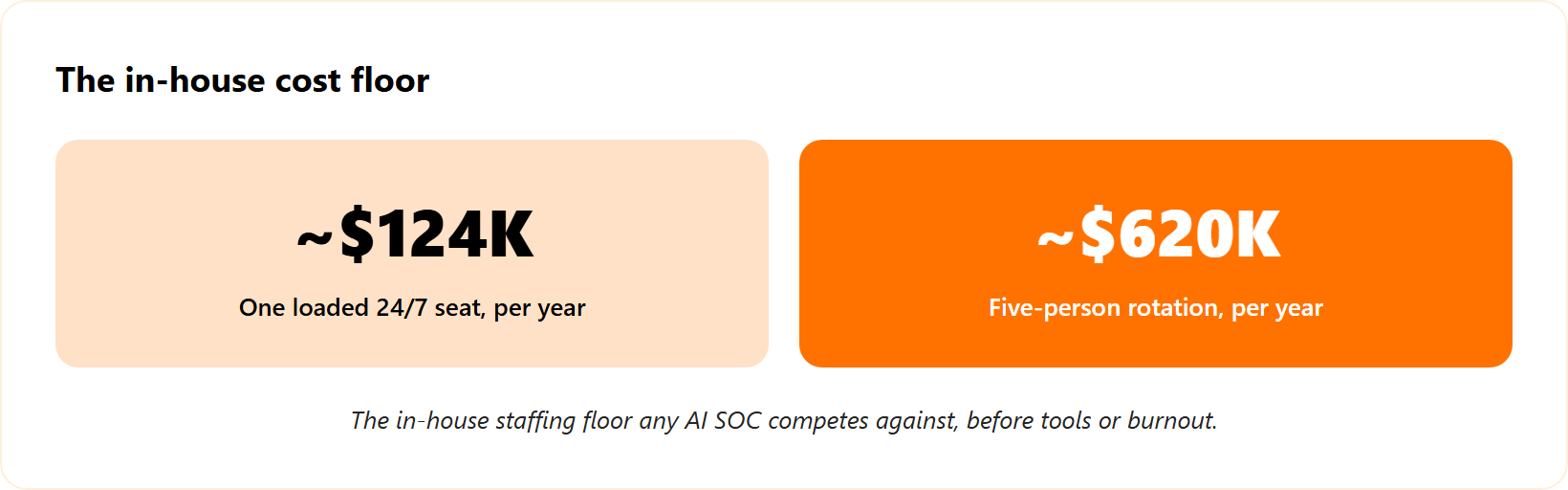
Here is the comparison that reframes the whole decision. A single fully loaded 24/7 seat costs around $124,163 a year, and five of them reach roughly $620,815 a year.
That is the floor, before tools, before burnout, before the seats you cannot fill in this hiring market. Build-versus-buy is shrinking as a gap, yet 24/7 consistency and trustworthy decisions stay genuinely hard to staff internally, which is exactly the tension our outsourced versus in-house SOC guide unpacks. You can sanity-check your own numbers with our SOC cost calculator.
How to model your own number
You can do this on one page. Take the vendor subscription, then multiply by 4 to 7 for a realistic first-year band, adjusting up for messy integrations.
Compare that band against your in-house floor above. We built the UnderDefense Agentic AI SOC platform to deliver that 24/7 consistency at a TCO below five hires, with a 2-minute alert-to-triage SLA and a separate 15-minute escalation SLA for critical incidents.
Q6: Why is proving “breach-prevention ROI” a trap, and how should you justify the spend instead?
Stop calculating ROI on “breaches avoided.” Proving a negative fails, and the “cost of downtime” number gets argued down to nothing. Discount vendor ROI decks for demo-environment optimism (30 to 50 percent), alert-quality drift (20 to 40 percent), and survivorship bias, since only about 5 percent of agentic AI deployments show measurable profit-and-loss impact. Then justify spend through financial exposure, reclaimed analyst-hours, and IBM’s documented $1.88M breach-cost delta for organizations using extensive AI and automation.
The calculation everyone reaches for
Walk into most budget meetings and you hear the same pitch. We spend X, we avoid a breach worth Y, so the ROI is obvious.
The standard read gets this backwards. The moment you anchor on “breaches avoided,” you have handed your CFO an argument you cannot win. Our cybersecurity budget guide for mid-market firms frames a better starting point.
Why the math collapses
You cannot prove a negative. If no breach happened, pointing to the one control that stopped it is nearly impossible, so seasoned CISOs avoid that question entirely.
The downtime number fares no better. It almost always gets argued down to zero, because revenue you “would have lost” is easy to dispute and hard to defend.
Discount the vendor deck before you trust it
Vendor ROI slides are built in clean rooms. So apply three honest haircuts before you believe them.
- Demo-environment optimism: discount 30 to 50 percent, since polished demos hide real noise
- Alert-quality drift: discount 20 to 40 percent, because SANS data shows 40 to 60 percent of alerts are false positives in typical SOCs
- Survivorship bias: discount hard, since roughly 5 percent of agentic AI projects reach measurable P&L impact
The reframe that actually lands
Here is what works with a board. Translate cyber risk into financial exposure, then track what you can measure: reclaimed analyst-hours and faster containment.
Anchor it in real data. IBM found organizations using extensive AI and automation paid $1.88M less per breach and contained incidents about 100 days faster. We built transparent ROI reporting into our MDR service so you can show verifiable evidence, rather than defending a number anyone can argue away.
Q7: How do Dropzone AI, Prophet Security, and Microsoft Security Copilot compare on cost per investigation?
Normalized to one unit, Dropzone AI runs about $9 per investigation ($36,000 for 4,000). Prophet Security runs about $10 per investigation ($50,000 for 5,000), plus $10 per overage. Microsoft Security Copilot bills roughly $4 per SCU-hour (Security Compute Unit), near $35,040 a year per unit, and per-endpoint managed detection spans $119 to $440+ per endpoint a year. The rates sit close, so the real differentiator becomes what an “investigation” includes and whether the platform actions the response.
What each price actually buys
A per-investigation rate tells you almost nothing until you ask what the investigation covers. Some end at a verdict. Others carry through to a contained threat. Our MDR vendors list compares how far each provider takes the response.
| Vendor / model | Price unit | Response included | Overage |
|---|---|---|---|
| UnderDefense Agentic AI SOC | Flat, outcome-tied | Concierge analyst response | Inside the flat fee |
| Dropzone AI | ~$9 / investigation | Verdict, you action it | Custom |
| Prophet Security | ~$10 / investigation | Verdict, you action it | $10 each |
| Microsoft Security Copilot | ~$4 / SCU-hour | Depends on your stack | Metered |
| Per-endpoint MDR | $119 to $440+ / endpoint / yr | Varies by tier | Tier upgrade |
The “AI washing” caution and what to test
Watch for relabeling. Some providers renamed a product without rebuilding the outcomes underneath, and buyers feel it during procurement when “a lot of similar products” suddenly appear. We flag the warning signs in our AI SOC red flags guide.
In a proof of value, test whether the platform closes false positives on its own and whether response is included. Verified UnderDefense Agentic AI SOC users speak directly to that outcome.
“The biggest win for me was getting actual control over our security alerts. Their team cleaned up our configurations and got the noise under control within the first week. Now when we get an alert, we know it’s something worth looking into.”
Verified User in Marketing and Advertising, Small-Business UnderDefense G2 Verified Review
“UnderDefense Agentic AI SOC integrates well with our systems, specifically with our SIEM, Splunk. Their team is proactive in identifying and addressing threats, providing 24/7 oversight.”
Oleg K., Director of Information Security UnderDefense G2 Verified Review
Q8: Is a fully autonomous SOC realistic, and what does that mean for what you should pay for?
A fully autonomous SOC from tier one to tier three stays unrealistic today, both technically and operationally. You do not want software autonomously quarantining users across your business. AI agents behave like teenagers: supremely intelligent, with no fear of consequence. At scale, getting it right 99 percent of the time still means one bad action in a hundred. Pay for context collection and speed, and keep humans on the decisions.
The situation vendors sell
The pitch is seductive. Hand the SOC to the machine, watch it contain threats in under a minute, and reassign your analysts.
Some platforms genuinely demonstrate this, with automated fusion workflows that deny access and stop an EC2 instance in under sixty seconds. That speed is real and useful, and it is the kind of capability our SOC automation checklist helps you scope.
The complication: one in a hundred is brutal
Here is where I get cautious. Getting it right 99 percent of the time sounds great until you count the actions.
An autonomous SOC takes thousands of actions on your behalf. One wrong action in a hundred, at that volume, is genuinely bad. I have watched a stray character in a PowerShell script cause a full outage, so I respect how a confident agent can be confidently wrong.
The answer: buy augmentation, price the humans in
So decide what you are actually paying for. Patent filings across the category, from Varonis to Microsoft to Rapid7, describe iterative AI investigation that still routes high-risk decisions to a human gate.
That design choice is the right one. We built the UnderDefense Agentic AI SOC platform so the agents act as foot soldiers collecting context fast, while our concierge analysts act as the generals who make the containment call. Price the human oversight in deliberately, because that is the line that keeps autonomous speed safe to buy, a stance we expand on in our take on whether AI kills or saves your SOC team.
Q9: What should you do before you sign to pressure-test an AI SOC quote?
Before you sign, baseline your own false-positive rate, mean-time-to-triage, and analyst-hours per incident for 30 days, because that becomes the denominator for every ROI claim. Run a 60 to 90 day paid pilot against real production volume with a walk-away clause. Map spend to NIST CSF (Cybersecurity Framework) risk families to expose proactive gaps, and audit existing E5 entitlements so you avoid buying what you already own.
Why baselining first changes the whole negotiation
Here is the move most buyers skip. They evaluate a quote before they know their own numbers, so the vendor’s deck sets the baseline for them.
Flip that order. Once you hold your own false-positive rate and triage times, every ROI slide becomes something you can check, rather than something you have to trust. Studies put typical false positives at 40 to 60 percent, and some environments far higher, so your real number is the only one that matters. Our guide to SOC metrics like MTTD and MTTR shows how to capture that baseline cleanly.
The four steps to run before you sign
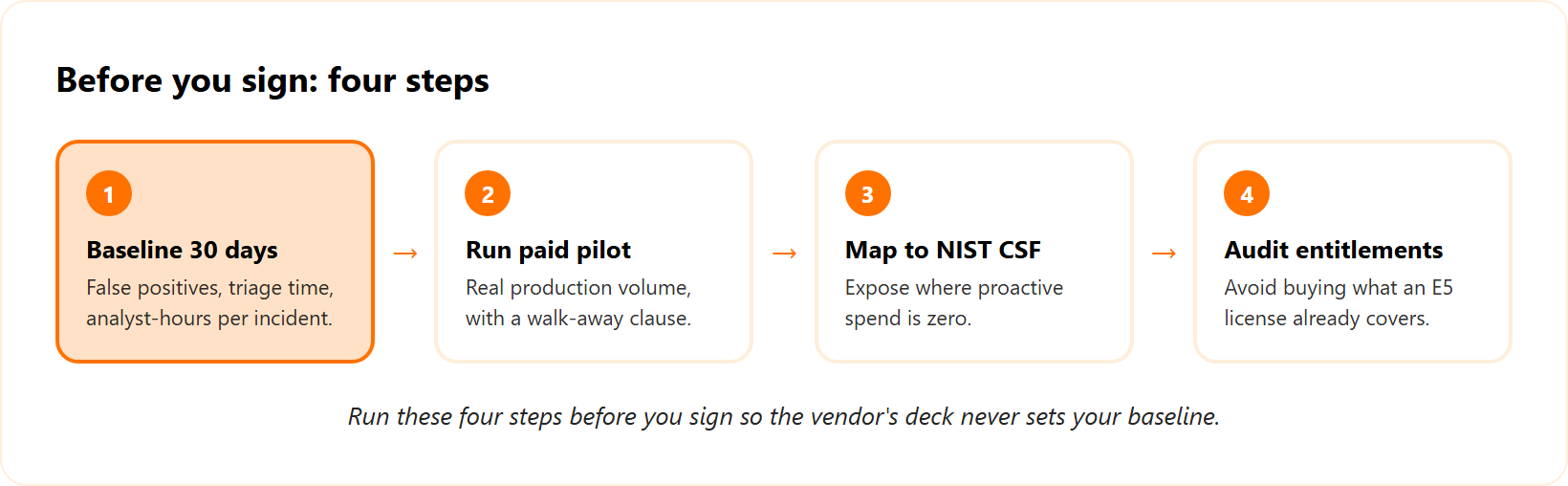
Do these in order. Each one strengthens your hand at the table.
- Baseline for 30 days. Record your false-positive rate, mean-time-to-triage, and analyst-hours per incident. This is the denominator for every claim a vendor makes.
- Run a paid pilot. Test 60 to 90 days against real production volume, with pre-set baseline deltas and a walk-away clause if targets miss.
- Map spend to NIST CSF. Allocate budget across the risk families, and you may find zero dollars going to proactive work, which reframes the buy. Our 2026 cybersecurity budget playbook walks through that allocation.
- Audit what you own. Many teams already pay for capabilities inside a Microsoft E5 license, so confirm before buying a duplicate. Our MDR for Microsoft 365 page shows what overlaps.
A quick shadow-IT tip while you baseline. As a Google Workspace admin, you can see every site where staff authenticated through OAuth, which surfaces unmanaged app sprawl fast, the kind of exposure our attack surface management guide helps you map.
What real teams report after this discipline
Buyers who baseline first tend to value the noise reduction most, because they can finally measure it. Verified UnderDefense Agentic AI SOC reviews echo that.
“Before UnderDefense Agentic AI SOC, we were slightly overwhelmed with alerts and often unsure of how to prioritize or respond to them. Now, not only do we get alerts, but we also get clear guidance on how to handle them, and false positives have become a rarity.”
Valeriia D., Marketing Specialist UnderDefense G2 Verified Review
“They’ve also made our audit process much less painful. The reports from their platform give us clear evidence of our security controls. Worth every penny for us.”
Verified User in Marketing and Advertising, Small-Business UnderDefense G2 Verified Review
“UnderDefense Agentic AI SOC integrates well with our systems, specifically with our SIEM, Splunk. Their team is proactive in identifying and addressing threats, providing 24/7 oversight.”
Oleg K., Director of Information Security UnderDefense G2 Verified Review
The question I’m sitting with
My current read is that the next 18 to 24 months will reward buyers who treat the baseline as their leverage, since only about 5 percent of agentic AI deployments today show measurable profit-and-loss impact. The teams that walk in with their own numbers will be the ones who get honest pricing, which is one reason businesses switch cybersecurity providers.
We are happy to run that baseline and model the real TCO with you, concierge analysts included, through our MDR service. If you want a second set of eyes on a quote before you sign, that is work we do every day.
1. How much does an AI SOC actually cost in 2026?
The honest answer is that the subscription is the smallest line on the invoice. Published entry points sit around $36,000 a year (Dropzone AI, for 4,000 investigations) and roughly $50,000 a year (Prophet Security, for 5,000 investigations, plus $10 per overage).
From what surfaces when we actually model these deals, real first-year total cost of ownership lands at four to seven times the sticker price for a mid-sized team. The gap comes from:
- Integration and onboarding per connector
- Overage and burst rates
- Data residency, retention, and compliance surcharges
- The human oversight hours each platform quietly assumes
We think the only number worth trusting is your own. Before you accept any quote, baseline your false-positive rate and triage time, then multiply the subscription by four to seven for a realistic band. We walk buyers through that exercise in our practical guide to MDR pricing, and we publish transparent figures on our SOC pricing page so the quote you see maps to the invoice you get.
2. What is the difference between Dropzone AI pricing and Prophet Security pricing?
On the surface the rates look almost identical. Normalized to one unit, Dropzone AI runs about $9 per investigation ($36,000 for 4,000), and Prophet Security runs about $10 per investigation ($50,000 for 5,000), plus $10 for each overage investigation.
The standard read stops there, but the real spread shows up after the rate card:
- How deep the integrations go before you pay a premium tier
- How overage behaves in a noisy month
- How many human oversight hours each platform assumes you supply
Both price the verdict, then hand you the response to action yourself. That is the line item buyers underestimate, because someone on your team still has to contain the threat.
We built our model differently, bundling detection and concierge analyst response into one number so the verdict arrives already actioned. If you are weighing named vendors against each other, our MDR vendors comparison breaks down how far each provider carries the response, which is where the true cost difference actually lives.
3. How do you calculate the total cost of ownership for an AI SOC?
We model AI SOC total cost of ownership across five components, not just the license:
- Platform fee, the quoted subscription
- Integration, connecting your SIEM, EDR, and identity tools
- Tuning, the detection engineering that cuts noise
- Oversight, human analyst time to verify verdicts
- Exit, migration and offboarding when you leave
Added up, that total typically reaches four to seven times the subscription in year one. The cleanest way to sanity-check it is to normalize everything to cost per investigation, then benchmark against the in-house alternative.
Here is the comparison that reframes the decision. One fully loaded 24/7 analyst seat runs roughly $124,000 a year, and a five-person rotation for round-the-clock coverage reaches about $620,000. That is the real floor any AI SOC competes against.
We help teams model their own number with our SOC cost calculator, so the build-versus-buy math reflects your environment rather than a vendor’s clean-room demo.
4. What hidden costs of an AI SOC never appear on the pricing page?
The metered rate rarely covers the whole bill. From what we see in real procurement, the routine surprises are:
- Onboarding and integration fees per connector
- Overage or burst rates, often $10 per extra investigation
- Data-residency and single-tenant premiums
- Audit-trail and log-retention extensions
- Compliance-tier surcharges of 15 to 30 percent tied to SOC 2, ISO 27001, and NIS2
There is also an infrastructure tax that almost nobody forecasts. Autonomous agents generate roughly 450 percent more network traffic than a human running the same task, so egress and compute climb fast once agents scale. Token spend is volatile too; we have seen a single agent quietly run up nearly $24,000.
Together these inflate true spend 25 to 40 percent beyond the quote. Before signing, demand answers on each line above, and plan for them deliberately. We map these surprises out in our 2026 cybersecurity budget playbook so they hit your forecast, not your renewal.
5. Which AI SOC pricing model is best: per-investigation, per-endpoint, per-data, or flat fee?
There is no universally best model; there is only the one your environment makes cheapest at scale. Four dominate the market:
- Per-investigation rewards clean, tuned alert pipelines and punishes noisy ones
- Per-endpoint stays predictable but disconnects cost from value
- Per-data, or per-GB ingested, grows directly with your log volume
- Flat platform fee gives budget certainty across a mixed environment
The model matters more than the headline rate, because it decides how your bill behaves when you grow, get breached, or have a noisy month. A low per-investigation rate is no bargain if your stack fires ten times the alerts you expected.
Our blunt advice: a high-noise SOC should tune detections before accepting per-investigation pricing, or it pays retail for grunt work. A fast-scaling company should fear per-endpoint creep. We price our platform as detection plus response together, and our take on outsourced versus in-house SOC helps you match the model to your reality.
6. How do we justify AI SOC spend to a CFO or board?
We tell buyers to stop calculating ROI on breaches avoided. Proving a negative fails, and the cost-of-downtime number almost always gets argued down to zero in a budget meeting.
Instead, justify the spend on what you can actually measure:
- Financial exposure translated from cyber risk into dollars
- Reclaimed analyst-hours from cutting false positives
- Faster containment and reduced breach cost
Anchor it in hard data. IBM found organizations using extensive AI and automation paid $1.88M less per breach and contained incidents about 100 days faster. That is a number a board can hold onto.
Also discount the vendor’s ROI deck before you trust it; demo-environment optimism alone is worth a 30 to 50 percent haircut, and only about 5 percent of agentic AI deployments show measurable profit-and-loss impact. We build transparent ROI reporting into our MDR service, so you present verifiable evidence rather than defending a figure anyone in the room can argue away.
7. Is a fully autonomous AI SOC realistic, and should we pay for one?
Our current read is that a fully autonomous SOC from tier one to tier three stays unrealistic today, both technically and operationally. We might be wrong in five years, but right now you do not want software autonomously quarantining users across your business.
The math is unforgiving. An autonomous SOC takes thousands of actions on your behalf, so getting it right 99 percent of the time still means one bad action in a hundred. At volume, that one action can be an outage.
So decide what you are actually paying for:
- Context collection and investigation speed, where AI agents genuinely excel
- Human judgment on high-risk containment, which still belongs at a human gate
We built our model so agents act as fast foot soldiers collecting context, while concierge analysts make the containment call, with a 2-minute alert-to-triage SLA and a separate 15-minute escalation SLA for critical incidents. Our view on whether AI kills or saves your SOC team expands on why human-plus-automation is the resilient model.
8. What should we do before we sign an AI SOC contract?
We recommend a short, disciplined playbook that puts the leverage back on your side of the table:
- Baseline for 30 days. Record your false-positive rate, mean-time-to-triage, and analyst-hours per incident; this becomes the denominator for every ROI claim.
- Run a paid pilot for 60 to 90 days against real production volume, with pre-set targets and a walk-away clause.
- Map spend to NIST CSF risk families to expose where you have zero proactive coverage.
- Audit what you already own, since many teams pay for capabilities inside a Microsoft E5 license they never activated.
The reason this works is simple. Once you hold your own numbers, the vendor’s deck stops setting the baseline for you, and every claim becomes something you can verify.
We are happy to run that baseline and model the real total cost of ownership with you, concierge analysts included. If you want a second set of eyes on a quote before you sign, our team is one message away.