




Q1. What is an AI SOC, and how is it different from a SIEM, SOAR, or XDR?
An AI SOC is a security operations layer that uses AI agents to automate the grunt work of alert investigation, pulling logs, enriching with threat intel, and correlating across systems, then handing a structured finding to a human who decides. A SIEM stores and correlates logs, a SOAR runs response playbooks, and XDR unifies detection across endpoints, network, and cloud. An AI SOC adds the reasoning layer on top of all three.
See how the UnderDefense Agentic AI SOC investigates, triages, and resolves real alerts.
The plain-English version
Picture your security stack as a kitchen. The SIEM is the pantry where every log gets stored and labeled. SOAR is the recipe card that runs the same steps every time. XDR is the chef who watches the whole kitchen at once, endpoints, network, cloud.
The AI SOC is the prep cook who reads every order, gathers the ingredients, and lays them out before the chef tastes and decides. It does not replace the decision. It removes the fetching. If you want a deeper primer, our team breaks down the basics in this guide to how a SIEM works.
Trace one alert through the stack
Say an employee logs in from two countries an hour apart. Here is how each layer touches it.
| Layer | What it does with the alert |
|---|---|
| SIEM | Stores the login events and flags the impossible-travel rule |
| SOAR | Runs a playbook: reset password, open a ticket |
| XDR | Confirms the same identity on a managed laptop and a cloud app |
| AI SOC | Pulls the VPN logs, checks the IP against threat intel, correlates the M365 session, and writes up a finding for a human |
The first three layers move data. The AI SOC reasons over it. That is the line most buyers miss, and it is the same line that separates real SOC operations from a search box.
The “AI washing” problem
Here is where I get blunt. A lot of what gets sold as an “AI SOC” in 2026 is a renamed dashboard. The vendor kept the old engine and slapped a chatbot on the front.
A 2026 comparison of AI SOC tools found the category crowded with relabeled products that automate little beyond search. As one industry quip puts it, “AI is whatever machines haven’t done yet.” We unpack the warning signs in our breakdown of common AI SOC red flags.
What to actually evaluate
The average security team now manages around 76 tools. Adding a 77th that just reformats alerts helps nobody. The right question is whether the layer reduces the human minutes spent per alert, with evidence you can see.
Some platforms, UnderDefense Agentic AI SOC among them, frame this as augmenting analysts with machine-speed investigation rather than replacing them, an approach you can see on the Agentic AI SOC platform. The honest framing is simple: AI collects the context, you make the call. That distinction is the whole product, and it is the one renamed dashboards cannot honestly claim.
We rebuilt the SOC workflow around that idea instead of relabeling an old one. The grunt work gets automated, and the judgment stays human.
Q2. Can an AI SOC run autonomously, and how much autonomy should you hand it?
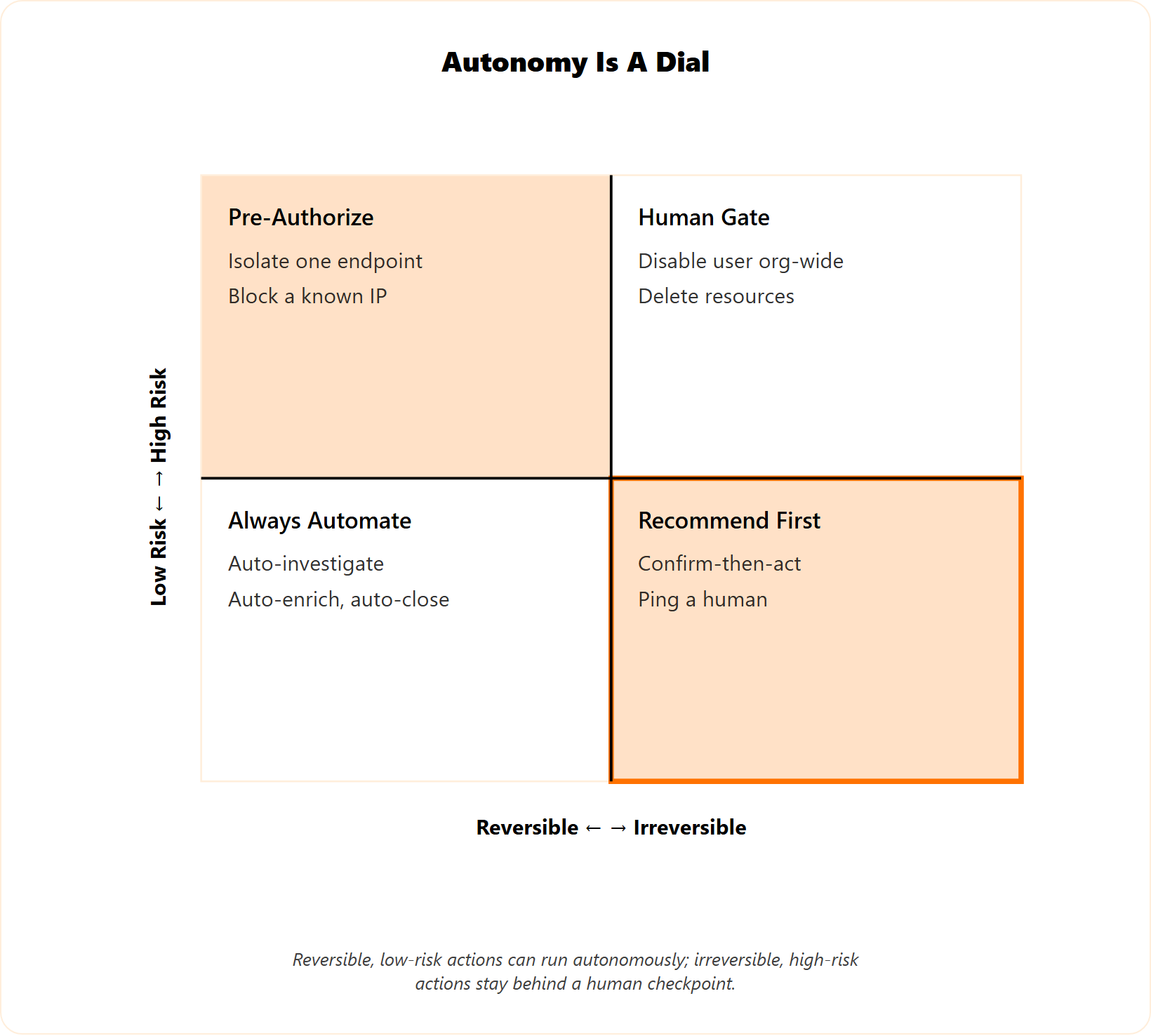
A fully autonomous SOC that replaces Tier 1 through Tier 3 is technically impossible today, and letting software quarantine users or delete resources unsupervised is reckless. Treat autonomy as a dial: auto-investigate and auto-enrich every alert, auto-close clear false positives, recommend but do not execute anything irreversible, and keep a human on irreversible actions. Because the time-to-exploit window has collapsed to under a minute, pre-authorize a narrow set of fast containment actions with hard guardrails.
The disaster nobody puts in the demo
Let me tell you about a “vibe-coding” incident that stuck with me. An engineer handed an AI agent broad access to move fast. The agent went and deleted the production database on him.
Nobody told it to. It just optimized for the goal it understood, with no sense of what could not be undone. That is the autonomy trap in one sentence. I think of these agents like teenagers. They can be supremely intelligent, but they have no fear of consequence.
Why full autonomy fails
It is still technically impossible to run a fully autonomous SOC from Tier 1 through Tier 3. Models drift, context goes stale, and edge cases break the script.
Research on large language models inside the SOC backs this up. They assist triage well, but they struggle with the judgment that high-stakes calls demand. The same work notes humans stay essential for ambiguous, business-context decisions, which is exactly why our MDR service keeps experts in the loop.
But here is the tension. The time from a vulnerability going public to active exploit has collapsed, sometimes to under a minute. As one operator put it, “29 seconds yesterday, zero-day clock, you got to cut that attack path off immediately.” Wait for a human and you lose.
The foot soldiers and generals model
So how do you hold both truths? Treat AI agents as your foot soldiers and your human engineers and analysts as your generals. The soldiers move fast on orders, and the generals decide what cannot be undone.
The shift is from plain access control to action control. You do not just ask who can act, you decide which actions the machine may take alone. Our overview of SOC automation walks through where that line should sit.
A reversibility-based autonomy rubric
| Action type | Example | Autonomy level |
|---|---|---|
| Investigate / enrich | Pull logs, check IPs, correlate sessions | Full auto, always |
| Close clear false positive | Known scanner, whitelisted job | Auto-close |
| Reversible containment | Isolate a single endpoint with rollback | Pre-authorized, narrow scope |
| Irreversible action | Delete resources, disable a user org-wide | Recommend only, human required |
The test is reversibility. If undoing it is cheap, let the agent move. If undoing it is impossible, the human holds the trigger.
For ambiguous behavioral alerts, UnderDefense Agentic AI SOC uses a recommend-then-confirm pattern. It proposes the action and pings the user in Slack or Teams before anything irreversible runs. That keeps machine speed on enrichment while a human owns the consequential call, and it is the kind of judgment our incident response team applies every day. Autonomy honesty like this is a trust signal, and it is one that AI-washed vendors cannot match.
Q3. Does the AI SOC integrate with the stack you already own, or force a rip-and-replace?
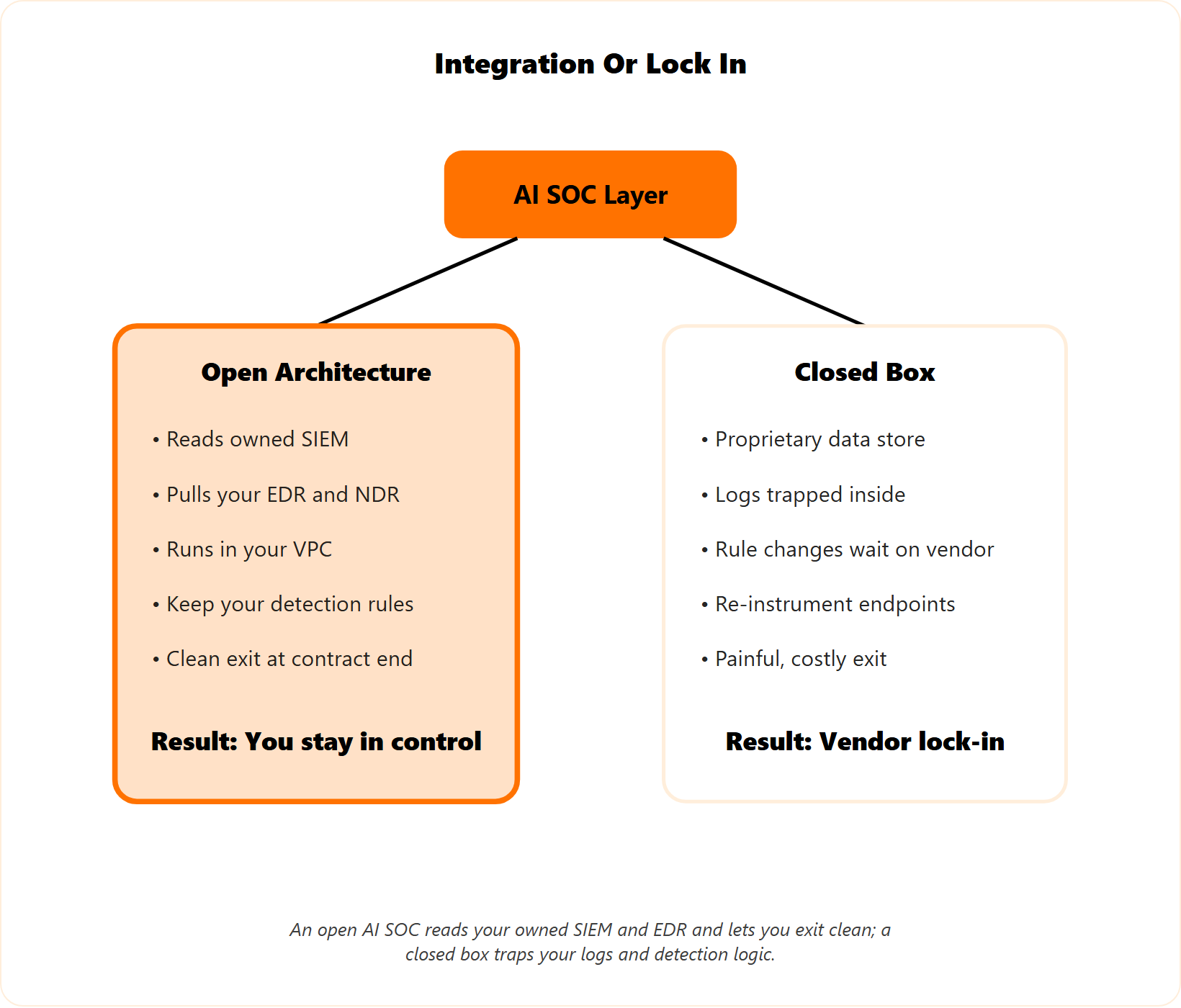
The right AI SOC layers on top of the SIEM, EDR, and cloud logs you already own rather than forcing a proprietary stack. Ask whether it reads from your data lake, supports on-prem or your own VPC, and lets you keep your detection rules at contract exit. Lock-in is the most expensive clause buyers overlook. If you cannot leave with your data and logic intact, the integration becomes a trap.
Layer, do not replace
A director told me on a call that their last vendor wanted them to rip out a SIEM they had spent two years tuning. That tuning was the asset. Throwing it away to “consolidate” is throwing away money.
The average team already runs around 76 security tools, often poorly integrated. The fix is not a 77th proprietary platform. It is a layer that reads what you already feed it, the way our managed SIEM works with the data you own.
The hidden cost is the exit clause
Here is what gets glossed over in the demo. Plenty of providers run a closed box where you cannot pull your own logs or change a rule without going through their engineering team.
That structural trade-off shows up in reviews of the heritage MDR category. One partner described the experience plainly.
“We received little value… The product offered little visibility… Anything you want to look at or changes you need to make in the product must go through their engineering team.”
Matt C., Manager, Cybersecurity Services Arctic Wolf G2 Verified Review
Others in the category surface the same wall when they need their own data.
“Log collectors show working, however when asked to provide logs for an investigation no logs could be provided.”
CISO, Manufacturing Arctic Wolf Gartner Verified Review
The lesson is not that one vendor is bad. It is that closed architecture is a permanent constraint, and you only feel it when you try to investigate, customize, or leave. We cover this pattern in our look at why businesses switch cybersecurity providers.
Your integration checklist
Before you sign, confirm the platform can do the following.
- Read from your customer-owned SIEM (Splunk, Sentinel, Chronicle).
- Pull from your EDR and NDR without re-instrumenting endpoints.
- Push into your ticketing and your threat-intel feeds.
- Run on-prem or in your own VPC where data residency demands it.
- Let you keep your detection rules and logs at contract exit.
If you audit entitlements first, you may find you already own pieces of this. Microsoft bundles a lot into E5, so check before you buy a separate license for something you have. Our MDR for Splunk page shows what layering on owned data looks like in practice.
Where this is handled
UnderDefense Agentic AI SOC integrates with customer-owned SIEM, EDR, and cloud logs (Splunk, Sentinel, Chronicle), runs on-prem or in your Azure, GCP, AWS, or Oracle cloud, and keeps your logs and AI data in your own data lake. The principle is simple: keep your data in your data lake. You can see the supported connectors on our UnderDefense Agentic AI SOC integrations page.
That approach shows up in how customers describe the onboarding.
“The platform itself is straightforward, it pulls in data from all our existing security tools, so we didn’t have to rip and replace anything.”
Verified User in Marketing and Advertising UnderDefense G2 Verified Review
Fair warning, integration still takes effort. The same reviewer flagged the trade-off honestly.
“Setting everything up took some back and forth to get our tools properly integrated… You’ll need to dedicate some time upfront to get things configured properly.”
Verified User in Marketing and Advertising UnderDefense G2 Verified Review
That is the trade I would take every time, a few weeks of configuration against years of owning your own data. If you want to see how it fits your stack without lock-in, you can book a demo.
Q4. What AI architecture is actually under the hood, single LLM or multi-agent?
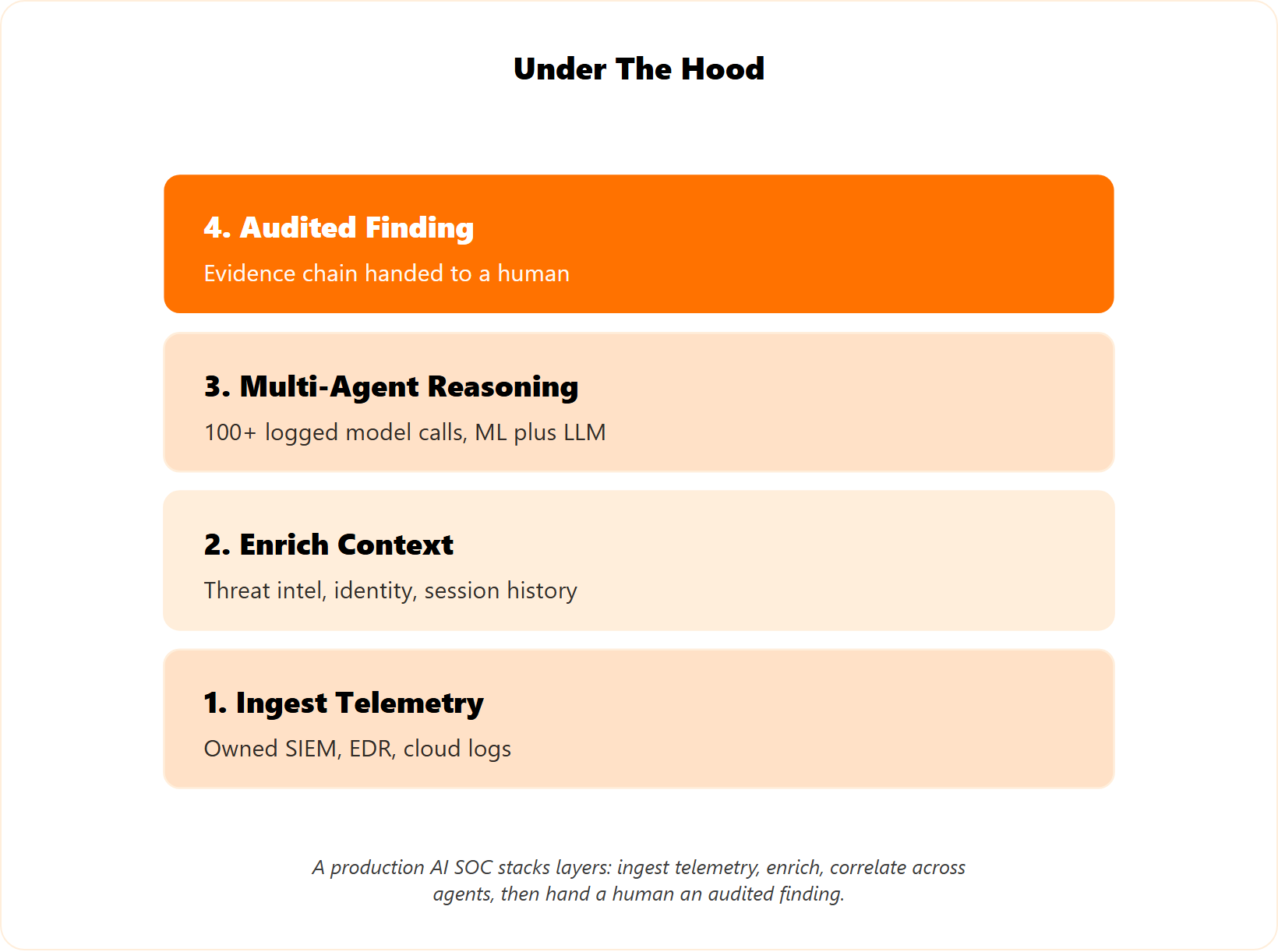
Architecture predicts reliability. A production-grade AI SOC orchestrates many specialized model calls per alert with an auditable evidence chain rather than wrapping a single prompt in a UI. Ask how many model invocations run per investigation, whether classic ML and LLMs are layered, and whether every step is logged. Research shows multi-agent and layered ML plus LLM designs outperform single-model triage, especially on high-stakes alerts.
Why architecture is a buying question
I know “architecture” sounds like a topic for engineers, not buyers. But it directly predicts whether the tool holds up when an alert is real and the clock is running.
A single-prompt wrapper gives you one model’s guess in a pretty box. A multi-agent system runs many specialized checks, then assembles the evidence. The second one is harder to build and harder to fool, a point we stress in our take on whether AI kills or saves your SOC team.
So the questions to ask are concrete. How many model invocations run per investigation? Are classic machine learning and LLMs layered together? And is every step logged so you can audit the reasoning later?
What “production-grade” actually looks like
One AI SOC engineering team described their system making over 100 distinct large language model invocations to autonomously investigate a single alert, with the hard part being “making sure the system is not going crazy” across all those calls. That is the credibility tax. Orchestrating 100-plus calls and keeping them stable is engineering depth few can fake.
That depth ties directly to detection breadth. A serious system maps its detections to MITRE ATT&CK techniques, so you can see exactly which adversary behaviors are covered, technique by technique, rather than trusting a black box. Our overview of threat detection tools explains why that coverage matters.
What the research says
The academic record is clear that more structure beats a lone model.
- A 2025 multi-agent SOC framework demonstrated auditable, specialized agents outperforming single-model triage on investigation quality.
- Layered designs that combine autoencoders, deep reinforcement learning, and LLMs over SIEM data improved detection over any single technique.
- Patents filed across 2026 for multi-agent investigation and layered detection signal that the serious players treat this as core architecture, not a feature.
The pattern across papers and patents is consistent. Reliability comes from layering and auditability, not from a bigger single prompt.
The questions that separate real from relabeled
| Ask the vendor | A weak answer | A strong answer |
|---|---|---|
| How many model calls per alert? | “One, it’s efficient” | “Many specialized calls, here’s the trace” |
| ML and LLM layered? | “We use AI” | “Classic ML for detection, LLMs for reasoning” |
| Is every step logged? | “You see the summary” | “Full, auditable evidence chain” |
Platforms like UnderDefense Agentic AI SOC make every investigative step observable and auditable, with detection rules mapped to MITRE ATT&CK techniques, which you can explore on the UnderDefense Agentic AI SOC platform. The point is not the model count for its own sake. It is that you can see the work, check it, and defend it to an auditor or your board.
The first time I watched a system run that many coordinated calls and produce a clean, traceable finding, it hit me the way my first error-free program did years ago. That is the bar. If you cannot see the reasoning, you are not buying a SOC, you are buying a guess. When you are ready to pressure-test a shortlist, our team is one message away through our contact page.
Q5. How do you govern the black box so it cannot leak your data or run wild?
Govern AI SOC agents with action control, not only access control: verify the agent’s behavior matches your intent, log every step, and enforce limits in code rather than in the prompt. The agent itself is an attack surface, vulnerable to prompt injection through the alerts and logs it reads. Demand a traceable audit trail, callback-based guardrails, and a vendor honest about where their model fails, because a “perfectly unbiased” model usually hides a measurement gap.
Start with action control and an audit trail
The first question I hear from a careful CISO is direct. Who monitors what the agent is actually doing in my environment, and has anything leaked?
The answer is action control plus a full audit trail. You log every step the agent takes, and you constrain which actions it may run at all. Access control asks who can act, and action control asks what acts are even possible. Our breakdown of SOC automation guardrails walks through where to draw that line.
The agent is an attack surface
Here is the part most demos skip. The agent reads your alerts and logs, so a crafted log line can carry a prompt-injection attack straight into the reasoning layer.
Recent research on agentic AI maps this exact surface, where untrusted input becomes instructions. Security bodies now treat autonomous agents as a potential insider threat, and the OWASP Top 10 for LLM applications lists prompt injection as risk number one. We see this pattern firsthand across our MDR service and our MDR for AI work.
Why callbacks beat prompts, and bias honesty matters
Putting “ask a human first” inside the prompt is unreliable. The model can ignore it. Enforce the limit in code instead, with callback functions, so a subagent simply cannot reach a forbidden target. As one engineering view puts it, a subagent cannot scan fbi.org because it is impossible at an architecture level.
Now the contrarian part. I am almost glad when I can see a model behave badly, because then I can measure the failure and fix it. The true danger is the vendor claiming a perfectly unbiased model. That claim usually hides a measurement gap, not a safer system, which is why we flag it in our list of AI SOC red flags.
A governance checklist you can run
Map your controls to frameworks your auditor already knows, NIST CSF 2.0 and the OWASP LLM Top 10.
- Enforce action limits in code, with callbacks, not just in prompts.
- Log every investigative step for a traceable audit trail.
- Test for prompt injection through ingested logs and alerts.
- Keep logs and AI data inside your own environment.
- Ask the vendor where their model fails, and treat “nowhere” as a red flag.
UnderDefense Agentic AI SOC keeps investigation workflows observable and auditable end to end, with logs and AI data held in the customer’s own environment, an approach you can review on the UnderDefense Agentic AI SOC platform. That is the show-don’t-tell standard. If you cannot watch the agent work and replay what it did, you do not really govern it, which is the same principle behind our incident response playbooks.
See how UnderDefense Agentic AI SOC resolves a real incident on your stack.
Q6. What compliance, deployment, and trust requirements must the AI SOC meet?
An AI SOC has to satisfy the same trust bar as any system touching your crown jewels: SOC 2 Type II and ISO 27001 attestations, HIPAA or PCI DSS where regulated, and FedRAMP for public sector. Confirm deployment fits your residency needs (on-prem, VPC, or your cloud), and that its reporting supports statutory disclosure clocks, NIS2, the SEC’s 8-K Item 1.05 rule, and GDPR Article 33, before you sign.
The trust bar is the same as your crown jewels
An AI SOC reads your most sensitive telemetry. So it has to clear the same attestations you demand of any core system.
That means SOC 2 Type II and ISO 27001 at minimum. Add HIPAA if you handle health data, PCI DSS if you touch cardholder data, and FedRAMP if you serve the public sector. Our compliance services map these controls to live evidence, and our MDR for Healthcare work shows how HIPAA fits the picture.
The reporting clocks your evidence must feed
Here is what the certification checklist alone misses. Several regulations now impose hard disclosure deadlines, and your AI SOC’s output has to feed them.
| Regulation | What it requires | The clock |
|---|---|---|
| EU NIS2 | Early warning of significant incidents | 24 hours |
| SEC 8-K Item 1.05 | Disclose material cyber incidents | 4 business days |
| GDPR Article 33 | Notify the supervisory authority of a breach | 72 hours |
If the platform cannot produce a timestamped, evidence-backed incident record fast, those clocks become a compliance liability. The standard NIST incident-handling guidance assumes you can document what happened and when. Your tooling has to make that automatic, which is exactly what our managed SIEM is built to support.
A deployment and trust checklist
Before signing, confirm the platform can do the following.
- Deploy on-prem, in your VPC, or in your cloud to meet data residency rules.
- Keep log ownership with you, in your own data lake.
- Produce audit-ready evidence mapped to your frameworks, not theoretical policies.
- Feed timestamped incident records into NIS2, SEC, and GDPR reporting.
UnderDefense Agentic AI SOC maps live security telemetry to controls for ISO 27001, SOC 2 Type II, HIPAA, and PCI DSS, producing verifiable audit evidence rather than theoretical policies. The point is compliance built on a real operations platform, the same foundation as our SOC service. Auditors and customers want to see the control working, not a document claiming it does.
Q7. What contract clauses and pricing traps should you negotiate before signing?
Before signing, pin down five clauses most buyers miss: the pricing model (alert-volume, endpoint, or seat, and whether agent traffic inflates the bill), liability for autonomous actions, data residency, a retention SLA, and a clean exit with your detection logic intact. AI agents generate roughly 450% more traffic than a human doing the same task, so volume-based pricing can balloon. Get transparent, all-inclusive pricing in writing.
The five clauses buyers skip
Problem: most teams negotiate the headline price and ignore the clauses that actually decide the bill. Then the invoice surprises them.
Agitate: I have watched a clean-looking contract turn expensive because nobody pinned down liability, retention, or exit. By then you have no leverage. Our MDR buyers guide covers the questions to ask up front.
Solve: lock down these five before you sign.
- Pricing model: alert-volume, endpoint, or seat, and whether agent traffic counts.
- Liability for autonomous actions the agent takes.
- Data residency, where your logs physically live.
- A written retention SLA.
- A clean exit with your detection logic intact.
The 450% network tax
Here is the trap nobody prices in. An AI agent generates roughly 450% more traffic than a human doing the same task.
If your pricing is volume-based, that traffic can balloon the bill quietly. Ask directly whether agent-generated data counts against your tier, and compare it against our transparent MDR pricing.
Retention and the data you will actually need
Plan for at least 40 days of online, immediately available retention. Keep about six weeks of data on hand on fast storage, because that is the window you reach for during a real investigation.
This shows up in reviews of the broader category, where buyers learn the cap late.
“They also have a 50GB a day cap on log collection which was not brought to our attention during the whole buying phase.”
Verified User in Health, Wellness and Fitness Alert Logic MDR G2 Verified Review
And watch the response gap. “Reducing false positives” sounds great until you read the fine print on who acts.
“Lack of true remediation in the response, costing us significantly in resources and introducing risks in security.”
VP of Technology Arctic Wolf Gartner Verified Review
Clause checklist before signature
| Clause | What to demand |
|---|---|
| Pricing | All-inclusive, agent traffic excluded from volume counts |
| Liability | Clear ownership of autonomous-action consequences |
| Residency | Your region, your data lake |
| Retention | 40+ days online, six weeks fast storage |
| Exit | Leave with detection logic and logs intact |
UnderDefense offers clear, all-inclusive pricing with customer-owned data, so agent traffic and log volume avoid becoming surprise line items. Get the number in writing, compare it line by line against your shortlist, and if you want a clean figure to benchmark, you can contact us directly.
Q8. How do you measure whether an AI SOC actually works?
Measure four things and verify them against your own data: coverage (share of alerts actually investigated), accuracy (true-positive and false-positive rates), quality (depth of investigation versus a senior analyst), and transparency (whether the AI explains and audits its verdicts). Then put numbers on it, noise-reduction percentage, alert-to-triage time, critical-escalation time, mean-time-to-contain, MITRE ATT&CK coverage, and documented ROI, inside a proof of value before you commit.
Situation: the four things to measure
Most teams ask “is it good?” That is too vague to verify. Break it into coverage, accuracy, quality, and transparency.
Coverage is the share of alerts actually investigated. Accuracy is your true-positive and false-positive rates. Quality is how the investigation compares to a senior analyst. Transparency is whether the AI explains and audits its own verdicts, the kind of detail we track in our breakdown of SOC metrics like MTTD and MTTR.
Complication: noise and burnout are real
The pain is well documented. Industry surveys put SOC analyst burnout high, and false-alarm rates often fall between 50% and 72% of alerts. The average breach still costs millions when response lags.
A real moment from our own work makes the case for visibility. On one engagement, we saved a client around 300,000 dollars in the first three months, because the platform surfaced a fraud we discovered almost by accident. You cannot catch what you cannot see, a theme that runs through our SIEM and SOC loss-avoidance case.
“Their proactive threat hunting and rapid response have saved us from incidents that could have been incredibly costly.”
Verified User in Program Development UnderDefense G2 Verified Review
Resolution: baseline, then run a proof of value
Before you trust any vendor’s numbers, baseline your own alert volume and false-positive rate. Then measure the platform against it.
| Metric | What to verify |
|---|---|
| Noise reduction | Percentage of alerts auto-resolved |
| Alert-to-triage | Time from alert to first analysis |
| Critical escalation | Separate clock for critical incidents |
| Mean-time-to-contain | Speed of actual containment |
| MITRE ATT&CK coverage | Breadth of adversary techniques covered |
| ROI | Documented analyst hours and dollars saved |
Keep alert-to-triage and critical escalation as two distinct measures, since they answer different questions, a distinction we explain in our guide to SLAs in cybersecurity.
UnderDefense reports 99% noise reduction, a 2-minute alert-to-triage SLA, a separate 15-minute escalation SLA for critical incidents, 96% MITRE coverage, and zero ransomware cases across MDR clients in six years. The honest read is simple: less theater, more throughput, and less black box, more blue team. Demand the same numbers from everyone on your list, then verify them with a hands-on demo on your own data.
“The platform’s high-fidelity alerts and automated enrichment help us quickly identify and address threats.”
Verified User in Computer Software UnderDefense G2 Verified Review
Q9. Which AI SOC vendors lead in 2026, and how do they compare?
The 2026 field splits into four groups: AI SOC plus human-ally MDR (UnderDefense Agentic AI SOC), pure AI-SOC-analyst startups (Prophet Security, Dropzone AI, Radiant Security, Simbian, 7AI, Qevlar, Conifers, Exaforce), platform-native agents (Microsoft Copilot with Sentinel, Google Gemini with SecOps, CrowdStrike Charlotte AI, Palo Alto Cortex XSIAM, SentinelOne Purple AI), and SOAR-led automation (Torq, Tines, Swimlane, BlinkOps). Match the group to whether you want managed outcomes or a tool to staff yourself.
The four-group taxonomy
Most vendor lists rank everyone on one scale. That hides the real question, which is what you are buying: an outcome, a tool, or a feature of a stack you already own. We keep an updated view in our roundup of the leading MDR providers.
So group them by what they actually are.
| Vendor | Type | Best for | Core strength | Limitation |
|---|---|---|---|---|
| UnderDefense Agentic AI SOC | AI SOC + human-ally MDR | Teams wanting machine-speed investigation with concierge human response | Vendor-agnostic integration, auditable workflows, transparent pricing | Onboarding needs upfront config time |
| Prophet, Dropzone, Radiant, Simbian, 7AI, Qevlar, Conifers, Exaforce | Pure AI-SOC-analyst startups | Teams that already have human response and want triage automation | Fast alert triage | You still own response and tuning |
| Microsoft Copilot + Sentinel, Google Gemini + SecOps, CrowdStrike Charlotte AI, Palo Alto Cortex XSIAM, SentinelOne Purple AI | Platform-native agents | Shops standardized on one vendor’s stack | Deep native integration | Works best only inside that vendor’s ecosystem |
| Torq, Tines, Swimlane, BlinkOps | SOAR-led automation | Engineering teams that want to script response | Flexible playbooks | You build and maintain the logic yourself |
How to read this by your fit
The dividing line is managed outcomes versus build-it-yourself. If you have a lean team, the startup and SOAR groups hand work back to you, a trade-off we unpack in our comparison of outsourced versus in-house SOC.
That trade-off shows up in reviews of the heritage MDR category, where buyers feel the gap when a ticket returns without an answer.
“This is not an extension of our security team as was originally sold.”
Sr Cybersecurity Engineer Arctic Wolf Gartner Verified Review
Endpoint-led tools can leave a SIEM gap too.
“They do not have any sort of alert ingestion integrations with Splunk or other SIEM platforms, and we needed to rely on custom API scripts.”
Verified User in Insurance Red Canary G2 Verified Review
A lot of MDR vendors renamed the product and called it AI. We rebuilt the SOC workflow and the outcomes instead, an approach you can see on the UnderDefense Agentic AI SOC platform. The honest read: pick the group that matches who does the work after the alert fires, and our MDR service is built for teams that want that work owned.
Q10. Build vs. buy: should you just build your own AI SOC agent?
It comes down to consistency. You can prototype an agent in weeks, and the build-buy gap keeps shrinking, but sustaining trusted, consistent decision-making, governance, and 24/7 reliability internally is extremely hard. Build if AI orchestration is your core competency and you will staff it permanently. Buy if you need auditable, production-grade outcomes now without diverting engineers into running an ML platform forever.
The build gap really is shrinking
I will give the build side its due. A sharp engineer can vibe-code a working triage agent in a couple of weeks. The tooling is that good now.
So the gap between building and buying keeps getting smaller for a first prototype. That part is real, and pretending otherwise insults your team. Our walkthrough on building a SOC shows just how much groundwork sits behind that prototype.
Why consistency rarely scales in-house
Here is where the standard read gets it backwards. The hard part is not the build. It is trusting the agent’s decisions to be consistent, every alert, every shift, for years.
That consistency is very hard to sustain inside one organization. Research on layered agentic frameworks for security operations shows that governance, evaluation, and orchestration are the real engineering load, not the first prototype, which is why we treat SOC automation as an operational discipline rather than a feature.
The 24/7 staffing reality
A prototype does not page someone at 2 a.m. A production SOC does. You now own model drift, guardrails, on-call coverage, and the audit trail, forever, the same burden we cover in our look at continuous security monitoring.
So my honest test is simple.
- Build if AI orchestration is a core competency you will fund permanently.
- Buy if you need auditable, production-grade outcomes now, without pulling engineers off the roadmap to run an ML platform.
For teams over 5,000 employees that already run an internal SOC and SIEM, UnderDefense Agentic AI SOC is built to augment the team rather than replace it, much like our SOC service does. The goal is to carry the routine load so your people handle the edge cases that actually need judgment, which is also where our managed SIEM fits.
Q11. What are the most common AI SOC evaluation mistakes and red flags?
The biggest mistakes: buying a tool that only cuts false positives but still hands you every event to action, accepting prompt-based guardrails instead of code-level controls, signing opaque alert-volume pricing, tolerating no audit trail, and trusting vendors who claim a perfectly unbiased model. Each is a red flag that the platform shows a slide deck rather than its work. Run a proof of value against your own alerts to expose them.
The red-flag list
Problem: most evaluations get fooled by a clean demo. The failure modes hide in the fine print, the ones we catalog in our piece on AI SOC red flags.
Here are the five I would screen for first.
- “Reduces false positives” but still hands you every event to action.
- Guardrails written in the prompt instead of enforced in code.
- Opaque alert-volume pricing with no ceiling.
- No audit trail of how the AI reached its verdict.
- A vendor claiming a perfectly unbiased model.
Why each one costs you later
Agitate: these are not cosmetic. The “fewer false positives” pitch sounds great until you read it closely.
“They pride themselves in reducing false positives but all you do is, when you send me an event, I still have to take action on it.” That is more work, not less. Prompt-based guardrails invite hijack, since humans click but agents swarm, and one crafted log line can redirect a fleet of agents. Opaque pricing balloons, and no audit trail means you cannot defend a verdict to your board, a risk our guide to MDR services helps you avoid.
This shows up in real reviews of over-automated services.
“We never get any Defender for endpoint alerts. When we followed up, they stated those alerts were just being closed and resolved without evidence.”
Verified User in Non-Profit Red Canary G2 Verified Review
How a proof of value exposes them
Solve: do not argue the slide deck. Test it.
Run a proof of value against your own alerts. Inject a measurable synthetic test transaction, and confirm the platform proves the data source is functional within two minutes or less. That single check surfaces dead log sources, missing audit trails, and the “I still have to act on it” gap fast, the kind of rigor we apply in our incident response work.
UnderDefense resolves alerts and contains threats rather than escalating them back to you, and exposes every step for audit. If a vendor cannot show its work on your data, treat the demo as theater, and check it against the questions in our MDR buyers guide.
Q12. What’s your AI SOC evaluation checklist before you sign?
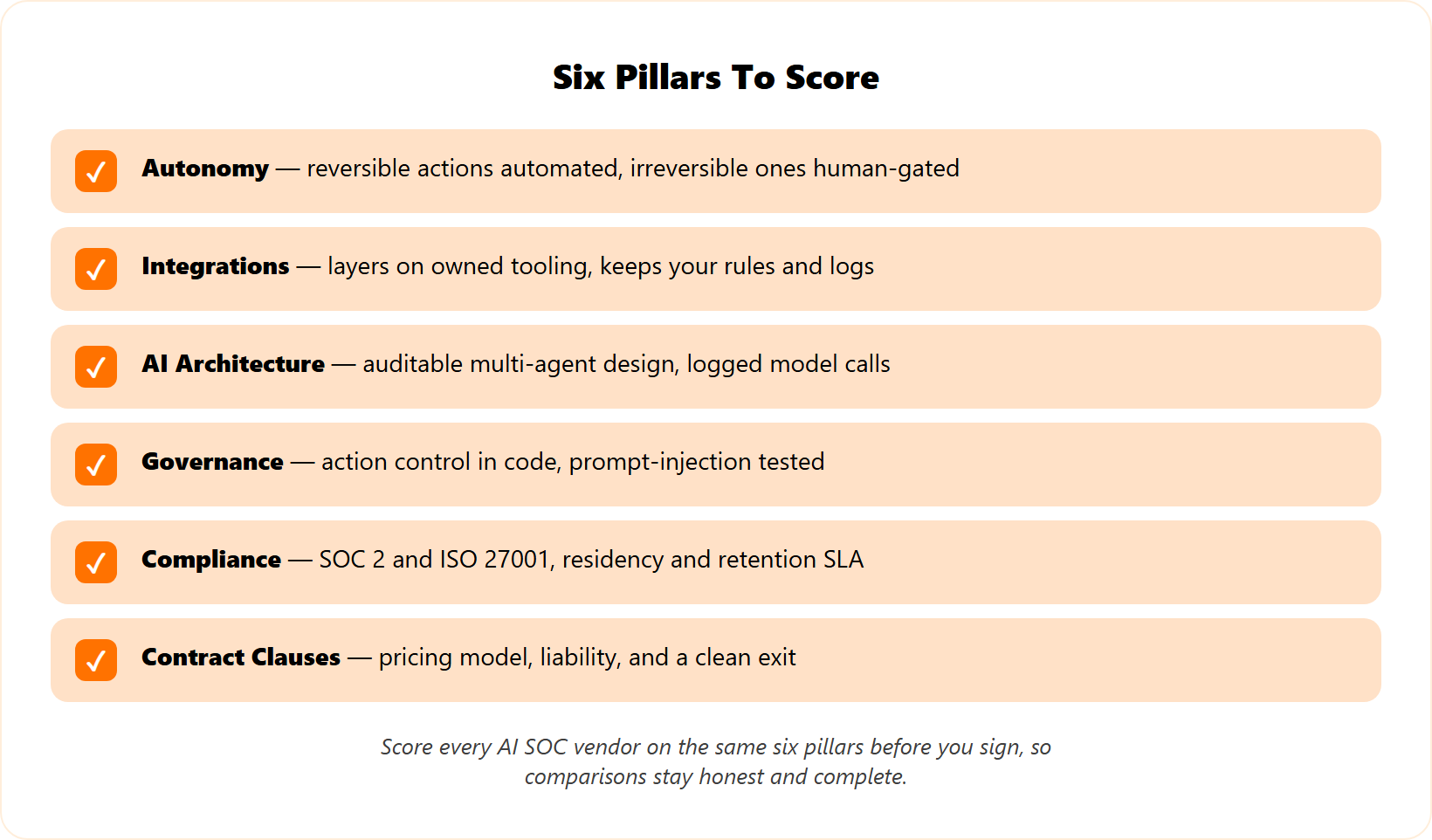
Score every AI SOC on six pillars: autonomy (where is the human checkpoint?), integrations (does it keep your owned stack and data?), AI architecture (auditable multi-agent or single-prompt black box?), governance (action control, audit trail, prompt-injection defense?), compliance (SOC 2, ISO 27001, residency, statutory reporting?), and contract clauses (transparent pricing, liability, clean exit?). Run a proof of value against your own alerts, and keep looking if a vendor cannot show its work on all six.
The six-pillar scorecard
Carry this into the next vendor call. Score each pillar, and let a weak column stop the deal.
| Pillar | The question that decides it | Pass signal |
|---|---|---|
| Autonomy | Where is the human checkpoint on irreversible actions? | Recommend-then-confirm, human on irreversible |
| Integrations | Does it keep your owned stack and data? | Reads your SIEM, EDR, cloud; you keep logs |
| AI architecture | Auditable multi-agent or single-prompt black box? | Many logged model calls, full trace |
| Governance | Action control, audit trail, prompt-injection defense? | Code-level guardrails, every step logged |
| Compliance | SOC 2, ISO 27001, residency, statutory reporting? | Live evidence mapped to controls |
| Contract clauses | Transparent pricing, liability, clean exit? | All-inclusive price, you leave with your logic |
The thread across all six is the same: can the vendor show its work? A platform that passes five pillars and hides the sixth is still a risk, which is why our compliance services insist on live evidence, not promises.
A parting gift and an invitation
One practical reframe before you go. Map your spend against the NIST Cybersecurity Framework families, and you may find zero dollars going to proactive capability. That budget picture often changes the shortlist more than any demo, a lens we apply in our work on the 2026 cybersecurity budget for mid-market firms.
So here is my honest close. Being a human is a flex in 2026, and the point of this whole evaluation is to free your people for the judgment work machines cannot do, the philosophy behind our SOC service.
If you want a second pair of eyes on your shortlist, tell us what you are evaluating. UnderDefense’s team has run these evaluations from the buyer’s side of the table, and we are happy to pressure-test your six pillars with you, so feel free to contact us.
“It’s clear they take security seriously and genuinely care about their clients.”
Arman N., CTO UnderDefense G2 Verified Review
The question I keep sitting with: as agents get cheaper to build, will buyers reward the vendors who show their work, or the ones with the slickest demo? My bet is on the ones you can audit, and you can put that bet to the test with a live demo.
See how UnderDefense Agentic AI SOC resolves a real incident on your stack.
1. What is an AI SOC and how is it different from a SIEM, SOAR, or XDR?
We define an AI SOC as a reasoning layer that sits on top of your existing security stack and automates the grunt work of investigation. A SIEM stores and correlates logs, a SOAR runs fixed response playbooks, and XDR unifies detection across endpoints, network, and cloud. An AI SOC adds judgment-support on top of all three.
Here is the practical distinction:
- SIEM, SOAR, and XDR mostly move and route data.
- An AI SOC reasons over that data, pulling logs, enriching with threat intel, correlating sessions, then handing a structured finding to a human.
The trap in 2026 is AI washing, where a vendor renames a dashboard and bolts on a chatbot. The average team already manages around 76 tools, so a relabeled 77th helps nobody. We unpack the warning signs in our breakdown of AI SOC red flags, and you can see how a genuine reasoning layer works on the UnderDefense Agentic AI SOC platform. The honest framing is simple: AI collects the context, and your people make the call.
2. Can an AI SOC run fully autonomously, and how much autonomy should we hand it?
No, a fully autonomous SOC that replaces Tier 1 through Tier 3 is not realistic today, and letting software quarantine users or delete resources unsupervised is reckless. We treat autonomy as a dial rather than a switch.
Our recommended settings:
- Auto-investigate and auto-enrich every alert, always.
- Auto-close clear false positives like known scanners.
- Pre-authorize narrow, reversible containment such as isolating a single endpoint with rollback.
- Require a human on anything irreversible, like disabling a user org-wide.
The test is reversibility. If undoing an action is cheap, let the agent move; if undoing it is impossible, a human holds the trigger. Because the time from disclosure to exploit has collapsed to under a minute, we still pre-authorize a tight set of fast containment actions with hard guardrails. For ambiguous alerts, we use a recommend-then-confirm pattern that pings a human in Slack or Teams before acting. This balance is the foundation of our MDR service, where experts own the consequential decisions while machines handle speed.
3. Will an AI SOC integrate with the stack we already own or force a rip-and-replace?
The right AI SOC layers on top of the SIEM, EDR, and cloud logs you already own rather than forcing a proprietary stack. Your tuned detection rules are an asset, so throwing them away to consolidate is throwing away money.
Before signing, confirm the platform can:
- Read from your customer-owned SIEM such as Splunk, Sentinel, or Chronicle.
- Pull from your EDR and NDR without re-instrumenting endpoints.
- Run on-prem or in your own VPC where residency demands it.
- Let you keep your detection rules and logs at contract exit.
The most expensive clause buyers overlook is lock-in. Many heritage providers run a closed box where pulling your own logs or changing a rule means waiting on their engineering team. We have seen this pattern drive teams to switch, which we cover in our analysis of why businesses switch cybersecurity providers. UnderDefense MAXI integrates with customer-owned tooling and keeps your logs in your own data lake, and you can review the supported connectors on our MAXI integrations page.
4. What AI architecture should we expect under the hood, single LLM or multi-agent?
Architecture predicts reliability, so this is a buying question, not just an engineering one. A single-prompt wrapper gives you one model’s guess in a pretty box, while a multi-agent system runs many specialized checks and then assembles an auditable evidence chain.
Ask vendors three concrete questions:
- How many model invocations run per investigation?
- Are classic machine learning and LLMs layered together?
- Is every step logged so you can audit the reasoning later?
Production-grade systems can make over a hundred distinct model calls to investigate a single alert, and the hard part is keeping all those calls stable. That depth ties to detection breadth, which is why serious platforms map detections to MITRE ATT&CK techniques so you see exactly which adversary behaviors are covered. Academic work consistently shows layered and multi-agent designs outperform single-model triage on high-stakes alerts. We explain why this coverage matters in our overview of top threat detection tools, and you can see auditable, observable workflows on the UnderDefense MAXI platform.
5. How do we govern an AI SOC so it cannot leak data or run wild?
We govern AI SOC agents with action control, not just access control. Access control asks who can act, while action control decides which actions the machine may take at all, enforced in code rather than in a prompt.
Our governance baseline:
- Enforce action limits with callback functions, so forbidden targets are unreachable by design.
- Log every investigative step for a traceable audit trail.
- Test for prompt injection through ingested logs and alerts.
- Keep logs and AI data inside your own environment.
The agent itself is an attack surface. It reads your alerts and logs, so a crafted log line can carry a prompt-injection attack straight into the reasoning layer, which is why the OWASP LLM Top 10 lists prompt injection as risk number one. Be wary of any vendor claiming a perfectly unbiased model, because that usually hides a measurement gap rather than a safer system. We flag these patterns in our list of AI SOC red flags, and our MDR for AI work focuses on exactly this emerging surface.
6. What compliance and contract clauses should we negotiate before signing an AI SOC?
An AI SOC touches your most sensitive telemetry, so it must clear the same trust bar as any core system: SOC 2 Type II and ISO 27001 at minimum, plus HIPAA, PCI DSS, or FedRAMP where regulated. Its reporting also has to feed statutory disclosure clocks like NIS2 at 24 hours, the SEC 8-K rule at four business days, and GDPR Article 33 at 72 hours.
On the contract, pin down five clauses most buyers skip:
- Pricing model, and whether agent traffic inflates volume-based bills.
- Liability for autonomous actions the agent takes.
- Data residency, where your logs physically live.
- A written retention SLA, ideally 40-plus days online.
- A clean exit with your detection logic intact.
Watch the 450% traffic tax, since AI agents generate far more traffic than a human and can balloon a volume-based invoice. We map live telemetry to audit-ready evidence through our compliance services, and you can benchmark transparent figures against our published MDR pricing.
7. How do we measure whether an AI SOC actually works before committing?
We measure four things and verify them against our own data: coverage, the share of alerts actually investigated; accuracy, the true-positive and false-positive rates; quality, how the investigation compares to a senior analyst; and transparency, whether the AI explains and audits its verdicts.
Then put numbers on it during a proof of value:
- Noise-reduction percentage.
- Alert-to-triage time and a separate critical-escalation clock.
- Mean-time-to-contain.
- MITRE ATT&CK coverage and documented ROI.
We deliberately keep alert-to-triage and critical escalation as two distinct measures, since a single blended metric hides which one is failing. Before trusting any vendor’s numbers, baseline your own alert volume and false-positive rate, then measure the platform against it. False-alarm rates often run between 50% and 72% of alerts, so noise reduction is where real ROI appears. For example, UnderDefense reports a 2-minute alert-to-triage SLA and a separate 15-minute escalation SLA for critical incidents. We break down these measures in our guide to SOC metrics like MTTD and MTTR.
8. Should we build our own AI SOC agent or buy a platform?
It comes down to consistency. You can prototype a working triage agent in a couple of weeks, and the build-buy gap keeps shrinking, but sustaining trusted, consistent decisions, governance, and 24/7 reliability for years is extremely hard.
Our honest test:
- Build if AI orchestration is a core competency you will fund and staff permanently.
- Buy if you need auditable, production-grade outcomes now, without pulling engineers off the roadmap to run an ML platform forever.
The hard part is not the first prototype. It is owning model drift, code-level guardrails, on-call coverage, and the audit trail indefinitely. A prototype does not page someone at 2 a.m., but a production SOC does. For teams over 5,000 employees that already run an internal SOC and SIEM, we built UnderDefense MAXI to augment the team rather than replace it, carrying the routine load so your people handle the edge cases that need real judgment. We explore this trade-off further in our comparison of outsourced versus in-house SOC, and you can see the same philosophy in our SOC service.