







Q1: What Is Network Penetration Testing, and Why Is It Now an MDR Scorecard?
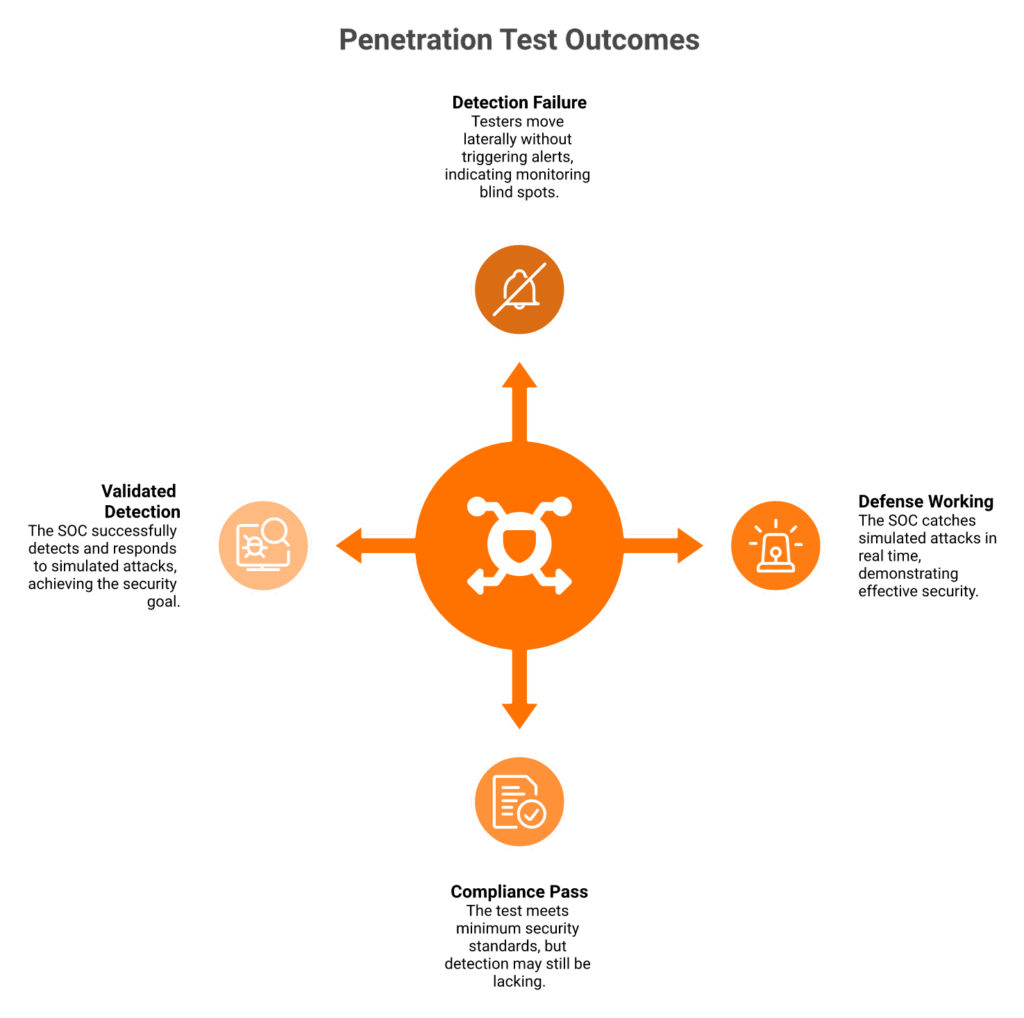
Network penetration testing is an authorized, simulated cyberattack against your internal and external network to find exploitable weaknesses before a real adversary does. For mature security teams, its highest value is acting as a live scorecard for your MDR or SOC: if testers move laterally and your monitoring stays silent, you have a detection failure, not proof of a secure perimeter.
Get a Pentest Quote from UnderDefense – Then Decide
The Definition Most Compliance Decks Get Half-Right
Picture a CISO three weeks before a board meeting. She has a clean pentest PDF, a green checkmark for the auditor, and a quiet dashboard. She feels covered. She is not.
A network penetration test is a controlled, authorized attack. Ethical hackers probe your firewalls, servers, VPNs, and internal segments the way a criminal would. The goal is to prove what an attacker could actually reach.
NIST defines this work in SP 800-115 as testing that finds vulnerabilities and verifies whether controls actually hold. The “verify controls” part is what compliance-only framing quietly drops.
Why “We Passed the Pentest” Is the Wrong Win
Here is the reframe most playbooks avoid. A pentest is not just a list of holes to patch. It is a test of whether your defenders notice the attack at all.
We have a working axiom on this from our own engagements: silence after a pen test is a detection failure, not a coverage success. If a tester pivots from a phished laptop to a file server and no alert fires, your tools are blind.
“We did a greybox penetration test. Everything was quick and the depth of the test was impressive.” Chief Engineering Officer, Software UnderDefense Gartner Verified Review
The “Silent Test” That Exposes a Blind MDR
We have watched teams realize this the hard way. A full internal test runs for days. Lateral movement, credential reuse, privilege escalation. Zero alerts. Zero phone calls from their incumbent provider.
That silence is the finding. It tells the security leader their monitoring stack sees compliance scans but misses live intrusion behavior. Many teams treat that exact moment as a baseline reason to switch providers.
The lesson is simple. Use offense to audit your defense, not just to fill a checkbox.
What This Article Will Actually Do for You
The rest of this guide treats a pentest as an operational tool, not a certificate. We will move through the full workflow in order.
You will get scope and planning (how to aim the test at real risk), the testing phases (recon to post-exploitation), reporting (what makes a report usable), and retesting (proof the fixes held). Each section translates into something you can action this quarter.
The mindset shift to hold onto: a point-in-time pass is the floor, not the ceiling. Continuous validation, where your defenses are checked constantly rather than once a year, is where this is heading. We will get there.
Q2: Internal vs. External Network Penetration Testing, Which Do You Actually Need?
External network penetration testing simulates an outsider attacking your internet-facing assets, like VPNs, web servers, and email gateways. Internal testing assumes the perimeter is already breached and tests how far an attacker moves laterally once inside. Most organizations need both: external proves your front door holds, and internal proves a single phished credential cannot reach your crown jewels.
The Front Door Versus the Crown Jewels
Think of your network as a house. External testing checks whether the locks, windows, and the front door hold against someone in the street.
Internal testing asks a harder question. Once an attacker is inside, maybe through one phished login, how far can they walk? Can they reach the safe in the bedroom, or are they stuck in the hallway?
You need both answers. A strong front door means little if one stolen credential opens every internal room. This is the Zero Trust idea in practice: assume breach, then test the blast radius.
A Side-by-Side Comparison
Here is how the two engagements differ in plain terms, and you can read more in our internal vs. external pentest breakdown.
| Dimension | External Pentest | Internal Pentest |
|---|---|---|
| Attacker position | Outside, on the internet | Inside, post-compromise |
| Target assets | VPNs, web apps, email gateways, public IPs | File servers, Active Directory, internal apps |
| Core question | Can they break in? | How far can they move? |
| Common techniques | Perimeter exploits, exposed services | Lateral movement, privilege escalation, credential reuse |
| Compliance driver | PCI DSS external scan needs | PCI DSS internal testing, segmentation checks |
| Typical duration | 3 to 7 days | 5 to 10 days |
A Real Internal Tactic Worth Scoping
One scenario we always push teams to include is the geographically improbable login. An attacker steals VPN credentials, then signs in from France and Canada fifteen minutes apart.
No human travels that fast. A good internal test checks whether your detection logic flags that pattern. Many stacks do not, and that gap is exactly what attackers abuse with stolen credentials.
This matters because credential abuse and vulnerability exploitation now drive a large share of breaches. The 2024 Verizon DBIR found that exploitation of vulnerabilities as an initial access path rose 180% year over year.
How to Decide What to Run
Use these simple rules to aim your budget.
- ✅ Choose external first if you have public-facing apps, a fresh internet presence, or a PCI DSS deadline tied to perimeter scope.
- ✅ Choose internal if you worry about phishing, flat networks, or weak segmentation between departments.
- ✅ Choose both if you handle regulated data under SOC 2, ISO 27001, or HIPAA, where auditors expect full coverage.
PCI DSS v4.0 Requirement 11.4 is explicit here. It calls for both internal and external penetration testing on a defined schedule, not one or the other.
The honest read: most mid-market teams underspend on internal testing because the perimeter feels more urgent. The breaches that hurt most, though, come from movement after entry. Test the hallway, not just the door.
Q3: How Do You Scope and Plan a Network Penetration Test Using Risk-Based Prioritization?
Scoping a network pentest means defining exactly which IP ranges, systems, and techniques are in and out of bounds, then documenting authorization and rules of engagement. Plan risk-first: rank assets by CVSS exposure, business impact, and whether any CVEs appear in CISA’s KEV catalog. Then pick black, grey, or white box based on the question you actually need answered.
Why Vague Scopes Burn Budget
A loose scope is how money disappears. Testers spend days poking low-value assets while your actual crown jewels sit untested.
I have seen scopes that read “test the network” with no IP list, no priorities, and no rules. The result is generic findings and a frustrated CFO. CVSS, by the way, is the Common Vulnerability Scoring System, a 0 to 10 severity rating.
Good scoping is an act of focus. You decide what matters most before anyone runs a single scan.
A Five-Step Scoping Sequence You Can Run
Here is the sequence we use to plan a test that targets real risk.
- Inventory your assets. List every in-scope IP range, subnet, application, and cloud account. You cannot protect what you have not named.
- Risk-rank each asset. Score by CVSS exposure, then business impact, then whether any related CVE sits in CISA’s Known Exploited Vulnerabilities catalog.
- Define rules of engagement (ROE). Set testing windows, off-limits systems, and who gets the emergency call if production wobbles.
- Confirm written authorization. No test starts without signed permission. NIST SP 800-115 treats this documentation as non-negotiable.
- Select your test depth. Choose the box type that fits the question, using the table below.
The Risk-Tiering Lens Most Vendors Skip
Here is a framework I rarely see in competitor guides. Tier assets by three signals stacked together: CVSS severity, business impact, and CISA KEV presence.
The KEV catalog lists vulnerabilities attackers are exploiting right now, in the wild. A medium-CVSS bug that sits in KEV often deserves more urgency than a high-CVSS bug nobody is exploiting. Real-world exploitation beats theoretical severity, which is the heart of strong attack surface management.
Choosing Black, Grey, or White Box
The “box” decides how much testers know upfront.
| Box Type | What Testers Know | Best For |
|---|---|---|
| ⬛ Black box | Almost nothing, like a real outsider | Testing perimeter realism |
| 🟫 Grey box | Partial access or limited credentials | Balanced cost and depth, most common |
| ⬜ White box | Full architecture and source access | Deep internal review, fastest coverage |
Grey box is where most mature teams land. It mirrors a phished employee, which is the most realistic modern entry point.
The “Throwing Stones” Planning Move
One pre-engagement habit pays for itself. Before any test, put your architecture diagram on the screen and invite your ethical hacking partner to throw stones at it.
Ask them where they would attack first. This surfaces obvious design flaws in an hour, before the formal test even begins. It also tells you fast whether your partner thinks like an attacker or just sells you one.
A scope built this way respects your cash. You test the assets that would actually hurt you, in the order they would hurt you.
Q4: What Are the Phases of a Network Penetration Test, From Recon to Post-Exploitation?
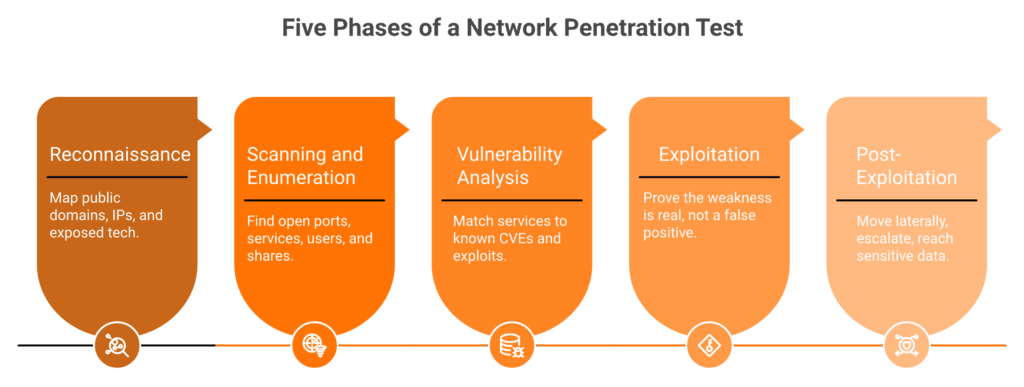
A network pentest follows five core phases: reconnaissance (mapping the target), scanning and enumeration (finding open services), vulnerability analysis (matching weaknesses to exploits), exploitation (proving the weakness is real), and post-exploitation (showing how far an attacker could go). NIST SP 800-115 and PTES formalize these phases so results stay repeatable, not improvised.
These phases are not bureaucracy. They mirror how a real attacker actually works, which is exactly why standards bodies codified them. NIST SP 800-115 frames the flow as planning, discovery, attack, and reporting, and the Penetration Testing Execution Standard (PTES) expands it into seven detailed stages.
Phase 1: Reconnaissance
Recon is the mapping stage. Testers gather public information about your organization: domain names, IP ranges, employee emails, and exposed technologies.
A concrete example: a tester finds an old subdomain on a forgotten cloud server through public DNS records. That stale asset becomes the quiet way in. Attackers love what you forgot you owned.
Phase 2: Scanning and Enumeration
Now testers probe the live network. Scanning finds open ports and running services. Enumeration digs deeper to name versions, users, and shares.
For instance, a scan reveals an exposed SMB file-sharing service on an internal server. Enumeration then lists the shares and the accounts that can reach them. That detail shapes the whole attack path.
Phase 3: Vulnerability Analysis
Here testers match what they found to known weaknesses. They cross-reference service versions against vulnerability databases and exploit libraries.
Example: that SMB service runs an unpatched version tied to a known remote-code-execution flaw. The tester confirms it is theoretically exploitable. This phase is where automated scanners do their best work, and also where they stop being enough.
Phase 4: Exploitation
This is the proof stage. Testers actually exploit the weakness to confirm it is real, not a false positive.
Using a tool like Metasploit, the tester gains a shell on the vulnerable SMB server. A “shell” here just means command-line control of the machine. A finding only earns “critical” once exploitation proves the impact is genuine.
Phase 5: Post-Exploitation
The final stage answers the question that scares boards. Now inside, how far can the attacker go?
Testers attempt lateral movement, privilege escalation, and data access. The example here: from that one server, the tester pivots to a domain controller and reaches sensitive records. That pivot chain is the real story your pentest report must tell.
Where Tools End and Humans Begin
Here is the part the standard read gets backwards. People assume scanners find the dangerous stuff. They mostly find the known stuff.
The highest-impact intrusions use Living off the Land (LOTL) techniques, where attackers abuse trusted built-in tools like PowerShell instead of obvious malware. Scanners rarely flag this, because nothing looks broken. A human notices the pattern, which is where a 24/7 SOC service earns its keep.
The XZ Utils case in 2024 is the gold standard of that instinct. Microsoft engineer Andres Freund caught a massive supply-chain backdoor (CVE-2024-3094, scored a perfect CVSS 10) simply because SSH logins felt a fraction of a second too slow.
No scanner flagged it. A curious human did. That is the human-led judgment a strong pentest is meant to validate inside your own SOC, and it is the difference between a report that lists ports and one that shows how your defenses actually behave under pressure.
Q5: Which Tools Do Penetration Testers Use, and Why Tools Alone Aren’t Enough?
Network pentesters rely on Nmap for discovery, Nessus and OpenVAS for scanning, Metasploit for exploitation, Wireshark for traffic analysis, Nikto and SQLmap for web-layer probing, and Burp Suite Pro for manual testing. But tools only find known issues. The real skill, and the real value, lives in the operator running them, not the scanner itself.
The Toolbox Every Tester Carries
Let me save you a search. Here is the working kit I see on almost every serious network engagement, and what each piece actually does.
| Tool | Type | What It Does |
|---|---|---|
| Nmap | Automated | Maps live hosts, open ports, and services |
| Nessus / OpenVAS | Automated | Scans for known vulnerabilities (CVEs) |
| Metasploit | Manual + Automated | Exploits confirmed weaknesses |
| Wireshark | Manual | Captures and inspects network traffic |
| Burp Suite Pro | Manual | Intercepts and tests web app requests |
| Nikto / SQLmap | Automated | Probes web servers and SQL injection flaws |
Our own testers lean on Nessus, Nikto, SQLmap, and Burp Suite Pro daily. Clients notice the depth this combination reaches, which is why our penetration testing engagements go further than a basic scan.
Why the Scanner Is Not the Hero
Here is where I will be blunt. A scanner finds what is already in a database. It does not think.
Automated tools flag the known stuff fast. They miss business logic flaws, chained attack paths, and quiet abuse of trusted features. That gap is exactly where the painful breaches live, and where seasoned ethical hacking talent earns its fee.
I use a simple analogy on calls with CISOs. Buying elite tools without skilled operators is a fleet of Ferraris with rookie drivers. The hardware is gorgeous, and you still lose the race.
What a Pentest Looks Like From the SOC Side
Run this test, and your own monitoring should light up. Smart analysts learn to spot the artifacts a tester (or a real attacker) leaves behind, which is one reason a dedicated SOC service matters.
- ⚠️ A bootable Kali Linux image appearing on the network.
- ⚠️ Vulnerability scans starting from an internal IP, not an approved one.
- ⚠️ PowerShell or Python launching from a non-standard folder.
We set clear escalation thresholds for that last one. Scripting from an odd location at an odd hour is a signal worth a phone call, not a silent log entry.
The Proof Is in the Reports
You do not have to take my word on the operator-over-tool point. Clients say it plainly.
“Their professionalism, expertise and promptness ensured we had an overall outstanding experience.” Manager, Legal and Compliance UnderDefense Gartner Verified Review
“We chose them among 5 other vendors. They understood our needs and gave us a detailed pen test report. Their team was quick and professional.” Manager of IT Services UnderDefense Gartner Verified Review
My honest read, after watching this across hundreds of environments: the tool list is the easy part. Anyone can download Nmap tonight. The judgment to chain three “medium” findings into one critical breach path is what you are actually paying for.
So when you evaluate a vendor, do not ask which tools they own. Ask them to walk you through a chain they built by hand. The answer tells you everything.
Q6: What Should a Penetration Testing Report Contain to Be Worth Reading?
A useful pentest report has three layers: an executive summary in business-risk language, technical findings with CVSS scores and reproduction steps, and a prioritized remediation roadmap. The best reports map findings to MITRE ATT&CK techniques, the catalog of real attacker behaviors. Reports that focus on those behaviors beat lists of IP addresses an attacker swaps out in seconds.
Most Reports Fail the Busy CISO
I have read hundreds of pentest reports. Most fail the same way. They drown a busy leader in 80 pages of CVSS scores with no story.
A CISO has ten minutes before the board call. If your report cannot answer “what could hurt us, and what do we fix first” on page one, it failed. CVSS is the 0 to 10 severity score, useful, but it is not a business case. Our pentest report template is built to avoid exactly that trap.
The Three Layers That Actually Work
A report worth reading is built in three tiers, top down.
- Executive summary. Plain business-risk language. What an attacker could reach, what it would cost, and the top three fixes. No jargon.
- Technical findings. Each issue with its CVSS score, evidence, and clear steps to reproduce it. This is for your engineers.
- Remediation roadmap. Fixes ranked by real risk, not alphabetical order. Critical and exploitable first.
That structure respects two readers at once. The board gets the “so what,” and the engineers get the “how.”
Why You Report on Behavior, Not Just Hashes
Here is the part the standard read gets backwards. People obsess over indicators like file hashes and IP addresses. Attackers change those in seconds.
David Bianco mapped this in 2013 with the Pyramid of Pain. At the bottom sit trivial indicators (hashes, IPs) that cause an attacker no pain to swap. At the top sit Tactics, Techniques, and Procedures (TTPs), the actual behaviors that are hardest for them to change.
A great report lives at that top layer. It tells you which attacker behaviors worked against you, mapped to MITRE ATT&CK, which catalogs 14 tactics and hundreds of techniques used in real intrusions.
Turning a Report Into Detection
This is where offense should feed defense, and where most vendors stop short. We treat every pentest finding as a hard lead that strengthens your MDR service.
Borrowing from the military F3EAD model (Find, Fix, Finish, Exploit, Analyze, Disseminate), a finding is a “Find.” You then hunt for real attackers who could use that same path, and you push the technique straight into your detection rules.
That is the closed loop I care about. A finding tagged with an ATT&CK technique becomes a new alert your SOC catches next time. The report stops being a PDF and becomes detection engineering.
“Under Defense security experts took the time to explain every discovered vulnerability as well as corresponding remediation steps.” CTO, IT Services UnderDefense Gartner Verified Review
“UnderDefense delivered a clear detailed report with issues and how to fix them.” Manager of IT Services UnderDefense Gartner Verified Review
My ask of any report you receive: can your team act on it Monday morning without a translation meeting? If not, it is documentation, not intelligence.
Q7: What Happens After the Test? Retesting and Risk-Based Remediation Workflows
Retesting verifies that the vulnerabilities found in your pentest were genuinely fixed, not just marked “resolved” in a ticket. Risk-based remediation means fixing in priority order: critical, externally exploitable, and actively exploited findings first. The strongest vendors include free remediation retesting, closing the loop from finding to fix to confirmed closure instead of handing you a PDF and walking away.
The “Resolved” Ticket That Was Never True
This is the gap nobody talks about. A finding gets a ticket. An engineer marks it “done.” Everyone moves on.
Nobody checked if the fix actually worked. I have seen a “patched” server that was patched on the wrong host entirely. The hole was still wide open at the next real test.
A closed ticket is a claim. A retest is proof. Those are not the same thing, and the difference is where breaches sneak back in.
A Five-Step Remediation Loop
Here is the workflow I would run after any test, in order.
- Triage by real risk. Sort findings by severity, exploitability, and exposure. Do not start at the top of the list alphabetically.
- Fix the worst first. Prioritize critical, internet-facing, and actively exploited issues.
- Retest each fix. Have the testers confirm the specific vulnerability is gone, not just ticketed.
- Confirm closure. Document the verified result. This becomes your audit evidence for SOC 2 and similar frameworks.
- Feed it forward. Push the lessons into continuous monitoring so the same gap gets caught automatically next time.
Let the Real World Set Your Order
How do you decide what counts as “worst first”? Lean on data, not gut feel.
CISA publishes the Known Exploited Vulnerabilities catalog, a list of flaws attackers are using right now, in the wild. A medium-severity bug sitting in that catalog often beats a high-severity bug nobody is touching. Fix what is actually being exploited, and lean on continuous security monitoring to keep watch after the fix.
Why Free Retesting Should Be a Buying Criterion
Here is a practical filter for your vendor shortlist. Ask one question: is remediation retesting included, or billed again?
Plenty of providers hand you the report and disappear until next year’s invoice. We include the retest, because a fix you cannot verify is not a fix. Our clients raise this point unprompted, and many of them tell us it is why they decided to switch providers.
“They also provided us with a free consultation and remediation testing afterward. A great job was done!” Founder, CTO, IT Services UnderDefense Gartner Verified Review
“Great overall experience from pentest project presentation to the clear and detailed report with findings and following remediation test.” SQA Manager, IT Services UnderDefense Gartner Verified Review
My current read: retesting is the cheapest insurance in this whole process, and the most skipped. If your provider treats it as an upsell, that tells you how they see the relationship. The goal was never the report. It was a closed gap.
Q8: How Much Does Network Penetration Testing Cost, and What Drives the Price?
Network penetration testing typically costs between $5,000 and $50,000 or more, driven by network size, the number of live IP addresses, internal versus external scope, and test depth (black, grey, or white box). Do not anchor on price alone. With the average breach now costing $4.88 million, a test that catches one real attack path pays for itself many times over.
What Actually Moves the Number
People want one price. The honest answer is that scope drives everything. Here is how each factor pushes the cost up or down.
| Cost Factor | Effect on Price |
|---|---|
| 💰 Network size (number of live IPs) | More hosts, more time, higher cost |
| 💰 Scope (internal, external, or both) | Both engagements roughly double effort |
| 💰 Test depth (black, grey, white box) | Deeper access and analysis raise the price |
| 💰 Specialized assets (cloud, OT, custom apps) | Niche expertise adds to the rate |
| 💰 Retesting and reporting depth | Verified closure and rich reports add value, and cost |
A small external test of a handful of IPs sits near the bottom of that range. A full internal and external test of a large, complex network sits near the top.
Not Sure What Your Pentest Should Cost? Find Out
The Math Most Budget Debates Ignore
I get the cash pressure. Every dollar here is a dollar not in headcount or product. So let me reframe the spend, and you can pressure-test it against your own cybersecurity budget.
IBM’s 2024 Cost of a Data Breach report put the global average breach at $4.88 million. Against that, a $25,000 test that finds one exploitable path to your customer database is not an expense. It is cheap risk transfer.
When Deep Testing Pays for Itself
Let me show you, not just tell you. Deep, investigative work surfaces things checkbox scanning never will.
Our pentesters once caught critical and medium vulnerabilities in time to save a client an estimated two million dollars per day in potential impact. That is a single engagement returning its cost in hours, not years.
In another environment, a deep behavioral audit accidentally uncovered an internal payroll fraud scheme within three months of onboarding. Nobody scoped for that. The depth of the work found it anyway.
How to Buy Without Getting Burned
A few practical rules I would give any peer evaluating quotes.
- ✅ Demand a scope-based quote, not a vague flat fee.
- ✅ Confirm whether retesting is included or billed separately.
- ❌ Walk away from “contact us for pricing” black boxes that hide the model entirely.
We publish transparent, scope-based pricing for exactly this reason. You can see the model before you ever talk to sales, on the pentest pricing page.
My closing thought on cost: the cheapest test is the one that finds nothing because it barely looked. Price the depth, not just the line item, because the breach you prevent is the real return.
Q9: Which Compliance Frameworks Require Network Penetration Testing?
Several frameworks require or strongly expect network penetration testing: PCI DSS v4.0 (Requirement 11.4, annual plus after significant change), ISO/IEC 27001:2022 (Annex A 8.8 technical vulnerability management), SOC 2 Type II (CC6 and CC7 controls), and HIPAA (45 CFR §164.308(a)(8) periodic evaluation). Knowing which mandate drives your test tells you exactly what scope and evidence you will need.
Map the Mandate Before You Scope
Most teams scope a pentest, then scramble for audit evidence later. Flip that. Start from the regulation that is forcing your hand, and the scope writes itself.
Here is the mapping I hand to compliance leaders on kickoff calls, and you can go deeper in our compliance roadmap.
| Framework | Clause | What It Requires | Frequency |
|---|---|---|---|
| PCI DSS v4.0 | Req. 11.4 | Internal and external pentest | Annual, plus after significant change |
| ISO/IEC 27001:2022 | Annex A 8.8 | Technical vulnerability management | Ongoing, risk-based |
| SOC 2 Type II | CC6, CC7 | Logical access and monitoring controls | Per audit period |
| HIPAA | 45 CFR §164.308(a)(8) | Periodic technical evaluation | Periodic, after change |
Passing the Audit Is Not Being Secure
Here is where I will push back on the category. A compliance pentest and an adversarial pentest are not the same animal.
A compliance pentest proves you checked the box for the auditor. An adversarial pentest proves whether a motivated attacker can actually get in. You can pass the first and fail the second on the same day, which is why pairing the test with real compliance services matters.
“Their team was professional, and they helped us meet our compliance requirements with a thorough penetration test and clear report.” IT Manager UnderDefense Gartner Verified Review
The Entitlement Audit Hiding in Your License
One practical move I rarely see compliance teams make. Use pentest workflows to audit what you already own, especially across Microsoft 365 environments.
A typical Microsoft 365 E5 license includes a dozen or more security features. In my experience, many sit switched off or misconfigured. You paid for them, and they are not protecting you.
So my forward question for you: are you scoping your next test to satisfy an auditor, or to find the gap that auditor will never look at? The honest answer usually reshapes the whole engagement.
Q10: Why Is a Point-in-Time Pentest No Longer Enough? The Case for Continuous Validation
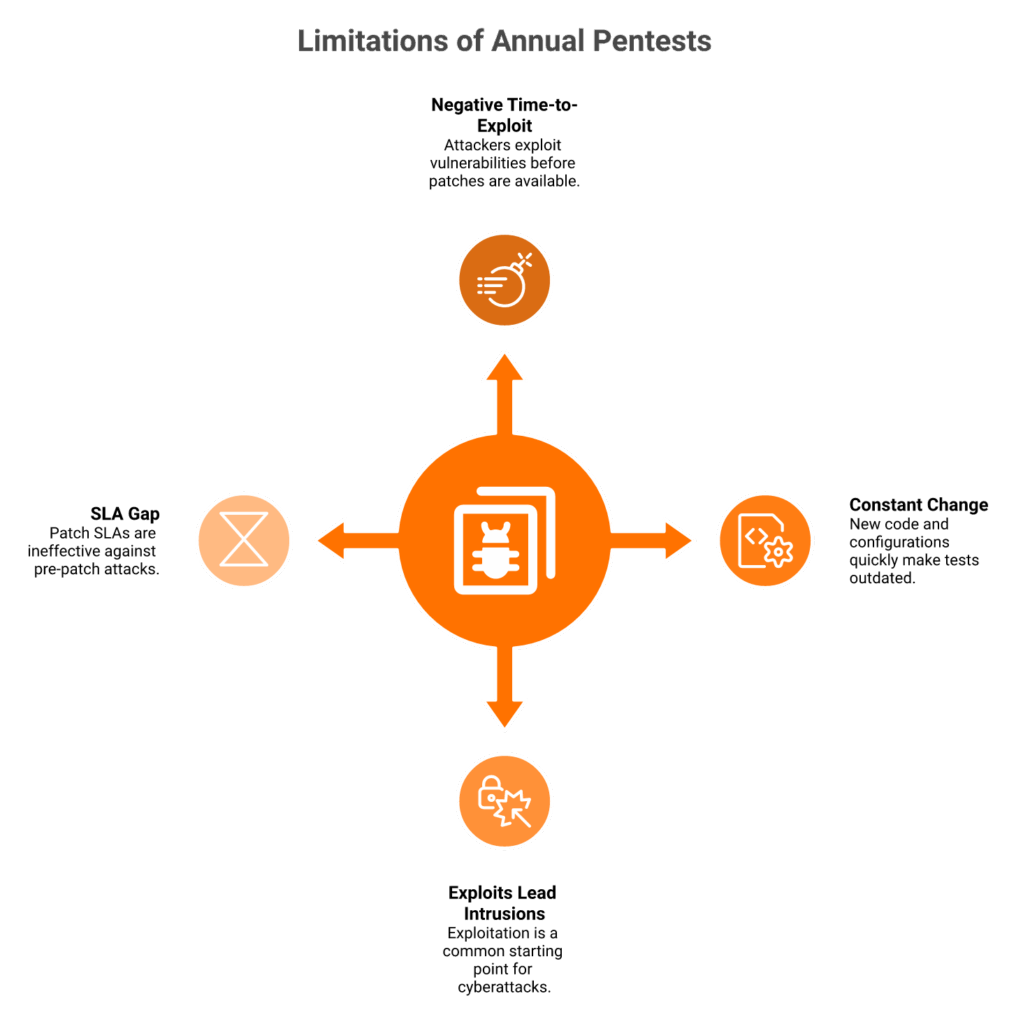
A traditional pentest is a single snapshot. It confirms your network was secure on one day last quarter. With attackers now exploiting many flaws before a patch even exists, an annual test leaves long windows of unvalidated risk. Continuous validation uses AI penetration testing agents and breach-and-attack simulation to keep probing your defenses year-round, not once a year.
If You Tested in Q1, Are You Safe in Q3?
Let me ask the uncomfortable question. You ran a clean pentest in January. It is now July. Are you still secure?
You changed firewall rules. You onboarded forty employees. You shipped new code. None of that existed when the testers looked. The snapshot is already stale, which is the core argument for continuous security monitoring.
The Clock Has Gone Negative
The standard read says “test annually, patch fast.” That math no longer works. Here is why.
Mandiant’s incident-response data shows the average time-to-exploit went negative in 2024. In plain terms, attackers are now exploiting many vulnerabilities before a patch exists. Exploits drove roughly one in three intrusions, the top initial-access method.
A 24-hour patching SLA means little when the attack predates the fix by a week. Attackers do not wait for your annual review. Neither should your penetration testing cadence.
From Annual Test to Constant Pressure
Here is the twist most playbooks miss. The fix is not a better annual pentest, but constant, automated offensive pressure.
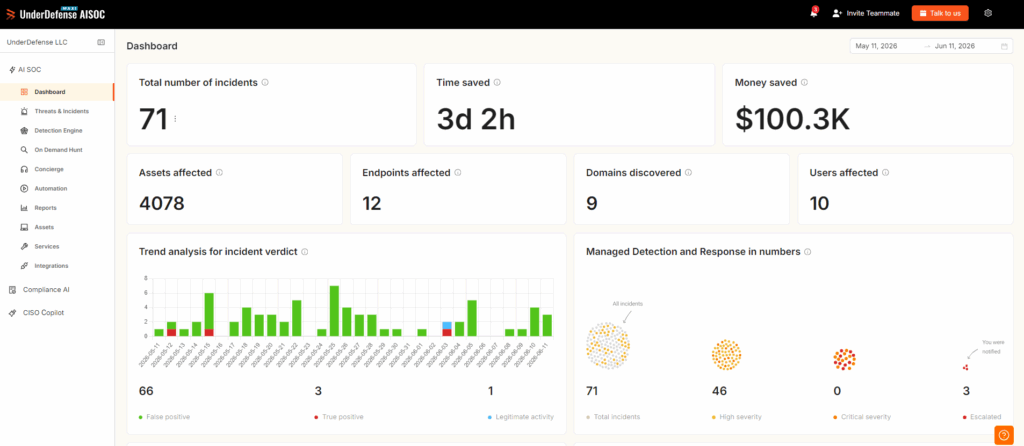
We treat AI as a continuous attacker. During the first thirty days of onboarding, we run real intrusion simulations using open tools like MITRE Caldera and Infection Monkey, both mapped to the ATT&CK framework of real attacker behaviors. That confirms full coverage of your specific use cases, not a generic checklist, and it is a natural extension of our UnderDefense Agentic AI SOC platform.
A point I will stand behind, even if it sounds odd: a measurable, slightly biased detection model beats one claimed to be “unbiased.” You can track a known bias, measure it, and adjust it. A black box you cannot.
My read for the next eighteen months: the annual pentest survives as a compliance artifact, but continuous validation becomes the real security control. The question I am sitting with is how fast mid-market teams make that shift before an attacker forces it.
Q11: How Should Security Leaders Evaluate and Choose a Network Pentest Vendor?
Evaluate pentest vendors on five criteria: the manual-to-automated testing ratio, ATT&CK-mapped reporting, free remediation retesting, integration with your existing SOC or MDR, and whether they respond to threats or merely alert. The sharpest test is simple. Ask whether their pentest feeds your detection engineering. Monitoring-only vendors find gaps. The strongest partners help you close them.
The “PDF and Walk Away” Problem
I have watched this pattern too many times. A vendor runs a scan, emails an 80-page PDF, invoices you, and disappears until next year. The gaps stay open. You are no safer.
A pentest should change how your defenses behave. If the relationship ends at the report, you bought paperwork, not protection, which is one reason teams compare options on lists of the best pentest companies.
Five Questions That Separate Vendors
Here is the rubric I would use, and how the common vendor types stack up.
| Criterion | Monitoring-Only MDR | Integrated Offense + Defense Partner |
|---|---|---|
| Manual vs. automated testing | Mostly automated scans | Heavy manual exploitation |
| ATT&CK-mapped reporting | ❌ Rare | ✅ Standard |
| Free remediation retesting | ❌ Often billed again | ✅ Included |
| Works with your existing stack | ⚠️ Often forces tool swap | ✅ Vendor-agnostic |
| Responds or just alerts | ❌ Alerts only | ✅ Detects and responds |
Where the Architecture Quietly Breaks
Let me be fair to the competition here. Pure-play monitoring vendors do alerting well. The architecture is the limit, not the people.
Many alert-heavy platforms drown teams in noise. Arctic Wolf users on G2 specifically flag high false positives and excessive ticket volume as a recurring pain, a gap our MDR service was built to close.
“There are times when there are false positives. This can lead to wasted time and resources investigating non-issues.” Verified User in Information Technology Arctic Wolf G2 Verified Review
That is the gap we built against. ✅ We run vendor-agnostic, so you keep your existing tools and your SIEM data ownership. ✅ Our analysts respond with context, not just escalate an alert. ❌ Many traditional MDRs force a proprietary tool swap and stop at the alert. ✅ We fold offense into the defensive engagement, so findings become detections. ❌ Opaque, alert-only models leave your team doing the manual investigation at 2 a.m.
“We chose them among 5 other vendors. They understood our needs and gave us a detailed pen test report.” Manager of IT Services UnderDefense Gartner Verified Review
My closing test for any vendor: ask them to throw stones at your architecture diagram on the first call. The ones who can attack it on the spot are the ones worth hiring, and the ones many clients describe when they explain why they decided to switch providers.
Q12: How Does the Pentest + SOC Closed Loop Turn Findings Into Continuous Defense?
The pentest + SOC closed loop means every finding becomes a detection rule. Instead of a static report, exploited attack paths and ATT&CK techniques get pushed straight into your monitoring, so the next time an attacker tries that move, your SOC catches it in real time. This is the difference between finding gaps and permanently closing them.
From a Dead PDF to a Live Detection
Here is the problem with the whole industry’s default. A pentest finds a path, writes it down, and the report goes in a drawer. The attacker path is still live.
We close that loop. Every exploited path and technique we find feeds straight into your UnderDefense Agentic AI SOC detection rules. We do not just find gaps. We turn them into alerts your SOC service catches next time.
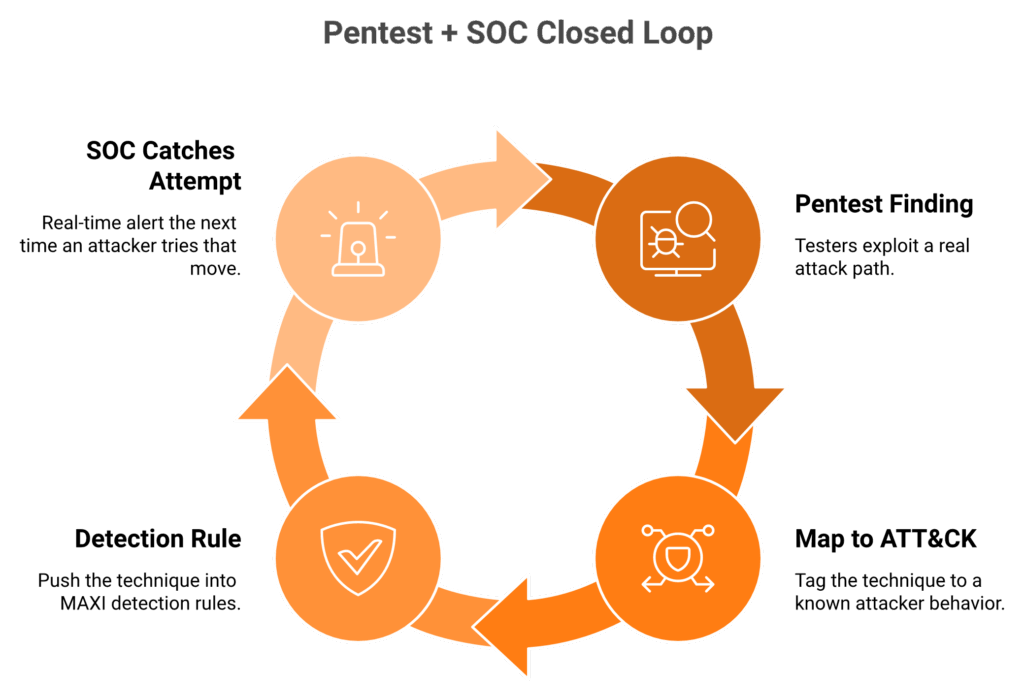
The Loop That Keeps Paying Off
This mirrors the F3EAD model from military intelligence. The last step, “Disseminate,” is the one most vendors skip entirely.
A finding becomes a detection. That detection catches the next attempt. That catch teaches the next test. The loop tightens with every pass, which is the whole point of continuous validation rather than an annual snapshot.
I will leave you with the question I keep asking CISOs. If your last pentest did not make your SOC smarter, what exactly did you buy? If you want to see what an attacker would reach first in your environment, let us show you, not just tell you.
1. What is network penetration testing, and how is it different from a vulnerability scan?
Network penetration testing is an authorized, simulated cyberattack against our internal and external network designed to find exploitable weaknesses before a real adversary does. A vulnerability scan only flags known issues from a database, while a pentest proves what an attacker could actually reach by chaining weaknesses into a real breach path. NIST SP 800-115 frames this work as both finding vulnerabilities and verifying whether controls actually hold, and that “verify controls” part is what compliance-only framing quietly drops. For us, the highest value of a pentest is acting as a live scorecard for our MDR or SOC: if testers move laterally and our monitoring stays silent, we have a detection failure, not proof of a secure perimeter. That is why we treat offense as a way to audit defense, not just to fill a checkbox. If you want this reframe applied to your stack, our network penetration testing services start from exactly that principle.
2. Do we need internal or external network penetration testing?
Most organizations need both. External testing simulates an outsider attacking our internet-facing assets, like VPNs, web servers, and email gateways, and answers the question “can they break in?”. Internal testing assumes the perimeter is already breached and tests how far an attacker moves laterally once inside, answering “how far can they move?”. A strong front door means little if one stolen credential opens every internal room, which is the Zero Trust idea in practice: assume breach, then test the blast radius. We choose external first when there are public-facing apps or a PCI DSS perimeter deadline, internal when phishing and flat networks are the worry, and both when regulated data falls under SOC 2, ISO 27001, or HIPAA. PCI DSS v4.0 Requirement 11.4 is explicit that it expects both on a defined schedule. Most mid-market teams underspend on internal testing, yet the breaches that hurt most come from movement after entry, so we walk clients through the tradeoff in our internal vs. external pentest guide.
3. How do we scope and plan a network penetration test so the budget targets real risk?
Scoping means defining exactly which IP ranges, systems, and techniques are in and out of bounds, then documenting authorization and rules of engagement. A loose scope is how money disappears, because testers spend days poking low-value assets while the actual crown jewels sit untested. We run a five-step sequence: inventory assets, risk-rank them, define rules of engagement, confirm written authorization, and select test depth. The risk-tiering lens we use stacks three signals together, namely CVSS severity, business impact, and whether a related CVE sits in CISA’s Known Exploited Vulnerabilities catalog. A medium-CVSS bug that sits in KEV often deserves more urgency than a high-CVSS bug nobody is exploiting, because real-world exploitation beats theoretical severity. We also put the architecture diagram on screen and invite the testers to throw stones at it before the formal test begins, surfacing design flaws in an hour. This connects naturally to broader attack surface management.
4. What are the phases of a network penetration test?
A network pentest follows five core phases: reconnaissance (mapping the target), scanning and enumeration (finding open services), vulnerability analysis (matching weaknesses to exploits), exploitation (proving the weakness is real), and post-exploitation (showing how far an attacker could go). NIST SP 800-115 and the Penetration Testing Execution Standard formalize these phases so results stay repeatable rather than improvised. These phases are not bureaucracy, because they mirror how a real attacker actually works. The part the standard read gets backwards is the assumption that scanners find the dangerous stuff, when they mostly find the known stuff. The highest-impact intrusions use Living off the Land techniques, where attackers abuse trusted built-in tools like PowerShell, and scanners rarely flag this because nothing looks broken. The 2024 XZ Utils backdoor (CVE-2024-3094, CVSS 10) was caught by a curious human, not a scanner, because SSH logins felt a fraction too slow. That human-led judgment is what a strong pentest validates inside our SOC service.
5. What should a network penetration testing report contain?
A useful report has three layers: an executive summary in business-risk language, technical findings with CVSS scores and reproduction steps, and a prioritized remediation roadmap. Most reports fail the same way, drowning a busy leader in 80 pages of CVSS scores with no story, when a CISO has ten minutes before the board call. The best reports map findings to MITRE ATT&CK techniques, the catalog of real attacker behaviors that catalogs 14 tactics and hundreds of techniques. Reporting on behavior beats reporting on indicators like file hashes and IP addresses, which attackers swap in seconds, a point David Bianco mapped in 2013 with the Pyramid of Pain. We treat every finding as a hard lead, borrowing the military F3EAD model so a finding tagged with an ATT&CK technique becomes a new alert the SOC catches next time. That turns the report from a PDF into detection engineering, and our pentest report template shows the structure we use.
6. How much does network penetration testing cost?
Network penetration testing typically costs between $5,000 and $50,000 or more, driven by network size, the number of live IP addresses, internal versus external scope, and test depth across black, grey, or white box engagements. A small external test of a handful of IPs sits near the bottom of that range, while a full internal and external test of a large, complex network sits near the top. We tell leaders not to anchor on price alone, because IBM’s 2024 Cost of a Data Breach report put the global average breach at $4.88 million, so a $25,000 test that finds one exploitable path to a customer database is cheap risk transfer, not an expense. Our pentesters once caught vulnerabilities in time to save a client an estimated two million dollars per day in potential impact. We publish transparent, scope-based pricing so you can see the model before talking to sales on our pentest pricing page.
7. Why is retesting after remediation so important?
Retesting verifies that the vulnerabilities found were genuinely fixed, not just marked “resolved” in a ticket. A closed ticket is a claim, while a retest is proof, and the difference is where breaches sneak back in. We have seen a “patched” server that was patched on the wrong host entirely, leaving the hole wide open at the next real test. We run a five-step remediation loop: triage by real risk, fix the worst first, retest each fix, confirm closure for audit evidence, and feed the lessons into continuous monitoring. To decide what counts as “worst first,” we lean on CISA’s Known Exploited Vulnerabilities catalog rather than gut feel. A practical buying filter is to ask whether remediation retesting is included or billed again, since plenty of providers hand over the report and disappear until next year’s invoice. We include the retest, because a fix you cannot verify is not a fix, and we keep watch afterward with continuous security monitoring.
8. Which compliance frameworks require network penetration testing?
Several frameworks require or strongly expect it: PCI DSS v4.0 (Requirement 11.4, annual plus after significant change), ISO/IEC 27001:2022 (Annex A 8.8 technical vulnerability management), SOC 2 Type II (CC6 and CC7 controls), and HIPAA (45 CFR §164.308(a)(8) periodic evaluation). We tell compliance leaders to map the mandate before scoping, because starting from the regulation forcing your hand makes the scope write itself. The honest caution here is that a compliance pentest and an adversarial pentest are not the same animal: one proves you checked the box for the auditor, the other proves whether a motivated attacker can actually get in, and you can pass the first and fail the second on the same day. One move we rarely see compliance teams make is using pentest workflows to audit entitlements they already own, since a typical Microsoft 365 E5 license includes a dozen or more security features that often sit switched off. We pair testing with full compliance services to close that gap.