





Q1: What Are the 11 Best Security Testing Services in 2026?
The 11 best security testing services in 2026 are: 1) UnderDefense Agentic AI SOC, 2) BreachLock, 3) Cobalt.io, 4) Synack, 5) NetSPI, 6) Packetlabs, 7) HackerOne, 8) Astra Security, 9) Sekurno, 10) Qualysec, and 11) Bright Defense. UnderDefense leads because it pairs offensive testing with an AI SOC plus human-ally response model. It validates that your detections actually fire, not just that vulnerabilities exist.
Choosing a security testing partner is a high-stakes call for regulated technology, healthcare, and PE-backed firms, where one missed vulnerability can mean a breach, a failed audit, or a board-level disclosure. For this guide, we analyzed dozens of providers across Clutch, G2, and Gartner, then scored them on detection-and-response validation, infrastructure and AI coverage, compliance support, pricing transparency, and verified customer reviews. This shortlist is built for CISOs, IT directors, CTOs, compliance leaders, and PE operating partners preparing an RFP or vendor evaluation.
Get a Pentest Quote from UnderDefense – Then Decide
📊 Security Testing Services at a Glance
| Provider | Best For | Key Strength | Compliance |
|---|---|---|---|
| UnderDefense | Lean security teams wanting detect plus respond | Agentic AI SOC + Human Ally, vendor-agnostic, response validation | SOC 2, ISO 27001, HIPAA, PCI DSS |
| BreachLock | Mid-market continuous PTaaS | First global CREST-accredited PTaaS platform | SOC 2, PCI DSS, HIPAA, ISO 27001 |
| Cobalt.io | Agile and DevSecOps teams | 24-hour pentest launch, credit model | SOC 2, PCI DSS, HIPAA, NIST |
| Synack | Enterprises and government needing vetted, continuous pentesting | Vetted Synack Red Team plus Hydra AI scanning | FedRAMP-aligned, audit-ready reporting |
| NetSPI | Enterprises wanting unified proactive security | Pentesting, ASM, and BAS in one platform | SOC 2, PCI DSS |
| Packetlabs | Compliance-driven manual penetration testing | Deep manual testing, 4.9 average across 47 Clutch reviews | SOC 2, PCI DSS |
| HackerOne | Enterprises with broad, evolving attack surfaces | Largest hacker-powered marketplace, bug bounty plus AI red teaming | Confirm with vendor |
| Astra Security | SMBs wanting scanning plus pentest plus live WAF | Scanning, manual pentest, and live WAF in one subscription | Confirm with vendor |
| Sekurno | European SaaS needing GDPR-native testing | GDPR-native EU-Ukraine team, 4.9 average on Clutch | ISO 27001, GDPR, SOC 2, HIPAA, PCI DSS |
| Qualysec | Web3, AI, and IoT testing at accessible pricing | Blockchain and AI/ML testing at India-based pricing | SOC 2, PCI DSS, ISO 27001, HIPAA, GDPR |
| Bright Defense | Small businesses and SaaS teams needing pentest plus compliance | Fixed-price pentest plans plus continuous compliance support | SOC 2, ISO 27001, HIPAA, CMMC, PCI DSS |
1. UnderDefense Agentic AI SOC: Best for Lean Security Teams That Need Detection and Response, Not Just a Report
Overview 😊
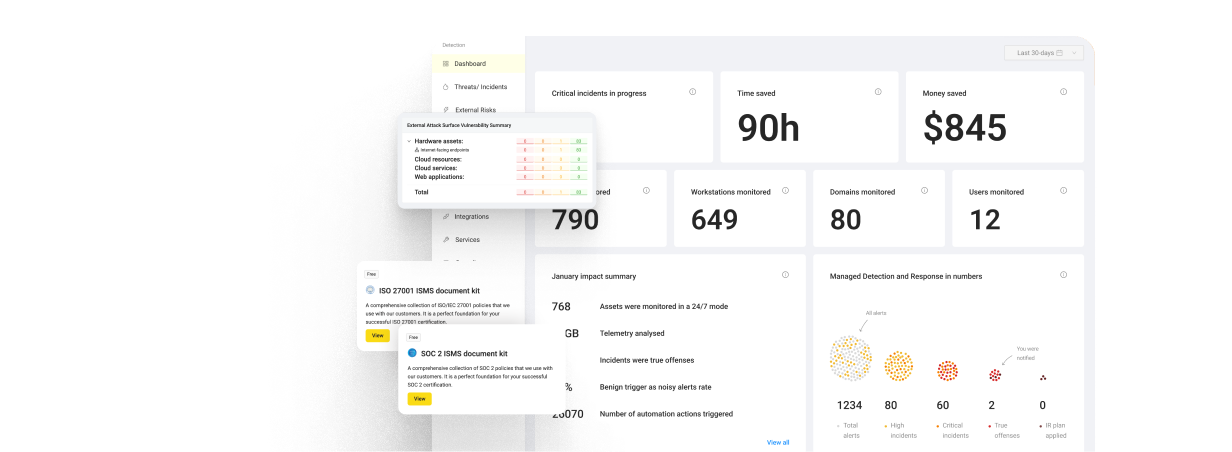
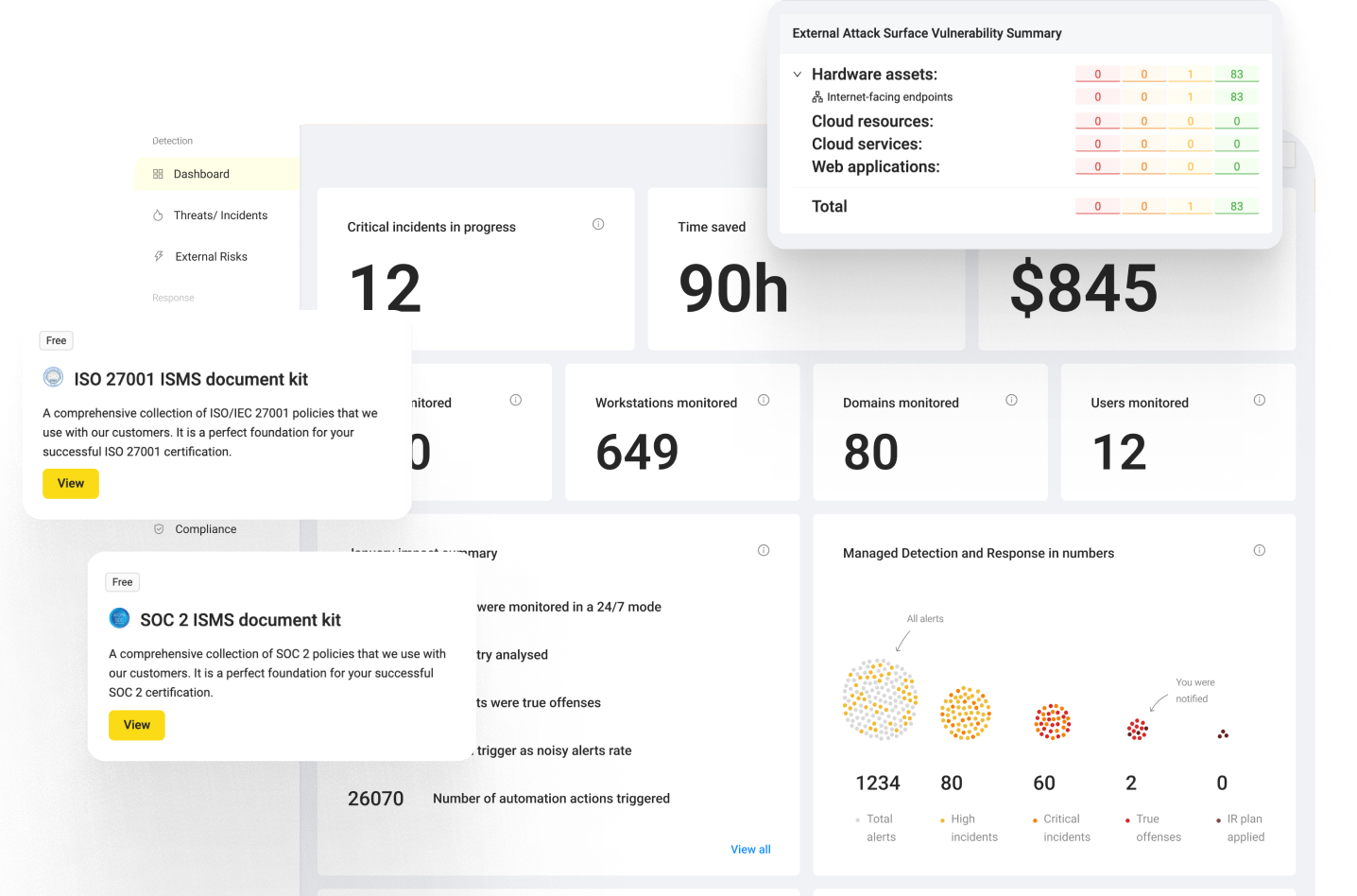
A CISO once pinged us at 2 a.m. He had a clean penetration test report on his desk and a real intruder in his network. That gap, between a green report and a real response, is the problem UnderDefense was built to close. UnderDefense Agentic AI SOC is an AI-powered MDR (Managed Detection and Response) platform paired with a human SOC (Security Operations Center) team. We test your defenses offensively, then verify that your stack actually detects and responds when attacked.
Here is my honest, practitioner view. Silence after a pentest is often a detection failure, not a coverage win. If a tester moves laterally through your network and your tools never call you, your defensive stack is broken. We do the dirty work most vendors skip. We automate the mechanical investigation steps, the SIEM (Security Information and Event Management) queries and log pulls, while humans own the final verdict.
Core Services 🛡️
- Penetration testing for web, API, mobile, network, and cloud, with remediation retesting
- AI SOC plus 24/7 human-ally detection and response across your existing tools
- Vendor-agnostic integration with 250+ security tools, no rip-and-replace
- Concierge response, where analysts verify suspicious activity directly with affected users over Slack or Teams
- Compliance support for SOC 2, ISO 27001, HIPAA, and PCI DSS
Why Companies Consider UnderDefense ✅
Most mid-market teams cannot staff a 24/7 SOC or build their own pentest bench. We act as a force multiplier that detects threats across your stack and then responds, instead of just escalating an alert into your queue. We keep your SIEM and your data, so you avoid vendor lock-in. That matters when you are juggling legacy tools and shadow AI in developer environments.
Ideal Customer Profile ❤️
Best suited for:
- Technology, SaaS, and healthcare firms with roughly 200 to 10,000 employees
- Compliance-driven teams preparing for SOC 2, ISO 27001, or HIPAA audits
- Security-lean teams that want offensive testing and ongoing response from one partner
- PE portfolio companies unifying security across multiple acquisitions
Commercial Model 💰
UnderDefense offers transparent, published pricing, with MDR commonly in the $11 to $15 per endpoint, per month range, and scoped penetration tests quoted per engagement. Engagements include onboarding, integration tuning, and ongoing advisory. Our focus is operationalizing the stack you already own, not selling a forced replacement.
When to Shortlist ⏰
Shortlist UnderDefense when you want one partner to both test your defenses and own the response, especially if you are switching from a monitoring-only MDR or a legacy MSSP that sends alerts without context.
Customer Reviews 💬
“We recently worked with UnderDefense on a penetration testing project, and the experience exceeded our expectations. Their team provided us with clear and detailed insights into security vulnerabilities, along with practical recommendations on how to fix them.” — Arman N., CTO, Mid-Market UnderDefense G2 Verified Review
“The methodology offered by UnderDefense has limited scope and needs to be adapted to future needs. The additional security assessment provided should have a better testing methodology. No other major disadvantages observed.” — Senior Engineer, Manufacturing UnderDefense Gartner Verified Review
2. BreachLock, Best for Mid-Market Teams Wanting Continuous PTaaS
Overview 😊
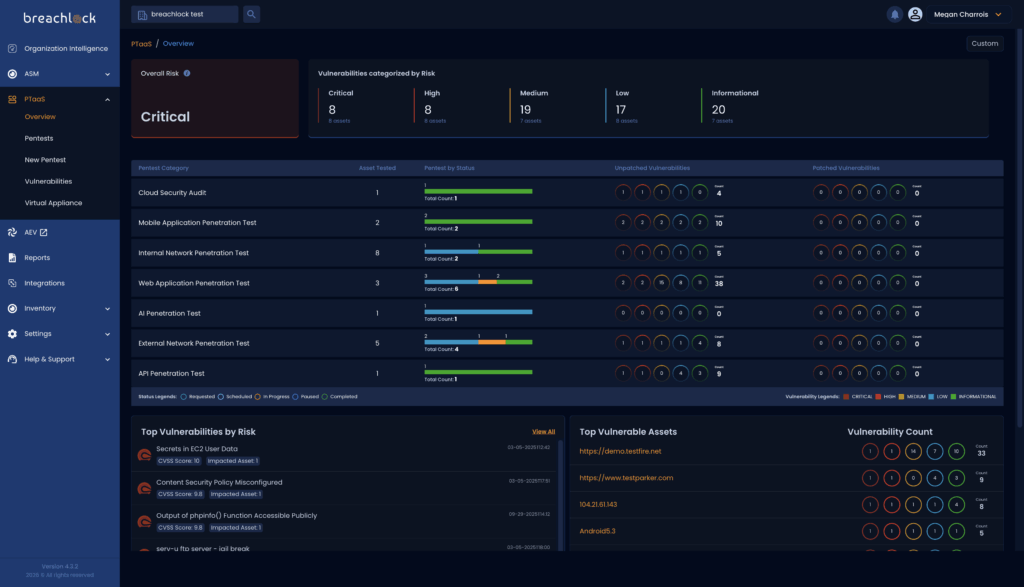
BreachLock is a global offensive security platform built around PTaaS (Penetration Testing as a Service). It combines CREST-accredited human pentesters with AI and automation to deliver continuous validation across web apps, networks, cloud, mobile, APIs, and IoT. In 2025, it became the first platform to elevate from regional to global CREST accreditation, a signal of consistent worldwide delivery.
Core Services 🛡️
- PTaaS across web, network, API, mobile, and cloud
- Attack Surface Management (ASM) with continuous discovery
- Red teaming and Adversarial Exposure Validation (AEV)
- On-demand retesting through a real-time vulnerability dashboard
- Compliance-ready reporting for SOC 2, PCI DSS, ISO 27001, and HIPAA
Why Companies Consider BreachLock ✅
BreachLock bundles ASM, PTaaS, red teaming, and AEV into one subscription, consolidating what many vendors sell as separate SKUs. On-demand retests are included, which most point-in-time vendors charge extra for. The company reported $17.3M ARR in 2024, up 83.2% year over year, and serves over 1,100 clients across 20 countries.
Ideal Customer Profile ❤️
Best suited for:
- Mid-market to enterprise firms (50 to 5,000 employees) in healthcare, FinTech, SaaS, and insurance
- Teams needing compliance-ready deliverables and continuous discovery
- Buyers wanting to retest remediations without procuring separate ASM and pentest vendors
Commercial Model 💰
Pricing starts at roughly $2,500 per engagement for one-time validation, $5,000 per year for annual validation, and custom pricing for continuous validation. Platform access is included for six months with a pentest engagement. Note that annual and continuous tier pricing requires a custom quote, which can slow budget planning. ⚠️
When to Shortlist ⏰
Shortlist BreachLock when you want continuous PTaaS plus attack surface management in one platform, and CREST accreditation matters for your audit or board.
Customer Reviews 💬
BreachLock holds a 4.6 average across 38 G2 reviews and a 4.3 average on Clutch, with reviewers consistently citing platform transparency, CREST credibility, and on-demand retesting as standout strengths. Its smaller Clutch review base (three reviews) is worth noting when weighing community sentiment depth.
3. Cobalt.io, Best for Agile and DevSecOps Teams
Overview 😊
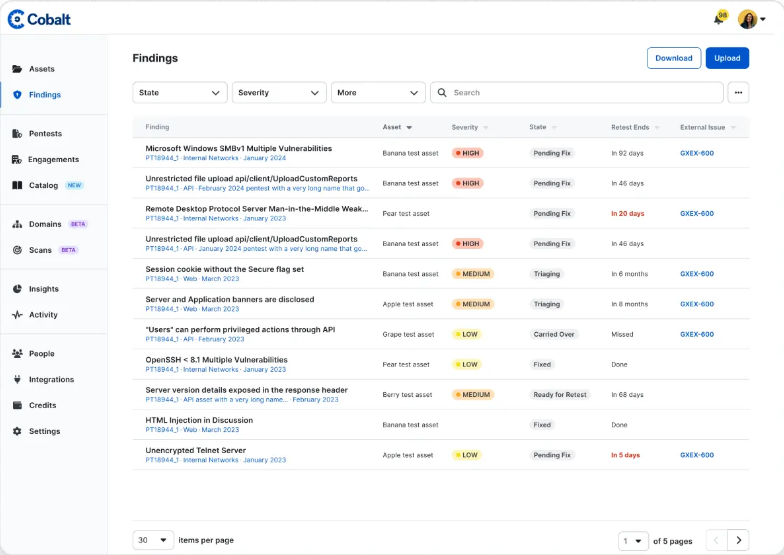
Cobalt is a PTaaS and offensive security platform that blends AI-powered automation with a vetted global community of pentesters. Its signature edge is speed. Teams can launch a pentest in as little as 24 hours and receive findings in real time during the engagement. Cobalt completed nearly 255,000 hours of practical testing in 2025.
Core Services 🛡️
- PTaaS across web, API, mobile, network, and cloud
- DAST (Dynamic Application Security Testing) in the same platform
- LLM and AI application penetration testing and jailbreaking
- Native developer integrations with Jira and GitHub
- Compliance-ready reporting for PCI DSS, HIPAA, SOC 2, and NIST
Why Companies Consider Cobalt ✅
Cobalt runs a credit-based, on-demand model, where each credit equals eight hours of testing. That lets agile teams spin up tests within 24 hours without re-procurement. Its native Jira and GitHub integrations make it a strong fit for teams managing continuous delivery. Cobalt earned 25 G2 badges in Winter 2026, the highest count in its category.
Ideal Customer Profile ❤️
Best suited for:
- FinTech, SaaS, healthcare, insurance, retail, and media companies
- DevSecOps teams wanting findings inside their developer workflow
- Mid-sized to large enterprises needing repeatable, agile testing
Commercial Model 💰
Starter packages begin at $8,500, with a clearly published credit model. The combined PTaaS plus DAST platform removes the need for a separate DAST subscription. Some reviewers flag premium pricing and limits on more exotic test types given the vetted community size. ⚠️
When to Shortlist ⏰
Shortlist Cobalt when speed and developer-workflow integration matter most, and you want pentests that slot directly into CI/CD pipelines.
Customer Reviews 💬
Cobalt holds a 4.5 average across 177 verified G2 reviews and was named number one in G2’s Enterprise DAST Relationship Index, with reviewers most often praising 24-hour test starts, real-time findings, and native developer integrations.
4. Synack, Best for Enterprises and Government Needing Vetted, Continuous Pentesting
Overview 😊
Synack runs a premium PTaaS model built on the Synack Red Team (SRT), a rigorously vetted global community of researchers, layered with its Hydra AI scanning engine. The pitch is simple. You get continuous, on-demand testing from elite ethical hackers, plus an audit trail strong enough for the most regulated buyers. Synack raised $112.1M in funding, which signals deep enterprise backing.
Here is my practitioner read. Synack’s strength is rigor and depth, not speed of procurement. ⚠️ That trade-off fits enterprises and agencies, but it can feel heavy for a 200-person SaaS team that just needs a fast scoped test.
Core Services 🛡️
- Continuous PTaaS across web, host, network, cloud, and API
- Synack Red Team, a vetted researcher community
- Hydra AI-driven continuous vulnerability scanning
- Real-time analytics and detailed compliance reporting
- Government and FedRAMP-aligned testing for public-sector buyers
Why Companies Consider Synack ✅
Synack is built for organizations where audit defensibility and researcher quality matter more than getting started in 24 hours. Its vetted community and analytics platform suit large enterprises, financial services, and government. The funding and enterprise focus give procurement teams confidence in long-term viability.
Ideal Customer Profile ❤️
Best suited for:
- Large enterprises, financial services, and government agencies
- Highly regulated firms needing strong audit trails
- Organizations wanting continuous, researcher-driven validation at scale
Commercial Model 💰
Synack is a premium, enterprise-tier service with custom pricing tied to scope and continuous coverage. Engagements emphasize ongoing testing rather than one-time projects. Expect a higher entry point than agile PTaaS vendors. 💸
When to Shortlist ⏰
Shortlist Synack when you are an enterprise or public-sector buyer who needs vetted researchers, continuous coverage, and rigorous, auditable reporting.
5. NetSPI, Best for Enterprises Wanting Unified Proactive Security
Overview 😊
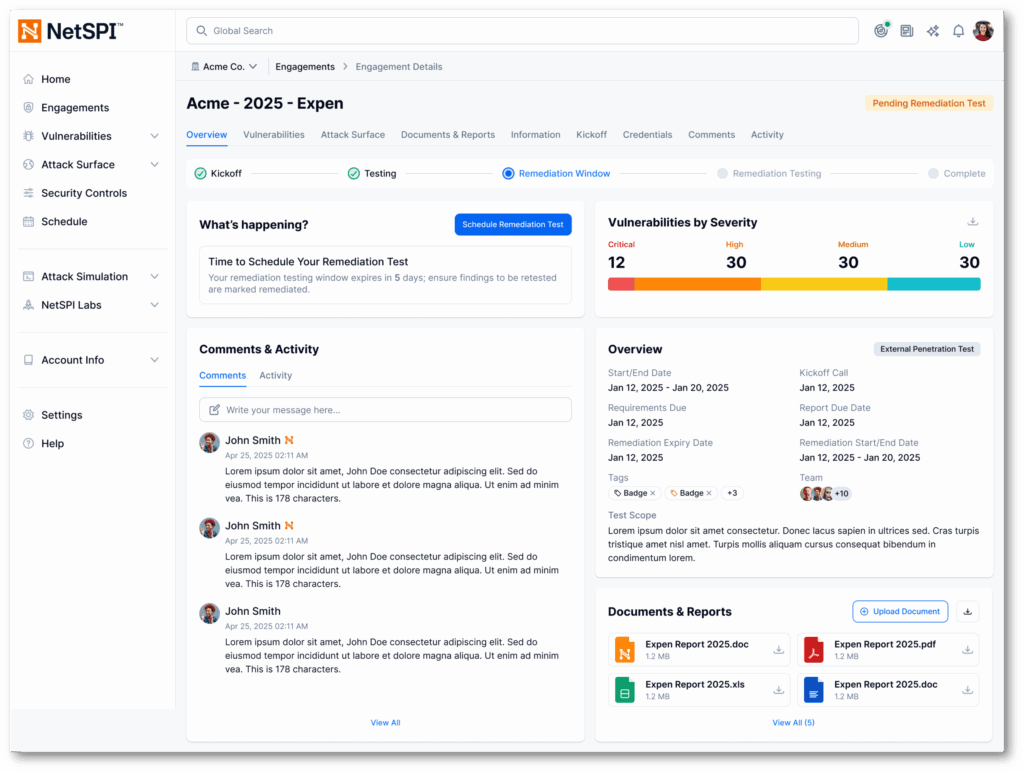
NetSPI positions itself as a Proactive Security platform that unifies penetration testing, attack surface management, and breach and attack simulation under one roof. Backed by KKR, it serves large, complex enterprises that want testing tied to a broader exposure-management program, not a one-off report.
My take from the field. NetSPI shines when you need depth across many asset types and a partner that treats testing as a continuous program. It is less of a fit for a small team wanting a quick, low-cost scoped test.
Core Services 🛡️
- Penetration Testing as a Service across networks, apps, cloud, and more
- Attack Surface Management (ASM)
- Breach and Attack Simulation (BAS)
- AI/ML penetration testing
- Compliance-aligned reporting for SOC 2, PCI DSS, and similar frameworks
Why Companies Consider NetSPI ✅
NetSPI consolidates three traditionally separate categories, testing, ASM, and BAS, into one platform. That appeals to enterprises trying to reduce vendor sprawl. KKR backing signals scale and staying power for multi-year programs.
Ideal Customer Profile ❤️
Best suited for:
- Large enterprises and Fortune 500 firms
- Financial services, healthcare, and technology companies
- Security teams building a continuous exposure-management program
Commercial Model 💰
NetSPI uses enterprise, custom pricing scoped to the program and asset coverage. It is positioned at the premium end of the market. Budget accordingly for a platform engagement rather than a single test. 💸
When to Shortlist ⏰
Shortlist NetSPI when you want to unify pentesting, attack surface management, and breach simulation with one enterprise-grade partner.
6. Packetlabs, Best for Compliance-Driven Manual Penetration Testing
Overview 😊
Packetlabs is a boutique, Canada-based firm focused on deep, manual penetration testing that goes well beyond automated scanning. Its methodology maps to recognized standards, and it carries strong, consistent client validation, holding a 4.9 average across 47 Clutch reviews. The appeal is craftsmanship over volume.
Here is my honest view. ⚠️ A boutique manual-first shop gives you depth and expert attention, but it does not scale like a platform-based PTaaS vendor. If you need continuous, self-serve testing across hundreds of assets, weigh that limit.
Core Services 🛡️
- Manual penetration testing for infrastructure, web, and applications
- Objective-based and red team engagements
- Ransomware penetration testing
- Purple teaming and adversary simulation
- Compliance-aligned testing for SOC 2, PCI DSS, and similar frameworks
Why Companies Consider Packetlabs ✅
Packetlabs is chosen by teams that value methodology depth and human expertise over automated breadth. Its 4.9 Clutch average reflects strong client trust and report quality. For compliance milestones that demand rigorous manual testing, it is a credible boutique option.
Ideal Customer Profile ❤️
Best suited for:
- Compliance-driven mid-market and enterprise teams
- Organizations needing deep, manual, objective-based testing
- Canadian and North American firms wanting a specialist partner
Commercial Model 💰
Packetlabs scopes engagements per project, with pricing tied to depth and objectives rather than a self-serve credit model. Expect a consultative, quote-based process. Plan lead time for scoping and scheduling. ⏰
When to Shortlist ⏰
Shortlist Packetlabs when manual depth, methodology rigor, and a specialist boutique relationship matter more than platform-driven scale.
7. HackerOne, Best for Enterprises With Broad, Evolving Attack Surfaces
Overview 😊
HackerOne runs the world’s largest hacker-powered security marketplace, built around bug bounty and vulnerability disclosure. The model is open and continuous. A global researcher community probes your public-facing apps for as long as your program runs, and you pay per validated finding. It powers programs for clients like the U.S. Department of Defense and Goldman Sachs.
My honest read. ⚠️ Bug bounty discovers what researchers find organically, not every critical flaw across a defined scope. It complements structured pentesting, but does not replace it. A large community means more submissions, including duplicates, so triage falls on your team.
Core Services 🛡️
- Public and private bug bounty program management
- Vulnerability Disclosure Programs (VDP)
- Managed penetration testing across web, API, network, and cloud
- AI Red Teaming for LLM and AI systems
- Triage and AI-powered validation via the Hai assistant
Why Companies Consider HackerOne ✅
Organizations with large, constantly changing attack surfaces use HackerOne for ongoing crowd-sourced discovery between periodic pentests. Its scale and AI red-teaming capability suit enterprises rolling out AI features. The DoD and major financial clients lend strong credibility.
Ideal Customer Profile ❤️
Best suited for:
- Large enterprises (1,000+ employees) with public-facing apps
- Teams with frequent code changes wanting continuous discovery
- Organizations needing AI red teaming alongside traditional testing
Commercial Model 💰
HackerOne uses a pay-per-validated-vulnerability model for bug bounty, where clients set researcher payouts and pay a platform fee on top. Managed pentesting is custom-priced and requires consultation. There is no free trial, though a demo is available. 💸
When to Shortlist ⏰
Shortlist HackerOne when you want always-on crowd-sourced testing for a broad attack surface, and you have the internal capacity to triage a higher volume of reports.
8. Astra Security, Best for SMBs Wanting Scanning Plus Pentest Plus Live WAF
Overview 😊
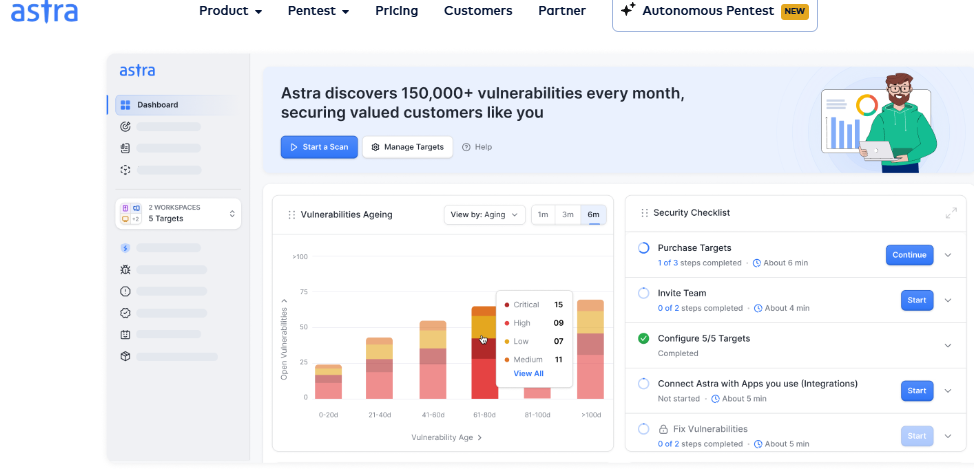
Astra Security is a hybrid VAPT platform that combines automated scanning, manual expert pentesting, and a built-in Web Application Firewall (WAF). The WAF is the standout. While vulnerabilities are being tested or awaiting a fix, it actively blocks exploit attempts in real time. No other vendor in this list bundles immediate protection with testing.
Here is my take. Astra bootstrapped to $9.8M ARR without venture funding, which signals capital discipline and a product people actually pay for. Its transparent pricing starts at just $199 per month, the lowest disclosed entry point in this category.
Core Services 🛡️
- Automated vulnerability scanning, over 8,000 tests across OWASP Top 10 and known CVEs
- Manual expert penetration testing by certified testers
- Live Web Application Firewall (WAF) protection
- Mobile, API, cloud, IoT, Blockchain, and AI/ML application testing
- CI/CD integration for DevSecOps
Why Companies Consider Astra ✅
Astra packs continuous scanning, manual pentests, and live WAF protection into one affordable subscription. It was named a G2 Leader in Penetration Testing for Spring 2025 and crossed 150 G2 reviews. For SMBs that cannot afford $8,500 engagement minimums, it makes enterprise-grade testing accessible.
Ideal Customer Profile ❤️
Best suited for:
- SMBs and mid-market tech firms (10 to 500 employees) in SaaS, eCommerce, or FinTech
- Teams wanting continuous scanning plus periodic manual pentests
- Companies needing IoT, Blockchain, or AI/ML testing on a budget
Commercial Model 💰
Astra publishes pricing openly: a Scanner tier at $199 per month, a Pentest tier at $5,999 per year, and an Enterprise tier from $9,999 per year. A free trial is available for the scanner. ⚠️ Note its delivery team is primarily India-based, which may raise data-residency questions for some buyers.
When to Shortlist ⏰
Shortlist Astra when you want affordable, continuous testing with live WAF protection, especially for IoT, Blockchain, or AI/ML apps that legacy firms rarely cover.
Customer Reviews 💬
“Astra works well for small-sized companies. Turn-around time is also pretty low so all your vulnerabilities get scanned as soon as you fix them.” — Verified User Astra Security Capterra Verified Review
9. Sekurno, Best for European SaaS Needing GDPR-Native Testing
Overview 😊
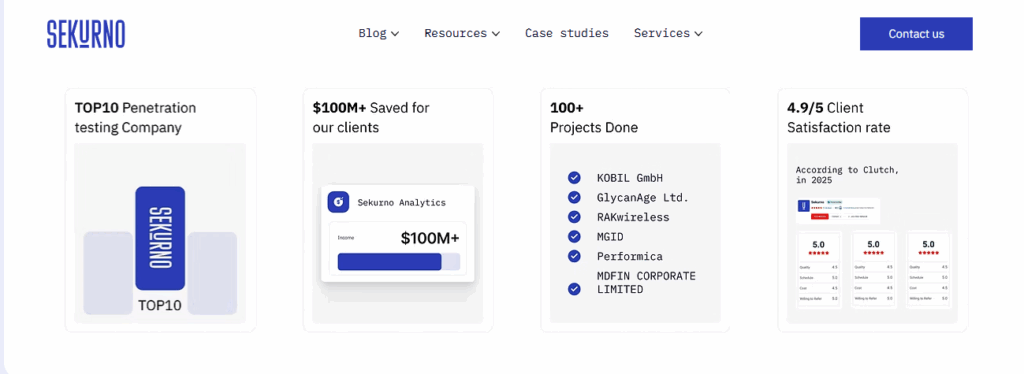
Sekurno is a boutique consultancy focused on deep-dive penetration testing and security beyond compliance for high-risk industries. Born from a Ukrainian cybersecurity community and supported by USAID’s Cyber Accelerator, it now serves clients globally with an EU base in Tallinn and Amsterdam. Its standout claim is a documented zero-breach track record across all engagements.
My read. ⚠️ A boutique team of 10 to 49 people gives you depth and senior attention, but capacity constraints can affect availability for concurrent enterprise work or tight deadlines. Sekurno also lists reviews on Clutch only, which limits discoverability for US buyers.
Core Services 🛡️
- Web, mobile, API, network, cloud, and IoT penetration testing
- Secure SDLC and shift-left security consulting
- ISO 27001, GDPR, SOC 2, HIPAA, and PCI DSS compliance testing
- Source code security review
- Cybersecurity awareness training
Why Companies Consider Sekurno ✅
Sekurno’s multilingual team and EU-Ukraine delivery enable GDPR-native consulting, where testers understand European regulatory context natively. It was named a global Top 15 cybersecurity company on Clutch in 2023, with a 4.9 average across 26 reviews. Its zero-breach positioning resonates in high-risk sectors.
Ideal Customer Profile ❤️
Best suited for:
- European SMBs and Enterprise SaaS firms (20 to 500 employees)
- HealthTech, IoT, and digital-identity companies needing GDPR-native testing
- Buyers wanting a boutique alternative to large consulting firms
Commercial Model 💰
Sekurno is project-based, starting around $5,000 per project, with most engagements running $10,000 to $49,000. There is no free trial, though consultation calls are available. Expect a consultative, scoped process. ⏰
When to Shortlist ⏰
Shortlist Sekurno when GDPR-native expertise, multilingual delivery, and a documented zero-breach track record matter for high-risk European workloads.
Customer Reviews 💬
“The thoroughness of Sekurno’s security testing really stood out. They took an in-depth approach and identified vulnerabilities that were previously missed by both our internal assessments and other auditors.” — Digital Identity Platform, Tech Company Sekurno Clutch Verified Review
10. Qualysec, Best for Web3, AI, and IoT Testing at Accessible Pricing
Overview 😊
Qualysec is an India-based penetration testing firm serving global clients across finance, government, healthcare, and high-tech sectors. Since 2020, it has combined human-led offensive expertise with AI-powered processes, marketing itself as “Human-Led, AI-Powered Penetration Testing.” Its differentiator is certified specialization in both Blockchain/Smart Contract and AI/ML application security, an emerging gap most legacy firms lack.
My honest read. ⚠️ Qualysec is young, founded in 2020, with a very limited G2 presence (one review), so buyers who rely on G2 will not discover it organically. Its India-only delivery may not satisfy data-residency or government-clearance needs for some enterprises.
Core Services 🛡️
- Web, mobile, cloud, API, and network penetration testing
- IoT penetration testing
- Blockchain and Smart Contract security testing
- AI/ML application security testing
- Compliance audits for SOC 2, PCI DSS, ISO 27001, HIPAA, and GDPR
Why Companies Consider Qualysec ✅
Qualysec delivers OWASP-aligned methodology at India-based pricing, often 40 to 60 percent below US or EU equivalents. It holds a 4.9 average across 28 Clutch reviews, strong validation for a young firm, and appears in multiple Top 20 VAPT India 2026 roundups. Its Web3 and AI/ML focus suits emerging-tech companies.
Ideal Customer Profile ❤️
Best suited for:
- SMBs, startups, and growth-stage firms globally with moderate budgets
- Web3, DeFi, and AI-native SaaS companies needing specialized coverage
- Price-sensitive teams wanting expert-quality testing at accessible rates
Commercial Model 💰
Qualysec uses project-based, custom quotes, with pricing not publicly disclosed. There is no free trial, though consultation calls are available. Its India-based delivery typically carries a 40 to 60 percent cost advantage over US/EU vendors. 💸
When to Shortlist ⏰
Shortlist Qualysec when you need Blockchain, Smart Contract, or AI/ML security expertise at accessible pricing, and global data-residency is not a hard requirement.
Customer Reviews 💬
“Human-Led, AI-Powered Penetration Testing. Smarter Security, Faster Results, Human Expertise at the Core.” — Verified Client Qualysec Clutch Verified Review
11. Bright Defense, Best for Small Businesses and SaaS Teams That Need Penetration Testing and Compliance Support
Overview 😊
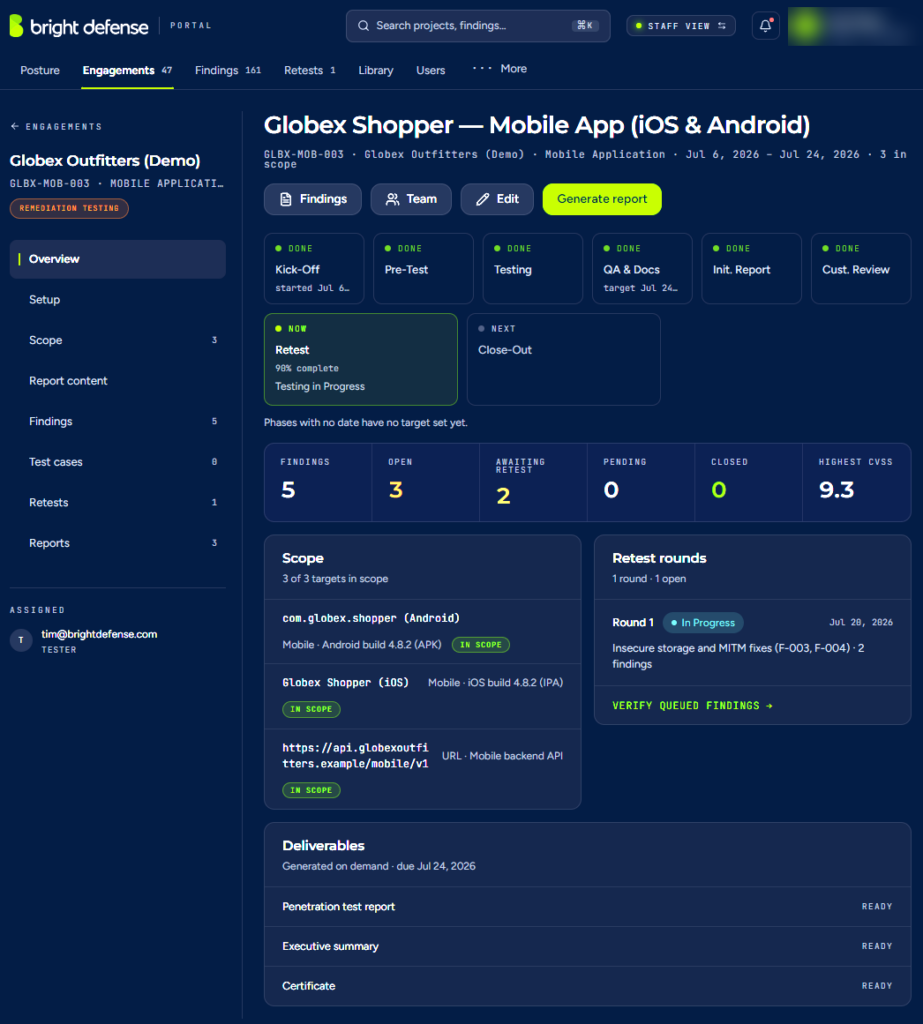
Bright Defense is a cybersecurity firm that combines penetration testing with continuous compliance and security leadership. Its penetration testing services cover web applications, APIs, and networks, with prioritized findings, remediation guidance, and retest support.
The company’s broader offering addresses the work surrounding a test: assigning responsibility for fixes, tracking remediation, and maintaining evidence for audits. For a growing business preparing for SOC 2 or ISO 27001, that combination can help connect technical findings to its compliance program.
Core Services 🛡️
- Web application, API, and network penetration testing
- OWASP Top 10 testing, authentication checks, and API fuzzing
- Prioritized reporting with remediation guidance and retest support
- Continuous compliance support for SOC 2, ISO 27001, HIPAA, CMMC, and PCI DSS
- Virtual Chief Information Security Officer (vCISO) services, risk assessments, and policy development
- Managed compliance automation, evidence collection, and remediation tracking
Why Companies Consider Bright Defense ✅
Bright Defense brings testing and compliance support into the same service portfolio. Companies can engage the team for a defined penetration test or use its broader monthly services to manage ongoing security and audit preparation.
That setup is particularly relevant when a founder, IT manager, or small security team owns compliance alongside other responsibilities. The broader engagement provides support with control implementation, evidence management, and audit coordination, helping the company maintain its program as systems and customer requirements change.
Ideal Customer Profile ❤️
Best suited for:
- Startups and small to mid-sized businesses with limited internal security resources
- SaaS and technology companies preparing for enterprise customer security reviews
- Organizations pursuing SOC 2 or ISO 27001 that need testing and remediation support
- Managed service providers developing a structured compliance program
Commercial Model 💰
Bright Defense offers three fixed-scope penetration testing plans: Ignite at $2,750 for 48 hours, Elevate at $5,250 for 96 hours, and Summit at $9,250 for 176 hours. Higher tiers cover more endpoints and application pages or modules.
Each plan includes remediation guidance and retest support. Separate continuous compliance plans start at $1,000 per month for organizations with 10 or fewer employees and one audit framework. Buyers should confirm the testing scope and ongoing services included in their engagement.
When to Shortlist ⏰
Shortlist Bright Defense when penetration testing is part of a broader compliance initiative and your team needs help managing the follow-through. Its combination of defined testing packages, vCISO support, and ongoing compliance services makes it a relevant option for growing companies building a repeatable security program.
Customer Feedback 💬
A testimonial on Bright Defense’s service page describes a penetration testing engagement supporting SOC 2:
“What stood out most was their responsiveness: kickoff happened quickly, communication throughout the engagement was prompt and clear.” — Danny Meagher, Co-Founder & COO, Heritage Auto Leasing
Q2: How Did We Rank These Security Testing Services? (Selection Criteria)
We scored each vendor across five weighted criteria summing to 100%: Detection-and-Response and Exploit Validation (25%), Cross-Infrastructure and AI Coverage (25%), Compliance and Credibility (20%), Pricing Transparency (15%), and User Reviews and Sentiment (15%). Scores of 81 to 100 earn 5 stars, 61 to 80 earn 4 stars, and 41 to 60 earn 3 stars. UnderDefense earns 5 stars. Point-in-time-only vendors lose points on response validation.
Why This Rubric, and What It Measures
I built this rubric the way I would scope a real vendor bake-off. No pay-to-play, no popularity contest. Every weight maps to a question a busy CISO actually asks before signing.
The dossier behind this list drew on verified signals, including 3,833 Clutch firm listings and 3,221 G2 reviews. That gave us a wide, auditable base. Here is what each criterion measures and why it carries the weight it does.
The Five Weighted Criteria
- Detection-and-Response and Exploit Validation (25%). Does the vendor prove a finding is exploitable, and does it test whether your defenses actually fire? This is the criterion most lists skip. ✅
- Cross-Infrastructure and AI Coverage (25%). Can it test web, API, network, cloud, mobile, and now AI systems? Coverage breadth decides real-world fit.
- Compliance and Credibility (20%). SOC 2, ISO 27001, HIPAA, and PCI DSS support, plus hard proof points. Synack’s $112.1M funding, NetSPI’s KKR backing, and BreachLock’s global CREST accreditation all counted here. ⭐
- Pricing Transparency (15%). Is pricing published, or hidden behind a sales call? Transparency lowers buyer risk. 💰
- User Reviews and Sentiment (15%). Verified G2, Clutch, and Gartner ratings, weighted for volume and recency.
The Criterion Most Competitors Quietly Omit
Here is where I will plant a flag. The standard “best pentest” list ranks on findings count and price. My read is that gets it backwards.
A finding is noise until you answer two questions. Was it exploitable, and did your stack notice? That is why “response validation” sits at the top of our weighting. We ask whether simulated lateral movement triggered a real MDR (Managed Detection and Response) phone call, not just a line in a PDF.
KEV-Mapped Prioritization
We also reward vendors that prioritize against the CISA KEV (Known Exploited Vulnerabilities) Catalog. That is the U.S. government’s running list of flaws attackers are using right now. Ranking by KEV beats ranking by raw CVSS score, because it focuses your team on what is actually being weaponized. ⚠️
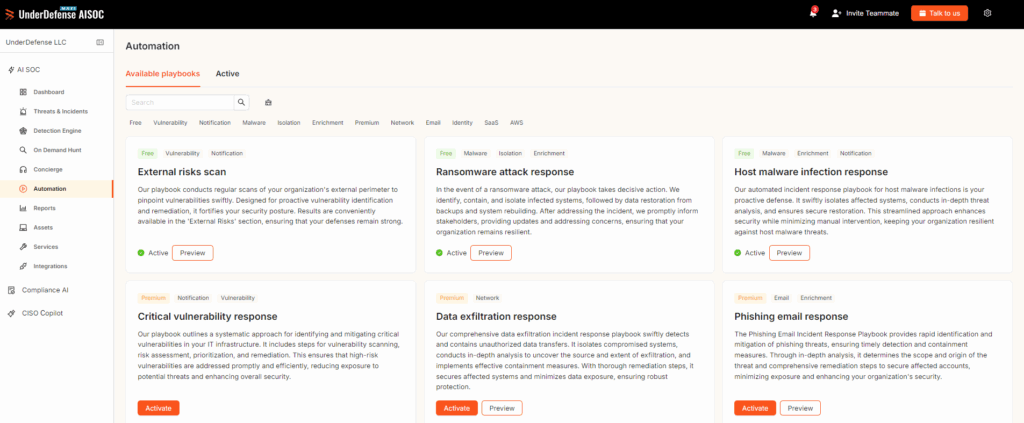
This is exactly where UnderDefense earns its 5 stars. We do not stop at “here is the hole.” We confirm the hole is reachable, then verify your detection and response close the loop, across the tools you already own. That is the core of our UnderDefense Agentic AI SOC platform.
What We Got Wrong, or Are Still Unsure About
Let me be honest about the limits. ⏰ Review-volume bias is real in this rubric.
A boutique like Sekurno carries a 4.9 Clutch average, but from only 26 reviews. Qualysec shows strong Clutch numbers, yet just one G2 review. Smaller sample sizes are noisier, so treat narrow-base ratings as directional, not definitive. I would weight a 177-review average more heavily than a 1-review one, and you should too.
“We recently worked with UnderDefense on a penetration testing project, and the experience exceeded our expectations. Their team provided us with clear and detailed insights into security vulnerabilities, along with practical recommendations on how to fix them.” — Arman N., CTO UnderDefense G2 Verified Review
“UnderDefense provides versatile service and was able to accommodate requirements for different projects. Scoping and detailed remediation reporting were clean and very comprehensive.” — CTO, IT Services UnderDefense Gartner Verified Review
Q3: What Are Security Testing Services, and Which Types and Infrastructure Do You Need?
Security testing services discover, validate, and remediate exploitable vulnerabilities across web apps, APIs, networks, cloud, mobile, and now AI systems. Most organizations need a layered mix: VAPT and PTaaS for recurring coverage, SAST, DAST, and IAST inside the SDLC, red and purple teaming to test detection, and bug bounty for continuous crowd coverage. The common blind spots are OT/SCADA and the agentic-AI developer toolchain.
Concept, Example, and Application
Think of security testing like a building inspection. A scanner walks the halls and flags loose wiring. A penetration tester actually tries to break in and prove the wiring starts a fire.
That difference, finding versus proving, is the whole game. In practice, a SaaS firm might scan weekly, run a manual penetration test before an enterprise audit, and keep a bug bounty open for its public app. Each method answers a different question. ✅
The Testing Types, and When to Use Each
Here is the plain-language breakdown of the methods you will compare.
- VAPT (Vulnerability Assessment and Penetration Testing): Combines automated scanning with manual exploitation. Use it for broad, recurring coverage and compliance milestones.
- PTaaS (Penetration Testing as a Service): A platform model with on-demand tests and real-time findings. Use it when you ship code often and need continuous validation.
- SAST, DAST, and IAST: Static testing reads source code, dynamic testing attacks the running app, and interactive testing watches the app from inside. Use these inside your SDLC (Software Development Life Cycle).
- Red and purple teaming: Red teams simulate real attackers. Purple teams pair them with your defenders. Use these to test whether detection actually fires. ⚠️
- Bug bounty: A crowd of vetted researchers probes your public apps for pay-per-finding. Use it for continuous coverage between structured pentests.
OWASP as the Common Baseline
Every credible vendor in this list maps to the OWASP Web Security Testing Guide, the open framework penetration testers use worldwide. It gives you a shared yardstick for scope and quality. If a vendor cannot tell you how they map to it, that is a flag. ❌
Infrastructure Coverage Matrix
Coverage breadth decides real fit. Most vendors cover web and API well, but the edges differ sharply.
| Asset Class | Vendor Coverage |
|---|---|
| Web applications | Universal across all vendors |
| API security | Near-universal |
| Cloud (AWS, Azure, GCP) | 9 of 11 vendors |
| Network | Offered by all vendors |
| Mobile (iOS, Android) | Common, not universal |
| IoT / Blockchain / AI-ML | Specialist (Astra, Qualysec) |
| OT / SCADA | Notable gap, no specialist in this list |
The Blind Spots Nobody Scopes
Two gaps surface when you actually run this in the field. First, OT and SCADA, the industrial control systems behind manufacturing and utilities, have no dedicated specialist on most shortlists. Second, the agentic-AI developer toolchain is wide open.
Tools like Cursor, Cline, and Copilot now write and execute code with real permissions. My current read is that most legacy pentest scopes ignore them entirely. We treat that AI developer surface as a first-class target, and we keep testing vendor-agnostic, so your data stays in your managed SIEM with sovereign deployment options for GDPR and NIS2. 💰
Your Monday action: inventory every asset class above, then circle the ones your current vendor has never scoped. That short list is your real risk. Our attack surface management approach starts from exactly that inventory.
Q4: Why Is a “Clean” Pentest Report Often a Detection Failure, and How Often Should You Test?
A clean pentest report can be dangerous reassurance. If a tester moves laterally and your MDR never calls, that is blind detection, not security. Verizon’s 2025 DBIR shows vulnerability exploitation is now a top initial-access vector, present in one in five breaches, up 34% year over year. Attackers weaponize new flaws in roughly five days, against a 32-day median patch lag. Annual checkbox testing cannot close that gap. Continuous validation can.
The Standard Read Gets This Backwards
Most teams celebrate a green report. I think that instinct is exactly wrong. A report tells you what a tester found, not whether your defenses noticed.
Picture a SOC (Security Operations Center) manager who passed her annual pentest in March. In June, a real attacker walks in through a stolen VPN credential, moves sideways, and nobody gets paged. The report was clean. The detection was blind.
The Numbers That Should Change Your Cadence
The gap between attacker speed and defender speed is now measurable. ⏰
- The median time to detect mass exploitation of a CISA KEV (Known Exploited Vulnerabilities) flaw is five days, per Verizon’s DBIR analysis.
- The median time to patch is 32 days, and only 54% of affected devices are fully remediated within a year.
- Exploitation of edge devices and VPNs jumped nearly eightfold, from 3% to 22% of exploitation actions.
If attackers move in five days and you patch in 32, an annual pentest is a snapshot of a war that already moved. ⚠️
From Point-in-Time to Continuous Validation
So what do I do instead? I stop asking “did we pass?” and start asking “did we detect, and did we respond?”
That means two shifts. Test your detection, not just your perimeter, by running simulated lateral movement and confirming a human actually gets the call. Then set cadence to the threat, validating continuously rather than once a year. Our continuous security monitoring model is built for exactly that rhythm. ✅
What This Looks Like in Practice
We run live attack-and-defense exercises against client stacks, and I will be honest, name-brand EDR (Endpoint Detection and Response) tools miss lateral movement more often than vendors admit. The fix is not a better report, but closing the loop between finding, detecting, and responding.
In one engagement, our team caught a roughly $300K business email compromise payroll-fraud attempt within 90 days of onboarding, because the system flagged the anomaly and a human verified it with the affected user. That is the difference between monitoring and owning the outcome. A clean report would have told us nothing. The catch did. ⭐
Q5: How Do Security Testing Services Map to SOC 2, ISO 27001, HIPAA, and PCI DSS?
Most frameworks expect regular, evidence-backed testing. PCI DSS mandates annual and post-change penetration testing, HIPAA requires risk assessment of ePHI systems, and SOC 2 Type II and ISO 27001 auditors look for documented vulnerability management. Eight of ten leading vendors generate compliance-ready reports. But auditors increasingly want proof that findings were remediated and retested, not just discovered.
What Each Framework Actually Demands
Let me define these in plain terms, because the acronyms hide simple ideas. Each one asks a slightly different question of your testing program. ✅
- PCI DSS (Payment Card Industry Data Security Standard): The rulebook for handling card data. Requirement 11.4 mandates internal and external penetration testing at least every 12 months, plus testing after significant changes.
- HIPAA (Health Insurance Portability and Accountability Act): The US health-data law. It requires a risk assessment of systems holding ePHI (electronic protected health information), and pentesting is how you evidence that.
- SOC 2 Type II: An audit of how your controls operate over time. Auditors look for documented, recurring vulnerability management.
- ISO 27001: The international standard for an information security management system. It expects ongoing technical evaluation, not a one-time scan.
Framework-to-Test Mapping
This table is the cheat sheet I would hand a GRC (Governance, Risk, and Compliance) lead before an audit.
| Framework | Testing It Expects |
|---|---|
| PCI DSS 11.4 | Annual + post-change penetration testing |
| HIPAA | Risk assessment and testing of ePHI systems |
| SOC 2 Type II | Documented, recurring vulnerability management |
| ISO 27001 | Ongoing technical evaluation and remediation |
The Drivers Pushing Cadence Up
Two newer rules are quietly raising the bar. The SEC Cyber Disclosure Rule requires public companies to report a material cyber incident on a Form 8-K, Item 1.05, within four business days of deciding it is material. In Europe, the NIS2 Directive expands mandatory security obligations across far more sectors.
Both make one thing clear. Boards now treat testing evidence as a disclosure-readiness issue, not just an IT line item. ⚠️
Where Auditors Are Getting Stricter
Here is the shift I see on real audits. The standard read treats a pentest report as the finish line. Auditors now want the next page.
They ask: was the finding fixed, and did you retest to prove it? That “remediated and retested” evidence is the new gap. We built our compliance support and on-demand retesting around exactly that, so the audit trail shows the loop actually closed, not just that a hole was once found. 💰
Your Monday step: map every test in your calendar to its audit date, and make sure each finding has a remediation-and-retest record attached. A scoped penetration test with retesting built in keeps that record clean.
Q6: How Should a CISO Evaluate Vendors, Compare Pricing, and Justify ROI?
Score vendors on methodology depth (manual-versus-automated ratio), infrastructure and AI coverage, detection-and-response validation, compliance with remediation and retest support, pricing transparency, and financial stability. Published 2026 pricing runs from about $2,500 per PTaaS engagement to $50,000-plus enterprise programs and pay-per-finding bug bounties. But hidden “log taxes” and separate ASM and retest SKUs often matter more. Weigh cost against the multimillion-dollar price of a single breach.
The Evaluation Steps I Would Run
Here is the procurement rubric I would actually use, in order. Each step has one RFP-ready question attached.
- Methodology depth. What is your manual-to-automated testing ratio, and how do you map to OWASP or PTES?
- Coverage. Which asset classes, including cloud and AI systems, do you test in-house versus subcontract?
- Detection-and-response validation. Do you confirm our defenses fired, or just hand us findings?
- Compliance support. Do you provide remediation evidence and free retesting?
- Pricing transparency. Is pricing published, and what is excluded?
- Financial stability. Can you serve a multi-year program?
Pricing Benchmarks, and the Hidden Costs
Published 2026 entry pricing varies widely. ⏰
| Vendor | Starting Price |
|---|---|
| Astra Security | $199/month |
| BreachLock | ~$2,500/engagement |
| Cobalt.io | $8,500/package |
| Packetlabs | $10,000 to $49,000/project |
| Foresite | $50,000 to $199,999 |
The sticker price rarely tells the real story. Watch for the “log tax,” where ingestion fees balloon your SIEM (Security Information and Event Management) bill, and separate SKUs for attack surface management or retesting. ❌ Our transparent MDR pricing is published precisely to avoid those surprises.
Framing ROI Against the Cost of a Breach
So, “should we even spend this?” I think that is the wrong question. The better one is “which delivery model is most resilient per dollar?”
The math is stark. IBM’s 2024 Cost of a Data Breach Report put the global average breach at $4.88 million, up 10% year over year. Against that, a testing program is rounding error. And IBM found organizations using extensive security AI and automation saved about $2.2 million per breach. 💸
The Switcher Economics
Here is where I will be direct about our own numbers. Because we tune ingestion and stay vendor-agnostic, we have cut clients’ SIEM bills meaningfully while keeping their data in their own Splunk, Sentinel, or Chronicle. The point is not a cheaper invoice, but operationalizing the stack you already paid for, with reproducible, auditable AI investigation trails on the UnderDefense Agentic AI SOC platform. ⭐
“UnderDefense is surprisingly affordable considering the level of protection we get. Their proactive threat hunting and rapid response have saved us from incidents that could have been incredibly costly.” — Verified User in Program Development UnderDefense G2 Verified Review
“Their expert management of our SIEM has added to the value of our security investments and tools.” — Yaroslava K., IT Project Manager UnderDefense G2 Verified Review
Q7: How Is AI Changing Security Testing and Response Over the Next 18 to 24 Months?
Over the next 18 to 24 months, AI collapses the attacker-defender speed gap. Mediocre attackers wielding agentic AI can run elite attack chains, and MCP-driven agent sprawl will adapt mid-attack. Defenders are reclaiming SIEM ownership (bring-your-own Splunk, Sentinel, or Chronicle), unit-testing detection logic in CI/CD, and demanding autonomous containment, like credential wipes and forced logouts, not just endpoint isolation. Testing and response are converging into one continuous loop.
The Speed Gap Is Collapsing
Think of security like aviation. Autopilot flies the boring legs, but a human grabs the controls when it hits the fan. AI is becoming that autopilot for the SOC.
The catch is that attackers got the same upgrade. With agentic AI, a mediocre attacker can now chain together moves that used to require an elite team. The expertise barrier is evaporating. ⚠️
Three Patterns I Am Watching
Here is what I expect to surface as teams actually run this.
- The expertise barrier disappears. MCP (Model Context Protocol) lets AI agents call tools and adapt mid-attack, so attack chains get faster and cheaper. ❌
- SIEM ownership comes back. Smart teams are reclaiming their data, running bring-your-own Splunk, Sentinel, or Chronicle, and unit-testing detection rules in CI/CD like real code. ✅
- Response becomes hyper-responsive. Buyers now want autonomous containment, credential wipes, and forced logouts, not just “we isolated the endpoint.”
The Counterintuitive Part
Here is the turn. The “self-driving SOC” pitch is mostly theater. Full autonomy without expert oversight is a fleet of Ferraris with rookie drivers.
Look at where budgets actually sit. Most NIST Cybersecurity Framework spend piles into Protect, while Respond stays manual and thin. That imbalance is exactly where AI-plus-human pays off. We let AI collect context fast, then a human owns the final verdict, because that is the only model I trust to scale without lying to you. Our MDR service is built on exactly that division of labor.
Not Sure What Your Pentest Should Cost? Find Out
The Question I Am Sitting With
So here is my open question, and I genuinely do not have a clean answer. As agents start defending and attacking at machine speed, how much judgment are we comfortable handing to software that cannot be cross-examined? I would rather keep a human in the loop and be slightly slower than be fast and blind. If you are wrestling with the same trade-off, I would like to compare notes.
1. What are the 11 best security testing services in 2026?
In our analysis, the eleven best security testing services in 2026 are UnderDefense Agentic AI SOC, BreachLock, Cobalt.io, Synack, NetSPI, Packetlabs, HackerOne, Astra Security, Sekurno, Qualysec, and Bright Defense. We scored each across five weighted criteria: detection-and-response validation, cross-infrastructure and AI coverage, compliance credibility, pricing transparency, and verified reviews. Each fits a different profile:
-
UnderDefense Agentic AI SOC for lean teams wanting offensive testing plus 24/7 response.
-
BreachLock and Cobalt.io for continuous, agile PTaaS.
-
Synack and NetSPI for enterprise and government rigor.
-
Packetlabs for boutique manual depth.
-
Astra, Sekurno, and Qualysec for SMB, GDPR-native, and Web3 needs.
-
Bright Defense for pentests tied to SOC 2 or ISO 27001 readiness.
We placed UnderDefense first because we do not stop at a report. Our penetration testing services verify that your stack actually detects and responds when attacked, not just that vulnerabilities exist. When you build a shortlist, weigh response validation, not findings count, as the deciding factor.
2. Why is a clean penetration test report often a detection failure?
A clean report can be dangerous reassurance. It tells you what a tester found, not whether your defenses noticed. If a tester moves laterally through your network and nobody gets paged, that is blind detection, not security. The numbers explain the urgency:
-
Attackers weaponize new flaws in roughly five days.
-
The median time to patch is 32 days.
-
Only 54% of affected devices are fully remediated within a year.
An annual checkbox pentest is a snapshot of a war that already moved. We fix this by running simulated lateral movement and confirming a human actually receives the alert, then closing the loop between finding, detecting, and responding. That is why our MDR service pairs an AI SOC with human analysts. In one engagement, we caught a roughly $300K business email compromise attempt within 90 days, because the system flagged it and a human verified it with the affected user.
3. Which security testing types do we actually need?
Most organizations need a layered mix rather than a single test, matched to how often you ship code and how regulated you are. The core methods break down like this:
-
VAPT combines automated scanning with manual exploitation for broad, recurring coverage.
-
PTaaS delivers on-demand tests and real-time findings, ideal when you release frequently.
-
SAST, DAST, and IAST live inside your SDLC to catch flaws in code, running apps, and from the inside.
-
Red and purple teaming test whether detection actually fires.
-
Bug bounty adds continuous crowd coverage between structured tests.
The blind spots we see most often are OT and SCADA systems and the agentic-AI developer toolchain, which legacy scopes ignore entirely. We treat that AI developer surface as a first-class target. For a structured starting point, our web application penetration testing maps each method to your asset inventory, so you scope coverage, not just findings.
4. How do security testing services map to SOC 2, ISO 27001, HIPAA, and PCI DSS?
Most frameworks expect regular, evidence-backed testing, though each asks a slightly different question. Here is the mapping we hand our GRC leads:
-
PCI DSS 11.4: internal and external penetration testing at least every 12 months, plus post-change testing.
-
HIPAA: a risk assessment of systems holding ePHI, with pentesting as your evidence.
-
SOC 2 Type II: documented, recurring vulnerability management.
-
ISO 27001: ongoing technical evaluation, not a one-time scan.
Newer rules raise the bar. The SEC Cyber Disclosure Rule requires reporting a material incident within four business days, and Europe’s NIS2 Directive expands obligations across more sectors. Auditors increasingly want proof that findings were remediated and retested, not just discovered. We built our compliance services and on-demand retesting around exactly that, so the audit trail shows the loop closed.
5. How often should we run security testing?
Annual checkbox testing cannot keep pace with attackers who weaponize flaws in about five days. We advise setting cadence to the threat, not the calendar. In practice, that means three layers:
-
Continuous or quarterly validation for fast-changing, internet-facing assets.
-
A deeper manual penetration test before major releases, audits, or enterprise deals.
-
Post-change testing whenever you ship significant infrastructure or application updates.
Compliance sets the floor, not the ceiling. PCI DSS mandates annual plus post-change testing, but if your real exposure changes weekly, an annual snapshot is already stale. The shift we push for is from point-in-time to continuous validation, pairing automated discovery with periodic human depth. Our continuous security monitoring guidance breaks down the in-house versus outsourced trade-offs, so you can match cadence to both risk and budget.
6. How much do security testing services cost in 2026?
Pricing varies widely by model, scope, and depth, so we always anchor it to deliverables rather than a headline number. Representative entry points include:
-
Scanner-plus-pentest platforms from around $199 per month.
-
On-demand validation from roughly $2,500 per engagement.
-
Credit-based PTaaS starter packages from about $8,500.
-
Boutique manual engagements commonly running $10,000 to $49,000.
-
Enterprise, continuous, and researcher-driven programs on custom quotes.
The sticker price rarely tells the whole story. We tell buyers to watch for the log tax, where SIEM ingestion fees balloon your bill, and separate SKUs for attack surface management or retesting. Because we stay vendor-agnostic and keep your data in your own SIEM, our transparent MDR pricing avoids surprise costs while operationalizing the stack you already own.
7. How should we evaluate and shortlist a security testing vendor?
We score vendors the way we would scope a real bake-off, with every weight mapping to a question a busy CISO actually asks. No pay-to-play, no popularity contest. Our five weighted criteria are:
-
Detection-and-response and exploit validation (25%): does it prove findings are exploitable and test whether your defenses fire?
-
Cross-infrastructure and AI coverage (25%): web, API, network, cloud, mobile, and AI systems.
-
Compliance and credibility (20%): framework support plus hard proof points.
-
Pricing transparency (15%): published versus hidden behind a sales call.
-
User reviews and sentiment (15%): verified G2, Clutch, and Gartner ratings, weighted for volume and recency.
The criterion most lists quietly omit is response validation, and we put it at the top. We also reward vendors that prioritize against the CISA KEV catalog over raw CVSS. For a structured comparison, our roundup of the best pentest companies applies these same standards.
8. Can one partner handle both offensive testing and ongoing detection and response?
Yes, and we believe that combination delivers the strongest return for most mid-market teams. The gap we built UnderDefense to close is the one between a green pentest report and a real response when an intruder is actually inside. A single, integrated partner gives you:
-
Offensive testing that proves what is exploitable across your stack.
-
24/7 detection and response that verifies your tools actually fire.
-
Vendor-agnostic integration with the tools you already own, with no rip-and-replace.
We test your defenses offensively, then confirm your stack detects and responds when attacked, all while keeping your data in your own SIEM. We let AI collect context fast, then a human owns the final verdict, because full autonomy without expert oversight is a fleet of Ferraris with rookie drivers. You can see how this works on the UnderDefense MAXI platform.