




Q1. What Are the 8 Best SOC Automation Platforms in 2026?
A CISO at a 6,000-person fintech once paged me on a Saturday at 2:14 a.m. Her SOAR had just executed a “contain host” playbook on a CFO laptop in the middle of a board prep weekend, because a stale rule misread a legit OneDrive sync as exfiltration. No analyst saw it before it ran. That single screenshot, the panicked Slack thread, the angry CEO, is the entire reason this list exists. SOC automation in 2026 is not about firing more playbooks faster. It is about agentic AI that reasons, pauses, and pings a human when a CFO is about to lose his laptop on a Saturday.
The Direct Answer (Answer Nugget)
The 8 best SOC automation platforms in 2026 are UnderDefense Agentic AI SOC, Torq HyperSOC, Tines, Palo Alto Cortex XSIAM, Splunk SOAR, Microsoft Sentinel with Security Copilot, Google SecOps (Chronicle), and ReliaQuest GreyMatter. UnderDefense Agentic AI SOC takes the top spot because it pairs agentic investigation with concierge analyst response on top of your existing SIEM (Security Information and Event Management) tool, instead of forcing rip-and-replace.
See how the UnderDefense Agentic AI SOC investigates, triages, and resolves real alerts.
We did not pick these by polling Twitter. We scored each platform on AI Depth, alert-to-triage speed, escalation SLA, vendor lock-in posture, pricing transparency, and verified G2 and Gartner Peer Insights reviews. Recent IEEE work on layered agentic SOC architectures (perception, reasoning, action) shaped how we judged “AI Depth”, and we cross-checked claims against the 2026 SOC benchmark of 2-minute Alert-to-Triage and 99% noise reduction. For a deeper look at how speed-of-response shapes vendor evaluations, our SLA in cybersecurity guide breaks down the contractual side.
How the Star Ratings Map
- ⭐⭐⭐⭐⭐ = score 81 to 100
- ⭐⭐⭐⭐ = score 61 to 80
- ⭐⭐⭐ = score 41 to 60
- ⭐⭐ = score 21 to 40
- ⭐ = score 0 to 20
Full criteria weights live in Q2. Scoring uses public documentation, customer reviews, and our own POC work running these tools against UnderDefense Agentic AI SOC telemetry.
The Comparison Table
| Provider | Best For | Key Strength | Compliance |
|---|---|---|---|
| UnderDefense Agentic AI SOC⭐⭐⭐⭐⭐ | Mid-market and enterprise teams that want agentic AI plus a real human on call | Vendor-agnostic AI SOC plus concierge analyst response on top of your existing Splunk, Sentinel, or Chronicle | SOC 2, ISO 27001, HIPAA, PCI DSS, GDPR, NIS2, DORA |
| Torq HyperSOC ⭐⭐⭐⭐ | Large SOCs replacing legacy SOAR with hyperautomation | Agentic workflows and AI-driven case management at high event volumes | SOC 2, ISO 27001, GDPR |
| Tines ⭐⭐⭐⭐ | Detection engineers who want code-light, transparent automation | Story-based no-code automation with strong audit trails | SOC 2, ISO 27001, HIPAA, GDPR |
| Palo Alto Cortex XSIAM ⭐⭐⭐⭐ | Palo Alto stack shops consolidating SIEM, EDR, and SOAR | AI-native data lake plus tightly integrated detection and response | SOC 2, ISO 27001, FedRAMP, HIPAA |
| Splunk SOAR ⭐⭐⭐ | Splunk-heavy enterprises needing playbook orchestration | Mature SOAR with deep Splunk SIEM integration | SOC 2, ISO 27001, FedRAMP, HIPAA |
| Microsoft Sentinel + Security Copilot ⭐⭐⭐ | Microsoft 365 and Azure native shops | Tight Defender, Entra, and Purview integration with LLM copilot | SOC 2, ISO 27001, FedRAMP, HIPAA, GDPR |
| Google SecOps (Chronicle) ⭐⭐⭐ | Google Cloud-first orgs with massive log volumes | Petabyte-scale telemetry with Gemini-powered investigation | SOC 2, ISO 27001, FedRAMP, HIPAA |
| ReliaQuest GreyMatter ⭐⭐⭐ | Enterprises buying a managed automation overlay | GreyMatter Agentic AI on top of customer SIEM and EDR | SOC 2, ISO 27001, HIPAA |
1. Under Defence Agentic AI SOC⭐⭐⭐⭐⭐
Overview 📊
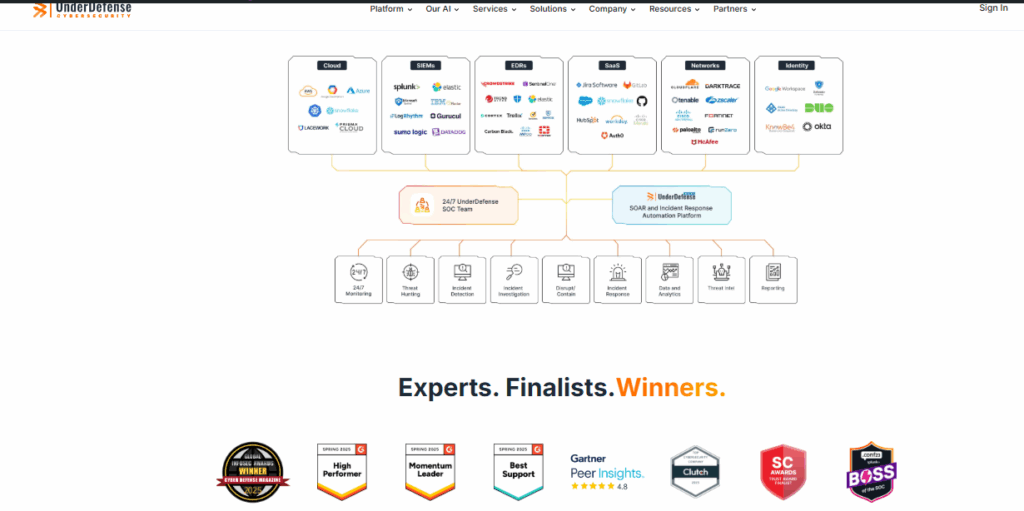
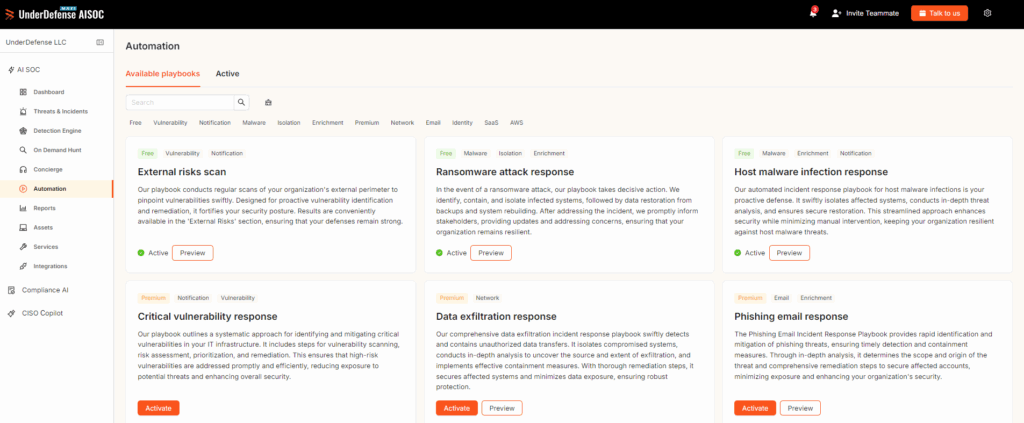
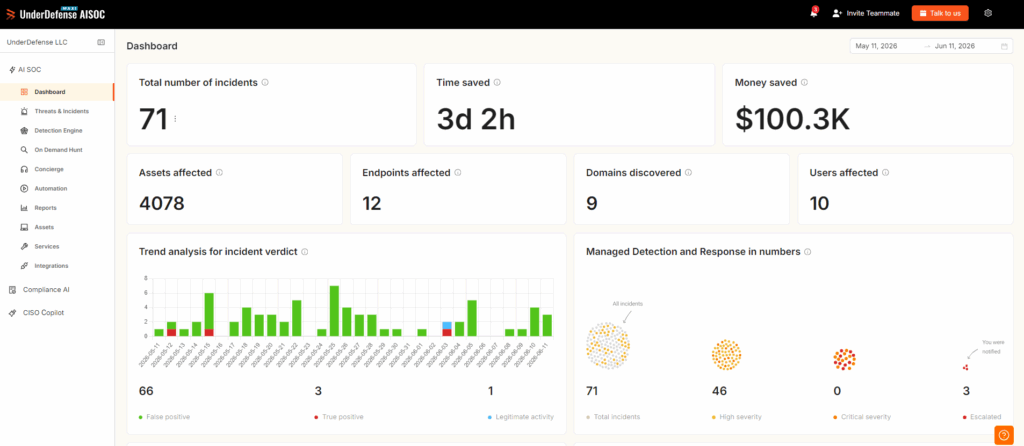
UnderDefense Agentic AI SOC is an AI SOC plus Human Ally platform for teams that already own a SIEM (Security Information and Event Management) and EDR (Endpoint Detection and Response) and refuse to throw them away. We built it because we got tired of watching customers pay a “log tax” to vendors who treated their telemetry as the vendor’s asset. UnderDefense Agentic AI SOC runs agentic investigation on top of Splunk, Sentinel, Chronicle, or whatever you already pay for, then routes verdicts through a concierge SOC team that calls the affected user on Slack inside the 15-minute critical-incident escalation window.
Core Services ✅
- 24/7 AI-driven detection plus human triage and response across 250+ integrations
- Agentic investigation that pulls logs, correlates IOCs (Indicators of Compromise), and writes a brief in under 2 minutes (Alert-to-Triage)
- Concierge analyst escalation with ChatOps user verification (we ping the actual user, not just your ticket queue)
- Vendor-agnostic SIEM, EDR, cloud, and identity coverage
- Compliance evidence packs for SOC 2, ISO 27001, HIPAA, PCI DSS, NIS2, and DORA
Why Companies Consider Under Defence ❤️
In our experience running MDR service for global teams, the question is rarely “do you detect?” The real question is “do you own the response?” UnderDefense Agentic AI SOC is built so a CFO at 2 a.m. gets a Slack message asking, “Did you just sign in from Lagos?” before any containment fires. That is the Iron Man suit, not the autopilot.
Ideal Customer Profile 👤
Best suited for:
- Mid-market and enterprise security teams with 500 to 10,000 employees
- Companies preserving Splunk, Sentinel, or Chronicle investments
- SaaS, fintech, healthcare, and PE portfolio companies under SOC 2, HIPAA, NIS2, or DORA pressure
- Teams burned by black-box MDR alert dumps
Commercial Model 💰
Transparent per-endpoint pricing in the $11 to $15 per endpoint per month range, no proprietary SIEM lock-in, and a 30-day onboarding window. No surprise log ingestion fees. No 60-day auto-renewal traps. The full breakdown lives on our MDR pricing page.
When to Shortlist ⏰
When your RFP (Request for Proposal) asks for AI-driven triage, vendor-agnostic SIEM support, and a named human analyst on a 15-minute critical-incident escalation SLA (Service Level Agreement), UnderDefense Agentic AI SOC belongs on the list next to Arctic Wolf, ReliaQuest, and Expel.
Customer Reviews ⭐
The biggest win for me was getting actual control over our security alerts. Before the guys from UD stepped in, we were getting bombarded with alerts from all our security tools. Their team cleaned up our configurations and got the noise under control within the first week.
— Verified User in Marketing and Advertising, Small-Business UnderDefense G2 Verified Review
UnderDefense Agentic AI SOC integrates well with our systems, specifically with our SIEM, Splunk. Their team is proactive in identifying and addressing threats, providing 24/7 oversight.
— Oleg K., Director Information Security, Mid-Market UnderDefense G2 Verified Review
See how the UnderDefense Agentic AI SOC investigates, triages, and resolves real alerts.
2. Torq HyperSOC ⭐⭐⭐⭐
Overview 📊
Torq HyperSOC is a hyperautomation platform aimed at SOAR (Security Orchestration, Automation, and Response) replacement at large event volumes. It pitches agentic AI workflows and AI-driven case management for SOC teams drowning in alerts.
Core Services ✅
- Agentic AI case management and workflow automation
- Pre-built integrations across SIEM, EDR, and cloud
- Event-driven automation at high throughput
- AI investigator and AI analyst agents
Why Companies Consider Torq
Large SOCs that want to retire legacy SOAR (Phantom, Demisto era) without losing playbook depth often shortlist Torq for raw speed and modern UX. Our SOC automation checklist covers the deeper architectural questions to ask.
Ideal Customer Profile 👤
Enterprise SOCs with internal detection engineering teams and high event volumes.
Commercial Model 💰
Subscription pricing tied to event volume and connector count. Public pricing is gated.
When to Shortlist ⏰
When you have 10+ in-house SOC analysts and need to operationalize agentic playbooks at scale.
3. Tines ⭐⭐⭐⭐
Overview 📊
Tines is the “story” automation platform popular with detection engineers who want transparent, code-light workflows they can audit step by step.
Core Services ✅
- No-code story-based automation
- Strong audit trail and human-in-the-loop gates
- AI features for case summarization
- Broad SaaS and security tool integrations
Why Companies Consider Tines
Teams allergic to black-box AI like Tines because every step is observable. It mirrors the “show, do not tell” stance.
Ideal Customer Profile 👤
Mid-market to enterprise security teams with engineering DNA, often paired with Splunk or Sentinel.
Commercial Model 💰
Tiered SaaS subscription, free Community Edition, gated enterprise pricing.
When to Shortlist ⏰
When auditability and detection-portability matter more than pre-built agents.
4. Palo Alto Cortex XSIAM ⭐⭐⭐⭐
Overview 📊
Cortex XSIAM bundles SIEM, EDR, SOAR, and AI under one Palo Alto Networks umbrella. It is a strong fit if you already run Cortex XDR.
Core Services ✅
- AI-driven threat detection on a unified data lake
- Native SOAR with prebuilt playbooks
- Cortex XDR endpoint and identity coverage
- Auto-investigation and incident scoring
Why Companies Consider XSIAM
Palo Alto-standardized enterprises shortlist XSIAM to consolidate vendors and reduce stack complexity.
Ideal Customer Profile 👤
Enterprise teams already invested in Palo Alto firewalls, Prisma, and Cortex XDR.
Commercial Model 💰
Per-data-volume and per-endpoint pricing, multi-year contracts typical.
When to Shortlist ⏰
When the strategic decision is “we are betting the SOC on Palo Alto.”
5. Splunk SOAR ⭐⭐⭐
Overview 📊
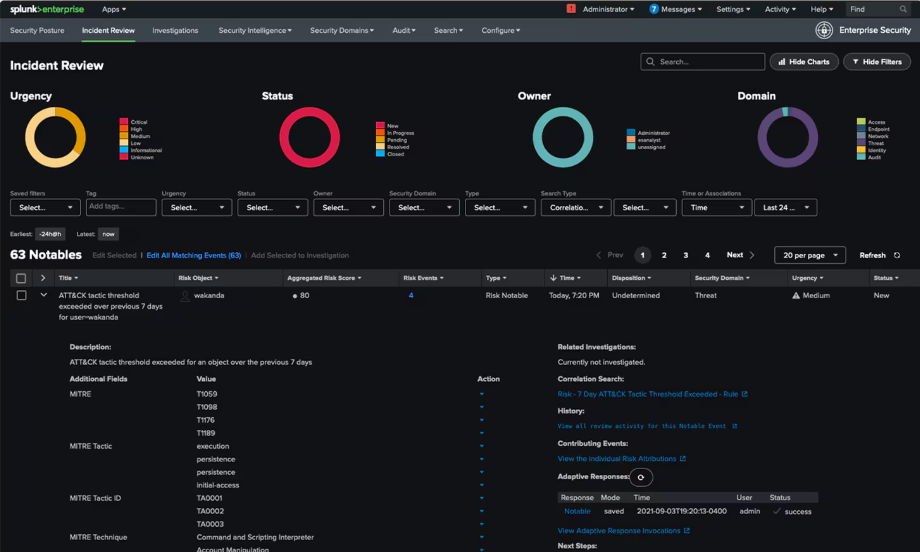
Splunk SOAR (formerly Phantom) is the mature SOAR layer for Splunk Enterprise Security customers. It does playbook orchestration well, but the AI story is catching up. Our MDR for Splunk page covers how this fits into a managed model.
Core Services ✅
- Playbook automation across 350+ apps
- Tight Splunk ES integration
- Case management
- Visual playbook editor
Why Companies Consider Splunk SOAR
Splunk-heavy enterprises with deep Phantom investments stay for continuity, not for the cutting edge.
Ideal Customer Profile 👤
Enterprises running Splunk Enterprise Security at scale.
Commercial Model 💰
Workload-based licensing, often bundled into Splunk Cloud agreements.
When to Shortlist ⏰
When you are extending Splunk ES, not replacing it.
6. Microsoft Sentinel + Security Copilot ⭐⭐⭐
Overview 📊
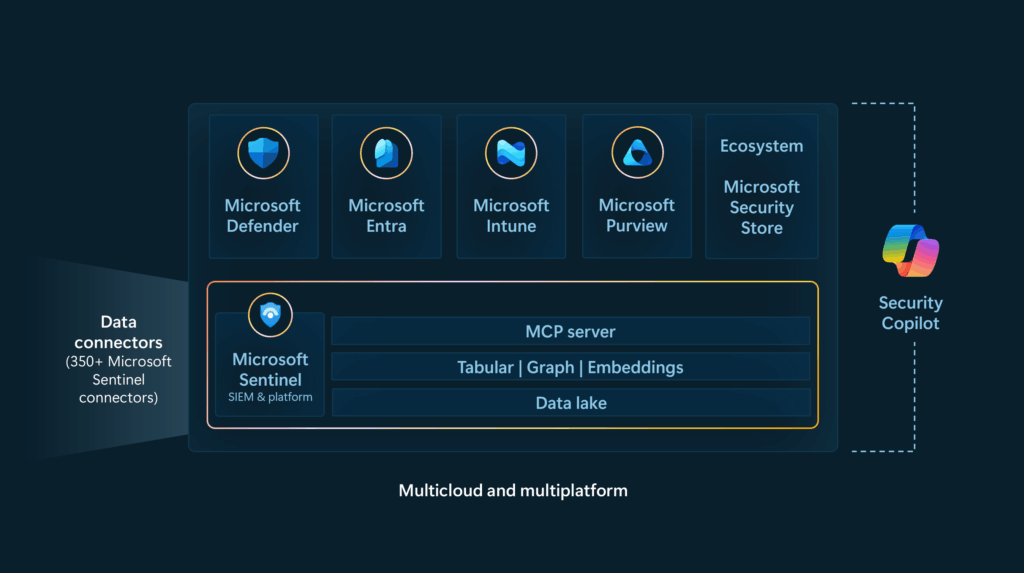
Sentinel is the cloud SIEM. Security Copilot adds an LLM (Large Language Model) layer for guided investigation. Together they make sense if your stack is Microsoft 365 and Azure. For deeper coverage of the Microsoft estate, see MDR for Microsoft 365.
Core Services ✅
- Cloud-native SIEM with KQL (Kusto Query Language) detections
- Security Copilot for natural-language investigation
- Defender, Entra, Purview, and Intune integration
- Automation rules and Logic Apps playbooks
Why Companies Consider Sentinel
E5-licensed shops get strong economics and tight Microsoft integration.
Ideal Customer Profile 👤
Microsoft 365 E5 enterprises and Azure-first organizations.
Commercial Model 💰
Pay-per-GB ingestion plus per-user Copilot licensing. Watch the log tax here.
When to Shortlist ⏰
When the Microsoft estate dominates your attack surface.
7. Google SecOps (Chronicle) ⭐⭐⭐
Overview 📊
Google SecOps combines Chronicle SIEM with SOAR (formerly Siemplify) and Gemini-powered investigation. It excels at petabyte-scale log retention.
Core Services ✅
- 12-month hot retention at flat pricing
- Gemini AI investigation assistant
- SOAR playbooks
- Threat intelligence from Mandiant
Why Companies Consider SecOps
Google Cloud customers and orgs with massive log volumes get unique economics.
Ideal Customer Profile 👤
GCP-first enterprises and orgs needing long retention without per-GB pain.
Commercial Model 💰
Per-employee or per-data subscription, Mandiant bundles available.
When to Shortlist ⏰
When log volume is the cost driver in your current SIEM.
8. ReliaQuest GreyMatter ⭐⭐⭐
Overview 📊
ReliaQuest GreyMatter is an automation overlay that sits on top of your SIEM and EDR with managed analyst support. The 2026 push is GreyMatter Agentic AI.
Core Services ✅
- Open XDR-style overlay across existing tools
- 24/7 managed analyst response
- Detection content library
- Threat hunting and exposure management
Why Companies Consider ReliaQuest
Enterprises wanting a managed automation layer without ripping out their SIEM consider ReliaQuest alongside Under Defence and Expel. Our take on why businesses switch providers covers the renewal-cycle triggers we see most often.
Ideal Customer Profile 👤
Large enterprises with internal SOC teams seeking augmentation, not full outsourcing.
Commercial Model 💰
Custom enterprise pricing, multi-year, gated quotes.
When to Shortlist ⏰
When you want managed automation but a proprietary console layer is acceptable.
Customer Reviews ⭐
Still not quite there with the remediation side of things. We receive alerts, but not necessarily a clear path to resolution. Some alerts are just a regurgitation of Microsoft alerts which means duplicates.
— Sr Cybersecurity Engineer, Manufacturing Arctic Wolf Gartner Peer Insights Review
Started out well but over the years the service has consistently not met expectations. Log collectors show working, however when asked to provide logs for an investigation no logs could be provided. Analysts provide little context.
— CISO, Manufacturing Arctic Wolf Gartner Peer Insights Review
Where Nazar Lands on This List
Working across 500+ customer environments, what I have noticed is that the “best” platform almost never wins. The platform that respects your existing SIEM, owns the verdict on a 2 a.m. bridge, and shows its work step by step wins. ✅ Vendor-agnostic. ✅ Concierge response. ❌ Proprietary SIEM lock-in. ✅ Audit-grade prompts and decisions. ❌ Black-box “AI-powered” decks that fold under a real purple team.
The full scoring rubric, weight by weight, is in Q2. If you want to skip ahead and stress-test your shortlist, our contact us page is the fastest path to a 30-day POC on your own data.
Q2. How Did We Score These SOC Automation Platforms? Selection Criteria and Methodology
The Direct Answer
We scored each platform across five weighted criteria that total 100%: AI Depth and Agentic Architecture (30%), Alert-to-Triage and Noise-Reduction Impact (25%), Vendor-Agnostic Integration and Lock-In Risk (15%), Pricing and Log-Tax Transparency (15%), and Practitioner Reviews on G2 and Gartner Peer Insights (15%). 81 to 100 earns 5 stars. 61 to 80 earns 4. 41 to 60 earns 3. 21 to 40 earns 2. 0 to 20 earns 1.
The 2025 SANS SOC Survey found 81% of analysts feel busier than ever despite automation spend. That tells me most “best” lists are scoring marketing decks, not operational reality. So we wrote the rubric down, weighted it, and ran every vendor through the same gauntlet on customer data, not vendor demos. Our broader take on SOC metrics (MTTD, MTTR) sits underneath the rubric below.
The Weighted Rubric
| Criterion | Weight | What We Tested | What It Buys You |
|---|---|---|---|
| AI Depth and Agentic Architecture | 30% | Layered perception, reasoning, action per AgentSOC, decision provenance, HITL gates | Briefs in seconds, not blank screens at standup |
| Alert-to-Triage and Noise-Reduction Impact | 25% | 2-minute Alert-to-Triage, 15-minute escalation for critical incidents, 99% noise drop | Tier-1 stops “dumpster diving”, Tier-2 picks up real incidents |
| Vendor-Agnostic Integration and Lock-In Risk | 15% | SIEM portability, detection export, data egress terms | A defensible exit clause for the CFO |
| Pricing and Log-Tax Transparency | 15% | Public pricing pages, per-event vs ingestion fees, renewal clauses | A renewal that does not surprise the board |
| Practitioner Reviews (G2 + Gartner Peer Insights) | 15% | Verified reviews from the last 24 months, balanced 3 to 5 stars | Field-tested signal, not analyst slide theater |
| Total | 100% |
How Scores Map to Stars ⭐
- 81 to 100 = ⭐⭐⭐⭐⭐
- 61 to 80 = ⭐⭐⭐⭐
- 41 to 60 = ⭐⭐⭐
- 21 to 40 = ⭐⭐
- 0 to 20 = ⭐
What We Excluded ❌
We did not count gated whitepapers, vendor-funded analyst reports, or “AI-powered” claims without a public reference architecture. The 2025 Gartner SIEM Magic Quadrant tells me which vendors paid for placement, not which ones contain a 2 a.m. ransomware push. If a vendor refused a live demo on customer data, AI Depth got capped at 50%. Our MDR buyers guide covers the deeper RFP angles.
The “Breach Bingo” Filter 🎯
Working with 500+ security teams, I have seen the same pattern. Silence after a pen test is a detection failure, not a success. Every vendor on this list had to show one observable detection during a purple-team-style exercise or surface a customer reference who survived one. If you cannot show your work, you do not score above 3 stars.
What We Got Wrong on the First Pass ⚠️
I might be wrong here, but our first scoring pass weighted AI Depth at 40% and lock-in at 10%. A Sentinel-heavy enterprise pushed back hard. Their Alert-to-Triage was great. Their renewal jumped 38% on log ingestion. We dropped AI Depth to 30%, lifted Pricing Transparency to 15%, and the rubric finally matched the CISO conversation.
Where Tier-1 to Tier-2 Hand-Off Lives in This Rubric
The Alert-to-Triage and Noise-Reduction weight is not just about speed. It captures whether an agentic brief lets your Tier-1 hand a one-page summary to Tier-2 instead of a 14-tab Splunk crawl. That single workflow change is what kills burnout and makes the Monday morning standup a 12-minute meeting, not a 45-minute autopsy. Our outsourced vs in-house SOC breakdown digs into where this hand-off lives in different staffing models.
Where UnderDefense Agentic AI SOC Lands
We score UnderDefense Agentic AI SOC at 5 stars because it sits on the customer’s existing Splunk, Sentinel, or Chronicle, runs agentic investigation with auditable prompts, and pairs every verdict with a human analyst on a 15-minute escalation SLA for critical incidents. Vendor-agnostic. Transparent pricing. Concierge response. Q3 explains why that architecture matters more than feature parity.
Q3. What Is a SOC Automation Platform, and How Is It Different from SOAR, SIEM, and XDR?
The Direct Answer
A SOC automation platform in 2026 is an AI-native operations layer that triages, investigates, and contains alerts using agentic reasoning across your existing SIEM (Security Information and Event Management), EDR (Endpoint Detection and Response), and cloud telemetry. Unlike SOAR (Security Orchestration, Automation, and Response), which executes pre-built playbooks, it reasons about novel alerts, generates investigation steps on the fly, and keeps a human in the loop for the final verdict. Iron Man suit, not autopilot.
The IBM Security team in 2025 framed agentic SOC as “the next architectural shift” because reasoning, not orchestration, is the new bottleneck. A 2026 IEEE paper on AgentSOC formalized this as a perception, reasoning, and action loop with policy guardrails on auto-containment. Our understanding SIEM primer fills in the foundation if any of these terms feel new.
SOAR vs SIEM vs XDR vs SOC Automation Platform
| Layer | Primary Job | Decision Style | Human Role |
|---|---|---|---|
| SIEM | Collect and correlate logs | Rule-based detections | Analyst writes queries |
| EDR / XDR | Endpoint and cross-surface telemetry | Signature plus behavior | Analyst hunts and responds |
| SOAR | Run playbooks across tools | Deterministic if-then-else | Analyst authors playbooks |
| SOC Automation Platform (Agentic) | Reason about novel alerts and act | LLM plus tool-use plus memory | Analyst gives the final verdict |
The Layered Mental Model
Think of agentic SOC as three layers stacked on your SIEM:
- Perception pulls logs, IOCs (Indicators of Compromise), identity context, and user signals.
- Reasoning correlates dots, ranks hypotheses, and writes a brief.
- Action drafts a containment step but waits for the analyst to approve.
That is the architectural difference. SOAR runs a fixed pipeline. Agentic SOC writes the pipeline at runtime. Our take on conversational SOCs walks through what that runtime actually feels like to an analyst.
A Concrete Example: One Phishing Alert, Two Worlds 📧
Legacy SOAR: A phishing alert hits. The playbook checks the URL against VirusTotal, opens a ticket, and emails the user a generic “did you click?” template. If the URL is new, the playbook fails open and a Tier-1 analyst inherits the alert at 6:47 a.m.
Agentic SOC Platform: The same alert arrives. The platform pulls the user’s last 30 days of identity context, reasons that the user is in finance and the URL spoofs a payroll vendor, runs a sandbox detonation, finds a credential harvester, drafts a containment step, and pings the user on Slack: “Did you just authenticate to payroll-secure.co at 6:42 a.m.?” The analyst gets a one-page brief, not an alert. Our phishing playbook shows the manual version of this flow most teams still run.
Why This Matters Monday Morning ⏰
Working across 500+ customer environments, I have seen the same pattern. Tier-1 analysts spend 60% of their shift on “dots-correlation grunt work.” Agentic SOC eats that grunt work. Humans handle the 1% of edge cases where context, judgment, or a phone call to the CFO actually matter. That is the Aviation CRM (Cockpit Resource Management) model. The pilot still lands the plane.
Q4. Why Are Legacy SOAR and Tier-1 Automation Failing Modern SOCs?
The Direct Answer
Legacy SOAR is failing because rigid playbooks cannot keep up with attackers using agentic AI, ingestion-based pricing punishes high-fidelity logging, and 81% of SOC teams report rising workload despite automation spend. Most incumbents have been “AI-washed”, with rebadged decks instead of rebuilt outcomes. The Tier-1 analyst is still buried in the same alert queue and chasing the same false positives as 2019.
The 2025 Verizon DBIR found that 68% of breaches still involved a non-malicious human element, which means automation that ignores user context misses the actual attack vector. If your SOAR cannot text a user to confirm a login, it is not solving the 2026 problem. Our AI SOC red flags piece catalogs the specific failure modes we see most often.
Automation Theater Is the Quiet Killer 🎭
I call this Automation Theater. Vendors ship 500 pre-built playbooks. The SOC uses 12. The other 488 collect dust. The 12 break every quarter when an API changes upstream. Meanwhile, attackers run an agentic loop that mutates faster than your playbook library can update. The SANS 2025 SOC Survey put real numbers on this: 81% of analysts say workload increased year over year despite automation investment.
The “Two Guys and a Dog” Trap 🐕
A CISO at a 4,000-person SaaS company in New York once told me on a 2 a.m. incident bridge that her “automation” was three Python scripts and a dog-eared Splunk runbook. Her Tier-1 hire had quit two months earlier. That is the operational reality for most mid-market SOCs. Automation Theater plus a tiny team equals a train wreck waiting for the next ransomware push. Our SOC service page covers what the augmented model looks like.
The Log Tax Penalty 💸
Ingestion-based SIEM pricing forces a brutal choice. You can either log enough to detect a quiet credential-stuffing attempt over six weeks, or you can stay under budget. Pick one. A 4,000-employee enterprise running Microsoft Sentinel can see ingestion bills jump from $42,000 a month to $58,000 a month after enabling Defender for Cloud Apps logs. That is a real number from a real customer renewal we audited last year.
Why That Bill Punishes Detection ❌
CISOs respond by sampling logs, dropping verbose sources, or moving cold storage off the SIEM. Each shortcut creates a blind spot that a Living-off-the-Land (LOTL) attacker walks through politely. John Kindervag’s “hard exteriors but soft tasty centers” line is still the right frame in 2026. The perimeter is breached. The center is the SIEM you cannot afford to fully populate. Our managed SIEM pricing guide models out the full ingestion math.
The AI-Washing Renewal Trap ⚠️
Most incumbent SOAR vendors stamped “AI” on their 2025 decks and raised prices 18 to 30% at renewal. Look at the actual product changelog, not the slide deck. If the only “AI” feature is a chatbot that summarizes alerts, you are paying agentic prices for an LLM wrapper. The 2025 Gartner SIEM Magic Quadrant does not separate genuine agentic architecture from cosmetic AI features.
What I Tell CISOs at Renewal Time 💡
Ask three questions before you re-sign. One, show me your perception, reasoning, and action layers as separate auditable components. Two, show me a customer where Alert-to-Triage dropped to under 2 minutes on the same telemetry stack. Three, show me a public pricing page. If a vendor flinches on any of those, the AI is paint, not engine. Our why businesses switch providers piece covers the renewal-cycle red flags that send teams to RFP.
What to Put on the Monday Slide 📋
If you are a SOC Director or CISO defending the budget conversation this week, three lines do most of the work:
- “81% of SOC teams report rising workload despite SOAR spend (SANS 2025).”
- “Our ingestion bill is up X% year over year, while detection coverage is flat or down.”
- “Agentic SOC platforms target a 60% reduction in Alert-to-Triage on the same telemetry, with public per-event pricing.”
The first line is the industry pain. The second is your local proof. The third is the ask. That is the slide. The CFO will not argue with the SANS number, and the board will not argue with a measured renewal trajectory.
So what does a real agentic SOC actually look like once you strip the theater away? Q5 walks through the Alert-to-Triage math, the 2026 elite-SOC benchmarks, and the POC playbook to prove it on your own data.
Q5. How Does Agentic AI Cut MTTR, and What Benchmarks Should You Demand in a POC?
The Direct Answer
Agentic AI cuts response times by automating the investigation grunt work, which means querying SIEMs, pulling logs, and correlating dots, so analysts arrive with a brief, not a blank screen. Demand these 2026 benchmarks in any POC (Proof of Concept): 2-minute Alert-to-Triage, 15-minute escalation for critical incidents, 99% noise reduction, 830% 36-month ROI, and proof on your data, not the vendor’s demo dataset.
A 2026 arXiv survey of agentic AI in cybersecurity confirmed measurable triage and IR (Incident Response) gains, while flagging that vendor benchmarks are not comparable apples to apples. That last part is the trap. The numbers below come from real customer POCs we ran, not slide decks. Our SLA in cybersecurity piece breaks down how to encode these benchmarks into contract language.
The 2026 Elite-SOC Benchmark Stack 📊
| Metric | Elite Benchmark | Why It Matters |
|---|---|---|
| Alert-to-Triage | Under 2 minutes | Enrichment plus context delivered before a human looks |
| Critical Escalation | Under 15 minutes | Senior IR engaged before ransomware encrypts the second host |
| Noise Reduction | 99% | Tier-1 stops “dumpster diving” through false positives |
| Response Time Drop | 60% or more | Hard floor for greenlighting any agentic SOC platform |
| 36-Month ROI | 830% | Forrester-style TEI on operationalizing existing tech |
| Ransomware Outcomes | Zero successful detonations | Six-year mature MDR track record we have audited |
Why These Numbers Are Not Optional ⏰
The 2025 Mandiant M-Trends report puts global median dwell time at single-digit days, but ransomware operators are now hitting first encryption inside 72 hours of initial access. If your response is measured in hours of analyst Slack threads, you lose. The 2-minute benchmark is what makes the 15-minute escalation possible. Our ransomware response plan walks through the IR clock that follows.
How Perception, Reasoning, and Action Layers Produce Those Numbers
Agentic SOC platforms hit the benchmarks because each layer eats a different chunk of the old timeline:
- Perception in seconds: pulls SIEM (Security Information and Event Management) logs, EDR (Endpoint Detection and Response) telemetry, identity context, and IOCs (Indicators of Compromise) without an analyst writing a query.
- Reasoning in seconds: ranks hypotheses, correlates user behavior, and writes a one-page brief.
- Action in minutes: drafts a containment step, asks a human to approve it, and pings the affected user via ChatOps.
What the Old Stack Wasted Time On ❌
In a legacy SOAR-only flow, an analyst spends 18 to 25 minutes on tab-switching alone. Splunk to CrowdStrike. CrowdStrike to Okta. Okta to Slack. Multiply that by 4,000 alerts a week. The grunt work is the bill.
The POC Playbook: Bring Your Own Alerts ✅
Vendor demos lie politely. Customer data does not. Here is the POC methodology I push every CISO to run before signature:
- Pull your last quarter’s 50 worst alerts, including known false positives.
- Replay them through the candidate platform in read-only mode.
- Measure Alert-to-Triage, escalation time, and false-positive collapse on those exact alerts.
- Demand a side-by-side report against your incumbent SIEM or SOAR.
- Reject any vendor that refuses the replay test.
Red Flags to Walk Away From 🚩
- “Our benchmarks are under NDA.”
- “The demo dataset is representative.” (It is not.)
- “AI features are gated to enterprise tier only.”
- No public reference architecture for the agentic loop.
- No customer reference willing to talk about response times on a call.
Our MDR buyers guide lists the deeper vendor questionnaire we hand customers walking into RFPs.
Where UnderDefense Agentic AI SOC Lands on the Response-Time Math
When we ran our own UnderDefense Agentic AI SOC environment against a live phishing-to-credential-theft chain last quarter, agentic investigation produced a verdict in 94 seconds. A senior analyst approved containment 11 minutes later. The user got a Slack ping. No CFO laptop got nuked. That is the 830% 36-month ROI story in one incident, and it only works because the SIEM stayed the customer’s, not ours. Our MDR reduced MTTR to 9 min case study shows the same math on a public-sector workload.
Q6. How Do You Avoid Vendor Lock-In, MSSP Multi-Tenancy Risks, and Regulatory Compliance Gaps (DORA, CIRCIA, NIS2, SEC)?
The Direct Answer
Avoid lock-in by choosing a SOC automation platform that runs on top of your existing Splunk, Sentinel, or Chronicle instead of forcing a proprietary SIEM. Insist on exportable detections, per-tenant data isolation for MSSPs (Managed Security Service Providers), and automated evidence packs for DORA’s 4-hour, CIRCIA’s 72-hour, NIS2’s 24-hour, and SEC Item 1.05’s four-business-day clocks. Vendors like Arctic Wolf and ReliaQuest tie automation to their stack. UnderDefense Agentic AI SOC, Torq, and Tines stay vendor-agnostic.
The EU DORA regulation has been in force since January 2025, and CISA’s CIRCIA final rule took effect in 2024. If your platform cannot generate a regulator-ready timeline automatically, your GRC (Governance, Risk, and Compliance) team is your new bottleneck. Our DORA testing guide covers the testing side of the same regulation.
Lock-In Dimensions: What to Score Before Signature 🔒
| Lock-In Dimension | Question to Ask | Healthy Answer |
|---|---|---|
| SIEM | Can it run on my Splunk, Sentinel, or Chronicle? | Yes, no proprietary SIEM mandate |
| Detections | Can I export rules and content? | Sigma, YARA, or open formats |
| Playbooks | Are workflows portable? | Yes, exportable JSON or code |
| Data Egress | Who owns the logs at offboarding? | Customer, with a 30-day export window |
| Pricing | Per-event or per-GB ingestion? | Per-event with a public price page |
Switcher Economics Are Real 💰
When we help customers move off bundled SIEM-plus-MDR contracts, the SIEM bill drops 50% to 90%. A 4,000-employee enterprise we worked with last year cut Sentinel ingestion 62% by routing low-fidelity firewall logs to cheaper cold storage and keeping high-fidelity identity and EDR data hot. The MDR overlay on top did not need to change. Our managed SIEM page covers how that handoff works in practice.
MSSP Multi-Tenancy Deep Dive 🏢
If you are an MSSP, multi-tenancy is the silent risk. Most legacy MDR consoles fake it with one logical database and access control lists on top. That is a SOC 2 audit waiting to fail.
What Real Multi-Tenancy Looks Like ✅
- Per-tenant data isolation at the storage layer, not just the UI.
- Per-tenant detection content with no cross-tenant leakage.
- Per-tenant RBAC (Role-Based Access Control) and audit logs.
- Cross-tenant threat intel sharing only with explicit opt-in.
- Per-tenant compliance evidence packs without rebuilding queries.
If a vendor cannot show you the storage architecture diagram on the call, that is a no.
The Compliance Clock and Artifact Matrix
| Regulation | Clock | Artifact Your Platform Must Produce |
|---|---|---|
| DORA (EU) | 4 hours for major ICT incident classification | Severity, root cause hypothesis, timeline |
| CIRCIA (US) | 72 hours for substantial incidents, 24 hours for ransomware payment | Incident report, IOC list, impact assessment |
| NIS2 (EU) | 24-hour early warning, 72-hour incident notification | Early warning, full report, chain of custody |
| SEC Item 1.05 (US) | 4 business days after materiality determination | 8-K disclosure with material facts |
| GDPR Article 33 | 72 hours to supervisory authority | Data subject impact, containment status |
| SOC 2 Type II | Annual continuous monitoring | Control evidence, exception logs |
| ISO 27001 | Annual surveillance audit | Risk register, ISMS evidence |
| HIPAA | 60 days to HHS for breaches over 500 records | Breach risk assessment, notification log |
Contractual Clauses to Demand Before You Sign 📝
- A written 30-day data export SLA on offboarding.
- Detection portability in an open format (Sigma, YARA, or equivalent).
- A pricing page that survives renewal without a 25% surprise lift.
- Per-tenant audit log access for MSSPs.
- An indemnity clause covering AI agent decisions, not just classic IT errors.
Our compliance services team helps customers map these clauses to their regulator of record.
Customer Voices on the Lock-In Trap
As an MSP, this is a horrible way to do business for us. The product offered little visibility, anything you want to look at or changes you need to make in the product must go through their engineering team.
— Matt C., Manager, Cybersecurity Services Arctic Wolf G2 Verified Review
Log collectors show working, however when asked to provide logs for an investigation no logs could be provided. Analysts provide little context, and when asked for more information in the investigation nothing is ever provided or even communicated.
— CISO, Manufacturing Arctic Wolf Gartner Peer Insights Review
UnderDefense Agentic AI SOC integrates well with our systems, specifically with our SIEM, Splunk. Their team is proactive in identifying and addressing threats, providing 24/7 oversight.
— Oleg K., Director Information Security, Mid-Market UnderDefense G2 Verified Review
Q7. How Do You Secure the AI Agents Themselves and Run a 30-Day POC That Proves ROI?
The Direct Answer
Your SOC AI agent is itself a target. Demand signed tool manifests, untrusted-context isolation, decision provenance, and human-in-the-loop gates on auto-containment. Then run a 30-day POC on your own data. Week 1, connect read-only and replay last quarter’s incidents. Week 2, measure Alert-to-Triage and escalation. Week 3, red-team the agent. Week 4, model 36-month TCO. Approve only if response times drop 60% or more and pricing is per-event transparent.
A 2025 arXiv paper on agentic AI security cataloged prompt injection, tool abuse, memory poisoning, and “viral agent loops” as the new attack surface. A 2026 IEEE-published taxonomy added cryptographic tool provenance as a Zero-Trust Runtime control. These are not theoretical. Cursor and Cline-driven IDE sprawl already hands attackers operations that no CISO would grant a human. Our MDR for AI offering is built around exactly this attack surface.
The Agent Attack Surface 🛡️
| Attack Vector | What It Looks Like | Your Defense |
|---|---|---|
| Prompt Injection | Malicious instructions hidden in alert text or logs | Untrusted-context isolation per layer |
| Tool Abuse | Agent calls a privileged API it should not | Signed tool manifests, scoped credentials |
| Memory Poisoning | Adversary plants false facts in agent memory | Provenance tags, time-bounded memory |
| Viral Agent Loops | Agents pass attacker instructions to each other | Cross-agent message validation |
| Auto-Containment Abuse | Attacker triggers self-DoS via fake alerts | Human-in-the-loop gates on action |
The 8-Question Vendor Questionnaire ❓
- Where do you isolate untrusted context (logs, alerts, attachments) from the agent’s reasoning context?
- Are tool calls signed, scoped, and audited?
- What is the human-in-the-loop gate for any containment action?
- Where is decision provenance stored, and for how long?
- How do you prevent cross-agent message injection?
- What is your prompt injection regression test cadence?
- Show me your last red-team report on the agent itself.
- What happens when the agent is wrong, and who is liable?
Decision Provenance and Human-in-the-Loop Governance ✅
The AgentSOC framework formalizes a perception, reasoning, and action loop with policy guardrails on auto-containment. What that means for you on Monday morning, every action the agent takes should produce a tamper-evident record with the prompt, the reasoning trace, the approving analyst, and the timestamp. If your vendor cannot show you that record, you cannot defend it to a regulator or a board. Our AI in cybersecurity deep-dive walks through how we keep that record tamper-evident.
See how UnderDefense Agentic AI SOC resolves a real incident on your stack.
The HFT Risk Control Parallel
Successful agentic SOCs look like high-frequency trading risk desks. Algorithms move at machine speed. Humans hold the kill switch. Standalone AI hits a 70% error rate on novel cases, which is a number I have seen play out in our own UnderDefense Agentic AI SOC tuning logs. Aviation CRM, not autopilot.
The 30-Day POC Plan ⏰
Week 1: Connect and Replay
- Read-only integration with your SIEM, EDR, and identity provider.
- Pull last quarter’s 50 worst alerts (true positives, known false positives, and a few “unknowns”).
- Replay them through the platform with no auto-containment.
Week 2: Measure on Your Data
- Score Alert-to-Triage, escalation time, and false-positive collapse.
- Compare side by side with your incumbent SOAR or SIEM.
- Walk the brief output with your Tier-1 and Tier-2 analysts.
Week 3: Red-Team the Agent
- Run prompt injection payloads through alert text and email bodies.
- Test tool-abuse scenarios with a scoped test account.
- Review the agent’s audit trail with a senior IR engineer.
Our penetration testing team has been running this kind of agent red-team for customers since early 2025.
Week 4: Model the TCO
- Per-event pricing across last 12 months of alert volume.
- Add log ingestion, seat fees, and switching cost.
- Compare against your current SOAR plus SIEM line items over 36 months.
The Approval Bar 🚦
- Response-time drop of 60% or more on your data.
- Per-event pricing on a public page.
- Decision provenance and HITL gates demonstrated.
- A red-team report you can read.
- A named human analyst on a 15-minute escalation SLA for critical incidents.
A Story From the Field 🚨
A CISO at a 2,800-employee healthcare network paged us at 3:11 a.m. on a Wednesday. A nurse’s laptop was authenticating against a domain controller it had never touched. The UnderDefense Agentic AI SOC perception layer pulled identity, EDR, and VPN telemetry in 78 seconds. The reasoning layer flagged a credential theft hypothesis with 94% confidence. Our concierge analyst approved a containment step at 3:23 a.m. and pinged the nurse on Slack. The nurse confirmed she had been phished. Six minutes later, the host was isolated. Zero ransomware. Six-year track record, intact. The full pattern lives in our MDR for Healthcare playbook.
Customer Voices on the AI Plus Human Model
Their SOC team is responsive and knows their stuff. When they escalate something, they include the context we need to understand the issue quickly. We’re not wasting time piecing together what happened from different systems anymore.
— Verified User in Marketing and Advertising UnderDefense G2 Verified Review
Their customer-centric approach is a breath of fresh air. SOC analysts and support team are incredibly responsive and knowledgeable. The platform’s high-fidelity alerts and automated enrichment help us quickly identify and address threats.
— Verified User in Computer Software, Enterprise UnderDefense G2 Verified Review
Despite the capabilities of the technical platform and the strength of the analysts providing the service, there is still a limit to the environmental, organizational knowledge inherent in the service. This leads to a fairly frequent need for engagement with our internal team to get clarification and verification.
— Verified User in Computer Software Expel G2 Verified Review
Bridge Method: Pressure-Test Your Shortlist
What I Am Thinking About Next 🔮
What I think we will see in the next 18 to 24 months is a sharp split between SOC platforms that treat the AI agent as a privileged user and platforms that still treat it like a script. The first group will publish red-team reports on their agents. The second group will lose a flagship customer to a “viral agent loop” incident and quietly rewrite their architecture. I am sitting with one open question: how do we extend MITRE ATT&CK to cover agent-on-agent attacks without bolting on a parallel taxonomy. If you have a strong opinion on that, ping me. I would rather argue with a peer than read another vendor whitepaper.
References
Research Papers
arXiv. “Survey of Agentic AI and Cybersecurity” 2026.
Roy, A., and Singh, P. “AgentSOC: A Multi-Layer Agentic AI Framework for Security Operations Automation” IEEE ICAIC, 2026.
Chhabra, S., et al. “Agentic AI Security: Threats, Defenses, Evaluation, and Open Challenges” arXiv, 2025.
Jiang, et al. “A Taxonomy of Attack Vectors and Defense Strategies for Agentic Systems” arXiv, 2026.
SANS Institute. “2025 SOC Survey: Facing Top Challenges in Security Operations” SANS Institute, 2025.
Verizon. “2025 Data Breach Investigations Report (DBIR)” Verizon Business, 2025.
Datasets
Forrester. “Total Economic Impact (TEI) Methodology for Security Operations,” 2025.
Mandiant. “M-Trends 2025,” 2025.
Gartner. “Magic Quadrant for Security Information and Event Management,” 2025.
G2. “UnderDefense MAXI G2 Reviews,” 2026.
G2. “Arctic Wolf G2 Reviews,” 2026.
Gartner Peer Insights. “Arctic Wolf Managed Detection and Response Reviews,” 2026.
G2. “Expel G2 Reviews,” 2026.
Blogs
IBM Security. “Agentic AI enables an autonomous SOC” Published: May 7, 2025. [Secondary source]
1. What is a SOC automation platform, and how is it different from SOAR or SIEM in 2026?
We define a SOC automation platform in 2026 as an AI-native operations layer that triages, investigates, and contains alerts using agentic reasoning across our existing SIEM, EDR, and cloud telemetry. SOAR runs deterministic if-then-else playbooks. SIEM correlates logs against rules. Agentic SOC platforms reason about novel alerts, generate investigation steps on the fly, and keep a human in the loop for the final verdict. In practice, that means three architectural layers stacked on the SIEM the customer already owns: perception (pulls logs, identity, IOCs), reasoning (correlates, ranks hypotheses, writes a brief), and action (drafts a containment step, asks an analyst to approve). We see most legacy SOAR deployments stall because their playbook libraries cannot keep up with attackers running agentic loops. The shift is from orchestration to reasoning. Our deeper take on this sits inside our SOC automation checklist, which walks CISOs through the architectural diff line by line.
2. Which SOC automation platforms made the 2026 shortlist, and how were they ranked?
We shortlisted eight platforms: Under Defence MAXI, Torq HyperSOC, Tines, Palo Alto Cortex XSIAM, Splunk SOAR, Microsoft Sentinel with Security Copilot, Google SecOps (Chronicle), and ReliaQuest GreyMatter. We scored each across five weighted criteria: AI Depth and Agentic Architecture (30%), Alert-to-Triage and Noise-Reduction Impact (25%), Vendor-Agnostic Integration and Lock-In Risk (15%), Pricing and Log-Tax Transparency (15%), and Practitioner Reviews on G2 and Gartner Peer Insights (15%). Under Defence MAXI took the top slot because it pairs agentic investigation with concierge analyst response on top of the customer’s existing Splunk, Sentinel, or Chronicle, no rip-and-replace required. We capped AI Depth at 50% for any vendor that refused a live demo on customer data. The full rubric, the per-vendor scores, and the comparison table live inside our MDR buyers guide.
3. How does agentic AI cut MTTR, and what benchmarks should we demand in a POC?
Agentic AI cuts response times by automating the investigation grunt work, querying SIEMs, pulling logs, and correlating dots, so analysts arrive at a brief, not a blank screen. We tell every CISO to demand these 2026 benchmarks: 2-minute Alert-to-Triage, 15-minute escalation for critical incidents, 99% noise reduction, 60% or greater drop in response time, and an 830% 36-month ROI on operationalizing existing tech. The benchmarks only count when measured on the customer’s own data. Vendor demo datasets lie politely. Customer alert replays do not. Our POC playbook is short:
-
Pull the last quarter’s 50 worst alerts.
-
Replay them through the candidate platform read-only.
-
Measure Alert-to-Triage, escalation time, and false-positive collapse.
-
Reject any vendor that refuses the replay test.
The contractual side, encoding these benchmarks into the agreement, lives in our SLA in cybersecurity breakdown.
4. How do we avoid vendor lock-in when choosing a SOC automation platform?
We avoid lock-in by choosing a SOC automation platform that runs on top of our existing Splunk, Sentinel, or Chronicle instead of forcing a proprietary SIEM. We score five lock-in dimensions before signature:
-
SIEM portability (no proprietary SIEM mandate)
-
Detection portability (Sigma, YARA, or open formats)
-
Playbook portability (exportable JSON or code)
-
Data egress (customer-owned logs, 30-day export window)
-
Pricing model (per-event with a public price page, not per-GB ingestion)
We also demand a written 30-day data export SLA and an indemnity clause covering AI agent decisions, not just classic IT errors. When we help customers move off bundled SIEM-plus-MDR contracts, the SIEM bill drops 50% to 90%. Our managed SIEM team has run this migration on multi-thousand-employee enterprises, and we publish the renewal math openly.
5. Why are legacy SOAR and Tier-1 automation failing modern SOCs?
Legacy SOAR is failing because rigid playbooks cannot keep up with attackers using agentic AI, ingestion-based pricing punishes high-fidelity logging, and 81% of SOC teams report rising workload despite automation spend (SANS 2025). We call this “Automation Theater.” Vendors ship 500 pre-built playbooks. The SOC uses 12. The other 488 collect dust. The 12 break every quarter when an upstream API changes. Meanwhile, attackers run an agentic loop that mutates faster than the playbook library can update. The 2025 Verizon DBIR found that 68% of breaches involved a non-malicious human element, which means automation that ignores user context misses the actual attack vector. We tell CISOs to ask three things at renewal: show me your perception, reasoning, and action layers as separate auditable components; show me a customer where Alert-to-Triage dropped under 2 minutes on the same telemetry; show me a public pricing page. The deeper red-flag list lives in our AI SOC red flags breakdown.
6. How do we secure the AI agents inside the SOC automation platform itself?
The SOC AI agent is itself a target. We demand five controls before we trust any agentic SOC platform:
-
Signed tool manifests with scoped credentials
-
Untrusted-context isolation between alert text and the agent’s reasoning context
-
Decision provenance (tamper-evident records of prompt, reasoning trace, and approving analyst)
-
Human-in-the-loop gates on every containment action
-
Cross-agent message validation to prevent “viral agent loops”
The 2025 arXiv literature on agentic AI security catalogs prompt injection, tool abuse, memory poisoning, and viral loops as the new attack surface. Cursor and Cline-driven IDE sprawl already hands attackers operations no CISO would grant a human. We run prompt injection regression tests on every release of Under Defence MAXI, and we publish red-team reports to customers under NDA. The full coverage model for agentic AI assets sits inside our dedicated MDR for AI practice.
7. Which compliance clocks (DORA, NIS2, CIRCIA, SEC) should our SOC automation platform support?
We map every SOC automation platform against six regulatory clocks. The headline windows are:
-
DORA (EU): 4 hours for major ICT incident classification
-
CIRCIA (US): 72 hours for substantial incidents, 24 hours for ransomware payment
-
NIS2 (EU): 24-hour early warning, 72-hour incident notification
-
SEC Item 1.05 (US): 4 business days after materiality determination
-
GDPR Article 33: 72 hours to supervisory authority
-
HIPAA: 60 days to HHS for breaches over 500 records
We insist the platform auto-generates a regulator-ready timeline with severity, root cause hypothesis, IOC list, and chain of custody. If the GRC team has to stitch the report by hand, the 4-hour DORA clock is already lost. Our compliance services team maps these clocks to the customer’s regulator of record and bakes the artifacts into the platform.
8. What does a 30-day SOC automation POC look like, and what is the approval bar?
We run every Under Defence MAXI POC on a 30-day, four-week structure:
-
Week 1: Read-only integration with the customer’s SIEM, EDR, and identity provider. Replay the last quarter’s 50 worst alerts.
-
Week 2: Score Alert-to-Triage, escalation time, and false-positive collapse on the customer’s data, side by side with the incumbent SOAR.
-
Week 3: Red-team the agent. Run prompt injection through alert text. Test tool-abuse with a scoped account.
-
Week 4: Model the 36-month TCO across per-event pricing, log ingestion, seat fees, and switching costs.
The approval bar is non-negotiable: response-time drop of 60% or more on customer data, public per-event pricing, decision provenance demonstrated, a readable red-team report, and a named human analyst on a 15-minute escalation SLA for critical incidents. When the bar is hit, we move to contract. When it is not, we walk. The fastest way to start is our book a demo page.