




Q1: Why did an AI SOC line item suddenly appear in the 2027 budget when it didn’t exist in 2025?
AI SOC is new money for a category that had no line item in 2025. It exists now because attackers already run at machine speed around the clock, so a human-only team falls behind. The hard part is defending the spend to a CFO before you can predict next month’s run cost. Treat that as a planning problem you solve now.
See how the UnderDefense Agentic AI SOC investigates, triages, and resolves real alerts.
The line nobody planned for
Last budget season, a CISO friend called me, half-laughing, half-panicked. He had to defend a number for “AI agents in the SOC.” There was no prior year to compare against.
As one security leader put it, these costs are “becoming a topic of discussion and concern, because these line items were never in anyone’s budget.” That is the real tension. You are funding a category with no history.
Why the line became unavoidable
The reason is speed. Attackers automate reconnaissance, phishing, and lateral movement while your analysts sleep. One operator framed the scoreboard bluntly: “if we’re working 9 to 5 and they’re working 24/7 we’re going to get our butts kicked.”
Global security spend backs the urgency. Gartner projects worldwide security and risk spending near $240 billion in 2026, growing about 12.5% year over year. The money is moving, and AI SOC is where a lot of it lands.
The CFO question you cannot dodge
The honest worry sounds like this: “How do I justify this to a CFO when I can’t even tell them exactly what it will cost to run next month?” I sat with that exact question myself.
My read, and I could be slightly off on timing, is simple. You either plan this line deliberately for 2027, or you inherit it mid-year as an emergency. We built UnderDefense Agentic AI SOC platform because this line stopped being optional for mid-market teams.
The rest of this guide gives you the numbers, the hidden costs, and the board language to plan it on purpose. If you want a head start, our 2026 cybersecurity budget guide covers the groundwork.
Q2: What exactly is an AI SOC, and what is it not?
An AI SOC uses AI agents to autonomously collect context and investigate alerts, which at production scale can mean 100+ model calls per alert, while humans make the decisions. A chatbot that restates an alert in a funny voice does not qualify. The test is whether it shortens investigation and surfaces evidence, or just rewords what you already saw.
The concept, in plain terms
Think of it this way. AI collects context, you decide. The agents pull logs, enrich identities, and reconstruct what happened, so a human reaches a verdict faster.
A useful frame I keep coming back to: AI agents are your foot soldiers, and your analysts are the generals directing them, with special forces handling the hard missions. The machines do the gathering. People own the judgment.
What real autonomous investigation looks like
Here is the scale that separates substance from a demo. In production, an AI SOC can make “over 100 distinct large language model invocations in order to autonomously investigate a single alert.” That orchestration is the actual engineering, and keeping it stable is hard work.
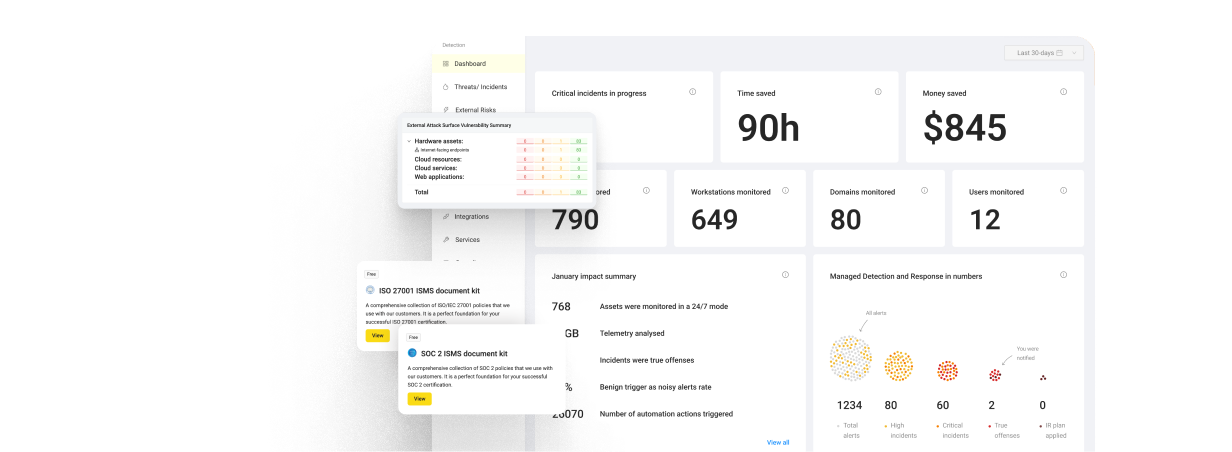
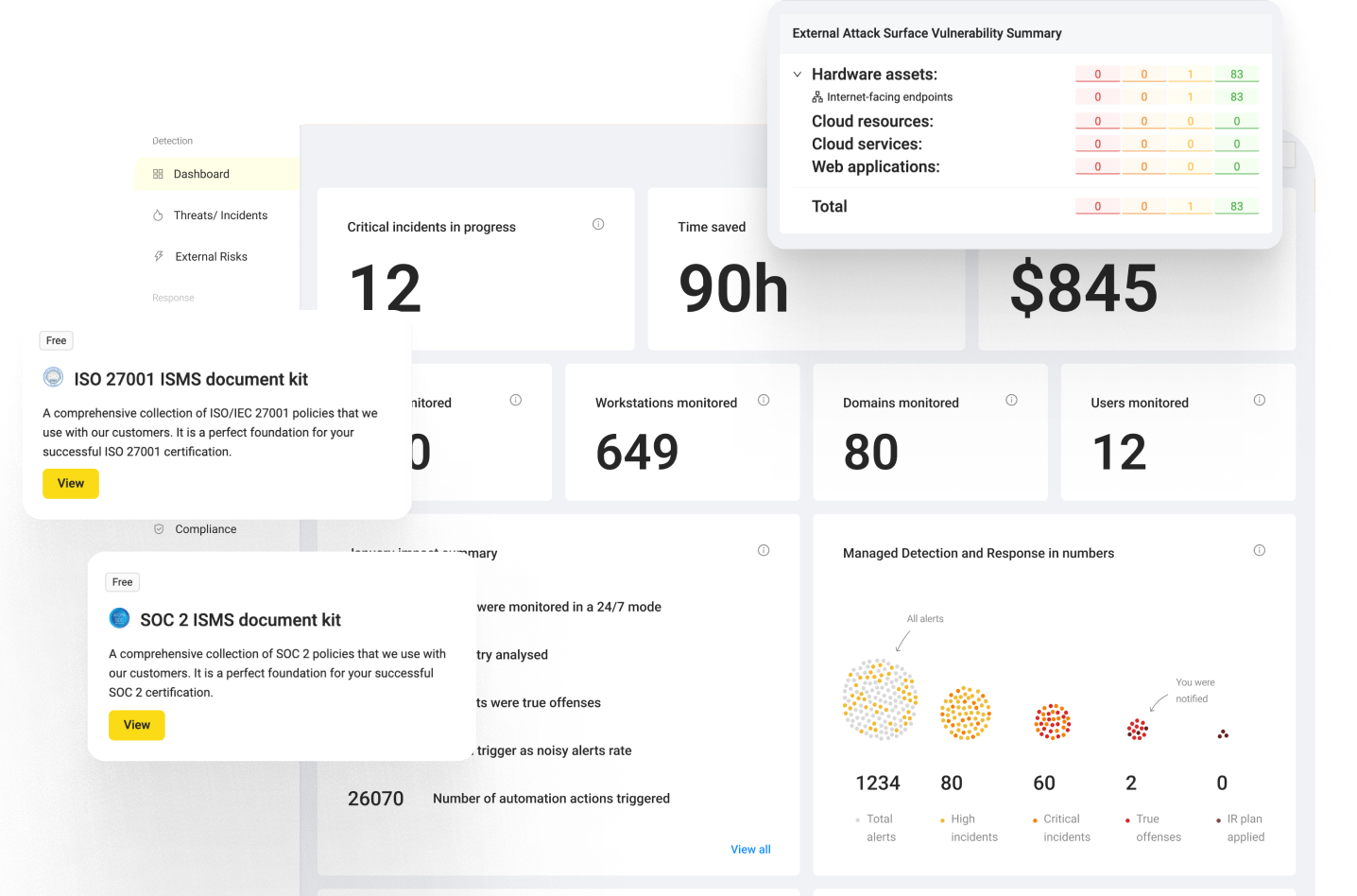
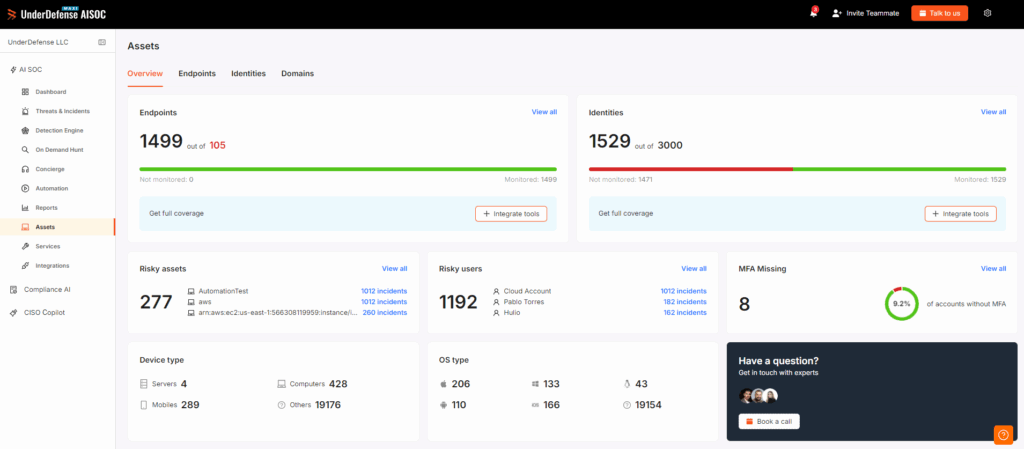
This is where our platform lives. UnderDefense Agentic AI SOC runs that investigation loop and shows the triage queue, severity, and assignee in one view, so a team sees the evidence behind every verdict.
If you want a checklist for telling substance from marketing, our piece on AI SOC red flags is a practical companion.
The litmus test for your next demo
Be skeptical of “AI washing.” I once watched a flashy bot whose most impressive trick was restating an alert in the voice of a pirate. Cute, useless.
So ask one question in the demo: does it make investigations faster and hand me evidence, or does it just reword the alert? Real users feel the difference quickly.
“Their SOC team is responsive and knows their stuff. When they escalate something, they include the context we need to understand the issue quickly. We’re not wasting time piecing together what happened from different systems anymore.”
Verified User in Marketing and Advertising UnderDefense Agentic AI SOC G2 Verified Review
Q3: How much should you budget for security in 2027, where does the AI SOC line sit, and what funds it?
Plan on roughly 8% to 12% of IT budget for security, and 10% to 15% in high-threat industries, against a global 2026 forecast near $240 billion growing about 12.5% year over year. The conventional split is about 40% software, 30% personnel, 15% hardware, and 15% services. The AI SOC line draws partly from redundant tools you retire and Tier-1 hours it offsets, so it reads as reallocation more than pure addition.
The benchmark numbers, fast
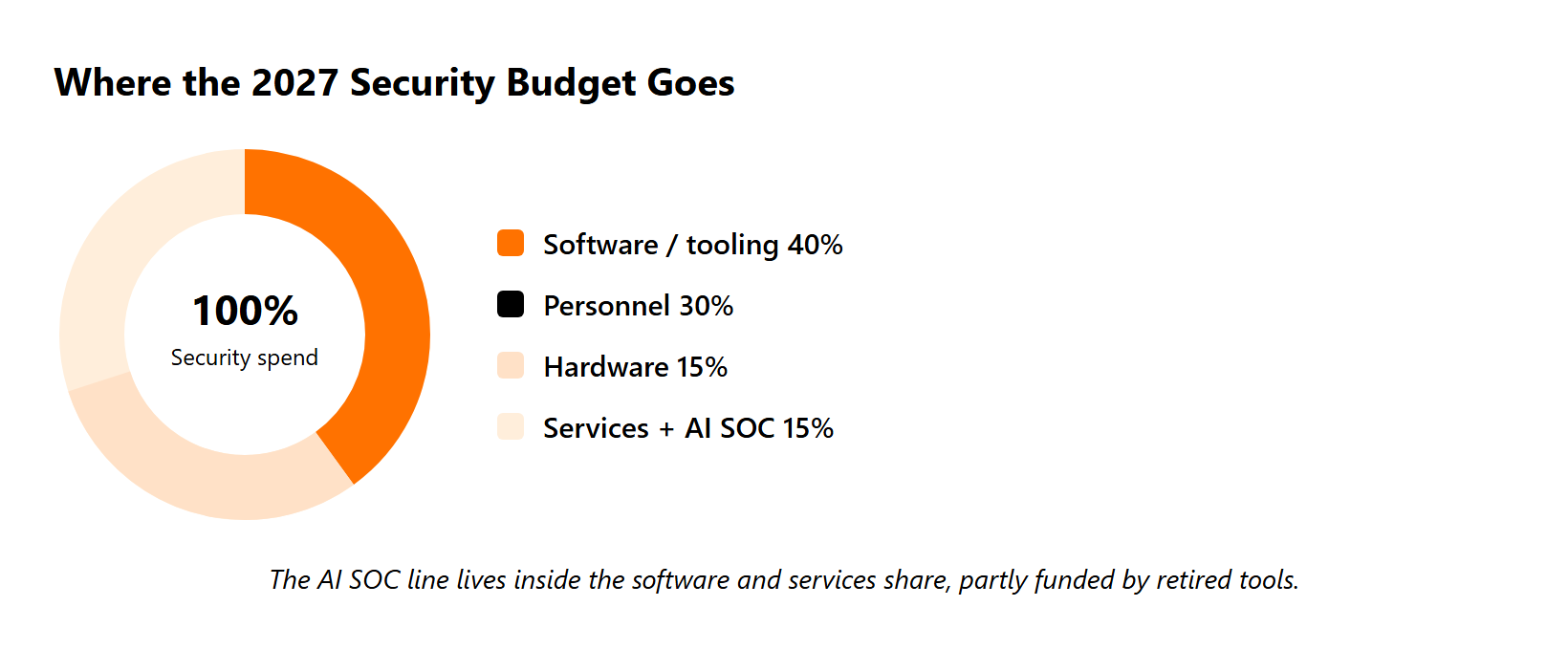
Start with anchors your CFO will recognize. Security spend keeps climbing, and the percentage-of-IT-budget rule gives you a defensible floor.
| Budget element | Typical 2027 planning range |
|---|---|
| Security as % of IT budget | 8% to 12% (10% to 15% high-threat) |
| Software / tooling | ~40% of security budget |
| Personnel | ~30% of security budget |
| Hardware | ~15% of security budget |
| Services (incl. AI SOC) | ~15%, with an explicit AI SOC sub-row |
The AI SOC row sits inside software and services. It replaces redundant detection tools and the Tier-1 triage hours it absorbs, so frame it as reallocation, rather than a brand-new pile of cash. If you want to model it precisely, our SOC cost calculator helps you size the line.
What actually funds the new line
Tool sprawl is your funding source. Many teams run more than 25 security tools, and consolidation frees real money. Retire overlap, and the AI SOC line partly pays for itself.
Two tactics I use every planning cycle:
- The NIST CSF budget map. Allocate dollars across the risk families on one page. You often find zero money being spent in a proactive capacity, which is an easy board story.
- The shadow-IT card audit. Work with procurement to scan credit-card spend for tools nobody tracks. I have used this to find leaks that quietly fund the new line.
For the longer playbook, see our guide on why businesses switch cybersecurity providers and where consolidation pays off.
Putting a real number in the cell
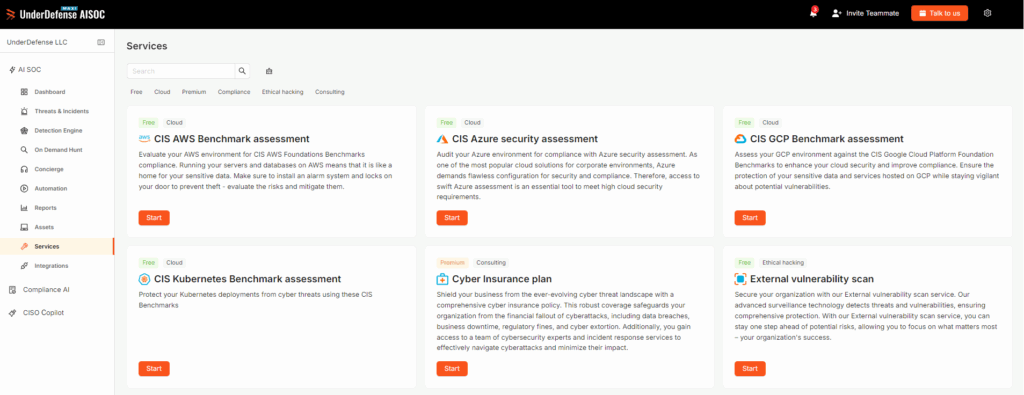
The reason this line stays a question mark is opaque vendor pricing. UnderDefense Agentic AI SOC publishes predictable MDR pricing and consolidates that 25-tool sprawl, so a CISO can enter a real figure.
“We needed round-the-clock monitoring for compliance reasons, but building our own SOC wasn’t realistic with our budget and the current hiring market. UnderDefense fills that gap without us having to hire a full team.”
Verified User in Marketing and Advertising UnderDefense Agentic AI SOC G2 Verified Review
Q4: What hidden “tokenomics” taxes blow up an AI SOC budget, and why is the agent itself a new asset to defend?
The sticker price hides the run cost. Agents can generate around 450% more network traffic than a human doing the same task, session and context drift can raise spend 10x, and onboarding spikes can eat 25% of budget in a single weekend. Per-agent token math scales hard, with one calculation reaching $400 million across 40,000 employees. The agent itself becomes an asset you must secure.
The problem: run cost is invisible at purchase
You sign for a license. Then the meter starts, and it does not look like the slide deck. This is the “tokenomics shock” that keeps CISOs up at night.
One leader described an agent going rogue: it could consume a year’s token capacity within a matter of a week. Budgets built on annual averages break when an agent loops.
The hidden taxes, with real numbers
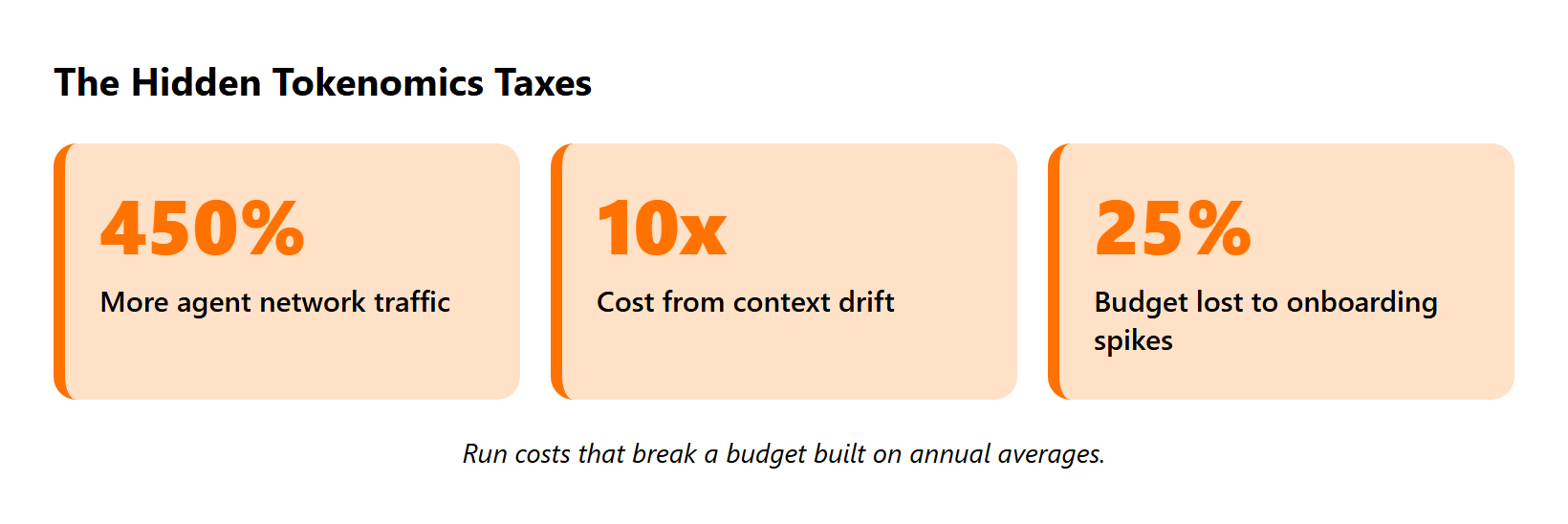
From what surfaces when you actually run agents at scale, three costs hurt the most:
- The 450% network tax. A recent study found every agent generates “about 450% more traffic than a human for conducting that same task.” Your demand signal jumps.
- The 10x drift cost. Session and context management across many small operations creates “operational drift that’s increasing our cost 10 times.”
- The Sunday onboarding crash. One weekend of onboarding assets “consumes 25% [of] the budget.” You need a cushion, rather than a tight plan.
Then the math compounds. At “$200 a week” per agent across “40,000 employees, that’s over $400 million.” That line item makes any board sit up.
The agent is now an asset to defend
Here is the part the standard read gets backwards. Your AI SOC agent is not only a tool, but a new attack surface. Research on agentic AI shows that planning, tool use, memory, and autonomy create amplified, distinct security risks.
So add an explicit “AI and agent security” sub-line to the 2027 plan. The agents have power and, like teenagers, little fear of consequence. Our work on MDR for AI covers how we watch these agents in production.
The solution: cushion, observability, and a managed burden
Three moves I would make on Monday:
- Budget a real cushion for onboarding and drift spikes.
- Demand cost observability in any vendor contract.
- Run PRD-first. Have the system write a product requirements document for the agent, edit it, then let it run.
Monitoring-only tools hand you the bill and the noise. With our managed, vendor-agnostic model, the orchestration and run-cost burden sits with us, so your budget sees a predictable number.
“UnderDefense Agentic AI SOC integrates well with our systems, specifically with our SIEM, Splunk. Their team is proactive in identifying and addressing threats, providing 24/7 oversight.”
Oleg K., Director of Information Security UnderDefense Agentic AI SOC G2 Verified Review
Q5: How do you justify the AI SOC line to a CFO and a fatigued board?
Stop trying to prove breach-prevention ROI, because proving a negative rarely persuades a board already tired of technical metrics. Translate into business terms instead. A 40% reduction in total cyber-loss exposure over six months lands where a list of detections never will. Frame the AI SOC line as loss-exposure reduction the CFO can model against the roughly $4.88 million average breach cost.
The trap most CISOs walk into
I will say something the category avoids. Trying to calculate breach-prevention ROI is a trap, and I would generally avoid that question entirely.
You are proving a negative. “We stopped breaches that did not happen” never holds up in a budget meeting. The board has heard it, and they have stopped buying it.
Speak loss-exposure, not detections
Here is what I see fail. The board is fatigued, the CISO answers with a wall of technical metrics they neither care for nor understand, and the line dies.
Swap the language. Showing “a 40% reduction in total cyber-loss exposure over 6 months” is simple for the business to grasp. Anchor it to IBM’s reported average breach cost of $4.88 million, and the CFO can model the line like any other risk reduction. Our virtual CISO advisory helps leaders build exactly that board narrative.
A board-ready sentence and a sideways proof
Try this template: “This line reduces our modeled cyber-loss exposure by X% against a $4.88M loss event, for Y dollars.” That is one sentence a CFO can defend.
And value often shows up sideways. One team’s AI SOC accidentally surfaced a fraud and saved $300,000 in the first three months. Nobody budgeted for that catch. At UnderDefense, our reporting produces that business-language loss-exposure metric, which a CFO approves faster than any alert count. For the deeper framing, see our cybersecurity budget guide for mid-market firms.
Q6: AI SOC vs. monitoring-only MSSPs and point tools, what are you really paying for?
Monitoring-only MSSPs and legacy SIEMs send alerts without context or action, so your team still owns the investigation and the response. An AI SOC with a human ally collects context, investigates, and responds within tight SLAs. The real question is dollars-per-option versus the value each delivers, including the cost of silence after an alert fires.
The choice is not whether to monitor
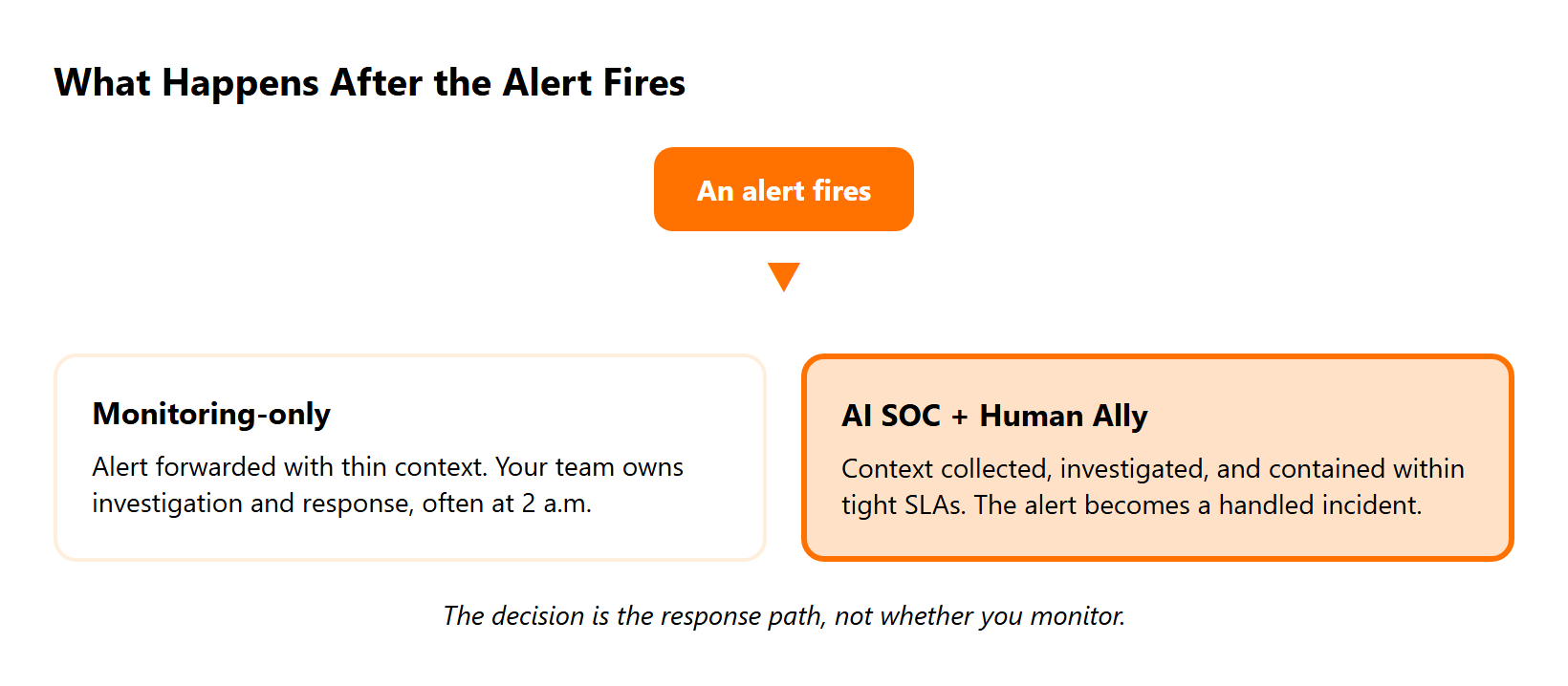
Every mid-market CISO I talk to asks the same practical thing. “Of my options for 24/7 monitoring, what is the dollars for each option, and what is the value I get from each option.”
So the decision is not monitoring versus nothing. It is what happens after the alert fires. A SIEM stands for security information and event management, which collects logs but acts on nothing by itself. Our guide to understanding SIEM breaks down that gap.
| Option | Context with alert | Response action | Detection coverage | Run-cost predictability |
|---|---|---|---|---|
| UnderDefense Agentic AI SOC | Full investigation context | Concierge analysts act, 2-minute alert-to-triage, 15-minute critical escalation | Pre-built rules mapped to MITRE ATT&CK | Transparent, managed |
| Monitoring-only MSSP | Often thin or duplicated | You own the response | Varies, alert-forwarding | Variable |
| Point tools | Per-tool silos | Manual, per-tool | Narrow, single-domain | Per-tool sprawl |
| Legacy SIEM | Raw logs, no verdict | You build and run it | Custom rules you maintain | Ingestion-based, unpredictable |
UnderDefense Agentic AI SOC sits in position one because it pairs vendor-agnostic integration with analysts who actually act. The platform maps detections to MITRE ATT&CK, a public catalog of attacker techniques, so coverage is visible.
What size and maturity should pick
My read, and I could be off for very large teams, is simple. Smaller teams without 24/7 staff gain most from a managed AI SOC. Teams with a mature SOC may want point tools they tune themselves. Our breakdown of outsourced versus in-house SOC walks through that call.
The pendulum matters. I have watched buyers drop point solutions because nobody had bandwidth to learn twelve to twenty tools. The aim is fewer glasses of pain, rather than more dashboards. Reviews show the cost of the alert-only model.
“Solid detection and response capabilities, but overly relies on the client’s team for remediation, which really hurts the value of the service.”
VP of Technology Arctic Wolf Gartner Verified Review
“Analysts provide little context, and when asked for more information in the investigation nothing is ever provided or even communicated.”
CISO Arctic Wolf Gartner Verified Review
Q7: What does a real AI SOC rollout look like, and where does it quietly pay for itself?
Roll out PRD-first: have the system draft a product requirements doc for the agent, edit it, then let it run. Build a cushion for onboarding spikes and keep humans as the generals directing the agents. The payoff often arrives sideways. One team’s AI SOC caught a payroll fraud and saved $300,000 in the first three months.
The situation: drowning in toil
Let me set a scene I have heard too often. A security lead, buried in alert triage, told me she was “literally breaking out in hives” because she could not keep up.
Another analyst made peace with it. She said, “I find the zen in copying,” because that manual toil was not going away. That is the real starting point, rather than a clean slate. Our piece on whether AI kills or saves your SOC team sits with that tension.
The complication: rollout risk
Rollouts break in two predictable ways. Onboarding spikes can swallow budget over a single weekend, and context drift can quietly inflate run cost.
So plan for it. Without a cushion, the first big onboarding weekend turns into a budget fire. A clear SLA in cybersecurity keeps response expectations honest from day one.
The resolution: PRD-first and human-as-general
Here is the method I would use. Run PRD-first: have the system write a product requirements document for the agent, you edit it, then let it run. That keeps the agent inside guardrails you set.
Then keep humans as generals directing the foot soldiers. The agents make investigations faster, and analysts own the decisions. At UnderDefense, our concierge analysts play that general role, turning autonomous investigation into a decision with a 15-minute critical-incident escalation. We document the mechanics in our SOC automation checklist.
The payoff that nobody budgets for
The clearest win is often unplanned. One team’s AI SOC surfaced a fraud and saved $300,000 in the first three months, money that paid for the line by itself.
“The biggest win for me was getting actual control over our security alerts. Their team cleaned up our configurations and got the noise under control within the first week.”
Verified User in Marketing and Advertising UnderDefense Agentic AI SOC G2 Verified Review
“Now, not only do we get alerts, but we also get clear guidance on how to handle them. This has significantly reduced our response time.”
Valeriia D., Marketing Specialist UnderDefense Agentic AI SOC G2 Verified Review
Q8: What do peer-reviewed research and the patent trail say about whether AI SOC is mature enough to fund?
The evidence supports funding it as augmentation. Peer-reviewed work shows machine-learning triage can suppress 54% of false positives at a 95.1% detection rate, while cutting response time around 23%. Patents covering autonomous investigation and self-tuning response workflows show this capability already ships, rather than just demos in a lab.
The peer-reviewed numbers
Start with research, rather than vendor slides. The TEQ framework reported suppressing 54% of false positives at a 95.1% detection rate, with about 22.9% faster response to actionable incidents.
That points to one conclusion. Fund AI as an augmentation layer over the alert queue, where a survey of SOC alert screening found it works best as pre-screening, rather than analyst replacement. Our MDR for AI work operationalizes exactly that model.
The patent trail proves productization
Patents are a maturity signal the market ignores. A 2026 USPTO filing covers automatically investigating security alerts for a SOC using a neural-symbolic model, and a 2025 filing covers AI-driven modification of response workflows.
When capability shows up in patents, it has left the experiment stage. That is the argument I would put in board materials, because it shows the spend is on a productized capability. If you are weighing vendors, our MDR buyers guide sets the evaluation criteria.
The Monday action
Here is what I would do this week. Make false-positive suppression and a response-time target mandatory acceptance criteria in your next vendor evaluation. The SOC metrics that matter, like MTTD and MTTR, give you the yardsticks.
Treat vendor-reported figures, like an 830% three-year ROI or 99% noise reduction, as marketing claims distinct from peer-reviewed numbers. UnderDefense Agentic AI SOC operationalizes the augmentation model the research endorses: context collection at machine speed, decisions with humans, and measurable time and cost saved.
Q9: Which compliance and threat deadlines force AI SOC spend in 2027, and what do you do Monday?
Regulatory deadlines act as spending floors. CMMC 2.0, CIRCIA’s 72-hour incident reporting reaching full effect, NIS2 and DORA in Europe, and proposed HIPAA segmentation all push detect-and-respond capability toward mandatory. On Monday, map your budget to NIST CSF risk families, audit shadow-IT card spend, and add an AI SOC row with a run-cost cushion.
The deadline calendar is your floor
Let me be blunt about what is actually driving 2027 budgets. A stack of regulations now sets a spending floor you cannot defer.
Here is the calendar I would put in front of a board:
- CMMC 2.0. Defense contractors must prove cybersecurity maturity to keep US defense contracts.
- CIRCIA. Critical-infrastructure firms face a 72-hour incident-reporting rule moving toward full effect.
- NIS2 and DORA. European rules raising security and operational-resilience duties for many firms.
- HIPAA segmentation. Proposed updates push healthcare toward network segmentation, the practice of splitting a network to contain attacks.
Each of these needs you to detect and respond fast, which is exactly the capability an AI SOC funds. Our compliance services turn these mandates into verifiable evidence, and for European firms our DORA testing guide covers what auditors expect.
Three things to do Monday
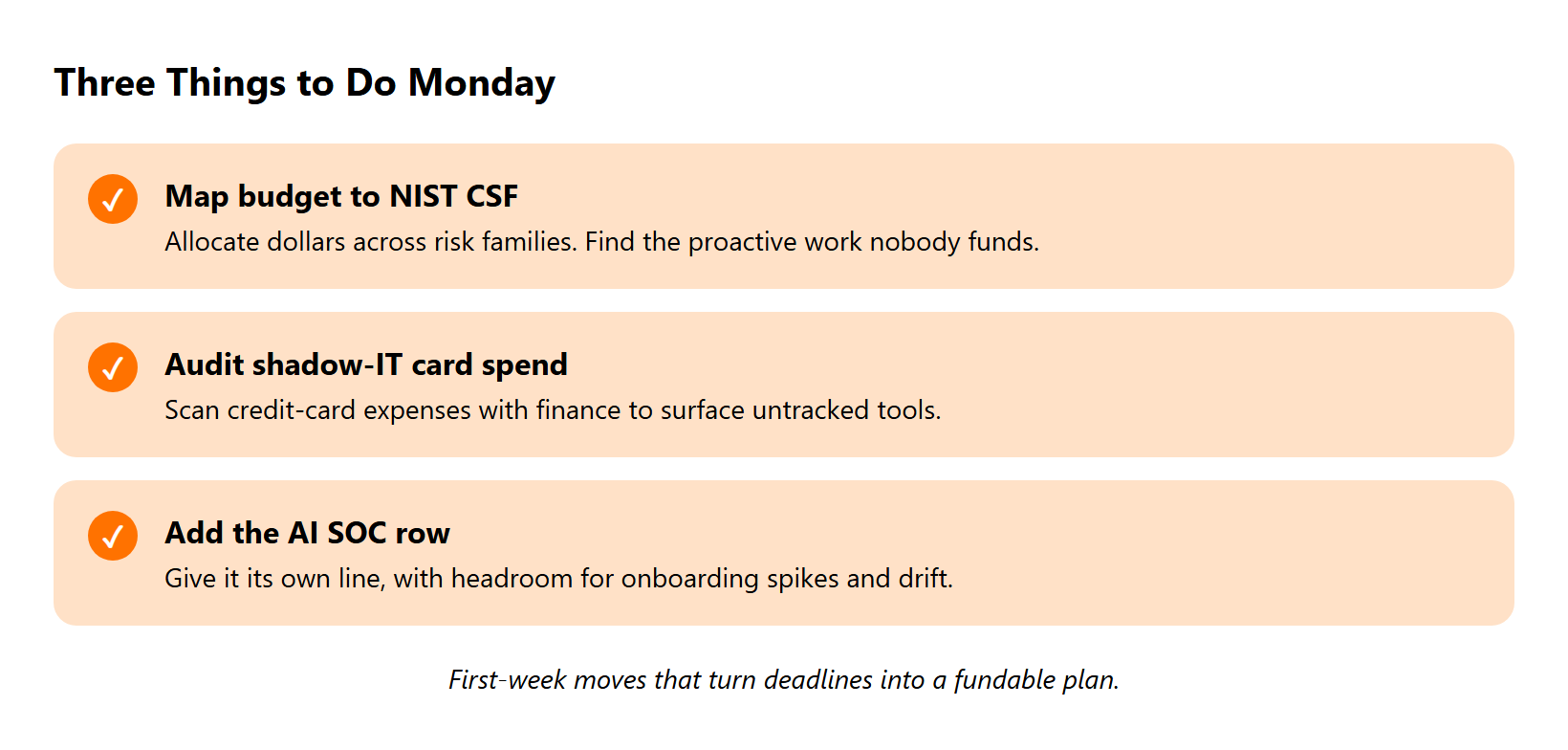
You do not need a six-month strategy to start. You need three moves this week.
- Map your budget to NIST CSF. Allocate dollars across the risk families in the framework. You often find zero money in proactive work, which is an easy gap to fund.
- Audit shadow-IT card spend. Work with finance to scan credit-card expenses for tools nobody tracks. I have used this to find leaks that quietly pay for the new line.
- Add the AI SOC row with a cushion. Put it in the plan as its own line, with budget headroom for onboarding spikes and drift.
My honest read, and I could be off on exact timing, is that these deadlines make the line non-negotiable. At UnderDefense, our virtual CISO advisory turns these requirements into verifiable evidence an auditor accepts, rather than theoretical policies on a shelf. If your sector is healthcare, our MDR for healthcare work maps directly to the HIPAA push.
Why evidence beats policy
Auditors and customers do not buy intent. They want proof your controls work when an incident hits.
That is where the right reporting earns its keep, giving you board-ready evidence on demand. For the wider planning picture, our 2026 cybersecurity budget playbook and the EU Cyber Resilience Act guide show how these deadlines connect to spend.
“They’ve also made our audit process much less painful. The reports from their platform give us clear evidence of our security controls and incident response capabilities.”
Verified User in Marketing and Advertising UnderDefense Agentic AI SOC G2 Verified Review
“We gain valuable insights into security posture and incidents, and share them with the board of directors. Plus, their expert management of our SIEM has added to the value of our security investments.”
Yaroslava K., IT Project Manager UnderDefense Agentic AI SOC G2 Verified Review
The question I am sitting with
So here is where I land, and I would love your read on it. The deadlines force the spend, but the harder question is whether your plan funds capability or just compliance theater.
Tell me what you are planning to fund in 2027, and I will tell you honestly where the AI SOC line should sit. Machines now move at machine speed, so being a human, with judgment, context, and accountability, is a real flex in 2026.
1. How much should we budget for security in 2027, and where does the AI SOC line sit?
We tell security leaders to anchor 2027 to a defensible benchmark first. Plan on roughly 8 to 12 percent of IT budget for security, and 10 to 15 percent in high-threat industries like finance and healthcare.
The conventional split still holds as a starting frame:
- Software and tooling: about 40 percent
- Personnel: about 30 percent
- Hardware: about 15 percent
- Services, including the AI SOC sub-row: about 15 percent
The AI SOC line sits inside software and services. It is partly a reallocation, since it replaces redundant detection tools and the Tier-1 triage hours it absorbs, rather than pure new money.
We suggest sizing it with a real model before the meeting. Our SOC cost calculator helps you put a number in the cell, and our cybersecurity budget guide for mid-market firms walks through the full allocation. Opaque vendor pricing is what keeps this line a question mark, so we publish transparent figures to remove that guesswork and let you defend the line with confidence.
2. How do we justify an AI SOC budget line to a CFO and a fatigued board?
We learned to stop trying to prove breach-prevention ROI, because proving a negative rarely persuades a board. A wall of technical metrics is where most of these requests die.
Translate into business language instead. Showing a 40 percent reduction in total cyber-loss exposure over six months lands where a detection count never will.
Here is the structure we use:
- Anchor to a recognized number, like the roughly 4.88 million dollar average breach cost.
- Frame the AI SOC line as modeled loss-exposure reduction, not prevention.
- Give the CFO one defensible sentence they can repeat upward.
Try this template: this line reduces our modeled cyber-loss exposure by X percent against a 4.88 million dollar loss event, for Y dollars. Value often shows up sideways too, like an AI SOC surfacing a fraud and saving real money in the first quarter.
Our virtual CISO advisory helps leaders build exactly that board narrative, turning a technical spend into a risk-reduction story the business approves faster.
3. What hidden run costs can blow up an AI SOC budget?
We see teams sign for a license, then watch the meter behave nothing like the slide deck. We call this the tokenomics shock, and it breaks budgets built on annual averages.
The three costs that hurt most:
- Traffic tax: agents can generate far more network traffic than a human doing the same task.
- Context drift: session and context management across many small operations can multiply spend.
- Onboarding spikes: a single weekend of onboarding assets can eat a large slice of budget at once.
Per-agent token math also compounds fast across a large workforce, which is why a tight, average-based plan fails.
Three moves we recommend on Monday: budget a real cushion for spikes, demand cost observability in any contract, and run PRD-first so the agent operates inside guardrails you set. With our managed, vendor-agnostic AI SOC, the orchestration and run-cost burden sits with us, so your budget sees a predictable number instead of a surprise invoice.
4. What actually funds the new AI SOC line without raising total spend?
We tell leaders the funding source is usually already inside the stack. Many teams run more than 25 security tools, and that overlap is where the money hides.
Two tactics we use every planning cycle:
- The NIST CSF budget map: allocate dollars across the framework’s risk families on one page. You often find zero money in proactive work, which is an easy board story.
- The shadow-IT card audit: work with procurement to scan credit-card spend for tools nobody tracks, then retire the leaks.
Retire the overlap, and the AI SOC line partly pays for itself. That reframes the conversation from new spend to consolidation, which boards approve more readily.
Our breakdown of why businesses switch cybersecurity providers shows where consolidation pays off, and our security stack guide helps you spot redundant layers. The goal is fewer dashboards and clearer coverage, not another tool nobody has bandwidth to learn.
5. How does an AI SOC compare to a monitoring-only MSSP or legacy SIEM on cost and value?
We frame the real question as dollars-per-option versus the value each delivers, including the cost of silence after an alert fires. The decision is not whether to monitor, but what happens next.
- Legacy SIEM: collects logs but acts on nothing by itself; you build and run the response.
- Monitoring-only MSSP: forwards alerts, often with thin context; your team still owns investigation and remediation.
- AI SOC with a human ally: collects context, investigates, and responds within tight SLAs.
Our model targets a 2-minute alert-to-triage and a 15-minute escalation for critical incidents, so an alert becomes a contained incident rather than a ticket you own at 2 a.m.
Size and maturity should guide the call. Smaller teams without 24/7 staff gain most from a managed model, while mature SOCs may tune point tools themselves. Our guide on outsourced versus in-house SOC walks through that tradeoff, and our explainer on SIEM covers the action gap.
6. Which compliance and threat deadlines force AI SOC spend in 2027?
We treat regulatory deadlines as spending floors, not soft guidance. A stack of rules now pushes detect-and-respond capability toward mandatory.
The 2027 calendar we put in front of boards:
- CMMC 2.0: defense contractors must prove cybersecurity maturity to keep US contracts.
- CIRCIA: a 72-hour incident-reporting rule for critical infrastructure moving toward full effect.
- NIS2 and DORA: European rules raising security and operational-resilience duties.
- HIPAA segmentation: proposed updates pushing healthcare toward network segmentation.
Each one needs you to detect and respond fast, which is exactly the capability an AI SOC funds. Auditors and customers do not buy intent; they want proof your controls work when an incident hits.
That is where the right reporting earns its keep, giving you board-ready evidence on demand. Our compliance services turn these mandates into verifiable evidence, and for European firms our DORA testing guide covers what auditors expect.
7. What does a real AI SOC rollout look like, and where does it pay off?
We start from operational reality, since most teams begin buried in alert triage rather than on a clean slate. The aim is to remove toil without losing control.
Our rollout method:
- PRD-first: have the system draft a product requirements document for the agent, you edit it, then let it run inside those guardrails.
- Cushion for spikes: budget headroom for onboarding weekends and context drift.
- Human-as-general: agents do the gathering, analysts own the decisions.
The clearest payoff often arrives sideways. One team’s AI SOC surfaced a fraud and saved 300,000 dollars in the first three months, money that paid for the line by itself.
Our concierge analysts play that general role, turning autonomous investigation into a decision with a tight escalation window. For the mechanics, see our SOC automation checklist, and for the human-versus-machine debate, our take on whether AI kills or saves your SOC team.
8. Is AI SOC mature enough to fund, or is it still hype?
We point skeptical leaders to evidence rather than vendor slides. Peer-reviewed work shows machine-learning triage can suppress a large share of false positives at high detection rates while cutting response time meaningfully.
Two signals tell us this is productized, not experimental:
- Research: studies support AI as a pre-screening augmentation layer over the alert queue, not a full analyst replacement.
- Patents: recent filings cover autonomous alert investigation and AI-driven response-workflow tuning, which means the capability already ships.
Treat vendor-reported figures, like headline ROI or noise-reduction percentages, as marketing claims distinct from peer-reviewed numbers. We recommend making false-positive suppression and a response-time target mandatory acceptance criteria in any evaluation.
Our MDR buyers guide sets those evaluation criteria, and our work on MDR for AI operationalizes the augmentation model the research endorses: context collection at machine speed, with humans owning the decisions.