




Q1. What Does Tanium Actually Cost in 2026? (The Short Answer Tanium Will Never Give You)
Tanium does not publish a price card. In 2026, enterprise buyers report paying roughly $20 to $24 per endpoint per year for the Core Platform alone at the mandatory 2,000-endpoint minimum. A realistic multi-module deployment, Core plus three or four modules, runs $35 to $70 per endpoint annually. Full-suite Autonomous Endpoint Management (AEM) deployments at enterprise scale can hit $60 to $90 per endpoint before professional services or premium support fees are added.
Negotiating a renewal right now?
Talk to a team that benchmarks these deals every week.
What actually moves your number
Buying Tanium is like buying a car where the sticker price is classified. You only see the figure when you sit across from the rep, and the figure shifts based on endpoint count, modules selected, deployment model (Tanium Cloud vs. on-prem), and how late in their fiscal quarter you sign. Mid-market buyers (5,000 to 25,000 endpoints) typically land 15% to 35% off list, while enterprise accounts at 50,000+ endpoints, multi-year, with a competitive displacement story, push toward 50% off.
What this guide will save you
I have sat on enough renewal calls to know the number your rep quotes in week one is rarely the number you pay by month three. This guide walks through how Tanium prices per endpoint and per module (Q2), the SKU-by-SKU price reference Tanium will not email you (Q3), and where bundles genuinely save money versus where dependency cascades quietly eat the discount (Q4). For deeper context on how to model these numbers against your team’s capacity, our MDR buyers guide walks through the same trade-offs we use with prospects.
Q2. How Is Tanium Priced? The Per-Endpoint, Per-Module Model Explained
Tanium charges an annual subscription per managed endpoint for each module deployed. Every module, from Patch to Threat Response to Comply, is a separate per-endpoint line item stacked on top of the mandatory Core Platform base license. The minimum deployment is 2,000 endpoints across all SKUs. In November 2024, Tanium repackaged into four Autonomous Endpoint Management (AEM) pillars: Core Plus, Endpoint Management Plus, Risk and Compliance Plus, and Incident Response.
What “managed endpoint” actually means
A managed endpoint is any device running the Tanium client agent: physical workstations, laptops, and servers across Windows, macOS, Linux, Solaris, and AIX. The definition matters because it decides what counts toward your bill and what triggers a true-up. If a sysadmin spins up 400 new VMs for a project, those land on your invoice at renewal.
Module economics, in plain numbers
Each module is its own SKU. Endpoint Detection and Response (EDR, your alert and response layer) sits inside Threat Response. Vulnerability Management (VM) lives inside Comply. Picture a 10,000-endpoint org buying Core ($18) plus Patch ($10) plus Comply ($12). That is roughly $400,000 per year before premium support, professional services (PS), or a single true-up.
What the AEM repackaging changed
Since November 2024, new deals are increasingly structured around the four AEM tiers rather than picking individual modules à la carte. AEM adds an automation overlay (recommend and execute endpoint changes safely at scale) on top of Core. The full AEM suite runs roughly $60 to $90 per endpoint per year on AWS Marketplace, with a 1,500-endpoint minimum on that listing. For organizations weighing this against a managed alternative, our Managed EDR service handles the response layer without the module stacking.
Edge cases that create true-up surprises
These are the categories that quietly inflate invoices when nobody is watching:
- VMs count as endpoints when the Tanium agent is installed; auto-scaling AWS or Azure groups need negotiated terms upfront.
- Containers do not count, because the agent runs on the host OS, not inside the container.
- Mobile (iOS, Android) is not natively supported; you keep paying Intune or Jamf.
- IoT and OT devices are discovered by the Discover module, but the license is per managed endpoint running the scanner, not per discovered device.
⚠️ The “Module Creep” problem is real. Working with security teams that walked into a Tanium renewal, what I have seen repeatedly is shelves full of licensed modules and operational use of three of them. Audit what you actively run before you sign anything new. Our security stack guide covers a structured approach to that audit.
“Tanium is more expensive than alternatives. Pricing is on the higher side compared to other competitors.”
— Verified Reviewer, IT Manager Tanium PeerSpot Verified Review
Q3. What Does Each Tanium Module Cost? Complete SKU Price Reference (2026)
This is the price card Tanium’s sales team will never email you. Tanium’s platform spans 37+ active SKUs. Per-endpoint annual costs range from roughly $6 to $10 for analytics modules like Benchmark and Certificate Manager, up to $15 to $22 for security-intensive modules like Threat Response. The Core Platform itself costs roughly $20 to $24 per endpoint annually at the minimum 2,000-endpoint tier. All prices are directional, drawn from NC State ITS government price lists and partner disclosures, not from a published Tanium retail rate card.
Methodology and confidence
Source hierarchy here is government price lists first (NC State ITS, April 2025), partner disclosures next (Prescriptive.solutions Global Partner Price List, January 2025), and buyer community data third (Vendr, PeerSpot). Confidence is High where two or more sources agree, Medium where only one source confirms. Working across hundreds of Tanium-adjacent environments, what I have seen is module sprawl outpacing module use roughly four to one. Treat these numbers as your negotiation floor, not your forecast.
Platform Foundation SKUs
| Module | $/Ep/Yr | Min Qty | Status |
|---|---|---|---|
| Core Platform | $20 to $24 | 2,000 | Active |
| Direct Connect | Included with Core | 2,000 | Active |
| Discover | $5 to $8 | 2,000 | Active |
Security Module SKUs
| Module | $/Ep/Yr | Dependencies | Status |
|---|---|---|---|
| Threat Response (EDR) | $15 to $22 | Core | Active |
| Protect | $10 to $14 | Core | Active |
| Reveal (DLP) | $8 to $12 | Core | Active |
| Integrity Monitor (FIM) | $7 to $10 | Core | Active |
IT Operations Module SKUs
| Module | $/Ep/Yr | Dependencies | Status |
|---|---|---|---|
| Patch | $8 to $12 | Core | Active |
| Asset | $8 to $11 | Core | Active |
| Deploy | $10 to $14 | Core | Active |
| Performance | $6 to $9 | Core | Active |
Risk and Compliance Module SKUs
| Module | $/Ep/Yr | Dependencies | Status |
|---|---|---|---|
| Comply (VM) | $10 to $14 | Core | Active |
| Comply Plus (agentless uplift) | +$4 to $6 | Comply | Active |
| SBOM | $6 to $9 | Asset, Comply | Active |
| Benchmark | $6 to $10 | Core | Active |
| Certificate Manager | $6 to $10 | Core | Active |
Three modules buyers fail to price upfront
- SBOM requires Asset and Comply as prerequisites; the bundle math gets ugly fast.
- Comply Plus (agentless uplift) adds $4 to $6 per endpoint on top of Comply, often missed in budget pages.
- Integrity Monitor (FIM) is a non-negotiable for PCI-DSS and HIPAA compliance, which makes it pricier than the line item suggests once audit deadlines hit.
For practical patterns on how compliance modules show up in scope, our log monitoring compliance piece covers the FIM and audit-trail requirements specifically.
Q4. Tanium Bundles vs. À La Carte: Which Structure Saves You More?
Tanium’s legacy bundles (Operations Suite, Security Suite, Risk and Compliance suites) save roughly 10% to 15% versus buying modules individually. The AEM full suite runs $60 to $90 per endpoint annually at enterprise scale. The catch: bundles often require prerequisite modules not yet licensed. Adding SBOM, for example, requires first licensing Asset and Comply, creating a dependency cascade that can eliminate the bundle discount entirely before your first true-up.
The bundle trap nobody flags upfront
Bundles look obvious. The discount is real on paper. The problem is the dependency cascade: a bundle that requires three modules you do not currently own quietly turns a 12% discount into a net cost increase. I have watched this play out on three separate procurement calls in the last year.
Legacy Tanium bundles
| Bundle | Included Modules | Est. $/Ep/Yr | Break-Even vs. Modular | Min Endpoints |
|---|---|---|---|---|
| Operations Suite | Core, Patch, Asset, Deploy, Performance | $45 to $58 | 4+ co-licensed modules | 2,000 |
| Security Suite | Core, Threat Response, Protect, Reveal, Integrity Monitor | $55 to $70 | 4+ security modules | 2,000 |
| Risk and Compliance Suite | Core, Comply, Benchmark, Certificate Manager, SBOM | $45 to $58 | 3+ R and C modules | 2,000 |
AEM tier bundles
| Tier | Included Modules | Est. $/Ep/Yr | Ideal Buyer |
|---|---|---|---|
| Core Plus | Core + AEM automation overlay | $28 to $36 | Existing Tanium customers upgrading |
| Endpoint Management Plus | Core Plus + Patch, Asset, Deploy | $50 to $65 | IT-ops consolidation |
| Risk and Compliance Plus | Core Plus + Comply, Benchmark, SBOM | $48 to $62 | Regulated industries |
| Incident Response (AEM Full) | Core Plus + Threat Response, Protect, Integrity Monitor | $60 to $90 | Enterprise SOC consolidation |
When to bundle vs. stay modular
Bundle if you need five or more modules in the same family, you have 5,000+ endpoints, and you can co-license everything in year one. Stay modular if your architecture is SaaS-native, identity-first, or your team only operates two or three modules consistently. The 15% to 28% bundle savings materialize reliably only at 5,000+ endpoints with at least four co-licensed modules.
The Constraints-and-Variables read
A SaaS-native, 500-person company paying for the full Operations Suite is buying a tool optimized for on-prem workloads it barely has. Identity is the perimeter, not the endpoint. For that profile, our MDR for Microsoft 365 and cloud security services tend to deliver a cleaner cost-to-coverage ratio than an endpoint-heavy bundle.
Before signing any bundle, run the math against a managed alternative using the SOC cost calculator. The dependency cascade that quietly inflates a Tanium bundle often disappears when the response layer moves to a partner who already integrates with what you own. For a fuller comparison framework, the MDR service page walks through how vendor-agnostic detection changes the bundle math.
“Bundles look attractive at first, but we ended up paying for modules we never deployed. The discount on paper did not match the spend in production.”
— Verified Reviewer, Security Engineer Tanium PeerSpot Verified Review
“The pricing model is opaque, and the bundle structure changed mid-evaluation. We had to redo our procurement math twice.”
— Verified Reviewer, IT Director Tanium Gartner Peer Insights Verified Review
Q5. What Is the True Anatomy of a Tanium Contract? (Year One vs. Year Two Reality)
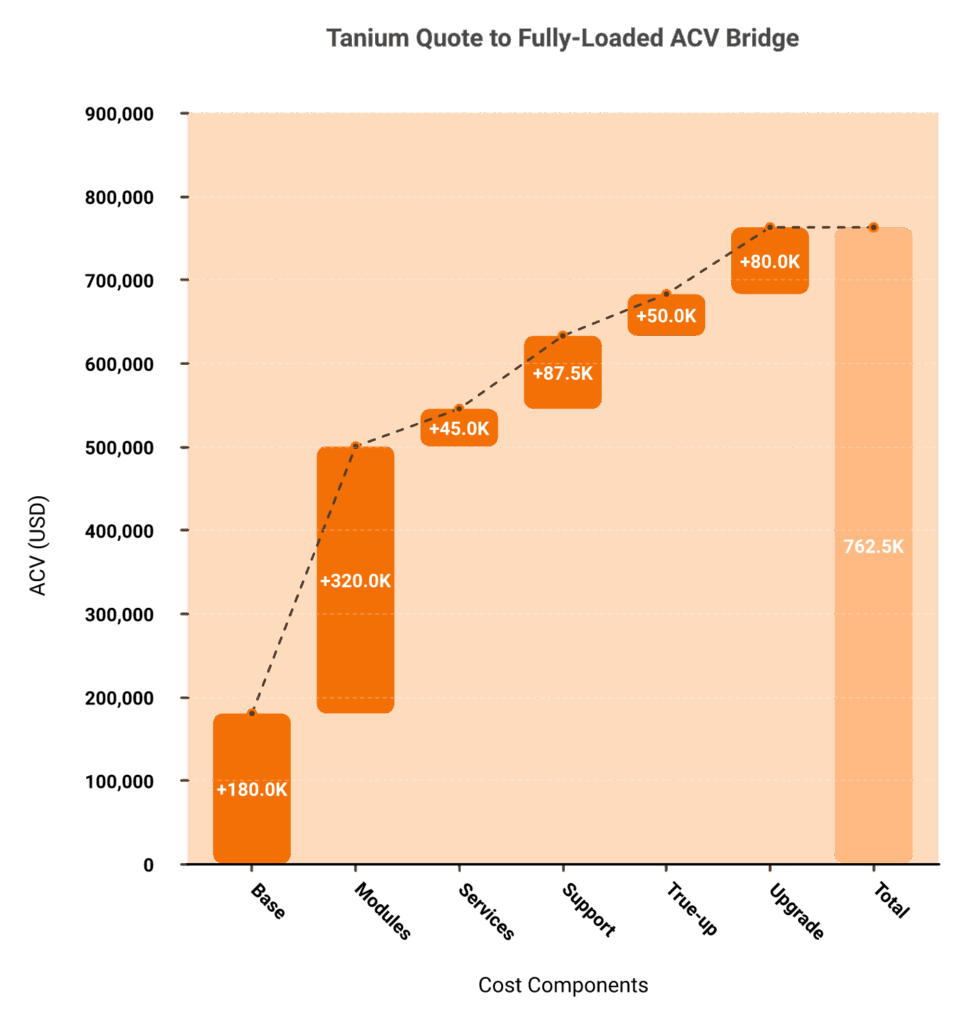
A Tanium contract has six cost layers most buyers do not see until the invoice arrives: base platform license, per-module add-ons, mandatory professional services ($15,000 to $75,000 one-time), Premium Support at 15% to 20% of Annual Contract Value (ACV), endpoint growth true-ups at renewal, and an AEM (Autonomous Endpoint Management) upgrade upsell that typically adds $5 to $12 per endpoint in year two. Year-one total cost routinely runs 40% to 60% higher than the license price alone.
The six layers, side by side
You received a quote. The quote shows two numbers (license, support). The complication is that five other cost categories arrive over the next 12 months and reshape your real ACV. Here is the full anatomy.
| Layer | What It Is | Typical Cost | When It Hits | Negotiable? |
|---|---|---|---|---|
| 1. Base license (Core) | Per-endpoint platform fee | ~$20 to $24/ep/yr | Day 1 | Partial |
| 2. Per-module add-ons | Each SKU stacked on Core | ~$8 to $22/ep/yr each | Day 1 | Yes |
| 3. Professional Services (PS) | Mandatory deployment work | $15K to $75K one-time | Year 1 | Partial |
| 4. Premium Support (24×7) | S1/S2 round-the-clock | 15% to 20% of ACV | Year 1 | Yes |
| 5. Endpoint true-ups | Growth billed at contract rate | +5% to 15% of ACV | Renewal | Yes (10% grace band) |
| 6. AEM upgrade upsell | Core to Core Plus shift | +$5 to $12/ep | Year 2 | Yes (pre-agree) |
Year-one vs. year-two reality
Year one is heavy on PS. Year two is heavy on true-ups and the AEM nudge. Buyers who do not pre-negotiate AEM pricing typically see a 5% to 25% renewal lift. Our MDR buyers guide walks through how to model this lift before signing.
| Component | Year 1 | Year 2 | Driver |
|---|---|---|---|
| License + modules | Full rate | Full rate (+true-up) | Endpoint growth |
| Professional Services | $15K to $75K | $0 (typically) | One-time deployment |
| Premium Support | 15% to 20% ACV | 15% to 20% ACV | % of ACV |
| AEM upgrade | $0 | +$5 to $12/ep | Renewal upsell |
| True-ups | Limited | +5% to 15% ACV | Endpoint growth |
⚠️ The seventh cost nobody invoices
The hidden seventh layer is operational debt. One client told me they had been tuning their EDR for four years and still were not “done.” That is FTE hours, on-call burnout, and tribal knowledge that never appear on the contract. It is the real cost of holding admin keys to a tool you do not have capacity to operate. Our piece on cybersecurity technical debt covers how to make this layer visible to finance.
💰 The number to take to your CFO
Not the per-endpoint rate on slide three. The fully-loaded year-one ACV. For 10,000 endpoints with Core plus four modules, that lands at roughly $180,000 to $240,000 once PS, support, and the first true-up are included. The quoted figure was probably $140,000. Run the comparison through the SOC cost calculator before you take it to the board.
“Tanium is a great tool, but the implementation and ongoing tuning costs are significant. We didn’t fully appreciate the ramp until year two.”
— Verified Reviewer, Director IT Operations Tanium Gartner Peer Insights Verified Review
“Pricing is high, and the renewal process introduces additional modules we hadn’t planned for.”
— Verified Reviewer, Security Engineer Tanium PeerSpot Verified Review
Q6. How Much Does Tanium Cost at Your Scale? Volume Pricing Curve and TCO Model
Tanium’s per-endpoint price drops materially with scale. Core Platform runs roughly $22 per endpoint at the 2,000-endpoint minimum, falling to ~$18 at 10,000 and ~$12 or below at 50,000+ endpoints with a multi-year commit. Adding three or four modules at any tier brings blended per-endpoint costs back to $35 to $70. Before renewing or expanding, audit your Microsoft 365 E5 entitlements; you may already own equivalents to Tanium Patch, Protect, and Reveal.
Key finding
Volume discounts are real, but they only meaningfully bend the curve above 10,000 endpoints. Module stacking, not the tier rate, is the primary driver of total spend. The 45% to 64% per-endpoint discount at scale is largely consumed by adding modules to make the platform useful. My current read is that the volume curve looks generous on paper and disappears the moment a third module lands on the quote.
Volume Discount Curve (Core Platform)
| Tier | Endpoints | Est. Core $/Ep/Yr | Discount vs. 2K | Total Annual Cost |
|---|---|---|---|---|
| T1 | 2,000 | $22 | baseline | ~$44,000 |
| T2 | 5,000 | $20 | ~9% | ~$100,000 |
| T3 | 10,000 | $18 | ~18% | ~$180,000 |
| T4 | 25,000 | $15 | ~32% | ~$375,000 |
| T5 | 50,000 | $12 | ~45% | ~$600,000 |
| T6 | 100,000+ | $8 to $10 | ~55% to 64% | ~$800K to $1M |
Blended Multi-Module TCO (3-Year)
| Scale | Modules | Blended $/Ep/Yr | 3-Year Total |
|---|---|---|---|
| 5,000 ep | Core, Threat Response, Comply, and Patch | ~$106 | ~$1.6M |
| 25,000 ep | Core, R and C bundle, and Threat Response | ~$85 | ~$6.4M |
| 50,000 ep | AEM Full Suite | ~$60 to $80 | ~$9M to $12M |
✅ The M365 E5 entitlement audit (Monday-morning move)
Before adding Patch, Protect, or Reveal at renewal, run an audit of what your existing M365 E5 already covers:
- Tanium Patch overlaps with Intune patch baselines for Windows fleets.
- Tanium Protect overlaps with Defender for Endpoint Plan 2.
- Tanium Reveal (DLP) overlaps with Microsoft Purview DLP.
- Discovery use cases overlap with Defender for Identity and Defender for Cloud Apps.
Buyers running this audit have stripped $8 to $15 per endpoint per year of redundant Tanium spend. That is real money on a 10,000-endpoint estate. For a parallel framework on M365 alignment, our MDR for Microsoft 365 page covers the overlap in detail.
The “Ferrari” question
The cost curve is not a pricing table. It is a build-vs-buy input. Working with security teams across mid-market and enterprise, what I have seen is that the question is rarely “can we afford Tanium?” It is “do we have the drivers to run it?” If the answer is no, the volume discount is irrelevant. Our analysis on outsourced vs in-house SOC walks through how to make that call honestly.
Hidden fees adding up faster than expected?
Get a plain-English breakdown tailored to your environment.
Q7. What Is Tanium’s Government and FedRAMP Pricing?
Government and public-sector buyers access Tanium through established contract vehicles: NC State ITS (US), CHEST (UK), and likely GSA Schedule. Those rates typically run 20% to 40% below commercial list pricing. The FedRAMP-authorized cloud version adds roughly $2 to $5 per endpoint per module versus the commercial cloud SKU, reflecting compliance overhead. For DoD contractors, Tanium’s asset visibility and compliance modules map directly to CMMC 2.0 Level 2 endpoint requirements.
Why government pricing is different (and useful)
Tanium maintains a dedicated FedRAMP-authorized SKU, “Tanium Core Platform: Tanium Cloud for US Government,” for federal, state, and local agencies. The vehicles route procurement through pre-negotiated frameworks, which forces published price lists. Commercial buyers should care because those lists are the closest thing to a public floor anchor Tanium has. Walk into your renewal with the NC State ITS price list as your benchmark.
What NC State ITS and CHEST UK reveal
The NC State ITS Tanium Master Agreement (effective April 2025) and the CHEST UK Higher Education agreement (2024 to 2025) confirm SKU names, dependency rules, and the 2,000-endpoint minimum. Specific unit prices are partially redacted in public snippets, but module ranges align with the Prescriptive.solutions partner price list (January 2025). Treat these as your floor, not your ceiling. Our compliance roadmap 2025 covers how to build government-rate anchors into commercial procurement.
| Vehicle | Region | SKU Coverage | Price vs. Commercial | Confidence |
|---|---|---|---|---|
| NC State ITS | US (SLED) | Full Tanium catalog | ~20% to 40% below list | High |
| CHEST UK | UK (HE/Research) | Full Tanium catalog | ~20% to 35% below list | High |
| GSA Schedule | US Federal | Likely; not publicly confirmed | Comparable framework rates | Medium |
| FedRAMP Tanium Cloud (US Gov) | US Federal | Core and key modules | +$2 to $5/ep/yr per module uplift | High |
Compliance alignment that matters in 2026
Federal and regulated buyers usually evaluate Tanium against three frameworks:
- FedRAMP Moderate, with IL-4 and IL-5 paths under the Tanium Cloud for US Government SKU.
- CMMC 2.0 Level 2, which mandates endpoint asset visibility and configuration management for DoD contractors handling Controlled Unclassified Information.
- The SEC Cyber Disclosure Rule (effective December 2023), which compresses material incident disclosure to four business days and makes endpoint response speed a board-level concern.
- NIST SP 800-61 Rev. 3 (April 2025), which formalizes continuous asset visibility as part of preparation and detection in incident handling.
Government price lists are also the most useful benchmark commercial buyers can pull, because they show the floor Tanium has already accepted in writing. Take them into your negotiation. For regulated industries running similar audit pressure, our compliance services and MDR for Healthcare pages cover the parallel framework alignment work.
Q8. How Does Tanium’s Price Compare to CrowdStrike, SentinelOne, and Microsoft Defender?
At equivalent enterprise scale, Tanium’s fully-loaded TCO of $85 to $119 per endpoint annually runs 30% to 60% above CrowdStrike Falcon Enterprise ($65 to $95), SentinelOne Complete ($45 to $75), and Microsoft Defender P2 ($35 to $55). That premium is defensible when Tanium replaces BigFix, SCCM, and a standalone EDR (Endpoint Detection and Response) at once; the consolidation math closes much of the gap. For pure-play EDR buyers without an IT-ops consolidation goal, the premium is harder to justify.
The problem with most Tanium comparisons
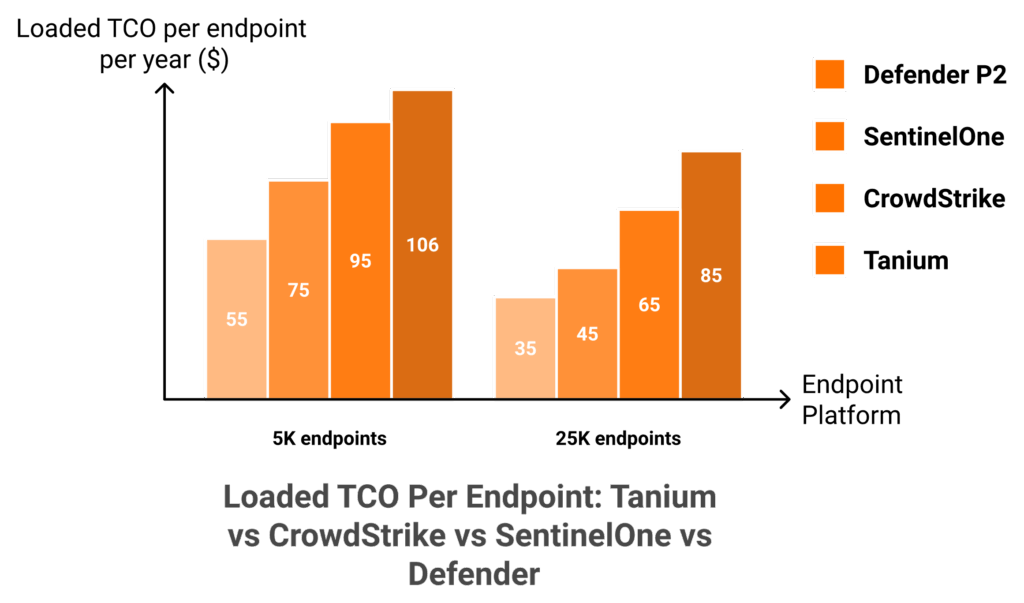
Most comparisons are wrong on basis. Vendor decks compare list price to list price, not loaded TCO to loaded TCO. They omit Professional Services, support uplifts, the SIEM (Security Information and Event Management) ingestion cost endpoint-heavy tools generate, and the labor to operate them. That is marketing math, not procurement math. For deeper benchmarks, our pricing breakdowns of CrowdStrike pricing 2026 and SentinelOne pricing 2026 use the same loaded-TCO methodology.
Loaded TCO at Equivalent Scale
| Platform | What’s Included | 5K Ep $/Ep/Yr | 25K Ep $/Ep/Yr | Consolidation Value | Ideal Buyer |
|---|---|---|---|---|---|
| Tanium (Core + 3 to 4 modules) | EDR, patch, asset, and compliance | ~$106 | ~$85 | High (replaces BigFix, SCCM, and EDR) | 10K+ ep, on-prem heavy |
| CrowdStrike Falcon Enterprise | EDR, threat intel, and identity protection | ~$95 | ~$65 | Medium (security only) | Security-led, cloud-native |
| SentinelOne Complete | EDR, XDR, and threat hunting | ~$75 | ~$45 | Medium (security only) | Mid-market, lean SOC |
| Microsoft Defender P2 | EDR via M365 E5 | ~$55 | ~$35 | Very high (bundled in E5) | M365 E5 customers |
When Tanium actually wins
The consolidation case is real when you can retire BigFix, SCCM, and a standalone EDR in the same year. At 25,000+ endpoints with multi-year commit and competitive displacement leverage, Tanium pricing can drop 30% to 55% off list. That math frequently beats keeping three legacy tools alive with their own support contracts and integration glue. Our comparison of CrowdStrike vs SentinelOne covers the security-only side of that math.
When Tanium loses
❌ Sub-5,000 endpoint estates rarely cross the consolidation threshold.
❌ SaaS-native, identity-first orgs get little use from the IT-ops modules.
❌ Lean teams without a dedicated Tanium operator pay for a Ferrari and park it.
❌ Buyers who already own M365 E5 are double-paying for patch and DLP equivalents.
The “Ferrari in the SOC” problem
Rick Howard’s framing fits here. Many enterprises spend the entire budget on fleets of Ferraris and run out of money before hiring the drivers. A fair comparison must price the driver, not just the car. Working across hundreds of SOC environments at UnderDefense, what I have seen consistently is that tool ownership does not equal coverage. What matters is whether telemetry actually reaches a correlation layer and whether a human is paid to act on it. Our Managed EDR service is designed for exactly that gap.
“Tanium is powerful, but you need dedicated people to extract value. We underestimated the staffing requirement.”
— Verified Reviewer, IT Director Tanium Gartner Peer Insights Verified Review
“We compared Tanium to CrowdStrike and the price gap was significant. We chose Tanium for the consolidation story but the operational lift is real.”
— Verified Reviewer, Security Architect Tanium PeerSpot Verified Review
The right question is not whether Tanium is expensive. It is expensive compared to what, and operated by whom.
Q9. How Do You Negotiate a Better Tanium Deal? The 2026 Playbook
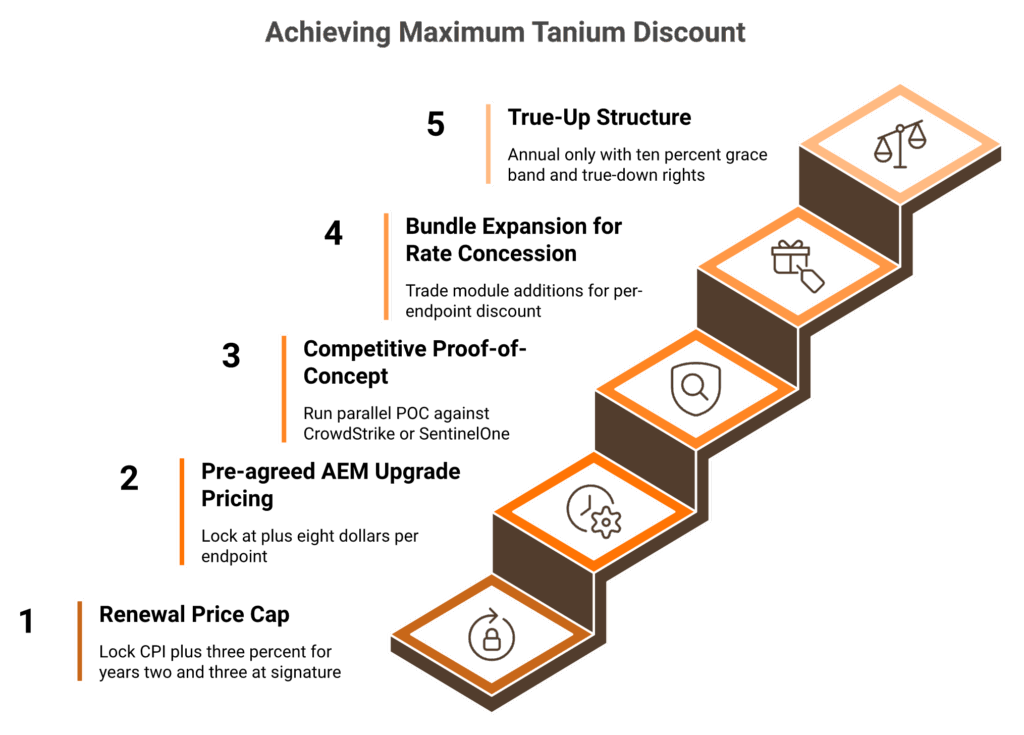
Enterprise buyers who run a disciplined Tanium negotiation land 15% to 35% off list at mid-market scale (5,000 to 25,000 endpoints) and 40% to 55% at large-enterprise scale (50,000+ endpoints, multi-year, with competitive displacement). The five highest-leverage asks are a renewal price cap (CPI+3%), pre-agreed AEM upgrade pricing, a competitive proof-of-concept against CrowdStrike or SentinelOne, bundle module expansion in exchange for rate concessions, and an annual true-up with a 10% grace band.
Why timing and order matter
Tanium expects to negotiate. Every deal routes through a rep, and discount authority sits at multiple levels. The question is not whether you can negotiate, but what you ask for, in what order, and where you sit in Tanium’s fiscal year. End-of-quarter and Tanium’s January fiscal year-end carry the most leverage. Our analysis of why businesses switch providers covers the renewal-window patterns we see most often.
The five tactical asks (run them in this order)
- Renewal price cap. Lock a CPI+3% ceiling for years two and three. Negotiate it before signing year one, never at renewal when leverage flips to the vendor.
- Pre-agree AEM upgrade pricing. The Core to Core Plus step-up is the single largest year-two upsell vector. Lock it at +$8 per endpoint now, not after Tanium uses it as renewal leverage.
- Run a competitive POC. Spin up a parallel proof-of-concept against CrowdStrike Falcon or SentinelOne. A credible BATNA (Best Alternative to a Negotiated Agreement) routinely unlocks 10% to 20% of additional discount. For benchmark TCO, our Sophos pricing 2026 breakdown gives you a third comparable.
- Bundle expansion in exchange for rate. Offer to add modules (SBOM, Comply Plus) only if Tanium concedes on the per-endpoint Core rate. This converts upsell pressure into your discount.
- True-up structure. Demand annual-only true-ups (not quarterly), a 10% grace band on endpoint growth, and explicit true-down rights for divestitures or fleet reduction.
⚠️ Red flags to challenge before you sign
These clauses appear in standard Tanium paper and quietly transfer leverage to the vendor:
- Auto-renewal without a price cap (negotiate 90-day opt-out window).
- No data portability clause (demand 90-day export rights via Tanium Connect).
- Technical Account Manager (TAM) assignment not in writing (Tanium has phased toward pooled support).
- Quarterly prorated true-ups instead of annual at renewal.
- No termination-for-convenience option (no convenience clause is publicly confirmed in standard paper).
Run the contract red flags against an SLA framework before signature, not after. For broader procurement context, our 2026 cybersecurity budget playbook walks through how to model these asks against full-year ACV.
The renewal is your highest-leverage moment
Silence is not safety. A Tanium deployment that has not been challenged at renewal is quietly consuming budget that could be redirected. Working with security teams across global enterprises, what I have seen is that buyers who treat the initial signature as the negotiation peak leave 20% to 30% of total contract value on the table. Renewal, with usage data, internal telemetry, and a credible competitive alternative in hand, is where the math actually shifts.
“Negotiation is mandatory with Tanium. If you accept the first quote, you will overpay by 25% or more.”
— Verified Reviewer, Procurement Lead Tanium PeerSpot Verified Review
Q10. How Do You Build the ROI Case for Tanium? (The CFO and Board Brief)
The CFO question is not “Why does Tanium cost $70 per endpoint?” It is “What does a breach cost us, and how much does Tanium reduce that exposure?” IBM’s 2024 Cost of a Data Breach Report puts the global average breach at $4.88 million. Tanium’s consolidation ROI, replacing BigFix, SCCM, and a standalone EDR (Endpoint Detection and Response), typically yields $15 to $30 per endpoint in avoided licensing, covering 30% to 60% of Tanium’s ACV before risk reduction is factored in.
The three pillars of the board case
A Tanium business case rests on three quantifiable financial levers. Present them with specific numbers, not generic claims. CFOs want expected-value math, not security poetry. Our cybersecurity budget 2026 guide covers how mid-market CFOs typically frame this conversation.
Pillar 1: Breach cost reduction 💰
The IBM 2024 report puts the average breach at $4.88 million globally, with $2.2 million in savings for organizations using AI and automation extensively in their security operations. Frame Tanium’s real-time query and patch capability as an expected-value calculation against your board’s stated risk tolerance. A 20% reduction in annualized breach probability on a $4.88M loss event is worth roughly $976,000 per year in risk-adjusted terms. For a real-world parallel, our $67M ransomware rescue case shows what loss-event prevention looks like in dollars.
Pillar 2: Mean-Time-To-Patch (MTTP) improvement ⏰
The Ponemon Institute and Ivanti research has historically pegged the industry-average patch lag at 97 days. Tanium’s sub-15-second endpoint query speed compresses that window dramatically when paired with disciplined operations. Verizon’s 2024 DBIR found exploitation of vulnerabilities as an initial access vector tripled year-over-year, making patch velocity a board-level metric. Our explainer on SOC metrics including MTTD and MTTR walks through how to translate patch velocity into board-friendly numbers.
Pillar 3: Tool consolidation savings 💸
This is the cleanest dollar argument on the slide. List the tools Tanium replaces in a typical consolidation:
- BigFix or SCCM (patch and configuration management).
- Standalone File Integrity Monitoring (FIM) tools.
- Standalone IT Asset Management (ITAM).
- Point Endpoint Detection and Response (EDR), where Threat Response is licensed.
- Standalone vulnerability scanners overlapping with Comply.
Avoided licensing plus reclaimed FTE hours typically delivers $15 to $30 per endpoint per year. At 10,000 endpoints, that is $150,000 to $300,000 in hard-dollar offset. Run the numbers through the SOC cost calculator before the board slide is finalized.
The CFO one-liner
At 10,000 endpoints, Tanium’s roughly $700,000 ACV compares against $4.88M average breach exposure. That is a risk-adjusted return of 7:1 before consolidation savings. If your board lives on probabilistic loss math, this is the slide that closes the deal.
What the invoice never shows
Working with security teams across mid-market and enterprise, what I have seen is that the most resonant ROI moments come from detections nobody budgeted for. A UnderDefense customer recovered the cost of their service in three months by detecting a payroll fraud scheme that “checkbox” monitoring would have missed. The ROI of detection is measured in what you catch, not what you spend. For a parallel, our SIEM and SOC case avoiding $650K loss documents that math in detail.
Q11. Is Tanium Worth It in 2026? Buyer Verdict Based on Real G2 and Gartner Data
Tanium is worth the premium for organizations managing 10,000+ endpoints in complex, heterogeneous environments who need a single platform to consolidate IT operations and security. It is a poor fit for SaaS-native organizations under 5,000 endpoints where identity, not endpoint, is the primary attack surface. The most common buyer regret cited in G2 and Gartner reviews is not the price; it is paying the price without the internal team to operate the platform at full fidelity.
The contrarian read most pricing guides skip
Most enterprises do not fail at buying Tanium. They fail at operating it. Tool ownership is not coverage. A quiet dashboard from a sophisticated platform often means telemetry is not reaching a correlation layer, not that the environment is clean. Verizon’s 2024 DBIR found a non-trivial share of breaches involved unmanaged or under-monitored endpoints. Honest take from where I sit: the cheapest Tanium deployment is the one your team can actually operate.
Buy vs. look elsewhere
| Dimension | ✅ Buy Tanium If… | ❌ Look Elsewhere If… |
|---|---|---|
| Endpoint count | 10,000+ | Under 5,000 |
| Architecture | Hybrid, on-prem heavy | SaaS-native, identity-first |
| In-house team | Dedicated platform engineer | Lean SOC, shared admin |
| Compliance | CMMC 2.0, FedRAMP, and PCI-DSS | M365 E5 covers most needs |
| Consolidation goal | Replace 3+ tools at once | Pure-play EDR replacement |
The 7-console risk
The most expensive mistake in enterprise security procurement is owning everything and operating none of it. A buyer with six or seven overlapping consoles has configuration drift, not coverage. If you sign for Tanium without the internal team to drive it at full fidelity, the answer is not a different tool. It is a managed overlay that supplies the expert drivers the Ferrari needs. Our SOC service is built precisely for this gap.
Top managed overlays and MDR providers for Tanium environments
- UnderDefense Agentic AI SOC. ⭐ BYO stack integration with Tanium and 250+ tools, 2-minute Alert-to-Triage SLA with 15-minute escalation for critical incidents, autonomous response (credential wipes, password resets, and ticket creation), and ingestion tuning that cuts SIEM telemetry 50% to 90%. See the UnderDefense Agentic AI SOC Platform for the full architecture.
- Computacenter XEM Managed Service. Long-standing Tanium partner offering managed XEM operations across global enterprises.
- True Zero Core as a Managed Service. Available on AWS Marketplace as a managed overlay for Tanium Core, Provision, and Enforce.
For a wider field scan of overlay options, our MDR vendors list 2025 covers comparable providers across mid-market and enterprise tiers.
“UnderDefense Agentic AI SOC has provided us with peace of mind. Their team treats our environment as their own and responds within minutes.”
— Verified Reviewer, IT Director UnderDefense G2 – Verified Review
“Tanium is a powerful tool, but the operational lift was higher than we expected. We needed a partner to extract value.”
— Verified Reviewer, Security Architect Tanium Gartner Peer Insights Verified Review
“Excellent partnership. UnderDefense fills the gaps our existing tooling could not close on its own.”
— Verified Reviewer, CISO UnderDefense G2 – Verified Review
Q12. Already Running Tanium? Here Is What UnderDefense Agentic AI SOC Adds on Top, and Why It Changes the Math
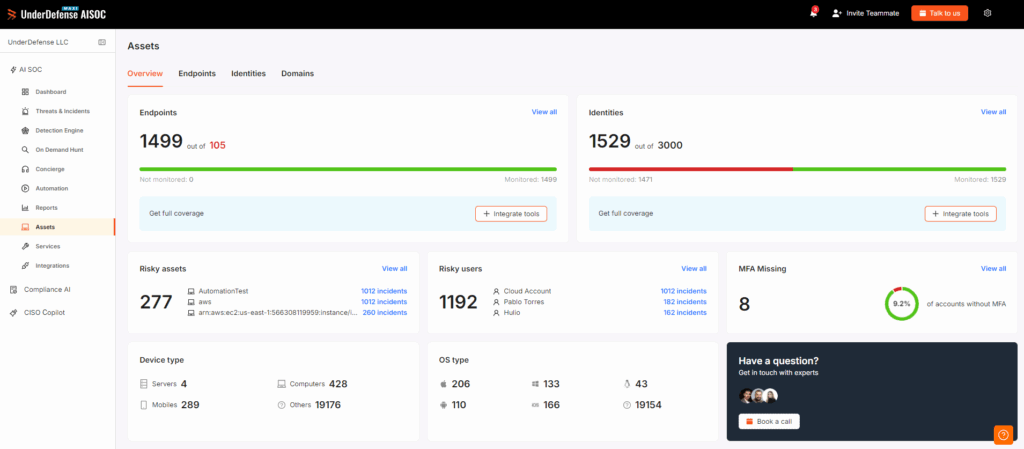
Tanium gives you real-time visibility across every endpoint. UnderDefense Agentic AI SOC gives you autonomous action on it: credential wipes, password resets, ticket creation, and analyst escalation within a 2-minute Alert-to-Triage SLA, with 15-minute escalation for critical incidents. UnderDefense Agentic AI SOC integrates with Tanium as a BYO (Bring Your Own) stack, so you keep your existing investment and add the response layer it was always missing. Ingestion tuning alone typically cuts SIEM (Security Information and Event Management) telemetry costs by 50% to 90%, often offsetting Tanium’s annual renewal increase.
The limitation every Tanium pricing guide avoids naming
Tanium is a visibility and management engine, but not a response engine. It tells you what is happening across the estate. It does not, on its own, wipe a credential, reset a password, or open a Tier-1 ticket autonomously when a threat surfaces. That gap is where breaches widen between detection and containment. For a deeper read on closing that gap, our MDR service page covers the response architecture in detail.
Turn these benchmarks into a real plan.
Get a vendor-neutral assessment and a cost-optimized roadmap.
What UnderDefense Agentic AI SOC adds on top of Tanium specifically
✅ BYO stack integration. No rip-and-replace; UnderDefense Agentic AI SOC ingests Tanium telemetry and acts on it.
✅ Autonomous response. Credential wipes, password resets, ticket creation, and ChatOps verification with end users.
✅ 2-minute Alert-to-Triage SLA. Versus 30 to 60 minutes for legacy MSSPs (Managed Security Service Providers) and many traditional MDR providers, with 15-minute escalation for critical incidents.
✅ Ingestion tuning. Cuts SIEM volume 50% to 90%, a hard-dollar ROI that often covers the year-over-year Tanium renewal lift. See our managed SIEM pricing guide for the underlying economics.
❌ What you avoid. Vendor lock-in, black-box escalation, and opaque pricing common in traditional MDR contracts.
Team extension, not tool replacement
For organizations paying $700K per year for Tanium with a three-person security team, UnderDefense Agentic AI SOC absorbs Tier-1 triage and routine response work. That frees internal analysts for detection engineering, threat hunting, and the strategic work that platforms alone cannot deliver. Working with hundreds of SOC environments, what I have seen consistently is that the value of a managed overlay is measured in analyst hours returned, not dashboards added. Our US IT leader 24/7 monitoring case documents that pattern in production.
Less theater, more throughput. Less black box, more blue team.
References
Official Docs / Indian Statutes
- NC State ITS. “Tanium Master Agreement Price List.” Effective April 2025.
- Prescriptive.solutions. “Tanium Global Partner Price List.” Published: January 2025.
- Netsync. “Tanium Price List Q4 2023.” Published: November 2022.
- Tanium. “Help Center: Solutions and Bundles.” Published: November 2025.
- AWS Marketplace. “Tanium Cloud Listing.” Verified: May 2026.
- AWS Marketplace. “Tanium On-Prem Listing.” Verified: May 2026.
- Tanium. “Autonomous Endpoint Management (AEM) Overview.” Published: June 2025.
- CHEST UK. “Tanium Higher Education Agreement.” Published: 2024–2025.
- NIST. “SP 800-61 Rev. 3: Incident Response Recommendations and Considerations for Cybersecurity Risk Management.” Published: April 2025.
- U.S. Department of Defense. “CMMC 2.0 Model Overview.” Published: 2024.
- U.S. Securities and Exchange Commission. “Cybersecurity Risk Management, Strategy, Governance, and Incident Disclosure Final Rule.” Effective: December 2023.
- Microsoft. “Microsoft 365 E5 Licensing Documentation.” Verified: 2026.
- UnderDefense. “Agentic AI SOC Platform Documentation.” Published: 2025–2026. [Source URL not provided]
- UnderDefense. “SOC Cost Calculator.”
Datasets
- Vendr Catalog. “Tanium Core Platform and Tanium Asset Deal Intelligence,” 2026. [Source URL not provided]
- IBM Security. “Cost of a Data Breach Report 2024,” 2024.
- Verizon. “2024 Data Breach Investigations Report (DBIR),” 2024.
- Ponemon Institute and Ivanti. “State of Vulnerability Response Report,” 2023–2024.
Blogs
- SelectHub. “Tanium Pricing.” Published: 2025–2026. [Secondary source]
- PeerSpot. “Tanium Buyer Reviews.” Published: 2024–2025. [Secondary source]
- Gartner Peer Insights. “Tanium Reviews.” [Secondary source]
- PointWire. “Tanium Pricing (UK Reseller).” Published: 2022. [Secondary source]
- G2. “UnderDefense MAXI Reviews.” [Secondary source]
1. What does Tanium actually cost per endpoint in 2026?
2. How is Tanium licensing structured, per endpoint or per module?
3. Which Tanium modules are most commonly under-utilized at renewal?
4. How do Tanium's bundles compare to buying modules à la carte?
5. How does Tanium pricing compare to CrowdStrike, SentinelOne, and Microsoft Defender?
6. How can we negotiate a better deal on a Tanium renewal?
7. What hidden costs should we expect beyond Tanium's quoted price?
8. We already run Tanium. What does adding UnderDefense Agentic AI SOC on top change for us?
Tanium gives you real-time visibility across every endpoint. UnderDefense Agentic AI SOC gives you autonomous action on it: credential wipes, password resets, ticket creation, and analyst escalation within a 2-minute Alert-to-Triage SLA, with 15-minute escalation for critical incidents. UnderDefense Agentic AI SOC integrates with Tanium as a BYO (Bring Your Own) stack, so you keep your existing investment and add the response layer Tanium does not provide on its own. What it adds in practice:
- Autonomous Tier-1 triage and routine response actions.
- 2-minute Alert-to-Triage versus 30 to 60 minutes for legacy MSSPs.
- SIEM ingestion tuning that cuts telemetry volume 50% to 90%, often offsetting Tanium’s annual renewal lift.
- Analyst hours returned to detection engineering and threat hunting.
See the architecture and integrations on the UnderDefense Agentic AI SOC platform, or compare overlay options through our managed EDR service.
Reasoning: Bottom-of-funnel conversion intent for the Tanium-installed segment, which is the article’s primary monetization path.