







Q1. What Is PCI Penetration Testing, and Who Needs It Under PCI DSS 4.0?
The Compliance Reality: Who’s in Scope Now
Since March 31, 2025, PCI DSS 4.0 is fully enforced, with no more grace periods and no more “future-dated” flexibility. If your organization stores, processes, or transmits cardholder data, you need a PCI penetration test. Period. That applies to Level 1–4 merchants, service providers, e-commerce platforms, SaaS companies handling payment data, and payment processors.
PCI penetration testing is a mandated simulated attack against your cardholder data environment (CDE), designed to prove whether an attacker can actually exploit your weaknesses, not just list them. It’s fundamentally different from running a vulnerability scanner and calling it a day.
Which SAQ Types Actually Require Pentesting?
Not every SAQ demands a full penetration test, but more do than most people think. SAQ D (merchants and service providers with complex environments) absolutely requires it. SAQ A-EP and SAQ C require penetration testing because they involve internet-facing systems that impact transactions. SAQ A, SAQ B, SAQ B-IP, SAQ C-VT, and SAQ P2PE generally do not. And any organization completing a Report on Compliance (ROC) must include a full PCI pentest, no exceptions.
⚠️ The Checkbox Pentest Trap
Here’s what I see constantly: companies treat PCI pentesting as an annual checkbox. They hire the cheapest vendor, get back what’s essentially an automated scan dressed up as a “pentest,” and hand it to their QSA, who rejects it. Under 4.0, QSAs are rejecting reports that lack proof of exploitation, authenticated testing, and segmentation validation. A $3,000 “pentest” that gets rejected costs you far more than a proper $15,000 engagement that passes the first time. That’s not a budget decision. That’s a math problem.
Detection without response is noise. A pentest without remediation is compliance theater.
From Annual Event to Continuous Obligation
PCI DSS 4.0 demands a risk-based, methodology-driven approach: authenticated internal testing, application-layer assessment per Requirement 6.4, segmentation validation every six months for service providers, and retesting triggered by “significant changes.” Penetration testing is no longer something you schedule once in December and forget about.
How We Approach This at UnderDefense
We don’t deliver a report and disappear. Our penetration testing services integrate directly with the UnderDefense MAXI platform’s 24/7 MDR, so pentest findings feed into your existing SIEM/EDR/XDR detection logic across 250+ tool integrations, and our concierge analysts verify remediation through Slack or Teams. Our testers hold OSCP, CEH, and CREST certifications, and our reports are accepted by major QSA firms without rework.
“UnderDefense provides versatile service and was able to accommodate requirements for different projects. Scoping and detailed remediation reporting were clean and very comprehensive.”
— CTO, IT Services UnderDefense Gartner – Verified Review
“Working with UD was great. We chose them among 5 other vendors. They understood our needs and gave us a detailed pen test report.”
— Manager of IT Services UnderDefense Gartner – Verified Review
Q2. What Changed from PCI DSS 3.2.1 to 4.0 and 4.0.1 for Penetration Testing?
Why the Version Shift Matters Right Now
PCI DSS 4.0 replaced 3.2.1 as the active standard on March 31, 2024. All future-dated requirements, including several major penetration testing enhancements, became mandatory on March 31, 2025. PCI DSS 4.0.1 followed as a limited clarification revision. If your compliance team is still referencing 3.2.1 requirement numbers, you’re already behind in your QSA conversations.
Requirement Remapping: What Moved Where
The numbering shifted, but so did the substance. Here’s the precise mapping:
| PCI DSS 3.2.1 | PCI DSS 4.0 Equivalent | What Changed |
|---|---|---|
| Req 11.3.1 (External pentest) | Req 11.4.2 | Now explicitly requires documented industry-accepted methodology in the report |
| Req 11.3.2 (Internal pentest) | Req 11.4.3 | Requires authenticated testing; expanded scope to all in-scope systems, not sampled |
| Req 11.3.3 (Retesting) | Folded into 11.4.2 / 11.4.3 | Retesting after remediation is now explicit, not implied |
| Req 11.3.4 (Segmentation testing) | Req 11.4.5 | Semi-annual for service providers unchanged; now requires documented validation criteria |
| Req 6.6 (Web app firewall or assessment) | Req 6.4 | Expanded: automated technical solutions to detect/prevent web attacks + annual app assessment |
| Req 11.5 (Intrusion detection) | Req 11.5.1 | Now requires alerting on suspected compromises |
✅ New Requirements You Didn’t Have Before
These are entirely new obligations, not just renumbered ones:
- Req 11.3.1.2, Authenticated internal vulnerability scanning. Internal scans must now use credentials to find vulnerabilities that unauthenticated scans miss. This was future-dated to March 31, 2025, and is now mandatory.
- Req 11.6.1, Anti-skimming and e-commerce tamper detection. Organizations with payment pages must deploy change-and-tamper-detection mechanisms that alert on unauthorized modifications to HTTP headers, payment page scripts, and content. This directly targets Magecart and e-skimming attacks.
- PCI DSS 4.0.1 clarifications, MFA and password policy. Multi-factor authentication is now required for all access into the CDE, not just remote access. Password minimum moved from 7 characters to 12 recommended (8 minimum if 12 isn’t feasible).
⏰ Transition Timeline
- March 31, 2024 → v3.2.1 retired, v4.0 active
- March 31, 2025 → All future-dated requirements mandatory
- 4.0.1 clarification released → Current enforcement state
How We Simplify This at UnderDefense
Our penetration testing methodology is already fully aligned with PCI DSS 4.0.1: authenticated internal scanning, application-layer testing per updated Requirement 6.4, and segmentation validation using documented criteria. Every report maps findings to the new 4.0 requirement numbers, so your QSA isn’t cross-referencing old numbering schemes. Our MDR platform also supports Requirement 11.6 monitoring for payment page tampering through continuous JavaScript integrity checking.
Q3. What Are the Exact PCI DSS 4.0 Penetration Testing Requirements?
The Five Pillars of PCI Pentest Compliance
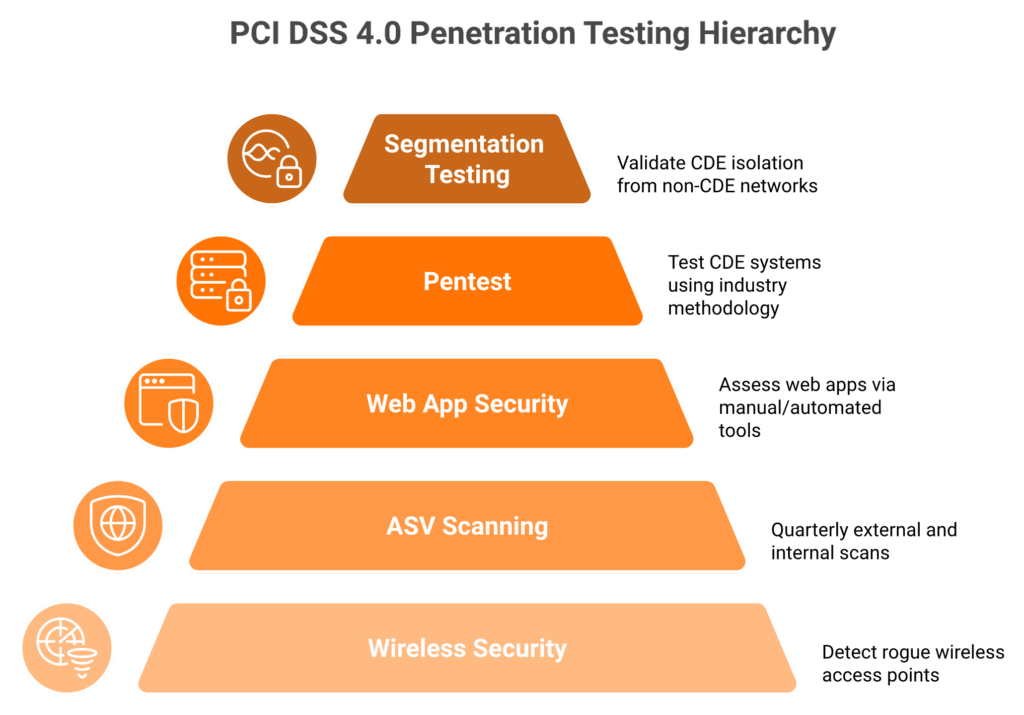
PCI DSS 4.0 penetration testing obligations span interconnected requirements across vulnerability management (Req 11), application security (Req 6.4), and organizational readiness. Think of this section as the audit reference you bring to your QSA meeting.
Requirement-by-Requirement Breakdown
| Requirement | What It Mandates | Frequency |
|---|---|---|
| 11.4.2, External pentest | Test all external-facing CDE systems using industry-accepted methodology | Annual + after significant change |
| 11.4.3, Internal pentest | Authenticated testing from inside the network; network-layer and application-layer | Annual + after significant change |
| 11.4.5, Segmentation testing | Validate that segmentation controls isolate CDE from out-of-scope networks | Semi-annual (service providers) / Annual (merchants) |
| 6.4, Web app security | Assess public-facing web apps via manual/automated tools; cover OWASP Top 10 | Annual + after changes |
| 11.1, Wireless security | Detect and identify wireless access points; rogue AP detection | Quarterly |
| 11.2 context, ASV scanning | Quarterly external scans by Approved Scanning Vendor; quarterly internal scans | Quarterly (distinct from pentesting) |
⚠️ The “Significant Change” Decision Tree
PCI DSS 4.0 requires retesting after “significant change” but doesn’t give you a precise checklist. The PCI SSC Penetration Testing Guidance offers examples: new network equipment, OS upgrades, new payment flows, sub-network additions, and major firewall rule changes. Here’s how to think through it:
- Did the change affect CDE boundary? → Retest segmentation
- Did it modify network topology within CDE? → Retest internal
- Did it add/modify external-facing systems? → Retest external
- Did it alter web application payment logic? → Retest application layer
- Did it add a new payment channel? → Full retest
Maintain a “significant change register” as ongoing audit evidence. Your QSA will thank you.
Who Can Perform the Test, and What QSAs Look For
PCI DSS allows internal resources if they’re organizationally independent from the area being tested. Your network team cannot pentest the network they manage. Third-party testers are preferred because they eliminate independence questions entirely.
Required qualifications include OSCP, OSCE, CEH, GXPN, GPEN, GWAPT, or CREST CRT/CCT, or equivalent verifiable experience. QSAs specifically validate:
- ✅ Qualified independent tester
- ✅ Scope covering entire CDE including segmentation
- ✅ Industry-accepted methodology
- ✅ Findings mapped to PCI DSS requirements with CVSS ratings
- ✅ Remediation completed with retesting confirmation
- ✅ Proof of exploitation in the report
“Highly qualified pentesters will perform a pentest with exceptional quality within the agreed terms.”
— Director, IT Security and Risk Management UnderDefense Gartner – Verified Review
“The issues they found were unique, so you know they were not just using tools to test. They got in and really found some edge-case issues that other penetration testers have not.”
— VP, Security & Compliance, Legal Tech Company UnderDefense Clutch – Verified Review
Q4. How Is a PCI Pentest Different from a Vulnerability Scan and a Regular Penetration Test?
The Core Distinction
A vulnerability scan is an automated, tool-driven sweep that identifies known weaknesses. It does not exploit them. A regular penetration test simulates real attacks but without PCI-mandated scope, methodology, or reporting constraints. A PCI penetration test combines human-driven exploitation against the CDE specifically, with compliance-mandated deliverables that QSAs evaluate.
PCI Pentest vs. Vulnerability Scan
| Dimension | PCI Penetration Test | Vulnerability Scan |
|---|---|---|
| Nature | Manual + automated exploitation | Automated scanning only |
| Objective | Prove exploitability and business impact | Identify known CVEs |
| Scope | CDE-specific per PCI DSS | Any target range |
| Depth | Exploits vulnerabilities, attempts lateral movement and privilege escalation | Detection only, no exploitation |
| PCI Requirement | Req 11.4 | Req 11.3 / 11.2 |
| Output | Audit-ready report with proof of exploitation | Vulnerability listing with CVSS scores |
| Frequency | Annual + after significant change | Quarterly internal/external |
| Performer | Qualified independent tester | Internal team or ASV for external |
PCI Pentest vs. Regular Pentest
| Dimension | PCI Pentest | Regular Pentest |
|---|---|---|
| Scope | CDE-only as defined by PCI DSS | Any agreed target |
| Methodology | Must follow PTES/OSSTMM/NIST per PCI SSC guidance | Flexible |
| Reporting | Must map findings to PCI DSS requirements with CVSS + proof of exploitation | No mandated format |
| Frequency | Annual + significant change + semi-annual segmentation for SPs | As-needed |
| Tester | Must demonstrate independence and qualifications per Req 11.4.1 | No mandated credentials |
| Retesting | Required for critical/high findings | Optional |
| Segmentation Testing | Mandatory if segmentation reduces CDE scope | Not applicable |
How We Handle Both at UnderDefense
We deliver PCI-specific, general, and continuous penetration testing through the same expert team. Your PCI pentest insights automatically inform broader security posture improvements without duplicating effort or vendor relationships. Our reports serve both QSA audit and operational security improvement simultaneously.
“We did a greybox penetration test. Everything was quick and the depth of the test was impressive. The team is great.”
— Chief Engineering Officer, Software Company UnderDefense Gartner – Verified Review
“They are real experts in the services they provide. Also, they work as a team, and it is rarely a one-person job.”
— Lead DevOps Engineer, Insurance Tech Company UnderDefense Clutch – Verified Review
Q5. What Should Be in Scope for Your PCI Penetration Test, Including Cloud, Containers, and APIs?
Why Scoping Is the Most Common PCI Pentest Failure Point
Incorrect scoping is the number one reason PCI penetration tests fail QSA review. Under-scope, and you leave CDE components untested, which means your Report on Compliance has a gap the QSA will flag. Over-scope, and you burn budget testing systems that don’t matter while rushing through the ones that do. Cloud, container, and API environments introduce entirely new scoping challenges that most pentest providers miss. If your CDE runs on EKS or Lambda and your pentester doesn’t know how to scope ephemeral workloads, you have a compliance blind spot that real attackers will find first.
✅ Traditional CDE Scoping Fundamentals
Before touching cloud or containers, get the basics locked down. Your PCI pentest scope must include:
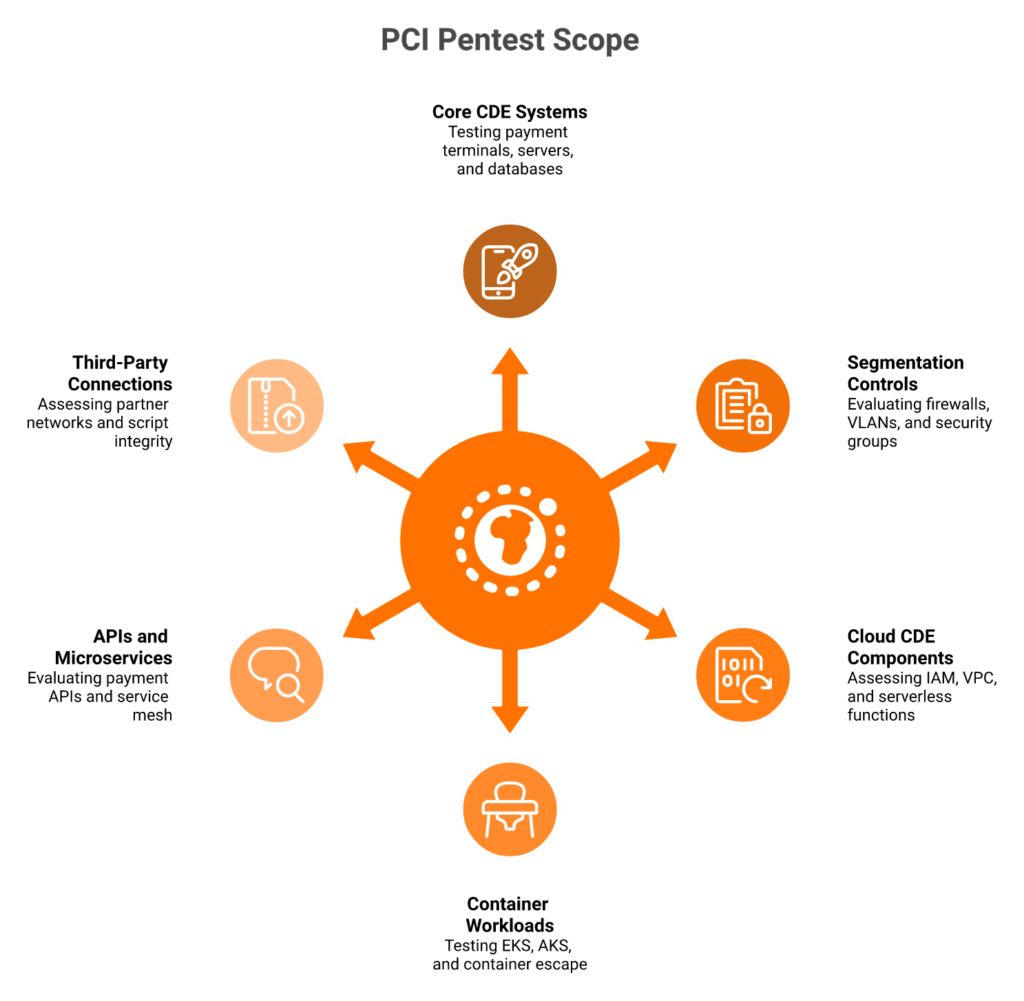
- All systems that store, process, or transmit cardholder data: payment terminals, POS systems, back-end processing servers, and databases with PAN/CVV
- All systems connected to or providing security services to the CDE: firewalls, IDS/IPS, authentication servers, and log aggregation
- All segmentation controls isolating the CDE from out-of-scope networks: firewalls, VLANs, ACLs, and microsegmentation policies
- The external perimeter: all public-facing IP addresses, DNS entries, web applications, and API endpoints serving the CDE
- Third-party connections and partner networks with CDE access
- Network diagrams showing cardholder data flows (QSAs will cross-reference the pentest scope against these)
Cloud CDE Scoping: AWS, Azure, and GCP
This is where most pentest providers drop the ball. The shared responsibility model means the cloud provider secures the infrastructure layer, but you’re responsible for CDE configuration, network segmentation, access controls, and application security.
Here’s what must be in scope for cloud CDEs:
- VPCs/VNets and security group configurations, which act as segmentation controls and must be tested as segmentation boundaries
- IAM roles and policies governing CDE access. Test for privilege escalation paths, cross-account role assumption, and SCP bypass
- Containerized payment workloads on EKS, AKS, and GKE. The CDE may span ephemeral containers that must be in scope during testing; coordinate with orchestration schedules
- Serverless functions (Lambda, Azure Functions, and Cloud Functions) processing cardholder data, in scope even though no persistent infrastructure exists
- API gateways and load balancers exposing payment endpoints. Test for broken authentication, excessive data exposure, and injection
- Cloud storage buckets/blobs containing cardholder data
⚠️ Cloud Provider Penetration Testing Policies
- AWS: No prior approval required for permitted services (EC2, RDS, Lambda, API Gateway, CloudFront, Lightsail, and Elastic Beanstalk). C2 testing requires approval.
- Azure: Requires compliance with their rules of engagement. No prior notification needed, but adhere to the acceptable use policy.
- GCP: Allows most testing without notification.
API and Microservices Scoping
Every microservice touching cardholder data or connected to CDE systems is in scope, even if it’s ephemeral. That includes payment API endpoints (tokenization, authorization, and settlement), webhook receivers processing payment notifications, inter-service communication within the CDE (service mesh authentication and mTLS validation), and API gateway configurations.
How We Handle This at UnderDefense
Our penetration testing team specializes in cloud-native CDE assessments with documented experience across AWS, Azure, and hybrid environments. The scoping process includes a structured discovery questionnaire and architecture review ensuring every CDE component, including containerized, serverless, and API workloads, is captured before testing begins.
Q6. How Does the PCI Penetration Testing Process Work from Pre-Engagement to Retesting?
Seven Phases, Multiple Test Types, One Lifecycle
A PCI-compliant penetration test follows a structured lifecycle with specific deliverables at each phase that your QSA will review. It spans multiple test types: internal, external, segmentation, and application-layer. It can use different approaches: black-box (no prior knowledge), grey-box (partial credentials and network info), or white-box (full architecture documentation and credentials). Grey-box is the most common for PCI engagements because it enables authenticated testing per Requirement 11.4.3 while simulating realistic attacker capability.
Phase-by-Phase Lifecycle
- Pre-Engagement and Scoping (Week 1) — Define CDE boundaries, agree on rules of engagement, provision credentials for authenticated testing, set testing windows, identify emergency contacts, and sign authorization documentation.
- Reconnaissance (Week 2) — Passive and active information gathering: DNS enumeration, OSINT, network mapping with Nmap, service and version identification, and web application crawling.
- Vulnerability Discovery (Week 2–3) — Automated scanning (Nessus, Qualys, Burp Suite, and OWASP ZAP) combined with manual testing. Network-layer: open ports, misconfigurations, unpatched services, and default credentials. Application-layer: OWASP Top 10, including SQL injection, XSS, CSRF, broken authentication, SSRF, and insecure deserialization.
- Exploitation and Proof of Impact (Week 3–4) — Manual exploitation to demonstrate real-world impact. PCI DSS 4.0 requires proof of exploitation: screenshots, command outputs, and data accessed. Techniques include credential attacks, privilege escalation, web application exploitation, and network service exploitation.
- Post-Exploitation, Lateral Movement, and CDE Pivot Testing (Week 4) — Can the attacker move laterally from a compromised system to other CDE components? Escalate to domain admin? Pivot from connected-to systems into the CDE? Exfiltrate cardholder data? This phase tests whether segmentation and access controls actually hold under real attack conditions.
- Reporting (Week 5) — Deliver audit-ready report mapped to PCI DSS 4.0 requirement numbers with CVSS scores and proof of exploitation.
- Remediation and Retesting (Week 6–8) — Remediate findings, then perform retesting to confirm fixes. QSAs require evidence that critical and high-severity findings were addressed.
Test Type Coverage Matrix
| Test Type | Objective | When Required | Key Techniques |
|---|---|---|---|
| External pentest | Test CDE perimeter defenses from the internet | Annual + after change | Port scanning, web app attacks, and perimeter exploitation |
| Internal pentest | Test CDE defenses from inside the network | Annual + after change | Authenticated scanning, privilege escalation, and lateral movement |
| Segmentation test | Validate CDE isolation from non-CDE networks | Semi-annual (SPs) / Annual (merchants) | Attempt to traverse segmentation controls |
| Application-layer test | Test web apps handling payment data | Annual + after change per Req 6.4 | OWASP Top 10, business logic, and API security |
| Social engineering (optional) | Test human element | Recommended, not mandated | Phishing simulations and credential harvesting |
How We Run This at UnderDefense
We cover all test types, including external, internal, segmentation, and application-layer, in a single 6–8 week engagement, eliminating the need to coordinate multiple vendors. Our project managers handle logistics end-to-end, providing weekly status updates and immediate escalation for critical findings discovered mid-test.
“UnderDefense delivered high-quality penetration testing. The results of the test were quite impressive and accordingly the report was informative and generated useful business insights. Throughout the project, we had constant communication.”
— Founder/CTO, IT Services UnderDefense Gartner – Verified Review
“The project management was smooth, so was the entire experience, transparent communication and a deep expertise and specialization team.”
— IT Cybersecurity Manager, IT Services UnderDefense Gartner – Verified Review
Q7. Which Methodologies and Tools Do PCI Pentesters Use?
Why Methodology Choice Determines QSA Acceptance
PCI DSS 4.0 requires penetration tests to follow “an industry-accepted penetration testing methodology.” The PCI SSC Penetration Testing Guidance document explicitly names accepted frameworks. Choosing the wrong methodology, or not documenting methodology at all, is a common reason QSAs reject pentest reports. This isn’t a theoretical preference; it’s a pass/fail criterion.
Methodology Comparison
| Framework | Focus Area | Key Strengths | PCI Alignment |
|---|---|---|---|
| PTES (Penetration Testing Execution Standard) | End-to-end lifecycle with 7 phases | Most commonly referenced for PCI; strongest for structured reporting and scoping | ⭐ Primary |
| OSSTMM (Open Source Security Testing Methodology Manual) | Quantitative security metrics, operational security | Strong for segmentation validation and controls verification | ✅ Accepted |
| NIST SP 800-115 | U.S. government standard for security testing | Strong for regulated industries already aligned with NIST frameworks | ✅ Accepted |
| ISSAF (Information Systems Security Assessment Framework) | Domain-specific technical depth | Comprehensive but less commonly updated | ✅ Accepted |
| OWASP Testing Guide | Application-security focused | Essential complement for Req 6.4 web application testing | ✅ Required for app-layer |
The most common approach for PCI compliance is PTES for the overall engagement structure combined with OWASP for application-specific testing.
Complete PCI Pentest Tool Stack
Reconnaissance: Nmap (network discovery, port scanning, and OS fingerprinting), Recon-ng (OSINT framework), and Shodan (internet-facing asset discovery)
Vulnerability Scanning: Nessus (comprehensive vulnerability scanner), Qualys (cloud-native scanning), and OpenVAS (open-source alternative)
Web Application Testing: Burp Suite Pro (manual web app testing, the go-to for Req 6.4), OWASP ZAP (open-source scanner), Nikto (web server misconfiguration), SQLmap (SQL injection automation), and Acunetix (commercial web app scanner)
Exploitation: Metasploit Framework (exploit development and delivery) and Cobalt Strike (adversary simulation and C2)
Password Testing: John the Ripper and Hashcat (credential cracking for authenticated testing)
Memory/RAM Scraping: Volatility Framework (RAM analysis for cardholder data in memory, which tests whether PAN/CVV persists after transactions)
⚠️ Automated vs. Manual: Where the Line Falls
The Pentest-as-a-Service (PtaaS) model, consisting of continuous or on-demand platforms like Cobalt, Synack, or Pentera, can supplement annual manual pentests by providing validation between engagements. But PtaaS cannot fully replace manual penetration testing because PCI DSS requires human-driven exploitation and proof of impact that automated platforms alone cannot provide. Automated tools handle vulnerability scanning (Req 11.2/11.3); manual expert testing is required for penetration testing (Req 11.4) to demonstrate exploitation chains, lateral movement, and business impact.
How UnderDefense Approaches This
Our pentesters combine automated scanning tools (Nessus, Burp Suite Pro, and SQLmap) with deep manual exploitation, ensuring findings go beyond what scanners detect.
“The issues they found were unique, so you know they were not just using tools to test. They got in and really found some edge-case issues that other penetration testers have not.”
— VP, Security & Compliance, Legal Tech Company UnderDefense Clutch – Verified Review
“It was highly technical, very documented and high value.”
— VP Security Services, IT Services UnderDefense Gartner – Verified Review
Q8. How Do You Prepare Your Team for a PCI Penetration Test? (Pre-Test Readiness Playbook)
Why Pre-Test Readiness Determines Pentest ROI
The success of a PCI penetration test is largely determined before the first scan runs. Organizations that prepare thoroughly get more accurate results, faster engagement timelines, cleaner audit evidence, and lower overall cost. Organizations that scramble to provide network diagrams and credentials mid-engagement waste 30–40% of the testing window on logistics, and pay the same price for less thorough testing. This playbook eliminates that waste.
📋 The Pre-Test Readiness Checklist
- Update CDE asset inventory. Confirm all in-scope IP addresses, hostnames, URLs, web applications, APIs, cloud resources, and containerized workloads. Missing assets mean untested attack surfaces.
- Validate and update network diagrams. Ensure cardholder data flow diagrams match current architecture including cloud CDE components. QSAs will cross-reference pentest scope against these diagrams.
- Document segmentation boundaries. List every segmentation control (firewalls, VLANs, ACLs, VPC security groups, and microsegmentation policies) and its justification.
- Provision test credentials. For authenticated testing per Req 11.4.3, prepare test accounts at multiple privilege levels: standard user, application admin, and domain admin.
- Coordinate testing windows and environment freeze. Align with IT operations to minimize production impact; establish an environment freeze to prevent changes during testing that could invalidate results.
- Define and sign rules of engagement. Document what testers can and cannot do (DoS testing, social engineering, and physical access), testing hours, rate limiting, and emergency stop procedures.
- Verify cloud provider policies. AWS allows testing without notification for permitted services; Azure requires compliance with their rules of engagement; GCP allows most testing without notification.
- Brief stakeholders and prepare communication plan. Notify SOC/NOC teams, development leads, IT operations, and executive sponsors. Provide testers’ source IPs so alerts can be contextualized without being suppressed.
- Gather previous pentest reports and remediation evidence. Provide prior findings so testers can verify remediation effectiveness and identify regression.
- Pre-assign remediation resources. Allocate development and infrastructure resources for post-test remediation before the engagement starts. A 3-month gap between finding and fixing is compliance theater.
Maintaining Continuous PCI Pentest Readiness
Don’t treat readiness as a one-time checklist. Maintain a living CDE inventory updated with every change. Integrate pentest scope validation into your change management workflows. Keep network diagrams current through automated tooling. Maintain a “significant change register” that triggers retesting discussions proactively. Quarterly internal readiness reviews, where the compliance team validates all prerequisites remain current, save weeks of scrambling before the annual engagement.
How We Simplify This at UnderDefense
Our penetration testing engagement begins with a structured discovery questionnaire and scoping call, ensuring every CDE component is captured, credentials are provisioned, and stakeholders are aligned before testing begins. Our project managers handle logistics end-to-end, letting compliance teams focus on remediation readiness rather than test coordination. We also provide FREE PenTest Report Templates (Internal and Web App) so teams can understand expected deliverables before the engagement starts.
Q9. What Should an Audit-Ready PCI Pentest Report Include, and How Can It Serve Multiple Frameworks?
Why Your Report Matters More Than Your Test
The pentest report is the primary artifact your QSA evaluates. A thorough test with a poor report is operationally useless; it won’t satisfy the auditor, and it won’t help your team remediate. The report must serve two audiences: executives who need risk context, and technical teams who need exploitation details with fix instructions. A well-structured report can simultaneously produce compliance evidence for multiple frameworks, reducing duplicated audit effort significantly.
📋 Report Component Checklist
- Executive Summary — Business-risk context, overall risk rating, key findings summary for C-suite audience, and comparison to previous assessment.
- Scope Statement — Exact systems, networks, and applications tested; date range; testing approach (black/grey/white-box); tester qualifications and certifications.
- Methodology Documentation — Which framework was followed (PTES, OSSTMM, or NIST) and specific testing procedures used per PCI SSC Penetration Testing Guidance.
- Detailed Findings — Each vulnerability documented with: description, affected system, CVSS 3.1 base score and severity rating, exploitation steps with screenshots and command outputs (proof of exploitation), impacted PCI DSS requirement (e.g., “This finding violates Requirement 2.2.7, default credentials on payment processing server”), and business impact assessment.
- Remediation Recommendations — Prioritized fix instructions with specific technical guidance, effort estimation, and risk-based prioritization.
- Retest Results — Confirmation that critical and high-severity findings were remediated and validated via retesting.
- Attestation Letter — Formal statement that the test was performed in accordance with PCI DSS 4.0 requirements by a qualified independent tester.
❌ Common Report Failures That Trigger QSA Rejection
- No proof of exploitation, just vulnerability scan output repackaged as a “pentest report”
- Missing PCI requirement mapping, with findings not linked to specific 4.0 requirement numbers
- Scope doesn’t match the CDE boundary in the network diagram
- No evidence of segmentation testing
- Findings lack CVSS severity ratings
- Methodology not documented or not an accepted framework
- Tester was not organizationally independent
✅ Multi-Framework Compliance Mapping: One Report, Multiple Audits
| Framework | Pentest Requirement | Overlap with PCI 11.4 | Additional Scope |
|---|---|---|---|
| SOC 2 | CC7.1/CC7.2, regular pentesting | Fully overlaps | Add logical access controls testing |
| HIPAA | §164.312, vulnerability assessment | Partially overlaps | Add PHI-specific scope if applicable |
| ISO 27001 | Annex A.12.6, A.18.2 | Fully overlaps | Add ISMS policy validation |
| CMMC | CA.L2-3.12.1 | Partially overlaps | Add CUI-specific scope if applicable |
| FedRAMP | CA-8, penetration testing | Fully overlaps | Add FedRAMP-specific reporting template |
Structuring your PCI pentest report with multi-framework finding tags allows one engagement to produce compliance evidence for 3–5 frameworks simultaneously.
How We Structure This at UnderDefense
Every UnderDefense PCI pentest report maps findings to the specific PCI DSS 4.0 requirement, includes CVSS scoring with screenshot-based proof of exploitation, and covers the complete remediation-retest cycle. We also provide forever-free compliance kits (SOC 2, HIPAA, and ISO 27001) with our MDR service, meaning pentest findings automatically feed into compliance evidence packages for multiple frameworks.
“Under Defense delivered a very detailed, easy to understand, insightful and actionable penetration testing report. Security experts took the time to explain every discovered vulnerability as well as corresponding remediation steps.”
— CTO, Software Development UnderDefense Gartner – Verified Review
“Great overall experience from pentest project presentation to the clear and detailed report with findings and following remediation test.”
— SQA Manager, IT Security and Risk Management UnderDefense Gartner – Verified Review
Q10. How Much Does PCI Penetration Testing Cost, and What Are the Penalties for Non-Compliance?
PCI penetration testing typically costs between $5,000 and $50,000+ per engagement in 2026, depending on CDE complexity, number of in-scope IPs and web applications, and whether cloud environments are included. Engagements typically run 2–6 weeks. Failing to perform required testing can result in fines of $5,000–$100,000 per month of non-compliance.
💰 Cost by CDE Complexity
| Tier | CDE Complexity | Typical Cost | Duration | Includes |
|---|---|---|---|---|
| SMB | <50 IPs, 1–2 web apps, on-prem only | $5,000–$15,000 | 1–2 weeks | External + internal + 1 web app + retest |
| Mid-Market | 50–200 IPs, 3–5 web apps, hybrid cloud | $15,000–$30,000 | 3–4 weeks | External + internal + segmentation + multiple web apps + cloud CDE + retest |
| Enterprise | 200+ IPs, 5+ web apps, multi-cloud, containers, and APIs | $30,000–$50,000+ | 4–6 weeks | Full scope + cloud CDE + API testing + social engineering (optional) + retesting |
Key cost drivers: number of in-scope IPs, web application complexity (roles, dynamic forms, and API endpoints), cloud vs. on-prem, segmentation testing scope, retesting requirements, tester certifications, and urgency. Expedited timelines always cost more.
⚠️ Penalties for Non-Compliance
| Consequence | Impact |
|---|---|
| Card brand fines | $5,000–$100,000/month from Visa/Mastercard, escalating over time |
| Forensic investigation | $20,000–$150,000+ per incident if a breach occurs during non-compliance |
| Increased transaction fees | Acquiring bank passes penalties directly to merchant |
| Loss of card processing privileges | Terminal consequence for any payment business |
| Breach liability | Non-compliant organizations bear full liability; card brands charge up to $90 per impacted account |
| Increased audit scrutiny | QSA requires more frequent assessments and expanded scope in subsequent years |
How UnderDefense Approaches Pricing
We publish transparent penetration testing pricing with detailed pre-engagement scoping, no hidden fees or surprise invoices. Our pentest-to-MDR pipeline means findings feed directly into continuous monitoring at no additional integration cost, reducing total cost of compliance.
“We chose them among 5 other vendors. They understood our needs and gave us a detailed pen test report. Their team was quick and professional.”
— Manager of IT Services UnderDefense Gartner – Verified Review
“Comprehensive tests and great and speedy customer service.”
— Engineer, Software Company UnderDefense Gartner – Verified Review
Q11. What 2026 Threats Should Your PCI Pentest Address, and What Are the Most Common Failures?
The Scenario Nobody Wants
Your compliance officer signed off on the annual PCI pentest three months ago. Last Tuesday, your fraud team noticed suspicious JavaScript injected into your checkout page, a Magecart e-skimming script siphoning cardholder data for an estimated 11 days before detection. Your pentest report says “no critical findings.” Your QSA wants to know why Requirement 11.6 monitoring wasn’t in place. Your CEO wants to know why a “passed pentest” didn’t prevent a breach.
This scenario plays out because most PCI pentests don’t test for the threats actually targeting payment environments in 2026.
The 2026 Threat Landscape Targeting Payments
- Magecart / e-skimming attacks — JavaScript injection into payment pages, supply chain compromises of third-party scripts, and formjacking that exfiltrates PAN/CVV client-side. A major campaign uncovered in early 2026 targeted six card networks simultaneously, creating fake Stripe payment forms that replaced legitimate checkout pages. PCI DSS 4.0 Requirement 11.6 was created specifically to address this, requiring change-and-tamper-detection on payment pages.
- AI-assisted attack vectors — AI-powered phishing targeting payment operations staff, automated credential stuffing against payment portals using breached databases, and AI-generated social engineering attacks.
- API abuse — Automated attacks against payment APIs exploiting broken authentication, excessive data exposure, and rate-limiting failures.
- Cloud-native threats — S3 bucket misconfigurations exposing cardholder data, IAM privilege escalation to CDE resources, and container escape attacks in payment workloads.
Top Vulnerability Patterns Found During PCI Pentesting
- SQL injection and input validation failures on payment applications
- Default/weak credentials on CDE systems (payment terminals and admin consoles)
- Segmentation bypass via firewall misconfigurations or overlapping VLANs
- Missing patches on internet-facing systems within CDE perimeter
- Insecure TLS/SSL configurations (TLS 1.0/1.1 still enabled, weak cipher suites)
- Cross-site scripting (XSS) on payment pages enabling session hijacking
- Excessive permissions on service accounts with CDE access
- Cardholder data found in application logs, debug output, or process memory
❌ Common PCI Pentest Failures That Cause Audit Failures
- Pentest didn’t cover all CDE systems identified in the network diagram
- Segmentation testing was skipped or insufficient
- No proof of exploitation in the report
- Application-layer testing per Req 6.4 was not performed on payment web apps
- Tester was not organizationally independent
How We Bridge the Gap at UnderDefense
Our penetration testing identifies static vulnerabilities, while our 24/7 UnderDefense MAXI MDR platform provides continuous payment page monitoring, JavaScript integrity checking, and real-time threat detection, preventing the 11-day dwell time scenario. Our pentesters specifically test for 2026 threat vectors: Magecart injection paths, API abuse, cloud CDE privilege escalation, and supply chain script compromises that generic pentest firms miss.
“The UnderDefense penetration testing service team is very professional, timely, accommodating, and comprehensive. The team is always looking for new ways to find vulnerabilities in our systems.”
— VP, IT Security and Risk Management UnderDefense Gartner – Verified Review
“They identified vulnerabilities we knew about, and vulnerabilities and weak points in our system which we did not know about.”
— IT Administrator, Charitable Organization UnderDefense Clutch – Verified Review
Q12. Who Are the Best PCI Penetration Testing Companies in 2026?
The leading PCI penetration testing companies in 2026 include UnderDefense, BreachLock, Cobalt, Bishop Fox, Rapid7, NCC Group, NetSPI, Coalfire, and Secureworks, each with distinct methodologies, cloud CDE capabilities, and compliance reporting approaches.
Why This Comparison Matters Now
PCI penetration testing has evolved beyond generic network scanning into a specialized discipline requiring PCI DSS 4.0 methodology compliance, cloud CDE expertise, audit-ready reporting with proof of exploitation, and remediation retesting. The key differentiators are now: methodology rigor, cloud-native testing capability, report quality (QSA acceptance rate), and whether the provider offers continuous security monitoring beyond the annual pentest.
Selection Criteria That Separate Top Providers
- PCI DSS 4.0-specific methodology compliance vs. generic pentest frameworks
- Cloud CDE expertise including containers, serverless, and API testing
- Audit-ready reporting with proof of exploitation and PCI requirement mapping
- Remediation support and retesting included vs. charged separately
- Continuous security integration: can pentest findings feed into ongoing MDR monitoring?
Where Each Provider Excels
Each provider fits different scenarios. UnderDefense for organizations wanting pentest-to-MDR integration with vendor-agnostic tool support across 250+ integrations. Bishop Fox for pure red-team engagements. BreachLock for PtaaS continuous testing models. And Coalfire for combined QSA + pentest engagements. The right choice depends on your CDE complexity, cloud architecture, and whether you need point-in-time testing or continuous security validation.
This analysis is based on Gartner Peer Insights reviews, documented pentest outcomes, QSA acceptance rates, and operational results across UnderDefense’s 500+ penetration testing engagements.
1. What is PCI penetration testing, and who is required to perform it under PCI DSS 4.0?
PCI penetration testing is a mandated simulated attack against your cardholder data environment (CDE) designed to prove whether an attacker can exploit your weaknesses — not just list them. Since March 31, 2025, PCI DSS 4.0 is fully enforced with no grace periods remaining. If your organization stores, processes, or transmits cardholder data, you need a PCI pentest. This applies to:
-
Level 1–4 merchants and service providers
-
E-commerce platforms and SaaS companies handling payment data
-
Payment processors
-
Any organization completing a Report on Compliance (ROC)
SAQ D, SAQ A-EP, and SAQ C filers all require penetration testing because they involve internet-facing systems impacting transactions. SAQ A, SAQ B, SAQ B-IP, SAQ C-VT, and SAQ P2PE generally do not. We see companies constantly treating PCI pentesting as an annual checkbox — hiring the cheapest vendor, getting back what’s essentially an automated scan dressed up as a pentest, and having it rejected by their QSA. A $3,000 pentest that gets rejected costs far more than a proper $15,000 engagement that passes the first time.
2. What changed from PCI DSS 3.2.1 to 4.0 for penetration testing requirements?
PCI DSS 4.0 replaced 3.2.1 on March 31, 2024, and all future-dated requirements became mandatory on March 31, 2025. The changes go beyond renumbering — they fundamentally expand what your pentest must cover. Key shifts include:
-
Req 11.4.2 (External pentest): Now explicitly requires documented industry-accepted methodology in the report
-
Req 11.4.3 (Internal pentest): Requires authenticated testing with expanded scope to all in-scope systems, not sampled
-
Req 11.4.5 (Segmentation): Requires documented validation criteria
-
Req 11.3.1.2: Authenticated internal vulnerability scanning is now mandatory
-
Req 11.6.1: Anti-skimming and e-commerce tamper detection targeting Magecart attacks
Entirely new obligations include MFA for all CDE access (not just remote) and minimum 12-character passwords. Our penetration testing methodology is already fully aligned with PCI DSS 4.0.1, and every report maps findings to the new 4.0 requirement numbers so your QSA isn’t cross-referencing old numbering schemes.
3. How is a PCI penetration test different from a vulnerability scan?
A vulnerability scan is an automated, tool-driven sweep that identifies known weaknesses but does not exploit them. A PCI penetration test combines human-driven exploitation against the CDE specifically, with compliance-mandated deliverables that QSAs evaluate. The critical differences:
-
Nature: PCI pentests require manual + automated exploitation; vulnerability scans are automated only
-
Objective: Pentests prove exploitability and business impact; scans identify known CVEs
-
PCI Requirement: Pentesting falls under Req 11.4; scanning under Req 11.2/11.3
-
Output: Pentests deliver audit-ready reports with proof of exploitation; scans produce vulnerability listings with CVSS scores
-
Frequency: Pentesting is annual + after significant change; scanning is quarterly
Both are required for PCI compliance — they serve different purposes. We deliver PCI-specific penetration testing alongside broader assessments through the same expert team, so pentest insights automatically inform vulnerability management improvements without duplicating vendor relationships.
4. What should be included in the scope of a PCI penetration test for cloud environments?
Incorrect scoping is the number one reason PCI pentests fail QSA review. For cloud CDE environments, the shared responsibility model means you’re responsible for CDE configuration, network segmentation, access controls, and application security. Your cloud PCI pentest scope must include:
-
VPCs/VNets and security group configurations acting as segmentation controls
-
IAM roles and policies governing CDE access (test for privilege escalation paths)
-
Containerized payment workloads on EKS, AKS, and GKE
-
Serverless functions (Lambda, Azure Functions) processing cardholder data
-
API gateways exposing payment endpoints
-
Cloud storage containing cardholder data
AWS requires no prior approval for most testing. Azure requires compliance with their rules of engagement. GCP allows most testing without notification. Our cloud penetration testing team specializes in cloud-native CDE assessments across AWS, Azure, and hybrid environments, including containerized, serverless, and API workloads that most providers miss.
5. How much does PCI penetration testing cost in 2026, and what are the penalties for non-compliance?
PCI penetration testing typically costs between $5,000 and $50,000 per engagement in 2026, depending on CDE complexity. Here’s the breakdown by tier:
-
SMB (<50 IPs, 1–2 web apps, on-prem): $5,000–$15,000, 1–2 weeks
-
Mid-Market (50–200 IPs, 3–5 web apps, hybrid cloud): $15,000–$30,000, 3–4 weeks
-
Enterprise (200+ IPs, 5+ web apps, multi-cloud, containers, APIs): $30,000–$50,000, 4–6 weeks
Non-compliance penalties are severe: card brand fines of $5,000–$100,000/month, forensic investigations costing $20,000–$150,000 per incident, increased transaction fees, and potential loss of card processing privileges entirely. Non-compliant organizations bear full breach liability at up to $90 per impacted account. We publish transparent penetration testing pricing with detailed pre-engagement scoping and no hidden fees. Our pentest-to-MDR pipeline means findings feed directly into continuous monitoring at no additional integration cost.
6. What methodologies and tools do PCI pentesters use to satisfy QSA requirements?
PCI DSS 4.0 requires penetration tests to follow an industry-accepted methodology — choosing the wrong one or not documenting methodology is a common reason QSAs reject reports. Accepted frameworks include:
-
PTES (most commonly referenced for PCI, strongest for structured reporting)
-
OSSTMM (strong for segmentation validation)
-
NIST SP 800-115 (preferred for regulated industries)
-
OWASP Testing Guide (required complement for Req 6.4 web app testing)
The standard tool stack includes Nmap (reconnaissance), Nessus/Qualys (vulnerability scanning), Burp Suite Pro (web application testing), Metasploit (exploitation), and Volatility (RAM analysis for cardholder data in memory). Automated Pentest-as-a-Service (PtaaS) platforms can supplement but cannot replace manual testing — PCI DSS requires human-driven exploitation and proof of impact. Our penetration testing services combine automated scanning with deep manual exploitation, ensuring findings go beyond what scanners detect.
7. What should an audit-ready PCI pentest report include to pass QSA review?
The pentest report is the primary artifact your QSA evaluates. A thorough test with a poor report is operationally useless. Every audit-ready report must include:
-
Executive Summary — Business-risk context and overall risk rating
-
Scope Statement — Exact systems tested, date range, approach (black/grey/white-box)
-
Methodology Documentation — Framework followed (PTES, OSSTMM, NIST)
-
Detailed Findings — Each vulnerability with CVSS 3.1 scores, exploitation steps with screenshots, and impacted PCI DSS requirement mapping
-
Remediation Recommendations — Prioritized fix instructions
-
Retest Results — Confirmation critical/high findings were remediated
-
Attestation Letter — Formal statement of compliance
Common QSA rejection triggers include missing proof of exploitation, no PCI requirement mapping, scope mismatches with network diagrams, and undocumented methodology. We provide free PCI pentest report templates so teams understand expected deliverables before the engagement starts.
8. How do you prepare your organization for a PCI penetration test to maximize ROI?
Organizations that prepare thoroughly get more accurate results, faster timelines, and lower costs. Those that scramble mid-engagement waste 30–40% of the testing window on logistics. Pre-test readiness checklist:
-
Update CDE asset inventory (all in-scope IPs, URLs, APIs, cloud resources)
-
Validate network diagrams match current architecture
-
Document segmentation boundaries with justification
-
Provision test credentials at multiple privilege levels for authenticated testing
-
Coordinate testing windows and establish environment freeze
-
Sign rules of engagement covering testing scope, hours, and emergency stops
-
Brief SOC/NOC teams and provide tester source IPs
-
Gather previous pentest reports for regression testing
Don’t treat readiness as one-time — maintain a living CDE inventory, integrate scope validation into change management, and conduct quarterly readiness reviews. Our penetration testing engagement begins with a structured discovery questionnaire ensuring every CDE component is captured before testing starts.