




Q1: What Is an Autonomous SOC and Why Is It No Longer Optional?
An autonomous SOC is a next-generation security operations model where agentic AI systems handle alert triage, investigation, and initial response, augmented by human analysts who provide contextual judgment and strategic decision-making. It is not a product you buy off a shelf. It is an operating model you adopt, one that lets machines do what they are best at (speed, pattern correlation, 24/7 coverage) while humans do what they are best at (judgment, context, trust).
The Numbers That Forced the Shift
Enterprise SOCs now handle 10,000 to 11,000 alerts per day, with false positive rates between 50% and 80%, and nearly 30% of alerts are never investigated at all. The global cybersecurity workforce gap has hit 4.8 million unfilled positions, a 19% increase from the prior year. Attackers have weaponized agentic AI: reconnaissance in minutes, adaptive malware that rewrites itself, phishing at scale. A human-speed SOC simply cannot match this pace.
Three terms get conflated constantly:
- Autonomous SOC: Goal-directed AI agents that make investigation decisions, collect evidence, and take action within defined parameters.
- AI-Powered SOC: ML-enhanced tools layered on top of manual workflows. Better dashboards, same bottleneck.
- Traditional SOC: Fully human-operated. Brave people, impossible math.
One more distinction: autonomous (self-governing within defined boundaries) versus autonomic (self-healing, self-optimizing infrastructure). An autonomous SOC makes decisions about threat investigation. Autonomic systems self-repair infrastructure. Related concepts, different scope.
❌ The “Black Box Escalation” Trap
Most traditional MDR providers operate as opaque alert factories. Arctic Wolf forces proprietary vendor lock-in, requiring you to replace your existing SIEM to get their coverage. ReliaQuest leans heavily on AI agents but returns tickets without actionable answers. CrowdStrike Falcon Complete is endpoint-only, missing cross-domain correlation. Legacy MSSPs deliver monitoring without intelligence, providing checkbox coverage based on rigid playbooks.
“We received little value from ArcticWolf. The product offered little visibility when we were using it. Anything you want to look at or changes you need to make in the product must go through their engineering team.”
— Matt C., Manager, Cybersecurity Services Arctic Wolf – G2 Verified Review
“Started out well but over the years the service has consistently not met expectations. Analysts provide little context, and when asked for more information in the investigation nothing is ever provided or even communicated.”
— CISO, Manufacturing ($3B–$10B) Arctic Wolf – Gartner Peer Review
The core failure: detection without response is noise. Response without context is risk.
Why Autonomy Is Now Imperative
Threat actors have crossed a threshold. Agentic AI lets a mediocre attacker execute what previously required elite red team skills. Commodity malware is becoming uncomfortably sophisticated. Reconnaissance, vulnerability identification, and lateral movement are all accelerated by AI systems working 24/7 without fatigue.
The autonomous SOC is the defensive counterpart: AI that reasons across your entire security stack, correlates behavioral signals across identity, endpoint, cloud, and network, and takes action at machine speed, while preserving human judgment for ambiguous decisions.
✅ The AI SOC + Human Ally Model
At UnderDefense, we built UnderDefense MAXI as the practical realization of these principles. Agentic AI automates investigation grunt work: context collection, multi-system correlation, and structured investigation reports in seconds. It integrates vendor-agnostically with 250+ existing tools, works with your SIEM and EDR, and keeps logs in your data lake. Detection Logic as Code means rules written in Python, versioned, unit-tested, and deployed via CI/CD. ChatOps user verification lets analysts reach out directly via Slack, Teams, email, or SMS. Every investigative step is observable and auditable. 96% MITRE ATT&CK coverage.
While most autonomous SOC vendors promise AI that replaces analysts, we deliver AI that augments them, with zero ransomware cases across all MDR clients in 6 years, a 2-minute alert-to-triage SLA, 15-minute critical escalation, and 830% ROI over 3 years. We do not just detect threats. We verify them with your users and contain them before your team wakes up.
“UnderDefense MAXI is simple and effective, clear insights, intuitive interface, and no unnecessary fluff. It’s the perfect tool for any business, even those with limited technical expertise.”
— Julia K., Marketing Manager UnderDefense G2 – Verified Review
Q2: What Are the Core Components of an Autonomous SOC?
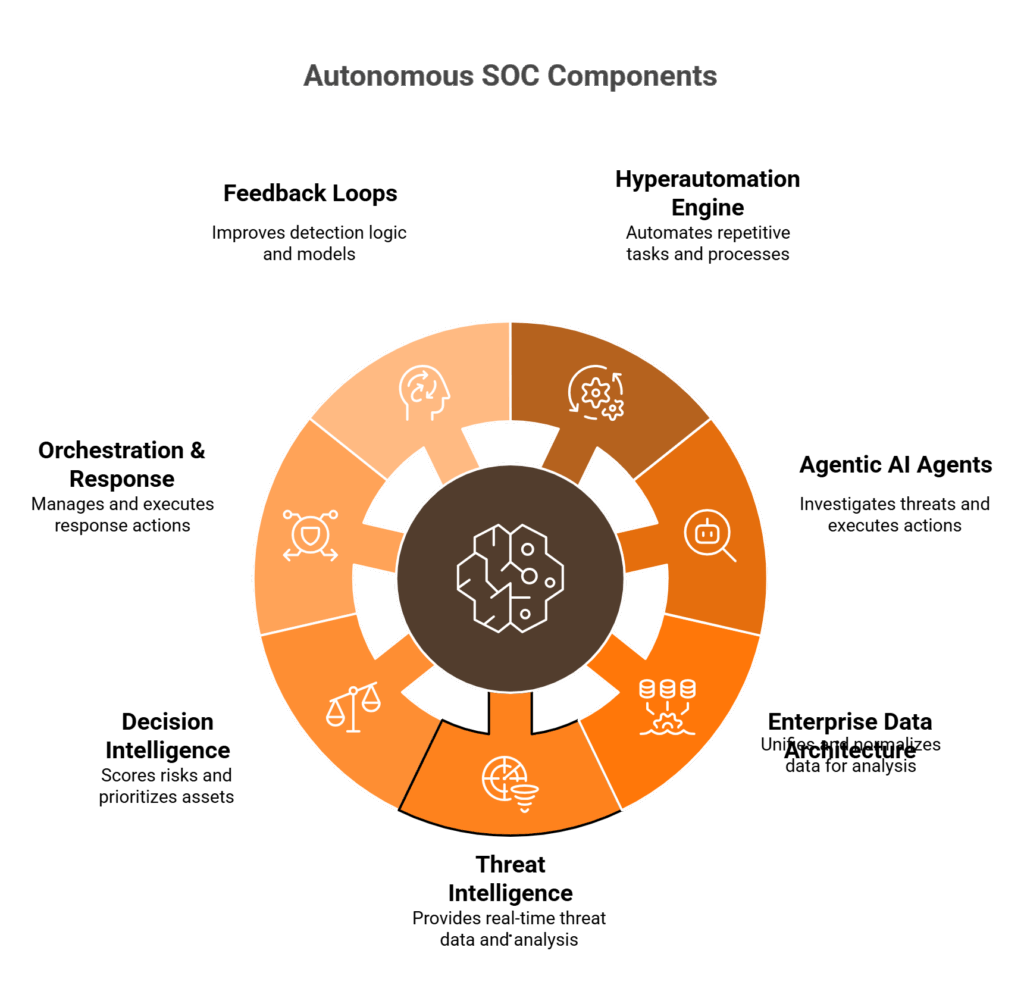
An autonomous SOC is not a single product. It is an integrated architecture of 7 interdependent components. Understanding each one helps security leaders evaluate which capabilities they already have, which they need to build or buy, and, critically, where vendor claims diverge from architectural reality. Skipping any of these does not give you a “lighter” autonomous SOC. It gives you an expensive dashboard with blind spots.
The 7-Component Framework
1. Hyperautomation Engine
Goes beyond traditional SOAR by combining robotic process automation, process mining, and decision automation into a single orchestration layer. This engine does not just run playbooks. It identifies which workflows need automation, measures their efficiency, and optimizes them continuously. Think of it as the nervous system connecting every other component.
2. Agentic AI and LLM-Powered Agents
Autonomous investigation agents that formulate hypotheses, determine what evidence to collect, query multiple systems, and reason across data sources. Architecturally, they operate using planner-executor and ReAct (Reason+Act) patterns. According to Omdia’s 2025 research, 39% of early adopters deploy agentic AI primarily for reduced costs and increased productivity.
3. Enterprise-Grade Data Architecture
A unified data lake ingesting telemetry from SIEM, EDR, NDR, XDR, cloud, identity, and SaaS platforms. Raw data is normalized into a common schema (OCSF or ECS), deduplicated, and enriched with organizational context.
4. Threat Intelligence and Continuous Learning
Real-time threat intelligence feeds, behavioral baselines unique to your organization, and MITRE ATT&CK mapping. Models retrain on resolved incidents, so every analyst correction makes the system smarter.
5. Decision Intelligence Layer
Probabilistic risk scoring that weighs asset criticality, behavioral deviation, kill-chain stage, and organizational context. This layer answers: “How confident are we this is real, and how bad is it if we are right?”, not just “did a rule fire?”
6. Orchestration and Response Fabric
Tiered response execution: auto-execute for high-confidence actions (IOC blocking, enrichment), recommend-and-confirm for medium-confidence (account suspension, endpoint isolation), and full human decision for sensitive actions. Rollback capability is non-negotiable, because automated response without an undo button is a self-inflicted outage waiting to happen.
7. Feedback Loops
Analyst corrections feed back into ML models, detection rules, and response playbooks via supervised learning. Detection Logic as Code enables version-controlled improvement cycles, meaning every false positive corrected today reduces noise tomorrow.
⚠️ Reference Architecture Data Flow
The pipeline follows a clear sequence: Telemetry Sources → Data Normalization → AI Triage & Enrichment → Agentic Investigation Agents → Decision Intelligence → Response Orchestration → Human Escalation Interface → Feedback Loop back to detection and AI layers. Each stage creates artifacts the next stage consumes. Break any link, and you get the fragmented detection-without-response experience that defines most traditional SOC setups.
How UnderDefense Simplifies This
UnderDefense MAXI implements all 7 components in a unified platform, on top of your existing stack. No SIEM replacement, no proprietary lock-in. It operates in your cloud environment (Azure, GCP, AWS, Oracle), keeps logs in your data lake, and is available via OpenAI and Perplexity for Enterprise AI customers. Every component is observable and auditable, because “trust me, it works” is not an architecture.
“Their experienced SOC engineers work closely with our team, providing continuous monitoring and threat detection. The seamless integration and optimization of the EDR platform, CrowdStrike, has been impressive. Despite the complexity involved, they delivered the deployment to 1,200 endpoints in just 23 business days.”
— Oleksii M., Mid-Market UnderDefense G2 – Verified Review
Q3: How Does an Autonomous SOC Work from Alert Ingestion to Automated Resolution?
Most SOC automation discussions focus on isolated capabilities: a triage tool here, a SOAR playbook there. In reality, an autonomous SOC operates as an end-to-end pipeline where each stage feeds the next. Partial automation fails because automating Stage 2 without fixing Stage 1 just creates faster garbage. Here is the 6-stage pipeline with quantified before-and-after metrics.
Stage 1: Data Ingestion and Normalization
Ingest telemetry from SIEM, EDR, NDR, cloud, identity, and SaaS platforms. Normalize into a common schema. Deduplicate via entity-based linking: same user, same endpoint, same session correlated across sources. This alone eliminates the “same alert, five consoles” problem.
⏰ Before: 11,000 raw alerts/day
✅ After: ~2,500 deduplicated incidents
Stage 2: AI-Driven Alert Triage and False Positive Elimination
ML-based anomaly detection, behavioral analysis, and severity scoring by asset criticality and MITRE ATT&CK stage. Auto-close 70–85% of confirmed false positives, investigated by AI and documented as benign with an auditable trail.
⏰ Before: 2,500 incidents requiring human eyes
✅ After: ~375 require analyst attention
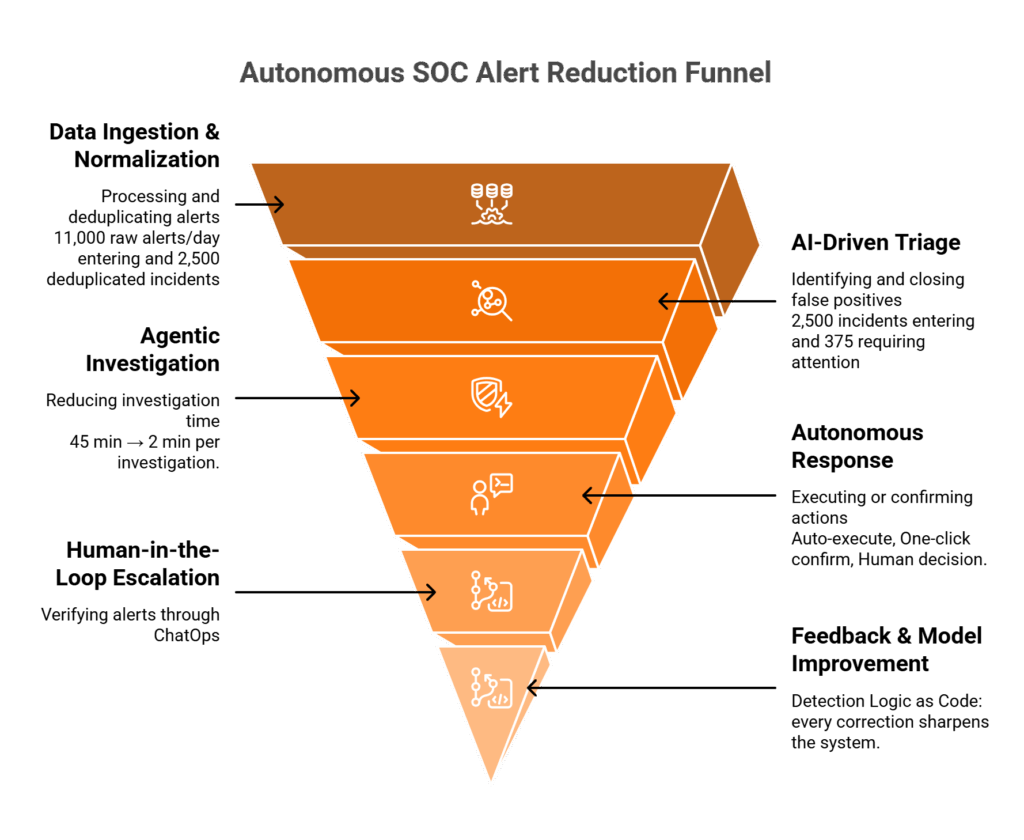
Stage 3: Agentic Investigation and Attack Chain Construction
AI agents query systems, collect forensic evidence, correlate across data sources, map to MITRE techniques, and produce structured reports. The agent formulates a hypothesis (“Is this a compromised service account?”), gathers evidence for and against, and delivers findings.
⏰ Before: 45-minute manual investigation per incident
✅ After: 2-minute AI-generated investigation report
Stage 4: Autonomous Response and Playbook Execution
Tiered by confidence level:
- Tier 1 (Auto-execute): IOC blocking, enrichment, known-bad containment
- Tier 2 (Recommend + one-click): Account suspension, endpoint isolation
- Tier 3 (Full human decision): Production system changes, VIP user actions
Automated where confidence is high, human where stakes are high.
Stage 5: Human-in-the-Loop Escalation
Ambiguous alerts route to analysts with complete investigation context already assembled. ChatOps closes the “context gap” by verifying directly with affected users. When the system flags suspicious activity, our analysts message the user directly via Slack or Teams. This single capability resolves alerts that competitors cannot close without bouncing tickets back to your team.
Stage 6: Continuous Feedback and Model Improvement
Analyst corrections, resolution outcomes, and user verification results feed back into ML models and detection rules. Detection Logic as Code enables version-controlled improvement, meaning every resolved incident sharpens the system. This is the stage most SOC automation vendors skip entirely, which is why their detection quality plateaus after month three.
How UnderDefense Executes This Pipeline
UnderDefense MAXI runs this entire 6-stage pipeline with a 2-minute alert-to-triage SLA and 15-minute escalation for critical incidents. ChatOps closes the context gap, with analysts pinging users directly via Slack, Teams, or email. Result: 99% noise reduction in month one, with only confirmed offences reaching your team. No black boxes. No “please investigate” tickets lobbed over the fence.
“The biggest win for me was getting actual control over our security alerts. Before the guys from UD stepped in, we were getting bombarded with alerts from all our security tools. Their team cleaned up our configurations and got the noise under control within the first week.”
— Verified User in Marketing and Advertising UnderDefense G2 – Verified Review
Q4: What Is Agentic Investigation and How Does It Differ from Traditional SOAR Playbooks?
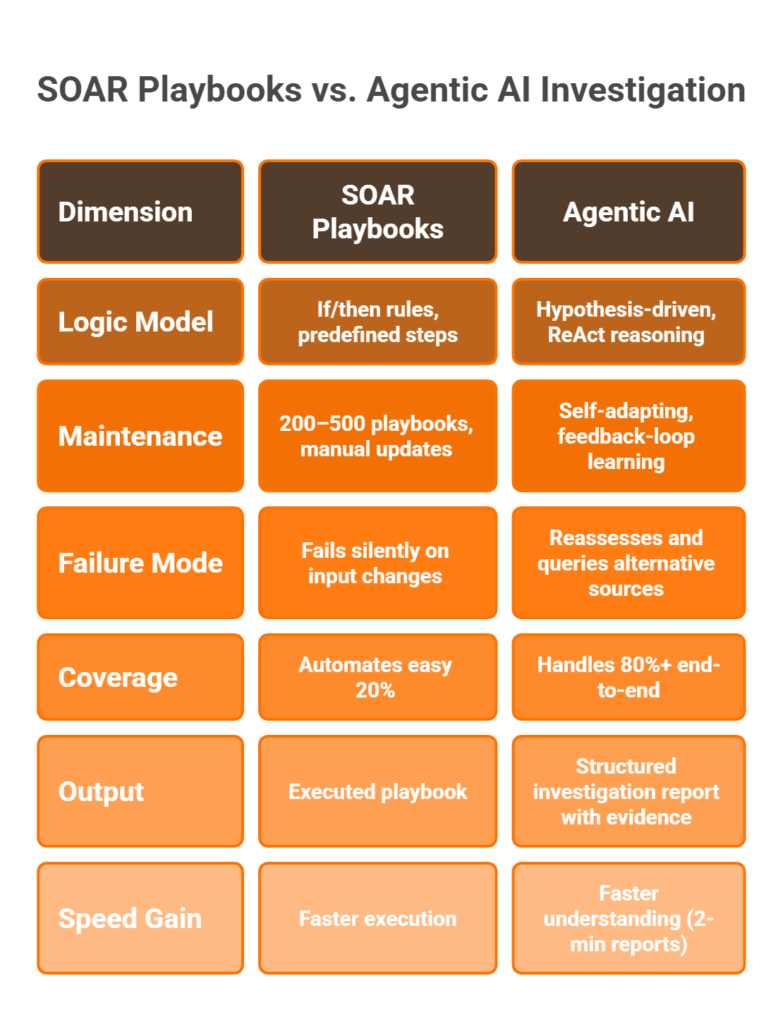
If you have worked in security operations for the past five years, you have lived through the SOAR era. Pre-programmed if/then workflows: “if phishing, extract IOCs, block sender.” A genuine step forward from fully manual processes. But here is what nobody said out loud: SOAR is rules-based automation masquerading as intelligence. It can execute playbooks. It cannot think.
❌ Why SOAR Breaks Down
Most enterprises maintain 200–500+ SOAR playbooks, each requiring ongoing maintenance as data formats change, APIs shift, and attack patterns evolve:
- Brittleness: Playbooks fail silently when input formats change. A vendor updates their log schema, and your “automated” investigation stops until someone notices.
- Maintenance burden: Each playbook needs manual updates. At 300+ playbooks, you need a dedicated team just to keep automation running.
- No reasoning: SOAR cannot form hypotheses or weigh conflicting evidence. When an alert does not match the expected pattern, it either fails or escalates everything.
- False sense of autonomy: Teams still investigate every exception manually. You have automated the easy 20% and created a queue for the hard 80%.
“This is not an extension of our security team as was originally sold. Still not quite there with the remediation side of things. We receive alerts, but not necessarily a clear path to resolution.”
— Sr. Cybersecurity Engineer, Manufacturing ($500M–$1B) Arctic Wolf – Gartner Peer Review
Arctic Wolf offers zero playbook customization for MDR clients. ReliaQuest’s “AI Agents” return tickets without actionable answers, meaning investigation still lands on your desk.
The Agentic Paradigm Shift
Agentic AI investigation works fundamentally differently. The agent receives an alert, formulates a hypothesis, determines what evidence to collect, queries systems autonomously, correlates findings, assigns a confidence score, and either acts or escalates with full context. The key distinction: the agent decides what to investigate and how, not following steps someone wrote six months ago.
Architecturally, these agents use planner-executor patterns (decompose a goal into sub-tasks, execute each, reassess) and ReAct frameworks (Reason + Act in alternating loops). Multi-agent orchestration allows specialized agents, covering identity investigation, endpoint forensics, and cloud activity, to collaborate on complex incidents.
✅ How UnderDefense MAXI Implements Agentic Investigation
- Automated context collection: Queries your SIEM, pulls relevant logs, enriches with threat intelligence.
- Multi-system correlation: Connects signals across endpoint, identity, cloud, network, and SaaS in a single investigation thread.
- Structured investigation reports: Findings delivered in seconds, with evidence mapped to MITRE ATT&CK techniques.
- ChatOps “breaking the fourth wall”: Analysts ask the user directly via Slack, Teams, email, or SMS.
- Detection Logic as Code: Python rules, Git-versioned, CI/CD deployed. Every change is peer-reviewed, unit-tested, and auditable.
Every step is observable. If you cannot see how the AI reached its conclusion, it is not augmentation. It is a liability.
The Proof Is in the Speed, and the Context
UnderDefense detected threats 2 days faster than CrowdStrike OverWatch, not because our AI is inherently “better,” but because agentic investigation combined with human context closes gaps pure technology misses. When an agent correlates a suspicious login with a user’s travel schedule confirmed via ChatOps, it resolves in minutes what SOAR would escalate as “anomalous, please investigate.”
SOAR gives you faster playbook execution. Agentic AI gives you faster understanding. That is the difference between automation and autonomy.
“It’s reassuring to know they’re always watching for threats, and it doesn’t cost a fortune. They catch and stop problems quickly, which is a huge relief. The platform works really well with our other security tools, which makes things much simpler.”
— Serhii B., Chief Information Security Officer UnderDefense G2 – Verified Review
Q5: What Does the Autonomous SOC Maturity Model Look Like?
Score your SOC against this 5-level model to identify where you stand, and where the gaps are costing you time, money, and coverage.
✅ The 5-Level Autonomous SOC Maturity Model
| Level | Name | Detection Speed | False Positive Rate | Tech Requirements | Staffing Model | You’re Here If… |
|---|---|---|---|---|---|---|
| 1 | Rules-Based | Hours–Days | 60%+ FP | Static SOAR, manual correlation, signature rules | Full manual team; high T1 headcount | Every alert requires a human to triage and escalate |
| 2 | ML-Enhanced Detection | Hours | 40–60% FP | ML anomaly detection, AI-scored alerts; humans still execute | Analysts execute AI-prioritized alerts | You have ML scoring but analysts still run every investigation |
| 3 | Automated Investigation & Response | Minutes | 20–40% FP | Agentic investigation for known patterns; auto-response on high-confidence alerts; human-in-the-loop for ambiguous cases | T1 work partially automated; T2 handles edge cases | Some alerts auto-close, but your team still handles the majority |
| 4 | Agentic AI-Driven | Minutes | 10–20% FP | AI handles 80%+ end-to-end; proactive hunting; Detection Logic as Code (CI/CD) | Lean team focused on T3 hunting and strategy | AI resolves most alerts autonomously; humans supervise and hunt |
| 5 | Adaptive Autonomous | Seconds | <5% FP | Self-optimizing models, cross-customer threat intel, continuous model evolution | Minimal staff; strategic oversight only | Your SOC learns from every incident and improves without manual tuning |
Most organizations today sit between Level 1 and Level 2. The jump from Level 2 to Level 4 is where operational transformation happens, and where most teams stall because they lack the integration depth, agentic workflows, and organizational context to get there.
📝 Self-Assessment Scorecard
Rate your SOC honestly. Check every box that applies:
- ☐ 24/7/365 monitoring with documented SLAs?
- ☐ Triage critical alerts within 5 minutes?
- ☐ Alerts from SIEM/EDR/cloud/identity correlated in a unified view?
- ☐ Agentic AI investigation (not just SOAR playbooks)?
- ☐ Verify suspicious activity via Slack/Teams directly with affected users?
- ☐ Automated response tiered by risk level?
- ☐ Security monitoring auto-generates compliance evidence?
- ☐ Can quantify SOC ROI for the board?
- ☐ Detection logic version-controlled via CI/CD?
- ☐ Platform integrates without vendor lock-in?
Score: 8–10 = Level 4–5 maturity. Score: 5–7 = Level 2–3, meaning critical gaps exist. Score: 0–4 = Level 1, where reactive processes dominate your posture.
How UnderDefense Closes the Gap
UnderDefense MAXI accelerates organizations from Level 1–2 to Level 4 within 30 days. Agentic AI handles investigation, the 2-minute alert-to-triage SLA drives speed, ChatOps verification adds the organizational context most tools lack, tiered automated response prevents over-blocking, and Detection Logic as Code prevents model drift, all across 250+ integrations without vendor lock-in.
Most teams go from 2–4 checked boxes to 9–10 out of 10 in month one.
“Their team provided us with clear and detailed insights into security vulnerabilities, along with practical recommendations on how to fix them. This level of transparency made it easy for our team to take action.”
— Arman N., CTO UnderDefense G2 – Verified Review
“Before the guys from UD stepped in, we were getting bombarded with alerts from all our security tools. Their team cleaned up our configurations and got the noise under control within the first week.”
— Verified User, Marketing & Advertising UnderDefense G2 – Verified Review
UnderDefense clients achieve 96% MITRE ATT&CK coverage and 99% noise reduction in month one, because Level 4 maturity should not require a 20-person SOC or a 12-month transformation.
Q6: How Does the Autonomous Decision Risk Matrix Govern Automated Response?
It is board meeting morning. Your SOAR auto-blocked the CFO’s account, flagged by a login from the new laptop IT shipped yesterday. The CFO cannot access financials. Your phone is ringing. The board deck is late.
⚠️ The Real Problem: Automation Without Context
This nightmare makes security leaders hesitate on every automation initiative. But the problem is not automation itself but automation without organizational context. Your SOAR saw a new device, matched a rule, and executed. It did not know IT shipped a laptop yesterday. It did not ask. Traditional MDR tools operate the same way: binary rules, zero business awareness.
The 3-Tier Autonomous Decision Risk Matrix
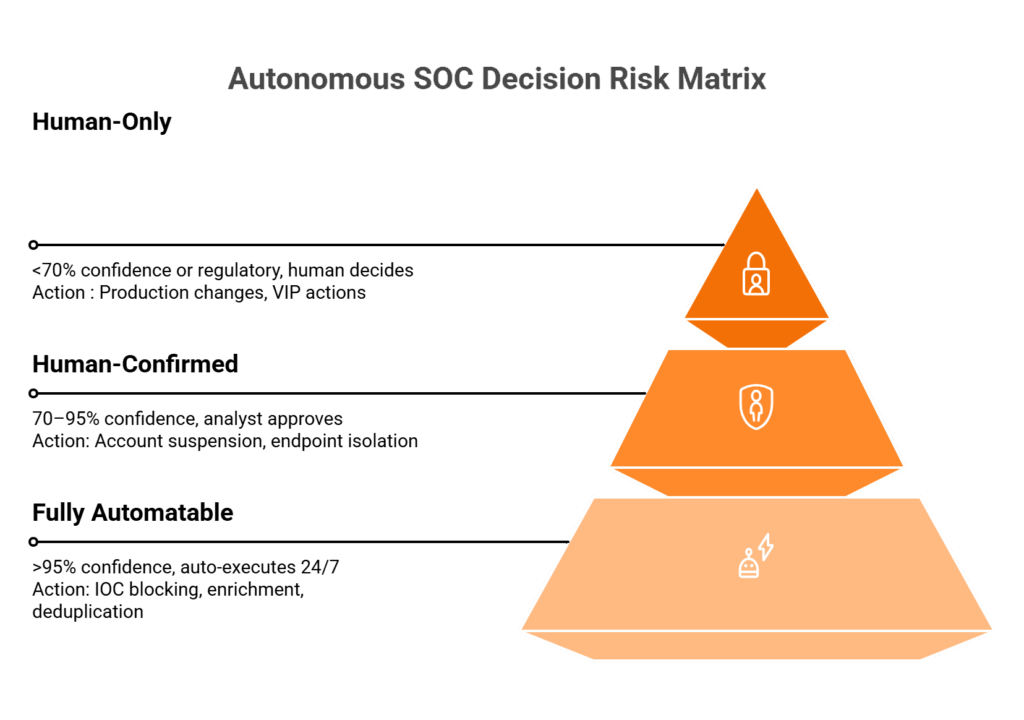
The solution is a structured risk taxonomy that governs what gets automated, what requires a human nudge, and what stays fully in human hands.
| Tier | Risk Level | Action Examples | Confidence Threshold | Guardrails |
|---|---|---|---|---|
| Tier 1: Fully Automatable | Low risk / High confidence | IOC blocking, alert enrichment, deduplication, known-bad IP blocking | >95% confidence | No approval needed; auto-executes 24/7 |
| Tier 2: Human-Confirmed | Medium risk | Account suspension, endpoint isolation, firewall rule changes | 70–95% confidence | AI recommends; analyst one-click approves within 15-min SLA |
| Tier 3: Human-Only | High risk / Regulatory | Production system changes, VIP account actions, business-critical asset modification | <70% or regulatory-impacting | AI provides full investigation context; human decides |
💸 The Hidden Cost of Getting This Wrong
❌ A false-positive automated block costs $25K–$100K in business disruption
❌ Manual-only response means threats dwell for hours or days
❌ The average breach costs $4.88M (IBM, 2024)
❌ One bad automated action sets back SOC automation trust by years
The tradeoff is not “automate everything” versus “automate nothing.” It is knowing exactly where the line sits for your organization.
How UnderDefense Governs Automated Response
UnderDefense MAXI learns your VIPs, critical assets, and user profiles, distinguishing technical users from non-technical ones. When a Tier 2 alert fires on the CFO’s new device, our ChatOps workflow confirms with the CFO directly via Slack or Teams: “New laptop login, was this you?” A “yes” closes the alert in seconds. A non-response triggers escalation within the 15-minute critical SLA.
Every automated action is auditable and reversible. Concierge analysts loop in managers for VIP alerts and provide special attention to high-value asset notifications. The system is fast enough to contain in minutes, contextual enough to never block the CFO.
⏰ The Contrast
Arctic Wolf offers no organizational context customization, with rules applying uniformly. ReliaQuest returns investigation tickets without taking action. UnderDefense delivers speed and context: 100% ransomware prevention across 500+ clients in six years, with zero business-disrupting false-positive automated actions.
“We received little value from ArcticWolf. The product offered little visibility when we were using it. Anything you want to look at or changes you need to make in the product must go through their engineering team.”
— Matt C., Manager, Cybersecurity Services Arctic Wolf – G2 Verified Review
Q7: What Are the Quantifiable Benefits, KPIs, and ROI of an Autonomous SOC?
Security leaders do not struggle to justify budget because the threat is theoretical. They struggle because the ROI language does not translate to the boardroom. Here is a framework that does.
📊 Quantified Operational Benefits
- 25–50% investigation time reduction: 60% of AI SOC adopters report at least 25% reduction; 21% exceed 50% (Gurucul, 2025)
- 70–90% manual triage reduction through automated alert enrichment and correlation
- 60–80% faster MTTD when agentic AI handles initial detection and classification
- 40–60% MTTR improvement with automated containment and human-confirmed response
- 99% noise reduction, verified across UnderDefense’s MDR client base
- Analyst elevation from T1 triage to T3 hunting and strategic work
- Proactive posture shift, from alert reaction to threat anticipation
- Analyst retention improvement, with reduced burnout extending average tenure beyond the industry’s 18-month norm
Three KPI Categories
| Category | Key Metrics |
|---|---|
| Operational | MTTD, MTTR, MTTI, false positive rate, alert-to-triage time, automation rate, MITRE ATT&CK coverage |
| Analyst Productivity | Alerts per analyst per shift, hunting vs. triage time ratio, satisfaction/retention scores, escalation accuracy |
| Business Impact | Cost per incident, breach probability reduction, insurance premium changes, audit pass rate, hiring avoidance, operational cost reduction |
💰 ROI Model
Formula:
ROI = ((Analyst Time Saved × Hourly Cost) + (Breach Probability Reduction × Avg Breach Cost) + Compliance Penalty Avoidance + Insurance Reduction − Platform Investment) / Platform Investment
| Variable | Range |
|---|---|
| Team size | 5–20 analysts |
| Avg. salary | $95K–$130K |
| Alert volume | 2K–10K+/day |
| Manual triage time | 15–45 min/alert |
| Automation rate | 70–90% |
| Avg. breach cost | $4.88M (IBM, 2024) |
| Breach probability reduction | 30–60% |
Three Scenarios:
- Conservative (5 analysts, 2K alerts/day, 70% automation) → ~250% ROI over 3 years
- Moderate (10 analysts, 5K alerts/day, 80% automation) → ~500% ROI over 3 years
- Aggressive (20 analysts, 10K+ alerts/day, 90% automation) → ~830% ROI over 3 years
🎯 Board Communication Templates
- Before/After slide: current vs. projected MTTD, MTTR, and false positive rate side by side
- Financial impact: 3-year TCO comparison with break-even timeline; use “reduced exposure,” not “better detection”
- Risk reduction: breach probability translated to expected annual loss reduction in dollars; use “protected revenue,” not “faster alerts”
Speak in business language. CFOs do not fund “detection improvements.” They fund “risk reduction that protects revenue.”
How UnderDefense Simplifies ROI Justification
UnderDefense documents 830% ROI over 3 years: zero ransomware across 500+ MDR clients in six years, 99% noise reduction, and a 2-minute triage SLA with transparent $11–15/endpoint/month pricing. Use the SOC Cost Calculator to model your specific scenario before committing.
“UnderDefense MAXI helps us secure sensitive data and mitigate potential cyber threats, which improves the overall security of our business operations.”
— Arman N., CTO UnderDefense G2 – Verified Review
Q8: What Are the Key Challenges and Risks of Autonomous SOC Adoption?
Autonomous SOC adoption fails more from organizational and data challenges than technology limitations. Security leaders who understand these risks upfront mitigate proactively instead of discovering them mid-deployment.
❌ Challenge 1: Trust and the Black Box Problem
Analysts will not rely on AI they cannot explain. If the system says “blocked” but cannot show why, your team will second-guess every automated action and build workarounds that defeat the purpose.
Mitigation: Require observable investigation steps. Every AI decision should produce an auditable trail showing what data was collected, what logic was applied, and what alternatives were considered.
❌ Challenge 2: Data Quality and Integration Silos
Garbage in, garbage out. Siloed telemetry from disconnected SIEM, EDR, cloud, and identity tools degrades AI accuracy and creates blind spots that attackers exploit.
Mitigation: Audit your telemetry coverage before deployment. Choose platforms supporting 250+ integrations that unify signals without forcing tool replacement.
❌ Challenge 3: Model Drift
Historical training data becomes stale as attacker TTPs evolve. Detection models tuned for last quarter’s threats miss next quarter’s techniques.
Mitigation: Implement feedback loops where analyst corrections retrain models continuously. Version-control detection logic via CI/CD pipelines (Detection Logic as Code) so drift is measurable and reversible.
❌ Challenge 4: Compliance and Regulatory Friction
Automated decisions may conflict with human oversight requirements under GDPR Article 22, NIS2, and sector-specific regulations that mandate human involvement in consequential actions.
Mitigation: Implement the tiered response matrix (see Q6), with fully automated handling for low-risk actions and human-in-the-loop for any decision with regulatory implications.
⚠️ Challenge 5: Failure Modes
Auto-blocking legitimate users, missing novel attacks outside training data, or cascading errors where one bad automation triggers a chain of disruptions.
Mitigation: Deploy rollback capabilities for every automated action. Set confidence thresholds per action type. Create VIP protection rules. Run parallel pilots where AI and humans both evaluate the same alerts before going live.
⚠️ Challenge 6: Change Management and Skills Gaps
Analysts fear replacement. Leadership lacks maturity understanding. Without proper framing, AI adoption meets internal resistance that stalls the entire initiative.
Mitigation: Frame AI as augmentation, not replacement. Upskill T1 analysts into T3 roles. Provide executive education on phased maturity progression so leadership understands this is a journey, not a switch.
How UnderDefense Addresses Each Challenge Architecturally
UnderDefense MAXI tackles every challenge by design: observable and auditable investigation steps eliminate the black box problem; 250+ integrations prevent data silos; Detection Logic as Code with CI/CD pipelines prevents model drift; tiered response with ChatOps verification satisfies regulatory human-oversight requirements; and 30-day turnkey onboarding with dedicated engineers manages the organizational transition from day one.
“It’s reassuring to know they’re always watching for threats, and it doesn’t cost a fortune. They catch and stop problems quickly, which is a huge relief. The platform works really well with our other security tools, which makes things much simpler.”
— Serhii B., Chief Information Security Officer UnderDefense G2 – Verified Review
“Overly relies on the client’s team for remediation, which really hurts the value of the service.”
— VP of Technology, Services ($50M) Arctic Wolf – Gartner Peer Review
Q9: How Should Security Leaders Evaluate Autonomous SOC Vendors?
Choosing an autonomous SOC platform commits you to an architecture for years. Wrong choice means proprietary lock-in, AI without organizational context, or detection without response. With $600M+ in VC flowing to AI SOC vendors in 2025 alone, marketing claims outpace operational reality, and the cost of a bad commitment compounds quarterly.
The Wrong Way to Decide
Most security leaders default to brand recognition (“CrowdStrike is the biggest”), integration count alone (“They support our SIEM”), or AI buzzwords (“agentic,” “autonomous,” “self-healing”). These criteria miss the critical question: Can it RESPOND with organizational context, or just detect and escalate? Can you audit every AI decision, or is the platform a black box that regurgitates vendor alerts?
“Analysts provide little context, and when asked for more information in the investigation nothing is ever provided.”
— CISO, Manufacturing ($3B–$10B) Arctic Wolf – Gartner Peer Review
7 Weighted Evaluation Criteria
Score each vendor 0–2 per criterion. Providers scoring 10+ represent a genuine operational partnership. Below 7, you are buying an alert feed.
- Vendor-Agnostic Integration (15%): Does it work with your existing SIEM, EDR, cloud, and identity stack, or force proprietary tool replacement?
- Agentic Investigation Depth (15%): Does the AI reason across multi-source telemetry and produce structured investigation reports, or just run rigid playbooks?
- Human Analyst Access (15%): Do you get direct communication with Tier 3–4 analysts, or just ticket-based escalations that return “without clear answers”?
- ChatOps User Verification (15%): Can the provider communicate directly with affected users via Slack/Teams to validate alerts, or does it escalate back to your team?
- Pricing Transparency (10%): Is cost published and predictable per-endpoint, or hidden behind “contact sales”?
- Compliance Integration (15%): Does security monitoring generate audit evidence automatically, or require separate compliance tools at additional cost?
- Deployment Speed (15%): Does it require a 6-month engagement and stack migration, or 30-day turnkey implementation?
Vendor Comparison Matrix
| Criterion | UnderDefense | Arctic Wolf | ReliaQuest | CrowdStrike |
|---|---|---|---|---|
| Vendor-Agnostic Integration | 2: 250+ integrations, works with existing stack | 0: Proprietary SIEM required, forces tool replacement | 1: GreyMatter platform, but positions as SIEM replacement | 1: Best within Falcon ecosystem, limited cross-vendor |
| Agentic Investigation Depth | 2: Multi-system correlation, structured reports in seconds | 1: Alerts lack context; remediation guidance minimal | 1: AI automation strong, but “responses lacked actionable insights during incident triage” | 2: Strong endpoint AI, autonomous response playbooks |
| Human Analyst Access | 2: Direct Tier 3–4 concierge model, 24/7 | 1: Concierge teams but “support incidents not worked to completion” | 1: “All tickets are coming back to customers without clear answers” | 1: Expert-led but ticket-driven escalation |
| ChatOps User Verification | 2: Only provider contacting users directly via Slack/Teams/Email | 0: Escalates to customer team | 0: “Scared to talk directly to the users” | 0: No direct user verification workflow |
| Pricing Transparency | 2: Published $11–15/endpoint/month | 1: Opaque; $96K median annual contract | 1: Premium pricing, separate add-ons for compliance | 1: ~$60/user/year, feature-gated tiers |
| Compliance Integration | 2: Forever-free compliance kits (SOC 2, ISO 27001, HIPAA) included | 1: Requires separate compliance product | 1: Charges premium add-ons | 1: Limited compliance bundling |
| Deployment Speed | 2: 30-day turnkey with custom detection tuning | 1: Requires stack migration | 1: “Not as out-of-the-box ready as competitors” | 1: Fast for Falcon-native; cross-domain slower |
| Total | 14/14 | 5/14 | 6/14 | 7/14 |
Who Should Choose What
- Arctic Wolf: If you are starting from scratch with no existing security investments and prefer a single-vendor ecosystem.
- CrowdStrike Falcon Complete: If your environment is 100% Falcon-native and you want endpoint-first MDR with automated response.
- ReliaQuest: If you are a Fortune 500 with a massive internal SOC team that needs an AI orchestration layer on top of existing infrastructure.
- UnderDefense: If you are protecting an existing multi-vendor stack, need transparent predictable pricing, and want analysts who verify suspicious activity directly with users rather than escalating tickets back to your team.
UnderDefense maintains a 100% ransomware prevention record across 500+ MDR clients over 6 years, with 113% net dollar retention, because detection without human-driven response is just expensive alerting.
“An Expensive Blackbox and Horrible Partner. We received little value. The product offered little visibility… the sales and account management team is very pushy.”
— Matt C., Manager, Cybersecurity Services Arctic Wolf – G2 Verified Review
Q10: How Do You Map Autonomous SOC Capabilities to Compliance Frameworks?
Most organizations treat security operations and compliance as separate workstreams: one team monitors threats while another scrambles to collect audit evidence. An autonomous SOC collapses this gap by generating compliance evidence as a byproduct of normal operations. Monitoring logs, audit trails, response documentation, and detection reports map directly to regulatory controls across SOC 2, ISO 27001, HIPAA, PCI DSS 4.0, NIS2, and DORA.
Compliance Mapping Table
| SOC Capability | SOC 2 | ISO 27001 | HIPAA | PCI DSS 4.0 | NIS2 | DORA |
|---|---|---|---|---|---|---|
| 24/7 Monitoring & Alerting | CC6.1, CC7.2 | A.8.15, A.8.16 | §164.308(a)(1)(ii)(D) | Req 10.2, 10.4.1 | Art. 21(2)(b) | Art. 17 |
| Automated Triage & Enrichment | CC7.2, CC7.3 | A.5.25 | §164.308(a)(6)(ii) | Req 10.4.1.1 | Art. 21(2)(b) | Art. 17 |
| Incident Response with SLAs | CC7.3, CC7.4, CC8.1 | A.5.26, A.5.28 | §164.308(a)(6) | Req 12.10.1 | Art. 21(2)(d) | Art. 17 |
| MITRE ATT&CK Detection Coverage | CC6.6, CC7.2 | A.8.15, A.8.16 | §164.312(b) | Req 11.5.1 | Art. 21(2)(b) | Art. 19 |
| Investigation Audit Trails | CC7.2, CC7.3 | A.8.15 | §164.312(b) | Req 10.2.1 | Art. 21(2)(d) | Art. 19 |
| Access & Identity Monitoring | CC6.1, CC6.2 | A.5.15, A.8.2 | §164.312(d) | Req 7.2, 8.3 | Art. 21(2)(b) | Art. 17 |
| Vulnerability Integration | CC7.1 | A.8.8 | §164.308(a)(1)(ii)(A) | Req 11.3.1 | Art. 21(2)(d) | Art. 19 |
| Auto Evidence Collection | CC4.1, CC4.2 | A.5.35, A.5.36 | §164.308(a)(8) | Req 12.10.2 | Art. 21(2)(d) | Art. 19 |
SOC 2’s Trust Services Criteria and ISO 27001’s Annex A controls share approximately 80% alignment, meaning organizations pursuing both certifications can leverage unified security telemetry to satisfy requirements in parallel.
The Competitive Gap
Most autonomous SOC platforms treat compliance as an afterthought. Arctic Wolf requires a separate compliance product, so security monitoring and audit evidence live in disconnected systems. ReliaQuest charges premium add-ons for compliance features, creating audit scrambles when organizations need to extract evidence from operational systems. This means security teams who have invested in detection and response must still run a parallel compliance operation, doubling effort and cost.
“Overly relies on the client’s team for remediation, which really hurts the value of the service.”
— VP of Technology, Services ($50M) Arctic Wolf – Gartner Peer Review
How UnderDefense Simplifies
UnderDefense MAXI Compliance is built on the same platform as UnderDefense MAXI AI SOC, not a standalone checklist tool. Real-time mapping of security telemetry to controls gives auditors verifiable evidence without manual extraction. ISO 27001, SOC 2, GDPR, HIPAA, and PCI-DSS compliance kits are included as forever-free resources, with zero additional cost, bundled directly with MDR service. This means the same 24/7 monitoring that stops threats simultaneously generates the documentation your auditor needs.
“UnderDefense also helped us navigate key compliance requirements, ensuring we met industry standards smoothly and efficiently. What stood out the most was their responsiveness and flexibility.”
— Arman N., CTO UnderDefense G2 – Verified Review
Q11: What Does a Phased Autonomous SOC Implementation Roadmap Look Like?
Autonomous SOC deployment fails with “big bang” transformation. The pattern of failure: buy platform → deploy everything → AI errors day one → analysts lose trust → revert to manual processes. As one former CISO noted, “I just can’t automate everything. I can’t get to a fully lights-out automated security stack because we always run into situations that need human analysis.” The successful approach is phased, with clear phase-gate criteria at each stage.
Phase 1: Assess and Baseline (Weeks 1–2)
Audit current alert volume, false positive rate, MTTD/MTTR, and complete tool inventory. Identify the top 5 alert categories consuming analyst time. Document your existing detection rules, correlation logic, and response playbooks. This baseline is your benchmark for measuring AI improvement.
Phase-gate: Baseline metrics documented and CISO-approved.
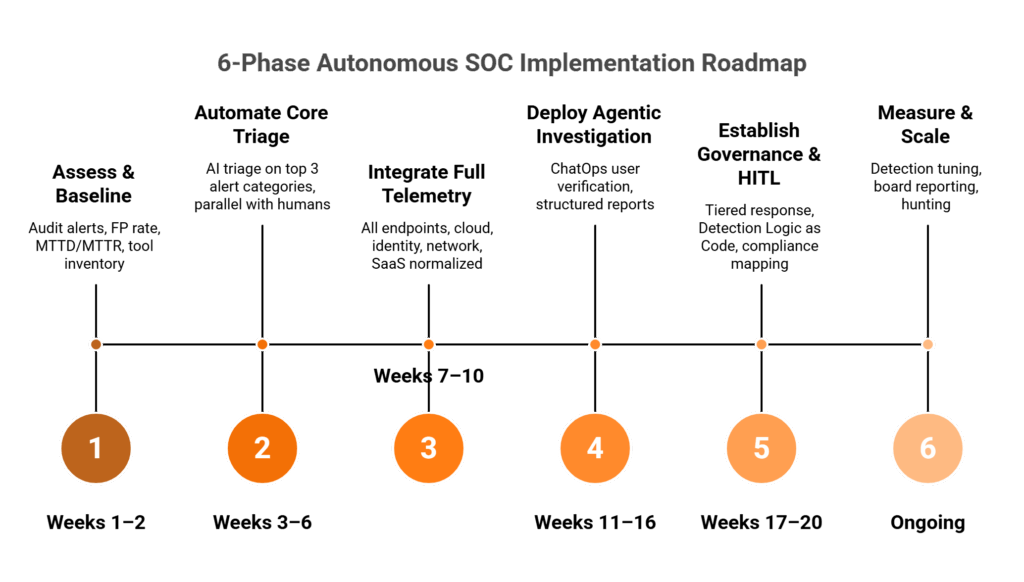
Phase 2: Automate Core Triage (Weeks 3–6)
Deploy AI-driven triage on the top 3 alert categories only. Run in parallel with human analysts, ensuring every AI verdict gets a human comparison. This builds trust through transparency, not faith. Track agreement rates between AI triage and human decisions daily.
Phase-gate: >70% AI/human agreement rate on triage verdicts.
Phase 3: Integrate Full Telemetry (Weeks 7–10)
Expand ingestion to all security tools across endpoints, cloud, identity, network, and SaaS. Normalize schema across sources and connect threat intelligence feeds. This phase is where vendor-agnostic integration matters. Platforms that require proprietary SIEM replacement force you to restart detection tuning from scratch.
Phase-gate: Full telemetry coverage confirmed; no critical blind spots.
Phase 4: Deploy Agentic Investigation (Weeks 11–16)
Expand AI to agentic investigation across all alert categories. Enable ChatOps user verification, where analysts reach out to affected users directly via Slack or Teams to confirm suspicious activity. Deploy structured investigation reports that deliver findings to analysts in seconds, not hours.
Phase-gate: >90% investigation accuracy; positive analyst trust scores.
Phase 5: Establish Governance and HITL (Weeks 17–20)
Implement tiered response policies: automated containment for high-confidence threats, human-in-the-loop for ambiguous or VIP-impacting scenarios. Define Detection Logic as Code pipeline for version-controlled, auditable detection rules. Map governance framework to compliance requirements (SOC 2, HIPAA, etc.).
Phase-gate: Risk matrix CISO-approved; tiered response policies operational.
Phase 6: Measure and Scale (Ongoing)
Continuous detection tuning, model retraining based on emerging threats, and proactive threat hunting. Establish quarterly board reporting with metrics: confirmed detection rate, MTTD/MTTR trends, false positive reduction, and compliance evidence coverage. Build a feedback loop where reactive findings inform proactive hunting priorities.
Common Pitfalls
- Automating response before validating triage: AI containing the wrong asset erodes trust faster than manual processes.
- Ignoring change management: Analysts who were not involved in parallel testing will resist AI verdicts, regardless of accuracy.
- Choosing a vendor-locked platform requiring SIEM replacement: All your custom correlation rules and business logic vanish when you switch, forcing you to restart from zero.
- Measuring only volume reduction vs. confirmed detection rate: A system that suppresses 99% of alerts means nothing if the 1% includes real threats it missed.
How UnderDefense Simplifies
UnderDefense’s 30-day turnkey onboarding compresses Phases 1–3. Dedicated engineers audit your existing tool stack during kickoff, build customized detection rules, and run real attack simulations with Caldera and Ransomware Monkey to validate 100% coverage of critical use cases. No 6-month professional services engagement. No stack migration. Organizations move from reactive operations to Level 4 maturity in 30 days, with 99% noise reduction from day one.
“The speed of onboarding was a delightful surprise. In times where integrating new systems can take weeks, UnderDefense had us up and running in no time. Their 24/7 detection and response service is fast and comprehensive.”
— Valeriia D., Marketing Specialist UnderDefense G2 – Verified Review
Q12: Which SOC Tools and Platforms Power Autonomous Security Operations?
Building an autonomous SOC requires tools across 5 core categories: (1) AI-powered SOC platforms with agentic investigation, with UnderDefense MAXI leading the category with 250+ integrations and sub-2-minute alert-to-triage; (2) SIEM/XDR for telemetry aggregation; (3) EDR/NDR for endpoint and network visibility; (4) SOAR/orchestration for response execution; and (5) threat intelligence platforms for enrichment. The differentiator in 2026 is not having tools but having them connected through an AI orchestration layer that reasons across all sources.
What Separates Autonomy-Enabling Tools from Noise Generators
- Vendor-agnostic integration: Works with your existing stack vs. forcing proprietary replacement
- Agentic AI capability: Reasons across multi-source telemetry vs. runs rigid playbooks
- Unified data architecture: Single context-aware layer vs. disconnected dashboards per tool
- Response orchestration: Takes containment action (isolate host, revoke credentials, block lateral movement) vs. only detects and alerts
- Compliance evidence generation: Produces audit artifacts as a byproduct of operations vs. requires separate tooling
The orchestration layer determines whether your stack operates as an autonomous system or a collection of disconnected dashboards that each demand their own analyst attention.
Full SOC Tools Evaluation
We have published a comprehensive evaluation of the best SOC tools across all categories, covering architecture comparisons, integration capabilities, pricing, and deployment considerations for building autonomous security operations.
This analysis is based on documented case studies, G2 reviews, MITRE ATT&CK evaluations, and operational outcomes across 500+ MDR deployments, including organizations running CrowdStrike, Splunk, SentinelOne, Microsoft Defender, and 250+ other tools.
“Their experienced SOC engineers work closely with our team, providing continuous monitoring and threat detection. The seamless integration and optimization of the EDR platform, CrowdStrike, has been impressive.”
— Oleksii M., Mid-Market UnderDefense G2 – Verified Review
1. What is an autonomous SOC and how does it differ from an AI-powered SOC?
An autonomous SOC is a next-generation security operations model where agentic AI systems handle alert triage, investigation, and initial response within defined parameters, augmented by human analysts who provide contextual judgment and strategic decision-making. The critical distinction is operational independence: autonomous SOC agents formulate hypotheses, collect evidence across multiple systems, and make investigation decisions on their own, while AI-powered SOCs simply layer ML scoring on top of manual workflows.
We built UnderDefense MAXI around this distinction. Agentic AI handles investigation grunt work, producing structured reports in seconds, while our Tier 3–4 analysts provide the contextual judgment that pure automation cannot replicate. The result is 99% noise reduction and a 2-minute alert-to-triage SLA, not just better dashboards over the same bottleneck. Traditional SOCs remain fully human-operated, AI-powered SOCs add scoring but keep humans running every investigation, and autonomous SOCs let AI reason and act independently within guardrails.
2. How does alert triage automation reduce false positives in an autonomous SOC?
Alert triage automation in an autonomous SOC works through a multi-stage pipeline. First, raw telemetry from SIEM, EDR, NDR, cloud, identity, and SaaS platforms is normalized into a common schema and deduplicated via entity-based linking, reducing 11,000 daily alerts to approximately 2,500 deduplicated incidents. Then ML-based anomaly detection, behavioral analysis, and severity scoring auto-close 70–85% of confirmed false positives, each documented with an auditable trail.
This means only about 375 incidents require analyst attention from an original volume of 11,000 alerts. At UnderDefense, our SOC automation approach layers behavioral baselines unique to each organization on top of MITRE ATT&CK stage mapping and asset criticality scoring. Every false positive corrected by an analyst feeds back into the detection model through continuous learning loops, so the system improves over time rather than plateauing after month three.
3. What are the core components needed to build an autonomous SOC?
An autonomous SOC requires 7 interdependent components working together as an integrated architecture:
-
Hyperautomation Engine: Combines RPA, process mining, and decision automation beyond traditional SOAR.
-
Agentic AI Agents: Autonomous investigation using planner-executor and ReAct patterns to reason across data sources.
-
Enterprise Data Architecture: Unified data lake normalizing telemetry into common schemas (OCSF or ECS).
-
Threat Intelligence and Continuous Learning: Real-time feeds with MITRE ATT&CK mapping and model retraining on resolved incidents.
-
Decision Intelligence Layer: Probabilistic risk scoring weighing asset criticality, behavioral deviation, and kill-chain stage.
-
Orchestration and Response Fabric: Tiered response with rollback capability.
-
Feedback Loops: Analyst corrections retraining ML models via Detection Logic as Code.
Skipping any component does not give you a lighter autonomous SOC. It gives you blind spots. UnderDefense MAXI implements all 7 in a unified platform on top of your existing security stack without requiring SIEM replacement.
4. How does agentic AI investigation differ from traditional SOAR playbooks?
SOAR playbooks are pre-programmed if/then workflows that execute predefined steps. They cannot reason, weigh conflicting evidence, or adapt when inputs change. Most enterprises maintain 200–500+ playbooks, each requiring manual maintenance as APIs shift and attack patterns evolve. SOAR automates the easy 20% and creates a queue for the hard 80%.
Agentic AI investigation works fundamentally differently. The agent receives an alert, formulates a hypothesis, determines what evidence to collect, queries systems autonomously, correlates findings, and assigns a confidence score before acting or escalating with full context. Architecturally, these agents use planner-executor patterns and ReAct frameworks (Reason + Act in alternating loops).
We built UnderDefense MAXI with agentic investigation that produces structured reports in seconds, with evidence mapped to MITRE ATT&CK techniques. Our team detected threats 2 days faster than CrowdStrike OverWatch because agentic investigation combined with human context closes gaps that rigid playbooks cannot.
5. What does the autonomous SOC maturity model look like, and where do most organizations fall?
The autonomous SOC maturity model spans 5 levels:
-
Level 1 (Rules-Based): Hours-to-days detection speed, 60%+ false positive rate, fully manual triage.
-
Level 2 (ML-Enhanced): ML scoring added, but analysts still execute every investigation.
-
Level 3 (Automated Investigation): Agentic investigation for known patterns with human-in-the-loop for ambiguous cases.
-
Level 4 (Agentic AI-Driven): AI handles 80%+ end-to-end with proactive hunting and Detection Logic as Code.
-
Level 5 (Adaptive Autonomous): Self-optimizing models with sub-5% false positive rates.
Most organizations today sit between Level 1 and Level 2. The jump from Level 2 to Level 4 is where operational transformation happens. We accelerate organizations from Level 1–2 to Level 4 within 30 days through our MDR service, achieving 96% MITRE ATT&CK coverage and 99% noise reduction in month one.
6. How do you calculate the ROI of an autonomous SOC for a board presentation?
The ROI formula accounts for five variables: (Analyst Time Saved × Hourly Cost) + (Breach Probability Reduction × Average Breach Cost) + Compliance Penalty Avoidance + Insurance Reduction, minus Platform Investment, all divided by Platform Investment.
Three documented scenarios illustrate the range:
-
Conservative (5 analysts, 2K alerts/day, 70% automation): ~250% ROI over 3 years.
-
Moderate (10 analysts, 5K alerts/day, 80% automation): ~500% ROI over 3 years.
-
Aggressive (20 analysts, 10K+ alerts/day, 90% automation): ~830% ROI over 3 years.
For board presentations, we recommend framing in business language: “reduced exposure” instead of “better detection,” and “protected revenue” instead of “faster alerts.” Use the SOC Cost Calculator to model your specific scenario with transparent $11–15/endpoint/month pricing before committing.
7. How does an autonomous SOC map security operations to compliance frameworks like SOC 2, HIPAA, and ISO 27001?
An autonomous SOC generates compliance evidence as a byproduct of normal security operations. Monitoring logs, audit trails, incident response documentation, and detection reports map directly to regulatory controls across SOC 2, ISO 27001, HIPAA, PCI DSS 4.0, NIS2, and DORA.
For example, 24/7 monitoring satisfies SOC 2 CC6.1/CC7.2, ISO 27001 A.8.15/A.8.16, and HIPAA §164.308(a)(1)(ii)(D) simultaneously. Investigation audit trails cover SOC 2 CC7.2/CC7.3, ISO 27001 A.8.15, and PCI DSS Req 10.2.1. SOC 2’s Trust Services Criteria and ISO 27001’s Annex A controls share approximately 80% alignment, so organizations pursuing both certifications can leverage unified telemetry.
UnderDefense MAXI includes forever-free compliance kits for SOC 2, ISO 27001, GDPR, HIPAA, and PCI-DSS bundled with MDR service, unlike competitors that charge premium add-ons or require separate compliance products.
8. What are the biggest risks of autonomous SOC adoption, and how do you mitigate them?
Autonomous SOC adoption fails more from organizational and data challenges than technology limitations. The six key risks are:
-
Trust/Black Box Problem: Analysts will not rely on AI they cannot explain. Require observable, auditable investigation steps for every AI decision.
-
Data Quality and Integration Silos: Disconnected SIEM, EDR, and cloud telemetry degrades AI accuracy. Choose platforms supporting 250+ integrations.
-
Model Drift: Detection models become stale as attacker TTPs evolve. Implement feedback loops and version-controlled Detection Logic as Code.
-
Compliance Friction: Automated decisions may conflict with GDPR Article 22 or NIS2 human-oversight mandates. Use tiered response matrices with human-in-the-loop for regulated actions.
-
Failure Modes: Auto-blocking legitimate users or cascading errors. Deploy rollback capabilities and VIP protection rules.
-
Change Management: Analysts fear replacement. Frame AI as augmentation and upskill T1 analysts into T3 roles.
Our 30-day turnkey onboarding with dedicated engineers addresses each challenge architecturally from day one.