






A critical supplier has just disclosed a breach, and the board wants to know which vendors hold access to production data and who is watching them. The honest answer is a spreadsheet of questionnaires last updated 11 months ago, and the examiner or auditor who asks the same question will write that gap up as a finding.
Here is how nine tools handle that job, and what none of them can see.
TL;DR
- The two product types: workflow platforms that run assessments and ratings platforms that score suppliers from outside, with many vendors selling both.
- Seven criteria to check in a demo, from tiering to regulatory exports and integrations.
- How nine tools assess, monitor, and price, with four of them publishing price figures.
- What a rating can’t see: what a supplier’s account does inside your environment.
Table of contents
- What Vendor Risk Management Software Does, Stage by Stage
- Where UnderDefense Fits Next to a Vendor Risk Management Tool
- What Regulators Now Expect From a Third-Party Risk Program
- Seven Criteria for Choosing Vendor Risk Management Software
- Vendor Risk Management Software Compared Side by Side
- The 9 Best Vendor Risk Management Software Solutions for 2027
- What Each Source of Vendor Evidence Proves
- Frequently Asked Questions
The same question comes up when a customer or auditor asks how you checked your suppliers. A SOC 2 report or ISO 27001 certificate on file shows what the supplier’s auditor saw last year, and nothing about what changed since. Either way, it comes down to one question: which vendors matter, and what changed since you last looked?
Vendor risk management software earns its price when it answers that question and catches change between annual assessments. This guide compares nine products on those two jobs and marks where each one stops.
Vendor facts come from each company’s own site or AWS Marketplace listing, read in November 2026. The order is this article’s own assessment for a regulated company with several hundred vendors.
Disclosure: UnderDefense publishes this guide and doesn’t sell a vendor risk management tool, so it isn’t ranked here.
See what a supplier’s account does inside your network
What Vendor Risk Management Software Does, Stage by Stage
Vendor risk management software keeps one record of every supplier and carries it from inventory to offboarding. The NIST Cybersecurity Framework (CSF) 2.0 from the National Institute of Standards and Technology, published in February 2024, describes the same lifecycle as outcomes in its Cybersecurity Supply Chain Risk Management category, GV.SC.
| Lifecycle stage | CSF 2.0 outcome | What the software does |
|---|---|---|
| Inventory | GV.SC-04 | Pulls suppliers into one record |
| Tiering | GV.SC-04 | Ranks suppliers by criticality and access |
| Due diligence | GV.SC-06 | Sends questionnaires, reviews documents |
| Contract | GV.SC-05 | Stores security terms and expiry dates |
| Monitoring | GV.SC-07 | Flags change between assessments |
| Offboarding | GV.SC-10 | Tracks access removal and data return |
🎯 Tiering decides how useful the rest will be. Say a third of your vendors touch systems or data: those earn a deep review, and the rest can run lighter. The method behind the scale is a separate job, and vendor risk scoring frameworks cover how to build one.
Two kinds of product do this work:
- Workflow platforms run intake, tiering, questionnaires, document review, remediation tracking, and approvals; their evidence is only as fresh as the supplier’s last answer.
- Security-ratings platforms score what a supplier exposes to the internet, refresh often, need nothing from the supplier, and can’t see inside its network.
Most vendors in this list now sell some of both. The useful question is which half leads the product you’d actually buy. If your evidence has to satisfy an examiner or auditor, start from a workflow platform; if your first need is to spot change across hundreds of suppliers without waiting for their answers, start from a ratings platform.
Where UnderDefense Fits Next to a Vendor Risk Management Tool
The UnderDefense Agentic AI SOC watches what a supplier’s account does inside your environment, the part a vendor risk management (VRM) score can’t show. It works on top of the SIEM and endpoint tools you already run, such as Splunk, Microsoft Sentinel, or CrowdStrike: AI agents investigate every alert, and analysts decide on escalation and containment.
When a supplier’s account, an OAuth app connected to your accounts, a remote-access tool, or a software update starts behaving like an attacker, your team gets an investigated alert around the clock.
If an investigation confirms a compromise, UnderDefense’s incident response team of 40 professionals takes over, and a 40-hour incident response retainer comes with the Standard tier.
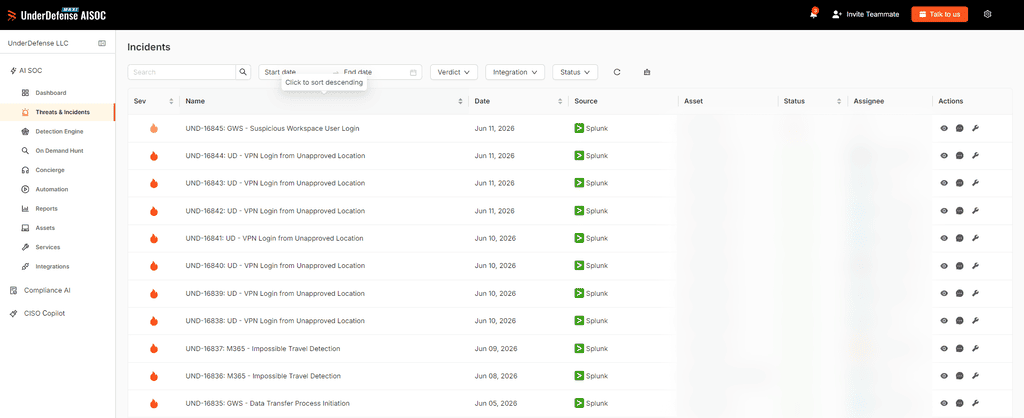
UnderDefense’s AI agents investigate every alert, with about 2 minutes from alert to triage, so the alert your security information and event management (SIEM) tool raises on a suspicious supplier login is looked at within minutes, at any hour.
Its 250+ integrations include Okta, CrowdStrike, Splunk, and Microsoft Sentinel, the identity and endpoint tools where supplier activity shows up. It runs as SaaS on Azure with tenant isolation, as a hybrid, or fully on-premises and air-gapped, so you choose where supplier logs are processed. Published pricing starts at $11 per device per month.
Catching a misused supplier account depends on detections tuned to the estate they watch. After a ransomware attack at a top-10 poultry producer with 35,000 employees, exporting to over 70 countries, the case study reports that “100+ personalized detection rules replaced over 900 ineffective and noisy rules.”
The team moved from 100 false positives to 30 critical alerts per day. A short critical queue is what lets an analyst notice a supplier login that doesn’t fit.
UnderDefense is rated 5.0 out of 5 from 83 reviews on G2 as of November 2026. One reviewer describes the verdict flow:
“When something fires, the Agentic SOC classifies it, pulls the relevant logs, maps to MITRE ATT&CK, and routes a structured verdict with reasoning before it reaches a human.” Maksym G., Chief Technology Officer, 51-1000 employees, G2, August 2026, from “What do you like best?”
If third-party risk and security operations sit in different teams, the list of vendors with production access is the document to hand to whoever owns detection.
Watch supplier access in your environment around the clock
What Regulators Now Expect From a Third-Party Risk Program
Regulators now expect you to name your information and communication technology (ICT) suppliers in a structured record, show which ones support critical functions, and keep that record current. The Digital Operational Resilience Act (DORA, Regulation (EU) 2022/2554), in application since January 17, 2025, states this most concretely.
Article 28(3) requires financial entities to “maintain and update” a register of information covering all contractual arrangements for ICT services. They also report on those arrangements at least yearly, so the register becomes a standing deliverable.
National authorities had to send the first submission to the European Supervisory Authorities (ESAs) by April 30, 2025. For later years, the ESAs’ reporting FAQ of February 2025 sets the reference date at December 31 of the preceding year, with the authorities’ own deadline at March 31.
Each authority fixes an earlier date for its entities. In practice, your register has to be accurate as of year-end and ready by the earlier date your national authority sets, so check its notice.
Registers also feed oversight of the suppliers themselves. On November 18, 2025, the ESAs published their first list of designated critical ICT third-party providers, after collecting data from those registers.
The list names 19 providers, among them Amazon Web Services, Google Cloud, Microsoft, Oracle, and SAP. Most of your vendors won’t appear on it, so designation can’t stand in for your own tiering.
The Joint ESAs’ 2025 Report on major ICT-related incidents, published June 3, 2026, found that “29% of all major incidents are caused by a failure attributable to a TPP,” a third-party provider. Close to a third of serious disruptions started outside the entity, so your tiers decide whether you see them coming.
The report counts ICT providers, other financial entities, and infrastructure providers as third parties. It also calls dependencies an area of supervisory attention “even those non designated as critical.”
If DORA doesn’t apply to you, NIST CSF 2.0 gives the program a shared vocabulary across GV.SC-01 to GV.SC-10. GV.SC-07 is the outcome an annual questionnaire cycle struggles with most: supplier risks “understood, recorded, prioritized, assessed, responded to, and monitored over the course of the relationship.”
Seven Criteria for Choosing Vendor Risk Management Software
These seven criteria separate vendor risk management tools that change how your program runs from those that digitize the spreadsheet. Ask each vendor to show them on your own supplier data, using one critical vendor and one low-risk vendor.
1. Tiering by Criticality and Access
A useful tier reflects what a vendor can reach: production data, customer records, or privileged access. That tier should then set the depth and frequency of review automatically, since your team will be working several hundred of these records.
2. Questionnaire Library and Custom Forms
The Standardized Information Gathering (SIG) questionnaire and the Consensus Assessments Initiative Questionnaire (CAIQ) should be ready to send, and your own questions should load without a services project. Suppliers rarely want to answer a second copy, so a tool that accepts a completed SIG saves both sides a round.
When a supplier already publishes a shared Trust Center, your reviewers can start from its current documents and send questions only for the gaps. That gives you evidence dated more recently than last year’s questionnaire.
3. Document and Evidence Review
Most of these products now read SOC 2 reports with AI, so the difference lies in traceability. Each finding should point to a page and an approver. Your reviewers still need to know what to ask for, and a third-party due diligence checklist gives them that baseline.
4. Continuous Monitoring Signal Quality
“Continuous” can mean a daily internet scan, a breach news feed, or a nightly score refresh. Those are three different signals, and each one needs a stated refresh rate and a rule for which change opens a task for your team. Match the signal to the tier: vendors with production access need one that opens a task the day it fires, and the rest can sit in a periodic digest.
5. Fourth-Party Visibility
Tools find your suppliers’ suppliers through vendor disclosure, public subprocessor lists, or passive detection, and each method carries a different level of certainty. The result helps most when it separates confirmed relationships from inferred ones and shows several vendors sharing one dependency.
6. Regulatory Registers and Reporting
If DORA applies, a live Register of Information export belongs in the demo, with its output format checked against the ESAs’ templates. Outside the EU, the test is how the tool maps assessments to the rules your examiners cite.
7. Integrations With GRC, ITSM, and Procurement
Your vendor record probably starts in procurement and ends in ServiceNow or Archer, the governance, risk, and compliance (GRC) and IT service management (ITSM) tools most teams run, so the direction and frequency of each sync matter as much as the connector’s name. If the score has to reach an enterprise risk register, IT risk management tools usually hold that view.
Vendor Risk Management Software Compared Side by Side
The table compares each vendor risk management platform as its own pages described it in November 2026. “Both” means the vendor sells workflow and its own security ratings.
| Vendor | Best for | Approach | Questionnaire library | Continuous monitoring | Regulatory reporting | Published pricing |
|---|---|---|---|---|---|---|
| ProcessUnity | Workflow plus a register export | Workflow, with a blended Risk Index | SIG Lite, SIG Core, custom imports | Risk Index refreshes nightly | One-click DORA register export | Yes, entry figure |
| Mitratech Prevalent | Questionnaire-led programs wanting managed help | Workflow, with threat monitoring feeds | SIG, CAIQ, custom survey wizard | Round-the-clock feeds, daily high-risk summaries | DORA mapping; confirm register export | Quote-based |
| Bitsight | Security-led programs wanting daily ratings | Both | SIG, CAIQ, NIST CSF, ISO 27001, custom | Ratings update daily | DORA questionnaire; confirm register export | Quote, priced by number of vendors |
| SecurityScorecard | Ratings plus threat-led vendor response | Both | SIG Lite, CAIQ Lite, custom | Continuous scans, scores updated within days | DORA page; confirm register export | Yes, on AWS Marketplace |
| UpGuard Vendor Risk | Lean teams wanting a public starting price | Both | SIG 2026, DORA, custom builder | Scans at least daily | DORA questionnaire; confirm register export | Yes, entry plan only |
| Panorays | DORA teams wanting register and assessments together | Both | SIG, CAIQ, DORA templates, custom | Continuous rating on the Monitoring plan only | Submission-ready register ZIP, add-on | Quote-based |
| Whistic Assess | AI review of vendor documents first | Workflow, ratings through partners | SIG, CAIQ, DORA, custom | Breach event updates, add-on | DORA questionnaire; files nothing itself | Yes, on AWS Marketplace |
| Aravo | Enterprises running many risk domains | Workflow, ratings through partners | Standard-specific and custom questionnaires | Partner feeds, real-time alerts | DORA application; confirm register export | Quote-based |
| Black Kite | Outside-in monitoring with Nth-party mapping | Security ratings, with document review | Maps SIG, CAIQ, and other frameworks | Ratings updated continuously, per Black Kite | DORA mapping; confirm register export | Quote-based |
🔍 Read the Approach column first, because it tells you what the score is made of. ProcessUnity, Mitratech Prevalent, Whistic, and Aravo start from what suppliers tell you and show you, then add outside signals. Bitsight, SecurityScorecard, UpGuard, Panorays, and Black Kite pair their own external rating with some form of assessment.
On the pages read for this article, ProcessUnity and Panorays describe a register export or file. For the other seven, make a live export part of the demo if DORA applies.
UpGuard and ProcessUnity publish one entry figure each. SecurityScorecard’s AWS figures stop at 75 domains, short of a program your size, while Whistic’s AWS tiers reach 500 assessments, enough for a program that reviews several hundred vendors a year. Whichever you choose, a tool without a register export leaves your team rebuilding the register by hand every year.
The 9 Best Vendor Risk Management Software Solutions for 2027
The nine below are ProcessUnity, Mitratech Prevalent, Bitsight, SecurityScorecard, UpGuard, Panorays, Whistic, Aravo, and Black Kite. Each entry uses the same template, and buyers often shortlist across the workflow and ratings groups.
1. ProcessUnity: Best for Regulated Programs That Want Workflow and a DORA Register Export in One Platform
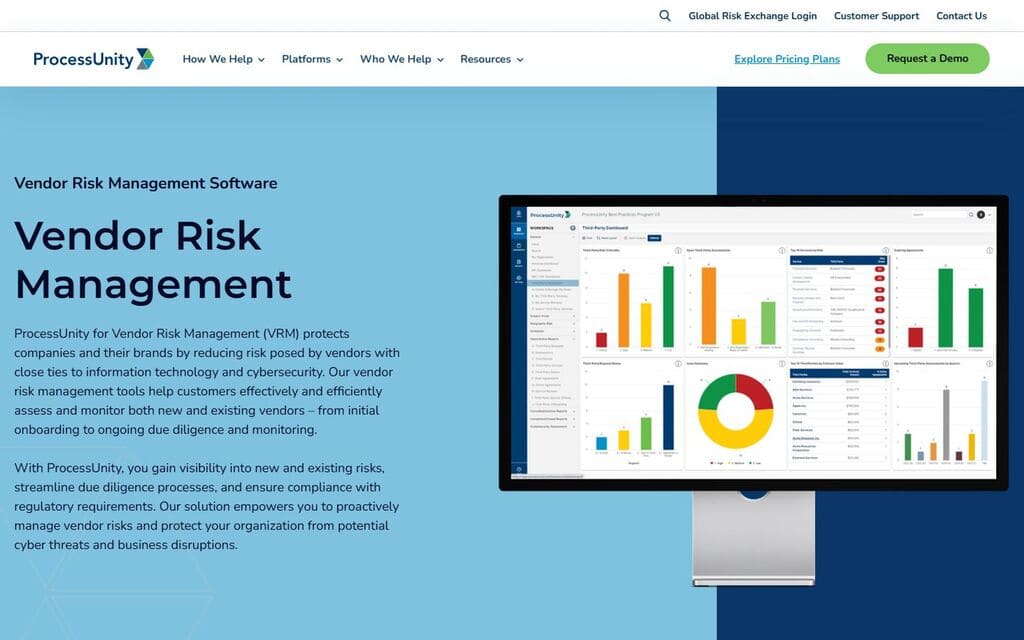
Overview: ProcessUnity for Vendor Risk Management is a workflow platform built for third-party risk. Its Emerging Enterprise page is pitched at companies of 1,000 to 10,000 employees, which fits a regulated company your size. ProcessUnity acquired CyberGRX in July 2023, and that exchange now runs as the Global Risk Exchange.
Key features:
- Global Risk Exchange, where a vendor completes one standard assessment and shares it with many customers
- Evidence Evaluator, an AI review of SOC reports, ISO 27001 certificates, and completed SIGs that shows where it found support
- Threat & Vulnerability Response, which narrows the vendors likely affected by a new threat and sends them targeted assessments
- Assessment Autofill, which drafts a vendor’s answers from its documents for the vendor to review
How it assesses and monitors vendors: ProcessUnity combines questionnaires, shared assessments, and a blended index. Inherent risk comes from a questionnaire, from Auto Inherent Risk (how other customers rated the same vendor), or from both, and the tier sets due diligence scope and frequency.
The Best Practice Program schedules ongoing reviews annually, biennially, or triennially by risk. The Risk Index is 80% control data and 20% externally observed data, so most of a vendor’s score rests on the control evidence it shares. It refreshes nightly, so a change shows up the next morning.
Integrations and setup: ServiceNow, RSA Archer, Jira, Coupa, SAP Ariba, and Ivalua all appear on its integrations page, along with ratings feeds from Bitsight, Black Kite, and SecurityScorecard. ProcessUnity’s team scopes, configures, and tests each connector, and the company says most go live in weeks. Smaller teams can start from a Best Practices Configuration.
Pricing: The Emerging Enterprise page says plans start at $25,000, without a unit or term, which tells you the entry point before a call. The pricing page sits behind a form, and large enterprises request a quote (read November 2026).
Pros:
- ProcessUnity’s DORA page documents a one-click Register of Information export, and its register data covers fourth-party dependencies
- The library names SIG Lite and SIG Core and accepts imported custom methodologies
Cons:
- Risk Index control data can be predictive until the vendor attests, so one number may rest on an estimate of that supplier
- Assessment speed still depends on suppliers, because Autofill drafts the answers and the vendor reviews and submits them
- The DORA page doesn’t state the export’s file format
Who should skip it: Buyers who want a self-serve purchase from a full public price list. Teams that only need an outside-in rating feed, too, since this product centers on a workflow and data program.
2. Mitratech Prevalent: Best for Questionnaire-Led Programs That Want Managed Help Available
Overview: Mitratech Prevalent is a questionnaire-led third-party risk management (TPRM) product. Mitratech acquired Prevalent in October 2024, and prevalent.net now redirects to Mitratech’s site.
Mitratech sells it as a standalone TPRM product and as part of its enterprise risk platform, which matters if you already use Mitratech’s GRC products.
Key features:
- AI FastTrack Assessment, which takes a vendor’s earlier assessments and populates a new questionnaire, so the vendor starts from answers it already gave
- Vendor Threat Monitor, drawing on adverse media, news, and enforcement and sanctions lists
- Technology Tags, which identify the vendors exposed to a specific supply chain incident
- Contract Essentials, a native contract module with AI-assisted risk analysis and DocuSign integration
- Third-Party Risk Managed Services, where Mitratech’s experts run the lifecycle for you
How it assesses and monitors vendors: Mitratech leads with questionnaires and correlates them with external monitoring. Tiers come from inherent and residual risk scores, and criteria include business criticality, regulatory location, and contact with protected data.
Assessments run on a schedule with automated chasers. Monitoring is described as continuous and round the clock, with daily summaries of high-risk events, and Mitratech frames it as filling the gap between point-in-time assessments.
Integrations and setup: Mitratech’s integrations page describes ServiceNow and Bitsight connectors, and Mitratech also names SAP Ariba and Coupa. You can load suppliers by spreadsheet template or API from a procurement tool, according to its DORA page.
Pricing: Quote-based. Mitratech says plans are flexible by business size and publishes no price (read November 2026). The $349 AWS Marketplace listing buys vendor-side access to a shared self-assessment, so it isn’t a figure to budget against.
Pros:
- The framework list names SIG and CAIQ and maps regulations including DORA and NIS 2, so the rules your examiners cite are likely mapped
- Fourth-party relationships can come from a questionnaire or a passive scan of a supplier’s public-facing infrastructure, ending in a relationship map
- A managed option helps when your team can’t staff every assessment
Cons:
- Mitratech’s product pages don’t document a Register of Information export, so ask to see one live
- Mitratech recommends implementation services for large-scale deployments
Who should skip it: EU financial entities that need a regulator-format register export today, unless Mitratech demonstrates one. Buyers who need a public price before they talk to sales should also look elsewhere.
3. Bitsight: Best for Security-Led Programs That Want Daily Ratings Tied to Questionnaires
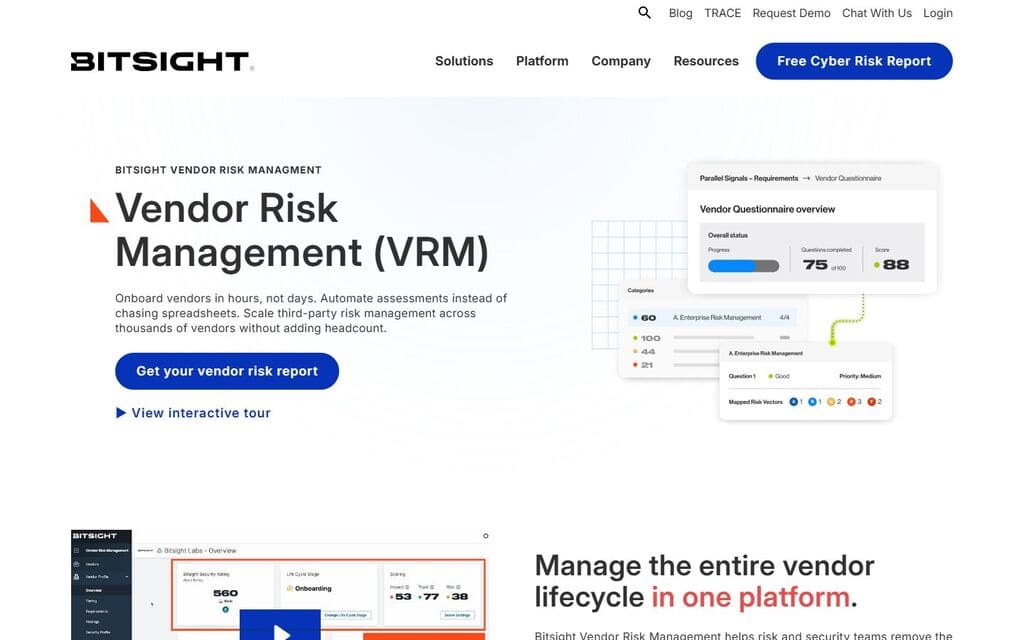
Overview: Bitsight Vendor Risk Management handles documents and questionnaires, and it grew from the ThirdPartyTrust acquisition announced in September 2022. Continuous Monitoring supplies the security rating, and the two connect natively, so the combined package is the one to price.
Key features:
- SOC2 Instant Insights, an AI summary of SOC 2 reports
- Framework Intelligence, which maps vendor documents to controls and returns Compliant, Not Compliant, or Needs Review
- Impact, Trust, and Risk Scores for inherent, trust-based, and residual risk
- Vendor Network, with pre-populated vendor profiles and questionnaires, so many of your suppliers may arrive with answers already on file
- Fourth-party discovery, which shows where several vendors share a dependency
How it assesses and monitors vendors: Bitsight pairs documents and questionnaires with an outside-in rating when the two are bought together. The Impact Score weighs criticality of service, ease of replacement, regulatory requirements, and the type and volume of information, and tiers trigger documentation requests.
The rating uses externally observed configuration and security event data. Ratings update daily, and VRM sends automatic reassessment reminders.
Integrations and setup: Bitsight’s partner list runs from ServiceNow and Archer to Okta, Coupa, SAP Ariba, Slack, and Microsoft Teams. The Archer integration syncs vendors into VRM and sends scores back.
The ServiceNow integration syncs tiers. Bitsight says vendors can be onboarded in hours and that its team can launch programs in weeks.
Pricing: Request pricing. The pricing page shows Continuous Monitoring and a combined package, banded by vendor count, and a program of several hundred vendors sits in the 101 to 500 band or above (read November 2026). Bitsight says price varies with vendor coverage, workflow needs, integrations, and services.
Pros:
- A daily signal that needs no vendor participation, useful for suppliers slow to answer
- Questionnaires named on the VRM page include SIG, NIST CSF, ISO 27001, and CAIQ, and custom forms import by CSV
- Fourth parties are discovered without self-reported data or questionnaires
Cons:
- By default, a monitored vendor’s Trust Score rests entirely on its Bitsight Rating until documents are linked to requirements
- Risk vector data inside questionnaires needs a Total Risk Monitoring subscription, according to the custom questionnaire article
- Fourth-party visibility sits under Continuous Monitoring on the pricing page, so a documents-only purchase needs checking
Who should skip it: Teams looking for assurance on a supplier’s internal controls from the rating alone, because the rating is externally observed. Bitsight’s own monitoring page says periodic questionnaires remain vital for onboarding and lower-risk vendors.
See how supplier access shows up in your alerts
4. SecurityScorecard TITAN AI: Best for Teams That Want Ratings and Threat-Led Vendor Response Together
Overview: SecurityScorecard is a ratings company that now packages its product as TITAN AI. The pricing page splits it into Watch for outside-in visibility, Assess for questionnaires, Secure for threat workflows, and OS for the set. You’ll likely compare Assess, Secure, and OS.
Key features:
- Security ratings shown as letter grades across categories such as DNS health, IP reputation, and patching cadence
- AI review that checks questionnaire answers against your policy and the vendor’s evidence
- Discrepancy analysis, which compares a vendor’s answers with what SecurityScorecard’s scans observed
- Breach response, which maps an event to affected vendors and sends each a templated request
- Fix verification, which rescans when a vendor claims a fix and reopens the finding if it persists
How it assesses and monitors vendors: Intake answers set an inherent risk tier from data types, vendor access type, and business impact, and that tier picks the questionnaire. The outside-in rating rests on IPs and domains attributed to the company.
Its cadence article says most issue types are scanned continuously and that main scorecards “typically update within 48 hours.” Scan frequency varies by issue type, so ask how quickly a supplier’s confirmed fix clears from its score.
Integrations and setup: The product descriptions name Archer, Jira, SAP Ariba, ServiceNow for Vendor Risk Management, and Splunk, along with Coupa, Microsoft Sentinel, and CrowdStrike. The homepage offers a 14-day free trial, so you can test the workflow on a few top-tier vendors before a sales call.
Pricing: The pricing page shows plan names without prices, and usage drives the quote. The AWS Marketplace listing shows SSC Business at $13,500 for 5 domains and SSC Enterprise at $155,375 for 75 domains, for 12 months (read November 2026).
Those older plan names don’t match TITAN packaging, and the figures show the price scale more than your price. A program your size still needs a quote.
Pros:
- Discrepancy analysis gives you a reason to challenge a questionnaire answer
- The default inherent risk scoring can be configured per organization
Cons:
- Capabilities split across packages: pre-built questionnaires sit in Assess and OS, and the plan table lists fourth-party detection on Secure and OS
- A fully monitored company consumes one slot per scorecard
- Detected fourth parties are “likely business relationships,” and the detection sources refresh weekly and monthly
Who should skip it: Teams that need a published price for several hundred vendors, because the AWS figures stop at 75 domains. EU financial entities should also ask to see a Register of Information output before shortlisting, since the DORA page focuses on supplier classification and board reports.
5. UpGuard Vendor Risk: Best for Lean Security Teams That Want a Published Starting Price
Overview: The UpGuard homepage now leads with a wider risk platform, and the product for this job is Vendor Risk. It pairs daily scanning with questionnaires and AI evidence review.
Key features:
- A security rating for an organization’s internet-facing web properties
- Security Profile, where AI reads uploaded evidence, marks each check, and cites the text it relied on
- A gap questionnaire that only asks for what’s missing
- Onboarding Portal, a dedicated intake flow for vendor assessments
How it assesses and monitors vendors: UpGuard combines daily scans, questionnaires, and AI evidence review. Tiers set assessment depth and pick the control template, and you can rename them or add more.
Until a vendor submits a questionnaire, the overall rating is all automated scanning of externally observable data, then it splits evenly with the questionnaire. UpGuard scans monitored vendors at least once per day, and most changes appear within 24 hours of the rescan.
Integrations and setup: UpGuard connects natively to Jira Cloud and Slack, offers a ServiceNow Vendor Risk app, and reaches other tools through Zapier and webhooks. Single sign-on (SSO) works with Microsoft Azure, Okta, and Ping Identity. Risk Automations, a separate product, syncs with tools such as Splunk, CrowdStrike, and Okta.
Pricing: Standard is $1,750 a month, billed annually, for 50 vendors, with extra vendors at $79 a month. That’s enough to price a pilot on your top-tier vendors (read November 2026).
Professional covers 150 vendors and Corporate covers 500, while Enterprise and Enterprise+ are unlimited. A program of several hundred vendors lands on Corporate or above, and those tiers need a sales conversation.
Pros:
- A public price lets you size a pilot before a sales call
- The questionnaire library lists SIG 2026, DORA, and NIS 2, and a builder is included on every plan
Cons:
- Fourth Parties starts at Corporate, so a program of several hundred vendors will likely land on a tier with no public price
- Compliance reporting against ISO 27001 or NIST CSF needs a completed questionnaire, because automated scanning alone doesn’t supply that information
- Some data, such as specific vulnerabilities, may take a few days to update
Who should skip it: Programs of several hundred vendors that need fourth-party mapping at a public price, since Fourth Parties starts at Corporate. If DORA applies, ask to see a register output: an UpGuard blog says the platform helps maintain a register of information.
6. Panorays: Best for Financial Services Teams Under DORA That Want the Register Beside Their Assessments
Overview: Panorays combines an external rating, questionnaires, and business context in one platform. Its pricing page sells three evaluation types (Inventory, Assessment, and Monitoring) that you can mix by supplier. That suits a portfolio where some vendors need depth and the rest need a lighter touch.
Key features:
- Cyber Posture Rating, a score of a company’s external digital perimeter
- Smart questionnaires that validate responses against posture data and uploaded documents
- DORA Register of Information tooling with validation and a submission-ready ZIP
- Nth-party discovery, with the evidence behind each detection
- Risk Insights and Response Portal, which maps a threat to direct and indirect suppliers and bulk-sends incident questionnaires
How it assesses and monitors vendors: Panorays blends an external rating, questionnaires, and document validation. Inventory tiers each third party on business impact and its rating.
Panorays suggests continuous monitoring for high-risk suppliers, periodic assessment for medium-risk ones, and a watchlist for the rest. The rating comes from externally available data, and Panorays says it updates continuously as the external footprint changes. You set the questionnaire schedule yourself.
Integrations and setup: For GRC and procurement, Panorays integrates with Archer, ServiceNow, Coupa, and SAP, and its list also covers Jira, Splunk, and QRadar. A professional services team can configure the questionnaire process and bulk-load suppliers. Panorays says it can deploy in days.
Pricing: Quote-based, with mix-and-match bundles. A free account covers up to 5 pre-built questionnaires and the cyber posture of 5 third parties, enough to test the workflow on a handful of suppliers (read November 2026).
Pros:
- The register tooling consolidates data errors across suppliers and, per the release notes, reports on contracted providers and indirect suppliers
- Built-in SIG and CAIQ, plus DORA-dedicated templates, so DORA questions don’t start from a blank page
- Question weights and “deal-breakers” are configurable, so scoring can follow your own policy
Cons:
- DORA Support, which includes the register export, is an add-on to Assessment and Monitoring
- Cyber Alerts, Rating History, and 4th-Party Auto Discovery are available on the Monitoring type alone
- The pricing table marks SIG Support as “Partially available” without saying what’s excluded
Who should skip it: Buyers who want a published price or a self-serve start beyond the free account. Teams outside DORA scope that only need a ratings feed would pay for tooling they won’t use.
7. Whistic Assess: Best for Teams That Want AI to Read Vendor Documents Before Anyone Sends a Questionnaire
Overview: Whistic Assess is the vendor assessment product inside a platform that also includes Vendor Monitoring, Compliance, and Trust Center. Whistic starts review from the documents a vendor already has and uses questionnaires only for the gaps.
Key features:
- Evidence review that shows the source, confidence, and explanation behind every answer
- Automation Orchestrator, with agents working inside Assess while people retain decisions, approvals, and overrides
- Trust Center Exchange, with published vendor profiles that give buyers a head start
- SOC 2 Summarization, covering exceptions, management response, complementary user entity controls, and subservices
How it assesses and monitors vendors: Documents come first, with questionnaires as the fallback. Each vendor record can carry an inherent risk, a residual risk, and a criticality level, and tiers carry a renewal frequency.
Vendor Monitoring processes breach-related updates every 30 minutes, so activity it picks up reaches your queue without waiting for the next assessment. Whistic describes it as event-based, with no posture score. RiskRecon scores, which update daily, and BitSight ratings arrive through integrations.
Integrations and setup: With the ServiceNow integration, ServiceNow stays your system of record and syncs to Whistic daily. The Archer integration works in a similar way. The integrations overview adds Slack, Jira, DocuSign, and a REST API, and SSO covers Okta and Azure AD.
Pricing: Whistic’s pricing page asks you to request pricing. The AWS Marketplace listing shows Core AI at $15,500 per 12 months and Assess AI tiers from $31,750 (75 assessments) to $76,000 (500 assessments).
A program that assesses a few hundred vendors a year can price its tier from that listing. Vendor Monitoring costs $5,500 for platforms under $30,000 a year and starts at $8,250 above that, plus $3,000 for each 25 extra monitored vendors, so an Assess AI buyer budgets the higher tier and its vendor count (read November 2026).
Pros:
- Reviewers can inspect the source behind each finding before they accept it
- AWS lists prices by assessment volume, so you can size a budget from your tier counts
- The questionnaire list names SIG Core, SIG Lite, CAIQ, DORA, and HECVAT (the higher-education questionnaire), though SIG access can depend on your contract
Cons:
- Vendor Monitoring is an add-on licensed per vendor
- Whistic says it “does not replace the official templates, validate the completed register, or submit regulatory filings” for DORA
- ServiceNow and Archer availability and pricing go through your Customer Success Manager
Who should skip it: Teams whose main need is a portfolio-wide outside-in score, since ratings come through RiskRecon or BitSight. The same goes for teams looking for a tool that produces and files the DORA register.
8. Aravo: Best for Large Regulated Enterprises Running Cyber Alongside Other Third-Party Risk Domains
Overview: Aravo’s Intelligence First Platform covers risk and compliance domains well beyond cyber, so cyber can sit beside financial, anti-bribery, and ESG risk on one system. Aravo targets very large enterprises, so a company of 1,000 to 10,000 employees sits at the smaller end of its market.
Key features:
- Aravo AI workflow agents, including Survey Agents that prefill assessments with cited sources and confidence levels
- Customer Defined Assessments, each with its own risk domain, scoring models, and workflows
- A multi-dimensional scoring engine with risk views by domain, entity, engagement, and enterprise
- Drag-and-drop workflow configuration
How it assesses and monitors vendors: Intake captures criticality and inherent risk, including access to customer data. Business rules set the level of due diligence.
Cyber ratings reach Aravo through partner feeds such as BitSight and SecurityScorecard, and a score drop below your threshold can open remediation. Aravo says partner feeds support real-time review, and ongoing due diligence runs by level, type of risk, and changes in risk profile.
Integrations and setup: The Integration Framework connects to enterprise resource planning (ERP), procure-to-pay, GRC, enterprise risk management (ERM), and in-house systems, with REST and SOAP APIs. Aravo connects to many risk intelligence providers, so you can likely keep the ratings feed you already buy. Aravo says deployment time depends on scope, integrations, data, and the complexity of the first use case.
Pricing: Quote-based. Aravo says plans depend on third-party volume, users, risk domains, and services (read November 2026).
Pros:
- One configurable system when your remit runs well past cyber
- A DORA application with a single third-party registry and data model
- Fourth-party exposure analysis using external risk intelligence subscriptions
Cons:
- Aravo itself says smaller teams with a limited vendor list may find it more than they need
- Aravo also advises looking past the subscription, because implementation effort, ongoing configuration, and external data can affect total cost
- Its services page warns that configuration missteps can lead to an expensive reimplementation
Who should skip it: Companies with smaller vendor portfolios, limited risk and compliance requirements, and relatively static programs. Aravo says that level of scale and flexibility may not be necessary for them.
9. Black Kite: Best for Security Teams That Want Outside-In Monitoring and Nth-Party Mapping Feeding ServiceNow or Archer
Overview: Black Kite is a cyber-focused platform that began as a rating product. It sells modules: start with Monitor, then add Assess, Extend, or both. Black Kite scopes itself to cyber risk, the cybersecurity part of the wider third-party risk discipline.
Key features:
- FocusTags, which map breaches, active exploits, and known vulnerabilities (CVEs) to specific vendors in your portfolio
- Assess, which reads vendor documentation and maps evidence to its built-in frameworks or your own control set
- Extend, which identifies and monitors fourth-, fifth-, and Nth-party vendors
- Open FAIR financial estimates of probable loss from a vendor breach, built on a standard model for cyber loss, for board reporting
How it assesses and monitors vendors: Black Kite runs outside-in ratings alongside AI document review. The FAQ says the rating only needs a company domain and that its data sources are external and need no internal access.
The methodology page says data is updated continuously. Custom tiers set the level of scrutiny, and its evaluation guide suggests annual reassessment with interim reviews for critical vendors.
Integrations and setup: The integrations page names ServiceNow TPRM and ITSM, Archer SaaS and On-Premise, OneTrust, Coupa, Jira, Slack, Splunk HEC, and CrowdStrike NG-SIEM, plus an open API. Vendor intake takes a URL, with no agent to install. Black Kite offers proof-of-concept trials.
Pricing: Quote-based. The FAQ answers “What Is the Cost?” with a demo request, and packages carry no public price (read November 2026).
Pros:
- External data means coverage on day one for suppliers who haven’t answered anything
- Dollar figures give you a board-ready way to rank vendors
- Control mapping covers SIG, CAIQ, NIST, ISO, HIPAA, PCI DSS, and GDPR
Cons:
- Rating data comes from outside the company, and Black Kite says monitoring and assessments are complementary
- Modules mean the outside-in, document, and Nth-party pieces are separate decisions
Who should skip it: Buyers who need one system for financial, legal, anti-bribery, or ESG third-party risk, because Black Kite scopes itself to cyber. Buyers expecting internal telemetry from a supplier won’t get it from any ratings product, Black Kite included.
What Each Source of Vendor Evidence Proves
Each source of vendor evidence proves one thing and leaves another open, so a defensible program layers them by tier. Where a vendor states a cadence, the refresh column points to it, and the entries above carry the rest.
| Evidence source | What it shows | What it misses | How often it refreshes |
|---|---|---|---|
| Questionnaire (SIG, CAIQ) | What the supplier says it does | Whether that’s still true today | On your tier’s schedule |
| SOC 2 report or ISO 27001 certificate | An auditor’s view of scoped controls | Anything outside scope or after the audit | With each audit cycle |
| Outside-in rating | Internet-facing configuration and exposure | Controls and activity inside the network | Daily at Bitsight and UpGuard |
| Breach and threat feeds | Disclosed incidents and exposed data | Events nobody has disclosed | Every half hour at Whistic |
| Fourth-party discovery | Likely or disclosed dependencies | Contract terms and actual data flows | Weekly and monthly at SecurityScorecard |
⚠️ None of those five sources watches your own environment. A supplier’s SSO account, an approved OAuth app, a remote-access tool, or a signed software update all arrive with legitimate access, and the first useful signal shows up in your own logs.
The npm supply chain attack of September 2025 started with a phishing email to a package maintainer. No vendor questionnaire would have caught that step.
So take the list of vendors with production access and check your detections against it. Can Okta or Entra ID flag a supplier account signing in from somewhere new? Can Splunk or Sentinel see an OAuth app widening its scopes?
Does CrowdStrike alert when a vendor’s agent or updater spawns something unusual? Those answers tell the board how a vendor incident would actually be caught.
Find out how a vendor incident would be caught in your environment
- Check which supplier logins, OAuth apps, and remote-access tools your identity provider, SIEM, and endpoint tools already see
- Watch AI agents investigate a suspicious supplier login while an analyst decides on escalation
- Get a rollout plan for your stack: SaaS, hybrid, or on-premises
Frequently Asked Questions
What is the difference between vendor risk management and third-party risk management?
Third-party risk management covers every outside party you rely on, while vendor risk management focuses on suppliers you buy from. In practice, the terms overlap, and third party risk management software and TPRM software usually describe the same products. Check the scope the vendor actually documents, especially if you also need financial or anti-bribery coverage.
How often should vendors be reassessed?
Reassess by tier and on events. ProcessUnity’s Best Practice Program schedules reviews annually, biennially, or triennially by risk, and Black Kite suggests annual reassessment with interim reviews for critical vendors. Add a trigger for a disclosed breach, a rating drop, or a change in the vendor’s access.
Are security ratings enough to assess a vendor?
No, because an outside-in rating reflects externally observable data, so it can’t confirm a supplier’s internal controls or show what its account does in your environment. Bitsight and Black Kite both keep assessments alongside their ratings. Use a rating to prioritize review and to catch change between questionnaires.
What does DORA require for ICT third-party providers?
DORA puts the duties on financial entities: a register of information (Article 28), exit strategies for critical or important functions (Article 28), a concentration risk assessment (Article 29), and written contract provisions (Article 30). The ESAs separately oversee designated critical providers.
How much does vendor risk management software cost?
There’s no single market price, because five of the nine quote. UpGuard, SecurityScorecard, Whistic, and ProcessUnity have public price figures, listed in their entries.