






A customer’s security review wants an independent audit report before renewal, and nobody has said which one. Pick a firm that can’t sign the report they meant, and you pay for an audit your customer won’t accept while the renewal waits.
Here is how to match the firm to the signature your requester needs.
TL;DR
- The comparison table shows which of nine audit firms can sign a SOC 2 report, an ISO 27001 certificate, a PCI DSS Report on Compliance, or a FedRAMP assessment.
- The first section shows who may sign each deliverable: a licensed CPA (certified public accountant) firm for SOC 2, a certification body for ISO 27001 (your customer checks who accredited it), a QSA company for a PCI DSS ROC, and a recognized 3PAO for FedRAMP.
- Seven criteria cover what to check before you sign, from the signer and independence to scope, evidence, and pricing terms.
- Each entry lists what the firm signs, how it collects evidence, its published fee ranges, and who should skip it.
Table of contents
- Five Kinds of Cyber Security Audit and Who May Sign Each
- Seven Criteria for Choosing a Cyber Security Audit Firm
- Where UnderDefense Fits Next to an Audit Firm
- Cyber Security Audit Companies Compared Side by Side
- The 9 Best Cyber Security Audit Companies for 2027
- Audit, Assessment, or Penetration Test: What Your Requester Will Accept
- Frequently Asked Questions
Most cyber security audit companies will say yes to that request, and that’s the trap.
“Cyber security audit” covers five deliverables: four of them need an authorized signer, and an assessment needs none. Choose the firm by the signature your requester will accept first, then by scope and how it collects evidence.

The nine firms below follow one template, built from each firm’s own site and the accreditors’ public directories, read in November 2026. The order is this article’s own assessment.
UnderDefense publishes this article and doesn’t sign audit reports, so it stays outside the ranked list. It keeps evidence ready so fieldwork doesn’t become weeks of file requests.
Know which documents your auditor will ask for
Five Kinds of Cyber Security Audit and Who May Sign Each
A cyber security audit can mean five different documents, and the party allowed to sign changes with each one. Ask your requester which one it wants before you call a single firm.
In the table, the AICPA is the American Institute of CPAs, ANAB and UKAS are the U.S. and UK accreditation bodies, a QSA (Qualified Security Assessor) company is one the PCI Security Standards Council has approved, and FedRAMP is the U.S. government program that authorizes cloud services.
| Deliverable | Who may sign | Governing body | Who usually asks |
|---|---|---|---|
| SOC 2 report | Licensed CPA firm | AICPA | Enterprise customers and procurement teams |
| ISO 27001 certificate | Certification body; customers expect an accredited one | Accreditor, such as ANAB or UKAS | International and enterprise customers |
| PCI DSS Report on Compliance | QSA company | PCI Security Standards Council | Acquirers, card brands, and payment partners |
| FedRAMP assessment | Third-party assessment organization (3PAO) | FedRAMP | Federal agencies buying cloud services |
| Assessment or gap audit | Nobody attests | None; the firm’s own method | Boards, internal audit, and security leaders |
A SOC 2 report is an attestation. The AICPA’s SOC page, read in November 2026, describes SOC as “a suite of service offerings CPAs may provide,” and the AICPA writes its standards. So a licensed CPA firm signs the report.
Most compliance tool providers aren’t CPA firms. The Journal of Accountancy said in February 2026 that “they cannot attest that the controls in place are effective and appropriate.”
An ISO 27001 certificate comes from a certification body, and your customer’s reviewer will care who accredited that body. ANAB’s directory shows which bodies the ANSI National Accreditation Board has accredited, and to which standards. UKAS, the United Kingdom Accreditation Service, plays the same role in the UK.
An ISO 27001 internal audit is a separate job. The standard requires it, and it produces no certificate.
A PCI DSS Report on Compliance (ROC) comes from a Qualified Security Assessor (QSA) company. The PCI Security Standards Council’s public list names the companies it has “qualified by the PCI Security Standards Council to validate an entity’s adherence to PCI DSS.” Your acquirer decides which validation form it accepts, so ask it first.
An assessment or gap audit ends in the firm’s own written findings. That suits a board or an internal audit team, and it won’t satisfy a customer who asked for a SOC 2 report.
Public companies can also describe an assessment in their annual cybersecurity disclosure, since Regulation S-K Item 106 of the U.S. Securities and Exchange Commission (SEC) asks whether they engage outside assessors.
Federal customers ask for the fifth: a FedRAMP assessment from a third-party assessment organization (3PAO) recognized on the FedRAMP Marketplace. It gets its own column in the comparison below.
Seven Criteria for Choosing a Cyber Security Audit Firm
These seven checks sort cybersecurity audit firms in the order that matters to a requester. Run them against the firm’s site and its accreditor’s list, and treat a gap as a question for the first call.
1. What It Can Sign for Your Deliverable
Start with the signature, and look up the legal entity. Several brands sign through a separate company: a CPA entity for SOC 2, and another for ISO certificates or PCI work.
The Journal of Accountancy’s February 2026 article also tells buyers to “Evaluate the firm’s qualifications, experience, and peer review results.” The AICPA’s public peer review file lists the five CPA entities named in this article.
2. Independence From Your Readiness Work
The firm that prepared you can’t attest to its own work. The AICPA’s 2025 guide to independence tells CPAs “you may not assume management responsibilities or even appear to assume management responsibilities.”
Section 2.2 of the QSA requirements (version 4.0, March 2021) demands separation of duties. Teams without audit experience often bring in compliance consulting for readiness, then hire a separate firm to sign.
Decide who prepares and who signs before you sign either contract.
3. Scope Fit
Ask what the report will cover: which product, which legal entities, and which AWS or Azure accounts. A clean report on the wrong system answers nothing, so send the firm your requester’s exact wording. For SOC 2, also ask which Trust Services Criteria your customer expects beyond security.
4. Evidence Method
Ask how the firm samples, how long the observation period runs, and whether it takes read-only access or asks for exports from Microsoft Entra ID, CrowdStrike, and Jira. A May 2026 Journal of Accountancy report on AICPA peer review guidance flags engagements with “identical reports, risk assessments, sample sizes, and testing procedures.” So ask how your sample gets chosen.
5. Industry and Team
Ask who will do the fieldwork and which of your regulators they’ve worked with. A fintech with a card program and a health-tech company with a request for HITRUST, a certifiable healthcare security framework, need different people, even from the same firm. Get the names before you sign.
6. Report Usability for Your Requester
Ask for a redacted sample and send it to the person who asked for the audit. If that reviewer accepts the signer, the accreditor, and the scope, you’ve saved a renewal argument. For a SOC 2 request, a SOC 2 audit checklist helps you compare the firm’s request list with what you already hold.
7. Pricing Transparency
Most firms quote per engagement, so transparency here means the terms around the number. Ask whether the fee is fixed, what would change it, whether travel time is billed, and how many audit days the quote assumes. Those answers make two quotes comparable.
Where UnderDefense Fits Next to an Audit Firm
UnderDefense MAXI Compliance AI brings you to fieldwork with the evidence already collected: it pulls evidence from tools you already run, such as Microsoft Entra ID and Microsoft 365, AWS, Azure, Okta, and CrowdStrike, without replacing them, and keeps it current between audits.
Your auditor then works with the evidence and reports inside the platform, with the access you grant, so fieldwork turns into review.
It prepares evidence for SOC 2, ISO 27001, HIPAA, PCI DSS, and DORA, connects to 250+ security tools in every package, and runs as SaaS, hybrid, on-premises, or air-gapped. Because you choose the signer, a partner firm or your own, your evidence isn’t tied to one auditor’s portal.
Your signing firm can’t also build your controls, and that preparation is the part of the work the platform takes off your team.
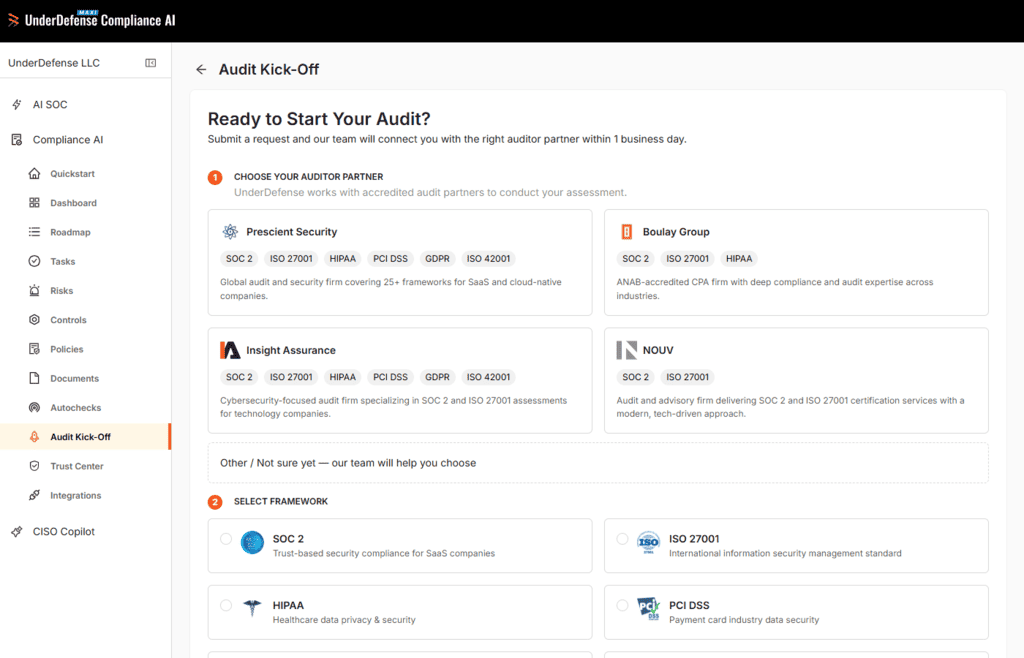
You keep the choice of signer: one of UnderDefense’s partner audit firms, listed on the Audit Kick-Off screen with the frameworks each one covers, or a firm you already work with. Among the published compliance packages, Starter runs from $499 per month and includes access to a trusted auditor pool, and the platform’s Audit Kick-Off matches you with a partner audit firm within one business day, so you can book a signer while readiness work runs.
Paid packages also include 24, 48, or 90 hours a year with UnderDefense compliance consultants, depending on the package. That covers the preparation your signing firm isn’t allowed to do for you.
Helpware, a global business process outsourcing (BPO) provider, ran SOC 2 and ISO 27001 across 8 countries on the platform. Its case study reports “2× faster audit readiness,” “30% less manual effort,” and “50+ automated checks running 24/7.”
The company also kept the same compliance team while the business doubled, so the audit workload grew without new hires.
UnderDefense is rated 5.0 out of 5 from 83 reviews on G2 as of November 2026, and your procurement team can read those reviews there. One reviewer on Clutch reports the audit result:
“We successfully passed our ISO audit.” Viktoriia Kulyk, Marketer, Solva (11-50 employees), Clutch
You still sign the audit contract with the firm that issues your report, while the platform shows which evidence your stack already produces and where the gaps are.
If your auditor also samples monitoring and incident records, the UnderDefense Agentic AI SOC produces them on the same platform.
Get matched with a partner audit firm within one business day
Cyber Security Audit Companies Compared Side by Side
This table sorts every firm by what it can sign, checked in November 2026 against its own site, the ANAB, PCI SSC, FedRAMP, and HITRUST directories, and an International Accreditation Service (IAS) certificate. UKAS status and state CPA licenses are the firms’ own statements.
“Not found” means the firm’s service pages, read in November 2026, don’t claim the role, and “No (firm says so)” means the firm states it doesn’t sign that report. ASV stands for Approved Scanning Vendor, the role that runs PCI external scans, and CMMC is the U.S. Defense Department’s cybersecurity certification.
| Firm | Best for | SOC 2 | ISO 27001 | PCI DSS ROC | FedRAMP | Other audits | Published pricing |
|---|---|---|---|---|---|---|---|
| A-LIGN | One firm for most reports | Yes, A-LIGN ASSURANCE entity | Yes, ANAB; states UKAS | Yes, QSA | Yes, 3PAO | HITRUST, CMMC | SOC 2 range in guide |
| Schellman | Federal-track cloud companies | Yes, Schellman & Company | Yes, ANAB; states UKAS | Yes, QSA | Yes, 3PAO | HITRUST, CMMC | ISO, HIPAA, GDPR ranges; SOC 2 quoted |
| Coalfire | Enterprises reusing one evidence set | Yes, Coalfire Controls | Yes, Coalfire Certification | Yes, QSA | Yes, 3PAO | HITRUST, CMMC | SOC 2 budget range on blog |
| Johanson Group | SaaS teams on compliance platforms | Yes, states CPA license | Yes, IAS | Yes, QSA | Not found | HIPAA, NIST | Quoted per engagement |
| BD Emerson | Published SOC 2 fee | Yes, BD Emerson CPA | No (firm says so) | No (firm says so) | No (firm says so) | HIPAA, GDPR | SOC 2 ranges published |
| SecurityMetrics | PCI ROC plus ASV scans | Not found | Not found | Yes, QSA | Not found | HITRUST, HIPAA | PCI audit range published |
| RSI Security | PCI work, advice-or-assessment rule | No (firm says so) | No (firm says so) | Yes, QSA | No (firm says so) | HITRUST, CMMC | CMMC range on blog; store packages |
| Bridewell | Framework audits for critical infrastructure | Not found | Not found | QSA listed; own ROC not stated | Not found | Framework audits | Quoted per engagement |
| NCC Group | Assessment plus technical testing | Not found | Not found | Yes, QSA | Yes, 3PAO | HITRUST | Quoted per engagement |
🔍 A-LIGN, Schellman, and Coalfire show a yes in all four signing columns, and Johanson Group shows three. BD Emerson signs SOC reports and says it signs none of the others.
SecurityMetrics, RSI Security, and NCC Group sign PCI DSS work and show no SOC 2 route. Bridewell’s named audit is one nobody attests to.
The numbering is this article’s own assessment: the first four firms can sign the most, and the last five fit narrower requests.
Several of these security audit companies print some fee figure: SOC 2 ranges from BD Emerson, A-LIGN, and Coalfire; ISO, HIPAA, and GDPR ranges from Schellman; a PCI range from SecurityMetrics; and a CMMC range from RSI Security.
The SOC 2 ranges run from BD Emerson’s $7,000 Type 1 floor to A-LIGN’s $150,000 or more, because they price different report types and company sizes. Without a scoped quote, you still can’t compare two firms on price, and the scope depends on evidence you may not have mapped yet.
The 9 Best Cyber Security Audit Companies for 2027
These nine cybersecurity audit companies are A-LIGN, Schellman, Coalfire, Johanson Group, BD Emerson, SecurityMetrics, RSI Security, Bridewell, and NCC Group. Each entry uses the same labels, and each firm’s facts come from its own site, read in November 2026, unless the entry names another source.
1. A-LIGN: Best for One Firm Across SOC 2, ISO 27001, PCI DSS, and FedRAMP
Overview: A-LIGN is a compliance audit firm headquartered in Tampa, Florida. If your renewal needs a SOC 2 report this year and an ISO 27001 certificate next year, one provider holds the credentials for both.
What it can sign (and what it cannot): SOC 2 reports come through its licensed CPA entity, Price and Associates CPAs, LLC dba A-LIGN ASSURANCE. ANAB’s directory lists A-LIGN for ISO/IEC 27001, and A-LIGN says it’s “dual-accredited by ANAB and UKAS.”
The PCI SSC list names it as a QSA company. The FedRAMP Marketplace shows 111 products assessed, up to Class D (high-impact systems).
HITRUST lists it as an external assessor. Its impartiality page rules out ISO management consulting.
Audit and assessment services: SOC 1, SOC 2, ISO 27001, ISO 27701, ISO 42001, PCI DSS, FedRAMP, GovRAMP (the state and local version of FedRAMP), CMMC (the U.S. Defense Department’s cybersecurity certification), HITRUST, and HIPAA, plus penetration testing and red team work.
How it collects evidence: Requests, evidence, and auditor messages run through its A-SCEND platform, where “Prior-year evidence rolls forward.” A-SCEND connects to third-party compliance platforms.
Its SOC 2 page gives a “3 to 12 month period” for Type 2 observation, so your first Type 2 report can’t arrive before the window you choose closes. A SOC 2 article ties sampling to AICPA guidance and control frequency. Ask whether its auditors take read-only access.
Industries and locations: Technology, healthcare, financial services, and federal clients, from offices in Tampa, London, Panama City, Sofia, Gurugram, and Galway.
Pricing: Quoted per engagement on a fixed fee after scoping. A-LIGN’s SOC 2 guide, updated October 2026, says a SOC 2 audit “typically ranges from $20,000 to $150,000 or more” (read November 2026). That range is wide enough that only a scoped quote gives you a budget line.
Pros:
- One provider covers SOC 2, ISO 27001, PCI DSS, FedRAMP, and HITRUST
- A public policy says it won’t audit a client where it performed non-audit work
- Evidence carries forward from one audit year to the next
- ANAB accreditation in its directory, plus UKAS by its own statement
Cons:
- Readiness assessments sit on the same site as that policy, and a partner post says audit teams are separated from advisory work, so confirm how that applies to you
- The SOC 2 signer is a separately named CPA entity, so check the legal name on the report
Who should skip it: Teams that want a firm-specific fee before a scoping call, or teams that want their ISO auditor to consult on the information security management system (ISMS) too.
2. Schellman: Best for Cloud Companies on a Federal Track
Overview: Schellman runs as an alternative practice structure, with a CPA firm and a separate compliance company under one brand. If a federal customer may follow your enterprise renewal, its FedRAMP record gives you a firm that already knows that path.
What it can sign (and what it cannot): SOC reports come from Schellman & Company, LLC, which shows Florida license AD62941. The site notes that “Schellman Compliance, LLC is not a licensed CPA firm,” and that second company is the one ANAB lists for ISO/IEC 27001 and the PCI SSC lists as a QSA.
Schellman also states UKAS accreditation for ISO 27001. The FedRAMP Marketplace lists 176 products assessed. HITRUST lists it too.
Audit and assessment services: SOC 1, SOC 2, SOC 3, ISO 27001, ISO 42001, PCI DSS, FedRAMP, CMMC, and HITRUST, plus penetration testing and AI red teaming.
How it collects evidence: Its SOC 2 page names an evidence request phase, then “process walkthroughs and interviews.” Type 2 observation runs “typically six months or more,” so plan your first report at least half a year out.
Audit sampling is mentioned for ISO surveillance audits. Ask how evidence moves, and whether auditors work through read-only access.
Industries and locations: Cloud and data centers, financial services and fintech, healthcare, payment card processing, federal government, and higher education. The contact page gives one address, in Tampa, Florida.
Pricing: SOC 2 is quoted per engagement under what its audit cost article calls “outcome-based fixed-fee arrangements.” Its own videos put ISO certification reviews in the low $30,000s to mid $40,000s in year one and lower in the next two years, so the ISO line repeats at a smaller amount.
Its videos also put a HIPAA assessment at $20,000 to $80,000 and GDPR assessments at $30,000 to $80,000 (read November 2026). If a healthcare customer or an EU privacy review follows the SOC 2 request, those ranges are the second line to add to your budget.
Pros:
- A long FedRAMP record, with the assessor date on the Marketplace reading July 2012
- Clear legal separation between the CPA entity and the compliance company
- ANAB listing for ISO 27001, plus UKAS by its own statement
- On FedRAMP it assesses and does not advise, which keeps advice and assessment apart
Cons:
- The SOC page says “Schellman performs readiness assessments,” which puts the boundary on your first-call list
- Its ISO page says fixed fees can be amended when scope grows, though it reports amendments for less than 5% of clients, so a scope change is what moves your price
- FedRAMP clients need a separate adviser, because Schellman only assesses there
Who should skip it: Teams that want one firm to advise on FedRAMP and then assess it, or teams that want a named evidence platform from the auditor.
3. Coalfire: Best for Enterprises Reusing One Evidence Set Across Audits

Overview: Coalfire is a cybersecurity services company headquartered in Chicago. If your team dreads answering the same question for three auditors, its assessment page says one evidence request can serve several frameworks.
What it can sign (and what it cannot): SOC reports come from Coalfire Controls, its CPA affiliate, per its SOC page. ANAB’s directory lists Coalfire Certification, Inc. for ISO/IEC 27001.
The PCI SSC list names Coalfire Systems as a QSA. The FedRAMP Marketplace shows 105 products assessed, up to Class D (high-impact systems). HITRUST lists it as an external assessor, and its Coalfire Federal unit says it’s a CMMC assessor (C3PAO).
Audit and assessment services: SOC 2, SOC for Cybersecurity, ISO certifications, PCI DSS, FedRAMP, HITRUST, CSA STAR (the Cloud Security Alliance registry), and C5 (Germany’s cloud security standard), alongside advisory work and its DivisionHex offensive and defensive security team.
How it collects evidence: Its Compliance Essentials platform keeps a Common Evidence Library and draws evidence automatically from “Jira, GitHub, Microsoft 365.” Type 2 observation is “typically at least six months,” so your first Type 2 report is half a year out. Its HITRUST readiness page mentions sampling; ask about read-only access on the first call.
Industries and locations: Financial services, healthcare, retail, and technology, with offices in Chicago, Alpharetta, Bellevue, Manchester, and Buenos Aires.
Pricing: Quoted per engagement. A Coalfire blog from September 30, 2025 gives SOC 2 audit fees of $30,000 to $50,000 for small companies and $70,000 to $100,000+ for growth-stage ones, as a budgeting guide (read November 2026). Coalfire ties the upper band to multi-cloud companies with multiple systems, so expect that band if you run both AWS and Azure.
Pros:
- A CPA affiliate, a certification company, and a QSA under one group
- Shared evidence across frameworks reduces repeat requests
- The evidence platform connects to Jira and Microsoft 365, which your team probably runs
- Its SOC page says the CPA affiliate takes part in the AICPA Peer Review Program
Cons:
- Advisory and assessment sit under one brand. Its FedRAMP advisory page rules out both for one authorization, and its SOC FAQ says “Independence must be maintained by your SOC auditor,” so get your own boundary from the team
- It states a “focus on enterprise clients” on its ISO 42001 page, so smaller scopes should ask about fit
- Its CMMC unit acts as both assessor and adviser, and you’ll want that role split explained
Who should skip it: Teams that need one simple report and have no use for a shared evidence program across frameworks.
4. Johanson Group: Best for SaaS Teams Already Running a Compliance Platform
Overview: Johanson Group LLP is a security and compliance audit firm in Colorado Springs, Colorado, according to its about page. If your evidence already sits in a compliance automation platform, its SOC 2 page says its auditors work inside that tool.
What it can sign (and what it cannot): Its homepage opens its SOC pitch with “As a licensed CPA firm.” Its ISO 27001 page offers certification audits, and an IAS certificate (MSCB-314) lists ISO/IEC 27001:2022 in scope.
The PCI SSC list names Johanson Group LLP as a QSA for the USA and Australia. It isn’t on the FedRAMP Marketplace assessor list, and its service pages state no HITRUST assessor role.
Audit and assessment services: SOC 1, SOC 2, SOC 3, ISO 27001, PCI DSS Reports on Compliance, NIST 800-53 and 800-171 assessments, HIPAA attestation, GDPR, gap assessments, and penetration testing.
How it collects evidence: Walkthroughs, evidence inspection, and control testing run asynchronously, and a named Customer Success Manager handles requests. Its FAQ says “The AICPA minimum is 90 days” for observation, with renewals on 12 months.
That puts a first Type 2 report at least three months away, then one report a year. Sampling method and read-only access are worth raising on the first call.
Industries and locations: Technology and SaaS, financial services, AI, government, healthcare, and education, with clients in the United States, Latin America, Europe, and APAC.
Pricing: Quoted per engagement. Johanson Group quotes fixed fees, and its contact page says it doesn’t publish a generic range (read November 2026).
Pros:
- SOC 2, ISO 27001, and a PCI DSS ROC can come from one legal entity
- Audit work can run inside a compliance platform your team already uses
- Its ISO page publishes its appeal, suspension, and impartiality rules
- It says it “will not provide advisory” work on the ISMS for ISO 27001 clients
Cons:
- Its quote form lists gap assessments beside audits, so get its split for SOC and PCI work in writing
- The IAS certificate lists ISO 27001 only, and its site also sells ISO 27017/18 and ISO 42001, so ask about accreditation for those
- Its pages don’t name IAS, and the certificate is worth requesting with your quote
Who should skip it: Companies with a federal customer that needs a recognized FedRAMP assessor, or a healthcare customer that requires HITRUST validation.
Find out which audit evidence you already hold
5. BD Emerson: Best for Teams That Want a Published SOC 2 Fee Before the Sales Call
Overview: BD Emerson LLC is a consulting firm across cybersecurity, compliance, privacy, and technology. If your CFO wants a number before a sales call, this firm prints a SOC 2 range on its audit pages.
Its about page says BD Emerson is part of Andersen Consulting, and that Andersen Group Inc. announced on October 15, 2026 that it had closed the acquisition. Confirm which entity your contract will name.
What it can sign (and what it cannot): SOC reports come through BD Emerson CPA, its attest arm, and its audit page says it will “issue the opinion ourselves.” Its SOC 2 readiness page adds that readiness and the examination are “separate engagements with separate firms.”
Its service pages also say it “does not issue ISO certificates,” that “BD Emerson does not sign ROCs,” and that it’s “not a FedRAMP Recognized assessor.” The AICPA’s peer review file lists BD Emerson CPA LLC in Virginia, so ask for its license number.
Audit and assessment services: SOC 1, SOC 2, and SOC 3 audits, HIPAA and GDPR audits, ISO 27001 internal audits, and NIST 800-53 and 800-171 work, plus readiness and penetration testing.
How it collects evidence: Its audit page gives a “3 to 12 month observation period” and fieldwork of “two to six weeks,” so block that time on your team’s calendar. Each finding names “the sample it came from,” and read-only access is a question for the first call.
Industries and locations: Financial services, healthcare, software, government, energy, and others, with offices in Richmond, Virginia, and La Jolla, California.
Pricing: Published. Its audit page says a SOC 2 Type 1 examination “typically runs $7,000 to $25,000 and a Type 2 runs $12,000 to $45,000,” with complex enterprise environments above that range (read November 2026). That gives you a first SOC 2 line for next year’s budget before any sales call.
Pros:
- A published audit fee range you can put in a budget request
- Each finding names the control, the sample, and the date
- It states exactly what it can’t certify, framework by framework
- Its audit page says the audit team works apart from its consulting practice
Cons:
- Its pages word the split differently: the about page says “readiness and examination sit with one firm,” and the SOC 2 readiness page calls them “separate engagements with separate firms,” so get your case in writing
- It sells readiness, implementation, and penetration testing beside audits
- ISO 27001, PCI DSS, and FedRAMP requests need another signer
Who should skip it: Teams whose requester named an ISO 27001 certificate or a PCI DSS ROC, and teams that want those signed by the firm that signs their SOC 2 report.
6. SecurityMetrics: Best for Merchants and Service Providers That Need a PCI DSS ROC and ASV Scans From One Firm
Overview: SecurityMetrics, headquartered in Orem, Utah, is a compliance assessment firm that works on PCI DSS, HIPAA, CMMC, and HITRUST, according to its about page. If a card program is behind the audit request, PCI work is the center of what it does.
What it can sign (and what it cannot): Its PCI audit page says “SecurityMetrics is a Qualified Security Assessor (QSA) and Approved Scanning Vendor (ASV).” The PCI SSC list names SecurityMetrics, Inc. as a QSA, and the same page says it will “submit your attestation of Compliance (AOC) and Report on Compliance (ROC).”
HITRUST lists it as an external assessor. It isn’t on the FedRAMP Marketplace assessor list, and its service pages state no SOC 2 attestation or ISO 27001 certification role.
Audit and assessment services: Onsite PCI DSS audits, PCI programs for smaller merchants, Secure Software Framework and point-to-point encryption (P2PE) audits, ASV scanning, HIPAA onsite audits, HITRUST assessments, and penetration testing. Its about page also lists PCI Forensic Investigator status.
How it collects evidence: Its PCI page says “Your QSA will either work with you remotely to collect evidence or make an in-person visit.” An audit coordinator tracks deadlines, and an initial gap analysis comes first. Sampling method and read-only access are questions for the scoping call.
Industries and locations: Its about page says it assesses “Level 1 merchants and service providers,” and its homepage speaks to organizations of every size. The PCI SSC list shows QSA coverage for the USA, Europe, Latin America, Canada, Asia Pacific, and CEMEA.
Pricing: Published for PCI. Its PCI page says “a PCI audit can start at $15k” for a simple environment and that “Complex audits can cost $75k+,” depending on locations, audited parties, and network complexity (read November 2026). Each one you bring into scope moves the quote.
Pros:
- QSA, ASV, and PCI Forensic Investigator roles under one firm
- It submits the ROC and AOC for you
- A published PCI fee range you can budget against
- Remote or on-site evidence collection
Cons:
- Its QSAs also run the initial gap analysis, so ask how the PCI SSC’s separation-of-duties rule applies to your engagement
- SOC 2 and ISO 27001 requests need another signer
Who should skip it: Teams whose requester named a SOC 2 report or an ISO 27001 certificate, and cloud providers that need a FedRAMP assessment.
7. RSI Security: Best for PCI DSS Work With a Strict Advice-or-Assessment Rule
Overview: RSI Security, the trading name of RSI Systems, Inc., is a cybersecurity and compliance advisory firm based in Southlake, Texas. If you’ve seen one firm’s consultants turn into its auditors and didn’t like it, its published rule keeps the two apart: for a given client, RSI Security provides advisory or assessment services, never both.
What it can sign (and what it cannot): It holds the PCI signature: the PCI SSC list names RSI Systems Inc. as a QSA for the USA and Latin America. HITRUST lists it as an external assessor, and it says it’s an authorized C3PAO.
Its SOC 2 page says it “does not perform SOC 2 examinations,” and its ISO page says it does “not issue ISO/IEC 27001 certifications.” Its FedRAMP page says it’s not yet an accredited FedRAMP 3PAO.
Audit and assessment services: PCI DSS QSA assessments and ASV scanning, HITRUST, CMMC assessments, and advisory work for SOC 2, ISO 27001, ISO 42001, and NIST 800-171, plus penetration testing.
How it collects evidence: Its master service agreement mentions “use of certain sampling techniques” and asks for scoping documents and evidence within two weeks. Line up your evidence owners before kickoff.
Its GRC Tool page offers a GRC portal with Slack, G Suite, and Microsoft 365 integration. Ask whether assessors take read-only access.
Industries and locations: Cloud providers, ecommerce, financial services, government, healthcare, retail, and technology, supporting organizations nationwide from Southlake.
Pricing: Assessments are quoted per engagement. Its blog puts a CMMC Level 2 C3PAO assessment at $30,000 to $60,000+, which matters only if a defense customer asks for CMMC.
Its online store lists fixed packages, such as a Cyber Risk Report at $5,850 and PCI ASV scanning at $2,575 to $7,725 (read November 2026). Those price scans and reports, and a QSA assessment still gets its own quote.
Pros:
- A firm-wide rule keeps advice and assessment apart for each client
- It says clearly what it can’t sign, so you won’t buy the wrong thing
- QSA and HITRUST status both check out on the accreditors’ lists
Cons:
- SOC 2 and ISO 27001 need a second firm
- FedRAMP assessments need a different firm today, as RSI itself advises
- Its contract sets time limits: engagements within six months and remediation within eight weeks, so check them against your plan
Who should skip it: Teams whose requester named SOC 2 or ISO 27001 and who want a single signer, and cloud providers that need a FedRAMP assessment now.
8. Bridewell: Best for Critical Infrastructure Operators That Need a Framework Audit
Overview: Bridewell is a UK-headquartered security firm with its American headquarters in Houston and offices in New York and Orlando. If your board wants an outside view and nobody has named a report, its Cybersecurity Audit tests you against established frameworks or ones you’ve written yourself.
What it can sign (and what it cannot): The PCI SSC list names Bridewell Consulting Limited as a QSA with USA coverage. Its pages explain a Report on Compliance in general and don’t say Bridewell signs one, so confirm that directly.
Its service pages state no SOC 2 attestation role, and its ISO 27001 page says the work “requires engaging a Certification Body (CB).” It isn’t on the FedRAMP Marketplace assessor list or the HITRUST assessor list.
Audit and assessment services: Cybersecurity audits, data privacy audits, ISO 27001 and PCI DSS consulting, and penetration testing. The UK’s National Cyber Security Centre (NCSC) lists it for Cyber Resilience Audit, a UK scheme.
How it collects evidence: Its audit page names surveys, interviews, focus groups, and on-site visits, plus proprietary tools for audit metrics and remediation tracking. A separate managed compliance service runs on a third-party compliance platform.
A UK audit case study mentions evidence sampling. Ask about observation periods and read-only access.
Industries and locations: A critical infrastructure focus: energy, water, aviation, transport, government, financial services, and others. It says it supports organizations across North America.
Pricing: Quoted per engagement. Its audit page offers a conversation with its experts (read November 2026).
Pros:
- A service named for the audit itself, on its American site
- Audits can run against a framework you choose, including your own
- It reviews whether suppliers comply with your requirements
- Its operating background covers regulated, critical sectors
Cons:
- Its audit, as described, ends in findings that nobody outside the firm attests to
- Its trust center says its own SOC 2 report covers its security operations work and leaves out consulting, so that report says nothing about this audit team
- No statement separating advice from audit appears on its American audit page
Who should skip it: SaaS and fintech teams whose customer named a SOC 2 report or an ISO 27001 certificate, unless they want a practice round before the signed audit.
9. NCC Group: Best for Global Companies Pairing PCI DSS or HITRUST Assessments With Technical Testing
Overview: NCC Group is a listed UK security company with its global headquarters in Manchester and a regional headquarters in Chicago. If your customer’s review pairs a PCI DSS request with deep technical testing, you can buy both here. Its menu has no item called “security audit,” so ask for the Cyber Security Review by name.
What it can sign (and what it cannot): The PCI SSC list names NCC Group Security Services Limited as a QSA with USA coverage. Its contract module refers to “the report on compliance created by NCC Group.”
The FedRAMP Marketplace lists NCC Group Security Services, Inc., with one product assessed. HITRUST lists it as an external assessor. Its service pages state no SOC 2 attestation or ISO 27001 certification role.
Audit and assessment services: The Cyber Security Review, PCI DSS and PCI 3DS assessments, FedRAMP assessments, HITRUST validated assessments, and penetration testing. The UK’s NCSC also names it for Cyber Resilience Audit, which covers the UK only.
How it collects evidence: Its contract asks for “prompt access to all staff, premises, systems and equipment.” A Cyber Services Portal shows penetration test results, and it isn’t described for audit evidence.
Its HITRUST guide describes control sampling and a 90-day minimum, so a HITRUST validation is at least a quarter away. For other audits, ask about both, along with read-only access.
Industries and locations: Financial services, retail, public sector, technology, energy, and health, across the UK, Europe, North America, and Asia Pacific.
Pricing: Quoted per engagement. Its contract accounts for audit time in half-day units (read November 2026), so a short session still bills half a day.
Pros:
- QSA, FedRAMP, and HITRUST status all check out on the accreditors’ lists
- Technical testing and assessment sit in one firm
- Offices across the UK, Europe, North America, and Asia Pacific suit a multi-region scope
Cons:
- Its contract says it won’t verify information you supply unless the statement of work says so, so write the testing you expect into that document
- The FedRAMP Marketplace shows one assessed product, a thin public record to check against
- Its contract bills travel time, which belongs in your quote comparison
Who should skip it: Teams whose requester named a SOC 2 report or an ISO 27001 certificate, and teams that want a firm built around attestation work.
Audit, Assessment, or Penetration Test: What Your Requester Will Accept
Your requester will accept the output that matches its own policy, so quote its wording back before you buy anything. These cybersecurity audit services differ in who stands behind the result, and that’s usually what the reviewer checks. Many IT security audit companies sell all three, so ask which one the quote covers.
| Option | What you get | Who stands behind it | Enough when |
|---|---|---|---|
| Audit | Opinion, certificate, or ROC | CPA firm, certification body, or QSA | The requester named that report |
| Assessment | Findings against a framework | The firm alone | Nobody needs a signature |
| Penetration test | Report on what testers reached | The testing firm alone | The request names a third-party test |
An audit ends in a signed result from a party a standard authorizes to sign. An assessment ends in written findings, such as a cloud security assessment of your AWS or Azure accounts.
A penetration test reports what testers could reach, and a red team assessment stretches that to test your detection and response. Neither one ends in a signed audit result.
📝 A pentest letter of attestation is the tester’s own summary of scope, dates, and results. It’s enough when a security questionnaire asks for proof of a recent third-party test, or when a customer agrees to accept it while your SOC 2 report is in progress.
It falls short when the requester named a SOC 2 report, an ISO 27001 certificate, or a ROC, because no CPA opinion, accredited certificate, or QSA validation stands behind it. When a questionnaire asks for a test, buy it as its own engagement, so the letter names its own scope and dates.
❓ If the customer’s wording is vague, ask one question: “Whose signature does your policy accept?” The answer tells you which column of the comparison table to read, and your requester’s deadline tells you how soon you need it.
UnderDefense shows your audit evidence gaps before fieldwork starts
- See which audit evidence your connected tools already hold
- Get 24, 48, or 90 consulting hours a year, by package
- Get matched with a partner audit firm within one business day
Frequently Asked Questions
What does a cyber security audit include?
It includes scoping, evidence requests, interviews, testing or sampling of controls, and a written result. For SOC 2 and ISO 27001, an authorized party signs that result. An assessment uses similar steps and ends in findings nobody attests to, so confirm which one your requester wants.
Who is allowed to issue a SOC 2 report?
A licensed CPA firm issues it, under standards the AICPA writes. Compliance tools can collect evidence, and they can’t attest. Some brands sign through a separately named CPA entity, so check the legal name on the report and ask about the firm’s peer review.
How much does a cyber security audit cost?
Most firms quote per engagement, so the fee depends on your scope: systems, locations, report type, observation period, and how ready your evidence is. BD Emerson, A-LIGN, and Coalfire publish SOC 2 ranges, Schellman ISO, HIPAA, and GDPR ranges, SecurityMetrics a PCI range, and RSI Security a CMMC range. Ask each firm what the fee covers and what would change it.
How often should a company run a security audit?
It follows the deliverable. An ISO 27001 certificate runs on a three-year cycle with surveillance audits between, so the audit line returns every year. PCI DSS validation is annual, and SOC 2 sets no fixed frequency, though customers often expect a current report each year.
Can the same firm prepare you for an audit and then audit you?
Usually no: a certification body can’t offer management system consultancy under ISO/IEC 17021-1:2015. A CPA firm can’t attest to controls it built or managed. Firms draw this line differently, as the entries show, so get yours in writing.