






A customer contract now names ISO 27001 as a condition of the deal, so the revenue waits on a certificate, and finance wants a three-year number before it approves the line in the 2027 budget. The question on your desk is how much ISO 27001 certification costs, all in, from kickoff to the first recertification.
Below is how to build that number line by line, starting with the one figure a published standard sets for you: audit days.
TL;DR
- An ISO 27001 budget has five lines: certification audits, readiness and consulting, tooling, internal staff time, and remediation.
- Audit fees are audit days times the body’s day rate, and ISO/IEC 27006-1 sets the days by headcount: a 600-person scope starts at 16.5.
- The guide compares consultant-led, platform-led, and in-house paths by who does the readiness work and what drives each one’s cost.
- A three-year budget worksheet, a staff-time method, and six ways to lower the cost close the guide.
Table of contents
- ISO 27001 Certification Cost Comes From Five Budget Lines
- How Certification Bodies Calculate Audit Days and Fees
- Three Paths to a Certificate and What Drives Each One’s Cost
- The Three-Year Cost: Surveillance Audits and Recertification
- A Three-Year Budget Worksheet for a 600-Person Company
- Six Ways to Lower the Cost Without Weakening the ISMS
- How a Compliance Platform Changes the Staff-Time Line
- Frequently Asked Questions
🧾 Many budgets start with the certification body’s quote, yet the ISO 27001 certification cost also includes the staff time behind every audit and the surveillance audits that follow the certificate.
This guide is for security and compliance leads and IT Directors who have to defend an ISO 27001 number to a CFO.
It shows how a certification body sets its fee from audit days, compares three paths to a certificate side by side, and lays out a three-year budget worksheet with every line named.
Audit days are the hard numbers here, because a published standard sets them. Certification bodies, consultants, and testers quote each engagement separately, so every other line names who supplies the figure and what to ask them.
Three terms come up throughout. The ISMS (information security management system) is the set of policies, risk decisions, and controls your certificate covers. Annex A is the standard’s list of 93 security controls. Stage 1 and Stage 2 are the two parts of the initial certification audit: a review of your documentation, then a test of whether the controls work.
ISO 27001 often becomes the base of a wider information security compliance program, and the choices you make in year 1 carry into the later audits.
See which ISO 27001 evidence your tools can collect for you
ISO 27001 Certification Cost Comes From Five Budget Lines
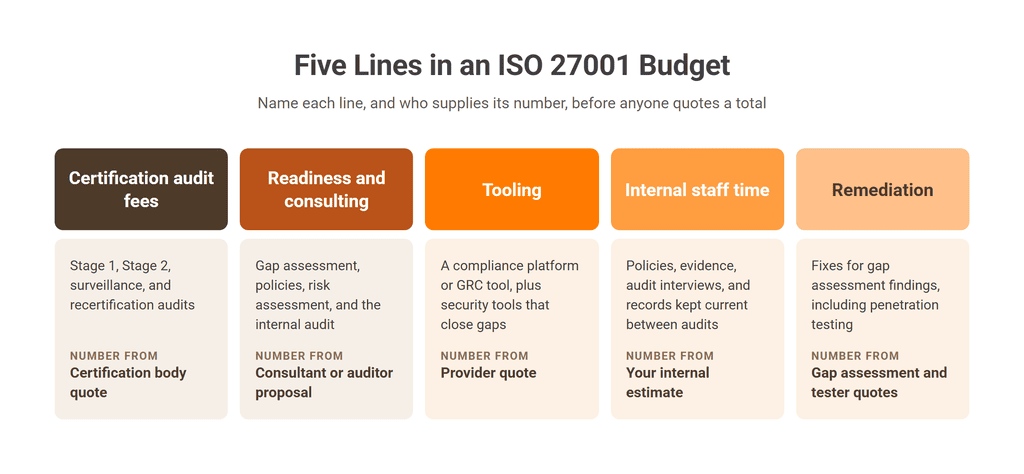
An ISO 27001 budget has five lines: certification audit fees, readiness and consulting, tooling, internal staff time, and remediation. Each line behaves differently over three years, so name all five before anyone quotes a total.
1. Certification audit fees
An accredited certification body charges for the Stage 1 and Stage 2 audits, then for the surveillance and recertification audits that follow. Its fee is audit days multiplied by a day rate, plus travel when auditors visit in person. The days come from a published table, covered in the next section, which makes this the easiest line to estimate.
2. Readiness and consulting
Readiness covers the gap assessment, policy writing, the risk assessment, and the internal audit. ISO/IEC 27001:2022 requires an internal audit (clause 9.2) and a management review (clause 9.3), and the certification body looks for both at Stage 2. Many teams buy the internal audit from an outside auditor to keep it independent of the people who built the controls.
Readiness help comes either as a standalone project or as hours bundled with a platform through compliance consulting, and the bundled form keeps paying off in years 2 and 3, when a one-off project has ended.
3. Tooling
Tooling means a compliance automation platform or governance, risk, and compliance (GRC) tool, plus any security tools you need to close gaps, such as vulnerability scanning or log retention. Platform subscriptions renew every year, so they belong in all three years of the budget.
4. Internal staff time
Staff time is the line most budgets leave blank, because no outside party quotes it. IT, security, HR, engineering, and legal all spend hours writing policies, collecting evidence, sitting in audit interviews, and keeping records current between audits.
A compliance automation platform such as UnderDefense MAXI Compliance AI reduces that work by collecting evidence from Microsoft 365, Entra ID, AWS, and Jira as they already run, so fewer people rebuild screenshots each quarter.
UnderDefense prepared for and passed its own ISO 27001 certification audit in the same platform, so the evidence workflow has already been through a certification audit.
5. Remediation, including penetration testing
Remediation is whatever the gap assessment finds: multi-factor authentication (MFA) gaps in Entra ID, missing logs, unencrypted backups, or supplier contracts without security clauses. ISO 27001 does not require a penetration test by name. In Annex A, control 8.8 asks you to manage technical vulnerabilities, and control 8.29 asks for security testing in development and acceptance.
Auditors commonly ask for evidence such as regular vulnerability scan results or a penetration test report. Certification body Ascert lists exactly that evidence for control 8.8 in its published certification procedure, revised in 2025.
Scope drives the cost of a penetration test, so ask testers to quote against the applications and networks inside your ISMS boundary, and confirm the deliverable includes a technical report your auditor can sample.
How Certification Bodies Calculate Audit Days and Fees
A certification body’s fee follows the number of audit days, and for ISO 27001 those days start from Table C.1 of ISO/IEC 27006-1:2024, the standard accredited bodies follow when they audit an ISMS.
The table gives a starting number of auditor days for Stage 1 and Stage 2 combined, based on the people working under your organization’s control in the certificate’s scope.
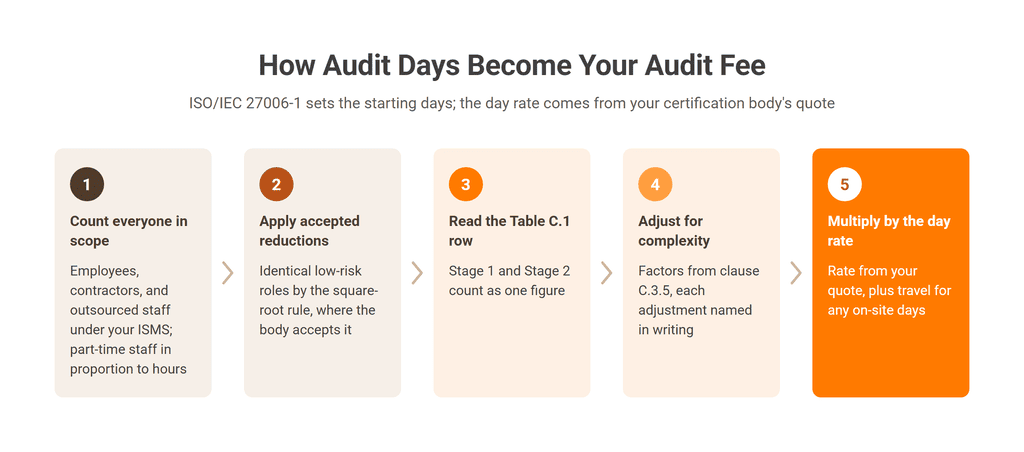
The headcount includes employees, contractors, and outsourced staff who work under your ISMS. Part-time staff count in proportion to their hours. Where many people perform identical, low-risk activities, such as read-only roles, the certification body may reduce the count for that group, using a square-root rule the standard defines, and records the reduction case by case.
🧮 To estimate your own days, count everyone in scope, apply any reduction the body accepts, and read the matching row.
Then ask which complexity factors the body will add or subtract, multiply the adjusted days by its day rate, and add travel for any on-site days. Do it for Stage 1 and Stage 2 together, because the table counts them as one figure.
The rows below cover scopes from 176 to 2,675 people. Initial audit days are copied from ISO/IEC 27006-1:2024 Table C.1, as reproduced in Ascert’s published procedure, cited above. Surveillance and recertification days are calculated from the same standard’s rules in clauses C.4 and C.5, explained in the three-year section below.
One row needs care: for 876 to 1,175 people, Ascert’s copy prints 19.5 days, the same as the next row, while ISO/IEC 27006:2015 (Table B.1) and certification body ASB’s 2025 audit-duration instruction give 18.5, which this table uses, so confirm that row with your certification body.
| People in scope | Initial audit days (Table C.1) | Surveillance days per year (calculated) | Recertification days, minimum (calculated) |
|---|---|---|---|
| 176–275 | 14 | 4.7 | 9.3 |
| 276–425 | 15 | 5.0 | 10.0 |
| 426–625 | 16.5 | 5.5 | 11.0 |
| 626–875 | 17.5 | 5.8 | 11.7 |
| 876–1,175 | 18.5 | 6.2 | 12.3 |
| 1,176–1,550 | 19.5 | 6.5 | 13.0 |
| 1,551–2,025 | 21 | 7.0 | 14.0 |
| 2,026–2,675 | 22 | 7.3 | 14.7 |
These are starting points. The certification body adjusts them up or down for factors the standard lists in clause C.3.5, including the criticality of the information in scope, the number of sites, the variety of IT platforms, outsourcing, and in-house software development. Ask for the calculation in writing, with each adjustment named.
Certification bodies quote each engagement separately, so the days are the number you can check and the day rate is the number you collect. That is the core of ISO 27001 audit cost: audit days times the day rate, repeated at every visit in the cycle.
Comparing certification body quotes
Send every body the same inputs: people in scope by site, the draft scope statement, IT platforms, outsourced functions, and any in-house development. Then ask each one for four things:
- Its days per visit: Stage 1, Stage 2, each surveillance audit, and recertification.
- The adjustments it made, and why.
- Its day rate.
- Whether that rate holds for all three years.
Also ask how it bills travel and follow-up visits, and confirm that its accreditation covers ISO/IEC 27001. Two quotes can show different totals for the same scope because one leaves out surveillance or travel, so compare days and rate first and totals last.
Three Paths to a Certificate and What Drives Each One’s Cost
Three paths lead to the same certificate: a consultant-led project, a platform-led project, and an in-house project. The certification audit uses the same Table C.1 days on all three, and the difference lies in who does the readiness work and whom you pay for it.
1. Consultant-led path
On the consultant-led path, an ISO consultancy runs the gap assessment, writes policies, facilitates the risk assessment, and often performs the internal audit. You buy expertise and a project manager. Your staff still collect most of the evidence and sit every interview, and consulting usually tapers after the first audit, so years 2 and 3 fall back on your team.
The certification body can’t do this work for you, because ISO/IEC 17021-1:2015 bars it from consulting on a management system it certifies.
2. Platform-led path
On the platform-led path, a compliance automation platform connects to your cloud, identity, and ticketing tools, maps controls to Annex A, collects evidence on a schedule, and supplies policy templates. Some platforms add expert support or an auditor network. The subscription renews each year and keeps collecting between audits.
Some platforms publish monthly package prices and others quote per scope, so compare them on the same headcount and frameworks.
3. In-house path
On the in-house path, your own security or GRC lead runs the project with spreadsheets and existing tools. You pay no outside party for most readiness work, so it lands on staff time, and the project depends on one or two people who know ISO 27001 well. If that person leaves before the recertification audit, the knowledge leaves too.
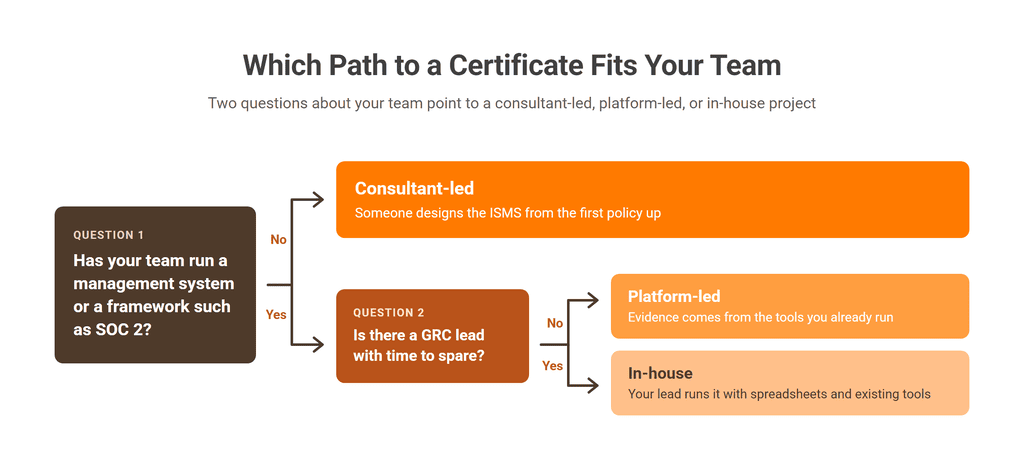
The in-house path suits teams that already run one framework, such as SOC 2, and have a GRC lead with time to spare.
Which path fits your team
For a security or compliance lead without a spare GRC lead, the platform-led path usually fits best, because evidence comes from the cloud, identity, and ticketing tools you already run and keeps flowing through years 2 and 3.
The consultant-led path fits when the team has never run a management system and needs someone to design the ISMS from the first policy up. A compliance platform package that bundles consultant hours and custom policies covers the same need on the platform-led path.
The table compares the three paths on what each one asks of you. It holds no prices, because each cell depends on your scope and on the quotes you collect.
| Comparison | Consultant-led | Platform-led | In-house |
|---|---|---|---|
| Readiness work done by | Consultant, with staff supplying evidence | Staff, with automation, templates, and any bundled consultant hours | Staff alone |
| You pay outside parties for | Consultant days and the audit | Subscription and the audit | The audit, plus any bought-in internal audit |
| What drives the cost | Consultant days, staff hours | Headcount, framework count, support level, staff hours | Staff hours, remediation |
| What to ask for | Hours the plan assumes from your team | Evidence that still needs manual collection | Who covers if the lead leaves |
| Certification audit | Table C.1 days | Table C.1 days | Table C.1 days |
| Effort in years 2 and 3 | Mostly on staff | Platform keeps evidence current | All on staff |
The ISO 27001 certification price a vendor or consultancy quotes therefore tells you only part of the story. Ask each one how many hours of your team’s time its plan assumes, in year 1 and in each surveillance year, and put that figure next to the cash.
Three questions usually settle the choice:
- Has anyone on the team run a management system before?
- Who owns evidence collection once year 1 ends?
- Does the customer’s contract deadline fit the certification body’s calendar?
A “no” to the first question points to a consultant-led project or a platform package with consultant hours. No owner for evidence after year 1 points to a platform. A customer deadline earlier than the body’s first free Stage 2 date means asking the customer whether a signed auditor engagement letter, with the audit date already booked, will do in the meantime.
Answer all three before you request quotes, so each provider prices the same path.
The Three-Year Cost: Surveillance Audits and Recertification
An ISO 27001 certificate runs on a three-year cycle, so the first-year quote covers only part of the cost.
The cycle follows ISO/IEC 17021-1:2015, and Bureau Veritas, a certification body, sets it out on its certification process page, read in November 2026: surveillance audits at least once a calendar year except in recertification years, the first within 12 months of the certification decision, and a full reassessment every three years, completed before the certificate expires.
Stage 1 checks readiness and documentation, and Stage 2 tests whether the controls operate. Surveillance audits then sample the ISMS each year: internal audits, management review, corrective actions, and changes since the last visit.
ISO/IEC 27006-1 sets annual surveillance time at about one-third of the initial audit time (clause C.4) and recertification at no less than two-thirds of it (clause C.5).
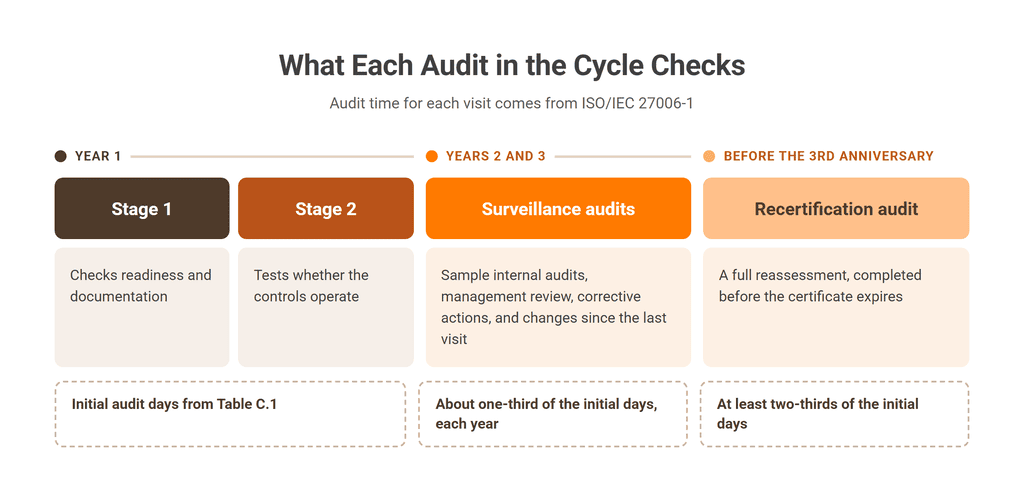
The table shows the cycle for a 600-person scope, using the 426–625 row of Table C.1.
| Cycle point | Audit | Audit days | Other recurring lines |
|---|---|---|---|
| Year 1 | Stage 1 and Stage 2 | 16.5 | Readiness, remediation, internal audit, platform |
| Year 2 | Surveillance audit 1 | About 5.5 | Internal audit, management review, platform |
| Year 3 | Surveillance audit 2 | About 5.5 | Internal audit, management review, platform |
| Before the third anniversary | Recertification audit | At least 11 | Recertification readiness, platform |
Those four rows add up to about 38.5 auditor days before the body’s adjustments. Multiply that figure by the day rate in your quote and add travel, and you have the audit line for the whole cycle.
The recertification audit follows the second surveillance audit and has to finish before the certificate’s third anniversary, so depending on your certification date it lands late in year 3 or in year 4. Book it with the certification body when you sign the first contract, so it lands in a budget year that planned for it.
Two things move this table, and both are worth naming in the budget note to finance. Scope changes, such as an acquisition or a new product line, add surveillance days. A major nonconformity at Stage 2 or at a surveillance audit can add a follow-up visit, so check how your quote bills it.
Staff time recurs too. Each surveillance year needs current evidence, an internal audit, and a management review, so estimate the ISO 27001 cost of years 2 and 3 from how evidence collection will run between audits.
Keep years 2 and 3 evidence current without another readiness project
A Three-Year Budget Worksheet for a 600-Person Company
This worksheet follows one 600-person company running Microsoft 365, Entra ID, AWS, and Jira. It splits the five budget lines into seven rows, because consulting and the internal audit are quoted separately, and so are penetration tests and other remediation.
The audit row shows days because a published standard sets them: multiply each by your body’s day rate. Fill every other cell from the source named in its row, because those figures depend on your own scope and quotes.
| Budget line | Year 1 | Year 2 | Year 3 | Recertification | Where the number comes from | Question to ask |
|---|---|---|---|---|---|---|
| Certification audits | 16.5 days × day rate | 5.5 days × day rate | 5.5 days × day rate | 11+ days × day rate | Certification body quote | Which adjustments changed the days? |
| Outside consulting | From your quote | From your quote | From your quote | From your quote | Consultant proposal | How many of your hours does it assume? |
| Outsourced internal audit | From your quote | From your quote | From your quote | From your quote | Auditor proposal | Is the auditor independent of the controls? |
| Penetration tests | From your quote | From your quote | From your quote | From your quote | Tester quote | Does the report cover the ISMS boundary? |
| Remediation | From your quote | From your quote | From your quote | From your quote | Gap assessment, vendor quotes | Which findings need new spending? |
| Platform subscription | Published price or quote | Published price or quote | Published price or quote | Published price or quote | Provider’s pricing page or quote | Which evidence still needs manual work? |
| Staff time | Your estimate | Your estimate | Your estimate | Your estimate | Internal estimate | Who owns each task each year? |
The recertification audit is included so the cycle total is complete; for a certificate issued during 2027 it lands late in the 2029 budget or in the 2030 budget.
If you narrow the ISMS to the 250 people who build, run, and support the product, the 176–275 row applies: 14 initial days, about 4.7 per surveillance audit, and at least 9.3 for recertification. That comes to about 32.7 days across the cycle, so run the worksheet both ways and show finance the difference.
Estimating the staff-time line
No published table covers staff time, so build this line from your own people and tasks. Start by naming who is involved and what each team does in year 1 and in each surveillance year.
| Team | Year 1 tasks | Each surveillance year |
|---|---|---|
| Security or GRC lead | Risk assessment, policies, Statement of Applicability | Risk review, internal audit support |
| IT | Access reviews, MFA and logging fixes | Access reviews, configuration evidence |
| Engineering | Change records, vulnerability fixes | Change records, vulnerability fixes |
| HR | Onboarding records, awareness training | Training records, joiner and leaver evidence |
| Legal and procurement | Supplier contracts, security clauses | Supplier reviews, contract changes |
| Executive sponsor | Scope approval, management review | Management review |
Then time real work. Ask each task owner to complete one Entra ID access review, one AWS configuration export, or one Jira change record, and to log the hours it took. Multiply that figure by how often the task recurs each year, and count evidence that serves several controls once.
Add the fixed events next: the audit interviews in the certification body’s audit plan, the internal audit, and the management review. Keep year 1 separate from the surveillance years, then ask finance for the loaded hourly cost of each team and turn the hours into dollars.
Hand the finished worksheet to finance with the source written beside each amount, so your CFO can check any line.
Six Ways to Lower the Cost Without Weakening the ISMS
Each of these levers cuts staff hours or audit days while keeping every control the auditor expects to see.
- Map the access reviews, change approvals, vendor reviews, and incident records you already collect for SOC 2 to Annex A before writing new policies.
- Certify the product, its infrastructure, and the teams that support it first, and check that the scope statement covers the service your customer buys.
- Connect a platform to your identity, cloud, and ticketing tools so access, configuration, and ticket evidence refresh on a schedule.
- Run the internal audit well before Stage 2, so findings can be closed first.
- Close Stage 1 findings before Stage 2, because a major nonconformity at Stage 2 delays the certificate and can add a follow-up visit.
- If you also hold ISO 9001 or plan ISO 27701, ask one certification body for combined visits that share opening meetings, travel, and planning.
Scope narrowing alone takes 2.5 initial audit days off the worksheet above, and it also shrinks the evidence your staff collect every year. Widen the scope at a later surveillance audit once the first certificate is in hand and a second customer asks for it.
SOC 2 reuse works best when one person owns the mapping between the two frameworks. Without an owner, two teams collect the same Entra ID access review twice in different formats.
Scope the internal audit clause by clause and control by control against an ISO 27001 compliance checklist, so it finds what a Stage 2 auditor would find while fixes are still cheap.
How a Compliance Platform Changes the Staff-Time Line
Years 2 and 3 are where the staff line hurts: two surveillance audits and a recertification need current evidence, and nobody quoted those hours to your CFO.
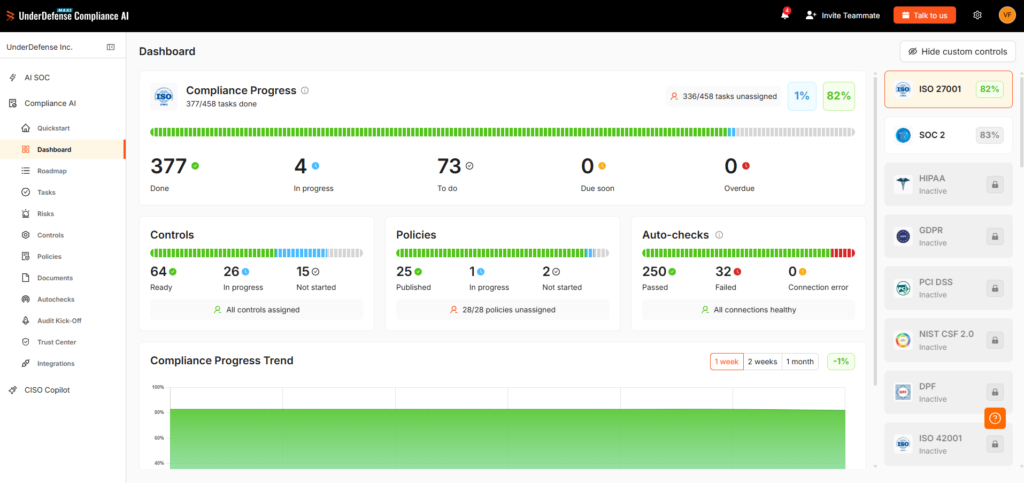
💡 MAXI Compliance AI takes the scheduled evidence work off your staff for a known monthly price. It maps each control once to Annex A and to SOC 2, pulls the evidence from Entra ID, Microsoft 365, AWS, and Jira on a schedule, and keeps it current between surveillance audits, so the access review you timed for the staff-time line runs without your team.
On G2, 83 reviews give UnderDefense an average of 5.0 out of 5 (November 2026), and the company was a 2025 Clutch Top Cybersecurity Company.
Your auditor reviews that evidence where it lives, in the platform, under the permissions you set. The same control set also answers SOC 2, HIPAA, GDPR, PCI DSS, DORA, NIST CSF 2.0, and ISO 42001. The platform collects the evidence, audit support comes with the Certified package, and the certificate itself comes from your accredited certification body.
What Changed for a Global BPO Provider
Helpware, a global business process outsourcing (BPO) provider, uses the platform for SOC 2 and ISO 27001 in eight countries. Its case study reports “50+ automated checks running 24/7,” “2× faster audit readiness,” and “30% less manual effort,” and says the rollout “reached full production readiness in 8 weeks.” That 30% is the staff-time line this guide asks you to estimate.
Packages, Consulting Hours, and Auditor Match
On UnderDefense’s published compliance packages page, monthly prices start at $499 for Starter, $1,299 for Essential, and $1,899 for Certified, plus a Free package at $0.
Each paid package also carries part of the consulting line: Starter includes 24 hours of compliance consulting a year, Essential 48, and Certified 90. From Starter up, the platform also finds you a partner audit firm within a business day, or you bring your own certification body; either way, confirm the body’s ISO/IEC 27001 accreditation as this guide recommends.
Price your ISO 27001 certification with UnderDefense
The same platform also hosts the UnderDefense Agentic AI SOC, so the evidence your auditor samples and the alerts your security team works come from one data set.
Bring your headcount and scope,
see which ISO 27001 controls your tools already prove
- Let your auditor review evidence in the platform, with access you grant
- Get 24, 48, or 90 consulting hours a year, by package
- Get matched with a partner audit firm within one business day
Frequently Asked Questions
How much does an ISO 27001 audit cost?
The audit costs its audit days multiplied by the certification body’s day rate, plus travel. ISO/IEC 27006-1 sets the starting days by headcount: 16.5 for 426 to 625 people in scope, before the body adjusts for complexity. Ask each body for its day count and day rate in writing, so quotes compare on the same basis.
How long does ISO 27001 certification take?
It depends on your scope, how far along your policies are, and when the certification body can schedule you. Readiness and closing gaps take most of the time; Stage 1 and Stage 2 take days. Ask for the body’s earliest Stage 2 date before you commit to a customer deadline, and expect the first surveillance audit within 12 months of certification.
Do you need a consultant to get ISO 27001 certified?
No. ISO 27001 doesn’t require a consultant, and the certification body can’t act as one for the system it certifies. Teams with an experienced GRC lead often certify in-house and buy outside help only for the internal audit. Teams without one can use consultant hours bundled with a compliance platform package.
How much do surveillance audits cost?
Each annual surveillance audit uses about a third of the initial audit’s days, billed at the certification body’s day rate. For a 600-person scope, that means about 5.5 days a year, plus the staff time to prepare current evidence and run the internal audit.
Is ISO 27001 cheaper if you already have SOC 2?
Yes, mainly in staff time. Evidence you already collect for SOC 2, such as access reviews, change records, and vendor reviews, maps to many Annex A controls. Starting audit days stay the same, because ISO/IEC 27006-1 sets them by headcount. If you budget both, count shared evidence hours once: what SOC 2 costs in staff time overlaps this staff line.