




Q1. What Are the 9 Best Managed SIEM Platforms for Multi-Cloud (AWS, Azure, GCP) in 2026?
The nine strongest managed SIEM platforms for multi-cloud teams in 2026 are UnderDefense, Arctic Wolf, Red Canary, ReliaQuest, Deepwatch, eSentire, Binary Defense, Dropzone AI, and Hunters. They differ less on whether they claim AWS, Azure, and GCP support and more on what each actually collects by default. Control plane, identity, network flow, and Kubernetes telemetry matter more than the logo on the datasheet, especially when a “supported” cloud needs a paid services build to see anything real.
Talk to a SIEM expert about fewer false positives.
The Moment Most Teams Realize Their SIEM Has a Blind Spot
Here is the trigger I see most often. A team runs fine on one cloud, then a new product line or an acquisition drops a second or third cloud into the estate. The incumbent SIEM “supports” it on paper. Then the security lead learns that support means a custom pipeline, a professional-services quote, and six weeks before a single GCP audit log lands in the console.
I have lived through four major SIEM implementations. I won 78% of the proofs of concept I ran, and the reason was boring: I knew exactly which logs produced which information, per cloud, before anyone signed. That is the lens for this whole list.
When I started in security operations in 2007, my team owned four tools. By the time I moved on, that same kind of team was juggling around 70. Multi-cloud SIEM is where that sprawl either gets consolidated or quietly turns into blind spots you find during an incident.
How We Ranked the Nine (One Simple Sorting Rule)
The sorting rule is one question: what does each platform collect natively, by default, versus what needs a billable build? A “native” integration is one the vendor maintains and updates when the cloud provider changes its logging APIs. A “services build” is a custom pipeline you pay to create and pay again to keep alive.
We scored each vendor on five things, which the next section breaks down in full:
- Native per-cloud coverage across AWS, Azure, and GCP
- Kubernetes and container telemetry (EKS, AKS, GKE audit logs)
- Cross-cloud identity correlation (IAM, Entra ID, Cloud Identity)
- Time to full coverage when you add a new cloud
- Ingestion cost transparency
The ranked nine, each with an honest one-line verdict:
- 1.1 UnderDefense: native AWS, Azure, GCP, and Kubernetes coverage, co-managed SIEM you own, plus an on-prem deployment option.
- 1.2 Arctic Wolf: a strong concierge brand with a mature SOC model, but a proprietary platform that trades cloud breadth and data ownership for simplicity.
- 1.3 Red Canary: genuine Microsoft and Azure depth, endpoint-anchored heritage, thinner outside that lane.
- 1.4 ReliaQuest: automation-forward GreyMatter platform, with transparency trade-offs some buyers flag.
- 1.5 Deepwatch: Splunk-anchored managed detection, powerful if you live in Splunk, less open if you do not.
- 1.6 eSentire: broad MDR pedigree, though tri-cloud native coverage is worth verifying source by source.
- 1.7 Binary Defense: analyst-led and human-heavy, with AI and automation maturity still catching up.
- 1.8 Dropzone AI: deep autonomous investigation, a newer entrant proving durability at scale.
- 1.9 Hunters: data-lake and detection depth, with tri-cloud parity worth confirming against your own log sources.
Verify Every Claim Against the Matrix
Do not take any verdict above (mine included) on faith. The detailed comparison table further down scores each vendor against the same five criteria, so you can check each claim against the vendor’s own integration docs before you shortlist. That is the “show, don’t tell” test I would apply to any provider on this page. Our SIEM evaluation questions can help you structure that review.
At UnderDefense, this is the work we do every day. We bring the managed SIEM, SOAR, and tooling, and you keep the data. Our detection and response is tailored to AWS, Azure, GCP, and Kubernetes, and we co-manage the SIEM you already own (Elastic, Splunk, QRadar, or LogRhythm) so you are not locked into our black box. If you want to see what your current setup actually collects from each cloud, that is a live exercise, not a slide.
| Provider | Best For | Key Strength | Compliance |
|---|---|---|---|
| UnderDefense (4.8, G2) | Lean 1,000 to 10,000-employee teams running true multi-cloud who want to keep their data | Native AWS, Azure, GCP, and Kubernetes coverage with co-managed SIEM and an on-prem option | SOC 2, ISO 27001, HIPAA, PCI DSS, and GDPR support |
| Arctic Wolf (4.5, G2) | Mid-market teams wanting a fully outsourced concierge SOC | Mature 24/7 concierge security model and brand | SOC 2, HIPAA, and PCI DSS readiness |
| Red Canary (4.6, G2) | Microsoft and Azure-centric estates | Deep Microsoft Defender and Azure detection engineering | SOC 2, HIPAA, and PCI DSS support |
| ReliaQuest (4.5, Gartner) | Enterprises wanting automation across existing tools | GreyMatter automation and cross-tool orchestration | SOC 2, ISO 27001, and PCI DSS support |
| Deepwatch (4.3, Gartner) | Splunk-standardized security teams | Managed detection built deep on Splunk | SOC 2, HIPAA, and PCI DSS support |
| eSentire (4.7, G2) | Mid-market seeking broad MDR with response ownership | Atlas platform and 24/7 response pedigree | SOC 2, HIPAA, PCI DSS, and GDPR support |
| Binary Defense (4.6, G2) | Teams wanting human-led threat hunting | Analyst-led hunting and managed SOC | SOC 2, HIPAA, and PCI DSS support |
| Dropzone AI (4.8, G2) | Teams testing autonomous alert investigation | AI SOC analyst automating tier-1 investigation | SOC 2 support |
| Hunters (4.6, G2) | Data-lake-first security teams | Open XDR and data-lake detection depth | SOC 2 and ISO 27001 support |
Star ratings reflect publicly listed G2 and Gartner Peer Insights averages at time of writing and shift over time; confirm the current score and each vendor’s native cloud coverage against their own documentation before you shortlist.
1.1 UnderDefense: Best for Lean Multi-Cloud Teams That Want to Keep Their Data
Overview
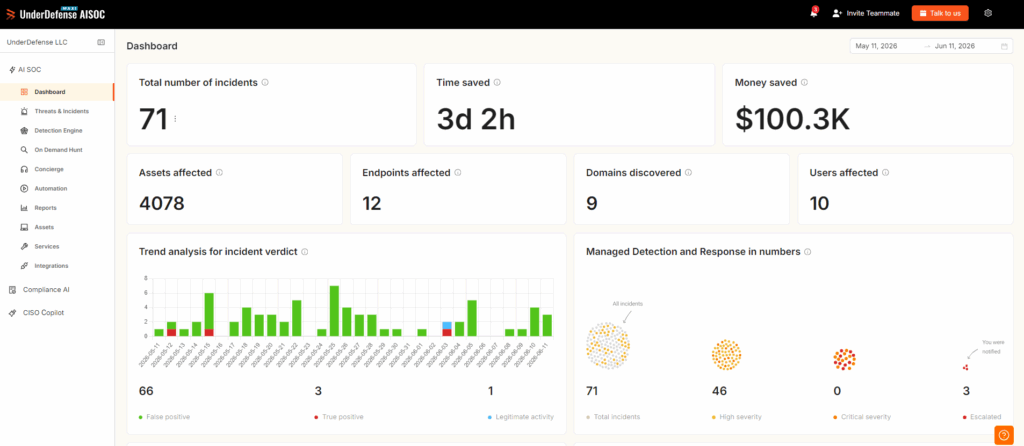
UnderDefense runs an Agentic AI SOC layered on a co-managed SIEM, built for organizations that operate across more than one cloud and cannot afford a blind spot in any of them. The model is deliberately vendor-agnostic. We bring the detection engineering, the SOC analysts, and the automation, and you keep ownership of your SIEM and your data. That matters most for teams in the 1,000 to 10,000-employee range who have real multi-cloud sprawl but a lean internal security staff.
The differentiator is coverage breadth that gets scored on the same matrix as everyone else, with no inflation. Detection and response is tailored to AWS, Azure, GCP, and Kubernetes, and the platform can run on-prem inside your own cloud, so logs and AI data stay in your data lake. If you are weighing this against staying in-house, our AI SOC build versus buy breakdown is a useful companion.
Core Services
- Agentic AI SOC (UnderDefense Agentic AI SOC) with 24/7 human analyst response, available through the WarRoom platform
- Co-managed SIEM across Elastic, Splunk, QRadar, and LogRhythm
- Native detection for AWS, Azure, GCP, and Kubernetes
- Managed cloud security services, CSPM, and cloud detection and response
- Incident response, penetration testing, compliance, and virtual CISO services
Why Companies Consider UnderDefense
Most lean teams cannot staff a 24/7 SOC in the current hiring market, and building one for compliance reasons alone rarely pencils out. UnderDefense fills that gap without a rip-and-replace, because it pulls data from the tools you already run. The recurring theme in customer feedback is noise reduction with real context, so the alerts that reach you are worth looking into.
Ideal Customer Profile
Best suited for:
- Multi-cloud teams of roughly 1,000 to 10,000 employees
- Security-lean organizations needing 24/7 coverage without new headcount
- Compliance-driven teams (SOC 2, ISO 27001, and HIPAA) needing audit-ready evidence
- Companies that want to keep SIEM and data ownership, avoiding lock-in
Commercial Model
UnderDefense operates on a subscription aligned to environment size and scope, and includes onboarding, tuning, 24/7 monitoring, and analyst response. Because you keep your own SIEM, log-ingestion economics stay in your control rather than the provider’s. You can sense-check the numbers with our managed SIEM ROI calculator.
When to Shortlist
Shortlist UnderDefense when you have added a second or third cloud, need coverage in weeks rather than a multi-month services build, and want the SOC to own outcomes without owning your data.
Customer Reviews
“The biggest win for me was getting actual control over our security alerts. Before the guys from UD stepped in, we were getting bombarded with alerts from all our security tools. Their team cleaned up our configurations and got the noise under control within the first week. The platform itself is straightforward, it pulls in data from all our existing security tools, so we didn’t have to rip and replace anything.”
Verified User in Marketing and Advertising, Small-Business UnderDefense G2 Verified Review
“Having navigated numerous cloud configurations and server environments over the years, I genuinely appreciate how UnderDefense Agentic AI SOC seamlessly integrates MDR with AWS. Started with a learning curve which is quite common for such swiss knife kind of tools.”
Lesia P., Product Marketing Manager UnderDefense G2 Verified Review
1.2 Arctic Wolf: Best for Mid-Market Teams Wanting a Fully Outsourced Concierge SOC
Overview
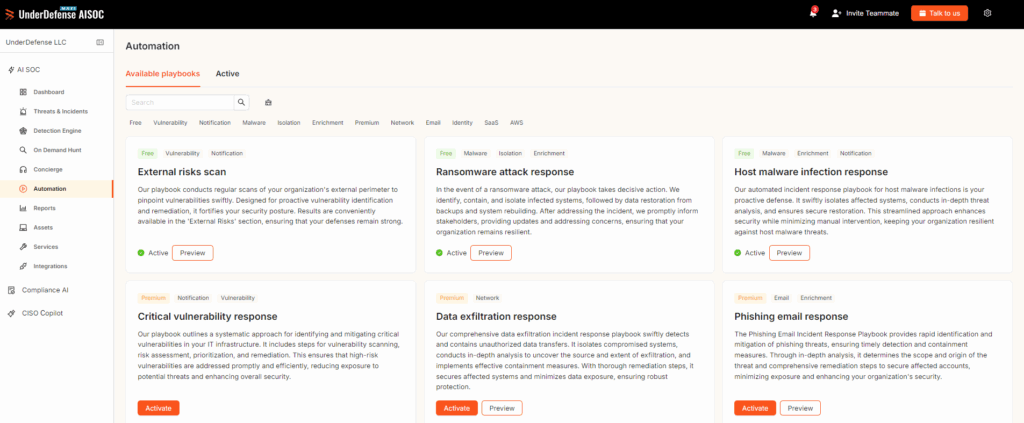
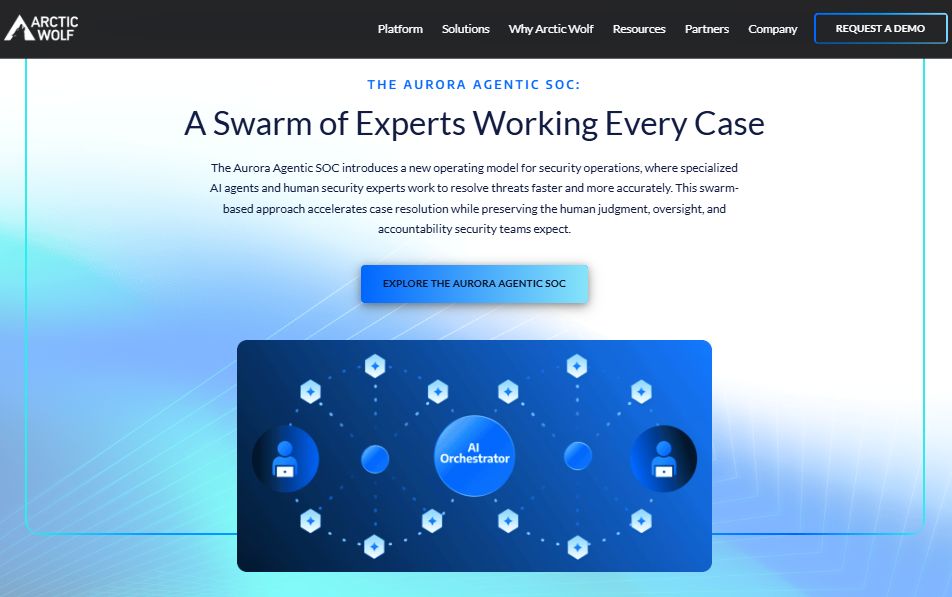
Arctic Wolf is a well-established managed security provider built around a concierge model, where you get a named security team rather than only a tool. For mid-market organizations that want enterprise-style coverage without building an internal SOC, that packaging is genuinely attractive, and the brand carries real weight in the MDR category.
The structural trade-off shows up in multi-cloud. Arctic Wolf runs on its own proprietary platform, so changes and investigations route through their engineering team, and you do not own the underlying data the way you would with a co-managed SIEM. For a single-cloud shop that is fine. For a true tri-cloud estate that wants control and portability, it is a real constraint to weigh, and one reason teams explore Arctic Wolf alternatives.
Core Services
- 24/7 Managed Detection and Response via the Concierge Security model
- Cloud and endpoint monitoring
- Vulnerability and risk management
- Incident response support
- Compliance readiness assistance (SOC 2, HIPAA, and PCI DSS)
Why Companies Consider Arctic Wolf
Many mid-market teams lack the budget or talent to run their own SOC, and Arctic Wolf positions itself as an operational partner that moves them from reactive alerting to continuous monitoring. The concierge relationship is the draw, since a named team that learns your environment reduces day-to-day overhead.
Ideal Customer Profile
Best suited for:
- Mid-market organizations of roughly 50 to 1,000 employees
- Security-lean teams that want a turnkey outsourced SOC
- Compliance-driven companies needing continuous monitoring
- Teams comfortable operating inside a single proprietary platform
Commercial Model
Arctic Wolf typically prices on a subscription aligned to organization size and monitored assets, with onboarding and ongoing advisory included. Buyers should note contract terms carefully, including renewal-notice windows, during evaluation.
When to Shortlist
Shortlist Arctic Wolf when you want a fully managed concierge SOC and your cloud footprint is relatively contained. Be more cautious when data ownership, deep tri-cloud native coverage, or in-platform self-service are hard requirements.
Customer Reviews
“Arctic Wolf provides solid detection and response capabilities, but overly relies on the client’s team for remediation, which really hurts the value of the service. Lack of true remediation in the response, costing us significantly in resources and introducing risks in security.”
VP of Technology, Services non-Government Arctic Wolf Gartner Verified Review
“The product offered little visibility when we were using it. Anything you want to look at or changes you need to make in the product must go through their engineering team. As an MSP, this is a horrible way to do business for us.”
Matt C., Manager, Cybersecurity Services Arctic Wolf G2 Verified Review
1.3 Red Canary: Best for Microsoft and Azure-Centric Estates
Overview
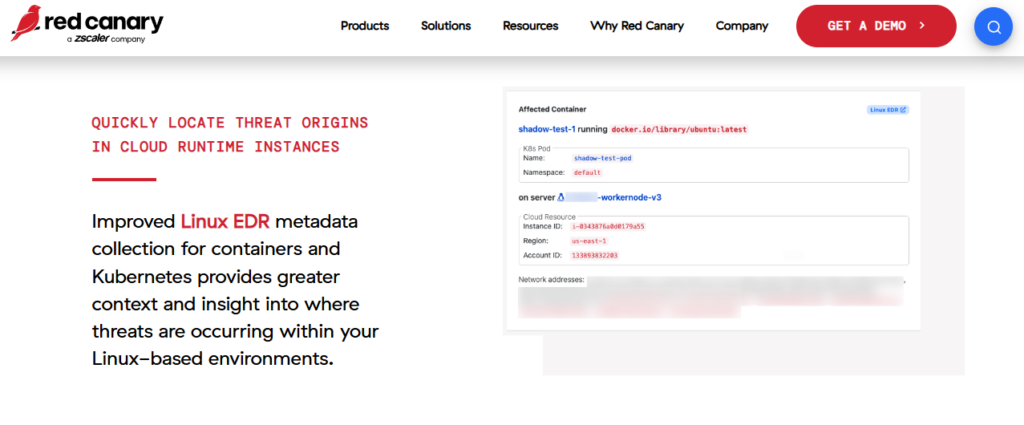
Red Canary earned its reputation on endpoint detection, and that heritage now shows up as genuine depth in the Microsoft and Azure stack. If most of your identity and workloads live in Entra ID and Azure, Red Canary reads those signals well. The honest limit is breadth. Coverage thins as you move into a true tri-cloud estate that leans heavily on AWS and GCP at the same time. For that scenario, our AI SOC for cloud-native infrastructure guidance is worth a read.
Core Services
- Managed detection and response with strong endpoint roots
- Deep Microsoft Defender and Azure signal coverage
- Threat hunting and detection engineering
- Cloud and identity monitoring
- Guided response and investigation
Why Companies Consider Red Canary
Teams standardized on Microsoft pick Red Canary because the detections feel native, not bolted on. The investigation quality is high, and analysts explain the “why” behind an alert rather than passing a raw signal downstream.
Ideal Customer Profile
Best suited for:
- Microsoft and Azure-centric organizations
- Endpoint-heavy security programs
- Teams wanting mature detection engineering
- Mid-market to enterprise buyers already in the Defender ecosystem
Commercial Model
Red Canary prices on a subscription tied to monitored endpoints and identities, with detection content and response guidance included.
When to Shortlist
Shortlist Red Canary when Azure is your center of gravity. Weigh it more carefully when AWS and GCP carry equal weight and you need identical native depth in all three.
1.4 ReliaQuest: Best for Enterprises Automating Across Existing Tools
Overview
ReliaQuest’s GreyMatter platform sits on top of the tools you already own and orchestrates detection and response across them. That “work with what you have” model appeals to enterprises with sprawling stacks. The trade-off some buyers raise is transparency, since automated outputs can arrive as tickets without a clear path to resolution. Teams weighing that trade-off often review ReliaQuest alternatives before deciding.
Core Services
- GreyMatter security operations platform
- Cross-tool detection and automated response
- Threat hunting and detection content
- Integration across existing SIEM and EDR
- Metrics and reporting on SOC performance
Why Companies Consider ReliaQuest
Large teams like that ReliaQuest reduces swivel-chair work across many consoles. The automation layer can genuinely cut manual effort when the underlying detections are tuned well.
Ideal Customer Profile
Best suited for:
- Enterprises with large, heterogeneous tool stacks
- Teams prioritizing automation and orchestration
- Organizations wanting to keep existing tooling
- SOCs measuring and improving performance metrics
Commercial Model
ReliaQuest prices on a subscription aligned to environment scope and integrated tools, with the GreyMatter platform and managed operations included.
When to Shortlist
Shortlist ReliaQuest when orchestration across many existing tools is the priority. Push harder in evaluation on how much context accompanies each escalation, so alerts arrive with answers attached. Our AI SOC evaluation questions can guide that conversation.
1.5 Deepwatch: Best for Splunk-Standardized Security Teams
Overview
Deepwatch built its managed detection deep on Splunk, and if you already live in Splunk, that alignment is a real strength. The engine is powerful and the detections are mature. The structural trade-off is openness. Teams that do not standardize on Splunk, or want to move data freely across an open architecture, feel the constraint sooner. If Splunk is your standard, our MDR for Splunk option is built for that footprint.
Core Services
- Managed detection and response on Splunk
- Threat detection engineering and tuning
- Threat hunting
- Managed SIEM operations
- Reporting and detection coverage mapping
Why Companies Consider Deepwatch
Splunk-heavy shops get a managed layer that speaks their language natively. The detection content and tuning maturity can outperform a generic overlay for those environments.
Ideal Customer Profile
Best suited for:
- Organizations standardized on Splunk
- Teams wanting managed SIEM operations
- Enterprises with mature logging pipelines
- Security programs comfortable inside one data platform
Commercial Model
Deepwatch prices on a subscription tied to data volume and scope, with managed detection and Splunk operations included.
When to Shortlist
Shortlist Deepwatch when Splunk is your standard and you want it managed well. Reconsider if open architecture and freedom to move data across clouds are hard requirements, a topic our guide on avoiding SIEM vendor lock-in covers in depth.
1.6 eSentire: Best for Mid-Market Seeking Broad MDR With Response Ownership
Overview
eSentire has a long MDR pedigree, and its Atlas platform pairs automated detection with 24/7 human response. For mid-market teams that want a provider to own response rather than just alert, it is a credible option. The honest caveat here is tri-cloud native coverage. Confirm exactly what Atlas ingests from AWS, Azure, and GCP by default, source by source, before you sign.
Core Services
- Managed detection and response via the Atlas platform
- 24/7 SOC and response actions
- Threat hunting and threat intelligence
- Endpoint, network, and cloud monitoring
- Incident response support
Why Companies Consider eSentire
Buyers value that eSentire takes response actions rather than handing back a ticket. The 24/7 SOC pedigree gives lean teams real coverage without building their own.
Ideal Customer Profile
Best suited for:
- Mid-market organizations wanting response ownership
- Security-lean teams needing 24/7 coverage
- Companies consolidating detection and response
- Buyers valuing threat intelligence depth
Commercial Model
eSentire prices on a subscription aligned to monitored assets and scope, with the Atlas platform and 24/7 response included.
When to Shortlist
Shortlist eSentire when response ownership matters and your cloud footprint is well defined. Verify native tri-cloud log parity against your own sources during the proof of concept, using a structured managed SIEM readiness assessment.
1.7 Binary Defense: Best for Teams Wanting Human-Led Threat Hunting
Overview
Binary Defense leans on human analysts and threat hunting as its core identity. For teams that want experienced people digging into their environment, that human-heavy model is a genuine strength. The trade-off is automation maturity. As alert volumes and multi-cloud complexity grow, a human-first model can strain without a deeper automation layer underneath it.
Core Services
- Managed detection and response
- Human-led threat hunting
- Managed SOC operations
- Endpoint monitoring
- Counterintelligence and threat research
Why Companies Consider Binary Defense
Teams that have been burned by pure black-box automation like the analyst-led approach. The hunting mindset surfaces threats that rule-only systems can miss.
Ideal Customer Profile
Best suited for:
- Teams valuing hands-on human analysts
- Organizations prioritizing proactive threat hunting
- Mid-market security programs
- Buyers wanting a hunting-forward partner
Commercial Model
Binary Defense prices on a subscription tied to scope and monitored assets, with managed SOC and hunting services included.
When to Shortlist
Shortlist Binary Defense when human-led hunting is the priority. Probe how automation scales the routine work, so analysts stay focused on the edge cases across your clouds, an approach detailed in our human-in-the-loop SOC design guide.
1.8 Dropzone AI: Best for Teams Testing Autonomous Alert Investigation
Overview
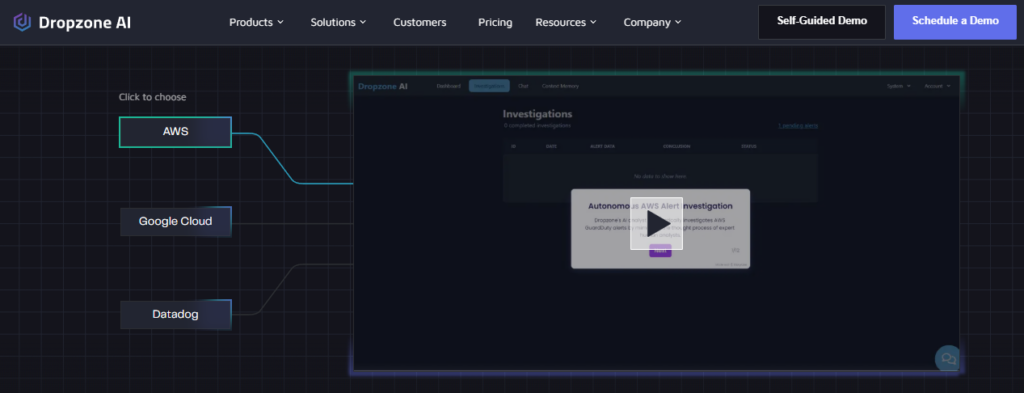
Dropzone AI focuses on autonomous investigation, using an AI SOC analyst to work through tier-1 alerts the way a human analyst would. For teams drowning in tier-1 triage, that depth is compelling. As a newer entrant, the honest questions are durability at scale and how well the autonomous layer holds up across complex tri-cloud environments over time. Our Dropzone pricing guide breaks down the commercial side.
Core Services
- AI SOC analyst for autonomous alert investigation
- Automated tier-1 triage and enrichment
- Integration with existing security tools
- Investigation reporting and context
- Alert-to-decision workflow support
Why Companies Consider Dropzone AI
Lean teams like that Dropzone works the alert queue without adding headcount. The investigation output arrives with context, which speeds the human decision.
Ideal Customer Profile
Best suited for:
- Lean teams overwhelmed by tier-1 alert volume
- Organizations testing autonomous investigation
- Security programs wanting to augment analysts
- Buyers comfortable with a newer platform
Commercial Model
Dropzone AI prices on a subscription aligned to alert volume and integrations, with the autonomous investigation layer included.
When to Shortlist
Shortlist Dropzone AI when autonomous tier-1 investigation is your pain point. Test how its reasoning holds up on cross-cloud identity cases, and demand auditable investigation trails, not just a verdict, a standard our AI SOC explainability and transparency resource explains.
1.9 Hunters: Best for Data-Lake-First Security Teams
Overview
Hunters takes an open XDR and data-lake approach, letting teams keep detection on top of their own data rather than a closed platform. For data-lake-first shops, that architecture is a real advantage. The honest caveat matches the others at the frontier: confirm tri-cloud parity against your specific AWS, Azure, and GCP log sources before you commit. Teams that prioritize this often shortlist an AI SOC that keeps your own SIEM data lake.
Core Services
- Open XDR detection and response
- Data-lake-based security analytics
- Cross-source correlation and detection content
- Threat hunting
- Integration with existing data pipelines
Why Companies Consider Hunters
Teams that value data ownership like keeping detection on their own lake. The open model avoids some of the lock-in that closed platforms carry.
Ideal Customer Profile
Best suited for:
- Data-lake-first security teams
- Organizations prioritizing data ownership
- Teams with mature data engineering
- Buyers wanting open architecture
Commercial Model
Hunters prices on a subscription tied to data scope and sources, with open XDR detection content included.
When to Shortlist
Shortlist Hunters when a data-lake-first, open architecture is core to your strategy. Verify native parity across all three clouds source by source, since data-lake breadth does not automatically mean tri-cloud detection depth.
Where UnderDefense Fits Across This Field
Reading the nine together, one pattern stands out. Most trade one strength for a structural constraint: Red Canary is deepest in Azure, Deepwatch is anchored to Splunk, Dropzone leans fully autonomous, and several ask you to verify tri-cloud parity yourself. My read is that the honest question for a multi-cloud buyer is coverage breadth plus data ownership, together.
That is the gap UnderDefense is built for. We bring the managed SIEM, SOAR, and tooling, and you keep the data, with detection tailored to AWS, Azure, GCP, and Kubernetes on the same matrix as everyone here. The Agentic AI SOC (UnderDefense Agentic AI SOC) works the routine triage, and human analysts own the edge cases, with a 2-minute alert-to-triage target and 15-minute escalation for critical incidents, delivered through the WarRoom platform. If avoiding lock-in while covering every cloud is the priority, that combination is worth a direct comparison.
Q2. How Did We Score These Platforms, and Should You Run Managed or Self-Managed?
Each platform is scored across five weighted criteria: Native Per-Cloud Coverage (30%), Kubernetes and Container Telemetry (20%), Cross-Cloud Identity Correlation (20%), Time-to-Full-Coverage (15%), and Ingestion Cost Transparency (15%). Scores map to stars, from 0 to 20% (1 star) up to 81 to 100% (5 stars). Managed suits lean cloud teams who want coverage without headcount. Self-managed suits teams with dedicated SIEM engineers who accept the tuning and cost burden.
Why Most “Best SIEM” Lists Fail a Multi-Cloud Buyer
Most ranking pages score brand recognition and analyst-quadrant position. That is fine if you run one cloud. It quietly breaks when you run three.
A demanding reader does not care that a vendor is famous. They care what it collects, per cloud, by default. So the whole scoring model here weights collection over reputation, because a SOC can only act on data it actually receives. Our SIEM solutions comparison applies the same lens.
The Five Weighted Criteria (Summing to 100%)
I weight coverage first for a simple reason. Autonomous response can only act on what the SIEM ingests. A brilliant detection engine sees nothing if the log never arrives.
| Criterion | Weight | What it measures |
|---|---|---|
| Native Per-Cloud Coverage | 30% | Default, maintained ingestion across AWS, Azure, and GCP |
| Kubernetes and Container Telemetry | 20% | EKS, AKS, and GKE audit-log collection |
| Cross-Cloud Identity Correlation | 20% | Linking IAM, Entra ID, and Cloud Identity as one story |
| Time-to-Full-Coverage | 15% | Days to see a new cloud, native versus a paid build |
| Ingestion Cost Transparency | 15% | Predictable pricing without hidden per-GB shocks |
The star bands are blunt on purpose. A vendor scoring 81 to 100% earns 5 stars, 61 to 80% earns 4 stars, and so on down to 1 star. You can re-weight these for your own footprint. A GCP-heavy shop might push per-cloud coverage past 30%.
This framing lines up with how Gartner defines Cloud Investigation and Response Automation, or CIRA, a category built on automated collection and analysis of cloud forensic data. Collection comes first there too, a point our AI SOC MITRE ATT&CK coverage comparison for cloud expands on.
Managed or Self-Managed: The Decision That Gates the List
Here is the honest fork in the road. Self-managed SIEM gives you maximum control, and it demands dedicated engineers to tune rules, chase false positives, and own the cost curve. If you have that bench, it can be the right call. Our AI SOC build versus buy analysis walks through the math.
Managed suits the lean multi-cloud team that cannot staff a 24/7 SOC in this hiring market. Speed matters. If you buy faster triage but still stare at the same alert volume, that is motion, not transformation.
My read is that most 1,000 to 10,000-employee teams sit in the managed camp, because the burnout math on self-managed rarely works. UnderDefense scores 5 stars on this matrix, driven by documented AWS, Azure, GCP, and Kubernetes coverage plus a co-managed SIEM you keep owning. We present that as an outcome of the criteria, scored the same as everyone else, and not an exemption from them. Teams comparing options often start with our managed SIEM service and the best managed SIEM providers for 2026 guide.
Q3. Why Is “Multi-Cloud Support” Meaningless, and What Does Complete Coverage Look Like Per Cloud?
“Multi-cloud support” says little because it spans a native, maintained integration all the way to a billable custom pipeline. Complete coverage is specific: AWS (CloudTrail, GuardDuty, VPC Flow, IAM, and EKS audit), Azure (Activity Log, Entra ID, Defender, NSG Flow, and AKS), and GCP (Cloud Audit Logs, VPC Flow, Cloud Identity, Security Command Center, and GKE audit), each mapped to MITRE ATT&CK with UEBA and SOAR on top. If a vendor cannot name what it collects, its “support” is marketing.
The Support Spectrum Nobody Puts on the Datasheet
“Support” hides three very different things. On one end is a native integration the vendor maintains and updates when the cloud provider changes its logging APIs. In the middle sits a gated integration, available but behind a higher tier. On the far end is a services build, a custom pipeline you pay to create and pay again to keep alive. Our managed SIEM integration guide breaks these down.
The maintenance question is the one that bites. Cloud logging APIs change often. When they do, someone has to fix the pipeline, and you want that someone to be the vendor, by default.
I have watched a Microsoft-only team love Azure Sentinel until they started ingesting outside tools. The bill climbed fast, and the “solution” became dropping logs or shoving them into cold storage. That is a blind spot created by economics, dressed up as support, and one reason teams read our guide on avoiding SIEM vendor lock-in.
AWS, Azure, and GCP: What Complete Actually Means
Complete coverage is a named list of sources per cloud, not a logo. Here is the checklist I hand any vendor.
- AWS: CloudTrail (control plane, meaning management actions), GuardDuty (threat detection), VPC Flow Logs (network), IAM (identity), and EKS audit logs (Kubernetes).
- Azure: Activity Log (control plane), Entra ID (identity), Microsoft Defender (threat detection), NSG Flow Logs (network), and AKS audit logs.
- GCP: Cloud Audit Logs (control plane), VPC Flow Logs (network), Cloud Identity (identity), Security Command Center (threat detection), and GKE audit logs.
Each source should map to MITRE ATT&CK, the public catalog of attacker techniques, so detections tie to real behavior. UEBA (User and Entity Behavior Analytics) then flags odd activity, and SOAR (Security Orchestration, Automation, and Response) runs the playbook. Those three are capability signals of a serious platform, as our threat detection tools overview explains.
Missing Sources, Not Missing Tools
The failure mode is rarely a bad tool. It is an inactive log. I have seen an intrusion where the early phase went fully undetected despite strong endpoint and SIEM products, because the right logs were never switched on.
That is the whole point. When I ran proofs of concept, I won most of them because I knew exactly which logs produced which information, per cloud, before signing. This is a “show, don’t tell” test you can reproduce with our managed SIEM evaluation questions.
At UnderDefense, we bring the SIEM, SOAR, and tools, and you keep the data. We treat these sources as native default collection and write cloud-native detections per source, so coverage is a list you can audit rather than a claim you have to trust. That is the foundation of our cloud security services.
Q4. Where Do the Real Blind Spots Hide: GCP, Kubernetes, and Cross-Cloud Identity?
Three blind spots recur in multi-cloud estates. GCP is often the least uniformly instrumented, so verify Cloud Audit Log routing, VPC Flow, and GKE ingestion per source rather than per datasheet. Kubernetes API-server audit logs are frequently off by default across EKS, AKS, and GKE. And identity, spanning IAM, Entra ID, and Cloud Identity, is the seam attackers traverse, where a reused credential looks like two unrelated events without cross-cloud correlation.
Block A: Why GCP Coverage Often Lags
This is a structural pattern, not a swipe at any one vendor. Many SIEM platforms matured on AWS first, then Azure, with GCP arriving last. GCP also uses a distinct log-sink and routing model, so parity takes deliberate engineering.
The practical result is uneven depth. A platform may “support” GCP while quietly missing GKE audit logs or specific Cloud Audit Log categories. Verify the routing yourself, source by source, during the proof of concept, ideally with a cloud security assessment.
Do not trust the datasheet here. Ask which GCP log types land natively, and which need a build. That one question surfaces the gap fast.
Block B: Kubernetes, the Invisible Cluster Boundary
Kubernetes is where visibility quietly ends. The API-server audit log, which records who did what inside the cluster, is commonly disabled by default. AWS documents that EKS control-plane audit logging is off unless you enable it, and Google documents GKE audit-log behavior you have to configure.
CSPM (Cloud Security Posture Management, which checks configuration) does not close this. CSPM tells you a cluster is misconfigured. It does not tell you an attacker just created a privileged role inside it.
I have seen the orchestration layer become a real gap, where a destructive action ran with almost no in-cluster telemetry behind it. If the audit log is off, the investigation starts blind. Turn it on across EKS, AKS, and GKE, then confirm your SIEM actually ingests it, a step our security log analysis resource details.
Block C: Identity, the Cross-Cloud Seam
Identity is the seam that ties the whole estate together, and it is where attackers move. A credential compromised in one cloud gets reused in another, and without correlation it reads as two unrelated events.
The Verizon 2025 DBIR found that 43% of cloud-related secrets exposed in public repositories were Google Cloud API keys, typically high-privilege and long-lived. Credential abuse was also the most common initial access vector that year. That is the raw material for lateral movement, which is why behavioral analytics for security matters so much here.
Speed makes it worse. In a well-known intrusion pattern, an actor who social-engineered cloud credentials created an administrative role and launched compute in about a minute. One stale login from an unexpected region can be an old compromise still walking through the front door.
The M&M Problem, and How We Close It
The old network was an M&M, hard shell and soft center. Cloud identity broke the shell, so one breached credential can leave the center exposed. The fix is correlation, treating IAM, Entra ID, and Cloud Identity as one story.
At UnderDefense, our cloud detection and response includes Kubernetes as a consolidation of tooling rather than another bolt-on, and we correlate identity across all three clouds as a single investigation. The model is analyst-in-the-loop: the AI collects context, and a human decides, an approach detailed in our human-in-the-loop SOC design. No “coming soon,” just coverage you can audit today.
Q5. Which Vendor Fits Your Cloud Footprint? The 9 Platforms Compared
Each platform suits a different footprint. UnderDefense leads on breadth, with native AWS, Azure, GCP, and Kubernetes coverage plus on-prem and a co-managed SIEM. Red Canary is strongest for Microsoft and Azure-centric estates. Dropzone AI and Hunters lead on autonomous investigation depth. Arctic Wolf, ReliaQuest, Deepwatch, eSentire, and Binary Defense each carry documented trade-offs on cloud breadth, open architecture, or automation. Match the vendor to whichever cloud is your weak spot.
The Master Coverage Matrix
This is the table I would build before any proof of concept. Native means default, maintained collection. Services build means you pay to create and maintain the pipeline. Our SIEM solutions comparison uses the same approach.
| Vendor | AWS / Azure / GCP native | Kubernetes | On-prem / hybrid | MITRE / UEBA / SOAR | Pricing model | Rating | Honest limitation |
|---|---|---|---|---|---|---|---|
| UnderDefense | All three native | Yes | Yes | All three | Subscription, keep your SIEM | 5 stars | Onboarding needs upfront config time |
| Arctic Wolf | Broad, own platform | Partial | Limited | Partial | Subscription | 4 stars | Ties detection to their SIEM |
| Red Canary | Azure-deep | Partial | Limited | Yes | Per endpoint/identity | 4.5 stars | Thinner on GCP breadth |
| ReliaQuest | Overlay on your tools | Partial | Hybrid | Yes | Subscription | 4 stars | Automation can return tickets without answers |
| Deepwatch | Splunk-anchored | Partial | Hybrid | Yes | Data volume | 4 stars | Closed to non-Splunk architectures |
| eSentire | Verify per source | Partial | Limited | Yes | Per asset | 4.5 stars | Confirm tri-cloud parity yourself |
| Binary Defense | Verify per source | Partial | Limited | Partial | Subscription | 4 stars | Automation depth still maturing |
| Dropzone AI | Integration-based | Partial | Limited | UEBA/SOAR-leaning | Per alert volume | 4.5 stars | Newer, prove durability at scale |
| Hunters | Data-lake, verify parity | Partial | Hybrid | Yes | Data scope | 4 stars | Lake breadth is not detection depth |
Ratings reflect this article’s five-criteria scoring, weighted toward native per-cloud collection. Confirm each row against the vendor’s own integration docs before you shortlist, using our managed SIEM evaluation questions.
Reading the Matrix Honestly
A few genuine strengths deserve naming. Red Canary’s Microsoft and Azure depth is real, and it reads Entra ID signals well. Forrester Wave-tier providers like Expel do document GCP coverage across Security Command Center and Cloud Logging, so do not assume a gap that a vendor has actually closed.
The trade-offs are structural, not bugs. Arctic Wolf’s model ties detection to its own platform, Deepwatch anchors to Splunk, and heavy automation can hand back tickets without a clear path to resolution. None of that makes them bad. It makes them a fit for some footprints and a constraint for others, which is why teams often review Arctic Wolf alternatives before committing.
Where UnderDefense Sits
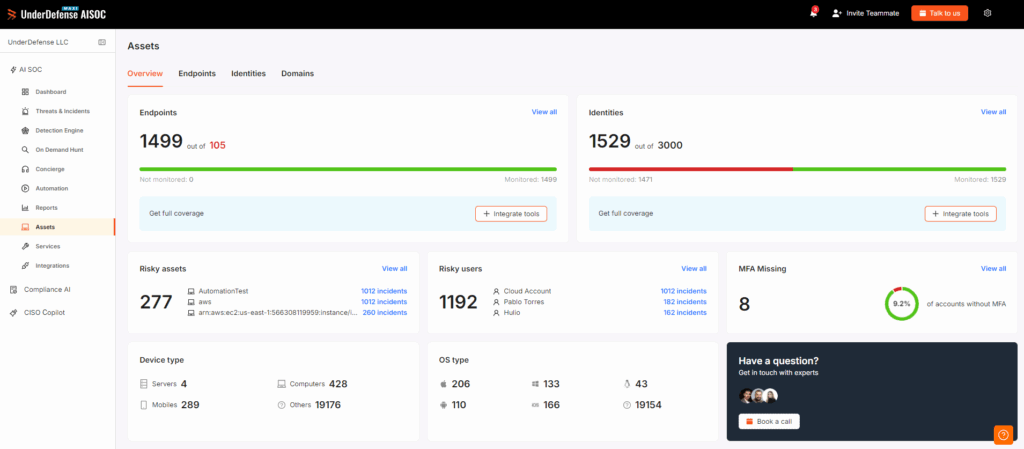
UnderDefense holds entry 1.1 at 5 stars, with detection tailored to AWS, Azure, GCP, and Kubernetes across a broad integration catalog. The Agentic AI SOC (UnderDefense Agentic AI SOC) can run on-prem inside your own cloud, keeping logs and AI data in your data lake, and co-manages the SIEM you own, whether Elastic, Splunk, QRadar, or LogRhythm, through the WarRoom platform. The honest limitation is real: proper onboarding takes upfront configuration time to wire every source correctly. Teams weighing this often start with our managed SIEM service.
Customer Reviews
“The platform itself is straightforward, it pulls in data from all our existing security tools, so we didn’t have to rip and replace anything. Setting everything up took some back and forth to get our tools properly integrated.”
Verified User in Marketing and Advertising, Small-Business UnderDefense G2 Verified Review
“Arctic Wolf provides solid detection and response capabilities, but overly relies on the client’s team for remediation, which really hurts the value of the service.”
VP of Technology, Services non-Government Arctic Wolf Gartner Verified Review
Q6. What Will Full Coverage Cost, and How Fast Can You Close the Gap?
In multi-cloud you pay twice. First for cloud egress to move logs out, then for per-GB SIEM ingestion, so full coverage can be technically available yet economically prohibitive. That pushes teams to drop logs and quietly recreate blind spots. Time-to-coverage for a new cloud ranges from same-day native integration to a multi-week services build. And the more autonomous your response layer, the more dangerous incomplete ingestion becomes.
The Double Charge Nobody Budgets For
Here is the cost trap. Cloud providers charge egress to move data out, and your SIEM charges per gigabyte to take it in. Two meters, one log. You can model this with our managed SIEM ROI calculator.
So teams do the rational thing under a fixed budget. They drop logs or park them in cold storage, where an investigation cannot reach them fast. The blind spot was not a technical failure. It was an accounting decision.
The Tuning Lever and the Speed Question
Most of that volume is noise. Working through customer environments, we have cut ingestion by around 90%, from roughly 300GB a day to 35 to 40GB, by dropping crap, unused, and duplicate logs that vendors often profit from carrying. That is the lever most buyers never pull, and our guide on avoiding SIEM vendor lock-in explains why.
Speed is the other half. Adding a new cloud can be same-day with native integrations, or a multi-week services build if the pipeline is custom. Given that attacker breakout time can run under a minute in the fastest cases, weeks-to-coverage is the honest bar to beat, a topic our managed SIEM implementation guide covers.
Why Coverage Gaps Get More Dangerous With AI
Autonomous response only acts on what the SIEM ingests. So a coverage gap is not a quiet risk. It is a blind spot your automation confidently operates around.
Feed a modern SOC clean, complete telemetry and the depth is real, with autonomous investigation running many reasoning steps per alert. Feed it partial data and it triages fast toward the wrong conclusion. Agents work best as foot soldiers, with human engineers as the generals, an approach detailed in our human-in-the-loop SOC design.
Framing the Spend as Consolidation
The CFO case is not “add another tool.” It is consolidate several into one and reclaim the double-charge. Get a fully managed Cloud SIEM live quickly, cut ingestion cost meaningfully, and reduce alert noise sharply over onboarding, so spend maps to signal. Our SOC service is built around that model.
At UnderDefense, that consolidation is the point. Time is the currency of the cloud, and the goal is coverage you can afford to keep switched on.
“The biggest problem they solved was our 24/7 coverage gap. We needed round-the-clock monitoring for compliance reasons, but building our own SOC wasn’t realistic with our budget and the current hiring market.”
Verified User in Marketing and Advertising, Small-Business UnderDefense G2 Verified Review
Q7. How Does UnderDefense Close a Multi-Cloud Blind Spot Without a Six-Month Project?
UnderDefense closes a cloud blind spot by co-managing your existing SIEM rather than replacing it. We bring native detection and response tailored to AWS, Azure, GCP, and Kubernetes, running on-prem in your own cloud so logs and AI data stay in your data lake. It consolidates CSPM and CDR point tools into one platform, with analyst-in-the-loop verdicts, so autonomous response acts only on complete, verified telemetry.
Why Replacement Is the Wrong Move
The reader’s live gap is usually a third cloud the incumbent cannot fully see. The instinct is to rip and replace the SIEM. That instinct is expensive and slow, and it throws away detection logic you already trust. Our cloud security services take the opposite path.
Replacement also resets the clock. You lose months re-tuning, and the blind spot stays open the whole time. Adding coverage on top of what you own closes the gap faster, as our managed SIEM with existing EDR guide shows.
What We Actually Bring
The approach is deliberately open, like Lego bricks rather than a sealed box. You keep your build, and we make it work harder.
- Broad integration coverage across cloud, identity, endpoint, and network sources.
- On-prem deployment inside your own cloud, so data never has to leave.
- Co-management of the SIEM you own, whether Elastic, Splunk, or QRadar.
- External and cyber-asset attack-surface visibility (EASM and CAASM).
- Detection Logic as Code, so detections are versioned and auditable per source.
The honest limitation stays the same as everywhere in this guide. Wiring every source correctly takes upfront onboarding effort, and I would rather set that expectation than pretend it is instant. A structured managed SIEM readiness assessment makes that scope clear.
One Platform Instead of a Drawer of Tools
The payoff is consolidation. One platform replaces the drawer full of point tools, and the Agentic AI SOC (UnderDefense Agentic AI SOC) works the routine triage while human analysts own the edge cases, delivered through the WarRoom platform. We bring the SIEM, SOAR, and tools, and you keep the data. The Agentic AI SOC (UnderDefense Agentic AI SOC) targets a 2-minute alert-to-triage and 15-minute escalation for critical incidents.
That mix matters more each quarter. As automation gets stronger, being a human in the loop is the flex, because the AI collects context and a person makes the call.
The Question I’m Sitting With
Here is what I keep turning over. In the next 18 to 24 months, autonomous SOC agents will get faster and more confident, and the teams that win will be the ones who kept their telemetry complete and their humans in the loop.
So the real question for your estate is simple. Which cloud can you not fully see right now, and what would it take to close that this quarter rather than next year? If you want a straight answer on where your gaps are, our team is ready to talk through your cloud footprint.
See tuned SIEM triage in action.