




Q1: Arctic Wolf in 2026: What Is the Platform, and Why Is There No Public Price List?
You received a quote. It had a total. It had no line items.
That single moment, staring at a number with no way to verify it, is why you’re reading this. Arctic Wolf runs a channel-first sales model through more than 2,200 partners worldwide. Public pricing would short-circuit that motion. So they don’t publish it. What you get instead is a quote, a deadline, and asymmetric information.
Here is what the quote won’t tell you: Arctic Wolf is not a single product. It is a company that sells eight distinct managed security services, all running on top of the Aurora Superintelligence Platform (rebranded March 2026). For buyers comparing alternatives, our MDR vendors list 2025 covers the wider competitive field.
See how the UnderDefense Agentic AI SOC investigates, triages, and resolves real alerts.
The Eight Product Families You’re Actually Evaluating
| Product Family | What It Does | Pricing Model | Covered In |
|---|---|---|---|
| MDR | 24/7 detection and response, per user/server | Per unit/year | Q2 |
| Aurora Endpoint Security | EPP/EDR, three tiers from prevention to fully managed | Per device/year | Q3 |
| Managed Risk | Continuous vulnerability scanning, CSPM, asset discovery | Per user/year | Q3 |
| Managed Security Awareness Plus | Phishing simulation, microlearning, and account takeover monitoring | Per user/year | Q3 |
| Incident360 IR Retainer | End-to-end IR for one incident, 3-hr SLA | Flat annual | Q3 |
| Threat Intelligence | Real-time intel module, curated reporting | Add-on to MDR | Q3 |
| Aurora Exposure Management | Attack Surface Management plus Vulnerability Management (launched May 2026) | Quote-only | Q3 |
| Total Security Operations Bundle | MDR plus all above plus $3M Security Warranty | Quote-only bundle | Q4, Q6 |
None of these carry a public commercial price list. Every number in this guide is sourced from the Arctic Wolf Public Sector Price List (Texas DIR, February 2025) or Vendr transaction data (May 2026). I’ll flag which is which as we go. Buyers wanting a structured framework can also use our MDR buyers guide alongside this breakdown.
Why Opacity Persists at This Scale
Arctic Wolf crossed $500M+ ARR while pursuing IPO readiness. At that revenue tier, a channel-first model with more than 2,200 reseller partners generates significant go-to-market leverage, but it also means list prices, if published, would constrain partner margin structures. Without a public anchor, every buyer negotiates from zero. That’s not an accident; it’s architecture. Understanding that dynamic is your first negotiation advantage, and we’ll come back to it in Q9.
Q2: Arctic Wolf MDR Pricing: What Does 24/7 Detection and Response Actually Cost Per User?
Here’s the number you came for.
Arctic Wolf MDR starts with a flat $15,000/year Aurora Platform base fee, one fee per organization regardless of seat count. On top of that, per-user and per-server licenses run: Silver $192/unit/year ($16.00/month), Gold $218/unit/year ($18.17/month), and Platinum $257/unit/year ($21.42/month) (TX DIR Public Sector Price List, February 2025).
A 100-user Silver deployment costs roughly $34,200/year at list before any add-ons. Across 17 verified Vendr purchases, the real-world median is $96,340/year, with a range from $29,176 to $319,984. For a transparent benchmark on what comparable coverage looks like, see our MDR pricing page.
MDR List Pricing by SKU
| SKU | License Unit | Annual List (USD) | Monthly Equiv. | Source |
|---|---|---|---|---|
| AW-PLATFORM-BASE | Flat org fee | $15,000 | $1,250 | TX DIR Feb 2025 |
| AW-CORE-USER-SILVER | Per user/year | $192 | $16.00 | TX DIR Feb 2025 |
| AW-CORE-USER-GOLD | Per user/year | $218 | $18.17 | TX DIR Feb 2025 |
| AW-CORE-USER-PLATINUM | Per user/year | $257 | $21.42 | TX DIR Feb 2025 |
| AW-CORE-SERVER-SILVER | Per server/year | $192 | $16.00 | TX DIR Feb 2025 |
| AW-CORE-SERVER-GOLD | Per server/year | $218 | $18.17 | TX DIR Feb 2025 |
| AW-CORE-SERVER-PLATINUM | Per server/year | $257 | $21.42 | TX DIR Feb 2025 |
⚠️ Critical note: SaaS modules, including O365, Google Workspace, Salesforce, Box, and AWS, are not included in base MDR. Each requires a separate per-user module license at the same Silver, Gold, or Platinum rate. A 500-user org with O365 effectively doubles its per-user MDR cost before negotiation.
Volume Discount Curve (Directional, Based on Vendr Data)
| Seat Count | List Price/User/Year | Typical Negotiated Discount | Effective Unit Cost | Est. Annual Total (MDR only) |
|---|---|---|---|---|
| 50 | $192 | 0% | $192 | $24,600 |
| 100 | $192 | 5 to 10% | ~$180 | $33,000 |
| 250 | $192 | 10 to 15% | ~$168 | $57,000 |
| 500 | $192 | 15 to 20% | ~$156 | $93,000 |
| 1,000 | $192 | 20 to 30% | ~$144 | $159,000 |
| 2,500 | Custom | 30 to 40% | ~$120 to $132 | Custom |
| 10,000+ | Custom | 43 to 50% | ~$96 to $110 | Custom |
Buyer-Reported Pricing Anchors
| Segment | P25 | P50 (Median) | P75 | Confidence |
|---|---|---|---|---|
| Small (≤100 users) | $25,000 | $40,000 | $55,000 | Low (small sample) |
| Mid-market (100 to 500) | $60,000 | $96,340 | $150,000 | Medium |
| Enterprise (500 to 2,500) | $120,000 | $180,000 | $320,000 | Low |
That $96,340 median sounds reasonable until you add the five layers most buyers forget to include. We cover those in Q5. Working with 500+ security teams, what I’ve noticed is that the buyers who feel least burned at renewal are the ones who stress-tested their quote against these curves before signing, not after. Run yours through the SOC cost calculator before you countersign.
Q3: Aurora Endpoint Security, Managed Risk, MSA & Incident360: What Does Each Add-On Product Cost?
Let me be direct about the structural problem I see most often: buyers price their Arctic Wolf deployment based on the MDR line alone. Then they get to implementation and discover four additional product families sitting outside the base subscription, each with its own per-unit SKU and licensing logic.
Here is each one, decoded.
💻 Aurora Endpoint Security: Three Tiers, Three Price Points
Arctic Wolf launched Aurora Endpoint Security in February 2025. It is not included in base MDR. For a managed-EDR comparison reference, see our Managed EDR page.
| Product | SKU | What It Does | List Price/Device/Year | Onboarding Fee (One-Time) | Who Needs It | Who Can Skip It |
|---|---|---|---|---|---|---|
| Aurora Protect (EPP) | AW-ES-PROTECT-DEVICE | Next-gen AV, malware/ransomware prevention | $35 | $21/device | Orgs replacing legacy AV | Already have CrowdStrike or SentinelOne |
| Aurora Endpoint Defense (EDR, self-managed) | AW-ES-EPDEF-DEVICE | AI-driven EDR, self-investigated | $42 | $26/device | Teams with internal analysts | Orgs without internal SOC capacity |
| Aurora Managed Endpoint Defense (fully managed) | AW-MES-MNGD-EPDEF-DEVICE | 24/7 SOC overlay on EDR | $110 standalone, $80 for existing MDR customers | $42/device | Orgs without internal EDR capacity | Already have managed EDR |
| Aurora Protect Mobile | AW-ES-PROTECT-MOBILE | Mobile device endpoint protection | $25 | N/A | BYOD environments | Desktop-only estates |
🔍 Managed Risk: Continuous Vulnerability Management
Managed Risk covers continuous vulnerability scanning, asset discovery, risk scoring, and CSPM for AWS. It runs $36 to $96/user/year depending on scale (Vendr benchmark). The bundled Plus Server SKUs combine MDR and Managed Risk into one license: Gold at $321/server/year and Platinum at $360/server/year.
If you have more than 250 users and are already buying MDR, the Plus tier is almost always cheaper than purchasing Managed Risk separately. Run the math before your renewal conversation.
🎓 Managed Security Awareness Plus: Phishing Simulation and More
Managed Security Awareness Plus includes phishing simulation, microlearning modules, and account takeover monitoring. List pricing runs $15 to $35/user/year (Vendr data). If you already have KnowBe4 or Proofpoint, this is redundant spend. However, awareness training only generates real risk reduction if the SOC behind it can act on what it surfaces. In our experience running simulations with 10,000+ employees, the awareness layer multiplies in value when it’s feeding telemetry into a responsive MDR function, not sitting as a standalone checkbox. Our 10K employee attack simulation case study shows what that integrated motion actually looks like.
🚨 Incident360 IR Retainer: When the Worst Happens
Incident360 is Arctic Wolf’s end-to-end IR retainer. It covers one incident of any type, with a 3-hour response SLA, and runs $35,000 to $65,000/year flat for mid-market. IR activation hours beyond the included scope trigger overages at $250 to $500/hour.
Incident360 is included in the Total Security Operations Bundle (Q4). If you’re evaluating Total purely for the $3M Warranty, factor in whether Incident360 standalone at roughly $50K covers your actual IR exposure more cost-efficiently. Buyers without an existing retainer should also review our incident response service before signing.
Q4: The Arctic Wolf Bundle Tiers Decoded: Core vs. Plus vs. Total: Which One Are You Actually Buying?
The most consequential commercial decision in an Arctic Wolf evaluation isn’t which edition you pick, but which bundle tier you anchor to. Here’s the governing thought: the $3M Security Operations Warranty lives exclusively in the Total tier. If your evaluation criteria includes the warranty, you have no choice but to price Total. If it doesn’t, Core or Plus almost always delivers better unit economics.
Bundle Tier Comparison
| Feature | Core | Plus | Total Security Operations |
|---|---|---|---|
| MDR (24/7 monitoring) | ✅ All tiers | ✅ All tiers | ✅ All tiers |
| Aurora Platform base fee | ✅ $15,000/year | ✅ $15,000/year | ✅ Included |
| Managed Risk | ❌ Add-on | ✅ Bundled (Plus Server SKU) | ✅ Bundled |
| Managed Security Awareness Plus | ❌ Add-on | ❌ Add-on | ✅ Bundled |
| Incident360 (one incident) | ❌ Standalone | ❌ Standalone | ✅ Included |
| $3M Security Operations Warranty | ❌ | ❌ | ✅ Qualifying events only |
| Typical List Pricing (500 users) | ~$115K/year | ~$175K/year | ~$180K to $350K/year |
| Est. Bundle Discount vs. à-la-carte | Baseline | 15 to 20% | 25 to 35% |
The Silver/Gold/Platinum Edition Ladder
| Edition | Per-Unit/Year (User/Server) | Target Segment | Feature Delta |
|---|---|---|---|
| Silver | $192 | SMB / Mid-market entry | Core MDR, standard CST SLA |
| Gold | $218 | Mid-market elevated | Enhanced detection tuning, elevated CST tier |
| Platinum | $257 | Enterprise | Full feature set, highest SLA, advanced response |
⚠️ Arctic Wolf does not publicly disclose the specific capability difference between editions. The feature delta above is directional. Confirm in writing with your sales contact before committing to a tier.
The Scope Creep Problem
One pattern I see repeatedly: buyers sign Core because the per-unit price looks reasonable. Then at renewal, new features that were logically “in scope” appear as new paid SKUs.
“It sometimes feels like more features are being added that require additional cost. When a customer invests at significant cost, it can be discouraging when new features feel like they should have been included from the start.”
— Verified Buyer Arctic Wolf – AWS Marketplace Verified Review
At 500 seats, Total bundle pricing often lands below the sum of Core plus all unbundled add-ons, especially once you account for Managed Risk, MSA, and Incident360 à-la-carte. Before you anchor to Core, run a full stack cost comparison. The math may surprise you. For a wider mid-market budget framing, see our 2026 cybersecurity budget playbook.
“Lack of true remediation in the response, costing us significantly in resources and introducing risks in security.”
— VP of Technology, Services Industry (Firm Size: <$50M USD) Arctic Wolf – Gartner Verified Review
This review captures a dynamic I’ve seen across MDR evaluations: the bundle tier you choose defines not just what you pay, but what outcome you actually own. Core delivers monitoring. Total delivers more complete coverage, though remediation depth, as we’ll cover in Q6, remains a structural gap regardless of bundle tier. Buyers wanting an alternative architecture can compare against the Agentic AI SOC platform, which keeps SIEM ownership and remediation depth in one motion.
Q5. What Are the Real Hidden Costs Arctic Wolf’s Quote Won’t Show You?
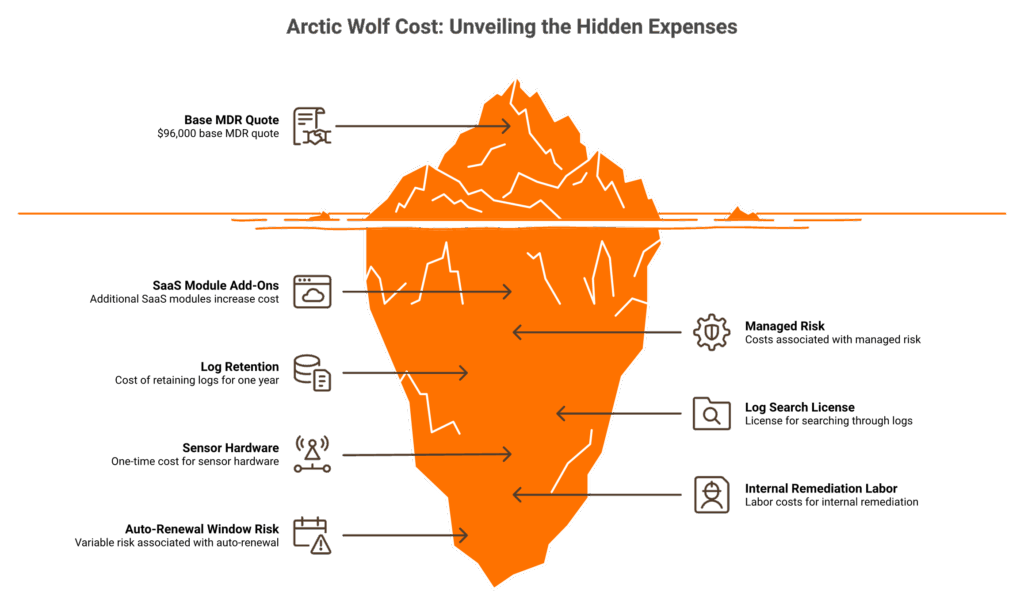
You signed the contract. You had a number. Then you found out the number was not the number. For a 500-seat mid-market buyer on MDR Silver with Managed Risk and O365 coverage, the per-user math alone puts you at roughly $207,600/year (negotiated at 15% off list). That still excludes seven cost layers your quote almost certainly did not itemize.
⚠️ The Eight Hidden Cost Layers, Ranked by Impact
| Rank | Hidden Cost | Median Year 2 Impact | Confidence |
|---|---|---|---|
| 1 | ❌ Per-SaaS module add-ons (O365, GWS, Salesforce, AWS) — each requires a separate per-user license at the same Silver/Gold/Platinum rate | 20–40% of base MDR cost | High |
| 2 | ❌ Extended log retention — default is 90 days; compliance teams typically need 1–3 years (AW-MDR-1YR: $14.40/asset/yr; AW-MDR-3YR: $21.60/asset/yr) | $500–$3,000/month depending on environment size | High |
| 3 | ❌ Log Search add-on (AW-MDR-LS) — log retention and log search are separate SKUs; you can store logs you cannot query without the $14.40/asset/yr Log Search license | $7,200/yr at 500 assets | High |
| 4 | ❌ Sensor hardware — network monitoring requires physical or virtual sensors; multi-site deployments need one per site; 100-Series at $1,500, 300-Series at $6,000–$7,500 (TX DIR list, Feb 2025) | $9,000–$45,000 one-time | High |
| 5 | ❌ New features released as separate paid SKUs — capabilities buyers expect to be bundled (Aurora Endpoint Security, Exposure Management) arrive as new line items at renewal | 5–15% TCV creep annually | High |
| 6 | ❌ IR overage fees — Incident360 retainer includes a set number of hours; activation beyond scope triggers $250–$500/hr overages | Variable; budget $25,000–$75,000 contingency | Medium |
| 7 | ❌ Internal remediation labor — Arctic Wolf surfaces threats and advises your team; active remediation is buyer-side; budget 2–8 FTE-weeks in the first 90 days, and 1–3 hours/week ongoing for alert triage | $15,000–$50,000 Year 1 | Medium |
| 8 | ❌ 60-day cancellation window for channel-sold deals — the standard direct contract requires 30 days’ notice; partner-sold contracts require 60 days. Miss the window by one day and you’re in for another full 12-month auto-renewal | One month’s additional subscription | High |
💸 What This Means for a 500-Seat MDR Silver Deployment
Take a buyer who thought they signed a $96,000 MDR deal. Add the O365 module ($96,000), Managed Risk ($30,000), 1-year log retention ($7,200), Log Search ($7,200), two 300-Series sensors ($12,000 one-time), and 5 FTE-weeks of internal labor ($14,400). The real Year 1 number is $262,800, not $96,000.
That’s a 174% gap between the headline per-user figure and the all-in cost. I’ve seen this exact pattern across dozens of MDR evaluations. The quote you receive is accurate. It’s just not complete.
What to Do Before Signing
Before you countersign, ask for pricing on every item in the table above. Force the quote to include SaaS modules, log retention tier, Log Search license, and sensor hardware. Get the escalation cap in writing. Standard contracts run 3–7% annually, and 5% compounding on a $244,000 base is $43,000 in extra spend over 3 years. Our guide to SLAs in cybersecurity contracts covers exactly which clauses to negotiate before countersigning.
“I can’t find anything I like very much about Arctic Wolf anymore… We’ve had some accuracy issues in responding to our tickets. These inaccuracies have led to us having to explain why our third-party vendor made an assessment mistake when presenting a critical external vulnerability for remediation.”
— Verified User, Hospital & Health Care, Enterprise 1,000+ emp. Arctic Wolf – G2 Verified Review
“Beware — they add a 60-day renewal notice instead of the typical 30-day notice. If you don’t give notice of canceling any services before 60 days, you will automatically renew everything.”
— Verified User, Electrical/Electronic Manufacturing, Mid-Market Arctic Wolf – G2 Verified Review
Working with 500+ security teams, what I’ve noticed is that the buyers who feel most burned are not the ones who were deceived. They’re the ones who didn’t ask enough questions before signing. That’s a fixable problem.
Hidden fees adding up faster than expected?
Get a plain-English breakdown tailored to your environment.
Q6. The $3M Arctic Wolf Security Warranty: What Does It Actually Cover?
The $3M Security Operations Warranty is the most-cited reason enterprise buyers upgrade to the Total Security Operations Bundle. Here’s what it actually covers, and the conditions that will disqualify your claim before you file it.
The warranty provides up to $3,000,000 USD in financial assistance for cyber events that occur while the customer maintains an active qualifying Total bundle subscription. It is not a cyber insurance policy. It does not replace insurance. It is a vendor-backed financial guarantee that Arctic Wolf will contribute remediation funds if a qualifying incident occurs on their watch.
✅ What the Warranty Covers
| Coverage Element | Detail |
|---|---|
| Qualifying event types | Ransomware, data breach, BEC (business email compromise), financial fraud via cyber event |
| Maximum payout | $3,000,000 USD total per claim event |
| Coverage trigger | Active Total bundle subscription at time of incident |
| IR coordination | Arctic Wolf Incident360 coordinates the IR response; response begins within a 3-hour SLA |
| Financial assistance | Breach notification, credit monitoring, forensic investigation costs, legal fees (directional; confirm scope in warranty documentation) |
❌ Known Exclusions and Conditions
This is where most buyers stop reading, and where the real risk lives.
- Only available in the Total Security Operations Bundle — Core and Plus tier buyers receive no warranty coverage.
- Requires continuous active subscription — any lapse in subscription voids coverage for the lapse period.
- Requires Arctic Wolf Incident360 to lead IR — buyers who engage a third-party IR firm before notifying Arctic Wolf risk voiding the warranty; confirm procedure in writing.
- Excludes events caused by customer-side misconfigurations not reported to Arctic Wolf — gaps you created and did not disclose are typically excluded.
- Does not cover pre-existing incidents — breaches that began before the Total bundle was activated are excluded.
- $3M cap is total, not per-incident — one large event can exhaust the full warranty.
- Not a substitute for cyber insurance — Arctic Wolf explicitly notes this; boards and insurers will still require a standalone cyber policy.
⚠️ How It Compares to CrowdStrike’s Warranty
CrowdStrike’s breach prevention warranty covers up to $1M and is included across all Falcon Complete tiers — no bundle upgrade required. UnderDefense Agentic AI SOC offers a $2M breach prevention guarantee bundled with its platform, positioning on prevention before the incident rather than financial restitution after it.
The honest read: Arctic Wolf’s $3M is the largest dollar amount in the market. CrowdStrike’s $1M is more accessible. The most important question is not the dollar cap. It’s whether your incident response process is fast enough that you never need to file a claim. A vendor whose MTTD is 15–60 minutes and whose MTTR is not published should prompt you to ask what “covered” really means when the clock is running.
“Started out well, but over the years the service has consistently not met expectations. Log collectors show working, however when asked to provide logs for an investigation, no logs could be provided. Analysts provide little context, and when asked for more information in the investigation, nothing is ever provided or even communicated.”
— CISO, Manufacturing, Firm Size 3B–10B USD Arctic Wolf – Gartner Verified Review
My current read is this: the warranty is real commercial value, particularly for buyers in regulated industries who face board-level scrutiny on cyber exposure. Treat it as a backstop, not a strategy. The goal is to never activate it. If you’re building an incident response plan that can operate faster than any warranty trigger threshold, that’s the more durable investment.
Q7. Arctic Wolf vs. UnderDefense Agentic AI SOC: How Do the 3-Year TCOs Actually Compare?
This is the comparison I get asked about most. Let me be direct: the two products are not the same category sell, and the TCO comparison only becomes honest when you account for what each platform actually does differently.
At 500 seats, Arctic Wolf MDR Gold + Managed Risk + O365 lands at approximately $207,600/year negotiated. Over 3 years with a 3% escalation cap, that’s roughly $651,000 all-in, including sensors and minimal professional services. UnderDefense Agentic AI SOC starts at $11–$15/endpoint/month ($66,000–$90,000/year at 500 seats), vendor-agnostic, with no proprietary sensor hardware required, and with the AI SOC + Human Ally model included in base pricing — no separate Concierge tier to unlock.
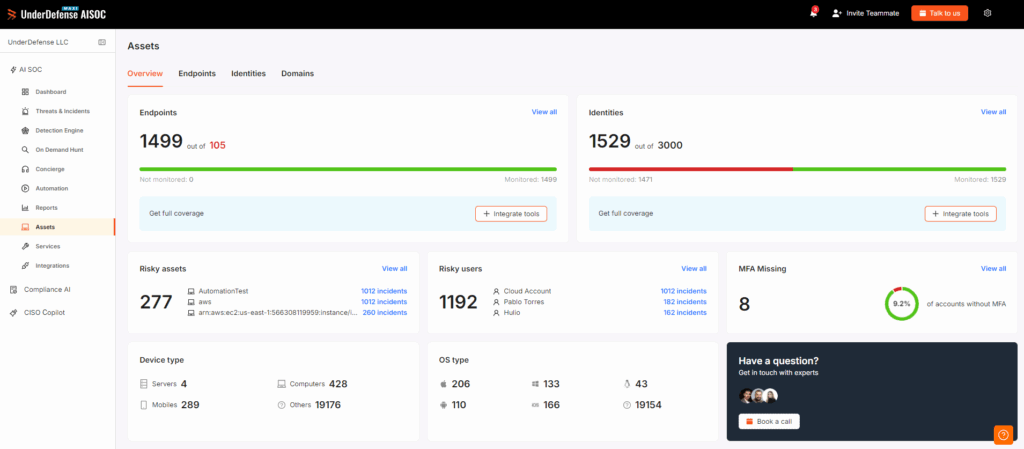
Side-by-Side: 500-Seat MDR Deployment, 3 Years
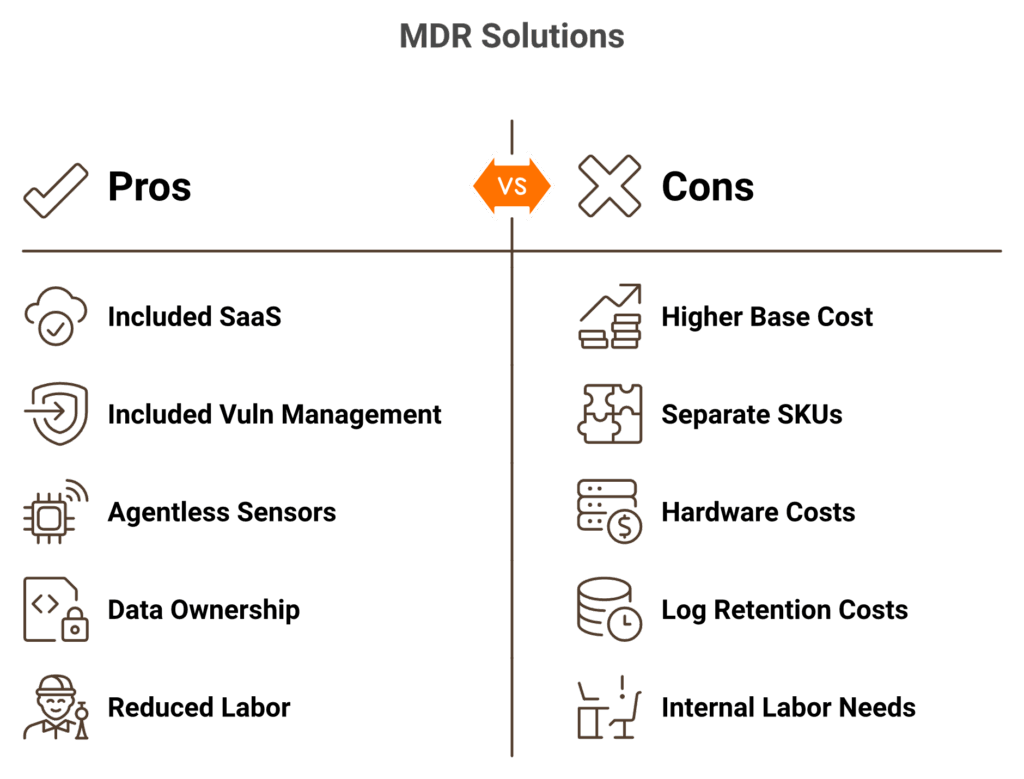
| Cost Element | Arctic Wolf | UnderDefense Agentic AI SOC |
|---|---|---|
| Base MDR license (negotiated) | ~$87,200/yr | ~$75,000/yr (midpoint, $12.50/endpoint/mo) |
| SaaS coverage (O365) | +$76,800/yr (separate SKU) | ✅ Included in base — vendor-agnostic integration |
| Managed Risk / Vuln. Management | +$24,000/yr (separate SKU) | Included in the Agentic AI SOC platform scope |
| Sensor hardware (one-time) | $9,000–$12,000 | ❌ Not required — agentless integrations |
| Log retention extension | +$7,200/yr (separate SKU) | ✅ Data ownership retained by customer |
| Internal remediation labor | 5–8 FTE-weeks Year 1 | Reduced — concierge analysts own remediation steps |
| Escalation clause | 3–7% annually | Transparent pricing, no black-box uplift |
| 3-Year All-In (est.) | ~$651,000 | ~$270,000–$310,000 |
✅ Where UnderDefense Is Structurally Different
Arctic Wolf sees your alerts and advises your team what to do next. UnderDefense Agentic AI SOC + Human Ally model means analysts communicate directly with affected users, verify suspicious activity via ChatOps, and own the response — not just escalate it.
This matters operationally. I’ve seen 2 a.m. incident bridges where the MDR vendor emails a ticket and waits. That 15-minute gap between “we saw it” and “someone acted on it” is where breaches spread. Arctic Wolf’s three autonomous actions (account disable, endpoint isolation, network containment) are meaningful, but they’re bounded. UnderDefense’s concierge response model removes that boundary.
❌ Arctic Wolf also does not participate in MITRE ATT&CK evaluations and publishes no aggregate MTTD or MTTR benchmarks. That’s a transparency gap that should concern any buyer presenting security posture data to a board. You can see how that gap plays out in our SOC metrics analysis, which walks through what MTTD and MTTR benchmarks should look like for a well-run MDR program.
“We were looking for an MDR provider and were choosing EDR tools. CrowdStrike was our favorite choice, but after a few calls with UnderDefense we realized we could get way more value, so they truly became our go-to cybersecurity ally, always by our side to solve problems and resolve incidents on our behalf.”
— Oleksii M., Mid-Market UnderDefense G2 – Verified Review
“The biggest win for me was getting actual control over our security alerts. Before the guys from UD stepped in, we were getting bombarded with alerts from all our security tools. Their team cleaned up our configurations and got the noise under control within the first week.”
— Verified User, Marketing & Advertising, Small-Business UnderDefense G2 – Verified Review
I might be wrong here, but when we benchmark these two platforms against environments where the buyer has an existing SIEM investment, the TCO gap widens further. Arctic Wolf’s value proposition assumes you replace your SIEM with Aurora Platform. UnderDefense Agentic AI SOC’s value proposition assumes you keep your SIEM and stop paying for it twice.
Q8. How to Negotiate an Arctic Wolf Contract: The Playbook That Saves $15K–$75K
Here is what Vendr’s transaction data tells us: buyers who actively negotiate achieve $15,000–$75,000 in savings versus initial quotes, depending on deployment size. The buyers who leave money on the table are the ones who treat the first quote as the final offer.
💰 The Nine Discount Levers, Ranked by Impact
| Lever | Typical Discount | Notes |
|---|---|---|
| 3-year commit | 15–25% off ACV | Best combined with bundle; 30–40% off list achievable at 1,000+ endpoints |
| Competitive alternatives (CrowdStrike, Huntress, Red Canary in active RFP) | 10–25% | Single highest-impact lever per Vendr data |
| End-of-quarter close (last 2–3 weeks of Q4/December) | 10–20% additional flexibility | Mid-quarter buyers see 0–5%; timing is free money |
| Multi-product bundle (MDR + MR + MSA) | 15–30% vs. à-la-carte | Bundle discount is additive with term discount |
| Upfront annual prepay | 3–7% | Arctic Wolf incentivizes prepay across all deal sizes |
| Logo/case study right | 5–10% | Formalize as reference agreement; don’t give it away informally |
| AWS Marketplace private offer | 5–15% | Counts toward AWS EDP committed spend; use for buyers with MACC obligations |
| Escalation clause cap negotiation | Saves 10–20% over contract lifetime | Fight for 0–3% cap or CPI-linked; the default 3–7% compounds destructively |
| CISO-to-CISO escalation when deal is stuck | Qualitative | Unlocks exceptions not available at rep level |
⏰ Timing Your Negotiation
Arctic Wolf operates on quarterly sales cycles. Buyers negotiating in the last 2–3 weeks of any calendar quarter see 10–20% more flexibility. The single best window is late November through December (Q4 close). Begin negotiations 6–8 weeks before your target date to allow for internal approvals. For a full breakdown of how to structure that conversation from the first call to signature, the MDR buyer’s guide has a step-by-step evaluation framework you can run in parallel.
⚠️ The Three Contract Terms to Fix at Signature
These are the clauses most buyers discover post-renewal:
- Auto-renewal notice window — direct contracts require 30-day notice; partner-sold contracts require 60-day notice. Set a calendar alert the day you sign.
- Mid-contract scale-down rights — standard terms are non-cancellable and non-refundable. If you anticipate workforce reductions or a divestiture, negotiate a true-down right at signature.
- Expansion pricing lock — mid-contract additions default to then-current list price unless you negotiate at signature to inherit the original per-unit rate. On a 5,000-seat deal, this is worth $50,000–$100,000 at renewal.
“We received little value from Arctic Wolf. Anything you want to look at or changes you need to make in the product must go through their engineering team. As an MSP, this is a horrible way to do business for us. On top of that, the sales and account management team is very pushy, even to the point of going around us directly to our clients because we weren’t moving fast enough for them.”
— Matt C., Manager, Cybersecurity Services Arctic Wolf – G2 Verified Review
In our experience building SOC teams across global enterprises, the contracts that hurt buyers most are not the ones with high list prices. They’re the ones with uncapped escalation clauses and no true-down rights, signed in a quarter-end rush without legal review. Take the extra two weeks. The savings compound for three years.
Q9. The Complete Arctic Wolf Negotiation Playbook: 9 Levers Ranked by Savings Impact
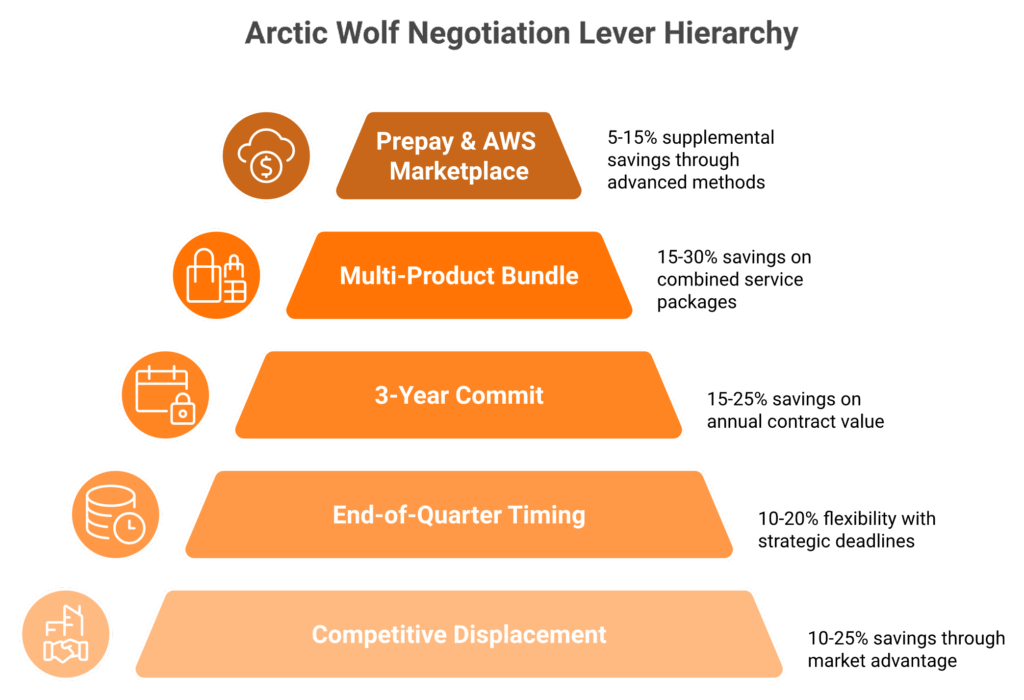
Buyers who actively negotiate Arctic Wolf contracts save between $15,000 and $75,000 versus initial quotes. That’s not a theoretical range. It comes from Vendr’s transaction database across 17+ anonymized Arctic Wolf deals as of May 2026. The three highest-impact levers are introducing a competitive alternative, timing your close to Arctic Wolf’s fiscal quarter-end, and committing to a three-year term while capping the escalation clause. Every other lever builds on these three.
What the Numbers Actually Look Like
Here are all nine levers, ranked by the savings they unlock:
| # | Lever | Typical Discount | How to Deploy |
|---|---|---|---|
| 1 | Competitive displacement | 10–25% off initial quote | Name CrowdStrike, Huntress, or UnderDefense Agentic AI SOC in writing. Vendors respond to a formal RFP with named alternatives far more aggressively than to verbal hints. |
| 2 | End-of-quarter timing | 10–20% better outcome | Arctic Wolf runs on quarterly sales targets. The last two weeks of Q4 (December) are the highest-pressure window. Begin negotiations six to eight weeks early and make pricing the final decision factor. |
| 3 | 3-year commit + escalation cap bundle | 15–25% on ACV + 10–20% lifetime savings | Lock in flat or CPI-capped pricing. Standard escalation clauses run 3–7% annually. At $500K ACV, a 5% compounding clause costs you $78,800 over three years. Cap it at 0–3%. |
| 4 | Multi-product bundle (MDR + MR + MSA) | 15–30% vs. à-la-carte | Bundling Managed Risk with MDR alone saves 15–25% vs. purchasing separately. Adding MSA and Incident360 pushes bundle savings to 25–35%. |
| 5 | AWS Marketplace private offer / EDP credit | 5–15% | Counts against your AWS Enterprise Discount Program (EDP) committed spend. Useful if you have a Marketplace Commit Agreement (MACC) to burn. |
| 6 | Prepay discount | 3–7% additional | Arctic Wolf offers discounts if you prepay for the full contract period. Stack this on top of a multi-year commit for maximum effect. |
| 7 | Logo / case study right | 5–10% | Arctic Wolf’s standard contract already grants use of your logo. Convert that into a formal case study or press release right and negotiate it as a discount lever at signature. Confirm value with AW sales. |
| 8 | CISO executive escalation | Qualitative — unlocks deal exceptions | When a deal is stuck, CISO-to-CRO engagement at Arctic Wolf can unlock exceptions unavailable to the rep. Use when you’ve already deployed the other levers. |
| 9 | Volume tier step-up | 5–10% | If your seat count sits just below a volume tier threshold, adding endpoints to cross the threshold unlocks a lower per-unit rate that applies retroactively to the full order. |
The Clause Buyers Always Forget
Arctic Wolf’s direct contract uses a 30-day auto-renewal notice window. But channel-partner agreements use a 60-day window. If you bought through a reseller, missing that 60-day window locks you into another 12-month term at current pricing.
“Beware — they add a 60-day renewal notice instead of the typical 30-day notice. If you don’t give notice of cancelling any services before 60 days, you will automatically renew everything.”
— Verified User, Mid-Market Manufacturing Arctic Wolf – G2 Verified Review
Two contract rights to negotiate at signature: (1) a true-down right allowing seat reductions mid-contract, and (2) a termination for convenience clause with pro-rata refund for deals above $500K ACV. Neither is in the standard terms, but both are achievable at enterprise scale.
Arctic Wolf crossed $500M+ ARR while pursuing IPO readiness. Growth-stage vendors under quarterly pressure respond to competitive displacement and end-of-quarter timing more strongly than mature, stable businesses. That market structure is your leverage. If you want to see how your current quote stacks up against what comparable buyers actually paid, the SOC cost calculator benchmarks your quote against real transaction data in under two minutes.
Q10. Arctic Wolf vs. CrowdStrike, SentinelOne, Huntress & UnderDefense Agentic AI SOC: A Capability-Adjusted Price Comparison
A raw price comparison between Arctic Wolf and its competitors is misleading. The capability sets are structurally different, and the switching cost hidden inside Arctic Wolf’s proprietary SIEM (Aurora) is the single most under-disclosed factor in any MDR procurement. When you add the capabilities each vendor is missing to match the others, the TCO gap narrows or inverts entirely.
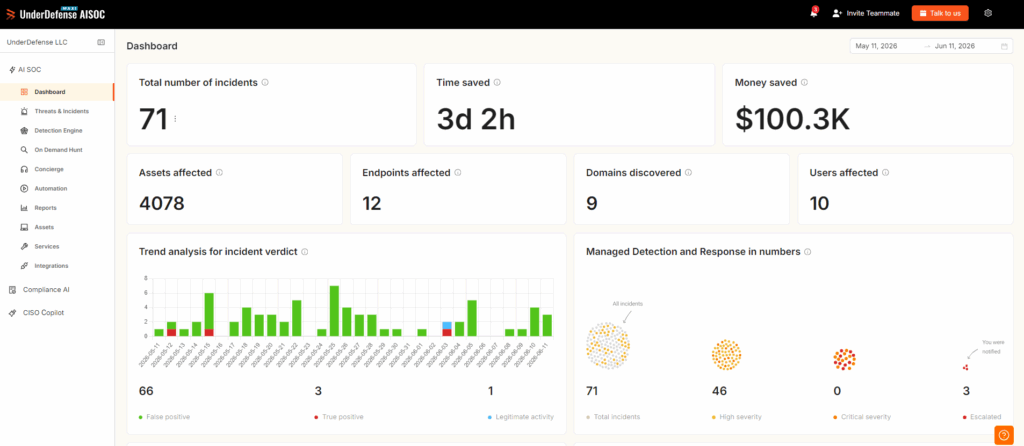
Why Raw Price Doesn’t Tell the Full Story
Arctic Wolf’s Aurora platform is not a standard SIEM (Security Information and Event Management system, the tool that collects, correlates, and searches your log data). It’s a proprietary detection layer. Switching away means losing years of custom detection logic, alert tuning, and incident history. One CISO I spoke with at a mid-market financial firm put it plainly: “Our correlation rules alone represent two years of tuning. That’s not in any contract migration budget.” CrowdStrike has four published MITRE ATT&CK (the industry-standard framework mapping adversary tactics and techniques) evaluations; Arctic Wolf has participated in none. Huntress delivers comparable MDR at $15–$20/asset/month vs. Arctic Wolf’s effective $27–$39 rate for comparable mid-market coverage. These are structural differences, not feature list gaps.
Capability-Adjusted Comparison
| Criteria | UnderDefense Agentic AI SOC | Arctic Wolf (Total Bundle) | CrowdStrike Falcon Complete | SentinelOne Vigilance | Huntress |
|---|---|---|---|---|---|
| SIEM model | BYO (Splunk, Sentinel, Chronicle) | Proprietary Aurora — lock-in | Falcon Next-Gen SIEM included | Singularity SIEM included | None |
| Autonomous response actions | Credential wipes, password resets, ticket creation | Account disable, endpoint isolation, network containment (3 actions) | SOAR via Fusion included | STAR custom rules | Limited |
| Alert-to-triage SLA | 2-minute published SLA; 15-minute escalation for critical incidents | 7-minute Mean Time to Ticket | 4-minute avg. MTTD published | 5-minute published | Not published |
| MITRE ATT&CK participation | ✅ Yes | ❌ No | ✅ Yes — top-tier 2024 results | ✅ Yes — top-tier 2024 results | ❌ No |
| Breach warranty | $2M prevention-first | $3M (Total bundle only) | $1M (all Complete tiers) | Not offered | Not offered |
| Pricing model | Transparent ($11–15/endpoint/month) | Quote-only | Quote-only | Quote-only | $15–20/asset/month |
| FedRAMP status | Available (on-prem/sovereign) | ❌ Not FedRAMP authorized | ✅ FedRAMP Moderate | In progress | No |
| Data sovereignty | On-prem / hybrid / sovereign | Vendor cloud; US, EU, APAC regions | Vendor cloud | Vendor cloud | Vendor cloud |
When Arctic Wolf Is the Right Choice
⭐ Arctic Wolf delivers its best TCO for:
- SMB or mid-market buyers under 1,000 users with no internal SOC
- Organizations that need fast deployment (2–3 weeks for under 250 units)
- Compliance-checkpoint buyers who need SOC 2 Type II, ISO 27001, or CMMC advisory guidance
- Buyers who want unlimited log ingestion without per-GB billing
When the TCO Math Changes
UnderDefense Agentic AI SOC becomes the better TCO option when:
- You’ve already invested in Splunk, Microsoft Sentinel, or Chronicle (preserving prior investment and avoiding Aurora lock-in)
- You need data sovereignty or on-premises deployment (federal contractors, healthcare, and financial services under strict residency mandates)
- You need autonomous remediation beyond the three containment actions Arctic Wolf offers
- You require SOAR (Security Orchestration, Automation & Response) integration without a separate $150,000–$300,000/year add-on
Working with customers across 500+ environments, what I’ve noticed is that buyers often don’t realize they’re buying a proprietary SIEM until Year 2 renewal, when the true switching cost becomes visible. The three-year TCO is the right metric, not the per-unit list price. Our guide to choosing a SIEM walks through exactly how to evaluate that switching cost before it appears in a renewal invoice.
“We received little value from ArcticWolf. Anything you want to look at or changes you need to make in the product must go through their engineering team. As an MSP, this is a horrible way to do business.”
— Matt C., Manager, Cybersecurity Services Arctic Wolf – G2 Verified Review
Q11. Is Arctic Wolf Worth It? A Decision Framework by Buyer Profile for 2026
Here’s the honest two-sentence version: Arctic Wolf delivers its best TCO for mid-market buyers (100–1,000 users) with no internal SOC who need fast deployment, compliance documentation, and predictable pricing. It is a weaker fit for FedRAMP-required buyers, organizations with existing SIEM investments, and buyers who need autonomous remediation beyond the three containment actions Arctic Wolf offers.
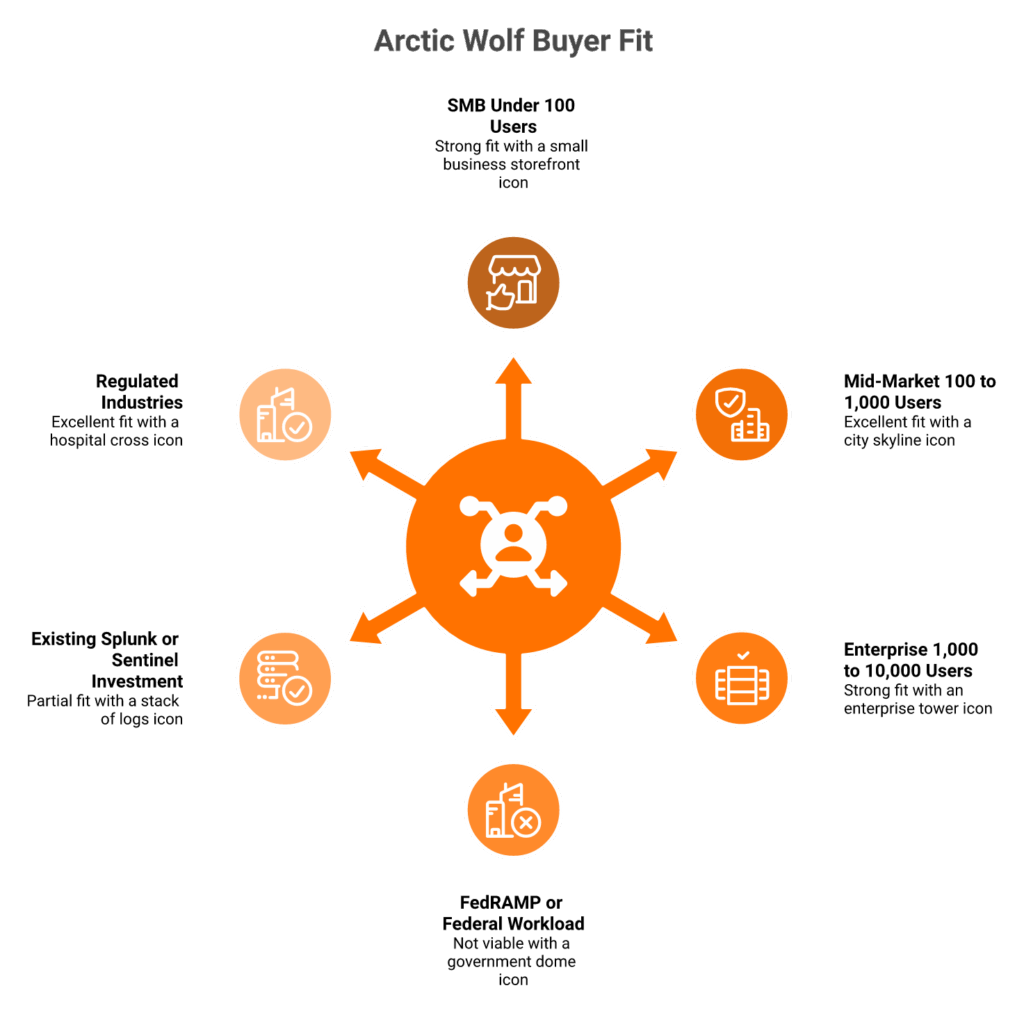
Buyer Profile Decision Table
| Buyer Profile | Arctic Wolf Fit | Recommended Action |
|---|---|---|
| SMB, under 100 users, no IT/security staff | ⭐ Strong | Core MDR Silver; evaluate Huntress as price alternative |
| Mid-market, 100–1,000 users, no SOC | ✅ Excellent | Plus or Total bundle; negotiate multi-year with escalation cap |
| Mid-market, 100–1,000 users, partial internal SOC | ✅ Strong | Total bundle; confirm remediation workflow with your internal team before signing |
| Enterprise, 1,000–10,000 users, no SOC | ✅ Strong | Total bundle, 3-year; add Managed Endpoint Defense |
| Enterprise, FedRAMP or federal workloads required | ❌ Not viable | CrowdStrike FedRAMP Moderate or Palo Alto (in progress) |
| Enterprise, existing Splunk/Sentinel investment | ⚠️ Partial fit | Supplement with BYO-SIEM MDR or evaluate UnderDefense Agentic AI SOC for Splunk to preserve your existing investment |
| Healthcare, financial services, legal | ✅ Excellent | Compliance guidance and breach warranty are strong fit; confirm HIPAA/PCI scope |
| Complex OT environment | ⚠️ Partial fit | Add OT-specialist overlay or evaluate Dragos/Claroty; Arctic Wolf OT coverage is limited |
What the CFO Conversation Actually Looks Like
When I work with CISOs justifying an MDR decision upward, the question is never “which vendor has the best MITRE score?” It’s “what does staying on the current trajectory cost us?” The Forrester TEI (Total Economic Impact, a structured ROI methodology) study on Arctic Wolf, commissioned in 2024, found a composite 2,500-endpoint mid-market organization achieved 414% ROI and payback in under six months. That’s a vendor-commissioned number, so treat it as an upper bound. A 12–24 month payback period is a more defensible board estimate. ⚠️ The number that belongs in your CFO deck is simpler: IBM’s 2024 Cost of a Data Breach Report found the global average breach cost is $4.88M, with AI and automation reducing that by $2.22M. Your MDR is either funding itself through breach avoidance, or it isn’t. If you’re building that case now, our 2026 cybersecurity budget playbook has a CFO-ready one-pager you can adapt directly.
The Ethical CISO Dividend
Something I’m watching in 2026: the most mature CISOs I work with are asking a question that doesn’t appear in any RFP template. They’re distinguishing between VC-backed MDR providers who price for ARR growth and founder-led specialists who price for customer outcomes.
That distinction matters more than it used to. When a $500M+ ARR vendor is under IPO pressure, their account team’s incentives are not aligned with your renewal value. The best MDR relationship is one where your vendor calls you before you call them. If that’s not what you’re experiencing, that gap has a dollar figure attached to it. The most common reason security teams switch MDR providers is not price. It’s that proactive communication gap.
“Arctic Wolf provides solid detection and response capabilities, but overly relies on the client’s team for remediation, which really hurts the value of the service.”
— VP of Technology, Services Firm Arctic Wolf – Gartner Verified Review
Q12. 🌉 Got an Arctic Wolf Quote? Benchmark It in 90 Seconds Before You Sign.
A CISO at a mid-size manufacturer once told me, “I don’t mind the price. I just need to know I’m not being taken.” That’s the right framing. The problem is not Arctic Wolf’s list price. The problem is that you have no external reference point to know if your specific quote is at the bottom, middle, or top of what comparable buyers actually paid.
The Situation Most Buyers Are Sitting In Right Now
You have a quote. It has a deadline. The CFO wants a number by end of week. And your Arctic Wolf rep knows your incumbent contract expires soon. That’s not a negotiation. That’s a trap. The one thing that changes the dynamic is a benchmark. In procurement terms, P25, P50, and P75 mean the 25th, 50th, and 75th percentile of actual transaction prices, representing the bottom quarter, the middle, and the top quarter of what real buyers paid for comparable deployments. If your quote is at P75, you’re in the top quartile of overpayers. That has a dollar figure, and it belongs in your CFO conversation.
What Changes in 90 Seconds
I’ll be honest. I built the SOC Cost Calculator because I was tired of watching security teams sign contracts they couldn’t defend to their boards. The calculator doesn’t pitch a switch. It benchmarks three scenarios: fully in-house SOC, hybrid, and fully managed MDR. You input your seat count and current quote. You get a market position report showing which specific line items, such as log retention extensions, SaaS module add-ons, and escalation clauses, have the most room to move.
One customer at a 2,000-person logistics company ran the benchmark and walked into their Arctic Wolf renewal call knowing their per-user rate was 22% above market median. They left with a $41,000 year-one savings and a flat-rate cap on years two and three. They didn’t switch vendors. They just stopped negotiating blind. If you’re evaluating whether a full managed detection and response switch makes more sense than a renewal, the MDR buyer’s guide covers the evaluation criteria most teams miss before signing.
Turn these benchmarks into a real plan.
Get a vendor-neutral assessment and a cost-optimized roadmap.
References
Official Docs / Indian Statutes
- Arctic Wolf Networks. “MDR Supplemental Product Terms” Published: August 2025.
- Arctic Wolf Networks. “TX DIR Public Sector Price List” Published: February 2025.
- UnderDefense. “SOC Cost Calculator” [First-party vendor documentation]
- UnderDefense. “AWS Security Services Cost Calculator” [First-party vendor documentation]
Blogs
- Vendr. “Arctic Wolf Networks — Buyer Transaction Data and Negotiation Benchmarks” Vendr Marketplace. Published: May 2026. [Secondary source — aggregated buyer transaction data]
- Matt C. “An Expensive Blackbox and Horrible Partner” G2 Verified Review. Published: August 31, 2022. [Secondary source — buyer review]
- Inventive HQ. “CrowdStrike vs. Arctic Wolf MDR Comparison” Published: February 2026. [Secondary source]
- MDRProviders.io. “Arctic Wolf MDR Provider Profile” Published: 2026. [Secondary source]
- Verified User, Mid-Market Manufacturing. “Deceptive” G2 Verified Review. Published: May 25, 2023. [Secondary source — buyer review]
- Gartner Peer Insights. “Solid Foundational Service, But You Need A Dedicated Cyber Team Anyways” Arctic Wolf MDR Review. Published: April 5, 2023. [Secondary source — buyer review]
1. What does Arctic Wolf MDR actually cost per user in 2026?
Arctic Wolf does not publish a commercial price list, but we’ve sourced the numbers directly from the Texas DIR Public Sector Price List (February 2025) and Vendr’s transaction database. The structure is a flat $15,000/year Aurora Platform base fee per organization, plus per-unit annual licenses at three tiers: Silver at $192/user/year ($16.00/month), Gold at $218/user/year ($18.17/month), and Platinum at $257/user/year ($21.42/month). These rates apply equally to users and servers. A 100-user Silver deployment costs roughly $34,200/year at list. But across 17 verified Vendr transactions, the real-world median sits at $96,340/year, with a range from $29,176 to $319,984. The gap between list and actual is explained by volume discounts, typically ranging from 5–10% at 100 seats to 30–40% at 1,000+ seats, and by multi-product bundle consolidation. What the per-user number won’t tell you is the add-on cost for SaaS modules. O365, Google Workspace, Salesforce, and AWS each require a separate per-user license at the same Silver/Gold/Platinum rate. A 500-user org with O365 coverage effectively doubles its per-user MDR cost before negotiation. We cover the full hidden cost stack, and what it means for a 500-seat deployment, in our MDR price guide.
2. What is the difference between Arctic Wolf's Silver, Gold, and Platinum tiers?
Arctic Wolf runs three edition tiers across its MDR, Endpoint Security, and Managed Risk products: Silver at $192/unit/year, Gold at $218/unit/year, and Platinum at $257/unit/year (TX DIR list, February 2025). The Silver tier targets SMB and mid-market entry buyers with core MDR and standard Concierge Security Team (CST) SLAs. Gold adds enhanced detection tuning and an elevated CST response tier. Platinum delivers the full feature set, the highest SLA commitments, and the most advanced autonomous response capabilities. The critical caveat: Arctic Wolf does not publicly disclose the specific capability differences between editions. The feature deltas above are directional, drawn from partner documentation and buyer interviews, not a published capability matrix. We consistently advise clients to request in writing, before committing to a tier, exactly which detection rules, response actions, and SLA metrics differ between Silver and Gold at their specific seat count. The tier decision has a second-order effect: SaaS modules (O365, GWS, Salesforce) are priced at the same Silver/Gold/Platinum rate as your base MDR tier. Upgrading from Silver to Gold mid-contract triggers the higher rate across every module, not just the base MDR license. If you’re mapping this against a full-stack alternative, our SOC cost calculator benchmarks total spend across all three tiers.
3. What are the hidden costs Arctic Wolf's quote won't show you?
This is the question we get asked most often by buyers who’ve already signed and are now reconciling the contract against actual invoices. The headline figure in your quote covers base MDR licensing. It almost certainly excludes eight cost layers that, for a 500-seat deployment, can push Year 1 spend from $96,000 to over $262,800. The highest-impact add-ons are: SaaS module licenses (O365, GWS, Salesforce, AWS each require a separate per-user license at the same tier rate, adding 20–40% to base MDR cost); extended log retention (default is 90 days; 1-year retention runs $14.40/asset/year via AW-MDR-1YR, and 3-year retention runs $21.60/asset/year); the Log Search license (retention and search are separate SKUs — you can store logs you cannot query without paying additionally); sensor hardware (physical or virtual sensors required per site, ranging from $1,500 to $7,500 each); and IR overage fees when Incident360 activation exceeds included hours at $250–$500/hour. Two additional costs most buyers miss: the internal remediation labor burden (Arctic Wolf surfaces and advises; your team executes — budget 5–8 FTE-weeks in Year 1) and the 60-day cancellation notice window on channel-sold contracts (missing it by one day locks you into another full 12-month auto-renewal). For a structured pre-signature checklist, see our guide to SLAs in cybersecurity contracts.
4. What does Arctic Wolf's $3M Security Operations Warranty actually cover?
Arctic Wolf’s $3M Security Operations Warranty is the most-cited reason enterprise buyers upgrade to the Total Security Operations Bundle. Here’s what it actually covers, and where the exclusions live. The warranty provides up to $3,000,000 USD in financial assistance for qualifying cyber events occurring under an active Total bundle subscription. It is not cyber insurance. Qualifying event types include ransomware, data breach, business email compromise (BEC), and financial fraud via cyber event. Coverage elements include breach notification costs, credit monitoring, forensic investigation, and legal fees (confirm exact scope in your warranty documentation). The exclusions matter more than the coverage headline. The warranty is only available in the Total Security Operations Bundle. Core and Plus tier buyers receive no coverage. Any subscription lapse voids coverage for that period. Buyers who engage a third-party IR firm before notifying Arctic Wolf risk voiding the warranty. Events caused by customer-side misconfigurations not disclosed to Arctic Wolf are typically excluded. Pre-existing incidents are excluded. The $3M cap is total across one claim event, not per-incident — one large breach can exhaust the full warranty. For context, CrowdStrike’s breach prevention warranty covers $1M across all Falcon Complete tiers. UnderDefense MAXI offers a $2M prevention-first guarantee. The honest read: the $3M figure is the largest in the market. However, the most valuable outcome is never having to file a claim at all. If you want to understand how fast response times reduce breach cost exposure, our SOC metrics guide covers the MTTD and MTTR benchmarks that determine whether a warranty ever becomes relevant.
5. How does Arctic Wolf's 3-year TCO compare to UnderDefense Agentic AI SOC?
At 500 seats, the comparison is not close. Arctic Wolf MDR Gold with Managed Risk and O365 coverage lands at approximately $207,600/year negotiated. Over three years with a 3% escalation cap, that’s roughly $651,000 all-in, including sensors and minimal professional services. UnderDefense Agentic AI SOC starts at $11–$15/endpoint/month ($66,000–$90,000/year at 500 seats), vendor-agnostic, with no proprietary sensor hardware required. The AI SOC and Human Ally model is included in base pricing — there is no separate Concierge tier to unlock. O365 coverage, vulnerability management scope, and data ownership are included in the base. Over three years, the all-in estimate lands at $270,000–$310,000. The structural difference beyond the price: Arctic Wolf runs on a proprietary SIEM (Aurora Platform). Switching away means losing custom detection logic, alert tuning, and incident history built over the contract term. UnderDefense Agentic AI SOC operates on a BYO-SIEM model — your Splunk, Microsoft Sentinel, or Chronicle investment is preserved, not replaced. For buyers who’ve already sunk two or more years into a SIEM build, the switching cost from Aurora is the single largest factor the 3-year TCO number doesn’t capture. We walk through how to model that in our SIEM buyer’s guide.
6. How do you negotiate an Arctic Wolf contract and what discounts are achievable?
Based on Vendr’s transaction database across 17+ anonymized Arctic Wolf deals as of May 2026, buyers who actively negotiate save between $15,000 and $75,000 versus initial quotes. The buyers who leave money on the table treat the first quote as the final offer. The three highest-impact levers are: (1) competitive displacement — naming CrowdStrike, Huntress, or UnderDefense MAXI in a formal written RFP consistently unlocks 10–25% off the initial quote; (2) end-of-quarter timing — negotiating in the last two to three weeks of Q4 (late November through December) unlocks 10–20% additional flexibility; and (3) a three-year commit combined with an escalation clause cap — a 5% compounding annual clause on a $500K ACV costs $78,800 over three years, and capping it at 0–3% is achievable at enterprise scale. Beyond the top three: multi-product bundling (MDR plus Managed Risk plus MSA) saves 15–30% versus à-la-carte; AWS Marketplace private offers count against EDP committed spend (5–15% savings); and prepayment discounts add 3–7% on top of multi-year commits. Three contract terms to fix at signature regardless of discount level: the 60-day auto-renewal notice window on channel-sold deals, mid-contract scale-down rights, and expansion pricing lock for seats added during the contract term. For the full negotiation framework, see our MDR buyer’s guide.
7. Does Arctic Wolf participate in MITRE ATT&CK evaluations, and why does it matter?
Arctic Wolf has not participated in MITRE ATT&CK evaluations. This is a transparency gap that directly affects how security leaders can present security posture data to a board or audit committee. MITRE ATT&CK evaluations are the industry-standard third-party test for MDR and EDR vendors, measuring detection coverage and response accuracy against real adversary techniques and tactics. CrowdStrike and SentinelOne both achieved top-tier results in the 2024 evaluations. UnderDefense MAXI participates in MITRE ATT&CK evaluations. Huntress does not. For Arctic Wolf specifically, the absence of MITRE participation means buyers have no independent benchmark for detection efficacy against the MITRE framework. Arctic Wolf publishes a 7-minute Mean Time to Ticket as its primary response SLA metric, but does not publish aggregate MTTD (Mean Time to Detect) or full MTTR (Mean Time to Respond) benchmarks. For buyers presenting security investment ROI to a board, the inability to reference independent third-party benchmarks is a material gap. Our recommendation: require Arctic Wolf to provide customer references from deployments of comparable size and industry, and ask specifically what detection coverage looks like against the ATT&CK sub-techniques most relevant to your threat model. If you’re building the board presentation around this evaluation, our SOC metrics guide covers exactly which MTTD, MTTR, and detection rate metrics belong in a security investment case.
8. Is Arctic Wolf the right MDR choice for healthcare, financial services, or regulated industries?
Arctic Wolf is a strong fit for regulated-industry buyers in several dimensions, and a weak fit in others. On the strong-fit side: Arctic Wolf’s compliance advisory layer covers SOC 2 Type II, ISO 27001, HIPAA, PCI-DSS, and CMMC guidance. The Total bundle’s breach warranty ($3M) resonates strongly with boards in regulated sectors facing cyber liability exposure. Deployment speed (2–3 weeks for under 250 units) is an advantage for organizations that need to demonstrate operational security controls quickly for audit purposes. Unlimited log ingestion without per-GB billing simplifies compliance log retention planning. On the weak-fit side: Arctic Wolf is not FedRAMP authorized, which eliminates it from federal contractor evaluations and any workloads subject to federal residency requirements. For healthcare and financial services buyers with strict data sovereignty mandates, Aurora Platform data is stored in vendor cloud (US, EU, and APAC regions), not on-premises or in a sovereign environment. If your regulatory environment requires on-premises deployment or sovereign cloud, UnderDefense MAXI supports on-prem and hybrid deployment models. For healthcare specifically, we’ve seen the HIPAA advisory layer add real value during audit preparation, but the remediation gap (Arctic Wolf advises; the buyer executes) creates labor exposure that compliance-heavy teams need to plan for explicitly. Our MDR for Healthcare page covers the specific compliance and response requirements that should drive your MDR selection in regulated healthcare environments.