






Finance wants a 2027 PCI number before it signs off, and if the line comes up short, the gap shows up as a failed quarterly scan, an open finding in your Report on Compliance, or a monthly non-compliance fee from your acquirer.
Here is where each part of that number comes from.
TL;DR
- PCI compliance cost has no single price list: the assessment, scans, and tests are priced by quote for your validation path and cardholder data environment.
- The PCI Security Standards Council bills assessors and scanning vendors, and validation itself carries no Council fee for merchants.
- Logging, testing, and incident response run all year, so budget them beyond the assessment.
- The guide covers the six budget lines, the all-year requirements, scope moves, and non-compliance costs, each with its driver.
Table of contents
- PCI Compliance Cost Starts With Your Validation Path
- What the PCI Security Standards Council Charges, and Who Pays It
- The Six Budget Lines and What Drives Each One
- The Requirements That Cost Money All Year
- Scope Reduction Cuts the Total More Than Any Discount
- What Non-Compliance and a Card Breach Cost
- Where a Compliance Platform Changes the PCI Budget
- Frequently Asked Questions
💸 No single price list gives you that number. The cost of PCI compliance comes from your validation path and the size of your cardholder data environment (CDE), and the requirements that run all year keep drawing on the budget after the assessor leaves.
This guide is for Heads of Compliance, IT Directors, and security leads at merchants and payment service providers who have to defend the PCI number to finance.
It separates what is published from what only a quote can tell you. Where no published figure exists, the amount stays blank, and you get the question that produces a comparable number.
Find the PCI DSS evidence your staff still collects by hand
PCI Compliance Cost Starts With Your Validation Path
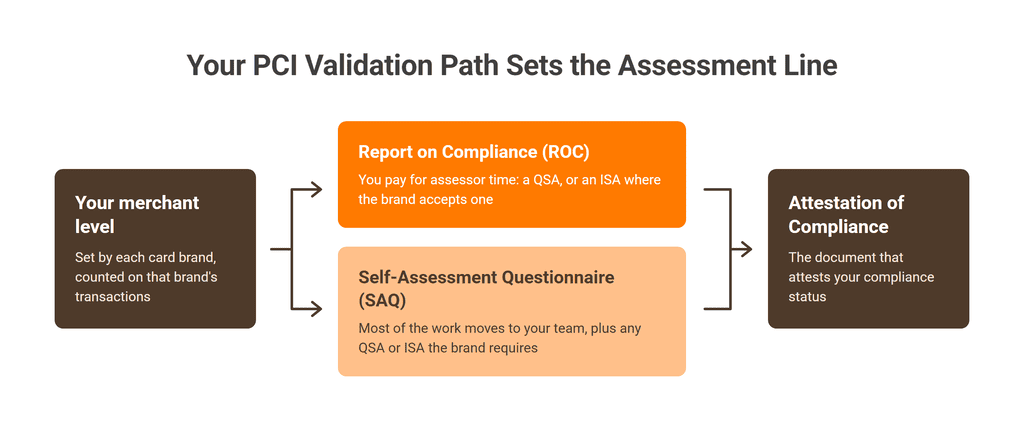
Your validation path is the first cost decision, because it decides whether you pay for a Report on Compliance (ROC) or complete a Self-Assessment Questionnaire (SAQ). Each card brand sets its own merchant levels, and your acquirer or the brand holds you to them. Visa puts it plainly: acquirers “must ensure that their merchants validate at the appropriate level.”
The path sets who carries the work. A ROC buys assessor time and still needs your staff to supply evidence, while an SAQ moves most of the assessment work onto your own team, plus any Qualified Security Assessor (QSA) or Internal Security Assessor (ISA) your brand requires.
The table reads each brand’s own document. Visa’s What To Do If Compromised guide (version 10.0, effective June 25, 2026) gives the thresholds, and its regional validation page gives the steps.
Mastercard’s Site Data Protection program and Discover’s validation requirements cover two more brands. American Express sets its own levels in its merchant regulations, so if you accept its cards, ask your acquirer which level it assigns you. An Approved Scanning Vendor (ASV) is a firm the PCI Security Standards Council qualifies to run external vulnerability scans.
| Card brand | Level | Annual transactions on that brand | Validation |
|---|---|---|---|
| Visa | 1 | More than 6,000,000 | Annual ROC by a QSA, quarterly ASV scans |
| Visa | 2 | 1,000,001 to 6,000,000 | Annual SAQ, quarterly ASV scans |
| Visa | 3 (levels 3 and 4 merged, April 2024) | 1 to 1,000,000 | Confirm with your acquirer |
| Mastercard | 1 | More than 6,000,000, or Visa Level 1 | Annual assessment ending in a ROC |
| Mastercard | 2 | More than 1,000,000, up to 6,000,000 | Annual SAQ, with a QSA or ISA for SAQ A, A-EP, or D |
| Mastercard | 3 | More than 20,000 e-commerce, up to 1,000,000 | Annual SAQ |
| Mastercard | 4 | All other merchants | SAQ; no validation to Mastercard unless law requires it |
| Discover | 1 | 6,000,000 or more | On-site QSA or ISA assessment, quarterly ASV scans |
| Discover | 2 | 1,000,000 to 6,000,000 | SAQ, quarterly ASV scans |
| Discover | 3 | All other merchants | SAQ, ASV scans, attestation on request |
Each threshold counts that brand’s own transactions, so one company can sit at different levels across brands. If any one brand puts you at its Level 1, expect a ROC for that brand, so check every brand you accept. Mastercard and Discover can each assign Level 1 at their discretion, so get your level from your acquirer in writing.
Service providers have separate levels. Visa and Discover set Level 1 at more than 300,000 transactions a year, far below their 6,000,000 merchant threshold, so a service provider reaches the annual ROC much sooner. Mastercard puts third-party processors, merchant payment gateways, and token service providers at Level 1 whatever their volume.
Who performs the ROC varies too. Discover accepts a QSA or the merchant’s own ISA, and Mastercard’s Level 1 note allows a QSA, an ISA, or in some cases an executive officer to sign.
The ROC and SAQ paths both end in an Attestation of Compliance (AOC). The Council’s AOC FAQ (July 2012) describes it as the document that attests your organization’s compliance status with PCI DSS.
What the PCI Security Standards Council Charges, and Who Pays It
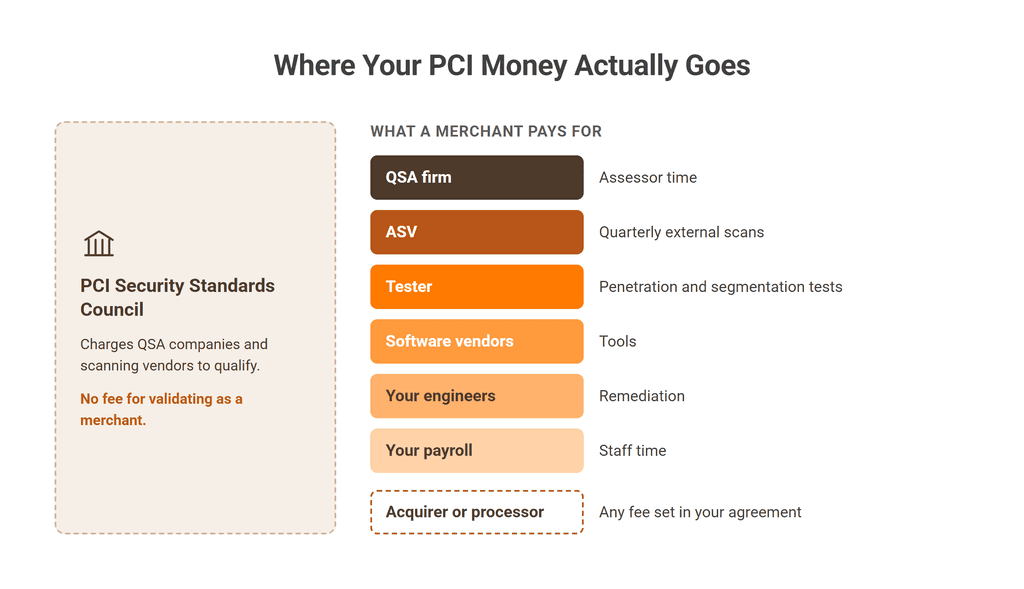
The Council charges assessor companies and scanning vendors to qualify, and its Programs Fee Schedule has no fee for validating as a merchant. A merchant pays the Council only by choice, such as for Internal Security Assessor training or Participating Organization membership.
The schedule lists what QSA companies and ASVs pay the Council to stay qualified (read November 4, 2026), so those fees won’t appear as their own line in your budget and say nothing about what a given firm will charge you.
The Council also leaves enforcement to others. Its FAQ on enforcement (April 2012) says “The individual participating payment brands will separately determine what entities must be compliant.” Any PCI compliance fees on your merchant statement therefore come from your acquirer or processor, under your agreement with them.
Apart from any fee your acquirer or processor charges, your spending flows to six places:
- A QSA firm bills assessor time.
- An ASV bills the quarterly scans.
- A tester bills the penetration and segmentation tests.
- Software vendors bill the tools.
- Your engineers carry the remediation.
- Your payroll carries the staff time.
Each of those six has its own driver, which is why the next section takes them one by one.
The Six Budget Lines and What Drives Each One
Name all six lines before anyone quotes a total, because the cheapest assessment quote can hide work that lands on another line. The sections below take them in order, from the assessment to staff time.
For the staff line, a compliance automation platform such as UnderDefense MAXI Compliance AI shrinks the work by collecting Requirement 10 (logging and log review) evidence from the security information and event management (SIEM) and endpoint detection (EDR) tools you already run, next to the scan and test reports you upload for Requirement 11 (scans and testing).
1. Assessment
On the ROC path you pay for a QSA’s time unless your brand accepts an ISA, and on the SAQ path you pay for any QSA or ISA your brand requires, plus the support you choose to buy. Either way, ask for the scope in writing.
The number of in-scope systems, locations, and payment channels drives the assessor’s days, and so does whether you’re assessed as a merchant or a service provider. Price both paths where your level gives you a choice, because a cheaper line on one side can mean a larger staff line on the other.
Ask each firm to split its quote into the assessment, any pre-assessment, and the report, so you can see which part changes when your scope does. Ask too what happens to the price if a finding needs a second round of evidence.
2. Quarterly ASV Scans
Requirement 11.3.2 calls for external scans at least once every 3 months by an ASV, with rescans until the passing-scan criteria are met. That’s four scan windows a year, and each failed scan adds a rescan and patching time. Your external IP addresses and domains drive the price, so list them before you ask for quotes.
3. Penetration and Segmentation Testing
Requirement 11.4.3 calls for external penetration testing at least once every 12 months and after any significant change. The tester must be qualified and independent, and doesn’t have to be a QSA or ASV, so this line can go to a separate firm.
Segmentation controls get tested every 12 months for merchants (11.4.5) and every 6 months for service providers (11.4.6), so a service provider buys those tests twice as often. Budget that frequency before you compare testers.
Testers that publish tier lists usually separate an external perimeter test from broader engagements. Ask each tester which tier covers your CDE and segmentation controls, and whether retests are included.
A tester prices by the number of targets, so ask for the target count before you compare quotes. A tester who can’t give that count can’t give a comparable price.
4. Tools
Tools cover log management and retention, scanners, payment-page script monitoring, phishing protection, and any compliance platform. Log volume, payment pages, and user counts drive subscription prices.
A ranking of PCI compliance software helps you build a shortlist once you know which evidence you still collect by hand. Ask each vendor to price the same frameworks, users, and connected systems, so the quotes compare.
5. Remediation
Remediation is whatever the gap assessment finds: multi-factor authentication (MFA) gaps in Entra ID, missing logs, stored card numbers nobody knew about, or unsegmented networks. Nobody can price it before that assessment, so run the gap assessment first and keep its findings on their own line.
6. Staff Time
Staff time for log review and evidence is the line nobody quotes, so estimate it yourself. List who is involved, which tasks they own, and how often each task recurs across the year.
The standard gives you the frequencies to start from: daily log review, scans every 3 months, scope confirmation every 12 months (every 6 for service providers), and an annual incident response test. Multiply each task by your own time records, because a borrowed benchmark won’t survive a CFO’s question.
If you also carry SOC 2, count shared evidence hours once, because what SOC 2 costs in staff time overlaps this line. Track those hours in one place so neither budget counts them twice.
The Budget Worksheet
Copy this worksheet into your 2027 budget. The amount column stays blank because your scope sets each figure, and each cell gets filled from a written quote or your own estimate.
The driver and question columns are this guide’s own reading.
| Budget line | What drives the amount | Where the number comes from | What to ask | Amount |
|---|---|---|---|---|
| Assessment | Validation path, in-scope systems, locations | QSA firm’s written quote | Days on-site and remote? Sample size? | |
| ASV scans | External IPs and domains, rescans | ASV’s written quote | Are rescans and dispute support included? | |
| Penetration and segmentation testing | Targets, segments, retests | Tester’s written quote | How many targets? Are retests included? | |
| Tools | Log volume, payment pages, users | Vendor’s written quote | What does renewal cost in year two? | |
| Remediation | Gap assessment findings | Engineering estimate, vendor quotes | Which findings block validation? | |
| Staff time | People, tasks, frequency | Your own estimate | Who owns each recurring task? |
Send every firm the same scope diagram and the same validation path, and ask for assumptions in writing. Two quotes only compare when they price the same systems.
📊 Keep the six lines separate in what you show finance, because each has its own driver. One blended PCI number is hard to defend to a CFO and harder to reduce.
Turn year-round PCI log review into assessor-ready evidence
The Requirements That Cost Money All Year
An assessment happens once a year, and the requirements behind it run all year. Of the 64 new requirements in PCI DSS v4.0, 51 were future-dated (Council blog, August 2024) and became effective on March 31, 2025, so assessments now test 51 requirements that were best practices before that date.
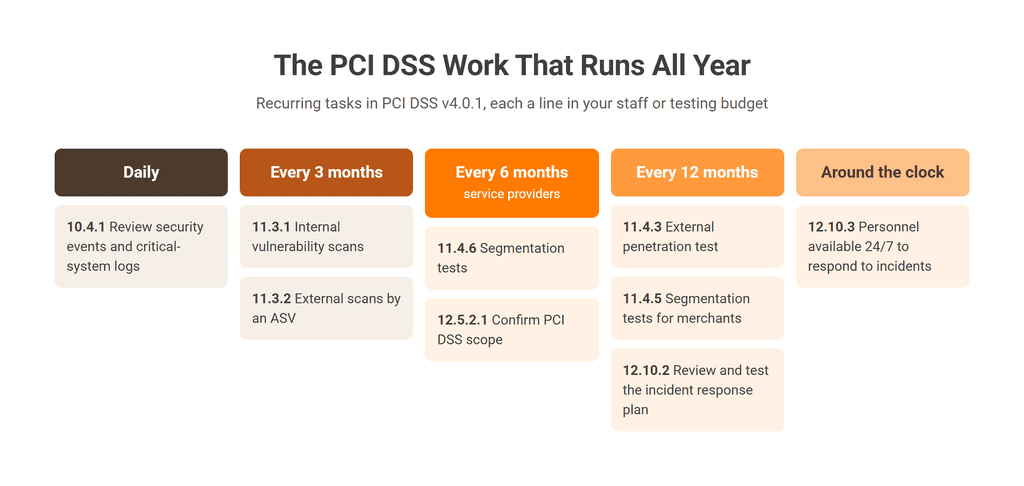
PCI DSS v4.0.1, published in June 2024, has been the only active version since the end of 2024, so every 2027 assessment runs on it.
The table takes each requirement from the standard. The cost column is this guide’s reading of where the work lands, in tools, testing, or staff time, with no dollar figures, because your stack and scope set them. Requirements 5.4.1, 6.4.3, 8.4.2, 10.4.1.1, 11.6.1, and 12.5.2.1 are among those that became mandatory in 2025.
| Requirement | What it asks | What it costs in practice |
|---|---|---|
| 5.4.1 | Automated mechanisms detect phishing and protect personnel | Email security tool, tuning time |
| 6.4.3 | Authorize, integrity-check, and inventory payment page scripts | Script tool, developer time on page changes |
| 11.6.1 | Detect tampering with payment page headers and content | Monitoring tool, staff to work alerts |
| 8.4.2 | MFA on access into the CDE | Identity licensing, rollout, exception handling |
| 10.4.1 | Daily review of security events and critical-system logs | Analyst time or 24/7 monitoring |
| 10.4.1.1 | Automated mechanisms perform audit log reviews | SIEM rules, retention, tuning |
| 11.3.1 and 11.3.2 | Internal and ASV scans at least every 3 months | Scanner, rescans, patching time |
| 12.5.2.1 | Service providers confirm scope every 6 months | Staff time, updated diagrams |
| 12.10.1 and 12.10.3 | Incident response plan, personnel available 24/7 | On-call staffing, plan testing |
Requirement 10 puts a daily task on the staff line. Requirement 10.4.1 asks for daily review of security events and logs from critical components, and FAQ 1304 (July 2025) confirms that other in-scope systems follow a frequency your own risk analysis sets.
Requirement 10 evidence depends on what your SIEM keeps and who reviews it, so check SIEM coverage for compliance before you commit to a staffing plan. Name who reviews the logs on weekends before you price the line.
Requirement 11 repeats on a fixed calendar, and each failed scan or test adds rework. A PCI DSS penetration test also feeds remediation, so leave room on that line after the report arrives.
Requirement 12.10.3 reaches past business hours: specific personnel must be available 24/7 to respond to suspected or confirmed incidents. Requirement 12.10.2 adds a review and test of the plan at least once every 12 months. Budget both as recurring work, and ask who covers nights, weekends, and holidays.
Scope Reduction Cuts the Total More Than Any Discount
A discount lowers one rate on one quote, while a smaller CDE lowers the assessor’s sample, the scan targets, the test scope, and the staff hours together. That’s why scope moves come before any negotiation.
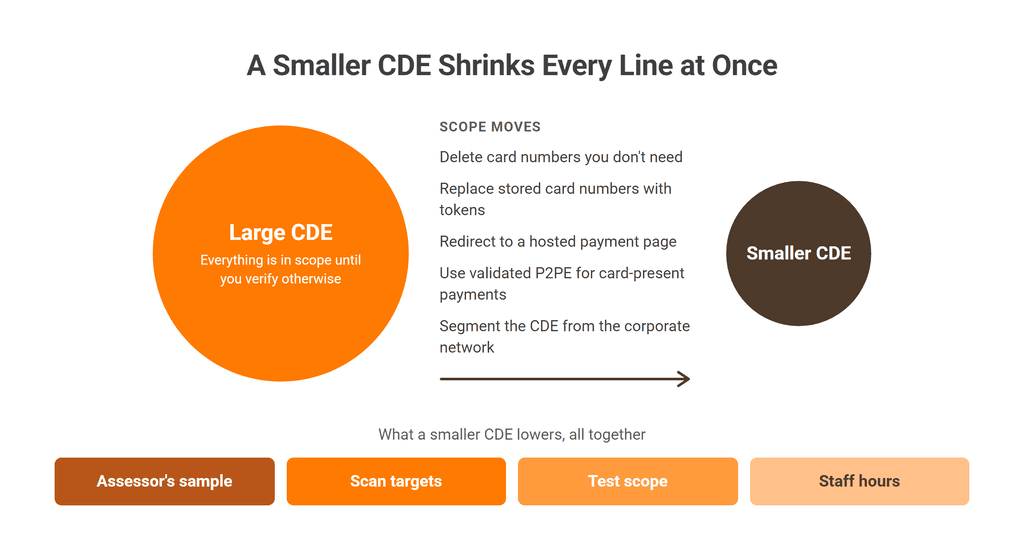
The Council’s scoping and segmentation guidance (May 2017) tells you to treat everything as in scope until you verify otherwise. It also notes that tokenization or encryption can reduce the size of the CDE.
Read the March 2025 SAQ A change before you pick a payment page design. The Council removed requirements 6.4.3, 11.6.1, and 12.3.1 from SAQ A and added an eligibility criterion: merchants must confirm their site is not susceptible to script attacks that could affect their e-commerce systems.
FAQ 1588 (February 2025) limits that criterion to pages with a processor’s embedded form, such as an iframe. It excludes merchants that redirect customers or fully outsource payment functions. An embedded form stays eligible if you deploy script protections such as those in 6.4.3 and 11.6.1, or if your compliant processor confirms that its form includes them.
Price these moves before you buy anything. Each one changes what an assessor, an ASV, and a tester will quote:
- Stop storing card numbers you don’t need, and delete old exports and logs that contain them.
- Replace stored card numbers with your processor’s tokens.
- Redirect customers to your processor’s hosted payment page.
- Get your processor’s written script-attack confirmation if you keep an embedded form.
- Use a validated point-to-point encryption (P2PE) solution for card-present payments.
- Segment the CDE from the corporate network, and budget the segmentation tests that follow.
- Retire payment channels and gateways nobody uses.
- Collect each service provider’s AOC and its written split of responsibilities.
Make these decisions before you request quotes. Each firm then prices the environment you will actually assess, and you avoid paying for scope you were about to remove.
Check each move against your acquirer’s expectations as well. The SAQ you qualify for depends on how you accept cards, and your acquirer has the last word on what it accepts, so ask for that answer in writing before you commit engineering time.
What Non-Compliance and a Card Breach Cost
The fee your acquirer charges for missing validation sits in your agreement, and no industry-wide schedule sets it. One processor’s support page says it charges a PCI noncompliance fee “for every month that you don’t comply” and prints no amount.
Read your own agreement before you put a figure in the budget. American Express publishes its own non-compliance fees in its merchant regulations, so read those too if you accept its cards.
Visa bills its members, the issuers and acquirers. Visa’s compliance page says “Visa may assess a non-compliance assessment to the issuer or acquirer” when a merchant or service provider doesn’t comply, and that the issuer or acquirer pays it. Ask your acquirer whether its agreement passes such a charge on to you.
⏱️ After a suspected compromise, Visa can require a PCI Forensic Investigator (PFI). Its What To Do If Compromised guide (June 2026) gives you 5 business days to sign a PFI contract, so the choice of firm can’t wait for the incident.
The PFI can’t be a firm that served you as QSA, advisor, consultant, or monitoring provider in the past 3 years, so your current partners can’t take this work. Pick a PFI from the Council’s list before you need one.
The same guide publishes figures for its own rules. Visa can charge its member, your acquirer or the card issuer, up to $100,000 per incident when the guide’s requirements aren’t met, and for Level 3 merchants the guide lists lower amounts of $5,000, $10,000, and $25,000, which Visa can raise. Your acquirer carries these first, so the agreement question above decides your exposure.
If a PFI investigation is still open after 4 full calendar months, the guide adds $10,000 a month for Level 1 and 2 merchants, or a flat $3,000 for Level 3. A slow investigation keeps adding cost, and your agreement decides how much of it reaches you.
Where a Compliance Platform Changes the PCI Budget
MAXI Compliance AI cuts the staff line by collecting Requirement 10 log-review evidence from the Splunk or Sentinel and the CrowdStrike or SentinelOne you already run, and keeping it current between assessments, so nobody rebuilds a log-review record the week before the on-site visit.
UnderDefense is rated 5.0 out of 5 from 83 reviews on G2 (November 2026).
The scan and test reports you upload for Requirement 11 sit in the same evidence set, and your assessor works with that evidence and its reports inside the platform, with the access you grant.
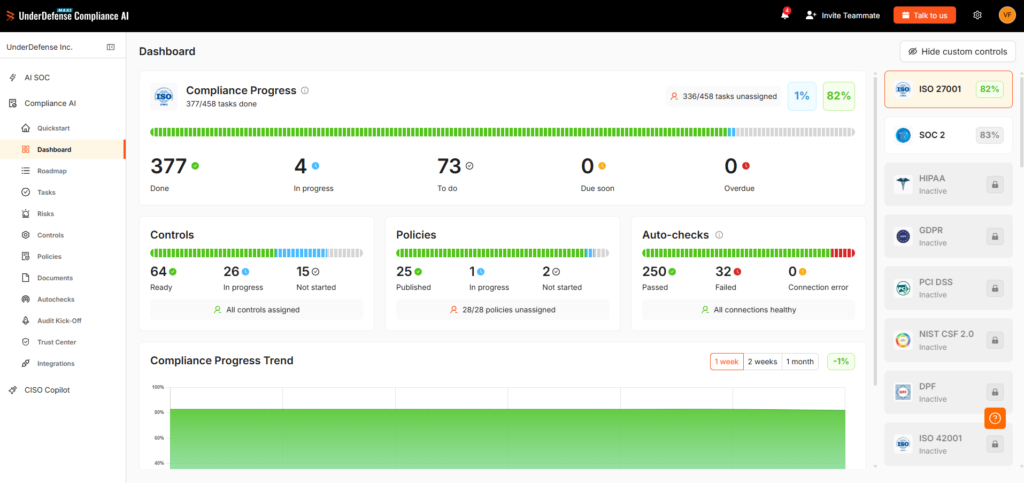
PCI DSS evidence collected once also counts toward SOC 2, ISO 27001, HIPAA, GDPR, and DORA, which matters when the same engineers answer every audit. Your QSA or your own team still completes the ROC or SAQ.
MAXI Compliance AI is not a PCI Approved Scanning Vendor: the Certified package’s vulnerability scans don’t replace the quarterly ASV scans in Requirement 11.3.2, so keep that line in your worksheet.
On the published compliance packages page, the Free tier costs $0 and the paid tiers start at $499 (Starter), $1,299 (Essential), and $1,899 (Certified) a month.
Each paid package also includes 24, 48, or 90 hours a year with UnderDefense compliance consultants, depending on the package, so part of the preparation work leaves your staff line too.
The paid packages also cover PCI work outside the logs: MFA configuration from Starter (Requirement 8.4.2), custom policies and security awareness training from Essential (Requirement 12), and a custom incident response plan with audit support in Certified (Requirement 12.10.1). The platform runs as SaaS, hybrid, on-premises, or air-gapped.
Check your PCI DSS readiness with a compliance expert
Helpware, a business process outsourcing (BPO) company holding SOC 2 and ISO 27001 in eight countries, runs its compliance program on the platform. Its case study reports “2× faster audit readiness” and “50+ automated checks running 24/7,” and notes the company “kept the same compliance team while the business doubled,” which is the staff line this guide asks you to estimate.
The UnderDefense Agentic AI SOC works on the same data in one system, with AI agents investigating every alert, including on the nights and weekends Requirement 12.10.3 asks you to cover.
See which PCI DSS evidence your current tools already produce
- Get custom policies and an incident response plan for Requirement 12
- Get 24, 48, or 90 consulting hours a year, by package
- Keep Requirement 10 evidence current between assessments
Frequently Asked Questions
How much does PCI compliance cost for a small business?
It depends on your level and SAQ type, and no single price list sets it for a business of any size. Use the same six lines as the worksheet, plus any fee in your acquirer agreement, and price each one for your SAQ type. The compliance platform line can be priced from a public list: UnderDefense MAXI Compliance AI has a $0 Free tier and paid packages from $499 a month.
Is there a PCI DSS certification, and what does it cost?
PCI DSS has no certificate, and what you receive is an Attestation of Compliance backed by a ROC or SAQ. What people call PCI certification is that validation, so PCI DSS certification cost means the assessment, scan, and testing lines in your worksheet.
Who pays the PCI compliance fee on my merchant statement?
You pay it, and your acquirer or processor sets and collects it under your agreement. The Council’s fee schedule has no such fee. Ask your processor what the fee covers, whether it includes a scanning or SAQ tool, and what documents clear a non-compliance charge.
How much does a QSA assessment cost?
A QSA firm sets the price in a written quote for your scope, and this guide prints no range because an unsourced estimate can’t be checked. Ask each firm for assessor days on-site and remote, the systems it will sample, and what triggers a change order, using the same scope diagram.
Does using Stripe or another processor make me PCI compliant?
No, you still validate your own compliance, though a processor can reduce what you handle. Stripe’s integration guide says “PCI compliance is a shared responsibility” and that a business accepting payments must “annually attest to this compliance.” Your integration type then decides which SAQ applies.