






An enterprise prospect in Europe sends its security questionnaire, and one of the first questions asks for your ISO/IEC 27001 certificate. If you can’t attach one, or at least an auditor’s engagement letter with a booked audit date, the deal waits in procurement while a competitor that holds the certificate moves ahead.
Below are nine platforms, checked against the clauses your certification body will test, and a stage-by-stage map from gap analysis to certificate.
TL;DR
- ISO 27001 compliance software comes in two kinds: ISO-native tools built around the management system, and multi-framework platforms that add ISO 27001 to SOC 2 and other frameworks.
- Six questions separate them: the risk method, the Statement of Applicability, internal audit, management review, auditor access, and SOC 2 reuse.
- The list ranks nine platforms, from UnderDefense MAXI Compliance AI to ISMS.online, Conformio, Vanta, and Drata.
- The closing sections show where software helps at each stage from gap analysis to the certification audit, and how to run ISO 27001 and SOC 2 from one control set.
Table of contents
- What a Certification Body Checks Beyond the Annex A Controls
- Six Questions That Separate an ISO 27001 Tool From a SOC 2 Tool With an ISO Template
- ISO 27001 Compliance Software Compared Side by Side
- The 9 Best ISO 27001 Compliance Software Solutions for 2027
- From Gap Analysis to Certification Audit: Where Software Helps at Each Stage
- Running ISO 27001 and SOC 2 From One Control Set
- Frequently Asked Questions
ISO 27001 compliance software shortens the road to that certificate, as long as you buy it for the right half of the standard. Most platforms map the Annex A controls, the standard’s list of security controls, well. The certification body also audits the management system around those controls: the risk assessment, the Statement of Applicability, the internal audit, and the management review.
Certification keeps spreading: the ISO Survey 2025 counted 125,622 valid ISO/IEC 27001 certificates at the end of 2025, up from 96,709 a year earlier, as reported by DQS in October 2026. For you, that means a European buyer is likely to see an ISO 27001 certificate from your competitors already.
This guide compares nine platforms on those management-system clauses, and they fall into two groups:
- ISO-native tools, such as ISMS.online, Conformio, and DataGuard, are built around the information security management system (ISMS) the standard defines, from interested parties to management review, and suit a team whose first goal is the certificate.
- Multi-framework platforms, such as Vanta, Drata, Sprinto, Secureframe, Hyperproof, and UnderDefense MAXI Compliance AI, map ISO 27001 onto a control set that also serves SOC 2, and suit a team that already holds a SOC 2 report.
Each competitor fact below was read on that vendor’s own site in October and November 2026.
The first entry, UnderDefense MAXI Compliance AI, feeds one control set for SOC 2 and ISO 27001 from live security data.
Disclosure: this article is published by UnderDefense, which places its own MAXI Compliance AI in first place. Every entry uses the same template and criteria.
Find the ISO 27001 clauses your auditor will test first
What a Certification Body Checks Beyond the Annex A Controls
ISO 27001 has two parts. Clauses 4 to 10 describe how you run your ISMS: how you decide on risks, check your own work, and report to management. Annex A is a list of 93 security controls. The certification body audits both, and most tools handle Annex A well, so the difference between them sits in the clauses.
ISO/IEC 27001:2022, published in October 2022, sets its requirements in seven clauses: context of the organization, leadership, planning, support, operation, performance evaluation, and improvement. Clause 6.1.3 d) requires a Statement of Applicability (SoA): the list of Annex A controls you apply, why you included or excluded each one, and whether it is implemented.
The 2022 edition’s Annex A groups its 93 controls in four themes (organizational, people, physical, and technological), and since October 31, 2025 certificates to the 2013 edition have expired or been withdrawn under the International Accreditation Forum’s IAF transition rules published in 2023. Any tool you buy should run the 2022 control set.
Here is how the clauses split between what a platform can hold and what your people still decide.
| Clause | What the auditor checks | What software can hold |
|---|---|---|
| 4 Context of the organization | Scope, interested parties, ISMS boundaries | Scope statement, interested-parties register |
| 5 Leadership | Policy, roles, management commitment | Approved policies, role assignments |
| 6 Planning | Risk method, treatment, SoA, planned changes | Risk register, treatment plans, SoA |
| 7 Support | Competence, awareness, documented information | Training records, document control |
| 8 Operation | Risk treatment carried out | Tasks, control evidence |
| 9 Performance evaluation | Monitoring, internal audit, management review | Audit program, findings, review minutes |
| 10 Improvement | Nonconformities and corrective actions | Corrective action log |
💡 The right column is a record, and the decisions behind it stay with your team. Someone decides which risks you accept, someone audits the ISMS impartially, and top management draws conclusions in its review. Tools that structure those decisions save more audit preparation than tools that only map controls.
Six Questions That Separate an ISO 27001 Tool From a SOC 2 Tool With an ISO Template
Six questions show whether a platform was built around the ISO management system or added it as one more framework. Ask every vendor all six on the first call, and ask to see each answer on screen.
1. Which risk assessment method does it support?
ISO 27001 lets you choose your method, so the tool should support yours, whether asset-based, scenario-based, or both. Look for likelihood and impact scoring, treatment options, owners, and a link from each risk to the controls that treat it. A register that stores only a score leaves your team writing the treatment decisions that clause 6.1.3 asks for.
2. Does it generate the Statement of Applicability?
Some tools build it for you: Conformio, Vanta, and Secureframe generate it, and UnderDefense MAXI Compliance AI builds it in the platform with a justification for each control, while Drata and Hyperproof leave it to a template or exports. The SoA lists the Annex A controls you selected, why you included or excluded each one, and whether it is implemented.
Ask whether the tool generates it from your risk treatment decisions, whether you can edit each justification, and whether it exports a dated version for the auditor.
3. How does it help you run the internal audit?
Clause 9.2 requires an internal audit by someone impartial, which means people don’t audit their own work. Tools handle it in three ways. A module runs the audit program in the product and suits a team that has someone outside the ISMS work to act as auditor.
An expert service from the vendor suits a small team where everyone who could audit also built the controls. A template is the minimum and works only if you already have that person. Whichever you pick, an ISO 27001 internal audit runs from scope through findings to follow-up and verification.
4. Does it support management review?
Clause 9.3 asks top management to review the ISMS against defined inputs and to keep documented results. A tool helps when it gathers those inputs, such as audit results, risk status, and open nonconformities, into one agenda and stores the minutes as evidence. Ask to see it, because the auditor will ask for the minutes.
5. How does the auditor get access?
Ask whether your certification body can log in with a read-only role scoped to the audit, or whether your team exports folders and shares screens for days. A scoped auditor role cuts the back-and-forth during fieldwork and leaves an access log that is itself evidence.
6. Will one control set cover SOC 2 and ISO 27001?
For the Annex A controls the two frameworks share, yes. If you already hold a SOC 2 report, ask how the tool maps one control to both frameworks and whether one piece of evidence satisfies both auditors. Then ask what it adds for clauses 4 to 10, because the SOC 2 Trust Services Criteria have no Statement of Applicability.
ISO 27001 Compliance Software Compared Side by Side
The table compares the nine platforms on fit, ISO focus, SoA, internal audit, and published pricing. “Ask in demo” marks a capability this review didn’t find described on that vendor’s pages. Treat it as a question for the first call.
| Vendor | Best for | ISO-native or multi-framework | SoA generation | Internal audit support | Published pricing |
|---|---|---|---|---|---|
| UnderDefense MAXI Compliance AI | ISO 27001 with live evidence and consultant hours | Multi-framework | Built in the platform, with justifications | 24, 48, or 90 consultant hours a year; monthly review and audit support in Certified | Published, monthly packages |
| ISMS.online | Microsoft 365 shops wanting an ISO-first ISMS | ISO-native | Online SoA with export | Audit plans in the product | Quote-based |
| Conformio | Subsidiaries certifying a narrow scope | ISO-native | Generated automatically | In the product | Published, monthly or annual |
| DataGuard | German-speaking markets, also NIS2 or TISAX | ISO-native, plus privacy | Ask in demo | Expert service | Quote-based |
| Vanta | SOC 2 customers reusing evidence | Multi-framework | Generated automatically | Template and workflow | Quote-based |
| Drata | Internal audits inside the audit workflow | Multi-framework | ISMS Plan template | In the product | Quote-based |
| Sprinto | Auditors from the vendor’s accredited network | Multi-framework | Pre-filled from your stack | Growth plan | Contact sales |
| Secureframe | A generated SoA and a published floor | Multi-framework | Generated, exportable | Help-center guidance | Published starting price |
| Hyperproof | Many frameworks on one control set | Multi-framework | Custom fields plus exports | Assessments and audits | Quote-based |
Conformio, Vanta, and Secureframe generate the SoA, UnderDefense builds it in the platform with a justification for each control, ISMS.online keeps an online SoA with export, and Sprinto pre-fills one.
Conformio, Drata, ISMS.online, Hyperproof, and Vanta support internal audit work inside the product, Sprinto adds internal audit management on its Growth plan, and UnderDefense backs the program with 24, 48, or 90 consultant hours a year, depending on the package.
Three vendors publish a price (UnderDefense, Conformio, and Secureframe), and the other six quote on request. Most ISO 27001 tools on this list cover Annex A mapping well. The SoA and internal audit columns are the ones to test in a demo.
The 9 Best ISO 27001 Compliance Software Solutions for 2027
Each of the nine ISO 27001 compliance tools below follows the same template, and its heading names the team it fits. The ISMS coverage field in each entry shows how the tool handles the four management-system records the auditor asks for: the risk assessment, the SoA, the internal audit, and the management review. UnderDefense MAXI Compliance AI comes first, followed by three ISO-native tools (ISMS.online, Conformio, and DataGuard) and five multi-framework platforms (Vanta, Drata, Sprinto, Secureframe, and Hyperproof).
1. UnderDefense MAXI Compliance AI: Best for ISO 27001 Teams That Want Live Evidence and Consultant Hours
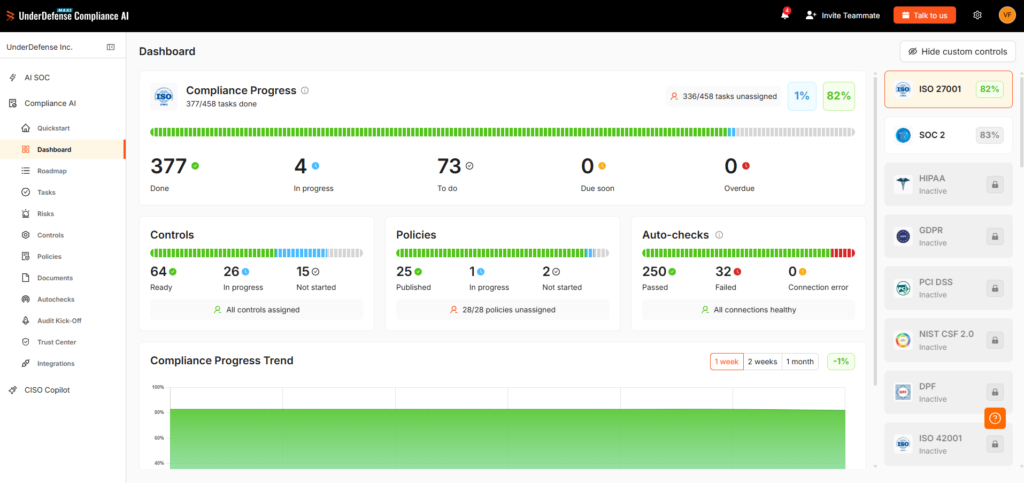
Overview: UnderDefense MAXI Compliance AI turns the controls you already run into an ISO 27001 program: it maps each control once to ISO 27001 and SOC 2, builds the risk assessment and the Statement of Applicability in the platform, and keeps Annex A evidence current from the security tools you connect.
On G2, UnderDefense averages 5.0 out of 5 over 83 reviews (November 2026), and it holds Clutch’s 2025 Top Cybersecurity Company badge.
Your certification body reviews that evidence in the platform through a read-only Auditor role you grant, so fieldwork doesn’t turn into weeks of file requests.
Consultant hours come with every paid package, so the ISMS work doesn’t land on your SOC 2 team alone.
Key features:
- One control set for ISO 27001 and SOC 2: each control mapped once, evidence collected once for both audits
- Auto-checks on connected cloud, identity, security monitoring (SIEM), and endpoint (EDR) systems that keep Annex A evidence current between surveillance audits
- Risk assessment, treatment plan, and SoA built in the platform, with a justification for each control
- 250+ integrations, including a Microsoft Entra ID and Microsoft 365 connector, Jira, AWS, Azure, and Okta, with other tools connected through MCP
- A native read-only Auditor role, scoped to your certification body’s audit
- Audit Kick-Off, which matches you with a partner audit firm within one business day
- Runs as SaaS, in a hybrid setup, on-premises, or fully air-gapped
The Audit Kick-Off screen shows the partner firms and the frameworks each one covers.
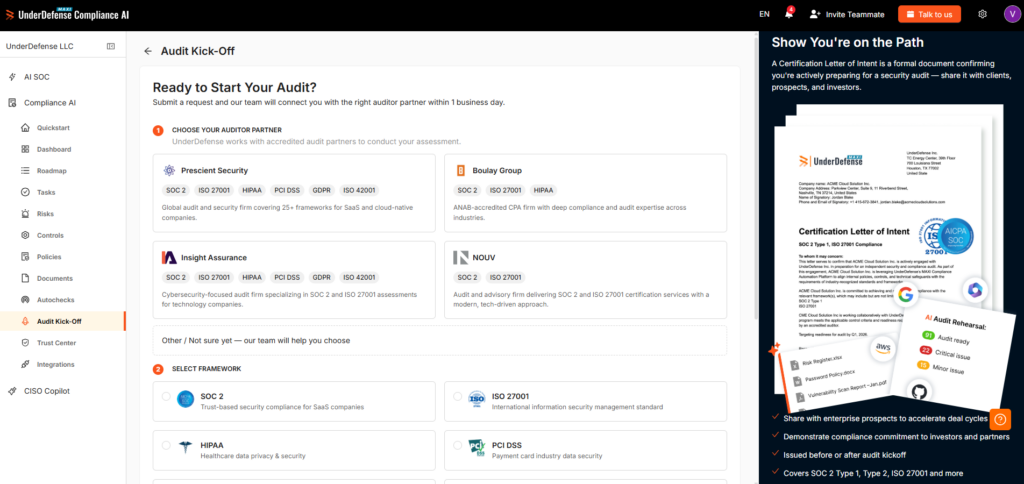
ISMS coverage: UnderDefense’s own certification is the proof. The company certified to ISO/IEC 27001:2022 on MAXI Compliance AI: scoping, gap analysis, the risk assessment and treatment plan, and the SoA with a justification for every included and excluded control were all built in the platform.
The certification body audited through the same read-only Auditor role your auditor would get. The product covers ISO 27001, SOC 2, HIPAA, GDPR, and PCI DSS, plus DORA (the EU’s Digital Operational Resilience Act), NIST CSF 2.0 (the NIST Cybersecurity Framework), and ISO 42001 (the standard for AI management systems).
The Certified package adds a monthly continuous compliance review plus audit support and advocacy, inside the same workspace your auditor uses.
Integrations and setup: Annex A evidence arrives through the platform’s 250+ integrations, including a Microsoft Entra ID and Microsoft 365 connector, Jira, AWS, Azure, and Okta, and tools without a native connector connect through MCP (Model Context Protocol).
MAXI Compliance AI sits on top of the stack you already run without replacing it. You can run the audit with one of UnderDefense’s partner audit firms or bring your own certification body, which gets the same scoped Auditor role.
Pricing: Four published compliance packages: Free at $0, Starter at $499 a month and up, Essential at $1,299 and up, and Certified at $1,899 and up (read October 2026).
Starter carries 24 consulting hours a year, Essential 48, and Certified 90. Starter also adds access to UnderDefense’s auditor pool, and Certified adds audit support and advocacy. Extra consulting is $65 an hour, so compare the package with a software license plus the consultant you would otherwise hire.
Pros:
- Your certification body reviews evidence in place through a scoped, read-only role
- SOC 2 and ISO 27001 run from one control set fed by live security data
- Evidence from the identity, cloud, and ticketing tools you already connect
- Consulting time is part of the price, so your team doesn’t prepare the audit alone
- Published monthly prices for every paid package, plus a Free tier
- On-premises and air-gapped options next to SaaS and hybrid
- UnderDefense certified to ISO/IEC 27001:2022 on the same platform
- Proof from a team running both frameworks: Helpware, a global business process outsourcing (BPO) company with SOC 2 and ISO 27001 across 8 countries, reports 2x faster audit readiness and kept the same compliance team while the business doubled, per its case study
Cons:
- The lower packages give less hands-on audit help: audit support and the monthly continuous compliance review come only with Certified, from $1,899 a month
One Clutch reviewer, whose engagement with UnderDefense included ISO 27001, names the outcome:
“We successfully passed our ISO audit.” Viktoriia Kulyk, Marketer, Solva (11-50 employees), Clutch
Who should skip it: Teams that want a document-led, ISO-only toolkit and have no plan to connect live security data or run SOC 2 alongside ISO 27001.
If you add security monitoring later, the UnderDefense Agentic AI SOC is one system working on this same data.
Map your ISO 27001 gaps with UnderDefense
2. ISMS.online: Best for Microsoft 365 Shops That Want an ISO-First ISMS
Overview: ISMS.online, now branded IO, is run by Alliantist Ltd in Brighton, UK. Its frameworks include ISO 27001, ISO 27701, and ISO 42001, and it splits certification into guided steps from the start date to the certificate.
Key features:
- A live risk register that links every risk to a treatment, a control, and an owner
- Audit plans, management review programs, and corrective actions aligned to clauses 10.1 and 10.2
- Pre-configured ISO 27001 policies and controls
- An interested-parties register for clause 4.2
- Entra and Intune signals surfaced as control evidence
ISMS coverage: Risk assessment, internal audit planning, management review, and corrective actions all appear on ISMS.online’s feature pages. ISMS.online says its online SoA addresses each Annex A control with applicability and justification, stays in sync with linked policies and controls, and offers a simple export. Ask to see the export your auditor would receive.
Auditors get access to “the areas required,” and the vendor can introduce accredited auditors while leaving you “free to use any auditor you choose.”
Integrations and setup: ISMS.online lists integrations with SharePoint, Teams, Outlook, Azure single sign-on, Intune, Entra, Jira, Slack, ServiceNow, and Okta, plus an API.
A dedicated customer success manager guides setup. Data sits in a primary UK data center, with others in Europe, the United States, and Australia.
Pricing: Quote-based. ISMS.online says its pricing “is bespoke to you” (read October 2026).
Pros:
- Built around the ISO management system, from interested parties to corrective actions
- Microsoft identity and device evidence from Entra and Intune
- UK hosting, plus ISO 27001 policies in French, German, and Spanish
Cons:
- No published price, so budgeting waits for a sales call
- The integrations page names Microsoft identity and device signals as its automated evidence sources, so confirm how evidence from AWS or Azure workloads gets in
Who should skip it: Teams whose evidence lives mostly in AWS and who want automated cloud configuration checks at the core of the program.
3. Conformio: Best for a Small Subsidiary or Business Unit Certifying a Narrow ISO 27001 Scope
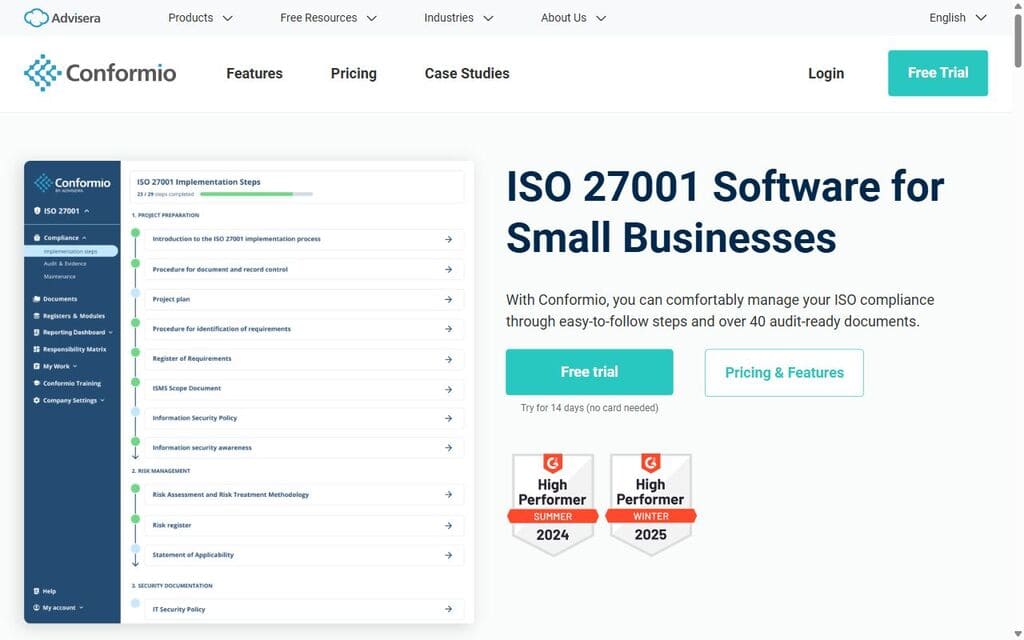
Overview: Conformio, from Advisera, is ISO 27001 compliance software built for small businesses. It walks a team through implementation in guided steps, from project preparation to the risk register and the Statement of Applicability, with “over 40 audit-ready documents.” A 14-day free trial needs no card.
Key features:
- A Statement of Applicability that “is automatically generated with suggested policies, procedures and tasks”
- A risk assessment and treatment methodology, with a risk register
- Internal audit and management review steps inside the product
- A pre-audit check with a certified expert on the Advanced plan
ISMS coverage: Conformio covers all four management-system areas this guide tests: risk assessment, an automatically generated SoA, internal audit, and management review. Its help center describes an Auditor role that “can access only the Audit & Evidence dashboard, all approved documents, and uploaded evidence, can’t make any changes.”
Integrations and setup: The help center lists three integrations (Dropbox, Microsoft SharePoint Online, and Slack), which sync approved policies and messages. Setup follows the step list on screen, and the Advanced plan adds one hour of expert consultation and one expert document review per month. Two-factor authentication is available on the Advanced plan only.
Pricing: Published, with monthly billing also offered. Annual prices: Starter $1,399 per year (3 users, up to 100 risks), Professional $2,399 per year (5 users, unlimited risks), and Advanced $2,699 per year (unlimited users), read October 2026.
Pros:
- ISO-native, with every management-system clause in one guided flow
- Published annual prices and a free trial
- A read-only Auditor role scoped to documents and evidence
Cons:
- Positioned for small businesses, with user limits on Starter and Professional
- Its three integrations sync policies and messages, so plan how evidence from Entra ID, AWS, and Jira gets into the tool
Who should skip it: A company certifying its whole organization across hundreds of staff, with evidence spread across cloud and identity systems.
Keep ISO evidence current from the cloud and identity tools you run
4. DataGuard: Best for German-Speaking Markets That Want ISO 27001, NIS2, and TISAX With Experts in the Loop
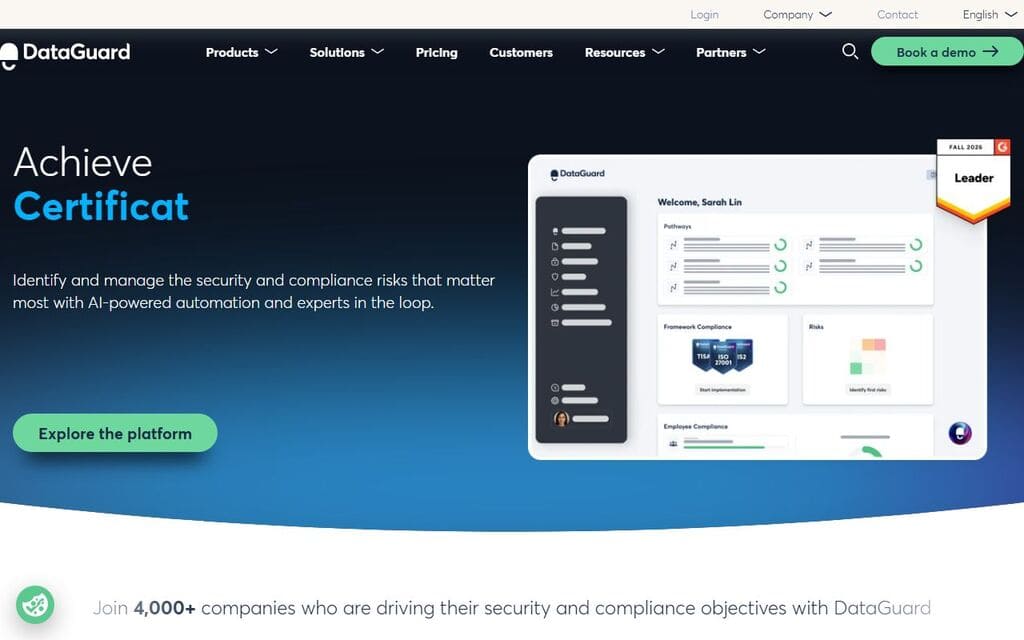
Overview: DataGuard, the brand of Munich-based DataCo GmbH, combines information security and privacy compliance with expert services for Germany, Austria, and Switzerland. Its frameworks include ISO 27001, the EU’s NIS2 cybersecurity directive, TISAX (the automotive industry’s information security assessment), GDPR, the EU AI Act, and ISO 42001, and its software is “hosted in Germany.”
Key features:
- A prepopulated risk library with treatment options to avoid, accept, transfer, or mitigate
- Policy templates with review, approval, and employee attestation tracking
- An asset inventory mapped to ISO 27001, NIS2, and TISAX controls
- Experts in the loop, including an external information security officer as an add-on
ISMS coverage: Risk assessment and treatment run in the platform. DataGuard’s pricing page lists “Internal audit to assess compliance, measure effectiveness, and identify security gaps” within its expert security program, and its ISO 27001 page says its experts help you conduct the internal audit. Ask how the platform produces the Statement of Applicability and the management review record.
Integrations and setup: DataGuard names integrations with Asana, Jira, and Azure, where it imports assets on a schedule. Automated asset import is “Exclusively available with Security Platform (Advanced).” The Pro plan pairs the platform with expert support to establish the ISMS.
Pricing: Quote-based, across Base, Pro, and Enterprise plans (read October 2026).
Pros:
- ISO 27001, NIS2, TISAX, and GDPR in one German-hosted platform
- Experts can run the internal audit and much of the ISMS build
- A risk library to start from on day one
Cons:
- No published prices
- Much of the ISMS work sits in expert service tiers, and automated asset import requires the Advanced platform
Who should skip it: Teams that want to run every clause themselves inside the tool, or that sell mainly in North America with no TISAX or NIS2 exposure.
5. Vanta: Best for SOC 2 Customers Who Want ISO Evidence Pulled From AWS, Azure, and Entra ID
Overview: Vanta supports ISO 27001 alongside SOC 2, HIPAA, and other frameworks. Its ISO 27001 page lists ISMS templates, a risk register aligned with ISO 27005, and guided workflows for management reviews and internal audits.
Key features:
- An SoA that Vanta generates and updates, mapping each control “to real tests and documents”
- A risk register with workflows “based on ISO 27005,” plus a risk library and treatment plans
- A Management Review template for clause 9.3
- Issue management for ISO nonconformities on the Professional and Enterprise plans
- Mapped controls, so SOC 2 evidence can serve ISO 27001
ISMS coverage: Vanta runs risk assessment, SoA generation, and management review in the product. For internal audit, its help center calls the support “a lightweight template for planning and designing your internal audit program,” so check how much of the audit runs inside Vanta.
Auditors sign in to a separate auditor portal scoped to their engagement, and every plan includes Vanta’s auditor network or the option to bring your own auditor.
Integrations and setup: Vanta pulls evidence from AWS and Azure resources. Its Entra ID connector imports users, groups, and roles, and sign-in and multi-factor authentication (MFA) data need Entra ID P1 or P2.
Jira integrates for tickets, and Confluence syncs published policy pages. An EU region exists, and Vanta’s help center says a European company is placed there only when it requests an EU tenant.
Pricing: Quote-based, across Essentials, Plus, Professional, and Enterprise plans, and each plan’s comparison column lists one compliance framework (read October 2026).
Pros:
- Generated SoA, ISO 27005-aligned risk register, and a management review template in one product
- Deep evidence collection from AWS, Azure, and Entra ID
- SOC 2 controls mapped to ISO 27001 out of the box
Cons:
- No published prices, and each plan lists one compliance framework, which makes SOC 2 plus ISO 27001 a pricing question for the first call
- Issue management for nonconformities appears only on Professional and Enterprise, and EU hosting has to be requested
Who should skip it: Anyone who must see a price before the first call, or who wants internal audits run by an outside expert inside the tool.
6. Drata: Best for Teams That Want Internal Audits Run Through the Same Workflow as External Audits
Overview: Drata’s frameworks include ISO 27001:2022, ISO 27701, ISO 42001, NIS 2, and DORA. It maps ISO 27001 controls to shared evidence that it keeps current across audits.
Key features:
- Internal audits that run in Drata through the same workflow as external audits
- A pre-loaded risk library with sources including ISO 27005, NIST SP 800-30, and the security risk assessment (SRA) tool of the HHS Office for Civil Rights (OCR)
- Inherent and residual risk scoring with accept, transfer, avoid, and reduce treatments
- An ISMS Plan template that walks clauses 4 to 10, the SoA, and Annex A
- An Audit Hub for auditor requests and documents
ISMS coverage: Risk assessment and internal audit run in the product. Drata’s 2022 checklist has you complete the SoA, the management review, and corrective action plans inside its ISMS Plan template, then upload the results as evidence.
The in-product internal audit is a “New Experience” feature, and customers who joined on or after February 24, 2026 are on it automatically. Auditors get read-only access through the audit portal.
Integrations and setup: Drata documents integrations with Microsoft 365, Entra ID and Azure, AWS, Jira Cloud, and Confluence, where you can keep policies while Drata tracks approvals. Its checklist tells you to engage an accredited certification body of your choice, and a compliance advisor offers a pre-audit readiness check-in.
Pricing: Quote-based. The Foundation plan stops at 50 full-time employees with a single pre-mapped framework, while Advanced and Enterprise open “Any Available Framework” (read October 2026).
Pros:
- Internal audits share the workflow, requests, and evidence of the external audit
- A starter risk library with ISO 27005 roots
- Policies can stay in Confluence while Drata tracks approvals
Cons:
- The SoA and management review live in a document template, so your team writes them
- More frameworks are add-ons beyond Foundation’s single pre-mapped one and 50-employee cap, and custom risk scoring is an Enterprise feature
Who should skip it: Teams expecting the SoA to be generated for them, or companies above 50 employees hoping to stay on the Foundation plan.
7. Sprinto: Best for SOC 2 Teams That Want an Accredited ISO Auditor From the Vendor’s Network
Overview: Sprinto automates frameworks out of the box with continuous monitoring across its integrations. ISO 27001 sits in its framework library alongside ISO 42001 and NIS 2, and its API supports data residency in the United States, Europe, and India.
Key features:
- A risk register with inherent and residual scores, custom scoring formulas, and four treatment options
- Periodic risk assessments that senior management reviews and signs off
- An auditor network that includes “IAF-accredited certifying bodies (for ISO standards)”
- Controls reused across frameworks, with Secure Controls Framework and Common Control Framework packs
ISMS coverage: Risk assessment and treatment run in the product. Sprinto handles the internal audit and its management review as workflow checks: your team uploads the audit report or meeting minutes on a set schedule, and “Internal audit management” appears on the Growth plan.
Auditors get “a read-only view of the audit” and can mark findings as minor or major nonconformities. Sprinto says it “pre-fills your SoA against the controls your actual tech stack needs,” so ask how you edit each justification and export a dated version.
Integrations and setup: Sprinto’s docs describe five ways to connect Microsoft 365 and Entra ID, plus AWS with automated checks, Azure, Jira, and Confluence. Partner audits are available on every plan, and bringing your own auditor is a Growth plan feature.
Pricing: Quote-based. Both the Foundation and Growth plans say “Contact sales,” and Sprinto’s docs note that “billing is based on enabled frameworks” (read October 2026).
Pros:
- An EU data residency option and connectors for the Microsoft, AWS, Azure, and Atlassian stack
- Accredited ISO certification bodies inside the vendor’s auditor network
- Auditors score nonconformities directly in the platform
Cons:
- No published prices, and the bill grows with each framework you enable
- Internal audit management and bring-your-own-auditor sit on the Growth plan
Who should skip it: Teams that want to keep a certification body outside Sprinto’s network while staying on the Foundation plan.
8. Secureframe: Best for Teams That Want a Generated, Exportable SoA and a Published Starting Price
Overview: Secureframe Comply covers ISO 27001 among its frameworks. Its ISO 27001 page lays out the full cycle, from Stage 1 and Stage 2 through surveillance audits and recertification.
Key features:
- An SoA that “Secureframe automatically generates,” exported from the ISO 27001 framework page
- A combined or cross-referenced SoA for ISO 27001 and ISO 27701
- A risk module that records treatment justifications and residual risk, with quantitative scoring on the Complete plan
- Alerts on nonconformities from connected systems
ISMS coverage: Risk assessment and SoA generation run in the product, and a control maps to clause 10.2 nonconformity and corrective action. Secureframe’s help center covers the internal audit and the annual management review meeting as work your team plans and records. Assign owners for clauses 9.2 and 9.3 early.
Auditors get read-only access by module, through Secureframe’s audit partner network or a firm you enter yourself.
Integrations and setup: Secureframe’s native integrations include Microsoft 365, Entra ID, Jira, and agentless scans of AWS and Azure “through read-only access.” It runs data centers in the United States and the United Kingdom, and its FAQ calls the UK site its “EU data center.” A free audit readiness review comes with every subscription.
Pricing: Fundamentals starts “at $7,500/year,” and Complete is quote-based (read October 2026).
Pros:
- A generated, exportable SoA, including a combined ISO 27001 and 27701 version
- A published starting price
- Agentless evidence from AWS, Azure, and Entra ID
Cons:
- The published figure is a floor, and the pricing table lists one compliance framework per plan, so ask how SOC 2 plus ISO 27001 is priced
- Quantitative risk scoring and the risk dashboard require the Complete plan, and European data sits in the UK
Who should skip it: Teams that need data hosted in an EU member state, or that want internal audit and management review run as modules.
9. Hyperproof: Best for GRC Teams Running ISO 27001 Next to NIS2, DORA, and Many Other Frameworks
Overview: Hyperproof, based in Seattle, runs a governance, risk, and compliance (GRC) platform with pre-built frameworks and crosswalks that map one control to several frameworks. It runs on Microsoft Azure data centers in the United States and Europe, with a separate EU instance.
Key features:
- Jumpstart, which maps existing ISO 27001 controls to frameworks “like NIST 800-53, PCI DSS, and SOC 2”
- A Framework Update feature that “automatically migrates your existing controls” from the 2013 to the 2022 edition
- Risk registers with inherent, residual, and control-health scoring
- Issues and tasks that track nonconformities to remediation
ISMS coverage: Risk assessment runs in a Risk Register, which Hyperproof sells as “an additional module.” The SoA is built from custom fields and exported reports, and the help article says justifications from a second export may need merging in Excel.
Internal audits run through Assessments and the Audits module. Ask how management review is recorded. External auditors see only the audits they’re added to.
Integrations and setup: Hyperproof’s integrations, called Hypersyncs, include AWS, Azure, a bidirectional Jira sync, Confluence, SharePoint, and Intune. Its Entra ID Hypersync requires “A Premium Entra ID subscription (P1 or P2).”
Pricing: Quote-based; Hyperproof publishes no price list (read October 2026).
Pros:
- Crosswalks that let one control serve ISO 27001, NIS2, DORA, and SOC 2
- A documented migration path from ISO 27001:2013 to 2022
- An EU instance on Azure Europe
Cons:
- The SoA takes custom fields and exports, and the Risk Register costs extra
- The Entra ID connector needs an Entra ID P1 or P2 license
Who should skip it: Teams certifying ISO 27001 alone, which won’t use the crosswalks they pay for.
From Gap Analysis to Certification Audit: Where Software Helps at Each Stage
Software shortens the stages where your team collects, maps, and tracks, and leaves the judgment calls with people. The path from gap analysis to certificate runs through eight stages. Put those stages into an ISO 27001 compliance checklist with owners and dates before you sign a platform contract.
| Stage | What software does | What people still do |
|---|---|---|
| Gap analysis | Compares current controls with 2022 requirements | Agree on scope and boundaries |
| Risk assessment and treatment | Holds the register, scores, and treatment plans | Decide which risks to accept |
| Statement of Applicability | Drafts the control list with justifications | Approve each inclusion and exclusion |
| Internal audit | Schedules the program, records findings | Audit impartially, report to management |
| Management review | Gathers inputs into one agenda | Review results, decide on changes |
| Stage 1 audit | Shares documents through an auditor role | Answer documentation questions |
| Stage 2 audit | Presents evidence mapped to each control | Show controls working, join interviews |
| Surveillance audits | Keeps evidence current between audits | Close nonconformities, run the next review |
The certification body runs the last three stages. A Stage 1 audit is a preliminary assessment, Stage 2 is the certification assessment, and ongoing surveillance audits follow, as Ireland’s National Standards Authority (NSAI), an accredited certification body, describes the cycle on its 2026 ISO/IEC 27001 page.
📝 Policies come first for most teams, because clause 5.2 and many Annex A controls need an approved document before anything else can be audited. Starting from ISO 27001 policy templates cuts drafting time, and the approval history in your platform becomes evidence on its own.
Stage 2 also tests technological controls in practice, so expect the auditor to ask for evidence that vulnerability management works, such as scan results and fixed findings.
This guide leaves out the full cost of certification, which depends on audit days, scope, and the number of sites. Plan the software budget and the certification body’s quote as separate lines.
Running ISO 27001 and SOC 2 From One Control Set
Run both programs from one control set: map each control once to SOC 2 and ISO 27001, collect the evidence once, and let both auditors sample the same records. Access reviews, change approvals, vendor assessments, incident records, and logging evidence serve both frameworks.
ISO 27001 adds a management system that SOC 2 doesn’t ask for in the same form: a defined ISMS scope, a risk assessment method, a Statement of Applicability, an internal audit program, and management reviews with documented results. It also ends in a certificate from an accredited certification body, where SOC 2 ends in an attestation report from a certified public accountant (CPA) firm.
Three habits let one evidence pull serve both audits:
- Align the two audit calendars.
- Tag each control with both framework references.
- Give each control one owner.
🗓️ When a European customer still sends its own questionnaire, security questionnaire automation can answer it from the same policies and evidence.
The same mapping extends to AI governance. Teams that add ISO 42001 for AI can carry their ISO 27001 controls into the new management system and add only the AI-specific requirements.
Give your ISO auditor one scoped view
of risks, controls, and evidence
- See which ISO 27001 controls your connected tools already prove
- Get 24, 48, or 90 consulting hours a year, by package
- Get matched with a partner audit firm within one business day
Frequently Asked Questions
Does ISO 27001 software certify my company?
No. An accredited certification body issues the certificate after a Stage 1 and a Stage 2 audit, and ISO itself certifies no one. Software prepares the management system and the evidence and gives the auditor access to both. Check that your certification body holds accreditation from a national body such as the United Kingdom Accreditation Service (UKAS) or the ANSI National Accreditation Board (ANAB).
How long does ISO 27001 certification take with a platform?
Plan for months. Your scope, the state of your policies, and the certification body’s calendar decide the timeline, because the Stage 1 and Stage 2 audits need dates on that body’s schedule. A platform shortens the evidence work in between.
Can I reuse SOC 2 evidence for ISO 27001?
Yes, for many Annex A controls. Access reviews, change management, vendor assessments, and incident records usually serve both audits. The management-system records under clauses 4 to 10 have no SOC 2 equivalent, so plan them separately.
What changed in ISO 27001:2022?
Annex A was regrouped into four themes and gained 11 new controls, and the clauses gained a new 6.3 on planning for changes. The internal audit and management review subclauses were renamed and reordered. Amendment 1 added climate action changes in 2024, and certificates to the 2013 edition have since expired or been withdrawn.
How much does ISO 27001 compliance software cost?
It ranges from published monthly prices to quote-only contracts, and the Published pricing column in the comparison table shows which vendors list prices. Quotes tend to scale with company size and the number of frameworks. Price SOC 2 and ISO 27001 together, and budget the certification body’s fees as a separate line.