






About three weeks before SOC 2 Type II fieldwork, your auditor sends the evidence request list, and every item on it has to prove a control worked across the whole observation period. Any control you can’t back with evidence becomes an exception in the report your customers read before they sign, and in an ISO 27001 audit, a nonconformity that can hold up your certificate.
Below are twelve tools, the six things to check in each, and the questions to ask in a demo so you know which one would close those gaps before the next request list arrives.
TL;DR
- Compliance management software comes in two kinds: enterprise governance, risk, and compliance (GRC) suites that run the whole program, and security-data compliance platforms that keep evidence current from your live systems.
- Six criteria separate the tools: control reuse across frameworks, evidence freshness, integrations, auditor access, regulatory change feeds, and total cost.
- The list ranks twelve tools, from UnderDefense MAXI Compliance AI, Vanta, Drata, and Thoropass for continuous audit evidence to MetricStream, Archer, and other GRC suites for programs built around regulator exams.
- The closing sections cover what each vendor publishes about price and the five questions that test a tool on your own controls.
Table of contents
- Compliance Management Software Tracks Obligations, Controls, and Evidence Across Every Framework You Answer To
- Six Evaluation Criteria to Check During a Compliance Software Demo
- Compliance Management Software Compared Side by Side
- The 12 Best Compliance Management Software Solutions for 2027
- Five Questions to Ask During a Compliance Software Demo
- What Compliance Management Software Costs in 2027
- Frequently Asked Questions
The search for compliance management software usually starts that same week, when the request list shows which controls have no current evidence. It’s also when vendor demos help least, because every demo shows a clean dashboard on sample data.
What you need to know is whether a tool maps each of your controls once across every framework you answer to, and whether the evidence behind those controls is still current on the day the auditor asks.
This guide ranks twelve compliance management tools against six criteria worth checking in every demo, gives each one the same entry template, and names a documented limitation for every vendor. All vendor facts were read on each vendor’s own website on October 28 and November 12, 2026.
UnderDefense MAXI Compliance AI, ranked first, maps live security data from the stack you already run to NIST, SOC 2, ISO 27001, and HIPAA, so one control set can answer several audits.
Disclosure: this guide comes from UnderDefense, which ranks its own product first and applies the template and criteria used for the other eleven entries; the order is this article’s own assessment.
Find the controls your auditor will flag before the request list arrives
Compliance Management Software Tracks Obligations, Controls, and Evidence Across Every Framework You Answer To
Compliance management software keeps three records in one system: the obligations you answer to, the controls that meet them, and the evidence that proves each control works.
For a team carrying SOC 2, ISO 27001, and HIPAA or PCI DSS, the value sits in the links between those records. One MFA control, tested once, should satisfy every framework that asks for it.
Auditors expect that proof across time. A SOC 2 Type II report, issued against the AICPA’s Trust Services Criteria (AICPA is the American Institute of Certified Public Accountants), covers how controls operated over an observation period of several months, so the auditor samples evidence from the whole window, from its first month to the week before fieldwork.
HIPAA adds retention: the Security Rule requires covered entities to keep its required documentation for six years (45 CFR 164.316), so ask how long a tool keeps evidence and policy versions, and what you can export if you leave.
When you search for compliance management software, two kinds of product come back, and they solve different problems:
- Enterprise GRC suites, such as Optro, MetricStream, Archer, and ServiceNow, are all-in-one platforms that run the whole program: obligation libraries, regulatory change, policy attestation, risk registers, internal audit, and regulator exams. They suit a Head of GRC who reports to a board and usually arrive with an implementation team.
- Security-data compliance platforms, such as UnderDefense MAXI Compliance AI, Vanta, Drata, and Thoropass, are lighter tools that connect to your identity provider, cloud accounts, security information and event management (SIEM) system, and endpoint tools, collect evidence from them continuously, and map it to SOC 2, ISO 27001, and HIPAA. They suit a security or compliance lead whose audits depend on live system state, in an enterprise or a smaller team.
Most suites sit inside a broader integrated risk management model, where compliance shares one data model with operational and enterprise risk.
The choice between GRC tools vs compliance platforms comes down to where your evidence starts: in a GRC workflow or in a live system.
💡 The two kinds can work together: a suite tracks obligations and attestations, and a platform keeps the security evidence behind them current.
If you are preparing for your first SOC 2 report, compliance automation software built for one framework and one auditor may be all you need. The wrap-up after the twelve entries says which kind each tool is.
Six Evaluation Criteria to Check During a Compliance Software Demo
A demo runs on the vendor’s sample tenant, where every control is mapped and every evidence item is green. These six criteria test what that tenant hides, and each entry in the list below is checked against them.
1. Control Mapping Reused Across Frameworks
Ask how one control links to requirements in several frameworks, and who maintains those links when a framework changes. Some vendors license a shared control set such as the Unified Compliance Framework or the Secure Controls Framework, and others ship their own mappings.
A licensed control set suits a program that answers to many regulators. Vendor mappings are enough for SOC 2, ISO 27001, and HIPAA, as long as the vendor names who keeps them current.
Pick one control from your register, map it to SOC 2 and to HIPAA or ISO 27001, and see whether the second mapping asks for new evidence.
2. Evidence Freshness Between Audits
Evidence uploaded once a year goes stale within weeks. Ask which evidence the tool collects automatically, how often, and what happens when a check fails between audits.
In September 2026, Ambry Genetics paid $700,000 to settle potential HIPAA Security Rule violations that included failing to conduct an accurate and thorough risk analysis, according to the Office for Civil Rights (OCR), the office of the U.S. Department of Health and Human Services that enforces HIPAA.
A risk analysis that is not accurate and current is the kind of gap a compliance tool should flag between audits, long before an investigator asks for it.
3. Integrations With the Stack You Already Run
Name your systems on the first call: Microsoft 365, Okta or Entra ID, AWS or Azure, ServiceNow, and Jira. Then ask which are native connectors, which need the vendor’s integration team, and which come through a REST API your engineers will maintain.
Native connectors matter most for the systems your auditor samples every cycle: identity, cloud, and ticketing. An integration count on a website tells you little about who builds the connector you need.
4. Auditor Access to Current Evidence
Your external auditor and your regulator will ask for evidence in their own format. Check whether the auditor gets a scoped role in the platform, a read-only link, or an export, and whether each request and response is logged. Every attachment you email is a copy that starts aging the day it leaves.
A scoped role suits fieldwork, where the auditor samples evidence across the whole period. A read-only link or an export is enough for a one-off customer request.
5. Regulatory Change Feeds With a Named Source
Regulations keep moving under the frameworks you already hold. DORA has applied to EU financial entities since January 17, 2025 under Regulation (EU) 2022/2554.
In the US, the Securities and Exchange Commission’s (SEC) fiscal year 2026 examination priorities add exams of the 2024 amendments to Regulation S-P, the SEC’s rule on protecting customer information, including incident response programs. Ask which provider feeds the tool’s regulatory library and how a change reaches your controls.
If you still track obligations by hand, start from your list of regulatory compliance requirements and check whether the vendor’s feed covers each source on it.
6. Total Cost Including Implementation
Ask for the implementation estimate, the partner rate card, the cost of each extra framework or module, and the renewal terms after the first contract. Of the other eleven vendors, only LogicGate publishes an average implementation time and only Thoropass an onboarding range, so ask the others for theirs in writing.
Compliance Management Software Compared Side by Side
The table puts all twelve compliance management tools on one page, in the same order as the detailed entries. The framework column shows which of the five widely used frameworks (SOC 2, ISO 27001, HIPAA, PCI DSS, and GDPR) each vendor names on its own site, and prices were read on October 28 and November 12, 2026.
| Vendor | Best for | Core frameworks named | Deployment | Published pricing | How auditors get evidence |
|---|---|---|---|---|---|
| UnderDefense MAXI Compliance AI | Continuous audit evidence | All five | SaaS, hybrid, on-premises, or air-gapped | Free; paid from $499 a month | Access you grant to platform data and reports |
| Vanta | Growing programs that want an auditor working inside the platform | All five | SaaS; US, EU, or Australia hosting | No prices; four plans | Partner firms or your own auditor |
| Drata | Controls defined once across many frameworks | All five | SaaS; North America, EU, or APAC | No prices; three plans | Audit Hub for a partner firm or your own auditor |
| Thoropass | Platform and audit on one contract | All five | Not published | Quote-based | In-house auditors inside the platform |
| Optro (formerly AuditBoard) | Financial firms joining audit and IT compliance | All five | Single-tenant SaaS on AWS | Quote-based | Scoped permissions for external auditors |
| MetricStream | Banks and insurers facing regulator exams | All five | Multi-instance SaaS | Quote-based | Regulator exam and request management |
| Archer GRC | Multi-regulator banks needing an on-premises option | All but GDPR | Multi-tenant SaaS or private/on-premises | Quote-based | Scoped external-auditor role |
| ServiceNow IRM | Companies already running ServiceNow for IT service management | None listed | ServiceNow cloud; government cloud option | Quote-based | Internal audit evidence requests |
| LogicGate Risk Cloud | No-code GRC live in about a quarter | All five | SaaS, four hosting regions | No prices; priced per application and Power User | Passcode access for outside auditors |
| OneTrust Tech Risk & Compliance | Programs sharing a platform with privacy | All but PCI DSS | OneTrust-hosted cloud | No prices; priced per admin user and asset | Auditor invites and Trust Profile |
| Diligent IT Compliance | Board reporting and U.S. federal cloud hosting | All but GDPR | SaaS on AWS; GovCloud available | Quote-based | Evidence export for assessors |
| NAVEX One Risk & Governance | Compliance-led programs already on NAVEX One | All but GDPR | SaaS | Quote-based | Internal audit workspace |
Two patterns stand out. Eleven of the twelve name SOC 2, ISO 27001, and HIPAA on their own pages, so those three frameworks won’t separate your shortlist; ServiceNow’s pages promise content through a provider and list none.
Sector rules are where shortlists split. HIPAA and PCI DSS appear on most vendors’ pages, so the rule that decides is often a regional one.
For DORA, the EU’s financial resilience regulation, MAXI Compliance AI (in its product framework list), Vanta, Drata, Thoropass, MetricStream, OneTrust, and NAVEX name it among their frameworks, and Archer names it on its financial-services page. Optro, ServiceNow, LogicGate, and Diligent don’t on the pages checked, so bring your sector controls to every demo.
The 12 Best Compliance Management Software Solutions for 2027
The best compliance management software for your program depends on which frameworks you carry and where your evidence lives. The ranking below is this article’s own assessment for a security or compliance lead whose SOC 2, ISO 27001, and HIPAA audits rest on evidence from live systems.
It weighs the six criteria above, with extra weight on control reuse and evidence freshness. Each entry follows the same template, and each closes with who should skip it.
1. UnderDefense MAXI Compliance AI: Best for Continuous Audit Evidence
Disclosure: UnderDefense publishes this article and makes this product.
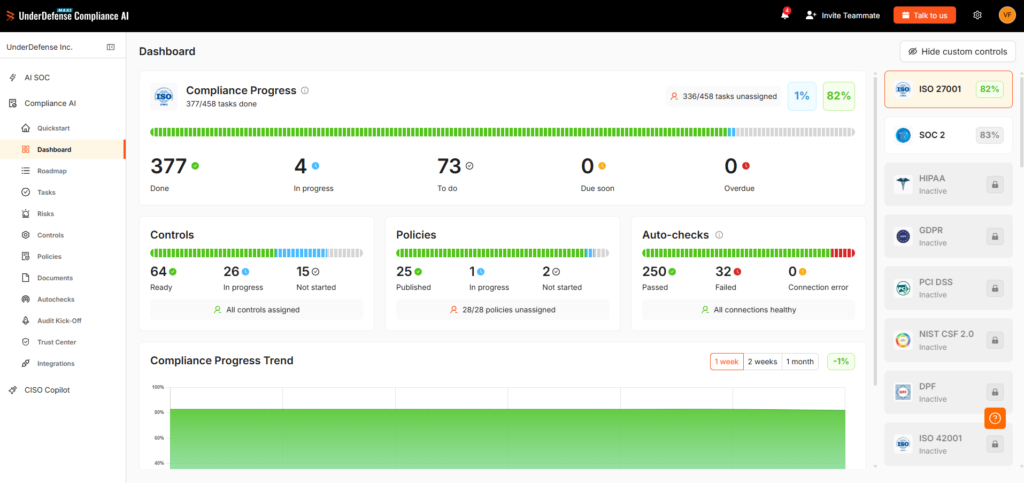
Overview: MAXI Compliance AI keeps your audit evidence current all year. It connects to the identity, cloud, SIEM, and endpoint tools you already run, collects evidence from them continuously, and maps each control a single time across SOC 2, ISO 27001, HIPAA, and the other frameworks you carry, so one tested control answers every audit that asks for it.
Buyers rate UnderDefense 5.0 out of 5 from 83 reviews on G2 (November 2026), and Clutch named it a Top Cybersecurity Company for 2025.
When the next request list arrives, your auditor works with the evidence data and reports in the platform through access you grant, and customers see your current posture through one Trust Center link, with no exports to chase.
Key features:
- One control set across SOC 2, ISO 27001, HIPAA, GDPR, PCI DSS, and DORA, with evidence collected once for every framework that uses it
- Auto-checks against connected identity, cloud, SIEM, and endpoint detection and response (EDR) tools, which flag a failing control between audits
- A HIPAA security risk analysis generated from current safeguard evidence
- Four deployment options: SaaS, hybrid, on-premises, and air-gapped
- Auditor access to the platform’s evidence data and reports, granted and controlled by you
- Audit Kick-Off, which matches you with one of four partner audit firms within one business day, or works with the auditor you already use
Frameworks covered: SOC 2, ISO 27001, HIPAA, PCI DSS, GDPR, DORA, NIST CSF 2.0, and ISO 42001 in the product’s framework list.
Integrations and setup: Evidence arrives through 250+ platform integrations, Microsoft Entra ID and Microsoft 365, Okta, AWS, Azure, Google Cloud, Microsoft Sentinel, Splunk, and CrowdStrike among them. Your team authorizes the connectors, and UnderDefense’s compliance consulting support covers policies and audit preparation.
Pricing: Published. Free, then Starter from $499, Essential from $1,299, and Certified from $1,899 a month on the published compliance packages page, with 24, 48, or 90 consulting hours a year in the paid packages (read October 28, 2026).
Pros:
- The only one of the twelve with published prices, starting with a $0 Free package
- Every paid package includes hours with UnderDefense compliance consultants (24, 48, or 90 a year, depending on the package), so your team doesn’t build the program alone
- Evidence comes from tools you already own, with no rip-and-replace
- SaaS, hybrid, on-premises, or air-gapped deployment; Archer is the only other vendor here that documents an on-premises option
- Proof from a multi-framework program: Helpware’s case study covers SOC 2 and ISO 27001 in 8 countries and reports audit readiness twice as fast, 50+ automated checks that run around the clock, and an unchanged compliance team while the business doubled
Cons: MAXI Compliance AI covers security evidence and the controls behind it; a regulatory change library and exam workflows sit outside it, in a GRC suite that can run on top.
Who should skip it: Programs whose main work is Sarbanes-Oxley (SOX) testing, internal audit workpapers, or regulator exams, which a GRC suite handles.
MAXI Compliance AI shares a platform with the UnderDefense Agentic AI SOC, so compliance and security operations work from the same live data in one system.
See how audit-ready you are with UnderDefense
2. Vanta: Best for Growing Programs That Want an Auditor Working Inside the Platform
Overview: Vanta collects compliance evidence from connected systems and maps it to many frameworks on one control set, with the auditor of your choice working inside the platform.
Vanta starts where MAXI Compliance AI does, with evidence pulled from the systems you run. It stops short of the GRC suites further down this list: its pages describe no obligation library and no regulator exam workflow.
Key features:
- Control reuse across frameworks, with evidence automation and progress tracking in one place
- Partner audit firms, or your own auditor, in a controlled auditor view
- A Trust Center for customer security reviews
- Add-on modules for questionnaire automation, access management, and third-party risk
Frameworks covered: Named frameworks include DORA, NIS 2 (the EU’s network and information security directive), NIST CSF 2.0, GDPR, PCI DSS, HIPAA, ISO 27001, and SOC 2.
Integrations and setup: Vanta’s directory lists Okta, AWS, Azure, and Jira. It runs as SaaS, with US, EU, and Australian hosting regions.
Pricing: Quote-based. Vanta lists Essentials, Plus, Professional, and Enterprise with “personalized pricing” and no figures, and Essentials covers one compliance framework (read November 12, 2026).
Pros:
- Your own auditor or a partner firm, working in a controlled auditor view
- Hosting regions in the US, EU, and Australia
Cons: Essentials covers a single framework, several capabilities are sold as add-ons, and Vanta’s pages describe no self-hosted option or obligation library.
Who should skip it: Regulated programs that need regulatory change tracking or regulator exam management in the same platform.
3. Drata: Best for Programs That Define Controls Once Across Many Frameworks
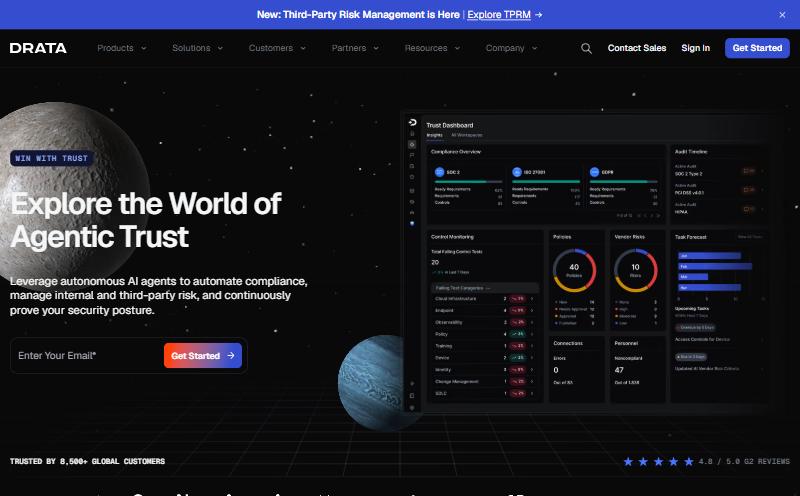
Overview: Drata’s Multi-Framework Support lets you define controls once and map them to each framework you add, which is the core of compliance management for a security team.
Your auditor works in Audit Hub, whether you pick a firm from Drata’s Auditor Alliance or bring your own. Like Vanta, Drata describes no obligation library or regulator workflow.
Key features:
- Multi-Framework Support with pre-built frameworks
- Audit Hub, where your auditor reviews evidence in a workspace of its own
- Continuous control testing, with AI-written cloud tests covering AWS, Azure, and GCP
- Vendor risk management as a separate product line
Frameworks covered: Drata’s list names SOC 2, ISO 27001, HIPAA, GDPR, PCI DSS, NIS 2, NIST CSF 2.0, and DORA.
Integrations and setup: Drata publishes no integration total. Its help center documents AWS, Okta, Azure, Jira, and Microsoft 365 with Entra ID, and its API runs in North American, EU, and APAC regions.
Pricing: Quote-based. Compliance plans are Foundation, Advanced, and Enterprise, sized by headcount with no figures; Foundation covers up to 50 full-time employees and one pre-mapped framework (read November 12, 2026).
Pros:
- One control definition reused across frameworks
- Your own auditor or a partner firm, both working in Audit Hub
- Setup guides for the identity, cloud, and ticketing tools named in this guide
Cons: Extra frameworks are add-ons on every compliance plan, Foundation stops at one framework and 50 employees, and Drata publishes no integration count or self-hosted option.
Who should skip it: Buyers who need a list price before the first call, or regulatory change tracking beside control testing.
4. Thoropass: Best for Programs That Want the Platform and the Audit on One Contract
Overview: Thoropass is a licensed auditor that delivers audits on its own Audit Lifecycle Platform. Its affiliated firm, Thoropass Assurance, performs the audit with in-house auditors who work alongside your team from day one.
For compliance management, the platform reuses evidence across overlapping requirements and notifies you of framework changes.
Key features:
- Evidence reuse across overlapping framework requirements
- In-house auditors inside the platform from scoping to report
- Updates when a framework you hold changes
- First Pass, which checks evidence quality before your auditor sees it
Frameworks covered: HIPAA, GDPR, PCI DSS, SOC 2, ISO 27001, NIS2, and NIST CSF 2.0 appear on its platform page, with no total published; a June 2025 Thoropass post announced eight new frameworks, DORA among them.
Integrations and setup: Thoropass gives no integration count. Its site shows AWS, Azure, and Jira, and its help center documents Okta and a two-way Jira sync. Thoropass states that onboarding often takes days, and readiness and audit cycles weeks to a few months.
Pricing: Quote-based, with no plans or figures; Thoropass says pricing “varies based on factors such as the frameworks pursued, audit scope, company size” (read November 12, 2026).
Pros:
- Platform and audit from one vendor and one team
- Evidence reused across frameworks
- A published onboarding and audit-cycle range
Cons: The audit comes from Thoropass’s own firm, and none of its pages describes bringing your own auditor. It publishes no price, integration count, or hosting details.
Who should skip it: Programs with an audit firm relationship worth keeping, or customers who require a named auditor.
5. Optro (formerly AuditBoard): Best for Financial Firms Joining Audit and IT Compliance
Overview: AuditBoard became Optro on March 9, 2026, with the same products, and auditboard.com now redirects to optro.ai.
The GRC Intelligence Platform puts SOX and controls management, internal audit, and IT compliance on one data model. CrossComply handles IT compliance, Agentic Compliance adds AI agents, and RegComply tracks regulatory change.
Its AI layer, Optro AI, includes domain-trained agents, Optro Assistant, and a Model Context Protocol (MCP) server that connects the platform to ChatGPT, Claude, and Copilot.
Key features:
- Shared controls and evidence mapped across frameworks, with Secure Controls Framework mappings, so one test satisfies several requirements
- Workflows and permissions that let external auditors complete tasks on their own, with workpapers exportable to the auditor’s template
- A RegComply regulatory change library sourced from CUBE, a regulatory content provider
- Autonomous Testing for control tests
- Out-of-the-box continuous monitoring templates for common IT controls
Frameworks covered: Preloaded frameworks include SOC 2, ISO 27001:2022, NIST CSF, NIST 800-53, PCI DSS 4.0, GDPR, HIPAA, SOX, and FDICIA (the Federal Deposit Insurance Corporation Improvement Act).
Integrations and setup: Optro names Workday, Okta, Oracle, Snowflake, ServiceNow, and SAP SuccessFactors, plus a REST API; Jira and Azure DevOps cover ticketing. Optro’s own team and certified partners run implementation on single-tenant SaaS hosted on AWS.
Pricing: Quote-based. Optro states that it does not publish list prices and quotes per organization by products and scope; its pricing page promises unlimited stakeholder licenses (read October 28, 2026).
Pros:
- Audit, SOX, and IT compliance share one record
- External auditors work inside the platform
- Okta and ServiceNow named among integrations
- Unlimited stakeholder licenses
Cons: Optro says it is not designed for small businesses without a dedicated audit, risk, or compliance function, and its preloaded list doesn’t name DORA. It offers no on-premises deployment.
Who should skip it: Security teams without an internal audit function, and anyone who needs to host the platform themselves.
6. MetricStream: Best for Banks and Insurers Facing Regulator Exams
Overview: MetricStream sells a GRC platform that covers risk, compliance, audit, cyber, and third-party programs. Its IT and Cyber Compliance Management product keeps a central compliance hierarchy so one control answers several frameworks, and Regulatory Engagement Management handles regulator examinations, meetings, and information requests.
Its AgentStream model gateway lets you bring your own model from OpenAI, Anthropic, AWS Bedrock, or Azure OpenAI. Expect a services-led rollout shaped around your regulators.
Key features:
- Common control mapping, with Intelligent Control Insights flagging duplicate, similar, and orphaned controls
- A Unified Compliance Framework (UCF) integration that maps IT control statements to regulations
- Control Testing Agents in its AgentStream AI layer that gather evidence and summarize results for review
- Regulatory change content from Thomson Reuters, CUBE, and Compliance.ai
Frameworks covered: NIST SP 800-53, NIST CSF, ISO 27001/27002, SOC 2, PCI DSS, HIPAA, GDPR, DORA, and TISAX (the information security assessment used across the automotive industry), with prepackaged controls.
Integrations and setup: No-code connectors for configuration management databases (CMDBs), vulnerability scanners, and ticketing, with named ServiceNow CMDB and incident integrations and a Jira link for evidence management. MetricStream’s own compliance specialists and consulting partners run implementation, and the platform runs as multi-instance SaaS.
Pricing: Quote-based. MetricStream publishes no prices and routes buyers to Contact Sales (read October 28, 2026).
Pros:
- HIPAA and PCI DSS content ships out of the box
- Regulator exam management sits next to compliance testing
- Three named regulatory content providers
Cons: Its integration pages name ServiceNow and Jira but no connector for Okta, Entra ID, or AWS, so ask how identity and cloud evidence reaches the platform. No go-live timeline is published.
Who should skip it: Teams that want self-serve setup or a published price, or whose audits rest mostly on SOC 2 evidence from cloud and identity systems.
Collect MFA evidence once for every audit you answer to
7. Archer GRC: Best for Multi-Regulator Banks That Need an On-Premises Option
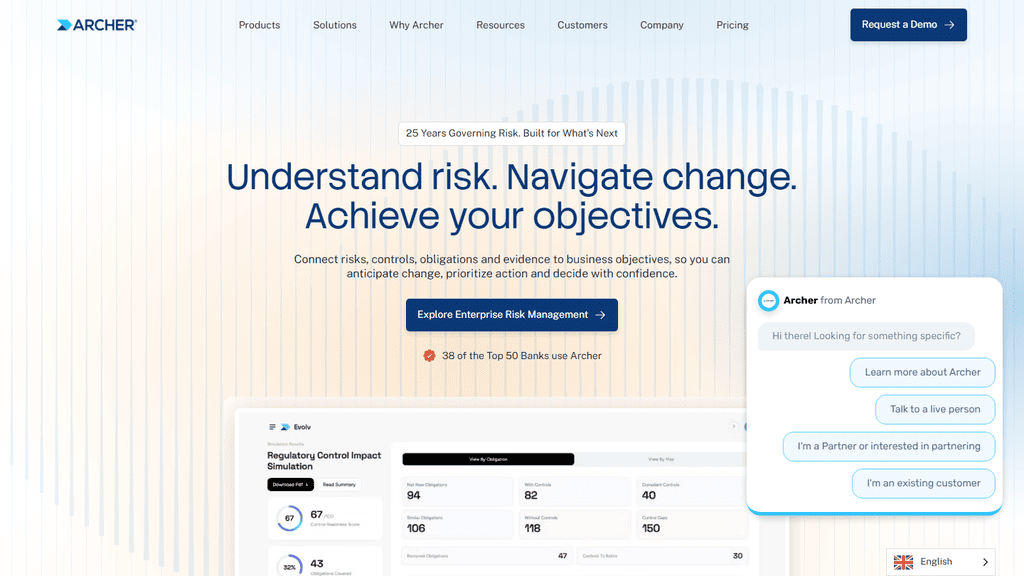
Overview: Archer sells Archer GRC on the Archer Platform with an AI layer called Archer Evolv. The older “Archer IRM” name no longer appears on its product pages.
Compliance work runs through Regulatory and Corporate Compliance Management, which puts six use cases on one control library, and Archer Evolv Compliance, which handles regulatory change and obligations. Its regulatory change feed comes from Compliance.ai, which Archer owns.
Key features:
- One control library under six compliance use cases, so a tested control reports to every mapped framework
- Continuous Controls Monitoring through read-only integrations with cloud platforms and identity systems
- A scoped external-auditor role that sees the engagement and nothing else
- Data Feed Manager for building your own regulatory RSS feeds
- AI Operators in Archer Evolv that handle horizon scanning and obligation extraction
Frameworks covered: ISO 27000 series, COBIT 5 (an IT governance framework), NIST 800 series, and PCI DSS ship with the IT and security use case; Archer names SOC 2, ISO 27001, NIST CSF, HIPAA, and SOX IT general controls (ITGC) for monitoring, and its financial-services page names DORA.
Integrations and setup: Archer’s pages don’t name Microsoft, Okta, or Jira connectors. Archer’s services team and partners implement it as multi-tenant SaaS or a private or on-premises configuration.
Archer’s customer examples range from six weeks for a migration to six months to go fully live in a multi-country program.
Pricing: Quote-based. The pricing page publishes no figures, and Archer says pricing scales with modules, users, and deployment model (read October 28, 2026).
Pros:
- On-premises or private deployment available
- Scoped external-auditor role
- A regulatory change feed with obligation extraction
- PCI DSS and HIPAA named for control monitoring
Cons: Archer prices by module, user count, and deployment model, and its own pages say most programs start with one use case out of nine, so a multi-framework program grows in phases. Named connectors for Entra ID, Okta, and Jira aren’t listed.
Who should skip it: Teams that want one quick rollout across every framework, or that need named Microsoft 365 and Okta evidence connectors on day one.
8. ServiceNow IRM: Best for Companies Already Running ServiceNow for IT Service Management
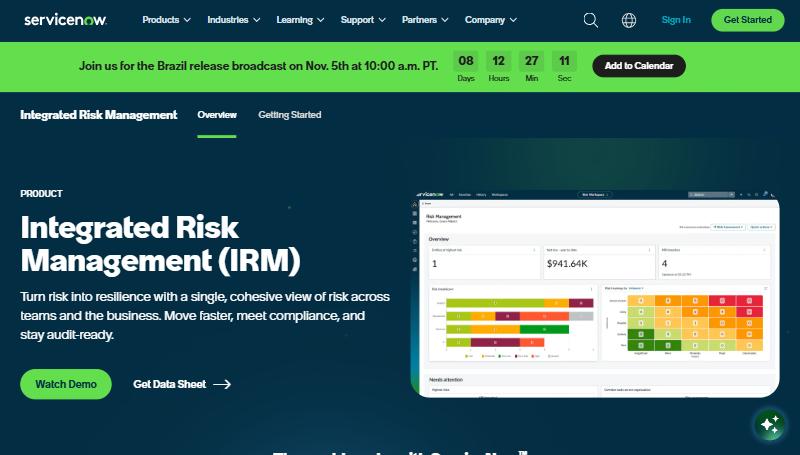
Overview: ServiceNow sells Integrated Risk Management inside its Governance, Risk, and Compliance family on the ServiceNow AI Platform. The compliance application is Policy and Compliance Management, which ServiceNow says is available with Governance, Risk, and Compliance.
If your IT teams already work in ServiceNow, compliance issues, policy exceptions, and control tests land in the queues they use every day. Policy exception requests can start from HR, DevOps, or Vulnerability Response, and Regulatory Change Management maps several providers’ taxonomies to one regulatory taxonomy.
Related applications on the same platform include Audit Management, Risk Management, Operational Resilience, Business Continuity Management, and Third-Party Risk Management, so a GRC program can grow module by module without another vendor contract.
Key features:
- A common control framework that maps one tested control to numerous regulations
- Automated controls testing with continuous monitoring
- AI agents that assess controls, classify them, and route remediation work
- Audit Management with evidence requests and Office 365 workpaper collaboration
Frameworks covered: ServiceNow’s product pages say framework content comes through a content provider integration and don’t list the frameworks, so ask for the list in writing.
Integrations and setup: Native to the ServiceNow AI Platform, with Office 365, OneDrive, and SharePoint named for collaboration and the ServiceNow Store for third-party integrations. ServiceNow and its partners implement it, with ServiceNow Impact plans for support. Government Community Cloud holds FedRAMP High, the top level of the U.S. federal cloud security authorization.
Pricing: Quote-based. ServiceNow publishes pricing pages for other products but none for GRC or IRM (read October 28, 2026).
Pros:
- Uses the configuration database, workflows, and approvals you already run
- FedRAMP High option through Government Community Cloud
- Compliance and IT remediation share one ticket queue
- Modules added one at a time without another vendor contract
Cons: Policy and Compliance Management is sold with the GRC package on the ServiceNow AI Platform, so it isn’t a standalone purchase, and the marketing pages name no frameworks or content provider.
Who should skip it: Companies that don’t run ServiceNow today, and teams that want framework content listed before the first sales call.
9. LogicGate Risk Cloud: Best for No-Code GRC Live in About a Quarter
Overview: LogicGate’s Risk Cloud is a no-code GRC platform sold as separate applications, and its Controls Compliance Application handles multi-framework control work.
LogicGate states a 96-day average implementation, done in-house by GRC practitioners through Quick Start, Standard, and Custom packages.
Foundational AI, formerly branded Spark AI, is built into the platform, and LogicGate’s frameworks page says you can cross-map and assess controls across its supported frameworks and regulations.
Key features:
- Predefined mappings between frameworks to remove duplicate assessments
- Evidence Sources for HR systems and cloud platform security services, included with Controls Compliance
- Regulatory Compliance Powered by Ascent, an obligations repository with change alerts
- Config Newton, an AI agent for building GRC workflows
Frameworks covered: Frameworks include the California Consumer Privacy Act (CCPA), CIS Controls, GDPR, HIPAA Security Standards, ISO 27001-2, NIST 800-53, NIST CSF, PCI DSS, the Secure Controls Framework, and SOC 2. Content for Australia’s Information Security Manual and for CMMC (the U.S. defense contractor certification) needs a separate license.
Integrations and setup: Native integrations with Jira, Slack, and Microsoft 365, a Microsoft Entra ID connector, an open REST API, and an SFTP connector. Customers choose among four hosting regions.
Pricing: Quote-based. LogicGate publishes its model (applications plus Power User licenses, with Standard and External users included) but no prices (read October 28, 2026).
Pros:
- A published implementation benchmark
- Standard and external users at no extra cost
- Microsoft 365, Entra ID, and Jira connections named
- No-code configuration your GRC team can own
Cons: The Entra ID connector requires 20 Integration Services hours per application. LogicGate’s GRC Agents are generally available for third-party risk, enterprise risk, AI governance, and business continuity, and the next wave it has announced names no compliance agent. Risk Cloud isn’t currently FedRAMP authorized.
Who should skip it: Federal contractors that need FedRAMP, and teams expecting AI agents inside compliance testing today.
10. OneTrust Tech Risk & Compliance: Best for Programs Sharing a Platform With Privacy
Overview: OneTrust’s homepage now leads with AI governance, and GRC is still sold as Tech Risk & Compliance, with Compliance Automation and IT Risk Management as its products. It sits on the OneTrust AI-Ready Governance Platform next to privacy, consent, and third-party risk.
For a healthcare or insurance company where the privacy office already runs OneTrust, the security team can keep SOC 2, ISO 27001, HIPAA, and GDPR evidence in the same record, with regulatory research from OneTrust DataGuidance.
Key features:
- A proprietary shared evidence framework that reuses one collected item across frameworks
- Collectors that capture real-time evidence from connected systems
- Auditor invitations and a Trust Profile for customers and partners
- CORIE, announced in September 2026, which connects context across privacy, technology risk, and AI risk
Frameworks covered: SOC 2, ISO 27001, GDPR, HIPAA, NIS2, DORA, CMMC 2.0, and NIST are named.
Integrations and setup: Certified service partners implement the platform. Its Okta, Microsoft 365, and ServiceNow integration pages describe privacy and data-discovery uses, so confirm which connectors collect compliance evidence.
Pricing: Quote-based. The pricing page states the unit, “admin users and asset inventory”, with no figures (read October 28, 2026).
Pros:
- Privacy, third-party risk, and IT compliance on one platform
- HIPAA and GDPR content named
- Auditor invitations built in
- DataGuidance regulatory research
Cons: Each OneTrust area is a separate package with its own pricing unit, so adding third-party risk or privacy means more packages, and the integration pages don’t name evidence connectors for your identity provider.
Who should skip it: Security teams with no OneTrust footprint that want a compliance tool built around security evidence.
11. Diligent IT Compliance: Best for Board Reporting and FedRAMP Hosting
Overview: Diligent sells the Diligent One Platform, which puts board management and GRC in one product. Diligent IT Compliance sits under its Risk menu and automates workflows for NIST, FedRAMP, SOC 2, and other frameworks; Diligent completed its Galvanize acquisition in 2021, and the HighBond product page is still live.
The draw for a Head of GRC is the line from control testing to the board pack. The platform holds FedRAMP Moderate and U.S. Department of Defense Impact Level 5 (IL-5) authorization and runs on AWS in several regions, with AWS GovCloud for federal customers.
Key features:
- Control reuse across frameworks, so one built control supports several certifications
- AI control suggestions and generation
- Agentic cyber risk assessments aligned with ISO 27005, in the companion IT & Cyber Risk Management product
- Regulatory tracking through a partnership with Regology
Frameworks covered: Frameworks include SOC 2, HIPAA, ISO 27001, NIST 800-53, PCI, and FedRAMP.
Integrations and setup: The integrations page lists HighBond connectors for Active Directory, AWS, Azure, Jira, ServiceNow, Splunk, Qualys, Tenable, Workday, and others, and Diligent’s own experts handle onboarding. The page carries a 2023 event banner, so confirm the list is current.
Pricing: Quote-based. Diligent offers packages tailored to organization size and stage with no published figures (read October 28, 2026).
Pros:
- Board reporting on the same platform as IT compliance
- Federal authorizations for government-facing work
- Framework content that includes FedRAMP
- AWS and Azure connectors named
Cons: The platform is positioned around board management plus GRC, IT Compliance is one of many separately listed products, and Okta, Entra ID, and Microsoft 365 don’t appear on its integrations list.
Who should skip it: Teams with no board-governance need, and Okta or Entra ID shops that want named identity connectors.
12. NAVEX One Risk & Governance: Best for Compliance-Led Programs Already on NAVEX One
Overview: NAVEX One Risk & Governance, formerly Lockpath and long sold as NAVEX IRM, is the integrated risk management product on the NAVEX One GRC platform.
It suits a chief compliance officer who already runs the NAVEX hotline, policy management, and training and wants IT risk and regulatory change in the same place.
Its Regulatory Change Management module sends prioritized alerts when a rule you track changes.
Key features:
- Mapping of compliance requirements to controls, risks, policies, and procedures
- Control gap analysis and policy and control effectiveness tracking
- Automated evidence-collection workflows
- Nira, the AI agent built into NAVEX One
Frameworks covered: SOC 2, HIPAA, PCI DSS, NIST CSF, and ISO 27001 are named, and DORA appears in its regulation library.
Integrations and setup: NAVEX describes API integration with your wider stack and names no specific connectors. A dedicated NAVEX implementation specialist runs the project as the single point of contact, and NAVEX says timing varies with the complexity of the solutions you deploy.
Pricing: Quote-based on company size, program needs, and solutions, and NAVEX says bundles save up to 30% (read October 28, 2026).
Pros:
- Ethics, policy, and IT risk on one platform
- Prioritized regulatory change alerts
- A single implementation contact
- Bundle discounts
Cons: The product centers on ethics and whistleblowing programs, the IT Risk Management page sits outside the main product menu, and no identity, cloud, or ticketing connectors are named.
Who should skip it: Security and compliance leads whose audits depend on automated evidence from Entra ID, Okta, AWS, or Azure.
Across the twelve, the split from the first section holds. Optro, MetricStream, Archer, ServiceNow, LogicGate, Diligent, and NAVEX run the wider GRC program, OneTrust bridges privacy and security, and MAXI Compliance AI, Vanta, Drata, and Thoropass keep the security evidence underneath them current, with Thoropass adding the audit itself.
For a compliance lead whose audits rest on SOC 2, ISO 27001, and HIPAA evidence, MAXI Compliance AI keeps that evidence current from the systems you already run; if a board or regulator also expects exam workflows and a regulatory change library, a GRC suite can sit on top of it.
Five Questions to Ask During a Compliance Software Demo
Book two hours per vendor for a demo built on your own controls; it will show you more than any feature tour. A week before the call, send the vendor your control list, two sample evidence files, and the framework names, and ask for a named solutions engineer who will run the session live.
Keep the same two people from your team in every demo, ideally one from GRC and one who owns Entra ID or Okta, and ask every vendor the same five questions so the answers stay comparable. Each question maps to one or more of the six criteria above.
- How many of my controls map to a second framework without new evidence? Bring 10 controls that sit in at least two frameworks, such as MFA in Entra ID or Okta, quarterly access reviews, change management in Jira or ServiceNow, logging, backups, vendor risk, and incident response, plus two your auditor flagged last year. Name the framework you hold today, SOC 2 or ISO 27001, and the one you add next, such as HIPAA or PCI DSS.
- What does the tool do with stale evidence? Hand over an access review from six months ago. Watch whether the tool marks it as out of date, shows when it was collected, and assigns someone to refresh it.
- What will my auditor see? Have the vendor create an external auditor role during the call, sign in from a second browser, and request one piece of evidence. Note what the auditor sees, what gets logged, and whether anyone reaches for email.
- Which of my systems connect natively? Name your identity, cloud, and ticketing systems and ask how each one connects.
- What does the second framework cost? Ask for the price of adding a framework or module and the implementation estimate, both in writing.
Score each answer 0 to 2, record only what you saw on screen, and keep promises in a separate column.
⚠️ A vendor that needs more time to load your controls is telling you something useful about implementation. Keep the two or three tools that score highest, and take that shortlist to procurement with a scored record of what each one showed.
What Compliance Management Software Costs in 2027
Published starting prices on this list run from $0 to $1,899 a month, all from UnderDefense; the other eleven quote after scoping. The table below shows what each vendor states on its own site about price, pricing basis, and implementation, read on October 28 and November 12, 2026.
| Vendor | Published price | Pricing basis | Implementation and consulting |
|---|---|---|---|
| UnderDefense MAXI Compliance AI | Free; Starter from $499, Essential from $1,299, Certified from $1,899 per month | Package, adjusted to requirements | 24, 48, or 90 consulting hours a year included |
| Vanta | None | Four plans, personalized pricing; Essentials covers one framework | Partner audit firms or your own auditor |
| Drata | None | Plans sized by headcount; extra frameworks as add-ons | Partner audit firms or your own auditor |
| Thoropass | None | Frameworks, audit scope, and company size | Audit by Thoropass’s in-house auditors |
| Optro | None | Products and scope; unlimited stakeholder licenses | Optro team plus certified partners |
| MetricStream | None | Contact Sales | Vendor specialists and consulting partners |
| Archer GRC | None | Modules, users, and deployment model | Archer services and partners |
| ServiceNow IRM | None | Sold with the GRC package | ServiceNow Impact and partners |
| LogicGate Risk Cloud | None | Applications plus Power User licenses | In-house; Quick Start, Standard, and Custom packages |
| OneTrust | None | Admin users and asset inventory | Certified service partners |
| Diligent | None | Packages by organization size and stage | Diligent experts |
| NAVEX | None | Company size, program needs, and solutions | Dedicated implementation specialist |
💰 Budget three lines for each quote: the license, implementation by the vendor or a partner, and the consulting time your own team spends mapping controls and assigning owners. Ask every vendor to price the second framework separately, because that’s where module and content fees appear.
Pricing units differ enough to change the comparison. LogicGate charges per application and Power User, OneTrust per admin user and asset inventory, Archer by modules, users, and deployment model, and UnderDefense by package. Model each quote at your current size and at the headcount and framework count you expect in two years.
Quotes from enterprise suites vary widely with modules and user counts, and a breakdown of GRC platform pricing shows the ranges buyers typically negotiate before the first renewal.
Give your auditor evidence that is current
on the day they ask
- See which controls your connected tools already prove
- Get 24, 48, or 90 consulting hours a year, by package
- Get matched with a partner audit firm within one business day
Frequently Asked Questions
Short answers to five questions buyers raise while building a shortlist.
What is the difference between compliance management software and compliance automation software?
Compliance management software runs the whole program: obligations, policies, risks, audits, and evidence across many frameworks and regulators. Compliance automation software focuses on collecting security evidence from connected systems for frameworks such as SOC 2 and ISO 27001. The two can connect, with the automation platform feeding evidence to the management suite.
Can one platform cover SOC 2, ISO 27001, and HIPAA at the same time?
Yes, when the platform maps one control to all three. Access control, logging, risk assessment, and incident response appear in each framework. Check each vendor’s framework list in the comparison table, then map one control to all three in the demo and confirm that a single evidence item satisfies each.
How long does it take to implement compliance management software?
Plan for weeks to months. Archer says scope drives the timeline, NAVEX says timing varies with the complexity of your needs, and LogicGate’s entry above gives the one published average. Helpware reached full production readiness on MAXI Compliance AI in 8 weeks, according to its case study. Connecting evidence sources is usually faster than agreeing control ownership, so start with one framework and add the next once owners are settled.
Does compliance management software replace an auditor?
No. The software tracks controls and prepares evidence; a certified public accountant (CPA) firm issues a SOC 2 report, and an accredited certification body issues an ISO 27001 certificate. UnderDefense prepares and supports audits on that same split, and responsibility for compliance stays with your company whichever tool you choose.
How much does compliance management software cost?
Eleven of the twelve vendors here quote after scoping products, modules, users, or assets. UnderDefense publishes monthly packages, from a $0 Free package to Certified from $1,899, with 24, 48, or 90 consulting hours a year in the paid ones, depending on the package. Vendor or partner implementation adds a second line to every other quote.