






Your enterprise customer’s procurement team has sent the security questionnaire back with one line highlighted: “Please provide your current SOC 2 Type II report.” The renewal, or the new contract, now waits in security review until you can produce one.
Below are seven platforms, and a criteria-by-criteria split of what each one covers for that report and what stays with your team.
TL;DR
- SOC 2 compliance software collects evidence for access, change, and policy controls from the tools you already run, and monitoring and responding to security incidents (criterion CC7) is the part it leaves to your team.
- Five questions separate the platforms: integrations, auditor model, Type II support, CC7 evidence, and the year-two price.
- The list ranks seven platforms on one template, UnderDefense MAXI Compliance AI first.
- The closing sections add up the full first-year cost and walk through the timeline from kickoff to a Type II report.
Table of contents
- What SOC 2 Software Collects and What Your Team Still Owns
- Five Questions to Ask Before You Pick a SOC 2 Platform
- SOC 2 Compliance Software Compared Side by Side
- The 7 Best SOC 2 Compliance Software Solutions for 2027
- What SOC 2 Software and the Audit Cost Together
- How Long SOC 2 Takes With a Platform, From Kickoff to Type II Report
- Frequently Asked Questions
SOC 2 compliance software is how most engineering leaders answer that request without stalling the roadmap. It connects to AWS or Google Cloud, Okta or Google Workspace, GitHub, Jira, and your endpoint tool, then collects the evidence an auditor asks for.
Procurement teams have good reason to ask. Verizon’s Data Breach Investigations Report (2026 DBIR executive summary) found that breaches with third-party involvement reached 48% of all breaches, up 60% on the prior year’s dataset.
This guide is for CTOs, VPs of Engineering, and security and compliance leads who need a shortlist this quarter. It splits the Trust Services Criteria of the American Institute of Certified Public Accountants (AICPA) into what a platform collects for you and what your team still has to staff, then ranks seven platforms on one template.
UnderDefense MAXI Compliance AI, ranked first, is the only platform of the seven with published package prices, and its Starter, Essential, and Certified packages include 24, 48, and 90 hours of compliance consulting a year. Every vendor fact comes from the vendor’s own website, read in October 2026.
Disclosure: UnderDefense publishes this article and ranks its own UnderDefense MAXI Compliance AI first, using the same template and criteria as every other entry.
Find the SOC 2 controls you can’t prove yet, before procurement asks
What SOC 2 Software Collects and What Your Team Still Owns
SOC 2 software collects evidence for most of the Trust Services Criteria, and your auditor still tests whether people watch and respond to security events. The criteria come from the AICPA’s 2017 Trust Services Criteria, with points of focus revised in 2022.
Every report covers the Security category, built on nine common criteria (CC1 to CC9), and you can add Availability, Processing Integrity, Confidentiality, and Privacy.
A Type I report covers whether your controls are suitably designed at a point in time. A Type II report adds an opinion on whether they operated effectively “throughout a specified period,” in the AICPA’s words, and that is the report most enterprise procurement teams ask for.
Here is how the common criteria split between what platforms collect and what your team owns. The middle column reflects what the seven vendors’ own SOC 2 pages describe collecting.
| Common criteria | What platforms collect for you | What your team still owns |
|---|---|---|
| CC1 Control Environment | Policy acknowledgments, background checks, training records | Leadership oversight and accountability |
| CC2 Communication and Information | Published policies, employee attestations | Telling customers and staff about changes |
| CC3 Risk Assessment | Risk register entries and scores | Deciding which risks matter |
| CC4 Monitoring Activities | Continuous control tests, failing-test alerts | Fixing what the tests flag |
| CC5 Control Activities | Policy templates mapped to controls | Running the controls day to day |
| CC6 Logical and Physical Access Controls | Okta accounts, multi-factor authentication (MFA) status, access reviews | Approving and revoking access |
| CC7 System Operations | Endpoint agent status, vulnerability scan results | Watching alerts, investigating, responding, recovering |
| CC8 Change Management | GitHub pull request reviews, Jira tickets | Approving changes and emergency fixes |
| CC9 Risk Mitigation | Vendor questionnaires, vendor SOC 2 reports | Judging vendor risk and business disruption |
The pattern holds row by row. Where a control lives in a system with an application programming interface (API), the platform pulls the evidence. CC7 asks something different: that you monitor system components for anomalies, evaluate security events, respond with “a defined incident-response program,” and recover. An auditor tests that by sampling real alerts and real tickets from your observation window.
That gap rarely shows up in a demo. A platform can confirm that CrowdStrike or SentinelOne runs on every laptop, and it still can’t show who looked at the alert that fired at 2 a.m. or what they did next.
⚠️ None of the seven platforms’ SOC 2 pages describe CC7 incident-response records (checked in October 2026), so treat it as work you staff or buy. The nine common criteria are only part of the SOC 2 compliance requirements your auditor scopes, so give each one a named owner before the observation window opens.
Five Questions to Ask Before You Pick a SOC 2 Platform
Five questions separate SOC 2 compliance tools faster than a feature checklist. Ask every vendor all five in the first call, and get the answers in writing.
1. Does it connect to the stack you already run?
The platform should list a connector for every system in scope: AWS or Google Cloud, Okta or Google Workspace, GitHub, Jira, CrowdStrike or SentinelOne, and Slack. Each missing connector turns into a screenshot someone uploads by hand every quarter.
Vendor integration counts range from 100+ to 400+, and the count matters less than whether your six or seven systems are on the list.
2. Is the audit included, or do you hire the auditor yourself?
The answer is one of three models:
- a marketplace of partner audit firms
- your own auditor
- an audit sold by the platform’s affiliated CPA firm
Only a licensed certified public accountant (CPA) firm can issue a SOC 2 report, so no platform issues it.
Ask whether your current auditor already works with the platform, because switching auditors partway through a cycle adds weeks.
Pick by your situation. A marketplace suits a first report when you have no auditor yet, your own auditor suits a team with a firm it wants to keep, and a bundled audit suits a team that wants one contract and accepts the platform’s firm.
3. How does it handle the Type II observation period?
A good platform tests each control continuously through the window and alerts you the day a test fails. The auditor samples evidence from across that window, so a control that drifted for six weeks without anyone noticing becomes an exception in your report.
Ask how often each test runs and whether the auditor gets direct access to evidence inside the platform.
4. What evidence will it produce for CC7?
Most platforms will show you an endpoint agent check and an incident response policy. Ask the vendor to show, in the product, the record of a real security event with four details:
- the alert that fired
- who investigated it
- what they decided
- when each step happened
If that record doesn’t exist, your team still has to produce it, and this is the same question your auditor asks.
5. What will it cost after year one?
First-year quotes often include onboarding help and discounts that change at renewal. Ask for three figures in writing:
- the year-two price
- the cost of adding ISO 27001 or HIPAA later
- which features sit in higher tiers
Pay only for the work SOC 2 automation actually removes, such as evidence screenshots and access-review exports, and keep the judgment calls with your team.
The answers to these five questions map onto the columns of the comparison table that follows.
SOC 2 Compliance Software Compared Side by Side
The table compares the seven platforms on those questions, using each vendor’s own published figures as of October 2026. Integration counts are as each vendor states them.
| Vendor | Best for | Auditor network | Type II support | Published pricing | Integrations |
|---|---|---|---|---|---|
| UnderDefense MAXI Compliance AI | Published prices and expert hours | Auditor pool from Starter tier | Continuous auto-checks; auditor works in the platform | Free tier; paid from $499 a month | 250+ |
| Vanta | Widest choice of auditors | Partner firm marketplace or your own | Type I and II, auditor portal | Not published | 400+ |
| Drata | Adding frameworks beyond SOC 2 | Partner directory or your own | Continuous tests, Audit Hub | Not published | “Hundreds of tools” |
| Secureframe | Former auditors on call | Audit Partner Network, higher plans | Daily monitoring, auditor workflows | Not published | 300+ |
| Thoropass | Platform and audit on one contract | Affiliated CPA firm performs audit | Audit runs on same platform | Not published | 200+ |
| Scytale | No dedicated governance, risk, and compliance (GRC) lead | Your chosen auditor or audit partners | Continuous control monitoring | Not published | 100+ |
| Scrut Automation | SOC 2 among many frameworks | Vetted audit partners | Tracks control performance over time | FAQ estimate only | 150+ |
Two patterns stand out from the table. UnderDefense publishes plan prices, five others publish none, and Scrut gives an estimate in its FAQ.
The auditor model splits three ways:
- Vanta, Drata, Secureframe, and Scrut work through partner firms, and Vanta and Drata also accept your own auditor.
- Scytale works with your chosen auditor or a Scytale partner, with a Scytale expert managing the process.
- Thoropass audits through its affiliated firm.
Each model changes who you contract with and when the auditor first sees your evidence.
Teams down to two names often run a Vanta vs Drata comparison against an audit-bundled option such as Thoropass, because the auditor model moves the total contract more than the feature list does.
The 7 Best SOC 2 Compliance Software Solutions for 2027
These are the best SOC 2 compliance software platforms for an engineering organization that sells to enterprise customers and needs a Type II report on a deadline. Each entry uses the same template, and each “Best for” names the situation of a company already past its first enterprise deals.
1. UnderDefense MAXI Compliance AI: Best for SaaS Teams That Want Published Prices and Expert Hours
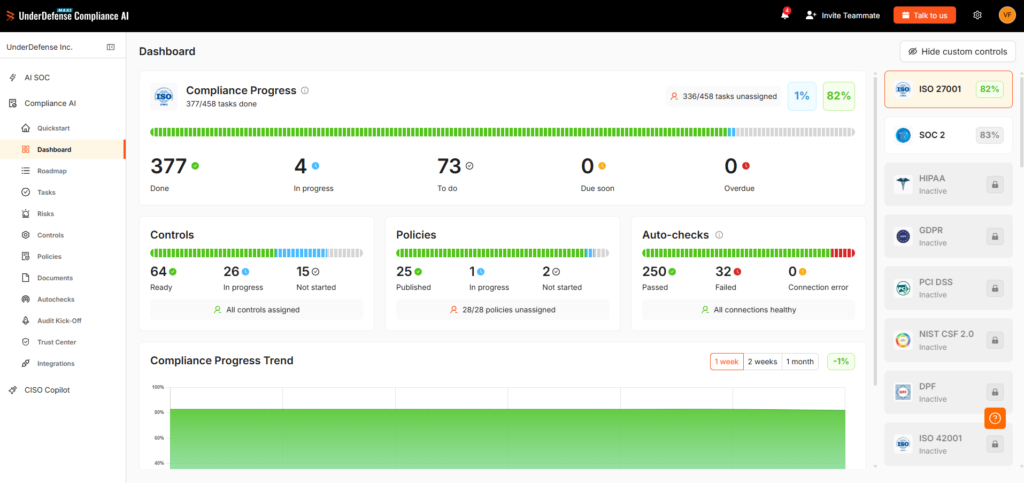
Overview: UnderDefense MAXI Compliance AI keeps your SOC 2 evidence current through the whole Type II window. It connects to AWS, Google Cloud, Okta, and the other tools you already run, tests each control continuously, and maps it once to SOC 2, ISO 27001, HIPAA, PCI DSS, GDPR, and NIST CSF 2.0, so the next framework a customer asks for reuses the same evidence.
On G2, UnderDefense holds 5.0 out of 5 across 83 reviews as of November 2026, and it was a Clutch Top Cybersecurity Company in 2025.
When a procurement team asks for proof, you send a Trust Center link that shows your live posture. Your auditor samples the same evidence inside the platform, under permissions you set.
Key features:
- Continuous evidence collection with auto-checks that flag a failed control during the observation window, mapped to all six frameworks above
- MAXI Compliance AI deploys as SaaS, hybrid, on-premises, or air-gapped
- A Trust Center link that shows your live posture to the customer’s procurement team
- An auditor pool from the Starter tier, with audit support and advocacy and a custom incident response plan in the Certified package
SOC 2 coverage: MAXI Compliance AI covers the evidence side of the common criteria: policies, access reviews, change records, and failing-test alerts across the observation window. A CPA firm still issues your report.
Helpware, a business process outsourcing (BPO) company whose SOC 2 and ISO 27001 programs span eight countries, is the documented case. Its case study reports audit readiness twice as fast, full production readiness in 8 weeks across eight countries, and a compliance team that did not grow as the business doubled.
Integrations and setup: MAXI Compliance AI collects evidence through the platform’s 250+ integrations, including AWS, Google Cloud, Okta, Jira, Slack, CrowdStrike, and SentinelOne, and sits on top of your existing stack without replacing it. Tools without a native connector, such as GitHub or Google Workspace, connect through MCP (Model Context Protocol).
The faster SOC 2 readiness program shares validated policies with auditors through time-limited links.
Pricing: UnderDefense lists published compliance packages: Free, Starter from $499 per month, Essential from $1,299 per month, and Certified from $1,899 per month (read October 2026).
Pros:
- The only platform of the seven with published prices, including a free tier
- Consultants share the audit work: Starter includes 24 hours a year, Essential 48, and Certified 90
- A partner audit firm matched within one business day, or your own auditor
- Works on top of the AWS, Okta, and CrowdStrike setup you already run
Cons:
- The custom incident response plan and audit support sit in the Certified package (from $1,899 per month); Starter and Essential cover evidence and the auditor pool
Who should skip it: Teams that want the audit performed by the platform vendor’s own CPA firm on one contract.
For CC7, MAXI Compliance AI runs on the same platform as the UnderDefense Agentic AI SOC, where every investigation step is auditable, so teams that run both keep the alert, the investigation, and the decision next to their compliance evidence.
Check your SOC 2 readiness with UnderDefense
2. Vanta: Best for SaaS Teams Under Enterprise Security Review That Want the Widest Choice of Auditors
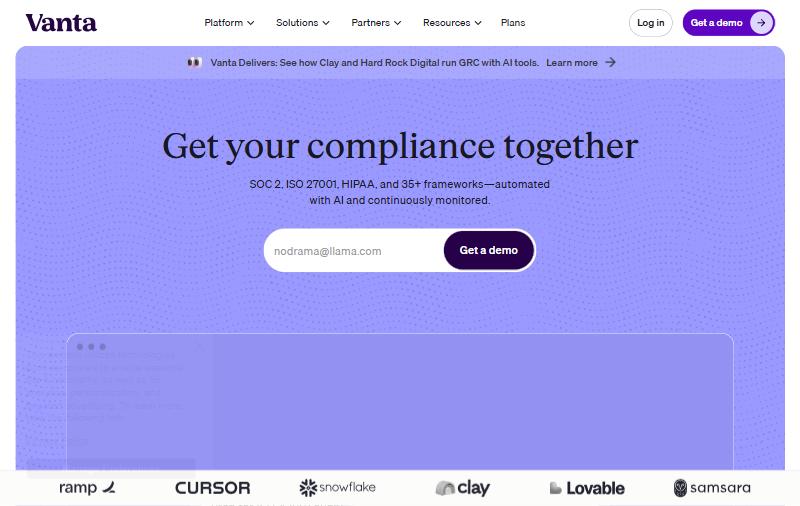
Overview: Vanta covers SOC 2, ISO 27001, HIPAA, and 35+ other frameworks, with automated evidence collection and continuous monitoring across them.
Key features:
- Automated compliance with hourly tests against your connected systems
- Audit collaboration: comment on evidence, track requests, and resolve issues with your auditor in the platform
- The Vanta AI Agent, which drafts policies and suggests remediation snippets for Terraform, AWS CLI, and CloudFormation
- Personnel and access reviews that pull account data automatically
- A Trust Center, included from the Essentials plan
SOC 2 coverage: Vanta’s SOC 2 page describes evidence pulled from connected systems, mapped to controls, and tested hourly, for both Type I and Type II. Auditors get a dedicated portal to review evidence in the platform.
You pick one of 100+ partner audit firms, or bring your own auditor through its audit page.
The SOC 2 page describes evidence, tests, policies, and access reviews. It says nothing about recording incident response for CC7, so plan that evidence separately.
Integrations and setup: Vanta says it pulls data from 400+ tools. Its directory lists AWS, Google Cloud Platform, Okta, GitHub, Jira, CrowdStrike, and Slack, and its help center documents a Google Workspace integration. Its help center also documents a SentinelOne integration that reads monitored hosts, prevention policies, and vulnerabilities. Setup runs through connecting each tool and assigning control owners.
Pricing: Vanta doesn’t publish prices; its pricing page offers “personalized pricing” across four plans: Essentials, Plus, Professional, and Enterprise (read October 2026). Essentials covers one compliance framework, and Vanta’s SOC 2 FAQ says audit pricing depends on scope, company size, and report type.
The plan you need depends on how many questionnaires your sales team fields. Plus includes questionnaire automation for 25 questionnaires a year and Professional for 144, and Professional adds risk management and custom monitoring tests. A company answering security reviews from several enterprise prospects each quarter will likely price Professional or Enterprise.
Pros:
- 100+ partner audit firms, plus the option to bring your own auditor
- Hourly automated tests for SOC 2 controls
- Connectors for nearly every tool in a typical AWS, Okta, and GitHub stack
- A dedicated auditor portal for evidence review inside the platform
Cons:
- The pricing table marks several capabilities as add-ons, including questionnaire automation, access management, and continuous vendor risk monitoring
- The audit is bought separately from a partner firm or your own auditor
Who should skip it: Teams that want the audit and the platform on one contract, or that need a published price before the first call.
3. Drata: Best for SaaS Teams Whose Enterprise Buyers Will Ask for More Frameworks
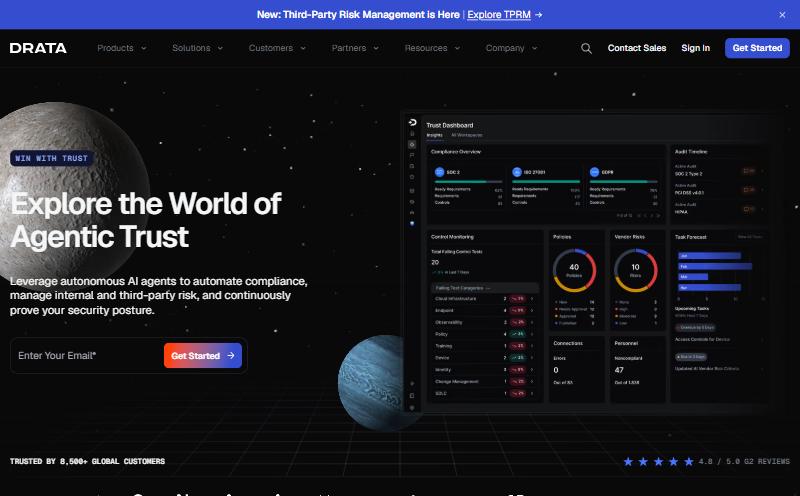
Overview: Drata offers 30+ pre-mapped frameworks, so a company that starts with SOC 2 can add ISO 27001 or HIPAA without rebuilding its control set. Its AI agents run compliance tasks and internal and third-party risk reviews.
Key features:
- Compliance automation with continuous monitoring and Audit Hub, a separate workspace for your auditor
- Drata AI, including AI Test Failure Insights and AI-Generated Cloud Tests for AWS, Azure, and GCP
- Third-party risk management (TPRM) with an agentic TPRM assessment
- A Trust Center and AI Questionnaire Assistance for security questionnaires
SOC 2 coverage: Drata’s SOC 2 page says it connects to your tech stack “to automatically collect and map evidence to SOC 2 controls” and “continuously tests your SOC 2 controls” across all five Trust Services Criteria categories. It doesn’t publish a total test count.
Drata doesn’t perform audits: you pick a firm from its partner auditor directory or bring your own, and the auditor works inside Audit Hub. Its SOC 2 page lists no incident-response record for CC7.
Integrations and setup: Drata says it connects to “hundreds of tools” and gives no exact figure. Its help center has setup guides for AWS, Google Cloud, Okta, Google Workspace, GitHub, Jira, CrowdStrike, SentinelOne, and Slack, which covers every tool in the stack this article assumes. Setup follows those guides one connector at a time.
Pricing: Drata doesn’t publish prices. Its compliance plans are Foundation, Advanced, and Enterprise (read October 2026). Foundation is listed for “Up to 50 FTEs” (full-time employees) with one pre-mapped framework, so a company with several hundred employees starts at Advanced or Enterprise.
Advanced lists Risk Management Pro, Workspaces, and Custom Frameworks as add-ons. Enterprise includes User Access Review and Risk Management Pro, with Agentic TPRM Assessment available as an add-on. Price the add-ons you need for SOC 2 Type II, access reviews above all, before comparing Drata’s quote with the others.
Pros:
- Documented setup guides for every tool in an AWS, Okta, GitHub, and CrowdStrike stack
- AI-generated cloud tests for AWS, Azure, and GCP
Cons:
- User Access Review is an add-on on Foundation and Advanced, included only at Enterprise
- No published test count, so compare control coverage in a demo
Who should skip it: Buyers after one framework at a published price, or a vendor that runs the audit itself.
4. Secureframe: Best for SaaS Teams Facing a First Enterprise Audit That Want Former Auditors on Call
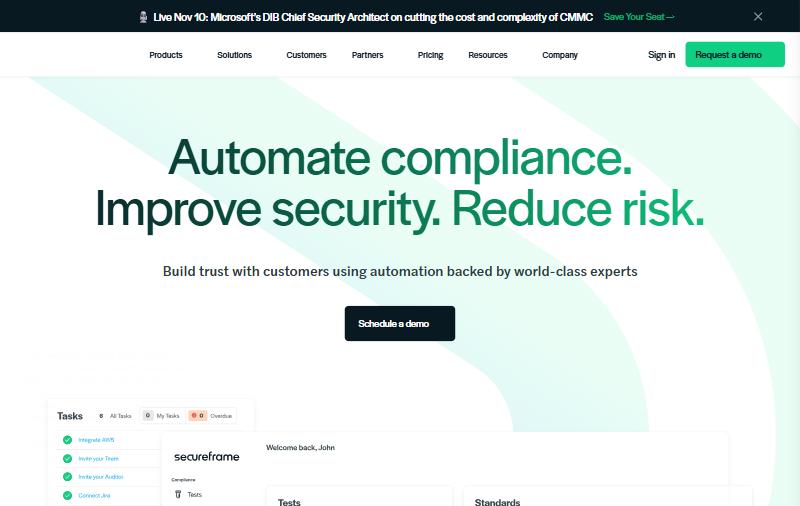
Overview: Secureframe’s core product is Secureframe Comply, backed by in-house compliance experts and former auditors, which suits a team that wants someone to sanity-check scoping before the auditor arrives. It also sells a Defense plan for companies working toward CMMC, the Cybersecurity Maturity Model Certification required of U.S. defense contractors.
Key features:
- Continuous monitoring with daily checks and alerts for failing tests
- Automated evidence collection with “hundreds of automated tests” already built
- Secureframe AI, including Comply AI for Remediation and AI Evidence Validation
- User access reviews inside the platform
- Vendor risk management for CC9 vendor oversight
SOC 2 coverage: Secureframe’s SOC 2 page condenses 200+ controls into eight steps and offers dozens of policies vetted by its in-house experts. It is explicit about timing: a Type II report covers “at least 3 months, with 12 months recommended.”
Auditors come through the Secureframe Audit Partner Network, and Secureframe doesn’t state that it performs audits. CC7 incident response isn’t covered on that page, so ask how Secureframe evidences it.
Integrations and setup: Secureframe’s integrations page lists 300+ integrations, including AWS, Google Workspace, GitHub, Jira, CrowdStrike, and Slack, and its SOC 2 page names Google Cloud. Its help center documents Okta and SentinelOne integrations, so every tool in the stack this article assumes is covered. Setup pairs the connectors with the expert team’s scoping help.
Pricing: Secureframe doesn’t publish prices. Its plans are Fundamentals, Complete, and Defense, and each includes one compliance framework, with more available as add-ons (read October 2026).
Fundamentals covers infrastructure monitoring, evidence collection, policy management, risk management, and a Trust Center. Complete adds advanced third-party risk management, advanced user access reviews, single sign-on and automated user provisioning (SSO and SCIM), and custom integrations, which most companies with a few hundred Okta accounts will want. Defense adds CMMC tooling for government contractors.
Pros:
- In-house former auditors to review scope and evidence
- Daily control monitoring with failing-test alerts
- AI Evidence Validation that flags missing documents and outdated timestamps before the auditor sees them
Cons:
- The pricing table lists the Audit Partner Network and advanced user access reviews on the higher plans
- Integration counts differ across its own pages (100+, 150+, and 300+)
Who should skip it: Teams that want the Audit Partner Network and advanced access reviews on the entry plan, or a published price.
5. Thoropass: Best for SaaS Teams That Need the Platform and the Audit on One Contract Before a Renewal
Overview: Thoropass’s affiliated firm, Laika Compliance, LLC dba Thoropass Assurance, is a licensed CPA firm, and it delivers SOC 2 audits with its own auditors on the Thoropass Audit Lifecycle Platform (ALP).
It fits a team that wants one contract and one point of contact for both the software and the report.
Key features:
- The Audit Lifecycle Platform, combining workflow, evidence collection, control management, and auditor collaboration
- Smart Sort, which maps incoming evidence to the right audit requests and controls
- First Pass, which checks evidence quality before it reaches your auditor
- A Risk Register and a Thoropass Model Context Protocol (MCP) server that connects AI tools to the platform
SOC 2 coverage: Thoropass’s own CPA firm runs the audit on ALP, with the auditor involved from scoping, as its SOC 2 page and IT security audit page describe. Its compliance automation page covers policies, monitors, and a risk register, and customers engage its in-house auditors to review and approve those monitors.
Thoropass describes a Type II review period as “often 3 to 12 months.” Smart Sort files the incident-response evidence you upload, and the SOC 2 page doesn’t describe how that record is created, so ask how Thoropass evidences CC7.
Integrations and setup: Thoropass says customers connect through 200+ integrations. Its compliance automation page shows AWS, Azure, GCP, Jira, Checkr, and Rippling. Its help center documents GitHub, Slack, Google Workspace, and Okta sign-in, so ask for the full list if your endpoint tool matters to the evidence plan. Evidence can also link through an API or the MCP server.
Pricing: Thoropass publishes no plans or prices. Its pricing page says “Organizations receive a tailored quote” based on frameworks, audit scope, company size, and required work (read October 2026).
Because the quote bundles the audit, compare it against a platform subscription plus a separate CPA audit. Thoropass also lists SOC 1, ISO 27001, ISO 42001, PCI DSS, HIPAA, and HITRUST among its frameworks, so ask for a multi-year quote if your customers will ask for a second report next year.
Pros:
- Platform and audit from one vendor, with the auditor involved from scoping onward
- Evidence quality checks before the auditor sees anything
- Smart Sort maps incoming evidence to audit requests
Cons:
- The audit comes from Thoropass’s affiliated firm, and the pages checked describe no option to bring your own auditor
- Quote-only pricing, so compare total cost against a platform plus a separate audit
Who should skip it: Teams with an auditor they want to keep, or a customer that asks for a specific audit firm.
Give your Type II auditor evidence from the stack you already run
6. Scytale: Best for SaaS Teams Facing Enterprise Reviews Without a Dedicated GRC Lead
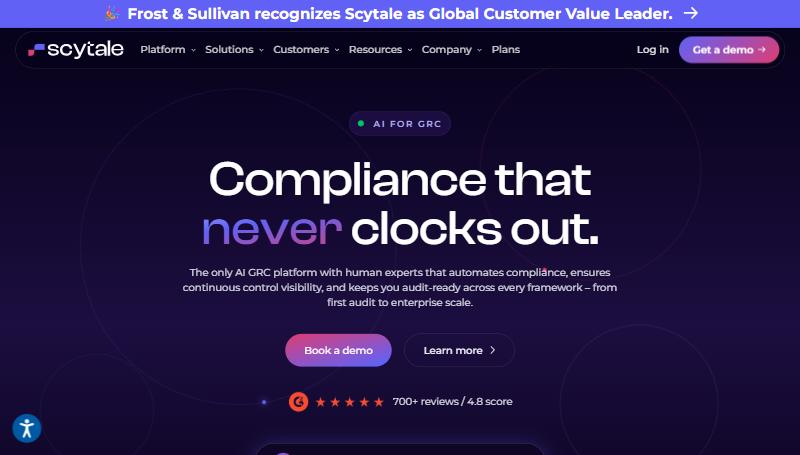
Overview: Scytale pairs an AI GRC platform with human compliance experts. Its framework library lists SOC 2 alongside 34 other frameworks. For an engineering-led company where nobody owns GRC full time, the draw is a dedicated compliance expert who manages audit readiness with you.
Key features:
- Agentic Compliance, with AI agents that monitor controls across your connected systems
- Scy, an AI assistant that works alongside Scytale’s experts
- Audit Management through Audit Hub, shared by you, your auditor, and your compliance expert
- GRC expert plans with weekly meetings and a dedicated consultant
- A Trust Center and AI security questionnaire answers
SOC 2 coverage: Scytale’s SOC 2 page describes automated evidence collection, continuous control monitoring, and expert support. Its SOC 2 guide adds auditor-approved policy templates, vendor security assessments, and automated risk assessment. Scytale doesn’t perform audits; its experts manage “your audit process with your chosen auditor.” Scytale’s SOC 2 pages are silent on CC7 incident-response records.
Integrations and setup: Scytale’s integrations page says you can “connect 100+ tools,” and its homepage says 150+. All nine tools in the stack this article assumes are listed: AWS, GCP, Okta, Google Workspace, GitHub, Jira, CrowdStrike, SentinelOne, and Slack. Setup runs with the dedicated expert on the consulting plans.
Pricing: Scytale doesn’t publish prices. Platform tiers are Build, Scale, and Enterprise, and consulting plans are LaunchReady, StayReady, and ComplianceShield (read October 2026). The entry bundles include one framework, with more as add-ons.
The consulting plans differ by length and depth. LaunchReady gives you a dedicated consultant for up to 6 months, StayReady for a full 12 months with up to 12 expert reviews a year, and ComplianceShield a dedicated team of GRC experts with up to 36 reviews a year. A first Type II with a 12-month window fits StayReady.
Pros:
- A dedicated compliance expert who manages readiness and the audit with your auditor
- Connectors listed for every tool in a typical AWS, Okta, and CrowdStrike stack
Cons:
- The expert support is sold as separate consulting plans on top of the platform tier
- Integration and framework counts differ across its own pages
Who should skip it: Teams with an in-house GRC lead who want software and no consulting plan.
7. Scrut Automation: Best for SaaS Teams Whose Enterprise Customers Ask for SOC 2 and More
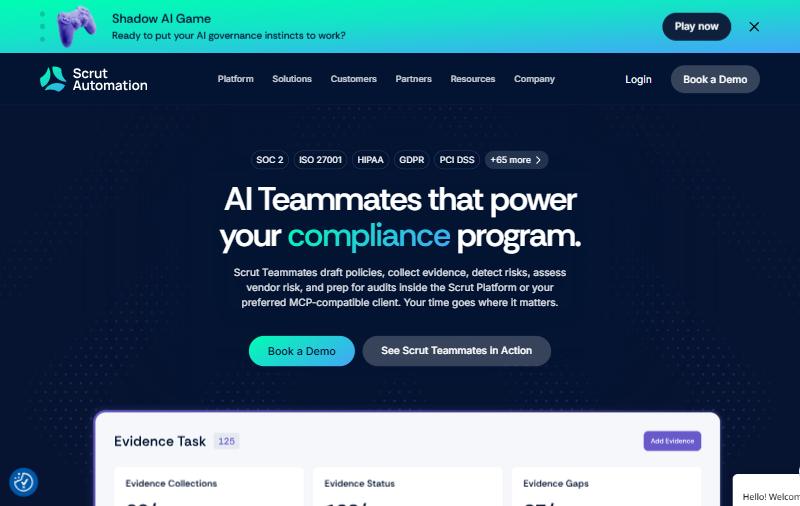
Overview: Scrut Automation lists 70+ frameworks plus custom frameworks. It suits a company whose customers ask for SOC 2 this quarter and ISO 27001 or HIPAA next.
Key features:
- Scrut Teammates, named AI roles such as Policy Architect, Evidence Collector, and Internal Auditor
- Audit Center, where you invite auditors, control what they see, and track requests
- A Trust Center for customer-facing posture
- An MCP server and continuous drift detection
SOC 2 coverage: Scrut’s SOC 2 page offers “hundreds of prebuilt tests to identify gaps against SOC 2 controls” and policy templates built for SOC 2. Its SOC 2 FAQ says evidence collection covers “over 65% of audit requirements” and that, for Type II, it tracks control performance over time.
Scrut connects you with vetted audit partners and doesn’t perform audits. Scrut’s SOC 2 materials don’t address CC7 incident-response records.
Integrations and setup: Scrut says it connects to 150+ tools, and its directory lists AWS, Google Cloud, Google Workspace, GitHub, Jira, Slack, Okta, and SentinelOne. Its help center documents a CrowdStrike integration that pulls user access and device records, and Scrut takes custom integration requests. Setup runs through the Teammates, which draft policies and collect evidence.
Pricing: Scrut has no pricing page. Its SOC 2 FAQ estimates a platform subscription at $10,000–$30,000 a year, within an estimated total SOC 2 cost of $30,000–$80,000 (read October 2026). The FAQ also says there are no hidden charges based on users, frameworks, or vendor questionnaires.
Confirm in the order form that adding a framework adds no line, and price the audit partner’s fee separately.
Pros:
- 70+ frameworks for companies facing several customer requirements
- Named AI Teammates for policy drafting and evidence collection
Cons:
- No published plans; its figures are FAQ estimates
- The audit itself comes from a separate vetted audit partner, so its fee is extra
Who should skip it: Teams that need a published plan price before the first call.
All seven platforms collect evidence for policies, access, and change; they differ on auditor model, price transparency, and how much expert help you get before fieldwork.
What SOC 2 Software and the Audit Cost Together
The platform subscription is one of four costs, and the CPA audit often matches or exceeds it. Budget all four lines before you compare platform quotes, because what SOC 2 costs in year one depends more on audit scope than on the subscription.
| Cost line | Published figure | Source, date read |
|---|---|---|
| Platform subscription | Published by UnderDefense; quote-based for most others | Vendor pricing pages, October 2026 |
| CPA audit, Type II | Up to $20,000; broader scopes $25,000–$100,000+ | Mallette, January 2026, currency not stated |
| Penetration test | Priced per engagement; budget it separately | Your testing provider’s quote |
| Internal time | Control owners, evidence fixes, auditor requests | No published figure |
Treat the audit range as indicative. It comes from Mallette, a Canadian assurance firm whose page doesn’t state the currency, with the lower band for small and mid-sized organizations and the upper band for broader scopes.
A SaaS company testing its application, API, and cloud network may need more than one penetration test engagement, and your auditor will ask how you tracked the findings to closure.
⏳ Internal time is the line vendors leave out. Someone owns each failing test, each access review, and each auditor request across the observation window. CC7 adds the hours spent watching and responding to alerts, and that line grows fastest when nobody on your team is on call at night.
Year two changes the mix. Readiness work shrinks, while the audit, the penetration test, and the operating hours repeat every year, so compare platforms on the renewal price and the hours they save in a steady year.
How Long SOC 2 Takes With a Platform, From Kickoff to Type II Report
A platform shortens readiness work, and the observation period still runs the length your auditor and customer agree. The AICPA criteria require operating effectiveness “throughout a specified period” and set no minimum length, and vendors including Secureframe, Thoropass, and Scytale describe 3 to 12 months as the usual range.
Speed claims deserve scrutiny. In the Journal of Accountancy in February 2026, the chair of the AICPA’s SOC 2 working group warned that “‘fast and easy’ may come at the expense of quality and objectivity.” Plan the timeline around the window your customer will accept.
The Four Stages From Kickoff to Report
Most teams move through four stages, and the platform does most of its work in the first.
- Readiness. Connect AWS, Okta, GitHub, Jira, and your endpoint tool. Adopt policies, fix failing tests, and agree the scope with your auditor.
- Type I (optional). Some teams take a Type I report first to unblock a deal while the Type II window runs.
- Observation period. Controls run and the platform tests them continuously. Your team keeps access reviews, change approvals, and incident response on schedule.
- Type II fieldwork. The auditor samples evidence from the window, tests controls, and issues the report.
Readiness is the stage a platform compresses most, because connecting tools replaces weeks of screenshot collection. How long it takes depends on how many controls fail on day one: a company with MFA enforced in Okta, branch protection in GitHub, and an endpoint agent on every laptop starts with fewer fixes.
The observation period can’t be compressed by software. If your customer needs a report sooner, ask whether they will accept a Type I now and a Type II later, and put that agreement in writing with the procurement contact.
Auditor quality matters as much as speed. The AICPA’s peer review board has told reviewers to treat SOC 2 engagements with “identical reports, risk assessments, sample sizes, and testing procedures” as nonconforming, according to the Journal of Accountancy in May 2026. Ask any partner firm how it tailors testing to your environment.
🗓️ The observation period is where CC7 evidence builds up or goes missing, so decide who watches alerts before the window starts. Put that owner in the same SOC 2 audit checklist you use for fieldwork, so alert reviews sit next to access reviews and change approvals.
See which SOC 2 criteria still need an owner
before fieldwork
- See which SOC 2 controls your connected tools already prove
- Get 24, 48, or 90 consulting hours a year, by package
- Get matched with a partner audit firm within one business day
Frequently Asked Questions
Does SOC 2 software issue the SOC 2 report?
No. Only a licensed CPA firm can issue a SOC 2 report. SOC 2 software collects evidence, tests controls, and gives your auditor access. Thoropass sells the audit through its affiliated CPA firm. The Journal of Accountancy notes that “compliance” is “a term never used in SOC 2 examinations.”
What is the difference between SOC 2 Type I and Type II?
Type I looks at control design on one date. Type II also gives the auditor’s opinion on operating effectiveness across the observation window, and it includes a description of the tests the auditor performed and their results. Enterprise procurement teams usually ask for Type II.
Which SOC 2 criteria can software not automate?
Software collects evidence well for access, change management, and policies. It can’t do the work CC7 System Operations tests: watching for anomalies, evaluating security events, responding to incidents, and recovering. Judging vendor risk under CC9 also stays with your team, even when the platform sends the questionnaires.
How long is a SOC 2 Type II observation period?
The AICPA criteria set no minimum; they require controls to operate “throughout a specified period.” Vendors including Secureframe, Thoropass, and Scytale describe 3 to 12 months as typical, and Secureframe recommends 12. A shorter window, such as the 3-month minimum Secureframe describes, can meet a customer deadline if the customer accepts it.
How much does SOC 2 compliance software cost?
Six of the seven vendors publish no plan prices. UnderDefense publishes four packages, from a free tier to Certified from $1,899 per month, and Scrut’s FAQ gives an annual estimate. The CPA audit, a penetration test, and internal time come on top of the subscription.