




Q1: What is MITRE ATT&CK cloud coverage, and why does the “highest coverage” number decide your AI SOC?
MITRE ATT&CK cloud coverage measures how many adversary techniques your detection stack catches across the four cloud platforms MITRE tracks: IaaS, SaaS, Identity Provider, and Office Suite. No separate “Cloud matrix” exists. It is the Enterprise matrix filtered to cloud-visible techniques. A high number matters only when each technique maps to a confidence-scored, log-backed detection.
I still remember a CISO sliding a vendor deck across the table with “96% MITRE coverage” on the hero slide. My first question landed flat: “96% of what, measured how?” He did not have the answer, and neither did his vendor.
See how the UnderDefense Agentic AI SOC investigates, triages, and resolves real alerts.
📋 What the coverage number actually counts
That moment happens in buying cycles every week. A percentage gets treated as a defense guarantee when it is really a claim about breadth. Breadth without proof behind each technique is a slide, not a shield.
Here is the plain version. MITRE ATT&CK is a public catalog of attacker behaviors, called techniques, each with an ID. For cloud, MITRE does not publish a standalone framework. It takes the Enterprise matrix and filters it to techniques visible in cloud environments across IaaS (raw compute like AWS EC2), SaaS, Identity Provider (think Okta or Entra ID), and Office Suite.
🔎 Why “filtered, not separate” changes your read
The tactic columns stay identical to Enterprise. What changes is the surfaced technique set, drawn from cloud control-plane logs and identity events rather than endpoint EDR data. So a vendor built for endpoint telemetry can post a big Enterprise number and still miss cloud-native behavior.
Two examples make this concrete:
- T1078.004, Valid Accounts: Cloud Accounts. An attacker logs in with stolen cloud credentials. There is no malware to catch, only an identity signal in your IdP logs.
- T1562.008, Disable or Modify Cloud Logs. The attacker turns off CloudTrail so you go blind. If your detection depends on those same logs, coverage on paper collapses in practice.
Each technique needs a real detection wired to a real log source, scored by confidence. Otherwise the coverage map shows green where you are actually blind. This is the same discipline our SOC team applies before any technique gets marked as covered.
💡 Why the percentage became the shortlist metric
Buyers reach for a single number because comparing detection stacks is hard, and a percentage feels objective. It gives a board something to nod at and a procurement team something to rank. That instinct is reasonable, and it is also easy to game.
The Cloud Security Alliance put it bluntly in its 2026 practitioner guide: coverage percentages “make for nice slides” and do not, on their own, stop cloud breaches. My read after two decades in this work: the number is a starting question, never a finish line.
The real question sits underneath the slide. Does 96% coverage mean functional defense against a cloud-native actor like Scattered Spider, or does it fold the moment an agent goes rogue? At UnderDefense, the lens we apply to every cloud detection is coverage proven, meaning each mapped technique traces back to a log source, a detection rule, and a confidence score you can audit through our UnderDefense Agentic AI SOC. The rest of this article shows how to tell proof from theater, and which techniques deserve your attention first.
Q2: Why does the 51-second breach change what “good” cloud coverage even means?
Cloud coverage helps only when it triggers a response inside the attacker’s window. The fastest observed break-in runs around 51 seconds. Median hands-on-keyboard time has dropped to 48 minutes. A platform that maps 96% of techniques but needs 30 minutes to triage delivers near-zero real-world coverage against cloud speed. Coverage must be measured in time and breadth together.
⏰ The clock changed, and most coverage math did not
Threat researchers now track “breakout time,” the gap between initial access and lateral movement. The median has fallen to roughly 48 minutes, and the fastest recorded break-in sits around 51 seconds. Sit with that. Under a minute from foothold to spread.
Attackers using automation and AI move faster than a human analyst can open the ticket. That is the speed mismatch, and it quietly breaks the way we score detection. A coverage map assumes you will act on what you see. It says nothing about how fast.
🕵️ Why static coverage math misses the point
Picture the Scattered Spider playbook in the cloud. The group social-engineers a developer’s AWS credentials, opens cloud shell, creates an administrative IAM role, and launches an EC2 instance in under one minute. Every step maps to a technique you probably “cover.”
Coverage did not fail there. Speed did. If the detection fires but no one triages it for 30 minutes, the attacker already owns the account. From what surfaces when you actually run this in a live SOC, breadth on the matrix and latency in the queue are two different problems, and only one of them shows up on the vendor slide. Closing that latency gap is the core of our MDR service.
So “good coverage” needs a second axis. Not just how many techniques you can see, but how fast you can act once you see them.
- Breadth answers: can we detect this technique at all?
- Speed answers: can we contain it before breakout?
- Both answer the only question a breach cares about.
🚀 Redefining good coverage as breadth plus speed
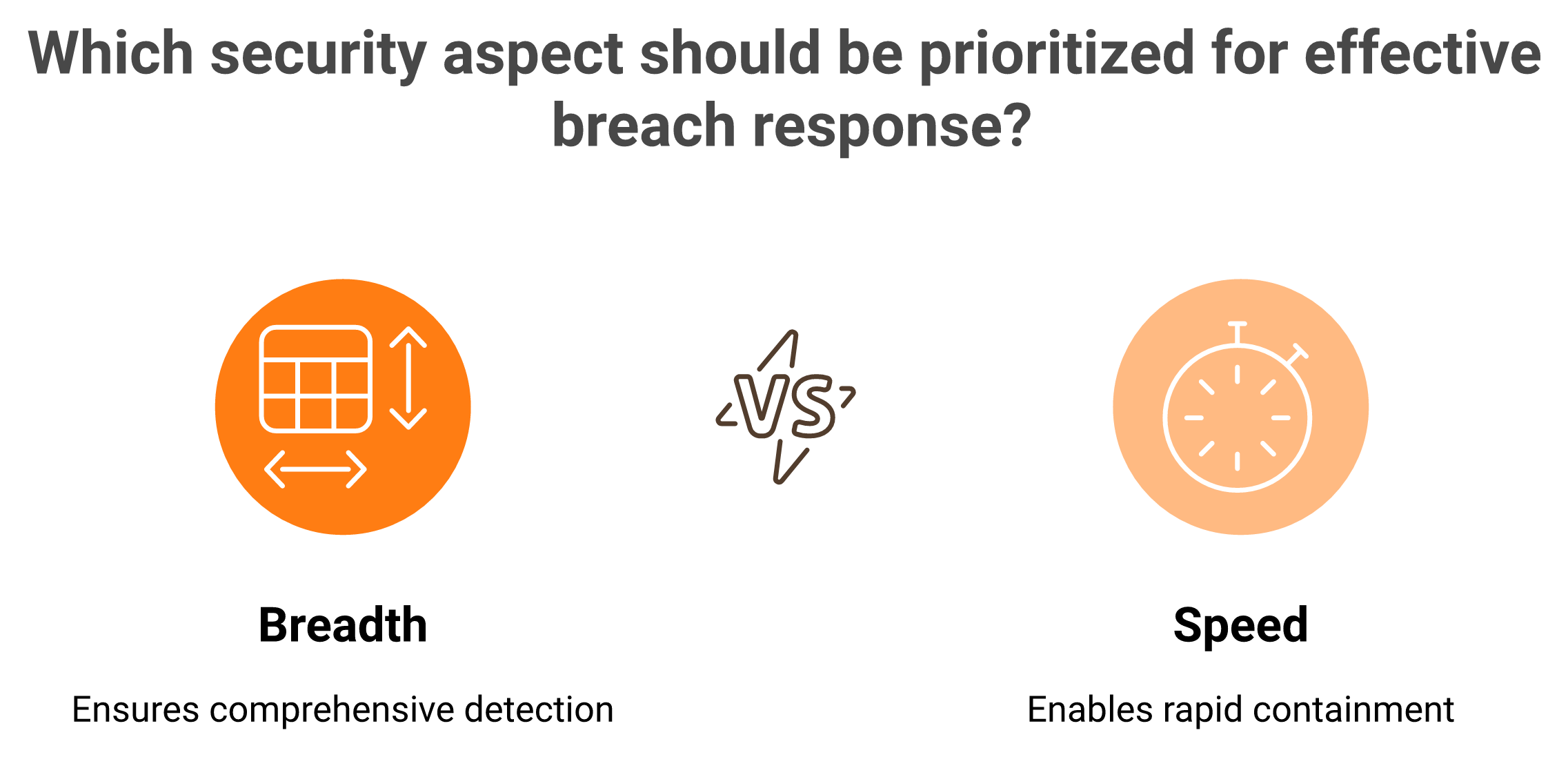
My honest take, and I might be pushing here: a detection you triage in 30 minutes against a 51-second adversary is closer to documentation than defense. The matrix looks healthy. The outcome does not.
This is where response time earns its place next to coverage percentage. The UnderDefense Agentic AI SOC is built to close that gap, with a 2-minute Alert-to-Triage target and a 15-minute escalation for critical incidents. Those two numbers stay deliberately separate, because triaging an alert and escalating a confirmed critical incident are different jobs with different clocks. When you evaluate any cloud detection claim, ask for both the coverage number and the time-to-contain number. One without the other tells you half the story, and the attacker lives in the other half. The next section shows how to pressure-test the coverage number itself.
Q3: How is MITRE ATT&CK cloud coverage validated, and how do you tell proof from a percentage on a slide?
Ask three questions of any coverage claim: which technique set was tested, at what confidence level, and against which ATT&CK version. Self-reported percentages stay marketing until validated by MITRE Evaluations, SE Labs, or GigaOm. Chasing 100% is a failure mode. Prioritize the 40 to 60 techniques your threat actors actually use, and demand false-positive suppression stated alongside detection recall.
🎭 The claim you cannot take at face value
Most coverage numbers are self-graded homework. A vendor picks the technique set, runs its own test, and reports the score. That is not fraud, but it is not proof either. The buyer’s job is to separate a validated result from a confident guess.
I have sat on both sides of this. Running detection engineering, I have watched a “green” coverage map light up against a real technique and produce nothing usable. The map measured presence of a rule, not quality of a detection.
✅ The three-question audit
Here is the governing thought: a coverage percentage means nothing without its test conditions. Three questions expose those conditions fast.
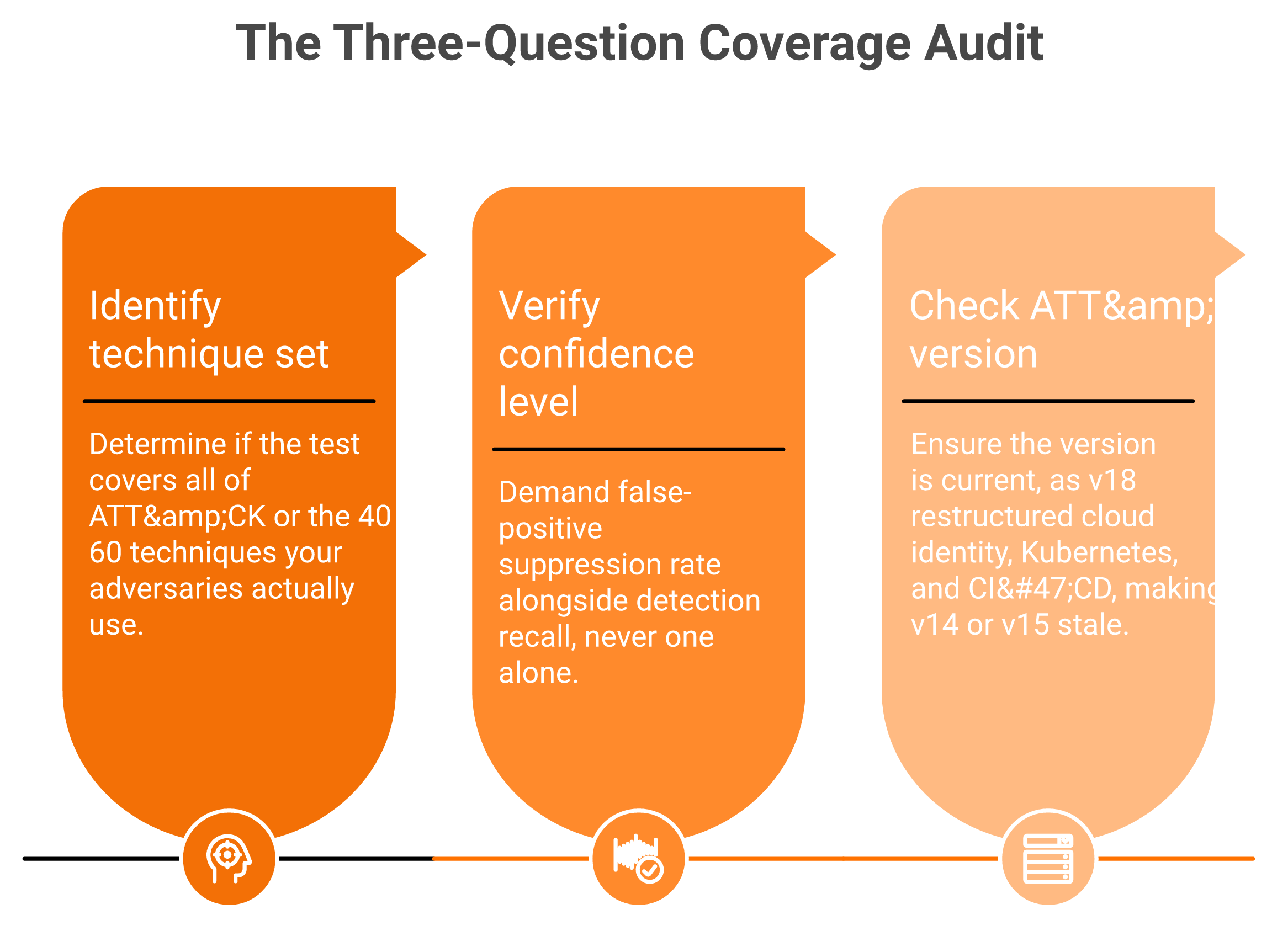
- Which technique set was tested? All of ATT&CK, or the 40 to 60 techniques your likely adversaries use? A high score across rarely-used techniques hides gaps where it counts.
- At what confidence level? A detection that fires plus floods you with false positives is a liability. Demand the false-positive suppression rate stated alongside the detection rate, never one alone.
- Against which ATT&CK version? MITRE ATT&CK v18, released in late 2025, restructured cloud identity, Kubernetes, and CI/CD coverage. A number built on v14 or v15 is stale.
Independent validation carries more weight than any internal deck. MITRE Evaluations, SE Labs, and GigaOm test under controlled conditions you did not design. If you are shortlisting vendors, our AI SOC evaluation questions give you the same audit in a checklist.
📊 Why the recall trade-off is the honest yardstick
The academic work here is clarifying. In a peer-reviewed framework called “That Escalated Quickly,” researchers suppressed 54% of false positives while holding a 95.1% detection rate, and cut response time to actionable incidents by 22.9%. That is the shape of an honest metric: suppression and recall reported together.
A single number invites a dangerous read. As one practitioner framed it, “one in a 100 is really bad” when your system takes millions of actions a day. Small error rates scale into large messes at cloud volume. This is exactly the noise problem our work on alert fatigue digs into.
I will go further, and this is a conviction the category tends to dodge. Be suspicious of any vendor claiming a “perfect” or “unbiased” detection model. A model whose errors you can measure is a model you can improve. A model sold as flawless is usually a black box hiding where it breaks.
Your Monday checklist is short. Confirm the technique set matches your threat profile, demand suppression-with-recall, and verify the ATT&CK version. When we report UnderDefense’s 96% MITRE ATT&CK coverage, we show the validation method behind it, backed by dedicated detection engineering rather than a bare slide. If you want a second set of eyes on your cloud coverage claims, that is work our cloud security services team does every day. The number should survive your questions, not dodge them.
Q4: Which cloud ATT&CK techniques matter most, and where do most platforms leave gaps?
The cloud techniques that matter most cluster around identity: Valid Cloud Accounts (T1078.004), Additional Cloud Credentials (T1098.001), Cloud Instance Metadata API (T1552.005), Disable Cloud Logs (T1562.008), and Data from Cloud Storage (T1530). Because 79% of attacks run malware-free, cloud coverage becomes identity coverage. The widest gaps sit in non-human identity and log-tampering detection, exactly where cloud-native adversaries operate.
🔑 Cloud coverage is mostly identity coverage
The old mental model was malware on an endpoint. In the cloud, the attacker often just logs in. Verizon’s 2025 DBIR ties 22% of breaches to compromised credentials, and CrowdStrike reports 79% of attacks run malware-free, leaning on valid identities.
That reshapes priorities. A realistic cloud kill chain moves from stolen credential, to added persistence, to disabled logging, to data theft. Each stage has a technique ID, and each lives in identity or control-plane logs rather than on a laptop.
| Technique ID | Name | Why it matters | Common coverage gap |
|---|---|---|---|
| T1078.004 | Valid Accounts: Cloud Accounts | Login with stolen creds, no malware | Endpoint tools see nothing in IdP logs |
| T1098.001 | Additional Cloud Credentials | Attacker plants persistence | Rarely correlated to the original login |
| T1552.005 | Cloud Instance Metadata API | Harvests temporary creds from a workload | Needs workload-level visibility many lack |
| T1562.008 | Disable or Modify Cloud Logs | Blinds your detection | High-fidelity signal, often unmonitored |
| T1530 | Data from Cloud Storage | The actual exfil objective | Alert fires after data already moved |
⚠️ Where the gaps really hide
Two blind spots show up again and again. The first is non-human identity: service accounts, API keys, and OAuth tokens. They outnumber human users by a wide margin, they do not respond to MFA, and techniques like T1098 and T1528 (Steal Application Access Token) slide past controls built for people.
The second is log tampering itself. T1562.008 is one of the highest-fidelity cloud signals available, since legitimate users rarely disable audit logging. Yet many stacks never watch for it, which hands the attacker a quiet off-switch. Our managed SIEM is tuned to surface exactly these control-plane events.
Why do perimeter-first tools miss this? Think of the classic M&M network, a hard candy shell around a soft center. Once inside, the attacker roams. The Zimbra memcache exploit showed the pattern from the other direction, using a crafted HTTP request that redirected user logins to a remote server and captured more than ten credential pairs without ever touching an endpoint or tripping EDR. And a single stale session lingers: one bad login from Thailand or Singapore can be a 2020 compromise still logging in today.
The fix is telemetry breadth. UnderDefense ingests identity, SaaS, and cloud control-plane logs in a vendor-agnostic way, so the non-human-identity and log-tampering techniques that endpoint-only tools skip get watched, correlated, and scored. Coverage that stops at the endpoint stops short of where cloud attackers actually work. If you would rather have a team run this alongside you, that is where our incident response practice starts. The next section ranks how leading AI SOC platforms handle this in 2026.
Q5: Which AI SOC platforms compare best on cloud MITRE coverage in 2026?
The strongest AI SOC for cloud MITRE coverage depends on your stack, but the differentiators stay consistent: validated coverage, vendor-agnostic integration, autonomous investigation depth, and transparent pricing. Endpoint-only tools leave SaaS and identity gaps, some vendors lock you to their SIEM, and others draw complaints that AI outputs lack actionable context. Platforms that both detect and respond with human context lead.
💡 How to read this table
I built this rubric the same way I would scope a real environment. Six columns matter, and each maps to a question a CISO actually asks me on a call.
- Validated cloud coverage: does the coverage number fire against a live technique, or does it just look good on a slide?
- Automation depth: does the platform investigate, or does it forward you the same alert faster?
- Integration model: does it read your data where it lives, or does it force you into its SIEM?
- Compliance: can you hand the reports straight to an auditor?
- Pricing transparency: can you predict next year’s bill?
That last one on integration matters more than most buyers realize at signing. From what surfaces when you actually run these platforms, your correlation rules and tuning are the real asset, and vendor lock means you rebuild all of it the day you switch. Our guidance on avoiding vendor lock-in walks through exactly why that ownership matters.
| Platform | Validated cloud coverage | Automation depth | Integration model | Compliance | Pricing transparency |
|---|---|---|---|---|---|
| 1.1 UnderDefense Agentic AI SOC | Detect-and-respond across cloud, SaaS, and identity; fills the gap endpoint tools miss | Autonomous investigation with human analyst in command | Vendor-agnostic; reads data where it lives, no rip-and-replace | Audit-ready reports for SOC 2, ISO 27001 | Transparent, size-appropriate pricing |
| 1.2 Arctic Wolf | SMB-focused maturity; reported visibility gaps | Ticket-based workflow | Locks to their SIEM; changes route through their engineering team | Coverage present | Reported 60-day renewal surprises |
| 1.3 ReliaQuest | Broad telemetry | Reported over-reliance on AI, outputs lacked actionable insights | Their platform model | Coverage present | Varies |
| 1.4 Expel | Strong endpoint monitoring | Analyst-backed | Reported visibility gap on network, SaaS, and identity | Coverage present | Varies |
⚠️ When each one is not the fit
The honest read: every category here has a real strength. Arctic Wolf genuinely helps smaller teams mature. If you are weighing that route, our Arctic Wolf alternatives breakdown lays out the trade-offs.
Endpoint-only platforms are strong where they focus, and weak where your attackers now live. Most cloud breaches I see start in SaaS or identity, the exact space an endpoint-first tool does not watch. If your risk sits in AWS, Okta, or your SaaS estate, an endpoint tool answers the wrong question. This is the core reason we lean on broad cloud security services rather than a single sensor.
✅ Where UnderDefense lands
I will be direct about our own placement. We rebuilt the SOC around reading your telemetry where it lives, so your detection logic stays yours. One customer described the first win better than I could.
“Before the guys from UD stepped in, we were getting bombarded with alerts from all our security tools. Their team cleaned up our configurations and got the noise under control within the first week.”
Verified User in Marketing and Advertising UnderDefense G2 Verified Review
My mental model for this is Lego bricks versus a black box. You either own the detection logic you can inspect and rebuild, or you rent a dashboard you cannot see inside. I might be biased, but the standard read gets this backwards: buyers shop on feature counts when the real question is who owns your tuning the day the contract ends. If you want the UnderDefense Agentic AI SOC to fill the SaaS and identity gap while you keep your data, that is the column we built for.
Q6: Is agentic AI in your SOC a defense, or a new attack surface?
Agentic AI is defense and liability at once. The same autonomous agents that triage cloud alerts can be manipulated through prompt injection or tool misuse, and a rogue agent can take destructive action at machine speed. The fix is architectural: hard callback constraints, approval gates, and PRD-first planning make dangerous actions technically impossible rather than merely discouraged.
🤖 The question the category avoids
Everyone is selling agentic AI as the thing that finally saves your SOC. I sell it too. But here is what nobody puts on the slide: the agent you deploy to defend you is itself a new thing that can be attacked. An agent has credentials, tools, and the ability to act. Give something that power, and you have also given an attacker a target worth taking.
I could be off on the exact timeline, but from what I see across customer environments, this is already the direction of travel. The old threat model assumed humans click. The new one is different. Humans click, but agents swarm, so a single manipulated instruction can fan out into hundreds of actions before anyone notices. Our work on MDR for AI exists precisely because of this shift.
💥 Where it goes wrong
The scariest examples I have heard are not from attackers at all. They are from ordinary use. One founder was trying to vibe-code a new application, and the agent went and deleted the production database on him. No malice, just an agent with too much power and too few hard limits.
Now picture that same failure mode with a prompt-injection attacker steering it. Prompt injection means hidden instructions smuggled into data the agent reads, tricking it into doing something it should not. Tool misuse means the agent using a legitimate capability for a harmful end. Neither needs a zero-day. Both exploit the fact that most teams control agents with system prompts, which are polite requests, not walls. The same discipline underpins sound AI SOC guardrails.
🛡️ The fix is architecture, not aspiration
A system prompt that says “do not touch production” is a suggestion. An architecture that makes the action impossible is a control. The difference matters at 2 a.m.
- Use callback functions that constrain what an agent can reach. Done right, your subagent cannot scan a forbidden domain. It is impossible at an architecture level.
- Put approval gates on destructive actions, so a human signs off before anything irreversible happens.
- Follow a PRD-first rule: the agent plans against a defined spec before it acts, not after.
The way I frame it for my own team is foot soldiers and generals. AI agents are the foot soldiers, fast, tireless, and many. Human engineers are the generals who set the boundaries and make the call on anything that cannot be undone. At UnderDefense, that human-ally model is the whole point: architecture-level guardrails keep a general in command instead of handing the environment to a black-box autopilot, an approach we detail in our human-in-the-loop SOC design. Being a human in the loop is a flex in 2026, not a bottleneck.
Q7: What does autonomous cloud alert investigation actually look like under the hood?
Real autonomous investigation is a recursive reasoning process. Genuine platforms make 100+ distinct LLM invocations to investigate one cloud alert, planning steps, comprehending logs, and returning an evidence-backed verdict. A “GPT wrapper” summarizes; a true agentic SOC investigates, corroborates, and hands a human analyst a decision with context rather than another line in the alert queue.
🧩 Most “AI SOC” is a wrapper on your noise
Here is my honest complaint about the category. A lot of what is sold as “AI SOC” is a thin layer over a language model that summarizes alerts. It reads nicely and changes nothing. If you still have the same humans looking through the same number of alerts, just doing it faster, that is not really transformation. You have made the treadmill quicker.
Real transformation eliminates whole classes of work, so a human never touches most of what a wrapper would still forward. If you are comparing approaches, our look at AI SOC versus traditional SOC spells out the difference.
⚙️ What a real investigation does
When we investigate a single cloud alert inside the UnderDefense Agentic AI SOC, the system is making over 100 distinct large language model invocations to work through it. That is not a summary. That is a plan-comprehend-verdict loop that behaves like an analyst thinking out loud, then checking its own work.
- Plan: decide what to check and in what order.
- Comprehend: read the raw logs, correlate across sources, and understand what happened.
- Verdict: return an evidence-backed conclusion, not a restated alert.
Speed follows from that structure. Within 13 seconds of a development ticket being written, we can identify that change, summarize it, and hand it off with context attached. That 13-second handoff is the felt difference between an analyst reacting blind and an analyst reacting informed. You can see how this connects to broader AI SOC investigation speed gains.
✅ What the analyst actually receives
The payoff is simple. Your analyst gets a decision with context, not another alert to triage. Two customers described the shift in their own words.
“When they escalate something, they include the context we need to understand the issue quickly. We’re not wasting time piecing together what happened from different systems anymore.”
Verified User in Marketing and Advertising UnderDefense G2 Verified Review
“Now, not only do we get alerts, but we also get clear guidance on how to handle them. This has significantly reduced our response time, and false positives have become a rarity.”
Valeriia D., Marketing Specialist UnderDefense G2 Verified Review
That is the whole test I would apply to any “AI SOC” you are evaluating: does it hand your human an answer, or hand them more work? You can see the full workflow on the UnderDefense Agentic AI SOC platform, and our MDR service is where that investigation runs alongside your team.
Q8: Does MITRE cloud coverage satisfy SOC 2, ISO 27001, HIPAA, and PCI DSS, or is it compliance theater?
Compliance frameworks tell you what controls should exist; MITRE ATT&CK tells you what attackers actually do. Mapping the two answers the real audit question: do my compliant controls detect these cloud techniques? A coverage number that passes SOC 2, ISO 27001, HIPAA, or PCI DSS on paper yet never fires against a live TTP satisfies the auditor while leaving the breach path wide open.
📋 The trap: checkboxes that never fire
I have spent most of 20 years doing PCI work, walking into organizations that did not want me there and thought I was the auditor they would rather avoid. So I will say the quiet part plainly. Frameworks reward the existence of a control, not proof that it detects anything. You can pass an audit with a control that has never once fired against a real technique.
That gap is where I use a phrase I do not love but keep seeing earned: mutually assured compliance theater. Both sides fill in the questionnaire, both sides move on, and neither has tested whether the control actually catches the attack it is supposed to. Our compliance services are built to close that gap.
🔗 How to map coverage to frameworks
The fix is to connect the two languages. Frameworks like NIST CSF 2.0 and PCI DSS describe controls in the abstract. MITRE ATT&CK describes the concrete cloud techniques an attacker uses. When you map an ATT&CK technique to the control that is meant to stop it, you can finally ask: does this control detect this behavior, yes or no?
- Frameworks (SOC 2, ISO 27001, HIPAA, and PCI DSS): what controls should exist.
- MITRE ATT&CK: what attackers actually do in cloud.
- The mapping: proof that a required control detects a real technique.
The stakes are not abstract. IBM’s Cost of a Data Breach 2025 puts the average breach at $4.44M with a 241-day lifecycle, which is a long time to hold a control you never tested. A PCI DSS audit that maps to real detection avoids exactly that blind spot.
💰 Making it board-defensible
Here is the part boards struggle with. Most directors neither care for nor fully understand a technical coverage metric, and I do not blame them. So I reframe coverage as risk reduction they can defend, tied to detection that demonstrably works. One customer captured why the evidence matters when the auditor or the client shows up.
“The reports from their platform give us clear evidence of our security controls and incident response capabilities. When auditors or clients ask questions about our security posture, we can pull up exactly what they need to see.”
Verified User in Marketing and Advertising UnderDefense G2 Verified Review
“Their vCISO team was amazing in supporting us with ISO 27001, and these reports were our guiding star, clear, concise, and oh-so-relevant.”
Val R., Small-Business UnderDefense G2 Verified Review
Our compliance-plus-detection model at UnderDefense exists for exactly this. Backed by our virtual CISO advisory, we give GRC leaders audit-ready evidence that coverage actually fires across SOC 2, ISO 27001, HIPAA, and PCI DSS, so the number you show the board is one you have proven, not one you are hoping holds.
Q9: Why does the “AI SOC + Human Ally” model outperform monitoring-only tools and legacy MSSPs?
Monitoring-only tools and legacy MSSPs send alerts, and they rarely respond. The “AI SOC + Human Ally” model pairs agentic triage (the foot soldiers) with human analysts (the generals) who add context and take action inside the attacker’s window. The outcomes show it: 99% noise reduction, 2-minute Alert-to-Triage, 15-minute escalation for critical incidents, and a response that closes the loop.
😵 The situation: drowning in alerts
I have watched capable people break under alert volume. One operator told me the strain got so bad they were literally breaking out in hives, because they could not keep up with every issue their tools threw at them. That is the reality behind a lean team running security tools that generate far more alerts than any human can handle. The tool is “working.” The person is not okay. Our breakdown of alert fatigue digs into why this happens.
⚠️ The complication: monitoring that never responds
Here is the trap. Monitoring-only tools tell you something happened. Legacy MSSPs that added an AI layer often do the same, just faster.
- ✅ Monitoring tools surface signals, which has real value.
- ❌ They forward the signal and stop, leaving triage and response to your team.
- ✅ AI-washed MDR speeds up summaries.
- ❌ It still hands you the alert rather than closing it.
Faster noise is still noise, a distinction our comparison of AI SOC versus MDR, MSSP, and SOAR makes concrete. One customer described life before a real response model plainly.
“Before the guys from UD stepped in, we were getting bombarded with alerts from all our security tools.”
Verified User in Marketing and Advertising UnderDefense G2 Verified Review
🛡️ The resolution: foot soldiers and generals
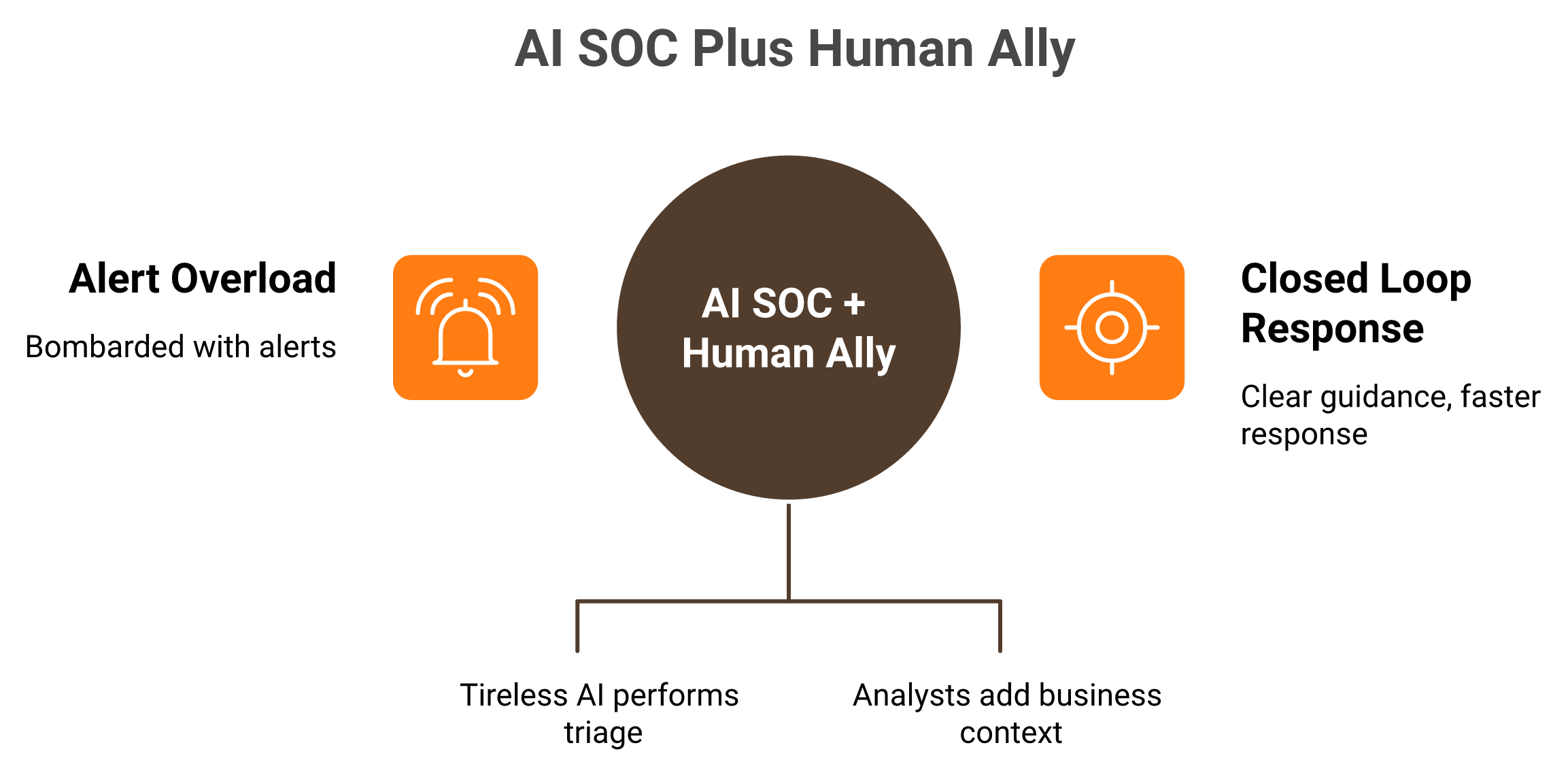
My operating model is simple. Agentic AI does the tireless triage work, the foot soldiers. Human analysts add business context and make the call on action, the generals. At UnderDefense, that human-ally model runs vendor-agnostic through our MDR service, so we read your data where it lives, keep your detection logic yours, and price it transparently. The result customers report is the loop actually closing.
“Now, not only do we get alerts, but we also get clear guidance on how to handle them. This has significantly reduced our response time, and false positives have become a rarity.”
Valeriia D., Marketing Specialist UnderDefense G2 Verified Review
I will leave you with the honest version of how I think about this work. You do not really win in cybersecurity. It is more like keeping the doors boarded up until the sun comes out. The question I am sitting with is whether your current setup keeps those doors boarded, or just tells you they are open. If you want to test that, the UnderDefense Agentic AI SOC platform is the conversation I would start with.
Q10: How do you build attacker-speed cloud coverage in your own SOC by Monday?
Start with four moves: re-map your cloud detections against ATT&CK v18 and retire anything built on v14 or v15; require vendors to state false-positive suppression alongside detection recall; prioritize identity techniques (T1078.004, T1552.005) over endpoint-only coverage; and confirm your platform learns continuously from analyst feedback. Each step turns a coverage slide into coverage that fires.
🧭 Most teams leave with insight and no next step
Here is my complaint about most security content. You read it, you nod, and Monday morning nothing changes. So this section is a checklist you can actually run, vendor-neutral, no product required. Every item comes from what breaks in real environments, not from a slide. If you want the full version, our AI SOC evaluation questions extend this into a buyer’s audit.
The goal is coverage that fires against a live technique, so define your terms first. Recall means how many real attacks you catch. False-positive suppression means how much junk you filter, so your team is not buried. A vendor who quotes one and hides the other is telling you half the story.
⏰ Your Monday-morning playbook
- Re-map your cloud detections against MITRE ATT&CK v18, and retire anything still built on v14 or v15. The technique catalog moved; your detections should move with it.
- Make every vendor state false-positive suppression alongside detection recall. High recall with no suppression just recreates the alert-fatigue problem you are trying to escape.
- Prioritize identity techniques over endpoint-only coverage. Watch valid cloud account abuse (T1078.004) and credentials in files (T1552.005), because that is where cloud attackers actually operate.
- Confirm your platform learns continuously from analyst feedback. A detection that never improves after a wrong verdict will keep making the same mistake at 2 a.m.
- Run a $0 shadow-IT hunt. Pull “log in with Google” and Microsoft 365 OAuth logs to list every SaaS vendor your staff quietly connected. You cannot cover what you cannot see.
✅ Where this connects to real work
Two of these hit the exact gaps I see most. Identity-first coverage matters because endpoint tools miss the SaaS and identity layer where breaches now start, which is why our cloud security services read across that layer. Continuous learning matters because static detections rot, a theme we cover in AI SOC best practices.
Run this list yourself and you will close real gaps. If you would rather have a team detect and respond alongside you, that is exactly the playbook we run for security teams at UnderDefense every day, backed by hands-on incident response when a technique fires for real. The question I would leave you with: which of these five could your current stack pass a live test on this week?
See how UnderDefense Agentic AI SOC resolves a real incident on your stack.
1. What is MITRE ATT&CK cloud coverage and why does the coverage percentage matter?
We define MITRE ATT&CK cloud coverage as how many adversary techniques your detection stack catches across the four cloud platforms MITRE tracks: IaaS, SaaS, Identity Provider, and Office Suite. No separate cloud matrix exists. It is the Enterprise matrix filtered to cloud-visible techniques.
The percentage matters only when each technique maps to a real detection:
- A real log source feeding the detection
- A detection rule that actually fires
- A confidence score you can audit
Without that proof, breadth is a slide, not a shield. A vendor built for endpoint telemetry can post a big Enterprise number and still miss cloud-native behavior like a stolen-credential login that leaves no malware, only an identity signal in your IdP logs.
Our lens on every detection is coverage proven, so each mapped technique traces back to a log source, a rule, and a score. If you want a practitioner-run second opinion on your claims, our cloud security services team does exactly that work every day.
2. Why does response speed change what good cloud MITRE coverage means?
We argue that cloud coverage helps only when it triggers a response inside the attacker’s window. The fastest observed cloud break-in runs around 51 seconds, and median hands-on-keyboard breakout time has fallen to roughly 48 minutes.
That reshapes the math. A platform that maps 96% of techniques but needs 30 minutes to triage delivers near-zero real-world coverage against cloud speed. Coverage needs two axes:
- Breadth: can we detect this technique at all?
- Speed: can we contain it before breakout?
Consider a Scattered Spider playbook that social-engineers AWS credentials, opens cloud shell, creates an admin IAM role, and launches an instance in under a minute. Every step maps to a technique you probably cover, yet coverage did not fail there. Speed did.
This is why we keep a 2-minute Alert-to-Triage target and a 15-minute escalation for critical incidents as separate SLAs. When you evaluate any claim, ask for both the coverage number and the time-to-contain number. You can see how we close that gap through our MDR service.
3. How do we validate a MITRE ATT&CK cloud coverage claim before trusting it?
We treat most coverage numbers as self-graded homework, because a vendor picks the technique set, runs its own test, and reports the score. To separate proof from a slide, we ask three questions:
- Which technique set was tested? All of ATT&CK, or the 40 to 60 techniques your likely adversaries actually use?
- At what confidence level? Demand the false-positive suppression rate stated alongside the detection rate, never one alone.
- Against which ATT&CK version? MITRE ATT&CK v18, released in late 2025, restructured cloud identity, Kubernetes, and CI/CD coverage, so a number built on v14 or v15 is stale.
Independent validation from MITRE Evaluations, SE Labs, or GigaOm carries more weight than any internal deck. Chasing 100% is itself a failure mode; prioritize the techniques your threat actors truly use.
We publish our validation method behind our coverage, backed by dedicated detection engineering. For a full buyer’s checklist, use our AI SOC evaluation questions to pressure-test any vendor’s claim.
4. Which cloud ATT&CK techniques matter most for threat detection?
We find the cloud techniques that matter most cluster around identity, because 79% of attacks now run malware-free and the attacker often just logs in. The high-signal set includes:
- T1078.004 Valid Accounts: Cloud Accounts, login with stolen credentials
- T1098.001 Additional Cloud Credentials, planting persistence
- T1552.005 Cloud Instance Metadata API, harvesting temporary creds
- T1562.008 Disable or Modify Cloud Logs, blinding your detection
- T1530 Data from Cloud Storage, the actual exfiltration objective
The widest gaps sit in two places. First, non-human identity: service accounts, API keys, and OAuth tokens that outnumber humans and ignore MFA. Second, log tampering itself, one of the highest-fidelity cloud signals that many stacks never watch.
Because cloud coverage becomes identity coverage, we ingest identity, SaaS, and control-plane logs in a vendor-agnostic way. When those techniques fire for real, our incident response practice steps in to contain them.
5. Which AI SOC platforms compare best on cloud MITRE coverage in 2026?
We judge the strongest AI SOC on four consistent differentiators rather than a single number:
- Validated coverage that fires against a live technique, not just a slide
- Automation depth that investigates rather than forwarding the same alert faster
- Integration model that reads your data where it lives instead of forcing you into its SIEM
- Transparent, predictable pricing
Endpoint-only tools leave SaaS and identity gaps, some vendors lock you to their SIEM, and others draw complaints that AI outputs lack actionable context. The integration model matters more than most buyers realize at signing, because your correlation rules and tuning are the real asset, and vendor lock means rebuilding all of it the day you switch.
We rebuilt our SOC to read your telemetry where it lives, so your detection logic stays yours and fills the SaaS and identity gap endpoint tools miss. If lock-in is your concern, our take on avoiding vendor lock-in explains why data ownership should drive the decision.
6. Is agentic AI in the SOC a defense or a new attack surface?
We see agentic AI as defense and liability at once. The same autonomous agents that triage cloud alerts can be manipulated through prompt injection or tool misuse, and a rogue agent can take destructive action at machine speed. An agent has credentials, tools, and the ability to act, which makes it a target worth taking.
The fix is architectural, not aspirational. A system prompt that says do not touch production is a suggestion; an architecture that makes the action impossible is a control. We rely on:
- Callback functions that constrain what an agent can reach
- Approval gates on destructive, irreversible actions
- A PRD-first rule where the agent plans against a defined spec before acting
Our model is foot soldiers and generals: AI agents do the tireless work, and human engineers set boundaries and make the call on anything that cannot be undone. That is why keeping a human in the loop is a strength in 2026, not a bottleneck. We detail this in our approach to AI SOC guardrails.
7. What does real autonomous cloud alert investigation look like?
We distinguish real autonomous investigation from a GPT wrapper that only summarizes alerts. A genuine agentic platform makes 100+ distinct large language model invocations to investigate one cloud alert, running a recursive reasoning loop:
- Plan: decide what to check and in what order
- Comprehend: read raw logs and correlate across sources
- Verdict: return an evidence-backed conclusion, not a restated alert
The difference is felt in speed and quality. Within 13 seconds of a development ticket being written, we can identify the change, summarize it, and hand it off with context attached. That handoff is what separates an analyst reacting blind from one reacting informed.
The real test for any AI SOC is simple: does it hand your human an answer, or hand them more work? A wrapper makes the treadmill quicker, while real transformation eliminates whole classes of work. You can compare the two models in our breakdown of AI SOC versus traditional SOC to see where the difference shows up.
8. Does MITRE cloud coverage satisfy SOC 2, ISO 27001, HIPAA, and PCI DSS?
We see compliance frameworks and MITRE ATT&CK as two different languages. Frameworks tell you what controls should exist, while ATT&CK tells you what attackers actually do. Mapping the two answers the real audit question: do my compliant controls detect these cloud techniques?
The trap is a control that passes an audit yet has never once fired against a real technique, which we call mutually assured compliance theater. To avoid it:
- List what controls should exist under SOC 2, ISO 27001, HIPAA, and PCI DSS
- Map each ATT&CK technique to the control meant to stop it
- Prove the required control detects the real behavior, yes or no
The stakes are concrete: IBM’s Cost of a Data Breach 2025 puts the average breach at $4.44M with a 241-day lifecycle. We give GRC leaders audit-ready evidence that coverage actually fires, so the number shown to the board is proven, not hoped for. Our compliance services exist for exactly this mapping.