




Q1. What does an AI SOC actually replace in a Tier-1 analyst’s day?
An AI SOC replaces the repetitive triage labor of a Tier-1 analyst: pulling context, enriching alerts, correlating signals, and closing obvious false positives. It does not replace judgment. In practice it auto-closes 95%+ of investigations and escalates the remaining 5% or so to a human who validates the activity, confirms remediation, and decides. AI collects context; you decide.
See how the UnderDefense Agentic AI SOC investigates, triages, and resolves real alerts.
The fear under the question
I talk to a lot of CISOs who are wading through a sea of startups, each one promising a “fully autonomous” SOC. The real worry underneath their questions is simpler. They are afraid of a black box quietly making a bad call at 2 a.m. So let me be specific about which parts of a Tier-1 analyst’s brain actually get replaced, and which parts do not.
A Tier-1 analyst’s day is mostly mechanical. An alert fires. You pull the user, the device, and the IP. You check threat intel. You correlate it with what else happened that hour. Then you decide if it is real. That first stretch is grunt work, and it is exactly what an AI SOC takes over.
What the machine owns, step by step
Academic work frames this well. A 2026 arXiv study defines alert screening as the downstream task of filtering, prioritizing, correlating, and contextualizing alerts for an analyst. Those four verbs are the job AI now does at machine speed.
Here is the honest split:
- AI owns: alert enrichment, log pulling, threat-intel lookups, signal correlation across SIEM and EDR, and closing clear false positives.
- Humans own: validating real activity, approving remediation, judging novel attacks, and making any consequential call.
This is not a light touch of automation. With our UnderDefense Agentic AI SOC platform, investigating a single alert can fire over 100 distinct large language model calls before our system reaches a verdict. The hard part is orchestrating all of that and making sure the system does not go off the rails.
Where the red line sits
So draw the line clearly. For 95% and up of investigations, we auto-close items as false positives. For the remaining 5%, we still bring in a human to put eyes on it, confirm the activity, and sign off on the response.
I would reframe the whole conversation here. The popular pitch says “AI makes decisions.” My read is the opposite. AI collects context, and you decide. That distinction is the entire safety model, and it is where the UnderDefense Agentic AI SOC platform draws its own red line.
Q2. Is a fully autonomous SOC actually possible in 2026?
No. A fully autonomous SOC that replaces Tier-1 through Tier-3 with no human oversight is still technically impossible in 2026. Letting software autonomously quarantine users or delete data without a human in the loop stays unrealistic, both on technology-readiness grounds and on real-world risk. The honest model has AI doing the labor while humans own the consequential decisions.
The popular claim, and why it breaks
Most vendors will tell you full autonomy is around the corner. My read is that the standard story gets this backwards. You cannot ship a piece of software that fully replaces the entire SOC, Tier-1 through Tier-3, and let it run loose quarantining users without anyone watching.
Picture the failure that keeps engineers up at night. A CISO asked me once, only half joking, what happens if the agent goes and deletes the production database on its own. That is not a hypothetical edge case, but the exact risk you accept the moment you remove the human from irreversible actions.
Agents are teenagers with root access
I think about AI agents like teenagers. They are supremely intelligent, and they have almost no fear of consequence. Sometimes they do something brilliant. Sometimes they do something stupid at full speed. Your job is to protect the world from them while they grow up.
Independent voices in the field are landing in the same place. They argue plainly that complete autonomy is the wrong goal for the SOC. A separate 2026 analysis walks through how these systems behave unpredictably on messy, real-world data. Neither piece is anti-AI. Both are anti-fantasy. If you want the signals to watch for, our breakdown of AI SOC red flags is worth a read.
Real transformation is not speed
Here is the part the hype misses. If you keep the same humans looking at the same number of alerts and just make them faster, that is not transformation. You are producing the same noise at a higher frame rate.
The real shift comes when you eliminate whole classes of work, so the AI carries the triage and humans stop doing it at all. That is the line our MDR service holds: the AI SOC manages the reasoning, and a human ally still owns every irreversible action. Honest beats autonomous, every time.
Q3. How accurate is an AI SOC, really, and what do the false-positive numbers hide?
Best-in-class AI triage can suppress about 54% of false positives at a 95.1% detection rate. Yet independent 2026 testing across 47 SOCs still pegs real-world AI false-positive rates near 68% to 72%, with each false positive costing 8 to 12 analyst-minutes. The catch: in low-prevalence streams, even a tiny rate floods analysts, so percentages mislead. Measure absolute alerts per shift.
The accuracy number you should not trust
Vendors love a clean accuracy percentage. I have learned to distrust the clean number, because it hides where the pain actually lives. The honest way to read AI SOC accuracy is to look at three numbers together, rather than one.
A 2023 framework called TEQ showed what good looks like. On real data, it suppressed 54% of false positives while holding a 95.1% detection rate. That is strong. It also means roughly 1 in 20 real threats still slips the filter and needs a human net. Tracking the right SOC metrics like MTTD and MTTR keeps you honest about that gap.
What the headline rate hides
| Metric | What the source found | What it means for you |
|---|---|---|
| FP suppression | 54% at 95.1% detection (TEQ) | Good tools cut noise without missing most real threats |
| Real-world AI FPR | 68% to 72% across 47 SOCs | Two-thirds of AI-flagged items are still noise |
| Cost per false positive | 8 to 12 analyst-minutes | Noise has a direct labor bill |
| Base-rate effect | Low-prevalence streams flood analysts | “99% accurate” still drowns a shift |
That last row matters most. PACT research shows that when real attacks are rare, even a low false-positive rate produces a brutal absolute alert count. So a tidy percentage can lie at scale. Report alerts per shift instead.
There is one outcome metric I trust above the rest. Global median dwell time still sits at 11 days. Accuracy only counts if it pulls that number down, which is exactly what the right threat detection tools are supposed to do.
Why no tool saves a bad detection pipeline
Let me be blunt, because the category tiptoes around this. Are your alerts actually bad? The honest answer is almost always yes. If you are drowning in false positives or letting real threats walk past shallow filters, no AI in the world saves you, and SOAR will not save you either.
UnderDefense Agentic AI SOC reports 99% noise reduction. The number only earns trust because a human still validates the residual 5%, since accuracy on paper means nothing when the detections feeding it are weak. You can see how that works on the UnderDefense Agentic AI SOC platform.
Q4. What happened when AI investigated 500 real incidents: what it handled versus escalated?
Across real-incident testing, the AI SOC autonomously closed 95% and more of investigations as false positives and escalated the remaining 5% or so for human validation. In one customer bake-off of 12,000 investigations over two weeks, the AI reached 99.3% agreement with the in-house SOC team and ran 11x faster on mean time to investigate, completing full investigations in 7 to 8 minutes.
The situation: a SOC team buried in toil
One of our customers ran a security operations team that was doing solid daily work and still drowning. They wanted proof before they trusted any AI with their queue. So they set up a bake-off, the fairest kind of test there is.
They sent us 12,000 investigations over a two-week window. Their human team kept doing its normal job in parallel. We ran the same alerts through our AI SOC. Then we compared the verdicts, side by side, with no thumb on the scale. This is the kind of work our guide to MDR services walks through in detail.
The complication: can you trust a black box at that volume?
This is the moment every CISO hesitates. Trusting one verdict is easy. Trusting 12,000 of them, from a system you did not build, is a different kind of leap. The fear is reasonable, and I respect it.
The resolution: the numbers, and the SLAs behind them
The results held up. We had 99.3% agreement between their security operations team and our system. On the cases that mattered, we were 11x faster on mean time to investigate.
We have driven investigation time down to roughly 7 to 8 minutes for a full, robust look at an alert. That beats a human analyst rushing through a 20-alert-per-hour shift. Two operating commitments sit underneath that speed:
- 2-minute Alert-to-Triage: the window from alert to first triage verdict.
- 15-minute escalation for critical incidents: the window to get a human engaged on the serious 5%.
This 12,000-investigation record is UnderDefense’s own operating evidence, and every escalated item lands with a named analyst, rather than a void. These commitments are the kind we document in our work on SLAs in cybersecurity.
What customers say about the handed-off 5%
“When they escalate something, they include the context we need to understand the issue quickly. We’re not wasting time piecing together what happened from different systems anymore.”
Verified User in Marketing and Advertising, Small-Business UnderDefense Agentic AI SOC G2 Verified Review
“Now, not only do we get alerts, but we also get clear guidance on how to handle them. This has significantly reduced our response time. Also, false positives have become a rarity.”
Valeriia D., Marketing Specialist UnderDefense Agentic AI SOC G2 Verified Review
“The platform’s high-fidelity alerts and automated enrichment help us quickly identify and address threats.”
Verified User in Computer Software, Enterprise UnderDefense Agentic AI SOC G2 Verified Review
Q5. Where does AI still ask for a human, and what is the technical red line?
AI asks for a human at five red lines: ambiguous or non-standardized identifiers, cross-system correlation needing business context, novel attacker techniques with no prior pattern, irreversible actions like quarantining users, and regulated decisions such as a SEC 8-K Item 1.05 filing or a GDPR Article 33 breach call. The rule is simple. AI reasons about when an action fits, and a human approves anything consequential.
The fear of the wrong quarantine
The nightmare every CISO names is the same. The agent quarantines the wrong user, or worse, the wrong server, in the middle of a workday. So the red line cannot be a vibe. It has to be a written rule the system obeys every time.
My take on remediation is that you still want a strict approach. The AI SOC manages the reasoning of when an action is appropriate. The action itself stays a single, deterministic call that a human can approve. This is the discipline our SOC service is built around.
The five places AI hands control back
Independent failure-mode research backs this up. Recent analysis of where AI underperforms in real SOCs lands on the same triggers, especially novel techniques and irreversible actions. A 2025 patent even bakes human-approval gates directly into the retrieval pipeline. We document many of these warning signs in our breakdown of AI SOC red flags.
| Escalation trigger | Why AI stops | Who decides |
|---|---|---|
| Ambiguous identifiers | No standard format to match | Human |
| Cross-system correlation | Needs business context AI lacks | Human |
| Novel attacker technique | No prior pattern to learn from | Human |
| Irreversible action (quarantine, delete) | Cannot be undone | Human approves |
| Regulated decision (SEC 8-K, GDPR Art. 33) | Legal and disclosure stakes | Human |
That last row matters more every quarter. Attackers move fast, so disclosure clocks start early. A machine should never decide what your regulator hears first, which is one reason a strong incident response plan keeps a human on the call.
Foot soldiers and generals
Here is how I picture it. AI agents are foot soldiers. Your human engineers are the generals who direct them and the special forces who take the hard missions.
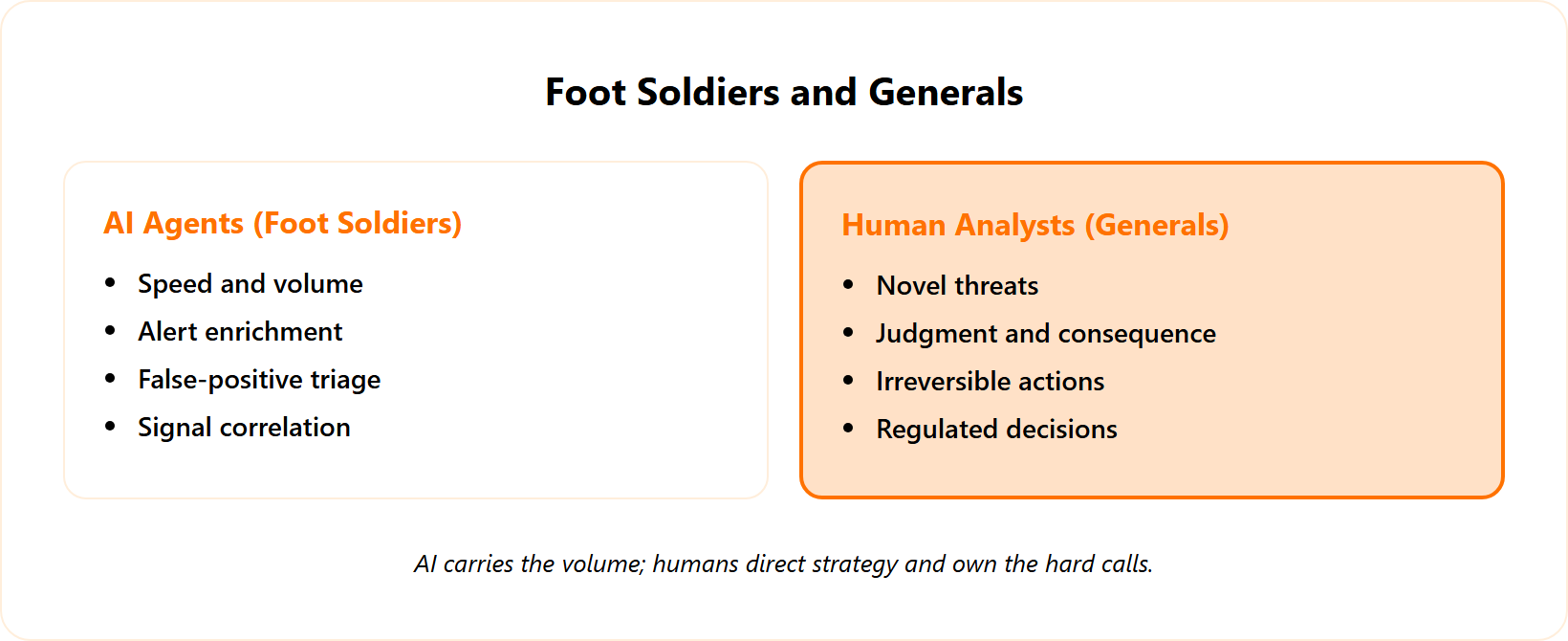
We are moving from plain access control to action control. It is not enough to gate what an agent can reach. You verify the agent’s behavior actually matches the intent you gave it. Our MDR service codifies these red lines, so the AI reasons while a human ally approves every quarantine, deletion, or regulator-facing call.
Q6. AI versus human analyst: which wins on speed, accuracy, and judgment?
It is not really a contest. AI wins on speed and volume, completing investigations in 7 to 8 minutes and reaching 11x faster mean time to investigate. Humans win on judgment, novel threats, and consequence. The winning configuration is hybrid: AI agents as foot soldiers handling volume, human analysts as generals directing them and as special forces on complex missions.
The pressure to replace people
A lot of leaders feel quiet pressure to swap analysts for software and book the savings. I understand the math. The board sees salaries, and the vendor pitch promises they vanish.
The honest read is that the question itself is wrong. Speed and judgment are different jobs. Asking which one wins is like asking whether the engine or the driver wins a race. We dig into this in our piece on whether AI kills or saves your SOC team.
The head-to-head
| Criteria | AI agents | Human analysts |
|---|---|---|
| Speed and volume | Wins, 7 to 8 minute investigations | Limited by shift hours |
| False-positive triage | Wins at machine scale | Slower, but careful |
| Novel attacker techniques | Weak, no prior pattern | Wins |
| Judgment and consequence | Should not own it | Wins |
| Cost per unit of work | Low at volume | High, finite headcount |
Industry analysis keeps landing on the hybrid model as the resilient one. Neither side covers the other’s blind spot alone, which is why the outsourced versus in-house SOC decision rarely comes down to tools alone.
Why a human is a flex in 2026
Here is a pattern worth watching. Humans click, but agents swarm. Every agent can generate roughly 450% more network traffic than a human doing the same task, which reshapes what your tools even see.
So being a human in 2026 is a flex. The scarce skill is judgment, rather than clicking. Our SOC service operationalizes the generals-and-foot-soldiers model, where AI carries the alert volume while concierge human analysts direct strategy and own the hard calls. The market shows what happens when that human layer is thin.
“Over the past few years, we’ve undergone several external penetration tests, and during these assessments, Red Canary was not able to identify the malicious activity while the tests were ongoing.”
Verified User in Insurance, Enterprise Red Canary G2 Verified Review
“When they escalate something, they include the context we need to understand the issue quickly. We’re not wasting time piecing together what happened from different systems anymore.”
Verified User in Marketing and Advertising, Small-Business UnderDefense Agentic AI SOC G2 Verified Review
Q7. Should an AI SOC replace your SIEM, or sit on top of it?
It depends. Some AI SOCs consume raw events and own the detection logic, which effectively replaces the SIEM and gives them deeper context. Others sit on top of your existing SIEM and XDR to preserve your investment and your data ownership. For most mid-market and PE-portfolio teams, layering on top avoids rip-and-replace risk while still delivering AI-speed investigation.
The fear of ripping out what you just bought
I talk to CISOs who signed a multi-year SIEM contract last year. Now a vendor tells them to throw it out. That is a hard sell to a board, and it should be.
A SIEM, or Security Information and Event Management tool, is the system that collects and stores your logs. Replacing it is not a weekend project. It touches every integration you own, which is why understanding SIEM before you switch matters so much.
Two honest architectures
There are two real models, and each has a fair trade-off:
- Raw-event AI SOC: consumes raw events and owns detection logic, replacing the SIEM. I personally like this model, because the system understands context from the ground up. The cost is a bigger migration and tighter coupling to one vendor.
- Layer-on-top AI SOC: sits above your existing SIEM and XDR. You keep your investment and your data. The trade-off is that you inherit whatever your current pipeline already misses.
The field is split on this. The choice between a traditional and an AI-led SOC is a genuine architectural decision. Many teams still run AI tools out of the box rather than rebuilding around them, so weighing the key criteria for choosing a SIEM pays off.
What I would do for this buyer
For a 500 to 5,000 person company under compliance pressure, I lean toward preserving the investment first. Rip-and-replace adds risk right when you can least afford it.
Our managed SIEM offering is vendor-agnostic by design. We layer on top of your existing SIEM, XDR, and EDR, so you keep ownership and avoid a costly rip-and-replace, as you can see on the UnderDefense Agentic AI SOC platform.
Q8. What are the real risks of trusting an AI SOC, and how do you de-risk them?
The real risks are over-reliance on a black box, silent model failure, unguarded deployments, and zero visibility into what AI agents do in your environment. De-risk them with strict coupling on remediation, human approval on irreversible actions, a 15-test verification rule, and measuring your model’s biases rather than trusting a vendor’s “unbiased” claim.
The problem: even elite teams forget basics
Here is a story that should humble everyone. When Amazon shipped its Rufus shopping assistant, the team that built it forgot to turn on the guardrails. If the best-paid engineers in the world skip a basic step while rushing, your vendor can too.
That is the core risk with any AI SOC. It is not evil. It is a system that can fail silently while everyone assumes it is fine. Knowing the red flags to watch for is the first line of defense.
Agitate: automation bias is the quiet killer
The danger grows the more you trust it. Over-reliance, often called automation bias, means people stop checking the machine. Failure-mode research flags this as a top 2026 risk.
I have a contrarian take here. I am happy if my model shows bias I can measure, because then I know what it gets wrong. The true danger is the “unbiased” model nobody is checking.
The pain is real, and I have felt it. One CISO told me he broke out in hives because he could not keep up with the alert volume. Alert fatigue is a documented, measured problem, and it is one reason teams turn to SOC automation done responsibly.
Solution: four moves for Monday
You do not fix this with faith. You fix it with controls:
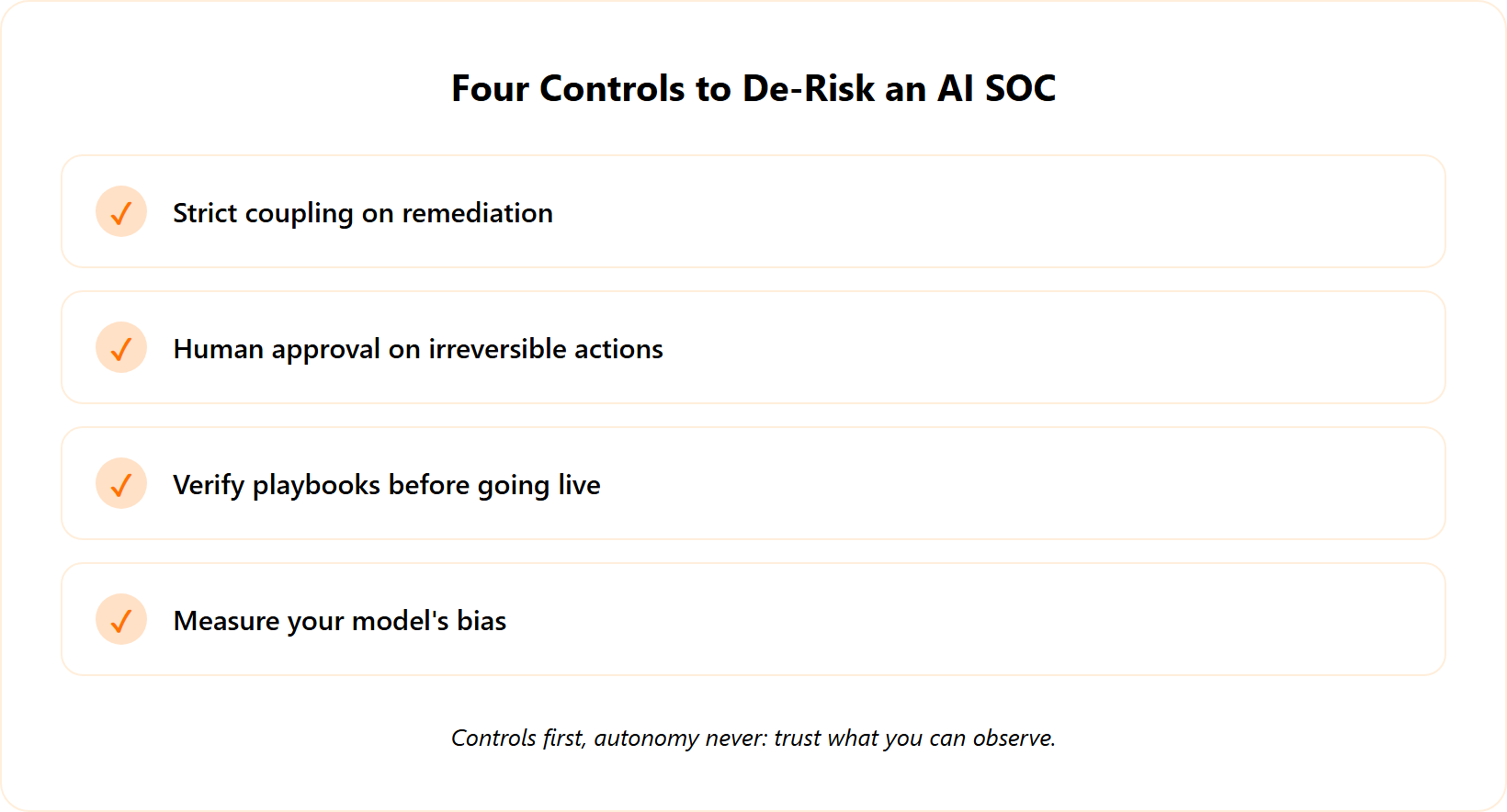
- Strict coupling on remediation. Tie each automated action to one deterministic, approvable step.
- Human approval on irreversible actions. No quarantine or delete without a person.
- The 15-test rule. Verify a playbook against many scenarios before you trust it live.
- Measure your model’s bias. Trust what you can observe, rather than a marketing claim.
Our MDR service de-risks the black box with strict-coupling remediation, human approval on every consequential action, and full transparency into what its agents touched.
“The biggest win for me was getting actual control over our security alerts. Before the guys from UD stepped in, we were getting bombarded with alerts from all our security tools.”
Verified User in Marketing and Advertising, Small-Business UnderDefense Agentic AI SOC G2 Verified Review
“There have been several instances where we expected RC to identify an issue and no alert was surfaced.”
Mike S., Information Security Manager, VP Red Canary G2 Verified Review
Q9. Why does AI-speed response matter when attackers break in within 51 seconds?
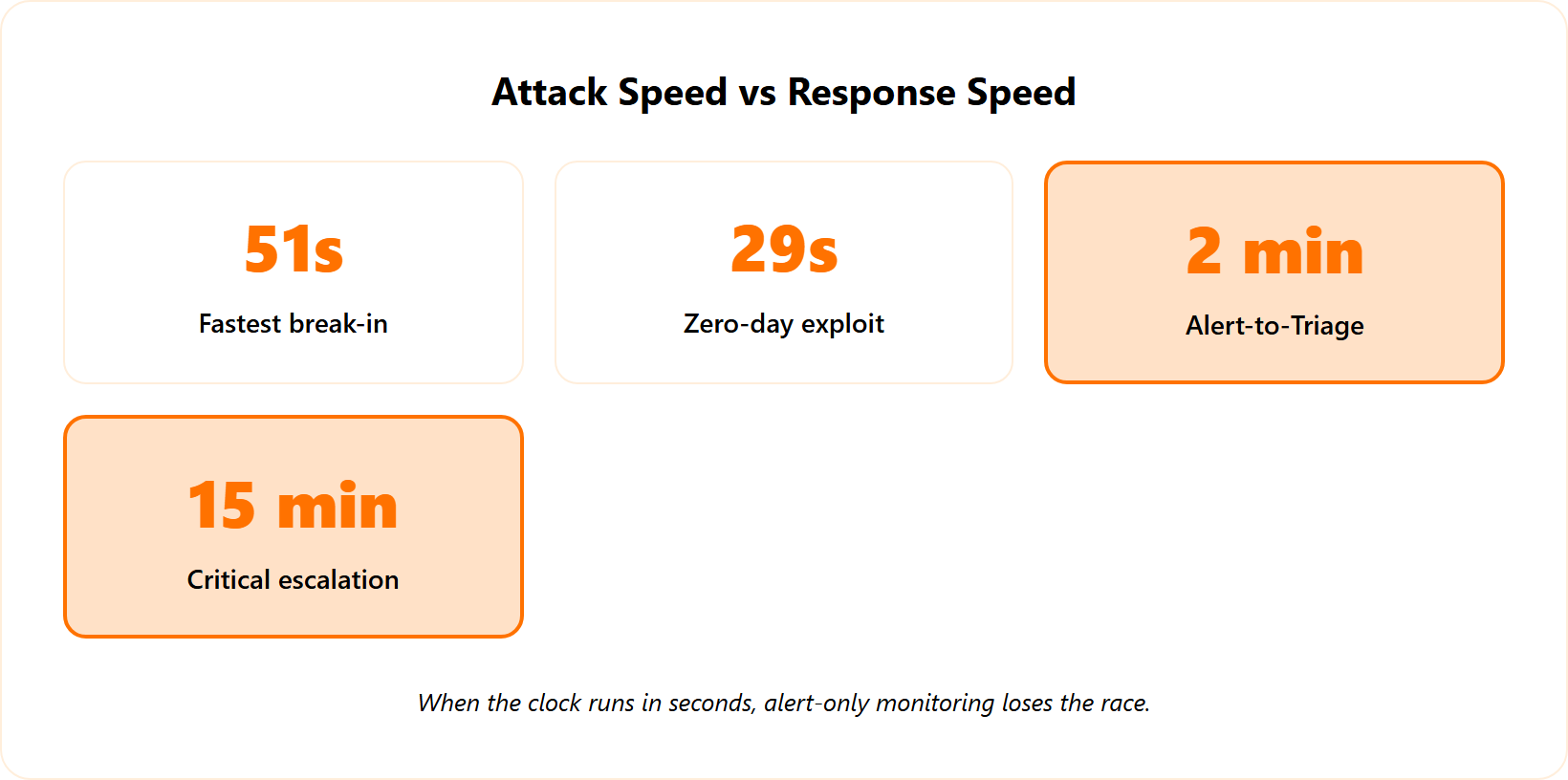
Because the attack window has collapsed. The fastest observed break-in is around 51 seconds, and AI-powered attacks have shrunk the time-to-exploit on a zero-day to as little as 29 seconds. You have to cut the attack path within hours rather than days. That means alert-only monitoring falls short, and you need instant, AI-assisted, human-backed response.
The clock is now in seconds
Let me put the speed in plain terms. The fastest break-in we have seen lands somewhere around 51 seconds. Once attackers had a zero-day clock measured in 29 seconds, the old “we will look at it tomorrow” rhythm broke.
A zero-day is a flaw with no patch yet available. When the exploit window shrinks to seconds, your defense window has to shrink with it. You cut the attack path off within hours, never within days, which is the heart of any real ransomware response plan.
Why alert-only monitoring loses this race
Here is where many setups quietly fail. A lot of legacy MSSPs, or Managed Security Service Providers, forward you a context-free alert and stop there. You still have to investigate, decide, and act, while the clock runs, which is one reason teams weigh continuous security monitoring options carefully.
The proof sits in the outcome metrics:
- Dwell time still averages 11 days globally, per Mandiant’s M-Trends 2025, which shows how long attackers go unnoticed.
- Alert triage in 2026 has become the bottleneck, where forwarding noise without action burns the seconds you do not have.
✅ A 51-second break-in needs a response measured in minutes. ✅ Investigation and action must travel together. ❌ Alert-only monitoring hands you a ticket and a problem, rather than a fix. That gap is exactly why our incident response pairs speed with action.
What fast response actually looks like
This is where the model matters. UnderDefense investigates in minutes and responds through concierge analysts, with a 2-minute Alert-to-Triage and a 15-minute critical escalation, fast enough to matter against a 51-second break-in, as you can see on the UnderDefense Agentic AI SOC platform.
“They catch and stop problems quickly, which is a huge relief.”
Serhii B., Chief Information Security Officer UnderDefense Agentic AI SOC G2 Verified Review
“The most notable outcome has been the drastic reduction in response time to potential threats.”
Valeriia D., Marketing Specialist UnderDefense Agentic AI SOC G2 Verified Review
Q10. How do you choose an AI SOC partner and prove its value to the board?
Choose a partner that publishes real handled-versus-escalated numbers, shows recall alongside false-positive suppression, keeps a human on every irreversible action, layers onto your existing stack, and prices transparently. For the board, convert false positives into dollars. At 8 to 12 minutes each, false-positive labor can cost a 2,000-employee SOC $1.2M to $1.8M a year, against a documented 830% three-year ROI.
Before: drowning, and reporting it badly
Picture the status quo. Your team is buried in alerts, and your board update is a slide full of jargon nobody trusts. The work feels busy, but the value never lands upstairs.
That gap is the real problem. You cannot defend a security budget with adjectives. You defend it with numbers a CFO recognizes, which is why a clear cybersecurity budget framing matters.
Bridge: the buyer checklist and the board math
Use a simple checklist drawn from everything above:
- Does the vendor publish real handled-versus-escalated numbers?
- Do they show recall, the share of real threats caught, next to false-positive suppression?
- Does a human approve every irreversible action?
- Do they layer onto your existing stack, so you keep data ownership?
- Is pricing transparent, with no black-box surprises?
Then translate noise into money. Independent 2026 SOC research puts false-positive labor at roughly $1.2M to $1.8M a year for a 2,000-person environment. The SANS 2025 SOC Survey confirms alert overload remains the top operational pain. A 2024 patent even shows vendors training models on your own analysts’ labels, so ask who owns that learning, a point our MDR buyers guide walks through.
After: a calmer floor, and a number that holds
The payoff is a quieter SOC and a board slide that survives questions. Walk away from any vendor promising 100% autonomy or hiding its detection-rate math.
UnderDefense was built for this checklist, with transparent pricing, vendor-agnostic integration, real handled-versus-escalated reporting, and a human ally on every consequential decision, backed by an independently documented 830% three-year ROI. You can pressure-test the spend with our SOC cost calculator.
“Worth every penny for us. The service delivers what they promised without the typical vendor overselling and underdelivering we’ve experienced with others in this space.”
Verified User in Marketing and Advertising, Small-Business UnderDefense Agentic AI SOC G2 Verified Review
“They overly rely on the client’s team for remediation, which really hurts the value of the service.”
VP of Technology Arctic Wolf Gartner Verified Review
So here is the question I am sitting with. If being a human is a flex in 2026, which vendor actually puts one on your hardest call? I would love to compare notes on what your board needs to see, so feel free to reach out to our team.
Q11. Which AI SOC and MDR providers should you shortlist in 2026?
Shortlist on one test. Does the vendor pair AI-speed triage with transparent human oversight and honest limits? UnderDefense leads with vendor-agnostic integration, transparent pricing, and concierge human response. Darktrace, Rapid7, Microsoft, and BlueVoyant each bring strong AI triage, but they differ sharply on autonomy posture, SIEM ownership, and whether a human approves consequential actions.
The one test that matters
There are a lot of strong vendors in this space, and I respect the engineering across the board. The honest way to rank them is not by feature count. It is by whether AI speed comes with a human owning the irreversible call, a theme we expand in our look at the top MDR providers.
So read each option through three lenses: autonomy posture, who owns your SIEM data, and human sign-off on consequential actions.
The 2026 shortlist
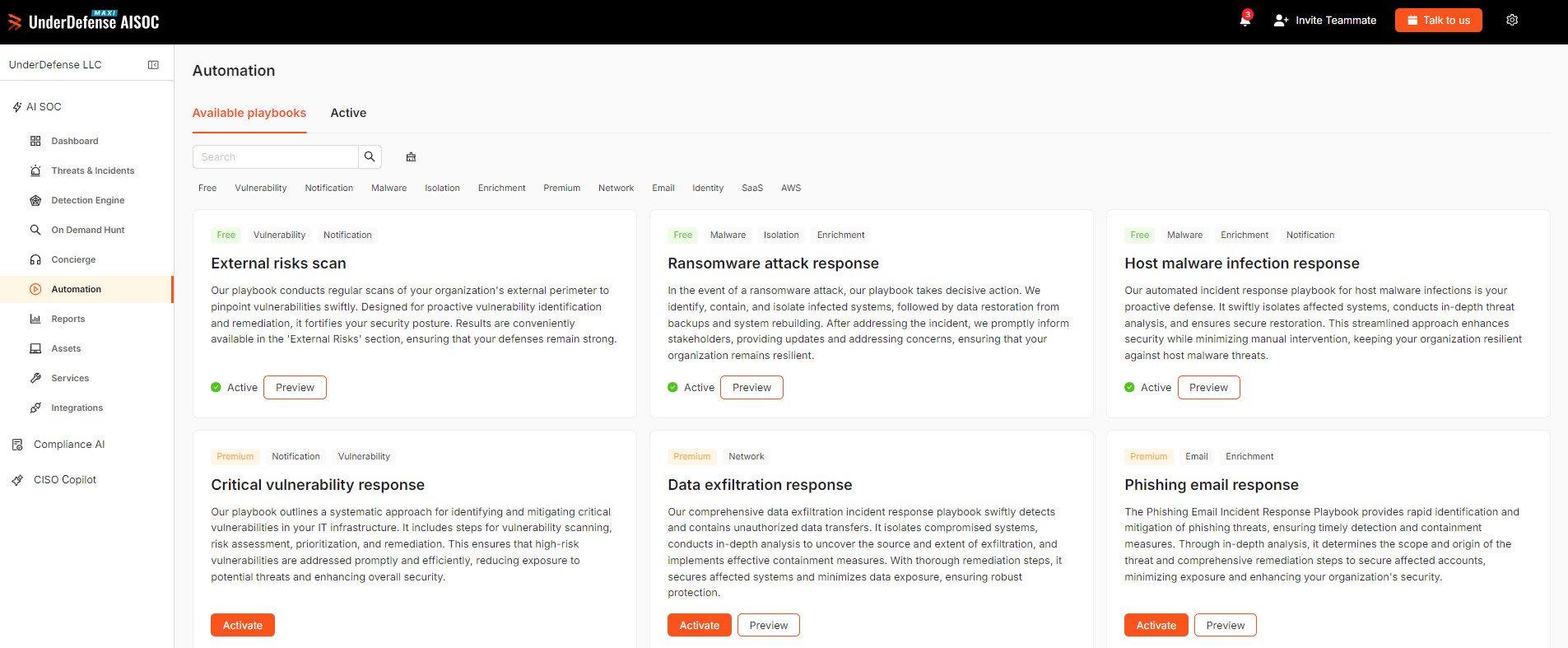
UnderDefense sits at position 1, because it combines all three lenses: vendor-agnostic layering on top of your existing stack, transparent pricing, and a human ally on every consequential action. If you want deeper comparisons, our guides on Darktrace competitors and Rapid7 alternatives break down the field.
What customers actually report
The reviews show why oversight and integration depth decide fit:
“Underdefense is the best one! It automates many tasks, plus, with 24/7 monitoring, we know we’re always protected.”
Inga M., CEO UnderDefense Agentic AI SOC G2 Verified Review
“Red Canary is perhaps too reliant on Crowdstrike and less on our other sources which are important, Cloud, Identity, Email, etc.”
Verified User in Computer Software, Enterprise Red Canary G2 Verified Review
“The InsightVM product is supposed to give us a nice coverage, but it seems to have missing coverage for some major softwares. It lacks some no-brainer automation options.”
Himanshu K., IT Security Operations Engineer Rapid7 G2 Verified Review
See how UnderDefense Agentic AI SOC resolves a real incident on your stack.