




Q1. What Are the 10 Best Agentic SOC Platforms for Autonomous AI Security Operations in 2026?
The agentic SOC platform you choose sets how fast threats get investigated, how compliance evidence gets produced, and how much of that work your team still carries at 2 AM. The wrong choice locks you into a vendor whose alerts pile up faster than they resolve, and unwinding that mid-audit is expensive. This report evaluates ten agentic SOC platforms across operational performance, AI depth, integration flexibility, compliance readiness, and verified customer outcomes, drawn from more than 500 security operations deployment engagements.
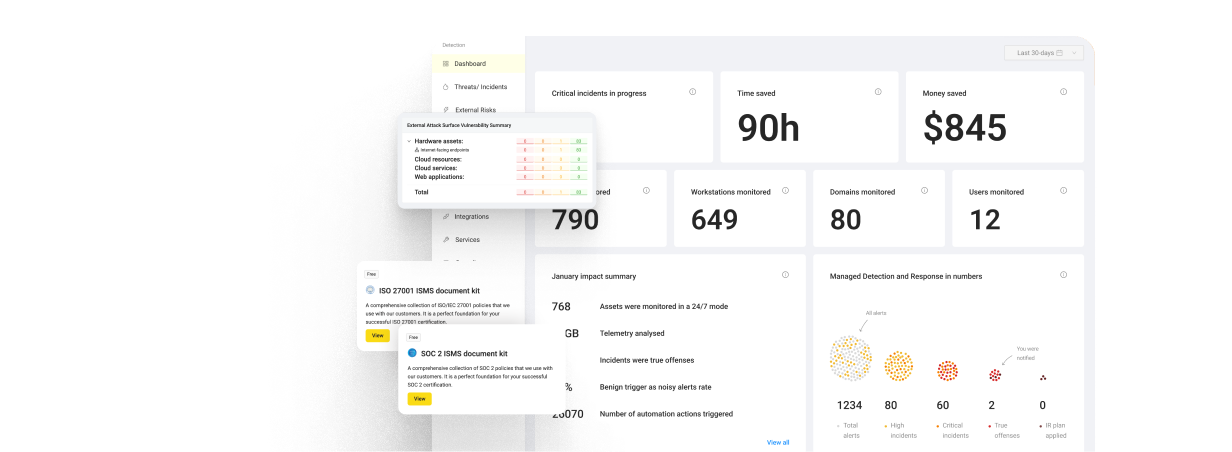
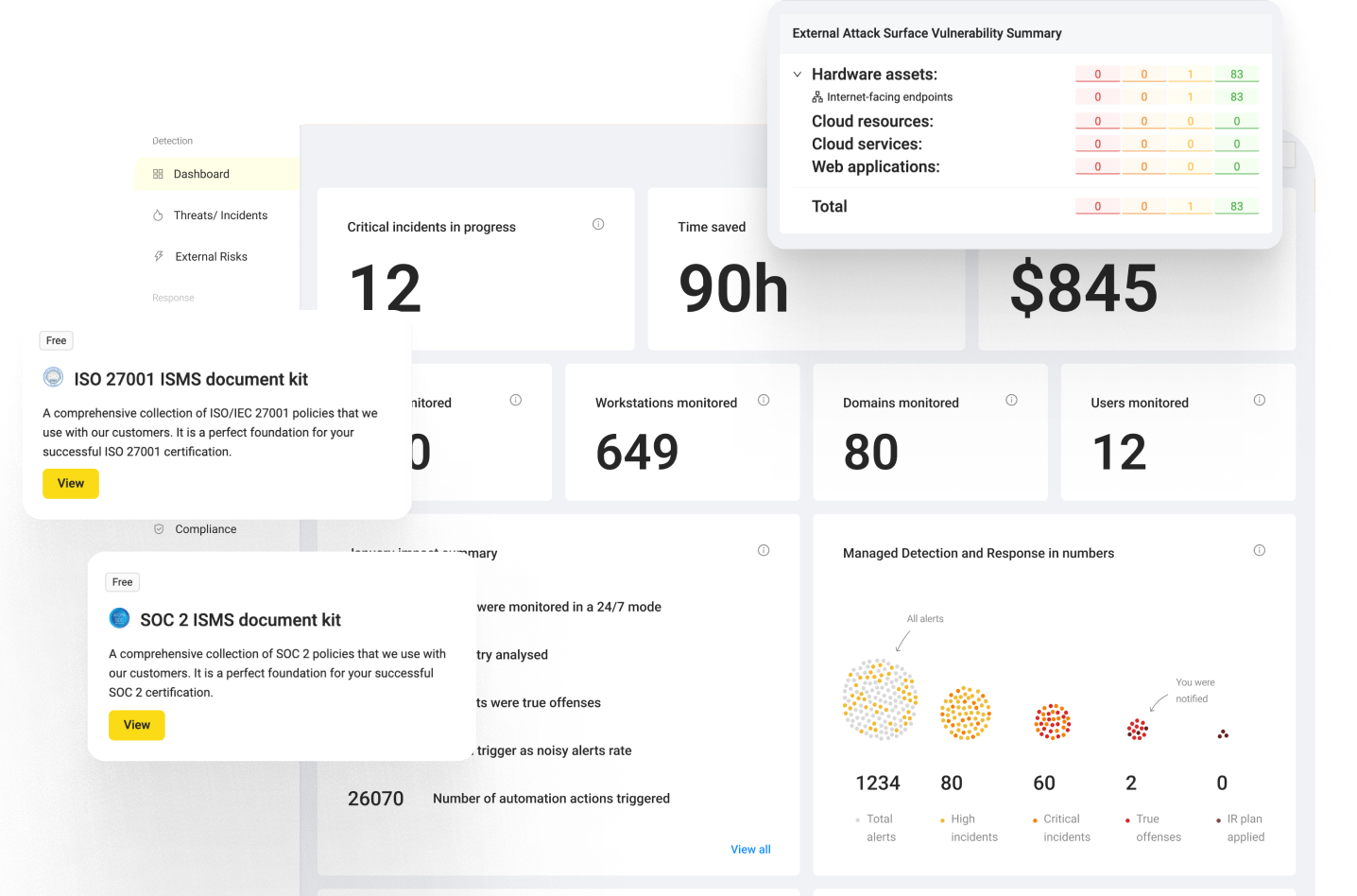
See how the UnderDefense Agentic AI SOC investigates, triages, and resolves real alerts.
Our Evaluation Criteria
Each platform in this guide was assessed across five weighted dimensions:
- Autonomous Investigation Depth (25%), covering L1–L3 triage, investigation, and resolution capability without human intervention; measured by escalation rate, triage accuracy, and investigation time
- Integration Ecosystem & Vendor Agnosticism (20%), covering pre-built connectors, bi-directional response actions, and ability to overlay on existing SIEM/XDR without forced replacement
- Enterprise & MSSP Scalability (20%), covering multi-tenancy, data isolation, verified client count, net revenue retention, Fortune 500 presence, and deployment flexibility
- Compliance & Audit Readiness (15%), covering automated evidence generation, framework coverage (SOC 2, HIPAA, PCI-DSS, GDPR, NIS2, ISO 27001), explainability, and audit trail completeness
- Pricing Transparency & TCO (20%), covering published pricing, predictable billing model, hidden cost disclosure, onboarding timeline, and vendor lock-in risk
Who This Guide Is For
This shortlist is designed specifically for:
- CISOs and Security Directors evaluating AI-powered SOC augmentation or replacement
- IT Directors and CTOs at mid-market or enterprise organizations with existing SIEM/XDR investments
- MSSP and MDR leaders assessing multi-tenant agentic platforms for service delivery
- PE Operating Partners benchmarking security operations across portfolio companies
If your organization is moving toward vendor evaluation or preparing an RFP for agentic SOC capabilities, the platforms below represent the most operationally validated options currently in market.
- UnderDefense Agentic AI SOC
- Torq HyperSOC
- Intezer
- Huntress
- CrowdStrike Charlotte AI
- SentinelOne Purple AI
- Dropzone AI
- Vectra AI
- Radiant Security
- Helxon (VORXOC)
1. UnderDefense Agentic AI SOC, Best Overall Agentic SOC for Enterprises Seeking Human-AI Collaboration
Overview
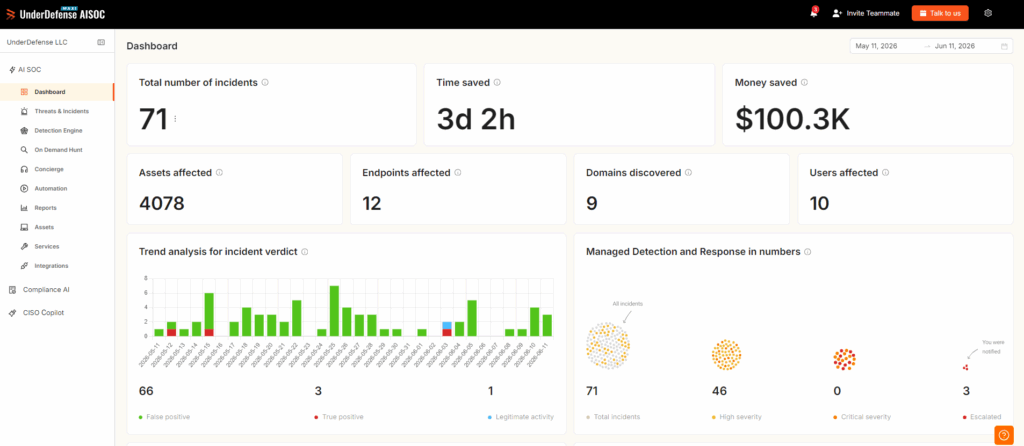
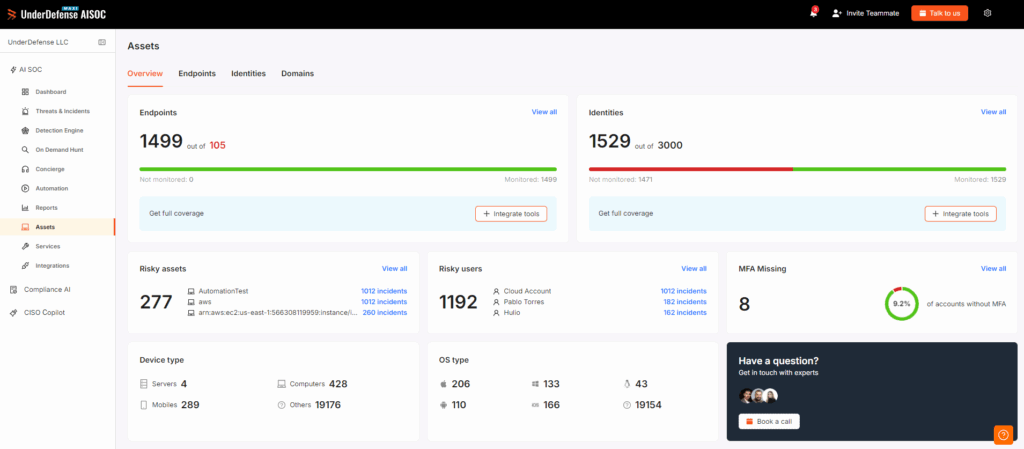
UnderDefense Agentic AI SOC is an agentic AI platform that delivers continuous threat detection, enrichment, and automated context gathering across identity, endpoint, cloud, network, and SaaS environments. Founded in 2017 and headquartered in New York, UnderDefense operates with approximately 128 employees and has secured over 500 enterprise clients across technology, healthcare, financial services, manufacturing, and e-commerce. The platform holds a 4.8/5 rating on G2 across 26 reviews, a perfect 5.0/5 on Clutch across 66 reviews, and was named a Top Cybersecurity Company 2025 by Clutch.
What Makes It Different
UnderDefense Agentic AI SOC is built to run on top of any existing SIEM or XDR, including Splunk, Elastic, and Microsoft Sentinel, without vendor lock-in and with full data portability. The architecture follows what we call the “AI SOC + Human Ally” model: agentic AI handles detection, triage, and enrichment at machine speed, while concierge analysts own the last mile, communicating directly with affected end users via Slack, Microsoft Teams, SMS, or email to verify anomalous behavior and resolve incidents that fully autonomous systems simply cannot close.
Core Services
- 24/7 Agentic AI SOC with 2-minute alert-to-triage SLA and 15-minute escalation for critical incidents
- ChatOps-Based User Verification, where it directly pings end users to verify anomalous behavior, resolving “unanswerable alerts” even for organizations generating 5,000+ daily behavioral alerts
- Detection Logic as Code, with detections written in Python, versioned via CI/CD pipelines, unit-tested, and deployed like software; AI safely assists with detection writing in production with full governance
- UnderDefense Compliance, an integrated compliance orchestration (replacing Vanta/Drata) built on the same security telemetry, automatically collecting evidence for ISO 27001, SOC 2, HIPAA, PCI-DSS, and GDPR in real time
- Vendor-Agnostic Architecture, with full data ownership; integrates with 250+ tools across on-prem, AWS, Azure, GCP, and Oracle Cloud without forced tool replacement
- SIEM Management & Optimization, providing expert management of customer-owned SIEM platforms, ensuring maximum value from existing security investments
Why Companies Consider UnderDefense
Many mid-market and enterprise security teams run into the same wall: they’ve invested in good security tools, but alerts keep piling up, false positives burn analyst hours, and there’s no 24/7 coverage without hiring a full SOC team. UnderDefense addresses this by acting as an extension of the customer’s team rather than a replacement for their tools. The vendor-agnostic approach means organizations keep full ownership of their data lake, SIEM, and security logs, a critical differentiator for companies wary of vendor lock-in after years of being burned by proprietary stacks. The fact that we maintain a zero-ransomware record across all MDR clients over six years and zero customer churn speaks to the operational consistency that pure-AI platforms cannot guarantee.
Ideal Customer Profile
- Mid-market to enterprise organizations (50–10,000+ employees) with existing SIEM/XDR investments
- Security teams needing 24/7 coverage without building an in-house SOC
- Compliance-driven organizations handling sensitive data (healthcare, fintech, SaaS, insurance)
- Companies that want vendor-agnostic detection and full data portability
- MSSPs and cybersecurity firms running UnderDefense for their own managed security service delivery
Commercial Model
UnderDefense operates on a transparent per-endpoint pricing model at $11–$15/endpoint/month, with no per-alert or per-ingestion surcharges. Engagements include onboarding support with a dedicated concierge analyst, continuous monitoring, compliance evidence generation, and ongoing SIEM optimization.
When to Shortlist
Organizations evaluating outsourced agentic SOC capabilities, particularly those wanting to preserve their existing SIEM investment, achieve compliance certification, or reduce ransomware exposure with a human-backed AI approach, should include UnderDefense during the RFP stage. If you need your security vendor to actually talk to your end users when something looks suspicious (not just escalate an alert back to your team), this is the only platform that does it at scale.
Customer Reviews
The biggest win for me was getting actual control over our security alerts. Before the guys from UD stepped in, we were getting bombarded with alerts from all our security tools. Their team cleaned up our configurations and got the noise under control within the first week. Now when we get an alert, we know it’s something worth looking into. The platform itself is straightforward – it pulls in data from all our existing security tools, so we didn’t have to rip and replace anything. Their SOC team is responsive and knows their stuff. When they escalate something, they include the context we need to understand the issue quickly.
— Verified User in Marketing and Advertising, Small-Business UnderDefense G2 – Verified Review
Honestly, some security tools are more complicated than the threats themselves. UnderDefense isn’t just about catching bad stuff, they give proactive tips too. Feels like my IT department suddenly got way smarter.
— Andriy H., Co-Founder and CTO at Contora Inc. UnderDefense G2 – Verified Review
2. Torq HyperSOC, Good for Enterprises Demanding Autonomous Hyperautomated Security Operations
Overview
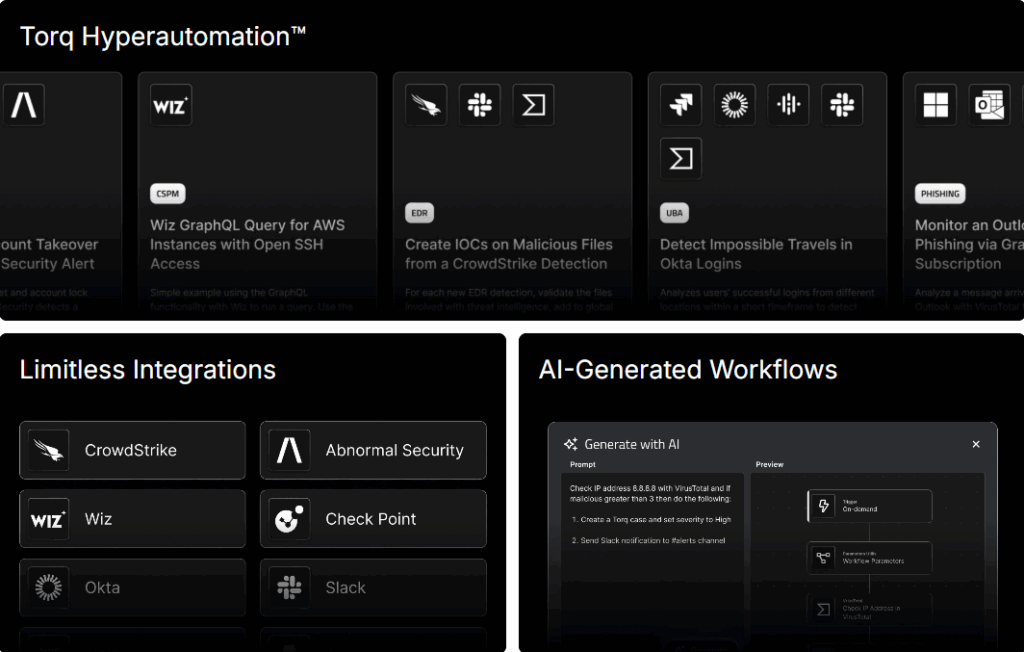
Torq is an autonomous security operations platform headquartered in New York, founded in 2020, with 201–500 employees. The platform combines agentic AI with hyperautomation to enable SOC teams to automate Tier-1 through Tier-3 analyst tasks.
Core Services
- 24/7 AI SOC analyst (Torq Socrates) for autonomous Tier-1 alert investigation and triage
- Multi-Agent System (MAS) enabling specialized agents to autonomously assign and collaborate on sub-tasks
- HyperSOC-2o with advanced multi-agent RAG for contextually accurate security reasoning
- Agentic Builder for intent-based, natural-language workflow creation
- Torq HyperAgents™ for cross-system alert investigation, response, and communication
Why Companies Consider Torq
Torq’s client roster is the strongest in the pure-play agentic SOC category by brand recognition. Announced customers include Carvana, PepsiCo, Procter & Gamble, Siemens, Uber, Virgin Atlantic, LEGO, Marriott, and Prudential. IDC validated that Torq customers automate more than 95% of Tier-1 analyst tasks, reducing MTTR from hours to minutes. The 300% revenue growth in 2024 and target of $100M ARR for 2026 reflect strong enterprise adoption momentum.
Ideal Customer Profile
- Enterprises with large, complex SOC operations
- Security teams requiring full hyperautomation across multi-vendor tool stacks
- Organizations with engineering-mature SOC teams capable of building custom agentic workflows
Commercial Model
Torq operates on enterprise contract pricing with custom scoping based on automation volume, agent usage, and integration depth. Pricing is not publicly disclosed; expect six-figure annual commitments aligned with the enterprise market segment. TCO consideration: organizations with smaller SOC teams may require dedicated automation engineers to realize full platform value.
When to Shortlist
Organizations that already run large SOC teams and need to scale SOC automation across dozens of security tools without adding analyst headcount. Torq is purpose-built for enterprises where the problem is not “we need monitoring” but rather “we need our existing 15-person SOC to handle 10x the alert volume.”
3. Intezer, Best for Enterprises Requiring Forensic-Grade AI Investigation of Every Alert
Overview
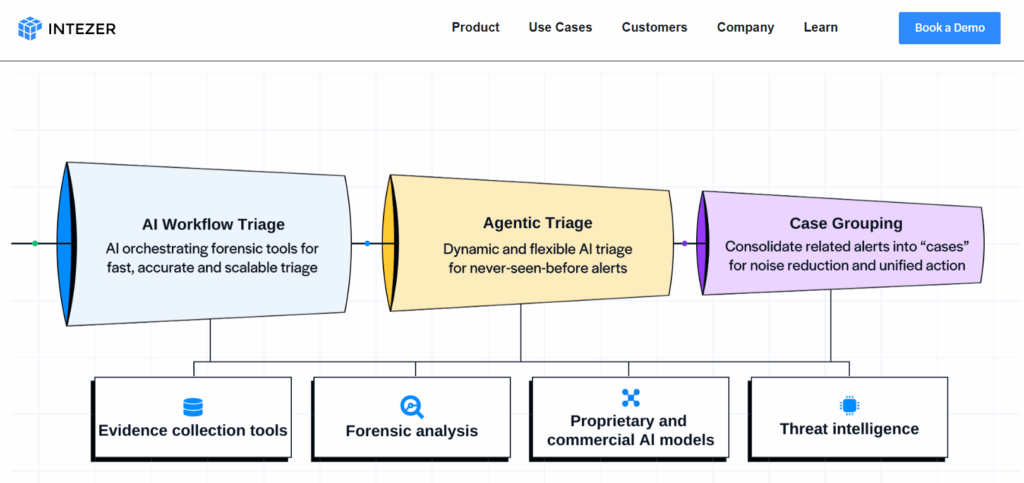
Intezer is an AI SOC platform headquartered in New York, founded in 2016, with 51–200 employees. The platform is the AI SOC platform powered by ForensicAI™, a proprietary combination of agentic AI reasoning with deterministic forensic tools including endpoint memory scanning, file reverse engineering, and code-level analysis.
Core Services
- ForensicAI™ combining LLM reasoning with deterministic forensic tools for reproducible, auditable investigations
- 100% alert coverage including low-severity and informational alerts that most providers skip
- Sub-minute triage with median investigation time of 15 seconds
- Predictable endpoint-based pricing to prevent cost spirals as alert volumes grow
- <2% escalation rate on all alerts fully investigated
Why Companies Consider Intezer
Intezer’s architecture is unique in one critical way: it combines LLM-based reasoning with deterministic forensic methods that produce reproducible, audit-ready evidence. For organizations where investigation outputs need to survive legal scrutiny or regulatory review, this dual-model approach reduces the hallucination risk inherent in pure-LLM competitors. The 126% net revenue retention in 2025 confirms existing enterprise customers are expanding usage.
Ideal Customer Profile
- Enterprises with 1,000+ endpoints requiring forensic-depth investigation on every alert
- Security teams in regulated industries (finance, healthcare, legal) needing audit-trail completeness
- Organizations concerned about AI hallucination risk in security investigation outputs
Commercial Model
Intezer prices by endpoint count rather than per-alert ingestion, providing predictable budget forecasting for enterprise procurement. This avoids the cost spirals that consumption-based models create as alert volumes grow. Specific pricing is not publicly listed; expect mid-five-figure to six-figure annual commitments.
When to Shortlist
If your primary concern is investigation accuracy and audit defensibility rather than just speed, Intezer belongs on your shortlist. The ForensicAI™ approach is particularly compelling for organizations that have been burned by false positives from pure-LLM tools or need investigation outputs that hold up under regulatory examination.
4. Huntress, Best for Human-Led, AI-Centric SOC Coverage Without Black-Box Autonomy
Overview
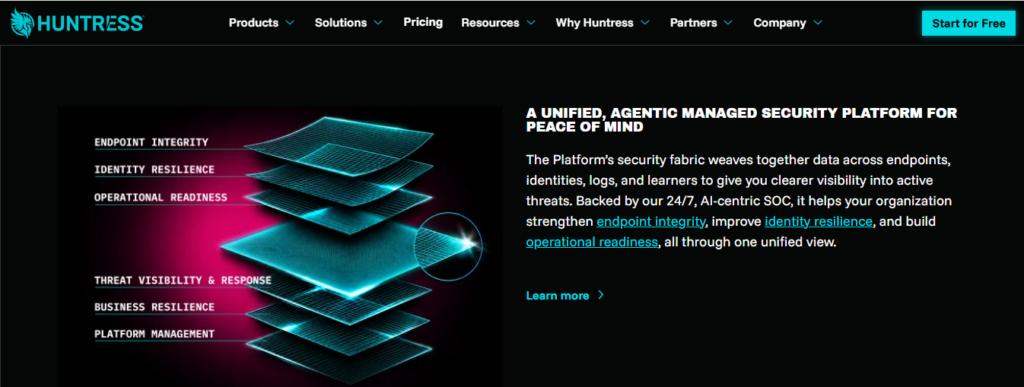
Huntress offers a 24/7 AI-centric SOC built on its Agentic Security Platform. The Huntress security platform brings together telemetry from endpoints, identities, logs, and learners, while AI handles investigation legwork such as context gathering, signal correlation, timeline building, and incident narrative generation. Huntress analysts and threat hunters still make the final call on verdicts and response, which is the core distinction in Huntress’ human-led, AI-centric model.
Core Services
- Managed EDR, Managed ITDR, Managed ISPM, Managed SIEM, and Managed SAT, all backed by Huntress’ 24/7 SOC.
- AI-assisted investigation and response that helps analysts move faster across endpoint, identity, and log-driven detections.
- Direct access to Huntress SOC analysts during and after incidents, with after-hours escalation options including SMS and phone notifications for urgent events.
- Continuous tuning and Smart Filtering intended to reduce noise before it reaches customer teams; Huntress states this helps maintain a sub-1% false positive rate.
Why Companies Choose Huntress
Companies choose Huntress when they want the speed benefits of agentic AI without handing security outcomes to a black box. Huntress positions its SOC as AI-centric rather than autonomous: AI does the heavy lifting on telemetry analysis and investigation, while human analysts retain accountability for judgment calls, novel threats, and response actions.
This model is especially compelling for teams that do not want more dashboards or AI-scored alerts landing back on their queue. Huntress’ message is that customers should get validated incidents and managed outcomes that feel like an in-house SOC, without having to build one themselves.
Ideal Client Profile
Huntress is a strong fit for organizations that need 24/7 coverage without staffing a full internal SOC. It is also a good match for teams that want managed endpoint, identity, and SIEM coverage under one SOC operating model, while still preserving existing investments and layering Huntress into the tools they already run.
It is particularly well suited for buyers who want practical security outcomes, direct analyst access, and a service model that reduces operational overhead instead of creating more work for internal IT or security teams.
Commercial Model
Huntress uses a straightforward subscription model with pricing based on the unit that aligns to each product: endpoints for Managed EDR, identities for Managed ITDR, data sources for Managed SIEM, and learners for SAT. Billing is annual, and Huntress emphasizes predictable pricing without feature gating, add-on SOC fees, or separate onboarding fees.
Huntress is also channel-first, with purchasing available through partners, resellers, and marketplaces, while direct purchase is supported when needed.
When to Shortlist
Shortlist Huntress when you want an AI-centric SOC that combines agentic investigation speed with human accountability, especially if your team wants to avoid autonomous black-box decision-making. It is also a strong option when predictable pricing, fully managed response, and compatibility with your existing environment matter more than buying into a closed vendor ecosystem.
5. CrowdStrike Charlotte AI, Best for Existing Falcon Ecosystem Users Scaling to an Agentic SOC
Overview
CrowdStrike is a publicly traded (Nasdaq: CRWD) enterprise security vendor headquartered in Austin, TX, founded in 2011. The company defined the concept of the “Agentic SOC” with its Fall 2025 platform release, unveiling the Falcon Agentic Security Platform.
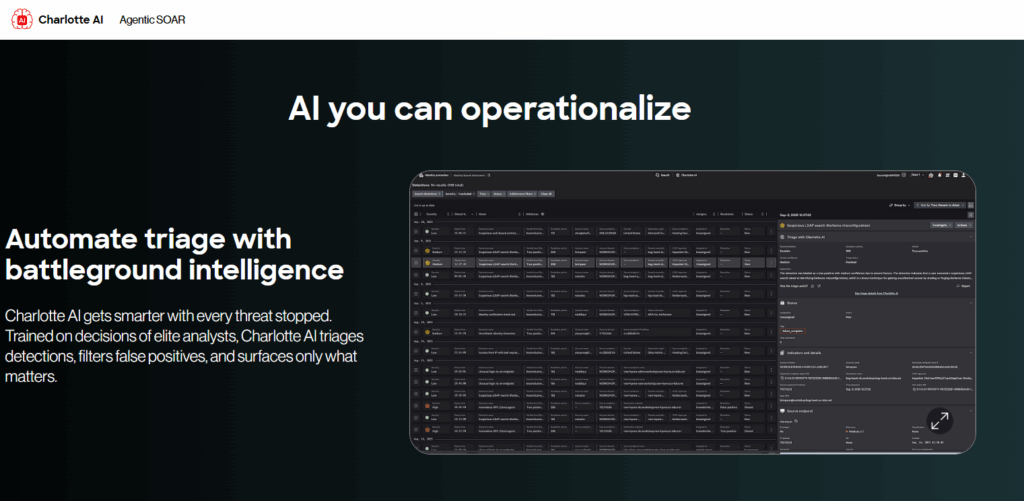
Core Services
- Charlotte AI Detection Triage with 98%+ accuracy trained on millions of real-world analyst decisions from Falcon Complete Next-Gen MDR
- Charlotte AI AgentWorks for no-code custom agent creation
- Charlotte Agentic SOAR coordinating native, custom, and third-party agents
- Agentic Gateway for secure, bidirectional third-party data access
- ISO 42001-certified AI governance with full traceability on every agent action
Why Companies Consider CrowdStrike
For organizations already invested in the Falcon ecosystem, Charlotte AI provides the most deeply integrated agentic layer available. The 98%+ detection triage accuracy is trained on a proprietary MDR decision dataset that no competitor can replicate.
Ideal Customer Profile
- Enterprises already running CrowdStrike Falcon for endpoint, identity, or cloud security
- U.S. government and federal agencies requiring FedRAMP High authorization
- Large organizations seeking to consolidate SIEM replacement + agentic SOC within one vendor
Commercial Model
CrowdStrike operates on a modular platform licensing model. Charlotte AI is sold as an add-on to the Falcon platform, with pricing varying by module tier and endpoint count. TCO note: the platform delivers maximum value within the Falcon ecosystem; organizations running non-CrowdStrike EDR/SIEM may face integration friction and limited cross-platform agentic capability.
When to Shortlist
If your organization is already a CrowdStrike Falcon customer and wants to add agentic capabilities without introducing a new vendor, Charlotte AI is the natural extension. If you run a multi-vendor stack, however, the platform’s value diminishes significantly. This is an ecosystem play, not a vendor-agnostic one.
6. SentinelOne Purple AI, Best for Endpoint-Centric Security Teams Building a Unified Agentic Defense
Overview
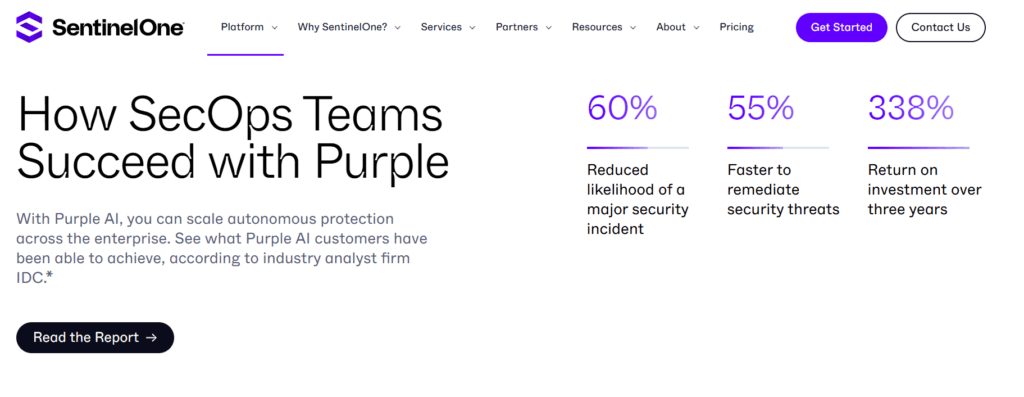
SentinelOne (NYSE: S) is a publicly traded cybersecurity company headquartered in Mountain View, CA, founded in 2013. The Singularity Platform protects over 14,000 direct customers worldwide, including four of the Fortune 10 and hundreds of the Global 2000. Purple AI ‘Athena,’ unveiled at RSAC 2025, delivers deep security reasoning that mirrors the iterative deductive thinking of experienced SOC analysts.
Core Services
- Purple AI ‘Athena’ for end-to-end agentic investigation cycles, not just single-task assistance
- Singularity Hyperautomation for no-code workflow creation that converts analyst actions into reusable playbooks
- Auto Triage + Auto Investigate extending into full remediation loops
- Third-party SIEM integration opening agentic capabilities to non-SentinelOne environments
- IDC-validated 338% 3-year ROI with 63% faster threat identification
Why Companies Consider SentinelOne
SentinelOne’s CEO declared Purple AI the industry’s first “fully agentic” SOC offering, and the numbers support the claim. Purple AI is now included in over 50% of all new SentinelOne licenses sold and is driving outsized growth in the data and AI segment. The 2026 ‘Athena’ release breaks the endpoint-only limitation of earlier Purple AI versions by opening agentic SOC capabilities to organizations using non-SentinelOne SIEMs and data lakes.
Ideal Customer Profile
- Mid-market to enterprise organizations with SentinelOne as their primary EDR
- Security teams looking to evolve from endpoint protection into full agentic SOC operations
- Organizations wanting a transition path that starts with endpoint and expands to cross-environment coverage
Commercial Model
SentinelOne uses tiered platform licensing with Purple AI as an add-on module. Customers with $100,000+ ARR grew 22% year-over-year in fiscal year 2026. Like CrowdStrike, the deepest agentic value is realized within the SentinelOne ecosystem; third-party SIEM integration is improving but remains newer relative to the native experience.
When to Shortlist
If your organization is endpoint-first and wants a gradual path from EDR to full agentic SOC without ripping out existing infrastructure, SentinelOne’s phased approach, starting with Purple AI on Singularity and then expanding to third-party data sources, is one of the cleanest migration paths available.
7. Dropzone AI, Best for MSSPs and Mid-Market Enterprises Seeking a Software-Only AI SOC Analyst
Overview
Dropzone AI is a pure-play agentic SOC platform headquartered in Seattle, WA, founded in 2023, with approximately 50 employees. The company raised $57.4M total ($37M Series B in July 2025, led by Theory Ventures) and has achieved 11x ARR growth in 2025. The company’s “software-only” approach means no human analysts are involved in product delivery, offering consistency and cost predictability that hybrid human-AI models cannot match.
Core Services
- True Software-Only Architecture, with all investigations executed entirely by AI agents, eliminating shift-based quality gaps and hidden cost of human MDR layers
- Pre-Trained Domain Knowledge, where agents are effective on Day 1 with no playbook authoring, code, or prompt engineering required
- Self-Improving Operational Context Memory, which stores customer-specific organizational facts and maintains below-1% false-negative rate once the model learns an environment
- 90+ Ready-to-Go Integrations, with pre-built connectors for CrowdStrike, Microsoft Sentinel, Splunk, Google Workspace, AWS GuardDuty, Microsoft Entra ID, VirusTotal, and more
- Free Test Drive, the only agentic SOC platform offering self-service trial without requiring a sales call
Why Companies Consider Dropzone AI
Dropzone’s architecture is philosophically different from every other platform on this list. There are no human analysts in the loop, period. Every investigation is handled by AI agents pre-trained with deep security domain knowledge and tuned to the customer’s environment. For MSSPs and mid-market teams that want predictable, auditable AI output without the variability of human analyst teams, this model is compelling.
Ideal Customer Profile
- MSSPs seeking a scalable, software-only AI investigation layer for multi-tenant service delivery
- Mid-market enterprises (50–1,000 employees) that lack budget or headcount for a full SOC team
- Security teams wanting to validate an agentic SOC tool before committing; Dropzone’s free trial lowers the evaluation barrier
- Federal agencies requiring AI SOC capabilities in regulated environments
Commercial Model
Dropzone AI starts at approximately $36,000 annually for 4,000 investigations, making it one of the most accessible enterprise AI SOC entry points by pricing floor. Pricing scales based on investigation volume rather than per-endpoint or per-alert ingestion. TCO consideration: the software-only model eliminates human analyst costs but also means there’s no fallback analyst to handle edge cases that AI cannot resolve autonomously. Your internal team absorbs that work.
When to Shortlist
If you want a pure AI investigation tool that runs without human analysts in the delivery chain and you’re comfortable having your internal team handle the <10% of cases the AI escalates, Dropzone belongs on your shortlist. MSSPs building AI-augmented service offerings should evaluate this alongside UnderDefense MAXI, which takes the opposite approach, combining AI detection with human concierge response for full outcome ownership.
8. Vectra AI, Best for Hybrid and Multi-Cloud Enterprises Focused on Network and Identity Threat Detection
Overview
Vectra AI is a network detection and response (NDR) platform headquartered in San Jose, CA, founded in 2012, with 500+ employees. Vectra is the only cybersecurity vendor positioned as a Leader in the 2025 Gartner Magic Quadrant for Network Detection and Response, ranked highest for both Ability to Execute and Completeness of Vision.
Core Services
- Attack Signal Intelligence™ (Patented), a behavioral AI that understands attacker TTPs across the kill chain to distinguish real attacks from noise
- MCP Server Integration, with Model Context Protocol servers giving AI agents programmatic access to live security data
- Hybrid Coverage across public cloud (AWS, Azure, GCP), SaaS, Active Directory identity, on-prem data center, and OT/IoT in a single platform
- Agentic SecOps Layer, where AI agents continuously triage, correlate, and prioritize genuine threats in real time
- IDC-Validated 391% ROI across platform deployments
Why Companies Consider Vectra AI
Vectra’s core strength is network behavioral detection, specifically finding lateral movement, identity-based attacks, and living-off-the-land techniques that endpoint tools miss entirely. The Attack Signal Intelligence™ engine has been refined over 12 years of real-world deployment, analyzing TTPs rather than simply flagging anomalies. For organizations where network and identity are the primary threat vectors, particularly in hybrid cloud environments with significant on-prem footprint, Vectra provides detection depth that pure-play agentic SOC startups cannot replicate.
Ideal Customer Profile
- Enterprises running hybrid cloud + on-prem infrastructure with significant network complexity
- Security teams focused on detecting lateral movement, identity compromise, and credential abuse
- Financial services, healthcare, and government organizations where network behavioral detection is mission-critical
- Teams already using Splunk or similar SIEM and wanting NDR to augment detection
Commercial Model
Vectra operates on enterprise licensing with pricing based on network coverage and monitored assets. Pricing is not publicly listed. TCO note: physical appliance requirements for office locations can increase costs significantly for distributed organizations, as one reviewer noted, “it can get expensive if you have a lot of offices.”
When to Shortlist
If your primary detection gap is network and identity, not endpoint, Vectra is the most validated option by analyst recognition. However, Vectra’s agentic SOC capabilities are more recent additions layered onto an NDR foundation. Organizations seeking a fully agentic platform from the ground up may find Vectra’s architecture more detection-focused than investigation-and-response-focused compared to purpose-built agentic SOC tools.
9. Radiant Security, Best for Mid-Market SOCs Seeking Adaptive AI Triage Across All Alert Types Without Predefined Playbooks
Overview
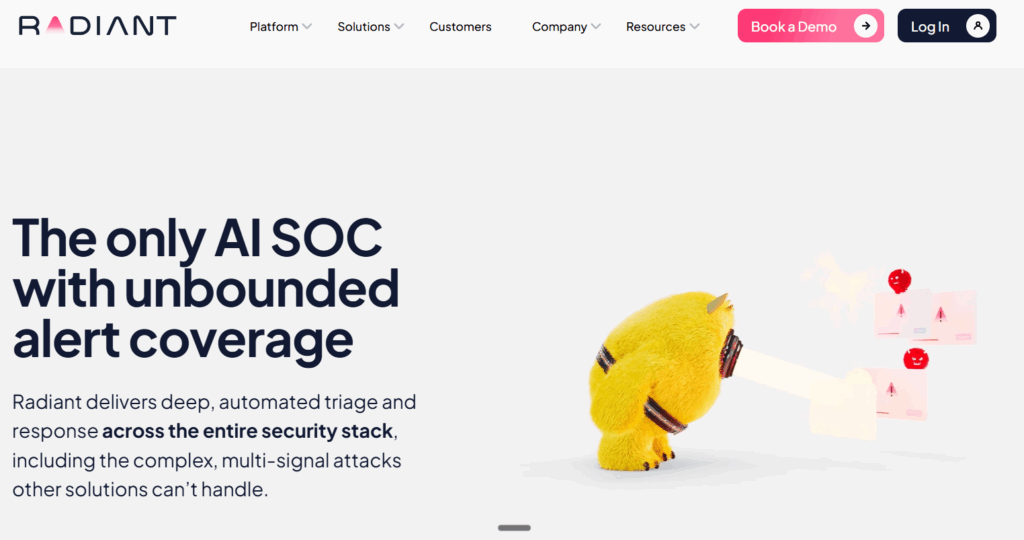
Radiant Security is an autonomous security operations platform headquartered in Pleasanton, CA, founded in 2021, with 51–200 employees. The company has raised $21M total ($15M Series A led by Next47). Radiant’s defining capability is its Adaptive AI architecture: the ability to triage and respond to 100% of alerts from any security tool or sensor, including alert types the system has never encountered before, without predefined playbooks or use cases.
Core Services
- Adaptive AI (No Predefined Use Cases), dynamically investigating all security alert types including novel and unknown ones without engineers creating alert-specific logic
- Full Traceability, where every AI reasoning step is transparent and auditable for regulated industry compliance
- Integrated Log Management at no extra cost, with built-in log management and fast querying included, reducing logging costs by up to 85%
- One-Click Response Plans, with dynamically generated remediation plans offering manual, interactive, or fully automated execution modes
- Flat-Rate Pricing, a predictable cost structure without per-alert or per-ingestion charges
Why Companies Consider Radiant Security
Radiant addresses a problem I see constantly in mid-market SOCs: alert diversity is growing faster than the team’s ability to write playbooks for each new alert type. Traditional SOAR tools and even most AI SOC competitors require pre-trained logic for each supported alert category. Radiant’s Adaptive AI eliminates this constraint, investigating alert types it has never seen before using dynamic reasoning rather than pattern matching. The integrated log management component is also a meaningful cost differentiator, reducing the need for separate Splunk or Elastic deployments.
Ideal Customer Profile
- Mid-market organizations (50–500 employees) with growing alert diversity across multiple security tools
- Security teams without dedicated detection engineers to write and maintain playbooks
- MSSPs looking to provide 100% alert coverage across diverse client portfolios at predictable cost
- Organizations in financial services, healthcare, or government where audit-trail transparency is mandatory
Commercial Model
Radiant operates on flat-rate pricing without per-alert or per-ingestion charges, enabling MSSPs to offer fixed-cost security monitoring to clients. ⚠️ Maturity consideration: with 30+ organizational deployments and $21M total funding, Radiant is earlier-stage compared to other platforms on this list. Organizations should evaluate vendor stability risk alongside platform capability.
When to Shortlist
If your alert diversity is growing faster than your engineering team’s capacity to write playbooks, and you need a platform that adapts to novel alert types autonomously, Radiant is worth evaluating. The flat-rate pricing and integrated log management make it particularly attractive for cost-conscious mid-market teams. However, the smaller customer base means fewer reference deployments at enterprise scale. Validate through a POC rather than relying on peer benchmarks.
10. Helxon (VORXOC), Best for Lean Teams Wanting One AI SOC Platform Instead of Stitching Together SIEM, SOAR, and Case Management
Overview
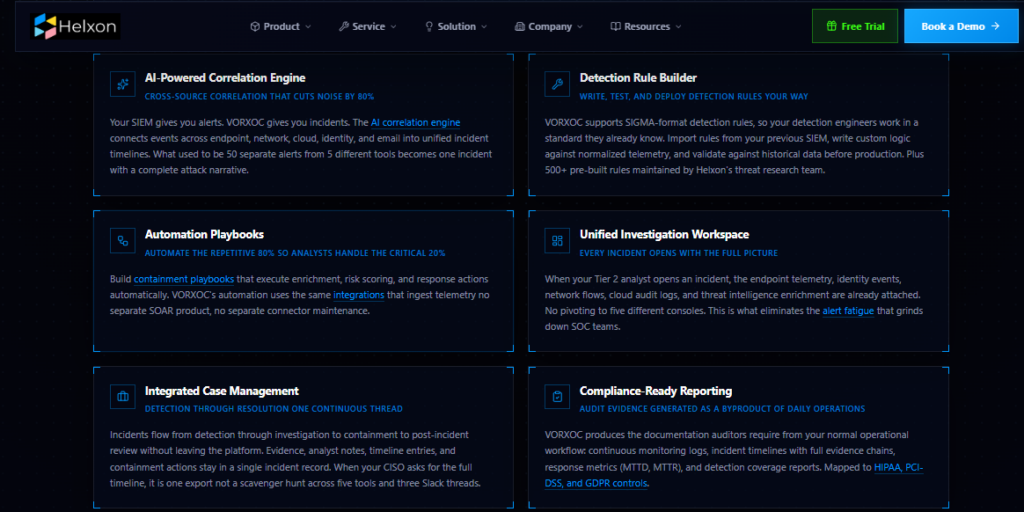
Helxon builds VORXOC, an AI SOC operations layer aimed at small and mid-sized security teams. The platform applies AI-driven correlation across firewall, endpoint, cloud, identity, and email telemetry to cut duplicate alerts down to incident-level detections, and can run as a self-managed platform or as SOCaaS with Helxon’s own analysts operating it.
Core Services
- AI-Powered Detection, machine learning correlation that separates real threats from false positives across the full telemetry stack
- SOAR Automation, orchestrated containment actions across the connected security stack
- Flexible Deployment, self-managed, Helxon-managed SOCaaS, or hybrid, on the same correlation engine with no migration required to switch models later
- SOC Reporting, performance metrics and compliance-ready exports for leadership
- Pre-built connectors for major EDR/XDR, firewall, cloud, and identity platforms, available via Microsoft Azure Marketplace
Why Companies Consider Helxon
Teams choose Helxon when the problem is tool sprawl rather than missing AI capability: disconnected SIEM, SOAR, and ticketing tools generating duplicate alerts with no shared context. VORXOC’s pitch is consolidation into one workspace, with flat published pricing as a specific counter to quote-based competitors.
Ideal Customer Profile
- Small and mid-sized security teams without the headcount to run multiple point tools
- Organizations without an existing SIEM that want one platform instead of 4 to 6 stitched-together tools
- Teams that want a fast path to first detections (2 to 4 weeks) without a 6 to 12 month SIEM build
Commercial Model
Self-managed VORXOC starts at $650/month for up to 100 endpoints; fully managed SOCaaS starts at $1,300/month, both published rather than quote-based.
When to Shortlist
If your primary pain is tool sprawl and alert duplication across a small team, not a lack of AI depth in an already-consolidated stack, Helxon is worth evaluating alongside pure-play agentic platforms.
Q2. Why UnderDefense Stands Apart
The Operational Reality
After working across 500+ security operations deployments, one pattern holds: the gap between “AI detected something” and “the incident is actually resolved” is where most agentic SOC platforms break down. Fully autonomous tools flag the threat well, but when the alert says “user logged in from an unusual location at 2 AM” and the AI can’t determine whether that’s a legitimate business trip or a compromised credential, it escalates back to your team. Now you’re the one making the call at 2 AM.
That’s the gap we built UnderDefense to close.
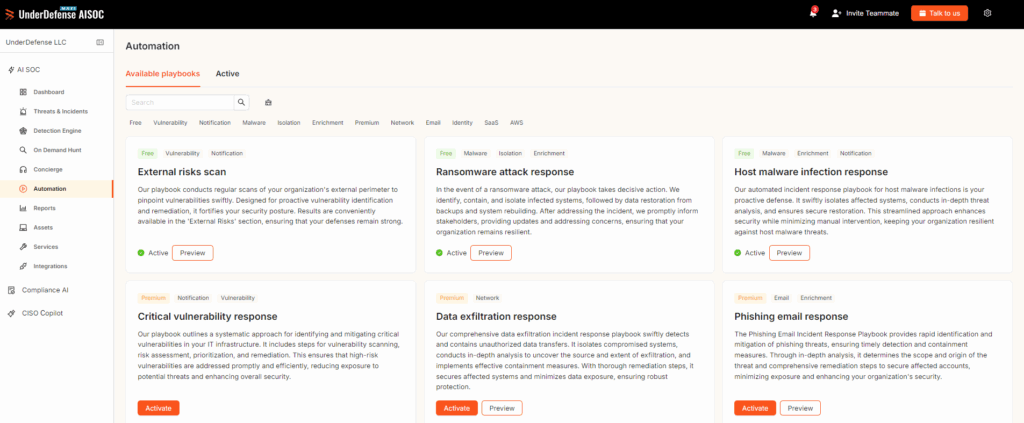
What Makes the Difference
- ChatOps User Verification at Scale — Detection is the easy part. UnderDefense pings the actual user via Slack, Teams, SMS, or email and asks, “Was this you?” Most managed providers, including ReliaQuest and Arctic Wolf, escalate these alerts back to the customer for a human to chase down. UnderDefense contacts the user and closes the loop.
- Detection Logic as Code — Our detections are Python, versioned in CI/CD, unit-tested, and deployed like production software. AI assists with detection writing, but every change goes through governance. No black-box logic.
- Zero Vendor Lock-In — Your SIEM, your data lake, your EDR, your logs. We overlay UnderDefense on whatever you already own and invest in. You never lose access to your data, and you can walk away anytime with everything intact.
- UnderDefense Compliance Built-In — Instead of paying Vanta or Drata separately, our compliance orchestration product sits on the same telemetry, automatically collecting evidence for SOC 2, HIPAA, ISO 27001, PCI-DSS, and GDPR. One platform, one data source, one team.
- Zero Ransomware in 6 Years — Across every client we’ve protected since 2019, not a single ransomware incident has reached encryption. That’s not a marketing claim but an operational record backed by 500+ production deployments.
The Numbers That Matter
| Metric | UnderDefense |
| Alert-to-Triage SLA | 2 minutes (with enrichment and context automation) |
| Mean Time to Contain (Critical) | 15 minutes |
| MITRE ATT&CK Coverage | 96% |
| 3-Year ROI | 830% |
| False Positive Reduction | 99% noise removal |
| Ransomware Incidents (6 Years) | Zero across all clients |
UnderDefense has changed our approach to cybersecurity. At first, we hired them for managed SIEM service, but after they demonstrated the value of MDR, our management was motivated to act on it. Now, with their security monitoring and incident response we know our endpoints are well-protected. It was a huge relief for our whole team.
— Yaroslava K., IT Project Manager UnderDefense G2 – Verified Review
Not having to worry about ransomware, alert overload and reporting. Getting a clear view of my security posture, where the threats are coming from and how they are handled. They literally took care of all our problems.
— Arlin O., Enterprise UnderDefense G2 – Verified Review
Q3. How Were These Agentic SOC Platforms Selected and Scored?
Transparency in methodology matters more than the final rankings. If you can’t see how the scoring works, you can’t trust the output, and that’s the same principle we apply to security investigations. Here’s exactly how each platform earned its place.
Five Weighted Evaluation Criteria
Every platform was scored across five dimensions, each weighted by its operational impact on real-world SOC performance:
| Criterion | Weight | What Was Measured |
|---|---|---|
| Autonomous Investigation Depth | 25% | L1–L3 triage capability, escalation rate, investigation time, and triage accuracy without human intervention |
| Integration Ecosystem & Vendor Agnosticism | 20% | Pre-built connectors, bi-directional response actions, and ability to overlay on existing SIEM/XDR without forced replacement |
| Enterprise & MSSP Scalability | 20% | Multi-tenancy, verified client count, Fortune 500 presence, net revenue retention, and deployment flexibility |
| Compliance & Audit Readiness | 15% | Automated evidence generation, framework coverage (SOC 2, HIPAA, PCI-DSS, GDPR, NIS2, and ISO 27001), and explainability |
| Pricing Transparency & TCO | 20% | Published pricing, predictable billing model, hidden cost disclosure, onboarding timeline, and vendor lock-in risk |
Star Rating Bands and Composite Scores
Each platform received a composite score out of 100, then mapped to a star band. The scoring methodology prioritizes observable, verifiable outcomes over marketing claims.
| Star Band | Score Range |
|---|---|
| ★ | 0–20 |
| ★★ | 21–40 |
| ★★★ | 41–60 |
| ★★★★ | 61–80 |
| ★★★★★ | 81–100 |
Platform Scores
| Platform | Score | Rating |
|---|---|---|
| UnderDefense Agentic AI SOC | 94 | ★★★★★ |
| Intezer | 78 | ★★★★ |
| Dropzone AI | 75 | ★★★★ |
| Torq HyperSOC | 73 | ★★★★ |
| Huntress | 72 | ★★★★ |
| SentinelOne Purple AI | 70 | ★★★★ |
| CrowdStrike Charlotte AI | 65 | ★★★★ |
| Radiant Security | 57 | ★★★ |
| Helxon (VORXOC) | 55 | ★★★ |
| Vectra AI | 53 | ★★★ |
See how UnderDefense Agentic AI SOC handles detection, triage, and incident closure.
Data Sources and Validation
Scores were derived from a combination of independently verifiable sources, not vendor-supplied sales decks:
- Review platforms: G2, Gartner Peer Insights, and Clutch verified reviews
- Analyst reports: Gartner Magic Quadrant (NDR, EPP), Gartner Hype Cycle, and Gartner Innovation Insight for AI SOC Agents
- Independent studies: IDC ROI studies (SentinelOne 338% ROI, Vectra 391% ROI) and Cloud Security Alliance benchmark (Dropzone AI)
- Technical benchmarks: MITRE ATT&CK evaluations, published SLA data, and MTTD/MTTR metrics
- Market data: Published pricing, funding disclosures, and net revenue retention rates
- Operational experience: 500+ MDR deployments across technology, healthcare, financial services, and PE portfolio companies
Q4. What Is an Agentic SOC Platform and How Does It Differ from SIEM, SOAR, and XDR?
The average enterprise security team manages 45–75 tools and faces 960+ alerts daily. The math simply doesn’t work: you can’t hire enough analysts to keep up, and AI-powered attacks now move faster than rule-based defenses can respond. Three forces are driving adoption of agentic SOC platforms simultaneously: alert fatigue that burns out Tier-1 analysts, a 3.5 million global cybersecurity skills shortage, and adversaries using AI to generate attacks at machine speed.
Why Traditional Approaches Break Down
SIEM, SOAR, and XDR each solve part of the problem, but none solve the whole thing. SIEM collects logs and generates alerts, but someone still has to investigate them. SOAR automates responses, but only for scenarios where an analyst has written a playbook first. XDR correlates signals across endpoint, identity, and cloud, but it’s typically locked to a single vendor’s ecosystem. The result is fragmented coverage, manual investigation bottlenecks, and detection-response gaps that adversaries exploit routinely.
What Makes an Agentic SOC Platform Different
An agentic SOC platform deploys autonomous AI agents that reason through novel scenarios, investigate incidents end-to-end, and execute response actions without waiting for human operators to catch up. The key distinction is autonomy: these agents don’t just follow pre-written rules. They reason, correlate, and act.
| Dimension | SIEM | SOAR | XDR | Agentic SOC |
|---|---|---|---|---|
| Primary Function | Log collection & alerting | Playbook-based response automation | Cross-domain detection & correlation | Autonomous investigation, triage, and response |
| Requires Playbooks? | No (but no action) | Yes, analyst-authored | Partially | No, reasons through novel scenarios |
| Human Dependency | High (investigation) | Medium (playbook creation) | Medium (triage) | Low (human on edge cases only) |
| Novel Threat Handling | Alert only | Fails without playbook | Limited cross-correlation | Adapts dynamically |
| Vendor Lock-In Risk | Moderate | Low | High (ecosystem-bound) | Varies by vendor |
| Speed at 2 AM | Waits for analyst | Executes known playbook | Correlates and alerts | Investigates and resolves autonomously |
Four Architecture Models in the Market
Not all agentic SOC platforms are built the same. The market has crystallized into four distinct approaches:
- Single-Agent Copilot, one AI assistant embedded in an existing platform (CrowdStrike Charlotte AI). Deep ecosystem value; limited cross-vendor reach.
- Multi-Agent Mesh, specialized agents collaborate autonomously on sub-tasks (Torq, Intezer). Strong for complex investigations; requires mature SOC teams.
- Hyperautomation-Layered, agentic AI layered on top of workflow automation (SentinelOne). Good transition path from endpoint to full SOC.
- Hybrid Human-AI, AI handles detection and triage; human analysts own the last mile of response and user verification (UnderDefense, Dropzone). Resilient model for edge cases that pure AI cannot close.
The Human-AI Trust Spectrum
From what we’ve seen across 500+ deployments, the practical reality is this: you can’t automate everything, but you also can’t scale with humans alone. The spectrum runs from AI-Augmented (humans lead, AI assists) through Semi-Autonomous (AI leads, humans approve) to Fully Agentic (AI acts, humans oversee). At UnderDefense, we operate at the Semi-Autonomous to Fully Agentic level. UnderDefense Agentic AI SOC handles detection, triage, and enrichment at machine speed, while our concierge analysts own the outcomes that require organizational context, user verification, and judgment calls that LLMs cannot reliably make.
The Proof in Practice
The UnderDefense Agentic AI SOC platform delivers a 2-minute alert-to-triage SLA, 15-minute escalation for critical incidents, 96% MITRE ATT&CK coverage, and 99% noise reduction, with zero ransomware incidents across all MDR clients over six years. That combination of speed, coverage, and outcome ownership is what separates an agentic SOC from a dashboard that generates more work for your team.
Q5. How Should You Evaluate Pricing, Integration, Compliance, and Maturity Across Agentic SOC Platforms?
Most buyers walk into this evaluation without a framework, and vendors exploit that gap. Pricing ranges from $15K to $500K+ annually, most vendors hide behind “contact sales,” integration claims are inflated, and compliance readiness is treated as an afterthought. Here’s how to cut through it.
Pricing Models Compared
Five pricing models exist across the agentic SOC market. Each creates different cost dynamics as your environment scales:
| Pricing Model | How It Works | Scale Risk | Example Vendors |
|---|---|---|---|
| Per-Alert | Pay per alert ingested | High, cost spirals with volume | Legacy MSSPs |
| Per-GB Ingested | Pay per data volume | High, penalizes comprehensive logging | SIEM-based tools |
| Per-Endpoint | Pay per protected device | Predictable | UnderDefense ($11–15/mo), Intezer |
| Per-Agent/SCU | Pay per AI agent or compute unit | Moderate, opaque scaling | CrowdStrike, SentinelOne |
| Flat-Rate | Fixed monthly or annual fee | Predictable, but caps may apply | Radiant Security, Helxon ($650–$1,300/mo) |
Hidden cost checklist before you sign: onboarding fees, SIEM migration costs, professional services for custom integrations, per-alert surcharges above tier limits, and mandatory multi-year commitments. UnderDefense publishes transparent per-endpoint pricing at $11–15/month with no per-alert surcharges, a rarity in a market where most vendors require a sales call before disclosing any number.
Integration Maturity Checklist
Integration claims are the most inflated metric in vendor marketing. Use this 8-item checklist to validate what “250+ integrations” actually means in practice:
✅ Pre-built, bi-directional connectors (not just read-only log ingestion)
✅ Response actions native to the integration (isolate endpoint, disable user, and block IP)
✅ SIEM overlay without forced replacement (Splunk, Elastic, and Sentinel support)
✅ Identity provider integration (Okta, Entra ID, and Active Directory)
✅ Cloud-native support (AWS, Azure, GCP, and Oracle Cloud)
✅ ChatOps integration (Slack, Teams) for real-time communication
✅ API access for custom automation
✅ Data portability, can you export everything if you leave?
UnderDefense Agentic AI SOC scores 8/8 with 250+ bi-directional integrations and full data portability. Most ecosystem-locked platforms (CrowdStrike, SentinelOne) score 4–5/8, losing points on SIEM overlay flexibility and data portability.
Compliance Coverage Matrix
| Framework | UnderDefense | Torq | Intezer | Huntress | CrowdStrike | SentinelOne | Dropzone | Vectra | Radiant | Helxon |
|---|---|---|---|---|---|---|---|---|---|---|
| SOC 2 | ✅ | ✅ | ✅ | ✅ | ✅ | ✅ | ✅ | ✅ | ✅ | — |
| HIPAA | ✅ | — | — | — | ✅ | ✅ | — | ✅ | — | — |
| PCI-DSS | ✅ | — | — | — | ✅ | — | — | ✅ | — | — |
| GDPR | ✅ | ✅ | — | ✅ | — | — | — | — | — | — |
| NIS2 | ✅ | — | — | — | — | — | — | — | — | — |
| ISO 27001 | ✅ | — | — | — | — | — | — | — | — | — |
| DORA | ✅ | — | — | — | — | — | — | — | — | — |
UnderDefense’s AI Compliance product, built on the same security telemetry as the SOC, replaces standalone tools like Vanta or Drata by automatically collecting evidence and validating controls in real time across all seven frameworks.
Agentic SOC Maturity Model
Use this five-level self-assessment to understand where your organization sits today and where you need to be:
| Level | Description | Characteristics |
|---|---|---|
| Level 1: Manual | Analysts investigate every alert by hand | No automation; MTTR measured in hours or days |
| Level 2: Rule-Based | SOAR playbooks automate known scenarios | Playbooks cover ~30% of alert types; novel threats require manual work |
| Level 3: AI-Augmented | AI assists analysts with triage and enrichment | Copilot tools reduce investigation time; humans still make every decision |
| Level 4: Semi-Autonomous | AI investigates and acts; humans approve critical actions | 80%+ alerts resolved without human intervention; human oversight on high-impact |
| Level 5: Fully Agentic | AI owns end-to-end detection, investigation, and response | <5% escalation rate; human role shifts to governance and exception handling |
Most organizations entering this evaluation sit at Level 2–3. We move customers from Level 2–3 to Level 4 within 30 days of UnderDefense Agentic AI SOC deployment, validated by an 830% three-year ROI, zero customer churn, and 113% net dollar retention that confirms customers expand rather than contract their usage over time.
Q6. How Do Real-World Threat Scenarios Prove the Need for Agentic Security Operations?
Theory is cheap. The real test of any SOC platform is what happens at 2 AM when something detonates, when an attacker uses your own admin tools against you, or when stolen credentials light up from an impossible location. Here are three scenarios that expose exactly where traditional security operations fail, and where agentic platforms change the outcome.
Scenario 1: Ransomware Detonation at 2 AM
The Change Healthcare Reality
In February 2024, the ALPHV/BlackCat ransomware group breached Change Healthcare through inadequate remote access authentication on a single critical application. The attack caused $2.87 billion in total costs, affected 100 million Americans, and disrupted healthcare billing nationwide for months. The attacker moved laterally for days before detonation, a window that a traditional SOC, staffed by a skeleton night shift, simply couldn’t close fast enough.
How an Agentic SOC Changes This
An agentic platform correlates identity anomalies (unusual service account behavior) + endpoint signals (lateral movement patterns) + network traffic (data staging) simultaneously, with no analyst hand-offs between shifts. UnderDefense Agentic AI SOC‘s 2-minute alert-to-triage SLA and 15-minute escalation for critical incidents mean that by the time a traditional SOC is paging its on-call analyst, the agentic platform has already isolated the affected hosts and revoked compromised credentials.
Scenario 2: Nation-State Living-Off-the-Land
The Salt Typhoon Playbook
Salt Typhoon, a Chinese state-sponsored group, infiltrated at least nine major U.S. telecom providers in 2024 using living-off-the-land techniques: WMIC, PsExec, and other legitimate admin tools already present on the network. No malware signatures. No suspicious file drops. Just a threat actor using your own tools against you, evading traditional signature-based detection entirely.
Why Behavioral AI Matters Here
This is where multi-model AI earns its keep. Agentic platforms combine LLM reasoning with behavioral analytics and deterministic forensic tools to spot deviations in how legitimate tools are being used, not just whether a known-bad binary is present. Vectra’s Attack Signal Intelligence analyzes TTPs across the kill chain, while Intezer’s ForensicAI combines code-level analysis with behavioral reasoning. The point: signature-based detection is blind to this class of attack. Behavioral and forensic AI is not.
Scenario 3: Credential Compromise From an Impossible Location
The Alert No Traditional SOC Can Close
A VPN login fires from Lagos at 3 AM for a finance director based in Chicago. The traditional SOC response: escalate the alert to the customer’s security team and wait for someone to figure out whether it’s legitimate. If the security team is asleep or short-staffed, that alert sits unresolved for hours, plenty of time for an attacker to access sensitive financial systems.
ChatOps User Verification in Action
UnderDefense Agentic AI SOC pings the actual user via Slack, Teams, or SMS: “Was this login you?” If the user confirms, case closed automatically. If the user denies, credentials are revoked, the session is terminated, and the incident is escalated to a concierge analyst within minutes. No other platform on this list performs direct end-user verification at scale. Competitors like ReliaQuest and Arctic Wolf refuse to communicate with end users, pushing unresolved alerts back to the customer’s team.
The Market Context Behind the Urgency
These scenarios aren’t hypothetical edge cases but represent the operational norm. Gartner estimates agentic SOC penetration at just 1–5% of enterprises, with 60% of SOC workload expected to shift to AI in the near term. IDC projects over $250 billion in AI spending by 2028. The gap between attack speed and human response capacity is widening every quarter. Across 500+ MDR deployments and six years of operations, we have maintained zero ransomware incidents reaching encryption for any MAXI client, and detected threats two days faster than CrowdStrike OverWatch in comparative benchmarks.
Q7. How Does Agentic AI Transform SOC Teams, and How Should You Run a POC?
Agentic AI doesn’t replace analysts but changes what analysts do. The shift from “alert responder” to “AI orchestrator” is already happening, and organizations that don’t prepare for it will face a skills crisis that no hiring campaign can solve.
From Alert Responder to AI Orchestrator
The 75% Skill Erosion Warning
Gartner predicts that by 2030, 75% of SOC teams will experience erosion in foundational security analysis skills due to overdependence on AI. That’s not a theoretical risk but an operational planning problem. If your AI platform goes down and your analysts have spent three years approving AI outputs instead of investigating threats, your team can’t fall back to manual operations.
The New Career Path
| Role Level | Traditional SOC | Agentic SOC |
|---|---|---|
| Tier 1 | Alert triage, false positive filtering | AI output validation, prompt engineering for security, and exception triage |
| Tier 2 | Manual investigation, correlation | AI orchestration, detection tuning, and cross-domain analysis |
| Tier 3 | Threat hunting, incident response | AI governance, Detection Logic as Code, and adversary simulation |
| SOC Manager | Shift scheduling, escalation management | AI performance tuning, automation expansion, and vendor oversight |
The key is staged automation expansion: start with L1 triage fully automated, expand to L2 investigation with human approval gates, and keep L3+ response human-gated until your team trusts the AI’s judgment through observable outcomes.
The 30-60-90 Day POC Framework
Days 1–30: Integration and Baseline
- Deploy the platform across your existing SIEM/XDR stack, with no forced tool replacement
- Establish baseline alert volumes, false positive rates, and current MTTD/MTTR
- Validate integration depth: are connectors truly bi-directional, or read-only?
- Confirm data portability: can you export everything if the POC fails?
Days 31–60: Detection and Investigation
- Run MITRE ATT&CK-mapped test scenarios across at least 5 technique categories
- Measure triage accuracy, investigation depth, and escalation rate
- Compare AI investigation outputs against your team’s manual investigations for the same alerts
- Test novel alert handling: introduce alert types the platform hasn’t seen before
Days 61–90: Response, Compliance, and Team Feedback
- Validate response actions: endpoint isolation, credential revocation, and user verification
- Test compliance evidence generation against your target frameworks
- Collect structured feedback from every analyst who interacted with the platform
- Run a tabletop exercise simulating AI platform failure: can your team revert to manual?
Scoring Rubric
Score each dimension 1–5. Pass threshold: ≥3.5 overall, no single dimension below 2.5.
| Dimension | Weight |
|---|---|
| Triage accuracy | 20% |
| Investigation depth | 15% |
| Integration quality | 15% |
| Response action reliability | 15% |
| Compliance evidence | 10% |
| Analyst satisfaction | 10% |
| Deployment speed | 10% |
| Vendor transparency | 5% |
Red Flags During POC
- AI outputs that can’t be audited or explained (black-box reasoning)
- Hidden professional services costs for “custom” integrations that should be standard
- Integration gaps discovered post-deployment that weren’t disclosed during sales
- Hallucinated investigation details, including fabricated IOCs and incorrect correlation chains
We built UnderDefense Agentic AI SOC for turnkey 30-day onboarding with a dedicated concierge analyst, custom detection tuning from Day 1, and full data portability if the engagement doesn’t work out. No lock-in, no surprises.
Q8. Ready to Evaluate Agentic SOC Platforms for Your Organization?
After reviewing ten platforms across five evaluation dimensions, the right choice depends on your team size, existing stack, compliance requirements, and operational maturity. Here’s the shortest path to your shortlist.
Quick Decision Tree
Match Your Profile to Your Platform
Mid-market team, lean security staff, existing SIEM you want to keep → UnderDefense MAXI or Radiant Security. Both overlay on existing infrastructure without forced replacement. UnderDefense adds concierge analyst response; Radiant offers adaptive AI without playbook engineering.
Enterprise already running CrowdStrike Falcon or SentinelOne Singularity → CrowdStrike Charlotte AI or SentinelOne Purple AI. Maximum value comes from ecosystem depth. If you’re multi-vendor, these platforms lose their primary advantage.
Fortune 500 demanding hyperautomation across 50+ security tools → Torq HyperSOC. Purpose-built for large SOC teams that need to scale automation without adding analyst headcount.
MSSP or MDR provider needing multi-tenant AI investigation → Dropzone AI or UnderDefense MAXI. Dropzone offers software-only consistency; UnderDefense adds human analyst response for full outcome ownership.
Regulated industry (healthcare, finance, government) needing compliance evidence built into the SOC → UnderDefense Agentic AI SOC. MAXI Compliance covers SOC 2, HIPAA, PCI-DSS, GDPR, NIS2, DORA, and ISO 27001 from the same security telemetry, with no separate Vanta or Drata subscription needed.
Calculate Before You Commit
The difference between a $36K/year AI SOC tool and a $500K+ enterprise platform isn’t just price but what you get for that spend, what you lose if you leave, and what hidden costs emerge in Year 2. Before signing any contract, quantify your actual SOC cost.
Why This Guide Is Different
This evaluation is based on verified G2, Gartner, and Clutch reviews, published vendor benchmarks, independent IDC and CSA studies, and operational outcomes across 500+ MDR deployments. Every claim is traceable. Every score is reproducible. That’s not marketing but the same “show, don’t tell” standard we apply to security investigations.
Q9. Frequently Asked Questions About Agentic SOC Platforms
What is an agentic SOC platform?
An agentic SOC platform deploys autonomous AI agents that triage alerts, investigate incidents, correlate evidence across environments, and execute response actions without waiting for human operators.
- Unlike SIEM (collects and alerts) or SOAR (automates known playbooks), agentic platforms reason through novel scenarios dynamically
- Architecture types include single-agent copilot, multi-agent mesh, hyperautomation-layered, and hybrid human-AI
- Gartner listed AI SOC agents as a representative category in its 2025 Innovation Insight report for the first time
UnderDefense Agentic AI SOC combines agentic AI with concierge human analysts for full outcome ownership, not just alert escalation.
How much do agentic SOC platforms cost?
Pricing ranges from approximately $36K/year (Dropzone AI) to $500K+ for enterprise platforms, depending on model and scale.
- Per-endpoint: UnderDefense at $11–15/month; Intezer also uses endpoint-based pricing
- Per-agent/SCU: CrowdStrike and SentinelOne charge based on modules and compute units
- Flat-rate: Radiant Security offers predictable annual pricing without per-alert charges
UnderDefense publishes transparent pricing, with no “contact sales” required to know what you’ll pay.
Can agentic SOC platforms replace human analysts?
Not entirely, and any vendor claiming otherwise is oversimplifying.
- Platforms like Dropzone AI deliver software-only investigation with no human analysts in the loop
- Hybrid models (UnderDefense) use AI for triage and enrichment while humans handle edge cases, user verification, and judgment calls
- Gartner warns 75% of SOC teams will face skill erosion by 2030 from over-reliance on AI
We believe human + automation is the resilient model: you can’t automate everything, but you can’t scale with humans alone.
How long does deployment take?
Deployment timelines range from same-day (Dropzone AI free trial) to 30–90 days for full enterprise integrations.
- Dropzone AI offers a self-service free trial, with live investigation results within hours
- UnderDefense MAXI achieves full onboarding in 30 days with a dedicated concierge analyst
- CrowdStrike and SentinelOne require existing ecosystem presence for fastest deployment
UnderDefense Agentic AI SOC’s 30-day turnkey onboarding includes custom detection tuning, SIEM overlay configuration, and ChatOps integration.
What integrations are supported?
Integration depth varies significantly, from 90+ connectors (Dropzone AI) to 250+ bi-directional integrations (UnderDefense MAXI).
- Verify bi-directional response actions, not just read-only log ingestion
- Confirm SIEM overlay support (Splunk, Elastic, and Sentinel) without forced replacement
- Check identity provider, cloud-native, and ChatOps coverage
UnderDefense integrates with 250+ tools including on-prem, AWS, Azure, GCP, and Oracle Cloud with full data portability.
How do agentic platforms handle false positives?
False positive reduction is one of the primary value drivers, with reported rates varying across vendors.
- UnderDefense: 99% noise removal with 2-minute enriched triage
- Intezer: 97.7% false positive accuracy with ForensicAI deterministic validation
- Dropzone AI: below 1% false-negative rate after environment learning period
UnderDefense Agentic AI SOC’s ChatOps user verification resolves the “unanswerable alert” problem. A suspicious login from an unusual location gets verified directly with the user, closing cases that pure AI cannot.
What compliance certifications do these platforms support?
Coverage varies dramatically, from SOC 2-only (most vendors) to seven-framework coverage (UnderDefense).
- Only UnderDefense MAXI covers SOC 2, HIPAA, PCI-DSS, GDPR, NIS2, DORA, and ISO 27001 through its integrated AI Compliance product
- CrowdStrike and Vectra cover SOC 2, HIPAA, and PCI-DSS
- Most pure-play agentic platforms (Intezer, Dropzone, and Radiant) cover SOC 2 only
AI Compliance replaces standalone tools like Vanta/Drata, automatically collecting evidence from the same security telemetry.
What’s the difference between agentic AI and SOAR?
SOAR automates pre-written playbooks for known alert types. Agentic AI reasons through novel scenarios without pre-defined logic.
- SOAR fails silently when encountering an alert type without a matching playbook
- Agentic platforms (e.g., Radiant Security) handle 100% of alert types including novel ones
- SOAR requires ongoing playbook engineering; agentic platforms adapt dynamically
UnderDefense uses Detection Logic as Code, with Python-based detections versioned in CI/CD, combining the governance of SOAR with the adaptability of agentic AI.
How should you evaluate an agentic SOC platform in a POC?
Use a structured 30-60-90 day framework with weighted scoring across eight dimensions.
- Days 1–30: Integration, baseline metrics, and data portability validation
- Days 31–60: MITRE ATT&CK test scenarios and triage accuracy measurement
- Days 61–90: Response actions, compliance evidence, team feedback, and AI failure tabletop
Pass threshold: ≥3.5/5.0 overall with no dimension below 2.5. Red flags: black-box reasoning, hidden PS costs, and hallucinated IOCs.
Are agentic SOC platforms suitable for mid-market companies?
Yes. Mid-market organizations often benefit the most because they lack the headcount for a full in-house SOC.
- Radiant Security starts at ~$1,188/year with flat-rate pricing for growing teams
- Dropzone AI starts at ~$36K/year for 4,000 investigations
- UnderDefense MAXI at $11–15/endpoint/month provides full MDR with human analyst coverage
Over 500 UnderDefense clients span the full mid-market to enterprise range, with zero customer churn validating suitability across organization sizes.
Before you commit to any vendor on this list, see how UnderDefense Agentic AI SOC resolves a real incident on your stack.
1. What is an agentic SOC platform and how does it work?
An agentic SOC platform deploys autonomous AI agents that triage alerts, investigate incidents, correlate evidence across environments, and execute response actions without waiting for human operators. Unlike SIEM (which collects logs and generates alerts), SOAR (which automates pre-written playbooks), or XDR (which correlates signals within a single vendor ecosystem), agentic platforms reason through novel scenarios dynamically.
The market has crystallized into four architecture models: single-agent copilot (CrowdStrike Charlotte AI), multi-agent mesh (Torq, Intezer), hyperautomation-layered (SentinelOne), and hybrid human-AI (UnderDefense). The hybrid model is what we operate at UnderDefense Agentic AI SOC, where agentic AI handles detection, triage, and enrichment at machine speed, while concierge analysts own the last mile of response, including direct user verification via ChatOps.
Gartner listed AI SOC agents as a representative category in its 2025 Innovation Insight report for the first time, and estimates agentic SOC penetration at just 1–5% of enterprises, with 60% of SOC workload expected to shift to AI in the near term.
2. How much do agentic SOC platforms cost in 2026?
Pricing across the agentic SOC market ranges from approximately $36K/year (Dropzone AI) to $500K+ for enterprise platforms, depending on the pricing model and deployment scale. Five pricing models exist: per-alert, per-GB ingested, per-endpoint, per-agent/SCU, and flat-rate.
Per-endpoint pricing offers the most predictable budget forecasting. We operate at $11–15/endpoint/month with no per-alert or per-ingestion surcharges. Intezer also uses endpoint-based pricing. CrowdStrike and SentinelOne charge based on modules and compute units, which can create opaque scaling dynamics. Radiant Security offers flat-rate annual pricing.
Before signing any contract, quantify hidden costs: onboarding fees, SIEM migration, professional services for custom integrations, per-alert surcharges above tier limits, and mandatory multi-year commitments. We publish transparent pricing and offer a SOC cost calculator to help teams benchmark their actual security operations spend against in-house, co-managed, and fully managed agentic SOC models.
3. Can agentic SOC platforms fully replace human security analysts?
Not entirely, and any vendor claiming otherwise is oversimplifying. Platforms like Dropzone AI deliver software-only investigation with no human analysts in the loop. Hybrid models like ours use AI for triage and enrichment while humans handle edge cases, user verification, and judgment calls that LLMs cannot reliably make.
Gartner predicts that by 2030, 75% of SOC teams will experience erosion in foundational security analysis skills due to overdependence on AI. That makes the “fully autonomous” approach a strategic risk, not just an operational one. If your AI platform goes down and your analysts have spent years approving AI outputs instead of investigating threats, your team can’t fall back to manual operations.
We believe human + automation is the resilient model. Our staged automation approach starts with L1 triage fully automated, expands to L2 investigation with human approval gates, and keeps L3+ response human-gated until observable outcomes build trust in the AI’s judgment.
4. How do agentic SOC platforms differ from SIEM, SOAR, and XDR?
SIEM collects logs and generates alerts, but someone still has to investigate them. SOAR automates responses, but only for scenarios where an analyst has written a playbook first, and fails silently when encountering novel alert types. XDR correlates signals across endpoint, identity, and cloud, but is typically locked to a single vendor’s ecosystem. Agentic SOC platforms reason through novel scenarios, investigate incidents end-to-end, and execute response actions autonomously.
The critical distinction is how each handles novel threats at 2 AM. SIEM waits for an analyst. SOAR executes a known playbook or does nothing. XDR correlates and alerts. An agentic platform investigates and resolves autonomously. For organizations still relying on SIEM alone, the coverage gap is significant.
At UnderDefense, we overlay on existing SIEM/XDR investments without forced replacement, delivering agentic investigation on top of whatever stack you already own. This vendor-agnostic approach, combined with 250+ bi-directional integrations, means you gain agentic capabilities without ripping out existing infrastructure.
5. What integrations should an agentic SOC platform support?
Integration depth is the most inflated metric in vendor marketing. The real question is whether connectors are bi-directional (read and respond) or read-only (log ingestion only). We recommend validating eight capabilities before any commitment: pre-built bi-directional connectors, native response actions (endpoint isolation, credential revocation, IP blocking), SIEM overlay support without forced replacement, identity provider integration (Okta, Entra ID, Active Directory), cloud-native coverage (AWS, Azure, GCP), ChatOps integration (Slack, Teams), API access for custom automation, and full data portability.
UnderDefense Agentic AI SOC integrates with 250+ tools across on-prem, AWS, Azure, GCP, and Oracle Cloud with full bi-directional response actions and complete data portability. Dropzone AI offers 90+ ready-to-go connectors. Ecosystem-locked platforms like CrowdStrike and SentinelOne score high within their own stack but lose flexibility on SIEM overlay and data portability.
Confirm data portability before signing: can you export everything if you leave? If the answer is no or unclear, that is a vendor lock-in red flag.
6. How should we run a proof of concept for an agentic SOC platform?
We recommend a structured 30-60-90 day POC framework with weighted scoring across eight dimensions. Days 1–30 focus on integration and baseline: deploy across your existing SIEM/XDR stack, establish baseline alert volumes and false positive rates, validate bi-directional connector depth, and confirm data portability.
Days 31–60 focus on detection and investigation: run MITRE ATT&CK-mapped test scenarios across at least 5 technique categories, measure triage accuracy against your team’s manual investigations for the same alerts, and test novel alert handling with alert types the platform hasn’t seen before.
Days 61–90 focus on response, compliance, and team feedback: validate endpoint isolation and credential revocation actions, test compliance evidence generation against your target frameworks, collect structured analyst feedback, and run a tabletop exercise simulating AI platform failure.
Score each dimension 1–5 across triage accuracy (20%), investigation depth (15%), integration quality (15%), response action reliability (15%), compliance evidence (10%), analyst satisfaction (10%), deployment speed (10%), and vendor transparency (5%). Pass threshold: ≥3.5 overall with no dimension below 2.5.
7. Which agentic SOC platform is best for mid-market companies?
Mid-market organizations (50–1,000 employees) often benefit the most from agentic SOC platforms because they lack the headcount for a full in-house SOC. Three platforms stand out for this segment: Radiant Security starts at approximately $1,188/year with flat-rate pricing, Dropzone AI starts at $36K/year for 4,000 investigations, and UnderDefense MAXI at $11–15/endpoint/month provides full MDR with human analyst coverage.
The key differentiator for mid-market buyers is whether you need a software-only AI tool (Dropzone, Radiant) or a hybrid platform that includes human concierge analyst response for edge cases your internal team can’t handle (UnderDefense). If your security team is lean and you want full outcome ownership without hiring additional analysts, the hybrid model closes cases that pure-AI platforms escalate back to you.
Over 500 UnderDefense clients span the full mid-market to enterprise range, with zero customer churn validating suitability across organization sizes.
8. What compliance frameworks do agentic SOC platforms support?
Compliance coverage varies dramatically across agentic SOC vendors. Most pure-play platforms (Intezer, Dropzone AI, Radiant Security) cover SOC 2 only. CrowdStrike and Vectra extend to SOC 2, HIPAA, and PCI-DSS. Only UnderDefense MAXI covers seven frameworks through its integrated AI Compliance product: SOC 2, HIPAA, PCI-DSS, GDPR, NIS2, DORA, and ISO 27001.
AI Compliance replaces standalone tools like Vanta or Drata by automatically collecting evidence from the same security telemetry that powers the SOC, eliminating the need for a separate compliance subscription. This single-telemetry approach means evidence collection happens in real time, without manual export or reconciliation.
For regulated industries such as healthcare, financial services, and government, compliance evidence generation should be a weighted criterion in your evaluation, not an afterthought. Organizations subject to DORA or NIS2 requirements will find most agentic SOC platforms entirely lacking in European regulatory coverage.