




This guide cuts through the noise when Andesite and Swimlane land on the same shortlist. It’s not “what do they do?”, you’ve seen the slides. It’s “what changes day one?”, “where can this hurt me?”, and “what will I show my board next quarter that doesn’t read like poetry?”
Let’s get into those two AI SOC solutions.
TL;DR
- Andesite is a bionic SOC cockpit for teams that need clarity, control, and audit-grade investigations across complex identity and SaaS threats.
- Swimlane is an automation backbone built to scale repeatable playbooks, shrink queues, and industrialize SecOps for volume-heavy teams.
- Neither wins alone. Choose by constraint, then plug in an MDR to wield them right: human-led, AI-powered, tailored to your stack, your risk, your rules.
Andesite vs. Swimlane: At-a-Glance Comparison
Dimension | Andesite (Bionic SOC) | Swimlane (SOAR + Case Mgmt) |
Primary value | Explainable investigations, analyst co-pilot | Automation at scale, consistent response |
Detection | None (depends on SIEM/XDR/IAM/SaaS logs) | None (depends on upstream signals) |
Response | Human-gated with context | Playbooks + approvals; limited “safe” auto-contain |
Day-1 win | One timeline, less swivel-chair, evidence lineage | Codified top playbooks, queue discipline, MTTR cuts |
Risk governance | Built for audit-grade decisions | Built for procedural accountability |
Failure mode | Thin telemetry → thin truth | Playbook rot; garbage in → automated garbage out |
Now let’s go beyond the snapshot and break down what each platform delivers in practice, starting with Andesite.
Andesite: The Investigation Engine
Andesite positions itself as the central interface for SOC investigations, not a replacement for analysts, but a force multiplier. It doesn’t detect threats on its own or take action to contain them. Instead, Andesite AI gives human analysts a single timeline that consolidates relevant alerts, evidence, and decision points into one workspace.
This translates into visibility and accountability: every decision can be traced, explained, and defended. In environments where risk decisions are ambiguous, like insider threats or identity abuse, this human-led control is critical. It also reduces the burden on small, overworked SOC teams by minimizing investigation friction and context switching.
Swimlane: The Automation Backbone
Swimlane is a SOAR platform with case management baked in. It excels at automating repeatable security operations through low-code workflows. Its latest iteration, Swimlane Turbine, pushes this further with agentic AI and deeper integrations that speed up response at scale. While it also doesn’t detect or interpret threats on its own, it connects tools across the stack (SIEM, EDR, IAM), and automates responses where confidence is high.
This means measurable MTTR improvements and increased operational efficiency. Mature SOCs benefit from turning tribal knowledge into consistent, auditable processes. But automation introduces its own failure modes: if playbooks are poorly built, outdated, or based on bad input signals, Swimlane automation can accelerate failure instead of preventing it. It’s a powerful tool for teams with the resources to maintain it.
Andesite vs. Swimlane: Side-by-Side Comparison
These platforms solve different problems.
Andesite security automation platform → Decision clarity.
If your analysts are spending half their day pivoting across ten consoles to answer “why is this high?” and “what really happened?”, Andesite AI collapses the noise into a single narrative with evidence lineage you can put in front of auditors and execs. It is not trying to be your detector or your automaton; it’s your thinking environment.
Swimlane security automation platform → Operational scale.
If your backlog is a bonfire, Swimlane Turbine gives you the robotic arms: ingest alert → enrich → route → contain (where safe) → record → report. It shines where you have defined processes that repeat a lot and you need them executed consistently at speed.
Pick by constraint.
- If your pain is “we can’t explain our decisions, we can’t trace them, our board thinks we’re a black box” → Andesite.
- If your pain is “we know what to do but we can’t do it fast enough or consistently enough” → Swimlane.
Tools like Andesite and Swimlane promise real value, but only within their lanes. Both tools need human judgment to fill the last mile, and when that fails, so does containment.
Get the 12 AI SOC Vendor Questions Guide
Learn questions that force evidence, timelines, and ownership.
What Changes on Day 1?
Andesite: Day‑1 reality
- Analysts triage from one investigation timeline, not 14 tabs.
- Decisions like “close,” “escalate,” or “investigate further” are backed by traceable reasoning and context, with audit-friendly visibility into the evidence.
- Human analysts remain in control of complex or ambiguous cases like identity abuse, risky access, or finance-linked activity.
Swimlane: Day‑1 reality
- Core SOC playbooks (e.g., phishing, brute force, malware triage, VIP account anomalies) are ready to deploy or customize with low-code workflows.
- Your SIEM, EDR, IAM, email, and cloud signals start flowing into defined queues, with assigned owners, deadlines, and dashboards tracking MTTR and SLAs.
- Sensitive actions (like disabling SSO or segmenting networks) stay behind approval gates, while routine high-volume events are automated to reduce analyst load.
The Real Constraint Is the Gap Between Signal and Action
In the field, the gap that gets teams burned isn’t whether they have automation or audit trails. It’s whether anyone can trust what they’re seeing and move before it matters.
Andesite AI sharpens your picture. Swimlane automation speeds up your playbook. But both rely on the assumption that your signals are clean, your processes are right, and your people are in position.
The truth is: tools don’t fail first: integrations, ownership, and judgment do.
The winners are those who deploy with eyes open:
- Who owns the gray-zone calls?
- Who keeps the playbooks current?
- Who catches the thing that looks normal, but isn’t?
If you’re not answering those questions upfront, it doesn’t matter what logo’s on your dashboard.
Andesite Cost vs. Swimlane Cost: Behind the Price Tag
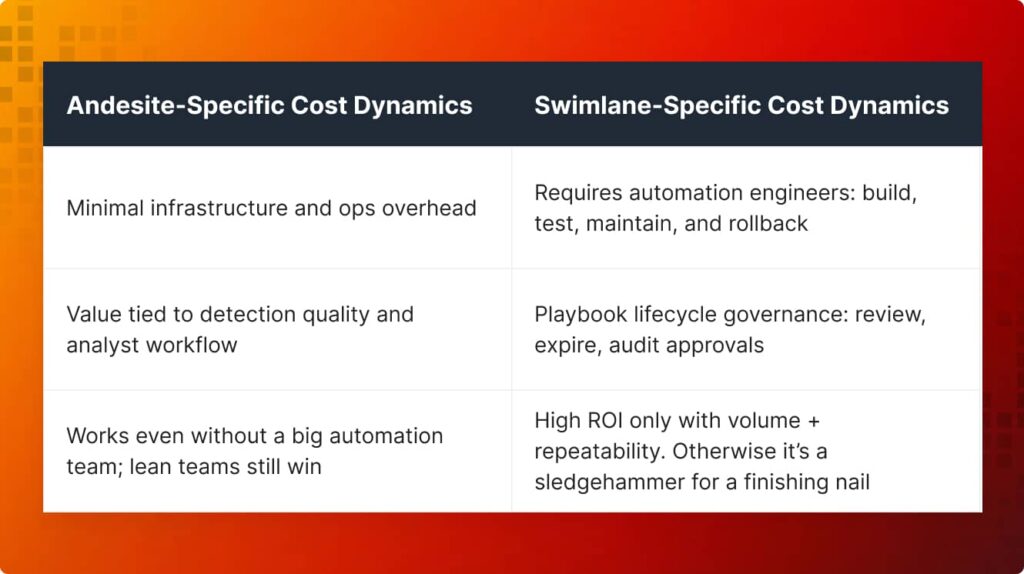
Andesite pricing is around + $12K–$120K/year
You’re paying for a “bionic” investigation workspace. The cost scales with the amount of surface area you want covered, including alert types, tools integrated, and the number of teams in the cockpit.
The cost of a Swimlane Turbine is around $ 47,000 per year.
Swimlane prices by action volume, not seats. Their starter plan runs around $47,250/year for five users. It’s all about how many playbooks you can codify and how much repetitive work you’ve got to automate. The more predictable your environment, the more the math works in your favor.
And let’s be clear, this isn’t “AI takes over” security.
With either platform, humans stay in the loop while AI and workflows handle the grunt work. You get context, structure, and real explainability. But if you drop the human oversight? You’re back in breach math: $4.4M average cleanup costs and boardroom questions you can’t automate your way out of.
Shared Costs That Sneak In Either Way
- Identity/SaaS log uplift
- Parser and content hygiene
- Ticketing system alignment
- Reporting and compliance formatting
- Tool integrations and maintenance
Security Outcomes vs. Speed: What Am I Buying?
Neither product creates detection. Both amplify your existing stack:
- Andesite AI amplifies investigation quality.
- Swimlane automation amplifies response scale.
If your breach patterns involve identity abuse, OAuth backdoors, or business-logic fraud, recognize these are human-judgment fights.
We’ve seen what this looks like in the real world. In one government case, CrowdStrike flagged suspicious activity, two days after our SOC had already investigated and shut it down. The detection was there. The tooling worked. But it took human judgment to question a “normal” system scan, connect it to a spoofed AD account, and escalate before data leaked. That’s what you’re actually buying: not just speed, but the right eyes on the right signals, before it’s too late. Read how we beat the breach clock (and CrowdStrike) →
Small Team vs. Big Team: Who Wins Where?
- Lean, senior team (≤6 analysts): Andesite first. You’ll convert expertise into cleaner, faster decisions without babysitting 50 playbooks. Add Swimlane Turbine later for the top repeatables.
- Larger SOC or MSSP model: Swimlane first. You need factory-grade consistency. Add Andesite where explainability and complex investigations bottlenecks.
How Does This Fit My Existing Stack?
Andersite and Swimlane assume you already own the usual suspects (Microsoft Defender/Entra, CrowdStrike, Okta, M365/Google, AWS/Azure/GCP, a SIEM or data lake, email security, ticketing).
- Andesite: Minimal disruption. Treat it like an overlay workstation that reads from your sources and writes back to your ticketing/IR logs. If your upstream detections are thin, Andesite won’t invent telemetry; it will make the best of what you have and show you the gaps.
- Swimlane: Expect connector work and playbook design. This is where you harvest ROI from the tools you already pay for; orchestration is the point.
If your SIEM is under-tuned, both will suffer, but Swimlane’s value holds (you can still automate service-desk loops, enrichment, containment checks). Andesite’s value spikes after you invest a bit in detection quality.
Who Owns Risk When Identity Moves Have Blast Radius?
This is the question boards and regulators are asking implicitly.
- Andesite: Built for explainability. Every action has who/what/why/when with a reasoning trail. It’s your audit-ready cockpit for sensitive decisions.
- Swimlane: Playbooks + approvals + logs. It’s process accountability: “we followed Change-ID 172, here are the steps, timestamps, approvals.” Less philosophical, more procedural.
If your top risk is identity fraud/business logic abuse, default to tools that force human brakes + receipts.
We’ve seen what happens when identity actions go unchecked.
One client had their CEO’s Azure AD account phished and used to quietly edit invoices. It looked like normal business flow until finance noticed payments were vanishing. The attacker had set inbox rules to hide replies, kept the scam running, and nearly got away clean.
They had tools. What they lacked was visibility into who did what, when, and why, and the human checkpoint to challenge it.
If there’s one place you don’t want to automate blindly, it’s identity. See how we kicked the attacker out.
Get the Guide to Blending AI with Your SOC
See workflows, data requirements, and rollout phases that work.
Will It Reduce Alert Fatigue and MTTR?
- Andesite reduces cognitive toil: fewer pivots, richer context, clearer decisions → better signal-to-decision.
- Swimlane reduces mechanical toil: fewer hands on the keyboard for the same tasks → shorter queues, faster closes.
If your team is small and senior, they’ll love Andesite’s clarity. If your team is broad and process-oriented (or MSSP-ish), they’ll love Swimlane’s throughput.
What Do You Show Your Board Next Quarter?
- Andesite: clean investigation timelines, explainable closures, and evidence lineage. Great for “we are in control” slides, post-incident reviews, and regulatory queries.
- Swimlane: throughput metrics (cases/day, MTTR/MTTA, auto-resolved rate), coverage of use cases, and SLA adherence. Great for “we’ve industrialized SecOps” slides.
Both can produce dashboards. The difference is the story:
- Andesite → “We make good decisions and we can prove it.”
- Swimlane → “We run at scale and we can prove it.”
Where Do Things Break in the Real World?
Andesite – common failure modes
- Thin telemetry → pretty timelines with holes. (Fix: prioritize identity/SaaS logging, parser hygiene.)
- Analysts use it like a feed reader instead of an investigation cockpit. (Fix: training + workflow discipline.)
Swimlane – common failure modes
- Playbook sprawl and rot. No governance cadence → automation debt.
- “Garbage in, automated garbage out.” Over-trusting upstream detections turns SOAR into a faster rubber stamp.
- Shadow approvals: high-blast actions sneak into auto mode. (Fix: hard gates, dual-control, rollback plans.)
Two Real-World Scenarios (How Each Behaves)
Scenario A: OAuth backdoor in finance SaaS (no malware, just intent)
- Andesite: Threads identity, SaaS logs, and email artifacts into one timeline → flags unexplained consent grant → forces human decision with evidence (risk to payroll, vendor payments). Brutal clarity, slow only where it should be.
- Swimlane: Enriches the alert, checks asset/owner, notifies finance owner via Teams, routes to gated response (revoke tokens, kill session, notify legal). Fast execution—if the upstream signal fired.
Scenario B: Phishing → Quick Assist abuse → hands-on-keyboard
- Andesite: Rapidly composes the multi-signal narrative (email + endpoint + M365 + VPN) so leadership sees what happened and why.
- Swimlane: Runs the containment train (isolate host, disable account, reset creds, block hash/URL, open IR case) with approvals where needed.
If your current stack didn’t log Quick Assist usage: both will struggle. No tool replaces telemetry truth.
Andesite vs. Swimlane Buying Checklist
Use these questions to cut through the pitch fog and pressure-test every vendor: Swimlane, Andesite, or anyone else promising “autonomous SOC.”
Telemetry & coverage
- Do we have full-fidelity identity + SaaS + endpoint + email + cloud logs turned on?
- Where are our parser/content gaps today?
Governance & brakes
- Which actions must be human-gated? (Okta role changes, token revokes, network segmentation, finance app access)
- Who signs? Where are the receipts stored?
Ops model
- Who will own the playbook lifecycle (design, test, retire)?
- Who will own investigation standards (what “good evidence” looks like)?
Board/Regulator
- What artifacts do we need to defend decisions? (Reasoning trails vs throughput metrics)
- What happens when the tool is wrong? (Escalation paths, rollback plans)
TCO & time
- What will my team stop doing the week after go-live?
- What gets measurably better in 30/60/90 days?
Compare how each tool fits your stack, team, and risk appetite. If a platform can’t answer these with receipts, walk. This list is your due diligence.
For 360° Defense, Look Beyond the Tools
You can pick Andesite. You can pick Swimlane. Hell, you can pick both. But if what you need is outcomes and a real force multiplier to get there, platforms alone don’t cut it. Human-led, AI-powered MDR will. And that’s us — UnderDefense.
When UnderDefense Humans Wield the AI
We work with you. Every move tailored to your stack, your risk, your rules.
AI where it helps, humans where it matters
We let automation do its thing: noise reduction, triage, enrichments. But when identity, money, or reputation’s on the line, our MDR team takes the wheel. No “black box” making career-ending calls with your Okta keys.
Outcomes over dashboards
You’re buying judgment. That means explainable timelines, decision trails, and breach math your CFO and CISO can both nod at. No more “we think it was handled”, we show what, who, and why, with proof you can print.
No rip-and-replace
We plug into what you’ve already paid for: Microsoft Defender, Sentinel, Elastic, Okta, Entra, you name it. We light up what’s working, harden what’s not, and deliver value without shelfware bloat or platform debt.
We prove where the tools break
Before attackers do. Our red teams and purple teams map the blind spots, hunt the rule rot, and pressure-test your automations so they don’t blow up at 2 a.m. You get a security stack that survives contact with real threats.
You’re not alone in the cockpit
Every analyst move is backed by UnderDefense’s 24/7 SOC, tuned detections, incident muscle, and regulatory-ready playbooks. Real hunters who close loops and call out edge cases before they land in court.
You want less stress, less finger-pointing, and more sleep.
That’s UnderDefense. We’re delivering control.
Before the next breach books you…
1. What’s the real TCO when AI SOC tools fail to catch the breach?
The sticker price isn’t the cost. The breach is.
You might pay $50K–$300K/yr for a platform, but if it flags a suspicious login at 2 a.m. and no one catches the SaaS abuse behind it? You’re into $4.4M in breach math, 200+ regulatory hours, and a board deck you can’t fill with vendor logos.
Most AI SOC tools look great on dashboards, until they miss the soft, identity-driven moves that land you in headlines. That’s where you need trained eyes on those tools and judgment on what they don’t.
Get the free breakdown on the hidden bill behind security automation, before your budget funds shelfware.
2. How do I know if my team’s ready for Swimlane or Andesite?
It’s not about headcount, it’s about constraint.
If your team is lean but sharp, and stuck trying to explain “why we closed this” to risk or audit. Andesite wins. If your team’s firefighting alert queues with no time to breathe, Swimlane Turbine delivers relief.
But neither works if no one owns playbook hygiene, parser upkeep, or gray-zone decisions. That’s where the Underdefense human+AI approach becomes a solution. We fill the seats your org doesn’t have yet, with MDR muscle, detection tuning, and judgment you can trust at 3 a.m.
Schedule your MDR call, before AI makes a $4M decision.
3. How do I blend AI into my SOC without breaking what already works?
You don’t bolt AI onto a broken model and hope for magic.
AI’s great at triage, noise-cutting, and kicking off repeatable responses. But without guardrails, context, and a feedback loop, it just automates guesswork at scale, and now you’ve got a faster way to miss stuff.
We’ve seen it work: AI chopping alert queues in half, freeing up Tier-1s, letting your senior analysts finally breathe. But we’ve also seen teams drown because they thought “AI = autopilot.” Spoiler: it’s not.
You still need humans to teach it, tune it, and yank the wheel when identity or money’s on the line. That’s how you scale without turning your SOC into a Rube Goldberg machine.
Download the SOC transformation guide and see how smart teams turn AI into an edge.