





Security Operations Center (SOC) is the nerve center of an organization’s cybersecurity efforts. SOC monitors, detects, and responds to security threats. It’s possible to build an in-house SOC, opt for Security Operations Center as a Service (SOCaaS), or combine both.
What is SOC as a Service?
SOC as a Service (SOCaaS) is a scalable security solution that offers fully managed threat detection and response, while also integrating with existing security teams to enhance visibility, efficiency, and incident handling. Sometimes it feels like renting a security team to work with your security tools and improve them. The primary purpose of such a “rented” team is to simplify security management for the core team and increase the ROI from SOC.
Comparing SOCaaS with In-House SOC
Shortly, SOCaaS eliminates the burden of maintaining in-house SOC and helps you ensure 24/7 security monitoring and compliance.
SOC as a Service (SOCaaS) | In-house SOC | |
Cost | Subscription-based | Needs investment in infrastructure, hiring and retaining skilled SOC analysts |
27/4 Monitoring | Provided by the service provider | Requires a dedicated round-the-clock team |
Response time | Faster response due to automated and expert-driven processes | Response speed depends on internal team efficiency |
Compliance | Often includes compliance support | Must ensure compliance independently |
Control | Less direct control over security operations | Full control over security strategies and policies |
Get the Checklist: 2025 SOC Providers Evaluation
Why Need: How SOCaaS Increases ROI From SOC
Running an in-house Security Operations Center (SOC) is costly and complex. SOC as a Service (SOCaaS) offers a scalable, cost-effective solution with predictable pricing, expert-led threat detection, and 24/7 monitoring—all without the overhead. Whether you need fully managed security or support for your existing team, SOCaaS delivers faster response times and stronger protection.
Here’s how SOCaaS boosts ROI and enhances security:
You pay only for the services you use.
What is a managed SOC price? Well, it’s predictable, subscription-based, and depends on your team’s size, security tools, and industry.
You can find custom SOC as a service solutions for various security and risk profiles — from a fully managed SOC for a small retail business or tech startup to compliance consultancy for a digital bank or health insurance firm.
You see results earlier.
Time to triage and contain incidents is accelerated due to automation and orchestration. For instance, an average 6 hours to respond to an incident can turn into 15 mins with UnderDefense Managed SOC.
It also takes less time to prepare for a compliance audit, as SOCaaS providers typically have all the document templates and experienced consultants. Some of them partner with auditors to get first-hand updates. Just compare 18 months of self-preparation vs. from 4 months if you prepare with UnderDefense SOCaaS.
You get 24/7 monitoring.
24/7 in-house monitoring would require hiring extra staff and paying them for night shifts. In the U.S., night shift workers earn a 10% premium. For example, an entry-level cybersecurity analyst making $121,444 annually would get an extra $12,000 for working nights.
A solid staff expansion is an unaffordable luxury for many companies. At the same time, one of the SOC as a service benefits is round-the-clock monitoring, threat detection, and response.
You get cloud-native protection.
SaaS teams use SOC cloud security tools to cut down on manual work, helping avoid mistakes and lessen the financial hit from security issues. Tools like Cloud IDS and DLP keep an eye out for threats and stop data leaks, while cloud-based SIEM systems provide real-time updates on potential risks. SOCaaS also comes with Cloud Incident Response, which means quick actions are taken if there’s a breach, minimizing any damage. Plus, there’s Cloud Security Posture Management (CSPM) to help businesses stay on top of regulations, steering clear of costly fines.
You access experts who remain ahead of the curve.
By serving many clients and aiming to work without a single client breach, SOCaaS teams constantly learn about new threats and improve their skills. This saves you the time and cost of training your own team.
Your SecOps advance as your business grows.
By outsourcing security, you don’t need to expand your security team when your business matures and, accordingly, becomes more lucrative for hackers.
Your threat detection tools are fine-tuned and empowered with AI.
Basically, SOC automation streamlines security operations, yet it also can overcomplicate your security infrastructure.
Expert Opinion
It’s tricky to cover all the threats effectively with limited resources and 1000 and 1 tools available on the market. Security engineers should fine-tune the tech stack rather than get lost within numerous add-ons and miss a threat.
Instead of increasing the security tech stack, an outsourced SOC team fine-tunes the tools you already have to work well together. It means both, better threat visibility and more comfortable threat management.
Altogether, an outsourced SOC service operations center will, most likely, integrate an AI analyzer to your cybersecurity ecosystem to identify and mitigate sophisticated threats. Such analyzers learn from your data and improve all the time.
How Does Managed SOC as a Service Work?
The general SOCaaS meaning suggests you can delegate a wide range of security operations to third parties, depending on your contract.
The higher the SOC service tier, the more options the provider covers.
Tier 1 | Tier 2 | Tier 3 | |
Specialists provided | Security Engineer + SOC Analyst | Security Engineer + SOC Analyst + Incident Responder | Security Engineer + SOC Analyst + Incident Responder + Threat Hunter |
Monitoring | Basic monitoring, alerting for known threats | Expanded monitoring with more detection capabilities | Comprehensive monitoring, including advanced threats |
Incident response | Initial triage, closing false positives and escalation of true ones | Incident response with in-depth investigation | Proactive incident management with advanced analytics |
Threst detection | Detection on endpoints, cloud, and SaaS | Full-stack detection across all environments | Full incident tracking with customized reporting |
Compliance support | Basic compliance reporting | Enhanced compliance support with specific standards | Comprehensive support with regulatory frameworks |
Tools management and updates | Maintain and update security tech stack | Ensure that the latest threat intelligence is incorporated into security strategies | Ensure that the latest threat intelligence is incorporated into security strategies |
Tools integration | Limited integration with existing tools | Integration with key tools and platforms | Full integration with advanced security tools |
Reporting | Standard SOC reports and alerts | Enhanced reporting with additional insights | Full incident tracking with customized reporting |
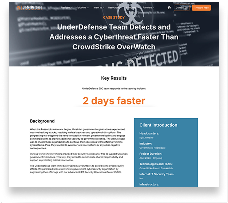
UnderDefense SOC responds to the incident 2 days faster than CrowdStrike Overwatch
How a Client Interacts with a SOC as a Service
Engagement of a managed SOC as a service requires minimum effort from a client.
A client:
- Grants the SOCaaS provider access to the necessary systems, networks, and data for monitoring and analysis;
- Maintains security hygiene (strong passwords, regular software updates, and employee security training);
- Addresses any questions or concerns to the SOCaaS provider.
- Reviews and approves service level agreements (SLAs) with the SOCaaS provider, which define service expectations and performance metrics.
- Participates in incident response activities, providing necessary information.
Factors to Consider When Choosing a SOCaaS Provider
Choosing the right SOC as a Service (SOCaaS) provider can make all the difference in keeping your business secure without breaking the bank. Whether you need a fully managed SOC or just a boost for your existing team, it’s all about finding the right fit for your needs and budget.
What is SOCaaS price that fits into your budget?
Think about how much you can afford to spend on setting up and keeping SOC as a service running. If your budget is tight, focus on the essential SOC functions like threat detection, incident response, and log management. Then, gradually invest in a stronger security posture as your resources grow. Many providers offer tiered packages, allowing you to scale up to advanced features as needed.
Managed SOC costs between $10 and $20 per asset.
SOC service type: Full-Fledged or Augmented
Full-fledged SOCaaS is a comprehensive solution where the provider manages all aspects of the SOC, from monitoring to incident response. Augmented SOCaaS model enhances an existing in-house SOC by providing additional resources or expertise. It’s ideal for organizations that need to bolster their current security capabilities.
SOC as a Service: Full-Fledged Vs. Augmented
Not all SOC as a Service (SOCaaS) solutions are the same—some businesses need a fully managed security operations center, while others just need extra support for their in-house team. Understanding the difference between full-fledged and augmented SOCaaS helps you choose the right fit for your security needs.
Full-Fledged SOC as a Service (fully managed) | Augmented SOC as a Service (co-managed) | |
Scope of services | Comprehensive SOC management (monitoring, response, analytics, custom reporting, and integration with existing tools) | Enhances existing in-house SOC with additional expertise where needed |
Responsibility | Provider manages all SOC functions | In-house team retains control, SOCaaS supports efforts |
Staffing | Provider handles staffing needs | Provider supplements existing security teams |
Customization | Fully customized to client needs | Adds specific resources or expertise where needed |
Incident management | Full response and mitigation capabilities | Provides expertise for handling complex incidents |
Scalability | High scalability, handles growth independently | Scales up based on internal team’s capabilities |

When it Makes Sense to Leverage a Full-Fledged SOCaaS
- SMBs benefit from SOCaaS as it offers enterprise-level security without the high costs.
- Companies lacking skilled cybersecurity experts or resources can rely on SOCaaS for comprehensive security coverage.
When it’s Better to Augment an In-House SOC
- Companies with substantial budgets and in-house expertise may prefer to have a dedicated SOC manager for more control.
- Companies with advanced security needs may turn to a managed SOC when their in-house SOC is overloaded.
Learn how to evaluate your SOC performance and make an informed decision about your next SOCaaS provider.
4 Challenges of a Managed SOC and How to Overcome Them
What can become a bottleneck when you go for security operations as a service?
- Integration Complexities
- Dependence on Provider
- Data Privacy Concerns
- Service Level Agreements (SLAs)
Roadmap to a Smoothly Running SOC as a Service
So, what is a SOC as a service that will not add up headaches to a company management? It is flexible, vendor-agnostic, compliant, and scalable.
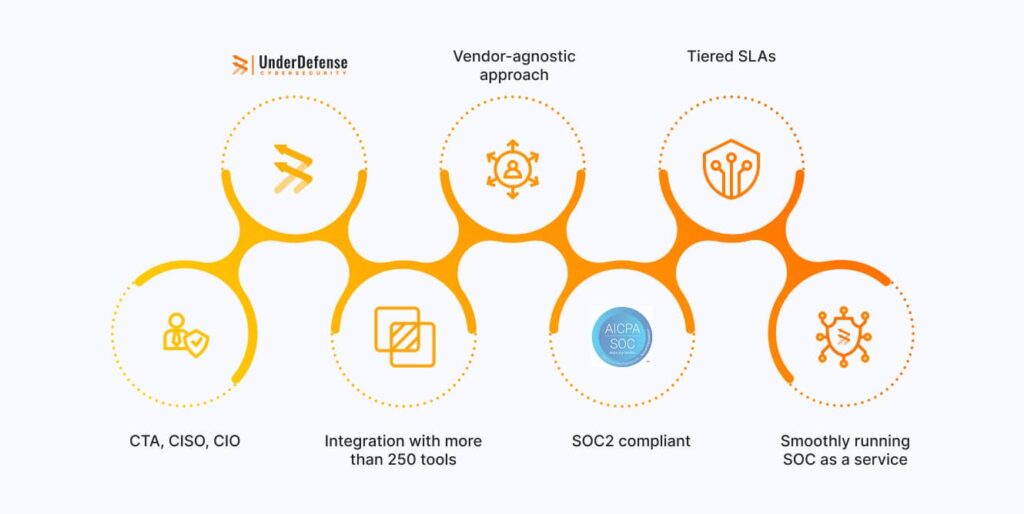
UnderDefense managed SOC solutions can cover your security stack whether it’s large or small, common or uncommon — just request the necessary coverage. The UnderDefense SOC works with all the best tools to strengthen your security posture, like:
- Security Information and Event Management (SIEM) Systems, which aggregate and analyze activity from different resources across the IT infrastructure;
- Intrusion Detection Systems (IDS) and Intrusion Prevention Systems (IPS), which monitor network traffic for suspicious activity and take action to prevent breaches;
- Endpoint Detection and Response (EDR) Tools, which provide visibility into end-user devices to detect and respond to threats;
- Threat Intelligence Platforms, which gather and analyze information about current and emerging threats.
Relying on a third-party provider for critical security functions may be risky if the provider fails to deliver. However, UnderDefense supports multiple trusted vendors, you get a strong and flexible security system. The best part is that the fine-tuned monitoring, threat detection, and incident response system remains fully owned by the client.
Clearly defined SLAs should mention the expected service quality and response times. Otherwise, you are buying a pig in a poke. That’s why, we handle your data securely and offer transparent SLAs. Schedule a call with our SOC Director if you want to see us in action.
1. Can a SOC be outsourced?
Yes, organizations can choose to outsource their SOC functions to third-party providers, known as Managed Security Service Providers (MSSPs). This approach can be cost-effective and provide access to specialized expertise without the need for significant in-house resources.
2. What types of organizations benefit most from SOCaaS?
SOCaaS is ideal for SMBs, teams with limited IT resources, and companies in highly regulated industries.
3. How does SOCaaS improve cybersecurity?
Among the benefits of SOC as a service is providing affordable continuous monitoring, rapid threat detection, and expert incident response. SOCaaS strengthens an organization’s security posture without capital investments associated with in-house SOC.
4. Will using SOCaaS slow down my network or disrupt operations?
No, SOCaaS operates in the background, analyzing logs and security events without impacting network performance or system availability.
5. How does SOCaaS integrate with my existing security tools?
Most SOCaaS providers offer API-based integrations or SIEM compatibility to seamlessly work with your firewalls, EDR, cloud security, and other security solutions. .
6. What happens if the SOCaaS provider itself is breached?
Reputable SOCaaS providers follow strict security protocols, including encryption, access controls, and redundancy, to minimize risks and prevent compromises. .
7. What are the key differences between full-fledged SOCaaS and augmented SOCaaS?
Full-fledged SOCaaS manages all security operations, while augmented SOCaaS supplements an in-house SOC with additional support and expertise. .
8. What should I look for in a SOCaaS provider?
Key considerations include the provider’s expertise, technology stack, scalability, and ability to integrate with your existing infrastructure. .