





TL;DR
- SOC as a service (SOCaaS) is a provider-run SOC on subscription, fully managed or alongside your own team.
- Managed SIEM operates the SIEM platform; SOCaaS adds the analysts who monitor, investigate, and respond.
- MDR centers on detection and response, often on the provider’s own tools; SOCaaS covers wider SOC operations.
- A subscription replaces the cost of staffing a 24/7 analyst rota yourself.
- Settle four risks before you sign: integration, provider dependence, data privacy, and SLA terms.
Table of contents
- What Is SOC as a Service?
- Comparing SOCaaS with In-House SOC
- Where SOCaaS Fits in the Security Stack
- Why You Need SOC as a Service: How SOCaaS Increases SOC ROI
- How Does Managed SOC as a Service Work?
- Factors to Consider When Choosing a SOCaaS Provider
- 4 Challenges of a Managed SOC and How to Overcome Them
- Frequently Asked Questions
A Security Operations Center (SOC) monitors, detects, and responds to security threats across your organization. You can build an in-house SOC, opt for Security Operations Center as a Service (SOCaaS), or combine both.
If you are weighing SOCaaS against Managed SIEM and MDR, the labels overlap, and providers use them loosely. This guide explains what SOC as a service covers, where it sits in your security stack, how it pays back, and the four challenges to settle in the contract.
What Is SOC as a Service?
SOC as a Service (SOCaaS) is a scalable security model that delivers fully managed threat detection and response, and can also work alongside your existing security team to improve visibility, efficiency, and incident handling. Sometimes it feels like renting a security team to work with your security tools and improve them. The primary purpose of such a “rented” team is to simplify security management for the core team and increase the ROI from your SOC.
Comparing SOCaaS with In-House SOC
In short, SOCaaS removes the burden of maintaining an in-house SOC and gives you 24/7 security monitoring and compliance support.
| SOC as a Service (SOCaaS) | In-house SOC | |
|---|---|---|
| Cost | Subscription-based | Infrastructure, hiring, and retaining skilled SOC analysts |
| 24/7 monitoring | Included in the provider’s coverage | Requires a dedicated round-the-clock team |
| Response time | Faster, through automation and expert-led processes | Depends on internal team efficiency |
| Compliance | Often includes compliance support | Your team ensures compliance independently |
| Control | Less direct control over security operations | Full control over security strategy and policies |
The trade-off sits in the last row: you gain round-the-clock coverage and give up some direct control, which is why the contract terms covered later in this guide matter.
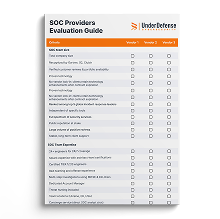
Get the Checklist: 2025 SOC Providers Evaluation
Where SOCaaS Fits in the Security Stack
SOCaaS sits on the operations layer of your stack. It uses the data your SIEM, EDR, cloud, and identity tools produce, and adds the people and processes that act on it. Managed SIEM and MDR overlap with it, and the difference between the three is mostly scope.
Is SOCaaS the Same as Managed SIEM?
SOCaaS and Managed SIEM differ in scope. Managed SIEM is the narrower model: a provider deploys, tunes, and maintains your SIEM platform, from log collection and parsing to correlation rules and retention. SOCaaS includes the analysts who watch what the SIEM raises, investigate it, and respond around the clock. Many SOCaaS providers run a managed SIEM as part of the subscription, so ask whether a quote covers the platform, the people, or both.
Is SOCaaS the Same as MDR?
SOCaaS and MDR overlap in part. Managed detection and response (MDR) focuses on finding and stopping active threats, often on the provider’s own endpoint or XDR technology, with response actions such as isolating a host. SOCaaS usually covers a wider set of SOC operations on the tools you choose, including log monitoring, compliance reporting, and security tool management. In practice the line blurs: many MDR offers include 24/7 monitoring, and many SOCaaS tiers include incident response.
The table below sums up how the three models usually divide the work.
| Managed SIEM | MDR | SOCaaS | |
|---|---|---|---|
| What you get | A SIEM run and tuned for you | Threat detection and response | An outsourced SOC team and processes |
| Technology | Your SIEM or the provider’s | Often the provider’s EDR or XDR | Your tools or the provider’s |
| 24/7 analysts | Sometimes, as an add-on | Yes | Yes |
| Response actions | Rarely included | Core of the offer | Included by tier |
| Compliance reporting | Log retention and reports | Limited | Often included |
Whichever label a provider uses, the question for your team is the same: who investigates an alert at 2 a.m., and on which tools. The UnderDefense Agentic AI SOC works on top of the SIEM, EDR, cloud, and identity tools you already own, so you compare outcomes without planning a migration. AI agents investigate every alert and 24/7 analysts make the decisions, and UnderDefense detects, investigates, and responds to threats in under 5 minutes.
Why You Need SOC as a Service: How SOCaaS Increases SOC ROI
Running an in-house Security Operations Center (SOC) is costly and complex. SOC as a Service (SOCaaS) offers a scalable, cost-effective model with predictable pricing, expert-led threat detection, and 24/7 monitoring, all without the overhead. Whether you need a fully managed SOC or support for your existing team, SOCaaS delivers faster response times and stronger protection. Here’s how SOCaaS boosts ROI and improves security.
You Pay Only for the SOC Coverage You Use
SOC as a service pricing is predictable, subscription-based, and depends on your team’s size, security tools, and industry.
You can find custom SOC as a service options for different security and risk profiles, from a fully managed SOC for a retail chain to compliance support for a digital bank or a health insurance firm.
SOCaaS Shortens Time to Triage, Containment, and Audit
Automation and orchestration speed up the time to triage and contain incidents, because the provider’s playbooks and analysts are already in place.
Compliance audit preparation also takes less time, as SOCaaS providers typically have the document templates and experienced consultants ready. Some of them partner with auditors to get first-hand updates.
24/7 SOC Monitoring Without Building Night Shifts
24/7 in-house monitoring requires hiring extra staff and paying them for night shifts. US federal employees on the General Schedule, for example, earn a 10% night pay differential for regularly scheduled work between 6 p.m. and 6 a.m., under OPM’s night pay rules.
The base salary is high before any premium. The US Bureau of Labor Statistics puts the median annual wage of information security analysts at $129,180 in May 2025, and a 24/7 rota needs several analysts to cover one seat around the clock. For many companies that expansion is hard to justify, while round-the-clock monitoring, threat detection, and response are among the core SOC as a service benefits.
Cloud-Native Protection from SOCaaS Providers
Cloud teams use SOC cloud security tools to cut manual work and reduce the financial impact of incidents. Tools such as cloud IDS and DLP watch for threats and stop data leaks, while cloud-based SIEM systems give real-time updates on potential risks. SOCaaS also comes with cloud incident response, so the provider acts quickly if there is a breach and limits the damage. Cloud Security Posture Management (CSPM) helps businesses stay on top of regulations and avoid costly fines.
Access to SOC Experts Who Track New Threats
By serving many clients and aiming to work without a single client breach, SOCaaS teams constantly learn about new threats and improve their skills. This saves you the time and cost of training your own team on every new technique.
SOCaaS Scales as Your Business Grows
With an outsourced SOC, you don’t need to expand your security team each time the business grows and, with it, becomes a more lucrative target for attackers.
SOC as a Service Fine-Tunes Your Threat Detection Tools with AI
SOC automation streamlines security operations, yet it can also overcomplicate your security infrastructure.
Expert Opinion
It’s tricky to cover every threat effectively with limited resources and a thousand and one tools on the market. Security engineers should fine-tune the tech stack they already have, so they never get lost among add-ons and miss a threat.
An outsourced SOC team fine-tunes the tools you already have so they work well together, without adding more to the stack. That means better threat visibility and easier threat management.
Altogether, an outsourced SOC will most likely add an AI analyzer to your security ecosystem to identify and mitigate sophisticated threats. Such analyzers learn from your data and improve over time.
How Does Managed SOC as a Service Work?
The general SOCaaS meaning is that you delegate a range of security operations to a third party, depending on your contract. The higher the SOC tier, the more the provider covers, as the typical three-tier structure below shows.
| Tier 1 | Tier 2 | Tier 3 | |
|---|---|---|---|
| Specialists provided | Security engineer and SOC analyst | Adds an incident responder | Adds a threat hunter |
| Monitoring | Basic monitoring, alerts for known threats | Expanded monitoring with more detection capabilities | Full monitoring, including advanced threats |
| Incident response | Triage, closing false positives, escalating true ones | Incident response with in-depth investigation | Incident management with advanced analytics |
| Threat detection | Detection on endpoints, cloud, and SaaS | Full-stack detection across all environments | Full-stack detection plus threat hunting |
| Compliance support | Basic compliance reporting | Support for specific standards | Support across regulatory frameworks |
| Tools management | Maintain and update the security stack | Bring the latest threat intelligence into detections | Bring the latest threat intelligence into detections |
| Tools integration | Limited integration with existing tools | Integration with key tools and platforms | Full integration with advanced security tools |
| Reporting | Standard SOC reports and alerts | Deeper reporting with additional insights | Full incident tracking with customized reporting |
When you compare quotes, check two rows first: who handles incident response, and how far integration with your existing tools goes.
Coverage expanded from 8×5 to 24×7 for a credit union’s four-person IT team
How a Client Interacts with a SOC as a Service
Engaging a managed SOC as a service takes minimal effort from you. As the client, your team:
- Grants the SOCaaS provider access to the systems, networks, and data it monitors.
- Maintains security hygiene, such as strong passwords, regular software updates, and employee security training.
- Brings questions or concerns to the SOCaaS provider.
- Reviews and approves the service level agreements (SLAs) that define service expectations and performance metrics.
- Takes part in incident response activities and provides the information the provider needs.
The SLA review shapes everything else, and the challenges section below explains what to look for in it.
Factors to Consider When Choosing a SOCaaS Provider
Choosing the right SOC as a Service (SOCaaS) provider can make all the difference in keeping your business secure without breaking the bank. Whether you need a fully managed SOC or a boost for your existing team, it’s all about finding the right fit for your needs and budget.
SOC as a Service Pricing That Fits Your Budget
Think about how much you can afford to spend on setting up and running SOC as a service. If your budget is tight, focus on the essential SOC functions, such as threat detection, incident response, and log management, then invest in a stronger security posture as your resources grow. Many providers offer tiered packages, so you can scale up to advanced features as needed.
Want to dig deeper?
UnderDefense estimates that the average monthly cost of a managed SOC is $10 to $20 per asset.
SOC as a Service: Full-Fledged vs. Augmented
Not all SOC as a Service (SOCaaS) offers are the same. Full-fledged SOCaaS is a fully managed model in which the provider runs every part of the SOC, from monitoring to incident response. Augmented SOCaaS strengthens an existing in-house SOC with extra resources or expertise, and it suits organizations that need to bolster their current security capabilities.
| Full-fledged SOCaaS (fully managed) | Augmented SOCaaS (co-managed) | |
|---|---|---|
| Scope of services | Monitoring, response, analytics, reporting, and tool integration | Adds expertise to an in-house SOC where needed |
| Responsibility | Provider manages all SOC functions | In-house team keeps control, provider supports it |
| Staffing | Provider handles staffing needs | Provider supplements your security team |
| Customization | Fully customized to your needs | Adds specific resources or expertise |
| Incident management | Full response and mitigation capabilities | Expertise for handling complex incidents |
| Scalability | Scales with your growth independently | Scales with your internal team’s capabilities |
Understanding the difference between the two models helps you choose the right fit for your security needs and budget.

When It Makes Sense to Choose a Full-Fledged SOCaaS
Two situations point to the fully managed model:
- Organizations without a 24/7 security team get enterprise-level security without the cost of building one.
- Companies that lack skilled cybersecurity staff or resources can rely on SOCaaS for full security coverage.
In both cases, the provider carries the day-to-day SOC work, and your team keeps oversight through the SLA.
When It’s Better to Augment an In-House SOC
Augmented SOCaaS suits teams that already run part of the SOC themselves:
- Companies with substantial budgets and in-house expertise may prefer a dedicated SOC manager for more control.
- Companies with advanced security needs may bring in a managed SOC when their in-house SOC is overloaded.
Either way, the in-house team sets the priorities, and the provider adds capacity where the queue backs up.
Want to dig deeper?
Learn how to evaluate your SOC performance and make an informed decision about your next SOCaaS provider.
4 Challenges of a Managed SOC and How to Overcome Them
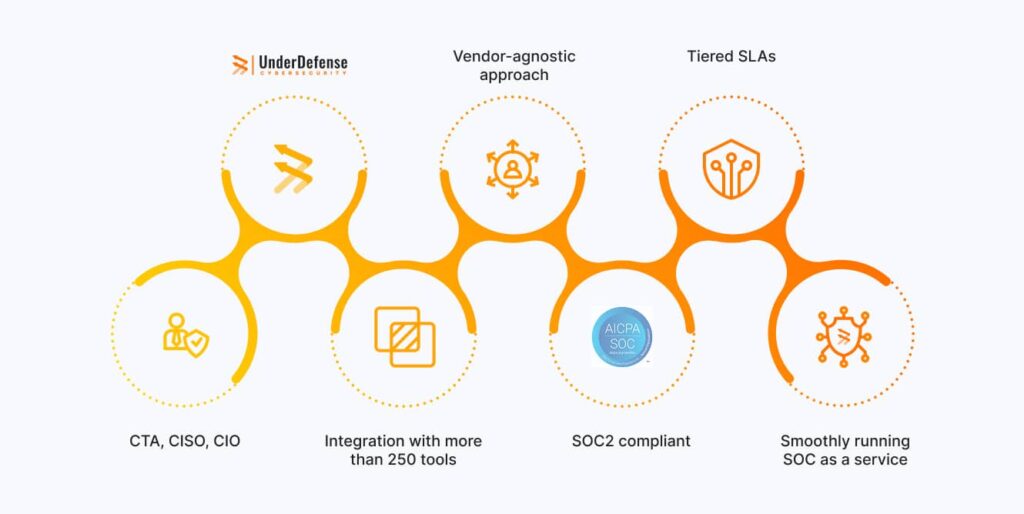
What can become a bottleneck when you choose security operations as a service? Four challenges come up most often, and each one has a contract or architecture answer. A provider that handles all four is flexible, vendor-agnostic, compliant, and scalable.
1. Integration Complexities
A SOCaaS provider can only act on the data it sees. If its platform cannot ingest your SIEM, EDR, firewall, and cloud logs, you either pay to migrate tools or accept blind spots, and onboarding drags on while connectors are built.
A working setup connects to the best SOC tools you already run, such as:
- SIEM systems, which aggregate and analyze activity from different sources across the IT infrastructure.
- Intrusion detection and prevention systems (IDS and IPS), which monitor network traffic for suspicious activity and act to prevent breaches.
- EDR tools, which give visibility into end-user devices to detect and respond to threats.
- Threat intelligence platforms, which gather and analyze information about current and emerging threats.
Your team keeps the stack it has and skips the migration project: the UnderDefense Agentic AI SOC works on top of 250+ integrations across SIEM, EDR, cloud, and identity tools.
In one published case, a credit union kept its CrowdStrike endpoint protection, and UnderDefense added a SIEM layer alongside it that correlated those alerts with network and server telemetry. The credit union’s IT Operations Manager put the start this way:
“The onboarding process was smooth and quick.”
IT Operations Manager, Credit Union (100 employees), UnderDefense case study
Going live is the first step: expect detection tuning to take from a few weeks to a few months, as reviewers report.
2. Dependence on Provider
Relying on a third party for critical security functions is risky if the provider fails to deliver or you decide to leave. The risk grows when detection rules, playbooks, and logs live only in the provider’s platform, because switching then means rebuilding them.
If you change course later, you keep what was built. UnderDefense works on top of the tools you own and supports multiple vendors, so there is no vendor lock-in, and the fine-tuned monitoring, threat detection, and incident response setup remains fully owned by your organization. Every investigative step is visible and auditable, so your team can see why each decision was made.
3. Data Privacy Concerns
A SOCaaS provider handles your logs, user identities, and sometimes regulated data. Settle where the data is stored and processed, who at the provider can access it, how long it is retained, and whether the setup satisfies your regulators and auditors under frameworks such as GDPR, HIPAA, or DORA.
If your data has to stay inside your environment, you can still get 24/7 coverage. The UnderDefense Agentic AI SOC can be deployed as SaaS, hybrid, on-premises, or air-gapped, so telemetry stays where your policy requires, and every agent and analyst action is auditable, which gives your auditors a record of who touched what.
4. Service Level Agreements (SLAs)
Clearly defined SLAs state the expected service quality and response times. Without them, you are buying a pig in a poke: “24/7 monitoring” can mean an email the next morning. Ask for response times by alert severity, a clear split between what the provider handles and what it hands back to you, and regular reporting against the SLA.
When a critical alert fires at 2 a.m., an UnderDefense analyst responds within the 20-minute SLA response time for critical alerts, and your team wakes up to the investigation. AI agents reach a triage verdict in about 2 minutes from alert to triage, so the analyst starts from the evidence.
Comparing SOCaaS, Managed SIEM, and MDR quotes? Bring your SLA questions. Book a SOC triage demo
Frequently Asked Questions
Can a SOC be outsourced?
Yes. Organizations can outsource their SOC functions to third-party providers, such as managed security service providers (MSSPs), MDR providers, and SOCaaS providers. This approach can be cost-effective and gives you specialized expertise without significant in-house resources.
What types of organizations benefit most from SOCaaS?
SOCaaS fits organizations without a 24/7 security team, teams with limited IT resources, and companies in highly regulated industries.
How does SOCaaS improve cybersecurity?
SOCaaS provides affordable continuous monitoring, rapid threat detection, and expert incident response, which are among the main benefits of SOC as a service. It strengthens an organization’s security posture without the capital investment of an in-house SOC.
Will using SOCaaS slow down my network or disrupt operations?
No. SOCaaS operates in the background, analyzing logs and security events without affecting network performance or system availability.
How does SOCaaS integrate with my existing security tools?
Most SOCaaS providers offer API-based integrations or SIEM compatibility to work with your firewalls, EDR, cloud security, and other security tools.
What happens if the SOCaaS provider itself is breached?
Reputable SOCaaS providers follow strict security protocols, including encryption, access controls, and redundancy, to minimize risks and prevent compromises.
What are the key differences between full-fledged SOCaaS and augmented SOCaaS?
Full-fledged SOCaaS manages all security operations, while augmented SOCaaS supplements an in-house SOC with additional support and expertise.
What should I look for in a SOCaaS provider?
Key considerations include the provider’s expertise, technology stack, scalability, and ability to integrate with your existing infrastructure.