




Q1. What does Sumo Logic actually cost in 2026, and how is Dojo AI gated?
Sumo Logic in 2026 sells five plans, Free, Essentials, Enterprise Operations, Enterprise Security, and Enterprise Suite, plus the Flex rail. List prices range from $0.15 to $0.36 per credit, with Dojo AI multi-agent investigation gated to Enterprise Suite only. Real ARR (Annual Recurring Revenue) for mid-market cloud-native estates lands between $90K and $1.2M, depending on workload mix and how aggressively credits are negotiated.
Negotiating a renewal right now?
Talk to a team that benchmarks these deals every week.
The headline plan grid you actually need
Here is the real plan matrix, stripped of marketing language and pulled from Vendr’s verified 2026 catalog and Sumo Logic’s Cloud Flex pricing schedule. For buyers benchmarking against alternatives, our managed SIEM pricing guide provides a parallel reference.
| Plan | List $/credit | Retention | Dojo AI access | Best fit |
|---|---|---|---|---|
| Free | $0 (20 credits/day) | 7 days | ❌ | 3-user trial only |
| Essentials | $0.15 | 30 days | ❌ | 1 to 10 GB/day SMB |
| Enterprise Operations | $0.18 to $0.22 | 90/180/365 days | ❌ | DevOps, APM-led |
| Enterprise Security | $0.20 to $0.23 | 90/180/365 days | ❌ | SIEM-led, SOC use |
| Enterprise Suite | $0.25 (US) / $0.30 (Frankfurt or Global) | 90/180/365 days | ✅ | Unified SIEM, SOAR, AI |
| Flex (rail, not tier) | $0 ingest, scan-priced | Tiered | Suite-only | High-volume, low-query estates |
Quarterly payment adds a flat 20% uplift on top of the base rate, and Frankfurt or Global deployments add another 20%. A Frankfurt customer paying quarterly on Enterprise Suite ends up at $0.36 per credit, a 44% premium over the US annual baseline.
Anatomy of a real $730K invoice
A 500 GB/day Enterprise Suite customer, on a negotiated $0.18 credit rate with 90-day retention, pays roughly $730K base plus $55K extended retention, $100K separately metered Cloud SIEM ingest, $88K Premium Support, and a one-time $55K SIEM and SOAR Professional Services fee in Year 1. Total fully-loaded Year 1: $1.028M.
The CSE GB Ingest line is the sneaky one. SIEM-bound data does not draw from your standard credit pool, it is metered separately, and most buyers miss this until mid-year. If you need this kind of unit-economics view across your stack, our SOC cost calculator models the full picture.
The log tax thesis
This is what I call the log tax. High-fidelity logging, the kind that actually catches an attacker, punishes you on a credit-priced SIEM. The more your DevSecOps team logs, the more credits you burn. The rest of this article exists to dismantle that tax with three levers: tuning, Flex, and negotiation.
Q2. How does the Sumo Logic credit model work, and how do you do the credit math?
A Sumo Logic credit is one pre-paid unit consumed at fixed conversion ratios across logs, metrics, traces, and security features, locked for the contract year. One credit covers a set GB of Continuous-tier ingest, a different GB of metrics, or a slice of scan volume on Flex. Run-rate forecasting, not list price, is the lever buyers must master, it determines whether you under-burn, over-burn, or true-up mid-term.
What a credit actually is
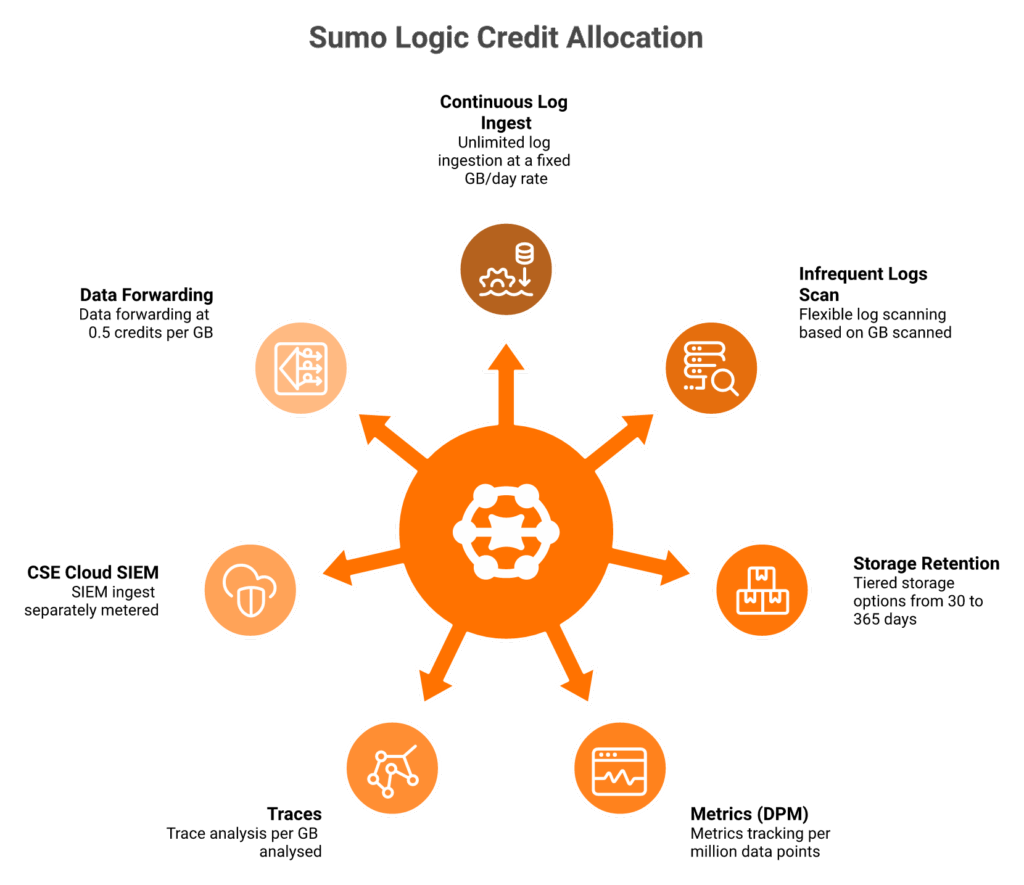
Think of credits as poker chips you bought at the door for the year. They are spendable across seven different tables, Continuous Log Ingest, Infrequent Logs scan (Flex), storage retention, Metrics (DPM), Traces, CSE Cloud SIEM Ingest, and Data Forwarding at 0.5 credits per GB out. Each table has its own conversion rate, which Sumo Logic locks into your Order Form for the contract term.
There is no per-seat charge. Every paid tier, Essentials through Enterprise Suite, includes unlimited named users. That matters when you are budgeting for a 1,000-analyst SOC. For teams weighing build versus buy at that scale, our piece on outsourced vs in-house SOC is worth a read.
A worked example, 200 GB/day
Take a 200 GB/day estate on Enterprise Security at a negotiated $0.20 per credit, with 90-day retention and 40 GB/day routed to the SIEM.
- Continuous Log Ingest: 200 GB/day × 365 days × ratio ≈ 73,000 credits ≈ $14,600/month, $175,200/year
- 90-day retention uplift: roughly 8% of base credits, $14,000/year
- CSE GB Ingest, 40 GB/day SIEM-bound: separately metered, roughly $48,000/year
- Data Forwarding to S3, say 30 GB/day: 0.5 credits × 30 × 365 × $0.20 ≈ $1,100/year
- Premium Support at 12% of ARR: roughly $29,000/year
You land near $267,000 fully loaded in Year 1, before any Professional Services or overage.
The run-rate dashboard, and what to do with it
Sumo Logic’s admin console exposes three views, Credits Used, Credits Remaining, and Usage Forecast, with a projected depletion date. ⏰ I tell every customer to put a calendar reminder on day 60, day 120, and day 240 of the contract.
If Usage Forecast shows depletion before month 11, you are over-burning and need to tune ingestion or buy more credits at the contracted rate, not list. The single sentence to add to your Order Form: any usage in excess of contracted credits shall be billed at the contracted per-credit rate, not list. That clause prevents the most common mid-year budget shock in the entire Sumo Logic community. Our managed SIEM team adds this redline to every Order Form we review for a customer.
The hidden cost most buyers miss is not the data, but the proprietary correlation logic your team builds inside the SIEM over three years. That logic is the real lock-in. An agentic AI layer above the SIEM preserves it, a rip-and-replace migration destroys it.
Q3. Flex pricing vs traditional credits, which model wins, and how do you run the scan-volume audit?
Flex makes log ingestion and indexing free and charges only for data scanned by queries plus tiered storage. It saves money for estates dominated by high-volume, low-query log sources like firewalls, DNS, and CloudTrail, and it loses money on dashboard-heavy SOC workflows. The decision rule, if your top-20 scheduled searches scan less than 30% of daily ingest, Flex usually wins, above 60% scan-to-ingest, classic credits stay cheaper.
Flex vs Credits, side by side
| Dimension | Classic Credits | Flex |
|---|---|---|
| Ingest cost | Credit-priced per GB | $0 ingest |
| Query/scan cost | Free (within tier) | Credit-priced per GB scanned |
| Storage | Standard 30-day included | Tiered, credit-priced |
| SIEM data (CSE) | Separately metered | Separately metered |
| Best fit | Dashboard-heavy SOC | Archival, compliance, low-query |
| Predictability | High, ingest is stable | Variable, depends on query volume |
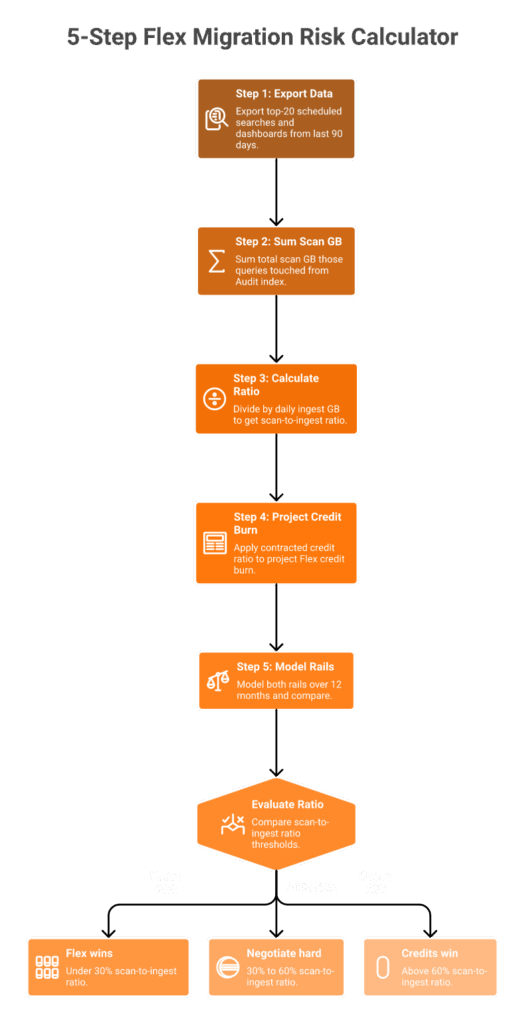
The 5-step Flex Migration Risk Calculator
I run this with every customer before they sign a Flex amendment. You can do it in an afternoon.
- Export your top-20 scheduled searches and dashboards from the past 90 days.
- Sum the total scan GB those queries touched. The Sumo Logic Audit index gives you this directly.
- Divide by your daily ingest in GB to get the scan-to-ingest ratio.
- Apply your contracted credit ratio to the projected scan volume to estimate Flex credit burn.
- Model both rails over 12 months and compare. ✅ Flex wins under 30%, ❌ Flex loses above 60%, ⚠️ negotiate hard between 30 and 60%.
Data-Tier routing rules
| Tier | Storage cost | Scan cost | Route here |
|---|---|---|---|
| Continuous | Standard | Free | Active SOC dashboards, real-time alerts |
| Frequent | Lower | Modest | Investigation logs, weekly searches |
| Infrequent (Flex) | Lowest | Highest | Compliance, forensics, audit retention |
A 500 GB/day estate with 70% archival data routed to Infrequent and 30% Continuous typically saves 25% to 35% versus an all-Continuous credit model.
The reseller gap, and why savings evaporate
Here is the catch most buyers miss. Providers like Expel resell Sumo Logic Flex but leave hosting, fine-tuning, and scan-volume governance to the customer. ❌ A G2 reviewer captured this exact pain.
“Our partner sold us the platform but we still ended up tuning rules and managing ingest ourselves, which was the whole reason we bought managed services.”
— Verified Reviewer, Mid-Market IT Director Expel – G2 Verified Review
If nobody owns the scan-volume audit on Monday morning, Flex savings turn into Flex bills inside two quarters. Our MDR service closes that ownership gap for Sumo Logic customers.
Q4. What hidden fees and contract traps quietly inflate your Sumo Logic invoice?
The traps are predictable, overage credits billed at list rather than contracted rate, Professional Services floors near $10K, multi-region surcharges of 10% to 20%, quarterly payment uplift of 20%, separately metered CSE SIEM ingest, and an uncapped 10% annual renewal escalator. Every one of these is negotiable in the redline before signature, almost none are negotiable after. Walk into the Order Form review with a clause library, not a wishlist.
The 8 line items that turn $300K into $480K
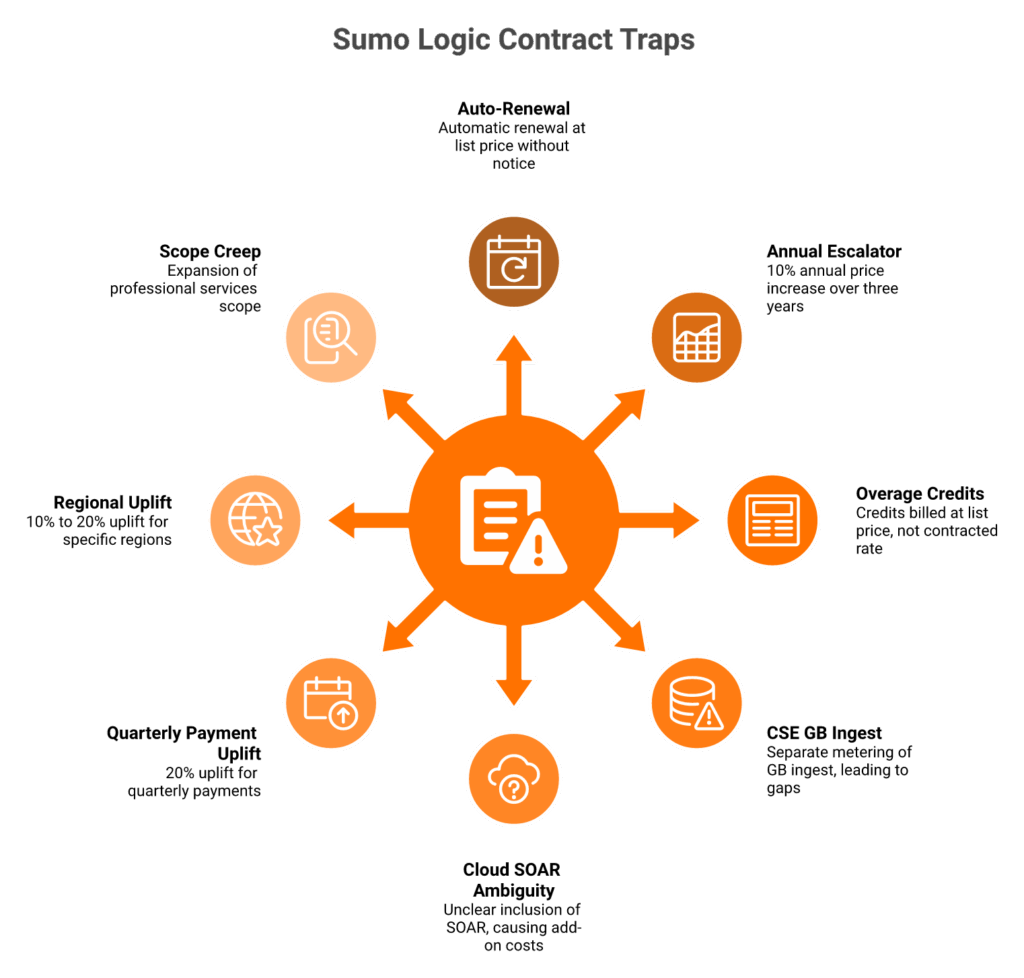
- Auto-renewal at list price, 30-day window. ⚠️ The single most expensive clause in the contract. The Order Form auto-renews at then-current list price, not your negotiated rate, on 30 days notice. Redline: replace with prior-year contracted rate, extend window to 60 or 90 days.
- 10% annual renewal escalator. 💸 At $500K ARR this adds $50K in Year 2, $55K in Year 3, $153,300 over three years if unaddressed. Redline: cap at 5% or CPI, applied to negotiated rate.
- Overage rate at list, not contracted. 💰 The single most common source of mid-year budget shock. Redline, one sentence: any usage in excess of contracted credits shall be billed at the contracted per-credit rate.
- CSE GB Ingest separately metered. SIEM-bound data does not draw from your standard credit pool, buyers routinely discover a $50K to $150K mid-year gap. Redline: confirm CSE rate explicitly on the Order Form.
- Cloud SOAR inclusion ambiguity. Enterprise Suite marketing says SOAR is included, Order Form language varies, some customers discover SOAR is a $50K to $300K add-on after signature. Redline: explicit written confirmation of SOAR inclusion.
- Quarterly payment 20% uplift. At $730K ARR, choosing quarterly costs $146K more per year than annual upfront. Use it as a trade chip, commit to annual upfront in exchange for a 10% to 15% rate cut.
- Regional uplift, 10% to 20%. Frankfurt, Global, Tokyo, Sydney, and Zurich all carry a 20% uplift on the base credit rate. Rarely waivable, but worth attempting on multi-region deals.
- Professional Services scope creep. Custom parsers run $5K to $15K per engagement, SOAR playbooks $5K to $10K each, full SIEM Quickstart $15K to $30K. Redline: pre-negotiate a PS hour bank and rollover language.
The four-year tuning treadmill
A prospect once told me they had been tuning their EDR (Endpoint Detection and Response) for four years and still were not “done.” Sumo Logic carries the same operational debt if PS budget is not pre-negotiated. ❌ A G2 reviewer put it bluntly.
“Pricing is opaque and overage charges hit hard if you don’t tune ingest carefully. Professional services costs add up fast.”
— Verified Reviewer, Senior Security Engineer Sumo Logic – G2 Verified Review
Another buyer flagged the renewal trap.
“The auto-renewal language nearly cost us 25% in unplanned spend, we caught it on day 28 of the 30-day window.”
— Verified Reviewer, IT Director Sumo Logic – G2 Verified Review
The renewal-cap ask that pays for itself
The single highest-value clause change available is capping annual uplift at 5% or CPI, applied to your prior-year negotiated rate, not list. Frame it as standard enterprise contract hygiene, not an aggressive ask. Sumo Logic legal teams have approved language ready, the buyer who fails to ask simply inherits the default. ✅ At $500K ARR, that one clause is worth $153,300 over three years.
In our experience running MDR pricing reviews for enterprise customers, the buyers who walk in with a clause library land 30% below list. The ones who walk in with a wishlist land at list with a smile. Pick which conversation you want to have on Monday. For broader procurement context, our analysis of why businesses switch providers is a useful companion read.
Q5. Dojo AI and Mo Copilot, what is gated, what costs extra, and is it worth the upgrade?
Dojo AI multi-agent investigation and Mo Copilot are gated to Enterprise Suite in 2026, billed either as a per-user uplift or as credits consumed by AI feature usage. The capability is real for query authoring, anomaly summarisation, and dashboard generation, but it does not replace analyst judgement, autonomous response, or detection engineering. Pay for it if your team writes a lot of ad-hoc queries, skip it if your bottleneck is response, not authoring.
What Dojo AI and Mo Copilot actually do
Mo Copilot is a natural-language query assistant. You type “show me failed SSO logins from new geographies in the last 24 hours,” and it writes the Sumo Logic query for you. Dojo AI is the multi-agent investigation layer, designed to summarise anomalies and stitch together related signals across logs, metrics, and Cloud SIEM.
What they do not do is close an incident. They do not call the affected user, wipe a credential, reset a password, or open a ServiceNow ticket on your behalf. That work still falls on the human analyst, or on a separate SOAR (Security Orchestration, Automation, and Response) platform. Our team explores this distinction further in our piece on conversational SOCs.
Gating and billing mechanics
Here is how the gating shakes out in 2026 Order Forms.
| Feature | Free | Essentials | Ent. Operations | Ent. Security | Ent. Suite |
|---|---|---|---|---|---|
| Mo Copilot (query assist) | ❌ | Limited | Limited | ✅ | ✅ |
| Dojo AI multi-agent investigation | ❌ | ❌ | ❌ | ❌ | ✅ |
| AI-generated dashboards | ❌ | ❌ | Partial | ✅ | ✅ |
| Anomaly summarisation | ❌ | ❌ | Partial | ✅ | ✅ |
| Billing model | n/a | Bundled | Bundled | Bundled | Per-user uplift or feature-pack credits, confirm on Order Form |
The line that catches buyers is “confirm on Order Form.” Some Suite contracts include Dojo AI in the base credit pool, others bill it as a per-seat uplift or a separate feature pack. ⚠️ Get the inclusion language in writing before signature, the same way you would for Cloud SOAR.
When Dojo AI is worth the line item, and when it is not
Use this rule on Monday morning.
✅ Buy Dojo AI if your top SOC complaint is “we cannot author queries fast enough,” your team writes 50-plus ad-hoc searches weekly, and your analysts spend more than 25% of their time in the search bar.
❌ Skip it if your top complaint is “we cannot respond fast enough,” your analysts are buried in ticket queues, or your alert-to-triage time on P1 incidents exceeds 30 minutes.
That is the binary test. Authoring assist beats no assist, but it does not move 2-minute Alert-to-Triage or 15-minute escalation SLAs on critical incidents. ChatOps user verification, autonomous credential wipes, and ticket creation move them. Sumo Logic’s own product documentation lists Dojo AI as an investigation and summarisation layer, not an autonomous response engine. Read that line literally before you sign. For the alternative, see how our UnderDefense Agentic AI SOC platform closes the response loop.
“Mo Copilot helps junior analysts ramp on the query language faster, but it didn’t change our triage volume.”
— Verified Reviewer, SOC Manager Sumo Logic – G2 Verified Review
Renamed product or rebuilt outcome
This is where I take a contrarian position. A lot of SIEM and MDR (Managed Detection and Response) vendors have AI-washed their 2026 decks, slapping a copilot label on what is still a query-authoring tool. That is fine for productivity. It does not amount to rebuilding the SOC around agentic AI.
The outcome that matters at 2 a.m. is not “the AI helped me write a faster query.” It is “the AI triaged 4,000 alerts down to 8 real incidents, autonomously isolated the affected endpoint, validated the user via ChatOps, and woke me up only when the situation actually required a human.” Those are different problems.
Working with 500-plus security teams, what I have noticed is that Dojo AI helps your analysts on Tuesday afternoon. ✅ It does not help your CISO on Sunday at 3 a.m. when the response gap, not the authoring gap, is what lengthens response times. If your bottleneck is alert volume and response speed, an agentic layer above your existing SIEM, one that owns the autonomous actions Sumo Logic does not perform natively, beats a renamed copilot inside it. Our writeup on AI SOC red flags covers what to look for. If your bottleneck is genuinely query authoring, Dojo AI is fairly priced and worth the upgrade.
Hidden fees adding up faster than expected?
Get a plain-English breakdown tailored to your environment.
Q6. Sumo Logic vs Splunk, Datadog, New Relic, ELK, and Cribl, what is the real three-year TCO?
At 500 GB/day with 90-day hot retention, Sumo Logic typically lands 20% to 50% below Splunk Cloud, 10% to 20% above Datadog Logs, 40% to 60% above self-managed ELK on raw licence cost, and 20% to 55% above Microsoft Sentinel for SIEM-only workloads. Add a Cribl pipeline and Sumo Logic costs drop another 30% to 50% by routing low-value telemetry away from credit-priced ingest. Above 2 TB/day, columnar alternatives start to win on raw cost.
Methodology, so you can audit the math
The numbers below come from Vendr’s verified 2026 catalog and three-year TCO model, blended with public Cloud Flex pricing schedules. Assumptions are: Enterprise Suite tier, US deployment, annual prepayment, 90-day retention, and competitive positioning that yields a 25% to 35% negotiated discount. ELK numbers exclude labour, the toil tax is broken out separately. Buyers comparing endpoint vendors alongside SIEM may also want our CrowdStrike pricing 2026 breakdown.
Three-year TCO at three volume bands
| Volume | Sumo Logic (Suite, negotiated) | Splunk Cloud | Datadog Logs | Microsoft Sentinel | Self-managed ELK (licence only) | Cribl-fronted Sumo Logic |
|---|---|---|---|---|---|---|
| 100 GB/day | $750K to $900K | $1.1M to $1.5M | $650K to $800K | $400K to $550K | $200K to $350K | $500K to $650K |
| 500 GB/day | $3.0M to $3.5M | $4.5M to $6.5M | $2.7M to $3.3M | $1.6M to $2.2M | $900K to $1.4M | $2.0M to $2.4M |
| 2 TB/day | $11M to $13M | $16M to $22M | $10M to $13M | $6.0M to $8.5M | $3.5M to $5.5M | $7.0M to $8.5M |
The toil tax that ELK numbers hide
ELK looks cheapest until you load the salary cost of the 5 to 6 FTEs required to run it 24/7. At a fully-loaded $180K per FTE, that is $2.7M to $3.2M over three years before you patch a single Logstash node. Sumo Logic absorbs that labour, which is why the comparison flips below 1 TB/day for most enterprises. Our outsourced vs in-house SOC analysis walks through the same math from a different angle.
Cribl is the lever most buyers underuse. ✅ A Cribl Stream pipeline lets you drop, sample, and route telemetry before it hits Sumo Logic’s credit-priced ingest. A 500 GB/day estate that pushes 60% of low-value firewall, DNS, and CloudTrail noise to cheaper object storage typically reclaims 30% to 50% of credits, with no SIEM detection loss when tuned correctly.
What buyers say about the squeeze
Buyers I work with confirm the squeeze is real.
“Pricing is opaque and overage charges hit hard if you don’t tune ingest carefully. We ended up adding a Cribl layer just to get our bill predictable.”
— Verified Reviewer, Senior Security Engineer Sumo Logic – G2 Verified Review
“Splunk’s licensing made our annual budget review brutal, the per-GB model punishes you for being thorough about logging.”
— Verified Reviewer, Security Operations Manager Splunk – G2 Verified Review
What this means for the NIST CSF budget map
Map this spend against NIST CSF 2.0 (the National Institute of Standards and Technology Cybersecurity Framework) and a pattern emerges. Almost every dollar above lands in the Detect column. Identify, Protect, Respond, and Recover are usually starved. 💸 In our experience running MDR service engagements for global enterprises, the CISOs who stay in budget are the ones who refuse to let Detect eat the entire envelope, and instead route 25% to 35% of the security spend to Respond and Recover capabilities that close incidents, not just surface them. The 2026 cybersecurity budget playbook codifies this allocation.
Q7. Which DevSecOps detections justify the spend, Sumo Logic mapped to MITRE ATT&CK and the NIST CSF budget?
Sumo Logic’s Cloud SIEM out-of-the-box content packs cover roughly 40% to 55% of MITRE ATT&CK techniques most relevant to cloud-native estates, strongest in initial-access, credential-access, and exfiltration, weakest in lateral-movement and impact. Mapped to NIST CSF 2.0, that puts almost every credit you spend in the Detect column, with Respond and Recover typically underfunded. The fix is not more credits, but an agentic response layer that closes the gap without re-papering the contract.
The governing thesis
Logging is not security. Detection without response is theatre. Your CFO does not pay for visibility, your CFO pays for reduced loss, and reduced loss only happens when a detection triggers a closed-loop action inside minutes, not hours. Our SOC metrics guide breaks down how to instrument that closed loop.
MITRE ATT&CK coverage by tactic
This is my read after auditing Sumo Logic Cloud SIEM content packs against ATT&CK v15 in customer environments.
| ATT&CK Tactic | Sumo Logic OOTB coverage | Strength | Common gap |
|---|---|---|---|
| Initial Access | CloudTrail, Okta, Azure AD packs | ⭐ Strong | Phishing payload context |
| Execution | Process logs (EDR-fed) | Moderate | Behavioural chains |
| Persistence | IAM and identity packs | Moderate | Cloud workload identities |
| Credential Access | Identity and SSO packs | ⭐ Strong | Session hijack patterns |
| Lateral Movement | Network and east-west | ⚠️ Weak | k8s pod-to-pod traffic |
| Discovery | Cloud API enumeration | Moderate | LLM-agent reconnaissance |
| Exfiltration | Egress and data forwarding | ⭐ Strong | DNS-tunnel detection |
| Impact | Limited | ❌ Weak | Ransomware encryption signal |
Strong does not mean complete. It means the OOTB pack catches the most common patterns, not the targeted, hands-on-keyboard intrusion.
The NIST CSF budget map, in prose
Picture five buckets, Identify, Protect, Detect, Respond, and Recover. A typical Sumo Logic Enterprise Suite contract pours 70% to 85% of the security telemetry budget into Detect, leaving Respond and Recover starved. That imbalance is what I call the M&M Network: hard exterior, soft tasty centre. The SIEM detects the breach, but nobody is staffed or equipped to actually close it before the attacker reaches the centre.
The Monday action for the budget map
Pull your last 12 months of security spend by line item. Tag each item to one NIST CSF 2.0 function, Identify, Protect, Detect, Respond, or Recover. If Detect is above 60% of your envelope, you are running an M&M Network: hard exterior, soft centre. The 2025 IBM Cost of a Data Breach Report shows that organisations with mature, automated response capability shaved an average of $1.9M off breach cost and 80 days off the lifecycle. Detect spend without Respond capacity is the most expensive math error in the enterprise security budget.
Reallocate 10 to 15 percentage points from Detect to Respond inside one quarter, either by adding an agentic response layer over your existing SIEM, or by hiring an in-house response engineer. ⚠️ Do not skip this conversation with your CFO, the budget is already there, but in the wrong column. Our incident response practice is what we typically activate to plug that gap.
What closes the soft centre
An UnderDefense customer, Carmeuse, illustrates the point. We layered UnderDefense Agentic AI SOC on top of their existing logging, retuned ingestion, and within three months the platform caught a payroll fraud scheme worth roughly $300K. The fraud signal was already in the logs. Nobody was structurally responsible for catching it, classifying it, and shutting it down inside hours. The SIEM and SOC avoided $650K loss case tells a similar story.
That is the difference between Detect spend and Respond spend. ✅ You do not fix it by buying more credits. You fix it by adding an agentic layer that performs the autonomous actions Sumo Logic does not do natively, including credential wipes, password resets, ticket creation, ChatOps user verification, and that operates with a 2-minute Alert-to-Triage and 15-minute escalation SLA on the highest-severity events.
In our experience hardening SOCs across 1,000 to 10,000-employee enterprises, the right ratio is roughly 50% Detect, 35% Respond and Recover, and 15% Identify and Protect telemetry. If your Sumo Logic line item is consuming 80% of your security budget, you are buying visibility, not outcomes.
Q8. Which negotiation tactics actually cut a Sumo Logic contract by 30%?
Three levers move the needle: timing the close to Sumo Logic’s fiscal Q4 (January FYE), bringing a credible competing quote (Datadog, Splunk, Microsoft Sentinel, or a co-managed MDR alternative) to the table, and committing to a multi-year deal with annual opt-out. Stack those with redlines on the 10% renewal escalator, overage at contracted rate, PS rollover, and Cloud SOAR inclusion, and 30% off list is the median outcome at $500K-plus ARR, not the ceiling.
The seven tactics that actually work
- Time the close to fiscal Q4 (January). ⏰ Sumo Logic’s fiscal year ends in January, giving sales reps month-end and quarter-end leverage. Closing in the last two weeks of January typically adds 5% to 10% discount on top of standard volume breaks. Ask: “What is your best year-end number for a January 31 close?”
- Bring a credible competing quote. Datadog, Splunk Cloud, or Microsoft Sentinel quotes in hand are worth 15% to 25% in discount. ✅ A real, costed alternative shifts the conversation from “what do you want to spend” to “what do we need to match.” Ask: “Here is the Sentinel quote, can you meet it?”
- Commit to multi-year with annual opt-out. A 24-month commitment with annual termination-for-convenience unlocks 10% to 20% beyond the standard rate. The opt-out clause keeps you safe from the lock-in. Redline language: “Customer may terminate at the end of any annual period with 60 days notice, no penalty.”
- Cap the 10% renewal escalator. 💰 Without this clause, fees rise 10% at each renewal, $50K compounding on a $500K ARR contract. Cap at 5% or US CPI applied to negotiated rate, not list. Ask: “Replace Section X annual fee adjustment with: increases capped at the lesser of 5% or CPI-U.”
- Lock overage to contracted rate, not list. This single clause prevents the most common mid-year cost shock in the entire Sumo Logic community. Redline language: “Any usage in excess of contracted credits shall be billed at the contracted per-credit rate stated in this Order Form.”
- Negotiate credit rollover and PS rollover. Default Sumo contracts forfeit unused credits at term end. Ask for 25% rollover into the next term, or applicability against Professional Services purchases. PS hours likewise should roll forward 12 months. Ask: “Can unused credits up to 25% roll into Year 2, or apply to PS engagements?”
- Get Cloud SOAR and Dojo AI inclusion in writing. Enterprise Suite marketing says Cloud SOAR is included, Order Form language varies, and Dojo AI billing is often per-user uplift. Get explicit written confirmation: “Cloud SOAR (orchestration and automation playbooks) and Dojo AI multi-agent investigation are included in the Enterprise Suite subscription at no additional charge for the duration of the term.”
What AEs cannot give, and when to walk
Account Executives cannot give termination-for-convenience without finance approval, custom MSA edits without legal review, or rate cuts beyond their approved discount band. Those require escalation and time. ⚠️ If your AE refuses to escalate, the deal will not improve. Walk and revisit at fiscal year-end. Our analysis of why businesses switch providers covers the deeper signals to watch for.
What buyers say worked
Buyers who walked harder got better outcomes.
“We brought a Splunk and Sentinel quote to the table, and Sumo Logic cut their renewal proposal by 28% inside two weeks. The leverage was real.”
— Verified Reviewer, Director of Security Engineering Sumo Logic – G2 Verified Review
“Auto-renewal at list price was the trap, we caught it on day 28 of the 30-day window and renegotiated the entire contract structure.”
— Verified Reviewer, IT Director Sumo Logic – G2 Verified Review
The buyers I see win consistently treat this as a structured negotiation, not a vendor relationship test. Less theatre, more throughput. Less black-box pricing, more written clauses. Walk in with a redline document and a clear view of your MDR pricing alternatives, and walk out with 30% off list.
Q9. How do you cut Sumo Logic spend in-life, ingestion tuning, FinOps governance, and M365 E5 offsets?
You can usually recover 25% to 40% of credits inside 90 days without re-papering the contract. Tune ingestion at the collector to drop low-value fields, route compliance and forensics logs to the Infrequent tier, retire stale scheduled searches, set query-cost SLOs (Service Level Objectives) by team, and offset duplicated identity telemetry with M365 E5 logs you already pay for. The fastest single win is ingestion tuning. Most estates carry 30% to 50% noise that consumes credits without producing detections.
The 6-tactic in-life optimisation playbook
- Tune ingestion at the collector. ⭐ The single highest-yield action. Drop debug-level fields, deduplicate identical CloudTrail events, and strip verbose JSON keys at the OpenTelemetry collector before bytes ever reach Sumo Logic. Most estates I audit drop 30% to 50% of telemetry volume here without losing a single detection.
- Route logs to the right Data Tier. Push compliance and forensics logs to Infrequent (Flex) where storage is cheapest. Keep active SOC dashboards on Continuous. A 500 GB/day estate that splits 70% Infrequent and 30% Continuous typically saves 25% to 35% on credits.
- Retire stale scheduled searches. 💰 Export the Audit Index and find every scheduled search that has not produced an alert in 90 days. Most SOCs carry 40 to 60 stale searches that scan terabytes weekly. Kill them, the credits return immediately.
- Implement query-cost SLOs by team. Use Sumo Logic Partitions to bucket cost by team, then set a monthly query-cost ceiling per Partition. When DevOps blows past the ceiling, the bill goes to DevOps, not Security. Behaviour changes inside one month.
- Set up Partition chargeback. Tag every collector with the owning business unit. Run monthly reports showing which BU consumed which credits. ✅ This single FinOps control turns Sumo Logic from a Security cost centre into a shared service with internal accountability.
- Offset duplicated identity telemetry with M365 E5. ⚠️ Most enterprises already pay for Microsoft 365 E5 licences, which include Defender for Cloud Apps, Defender for Identity, and full sign-in log retention. Stop ingesting raw Azure AD sign-in logs into Sumo Logic, query them in Microsoft Graph instead, and federate alerts. This typically reclaims 8% to 15% of credits at zero cost. Our MDR for Microsoft 365 team runs this offset audit as part of onboarding.
Governance cadence that actually sticks
A weekly 30-minute run-rate review with the SecOps lead and FinOps owner. A monthly Partition chargeback report to BU leaders. A quarterly true-up against your contracted credit pool, with a credit-redirect plan if you are tracking to over-burn or under-burn. Our continuous security monitoring guide covers the governance rhythm in more depth.
In our experience tuning Sumo Logic deployments at UnderDefense, we routinely cut customer telemetry volume by 50% to 90% through correlation-aware ingestion tuning. That is the operational equivalent of a 30% renegotiation discount, without re-opening the contract. The managed SIEM practice owns this workstream end-to-end.
What buyers say about the tuning gap
The buyers who try this without help usually get partway. ❌ A G2 reviewer captured the gap.
“We knew we were over-paying but didn’t have the FinOps muscle to actually tune ingestion, the platform tools help but the work still falls on a small team.”
— Verified Reviewer, Senior Security Engineer Sumo Logic – G2 Verified Review
“Once we set Partition-based chargeback, our DevOps team self-policed their log volume inside two months.”
— Verified Reviewer, Director of Security Operations Sumo Logic – G2 Verified Review
If you do nothing else this quarter, do tactic one and tactic three. Together they typically reclaim 20% of credits in 30 days.
Q10. When should you co-manage Sumo Logic with an AI-SOC partner instead of running it in-house?
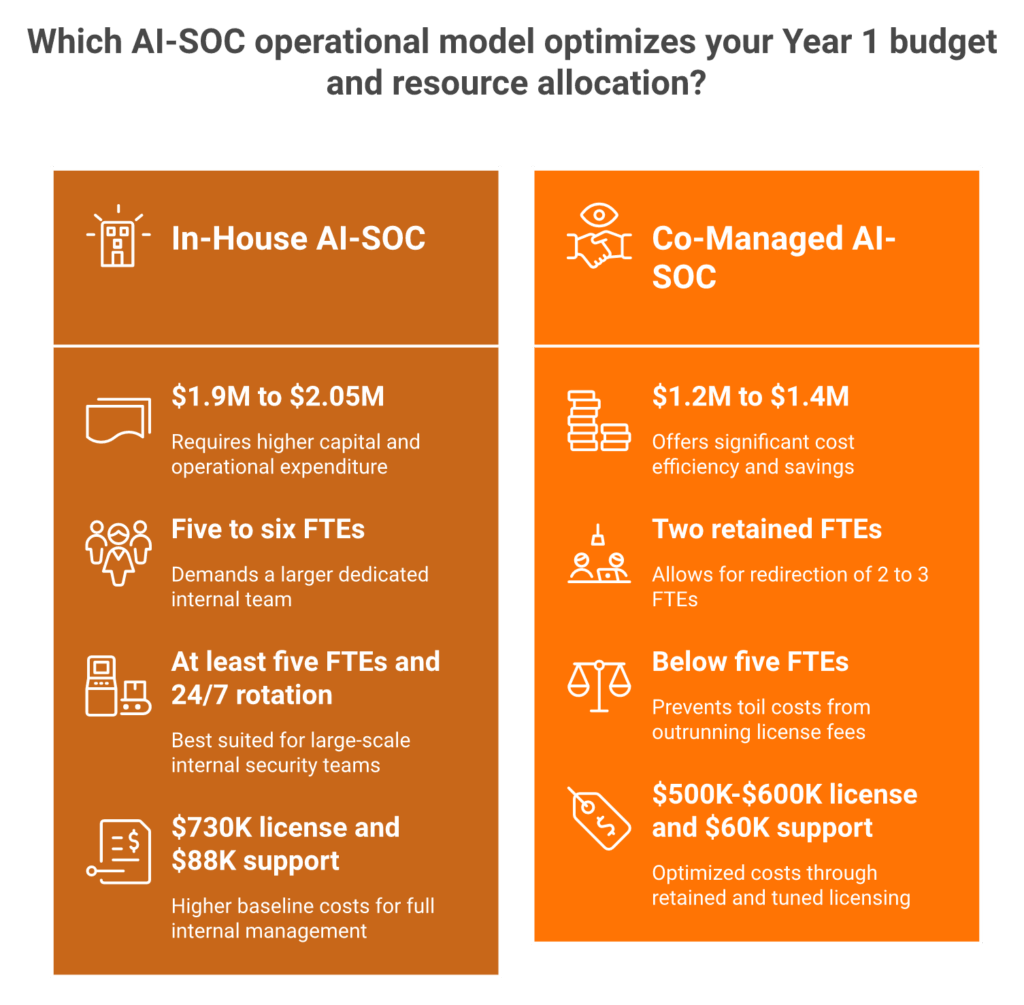
Run Sumo Logic in-house only if you have at least five dedicated FTEs (Full-Time Equivalents), a detection-engineering function, and a 24/7 on-call rotation. Below that threshold, the toil cost outruns the licence cost inside 12 months and the Detect budget eats the Respond budget. A vendor-agnostic AI-SOC partner that sits on top of your existing Sumo Logic instance closes the response gap, preserves correlation rules, and typically lands at 60% to 70% of in-house fully-loaded cost.
The toil math nobody puts in the budget deck
Running a 500 GB/day Sumo Logic deployment with 24/7 SOC coverage requires roughly 5 to 6 FTEs, including two SOC analysts on rotation, one detection engineer, one platform engineer for tuning, and 1 to 2 incident responders. At a fully-loaded $180K per FTE, that is $900K to $1.08M in salary alone, every year.
Add the licence ($730K negotiated), Premium Support ($88K), Professional Services ($55K), and Cribl pipeline ($120K), and your fully-loaded Year 1 in-house cost lands near $1.9M to $2.05M. ⏰ A co-managed AI-SOC layer typically delivers the same outcome at $1.2M to $1.4M, freeing 2 to 3 FTEs to work on Identify and Protect controls instead of triage. Our SOC cost calculator models this side-by-side for your estate.
The response gap that detection-only spend leaves open
Sumo Logic detects. It does not call the affected user, wipe a credential, reset a password, isolate an endpoint, or open a ticket on your behalf. That is not a product flaw, but a design decision. SIEM is a detection engine. When detection runs at 4,000 alerts per day and response runs at six analysts, the math breaks at 2 a.m. on a Sunday.
That is the M&M Network problem: hard exterior, soft tasty centre. The SIEM hardens the perimeter signal. Only an agentic response layer with autonomous actions and ChatOps user verification hardens the centre. Our SOC automation checklist walks through the autonomous-action design pattern.
Ranked partner shortlist for co-managing Sumo Logic
| Rank | Partner | BYO-stack support | Alert-to-Triage / Escalation SLA | Sumo Logic operationalisation depth |
|---|---|---|---|---|
| 1 | UnderDefense Agentic AI SOC | ✅ Full | 2-minute Alert-to-Triage, 15-minute escalation | Owns ingestion tuning, detection-as-code, and autonomous response |
| 2 | Expel | ✅ Yes | 15 to 30 minutes | Resells Sumo Logic, leaves fine-tuning to customer |
| 3 | Arctic Wolf | ❌ Pushes proprietary platform | 20 to 45 minutes | Limited Sumo Logic support, prefers own data lake |
| 4 | ReliaQuest GreyMatter | ✅ Yes | 15 to 30 minutes | Strong telemetry layer, slower autonomous response |
| 5 | CrowdStrike Falcon Complete | ❌ Endpoint-first | 15 minutes | Excellent EDR coverage, weaker SIEM integration |
The ranking reflects two specific criteria: can the partner operate inside your existing Sumo Logic instance without forcing replacement, and can they autonomously close incidents instead of escalating alerts. For a deeper comparison, see our MDR vendors list 2025.
Why the Carmeuse story matters
We onboarded Carmeuse onto Under Defense Agentic AI SOC as a layer above their existing logging stack. Inside three months, the platform caught a payroll fraud scheme worth roughly $300K, paying for the entire managed contract three times over. The fraud signal was already in their logs. ✅ Nobody had been structurally responsible for catching, classifying, and shutting it down inside hours, until we layered an agentic SOC on top.
“UnderDefense feels like an extension of our team, not a vendor. They tune our environment, respond fast, and explain what they did.”
— Verified Reviewer, CISO UnderDefense G2 – Verified Review
“The 24/7 monitoring and instant context on alerts is what we were missing with our previous MSSP.”
— Verified Reviewer, IT Director UnderDefense G2 – Verified Review
Less theatre, more throughput. Less black box, more blue team. That is the bar for any partner you put on top of a $730K SIEM contract.
Co-manage your Sumo Logic with an AI-SOC partner
Keep your Sumo Logic instance. Cut credits 30% to 50%. Close the response gap.
UnderDefense Agentic AI SOC sits on top of your existing Sumo Logic deployment, preserving every correlation rule, tuning ingestion 50% to 90%, and adding an agentic response layer with a 2-minute Alert-to-Triage and 15-minute escalation SLA. No rip-and-replace.
See MDR for SIEM → Run the SOC Cost Calculator →What I’m thinking about next
Two things keep me up. First, agentic AI for developers. Autonomous coding agents like Claude and Copilot are now writing, deploying, and modifying production code with minimal human review. Sumo Logic, Splunk, and every legacy SIEM were built to log human actions, not agent actions. The next 18 to 24 months are going to expose every estate that has not modelled “what is my Claude agent actually doing in production at 3 a.m.” as a first-class telemetry source. Our piece on MDR for AI is where I am working through that visibility problem.
Second, I am sitting with a question I do not yet have a clean answer to. As Dojo AI, Mo Copilot, and similar copilots mature, does the credit model survive, or does pricing eventually move to per-outcome (per detection closed, per incident resolved) instead of per-GB? My current read is the outcome model wins by 2028. I might be wrong.
If you are negotiating a Sumo Logic renewal this quarter, or considering layering an AI-SOC partner on top, send me your Order Form. I will tell you, candidly, where the 30% lives.
Turn these benchmarks into a real plan.
Get a vendor-neutral assessment and a cost-optimized roadmap.
References
Official Docs / Statutes
- Vendr. “Sumo Logic Complete Pricing Foundation Guide 2026, Bundles, Hidden Costs, Contract Implementation, and 3-Year TCO Model.” Compiled from Vendr Catalog, Sumo Logic Cloud Flex Pricing Schedule (public), Sumo Logic Service Agreement (MSA), Sumo Logic Professional Services Catalog, and Vendr Negotiation Intelligence transaction data, Published 2026.
- Microsoft. “Microsoft 365 E5 Security and Compliance Entitlement Matrix, Defender for Cloud Apps and Defender for Identity Inclusions.” Microsoft Licensing Documentation, Published 2025.
- NIST. “Cybersecurity Framework (CSF) 2.0.” NIST CSWP 29, Published February 26, 2024.
- MITRE Corporation. “MITRE ATT&CK Enterprise Matrix, v15.” Published October 2024.
- Sumo Logic. “Cloud Flex Credit Overview.” Sumo Logic Product Documentation, Published 2025–2026.
- Sumo Logic. “Flex Pricing FAQ.” Sumo Logic Documentation, Published 2025.
- Sumo Logic. “Data Tiers FAQ.” Sumo Logic Documentation, Published 2025.
Datasets
- IBM Security and Ponemon Institute. “Cost of a Data Breach Report 2025.” IBM, Published 2025.
- Gartner. “Market Guide for Managed Detection and Response Services 2025.” Gartner Research, Published 2025.
Blogs
- UnderDefense. “Agentic AI SOC Customer Outcomes, Carmeuse Payroll Fraud Discovery and Ingestion Tuning Case Data.” UnderDefense Case Studies, Published 2025. [Secondary source]
- G2. “Sumo Logic Verified User Reviews.” G2 Crowd, Accessed 2026. [Secondary source]
- G2. “UnderDefense MAXI MDR Verified User Reviews.” G2 Crowd, Accessed 2026. [Secondary source]
- G2. “Splunk Enterprise Security Verified User Reviews.” G2 Crowd, Accessed 2026. [Secondary source]
- G2. “Expel Verified User Reviews.” G2 Crowd, Accessed 2026. [Secondary source]
- G2. “Arctic Wolf Verified User Reviews.” G2 Crowd, Accessed 2026. [Secondary source]
1. What does Sumo Logic actually cost per GB or per credit in 2026?
We see Sumo Logic 2026 list prices land between $0.15 and $0.36 per credit, depending on tier, region, and payment cadence. Essentials sits at $0.15, Enterprise Operations at $0.18 to $0.22, Enterprise Security at $0.20 to $0.23, and Enterprise Suite at $0.25 in the US or $0.30 in Frankfurt and Global regions. Quarterly payment adds a flat 20% uplift, and Frankfurt or Global deployments add another 20% on top, pushing some buyers to $0.36 per credit at the high end. A few cost realities we surface during every Order Form review:
-
Credits are spendable across seven different rails: ingest, scan, retention, Metrics, Traces, CSE SIEM Ingest, and Data Forwarding.
-
CSE Cloud SIEM ingest is separately metered and does not draw from your standard credit pool.
-
Real mid-market ARR lands between $90K and $1.2M fully loaded.
We walk customers through the line-by-line invoice as part of our managed SIEM onboarding, so there are no Year 1 surprises.
2. How does the Sumo Logic credit model actually work?
We tell customers to think of credits as poker chips bought once at the door for the year, then spendable across seven tables: Continuous Log Ingest, Infrequent Logs scan (Flex), storage retention, Metrics (DPM), Traces, CSE Cloud SIEM Ingest, and Data Forwarding at 0.5 credits per GB out. Each rail has its own conversion ratio, which Sumo Logic locks into your Order Form for the contract term. Three operational truths matter most:
-
There is no per-seat charge; every paid tier includes unlimited named users.
-
The admin console exposes Credits Used, Credits Remaining, and a forecasted depletion date.
-
Overage credits, unless redlined, are billed at list price, not your negotiated rate.
We schedule day-60, day-120, and day-240 run-rate reviews with every customer and pair the math with our SOC cost calculator so finance and security are looking at the same numbers.
3. Is Flex pricing cheaper than the classic credit model?
Flex makes log ingestion and indexing free and charges only for data scanned by queries plus tiered storage. We tell customers to run a 5-step scan-volume audit before signing a Flex amendment: export the top-20 scheduled searches, sum total scan GB, divide by daily ingest, apply the contracted credit ratio to projected scan volume, then model both rails over 12 months. Our decision rule:
-
Scan-to-ingest under 30%: Flex usually wins.
-
Scan-to-ingest between 30% and 60%: negotiate hard, the answer is environment-specific.
-
Scan-to-ingest above 60%: classic credits stay cheaper.
Flex shines for archival, compliance, and forensic retention. It loses fast on dashboard-heavy SOC workflows where the same data is queried constantly. We document this trade-off in our managed SIEM pricing guide for buyers comparing approaches.
4. What are the hidden fees and contract traps in a Sumo Logic Order Form?
We have catalogued eight recurring traps in real 2026 Order Forms. The auto-renewal clause defaults to then-current list price on a 30-day window. The 10% annual escalator compounds quietly, adding $153,300 over three years on a $500K ARR contract. Overage credits, unless explicitly redlined, bill at list rather than contracted rate. CSE GB ingest is separately metered. Cloud SOAR inclusion is ambiguous in some Suite contracts. Quarterly payment adds 20%. Regional deployments add another 10% to 20%. Professional Services scope creep adds $5K to $30K per engagement. Three redlines we never sign without:
-
Cap the renewal escalator at 5% or CPI, applied to the negotiated rate.
-
Lock overage at contracted per-credit rate.
-
Get Cloud SOAR and Dojo AI inclusion in writing.
Our MDR pricing review process applies the same clause library when we evaluate customer contracts.
5. Is Sumo Logic Dojo AI and Mo Copilot worth the Enterprise Suite upgrade?
We see Dojo AI and Mo Copilot deliver real value for query authoring and anomaly summarisation, but they do not replace analyst judgement or autonomous response. The decision is binary. Buy Dojo AI if:
-
Your SOC writes 50-plus ad-hoc searches weekly.
-
Analysts spend more than 25% of their time in the search bar.
-
Your top complaint is “we cannot author queries fast enough.”
Skip it if:
-
Your top complaint is “we cannot respond fast enough.”
-
Your alert-to-triage time on P1 incidents exceeds 30 minutes.
-
Analysts are buried in ticket queues, not query queues.
Dojo AI helps Tuesday afternoon. It does not help Sunday at 3 a.m. when the response gap, not the authoring gap, lengthens response times. For the closed-loop response problem, we layer our MAXI AI platform on top of existing SIEM instances.
6. How does Sumo Logic compare to Splunk, Datadog, and Microsoft Sentinel on three-year TCO?
At 500 GB/day with 90-day retention, we see Sumo Logic land 20% to 50% below Splunk Cloud, 10% to 20% above Datadog Logs, 40% to 60% above self-managed ELK, and 20% to 55% above Microsoft Sentinel on SIEM-only workloads. Add a Cribl pipeline in front of Sumo Logic and credit burn drops another 30% to 50%. Where each vendor wins:
-
Splunk Cloud: deepest detection content and SOAR integration.
-
Datadog: best observability-plus-security unified UX.
-
Microsoft Sentinel: cheapest for shops already paying E5, deeply tied to Azure.
-
ELK: cheapest on licence, expensive in 5 to 6 FTEs of toil.
-
Sumo Logic: best multi-cloud breadth at mid-market scale.
Above 2 TB/day, columnar alternatives start to win on raw cost. We use the framework in our security stack guide when running TCO reviews.
7. How do we cut Sumo Logic spend in-life without renegotiating the contract?
We routinely recover 25% to 40% of credits inside 90 days by tuning operations rather than re-papering paper. Six tactics work, in order of yield:
-
Tune ingestion at the collector to drop debug fields and verbose JSON keys; most estates drop 30% to 50% of telemetry volume here.
-
Route compliance and forensics logs to the Infrequent (Flex) tier.
-
Retire scheduled searches that have not produced an alert in 90 days.
-
Implement query-cost SLOs per Partition by business unit.
-
Set up Partition-based chargeback so DevOps owns its own log spend.
-
Offset duplicated Azure AD ingestion with M365 E5 logs you already pay for.
We codify this rhythm with a weekly 30-minute run-rate review and a monthly chargeback report. Across our SOC service engagements we cut telemetry volume by 50% to 90% through correlation-aware tuning, no contract change required.
8. Should we run Sumo Logic in-house or co-manage it with an Agentic AI SOC partner?
We tell customers to run Sumo Logic in-house only if they have at least five dedicated FTEs, a detection-engineering function, and a 24/7 on-call rotation. Below that threshold, toil cost outruns licence cost inside 12 months. The fully-loaded math at 500 GB/day:
-
In-house: $1.9M to $2.05M Year 1 (licence + 5 to 6 FTEs at $180K + support + PS + Cribl).
-
Co-managed with an AI-SOC partner: $1.2M to $1.4M Year 1, freeing 2 to 3 FTEs.
A vendor-agnostic AI-SOC layer preserves your existing Sumo Logic correlation rules, tunes ingestion, and adds autonomous response actions Sumo Logic does not perform natively, including credential wipes, password resets, and ChatOps user verification. Our MDR for Splunk practice runs this exact playbook on top of SIEM instances customers already own.