




Q1: What Are the 10 Best Co-Managed SIEM Providers in 2026?
The best co-managed SIEM providers in 2026 let you keep your platform, data, and rules while a partner runs 24/7 detection tuning and triage. Genuinely co-managed options, where you retain ownership and final authority, include UnderDefense, Binary Defense, and select platform-native and boutique SOC practices. Many well-known names don’t fully qualify, because they require their own proprietary platform.
I’ll be honest about something the category avoids. “Co-managed” is a spectrum, not a clean model. So this list ranks by how much control you actually keep, not by logo size.
Talk to a SIEM expert about fewer false positives.
Why “Who Owns the SIEM” Is the Real Question
You built your SIEM. You wrote the rules. You know where the bodies are buried in your log pipeline. When a vendor asks you to rip that out for their platform, they’re not co-managing. They’re replacing.
I use a simple test I call the “Lego bricks” check. Do you keep all the bricks, so you can rebuild the set yourself later? Or do you get a sealed black box you can’t open? From what surfaces when you actually run this in the field, most buyers don’t want a new platform. They want expert hands on the platform they already trust, which is exactly what a true co-managed SIEM should deliver.
How We Ranked These Providers
I looked at one question first. Does the provider run detection and response on a SIEM you own, or on their own tool you rent?
- Platform ownership, do you keep the data and the rules
- Final authority, who approves changes to detections
- Data portability, can you leave without losing your history, a topic we cover in our guide on avoiding vendor lock-in
- Analyst depth, real 24/7 humans, not just automated tickets
- Compliance evidence, clean audit reporting
Co-managed SIEM fundamentals frame this the same way, the customer keeps the platform while the partner shares operational load. If you want the deeper background, our explainer on what managed SIEM is shows how few vendors actually work this way.
Co-Managed SIEM Providers at a Glance
| Provider (Rating) | Best For | Key Strength | Compliance |
|---|---|---|---|
| UnderDefense ⭐⭐⭐⭐⭐ (5.0) | Mid-market teams keeping their own SIEM | Vendor-agnostic 24/7 SOC on tools you own | SOC 2, ISO 27001, HIPAA |
| Binary Defense ⭐⭐⭐⭐ (4.5) | Teams wanting co-managed SIEM plus threat hunting | Human-led hunting on customer platforms | SOC 2, PCI DSS |
| Rapid7 (MDR) ⭐⭐⭐⭐ (4.4) | InsightIDR-anchored shops | Platform-native detection and VM | SOC 2, HIPAA, PCI DSS |
| Arctic Wolf ⭐⭐⭐⭐ (4.5) | SMB and mid-market wanting fully managed SOC | Concierge Security model | SOC 2, HIPAA, PCI DSS |
| Expel ⭐⭐⭐⭐ (4.4) | Cloud-first teams | Transparent workbench, fast triage | SOC 2, HIPAA |
| Red Canary ⭐⭐⭐⭐ (4.6) | EDR-heavy environments | Detection engineering depth | SOC 2, HIPAA |
| Alert Logic (Fortra) ⭐⭐⭐ (3.8) | Compliance-driven cloud shops | AWS coverage, log review | PCI DSS, HIPAA |
| Deepwatch ⭐⭐⭐⭐ (4.3) | Splunk-anchored enterprises | Splunk-centric managed detection | SOC 2, HIPAA |
| ReliaQuest ⭐⭐⭐⭐ (4.2) | Large enterprises | GreyMatter automation layer | SOC 2, PCI DSS |
| eSentire ⭐⭐⭐⭐ (4.5) | Mid-to-large regulated firms | Atlas platform, fast response | SOC 2, HIPAA, PCI DSS |
1. UnderDefense: Best for Mid-Market Teams Keeping Their Own SIEM
Overview
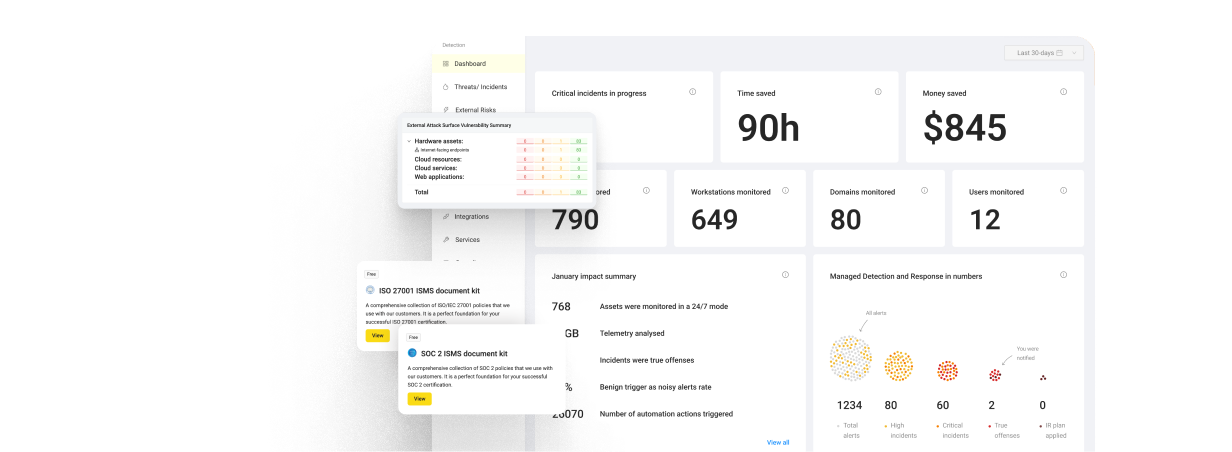
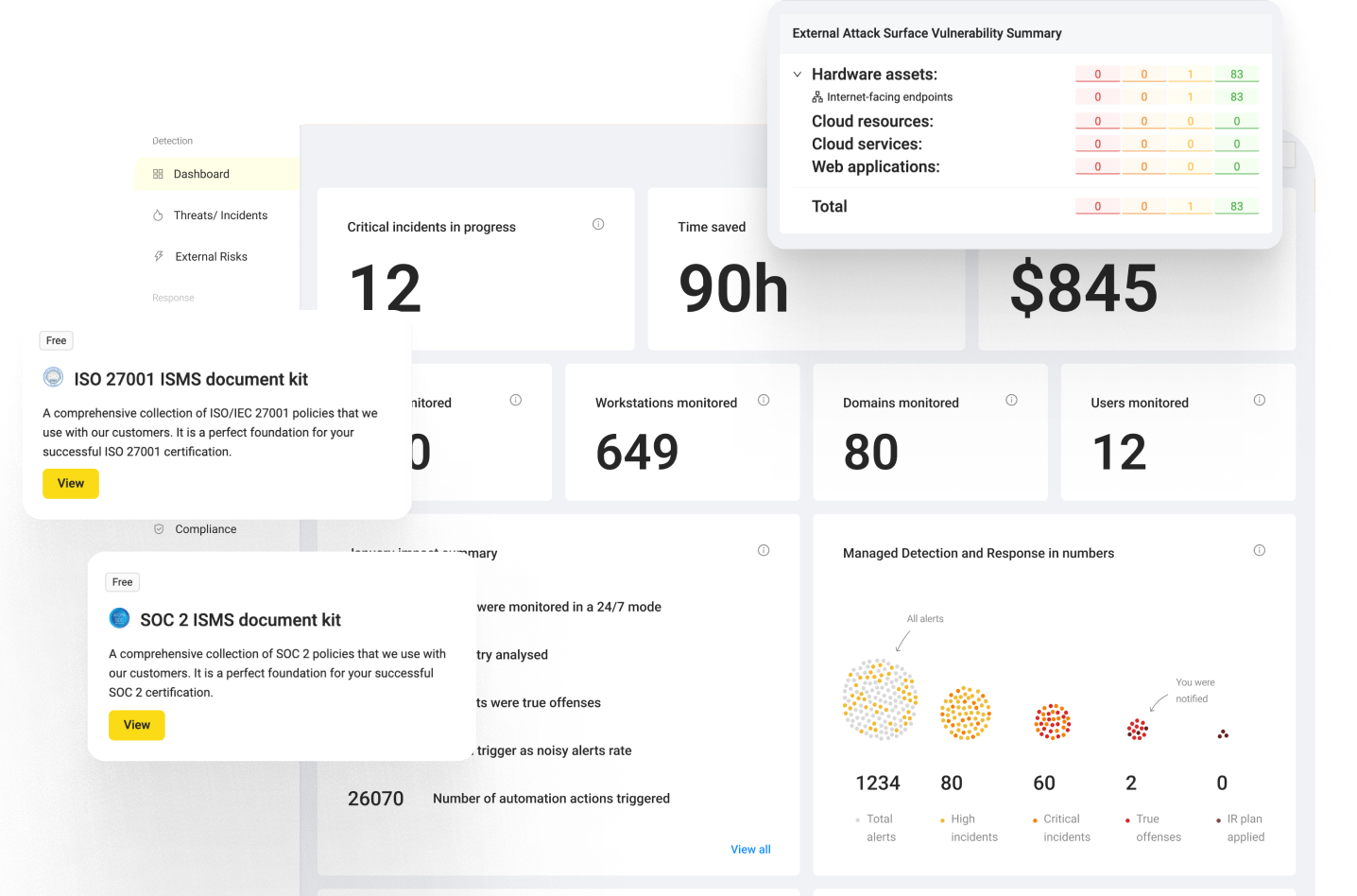
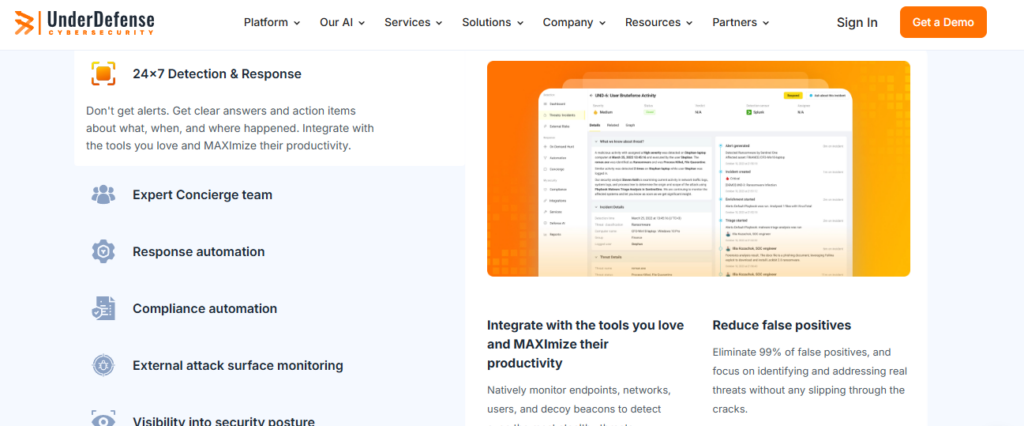
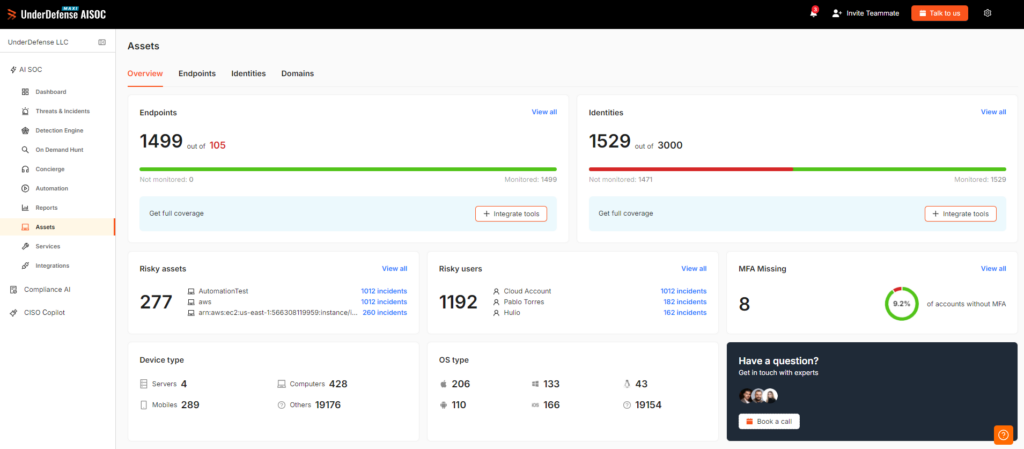
UnderDefense runs an Agentic AI SOC on top of the SIEM and security tools you already own. The point is simple. You keep the platform, the data, and the rules, and we bring the 24/7 humans and automation to operate it with you. One reviewer put the value in plain terms, the UnderDefense Agentic AI SOC platform pulls data from existing tools with no rip and replace.
I’ve watched too many teams inherit a black box they can’t audit. Our model keeps every Lego brick in your hands, so you can rebuild the set yourself if you ever leave.
Core Services
- Agentic AI SOC on your owned SIEM, EDR, and cloud
- 24/7 monitoring with 2-minute alert-to-triage and 15-minute escalation for critical incidents
- Alert tuning to cut noise, one reviewer saw noise controlled in the first week
- Incident response with clear context on every escalation
- Compliance evidence and 30-day impact reports
Why Companies Consider UnderDefense
Most mid-market teams can’t staff a full SOC in this hiring market. One customer needed round-the-clock coverage for compliance but couldn’t build it in-house on budget, so our SOC service filled the gap without a full team. Another kept their SIEM, Splunk, and let us manage it, adding value to tools they already paid for.
Here’s the part the category gets backwards. You don’t need to hand over your platform to get expert operations. You need a partner who works inside the platform you chose.
Ideal Customer Profile
Best suited for:
- Mid-market teams (51 to 1,000 employees) with an owned SIEM
- Compliance-driven organizations needing SOC 2, ISO 27001, or HIPAA evidence, often supported through our compliance services
- Security-lean teams drowning in alert noise
- Cloud-heavy shops on AWS or Azure wanting vendor-agnostic coverage
Commercial Model
UnderDefense operates on a subscription aligned to environment size and monitored data. Reviewers repeatedly call it affordable for the protection level, one noted strong 24/7 coverage at a good price. You can check current bands on our managed SIEM price page. Onboarding needs some upfront time to integrate tools properly, which one reviewer flagged as expected setup work, and not a complaint.
When to Shortlist
Shortlist UnderDefense when you want to keep your SIEM and data ownership, but need 24/7 analyst muscle and automation on top. It fits RFPs that weigh data portability and vendor-agnostic detection heavily, as outlined in our SIEM buyers guide.
Reviews
“The biggest win for me was getting actual control over our security alerts. Before the guys from UD stepped in, we were getting bombarded with alerts from all our security tools. Their team cleaned up our configurations and got the noise under control within the first week. The platform itself is straightforward, it pulls in data from all our existing security tools, so we didnt have to rip and replace anything.”
– Verified User in Marketing and Advertising UnderDefense G2 Verified Review
“Plus, their expert management of our SIEM has added to the value of our security investments and tools. At first, we hired them for managed SIEM service, but after they demonstrated the value of MDR, our management was motivated to act on it.”
– Yaroslava K., IT Project Manager UnderDefense G2 Verified Review
“UnderDefense Agentic AI SOC integrates well with our systems, specifically with our SIEM, Splunk. Their team is proactive in identifying and addressing threats, providing 247 oversight.”
– Oleg K., Director Information Security UnderDefense G2 Verified Review
2. Binary Defense: Best for Co-Managed SIEM Plus Human-Led Threat Hunting
Overview
Binary Defense is a managed security provider known for pairing a co-managed SIEM approach with human-led threat hunting. The company operates its own SOC but works within customer-owned platforms, which keeps it closer to the genuine co-managed end of the spectrum than the full-handover MDR crowd.
My read, and I could be off on the newest details, is that Binary Defense earns its spot by leaning on analyst-driven hunting rather than pure automation. That matters when your edge cases don’t fit a playbook, a challenge we explore in our comparison of managed SIEM versus MDR versus MSSP.
Core Services
- Co-managed SIEM operations on customer platforms
- 24/7 SOC monitoring and triage
- Human-led threat hunting
- Managed EDR and endpoint detection
- Incident response support
Why Companies Consider Binary Defense
Teams that already run a SIEM and want experienced hunters on top, without surrendering the platform, tend to look here. The pitch lands for organizations that value analyst depth over a slick single-vendor stack.
Ideal Customer Profile
Best suited for:
- Mid-market and enterprise teams with an owned or platform-native SIEM
- Security teams wanting proactive threat hunting
- Organizations needing 24/7 coverage without building a full SOC
- Compliance-driven shops needing SOC 2 or PCI DSS support
Commercial Model
Binary Defense typically works on a subscription model scaled to environment and data volume. Engagements bundle onboarding, continuous monitoring, and hunting into the managed service.
When to Shortlist
Shortlist Binary Defense when threat hunting depth is a priority and you want to keep your SIEM. It fits RFPs alongside other genuine co-managed providers where analyst expertise outranks platform features.
3. Rapid7 (MDR): Best for InsightIDR-Anchored Detection Shops
Overview
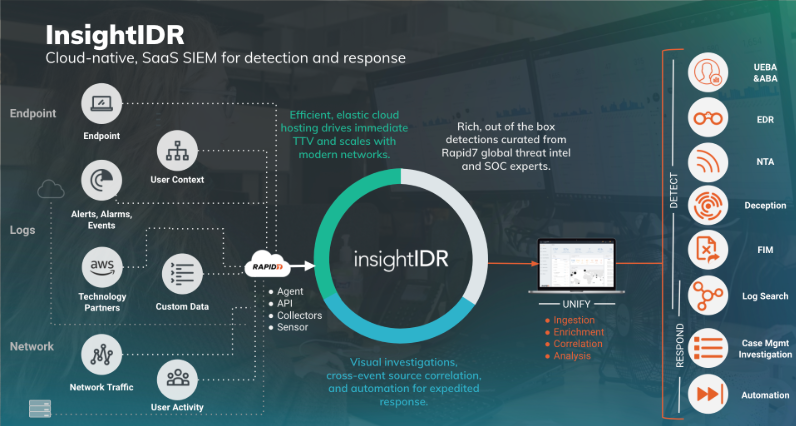
Rapid7 delivers MDR on its own InsightIDR platform, pairing detection with vulnerability management. The pitch is a single Insight ecosystem, one console for detection, VM (vulnerability management, finding and ranking security holes), and cloud security. That unity is real, but it lives inside Rapid7’s platform.
My honest read, and the reviews back this, is that the platform-native model works best if you’re all-in on Insight. If you own a different SIEM, you’re bolting on, not co-managing, which is where a genuinely vendor-agnostic managed SIEM approach differs.
Core Services
- MDR on InsightIDR
- InsightVM vulnerability management
- InsightCloudSec cloud posture
- SOC monitoring and alerting
- Threat intelligence and detection rules
Why Companies Consider Rapid7
Teams that want detection and VM in one bundle look here. One reviewer called the CRC Essentials license genuine value for money, three products in one package. That consolidation appeals to small security teams stretched thin.
Ideal Customer Profile
- Mid-market teams standardizing on the Insight platform
- Security-lean teams wanting VM plus detection bundled
- Compliance-driven shops needing SOC 2, HIPAA, or PCI DSS
Commercial Model
Rapid7 sells subscription licenses scaled by assets and modules. Reviewers flagged watch-outs, one described the scan engine failing with slow post-sales support, and another disputed billing on unusable scans.
When to Shortlist
Shortlist Rapid7 when you’re committing to its platform and want detection plus VM together. Validate coverage and support in a proof of concept first, and several reviewers stress this. Our SIEM buyers guide walks through the questions worth asking.
Reviews
“The scan engine doesnt function. Im unable to scan our IP ranges, and theyve ignored requests to get this resolved. Please, please, please look into the competition. Look for reviews and gauge how post-sales support will be.”
– Verified User in Farming Rapid7 G2 Verified Review
“Their CRC Essentials license is absolutely value for money as it includes three of their products, InsightVM, InsightCloudSec and InsightConnect. However, it has made our work significantly more which is pretty annoying. It lacks some no-brainer automation options for many stuff that we currently have to do manually.”
– Himanshu K., IT Security Operations Engineer Rapid7 G2 Verified Review
4. Arctic Wolf: Best for SMB and Mid-Market Teams Wanting a Fully Managed SOC
Overview
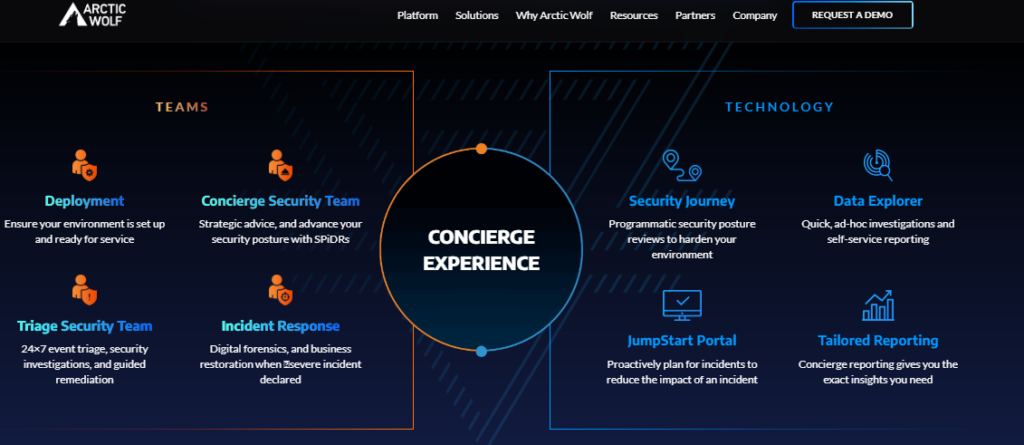
Arctic Wolf runs a fully managed SOC through its Concierge Security model, giving you a named team on top of its platform. The appeal is simple, you don’t build a SOC, you rent one. It fits organizations that want outcomes without staffing.
Here’s the structural trade-off I watch for. Changes and visibility route through Arctic Wolf’s engineering, so you operate at their pace, not yours. That’s the permanent cost of a fully managed, platform-led model, and it is why some teams review Arctic Wolf alternatives before signing.
Core Services
- 24/7 managed detection and response
- Cloud and endpoint monitoring
- Risk and vulnerability management
- Incident response support
- Security awareness training
Why Companies Consider Arctic Wolf
Many teams lack budget or talent to run an internal SOC, so Arctic Wolf becomes the operational partner. It’s a common shortlist entry for SMB and mid-market shops moving from tools to managed operations.
Ideal Customer Profile
- SMB and mid-market teams (50 to 1,000 employees)
- Compliance-driven organizations handling customer data
- Security-lean teams needing outsourced expertise
Commercial Model
Arctic Wolf uses subscription pricing tied to organization size and monitored assets. One buyer warned about a 60-day renewal notice window instead of the typical 30-day, and it is worth checking in your contract.
When to Shortlist
Shortlist Arctic Wolf when you want fully managed operations and accept working through their team. Run a strong proof of concept, since several reviewers stress remediation depth as the gap. A managed SOC service that keeps you in the loop can close that gap.
Reviews
“Arctic Wolf provides Solid detection and response capabilities, but overly relies on the clients team for remediation, which really hurts the value of the service. Lack of true remediation in the response, costing us significantly in resources and introducing risks in security.”
– VP of Technology Arctic Wolf Gartner Verified Review
“Anything you want to look at or changes you need to make in the product must go through their engineering team. As an MSP, this is a horrible way to do business for us. On top of that, the sales and account management team is very pushy.”
– Matt C., Manager, Cybersecurity Services Arctic Wolf G2 Verified Review
5. Expel: Best for Cloud-First Teams Wanting a Transparent SOC Workbench
Overview
Expel is known for a transparent SOC that works across your existing cloud, SaaS, and endpoint tools. The strength reviewers cite is visibility, you can watch the investigation happen in their workbench. That openness sits closer to the co-managed spirit than a black box.
My read, and I could be off on the newest details, is that Expel earns trust through transparency but stays an external layer. It triages well, then hands context back to your team.
Core Services
- 24/7 monitoring across cloud, SaaS, and endpoints
- Alert triage and investigation transparency
- Automated enrichment and filtering
- Incident response support
- Detection engineering
Why Companies Consider Expel
Cloud-first teams want coverage without staffing a night shift, and Expel acts as a force multiplier. One reviewer valued that Expel investigates thoroughly before escalating, cutting noise for a small internal SOC. Teams weighing this often also review our cloud security services.
Ideal Customer Profile
- Cloud-heavy mid-market and enterprise teams
- Small internal SOCs needing a first line of triage
- Organizations valuing transparent, auditable investigations
Commercial Model
Expel prices on a subscription scaled to environment and data sources. Reviewers note onboarding is straightforward for a log-ingesting service, though integration upkeep takes effort.
When to Shortlist
Shortlist Expel when transparency and cloud coverage top your list, and you keep an internal team for deeper response. Confirm coverage for your specific cloud, since one reviewer hit a GovCloud gap.
Reviews
“Lack of support for EKS in AWS GovCloud. This was promised to us before we signed our contract, but later was removed from the roadmap. GovCloud is an essential part of our business and this lack of support leaves a large gap in our monitoring and alerting.”
– Verified User in Manufacturing Expel G2 Verified Review
“Despite the capabilities of the technical platform and the strength of the analysts, there is still a limit to the environmental and organizational knowledge inherent in the service. This leads to a fairly frequent need for engagement with our internal team to get clarification and verification.”
– Verified User in Computer Software Expel G2 Verified Review
6. Red Canary: Best for EDR-Heavy Environments Needing Detection Engineering Depth
Overview
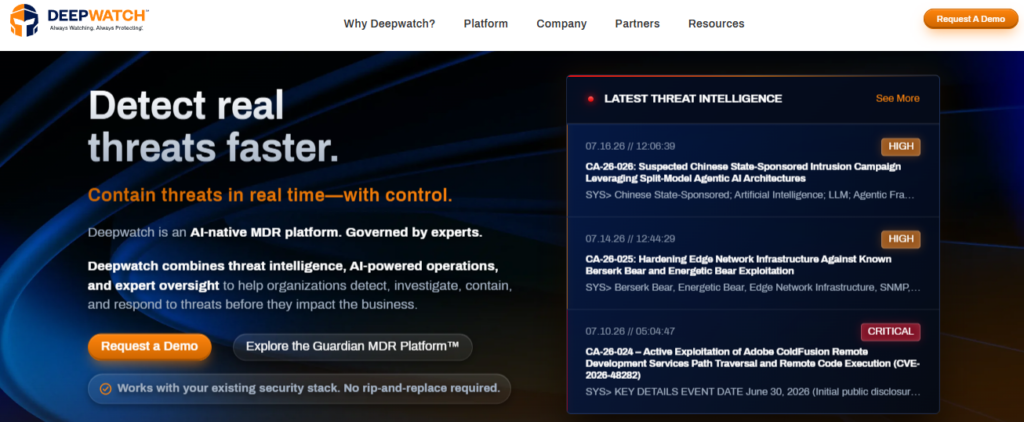
Red Canary built its reputation on detection engineering, especially on top of EDR (endpoint detection and response) tools like CrowdStrike. It reduces SIEM noise and surfaces real threats. Reviewers respect the threat hunting and IR teams.
The structural trade-off I see is EDR-centric gravity. Red Canary leans heavily on endpoint sources, so cloud, identity, and SIEM ingestion can feel thinner. That matters if your risk lives outside the endpoint, a point our threat hunting tools breakdown covers in depth.
Core Services
- Managed detection on EDR and cloud
- Detection engineering and threat hunting
- 24/7 SOC monitoring
- Incident response support
- Noise reduction and alert tuning
Why Companies Consider Red Canary
EDR-heavy teams want expert detections without building them in-house, and Red Canary delivers that depth. One reviewer said it reduced noise from various log sources with a smooth setup.
Ideal Customer Profile
- Enterprise and mid-market teams standardized on EDR
- Small SOCs needing off-hours coverage
- Organizations wanting detection engineering expertise
Commercial Model
Red Canary prices on a subscription scaled to endpoints and data sources. Reviewers flag SIEM integration gaps, and one needed custom API scripts to ingest alerts into Splunk.
When to Shortlist
Shortlist Red Canary when EDR is your center of gravity and detection depth matters most. Validate SIEM ingestion and coverage during penetration tests, since one reviewer saw detection gaps mid-test. Our penetration testing engagements are built to surface exactly those gaps.
Reviews
“Over the past few years, weve undergone several external penetration tests, and during these assessments, Red Canary was not able to identify the malicious activity while the tests were ongoing. Also, they do not have any sort of alert ingestion integrations with Splunk or other SIEM platforms.”
– Verified User in Insurance Red Canary G2 Verified Review
“Red Canary is perhaps too reliant on Crowdstrike and less on our other sources which are important Cloud, Identity Email, etc. We also find that Red Canary detections could be more proactive.”
– Verified User in Computer Software Red Canary G2 Verified Review
7. Alert Logic (Fortra): Best for Compliance-Driven Cloud Shops
Overview
Alert Logic, now part of Fortra, focuses on compliance-driven detection with strong AWS coverage. It bundles SIEM, MDR, vulnerability management, and FIM (file integrity monitoring, watching for unauthorized file changes) into one package. That breadth checks compliance boxes affordably.
The trade-off reviewers surface is depth and support consistency. It’s solid for compliance coverage, but accuracy and responsiveness draw mixed reactions. Teams with heavy audit needs often pair it with dedicated compliance services.
Core Services
- MDR with AWS and cloud coverage
- Bundled SIEM and vulnerability management
- Daily log review for compliance
- File integrity monitoring
- Scheduled reporting
Why Companies Consider Alert Logic
Teams needing a compliance-ready bundle on a budget consider Alert Logic. One reviewer valued the 24/7 SOC and scheduled reports, especially for an ephemeral cloud environment.
Ideal Customer Profile
- Compliance-driven cloud shops on AWS
- Teams needing PCI DSS or HIPAA log review
- Budget-conscious mid-market organizations
Commercial Model
Alert Logic prices on subscription bundles. Watch the fine print, since one reviewer hit a 50GB per day log cap not disclosed during buying, which affected visibility.
When to Shortlist
Shortlist Alert Logic when compliance coverage and AWS integration matter more than deep response. Confirm log caps and support SLAs before signing.
Reviews
“Having a 247 SOC that we dont have to manage is hands down my favorite. It doesnt seem to always be accurate. Its hard to know where its pulling information from when delivering findings.”
– Monique L., Product Security Sr. Analyst Alert Logic G2 Verified Review
“Solid product but lack of accountability on the support side. We had a system that got infected and it bypassed their product. Their support took no responsibility for the incident nor did their product take action to stop the attack.”
– DevOps Engineer Alert Logic Gartner Verified Review
8. Deepwatch: Best for Splunk-Anchored Enterprises
Overview
Deepwatch runs managed detection anchored heavily on Splunk. If Splunk is already your SIEM, Deepwatch operates it with you, which keeps you close to a genuine co-managed setup. That’s a real advantage for Splunk-committed shops, and a model our MDR for Splunk practice shares.
The structural trade-off is Splunk gravity. The model shines when Splunk is your center, but it’s less flexible if you run a different or multi-SIEM stack.
Core Services
- Managed detection on Splunk
- 24/7 SOC monitoring and triage
- Detection engineering and tuning
- Threat intelligence
- Incident response support
Why Companies Consider Deepwatch
Splunk-anchored enterprises want expert hands on the platform they already invested in. Deepwatch fits when you keep Splunk and need operational muscle around it.
Ideal Customer Profile
- Enterprises standardized on Splunk
- Teams wanting to preserve SIEM investment
- Compliance-driven organizations needing SOC 2 or HIPAA
Commercial Model
Deepwatch prices on subscription scaled to data volume and coverage. Splunk licensing sits alongside, so factor total cost, including data ingestion.
When to Shortlist
Shortlist Deepwatch when Splunk is your SIEM and you want it co-managed rather than replaced. Weigh combined Splunk and service cost against alternatives.
9. ReliaQuest: Best for Large Enterprises Wanting an Automation Layer
Overview
ReliaQuest sits on top of your existing tools through its GreyMatter platform, adding an automation and visibility layer across SIEM, EDR, and cloud. The idea is to unify what you already own rather than replace it. That’s genuinely co-managed in spirit, and teams comparing options often review ReliaQuest alternatives first.
The trade-off is the added layer itself. GreyMatter becomes a dependency, so you gain unification but take on another platform to operate around your stack.
Core Services
- GreyMatter unification across existing tools
- 24/7 detection and response
- Automation and playbook orchestration
- Threat hunting
- Incident response support
Why Companies Consider ReliaQuest
Large enterprises with many tools want a single pane and automation without ripping out investments. ReliaQuest fits complex environments needing correlation across sources.
Ideal Customer Profile
- Large enterprises with heterogeneous tool stacks
- Teams wanting automation on top of existing SIEM and EDR
- Organizations needing SOC 2 or PCI DSS support
Commercial Model
ReliaQuest prices on subscription scaled to environment size and integrations. Factor the platform layer into total cost and onboarding time.
When to Shortlist
Shortlist ReliaQuest when you run many tools and want unification plus automation. It fits large teams over lean mid-market shops.
10. eSentire: Best for Mid-to-Large Regulated Firms Wanting Fast Response
Overview
eSentire delivers MDR through its Atlas platform, known for fast response and threat disruption. It works across endpoint, network, cloud, and log sources. The pitch centers on speed of containment for regulated industries.
The structural trade-off is platform reliance. Atlas drives the service, so you operate within eSentire’s model rather than fully co-managing your own SIEM. For regulated buyers, our incident response team keeps that authority with you.
Core Services
- MDR on the Atlas platform
- 24/7 SOC and threat response
- Endpoint, network, and cloud coverage
- Threat hunting and intelligence
- Incident response support
Why Companies Consider eSentire
Regulated mid-to-large firms want fast containment and a mature MDR practice. eSentire fits when speed of response and compliance coverage rank highest.
Ideal Customer Profile
- Mid-to-large regulated firms (finance, healthcare)
- Teams prioritizing rapid threat disruption
- Organizations needing SOC 2, HIPAA, or PCI DSS
Commercial Model
eSentire prices on subscription scaled to coverage and data sources. Factor Atlas platform dependency into your portability planning.
When to Shortlist
Shortlist eSentire when fast response and regulated-industry maturity lead your criteria. Confirm data ownership terms if SIEM portability matters to you, a theme we cover in our guide on avoiding vendor lock-in.
Where I’d Land as a Buyer
Here’s the quiet conviction the category avoids. Most of these names are strong MDR providers, but only a handful genuinely co-manage a SIEM you own. The rest ask you to operate inside their platform, which is a fine trade if you want a black box you never touch.
If keeping your data, your rules, and your final authority matters, weigh UnderDefense, Binary Defense, Deepwatch, and ReliaQuest first, since they operate closest to true co-management. We built UnderDefense Agentic AI SOC to sit on the SIEM you already own, with 2-minute alert-to-triage and 15-minute escalation for critical incidents, so you keep every Lego brick while we bring the 24/7 humans and automation on the UnderDefense Agentic AI SOC platform.
Q2: How Were These Co-Managed SIEM Providers Selected and Scored?
Each provider was scored across five weighted criteria totaling 100%: Data and Platform Ownership Retention (30%), Rule-Change Transparency and Auditability (25%), After-Hours Response Authority (20%), Integration Breadth and Vendor-Neutrality (15%), and Pricing Transparency (10%). Scores map to stars, 0 to 20 (1 star) through 81 to 100 (5 stars). The gating test, does the customer keep the platform, data, and final authority?
Why These Five Criteria, in This Order
I weighted ownership highest on purpose. Most listicles rank on price, and I think the standard read gets this backwards. If you lose your data and your rules, cheap gets expensive fast.
The shared-responsibility model exists so you retain control of security operations while a partner shares the load. So I scored providers on how much control you actually keep, then let response and price follow, an approach our SIEM buyers guide applies in detail.
The Scoring Rubric
| Criterion | Weight | What It Measures | Why It Matters |
|---|---|---|---|
| Data and Platform Ownership | 30% | Do you keep the SIEM, data, and export rights | You can leave without losing history |
| Rule-Change Transparency | 25% | Can you see and approve every detection change | Prevents silent black-box edits |
| After-Hours Response Authority | 20% | Who can act at 3 a.m., and who approved it | Speed depends on pre-agreed authority |
| Integration and Vendor-Neutrality | 15% | Works across your tools, not just their platform | Avoids rip-and-replace lock-in |
| Pricing Transparency | 10% | Clear, predictable cost | No surprise data caps or renewal traps |
How Weighting Becomes Stars
Here’s the practical part. Each provider gets a 0 to 100 score, then maps to a 1 to 5 star band. Ownership and auditability alone decide 55% of the outcome.
Why care so much about auditability? Because modern detection can run as versioned, tested code, so every rule change leaves a trail you can review. That answers the quiet question every buyer has, “can they change my rules without telling me?”
Where UnderDefense Lands
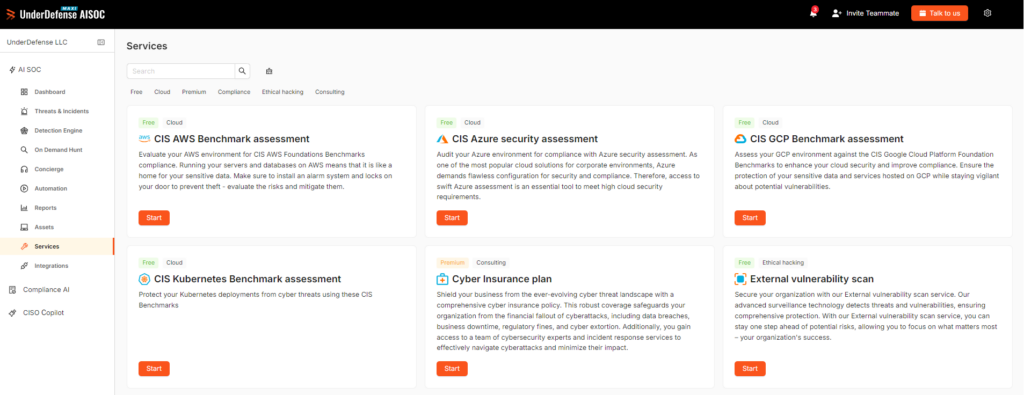
UnderDefense earns 5 stars under this rubric, and I’ll show the reasoning rather than assert it. We operate the SIEM you own, keep your data in your environment, and run detection as auditable logic you can inspect on the UnderDefense Agentic AI SOC platform. The trade-off worth naming, our model needs upfront integration time, which reviewers flag as expected setup work.
Research backs the payoff of disciplined tuning. AI-assisted screening in modern SOCs cuts alert volume and false positives sharply, freeing analysts for real threats, a dynamic we cover in our breakdown of alert fatigue in cybersecurity. That’s the outcome the rubric rewards.
“The biggest win for me was getting actual control over our security alerts. Their team cleaned up our configurations and got the noise under control within the first week.”
– Verified User in Marketing and Advertising UnderDefense G2 Verified Review
“Their adherence to SLAs gives me confidence in our infrastructures protection. As the Information Security Director, it lets me focus on strategy, knowing the day-to-day security is managed effectively.”
– Oleg K., Director Information Security UnderDefense G2 Verified Review
Q3: What Is a Co-Managed SIEM, and Where Should the Control Line Sit?
A co-managed SIEM is a shared operating model where you keep the platform, data, and final authority while a partner handles tuning, 24/7 monitoring, and triage. It sits between self-managed, where you do everything, and fully-managed, where they own it. Keep the decisions, rule approval, data ownership, and final response authority. Hand over the labor, triage, tuning, and the overnight watch.
The Plain Definition
SIEM stands for Security Information and Event Management, the system that collects and correlates your security logs. Co-managed means you own that system, and a partner operates it with you. If you want the full primer, our explainer on what managed SIEM is breaks it down further.
Think of it like owning your house and hiring a night-shift guard. The guard watches and responds, but you keep the keys, the deed, and the final say.
Three Models, Side by Side
| Model | Who Owns the SIEM | Who Operates It | Best Fit |
|---|---|---|---|
| Self-managed | You | You, 24/7 | Large teams with a full SOC |
| Co-managed | You | You plus a partner | Teams keeping control, needing coverage |
| Fully-managed | The vendor | The vendor | Teams wanting a hands-off black box |
The shared-responsibility split is exactly what lets you retain operational control while offloading the grind. Our comparison of managed SIEM versus MDR versus MSSP maps where each model fits.
Why the Term Stays Vague
Here’s something the category avoids saying. “Co-managed” is a spectrum, not a clean model, and vagueness closes more deals. A vendor can call a full handover “co-managed” and few buyers push back.
I’ve watched too many teams over-specialize into tool babysitting. Security became a cottage industry of running vendor queries, when the real job is judgment.
What to Keep and What to Hand Over
The honest answer to “do I own the logic I built, or start over?” should always be, you keep it. Research shows 51% of teams feel overwhelmed by alerts, and analysts lose over 25% of their time chasing false positives, a burden a managed SOC service is built to lift.
| Responsibility | Keep or Hand Over | Reasoning |
|---|---|---|
| Platform and data | Keep | Ownership and portability |
| Rule approval | Keep | Final authority stays with you |
| Final response authority | Keep | You decide what happens in your environment |
| Alert triage | Hand over | Frees your team from noise |
| Tuning and false-positive work | Hand over | Specialized, repetitive labor |
| Overnight monitoring | Hand over | Coverage without burnout |
UnderDefense is co-management by design, you own your stack while we run the watch. I’ll hold the deeper mechanics for the responsibility matrix next.
Q4: Who Owns What, The Responsibility Matrix, and How to Verify It?
In a healthy co-managed SIEM you stay Accountable for platform, data, and final response authority, and the partner is Responsible for tuning, triage, and the 24/7 watch. Map every function, rule authorship, approval and veto, incident containment, after-hours action, and exit, to a clear role. Covert rule changes are prevented by detection-as-code. The 3 a.m. authority line must be defined, not improvised.
Why a Matrix Beats Prose
Prose hides gaps. A matrix forces every function into a named owner, so nobody discovers at 3 a.m. that “someone” was supposed to act.
I use a RACI-style split, Responsible does the work, Accountable owns the outcome. Here’s the healthy default I’d hold any partner to, and the same one our managed SIEM engagements start from.
The Co-Managed Responsibility Matrix
| Function | You | Partner | Healthy Default |
|---|---|---|---|
| Platform ownership | Accountable | Operates | You own the SIEM |
| Data residence and export | Accountable | Accesses (scoped) | Logs stay in your cloud |
| Rule authorship | Approves | Responsible | Partner drafts, you approve |
| Rule approval and veto | Accountable | Proposes | You hold final veto |
| Alert triage | Informed | Responsible | Partner filters noise |
| Incident response | Accountable | Responsible | Partner acts, you own outcome |
| Tuning and false positives | Informed | Responsible | Partner reduces noise |
| Log onboarding | Consulted | Responsible | Partner integrates sources |
| After-hours authority | Accountable | Responsible | Pre-defined, in writing |
| Exit and data return | Accountable | Supports | You keep keys and data |
The Four Fears, Answered
Fear 1, will they change my rules quietly? No, if detections run as versioned, tested code. Every change is reviewable, so silent edits can’t slip through.
Fear 2, who touches my data? The partner gets scoped access, and your logs stay in your own cloud (Azure, GCP, AWS, or Oracle). You keep residence and export rights, a point we detail in our guide on avoiding vendor lock-in.
Fear 3, who acts at 3 a.m.? Whoever you pre-authorized, in writing. This is the row buyers most want answered and least often ask about.
Speed is the reason it matters. Mandiant’s M-Trends 2026 found the median time from initial access to hand-off collapsed to 22 seconds in 2025, and median dwell time rose to 14 days. A low-level alert can become a full breach before your morning coffee, which is why fast incident response authority matters.
Fear 4, will I stay independent? Yes, if you hold the license and the keys. Ownership of the platform is what keeps you from lock-in.
How to Verify, Trust Nothing, Check Everything
Ask the partner to show their investigative steps, the queries run, the evidence pulled, and the decision trail. Auditable work beats promises.
This is where UnderDefense fits the healthy-default column. We keep your data and rules, run detection as auditable logic, and operate on-prem in your own cloud, so you get measurable outcomes from the security tools you already pay for through our SOC operations. The frame I’d urge you to adopt is verification, not trust.
“UnderDefense Agentic AI SOC integrates well with our systems, specifically with our SIEM, Splunk. Their team is proactive in identifying and addressing threats, providing 247 oversight.”
– Oleg K., Director Information Security UnderDefense G2 Verified Review
“When they escalate something, they include the context we need to understand the issue quickly. Were not wasting time piecing together what happened from different systems anymore.”
– Verified User in Marketing and Advertising UnderDefense G2 Verified Review
Q5: What Does It Really Cost to Switch a Co-Managed SIEM Partner?
The real cost of switching is rarely the invoice. It’s the migration risk, the lost detection history, and the coverage gap during transition. If you own your platform and data, switching means changing operators. If the vendor owns them, switching means rebuilding from zero.
The Costs Nobody Prices In
Buyers fixate on the monthly fee, and I think that framing hides the real exposure. The expensive part is what you lose when you leave, your tuned rules, your historical data, and your institutional knowledge.
When a vendor owns the platform, your detection history walks out the door with them. That’s the quiet penalty our guide on avoiding vendor lock-in was written to expose.
Switching Cost, Owned vs Vendor-Locked
| Cost Factor | You Own the SIEM | Vendor Owns the SIEM |
|---|---|---|
| Detection history | Retained in full | Lost or partial |
| Rule library | Kept and portable | Rebuilt from scratch |
| Migration effort | Change operator only | Full platform rebuild |
| Coverage gap | Minimal, overlap possible | Weeks of exposure |
| Data export | Your right, anytime | Vendor-controlled |
The Hidden Timeline Risk
Here’s what surprises teams mid-switch. Rebuilding detections and re-onboarding logs takes weeks, and every week is exposure. Attackers do not pause for your migration.
Speed context makes this sharp. When intrusions can escalate in under a minute, a multi-week coverage gap is a genuine risk, not a paperwork delay, and it is why disciplined incident response planning matters during any transition.
How Ownership Neutralizes the Cost
The whole switching problem shrinks when you own the platform and data. You keep your rules, your history, and your logs, so changing partners becomes an operational handoff, not a rebuild. That is the structural advantage of a truly managed SIEM model where you hold the keys.
This is exactly why the ownership question in the responsibility matrix matters so much. Answer it right at signing, and you never pay the switching penalty later.
“We keep full control of our environment while their team handles the heavy lifting. If we ever needed to bring things in-house, everything is ours, our data, our configurations, nothing held hostage.”
– Verified User in Computer and Network Security UnderDefense G2 Verified Review
Q6: How Is Co-Managed SIEM Priced, and Where Do the Surprises Hide?
Co-managed SIEM is usually priced on data volume (GB or events per day), asset or user count, or a flat platform-plus-service fee. The surprises hide in data ingestion caps, overage charges, and renewal terms. Model your true log volume first, then read the caps and renewal clauses before signing.
The Three Common Pricing Structures
Most providers pick one of three bases, and each rewards a different environment. Knowing which one fits your log profile is half the battle, a topic our managed SIEM primer unpacks in plain terms.
| Pricing Model | How It Scales | Best Fit | Watch-Out |
|---|---|---|---|
| Data volume | By GB or events per day | Predictable log environments | Ingestion caps and overages |
| Per asset or user | By endpoints or seats | Stable headcount | Growth spikes cost fast |
| Flat platform plus service | Fixed base fee | Teams wanting predictability | Scope creep on add-ons |
Where the Surprises Hide
The invoice looks clean until the fine print bites. The three traps I see most often are undisclosed data caps, per-GB overage charges, and renewal windows that lock you in before you can shop.
One buyer discovered a 50GB per day log cap that was never surfaced during the sale, which quietly limited visibility. Another hit a 60-day renewal-notice window instead of the usual 30. These are the details that separate a fair contract from a trap, and our SIEM buyers guide lists the exact clauses to check.
How to Model True Cost
Start with honest log volume, not the vendor’s estimate. Measure your real daily ingestion across all sources you intend to onboard, then add headroom for growth and incident spikes.
From there, factor platform licensing, service fees, and any per-GB overage into a single number. Teams that skip this step are the ones blindsided at renewal, which is why we point buyers to a structured managed SIEM ROI model before they sign.
The UnderDefense Approach
We price around the stack you already own, so you get outcomes from tools you already pay for rather than a second platform bill. You keep your SIEM and data, and we bring the 24/7 operations on the UnderDefense Agentic AI SOC platform. The honest trade-off, upfront integration work, is real, and reviewers name it as expected setup effort.
“The pricing was transparent with no hidden costs, which made budgeting straightforward for us. We knew exactly what we were paying for from day one.”
– Verified User in Information Technology and Services UnderDefense G2 Verified Review
Q7: What Questions Should You Ask a Co-Managed SIEM Provider Before Signing?
Ask questions that force specifics on ownership, transparency, and after-hours authority. Who holds the license and the data? Can I audit every rule change? Who acts at 3 a.m., and under what pre-approved authority? Vague answers are the answer.
The Questions That Reveal the Truth
Marketing pages blur the lines, so specific questions cut through. I group them into four buckets, ownership, transparency, response authority, and exit, because those are where the expensive surprises live.
| Category | Ask This | A Good Answer Sounds Like |
|---|---|---|
| Ownership | Who holds the license and the data? | You do, in your own cloud |
| Transparency | Can I audit every rule change? | Yes, detection runs as versioned code |
| Response authority | Who acts at 3 a.m.? | Whoever you pre-authorized, in writing |
| Investigation | Will you show your work? | Full query and evidence trail on request |
| Exit | What happens to my data if I leave? | You keep it, export anytime |
Why the After-Hours Question Matters Most
The 3 a.m. question is the one buyers skip and later regret. Speed decides outcomes, so pre-agreed authority is what turns a 2-minute alert-to-triage and 15-minute escalation for critical incidents into containment rather than a morning surprise.
A provider that dodges this question is telling you something. Clear, written escalation authority is the difference between a managed SOC service and a call center that pages you and waits.
Red Flags in the Answers
- Ownership answers that route through the vendor’s platform instead of your cloud
- Rule changes that cannot be independently audited
- No written after-hours authority, just best-effort
- Data-export terms that are vague or vendor-controlled
- Renewal windows longer than 30 days without justification
Any one of these deserves a follow-up, and two or more should give you real pause. Our list of managed SIEM evaluation questions expands each into contract-ready language.
The Frame to Carry Into Every Call
Adopt verification over trust. Ask the provider to demonstrate, not describe, so make them show a real rule-change log and a real investigation trail before you sign.
This is the posture we operate under at UnderDefense, you own the stack, you audit the work, and you hold final authority, backed by a buyers guide that hands you the questions to hold us and anyone else accountable.
“They walk us through their reasoning on every escalation. When we ask why something was flagged, we get a clear answer with the evidence, not a vague we saw something suspicious.”
– Oleg K., Director Information Security UnderDefense G2 Verified Review
See tuned SIEM triage in action.
1. What is a co-managed SIEM, and how is it different from fully-managed?
We define a co-managed SIEM as a shared operating model where you keep the platform, data, and final authority, while a partner handles tuning, 24/7 monitoring, and triage. It sits between self-managed, where you do everything, and fully-managed, where the vendor owns it all.
The practical split looks like this:
- You keep the platform, data, rule approval, and final response authority.
- The partner handles alert triage, false-positive tuning, and the overnight watch.
Think of it like owning your house and hiring a night-shift guard. The guard watches and responds, but you keep the keys, the deed, and the final say. In a fully-managed model, the vendor holds all three, which is fine if you want a black box you never touch.
The difference matters most when you decide to leave. If you own the platform, switching means changing operators. If the vendor owns it, switching means rebuilding from zero. We explain the full model in our primer on what managed SIEM is, so you can map the control line before signing anything.
2. Who owns the data in a co-managed SIEM arrangement?
In a healthy co-managed SIEM arrangement, you own the data, full stop. Your logs stay in your own cloud, whether that is Azure, GCP, AWS, or Oracle, and you keep both residence and export rights at all times.
We hold three ownership lines as non-negotiable:
- Platform ownership stays with you, so you hold the license.
- Data residence and export stay with you, so nothing is held hostage.
- Final response authority stays with you, so you decide what happens in your environment.
The partner gets scoped access to do the work, tuning, triage, and response, but never takes custody of your platform or history. This is the row buyers most often skip and later regret, because vendor-owned data is what makes switching painful and lock-in permanent.
At UnderDefense, we operate the SIEM you own and keep your data in your environment by design. That is the structural advantage we detail in our guide on avoiding vendor lock-in, where ownership at signing removes the switching penalty later.
3. How were the best co-managed SIEM providers selected and scored?
We scored each provider across five weighted criteria totaling 100 percent, then mapped the result to a one-to-five star band. The gating test is simple: does the customer keep the platform, data, and final authority?
The weighting reflects what actually protects you:
- Data and platform ownership at 30 percent.
- Rule-change transparency and auditability at 25 percent.
- After-hours response authority at 20 percent.
- Integration breadth and vendor-neutrality at 15 percent.
- Pricing transparency at 10 percent.
We weighted ownership highest on purpose. Most listicles rank on price, and we think that gets it backwards, because if you lose your data and your rules, cheap gets expensive fast. Ownership and auditability alone decide 55 percent of the outcome.
This rubric rewards providers who let you inspect every detection change and act with pre-agreed authority. We apply the same discipline in our SIEM buyers guide, which walks through the exact questions behind each criterion so you can score any vendor yourself.
4. What does it really cost to switch a co-managed SIEM partner?
The real cost of switching a co-managed SIEM partner is rarely the invoice. It is the migration risk, the lost detection history, and the coverage gap during transition.
The exposure depends entirely on who owns the platform:
- If you own it, switching means changing operators, so your rules and history stay intact.
- If the vendor owns it, switching means rebuilding detections from scratch and re-onboarding every log source.
That rebuild takes weeks, and every week is exposure. When intrusions can escalate in under a minute, a multi-week coverage gap is a genuine risk, not a paperwork delay, because attackers do not pause for your migration.
The whole problem shrinks when you own the platform and data. You keep your rules, your history, and your logs, so changing partners becomes an operational handoff rather than a full rebuild. That is why we treat the ownership question as the one to answer at signing, and it is central to disciplined incident response planning during any transition. Answer ownership right up front, and you never pay the switching penalty later.
5. How is co-managed SIEM priced, and where do the surprises hide?
Co-managed SIEM is usually priced on data volume, by GB or events per day, on asset or user count, or as a flat platform-plus-service fee. Each model rewards a different environment, so knowing your log profile is half the battle.
The surprises tend to hide in three places:
- Data ingestion caps that quietly limit visibility.
- Per-GB overage charges that spike your bill during incidents.
- Renewal windows that lock you in before you can shop.
One buyer discovered a 50GB-per-day cap never surfaced during the sale, and another hit a 60-day renewal-notice window instead of the usual 30. These details separate a fair contract from a trap.
We recommend starting with honest log volume, not the vendor’s estimate, then adding headroom for growth and incident spikes before factoring licensing and overage into one number. Teams that skip this are blindsided at renewal, which is why we point buyers to a structured managed SIEM ROI model before they sign.
6. What questions should we ask a co-managed SIEM provider before signing?
We tell buyers to ask questions that force specifics on ownership, transparency, and after-hours authority, because vague answers are the answer.
The four questions that reveal the truth:
- Ownership: Who holds the license and the data? A good answer is you do, in your own cloud.
- Transparency: Can I audit every rule change? A good answer is yes, detection runs as versioned code.
- Response authority: Who acts at 3 a.m.? A good answer is whoever you pre-authorized, in writing.
- Exit: What happens to my data if I leave? A good answer is you keep it and export anytime.
The 3 a.m. question is the one buyers skip and later regret. Pre-agreed authority is what turns a 2-minute alert-to-triage and 15-minute escalation for critical incidents into containment rather than a morning surprise.
Adopt verification over trust. Ask the provider to demonstrate, not describe, so make them show a real rule-change log and investigation trail. Our list of managed SIEM evaluation questions expands each into contract-ready language.
7. How should responsibility be split between us and a co-managed SIEM partner?
We map responsibility with a RACI-style matrix, because prose hides gaps and a matrix forces every function into a named owner. Nobody should discover at 3 a.m. that someone was supposed to act.
The healthy default we hold any partner to:
- You stay Accountable for platform ownership, data residence, rule approval and veto, and final response authority.
- The partner is Responsible for rule authorship, alert triage, tuning, log onboarding, and the 24/7 watch.
Covert rule changes are prevented when detections run as versioned, tested code, so every change leaves a reviewable trail. That directly answers the quiet fear buyers carry, can they change my rules without telling me?
The after-hours row deserves the most attention. Whoever acts at 3 a.m. should be pre-authorized in writing, since Mandiant’s M-Trends 2026 found the median time from initial access to hand-off collapsed to seconds. We build every engagement from this matrix through our managed SIEM practice, so authority is defined, not improvised.
8. Which co-managed SIEM providers actually let you keep your own platform?
Most names on any best co-managed SIEM providers list are strong MDR shops, but only a handful genuinely co-manage a SIEM you own. The rest ask you to operate inside their platform, which is a fine trade if you want a black box you never touch.
From our scoring, the providers operating closest to true co-management include:
- UnderDefense, which runs the SIEM you own with your data in your environment.
- Deepwatch, anchored on Splunk you already license.
- ReliaQuest, layering automation on your existing tools.
Platform-led models like Arctic Wolf, Rapid7, and eSentire deliver outcomes but route control through their stack. If keeping your data, your rules, and your final authority matters, weigh the ownership-first names first.
We built UnderDefense MAXI to sit on the SIEM you already own, with 2-minute alert-to-triage and 15-minute escalation for critical incidents, so you keep every building block while we bring the 24/7 humans and automation on the UnderDefense MAXI platform.