




Q1. What Is an Autonomous SOC, and How Does It Differ from an Automated or AI-Powered SOC?
There’s a lot of confusion around these terms, so let me be direct. An automated SOC, an AI-powered SOC, and an autonomous SOC are not the same thing. They sit on a spectrum, and understanding exactly where your security operations land on that spectrum determines whether your team spends the next year triaging noise or actually hunting threats.
The Spectrum: Automated → AI-Powered → Autonomous
An automated SOC uses rule-based playbooks and SOAR workflows to handle repetitive tasks. If alert X fires, run playbook Y. It’s reliable for the known and expected, but the moment something novel appears, it stops dead.
An AI-powered SOC layers machine learning onto existing tools. Detection improves. Alert scoring gets smarter. But the human still makes every meaningful decision, and the AI lacks the ability to reason across systems or adapt without retraining.
An autonomous SOC goes further, deploying agentic AI that reasons, investigates, and acts across the full security stack with minimal human intervention. It doesn’t just follow a playbook. It builds one in real time based on what it finds.
Three Models Compared
| Dimension | Automated SOC | AI-Powered SOC | Autonomous SOC |
|---|---|---|---|
| Decision-Making | Rule-based (if-then) | ML-assisted scoring | Agentic reasoning |
| Human Role | Operator executes playbooks | Reviewer validates AI output | Strategic overseer |
| Adaptability | Static playbooks | Tuned models, periodic retraining | Continuous learning |
| Alert Handling | Workflow execution | ML-scored triage | End-to-end agentic investigation |
| Integration Scope | SOAR-centric | SIEM + EDR | Full-stack orchestration (250+ tools) |
| Scalability | Linear (more alerts = more analysts) | Moderate | Elastic |
Why SOAR Falls Short of Agentic AI
This is the distinction most vendors blur, and it matters. Legacy SOAR platforms execute pre-defined if-then playbooks: they automate the known. If an alert doesn’t match a playbook, it sits in a queue until a human gets to it.
Agentic AI reasons about the unknown. It queries your SIEM, pulls endpoint logs, enriches with threat intel, reaches out to affected users via Slack or Teams for verification, and constructs a structured investigation narrative, all without a pre-written playbook. This is the fundamental architectural shift from “automated” to “autonomous”.
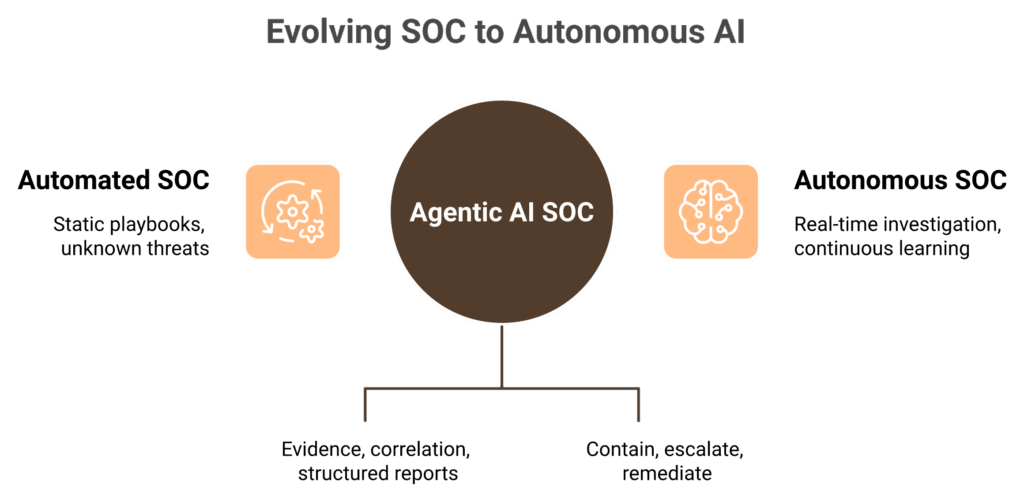
⚠️ But here’s the part nobody says out loud: fully autonomous is not the goal. The goal is the right division of labor. At UnderDefense, we built UnderDefense MAXI around a straightforward principle: AI collects context, you decide. Our agentic AI handles the investigation grunt work, including evidence collection, multi-system correlation, and structured reports delivered in seconds. But the decision to contain, escalate, or remediate? That stays with a human who understands your business.
Q2. Why Is the Shift from Automated to Autonomous SOC Happening Now?
It’s 3:12 AM on a Tuesday. Your Tier-1 analyst is triaging the 200th alert of the shift. Half are false positives, 30% lack cross-tool context, and somewhere in the noise, a lateral movement event is aging past the 4-hour dwell-time threshold. By morning, no one will remember it existed.
If that scenario sounds familiar, you’re not alone. And it’s exactly why the autonomous SOC conversation has shifted from theoretical to urgent.
Five Converging Pressures That Broke the Traditional SOC
AI-weaponized attacks. Attackers using agentic AI move at machine speed: automated reconnaissance in minutes, adaptive malware that mutates per target, and perfectly crafted phishing at scale. Your SOC can’t respond at human speed when the threat operates at machine speed.
Expanding attack surfaces. Cloud (AWS, Azure, GCP), identity platforms (Okta, Azure AD), OT/IoT, and hybrid environments multiply telemetry sources faster than SOC teams can hire analysts to cover them.
The cybersecurity talent cliff. The global cybersecurity workforce gap has reached 4.8 million unfilled positions, a 19% year-over-year increase. The workforce needs to grow 87% just to meet current demand. You can’t staff your way out of this.
⏰ Analyst burnout. SOC analysts process an average of 4,484 alerts daily, spending nearly 3 hours per day on manual triage alone. Burnout rates exceed 65%, and two-thirds of cybersecurity professionals experienced burnout within the past year.
💰 Rising costs. A traditional 24/7 SOC requires 8–12 analysts across three shifts. At US salaries ($85K–$130K per analyst), staffing alone costs $850K–$1.5M/year, before SIEM licensing, infrastructure, training, and turnover.
The Hidden Costs No One Budgets For
- 20–40 minutes per alert investigation by a human analyst, multiplied by thousands daily
- 20–30% of alerts go completely uninvestigated due to volume
- Average dwell time increases dramatically when analysts are overwhelmed
- Analyst replacement cost: $15K–$25K per hire plus 3–6 months ramp to productivity
What the Right System Actually Looks Like
The right system correlates alerts across all tools, verifies suspicious activity directly with affected users, and escalates only confirmed incidents requiring human judgment. That’s not a fantasy but an architecture choice.
We built UnderDefense MAXI for exactly this threat landscape: agentic AI that works at attacker speed, combined with human-led intelligence that understands intent, context, and business impact. Our SOC detected and contained threats 2 days faster than CrowdStrike OverWatch, because AI-driven detection without organizational context still leaves gaps that only analysts communicating directly with users can close.
“The product offered little visibility when we were using it… Anything you want to look at or changes you need to make in the product must go through their engineering team.”
— Matt C., Manager, Cybersecurity Services Arctic Wolf – G2 Verified Review
“With their proactive monitoring and rapid incident response capabilities, we can detect and mitigate security threats.”
— Alexey S., CEO UnderDefense – G2 Verified Review
“Underdefense act as an extension of our team, so we don’t need additional resources, ensuring 24/7 protection.”
— Inga M., CEO UnderDefense – G2 Verified Review
Q3. What Are the Core Components and Architecture of an Autonomous SOC?
Most autonomous SOC content out there reads like a marketing page: big promises, zero architecture detail. Here’s what actually matters when you’re building or evaluating one, a vendor-neutral, 5-layer reference architecture that works with your existing tools, not instead of them.
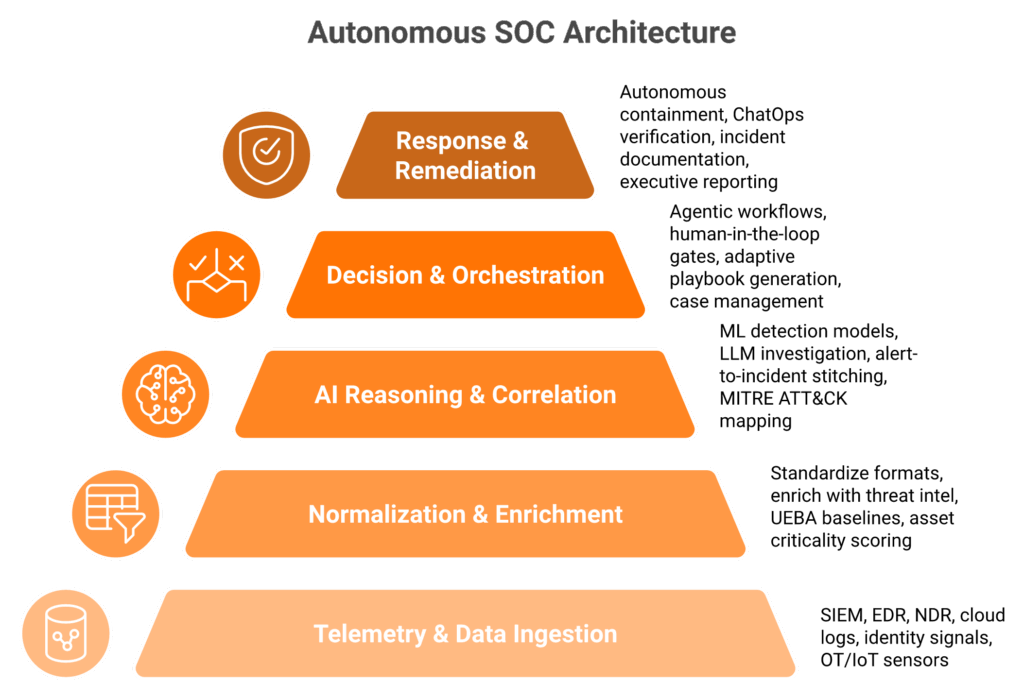
The 5-Layer Reference Architecture
Layer 1: Telemetry & Data Ingestion
This is your data foundation. SIEM logs (Splunk, Sentinel, Chronicle), EDR telemetry (CrowdStrike, SentinelOne, Defender), NDR feeds, cloud logs (AWS CloudTrail, Azure Activity), identity signals (Okta, Azure AD), and OT/IoT sensors. If it generates a security-relevant log, it needs to feed into one pipeline.
Layer 2: Normalization & Enrichment
Raw telemetry is useless without context. This layer standardizes heterogeneous formats, enriches with threat intel feeds, establishes UEBA behavioral baselines, and scores asset criticality. Without this layer, your AI is reasoning on garbage.
Layer 3: AI Reasoning & Correlation
Here’s where the intelligence lives. ML detection models (supervised for known threats + unsupervised for anomaly discovery), LLM-powered investigation, alert-to-incident stitching, and automated attack chain construction with MITRE ATT&CK mapping.
Layer 4: Decision & Orchestration
Agentic workflows, human-in-the-loop approval gates, adaptive playbook generation and execution, and automated case management. This layer determines who decides, the AI or the human, based on confidence thresholds and impact severity.
Layer 5: Response & Remediation
Autonomous containment for pre-approved low-risk actions, ChatOps user verification (Slack/Teams), full incident documentation, and executive-ready reporting.
Core Component Deep-Dive
- ✅ Hyperautomation engine: orchestrates end-to-end workflows across detection, investigation, and response without requiring a separate SOAR platform
- ✅ Agentic AI layer: a multi-agent system that reasons, investigates, and adapts (detailed in Q4)
- ✅ Enterprise data pipeline: normalizes telemetry from heterogeneous sources for unified analysis
- ✅ Open API integration layer: connects 250+ tools (SIEM, XDR, EDR, NDR, SOAR, identity, cloud) without vendor lock-in
- ✅ Automated case management: tracks incidents from detection through remediation with full audit trail
How the Data Actually Flows
Raw telemetry → normalized events → correlated incidents → AI-scored risk assessment → agentic investigation → human-validated or auto-contained response → documented incident report.
The critical design principle: vendor-agnostic architecture. If switching your MDR provider means losing all your correlation rules, detection logic, and integration work, you’ve built a dependency, not a capability. I’ve seen this bite organizations hard. As one CISO I recently spoke with put it: “All of my business logic stays with me, in the event I change MDR providers.”
How UnderDefense MAXI Implements This Architecture
At UnderDefense, UnderDefense MAXI implements this 5-layer architecture natively, ingesting from 250+ tools, correlating across endpoint, identity, and cloud domains, and delivering structured investigation reports to analysts in seconds. The platform works with your Splunk, your Sentinel, your CrowdStrike, preserving tool investments while adding the AI reasoning and human response layers most organizations lack.
Q4. How Do AI Agents, LLMs, and Behavioral Analytics Power an Autonomous SOC?
Everyone says “agentic AI” now. Most can’t explain what it actually means in a SOC context. So let me break it down in practical terms: no hype, no handwaving. Just the mechanics that matter when you’re evaluating whether a platform actually reasons or just runs fancy if-then logic.
What Makes an AI Agent Truly Autonomous in the SOC
An AI agent in the SOC is not a chatbot. It’s not a rules engine with a language model bolted on. It’s an autonomous reasoning system that can:
- Plan multi-step investigations (not just execute pre-built sequences)
- Use tools: query your SIEM, pull endpoint logs, and call threat intel APIs
- Maintain memory across investigation steps (context doesn’t reset between actions)
- Incorporate feedback, learning from analyst corrections and improving
- Coordinate with other agents to parallelize complex investigations
⚠️ If your vendor can’t demonstrate these five capabilities in a live workflow you can observe and reproduce, what they have is automation with better marketing.
Three AI Model Categories Powering Autonomous SOC
| AI Category | What It Does | How It Works |
|---|---|---|
| Detection AI | Identifies known and novel threats | Supervised models (labeled attack data) + unsupervised models (anomaly detection, clustering) |
| Correlation AI | Stitches fragmented alerts into attack chains | Alert-to-incident mapping, MITRE ATT&CK tagging, cross-stack threat scoring, and unified severity rating |
| Response AI | Executes containment actions | Autonomous remediation workflows: isolate endpoint, revoke credentials, block lateral movement, with human gates for high-impact actions |
The key: these three categories work in sequence, not in isolation. Detection AI flags anomalies. Correlation AI connects them into a coherent attack narrative. Response AI acts, but only within pre-approved parameters, with human approval gates for anything high-impact.
LLMs and Generative AI: Practical Capabilities
Generative AI in the SOC isn’t about chatbots answering “what is phishing?” It’s about replacing the 45-minute manual investigation write-up with an instant, structured report that explains what happened, why it matters, and what was done. Practical applications include:
- Natural language investigation summaries, structured, auditable, and ready for executive review
- Natural language querying: “Show me all failed logins from this IP in the last 72 hours” instead of writing KQL or SPL
- Automated playbook generation from incident patterns
- Executive-ready reporting without analyst time spent on formatting
Behavioral Analytics (UEBA) in Autonomous SOC
UEBA establishes baseline “normal” behavior for every user and entity, then flags deviations: impossible login times, unusual data access patterns, and privilege escalation anomalies. Without UEBA, your detection is signature-based, and you’ll miss every insider threat and novel attack vector.
Multi-Agent Architecture in Practice
A properly designed autonomous SOC uses specialized agents that communicate results to orchestrate the full investigation:
- Triage Agent: initial scoring, deduplication, and priority assignment
- Investigation Agent: automated evidence collection across SIEM/EDR/identity
- Enrichment Agent: threat intel lookup, historical correlation, and MITRE mapping
- Verification Agent: ChatOps outreach to affected users via Slack/Teams
- Reporting Agent: structured incident report generation
Each agent is specialized but shares context. The Triage Agent doesn’t just score an alert. It passes that score, the raw evidence, and the enrichment context to the Investigation Agent, which builds on that foundation rather than starting from scratch.
At UnderDefense, UnderDefense MAXI implements this agentic investigation model to automate the mechanical grunt work, not the decisions. Evidence collection, multi-system correlation, user verification, and structured reports. The human analyst receives a complete investigation package in minutes, not hours. “AI collects context, you decide.”
Q5. What Are the 5 Stages of SOC Automation Maturity, and Where Do You Stand?
SOC maturity is not a switch you flip but a continuum. Every security operations center sits somewhere on a five-stage spectrum, from fully manual and reactive to near-autonomous. The problem? Most organizations in 2026 still operate at Stage 0 or Stage 1, burning analyst hours on work that machines should be handling. If you’ve never mapped where you stand, you can’t plan where you’re going. Here’s the framework I use to benchmark SOC teams, whether it’s a 50-person startup or a 30,000-employee enterprise.
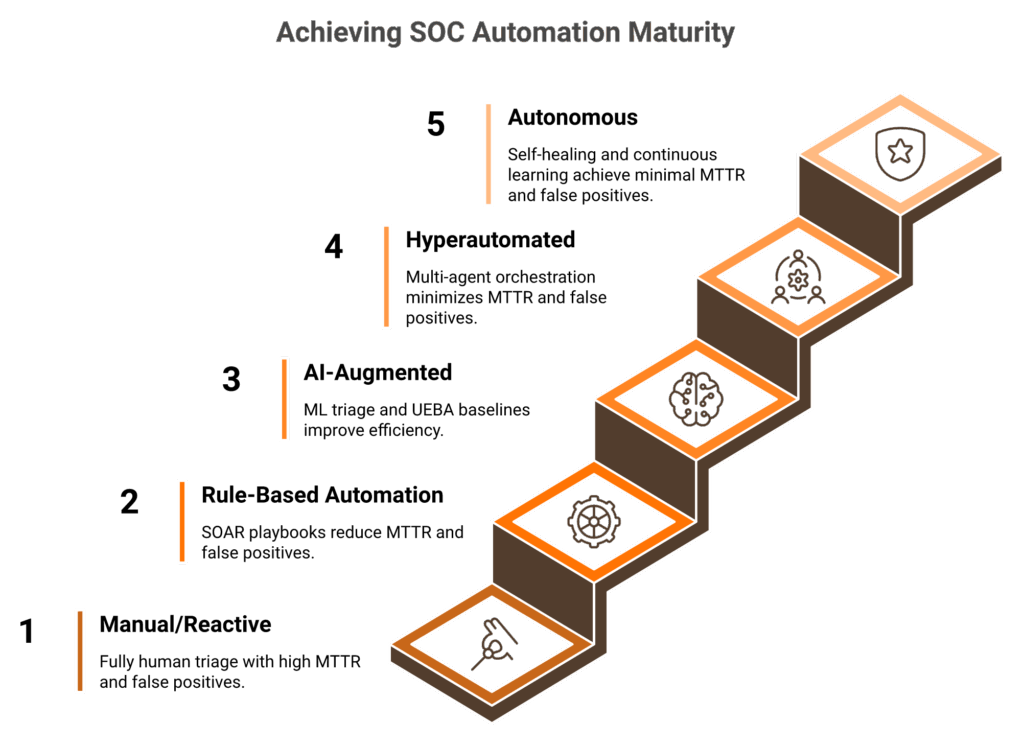
The 5-Stage SOC Automation Maturity Model
| Stage | Name | Description | MTTR Benchmark | Analyst-to-Alert Ratio | False Positive Rate |
|---|---|---|---|---|---|
| 0 | Manual / Reactive | Ticket-based, fully human triage. Analysts investigate every alert by hand. No automation, no playbooks. | 45+ min | 1:50 | 60%+ |
| 1 | Rule-Based Automation | SOAR playbooks handle repetitive if/then workflows. Static rules cover ~60% of common alerts. | 15–30 min | 1:150 | 40–60% |
| 2 | AI-Augmented | ML-driven triage and behavioral analytics. Analyst-in-the-loop for final decisions. AI handles context collection and enrichment at machine speed. | 5–15 min | 1:500 | 15–30% |
| 3 | Hyperautomated | Multi-agent orchestration, cross-domain correlation. Autonomous containment of low-risk incidents (credential revocation, endpoint isolation). Humans focus on high-judgment decisions. | 2–5 min | 1:1,000+ | 5–15% |
| 4 | Autonomous | Self-healing, continuous-learning systems. Human oversight reserved for strategic and high-impact decisions. Full MITRE ATT&CK coverage with adaptive detection logic. | <2 min | 1:5,000+ | <5% |
⏰ Transition Triggers: When to Move Up
Knowing when to advance matters as much as knowing how. Each stage transition has a clear signal:
Stage 0 → 1: Alert volume exceeds 500/day, and manual processes consistently miss SLA windows. Your team is drowning in tickets, not investigating threats.
Stage 1 → 2: Playbook coverage plateaus around 60%, and your false positive rate stubbornly stays above 40%. Static rules can’t keep up with behavioral threats.
Stage 2 → 3: AI triage accuracy exceeds 90%, and your analysts actively trust AI recommendations enough to delegate low-risk containment. This is a cultural milestone, not just a technical one.
Stage 3 → 4: Autonomous containment success rate exceeds 95%, and your governance framework, including audit trails, rollback procedures, and human override authority, is mature enough to support delegation at scale.
The Shadow → Assist → Autonomous Adoption Roadmap
Within each transition, I recommend a three-phase rollout. Skipping phases is how teams lose trust in automation:
Shadow Mode — AI runs in parallel with human analysts. It generates recommendations but takes no action. You compare AI output against human decisions for 30–60 days to build confidence.
Assist Mode — AI triages alerts and drafts response actions. Humans approve before execution. This is where most organizations should live for the longest period.
Full Autonomous Mode — AI acts within pre-approved parameters (e.g., isolating endpoints for confirmed malware, revoking compromised credentials). Humans review post-action and handle exceptions.
✅ Self-Assessment: Where Do You Stand Right Now?
Answer these five questions honestly:
- What percentage of your alerts are triaged by automation vs. humans?
- Can your SOC correlate alerts across endpoint + identity + cloud in real time?
- What’s your current MTTR for critical incidents?
- Do you have agentic AI or only SOAR playbooks?
- Can your system auto-contain low-risk incidents without human approval?
Score interpretation: 0–1 yes = Stage 0 | 2 yes = Stage 1 | 3 yes = Stage 2 | 4 yes = Stage 3 | 5 yes = Stage 4.
How UnderDefense Simplifies the Journey
UnderDefense MAXI operates at Stage 2–3 out of the box: 2-minute alert-to-triage, 15-minute escalation for critical incidents, and 96% MITRE ATT&CK coverage. For teams that don’t have the internal skill to build AI-augmented SOC capabilities from scratch, UnderDefense MAXI bridges the gap with vendor-agnostic integration across 250+ tools and dedicated concierge analysts who handle the operational complexity while your team levels up.
Q6. What Measurable Benefits Does an Autonomous SOC Deliver?
Organizations that advance to Stage 2–3 SOC maturity report 50–90% MTTR reduction, 99% alert noise elimination, 40–60% operational cost savings, and 24/7 threat coverage without proportional staffing increases. Here’s what the data shows:
Key Benefits with Benchmarks
✅ Alert fatigue eliminated: 99% reduction in analyst-facing alerts through AI triage and false positive auto-remediation.
✅ MTTD/MTTR transformation: From 45+ minutes to under 5 minutes for detection-to-triage; from hours to minutes for containment.
✅ 24/7 continuous monitoring without the 3-shift staffing model that burns through budget and talent.
✅ Detection accuracy: 96%+ MITRE ATT&CK coverage with ML-driven behavioral detection vs. signature-only approaches.
✅ Analyst role elevation: Tier-1 triage operators become threat hunters, detection engineers, and AI SOC engineers, doing work that actually grows their careers.
✅ Skills upleveling: Junior analysts learn faster through AI-assisted investigation workflows that surface context, not just raw alerts.
💰 Cost optimization: 40–60% reduction in SOC operational costs, with 240% projected first-year ROI compared to fully manual operations.
✅ Proactive security posture: Shift from reactive alert response to proactive threat hunting, where analysts spend time finding threats, not chasing false positives.
Autonomous SOC vs. Traditional SOC
| Dimension | Traditional SOC | Autonomous SOC (Stage 2–3+) |
|---|---|---|
| Alert Triage | Manual, 45+ min per alert | AI-driven, <5 min per alert |
| Coverage Model | 3-shift staffing or business-hours only | 24/7 continuous, no staffing gaps |
| Detection Method | Signature + static rules | Behavioral ML + cross-domain correlation |
| Analyst Role | Reactive triage operator | Proactive threat hunter / detection engineer |
| Cost per Endpoint | $25–40/month (in-house SOC) | $11–15/month (managed AI SOC) |
| MITRE ATT&CK Coverage | 40–60% (rule-dependent) | 96%+ (ML + behavioral) |
How UnderDefense Delivers These Benchmarks
UnderDefense MAXI delivers these benchmarks operationally: 2-minute alert-to-triage, 96% MITRE ATT&CK coverage, and 99% alert noise reduction, while keeping your existing security stack intact. The 100% ransomware prevention record across 500+ MDR clients over 6 years is not a marketing claim but an operational outcome you can verify.
“They provide incredible service with fast detection time, detailed investigation, and rapid response time with the recommendation on improvement, so it was a no-brainer for us.”
— Yevhenii S., Director of IT, Mid-Market UnderDefense – G2 Verified Review
“UnderDefense detected the threat 2 days faster than CrowdStrike OverWatch in a documented case study, because AI-driven detection without human context still leaves gaps only analysts communicating directly with users can close.”
— UnderDefense Documented Case Study
“We received little value from Arctic Wolf. The product offered little visibility when we were using it.”
— Matt C., Manager, Cybersecurity Services Arctic Wolf – G2 Verified Review
Q7. What Are the Biggest Challenges and Risks of Building an Autonomous SOC?
The path to an autonomous SOC is not a technology problem alone but an organizational, data, and trust challenge. I’ve seen teams invest heavily in AI-powered tools and still fail because they ignored the human and process dimensions. Here are the six core challenges every security leader needs to plan for, along with practical mitigations for each.
Challenge 1: Data Integration and Normalization
Different tools produce different log formats, different telemetry structures, and different severity classifications. Your EDR speaks one language, your SIEM another, your cloud provider a third. AI can only reason as well as its inputs allow, and if your data pipeline is fragmented, your AI will produce fragmented results. Standardizing on common data formats like CEF or OCSF, and validating ingestion quality before enabling AI, is the non-negotiable first step.
Challenge 2: Cultural Resistance and Change Management
SOC teams fear replacement. Managers fear loss of control. Leadership fears liability. These are legitimate concerns, not irrational resistance. The fix is not a memo from the CISO but positioning AI as a career accelerator, not a terminator. When analysts see that AI handles the repetitive triage grind while they graduate to threat hunting and detection engineering, adoption follows naturally.
⚠️ Challenge 3: Skill Gaps and Budget Constraints
AI-first security requires skills, including ML ops, detection engineering, and prompt engineering, that most SOC teams don’t have yet. You can’t build what you can’t staff. Starting with a managed AI SOC partnership bridges the gap while you build internal capability. It’s the same logic as hiring an MDR provider while you’re growing: borrow the expertise until you can own it.
Challenge 4: Trust Deficit in AI Decision-Making
Analysts and leadership need evidence that AI recommendations are accurate before delegating authority. This is exactly why the shadow → assist → autonomous adoption path from Q5 exists. Use shadow mode for 30–60 days before enabling AI-assisted actions. Let your team see the AI’s decisions side-by-side with their own. Trust is earned through observable outcomes, not vendor promises.
❌ Challenge 5: Data Quality and Integrity Risks
Garbage in, garbage out applies to AI SOC with compounding consequences. Incomplete logs, misconfigured telemetry, or stale threat intelligence undermines AI accuracy and creates dangerous false confidence. An AI that says “all clear” when it’s actually blind to half your environment is worse than no AI at all. Implementing data quality scoring and automated integrity checks in the ingestion layer is essential before enabling autonomous actions.
Challenge 6: Over-Reliance and Autonomous Failure Risk
“What happens when the AI is wrong?” is a legitimate question, not a reason to avoid automation but a reason to architect safeguards. Model drift, adversarial manipulation, and edge-case failures are real risks. Establishing governance guardrails, rollback procedures, and never allowing autonomous action on high-impact decisions without human gates addresses this directly. The goal is not blind trust but verified trust.
How UnderDefense Mitigates These by Design
UnderDefense MAXI addresses these challenges architecturally: vendor-agnostic integration across 250+ tools solves data normalization, the “AI investigates, humans decide” model addresses trust and over-reliance, 30-day onboarding bridges the skill gap, and dedicated concierge analysts handle the cultural transition by augmenting your team rather than replacing it. This is not a rip-and-replace pitch but a force multiplier that lets your existing team operate at Stage 2–3 maturity while you build long-term internal capability.
Q8. What Governance, Compliance, and Human-in-the-Loop Safeguards Are Non-Negotiable?
AI in your SOC makes high-stakes decisions: isolating endpoints, revoking credentials, and blocking network segments. Without governance, you’re handing containment authority to models you can’t audit. Score your autonomous SOC readiness against these six governance pillars:
The 6-Pillar AI Governance Framework
☐ (1) Model Validation Cadence — Quarterly red-team testing of AI detection models against novel TTPs. If your AI hasn’t been challenged in 90 days, you’re operating on assumptions, not evidence.
☐ (2) Escalation Policy Design — Define which severity levels require human approval before autonomous action. Critical and high-severity incidents should always have a human gate.
☐ (3) Explainability Requirements — Every AI decision produces a human-readable rationale with an evidence chain. No black-box verdicts.
☐ (4) Human Override Authority — Analysts can reverse any autonomous action within defined SLA windows. Override must be fast, documented, and encouraged, not buried in a ticketing system.
☐ (5) Bias & Drift Monitoring — Track false positive/negative trending monthly. Retrain models when drift exceeds defined thresholds. AI that worked six months ago may not work today.
☐ (6) Audit Trail & Accountability — Every AI action logged with timestamp, reasoning, data sources, and outcome. If you can’t reconstruct why a decision was made, your compliance posture is theatrical, not real.
Compliance Mapping: Autonomous SOC Capabilities × Framework Controls
| Autonomous SOC Capability | SOC 2 (CC6/CC7) | ISO 27001 (A.12/A.16) | HIPAA (§164.308/312) | PCI-DSS (Req 10/11/12) | NIST CSF 2.0 (DE.CM/RS.RP) | DORA (Art. 5–11) |
|---|---|---|---|---|---|---|
| Continuous Monitoring | ✅ | ✅ | ✅ | ✅ | ✅ | ✅ |
| Automated Log Collection | ✅ | ✅ | ✅ | ✅ | ✅ | ✅ |
| Real-Time Alerting | ✅ | ✅ | ✅ | ✅ | ✅ | ✅ |
| Incident Response Documentation | ✅ | ✅ | ✅ | ✅ | ✅ | ✅ |
| Access Anomaly Detection | ✅ | ✅ | ✅ | ✅ | ✅ | ✅ |
| Threat Hunting | ✅ | ⚠️ | ⚠️ | ⚠️ | ✅ | ✅ |
| Vulnerability Correlation | ⚠️ | ✅ | ✅ | ✅ | ✅ | ⚠️ |
⚠️ GDPR and Data Privacy Implications
AI-driven security decisions that process personal data, including user behavior analytics, login monitoring, and email analysis, must comply with GDPR Article 22, which grants individuals the right not to be subject to purely automated decisions with significant effects. This means your autonomous SOC needs a Data Processing Impact Assessment (DPIA) before deployment, meaningful human review on request (not nominal checkbox review), and documented processes for individuals to contest AI-driven decisions. The EU AI Act’s Article 14 goes further: high-risk AI systems require designated humans with training, authority, and ability to interrupt or override before deployment.
Score Interpretation and Gaps
6/6 pillars ✓ = Governance-ready for autonomous operations.
3–5 ✓ = Critical gaps exist. Limit AI to Assist Mode until addressed.
0–2 ✓ = Autonomous SOC is premature. Start with Shadow Mode only.
Controls that autonomous SOC alone cannot satisfy: physical security, policy documentation, employee security awareness training, and third-party vendor risk assessments. Human-in-the-loop is architecture, not a limitation. Full autonomy is not the goal. Optimized human-AI collaboration is, where AI handles speed-critical tasks and humans handle judgment-critical decisions.
How UnderDefense Covers the Governance Gap
UnderDefense MAXI embeds governance by design: AI investigates, humans decide. Compliance evidence is auto-generated, including audit-ready logs, incident timelines, and response documentation that maps directly to SOC 2, ISO 27001, HIPAA, and NIST CSF controls. Forever-free compliance kits are included with the MDR service, not sold as an upsell. Liability is addressed through clear accountability: every action in UnderDefense MAXI has a documented human approval chain, and every AI recommendation includes the evidence trail your auditor needs to sign off on.
Q9. What Does the TCO Look Like, and Should You Build, Buy, or Partner?
Here’s what nobody tells you in the sales pitch: the real cost of 24/7 security operations isn’t the tools. It’s the people, the turnover, the 3 AM on-call rotations, and the six months it takes a new analyst to stop creating more noise than they resolve. Before you pick a path, you need to understand the full cost picture, not just the line items your vendor wants you to see.
⏰ The True Cost of a Traditional SOC
A traditional 24/7 SOC requires a minimum of 8–12 analysts spread across three shifts, plus a SOC manager, a threat hunter, and at least one dedicated incident responder. At average US salaries ($85K–$130K per analyst), staffing alone runs $850K–$1.5M/year, before you add tools, infrastructure, training, and turnover costs.
| Cost Model | Staffing | Tooling & Infra | Hidden Costs | Total Annual TCO |
|---|---|---|---|---|
| Traditional 24/7 SOC | 12 analysts + SOC manager + IR lead | SIEM + EDR + facility | Recruitment ($15K–$25K/hire), 3–6 month ramp, turnover (18-month avg tenure) | $1.5M–$2.5M |
| AI-Augmented Internal SOC | 4–6 analysts + detection engineers | AI platform license + detection engineering | ML ops training, model tuning, governance overhead | $600K–$1.2M |
| Managed AI SOC (Outsourced) | Internal security lead + oversight | MDR provider fee | Integration validation, occasional escalation review | $200K–$500K |
💸 The hidden costs are what kill budgets. Recruitment runs $15K–$25K per hire, training ramp takes 3–6 months to productivity, and your senior analysts end up doing Tier-1 triage instead of strategic work. That’s the most expensive misallocation of talent in any SOC.
✅ Build vs. Buy vs. Partner: A Decision Framework
The right path depends on seven evaluation criteria. Score each honestly, and the answer usually becomes obvious:
- Internal security maturity and existing team size: Do you have 15+ SOC analysts, or fewer than 5?
- Budget model: CapEx-heavy (build) vs. OpEx-friendly (partner)?
- Existing tool investments to preserve: If you’ve invested in Splunk, CrowdStrike, or Sentinel, replacing them to fit a proprietary MDR stack is waste.
- Compliance requirements and audit frequency: SOC 2, HIPAA, and ISO 27001 evidence generation frequency matters.
- Time-to-value urgency: Can you wait 6–12 months to build, or do you need coverage in 30 days?
- Customization depth: Do you need environment-specific detection logic?
- Long-term strategic vision: Are you building a security center of excellence, or do you need a force multiplier?
Build (in-house) = best when you have a 15+ person SOC, large budget, and a unique threat model. Buy (platform) = best when you have 5–15 analysts, existing tools, and need AI augmentation. Partner (MDR) = best when you have fewer than 5 security staff, limited budget, and need 24/7 coverage immediately.
💰 Three Real-World Implementation Scenarios
Scenario 1, Mid-Market (500 employees, 5-person security team, 10K daily alerts): Current maturity Stage 0–1. Recommended path: partner with a managed AI SOC, target Stage 2 in 30 days. Projected cost: $180K–$300K/year vs. $1.2M in-house equivalent.
Scenario 2, Enterprise (5,000 employees, 20-person SOC, multi-cloud): Current maturity Stage 1–2. Recommended path: buy an AI platform and augment with MDR for off-hours coverage. Target Stage 3 in 90 days. Projected cost: $800K–$1.2M/year vs. $2.5M current spend.
Scenario 3, MSSP managing 50+ clients: Multi-tenant architecture, per-client customization, shared AI models with client-specific tuning. Economies of scale in analyst staffing make the managed model increasingly cost-effective per client.
At $11–$15/endpoint/month with transparent published pricing, UnderDefense delivers Stage 2–3 maturity capabilities without the $1.5M+ staffing investment. Model your own scenario using the UnderDefense SOC Cost Calculator. Track ROI through cost-per-incident-investigated, analyst capacity multiplier, and MTTR improvement as breach cost avoidance: IBM’s $4.88M average breach cost × your probability reduction equals your real security ROI.
Q10. Who Are the Leading SOC-as-a-Service Providers for Autonomous SOC Capabilities?
The leading providers delivering autonomous SOC capabilities in 2026 include UnderDefense (vendor-agnostic AI SOC + Human Ally), Arctic Wolf (proprietary platform), CrowdStrike Falcon Complete (ecosystem-native), Stellar Cyber (Open XDR), Swimlane (hyperautomation), and Torq (AI-native SOAR), each with fundamentally different architectural approaches, integration philosophies, and pricing models.
What Separates the Field
The autonomous SOC provider landscape is evolving fast, and the labels are becoming meaningless without scrutiny. Key differentiators aren’t feature lists but architectural commitments that determine whether a provider can actually deliver outcomes or just generate dashboards.
What separates genuine autonomous SOC providers from rebranded monitoring tools:
- Vendor-agnostic integration (works with your existing SIEM/EDR/identity) vs. proprietary stack replacement
- Agentic AI investigation (autonomous reasoning across tools) vs. static SOAR playbooks
- Human analyst response capability (direct containment + user verification) vs. alert escalation only
- Published response time SLAs and pricing vs. opaque “contact sales”
- Compliance evidence auto-generation vs. separate compliance tools required
Choosing the Right Fit
Each provider excels in different scenarios: UnderDefense for organizations preserving existing security investments with transparent pricing, Arctic Wolf for single-vendor simplicity, and CrowdStrike for Falcon-native environments. The right choice depends on your current tool stack, team size, budget, and maturity stage. For a detailed head-to-head comparison with pricing, capabilities, and deployment models:
This provider assessment is based on documented response times, G2 Spring 2026 rankings, published pricing data, MITRE ATT&CK coverage, and operational outcomes across 500+ MDR deployments.
Q11. What Does a Practical Implementation Roadmap and Team Transition Plan Look Like?
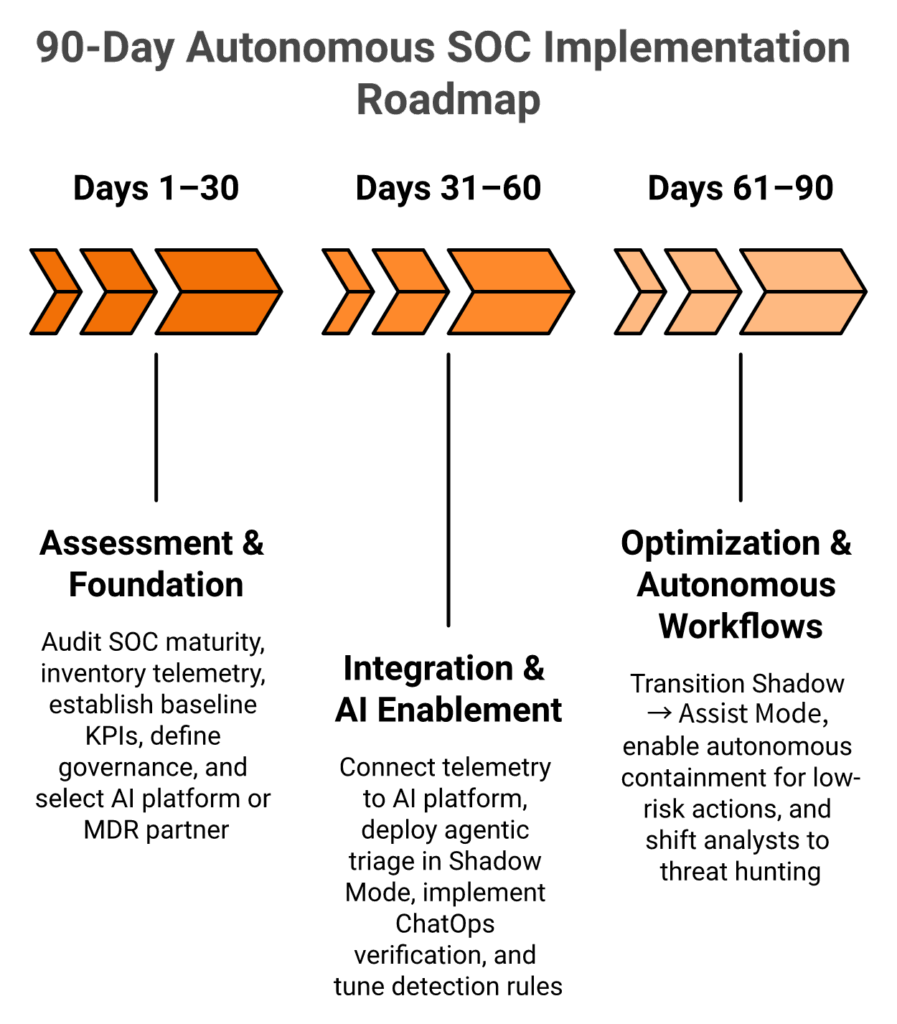
Every autonomous SOC deployment I’ve seen fail had one thing in common: the team tried to flip a switch instead of running a phased transition. Here’s the 90-day roadmap that actually works, built from real deployments, not whiteboards.
Phase 1 (Days 1–30): Assessment & Foundation
Audit your current SOC maturity using the maturity framework from earlier sections. Inventory all telemetry sources. Establish baseline KPIs: current MTTD, MTTR, false positive rate, and alerts per analyst per shift. Define governance policies, and select your AI platform or MDR partner.
Key milestone: SOC maturity score documented, baseline metrics established, governance framework approved.
Phase 2 (Days 31–60): Integration & AI Enablement
Connect all telemetry sources to the AI platform. Deploy agentic triage for Tier-1 alert handling in shadow mode, where AI runs alongside human triage, side by side, so you can validate accuracy before trusting it. Implement ChatOps user verification workflows, tune detection rules for environment-specific false positive reduction, and run parallel operations.
Key milestone: AI triage handling 60%+ of Tier-1 alerts in shadow mode with <5% false negative rate.
Phase 3 (Days 61–90): Optimization & Autonomous Workflows
Transition from shadow to assist mode for proven use cases. Enable autonomous containment for low-risk, pre-approved actions. Shift analysts from triage to threat hunting and strategic work. Establish continuous model validation cadence, document compliance evidence workflows, and define the ongoing maturity advancement plan toward Stage 3–4.
Key milestone: 50%+ reduction in analyst triage workload, measurable MTTR improvement, first autonomous containment actions successfully executed.
⚠️ The SOC Team Transition: Reskilling, Not Replacing
This is the part most vendors skip, and it’s the part that determines whether your team embraces or sabotages the transition. Here’s the role-mapping table:
| Current Role | New Role Options | Focus Shift |
|---|---|---|
| Tier-1 Triage Analyst | Detection Engineer, AI SOC Engineer, or Junior Threat Hunter | From alert queue to tuning AI models, writing detection-as-code, or proactive investigation |
| Tier-2 Incident Responder | Senior Threat Hunter or IR Lead | Focusing on complex multi-stage attacks AI escalates |
| Tier-3 Senior Analyst | AI SOC Architect, Detection Engineering Lead, or Security Strategy Advisor | Designing workflows, governing AI decisions, and advising on strategy |
| SOC Manager | AI-Augmented SOC Director | Managing human-AI workflows and governance oversight |
🔑 Change Management That Actually Works
Four principles from deployments where retention stayed high:
- Communicate early and transparently: share the role-mapping table with your team before implementation starts. Position AI as a career accelerator, not a terminator.
- Invest in upskilling: provide training paths for detection engineering, threat hunting, ML ops, and prompt engineering.
- Run parallel operations: no analyst loses their role until the new role is established and skills are validated.
- Measure success by analyst capability growth, not just headcount or cost reduction.
Flatten the traditional Tier 1/2/3 hierarchy into specialized functions, including Detection Engineering, Threat Hunting, AI Operations, and Incident Response, that collaborate rather than escalate.
When organizations partner with UnderDefense MAXI, internal teams level up. Analysts freed from triage noise focus on strategic security. UnderDefense’s 30-day turnkey onboarding accomplishes Phase 1–2 simultaneously, accelerating the 90-day roadmap.
“UnderDefense act as an extension of our team, so we don’t need additional resources, ensuring 24/7 protection. It also solved our problem of having separate security tools that didn’t work well together.”
— Inga M., CEO UnderDefense – G2 Verified Review
“Their experienced SOC engineers work closely with our team, providing continuous monitoring and threat detection. They delivered the deployment to 1,200 endpoints in just 23 business days.”
— Oleksii M., Mid-Market UnderDefense – G2 Verified Review
Q12. How Does UnderDefense MAXI Accelerate Your Autonomous SOC Journey?
If you’ve read this far, you understand the architecture, the maturity stages, the TCO math, and the team transition plan. Now here’s the reality: most organizations are stuck at Stage 0–1, drowning in alerts from fragmented tool stacks, unable to hire enough analysts to cover three shifts, and watching attackers leverage agentic AI while their SOC operates at human speed. The gap between where you are and the autonomous SOC vision described in this article feels insurmountable, especially when board approval requires TCO justification and compliance proof.
❌ Why Traditional Approaches Fall Short
Arctic Wolf forces proprietary stack replacement, abandoning your existing SIEM, EDR, and identity investments to start over in their ecosystem. One G2 reviewer put it bluntly:
“We received little value from ArcticWolf. The product offered little visibility when we were using it. Anything you want to look at or changes you need to make in the product must go through their engineering team.”
— Matt C., Manager, Cybersecurity Services Arctic Wolf – G2 Verified Review
CrowdStrike Falcon Complete covers only its own endpoint ecosystem. If your environment spans multiple vendors, you’re still fragmented. ReliaQuest provides data visibility without response authority. Traditional MSSPs deliver monitoring without intelligence, offering checkbox coverage based on rigid playbooks rather than real-time threat context. None deliver the “AI SOC + Human Ally” model that autonomous SOC maturity demands.
✅ UnderDefense’s Architectural Advantage
UnderDefense MAXI implements the autonomous SOC architecture natively: 250+ vendor-agnostic integrations (works with your Splunk, Sentinel, Chronicle, CrowdStrike, SentinelOne, Defender, and Okta), agentic AI investigation delivering 2-minute alert-to-triage, ChatOps user verification via Slack/Teams/email, and dedicated concierge analysts who contain threats while your team sleeps. It works WITH your existing security stack, not instead of it. 96% MITRE ATT&CK coverage. We don’t just monitor your environment. We partner with you to defend it.
💰 Capabilities Mapped to What You’ve Learned
- Maturity acceleration: Stage 0→2 in 30-day turnkey onboarding
- Transparent TCO: $11–$15/endpoint/month vs. $1.5M+ internal SOC build
- Compliance evidence auto-generation: Forever-free compliance kits for SOC 2, ISO 27001, and HIPAA
- Governance-by-design: AI investigates, humans decide, and every action is auditable
- Team evolution support: Your analysts level up from triage operators to threat hunters and detection engineers
Model your economics: SOC Cost Calculator | See the platform: Book a Demo
“Not having to worry about ransomware, alert overload, and reporting. Getting a clear view of my security posture, where the threats are coming from, and how they are handled. They literally took care of all our problems.”
— Arlin O., Enterprise (1,000+ emp.) UnderDefense – G2 Verified Review
“The biggest win for me was getting actual control over our security alerts. Before the guys from UD stepped in, we were getting bombarded with alerts from all our security tools. Their team cleaned up our configurations and got the noise under control within the first week.”
— Verified User, Marketing and Advertising UnderDefense – G2 Verified Review
UnderDefense maintains a 100% ransomware prevention record across 500+ MDR clients over 6 years, detecting threats 2 days faster than CrowdStrike OverWatch in documented case studies. The fastest path to autonomous SOC maturity isn’t building everything yourself. It’s partnering with an AI SOC that already operates at the maturity level you’re targeting.
1. What is the difference between an automated SOC, an AI-powered SOC, and an autonomous SOC?
These three terms sit on a spectrum, not in separate categories. An automated SOC runs rule-based SOAR playbooks: if alert X fires, execute playbook Y. It handles the known and expected but stalls on novel threats. An AI-powered SOC adds machine learning for smarter alert scoring and detection, but humans still make every meaningful decision. An autonomous SOC deploys agentic AI that reasons, investigates, and acts across the full security stack with minimal human intervention. The key architectural difference is decision-making: rule-based if-then vs. ML-assisted scoring vs. agentic reasoning. We built UnderDefense MAXI around the principle that fully autonomous is not the goal. The right division of labor is: AI collects context, enriches evidence, and builds structured investigation reports in seconds. The decision to contain, escalate, or remediate stays with a human who understands your business. This “AI SOC + Human Ally” model delivers Stage 2–3 maturity without removing human judgment from high-impact decisions.
2. What are the 5 stages of SOC automation maturity, and how do I assess where my team stands?
Every SOC sits on a five-stage spectrum. Stage 0 (Manual/Reactive) means fully human triage with 45+ minute MTTR and 60%+ false positive rates. Stage 1 (Rule-Based Automation) uses SOAR playbooks covering roughly 60% of common alerts. Stage 2 (AI-Augmented) introduces ML-driven triage and behavioral analytics with analyst-in-the-loop decisions. Stage 3 (Hyperautomated) deploys multi-agent orchestration with autonomous containment of low-risk incidents. Stage 4 (Autonomous) features self-healing, continuous-learning systems with human oversight reserved for strategic decisions. To assess your current stage, answer five questions honestly: What percentage of alerts are triaged by automation? Can your SOC correlate across endpoint, identity, and cloud in real time? What is your current MTTR? Do you have agentic AI or only SOAR playbooks? Can your system auto-contain low-risk incidents? Score 0–1 “yes” = Stage 0; 5 “yes” = Stage 4. We recommend benchmarking against our SOC metrics guide before planning your transition.
3. How much does it cost to run a 24/7 SOC, and should I build, buy, or partner?
A traditional 24/7 SOC requires 8–12 analysts across three shifts, plus a SOC manager and IR lead. At US salaries ($85K–$130K/analyst), staffing alone runs $850K–$1.5M/year. Add SIEM licensing, infrastructure, recruitment ($15K–$25K/hire), and 18-month average tenure turnover, and the total annual TCO reaches $1.5M–$2.5M. An AI-augmented internal SOC drops to $600K–$1.2M. A managed AI SOC (outsourced) runs $200K–$500K. The build/buy/partner decision hinges on seven criteria: team size, budget model (CapEx vs. OpEx), existing tool investments, compliance requirements, time-to-value urgency, customization depth, and long-term vision. Build if you have 15+ analysts and unique threat models. Buy a platform if you have 5–15 analysts with existing tools. Partner with an MDR provider if you have fewer than 5 security staff and need 24/7 coverage immediately. Model your scenario using our SOC Cost Calculator.
4. How do AI agents and agentic AI actually work inside a SOC?
An AI agent in the SOC is an autonomous reasoning system, not a chatbot or rules engine with a language model attached. A true agentic AI can plan multi-step investigations, use tools (query SIEM, pull endpoint logs, call threat intel APIs), maintain memory across investigation steps, incorporate analyst feedback, and coordinate with other specialized agents. A properly designed autonomous SOC uses five specialized agents working in sequence: a Triage Agent (scoring, deduplication, priority), an Investigation Agent (evidence collection across SIEM/EDR/identity), an Enrichment Agent (threat intel, MITRE ATT&CK mapping), a Verification Agent (ChatOps outreach to users via Slack/Teams), and a Reporting Agent (structured incident reports). Each agent shares context so work compounds rather than restarts. If your vendor cannot demonstrate these capabilities in a live workflow, what they have is SOC automation with better marketing. We built UnderDefense MAXI to automate the mechanical grunt work while keeping decision authority with human analysts.
5. What are the biggest challenges of implementing an autonomous SOC?
We have seen six core challenges derail autonomous SOC projects. First, data integration and normalization: different tools produce different log formats, and AI can only reason as well as its inputs. Standardize on CEF or OCSF before enabling AI. Second, cultural resistance: SOC teams fear replacement. Position AI as a career accelerator by showing analysts they graduate from triage to threat hunting and detection engineering. Third, skill gaps: ML ops, detection engineering, and prompt engineering are skills most SOC teams lack. Starting with a managed AI SOC partnership bridges the gap. Fourth, trust deficit: use shadow mode for 30–60 days so analysts observe AI decisions side-by-side with their own. Fifth, data quality risks: implement integrity checks before autonomous actions. Sixth, over-reliance: architect governance guardrails, rollback procedures, and human gates for high-impact decisions. The path forward requires addressing organizational and process dimensions, not just technology.
6. What governance and compliance safeguards are required for AI-driven SOC decisions?
AI in your SOC makes high-stakes decisions: isolating endpoints, revoking credentials, blocking network segments. Without governance, you are handing containment authority to models you cannot audit. We recommend scoring readiness against six pillars: model validation cadence (quarterly red-team testing), escalation policy design (human gates for critical/high-severity incidents), explainability requirements (human-readable rationale with evidence chains), human override authority (fast, documented reversal within defined SLAs), bias and drift monitoring (monthly false positive/negative trending), and audit trail accountability (every AI action logged with timestamp, reasoning, and outcome). For compliance, autonomous SOC capabilities map directly to SOC 2, ISO 27001, HIPAA, PCI-DSS, NIST CSF 2.0, and DORA controls. GDPR Article 22 requires meaningful human review for automated decisions affecting individuals. Score 6/6 pillars to operate autonomous workflows. Score 3–5 means limit AI to Assist Mode. Score 0–2 means start with Shadow Mode only.
7. What does a practical 90-day autonomous SOC implementation roadmap look like?
Every failed autonomous SOC deployment we have seen had one thing in common: the team tried to flip a switch instead of running a phased transition. Our proven 90-day roadmap has three phases. Phase 1 (Days 1–30): Audit current SOC maturity, inventory telemetry sources, establish baseline KPIs (MTTD, MTTR, false positive rate), define governance policies, and select your AI platform or MDR partner. Phase 2 (Days 31–60): Connect all telemetry to the AI platform, deploy agentic triage in shadow mode alongside human analysts, implement ChatOps verification workflows, and tune detection rules. Target: AI handling 60%+ of Tier-1 alerts with <5% false negative rate. Phase 3 (Days 61–90): Transition to assist mode for proven use cases, enable autonomous containment for pre-approved low-risk actions, and shift analysts from triage to threat hunting. Target: 50%+ reduction in triage workload and measurable MTTR improvement. When organizations partner with UnderDefense MAXI, 30-day turnkey onboarding accomplishes Phase 1–2 simultaneously.
8. How do I reskill my SOC team during an autonomous SOC transition without losing talent?
This is the part most vendors skip, and it determines whether your team embraces or sabotages the transition. We use a clear role-mapping framework: Tier-1 triage analysts become detection engineers, AI SOC engineers, or junior threat hunters. Tier-2 incident responders become senior threat hunters or IR leads. Tier-3 senior analysts become AI SOC architects or security strategy advisors. SOC managers become AI-augmented SOC directors. Four change management principles keep retention high. Communicate early by sharing the role-mapping table before implementation starts. Invest in upskilling with training paths for detection engineering, threat hunting, and ML ops. Run parallel operations so no analyst loses their role until the new role is validated. Measure success by analyst capability growth, not headcount reduction. Flatten the traditional Tier 1/2/3 hierarchy into specialized functions: Detection Engineering, Threat Hunting, AI Operations, and Incident Response that collaborate rather than escalate. When analysts see AI handling repetitive triage while their careers advance, adoption follows naturally.