




Best AI SOC for SMBs Under 500 Employees
If you run IT for a company of 50 to 500 people with no security team, the question is which AI SOC will watch your alerts at night, and what it will cost once signed. This guide scores six providers on operational fit, customer validation and pricing honesty for lean IT teams. UnderDefense publishes this guide and ranks the UnderDefense Agentic AI SOC in it, scored on the same criteria as every other provider.
Key takeaways:
- Per-device and per-user pricing keep an SMB AI SOC bill predictable; data-volume pricing grows with every new log source.
- UnderDefense, Huntress and Blumira publish prices; Arctic Wolf and Todyl quote on request.
- Before signing, get the billable-device definition, the minimum commitment and the downgrade terms in writing.
- A 24/7 in-house rota needs four to five analysts, so outsourced coverage usually starts the comparison.
Our Evaluation Criteria
Each provider included in this guide was assessed across five weighted areas:
- SMB Setup & Usability (25%): Time to deploy, ease of use for non-security staff, and onboarding friction
- 24/7 Detection & Response Capability (25%) : Monitoring maturity, threat detection depth, incident response ownership, and MITRE ATT&CK coverage
- Pricing Transparency & Affordability (20%) : Published pricing, minimum commitments, and cost predictability for SMB budgets
- Vendor-Agnostic Integration (15%) : Ability to work with existing security tools without requiring rip-and-replace
- Customer Validation (15%) : Verified reviews on G2, Clutch, Gartner Peer Insights, and community sentiment on Reddit
Who This Guide Is For
This shortlist is designed specifically for:
- SMBs with 50–500 employees evaluating outsourced security operations as an alternative to hiring a full internal SOC team
- IT Directors and CTOs preparing for compliance certification (SOC 2, HIPAA, ISO 27001) who need 24/7 monitoring evidence
- PE portfolio companies and growing SaaS businesses seeking ransomware protection and continuous monitoring
- Organizations with one or two IT generalists who need a security force multiplier and have no time for another dashboard
If your organization is moving toward vendor evaluation or preparing an RFP, the providers below represent established AI SOC partners purpose-built for SMBs operating without dedicated security teams.
| Provider | Best For | Key Strength | Compliance |
|---|---|---|---|
| UnderDefense (93/100) | SMBs without a dedicated security team | AI SOC + Human Ally concierge; vendor-agnostic across 250+ tools | SOC 2, ISO 27001, HIPAA, GDPR |
| Huntress (77/100) | SMBs wanting proven scale via MSPs | 285K+ organizations, per Huntress; ex-NSA-founded human-led SOC | SOC 2, HIPAA, PCI DSS |
| Arctic Wolf (64/100) | SMBs wanting a dedicated concierge team | Named Concierge Security Team + up to $3M warranty | SOC 2, HIPAA, PCI DSS, NIST |
| Blumira (80/100) | SMBs starting from zero SOC infrastructure | Free SIEM tier; deploy in hours with no security expertise needed | HIPAA, SOC 2, PCI DSS, NIST, CMMC |
| Todyl (71/100) | MSP-served SMBs consolidating security tools | Single platform replaces 8+ tools (SASE, EDR, SIEM, SOAR, GRC) | SOC 2, HIPAA, PCI DSS, CMMC |
| Radiant Security (74/100) | Tech-forward SMBs with existing tooling | 100% AI alert triage with fully transparent, auditable reasoning | SOC 2, HIPAA, GDPR |
1. UnderDefense: Best Overall AI SOC for SMBs Without a Security Team (93/100)
📋 Overview
If one or two IT generalists carry your security today, this entry is built for that gap. UnderDefense builds an agentic AI platform that unifies security operations and compliance on top of the stack you already own. The Agentic AI SOC detects, investigates and responds to threats in under 5 minutes, automating Tier 1 and Tier 2 SOC work, while UnderDefense MAXI Compliance AI maps live security data to SOC 2, ISO 27001 and HIPAA.
Analysts confirm suspicious activity with the affected user over Slack or Microsoft Teams before anyone escalates, so your team receives a finished investigation. With 500+ enterprise customers and 150+ incident response experts across three global centers, UnderDefense puts people with hands on the keyboard behind every escalation.
✅ Core Capabilities
- 24/7 Agentic AI SOC coverage: AI agents triage and investigate every alert, and dedicated analysts make the response decisions
- Vendor-agnostic integration across 250+ security tools, works with your existing SIEM, EDR, and cloud stack without forcing replacement
- ChatOps-driven incident response via Slack/Teams with direct user verification and Jira-integrated remediation workflows
- Compliance automation for SOC 2, ISO 27001, HIPAA and GDPR through MAXI Compliance AI, starting with a Free package
- A free platform tier with external attack surface analysis, dark web monitoring and AI threat investigation
- Penetration testing and vCISO advisory services for organizations needing strategic security leadership
🎯 Why SMBs Consider UnderDefense
Many detection providers hand incidents back to your team half-investigated, or ask you to replace the tools you already own. The Agentic AI SOC works on top of your existing stack, whether Splunk, Microsoft Sentinel or CrowdStrike, and its analysts carry each incident through to containment, so your IT generalists receive the outcome and the evidence behind it.
⏰ A Track Record That’s Hard to Ignore
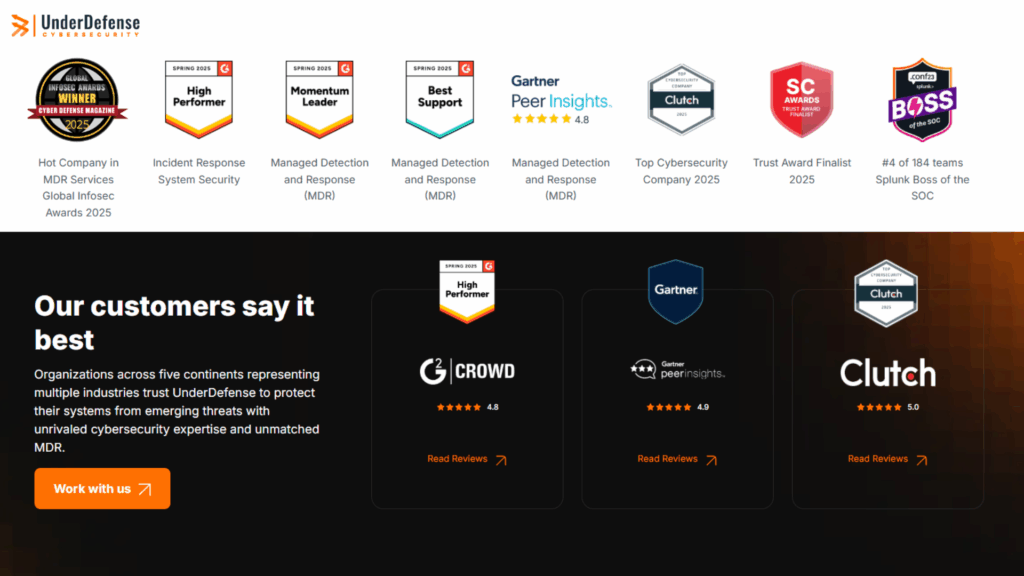
When a critical alert fires at 2 a.m., an UnderDefense analyst responds within the 20-minute SLA for critical alerts, and your IT lead wakes up to the investigation. UnderDefense reports 96% MITRE ATT&CK coverage and that, across six years, no ransomware incident reached impact.
👥 Ideal Customer Profile
- SMBs with 50–500 employees and one or two IT generalists managing security part-time
- Compliance-driven organizations handling customer data under SOC 2, HIPAA, or ISO 27001
- Companies with existing security tools (SIEM, EDR, firewalls) that want to maximize ROI without ripping and replacing
- PE portfolio companies needing rapid security posture improvement across multiple entities
💰 Commercial Model
UnderDefense publishes 24/7 monitoring from $11 per device per month and offers a 14-day free trial, so you can watch the Agentic AI SOC work on your own alerts before you commit a budget line.
⏰ When to Shortlist
Organizations that want both a technology platform and human-led security operations in a single vendor, particularly those that refuse to accept vendor lock-in or opaque pricing, should include UnderDefense during the RFP stage. If your team already runs Splunk, CrowdStrike, SentinelOne, or Microsoft Sentinel and needs someone to actually operationalize those investments 24/7, this is where to start.
💬 Customer Reviews
“We recently worked with UnderDefense on a penetration testing project, and the experience exceeded our expectations. Their team provided us with clear and detailed insights into security vulnerabilities, along with practical recommendations on how to fix them. This level of transparency made it easy for our team to take action and strengthen our security.”
Arman N., CTO, Mid-Market (51–1000 emp.) UnderDefense G2 – Verified Review
“The biggest win for me was getting actual control over our security alerts. Before the guys from UD stepped in, we were getting bombarded with alerts from all our security tools. Their team cleaned up our configurations and got the noise under control within the first week. Now when we get an alert, we know it’s something worth looking into.”
Verified User in Marketing and Advertising, Small-Business (50 or fewer emp.) UnderDefense G2 – Verified Review
2. Huntress: Best for SMBs Wanting the Largest Proven SOC Ecosystem (77/100)
📋 Overview
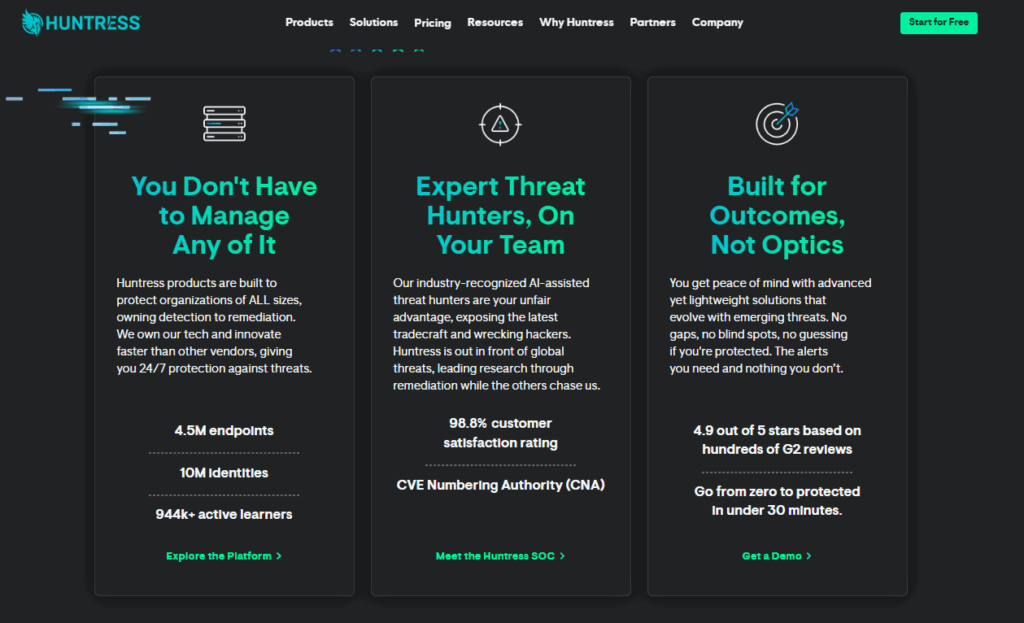
Huntress sells to SMBs at volume: its pricing page says it partners with 285,000+ organizations. Founded by former NSA cyber operators Kyle Hanslovan and Chris Bisnett, the company brings offensive expertise to defensive security and sells mainly through MSP partners.
✅ Core Services
- 24/7 human-led, AI-assisted SOC with investigation, containment, and remediation
- Managed EDR, Identity Threat Detection (ITDR), SIEM, and Security Awareness Training
- Platform deployment in under an hour, according to Huntress
- Free trial available with full functionality and no commitment
- MSP-first distribution model with simple per-endpoint pricing
🎯 Why SMBs Consider Huntress
If you want the reassurance of a platform used by hundreds of thousands of businesses, Huntress delivers it at scale. Its pricing page shows a 4.8/5 rating from 1,200+ G2 reviews, as of October 2026.
👥 Ideal Customer Profile
- SMBs with existing MSP relationships looking for managed security through their IT partner
- Organizations with 10–500 endpoints wanting proven, battle-tested detection
- Budget-conscious teams that want published per-endpoint pricing in managed EDR
💰 Commercial Model
Huntress’s pricing page lists Managed EDR at an MSRP of $8.99 per endpoint a month, or $7.99 at 100 endpoints, with ITDR, SIEM and security awareness training priced per unit. Buying through an MSP carries no Huntress minimum; buying direct or through a reseller requires 50 seats per product on a standard 12-month term.
⏰ When to Shortlist
SMBs that already work with an MSP, or plan to, and want the largest community-validated security platform should evaluate Huntress. Its customer base gives its SOC a wide view of the threats aimed at small businesses.
3. Arctic Wolf: Best for SMBs Wanting a Dedicated Concierge Security Team (64/100)
📋 Overview
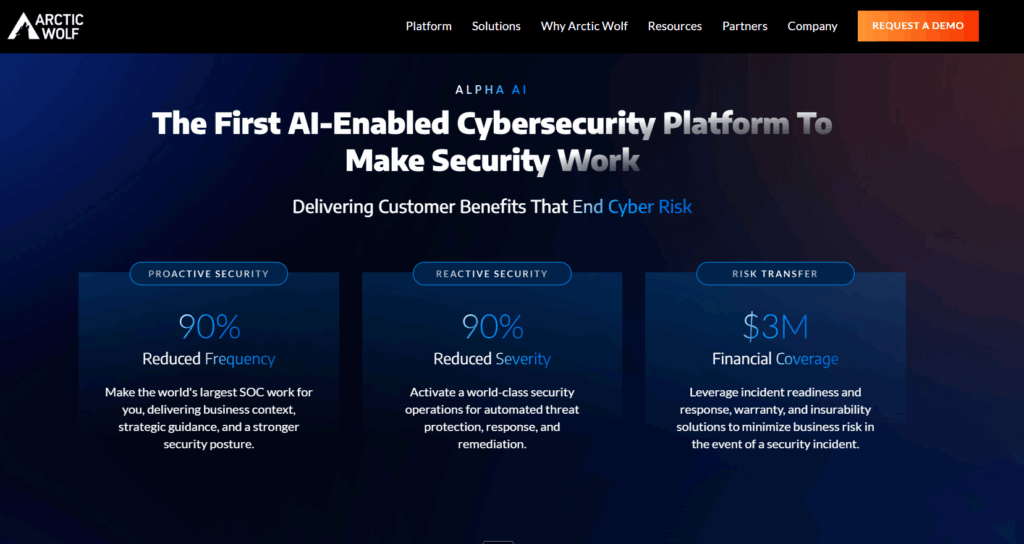
Arctic Wolf delivers a fully outsourced SOC experience on its Aurora platform, with 250+ integrations and 2,700+ MSP and channel partners, according to Arctic Wolf’s website. Its Concierge Security model assigns every customer a named security team, so the same people learn your environment and pair strategic guidance with day-to-day monitoring.
✅ Core Services
- 24/7 Concierge Security Team with named analysts providing ongoing strategic advisory
- Managed Detection & Response, vulnerability management, and cloud monitoring
- Aurora platform for AI-led security operations and workflow automation
- $3M financial coverage warranty against security incidents
- 250 technology integrations across endpoint, network, cloud, and identity sources
🎯 Why SMBs Consider Arctic Wolf
The concierge model appeals to SMBs that want a named security team they can build a relationship with. Arctic Wolf also offers a Security Operations Warranty with up to $3 million in financial coverage, according to its website.
👥 Ideal Customer Profile
- SMBs with 100–500 employees willing to invest in a premium, fully outsourced security operations experience
- Organizations seeking a strategic security partner with advisory beyond day-to-day monitoring
- Compliance-heavy industries (healthcare, financial services) needing continuous risk management
💰 Commercial Model
Arctic Wolf does not publish prices on its website; MDR is quoted through sales and partners and sized to the organization. Ask for the minimum term and seat count in writing before you set the quote against per-device offers.
⏰ When to Shortlist
SMBs with 100 to 500 employees and budgets that support premium concierge service, and organizations that value named relationships over technology-first approaches, should include Arctic Wolf during evaluation.
4. Blumira: Best Free-Tier Entry Point for SMBs Starting From Zero (80/100)
📋 Overview
Blumira is a Michigan-based cybersecurity company focused exclusively on making SIEM and automated detection accessible to businesses with zero existing security infrastructure. Founded in 2018 with $28M in funding, Blumira’s cloud-native platform enables IT generalists without security training to deploy meaningful threat detection in a single afternoon.
✅ Core Services
- Free SIEM edition with 3 cloud integrations and 14 days of data retention
- Automated Detection & Response with sub-30-minute mean time to respond (MTTR)
- Pre-built compliance reports for 13 frameworks including HIPAA, SOC 2, PCI DSS, NIST, and CMMC
- 70+ integrations with flat-rate, per-user pricing (not data-volume-based)
- Deployment in hours requiring ~30 minutes/week of IT generalist time
🎯 Why SMBs Consider Blumira
For organizations that literally have zero SOC infrastructure today, Blumira offers the lowest-risk starting point. Connect Microsoft 365 or AWS in minutes, start seeing security insights immediately, and upgrade to paid monitoring when you’re ready. No vendor lock-in, no data-volume cost surprises.
👥 Ideal Customer Profile
- SMBs with 50–500 employees, zero existing security operations, and a tight budget
- Healthcare, financial services, and government organizations needing compliance-ready monitoring fast
- IT generalists who want to manage security with minimal time investment
💰 Commercial Model
Free tier available with no credit card required. Paid plans start at $12–21/user/month with flat-rate pricing, no data ingestion fees, and no surprise overages.
⏰ When to Shortlist
If your organization has literally zero security monitoring today and needs to start somewhere immediately, particularly ahead of a compliance audit, Blumira’s free tier is the fastest path to visibility.
5. Todyl: Best Unified All-in-One Platform for MSP-Served SMBs (71/100)
📋 Overview
Todyl is a New York/Denver-based cybersecurity platform that replaces up to eight separate security tools with a single, unified offering. Founded in 2017, the company raised $50M in Series B funding in 2024 with Datto founder Austin McChord joining the board. Todyl operates exclusively through MSP/MSSP partners, never selling directly to end customers, ensuring SMBs get local, hands-on support.
✅ Core Services
- All-in-one platform: SASE, EDR/NGAV, SIEM, MXDR, SOAR, and GRC from a single vendor with one agent
- Dedicated Risk and Advisory Manager (DRAM) for every customer regardless of size
- Janus AI case analysis (2026) for natural-language threat investigation
- Channel-only model preserving MSP relationships and local support
- Modular packages quoted through MSP partners
🎯 Why SMBs Consider Todyl
Tool sprawl is a real operational tax for lean IT teams. Todyl’s pitch, consolidating your firewall, EDR, SIEM, SOAR, and compliance into a single platform managed by your existing MSP, resonates with SMBs drowning in point solutions. One user reported cutting onboarding time from hours to under an hour after consolidation.
👥 Ideal Customer Profile
- SMBs that work through an MSP for IT management and want unified security through that partner
- Organizations seeking to eliminate tool sprawl and reduce total security spend
- Not ideal for SMBs that manage IT internally without an existing MSP relationship
💰 Commercial Model
Todyl’s pricing page lists what each package includes and sends every buyer to sales for a quote, and pricing flows through MSP partners. Ask your MSP to price each module on its own line.
⏰ When to Shortlist
If your SMB already relies on an MSP for IT services and wants that partner to deliver security, networking, and compliance through a single platform, Todyl should be on the evaluation list.
6. Radiant Security: Best AI-Native SOC for Tech-Forward SMBs (74/100)
📋 Overview
Radiant Security builds an AI-native SOC platform. Founded in 2021 by cybersecurity veterans from Imperva and Exabeam, the California-based startup raised $15M in Series A funding from Next47 (Siemens’ VC arm) and Lightspeed Venture Partners. Radiant currently protects 30 organizations and over 1 million users/endpoints, the smallest customer base on this list but arguably the most advanced AI approach.
In August 2026, Cribl announced it had acquired the technology assets of Radiant Security’s AI SOC product and is adapting them to run on Cribl’s telemetry platform. Confirm with Cribl how the product is sold today before you add it to a shortlist.
✅ Core Services
- 100% alert triage: Radiant’s AI investigates every single alert, including never-before-seen alert types, with transparent reasoning
- Automates 80–90% of SOC workload out-of-the-box
- Built-in security data lake replacing expensive SIEM with claims of 85% logging cost reduction
- 100+ integrations with 30-minute onboarding (one CISO reported detecting a true positive within 30 minutes)
- Explainable AI: every escalation and dismissal includes full traceability of data sources queried, patterns detected, and reasoning
🎯 Why SMBs Consider Radiant Security
Most SOC tools and even human teams only triage a fraction of incoming alerts. Radiant’s differentiator is investigating 100% of them, with adaptive AI that reasons about entirely new alert types it has never seen before. For tech-forward SMBs that already have security tooling but lack the team to make sense of it all, Radiant turns existing investments into actually useful outcomes.
👥 Ideal Customer Profile
- Tech-forward SMBs with 50–500 employees that have existing EDR, cloud platforms, and identity tools but no SOC team
- Organizations seeking to eliminate the human bottleneck in alert investigation
- Companies comfortable with an earlier-stage vendor backed by strong VC funding
💰 Commercial Model
Custom pricing on a flat-rate model (not consumption-based), making costs predictable for SMB budgets. Specific pricing is not publicly disclosed. Prospective customers should request a tailored quote.
⏰ When to Shortlist
Tech-forward SMBs that want maximum AI automation with full transparency, and are comfortable being an early adopter of a well-funded but smaller-scale platform, should evaluate Radiant Security alongside more established providers.
Q2. How Were These AI SOC Providers Evaluated? (Selection Criteria & Scores)
Each provider was scored out of 100 on five weighted criteria built for SMBs with lean IT teams, using vendor documentation, published pricing and verified reviews. Here’s how every vendor on this list earned its score, and why the criteria carry the weights they do.
⚖️ Five Criteria, Weighted to 100%
Each AI SOC provider was scored across five dimensions specifically calibrated for SMBs with under 500 employees:
| # | Criterion | Weight | What It Measures |
|---|---|---|---|
| 1 | SMB Fit & Lean-Team Design | 25% | Suitability for organizations without dedicated security staff; deployment simplicity for IT generalists |
| 2 | AI SOC Capability & Detection Depth | 25% | 24/7 monitoring maturity, MITRE ATT&CK coverage, AI triage, and incident response ownership |
| 3 | Pricing Transparency & Affordability | 20% | Published pricing, minimum commitments, cost predictability, and freemium options for SMB budgets |
| 4 | Review Quality & Volume | 15% | Verified reviews on G2, Clutch, Gartner Peer Insights, Capterra, and community sentiment on Reddit’s r/msp and r/cybersecurity |
| 5 | Onboarding Speed & Setup Simplicity | 15% | Time from contract to operational monitoring; technical complexity required from the buyer’s side |
Composite Scores
Scores were compiled from vendor documentation, published pricing pages, verified review platforms, and Reddit community threads, all accessed and confirmed active in March 2026. Each total is out of 100.
| Provider | SMB Fit (25%) | AI SOC Capability (25%) | Pricing (20%) | Reviews (15%) | Onboarding (15%) | Total |
|---|---|---|---|---|---|---|
| UnderDefense | 24 | 23 | 19 | 13 | 14 | 93 |
| Blumira | 22 | 18 | 18 | 11 | 11 | 80 |
| Huntress | 20 | 19 | 16 | 14 | 8 | 77 |
| Radiant Security | 17 | 22 | 14 | 8 | 13 | 74 |
| Todyl | 18 | 17 | 15 | 11 | 10 | 71 |
| Arctic Wolf | 14 | 20 | 10 | 12 | 8 | 64 |
📊 Why UnderDefense Leads This Scoring
UnderDefense scored highest in this guide’s own assessment because it combines a free entry tier, published pricing from $11 per device per month, vendor-agnostic integration across 250+ tools and analysts who work in your Slack and Teams channels, which suits a company with one or two IT generalists. No other provider in the table scores at that level on all five criteria.
Arctic Wolf scored lowest mainly on pricing transparency, since it publishes no rates, despite strong detection capabilities.
🔍 A Note on Data Sources
All scores drew from G2 (Spring 2025 and Winter 2026 reports), Clutch verified reviews, Gartner Peer Insights, Capterra, Reddit sentiment analysis across r/msp and r/cybersecurity, vendor pricing pages, and direct website verification conducted in March 2026.
Q3. Why Do SMBs Need an AI SOC, and How Is It Different From MDR, MSSP, or DIY SIEM?
🔓 The SMB Security Paradox
Small companies face the same attacks as large ones with a fraction of the staff. Ransomware appeared in 48% of breaches in Verizon’s 2026 DBIR, and exploitation of vulnerabilities became the most common initial access vector, at 31%.
Most IT Directors and CTOs already know they need monitoring. The security industry built its playbook for enterprises with 20-person SOC teams and seven-figure tooling budgets, so when an SMB buys a SIEM, an EDR and a firewall without dedicated analysts to operate them, the result is noise.
🛠️ The Tech Stack in Plain Language
Before comparing models, here’s what the jargon actually means:
- SIEM (Security Information & Event Management): Collects and correlates logs from across your environment. Think of it as a security camera system that records everything but doesn’t stop anyone.
- EDR (Endpoint Detection & Response): Monitors individual devices (laptops, servers) for malicious behavior. It sees what happens on each machine but not the broader organizational context.
- SOAR (Security Orchestration, Automation & Response): Automates response playbooks when threats are detected. Only useful when someone has actually written and maintained those playbooks.
Tools without a team produce noise.
❌ Why Legacy Models Fail SMBs
| Model | What You Get | What’s Missing | Estimated SMB Cost |
|---|---|---|---|
| DIY SIEM | Log collection, basic alerting | Analysts to investigate; 24/7 coverage; response capability | $50K–$150K/yr (tool + 1 FTE) |
| Legacy MSSP | Checkbox monitoring, monthly reports | Actionable context; real-time response; organizational understanding | $3K–$8K/mo |
| Traditional MDR | Alert detection, escalation tickets | Full response ownership; vendor-agnostic visibility; user verification | $5K–$15K/mo |
| AI SOC | AI-automated triage + human-led response across your full stack | $1K–$8K/mo |
The cost column is this guide’s estimate for a company of 50 to 500 employees. MSSPs give you monitoring without intelligence, applying rigid playbooks to alerts they’ve never contextualized for your environment. Many traditional MDR providers detect and escalate, and remediation still lands back on your team.
🤖 What an AI SOC Actually Does
An AI SOC automates most of the triage, investigation and response cycle that used to need a full analyst team. It reasons across your entire tool stack, correlating endpoint alerts with identity signals, cloud logs and email activity, then acts on confirmed threats before your team wakes up.
✅ The AI SOC + Human Ally Difference
If your team owns SIEM, EDR and identity tools that nobody watches around the clock, the Agentic AI SOC works on top of them: AI agents collect context and spot patterns at machine speed, and analysts make the final call on sensitive decisions. Analysts confirm suspicious activity with affected users in Slack or Teams and contain threats through credential revocation, endpoint isolation and blocking lateral movement, so your IT team receives resolved incidents.
Q4. How Much Does an AI SOC Actually Cost? Real Pricing by Company Size
At published rates, 24/7 coverage for a 100-person company runs from about $9,600 to $14,400 a year across the three providers in the table below that publish prices. Opaque “contact sales” pages don’t help a 150-person company trying to build a security budget. Here’s what AI SOC protection costs at different company sizes, based on published rates.
💰 Pricing Models Explained
AI SOC providers typically price through one of four models:
- Per-device/per-endpoint: You pay for each monitored laptop, server, or workstation. Best for predictable SMB budgets.
- Per-user: Covers all devices a single employee uses. Simpler to forecast when employees have multiple devices.
- Flat subscription: Monthly base fee plus modular add-ons. Works well through MSP partners.
- Data-volume/consumption: Pricing tied to log ingestion volume. Unpredictable and risky for SMBs with growing environments.
For SMBs under 500 employees, per-device and per-user models deliver the most budget predictability. Avoid data-volume pricing unless you can guarantee stable log volumes, which most growing companies cannot.
📊 Estimated Annual Cost by Company Size
| Provider | Pricing Model | 50 Employees | 100 Employees | 250 Employees | 500 Employees |
|---|---|---|---|---|---|
| UnderDefense | $11/device/mo | ~$6,600/yr | ~$13,200/yr | ~$33,000/yr | ~$66,000/yr |
| Huntress | $8.99/endpoint/mo MSRP, lower at volume | ~$5,400/yr | ~$9,600/yr | Under $24,000/yr | Under $48,000/yr |
| Blumira | $12–$21/employee/mo | ~$7,200/yr | ~$14,400/yr | ~$36,000/yr | ~$72,000/yr |
| Todyl | Quote via MSP partners | Contact sales | Contact sales | Contact sales | Contact sales |
| Arctic Wolf | Quote only, no published rates | Contact sales | Contact sales | Contact sales | Contact sales |
| Radiant Security | Custom flat-rate | Contact sales | Contact sales | Contact sales | Contact sales |
Estimates use each vendor’s published pricing, rechecked in October 2026 on the Huntress and Blumira pricing pages. Todyl and Arctic Wolf quote on request, and Radiant Security’s AI SOC technology passed to Cribl in August 2026. Actual costs vary with environment complexity and contract terms.
💸 The Real Comparison: AI SOC vs. Hiring vs. Getting Breached
The numbers above look abstract until you compare them to the alternatives:
- One analyst hire: the US Bureau of Labor Statistics puts the median information security analyst wage at $129,180 (May 2025 data), for one person covering business hours. True 24/7 coverage needs four to five people to fill 168 hours a week, so salaries alone pass $500,000 a year before tools and training.
- Average breach cost: IBM’s 2026 study puts the global average breach at $4.99 million, against an AI SOC budget measured in thousands of dollars a year.
- Hidden costs of DIY: separate compliance tools, SIEM licensing that grows with data volume, and the hours your IT generalists lose to alert triage every week.
✅ Why Transparent Pricing Matters
When you build a business case for your CFO, you need a number before the third sales meeting. UnderDefense publishes its pricing (24/7 monitoring from $11 per device per month) and a SOC Cost Calculator that models in-house against outsourced costs for your environment. A provider that shows its price only on the contract leaves you building the case on guesses.
Q5. How to Choose the Right AI SOC, and Where to Start With Zero Infrastructure
Choose an AI SOC in three steps: score your own readiness, score each provider on seven criteria, then negotiate the contract terms that set the real bill. A provider that forces a vendor-specific stack creates more work than it removes, while the right one gives a lean IT team the coverage of a 20-person SOC.
✅ Security Operations Readiness Checklist
Before evaluating any vendor, score your current posture. Be honest: this score is for your own planning.
- ☐ Do you have true 24/7/365 threat monitoring, including nights and weekends?
- ☐ Does your team verify suspicious user activity directly via Slack, Teams, or phone before escalating?
- ☐ Can you contain a critical threat within 30 minutes of detection?
- ☐ Are your SIEM, EDR, cloud, and identity alerts correlated in one unified view?
- ☐ Does your security monitoring automatically generate compliance evidence (SOC 2, HIPAA, ISO 27001)?
- ☐ Can your team focus on strategic initiatives, or are they consumed by alert triage?
- ☐ Do you have direct access to Tier 3–4 analysts through a channel faster than a ticket queue?
📊 Score Interpretation
| Score | Assessment | What It Means |
|---|---|---|
| 6–7 | Mature | Focus on optimization and threat hunting |
| 3–5 | Critical gaps | You’re likely missing threats or losing hours to alert noise |
| 0–2 | High risk | Reactive processes dominate; coverage gaps expose you to breach risk |
🔍 The 7-Criteria Evaluation Framework
Score each AI SOC provider 0–2 on these criteria. Providers scoring 10+ represent genuine operational partnership; below 7 means you’re buying an alert feed with no one accountable for 24/7 response.
- Vendor-Agnostic Integration: Does it work with your existing stack (SIEM, EDR, cloud), or force proprietary tool replacement?
- Human Analyst Access: Do you get direct communication with Tier 3–4 analysts, or just ticket-based escalations?
- Response Capability: Can they contain and remediate threats, or just detect and notify?
- ChatOps User Verification: Can they communicate directly with affected users to validate alerts, or escalate back to your team?
- Pricing Transparency: Is cost published and predictable per-endpoint, or hidden behind “contact sales”?
- Compliance Automation: Does security monitoring generate audit evidence automatically (SOC 2, HIPAA, ISO 27001, cyber insurance), or require separate GRC tools?
- Onboarding Speed: Does it require 6-month deployment and professional services, or 30-day turnkey implementation?
How to Negotiate Better AI SOC Pricing as an SMB
Once a provider clears the seven criteria above, the per-device rate is only part of the bill. Three terms decide what an SMB actually pays over the contract: what counts as a billable device, the minimum you commit to, and how you cancel or downgrade. Get each one in writing before you compare quotes.
Pin Down What Counts as a Billable Device
Ask for the definition in the contract itself. One provider may count any host that sent data in the past 30 days, so a retired laptop stays on the bill for a month; another may count named users or licensed identities. These questions change the total most:
- Are servers, virtual machines and cloud workloads billed at the laptop rate?
- How often is the count reconciled, and do retired devices drop off?
- Are Microsoft 365 or Google Workspace identities billed on top of endpoints?
- Is there a separate fee for the agent or sensor on each device?
If the answers come back vague, ask for the definition as a contract clause before you compare rates.
Size the Minimum Commitment to the Estate You Run Today
Many SMB contracts set a minimum seat count or a minimum annual fee and bill overages on top of it. Commit to the devices you run today, get the overage rate in writing at the same per-device price, and ask whether raising the minimum mid-term restarts your contract term. Paying annually up front can buy a discount, while monthly billing on deployed devices keeps cash free if headcount is still moving.
Agree Cancellation and Downgrade Terms Before You Need Them
Ask for three clauses before signing: the right to drop a tier or an add-on, such as threat hunting, without a penalty; an exit clause if the provider misses its documented response SLA for critical alerts; and an early-termination fee stated as a fixed number of months. Each one caps what a bad fit can cost you.
With those terms on paper, compare quotes on one number: cost per billable device per year, with the minimum included. A low headline rate with a high floor then shows up for what it is.
Where UnderDefense Stands: 14/14
| Criterion | Score | Why |
|---|---|---|
| Vendor-Agnostic Integration | 2 | 250+ integrations; works on top of your existing stack |
| Human Analyst Access | 2 | Analysts work in your Slack or Teams channels |
| Response Capability | 2 | Analysts contain threats in your environment |
| ChatOps User Verification | 2 | Analysts confirm with users over Slack, Teams, email or SMS |
| Pricing Transparency | 2 | Published 24/7 monitoring from $11 per device per month |
| Compliance Automation | 2 | MAXI Compliance AI, from a Free package |
| Onboarding Speed | 2 | Connects to the tools you run; tuning takes weeks |
| Total | 14/14 |
🗺️ “Zero to Protected” Roadmap
For organizations starting with no SOC infrastructure, a phased approach keeps cost and risk low:
- Week 1: Start a free trial or free tier and connect Microsoft 365, cloud or firewall logs for immediate visibility.
- Weeks 2–4: Review initial findings. Use free-tier data to identify your actual threat surface and build the business case for your CFO.
- Month 2: Upgrade to the paid 24/7 tier, adding human-led monitoring and incident response.
- Month 3+: Expand to compliance automation (SOC 2, HIPAA, ISO 27001) and penetration testing to close remaining gaps.
🔒 Compliance Triggers That Force the Decision
SOC 2 client demands, HIPAA rules and cyber insurance mandates requiring 24/7 monitoring often set the deadline. When the auditor asks for evidence, MAXI Compliance AI maps live security data to SOC 2, HIPAA and ISO 27001 and shares posture through a Trust Center link, so nobody rebuilds a spreadsheet the week before the audit.
Q6. Ready to Protect Your SMB With 24/7 AI SOC Coverage?
You’ve seen the providers, the scoring methodology, the real pricing, and the deployment roadmap. The next step is straightforward: start a 14-day free trial of the Agentic AI SOC, or request a custom SOC quote tailored to your environment and compliance needs.
📋 Before You Request a Quote
Have these four details ready to get the most accurate proposal:
- Current endpoint count: Laptops, servers, and workstations your organization needs monitored
- Existing security tools: EDR (CrowdStrike, SentinelOne, Defender), SIEM (Splunk, Sentinel), identity (Okta, Azure AD)
- Compliance frameworks: SOC 2, HIPAA, ISO 27001, PCI DSS, or cyber insurance requirements driving the decision
- Deployment timeline: When 24/7 coverage needs to be operational, and any audit or insurance date driving it
🚀 Two Paths Forward
Whether you want to estimate costs first or talk to a human, both paths are available:
This analysis is based on verified G2 and Clutch reviews, published pricing data and MITRE ATT&CK documentation.
Q7. FAQ: AI SOC for Small Businesses, Your Questions Answered
1. What is an AI SOC, and how does it differ from a traditional SOC for small businesses?
An AI SOC combines artificial intelligence-driven detection, triage, and investigation with human analyst oversight to deliver security operations at a fraction of the cost of a traditional SOC. In a traditional model, you need four to five full-time analysts to maintain true 24/7 coverage. An AI SOC automates the repetitive investigation steps, including log correlation, alert enrichment, and context collection, then escalates only confirmed threats to human analysts for final decision-making.
For SMBs under 500 employees, this means you get enterprise-grade monitoring without hiring a single security specialist. The AI handles alert volume at machine speed, while dedicated analysts own containment and remediation. The Agentic AI SOC follows this model: AI collects context, analysts make the call, and your IT generalist stays focused on their actual job.
The key distinction from legacy MSSPs or traditional MDR is response ownership: an AI SOC investigates, verifies with affected users, and contains threats itself.
2. How much does an AI SOC cost for a company with 50 to 500 employees?
AI SOC pricing for SMBs varies significantly by provider and pricing model. Based on published rates, rechecked in October 2026:
-
Per-device pricing (most predictable): UnderDefense publishes 24/7 monitoring from $11 per device per month, about $66,000 a year for 500 devices.
-
Per-user pricing: Blumira lists $12 to $21 per employee a month by edition, reaching $72,000/year at 500 employees.
-
Flat subscription: Todyl quotes modular packages through MSP partners.
-
Premium concierge: Arctic Wolf quotes on request and publishes no rates.
For context, a 24/7 in-house rota needs four to five analysts before any tooling. UnderDefense publishes its per-device pricing so you can build a business case without sitting through three sales calls, and its SOC cost calculator compares in-house and outsourced scenarios for your environment.
3. Can a small business get 24/7 security monitoring without hiring a security team?
Yes. This is precisely what AI SOC providers are designed for. By combining AI-automated triage with outsourced analyst coverage, SMBs with one or two IT generalists can achieve round-the-clock protection without a single security hire.
Here’s what that looks like operationally:
-
AI handles the first investigation steps automatically: log queries, threat intel enrichment, cross-tool correlation.
-
Human analysts, available 24/7/365, review escalated findings, verify suspicious activity directly with affected users via Slack or Teams, and execute containment actions like credential revocation and endpoint isolation.
-
Your IT team receives resolved incidents with the evidence attached, freeing the hours that would otherwise go to manual triage.
If you can’t justify a 24/7 SOC payroll, the UnderDefense Agentic AI SOC puts analysts on your alerts around the clock, and a 14-day free trial lets you see it work on your own alerts before you commit.
4. What is the difference between AI SOC, MDR, MSSP, and SOC-as-a-Service?
These terms overlap in the market, but they describe distinct models:
-
MSSP (Managed Security Service Provider): Provides checkbox monitoring and monthly reports based on rigid playbooks. Lacks actionable context, real-time response, and organizational understanding. This guide estimates $3K to $8K a month.
-
MDR (Managed Detection & Response): Detects threats and escalates via tickets, but remediation often lands back on your team. Many traditional MDR providers still leave you to investigate and close incidents.
-
SOC-as-a-Service (SOCaaS): A delivery model where security operations are outsourced as a managed service. Doesn’t specify the technology approach.
-
AI SOC: A technology approach that uses AI to automate triage, investigation, and response at machine speed, combined with human analyst oversight.
The best providers combine SOCaaS delivery with AI SOC technology. The choice between outsourced and in-house SOC models comes down to cost, coverage hours and who owns the response.
5. What compliance frameworks does an AI SOC help with?
A properly configured AI SOC generates continuous compliance evidence across multiple frameworks:
-
SOC 2: Automated evidence collection for trust service criteria (security, availability, confidentiality).
-
ISO 27001: Continuous monitoring mapped to Annex A controls with audit-ready documentation.
-
HIPAA: Protected health information monitoring, access logging, and incident documentation for healthcare organizations.
-
PCI DSS: Cardholder data environment monitoring and log retention for payment processors.
-
NIST CSF: Detection and response capabilities aligned to the NIST Cybersecurity Framework.
-
Cyber insurance: 24/7 monitoring evidence that many insurers now require for policy issuance or renewal.
Client demands for SOC 2 reports, HIPAA regulations and cyber insurance mandates requiring 24/7 monitoring push most SMBs toward an AI SOC. MAXI Compliance AI maps live security data to these frameworks, starting from a Free compliance package, so evidence for your auditor builds up between audits.
6. What red flags should I watch for when evaluating AI SOC vendors?
Five warning signs come up again and again:
-
Opaque pricing: If there’s no published per-endpoint rate and the first number you see is on a contract, expect aggressive upselling and unpredictable costs.
-
Proprietary lock-in: Providers that force you to replace your existing SIEM or EDR with their stack are prioritizing their revenue over your operational continuity.
-
Detection-only service: If the provider detects threats but doesn’t contain, remediate, or respond, you’re paying for alerts and doing the response yourself.
-
No MTTR SLAs: Response time commitments that aren’t documented and published likely mean they aren’t fast.
-
No free trial or free tier: Confident vendors let you validate before you commit.
Each of these AI SOC red flags can be tested before you sign. The core principle is simple: if a vendor can’t show you exactly how they work before you sign, that opacity will persist after you’re locked in.
7. How quickly can an SMB deploy an AI SOC with zero existing infrastructure?
With the right provider, you can go from zero SOC infrastructure to operational 24/7 monitoring in under 30 days. A phased approach works best:
-
Week 1: Deploy the free tier. Connect Microsoft 365, cloud environments, or firewall logs to get immediate visibility into your threat surface. Zero cost, zero risk.
-
Weeks 2–4: Review initial findings with the provider. Use free-tier data to identify your actual risk profile and build the business case for paid coverage.
-
Month 2: Upgrade to the paid 24/7 tier with human-led monitoring and incident response.
-
Month 3+: Expand to compliance automation and penetration testing to close remaining security gaps.
The critical factor is onboarding complexity. Some providers require 6-month deployments with professional services. Others connect to the tools you already run, though detection tuning still takes weeks to a few months. Always ask for documented onboarding timelines before signing.
8. Is an AI SOC worth it for a company with fewer than 100 employees?
Absolutely. In fact, companies under 100 employees often have the most to gain because they face the same threats as larger organizations but with a fraction of the resources. The math is straightforward:
-
Breach exposure: a single incident brings response, legal and lost-revenue costs that can dwarf a year of monitoring.
-
AI SOC cost for 50 employees: As low as $6,600/year ($550/month) with per-device pricing at $11/device.
-
One SOC analyst hire: a full salary for business-hours coverage only.
At $550 a month, a 50-person company gets 24/7 detection, analyst response and compliance evidence for about 5% of the BLS median analyst wage. UnderDefense prices its SOC plans per device to keep this within a small company’s budget, and a 14-day free trial lets you check the value on your own alerts first.
9. How do you check the device count on an AI SOC quote?
Export the device list from your EDR or device management console, for example CrowdStrike, Microsoft Intune or Jamf, and compare it line by line with the count on the quote. Mark servers, virtual machines and shared kiosks separately, then ask the provider to price the reconciled number and confirm it in the order form.
10. What happens to an AI SOC bill if your company shrinks mid-contract?
On many annual contracts, the committed minimum stays billable until the term ends, even if your device count drops. Before signing, ask for a step-down right at each anniversary and the notice period it needs, so a smaller team lowers next year’s bill. Put the clause in the order form, since a sales email does not bind the renewal.
11. What do you get back if you cancel an AI SOC contract?
Ask before signing for an exit clause that returns your detection rules, case history and incident reports in a usable export, plus a set number of days of log access after the end date. If the provider runs on your own SIEM and EDR, your logs already stay with you, which makes switching simpler.