






Three proposals on your desk all promise a “security assessment” before the SOC 2 deadline your biggest customer set. Pick the one that ends with a 40-page report and no owner, and the same findings are still open when that customer’s security review comes back, with the renewal waiting on your answer.
Here is how to tell the four kinds of consulting apart and compare seven firms on what they leave behind.
TL;DR
- Four engagement models: project assessment, fractional or virtual CISO, offensive testing, and compliance program.
- Seven firm profiles with what each leaves behind and its trade-off.
- Proposal questions on scope, staffing, re-tests, and what stays behind after the consultants leave.
- How consulting is priced, using only figures each firm publishes.
Table of contents
This guide compares the best cybersecurity consulting firms for a company of 500 to 5,000 people with a security team of two to five. The examples assume a stack of Microsoft 365, Entra ID, CrowdStrike or SentinelOne, Sentinel or Splunk, and AWS or Azure.
Every firm is judged on one question: what changes in your environment after the report. Facts come from each firm’s own pages, read in November 2026, and where a page is silent, you get the question to ask on the first call.
Disclosure: UnderDefense publishes this article and ranks itself first, using the same template and criteria as every other firm.
Find the controls your next customer security review will question
What a Cybersecurity Consulting Firm Actually Sells: Four Engagement Models
Cybersecurity consulting firms sell four kinds of engagement, and most proposals mix two or three of them. Naming the model behind each line of a proposal is the fastest way to compare three documents written in three different formats.
Proposals use a few labels: GRC (governance, risk, and compliance), IR (incident response), MDR (managed detection and response, 24/7 outsourced monitoring), and OT (operational technology, the systems that run plants and equipment).
The table below puts three of the models side by side, with what each leaves in your environment and when it is the right buy.
| Model | What stays behind | Buy it when |
|---|---|---|
| Project assessment | A findings report and a prioritized roadmap, worth as much as the ownership of each recommendation | You can’t yet say which model your gap needs |
| Offensive testing | Evidence: timestamps, attack paths, and a re-test that confirms the fixes | You need proof of what an attacker can reach and what your detection missed |
| Compliance program | A working program, and often a platform that holds the evidence for the next audit | A SOC 2, ISO 27001, HIPAA, or PCI DSS audit needs gap assessment, policies, evidence, and audit support |
Most proposals mix two or three of these rows, so label each line item with its row before you compare prices.
Hiring these skills takes time you don’t have. The ISC2 2025 Cybersecurity Workforce Study, published in December 2025, found that 95% of respondents reported at least one skill need and 59% reported critical or significant ones. you need is also the hire every other company is trying to make, and a consultant can close the gap when hiring can’t happen before your deadline.
Project Assessment
A project assessment is a fixed-scope review against a framework such as ISO 27001 or SOC 2, ending in a findings report and a prioritized roadmap. What stays behind is the document, so its value depends on whether someone on your team owns each recommendation.
Ask for the roadmap format before you sign. A roadmap that lists each finding with an owner, a date, and an effort estimate can be handed to your two to five people on Monday; a narrative report needs a second project to turn it into tasks.
Fractional or Virtual CISO
A fractional or virtual CISO is a part-time security leader on a monthly retainer who owns the roadmap, reports to the board, and manages vendors. What stays behind is a program with a named owner, as long as the hours in the contract match the work.
Check how many hours a month the retainer buys and what they cover. Board reporting, vendor reviews, and policy approvals each take time, and a leader with too few hours becomes one more person waiting on your team.
Offensive Testing
Offensive testing covers penetration tests, red team engagements (testers act as a real attacker without warning the defenders), and purple team engagements (attackers and defenders work together to tune detection). Each proves what an attacker can reach and what your detection missed. What stays behind is evidence: timestamps, attack paths, and a re-test that confirms the fixes.
The evidence standard matters. A testing report should time-stamp each attacker action next to the moment your SOC reacted, if it did, so your board sees exactly what to fix first. In a purple team assessment UnderDefense ran for a $6 billion food producer, 6 days of C2 (command-and-control, the attacker’s remote channel to infected machines) activity went unnoticed before the simulation surfaced it.
Compliance Program
In a compliance program, a firm runs your SOC 2, ISO 27001, HIPAA, or PCI DSS work month by month: gap assessment, policies, evidence, and audit support. What stays behind is a working program, and often a platform that holds the evidence for the next audit.
For SOC 2 compliance, that means the evidence your auditor samples stays current all year, so audit month brings no scramble.
💡 If you can’t say which of the four your gap is, start with a short project assessment that ends in a roadmap, and buy the other models against that roadmap. That way every later proposal is scoped against findings you already own.
Most companies end up combining two models. A common pairing is an assessment that produces the roadmap and a compliance program or fractional leader who owns it, with offensive testing once a year to prove the fixes held.
Cybersecurity Consulting Firms Compared Side by Side
The table below sets the seven cyber security consulting firms side by side on the two things that decide value: the deliverables you get and whether the firm stays to implement or operate. Published pricing is listed only where the firm prints it.
| Firm | Best for | Engagement models | Typical deliverables | Stays to implement or operate | Published pricing |
|---|---|---|---|---|---|
| UnderDefense | Compliance program on a platform you keep | Compliance program, assessment, testing | Gap assessment, policies, evidence, audit support | Yes, on UnderDefense MAXI Compliance AI | Yes, packages and an hourly rate |
| Bright Defense | Startups and SaaS needing a monthly program | vCISO, compliance program, testing | Roadmap, policies, evidence, pentest report | Yes, monthly plans | Yes, monthly plans and pentests |
| Deloitte | Multi-unit security transformation | Strategy, defense, operate | Strategy, transformation programs, managed operations | Yes, through Cyber Operate | Quoted per engagement |
| Accenture | Security inside a large transformation | Strategy, resilience, managed centers | Strategy, zero trust, OT security | Yes, through cybersecurity centers | Quoted per engagement |
| Protiviti | Security tied to enterprise risk | Assessment, vCISO, managed services | Risk quantification, board reporting, programs | Yes, managed services listed | Quoted per engagement |
| GuidePoint Security | Strategy plus product selection | GRC, vCISO advisory, testing, SOC | Roadmap, program review, product selection | Yes, managed and SOC options | Quoted per engagement |
| Kudelski Security | Advisory, testing, and detection together | Advisory, testing, IR, MDR | Readiness, red team, exposure management | Yes, MDR and IR retainer | Quoted per engagement |
Read the “stays to implement” column first. A firm that only assesses leaves the fixing to your two to five people, which is exactly the capacity you’re short of.
The pricing column shows how few firms print a figure. Two of the seven publish prices; the other five scope each engagement first, so plan a discovery call per firm before you can compare totals.
The 7 Best Cybersecurity Consulting Firms for 2027
Each entry uses the same eight labels in the same order, so you can compare cybersecurity consulting companies line by line. Where a firm quotes per engagement, the entry says so and turns the gap into a question for the first call.
The seven were chosen to cover each way of buying consulting: two firms that publish monthly programs, two global consultancies with operate models, one risk-led advisory firm, and two firms that pair advisory with testing and monitoring. Each entry was written from the firm’s own service pages, read in November 2026.
The ranking reflects this article’s assessment of fit for a company of 500 to 5,000 people with a small security team and a deadline. A different reader, such as a global bank, would rank the large consultancies higher, and the “Best for” line in each heading says who each firm suits.
1. UnderDefense: Best for Companies Facing an Audit That Want the Compliance Program Run on a Platform They Keep
Overview. UnderDefense runs compliance consulting on its own platform, UnderDefense MAXI Compliance AI, so the gap assessment, policies, and evidence your auditor asks for sit in one place your team keeps after the engagement. When the customer’s security review arrives, you share a Trust Center link and skip the week of rebuilding spreadsheets.
UnderDefense is rated 5.0 out of 5 from 83 reviews on G2 as of November 2026 and is ISO 27001 certified.
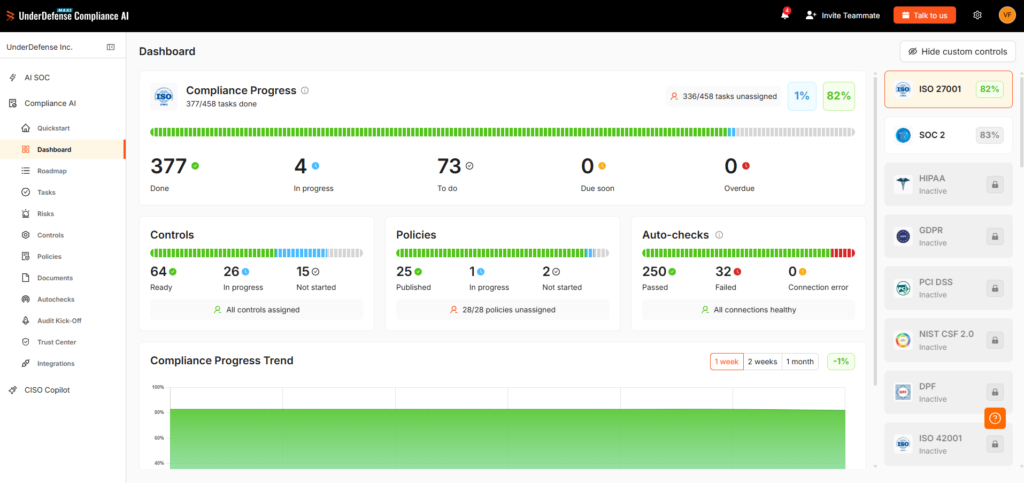
Engagement models offered. A monthly compliance program, a gap assessment as the starting project, and offensive testing through penetration testing services when a framework calls for one. The program covers SOC 2, ISO 27001, HIPAA, GDPR, PCI DSS, DORA, NIST CSF 2.0, and ISO 42001.
What you actually get. MAXI Compliance AI pulls evidence from 250+ integrations, including a Microsoft Entra ID and Microsoft 365 connector, so controls are tested against the tools you run; the Audit Kick-Off view matches you with a partner audit firm within one business day.
Compliance officers work with MAXI Compliance AI to run the gap assessment, generate audit-ready documentation, and monitor your posture against each framework. From the Essential package up, the published compliance packages list custom policy development and roadmap development with remediation guidance, and the Certified package adds audit support and advocacy.
UnderDefense’s own certification is the proof: the company certified to ISO/IEC 27001:2022 on MAXI Compliance AI. Helpware, a global BPO, prepared SOC 2 and ISO 27001 across 8 countries on the platform, reached full production readiness in 8 weeks, and kept the same compliance team while the business doubled.
Who does the work and what stays behind. UnderDefense’s compliance officers do the consulting, and the platform holds the result: controls, policies, and evidence from the tools you already run. Your team keeps that record between audits, so the next one starts from current evidence.
The audit itself is performed by an independent auditor, either a partner audit firm or one you bring. For clients who also run the UnderDefense Agentic AI SOC, the same platform holds the compliance evidence and runs the 24/7 monitoring.
Pricing. Published on the pricing page, read in November 2026: Free, Starter from $499, Essential from $1,299, and Certified from $1,899 per month. The comparison table lists consulting and implementation support of 24 hours a year on Starter, 48 on Essential, and 90 on Certified, with additional consulting at $65 per hour, so you see the help inside each price.
Pros
- The program lives on a platform you keep, so evidence survives a change of consultant
- Prices and consulting hours are published, so you can budget before the first call
- Works on top of the tools you already run, with no rip-and-replace
Cons
- Package prices are “from” figures, so a scope with several frameworks or entities is quoted after a scoping call
Who should skip it. A group running security across several business units and countries, where the global consultancies below are built for that scale.
Check your audit readiness with an UnderDefense compliance expert
2. Bright Defense: Best for Startups and SaaS Companies That Want SOC 2, ISO 27001, or HIPAA Run as a Monthly Program
Overview. Bright Defense is based in Culver City, Los Angeles, and serves clients nationwide. Its “monthly engagement model” combines compliance work with a compliance automation platform, and its site lists CISSP and CISA credentials for the people who lead the work.
For a buyer, the CISA credential signals audit experience, which helps when the program’s goal is passing an external audit. Bright Defense’s site also lists ISO 42001 among its frameworks, which matters if you build AI products.
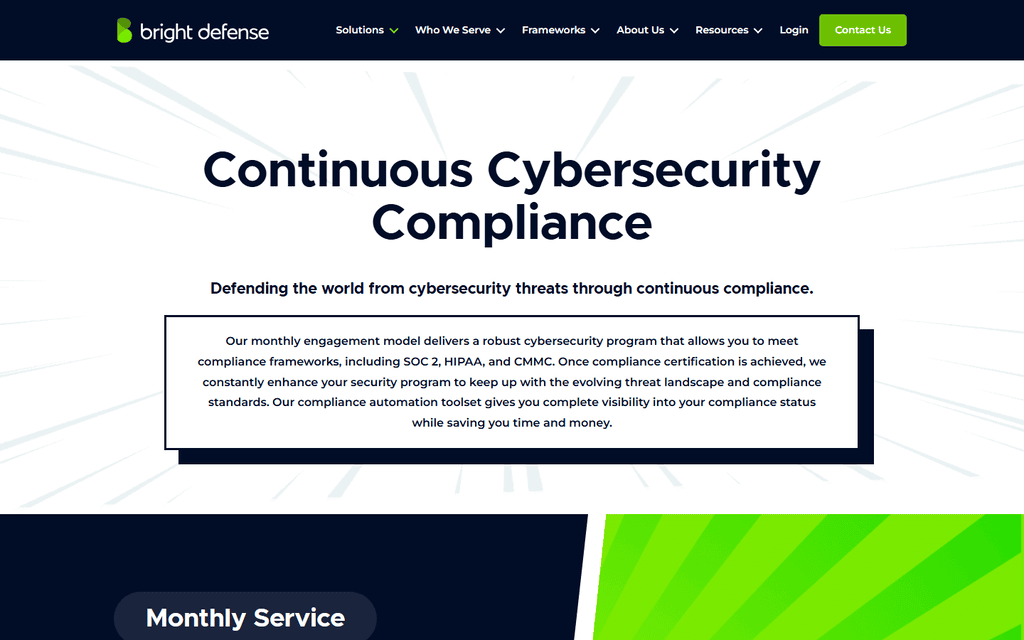
Engagement models offered. A vCISO retainer, a continuous compliance program, and offensive testing. The site’s menu also lists vulnerability management, managed security awareness training, security assessment and remediation, and internal audits, across CMMC, HIPAA, ISO 27001, ISO 42001, NIST, PCI DSS, and SOC 2.
What you actually get. The compliance plan table lists gap analysis, a compliance readiness roadmap, policy and procedure development, risk register management, evidence collection, and remediation tracking. It also lists audit support and advocacy, plus an annual SOC 2 or ISO 27001 audit, so ask which audit firm performs that audit and which plan includes it.
The same table lists incident response planning and testing, third-party risk management, external vulnerability scanning, and a security awareness training program. Security questionnaire management is capped at 10 or 30 a year depending on the plan, which matters if your sales team answers several customer questionnaires a month.
The pentest plans cover web applications and APIs, with Ignite testing 1 web and 1 API endpoint and Summit testing 6 web and 3 API endpoints. Bright Defense positions one pentest report for SOC 2, ISO 27001, PCI DSS, and CMMC requirements; confirm with your auditor.
Who does the work and what stays behind. The plan table lists dedicated vCISO program leadership, and the Sentry plan “includes 24 hours per year of vCISO Services.” What stays behind is a running program on the platform, with continuous control monitoring between audits.
Pricing. Published and read in November 2026: Sentry, Guardian, and Defender plans at $1,000, $2,000, and $3,000 per month, priced for 10 employees or less and one audit framework, so expect a custom quote. Penetration test plans Ignite, Elevate, and Summit cost $2,750, $5,250, and $9,250, with 48, 96, and 176 hours of testing and retest support included.
Pros
- Fixed monthly prices for compliance and fixed prices for pentests, so you know the cost before you start
- Fractional CISO hours come inside the compliance plan
- Pentest plans state their testing hours, so you can compare depth across proposals
Cons
- Fractional CISO time on the Sentry plan is set at 24 hours a year, per the plan table
- Published prices cover 10 employees or fewer and one framework, so a 500-person company with two frameworks needs a custom quote
Who should skip it. A 500 to 5,000-person company with its own security team should confirm how price and vCISO hours scale with headcount and frameworks. If 24 hours a year can’t cover your roadmap, that gap reappears as unowned findings.
3. Deloitte: Best for Multinational Enterprises Running a Security Transformation Across Business Units
Overview. Deloitte’s cyber practice covers strategy, defense, and managed operations for large organizations across many industries and countries. For you, that breadth means specialists exist for nearly any gap, and the question becomes which of them are named on your engagement.
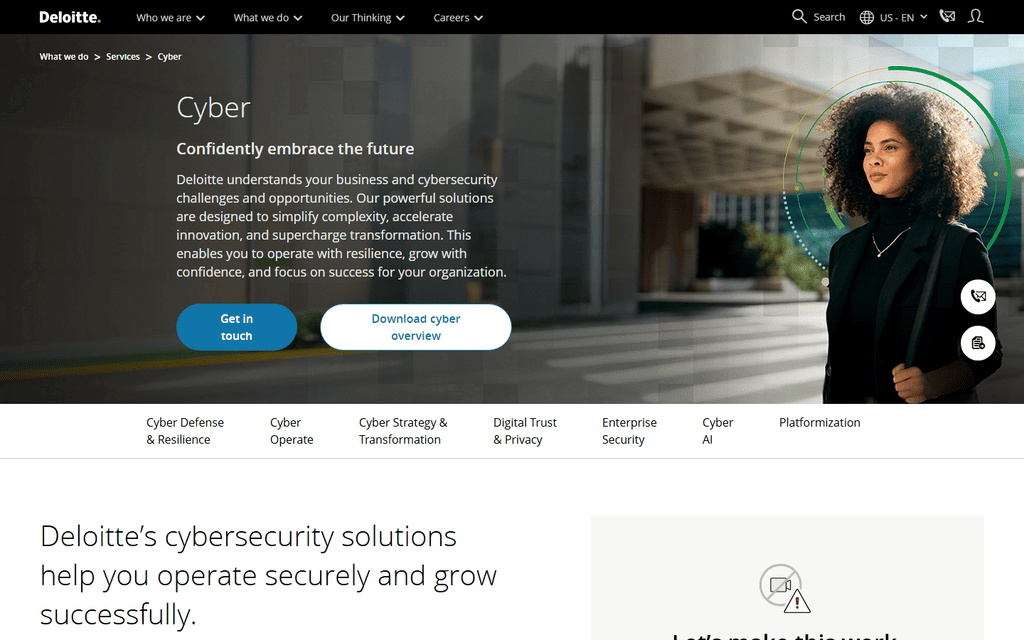
Engagement models offered. The cyber page groups the work into Cyber Defense & Resilience, Cyber Operate, Cyber Strategy & Transformation, Digital Trust & Privacy, Enterprise Security, and Cyber AI. That covers strategy projects, incident response and resilience, and an operate model where Deloitte runs security functions.
What you actually get. Strategy and transformation programs, integrated incident response and resilience work, and security built into development and deployment through Enterprise Security. Deliverables are defined per engagement, so ask for a sample of the named outputs before you sign.
The page also lists Cyber AI services for teams designing or securing AI systems, and industry teams for consumer, financial services, life sciences and health care, energy, government, and technology.
Who does the work and what stays behind. Cyber Operate is the model in which Deloitte runs security functions for a client, so Deloitte can stay to run what it designs. Get the partner, manager, and day-to-day staff named in the statement of work.
Pricing. Quoted per engagement. The cyber page, read in November 2026, offers a “Submit RFP” route and publishes no rates.
Pros
- Strategy, operations, and incident response from one firm across many countries
- An operate model for functions you can’t staff
- Sector teams that know your regulator’s expectations
Cons
- Work is scoped through an RFP and published rates are absent from the cyber page, so budget time for procurement
- In a practice this large, your team’s seniority depends on the names in the statement of work
Who should skip it. A team that needs a fixed-price compliance program running next month. The RFP route suits multi-unit programs with a procurement team behind them. If you do invite Deloitte, send the same scope sheet you send every other firm, so the proposals stay comparable.
4. Accenture: Best for Enterprises That Need Security Built Into a Large Technology or Cloud Transformation
Overview. Accenture sells security as part of strategy and transformation programs. It suits companies where the security project rides on a cloud migration, an ERP rollout, or an OT program that Accenture may already be delivering.
Engagement models offered. Cyber strategy, cyber resilience, cyber protection, quantum security, operational technology security, industry-specific programs, and cybersecurity centers that provide managed services. That spans project work, transformation programs, and ongoing operations.
What you actually get. Strategy work aligned to business goals, resilience programs for threats and new regulations, zero trust protection during transformation, and OT security for connected operations. The page also lists post-quantum readiness for teams with long-lived encrypted data.
Who does the work and what stays behind. Accenture’s cybersecurity centers offer managed services, advanced analytics, and automation, so the firm can run what it builds. Ask how ownership hands back to your team if the managed contract ends.
The page lists partnerships with CrowdStrike and Palo Alto Networks. If you run either, ask whether the same partnership team would staff your engagement, since that shortens the time to a working configuration.
Pricing. Quoted per engagement; the cybersecurity page, read in November 2026, publishes no rates.
Pros
- Security delivered inside the same program as cloud, ERP, or OT change
- Managed operations through its cybersecurity centers
- OT and quantum security practices for industrial or long-horizon risks
Cons
- The page frames engagements around transformation and reinvention, so confirm a minimum engagement size before you invite a proposal for one assessment
- Rates are absent from the cybersecurity page, so any comparison starts with a scoping call
Who should skip it. A company whose need is one compliance deadline or one pentest. If no transformation program is running, a smaller scope from a specialist reaches the same report faster, with fewer findings left waiting for an owner. Accenture fits better when security is one workstream inside a program it already runs.
Turn the gap assessment into a compliance roadmap your team owns
5. Protiviti: Best for Companies That Want Security Tied to Enterprise Risk, Internal Audit, and Board Reporting
Overview. Protiviti delivers cybersecurity consulting across cloud security, data protection, identity, security strategy, cyber risk quantification, managed services, and cyber resilience. Protiviti ties security work to enterprise risk and board reporting, which suits a CISO who reports risk to an audit committee.
Engagement models offered. Project assessments, cyber risk quantification, a fractional leader through the “virtual CISO capabilities” its page names, and managed services. Its client stories include building a standardized vulnerability management program for an auto manufacturer.
A client story describes a Microsoft Purview rollout for a financial services company. For a Microsoft 365 shop, that shows Protiviti implements controls in your own tenant, which is the follow-through a findings report alone can’t give you.
What you actually get. Risk translated into business terms, governance and board-level reporting, and programs across identity, data, and cloud. For you, risk quantification means the board sees findings as exposure and budget, which makes the roadmap easier to fund.
Who does the work and what stays behind. Practitioners across security architecture, risk, identity, and resilience, with “named cybersecurity leaders” brought in “where relevant.” Managed services can keep the program running, and the governance reporting stays with your risk function.
Pricing. Quoted per engagement; the consulting page, read in November 2026, publishes no rates.
Pros
- Security reporting built for audit committees and boards
- Cyber risk quantification links findings to budget
- Managed services and fractional leadership from the same firm
Cons
- Named cybersecurity leaders join “where relevant,” per its page, so the seniority of your team depends on scope; get names into the statement of work
- Cyber is one practice inside a broad business consulting firm
Who should skip it. A company that needs hands-on testing more than risk reporting. If your board already accepts the risk, and the gap is exploitable systems, an offensive testing specialist proves more in less time. Protiviti fits best when the audit committee is the audience for the roadmap.
6. GuidePoint Security: Best for Teams That Need Strategy Help Plus Support Selecting and Implementing Security Products
Overview. GuidePoint Security, founded in 2011, pairs consulting with technology work: it vets security vendors and helps clients select and deploy their products. That helps a team that must pick and deploy tools alongside the strategy, so ask for references in your sector.
Engagement models offered. Governance, risk, and compliance consulting, a virtual CISO advisory, vulnerability management and penetration testing, incident response, staff augmentation, managed security, and SOC options. That covers every model in this guide, plus product resale and implementation.
What you actually get. The GRC page lists a security structure and strategy, a prioritized program roadmap, policy work, risk management programs, and readiness assessments. Its Security Program Review measures program maturity against a framework, which gives you a baseline to re-measure in a year.
On compliance, GuidePoint lists environment review and scope validation, readiness assessments, a review of your IT controls, and formal compliance assessments. The GRC menu adds data security governance, data privacy, an ICS security program review, and M&A security for buyers assessing a target company.
Who does the work and what stays behind. GRC practitioners and consultants who help “plan, build and run” security programs; ask who from that team would staff your engagement, by name. Staff augmentation and managed security can keep the work going after the plan.
The services menu also covers application, cloud, data, email, endpoint, identity, network, and OT security. For a team running Entra ID and CrowdStrike, that breadth means one firm can review the identity and endpoint configuration it recommended in the roadmap.
Pricing. Quoted per engagement; the pages read in November 2026 publish no rates.
Pros
- Strategy, product selection, and implementation from one partner
- A maturity review you can repeat to show progress
- Staff augmentation when the gap is hands, with the plan already clear
Cons
- The same firm evaluates and sells products; its page describes a “vendor-objective approach,” so ask how recommendations are kept independent of resale
- Its pages show no rates, which leaves your budget open until a scoped quote arrives
Who should skip it. A team that already owns its tool stack and only needs a compliance program run. Product selection adds scope you won’t use, and those hours are better spent closing findings. GuidePoint fits best when a tool decision and a roadmap are due in the same quarter.
7. Kudelski Security: Best for Enterprises That Want Advisory, Offensive Testing, and 24/7 Detection From One Provider, Including OT
Overview. Kudelski Security offers advisory, threat exposure management, incident response, managed detection and response, and OT security from one services catalog. For a company with plants or connected devices, one firm can assess, test, and monitor IT and OT together.
Engagement models offered. Strategy, risk, and compliance advisory, including on-demand security leadership; penetration testing, red team, and purple team work; a 24/7 incident response retainer; and MDR. It also lists AI, blockchain, and quantum security assessments.
What you actually get. Readiness assessments, cyber risk quantification, compliance work, zero trust alignment, third-party risk management, and cloud posture assessment on the advisory side. On the testing side, expert-led manual exploitation and red team simulations that test your detection.
Its threat exposure management line adds external attack surface management, risk-based vulnerability management, and continuous validation of your defenses. For your team, that turns a one-time pentest into a running list of exposures ranked by risk, which is easier to assign to owners than a static report.
Who does the work and what stays behind. Advisory consultants for strategy and compliance, offensive testers for validation, and MDR analysts if you buy monitoring. Continuous exposure management can track whether findings get fixed after the consultants leave.
The detection catalog lists CrowdStrike Falcon Complete and an MXDR offer for Microsoft, and the incident response line includes a Cyber Emergency Response Team. If you run CrowdStrike or Microsoft security tools, ask which of these the advisory team would recommend, and why.
Pricing. Quoted per engagement; the services page, read in November 2026, publishes no rates.
Pros
- Advisory, testing, incident response, and monitoring from one provider
- OT and cyber-physical security practices for manufacturers and utilities
Cons
- The catalog spans advisory through MDR, so confirm which parts your proposal includes and which are separate contracts
- No rates appear on the services page, so price comparison waits for the proposal
Who should skip it. A company that needs only a compliance program run on a schedule. The breadth that helps an OT manufacturer adds scoping work for a team whose problem is one audit, and an unclear scope is how findings end up unowned. Kudelski fits best when OT, testing, and monitoring all sit on the same roadmap.
How to Compare Consulting Proposals Line by Line
Proposals from three cyber security consulting companies become comparable once you ask each firm the same questions in writing. Send this list before the first call, and score the answers side by side:
- Which of the four engagement models is each line item?
- Name each deliverable, with a redacted sample.
- Who does the work: partners, seniors, or junior staff, by name?
- What happens to each finding: who owns it, by when?
- Are re-tests included, and on what terms?
- How many hours of follow-through are included after the report?
- Where do evidence and documents live when the contract ends?
- What are the exit terms, and what do you keep?
The ownership question decides most outcomes. A finding without an owner and a date is the same open item your auditor or customer will raise again, so a firm that assigns owners in the roadmap saves you a second assessment.
⚠️ Watch the staffing answer closely. A proposal that names a partner for the kick-off and leaves the rest of the team unnamed often means juniors will do the work, so get names in the statement of work before you sign.
Re-test terms show whether the firm expects its findings to be fixed. A pentest that includes a retest proves the fix worked, while a report with no retest leaves your team to prove it to the auditor alone.
The evidence question matters at renewal. If your policies, evidence, and roadmap live in the consultant’s spreadsheets, a change of firm means rebuilding them, so ask for the evidence in a system your team keeps.
Score the answers on one sheet, one column per firm. A firm that answers every question in writing, with names and samples, is usually the firm that runs the engagement the same way.
Three answers are red flags. A deliverable described only as “recommendations,” a team listed by title with no names, and evidence that stays on the firm’s systems all point to a report your team will have to rebuild before the next audit.
Match each proposal to your gap. If your problem is ownership, the strongest proposal includes a named leader and monthly hours; if it’s an audit date, the strongest one includes the evidence platform and audit support; if it’s proof for the board, it includes testing with a re-test.
How Cybersecurity Consulting Is Priced
Cybersecurity consulting services are priced in four ways, and each one rewards a different kind of firm behavior. Knowing the model behind a quote tells you what the firm is paid to deliver.
Fixed Project
A fixed project has one price for a defined scope, and it’s common for assessments and pentests. Bright Defense’s pentest plans state their testing hours next to the price, so you can compare depth per dollar across proposals.
Retainer
A retainer is a monthly fee for ongoing work, typical for fractional CISO and compliance programs. Check how many leadership hours the fee buys.
Hourly or Day Rate
An hourly or day rate bills for time, which is common for advisory and remediation work. A published hourly rate, such as UnderDefense’s for additional consulting, turns extra remediation into a figure you can budget before you need it.
Hours Bundled Into a Platform Package
Some firms put consulting hours inside a monthly platform subscription. Check how many hours a year each tier includes and what happens when you use them up.
What Moves a Quote
Deloitte, Accenture, Protiviti, GuidePoint Security, and Kudelski Security quote per engagement on the pages read in November 2026. Scope, frameworks, entities, environments, staffing level, and re-test terms are what move those quotes.
Each extra framework adds controls to map, and each extra legal entity or cloud account adds evidence to collect. Ask every firm to price the same scope sheet, listing frameworks, entities, cloud accounts, headcount, and the scope of any GDPR compliance services you need, so the totals you compare describe the same work.
💡 Compare any retainer against the cost of a hire. The Bureau of Labor Statistics Occupational Outlook Handbook, in its 2025 data, puts the median pay for an information security analyst at $129,180 a year, before benefits and recruiting.
BLS also projects 21% job growth for the role from 2025 to 2035, so hiring will stay competitive while your deadline doesn’t move. Settle where the money goes during security budget planning, before the proposals arrive.
When the deadline is a SOC 2 or ISO 27001 audit, compliance consulting that runs on a platform you keep turns the report into a program that keeps working after the consultants leave. The evidence for the next audit then builds up month by month.
Get a compliance program that keeps running after the report
- Find the gaps your connected tools show today
- Get 24, 48, or 90 consulting hours a year, depending on the package
- Get matched with a partner audit firm within one business day
Frequently Asked Questions
What does a cybersecurity consulting firm do?
A cybersecurity consulting firm supplies skills your team lacks for a defined period: assessments, a fractional security leader, offensive testing, or a compliance program. The best ones leave something that keeps working after they go, such as a roadmap with owners, implemented controls, or evidence held in a system you keep.
Do I need a consultant or a vCISO?
You need a consultant when the gap is a defined project with an end date, such as a gap assessment or a pentest. You need a fractional or virtual CISO when the gap is ongoing ownership: someone who runs the roadmap, reports to the board, and manages vendors month after month.
How much do cybersecurity consulting firms charge?
Pricing depends on the model: fixed project, monthly retainer, hourly rate, or hours bundled into a platform package. Of the seven firms here, only Bright Defense and UnderDefense publish prices; the others quote per engagement, so compare quotes by scope, named staff, and re-test terms.
What should a cybersecurity assessment report include?
A useful report names each finding with its evidence, rates it by business risk, and assigns an owner and a date in a roadmap. For offensive testing, it should include timestamps, attack paths, and re-test results, so your board sees what was fixed and what remains.
Can a consulting firm also run our security operations?
Yes, several can. Deloitte, Accenture, Protiviti, GuidePoint Security, and Kudelski Security list managed or operate options on their pages. Keep operations in a separate contract from the assessment, so each one can be judged on its own results.