









Your board, or for an EU financial entity your regulator, wants proof that the SOC would catch a targeted attacker, and last year’s pentest report doesn’t answer that. Pick the wrong red team provider, and the year’s budget buys a report that still can’t tell the board whether anyone noticed.
Here is how to choose the provider whose report answers that question.
TL;DR
- What a red team company sells: an agreed objective, a threat-led scenario, stealth, and a detection timeline.
- Seven criteria and a side-by-side table of nine providers, each reviewed on one template.
- A due-diligence checklist borrowed from the EU’s 2025 red team rules under DORA, the Digital Operational Resilience Act.
- Which model fits your program: point-in-time, purple team, or continuous.
Table of contents
- What You Buy From a Red Team Company
- The Due-Diligence Checklist EU Regulators Wrote for Red Team Providers
- Seven Criteria for Comparing Red Team Companies
- Red Team Companies and Their Red Team Services Compared Side by Side
- The 9 Best Red Team Companies for 2027
- Four Criteria the Table Leaves Out
- Point-in-Time, Continuous, or Purple Team: Which Model of Red Teaming Services Fits
- Frequently Asked Questions
This guide compares nine red team companies on how they scope the objective, run the rules of engagement, and report what your detection and response missed. Every entry uses one template, and every firm is judged on the same seven criteria.
The facts come from each company’s own pages, read in November 2026. Where a page is silent on something you care about, treat it as a question for the sales call.
You’ll finish with a shortlist of three, a due-diligence checklist to send to each, and a clear view of which engagement model fits.
Disclosure: UnderDefense publishes this article and ranks itself first, using the same template and criteria as every other entry.
Find out if your SOC would catch a targeted attacker
What You Buy From a Red Team Company
A red team company sells proof of what your SOC does when a specific attacker goes after a specific goal. Two terms come up in almost every entry below: assumed breach, where testing starts as if an attacker already holds a foothold inside your network, and purple team, where testers and your analysts replay the attack together.
A penetration test lists weaknesses in a defined scope, while a red team engagement measures whether anyone noticed those weaknesses being used. If your known findings are still open, red teaming vs penetration testing is the decision to settle before any shortlist.
Four things separate this purchase from the pentest you already run. Each one below is something to ask for in writing.
An agreed objective. You and the provider pick a goal the testers must reach and prove, usually called a flag. Good flags sit close to the business: approving a payment, reading a VIP mailbox, or holding Entra ID global admin rights. A flag keeps the engagement honest, because the report has to say whether it was reached.
A threat-led scenario. The provider builds the attack around the groups likely to target your sector and the techniques they use. A healthcare SaaS company and a payments firm should get different scenarios, even with the same CrowdStrike and Sentinel deployment.
Stealth. Your analysts, the blue team, work the activity as they would any other alert. Under Commission Delegated Regulation (EU) 2025/1190, the 2025 rules for threat-led penetration testing (TLPT) under DORA, the control team lead tells the blue team a test took place once active testing ends. Commercial engagements follow the same logic, and that secrecy is why the result means something to your board.
A detection timeline. This is the deliverable you’re paying for. Annex V of the same regulation requires a red team report to list flags reached and not reached, attack paths that worked and failed, and the blue team actions the testers observed.
⏱️ Your version should add timestamps, so each attacker action sits next to the moment your SOC reacted, if it did. Ask every provider for a redacted sample report before you ask for a price. If the sample can’t show both times, it can’t answer your board’s question.
The Due-Diligence Checklist EU Regulators Wrote for Red Team Providers
The EU wrote a public selection checklist for red team providers with hard numbers in it, and you can borrow it wherever you operate. Article 7 of the 2025 TLPT regulation tells a financial entity’s control team what to collect from threat intelligence providers and external testers before a test.
It binds EU financial entities only, so a buyer in the United States has no duty to apply it. Its numbers still give you a pass-or-fail test for an RFP, so a weak provider drops out before the sales call. Send these items to each company on your shortlist:
- A detailed CV for each tester and threat intelligence analyst, with copies of their certifications
- Professional indemnity insurance that covers misconduct and negligence
- At least five references from earlier penetration testing and red team assignments, and three from the threat intelligence provider
- A red team manager with at least 5 years of penetration testing and red team experience, plus at least two testers with at least 2 years each
- A red team with combined participation in at least five previous assignments
- Skills that fit the role: for testers, knowledge of your business, reconnaissance, risk management, exploit development, physical penetration, social engineering, and vulnerability analysis
- A threat intelligence manager with at least 5 years of experience, one more member with at least 2 years, and at least three previous assignments between them
- Separation between threat intelligence staff and testers when one provider supplies both, and no blue team overlap: neither group can be doing blue team tasks for you at the same time
- Restoration at the end of testing: command-and-control deactivation, scope and date kill switches, removal of backdoors and malware, and secure deletion of compromised credentials
- No unauthorized destruction of equipment, uncontrolled changes to data, deliberate disruption of critical functions, out-of-scope systems, or unauthorized disclosure of results
👥 The experience numbers tell you who will be on your network: a firm that can’t name a 5-year manager and two 2-year testers is staffing your test with juniors. The five references are the fastest check, because a firm that can’t produce them hasn’t run many engagements like yours.
The overlap item deserves a direct question. Article 1 counts SOC work as a blue team task, so ask any provider that also monitors your environment how it would keep the two teams apart.
The regulation allows exceptions. In exceptional circumstances, a financial entity may hire a provider that misses one or more of the requirements on CVs, insurance, references, experience, and team separation, as long as it adopts and records measures to mitigate that risk.
Outside the EU, you can use the same approach and note any gap in your vendor file. If you follow TIBER-EU, the European Central Bank’s red teaming framework, the ECB’s February 2025 update also added guidance on how to assess the quality of a provider.
Seven Criteria for Comparing Red Team Companies
These seven criteria turn a sales conversation into a comparison you can defend to your board. The table, its wrap-up, and the entries apply them, and where a page is silent, you get the question to ask.
1. Threat-Intelligence-Led Scenarios
Ask who builds the scenario and from what evidence. In a TLPT, testers base their attack scenarios on a targeted threat intelligence report. Ask a commercial provider for the same order of work: which groups target your sector, and which of their techniques apply to your Entra ID and AWS estate.
2. A Named Team and Its Experience
Ask for the names of the people who will run your test, then match them to the checklist above. A firm’s research group or former government operators only help you if those people are assigned to your engagement, so get the names in the statement of work.
3. Rules of Engagement and a Control Team
Rules of engagement set the limits, and the control team is the small group who know the test is happening. The ECB’s 2025 TIBER-EU update changed the name “White Team” to “Control Team,” so expect both terms. Ask what happens when your SOC escalates the testers at 2 a.m. and who decides whether the test continues.
4. Purple Team Replay With Your SOC
Replay is where your analysts see what they missed and why. Article 12 of the TLPT regulation has the blue team and testers replay their actions within 10 weeks of active testing ending, and the control team also runs a purple teaming exercise.
That 10-week deadline means your analysts replay the attack, and start fixing detections, no more than about two and a half months after active testing ends. Ask whether replay is included in the price or sold as a second project.
5. A Report That Maps Detection Gaps to MITRE ATT&CK
MITRE ATT&CK gives you and the provider a shared way to say which techniques were tried, seen, and missed. Annex V doesn’t name it, so add it as your own buying requirement. Ask for a sample with a timestamp beside each technique, so your detection engineers can write rules from it.
6. Remediation and Retest
Ask what happens after the report lands. Annex V requires a root cause analysis of successful attacks and remediation recommendations with a priority, and those fields decide whether your team can act on the report. Then ask whether a retest is included, quoted separately, or left to you. A retest in the price is the stronger offer, because it proves the fix worked without a second purchase order.
7. Regulated-Test Experience (TLPT, TIBER-EU, CBEST)
If a regulator names you, experience has to be stated by the provider and confirmed with references. DORA TLPT, TIBER-EU, and CBEST (the Bank of England’s scheme for UK financial firms) are separate schemes, so ask about the one that applies to you. A silent web page doesn’t prove a firm lacks the experience, and a claim on a page still needs a reference behind it.
Red Team Companies and Their Red Team Services Compared Side by Side
The table shows what each company states on its own pages, read in November 2026. “Point-in-time” is this article’s label for a single scoped engagement; SpecterOps rejects the term for its own work, so its row uses its wording. “Not on red team page” means exactly that, so ask the company directly.
| Company | Best for | Engagement model | Threat-intelligence-led scenarios | Regulated testing stated on site | Published pricing |
|---|---|---|---|---|---|
| UnderDefense | Purple team work with your blue team; DORA threat-led tests | Point-in-time, purple team | Stated | TLPT | Pentests from $5,000 (published tiers); red team quoted |
| Mandiant (Google Cloud) | Scenarios built from incident response | Point-in-time, purple team | Stated | Not on red team page | Quoted per engagement |
| CrowdStrike | SOC training during an attack | Point-in-time, red and blue exercise | Stated, by vertical | Not on red team page | Quoted per engagement |
| Rapid7 | Continuous external red teaming | Continuous, point-in-time | Intelligence team input stated | DORA TLPT preparation and support | Quoted |
| Bishop Fox | Modular work with an attack timeline | Point-in-time, continuous, purple team | Stated | DORA TLPT support stated | Quoted per engagement |
| Praetorian | Board-level proof | Point-in-time, purple team | Threat model, nation-state emulation | Not on red team page | Quoted per engagement |
| NetSPI | Regulated financial testing | Point-in-time, scenario-based | Stated, with partners | DORA, TIBER-EU, CBEST | Quoted per engagement |
| TrustedSec | Full scope with physical entry | Point-in-time, purple team | Stated | Not on red team page | Quoted per engagement |
| SpecterOps | Assumed breach with established detection | Single-objective engagement, purple team | Not on services page | Not on services page | Quoted per engagement |
NetSPI is the one company here that names DORA, TIBER-EU, and CBEST together on its red team page. Rapid7’s Vector Command is built around continuous work, and Bishop Fox lists continuous or recurring campaigns as one of several types.
💰 No company on this list publishes a fixed red team price on its service page. UnderDefense publishes its penetration test tiers and quotes red team work per engagement, so your scope sets the figure.
To get to a shortlist of three, start from your trigger. If a regulator is asking under DORA, look at UnderDefense, which runs DORA threat-led testing, NetSPI, Bishop Fox, and Rapid7, then confirm each claim with references.
If your board wants independent proof, compare Mandiant, Praetorian, and Bishop Fox. If you want your analysts to improve during the test, compare UnderDefense (purple team work with your blue team, as in the food producer case below), CrowdStrike, TrustedSec, and SpecterOps. For clients who also run the UnderDefense Agentic AI SOC, red team findings also become detections.
The 9 Best Red Team Companies for 2027
The nine red teaming companies below are ranked by this article’s own assessment against the seven criteria, and the order is the publisher’s judgment. Each entry uses the same labels, and anything marked as published comes from that company’s own site.
1. UnderDefense: Best for Purple Team Work With Your SOC and DORA Threat-Led Testing
Overview: UnderDefense shows you where an attack slipped past your SOC: its red and purple team engagements put testers beside your blue team, and the case below measured how long an intruder stayed unseen.
It is the only company here that publishes penetration testing prices, and it runs DORA threat-led penetration testing (TLPT) for EU financial entities. Offensive security has been its work since its founding in 2017.
Red team services offered: Red team engagements across people, processes, and technology, plus purple team assessments run with your blue team, and penetration tests in published tiers.
How an engagement runs: Planning documents the objective, scope of work, start date, and engagement model before any testing starts. The red team assessment then runs from reconnaissance to the final report, against the deliverables agreed in planning.
Reporting and detection follow-up: The case to read is a purple team assessment for a leading food production company in the United States with $6 billion in annual revenue, a business that already ran a SOC and monitoring tools. UnderDefense’s red team worked with the client’s blue team, and the case records “6 days of silent C2 activity undetected by SOC and monitoring tools.”
That six-day command-and-control (C2) window is the line a provider’s report must show you, because it answers your board’s question directly. The same case records that “A 10GB file was exfiltrated to Dropbox,” and that “Out of 331 emails in total, 43 employees clicked the malicious links.”
Standard and Professional penetration tests include a technical report, a letter of attestation, and a free post-remediation retest.
For clients who also run the UnderDefense Agentic AI SOC, red team findings go straight to the analysts who watch that environment and become detections.
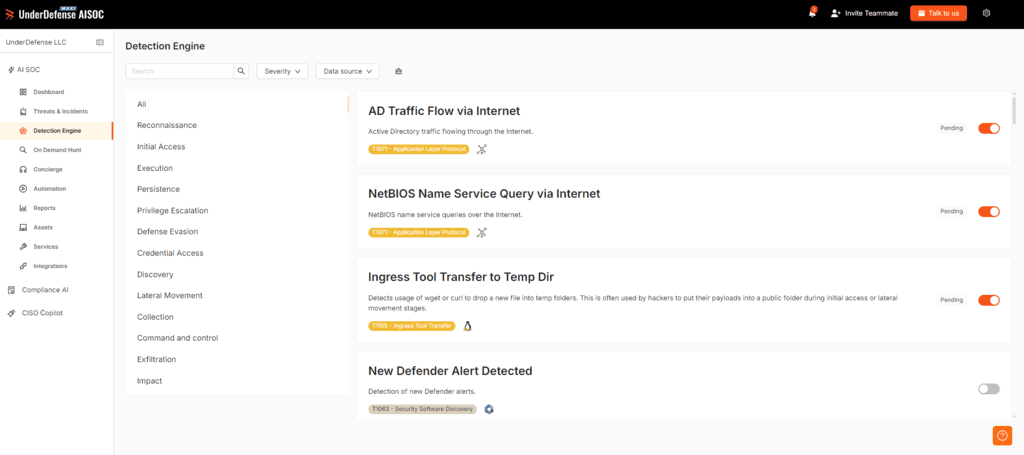
Regulated testing and credentials: UnderDefense runs DORA threat-led penetration testing covering threat intelligence gathering, scenario-based tests, and reporting. Its engineers hold CEH, OSCP, OSCE, CCNA/CCNP, ISACA, CIW, and AWS credentials.
G2 shows 5.0 out of 5 from 83 reviews as of November 2026. The Clutch review below covers a gray-box penetration test, so read it as a signal about testing depth:
“they were not just using tools to test” VP, Security & Compliance, legal tech company (501-1,000 employees), Clutch, December 2024
Pricing: Its published pentest pricing lists starting prices and durations by package (read November 2026). Red team work is quoted per engagement.
Pros:
- The only company here with published testing prices: penetration tests from $5,000, and a technical report, letter of attestation, and free retest from the Standard tier (from $8,000)
- A purple team case with a measured detection gap, plus DORA threat-led penetration testing (TLPT)
- Findings become detections for clients who also run the Agentic AI SOC
- Engineers with CEH, OSCP, and OSCE credentials
Cons:
- Its regulated-testing offer is DORA TLPT; if your regulator runs TIBER-EU or CBEST, ask for references under that scheme
Who should skip it: Skip it if your regulator requires a TIBER-EU or CBEST track record in writing.
Need proof your SOC would notice? Talk to a red team expert
2. Mandiant (Google Cloud): Best for Scenarios Built From Incident Response Cases
Overview: Mandiant, now part of Google Cloud, sells red team work through its security consulting line, and the page sits under “Mandiant Consulting.” Its pitch rests on incident response: scenarios draw from “tactics, techniques, and procedures (TTPs) found in incident response engagements.” That suits a CISO whose board wants to know how a real intruder would have fared.
Red team services offered: The Red Team Assessment simulates a persistent attack in your environment. A separate data sheet calls the engagement Red Team Operations, run with non-destructive methods. A separate Purple Team Assessment “generally takes a total of three weeks,” so you can plan detection work with your analysts as a short, bounded project.
How an engagement runs: Mandiant first settles three things: whether testers start with information about your environment, what threat intelligence it holds on your industry, and which objectives they must reach. It then works with your leadership team on reconnaissance, attempts social engineering, escalates privileges, and sets up command and control.
The data sheet says objectives are “jointly agreed upon.” Ask who sits on your control team.
Reporting and detection follow-up: You get a technical report on the steps taken, vulnerabilities found, and remediation, plus an executive report with long-term recommendations.
Mandiant says the work assesses your team’s detection and response “in real-time.” Its detection scorecard and MITRE ATT&CK alignment are documented under the Purple Team Assessment, so ask which of those you get from a red team engagement.
Regulated testing and credentials: The red team page names no TLPT, TIBER-EU, or CBEST work. It lists consultants experienced with critical infrastructure sectors, naming energy, healthcare, manufacturing, and telecommunications.
Pricing: Quoted per engagement; no red team price on the page (read November 2026).
Pros:
- Scenarios come from Mandiant’s own incident response cases
- Separate technical and executive reports
- Custom objectives such as access to payment card data, personal data, or trade secrets
Cons:
- The red team page’s sector list names energy, healthcare, manufacturing, and telecommunications, so ask for references from your own sector
- Detection scorecards are documented under a separate Purple Team Assessment
Who should skip it: EU financial entities that need TLPT or TIBER-EU experience in writing should ask first, since the red team page names neither. Teams whose first need is detection coaching may get more from a purple team exercise.
3. CrowdStrike: Best for Hands-On SOC Training During a Simulated Attack
Overview: CrowdStrike is a security platform vendor that also sells offensive exercises through CrowdStrike Services. This entry covers its red team work, separate from its managed offerings. It suits a Head of Security who wants analysts to learn during the test.
Red team services offered: The Red Team / Blue Team Exercise pairs two CrowdStrike groups. Its red team attacks, and its blue team helps your team defend “against a targeted attack within your environment.” A separate Adversary Emulation Exercise simulates “a targeted attack by a real-world threat actor.”
How an engagement runs: The exercise typically follows the kill chain: active reconnaissance, delivery and exploitation, command and control, operations, and an after-action review. Hands-on incident response training happens during simulation pauses, so your analysts stop, learn, and resume. Ask how objectives and limits are agreed, and who holds the stop button.
Reporting and detection follow-up: After the exercise, you receive a summary of the vulnerabilities exploited, a summary of the TTPs used, observations from the incident response training, and recommendations on process, methodology, and technology.
CrowdStrike also says it will help you identify misconfigured tools and coverage gaps in existing security products. The Adversary Emulation Exercise evaluates maturity across the phases of MITRE ATT&CK.
Regulated testing and credentials: The exercise page names no TLPT, TIBER-EU, or CBEST work. It says its blue teams give insight into the tactics that target your vertical.
Pricing: Quoted per engagement; the page offers “Request info” and a data sheet (read November 2026).
Pros:
- Incident response training during pauses in the simulation
- Coverage-gap findings on the security products you already own
- Recommendations span process, methodology, and technology
Cons:
- Pauses and coaching are part of the design, so results show a supported SOC
- A board question about what the SOC would notice needs a covert test, so ask whether the Adversary Emulation Exercise tells defenders in advance
Who should skip it: Teams that need independent, unannounced proof from this exercise format. EU financial entities named for a TLPT that use CrowdStrike for blue team tasks: have your control team check Article 7’s independence rules before scoping.
4. Rapid7: Best for Continuous Red Teaming of Your External Attack Surface
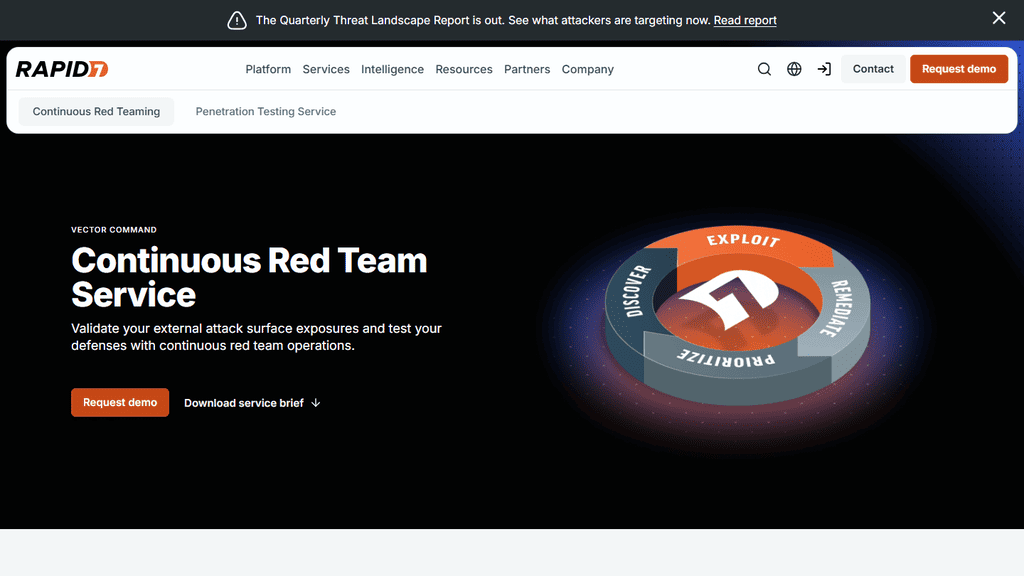
Overview: Rapid7 sells security operations and exposure products, and its Vector Command offering turns red teaming into an ongoing subscription. It fits a security leader whose internet-facing estate changes faster than a yearly test can track.
Red team services offered: Vector Command combines external attack surface assessment with red team operations. Vector Command Advanced adds internal penetration testing and reporting for compliance needs. Point-in-time red team attack simulation sits under Rapid7’s penetration testing line.
How an engagement runs: Rapid7 runs constant reconnaissance on your internet-facing assets, then its testers exploit what they find on an ongoing basis. Core tactics are opportunistic phishing, external network assessment, post-compromise breach simulation, and emergent threat validation. Ask how rules of engagement and SOC deconfliction work over a running subscription.
Reporting and detection follow-up: Findings arrive with same-day reporting, including multi-vector attack chain paths and a curated list of risky assets. Same-day means an exploited exposure can reach your fix queue before the next change window. Expert advisors give remediation guidance.
The scope of service adds verification “that previously remediated external vulnerabilities remain secure.” Ask how findings show what your SOC detected.
Regulated testing and credentials: Rapid7’s DORA page says it “supports DORA’s mandatory resilience testing program through continuous red teaming, penetration testing, and threat-led exercises,” and that it “prepares organizations for TLPT exercises.” The Vector Command page lists team certifications in “CISSP, MCSE, OSCP, and more.”
Pricing: Quoted; the page offers a demo and a service brief (read November 2026).
Pros:
- Continuous coverage of external exposure between yearly tests
- Same-day findings on successful exploits, with retest verification
- Remediation guidance on successful attack chains
Cons:
- Testing covers your “approved external network attack surface,” and internal testing needs the Advanced tier
- Rapid7’s own table describes a traditional red team as a “deep 1:1 engagement” with a set objective, a separate purchase from Vector Command
Who should skip it: Teams that need one targeted engagement with a detection timeline for the board should ask about Rapid7’s point-in-time option. EU financial entities named for a TLPT that use Rapid7’s MDR for blue team tasks: have your control team check Article 7’s independence rules before scoping.
See which attacker techniques your SOC never flagged
5. Bishop Fox: Best for a Modular Engagement With an Attack Timeline in the Report
Overview: Bishop Fox is an offensive security firm. Its Red Team Services page lists measuring detection and response capabilities among the benefits.
Red team services offered: The page lists full-scope red team, adversary emulation, assumed breach, purple team, social engineering, physical red team, and continuous or recurring red team. You can combine types to size the work to your objective.
How an engagement runs: You set the objectives and can include or exclude specific tactics, techniques, and procedures. Testers run covertly “within agreed rules of engagement,” with active attack simulation over several weeks. Customer-specific threat intelligence comes from reconnaissance on your people, processes, and technology.
Reporting and detection follow-up: The page lists “Attack Timeline and Execution Pathway Summaries” that outline the timeframe of events, actions performed, defensive performance, and achievement against objectives.
Attack graphing and a live walkthrough follow. Engagements align closely with MITRE ATT&CK, and Bishop Fox supports purple teaming during or after the work.
Regulated testing and credentials: Bishop Fox says red team engagements “can support alignment with Threat-Led Penetration Testing (TLPT) expectations.” Its 2024 DORA post says it can “either fulfill both aspects of DORA compliance or collaborate with your intelligence providers.” The red team page names no TIBER-EU or CBEST work.
Pricing: Quoted per engagement; the page offers “Get Started” (read November 2026).
Pros:
- A published attack timeline with defensive performance in the deliverables
- Seven engagement types, including continuous or recurring campaigns
Cons:
- Bishop Fox says red teaming is “best suited for organizations with mature security programs”
- It says it can supply both threat intelligence and testing, so ask how it would keep them separate under Article 7
Who should skip it: Teams still fixing basic findings from their yearly pentest. If that’s you, the gap your board worries about is still closing, and a red team will mostly confirm what the pentest already found.
6. Praetorian: Best for Board-Level Proof Against a Published List of Objectives
Overview: Praetorian is an offensive security company that pairs services with its Guard platform. It names boards of directors among the buyers of its red team work and reports results for leadership.
Red team services offered: Exercises emulate “nation-state adversaries and advanced persistent threats” across people, process, and technology. Published objectives include transferring funds to a nominated account, reaching a VIP mailbox, controlling an industrial control system (ICS) device, simulating ransomware on test systems, and stealing customer data. A separate Purple Team engagement can follow, replaying the attack chain with your team.
How an engagement runs: A Practice Manager sets up a kickoff, then the teams agree on rules of engagement and a threat model and “collaboratively define the attack objective.” Praetorian describes close collaboration with a White Team.
It says most engagements run two to six weeks, including planning, execution, and reporting, so a board answer can land within one quarter. Simulated destructive actions run only on isolated test systems or with prior approval.
Reporting and detection follow-up: Deliverables typically include a technical report, an executive summary, and a prioritized remediation roadmap. Praetorian lists a “technical narrative of the attack chain with forensic artifacts” and “playbook validation and recommendations for detection and response.”
It says results typically show gaps in detection latency and escalation procedures, which is the evidence you want. An executive debrief follows.
Regulated testing and credentials: Praetorian’s red team page doesn’t mention TLPT, TIBER-EU, or CBEST, so ask about any scheme that applies to you. It says clients use the deliverables to support audits.
Pricing: Quoted per engagement; Praetorian lists no red team figure (read November 2026).
Pros:
- A published objective list you can adapt into your own flags
- A named white team and agreed rules of engagement
- Executive-level risk assessment for leadership
- A platform for tracking attack objectives
Cons:
- The published two-to-six-week range is shorter than the TLPT active-testing minimum in the FAQ below
- Replay with your SOC is a separate engagement that follows the red team exercise
Who should skip it: EU financial entities named for a TLPT, unless Praetorian confirms a separate scope and regulated experience.
7. NetSPI: Best for Financial Entities That Need DORA, TIBER-EU, and CBEST Stated
Overview: NetSPI sells penetration testing as a service and security assessments, with red teaming under the assessments line. It fits a CISO at an EU or UK financial entity who needs a provider’s regulated-testing position in writing before the first meeting.
Red team services offered: Red Team Operations comes in three forms: Assumed Breach Scenario-Based Testing, Black Box, and Threat Intelligence-Led. A related offering, Detective Controls Testing, validates detection controls through focused attack simulations.
How an engagement runs: The type you choose sets the starting point: assumed breach begins inside your environment, and black box starts from finding an access point. Threat intelligence comes from partner providers. Ask who the partner would be and who forms the control team.
Reporting and detection follow-up: NetSPI promises “comprehensive analysis, documentation, and tailored remediation strategies.” It lists improved detection and response among the results, and frameworks on the page include MITRE ATT&CK.
Ask for a sample that shows timing against your SOC’s actions. NetSPI suggests annual tests as a baseline, then moving “towards continuous and ongoing scenario-based assessments.”
Regulated testing and credentials: NetSPI says it supports DORA compliance through threat-led red teaming and names TIBER-EU, CBEST, and CREST on its red team page. Ask for references under the scheme your regulator uses.
Pricing: Quoted per engagement; the page offers “Schedule a Test” and a solution brief (read November 2026).
Pros:
- DORA, TIBER-EU, and CBEST named on its red team page
- Separate threat intelligence partners, which suits Article 7’s separation of roles
- Three starting points to match your maturity
Cons:
- NetSPI describes scenario-based testing as “a hybrid of pentesting and a purple team-like” operation, so confirm which type your quote covers
- Threat intelligence quality depends on a partner you should vet separately
Who should skip it: Buyers who want a single supplier for intelligence and testing should raise that early.
8. TrustedSec: Best for Full-Scope Simulations With Physical Entry and Purple Team Work Built In
Overview: TrustedSec is a security consultancy that builds its own attack tooling for engagements. It suits a mature team that wants people, buildings, and networks tested together.
Red team services offered: Adversarial Attack Simulation is the main red team offering, available as a traditional red team or an assumed breach model. Purple teaming is also sold separately as Adversarial Detection & Countermeasures, if you want more detection work later.
How an engagement runs: Each engagement starts with pre-planning and threat modeling to define critical assets, objectives, and scenarios. Initial access uses “ethical phishing, vishing, SMS, and physical breach techniques,” followed by privilege escalation and lateral movement.
A 2024 TrustedSec post gives assumed breach minimums of one to three weeks by scenario, which tells you how much calendar to hold. Ask how rules of engagement and SOC escalation work.
Reporting and detection follow-up: A phase called Defensive Inclusion & Purple Teaming puts testers alongside your security team “to refine detection capabilities and enhance incident response.” You then get a detailed report with findings and attack paths, and an executive debrief. Ask how the report records what your SOC detected and when.
Regulated testing and credentials: TrustedSec announced CREST certification for penetration testing in April 2025, and that stated scope is penetration testing. The red team page names no TLPT, TIBER-EU, or CBEST work.
Pricing: Quoted per engagement. A TrustedSec buyer guide says a full-scope engagement for a large enterprise “can range from $75,000 to $250,000 or more,” worded as a general range (read November 2026).
Pros:
- Physical entry, vishing, and SMS sit alongside technical attack paths
- Purple team work is a phase inside the engagement
Cons:
- The red team page addresses “organizations with mature security programs”
- Purple teaming beyond the built-in phase is a separate service, Adversarial Detection & Countermeasures
Who should skip it: Teams early in building detection, since a 2020 TrustedSec webinar warns that a red team done too soon “will waste money.” EU financial entities that need stated TLPT experience should ask first.
9. SpecterOps: Best for Teams With Established Detection That Want Assumed-Breach Engagements
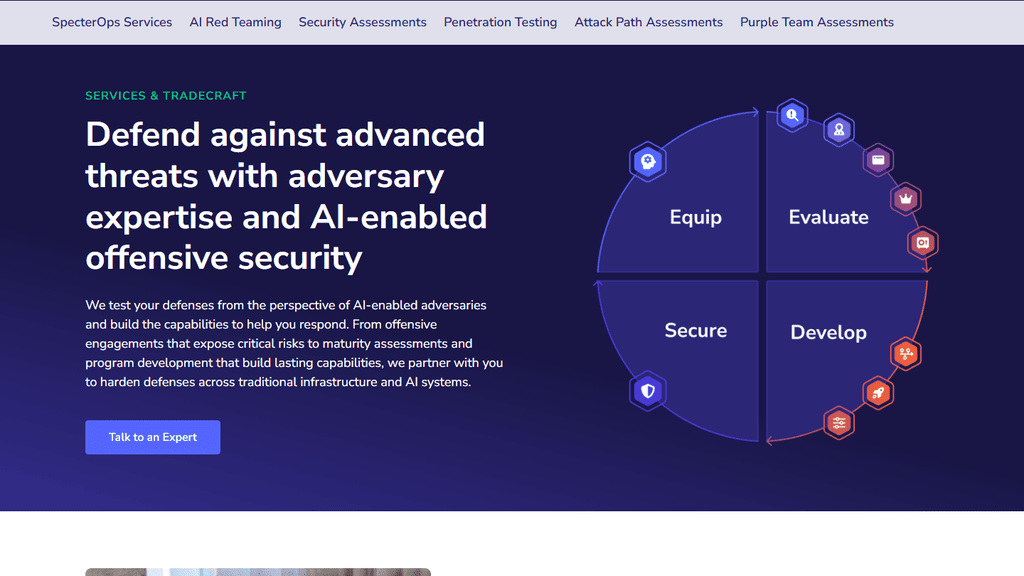
Overview: SpecterOps sells adversary simulation and detection services. Its engagements suit a Head of Security who wants to measure response after a compromise.
Red team services offered: The services page lists AI Red Teaming, Purple Team Assessments, Penetration Testing, and Attack Path Assessments. Its data sheet uses “Red Team Exercises,” and the company separates a covert engagement from an exercise where defenders are fully engaged.
How an engagement runs: SpecterOps structures engagements “around a single primary objective,” documents objectives in the statement of work, and sets tactics in the rules of engagement. Its approach “begins from the assumed breach perspective,” with initial access testing on request. Structured exercises use “a control cell,” which it defines as a neutral coordination team.
Reporting and detection follow-up: Each engagement includes an attack path narrative “supported by chronological timelines of activity, timestamps, and indicators of compromise.” SpecterOps says the narrative shows how long detection took when your team caught the activity.
Findings focus on root cause, and a purple team assessment can validate new detections. It has described that assessment as a two-week engagement (2023), short enough to follow the red team inside one quarter.
Regulated testing and credentials: The services page names no TLPT, TIBER-EU, or CBEST work, so ask for references under the scheme that applies to you.
Pricing: Quoted per engagement; the page offers “Talk to an Expert” (read November 2026).
Pros:
- Published timelines and timestamps in the report narrative
- A clear split between covert engagements and defender-led exercises
Cons:
- Assumed breach is the default start, so phishing and perimeter testing need a request
- A single primary objective comes first, and secondary goals wait until it’s resolved
- SpecterOps says the engagement itself “is not designed to close” the gaps it finds
Who should skip it: Teams without established detection and response, since SpecterOps says they “may benefit more from penetration testing or purple team assessments.” Regulated entities that need a stated TLPT record should ask first.
Four Criteria the Table Leaves Out
Across all nine entries, four criteria didn’t fit the comparison table:
- Retest: Rapid7 states one for Vector Command, and UnderDefense for its Standard and Professional penetration tests.
- Rules of engagement: Bishop Fox, Praetorian, and SpecterOps describe them on the pages read.
- MITRE ATT&CK: Bishop Fox and NetSPI name it on their red team pages, CrowdStrike on its Adversary Emulation page, and Mandiant under its Purple Team Assessment.
- Named teams: no page commits names, so ask every firm to put them in the statement of work.
Where a firm is missing from an item, ask it directly about retest, limits, and escalation.
Point-in-Time, Continuous, or Purple Team: Which Model of Red Teaming Services Fits
Buy a point-in-time engagement if you need independent proof, a purple team exercise if you need better detections soon, and a continuous program if your external exposure keeps changing. The choice depends on what you were asked to prove and how much your SOC can absorb.
A point-in-time engagement runs covertly against one objective and gives your board a dated answer. A purple team exercise puts testers and analysts together, so you lose the surprise and gain tuned rules quickly.
Continuous work, often sold as red team as a service, keeps testing your exposure and tracks whether fixes hold, though it may give up the single targeted objective. The table below maps these choices to where your program stands today.
| Where you are | Buy first | What you get |
|---|---|---|
| Yearly pentests still find easy paths to admin | Another targeted pentest | Basic paths closed before anyone tests stealth |
| 24/7 SOC with mostly default detections | Purple team exercise | Tuned rules and analysts who’ve seen the technique |
| Tuned SOC, and a board or insurer asking for proof | Point-in-time engagement | A dated detection timeline |
| Internet-facing estate that changes weekly | Continuous red team | Exposure findings between yearly tests |
| Named by an EU authority for a TLPT | A TLPT under the EU rules | Provider checks and phases set by regulation |
If the first row describes you, a shortlist of penetration testing companies is the better purchase this year. For the other rows, one budget stretches further when the first objective comes from gaps your detections have never faced.
Get a red team objective your SOC has never been tested against
- Review your attack surface and what belongs in scope
- Choose between a pentest, a purple team session, or a full red team
- Get a scope, a timeline, and the report you’d receive for your test
Frequently Asked Questions
How long does a red team engagement take?
It depends on the objective, because commercial engagements are scoped per objective. For a DORA TLPT, Article 11 of the 2025 regulation says the active testing phase lasts “at least 12 weeks,” so block close to a full quarter for active testing alone, before planning and reporting.
How much do red team services cost?
Providers quote per engagement. A TrustedSec buyer guide puts a full-scope engagement at a large enterprise at $75,000 to $250,000 or more as a general range. Scope, physical entry, and company size move your figure most.
Which certifications should a red team company have?
Ask for the certifications of the people assigned to you. The EU’s Article 7 asks for copies of certifications that meet recognized market standards and names none, so match them to the work. Firm-level accreditation is a separate question, and it should cover red team work specifically.
Is red teaming required for compliance?
For some financial entities, yes. Article 26 of DORA, the EU’s 2022 regulation, requires identified financial entities to run a TLPT “at least every 3 years,” so a named firm plans at least one test per three-year cycle. Outside DORA, red team results can still support your evidence.
What should a red team report include?
At minimum: flags reached and missed, attack paths and techniques used, blue team actions the testers saw, root cause, and remediation priority. Annex V of the EU rules requires those items for a TLPT. Add timestamps showing what your SOC detected and when, mapped to MITRE ATT&CK.