








A data request from the Office for Civil Rights (OCR) at the U.S. Department of Health and Human Services (HHS), which enforces HIPAA, asks for your latest risk analysis, and yours is two years old. In September 2026, Ambry Genetics paid $700,000 and took on two years of OCR-monitored corrective action in a settlement that named its risk analysis first.
Leadership has approved outside help, and this guide shows how to choose the firm whose next analysis holds up.
TL;DR
- A HIPAA compliance consulting firm earns its fee when you can defend its risk analysis to OCR.
- Judge every firm on its risk analysis method, OCR investigation experience, and support after the report.
- Healthcare specialists, audit and attestation firms, and security consultancies each fit a different gap.
- No firm can certify you, because HHS certifies no person or product as HIPAA compliant.
Table of contents
- A HIPAA Consulting Engagement Should Leave You With a Risk Analysis You Can Defend
- Why OCR Settlements Keep Starting With the Risk Analysis
- Seven Criteria for Choosing a HIPAA Consulting Firm
- HIPAA Consulting Firms Compared Side by Side
- The 9 Best HIPAA Compliance Consulting Firms for 2027
- Consultant, Assessor, or Software: Which Kind of Help Fits Your Gap
- Frequently Asked Questions
That approval turns into a shortlist quickly, and HIPAA compliance consulting covers very different jobs. One firm writes the analysis with you, another answers OCR alongside you, and a third tests what you already have and leaves the fixing to your team.
This guide is for HIPAA security officers, compliance and privacy officers, and IT Directors at healthcare providers and business associates. It ranks nine firms on one template and judges each on the same seven criteria.
UnderDefense, ranked first, pairs consultants with a platform that generates the HIPAA security risk analysis from live data, so the analysis stays current after the report is delivered. Facts about the other eight firms come from each firm’s own site, read in November 2026.
Disclosure: UnderDefense publishes this article and ranks itself first, using the same template and criteria as every other firm.
See which HIPAA safeguards your current tools already prove
A HIPAA Consulting Engagement Should Leave You With a Risk Analysis You Can Defend
A HIPAA consulting engagement has done its job when you can hand OCR a risk analysis, explain every line of it, and show the plan that followed. Good HIPAA consulting services deliver that analysis along with the documents that depend on it.
HHS’s guidance on risk analysis, last reviewed in August 2026, lists what any method must cover. That includes every system holding electronic protected health information (ePHI), documented threats and vulnerabilities, current security measures, likelihood, impact, a risk level for each combination, finished documentation, and periodic updates.
That list is your test for any proposal. A statement of work should promise these outputs:
- A risk analysis covering all ePHI, with a risk level for each threat and vulnerability pair
- A risk management plan that gives each risk an owner and a date
- Security Rule policies and procedures revised to match the analysis
- Workforce training tied to those policies
- A review of the business associates that handle your protected health information (PHI)
- Support if OCR opens an investigation
Two things stay with you whichever firm you hire. Accountability stays, because 45 CFR 164.308, in force as of November 2026, places the risk analysis duty on the covered entity or business associate.
Daily operation of the safeguards stays too. Someone on your side, or a partner you appoint, still reviews Entra ID activity, removes access when people leave, and responds when CrowdStrike raises an alert. Fit the engagement into the governance, risk, and compliance work you already run, so the plan has named owners when the consultants leave.
⚠️ No consulting firm can certify you as HIPAA compliant. Treat any seal or badge as that firm’s own document, and judge the engagement by what you could show OCR the morning a request arrives.
Why OCR Settlements Keep Starting With the Risk Analysis
Several of OCR’s recent Security Rule settlements name the risk analysis first among the potential violations. That makes it the line your consulting scope has to get right, and HHS’s Ambry Genetics settlement, announced on September 17, 2026, is the clearest recent example.
A January 2020 phishing attack on one employee’s email account potentially exposed the PHI of 225,370 individuals. One compromised mailbox was enough for OCR to examine the whole risk program, and it found potential failures in the risk analysis, in ending access, and in unique user identifiers.
Ambry paid $700,000 and agreed to a corrective action plan that OCR will monitor for two years. For you, that means the fix becomes two years of reporting work on top of the payment.
OCR Director Paula M. Stannard described a compliant risk analysis, risk management, and full implementation of the Security Rule as “the foundation for effective cybersecurity.” Her words tell you where an investigator looks first.
OCR’s resolution agreements list shows the same pattern at business associates. In Comstar’s agreement, announced in May 2025, $75,000, and Consociate’s December 2025 agreement, $225,000, the risk analysis is the only conduct listed.
A weak risk analysis can cost a business associate a settlement even when nothing else is found. Consociate’s plan also requires a complete inventory of its locations, hardware, software, and data assets, which shows how much work a missing analysis creates. Each item in Ambry’s corrective action plan translates into a line you can write into a consulting scope today.
| Ambry’s plan requires | Write this into your scope |
|---|---|
| Accurate and thorough risk analysis | Every ePHI system named in the statement of work |
| Risk management plan | Who tracks each open risk after the consultants leave |
| Revised Security Rule policies | Which policies each finding changes |
| Unique user identification | Identity review across every ePHI system |
| Workforce training | Who keeps the training completion records |
📝 A proposal that stops at the first row leaves the other four with your team. That can be the right call for a capable team, as long as you decide it before you sign.
Seven Criteria for Choosing a HIPAA Consulting Firm
Seven criteria show whether a HIPAA compliance consultant can leave you with an analysis you can defend. Every firm below is described on the same fields, and each criterion becomes a question for the scoping call.
1. Healthcare Depth
Ask who on the proposed team has worked inside an EHR environment like yours, and ask for a reference from a similar provider group or business associate. A healthcare-only firm brings clinical workflow knowledge, while a multi-industry firm can bring wider framework coverage.
2. Risk Analysis Method
The Security Rule prescribes no single method. Ask the firm to name its own and show a sample. Look for OCR’s guidance elements, the National Institute of Standards and Technology’s (NIST) SP 800-30 Rev. 1 (2012) for assessment steps, or NIST SP 800-66 Rev. 2 (2024) for Security Rule implementation.
A firm that cites the current revisions is working from the references OCR’s own guidance draws on. Its own tool is fine when the output covers those elements.
3. Technical Testing In-House or Subcontracted
A rating built only on interviews tells you less than one backed by vulnerability scans and penetration tests. Ask who runs the testing, and whether any subcontractor would need a business associate agreement.
4. OCR Investigation Experience
Preparing for a review and answering a live data request are different skills. Ask how many OCR requests the team has answered, who drafted the responses, and how it works with your counsel.
5. Support After the Report
An analysis ages the day you add an EHR module or move a workload to Azure. Ask what continues after delivery and who does it: a set number of consulting hours a year, a retainer, or a scheduled reassessment, and whether the analysis is updated when a system changes.
Consulting hours suit a team that keeps the analysis itself and needs help when systems change. A retainer suits a team that expects OCR or incident work. A scheduled reassessment suits an environment that rarely changes. Ongoing help works best inside regulatory compliance programs that already assign owners.
6. Independence
A firm that assesses should not also grade its own remediation. Ask whether the same people would do both, and how the firm separates them if you later want an outside attestation.
7. Published Pricing
Few firms in this field publish rates, and a published figure tells you something about how the firm sells. Where nothing is published, ask for the fee model and for what would change the number.
HIPAA Consulting Firms Compared Side by Side
The table sets the nine HIPAA consulting firms against the same criteria. Firm type comes first because it decides which gap each one fits. In the cells, vCISO means a virtual chief information security officer, and HITRUST, a private security certification common in healthcare, comes up in several rows.
| Firm | Best for | Firm type | Risk analysis method | OCR investigation support | Ongoing support | Published pricing |
|---|---|---|---|---|---|---|
| UnderDefense | Risk analysis kept current from live data | Compliance platform with consultants | Platform-generated HIPAA risk analysis from live data, reviewed by consultants | Access-control and safeguard evidence already collected from connected tools; incident and breach-notification workflow | Compliance packages and added consulting hours | Published packages and hourly rate |
| Clearwater | Outsourced healthcare risk program | Healthcare specialist | Asset-based; NIST and OCR guidance; own software | Response and OCR communication support | vCISO, virtual privacy officer, managed programs | Quoted |
| Meditology Services | Open OCR investigation and corrective action plan | Healthcare specialist | OCR guidance plus NIST SP 800-30 Rev. 1 | Active investigations, corrective action plans | vCISO, retainer subscription | Quoted |
| BerryDunn | Mock OCR audit plus reporting from a licensed CPA (certified public accountant) firm | Audit and attestation | NIST-aligned gap and risk analysis | OCR complaint response, mock audits | Outsourced compliance officer | Quoted |
| Kroll | Risk analysis needed during breach response | Security consultancy | Four steps; gaps against the NIST Cybersecurity Framework | Confirm in scoping | vCISO, retainer credits | Quoted |
| RSI Security | Business associates adding HITRUST or SOC 2 | Security consultancy | Security Rule-aligned risk analysis | Preparation for OCR review | Retained vCISO, periodic reassessments | Testing only; HIPAA work quoted |
| Fortified Health Security | Multi-site provider groups | Healthcare specialist | 64-control HIPAA assessment, site visits | Confirm in scoping | vCISO, monthly corrective action calls | Quoted |
| A-LIGN | Third-party HIPAA report for customers | Audit and attestation | Validation against HIPAA safeguards | Confirm in scoping | Recurring assessments | Quoted |
| Schellman | Fast independent read of your analysis | Audit and attestation | OCR HIPAA Audit Protocol baseline | Preparation for OCR audits | Annual revalidation recommended | Assessment ranges |
“Confirm in scoping” means this review found no named service on the firm’s pages in November 2026. The firm may still offer it. Ask directly.
One pattern stands out. Three of the nine are healthcare specialists, three are audit and attestation firms, two are security consultancies, and one is a compliance platform with consultants, so the type predicts the engagement better than the brand does.
Clearwater and Meditology lead with OCR-facing work, Fortified with site-level assessment, the audit firms with outside attestation, the consultancies with breadth across frameworks, and UnderDefense with a risk analysis that stays current from live data.
The 9 Best HIPAA Compliance Consulting Firms for 2027
These are the best HIPAA compliance consulting firms for the situations named in each heading: UnderDefense, Clearwater, Meditology, BerryDunn, Kroll, RSI Security, Fortified Health Security, A-LIGN, and Schellman. The ranking is this article’s own assessment, and every entry uses the same labels.
1. UnderDefense: Best for a HIPAA Risk Analysis Kept Current From Live Data
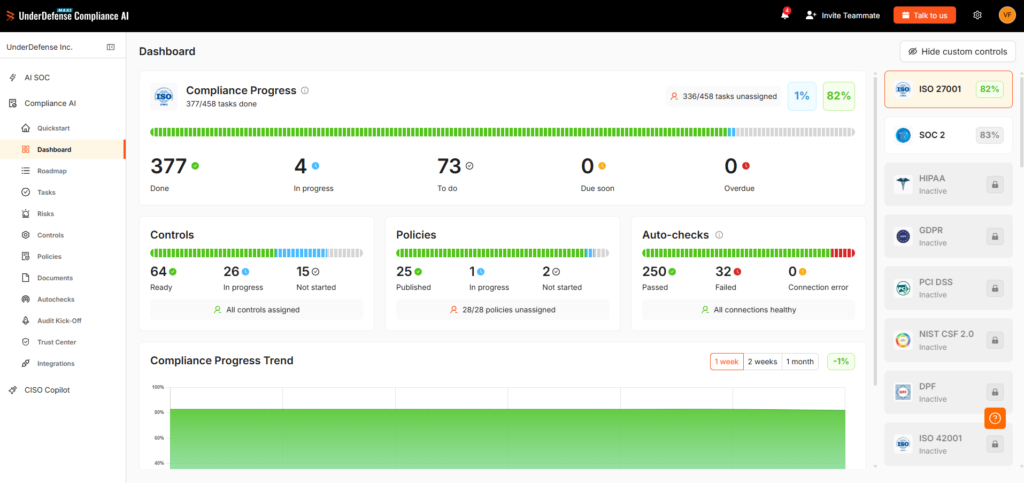
Overview: Compliance platform with consultants. UnderDefense MAXI Compliance AI generates the HIPAA security risk analysis, threats included, from live data in your identity, cloud, and endpoint tools, and UnderDefense consultants review it with your team. The analysis stays backed by current evidence after the report is delivered.
UnderDefense has offices in New York, Jacksonville, Krakow, and Lviv.
HIPAA services: UnderDefense’s compliance consulting covers risk assessments, policy development, evidence collection, and audit preparation, with HIPAA among the named frameworks. The platform also keeps a register of your business associate agreements and runs the incident and breach-notification workflow.
The Essential package includes custom policies and security awareness training, and the Certified package adds a custom incident response plan and internal, external, and cloud vulnerability scans.
Risk analysis method: MAXI Compliance AI generates the HIPAA security risk analysis, with the threats included, from live data it collects through connectors such as Microsoft Entra ID and Microsoft 365, Azure, and CrowdStrike. Consultants then review it with your team, and the platform maps it to NIST and HIPAA.
When OCR asks for access-control evidence, your team starts from what the platform has already collected from Entra ID and your other connected tools, so nobody rebuilds a spreadsheet the week the request arrives. For an outside attestation, your auditor works with the same evidence and reports in the platform, with the access you grant.
Engagement model: Monthly packages and added consulting hours, so the analysis has someone keeping it current after delivery. Outside attestation comes from a partner audit firm matched within one business day, or from your own auditor, so the team that helps build your program doesn’t attest to it.
One documented client, the outsourcing firm Helpware, shows how that holds up over time: its case study says the company “kept the same compliance team while the business doubled.”
UnderDefense is rated 5.0 out of 5 from 83 reviews on G2 as of November 2026. A client on Clutch describes the fit:
“UnderDefense impressed us with their ability to tailor their services to our unique needs and challenges.” CIO of Security, ARX Insurance Company, 501-1,000 employees, Clutch
Pricing: Four published compliance packages run from Free to Certified: Starter costs from $499, Essential from $1,299, and Certified from $1,899 a month (read November 2026). Additional consulting costs $65/hour on paid packages, so you can price extra hours before you approve them.
Pros:
- A HIPAA security risk analysis generated from live data, threats included, and kept current between assessments
- Consulting hours and live evidence from one partner, on the stack you already run
- 24, 48, or 90 hours a year with UnderDefense compliance consultants, depending on the package, plus a published rate for extra hours
- A partner audit firm matched within one business day when a customer asks for outside attestation
- Published monthly prices for all four packages, Free at $0 and Certified from $1,899, where seven of the other eight firms quote per engagement
- SaaS, hybrid, on-premises, or air-gapped deployment, for when evidence has to stay in your environment
Cons:
- Packages are monthly subscriptions, which suits a program kept current, not a team that wants one analysis and nothing after it
Who should skip it: A team that wants a healthcare-only firm to lead legal correspondence with OCR.
Is your risk analysis defensible today? Ask a HIPAA expert
2. Clearwater: Best for Hospitals That Want a Fully Outsourced Risk Program
Overview: Healthcare specialist. Clearwater focuses only on healthcare and sells managed services, consulting, and software.
Ask how many of its consulting clients run an EHR like yours. Its contact page lists Nashville, Tennessee, and its clients include large health systems, physician practice management groups, and digital health companies.
HIPAA services: The HIPAA page names risk analysis, risk management planning, policy and procedure templates customized for your organization, and web-based workforce training. It also offers help “coordinating and supporting your response and communication with OCR.” Its technical testing team runs vulnerability and penetration testing, and vendor risk assessments cover your third parties.
Risk analysis method: Clearwater says its methodology “is built on NIST standards, HIPAA requirements, and OCR guidance.” The work rates likelihood and impact at the information system level, with documentation held in its IRM|Analysis software.
Engagement model: Project consulting for a single need, or a managed program. ClearAdvantage tiers include vCISO or virtual privacy officer leadership, risk analysis, and workforce training. ClearConfidence is a fully outsourced program for hospitals, built to keep the analysis current.
Pricing: Quoted per engagement. No rate appears on the service or managed program pages (read November 2026), and the digital health page mentions start-up pricing without a figure.
Pros:
- A healthcare-only team
- OCR response support named on the HIPAA page
- Virtual security and privacy officer options that continue after the report
- Experience working under attorney-client privilege, according to its page for healthcare attorneys
Cons:
- The scope includes a subscription to IRM|Analysis. What do you keep if the contract ends?
- The same firm sells assessment, remediation, and managed security, which puts independence on your scoping list
Who should skip it: A business associate with large non-healthcare lines that wants one firm across all of them, or a team that needs an independent attestation of work it has already done. In that second case, an audit and attestation firm from entries 8 or 9 is the closer fit.
3. Meditology Services: Best for Negotiating a Corrective Action Plan After OCR Opens an Investigation
Overview: Healthcare specialist. Meditology works only with healthcare organizations.
Ask how many of its engagements were risk analysis projects for an organization like yours. Its contact page gives an Atlanta, Georgia address, and its clients span health systems, academic medical centers, payers, physician groups, and health IT vendors.
HIPAA services: The HIPAA page names security and privacy risk assessments, policy and procedure development, workforce training, and business associate inventory and compliance management. Its OCR page says it supports “clients who are already under OCR investigation,” helping organize the factual record and assemble evidence. It also covers negotiating and implementing corrective action plans, and penetration testing comes from its own team.
Risk analysis method: Meditology says its risk assessment aligns with OCR guidance, Security Rule requirements, and NIST SP 800-30 Rev. 1. The work runs through five stages: scoping, assessment, analysis, reporting, and a remediation roadmap.
The firm works with the platforms you already use.
Engagement model: Every engagement runs on a three-tier model: Advise, Implement, and Manage. The RITHM subscription includes a monthly cybersecurity retainer and an annual HIPAA risk assessment. A virtual CISO can run short-term or ongoing, inside RITHM or in defined hourly blocks.
Pricing: Quoted per engagement. No rate appears on the HIPAA, OCR, risk assessment, vCISO, or RITHM pages (read November 2026), and a 2022 release describes RITHM as fixed-price without giving a figure.
Pros:
- Named support for investigations already under way, including corrective action plans
- A method that cites NIST SP 800-30 Rev. 1 and OCR guidance by name
- Staff who can carry out the remediation after the analysis
- Separate teams for HITRUST readiness and validated assessment, as its HITRUST page states
Cons:
- Meditology calls an open OCR investigation “a distinct engagement,” so budget for it apart from program work
- The firm positions a standing program ahead of a single deliverable, which matters if you want one analysis
- Its stated team separation covers HITRUST and SOC 2, with HIPAA risk analysis left as a question for the call
Who should skip it: A team with no OCR pressure that wants a single fixed-scope analysis and plans to run everything afterward itself. Kroll in entry 5 sells the HIPAA risk assessment as its own engagement.
4. BerryDunn: Best for a Mock OCR Audit Plus CPA-Backed SOC 2 and HIPAA Reporting
Overview: Audit and attestation firm with an advisory practice. HIPAA is one practice inside BerryDunn, a large accounting and consulting firm.
Its Portland, Maine page names that office its national headquarters, and attest work runs through BDMP Assurance, LLP, a licensed CPA firm. Its HIPAA clients include healthcare organizations, health plans, higher education, and vendors with HIPAA obligations.
HIPAA services: The HIPAA page names security risk analysis, gap analysis, policy and procedure development, training, and implementation support. It also offers help “responding to OCR complaints and privacy breaches,” plus mock OCR audits that simulate an official audit before a real review. Its cybersecurity team covers internal and external penetration testing and third-party risk assessments.
Risk analysis method: BerryDunn’s cybersecurity page says it assesses risks to PHI, identifies gaps in administrative, physical, and technical safeguards, and aligns assessments with “industry standards like NIST, PCI, and HIPAA.” A senior living client received a gap assessment, a risk analysis, and a mock OCR audit together. Ask which NIST publication governs the risk analysis itself, and request a sample.
Engagement model: Tailored projects that can repeat, as with that senior living client, which has returned for assessments year after year. BerryDunn also offers outsourced Compliance Officer and Privacy Officer services and ad hoc consultation, which suits a team with no dedicated privacy lead.
Pricing: Quoted per engagement. No rate appears on the HIPAA, healthcare compliance, cybersecurity, or SOC audit pages (read November 2026).
Pros:
- Mock OCR audits named as a service, useful before a live request arrives
- SOC 2 plus HIPAA reporting backed by a licensed CPA firm for customers that ask for it
- Outsourced compliance and privacy officer roles
Cons:
- HIPAA is one service line in a multi-industry accounting and consulting firm. How many of its staff work in healthcare full time?
- Advisory and attest work sit in separate entities, and BerryDunn states “neither entity is liable for the services provided by the other entity,” so contract with each deliberately
Who should skip it: A team that wants a healthcare-only firm. If you also need a HITRUST validated assessment, check assessor status in HITRUST’s directory before you scope that work.
5. Kroll: Best for a Risk Analysis Needed During Breach Response
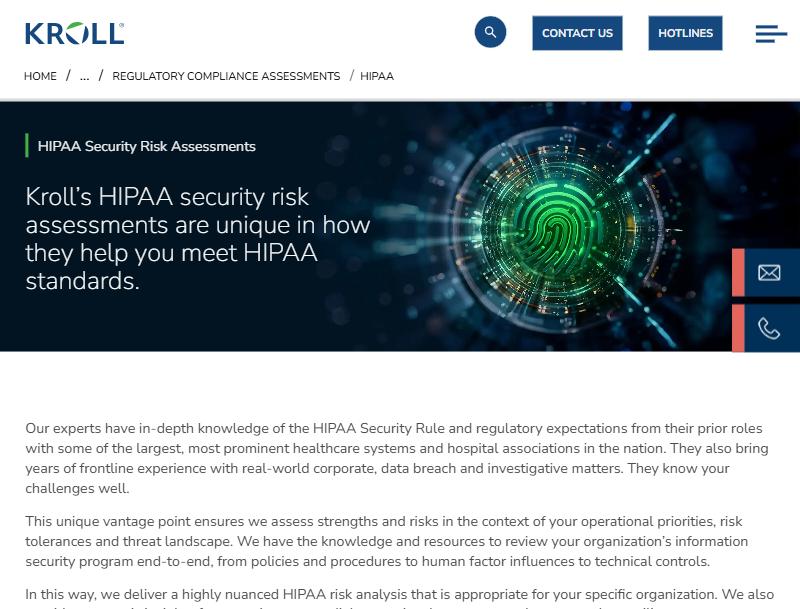
Overview: Security consultancy inside a global financial and risk advisory firm. Kroll’s locations page says it is headquartered in New York.
The firm puts breach responders and risk assessors in the same firm, which helps when an OCR request follows an incident.
HIPAA services: The HIPAA page centers on HIPAA security consulting through risk assessments, including a review of policies, procedures, and previous security reports. It ends in a prioritized roadmap of recommendations.
Its virtual CISO page covers policy development, remediation, and training without being HIPAA-specific, and third-party assessments can align to HIPAA. Kroll describes an in-house penetration testing team.
Risk analysis method: Four steps: collect data, assess current security measures, identify security risks to ePHI, and prioritize them. Kroll documents gaps “using the NIST Cybersecurity Framework as guidance” and ranks findings by likelihood and impact. Ask how that output maps to the elements in OCR’s guidance, since OCR’s own definitions draw on NIST SP 800-30.
Engagement model: An assessment project, with annual assessments as an option. A vCISO can serve as an interim CISO, support your CISO, or stay longer term. Kroll also offers a Cyber Risk Retainer with credits usable across its professional services, which helps when a compliance need and an incident arrive together.
Pricing: Quoted per engagement. No rate appears on the HIPAA, regulatory assessment, vCISO, or penetration testing pages, which point you to a quote request (read November 2026).
Pros:
- Breach response, investigative work, and the risk analysis available from one firm
- An in-house penetration testing team, as Kroll describes it
- Retainer credits that flex across security work
Cons:
- HIPAA is one entry in a broad regulatory assessment list that also covers DORA, CMMC, and PCI DSS
- Kroll can assess and then implement the remediation plan through a vCISO, which makes independence a question for the scoping call
Who should skip it: A provider group that wants a healthcare-only team. Clearwater and Meditology name OCR response support on their own pages, which a team facing an open OCR data request needs first.
Check your risk analysis against live evidence before signing a scope
6. RSI Security: Best for Business Associates Adding HITRUST or SOC 2 to HIPAA
Overview: Security consultancy. RSI Security is a cybersecurity and compliance advisory firm, and its site footer places its headquarters in Southlake, Texas.
Healthcare is one of several sectors it names, alongside defense, finance, SaaS, and the public sector. That mix suits a health-tech company selling into more than one regulated market.
HIPAA services: The HIPAA page names a Security Rule-aligned risk analysis, readiness reviews, policy gap assessments and updates, identification of business associates and subcontractors with PHI access, and awareness training support. It evaluates documentation and safeguards “in preparation for potential OCR review.” Penetration testing lists the HIPAA Security Rule among its frameworks.
Risk analysis method: RSI describes a risk analysis that identifies where ePHI exists, evaluates threats and vulnerabilities, and informs the choice of safeguards, inside a five-step program. Its resource center offers a free HIPAA self-assessment tool. The service page names no NIST publication. Ask for a sample deliverable and the method behind it.
Engagement model: Project work that RSI frames as a continuing lifecycle with periodic reassessments. A retained vCISO works with your leadership team, and resource augmentation covers short-term projects, ongoing advisory work, or embedded team members.
Pricing: RSI’s online store lists an internal network penetration test at $12,570 and an external one at $11,310 (read November 2026). Those figures let you budget the testing line of a risk analysis before scoping, while HIPAA consulting itself is quoted.
Pros:
- A written independence rule: “For a given client, RSI Security provides advisory or assessment services, never both.”
- One roadmap across HIPAA, SOC 2, PCI DSS, CMMC, and NIST
- Published prices for testing, which most firms here keep quote-only
Cons:
- That independence rule means a second firm for the other role if you want HITRUST advice and a validated assessment
- The HIPAA page says RSI “provides advisory and readiness support only,” so a legal response stays with your counsel
Who should skip it: A provider group that wants a healthcare-only firm, or a team already under investigation that needs named OCR response support. Entries 2 and 3 name that support directly.
7. Fortified Health Security: Best for Multi-Site Provider Groups With a Small Team
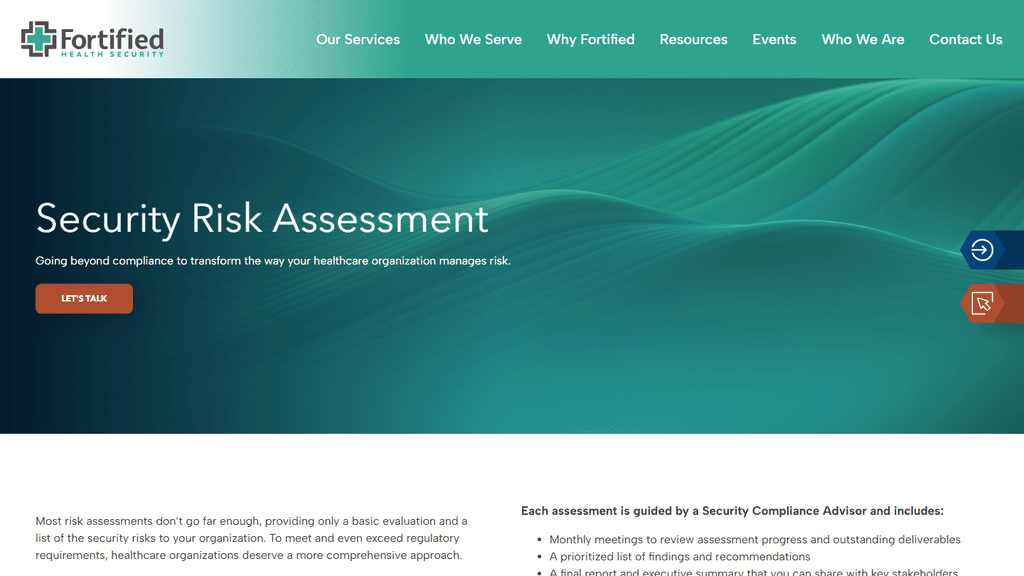
Overview: Healthcare specialist with advisory and managed security arms. Its contact page gives a Brentwood, Tennessee address, and it serves hospitals, provider groups, healthcare technology companies, and health plans. Fortified says its assessments are conducted by experts who work exclusively in healthcare cybersecurity.
HIPAA services: The security risk assessment page offers a HIPAA risk assessment and a larger NIST assessment. The resource hub adds a formal corrective action plan and monthly calls to keep remediation moving.
Separate lines cover awareness training, vendor risk, and penetration testing. Ask who drafts HIPAA policies, because the assessment pages focus on risk.
Risk analysis method: The HIPAA tier evaluates 64 controls and the NIST tier 108, with a physical site assessment in both. Pick the NIST tier if a customer or board wants NIST alignment, since it covers more controls.
Findings are tracked in its Fortified Central Command platform. In a Summit Medical Group case, a group with over 90 locations wanted each one evaluated, the situation a multi-site provider group faces.
Engagement model: An assessment that continues as a partnership, led by a dedicated Security Compliance Advisor. vCISO tiers and retainer or project staffing extend that work.
Pricing: Quoted per engagement. No rate appears on the risk assessment, vCISO, or staffing pages (read November 2026).
Pros:
- Physical site assessments, which matter for a group with many clinics
- Monthly corrective action calls that keep a small team moving
- A healthcare-only team
Cons:
- The assessor also sells the fixes, stating it offers “numerous services to help you execute your CAP.” How does it keep its recommendations neutral?
- Services run through its own platform, which makes data export a contract question
Who should skip it: A team that wants a one-off report and no continuing relationship, or a business associate with large non-healthcare lines. Schellman’s fixed-fee projects in entry 9 suit a single engagement better.
8. A-LIGN: Best for Business Associates That Need a Third-Party HIPAA Report for Customers
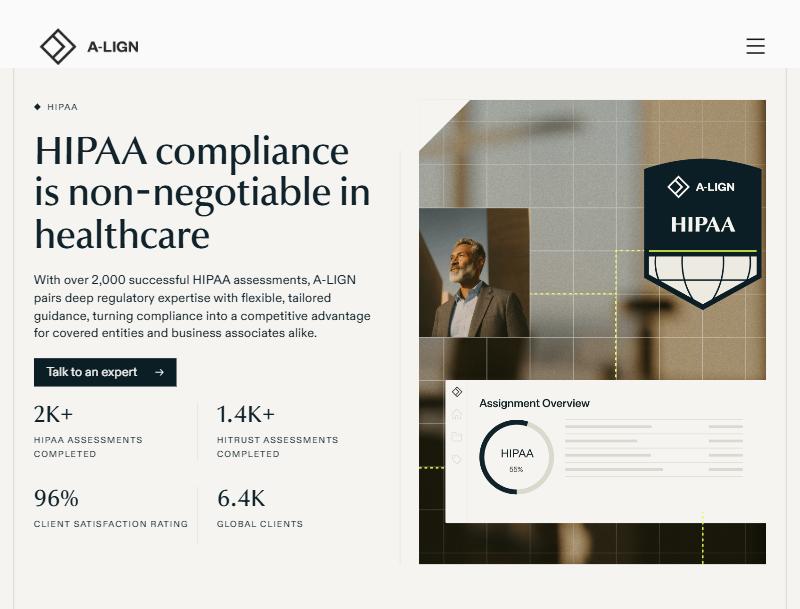
Overview: Audit and attestation firm. A-LIGN lists Tampa, Florida first among its offices.
It is a HITRUST-authorized External Assessor Organization, so if a customer later asks for HITRUST, the same auditor can run it. Its HIPAA page addresses covered entities and business associates, and states plainly that HIPAA has no official certification body.
HIPAA services: A readiness assessment “identifies high-risk control gaps, provides recommendations for improving controls, and allows for remediation prior to the official HIPAA assessment.” Validation follows, as a SOC 2 + HIPAA assessment or a security assessment report, and HITRUST is a third route.
Penetration testing comes from a team A-LIGN describes as separate and independent. Its readiness checklist treats a completed risk assessment as something you bring, so confirm who would write yours.
Risk analysis method: A-LIGN validates compliance against the HIPAA safeguards and issues a report outlining the level of compliance. It says assessments are tailored to each client and managed in its A-SCEND audit platform. Ask how it tests your risk analysis against the elements in OCR’s guidance.
Engagement model: Assessment projects that repeat on the same audit platform. It names technology and services partners who consult, advise, and support clients, so advisory work may sit with a second firm.
Pricing: Quoted per engagement. No rate appears on the HIPAA, healthcare, or HITRUST pages, and its HITRUST FAQ gives cost factors without a figure (read November 2026).
Pros:
- A written independence policy against performing “audit services for clients where non-audit services have been performed”
- SOC 2, HIPAA, and HITRUST under one auditor, useful when health-system customers ask for each
- Listed as an External Assessor in HITRUST’s directory
Cons:
- The named HIPAA offerings are readiness, validation, and HITRUST, so a team with no current analysis may need another firm to produce one
- Readiness and validation come from one firm, and the HIPAA page doesn’t explain how they are kept apart for a single client
Who should skip it: A team that needs someone to rebuild its risk analysis before answering OCR. Start with a healthcare specialist from entries 2 or 3, then bring A-LIGN in to validate the result.
9. Schellman: Best for a Fast Independent Read of Your Risk Analysis
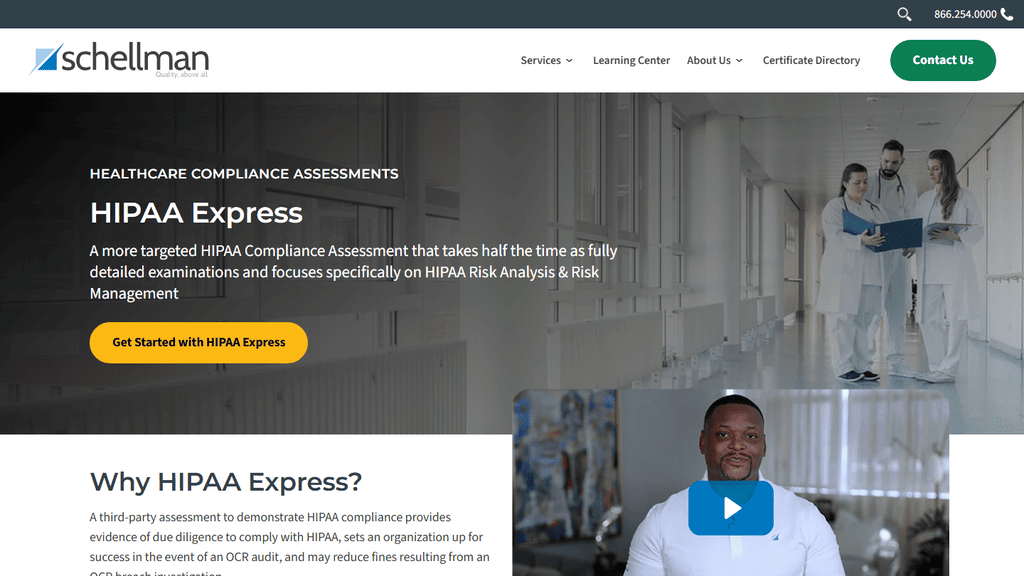
Overview: Audit and attestation firm. Schellman & Company is a licensed CPA firm, paired with Schellman Compliance for non-attest work, and its contact page gives a Tampa, Florida address.
The firm runs HIPAA examinations for business associates, and HIPAA Express is aimed at large healthcare systems and regional providers.
HIPAA services: Two products. A full HIPAA Attestation tests the security and privacy safeguards and breach notification requirements.
HIPAA Express focuses on risk analysis and risk management, with a requirements workshop that gives “immediate feedback” against the essential elements OCR expects, plus a review of your policies and procedures. Penetration testing is a separate line.
Risk analysis method: Schellman says HIPAA Express follows the OCR HIPAA Audit Protocol as its baseline. Its guidance on risk analysis points readers to OCR’s essential elements and NIST SP 800-30. The firm assesses the analysis you hold, so you bring the document and it tells you whether it would stand up.
Engagement model: Fixed-fee projects. Schellman says HIPAA Express typically takes one to two weeks, depending on the size of the organization, which fits a team working to an OCR deadline. The full attestation runs through planning, kickoff, testing, and reporting, and Schellman recommends revalidating results at least annually.
Pricing: Schellman publishes ranges: HIPAA Express “costs $15,000 – $30,000 on average” (post last updated February 2025). A HIPAA assessment runs “anywhere from $20,000 up to $80,000” (video last updated September 2025).
The two ranges overlap, so ask which assessment your scope matches before comparing quotes. Both pages first appeared in 2022. Confirm the figures in a quote.
Pros:
- Published price ranges, which few firms here offer
- An independence stance on its about page: no consulting sold on top of its assessments
- A short assessment that fits a team under time pressure
Cons:
- Schellman says external auditors “leave you to decide” what to do with findings, so your team of one to five still does the fixing
- HIPAA Express is a narrower, provider-shaped assessment
- The firm itself says it is commonly more expensive than smaller comparable firms
Who should skip it: A team that needs the analysis written for it, or a team that needs help answering a live OCR data request. It works best as an outside check after a specialist has rebuilt the analysis.
Consultant, Assessor, or Software: Which Kind of Help Fits Your Gap
The right kind of help depends on the gap you can name today. Healthcare specialists fit an analysis problem with OCR attached, audit and attestation firms fit a customer asking for outside proof, and security consultancies fit HIPAA work that overlaps other frameworks. A compliance platform with consultants fits a team that needs the analysis written and kept current.
| Your gap | Kind of help that fits | Question for the scoping call |
|---|---|---|
| No current risk analysis | Compliance platform with consultants, healthcare specialist, or security consultancy | Who writes it, who signs it, and who updates it when a system changes? |
| OCR investigation open | Healthcare specialist with named OCR support | How many data requests have you answered? |
| Customer wants a third-party attestation | Audit and attestation firm | Who else worked on these controls? |
| No one runs the safeguards day to day | A monitoring partner or an in-house on-call rotation | Who reviews logs on nights and weekends? |
Software alone fits a narrower case: your team already has the method and the hours, and it needs a system to hold the risk register and evidence. Before buying, compare GRC tools vs compliance platforms, because neither one writes a risk analysis your team can’t explain to OCR.
Between the two sits software with consulting hours attached. UnderDefense MAXI Compliance AI is one example: it generates the risk analysis from the Entra ID, Azure, and CrowdStrike data your team already has, keeps it current, and consultants fill the gaps it shows.
The last row of the table is the gap a consulting report leaves open. Audit controls and log review count only if someone does them every day, and an AI SOC for healthcare is one way to keep those safeguards running between assessments.
🤝 Several of these firms also work well together. An audit firm can test what a specialist helped you build, and that separation answers the independence question directly. For HIPAA security consulting, the order matters: fix the analysis first, staff the safeguards second, and buy the attestation last.
The session starts from the identity, cloud, and endpoint tools you already run and shows how the platform builds your HIPAA risk analysis from them. Book it before you sign a consulting scope, while the scope can still change.
Bring your last risk analysis to a HIPAA gap assessment
- See which HIPAA safeguards your connected tools already prove
- Get 24, 48, or 90 consulting hours a year, by package
- Keep a register of your business associate agreements
Frequently Asked Questions
How much does a HIPAA compliance consultant cost?
Two of the nine publish HIPAA figures. UnderDefense publishes monthly compliance packages, Starter from $499 (24 consulting hours a year) up to Certified from $1,899 (90 hours), with extra consulting at $65/hour, and Schellman publishes assessment ranges. The other seven quote per engagement, based on the systems holding ePHI, the sites in scope, testing, and support after the report.
Is there an official HIPAA certification for consulting firms?
No. HHS states that it and OCR “do not certify any persons or products as ‘HIPAA compliant'” in its guidance on misleading marketing, last reviewed in 2013. Your proof stays the risk analysis, the plan, and the records behind them.
Do we need a business associate agreement (BAA) with our HIPAA consultant?
Yes, if the work involves PHI. 45 CFR 160.103, in force as of November 2026, lists consulting among the services that make a provider a business associate when PHI is disclosed to it. HHS guidance, last reviewed in October 2026, requires written assurances, so sign the agreement before sharing any PHI.
Can a consultant perform our HIPAA risk analysis for us?
Yes. HHS guidance says the Security Rule “does not prescribe a specific risk analysis methodology.” The legal duty and the risk decisions stay with you, so your team supplies the asset data, challenges the ratings, and keeps the analysis current.
What is the difference between a HIPAA consultant and a HITRUST assessor?
A HIPAA consultant helps you meet a federal regulation that carries no certificate. A HITRUST External Assessor is an organization HITRUST approved and trained to perform validated assessments for its private certification, so check the directory and ask who would do which part.