




Short answer
- A traditional SOC is people, process, and technology working together to turn IT system logs into a small number of high confidence security incidents.
- AI, LLMs, and AI agents raise the ceiling on how much a SOC can process, and they behave non-deterministically, which makes them safe on some steps of the investigation pipeline and unsafe on others.
- Switching makes operational sense. No vendor on the market today can guarantee investigation quality, so the practical path runs in parallel: evaluate AI SOC platforms while auditing your own pipeline for automation candidates.
See how the UnderDefense Agentic AI SOC investigates, triages, and resolves real alerts.
What is a traditional SOC?
A Security Operations Center is a team of security engineers working 24/7, investigating security alerts generated by IT systems and helping the owners of those systems mitigate the issues that triggered those alerts. Technically a SOC is a room full of people. The function it delivers carries the industry label Managed Detection and Response, and the two terms get used interchangeably. As a function, a SOC consists of people, process, and technology.
SOC people
Analysts investigate alerts, hunting for true positives, which are immediately promoted to security incidents and mitigated shoulder to shoulder with IT system owners.
Engineers run the whole SOC infrastructure, including connectors, detections, playbooks, workbooks, SIEM, and SOAR.
Managers act as battle captains. They plan and optimize the SOC process when everything is calm, and they orchestrate incident handling with IT system owners and the SOC when an incident breaks out. Getting this mix right is its own discipline, covered in our guide on building a strong SOC team.
SOC process
To guarantee a predictable, repeatable, high quality result from incident investigation, a SOC needs established, tested, and enabled processes and procedures covering every step of the investigation. The more algorithms, scripts, and checklists a SOC has, the more predictable its output becomes without relying on individual expertise. The more thoroughly and frequently those processes are reviewed and tested, the higher the quality of the investigations.
The key quality requirement for incident investigation is this:
A final verdict with a high level of confidence, proved by attached evidence and reasoning.
SOC technology
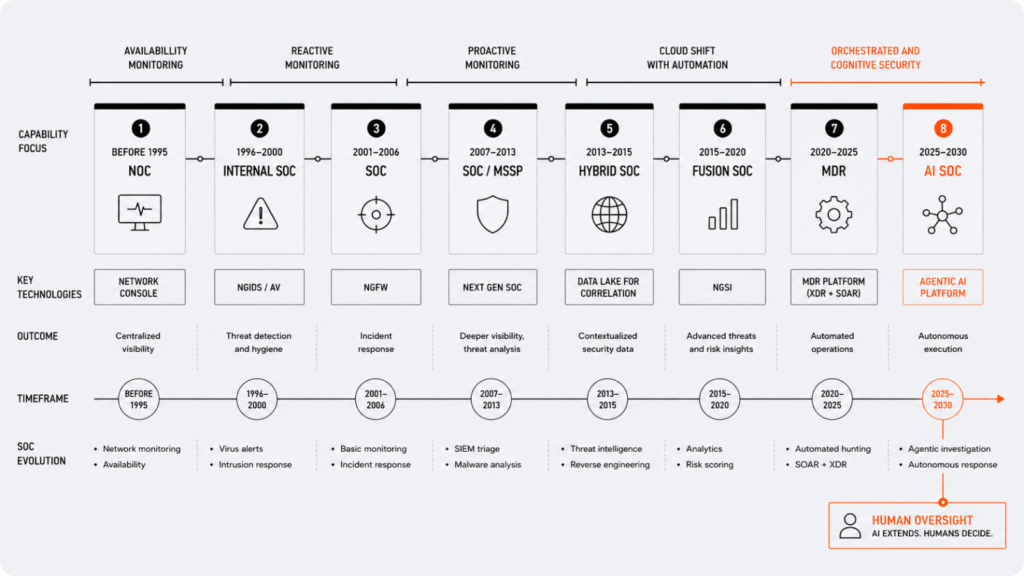
Every piece of technology needed to transform IT system activity logs into just enough security incidents, enriched with additional context, so that a security analyst can reason quickly and confidently about the nature of each one and escalate it for mitigation when needed. In most environments the centre of gravity here is the log platform, which is why managed SIEM sits underneath so much of the rest.
Why does every traditional SOC hit the same bottleneck?
The obvious bottleneck in every SOC is the fragile balance between the number of alerts arriving from IT systems and the number of analysts handling them. It is possible to reduce input alerts to an absolute minimum without compromising contractual coverage of the attack perimeter, and the remaining volume can still be too high to investigate thoroughly at the quality bar described above, which is hard to write into a contract. To handle this Achilles’ heel, a weak SOC hires more analysts and a good SOC automates everything it can.
The measurements that expose this balance honestly are the same ones worth tracking through any transition. Our breakdown of SOC metrics and the way detection and response SLAs are written both apply directly here.
How far can traditional SOC automation go?
The best SOCs automate the process from East to West, from the log data source to the owners of the IT systems, to comply with the “garbage in, garbage out” principle: automating incident investigation before you filter out garbage logs makes no sense.
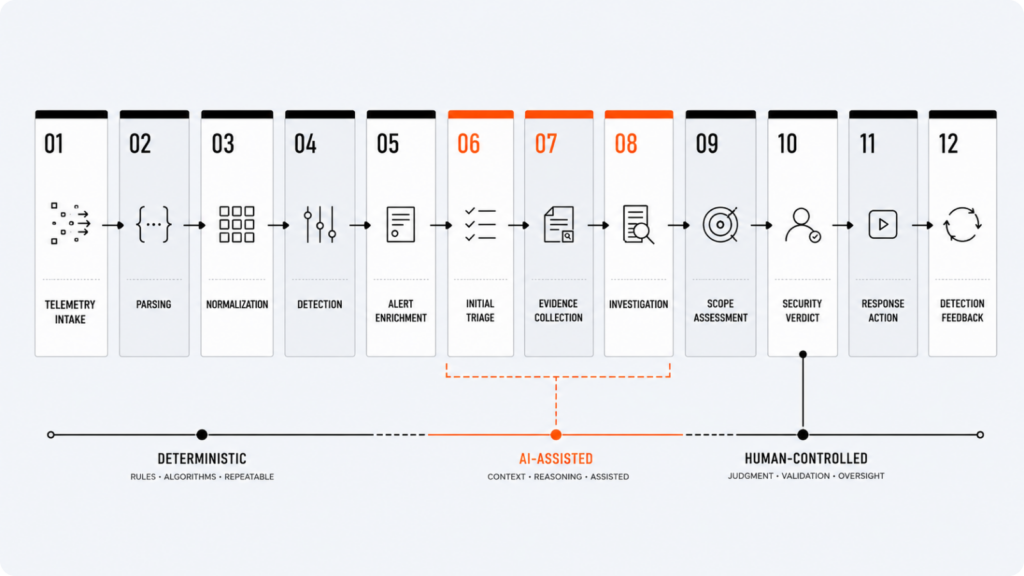
East to West automation options:
- Ingestion
- Normalization
- Deduplication
- Correlation
- Enrichment
- Detection
- Triage
- Investigation
- Escalation
- Communication
- Mitigation and response
- After action review and enhancements
The level of automation is limited only by the imagination of the engineers and by the investigation quality requirement. The goal is to break the linear dependency between the number of input alerts and the number of analysts. The security automation tooling landscape covers what is available for each of these steps.
Can AI, LLMs, and AI agents automate a SOC further than traditional approaches reach? Yes, with nuances.
What happens when you add AI to an already automated SOC?
Take a good, already automated traditional SOC, automate it further with AI tools blindly, and you will process a crazy number of input alerts with fewer analysts while drastically compromising the quality of incident investigation.
Traditional automation relies on algorithmic approaches, which always produce a predictable outcome. Predictable does not always mean correct, and the logic stays clear and unambiguous: if you see X then do Y, else do Z. Given X as input, there is no chance of producing M, P, or Q as output. Given N in place of X, the automation stops with an error.
AI, LLMs, and AI agents do not work that way. Their nature is non-deterministic, which means the same input returns an output that is consistent in context and different in form every time. It is like getting an explanation from a professor in a different shape each time you ask the same question.
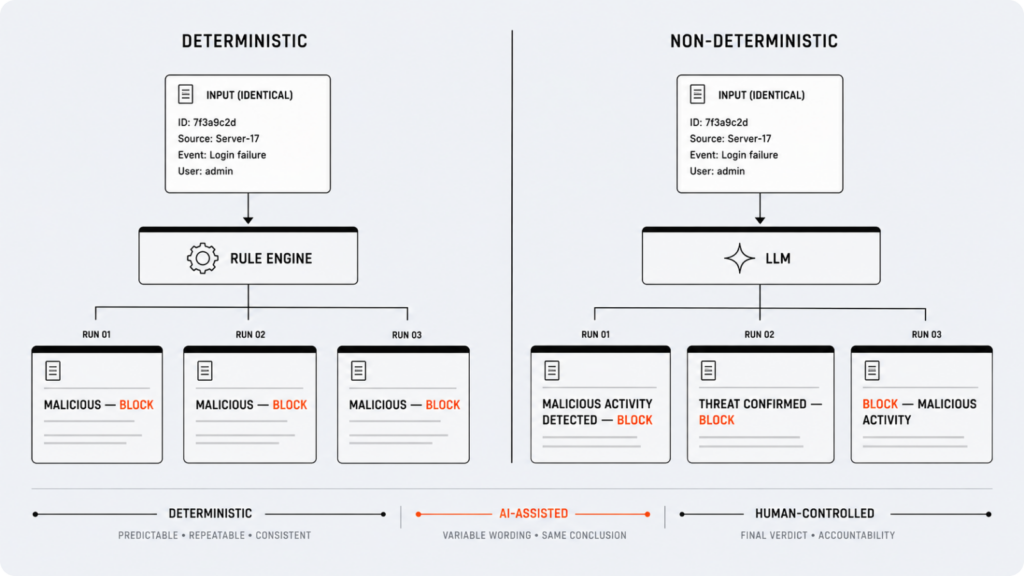
So the AI toolset has to be applied carefully, with a full understanding of where it pays off. Here are the do’s and don’ts of SOC automation with AI.
Do’s
- Explaining alert details in plain English
- Answering analyst questions about an alert, incident, asset, or other customer context
- Running on-demand MCP requests to clarify or enrich alert context
- Forming a verdict hypothesis with clear reasoning
- Uncovering hidden correlations between alerts, assets, and service tickets
- Generating well formatted HTML reports
- Transforming detection rule logic into different languages
- Polishing and unifying communication with the customer
The triage step is where this pays off first, and we walked through the mechanics of it in AI enabled incident triage.
Don’ts
- Creating and updating detection rules
- Ingesting activity logs
- Transforming logs into alerts
- Normalizing, deduplicating, and auto-closing alerts
- Launching response on the customer’s IT systems
What does AI SOC automation actually cost?
Last but not least: do not assume you can save costs by substituting people with AI automation. The number of tokens burned running incident investigations can cost more than the combined compensation of an entire security analyst team. Anyone modelling this against a service contract will find our SOC as a service pricing breakdown a useful comparison point.
Pushing investigation speed up with AI automation can degrade investigation quality, which is the most important requirement for a SOC. It does not matter how fast you process alerts per shift if you miss the one that mattered.
That is why it is wise to keep people as the last validation checkpoint at the end of the investigation process. Investigation remains an intellectual exercise: finding a hidden pattern in a chain of events and collected evidence. Automating evidence collection and interpreting it in simple words is a smaller job than that.
It is possible to reduce the number of people involved in the incident investigation pipeline by automating their routine tasks, and at the moment that will not save your security budget if you care about not missing any critical, impactful incident.
The order of the layers is what makes the economics work. On our own pipeline, deterministic filtering, deduplication, and correlation remove around 99% of raw alert volume before an AI agent touches anything. The agents then work only on what survived that pass and reach a triage verdict in roughly two minutes, with the evidence and reasoning attached for an analyst to check. Put AI in front of that filtering step and you pay token costs on the noise you should have dropped for free.
So should you switch from a traditional SOC to an AI SOC?
Yes. Without it you gradually lose your marginality, because operational expenses grow with every additional security analyst and engineer hired after new customers are onboarded.
Can you buy an AI SOC on the market that guarantees high quality incident investigation? Not yet, and the key word here is guarantee.
So what do you do? Start a discovery and testing process across the AI SOC solutions available on the market, and ask every vendor the same question: how do you guarantee investigation quality without suppressing input signals? It also helps to be precise about categories, since AI SOC, MDR, MSSP, and SOAR get sold as if they were the same thing.
We put that question to ourselves before we put it to anyone else, and here is our answer to it. Every verdict our agents produce ships with the evidence and the reasoning behind it, so you can audit how it was reached. A human analyst validates the verdict before it reaches you. Nothing gets tuned out of the input stream to make throughput numbers look better, because the volume reduction happens through deterministic filtering that we can show you step by step. None of that amounts to a guarantee. It does amount to something you can test in a pilot this quarter, against your own alert volume.
In parallel, start auditing the SOC processes that make up your incident investigation pipeline, looking for the parts that are bottlenecks and carry high automation potential without compromising investigation quality.
Somewhere down the road you will understand what to automate first, and which approach to AI automation fits your case: build, buy, or borrow.
Next step
Take the twelve pipeline steps above and mark the ones your SOC still runs by hand. Bring that list to a technical session with the UnderDefense Agentic AI SOC team, and we will walk through which of those steps an agent can take over without touching your verdict quality, and which ones should stay with your analysts.
Waiting for the category to mature costs you a year of pipeline work you could be doing now. The audit is worth running whatever you end up buying, and the vendor question is answerable today.
See how UnderDefense Agentic AI SOC resolves a real incident on your stack.
1. What is an AI SOC?
An AI SOC is a security operations centre where LLMs and AI agents handle parts of the investigation pipeline previously managed by analysts or rule-based automation.
It runs on the same three components as a traditional SOC:
- People who own judgment and accountability at the decision points AI cannot reliably hold.
- Process that defines which pipeline steps are safe to hand to AI and which are not.
- Technology where AI is applied to selected steps: context enrichment, verdict hypothesis, and reporting.
The distinction that matters is not that AI is present, but which steps it owns and which it supports.
2. How does an AI SOC differ from a traditional SOC?
The core difference is determinism. A traditional SOC automates with deterministic logic: the same input always produces the same output, correct or otherwise. An AI SOC adds non-deterministic components, so the same input returns an answer consistent in meaning but variable in form.
- Deterministic automation is predictable, auditable, and safe for exact-repeatability steps.
- Non-deterministic AI is flexible and can reason across context, but cannot guarantee identical output for identical input.
That difference decides which pipeline steps are safe to hand over and which are not. Treating them as equivalent is where AI SOC deployments go wrong.
3. What are the challenges of using AI in a SOC?
Non-determinism is the main one. Because output form varies, AI is unreliable for any step that requires exact repeatability.
Steps that should not be handed to AI include:
- Detection rule creation, where precision is non-negotiable.
- Log ingestion and normalization, which require deterministic pipelines.
- Deduplication and auto-closing alerts, where a wrong call discards evidence.
- Response actions on customer systems, where incorrect execution has direct operational consequences.
Investigation quality degrades quietly when these steps are handed over. The risk is not visible failure but silent degradation.
4. Does an AI SOC reduce SOC costs?
Not automatically. The economics depend on what the AI layer is actually doing and whether human validation stays in the loop.
- Token consumption for running incident investigations at volume can exceed the combined compensation of a security analyst team.
- Routine task automation does reduce the number of people needed in the pipeline.
- Human validation at the end limits how far headcount can actually shrink.
The saving is rarely a straight budget reduction once you account for the full operating model. The more useful question is where cost shifts rather than whether it disappears.
5. What should a SOC automate first?
Work from East to West: start at the log data source and end with IT system owners. Filtering garbage logs comes before automating investigation.
Once input quality is solid, the highest-value AI candidates in order are:
- Alert explanation that gives analysts immediate context instead of a raw event.
- On-demand context enrichment that surfaces asset, identity, and threat-intel data at triage time.
- Correlation discovery that connects events a rule would miss.
- Verdict hypothesis with reasoning, where the AI proposes a conclusion and shows its work.
- Reporting that drafts incident summaries from structured investigation output.
Sequencing matters. Automating investigation before fixing input quality produces confident wrong answers at scale.
6. How do you evaluate an AI SOC vendor?
Two questions do most of the work: how does the vendor guarantee investigation quality without suppressing input signals, and can they show you the evidence and reasoning behind a verdict?
Run the same audit on your own environment:
- Map your twelve pipeline steps from log source to resolution.
- Mark the manual ones that represent the real cost and latency in your process.
- Compare vendor claims against the specific steps you need covered, not the steps their marketing leads with.
The failure mode is a vendor that triages behind a wall and hands alerts back with little context. A useful litmus test: does the layer resolve alerts or escalate them back to you? See how we approach this on the UnderDefense Agentic AI SOC platform.