




Q1: Why Do Arctic Wolf and Deepwatch Look Identical on Paper?
Both are pure-play, technology-agnostic managed security operations vendors, so their feature lists converge. 24/7 monitoring, a named team, autonomous containment, and compliance support appear on both. That convergence is why buyers can’t tell them apart. The differences that decide the next three years are structural: where your telemetry lands, who owns the detection logic, and what you can take with you at contract end.
Talk to a SIEM expert about fewer false positives.
🔍 Two demos that canceled each other out
Here’s the scene I keep seeing. An IT Director sits through two vendor demos in the same week. Arctic Wolf on Tuesday, Deepwatch on Thursday. By Friday, the shortlist can’t be ranked.
Both said “24/7.” Both said “named team.” Both said “we contain threats for you.” The notes look like carbon copies. The frustration is real, and it’s not a failure of research. It’s the market doing exactly what mature markets do.
📋 The convergence is genuine, not marketing spin
When two vendors chase the same buyer for years, their surface features flatten out. On paper, the overlap is real:
- Both are pure-play managed security operations vendors, not resellers.
- Both claim technology-agnostic coverage across major surfaces.
- Both offer autonomous containment actions and compliance reporting.
- Both assign a named team so you’re not shouting into a ticket queue.
So the “we’re better” narrative from each side becomes noise. You end up choosing between two black boxes on vibes. Scaling detection alone, without a structural lens, just becomes a faster way to be wrong.
🧭 Features converge, structure diverges
Here’s my read after sitting on the operator side of these deals. The standard comparison, feature-versus-feature, is close to useless at this stage. The features already match.
What does not match is the architecture underneath. Where does your data actually live? Who writes and owns the detection rules? Can you walk away with your SIEM and your logic intact, or do you leave empty-handed?
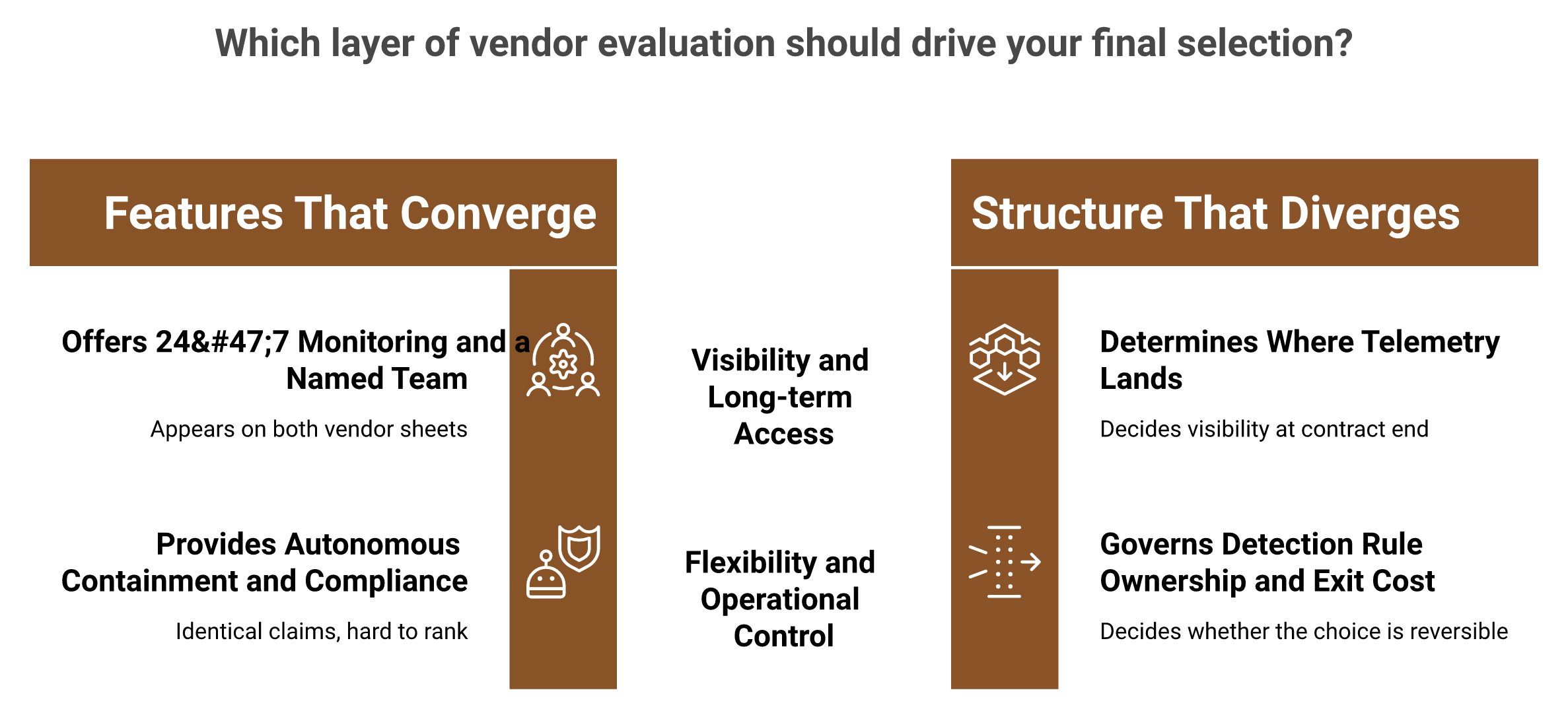
At UnderDefense, the whole reason we built an open, vendor-agnostic model is that we watched buyers get trapped by the answer to those three questions two years after signing. The feature sheet never warned them. The structure did. That’s the pivot this comparison needs, and it’s where the rest of this guide goes next.
Q2: What Should You Actually Compare When Two Managed SIEM Vendors Converge?
Compare eight structural criteria rather than features: where telemetry lands, detection-rule ownership at contract end, SIEM portability, data egress terms, pricing model and cost drivers, coverage including on-prem, resolve-versus-escalate, and practical exit cost at 24 months. These decide whether your choice is reversible, which matters more than any feature checkbox.
🧱 Why structure beats features when vendors converge
When feature lists match, the only honest way to separate two vendors is to compare how they’re built and what happens when you leave. I think of it like buying the bricks, not the finished toy. If you own the bricks, your security tooling, your logs, your detection logic, you keep the business context you paid to build. If the vendor owns them, you rent your own security posture.
One disclosure first, so you can weigh what follows. UnderDefense operates in this exact space, and our Agentic AI SOC is built around customer-owned data. The criteria below are useful no matter which vendor you pick, and every row applies to us too.
📊 The eight criteria that decide reversibility
| Criterion | Why it matters at 24 months |
|---|---|
| Where telemetry lands | If logs sit in the vendor’s platform, your visibility ends when the contract does |
| Detection-rule ownership | Rules built on your environment are IP; losing them means starting detection from zero |
| SIEM portability | A portable SIEM lets you switch providers without re-architecting; a locked one traps you |
| Data egress terms | Export fees and format lock-in quietly turn a switch into a rebuild |
| Pricing model and cost drivers | Per-user versus per-GB decides whether growth is predictable or punishing |
| Coverage including on-prem | A cloud-only model leaves hybrid and legacy systems dark |
| Resolve versus escalate | Escalate-only means the alert lands back on your team, undoing the point of the service |
| Practical exit cost | The real test: what do you keep, and what do you rebuild, when you leave? |
💡 The point is reversibility, not perfection
Here’s the quiet conviction I’ll stand behind. No vendor scores perfectly on all eight, including us. The goal isn’t a flawless scorecard. It’s knowing that your choice is reversible.
A feature checkbox tells you what a vendor does today. These eight tell you what you’ll own in two years, and whether your next decision is still yours to make. That’s the artifact worth forwarding to Legal before you sign anything, and a structured SIEM buyers guide can help frame it.
Q3: How Do Arctic Wolf and Deepwatch Compare on Coverage and Response?
Deepwatch covers four attack surfaces, adding cloud and SaaS, versus Arctic Wolf’s three base surfaces, and supports six autonomous response actions to Arctic Wolf’s three under a documented sub-one-hour response SLA. Arctic Wolf brings EDR via the Cylance/BlackBerry acquisition and a named Concierge Security Team. On-prem is the live differentiator: Arctic Wolf’s platform is recorded as cloud-native.
🎯 Map coverage to techniques, not “surfaces”
“Surfaces” is a marketing word. Attackers don’t think in surfaces. They think in techniques, moving from a phished identity to an endpoint to a cloud console. So I map coverage to MITRE ATT&CK, the public knowledge base of real attacker techniques, instead of counting logos on a slide.
On raw count, Deepwatch covers four attack surfaces including cloud and SaaS, while Arctic Wolf covers three base surfaces. But count matters less than completeness. I learned this the hard way once, watching an intrusion run fully undetected because logs were never turned on for one pilot application. The center was defenseless because one door had no sensor. Coverage completeness beats surface count every time.
⚡ Response actions and SLA structure
Coverage finds the threat. Response decides whether it matters.
- Deepwatch supports six autonomous response actions under a documented sub-one-hour response SLA.
- Arctic Wolf supports three autonomous actions.
Here’s a distinction I’d flag for any buyer. “Guided remediation” and “hands-on containment” are different jobs. NIST SP 800-61, the federal incident-handling guide, splits detection from actual containment for a reason. If a vendor guides while you execute, the 2 a.m. work is still yours.
🐺 Arctic Wolf’s real strengths
Fair is fair. Arctic Wolf brings genuine endpoint depth through its Cylance/BlackBerry acquisition, plus a named Concierge Security Team that customers do value. The white-glove setup earns loyalty when it works.
The model does carry honest limits worth weighing against a fully co-managed approach to managed detection and response, where changes don’t have to route through a single engineering queue.
☁️ Deepwatch’s strengths and the on-prem gap
Deepwatch brings broad cloud and SaaS coverage and deep Splunk expertise, which suits cloud-heavy shops well. That’s a real edge if your stack already lives in Splunk.
The live differentiator is on-prem. Arctic Wolf’s platform is recorded as cloud-native, so hybrid and legacy on-prem environments are a structural stretch, rather than a feature bug. If half your estate sits in a data center, that’s a decision-relevant gap you feel on day one.
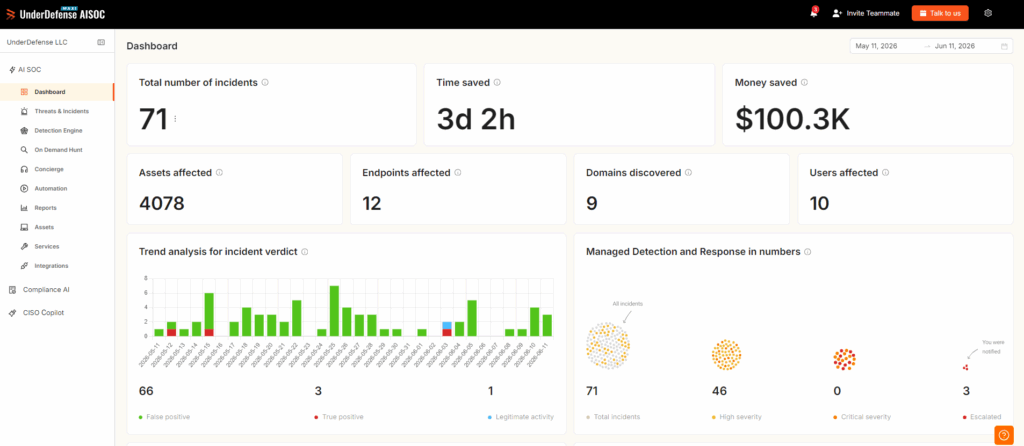
We co-manage the SIEM you already own, across cloud, on-prem, and hybrid. If you want managed coverage without moving your data into a vendor’s platform, that’s the work our managed SIEM team does every day.
“UnderDefense Agentic AI SOC integrates well with our systems, specifically with our SIEM, Splunk. Their team is proactive in identifying and addressing threats, providing 24/7 oversight.”- Oleg K., Director of Information Security UnderDefense G2 – Verified Review
Q4: How Do the Pricing Models Compare and Where Do Mid-Market Budgets Break?
Neither vendor publishes standard pricing, so compare failure modes rather than figures. Arctic Wolf uses per-user licensing on its own SIEM with unlimited ingestion, which is predictable but keeps the data engine with the vendor. Deepwatch’s economics ride Splunk, growing expensive as telemetry volume climbs. Buyer-reported Arctic Wolf medians sit near $96,340/year, ranging $29K to $320K.
💰 Why neither publishes mid-market pricing
Neither Arctic Wolf nor Deepwatch posts a standard price sheet. That’s not an oversight. Custom quoting lets each deal flex to what the buyer will bear, which blocks apples-to-apples comparison before you even start.
So stop hunting for a magic number. Compare failure modes instead, the specific way each pricing model breaks as your company grows. That’s the conversation your CFO actually needs, and our MDR pricing breakdown frames it the same way.
🐺 Arctic Wolf’s model: per-user on a proprietary SIEM
Arctic Wolf licenses per user, runs on its own SIEM, and folds in unlimited ingestion. The upside is real: predictable billing, no per-gigabyte panic when log volume spikes. Buyer-reported medians land near $96,340 per year, ranging from about $29K to $320K depending on size.
The trade-off is structural. Unlimited ingestion is generous precisely because the data engine stays with the vendor. You get predictability, but the SIEM, and the detection logic on top of it, isn’t yours to take.
📈 Deepwatch’s model: Splunk-coupled economics
Deepwatch’s cost rides on Splunk, so the pricing pressure sits in ingestion. As your telemetry grows, the per-GB meter grows with it. For a data-heavy environment, that curve bends the wrong way over a three-year contract.
There’s a hidden lever here most buyers miss. Untuned data is expensive data. I’ve seen ingestion cut by roughly 90%, from 300GB a day down to 35 to 40GB, simply by filtering noise before it hits the SIEM. Under a per-GB model, nobody upstream is motivated to help you trim that bill.
⚠️ Where each model breaks for a 500 to 2,000-employee shop
Here’s the honest read for a mid-market buyer:
- Arctic Wolf’s per-user model breaks if you’re headcount-heavy but data-light. You pay for seats, not risk.
- Deepwatch’s ingestion model breaks if you’re data-heavy, common in cloud and DevOps-forward shops, where volume climbs faster than headcount.
- Both leave the data engine or its economics tied to the vendor, which is the reversibility cost from criterion eight.
One reframe I give every finance conversation: benchmark against the cost of building this in-house. Staffing a 24/7 SOC realistically means five people, and a single loaded analyst position runs well over $100,000 a year, so roughly $620,000 is the floor just to keep the lights on around the clock. Any managed service has to beat that internal baseline, and the projected cost of one day of business interruption is the number that actually frames the spend. A SOC cost calculator makes that baseline concrete.
“It’s reassuring to know they’re always watching for threats, and it doesn’t cost a fortune. The platform works really well with our other security tools, which makes things much simpler.”- Serhii B., Chief Information Security Officer UnderDefense G2 – Verified Review
“UnderDefense is surprisingly affordable considering the level of protection we get. Their proactive threat hunting and rapid response have saved us from incidents that could have been incredibly costly.”- Verified User, Program Development UnderDefense G2 – Verified Review
Q5: Who Owns Your SIEM Data and Detection Rules When the Contract Ends?
This is where the models diverge most. Arctic Wolf normalizes your data into its proprietary SIEM and provides dashboards and reports rather than direct access to raw normalized data or the detection logic. Deepwatch’s detection logic lives in Splunk instances it operates. Ask both, in writing: at contract end, do I keep my detection rules, in what format, and at what egress cost?
🔑 Why ownership decides reversibility
Ownership sounds like a legal footnote. In practice, it decides whether your next security decision is still yours to make. If your telemetry and detection logic live inside a vendor’s platform, leaving means starting detection from scratch somewhere else.
I’ve watched this play out on the operator side. The feature sheet never warns you. The exit clause does, two years later, when the renewal quote lands and you realize you can’t walk, which is exactly the trap a strong approach to avoiding vendor lock-in is built to prevent.
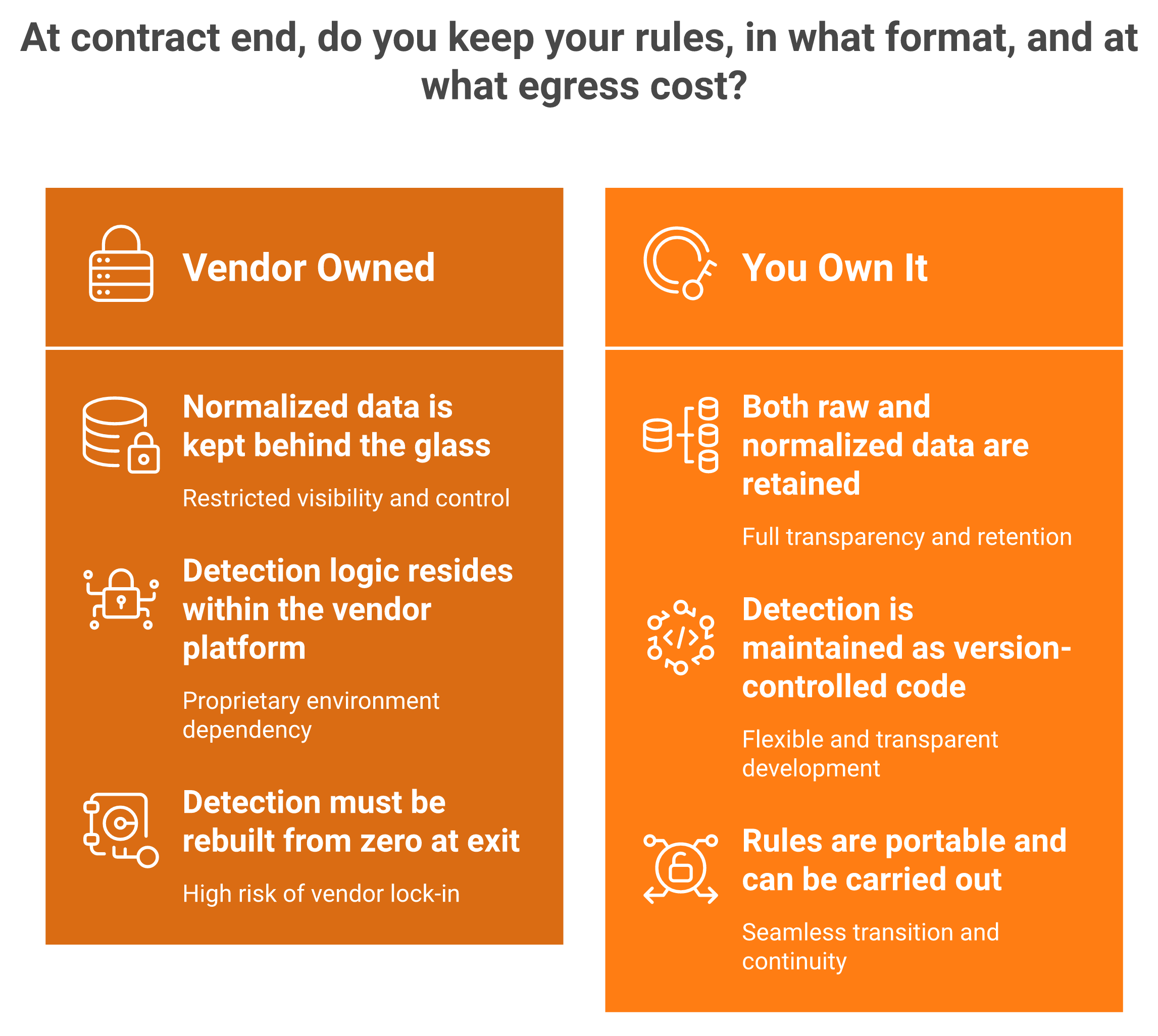
🐺 Arctic Wolf: normalized data behind the glass
Arctic Wolf’s model normalizes your logs into its own SIEM, then hands you dashboards and reports. That’s a clean experience day to day. The trade-off is structural: you’re consuming outputs, rather than holding the raw normalized data or the rules that generate it.
📈 Deepwatch: rules that live in operated Splunk
Deepwatch runs its detection logic inside Splunk instances it operates. Portability then depends on one question: do you own that Splunk deployment, or does Deepwatch? If it’s theirs, the rules built on your environment may not travel with you, so a co-managed model for Splunk that keeps the deployment yours matters.
⚠️ The black-box problem is a real cost, not a vibe
Here’s the contrarian read most buyers miss. An opaque detection model is not neutral. When you can’t see or tune the logic, false positives pile up and land on your team, driving the kind of alert fatigue that burns out lean teams.
The research backs this up. A 2025 ACM study found that 51% of SOC teams feel overwhelmed by alert volume, spending over a quarter of their time chasing false positives. A 2022 USENIX study measured false-positive rates near 99% in some black-box detection tooling. That’s not a rounding error. That’s your analysts’ week.
🤖 Automation maturity you can actually inspect
SOAR, security orchestration, automation, and response, is the layer that auto-handles routine alerts. Its maturity varies, and you can read it in the patent record. Arctic Wolf’s filings (US20250047698A1) describe automated response workflows, and Fortinet’s (US11563755B2) sit as a neutral benchmark for the category.
The point is not the patent count. It’s whether the automation is observable. If you can’t see why a rule fired, you can’t trust it, and you can’t hand it to an auditor, which is why explainable, transparent investigations matter.
🧱 Detection-as-code makes rules portable
The mechanism that fixes this is treating detection logic like software. Rules written in code, version-controlled, unit-tested, and deployed through a pipeline become assets you own and can carry. This is becoming standard mid-market procurement language, and Legal reviews are starting to ask for it by name in 2026.
At UnderDefense, this is exactly why we build on customer-owned managed SIEM and keep every investigative step observable. Two buyers described the difference plainly:
“The platform itself is straightforward. It pulls in data from all our existing security tools, so we didn’t have to rip and replace anything. When they escalate something, they include the context we need.”- Verified User, Marketing and Advertising UnderDefense G2 – Verified Review
“UnderDefense Agentic AI SOC integrates well with our systems, specifically with our SIEM, Splunk. Their adherence to SLAs gives me confidence in our infrastructure’s protection.”- Oleg K., Director of Information Security UnderDefense G2 – Verified Review
Put the exit question in the contract before you sign, whichever vendor you choose. You can read more about the model on the UnderDefense platform page.
Q6: Are Arctic Wolf and Deepwatch Even Competing for the Same Buyer?
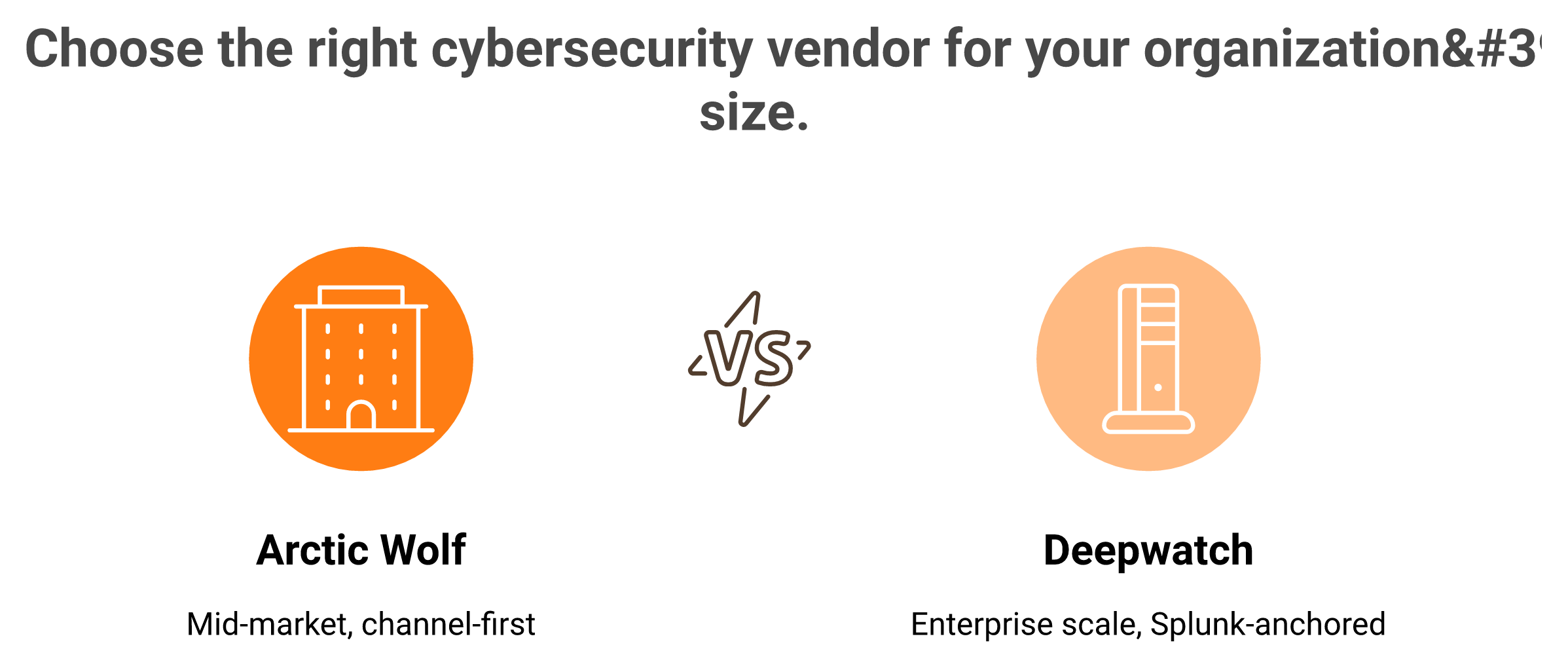
Possibly not, and that may be your answer. Arctic Wolf delivers its best value for mid-market buyers of roughly 100 to 1,000 users with no internal SOC. Deepwatch is Splunk-anchored and built for Fortune 2000 enterprises. For a 500 to 2,000-employee company, that segment gap is often more decisive than any feature. One vendor is built for your size, the other for a tier above.
🎯 The finding that reframes the whole decision
Here’s the standard read, and I think it gets this backwards. Buyers treat Arctic Wolf and Deepwatch as head-to-head rivals fighting for the same deal. Look closer at how each one goes to market, and they may not be chasing the same buyer at all.
This is the single most decision-relevant fact for a mid-market reader. If two vendors are built for different sizes, the “better features” debate is almost beside the point, a nuance worth pinning down early in any MDR buyers guide.
📊 Where each vendor actually fits
The evidence points to two different center-of-gravity segments:
- Arctic Wolf runs a channel-first, mid-market motion and delivers its strongest value for roughly 100 to 1,000 users with no in-house SOC.
- Deepwatch anchors on Splunk, with the bulk of its pipeline flowing through it, and targets Fortune 2000 enterprises.
So the “fair fight” you thought you were refereeing is really two vendors optimized for different weight classes. One is tuned for lean teams without a SOC. The other assumes a Splunk investment and enterprise-scale operations.
🧭 What the gap means for a 500 to 2,000-employee reader
For a company in that band, weight the segment fit above the feature grid. If you have no internal SOC and no heavy Splunk footprint, the enterprise-tier option may hand you cost and complexity you don’t need. If you’re already deep in Splunk and running at enterprise scale, the mid-market motion may feel thin, and an AI SOC built for mid-market teams is worth weighing.
I’ll add one honest hedge. Segment lines blur at the edges, and both vendors will happily quote outside their sweet spot. But at UnderDefense, the reason we built one platform that scales from mid-market to Fortune 500 is precisely this trap: buyers forced to choose a vendor sized for someone else. Match the tool to your size first, then compare features second.
Q7: How Does Each Handle Compliance Evidence and Audit Continuity?
Both support common frameworks, but audit continuity hinges on data ownership. When normalized logs and evidence live in a vendor’s platform, an auditor’s request during a transition can stall. Arctic Wolf offers compliance-checkpoint guidance across SOC 2 Type II, ISO 27001, and CMMC. Ask each how historical evidence transfers if you switch, because that continuity is what Legal actually reviews.
📋 Audit continuity is an ownership question
Compliance readiness looks the same on both brochures. The difference shows up during a vendor change, when an auditor asks for evidence spanning the transition. If that evidence sits locked in a platform you’re leaving, the request stalls.
I’ve spent two decades walking into organizations for PCI work, often as the person nobody wanted in the room. The one thing that saves an audit is continuous, portable evidence, the backbone of any compliance services engagement. The one thing that sinks it is a gap where your old provider’s logs used to be.
✅ Arctic Wolf’s compliance strengths
Credit where it’s due. Arctic Wolf provides genuine compliance-checkpoint guidance across SOC 2 Type II, ISO 27001, and CMMC. For a lean team facing a first audit, that advisory layer has real value.
🗺️ A one-page budget map for your CFO
Here’s a tactical move I give every leader heading into a compliance spend. Map the NIST Cybersecurity Framework’s five functions onto a single page, then slot every security dollar into one of them:
- Identify: asset inventory, risk assessment, and scoping.
- Protect: access control, hardening, and training.
- Detect: monitoring, SIEM, and detection engineering.
- Respond: incident response and containment playbooks.
- Recover: backups, restoration, and post-incident review.
Now your CFO sees exactly where money goes and where the gaps sit. It turns a vague security ask into a coverage map anyone can read, and the 2026 cybersecurity budget playbook builds on the same idea.
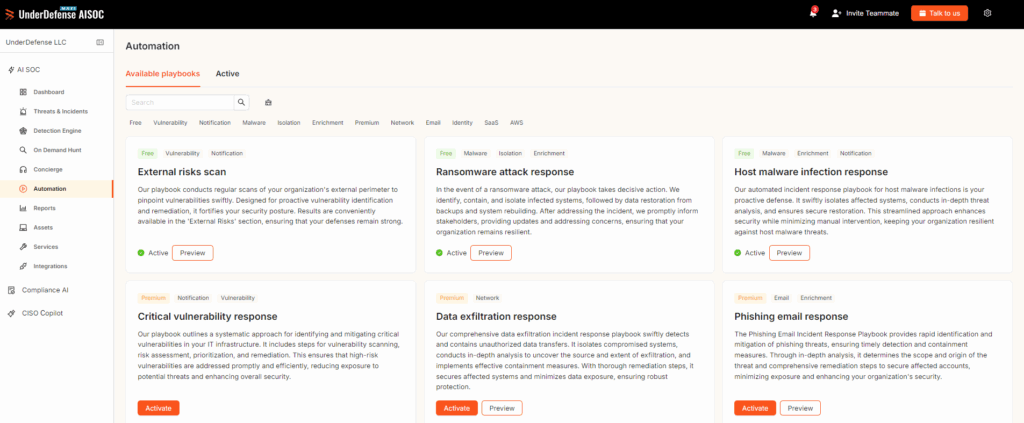
At UnderDefense, evidence continuity is the whole point of building MAXI Compliance AI on top of a security operations platform, and customers feel it at audit time:
“They’ve made our audit process much less painful. When auditors or clients ask questions about our security posture, we can pull up exactly what they need to see.”- Verified User, Marketing and Advertising UnderDefense G2 – Verified Review
“Their vCISO team was amazing in supporting us with ISO 27001. The 30-day impact reports have transformed our understanding of security posture.”- Val R., Small-Business UnderDefense G2 – Verified Review
Q8: What Should Legal and Procurement Check Before You Sign Either Contract?
Put six terms in front of Legal before signing either vendor: who legally owns normalized data and detection rules, egress format and cost, notice period to terminate, SLA structure and remedies, liability and warranty scope, and transition assistance on exit. Arctic Wolf’s $3M cyber-insurance warranty is a genuine advantage worth weighing here.
⚖️ Why the fine print matters more here than usual
For most software, the contract is boilerplate. For managed security, the contract decides who owns your data and whether you can ever leave. That makes the data-handling terms the most important clauses in the document, and reviewing SOC contract clauses closely pays off.
I’ve seen renewals turn hostile over a single line about notice periods or egress fees. Read those clauses before the honeymoon, rather than after.
📝 The six questions to put in front of Legal
Hand your Legal and procurement teams this exact set:
- Ownership: Who legally owns the normalized data and the detection rules built on your environment?
- Egress: In what format, and at what cost, can you export your data and logic at exit?
- Notice period: How much notice does termination require, and does it auto-renew?
- SLA structure: What are the response commitments, and what remedies apply if they’re missed?
- Liability and warranty: What’s the scope, and what’s specifically excluded?
- Transition assistance: What help do you get moving off the platform on the way out?
Each answer should come back in writing, from both vendors, before anyone signs. If a breach hits mid-transition, you’ll also want a clear line to incident response that does not depend on the outgoing vendor.
💰 Where Arctic Wolf holds a genuine edge
I’ll be straight, because honesty is what makes this whole comparison worth reading. Arctic Wolf’s $3M cyber-insurance warranty is a real advantage. It’s a financial backstop that many providers, UnderDefense included, do not match.
That said, read the exclusions carefully. A warranty is only as strong as what it covers, and the fine print is exactly the kind of thing your Legal team should be pressure-testing on question five above. Weigh the backstop against the ownership and exit terms together, since one strong clause doesn’t offset a weak one. When you’re ready to pressure-test your own terms, our team is happy to talk it through.
One customer summed up why the ownership and transparency side matters just as much on the day-to-day:
“It’s clear they take security seriously and genuinely care about their clients. Their responsiveness and flexibility stood out. No matter the issue, they tackled it quickly.”- Arman N., CTO UnderDefense G2 – Verified Review
Q9: How Fast Does Each Reach First Value Across 30, 60, and 90 Days?
Arctic Wolf deploys quickly for smaller footprints, roughly two to three weeks under 250 units, because you adopt its platform wholesale. Deepwatch’s timeline depends on your Splunk maturity, so a committed Splunk shop starts faster while a greenfield one takes longer. Map value in phases: onboarding and log coverage at 30 days, tuning and noise reduction at 60, steady-state detection quality at 90.
⏰ Why the speed bar is higher than it looks
Time-to-value is not a nice-to-have. Attackers move at machine speed now. Recent breach data clocks initial access in as little as 51 seconds, with a median breakout around 48 minutes. Any partner you pick has to beat that clock, and a slow onboarding leaves you exposed during the exact window you’re paying to close, which is why investigation speed belongs at the top of your criteria.
🐺 Arctic Wolf: fast because you adopt the platform
Arctic Wolf’s onboarding is genuinely quick for smaller footprints, often two to three weeks under 250 units. The reason is structural: you adopt its platform wholesale, so there’s less to integrate. The trade-off is that speed comes bundled with committing to its stack, which loops back to the ownership question from earlier sections and the risk of vendor lock-in.
📈 Deepwatch: speed tracks your Splunk maturity
Deepwatch’s timeline is a function of your existing Splunk investment. A committed Splunk shop with clean data pipelines starts fast. A greenfield environment, one building Splunk from scratch, takes noticeably longer because the foundation isn’t there yet, so a readiness assessment pays off before you commit.
🗺️ A neutral 30/60/90 framework
Whichever vendor you evaluate, judge first value in three phases:
- Day 30: Onboarding complete, log sources connected, baseline coverage live.
- Day 60: Detection tuning underway, false positives dropping, playbooks adapting to your environment.
- Day 90: Steady-state detection quality, with alert-to-triage times you can measure and defend to your board.
The milestone I’d watch hardest is noise reduction during onboarding. If a provider hasn’t cut the false-positive flood by day 30, the other numbers won’t matter. At UnderDefense, we treat two commitments as separate SLAs on purpose: 2-minute Alert-to-Triage and 15-minute escalation for critical incidents. Collapsing them into one “MTTR” number hides which promise you’re actually buying, a distinction our SLA guide breaks down. Buyers describe the onboarding difference directly:
“The speed of onboarding was a delightful surprise. Their 24/7 detection and response service is fast and comprehensive. Now, when alerts pop up, there’s no panic.”- Valeriia D., Marketing Specialist UnderDefense G2 – Verified Review
“Their team cleaned up our configurations and got the noise under control within the first week. Now when we get an alert, we know it’s something worth looking into.”- Verified User, Marketing and Advertising UnderDefense G2 – Verified Review
Q10: Which Should You Pick, Arctic Wolf, Deepwatch, or Reconsider Both?
Pick Arctic Wolf if you are a 100 to 1,000-user mid-market shop with no internal SOC that values fast deployment, unlimited ingestion, and the $3M warranty. Pick Deepwatch if you are a committed Splunk enterprise wanting to extend that investment. Reconsider both if on-prem coverage, keeping your own SIEM, or owning your detection rules is non-negotiable.
🐺 Pick Arctic Wolf if
Choose Arctic Wolf when your profile lines up with its sweet spot:
- You run 100 to 1,000 users with no internal SOC to co-manage anything.
- You want fast deployment and predictable, unlimited-ingestion billing.
- The $3M cyber-insurance warranty carries real weight in your risk calculus.
The one-line rationale for your CFO: it’s built for your size and removes the staffing headache without a per-gigabyte surprise, though it’s still worth checking the numbers against a SOC cost calculator.
📈 Pick Deepwatch if
Choose Deepwatch when Splunk is already central to how you operate:
- You’ve committed to Splunk and want to extend that investment, rather than replace it.
- You run at enterprise scale with the team to match.
The one-line rationale: you’re paying to deepen a platform you already trust, and the economics only make sense if that Splunk foundation is real. A co-managed approach to MDR for Splunk is worth comparing before you extend.
⚠️ Reconsider both if
Here’s the honest branch most comparisons skip. Step back if any of these are non-negotiable:
- Half your estate sits on-prem, where a cloud-native model leaves gaps, so weigh a hybrid and on-premise option.
- You need to keep your own SIEM and the data inside it.
- You want your detection rules to stay portable, as owned, versioned code.
I’ll level with you on expectations, too. You don’t really “win” in security. You keep the doors boarded up until the sun comes out, and the honest question is the comparative cost of a 24/7 capability you can’t opt out of, the kind our managed SIEM team delivers. Two customers who weighed exactly this landed here:
“I used to work with many MDR solutions in the past, and so far UnderDefense is the best one. It automates many tasks, plus, with 24/7 monitoring, we know we’re always protected.”- Inga M., CEO UnderDefense G2 – Verified Review
“We hired them for managed SIEM service, but after they demonstrated the value of MDR, our management was motivated to act on it. Their expert management of our SIEM added to the value of our security investments.”- Yaroslava K., IT Project Manager UnderDefense G2 – Verified Review
Q11: What If Neither Model Fits, Is There a Third Architecture?
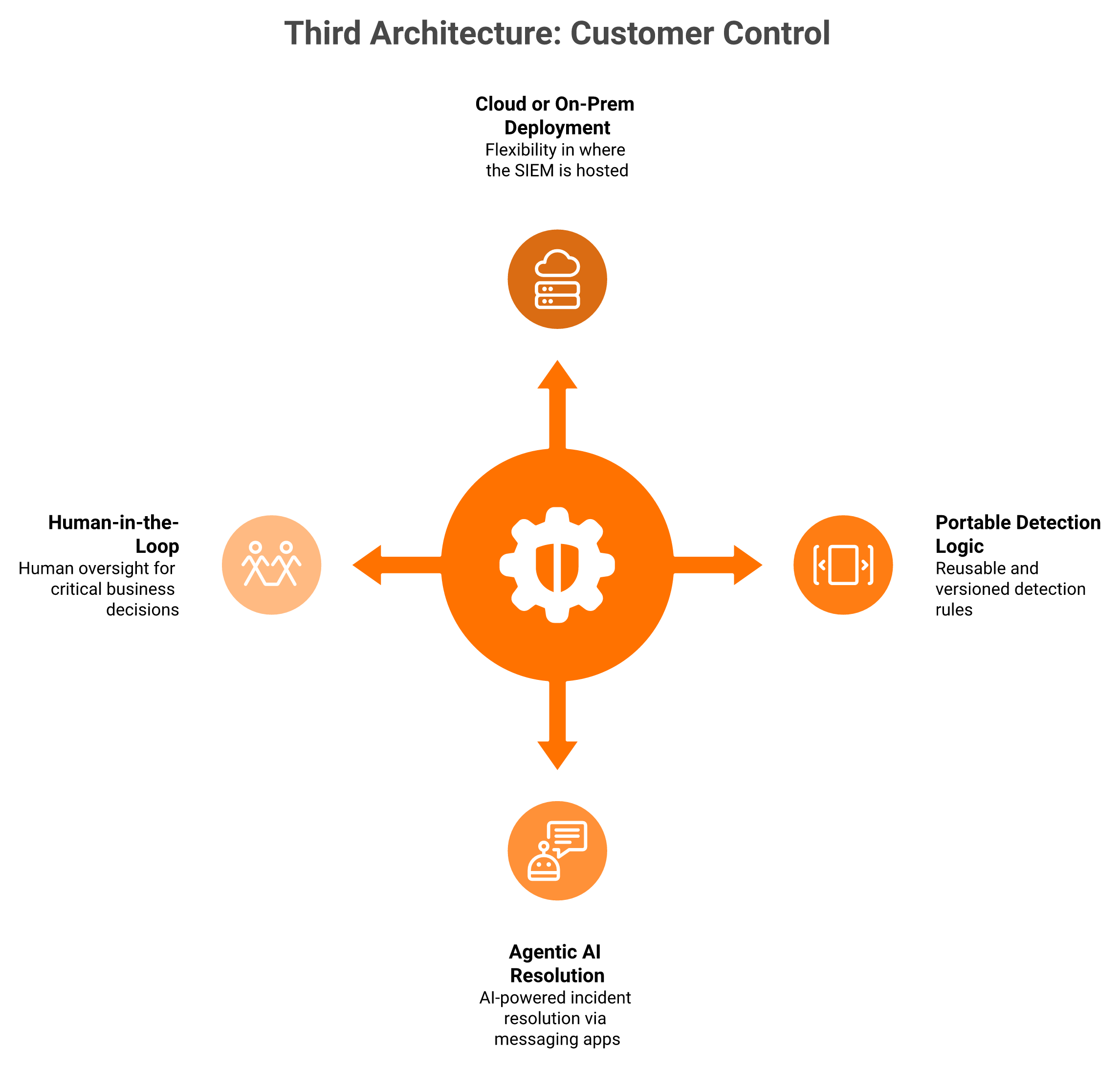
For managed operations without surrendering your data or detection rules, a third model exists. A vendor-agnostic team co-manages a SIEM you own, deployed in your own cloud or on-prem, with detection logic kept as portable, versioned code. UnderDefense Agentic AI SOC follows this pattern, keeping the data plane and rules in your hands rather than the vendor’s.
🧩 The third architecture, explained plainly
The two models you’ve compared share one assumption: the vendor holds the platform, and you consume the output. The third architecture flips that. You keep the SIEM, the data, and the rules; a specialist team operates on top of what you own.
Concretely, that means an agnostic layer over your owned SIEM, deployed in your own cloud or even fully on-prem for regulated shops. Detection logic lives as versioned code you can carry. And the agentic AI, autonomous software agents that investigate alerts, resolves the routine work through your existing Slack or Teams, rather than escalating a half-finished ticket back to your team, which is the promise of a genuine autonomous SOC.
🧠 Why human-in-the-loop still matters
Here’s the mental model I use. The AI agents are foot soldiers running hundreds of reasoning steps per alert, and human engineers are the generals making the call. That combination once caught a payroll business-email-compromise attempt, a fraudulent wire request, that had nothing to do with malware and everything to do with business risk. Being a human in the loop is a genuine edge in 2026, rather than a legacy cost.
✅ What UnderDefense Agentic AI SOC is, and honestly what it isn’t
This is the one place I’ll name our own platform. UnderDefense Agentic AI SOC keeps the data plane and detection rules with you, pairs agentic AI with human analysts, and runs the two SLAs I mentioned as distinct commitments: 2-minute Alert-to-Triage and 15-minute escalation for critical incidents. You can see the workflows on the UnderDefense platform page.
Now the honest part, because a comparison that only flatters itself is not worth your time. We are not listed on the Forrester Wave for MDR, where Arctic Wolf sits as a Contender. And we do not match Arctic Wolf’s $3M cyber-insurance warranty. If a Wave placement or that financial backstop is your deciding factor, weigh those honestly against data ownership and portability, and pick what your board actually needs. Customers who value the managed detection and response ownership model put it this way:
“The platform pulls in data from all our existing security tools, so we didn’t have to rip and replace anything. When they escalate something, they include the context we need.”- Verified User, Marketing and Advertising UnderDefense G2 – Verified Review
“Their customer-centric approach is a breath of fresh air. The platform’s high-fidelity alerts and automated enrichment help us quickly identify and address threats.”- Verified User, Computer Software UnderDefense G2 – Verified Review
What I keep sitting with, heading into the next 18 months, is this: as attackers deploy their own agents, the deciding question stops being “who monitors me” and becomes “who lets me keep control while they do.” That’s the conversation I’d genuinely like to have with you.
See tuned SIEM triage in action.
1. Arctic Wolf vs Deepwatch: which is better for SIEM management?
There is no universal winner, and we think that framing hides the real decision. On paper both are pure-play, technology-agnostic managed security operations vendors, so their feature lists converge on 24/7 monitoring, a named team, and autonomous containment.
The choice depends on your profile:
- Arctic Wolf fits a 100 to 1,000-user mid-market shop with no internal SOC that values fast deployment and unlimited ingestion.
- Deepwatch fits a committed Splunk enterprise wanting to extend that investment at scale.
- Reconsider both if on-prem coverage, keeping your own SIEM, or owning your detection rules is non-negotiable.
What actually decides the next three years is structural: where your telemetry lands, who owns the detection logic, and what you can carry out at contract end. We built our managed SIEM practice around customer-owned data precisely because we watched buyers get trapped two years after signing. Match the tool to your size and ownership needs first, then compare features second, since a feature checkbox tells you what a vendor does today, not what you will own in two years.
2. How do Arctic Wolf and Deepwatch pricing models compare?
Neither vendor publishes standard pricing, so we tell buyers to compare failure modes rather than hunt for a single figure.
- Arctic Wolf licenses per user on its own SIEM with unlimited ingestion, which keeps billing predictable but keeps the data engine with the vendor. Buyer-reported medians land near $96,340 per year, ranging from about $29K to $320K by size.
- Deepwatch ties economics to Splunk, so cost pressure sits in ingestion and climbs as telemetry volume grows.
The practical read: Arctic Wolf’s per-user model breaks if you are headcount-heavy but data-light, and Deepwatch’s ingestion model breaks if you are data-heavy, common in cloud and DevOps-forward shops. One lever most buyers miss is that untuned data is expensive data; we have seen ingestion cut roughly 90%, from 300GB a day to 35 to 40GB, by filtering noise before it hits the SIEM.
Benchmark either quote against the cost of building in-house, which realistically means five people and well over $620,000 a year. Our MDR pricing breakdown frames the same conversation your CFO needs.
3. Who owns the SIEM data and detection rules when the contract ends?
This is where the two models diverge most, and it is the clause we tell buyers to read before the honeymoon ends.
- Arctic Wolf normalizes your logs into its proprietary SIEM and hands you dashboards and reports rather than direct access to raw normalized data or the detection logic.
- Deepwatch runs detection logic inside Splunk instances it operates, so portability depends on whether you or Deepwatch owns that deployment.
Ownership sounds like a legal footnote, but it decides whether your next security decision is still yours to make. If telemetry and rules live inside a vendor’s platform, leaving means rebuilding detection from scratch. The fix is detection-as-code: rules written in code, version-controlled, and portable become assets you own and can carry out.
We build on customer-owned SIEM and keep every investigative step observable, so you can avoid the trap our guidance on avoiding vendor lock-in describes. Ask both vendors in writing: at contract end, do I keep my detection rules, in what format, and at what egress cost?
4. Does Arctic Wolf or Deepwatch support on-premise environments?
On-prem is the live differentiator between these two, and it is often more decisive than any feature for hybrid estates.
- Arctic Wolf is recorded as cloud-native, so hybrid and legacy on-prem environments are a structural stretch rather than a simple feature toggle.
- Deepwatch brings broad cloud and SaaS coverage plus deep Splunk expertise, which suits cloud-heavy shops but is not built primarily for data-center workloads.
If half your estate sits in a data center, a cloud-only model leaves those systems dark, and that is a gap you feel on day one. We map coverage to attacker techniques rather than counting logos, because a center is defenseless when one door has no sensor.
The third path is a vendor-agnostic team co-managing the SIEM you already own, across cloud, on-prem, and hybrid. That is the work our team does through a co-managed hybrid and on-premise SIEM model, so managed coverage does not require moving your data into someone else’s platform. Confirm on-prem support explicitly before you shortlist either vendor.
5. How do Arctic Wolf and Deepwatch compare on coverage and response?
Coverage finds the threat and response decides whether it matters, so we weigh both, not just surface counts.
- Deepwatch covers four attack surfaces, adding cloud and SaaS, and supports six autonomous response actions under a documented sub-one-hour response SLA.
- Arctic Wolf covers three base surfaces, supports three autonomous actions, and adds EDR depth via the Cylance/BlackBerry acquisition plus a named Concierge Security Team.
Count matters less than completeness. We map coverage to MITRE ATT&CK rather than counting logos, because an intrusion can run undetected when logs were never turned on for one application. We also flag a distinction buyers miss: guided remediation and hands-on containment are different jobs, and if a vendor guides while you execute, the 2 a.m. work is still yours.
Our approach to managed detection and response keeps changes from routing through a single engineering queue. Ask each vendor whether they resolve incidents or simply escalate them back to your team.
6. Are Arctic Wolf and Deepwatch even competing for the same buyer?
Possibly not, and that may be your answer. When we look at how each goes to market, they optimize for different weight classes.
- Arctic Wolf runs a channel-first, mid-market motion and delivers its strongest value for roughly 100 to 1,000 users with no in-house SOC.
- Deepwatch anchors on Splunk, with the bulk of its pipeline flowing through it, and targets Fortune 2000 enterprises.
For a 500 to 2,000-employee company, that segment gap is often more decisive than any feature grid. If you have no internal SOC and no heavy Splunk footprint, the enterprise-tier option may hand you cost and complexity you do not need. If you are already deep in Splunk at enterprise scale, the mid-market motion may feel thin.
Segment lines blur at the edges, and both vendors will happily quote outside their sweet spot. We built one platform that scales from mid-market to Fortune 500 precisely to avoid this trap, which our thinking on an AI SOC for mid-market teams explains. Match the tool to your size first, then compare features.
7. What should Legal and procurement check before signing either contract?
For managed security, the contract decides who owns your data and whether you can ever leave, so the data-handling terms are the most important clauses in the document.
We hand Legal and procurement six questions to put to both vendors in writing:
- Ownership: Who legally owns the normalized data and the detection rules built on your environment?
- Egress: In what format, and at what cost, can you export data and logic at exit?
- Notice period: How much notice does termination require, and does it auto-renew?
- SLA structure: What are the response commitments, and what remedies apply if they are missed?
- Liability and warranty: What is the scope, and what is excluded?
- Transition assistance: What help do you get moving off the platform on the way out?
Arctic Wolf’s $3M cyber-insurance warranty is a genuine advantage worth weighing, though you should read the exclusions carefully. If a breach hits mid-transition, you will also want a clear line to incident response that does not depend on the outgoing vendor. Weigh the backstop against ownership and exit terms together.
8. Is there an alternative to Arctic Wolf and Deepwatch that keeps your own SIEM?
Yes. Both vendors share one assumption, that the vendor holds the platform and you consume the output, and a third architecture flips that.
In this model, a vendor-agnostic team co-manages a SIEM you own, deployed in your own cloud or fully on-prem for regulated shops, with detection logic kept as portable, versioned code you can carry. Agentic AI, autonomous software agents that investigate alerts, resolves routine work through your existing Slack or Teams rather than escalating a half-finished ticket back to your team.
- You keep the data plane and the detection rules.
- Human engineers stay in the loop for business-risk calls that malware-focused tooling misses.
- Two SLAs stay distinct: 2-minute Alert-to-Triage and 15-minute escalation for critical incidents.
We will be honest about trade-offs: we are not on the Forrester Wave for MDR, and we do not match Arctic Wolf’s $3M warranty. If those are decisive, weigh them against ownership and portability. You can see how our MDR service keeps control in your hands while we operate on top of it.