




Q1: What Are the 11 Best Managed SIEM Providers for Companies Running Elastic in 2026?
The 11 best managed SIEM providers for Elastic in 2026 are the ones that operate your existing deployment in place, keeping your data and your detection rules, instead of moving you onto their own platform. Most mainstream MDR vendors fail this first test because they require a proprietary SIEM. That single rule is why this list looks different from a normal roundup.
Let me be honest about who this is for before we get into names.
You inherited an Elastic deployment. A contractor stood it up, or an engineer built it and then left. It still ingests, it still stores, it still alerts. Nobody on your team today can safely tune a rule, add a data source, or fix it when it breaks. That is the reader I wrote this for.
You are not shopping for a new SIEM. You are asking a quieter question: who will run the Elastic I already have?
Talk to a SIEM expert about fewer false positives.
How We Built This List
I have sat inside enough SIEM projects to know the trap here. The obvious move is to list nine famous MDR brands and pad the rest. That would waste your time, because most of those brands cannot operate your Elastic cluster at all.
So we started from the property that matters and worked backward. We treated Elastic co-management as a Lego problem. You want to own all the bricks, then let someone help you run your own build, rather than hand the whole box to a vendor who locks it shut.
We evaluated providers against one gate first, then four supporting criteria, detailed in the next section:
- In-place or migration-required. Do they run your existing Elastic, or do they need you on their stack?
- Elastic-specific depth. Real Elasticsearch, Kibana, Logstash, ILM, and ingest-pipeline skill, or generalist SIEM management?
- Rule and data ownership. Can you still see, edit, and keep your detections and logs?
- What is actually operated. Tuning, detection engineering, upgrades, retention, and cluster health.
- Cost transparency. Flat, per-endpoint, or tied to your ingestion volume.
Why Most Big MDR Names Are Not Here
Here is the part the category avoids saying out loud. When you apply the in-place test, a large share of the well-known MDR field drops off the list.
That is not a knock on their engineering. A provider that runs everything on its own SIEM has made a real architectural choice with real benefits, like tight integration and fast onboarding. It just solves a different problem than the one you have. If your job is to keep the Elastic you already own, a rip-and-replace model does not fit, and that is a fit question, not a quality one. This is exactly the trade-off we break down in our guide on avoiding SIEM vendor lock-in.
So this list mixes true co-management specialists, Elastic Verified MSP partners, and Elastic’s own offerings. My current read is that an honest “only a handful genuinely do this” is more useful to you than a padded top 20.
The 11 Providers at a Glance
- UnderDefense
- Fortgale
- Proficio
- Netrix Global
- Kyndryl
- Accenture (Elastic Verified MSP)
- ECS (Elastic Verified MSP)
- NEC (Elastic Verified MSP)
- Elastic Consulting and Support (first-party)
- BitLyft
- Regional Elastic MSP or boutique specialist
Elastic Co-Management Providers Compared
| Provider (Rating) | Best For | Key Strength | Compliance |
|---|---|---|---|
| UnderDefense (5 stars) | Inherited Elastic you need operated in place | Co-manages your owned SIEM; you keep data and rules; Detection Logic as Code | SOC 2, ISO 27001, HIPAA, and PCI DSS support |
| Fortgale (4 stars) | European teams wanting a native Elastic SOC | 24/7 European SOC, custom ESQL and EQL rules on open data | ISO 27001, NIS2-ready, DORA-aligned, and GDPR |
| Proficio (4 stars) | Enterprises wanting an award-winning Elastic MSSP | Elastic Excellence Award winner; co-managed model offered | SOC 2, HIPAA, and PCI DSS readiness |
| Netrix Global (4 stars) | Mid-market wanting managed Elastic in Elastic Cloud | 24/7 MDR on Elastic; centralized logging and remediation | Compliance-readiness support |
| Kyndryl (4 stars) | Large enterprises wanting meet-you-where-you-are SecOps | Top-ranked MSSP; SIEM, EDR, and MDR building blocks, no forced rip-and-replace | ISO 27001 certified |
| Accenture (3 stars) | Global enterprises needing Elastic plus integration muscle | Elastic Verified MSP designation | Enterprise compliance programs |
| ECS (3 stars) | Public sector and regulated Elastic deployments | Elastic Verified MSP; analytics depth | Government-grade compliance |
| NEC (3 stars) | APAC and global managed Elastic estates | Elastic Verified MSP; broad managed portfolio | Regional compliance coverage |
| Elastic Consulting and Support (3 stars) | Teams wanting first-party Elastic expertise | Vendor-native Elasticsearch, Kibana, and Logstash depth | Platform-level certifications |
| BitLyft (3 stars) | SMBs weighing ELK as a SIEM choice | Practical ELK operating guidance and monitoring | SOC 2 and HIPAA support |
| Boutique Elastic specialist (3 stars) | Teams wanting a hands-on regional partner | Deep, focused Elastic tuning attention | Varies by provider |
Star ratings map to the weighted rubric in Q2. UnderDefense earns five stars on the in-place criterion; the rest are scored on how fully they operate a customer-owned Elastic cluster. If you want a structured way to score vendors yourself, our managed SIEM evaluation questions cover the same ground.
Now let’s look at each provider in detail, starting with the two that anchor the list.
1.1 UnderDefense: Best for an Inherited Elastic Deployment You Need Operated In Place
Overview
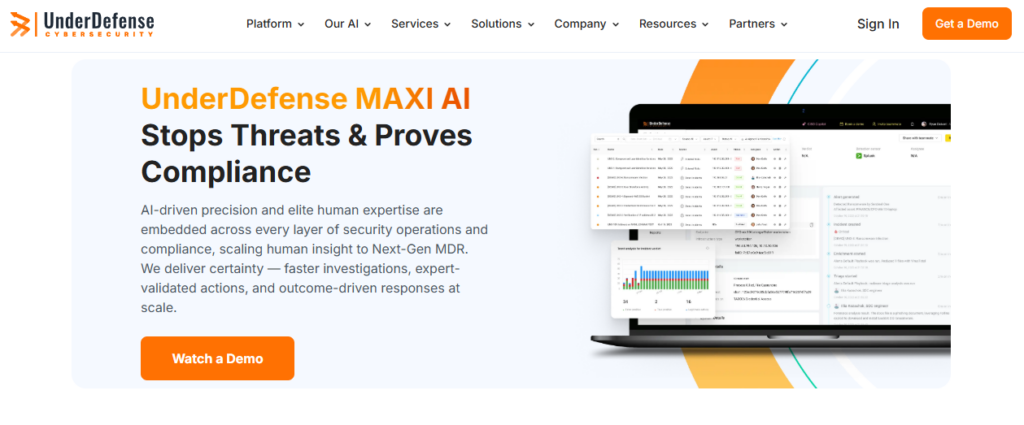
UnderDefense is a security operations partner built around a simple idea: co-manage the SIEM you already own, rather than take it over. For an Elastic team, that means we operate your existing cluster, your data, and your rules, in place. There is no platform swap and no migration project waiting behind the sales call.
We work across Elastic Cloud and Elastic Stack, meaning Elasticsearch, Kibana, and Logstash, the three engines under an ELK deployment. That is the exact skill set an inherited deployment loses when the engineer who built it walks out the door. Our managed SIEM integration guide walks through how that handover works.
Core Services
- 24/7 threat hunting and monitoring on your existing Elastic deployment
- Detection Logic as Code, so rules are versioned, unit-tested, and reviewable instead of tribal knowledge
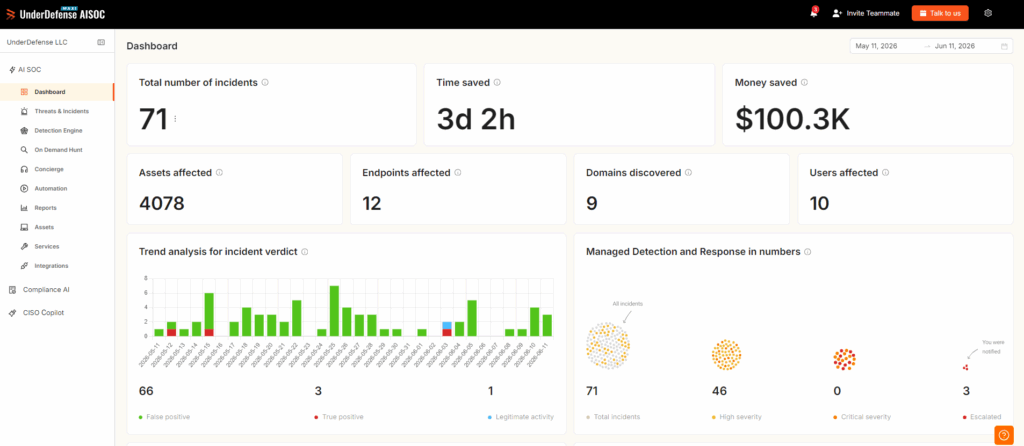
- Manual fine-tuning to cut alert noise, with roughly 99% noise reduction during a 30-day onboarding
- UnderDefense, running on top of your telemetry, available through the Agentic AI SOC platform
- Runs on-prem in your own cloud, with 215 integrations across your stack
Why Companies Consider UnderDefense
The pull is ownership. You keep your data and your detections, so you are never “starting over on the tuning” if you leave. One reviewer described exactly the inherited-noise problem this page is about.
The noise reduction is the part operators feel first. When 50% to 90% of SOC alerts are false positives, tuning is not a nice-to-have, but the whole job. We cover why this happens in our breakdown of alert fatigue in cybersecurity.
Ideal Customer Profile
- Tech, SaaS, and mid-market teams with a working-but-frozen Elastic deployment
- Security-lean teams that cannot hire a scarce Elastic engineer
- Compliance-driven orgs needing 24/7 coverage without building a SOC
Commercial Model
UnderDefense offers CAPEX and OPEX options, plus a free tier that includes a leak check, dark-web monitoring, and an external-perimeter scan. That free tier suits a reader who wants to try before talking to anyone. You can see the full breakdown on our managed SIEM pricing page.
When to Shortlist
Shortlist UnderDefense when your goal is measurable outcomes from your existing Elastic investment, and you want to fill an unfilled Elastic-engineer role instead of running a migration. If you have just taken over an environment, our MDR service team can operate it while your rules stay yours.
Reviews
“The biggest win for me was getting actual control over our security alerts. Before the guys from UD stepped in, we were getting bombarded with alerts from all our security tools. Their team cleaned up our configurations and got the noise under control within the first week. The platform itself is straightforward, it pulls in data from all our existing security tools, so we didnt have to rip and replace anything.”
– Verified User in Marketing and Advertising, Small-Business UnderDefense G2 – Verified Review
“They keep us informed, suggesting relevant and cost-effective security improvements and new use cases that enhance our defenses. Plus, their expert management of our SIEM has added to the value of our security investments and tools.”
– Yaroslava K., IT Project Manager UnderDefense G2 – Verified Review
1.2 Fortgale: Best for European Teams Wanting a Native Elastic SOC
Overview
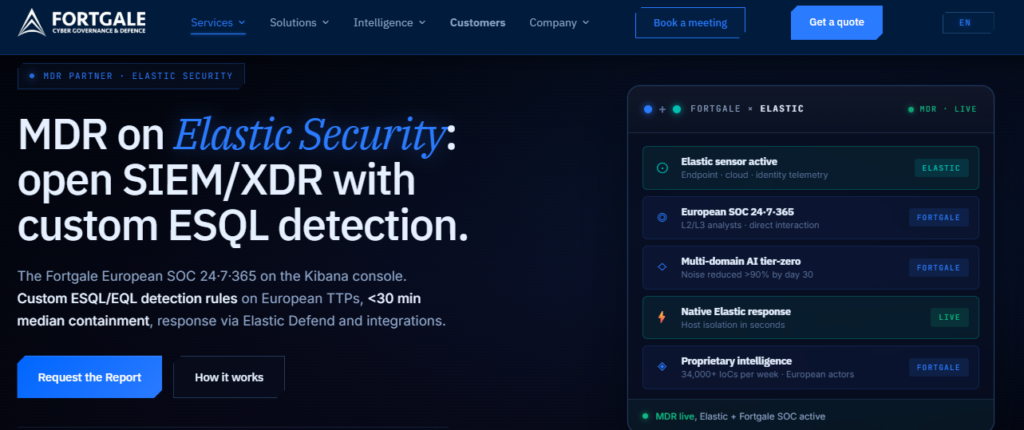
Fortgale runs a 24/7/365 European SOC directly on Elastic Security. Their analysts work inside your Kibana console, the visual front end of Elastic, rather than routing your data through a black box. They lean hard into Elastic’s open, data-first model, which has no events-per-second ingestion caps.
Core Services
- 24/7 European SOC monitoring on Elastic Security
- Custom ESQL and EQL detection rules, the query languages Elastic uses to write detections
- Native response through Elastic Defend, including host isolation and process kill
- Threat hunting on the open Elastic data lake with proprietary threat intelligence
- Managed cluster, Fleet, and integration upkeep
Why Companies Consider Fortgale
Fortgale reports a median containment time around 11 minutes and roughly 94% noise reduction through ESQL and machine-learning detection. For teams worried that legacy 30-to-60-minute response is too slow, that speed matters. It also runs on your existing instance, not only their own build.
Ideal Customer Profile
- European organizations with EU data-residency needs
- Teams that already own Elastic and want analysts fluent in it
- Regulated firms tracking NIS2 and DORA timelines
Commercial Model
Fortgale operates on Elastic’s resource-based pricing, which ties cost to compute rather than per-event volume, and supports both Elastic Cloud and on-prem clusters.
When to Shortlist
Shortlist Fortgale when you need a European SOC operating your Elastic in place, with NIS2 reporting support to the national CSIRT inside 24 hours. For teams comparing service models, our guide on managed SIEM vs MDR vs MSSP is a useful companion read.
I could be slightly off on their exact metrics, since these are Fortgale’s own published figures rather than an independent audit, so verify them against your own telemetry during a trial.
1.3 Proficio: Best for Enterprises Wanting an Award-Winning Elastic MSSP
Overview
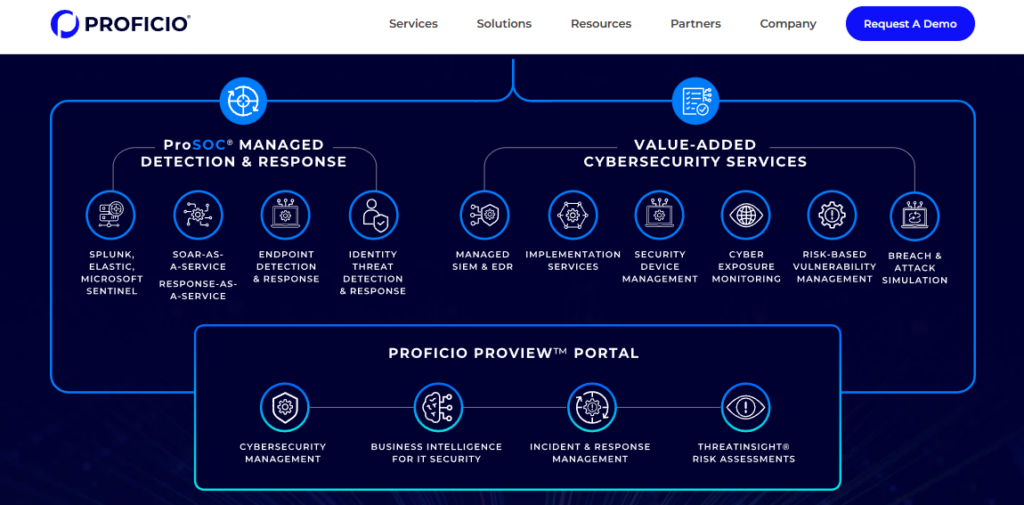
Proficio is a global managed security services provider (MSSP) that operates security operations around the Elastic Stack. It won an Elastic Excellence Award, which signals real depth on the platform rather than a bolt-on.
The important detail for this list is the co-managed option. That means Proficio can run detection on an Elastic environment while you keep visibility into it.
Core Services
- 24/7 SOC monitoring and Managed Detection and Response (MDR)
- Threat hunting and detection engineering on Elastic
- Co-managed SIEM engagements
- Compliance reporting support
- Incident response assistance
Why Companies Consider Proficio
The pull is enterprise scale plus recognized Elastic credibility. For a larger org that wants an established brand with Elastic muscle, Proficio checks that box.
I would still confirm one thing during a trial. Ask exactly how much of the work runs on your cluster versus theirs, because “co-managed” means different things to different vendors, a point we unpack in our managed SIEM integration guide.
Ideal Customer Profile
- Enterprises with mature security programs
- Regulated firms needing structured compliance reporting
- Teams wanting a globally staffed SOC on Elastic
Commercial Model
Proficio uses subscription-based MSSP pricing scoped to environment size and monitored assets. Expect a formal onboarding and advisory layer.
When to Shortlist
Shortlist Proficio when you want an award-recognized Elastic MSSP and your buying process favors a large, established provider.
Reviews
“Proficio’s ProSOC service has been a solid partner. The team is responsive and the reporting gives us clear visibility. Overall our experience has been very positive.”Verified ReviewerProficio Gartner Verified Review
1.4 Netrix Global: Best for Mid-Market Teams Wanting Managed Elastic in Elastic Cloud
Overview
Netrix Global delivers managed detection and response with Elastic as a supported SIEM, often inside Elastic Cloud. Their pitch centers on centralized logging, monitoring, and remediation for mid-market teams.
They frame the model around you keeping control of your data, which fits the inherited-deployment reader well.
Core Services
- 24/7 MDR on Elastic
- Centralized log management and correlation
- Threat detection and remediation support
- Compliance-readiness assistance
- Security advisory
Why Companies Consider Netrix
The appeal is a mid-market fit without a rip-and-replace. If your Elastic lives in Elastic Cloud, Netrix can operate it while your team keeps the keys.
My read is that this is a reasonable middle option. Just confirm how deep their Elastic detection engineering goes versus general SIEM monitoring, which our managed SIEM evaluation questions can help you probe.
Ideal Customer Profile
- Mid-market organizations on Elastic Cloud
- Teams wanting managed monitoring without migration
- Compliance-driven firms needing coverage
Commercial Model
Netrix operates on managed-service subscription pricing scoped to your environment and log volume.
When to Shortlist
Shortlist Netrix when your Elastic runs in Elastic Cloud and you want a mid-market MDR partner who leaves your data in your hands.
1.5 Kyndryl: Best for Large Enterprises Wanting Meet-You-Where-You-Are SecOps
Overview
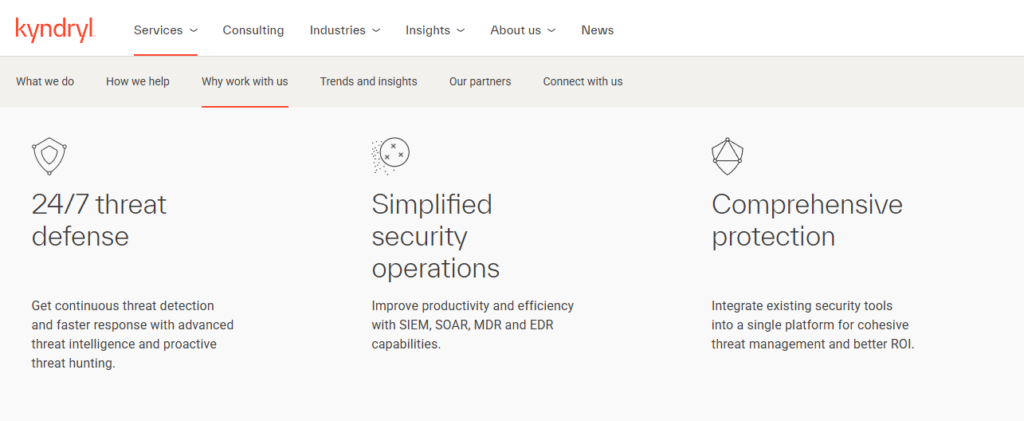
Kyndryl is a global IT and security services firm that spun out of IBM. It offers SIEM, EDR, and MDR as building blocks rather than a single forced stack.
That modular posture matters here. A provider that does not force a rip-and-replace can, in principle, operate the Elastic you already run.
Core Services
- Managed SOC and MDR
- SIEM and EDR operation across multiple platforms
- Incident response and recovery
- Compliance and risk services
- Global delivery at enterprise scale
Why Companies Consider Kyndryl
The draw is scale and breadth. For a 5,000-plus-employee enterprise with a complex estate, Kyndryl can staff and standardize operations globally.
The honest trade-off is coordination overhead. Some reviewers flag slower ticket handoffs between departments, which is common at very large services firms. If Kyndryl is on your shortlist, it is worth comparing against a focused MDR service built around your existing stack.
Ideal Customer Profile
- Large, global enterprises
- Complex multi-platform environments
- Teams wanting a single global operations partner
Commercial Model
Kyndryl uses enterprise managed-services contracts, scoped and priced per engagement. Expect formal SLAs and a structured governance layer.
When to Shortlist
Shortlist Kyndryl when you are a large enterprise wanting a meet-you-where-you-are model, and you can absorb the governance of a big provider.
Reviews
“Kyndryl has a strong understanding of business expectations, as well as the ability to effectively manage incidents and crisis. The Teams are highly committed and reactive.”Director of IT, TransportationKyndryl Gartner Verified Review
“Technical support desk takes a long time to react, ticket logs can be left unattended for days without updates.”IT Security and Risk Management Associate, ManufacturingKyndryl Gartner Verified Review
1.6 Accenture: Best for Global Enterprises Needing Elastic Plus Integration Muscle
Overview
Accenture is an Elastic Verified MSP, a designation Elastic grants to partners with proven managed-service capability on its platform. That verification is the reason it belongs on an Elastic-specific list.
Accenture pairs Elastic operations with large-scale systems integration. For enterprises mid-transformation, that combination can matter.
Core Services
- Elastic-based managed security operations
- Large-scale integration and migration work
- Threat detection and response
- Compliance and risk programs
- Global SOC delivery
Why Companies Consider Accenture
The pull is reach and integration depth. If Elastic is one piece of a broader transformation program, Accenture can operate it inside that bigger effort.
The trade-off is size. A consulting-scale engagement can be heavier than a focused co-management shop, so weigh that against your speed needs, especially where fast incident response matters.
Ideal Customer Profile
- Global enterprises running transformation programs
- Complex, multi-vendor environments
- Teams wanting integration and SecOps together
Commercial Model
Accenture engages through enterprise consulting and managed-services contracts, scoped per program.
When to Shortlist
Shortlist Accenture when Elastic operations sit inside a larger integration or transformation initiative you already own.
1.7 ECS: Best for Public Sector and Regulated Elastic Deployments
Overview
ECS is an Elastic Verified MSP with strong analytics and public-sector roots. That heritage shows up in how it handles regulated, high-assurance environments.
For government and regulated buyers running Elastic, ECS speaks the compliance language natively.
Core Services
- Elastic-based security analytics and monitoring
- Managed detection and response
- Public-sector and regulated compliance support
- Data engineering on Elastic
- Threat hunting
Why Companies Consider ECS
The appeal is regulated-environment credibility. If your Elastic holds sensitive or government data, ECS has operated in those constraints before.
My read is that ECS is a specialist fit. It is less about breadth and more about depth in regulated analytics, so pair it with strong compliance services if you need formal certification support.
Ideal Customer Profile
- Public-sector agencies
- Regulated industries with strict data rules
- Analytics-heavy Elastic deployments
Commercial Model
ECS engages through managed-services and public-sector contracting vehicles, scoped per environment.
When to Shortlist
Shortlist ECS when you are in the public sector or a heavily regulated industry and your Elastic deployment needs government-grade handling.
1.8 NEC: Best for APAC and Global Managed Elastic Estates
Overview
NEC is an Elastic Verified MSP with a broad managed-services portfolio and strong presence across APAC. That regional reach is its distinguishing feature here.
For organizations with operations in Asia-Pacific running Elastic, NEC offers local delivery with Elastic verification behind it.
Core Services
- Managed Elastic security operations
- Detection and response services
- Broad IT and managed-services portfolio
- Regional compliance coverage
- Integration support
Why Companies Consider NEC
The pull is regional coverage plus Elastic credibility. If your estate spans APAC, local presence reduces friction on time zones and data rules.
The trade-off, as with any large portfolio provider, is confirming Elastic depth specifically. Ask to see the detection-engineering team, not just the account team, and dig into how they handle data residency across regions.
Ideal Customer Profile
- Organizations with APAC operations
- Global estates needing regional delivery
- Teams wanting a broad managed-services partner
Commercial Model
NEC engages through enterprise and regional managed-services contracts, scoped per deployment.
When to Shortlist
Shortlist NEC when your Elastic estate spans APAC and you want a regionally present, Elastic-verified partner.
1.9 Elastic Consulting and Support: Best for Teams Wanting First-Party Elastic Expertise
Overview
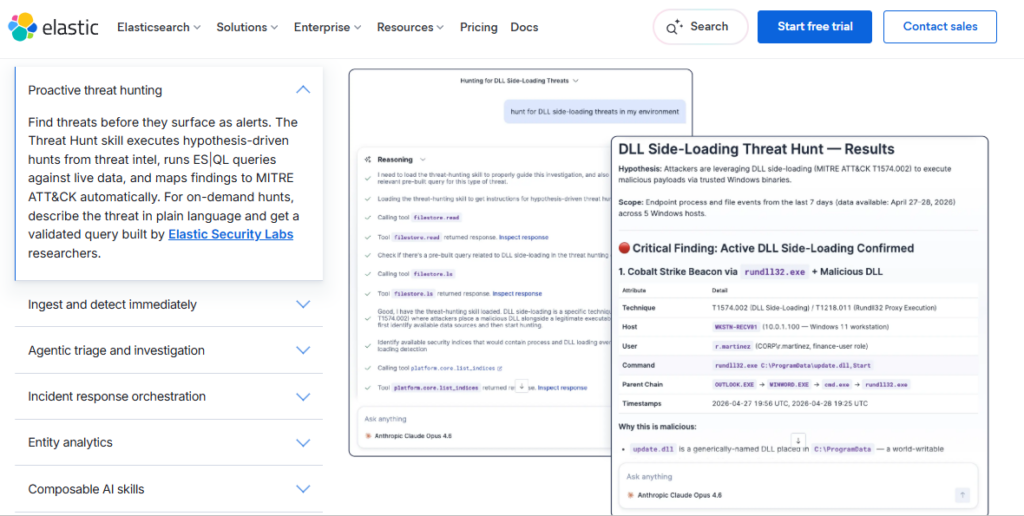
Elastic itself offers Consulting and Support services on its own platform. This is the vendor-native option, straight from the people who build Elasticsearch, Kibana, and Logstash.
For deep platform questions, nobody knows the internals better. The gap is that this is platform expertise rather than a 24/7 outsourced SOC.
Core Services
- First-party Elastic architecture and tuning guidance
- Deployment and upgrade support
- Detection and analytics enablement
- Platform-level troubleshooting
- Training and best-practice consulting
Why Companies Consider Elastic First-Party
The draw is authority. When you need the definitive answer on ILM, ingest pipelines, or a scaling problem, the source is Elastic.
The honest limit is scope. First-party consulting helps you run the platform, but it does not replace round-the-clock analyst monitoring and response, which is where a dedicated SOC service fills the gap.
Ideal Customer Profile
- Teams with in-house analysts who need platform depth
- Organizations doing major Elastic architecture work
- Buyers wanting vendor-native guidance
Commercial Model
Elastic offers consulting and support subscriptions tied to your deployment and license tier.
When to Shortlist
Shortlist Elastic Consulting and Support when your gap is deep platform expertise, and you already have the people to watch alerts around the clock.
1.10 BitLyft: Best for SMBs Weighing ELK as a SIEM Choice
Overview
BitLyft is a managed security provider that publishes practical guidance on running ELK (Elasticsearch, Logstash, and Kibana) as a SIEM. It leans toward smaller teams making that platform decision.
For an SMB early in its Elastic journey, BitLyft offers accessible operating help.
Core Services
- Managed detection and response
- ELK operating and monitoring guidance
- Threat detection support
- Compliance assistance
- Security automation
Why Companies Consider BitLyft
The appeal is approachability for smaller teams. BitLyft meets an SMB where it is, without enterprise-scale overhead.
My read is that BitLyft fits earlier-stage buyers. Larger, complex Elastic estates may outgrow it, so match the provider to your scale, and if you are still deciding, our overview of what managed SIEM is can help frame the choice.
Ideal Customer Profile
- Small and lower-mid-market organizations
- Teams evaluating ELK as their SIEM
- Buyers wanting hands-on, accessible support
Commercial Model
BitLyft uses subscription-based managed-service pricing scoped to smaller environments.
When to Shortlist
Shortlist BitLyft when you are an SMB weighing ELK and you want practical, right-sized operating help.
1.11 Regional Elastic MSP (Boutique Specialist): Best for Teams Wanting a Hands-On Regional Partner
Overview
The eleventh slot is a category rather than a single name. Regional boutique MSPs that specialize in Elastic can offer focused, hands-on attention that big firms struggle to match.
These shops live inside Elastic all day. For some teams, that concentration beats brand size.
Core Services
- Focused Elastic tuning and detection engineering
- Managed monitoring on your cluster
- Direct, senior-level access
- Local or regional delivery
- Flexible engagement scope
Why Companies Consider a Boutique
The pull is attention and flexibility. A small specialist often gives you senior engineers directly, without layers of account management.
The trade-off is resilience. A boutique may lack deep 24/7 bench coverage, so probe their on-call model and staffing before you commit, using our managed SIEM readiness assessment as a checklist.
Ideal Customer Profile
- Teams wanting a close, hands-on partner
- Organizations valuing senior access over brand
- Buyers with a specific regional preference
Commercial Model
Boutique pricing varies widely, often more flexible than enterprise contracts, but confirm coverage guarantees in writing.
When to Shortlist
Shortlist a boutique specialist when you want deep, hands-on Elastic attention and you have verified their 24/7 coverage holds up.
How I Would Use This List
If I had to compress the whole ranking into one move, it would be this. Score every provider on whether they operate your cluster, then on whether you keep your rules and data.
The category default is a proprietary SIEM you rent and never fully own. Elastic gives you the Lego bricks, and the right partner helps you run your own build instead of locking the box. That is the case we make in our guide on avoiding SIEM vendor lock-in.
That is the exact model we run at UnderDefense. We co-manage the Elastic you already own, apply Detection Logic as Code so your rules stay versioned and portable, and layer UnderDefense Agentic AI SOC on top of your telemetry, so you gain 24/7 coverage without surrendering ownership.
That approach is why customers describe leaving with their tuning intact, as one CISO put it below.
“Its reassuring to know theyre always watching for threats, and it doesnt cost a fortune. They catch and stop problems quickly, which is a huge relief. The platform works really well with our other security tools.”Serhii B., Chief Information Security OfficerUnderDefense G2 Verified Review
Q2: How Were These Elastic Co-Management Providers Selected and Scored?
Providers were scored on five weighted criteria that total 100%: In-Place Co-Management versus Migration-Required (30%), Elastic-Specific Depth (25%), Rule and Data Ownership (20%), What’s Actually Operated (15%), and Cost Transparency (10%). Scores map to stars: 0 to 20 is 1 star, 21 to 40 is 2, 41 to 60 is 3, 61 to 80 is 4, and 81 to 100 is 5.
Why These Five Criteria
The weighting is a thesis, not a coin flip. If you inherited an Elastic deployment, your problem is a staffing gap, not a migration project. So the heaviest weight sits on whether a provider operates your cluster in place instead of moving you onto theirs. We break down the same logic in our guide on avoiding SIEM vendor lock-in.
Rule and data ownership carries real weight for a reason. Alarm sensitivity and configuration are engineering facts, not opinions. The buried fear I hear most is “starting all over on that tuning if I ever leave,” so a model that keeps your rules yours scores higher.
The Scoring Rubric
| Criterion | Weight | What earns a high band |
|---|---|---|
| In-Place Co-Management vs Migration | 30% | Operates your existing Elastic; no forced platform swap |
| Elastic-Specific Depth | 25% | Real Elasticsearch, Kibana, Logstash, ILM, and pipeline skill |
| Rule and Data Ownership | 20% | You keep, see, and edit detections and logs |
| What’s Actually Operated | 15% | Tuning, upgrades, retention, cluster health, and integrations |
| Cost Transparency | 10% | Flat or resource-based; not tied to your ingest volume |
UnderDefense lands at 5 stars against this rubric. It co-manages the SIEM you own, keeps your data and rules in your hands, and versions detections as Detection Logic as Code, meaning rules are written, tested, and tracked like software. That earns the top band on the three heaviest criteria rather than claiming it. This is the core of how our managed SIEM engagements work.
How to Reuse This Rubric
Take these five criteria into your next vendor call and score each answer live. Ask one blunt question first: “Do you run my Elastic, or do I move to yours?”. The answer alone sorts most of the field before you discuss price. Our list of managed SIEM evaluation questions gives you more to bring into that conversation.
Q3: You Inherited an Elastic Deployment Nobody Can Manage. What Is Co-Management, and Why Does Elastic Suit It?
Co-management means a partner operates your existing Elastic deployment, your cluster, your data, and your rules, without moving you to their platform. It is not a migration, a platform swap, or a new hire. Elastic is the most co-manageable SIEM precisely because it is open and customer-owned, and the same openness that makes it hard to staff in-house is what makes it easy to co-manage.
First, You Are Not Behind
Here is the situation I see constantly. A contractor or an engineer built a solid Elastic stack, then moved on, and now the system ingests and alerts but nobody can safely touch it. There is no blame here, since a SIEM that outlives its builder is normal, not negligent.
The quiet anxiety is real, though. You own a working asset you cannot change, and that feels worse than owning nothing at all.
Three Models, One Clear Winner for You
People blur three very different arrangements, so let me separate them plainly.
- Migration: a vendor moves you onto their proprietary SIEM; you relearn everything and lose portability.
- Monitoring-only: a vendor watches your alerts but cannot change your rules or fix your cluster.
- Co-management in place: a partner operates the Elastic you already own, tuning and maintaining it directly.
For an inherited deployment, only the third model solves the actual gap. If you want the fuller distinction, our explainer on what managed SIEM is maps these models out.
A Concrete Before and After
Before: your cluster fires 400 noisy alerts a day, retention is misconfigured, and one broken pipeline silently drops logs. Nobody knows which rule is safe to edit, so nobody edits any.
After co-management: an engineer tunes the noisy rules, fixes retention through index lifecycle policies (the rules that age and delete data), and repairs the pipeline. Same cluster, same data, but now it is operated. That daily operation is what our MDR service delivers on an inherited stack.
Why Elastic Fits Co-Management
Elastic is open and data-first, so your logs and detections stay in your environment rather than a vendor black box. You can run it self-hosted, on Elastic Cloud, or inside your own cloud account. That flexibility is exactly why a partner can step in without ripping anything out.
UnderDefense is one canonical example of this model, since it co-manages the customer-owned SIEM and can run on-prem in your own cloud through the Agentic AI SOC platform. Customers describe the practical result plainly.
“The biggest win for me was getting actual control over our security alerts. Their team cleaned up our configurations and got the noise under control within the first week. The platform itself is straightforward, it pulls in data from all our existing security tools, so we didnt have to rip and replace anything.”
– Verified User in Marketing and Advertising, Small-Business UnderDefense G2 – Verified Review
“Their expert management of our SIEM has added to the value of our security investments and tools.”
– Yaroslava K., IT Project Manager UnderDefense G2 – Verified Review
You now have the vocabulary to carry into vendor calls. The next question is the practical one: what does managing Elastic actually involve day to day?
Q4: What Does Managing Elastic Actually Involve, and How Do You Health-Check an Inherited Deployment?
Managing Elastic means detection tuning, index lifecycle and retention, ingest pipelines and field mapping, cluster health and scaling, version upgrades with breaking-change handling, and integration maintenance. To gauge an inherited deployment’s state, check six things: rule currency, ILM correctness, index and cluster health, version currency, ingestion gaps, and broken integrations.
Setup Is Not Operation
Standing up Elastic and running it are different jobs. A deployment drifts the moment its builder leaves, because rules go stale, indices bloat, and pipelines quietly break. The system keeps humming, which is exactly what hides the rot.
That drift is why “it still works” is a weak status report. Working and healthy are not the same state.
The Six Operating Workstreams
- Detection tuning: cut false alarms; research shows 50% to 90% of SOC alerts are false positives.
- Index lifecycle (ILM) and retention: age, roll, and delete data on policy.
- Ingest pipelines and field mapping: make sure logs parse into the right fields.
- Cluster health and scaling: watch shards, memory, and node load.
- Version upgrades: handle Elastic’s breaking changes on schedule.
- Integration maintenance: keep data sources connected and firing.
Alert fatigue is not a soft problem, since analysts miss real threats when noise buries them. Tuning is the workstream that protects every other one, as we detail in our breakdown of alert fatigue in cybersecurity.
The Six-Point Health Check
Run this on your own deployment this week.
- Rule currency: when was a detection rule last edited? Stale rules miss new attacks.
- ILM correctness: are retention policies actually applied, or are indices growing forever?
- Index and cluster health: any red or yellow shards in Kibana?
- Version currency: how many versions behind is the stack?
- Ingestion gaps: is any critical source silently not sending logs?
- Broken integrations: do all connectors still fire?
If you want a structured worksheet for this, our inherited security stack worksheet walks through each item.
What the Red Flags Mean
A silent ingestion gap is the scariest one. In one real intrusion, a crafted request harvested credential pairs while the initial phase stayed fully undetected, because logs were not active on that application. You cannot alert on data you never collect.
Two field-tested habits help here. Point SIEM sources at DNS names, not IP addresses, so a re-addressed server keeps reporting. Then run a synthetic transaction, a harmless test event, to prove a source can trigger an alarm within roughly two minutes.
Healthy Asset or Drifting Liability
The check tells you which one you own. If most items pass, you have a valuable asset that needs an operator. If several fail, you have a drifting liability wearing a green dashboard. This is where UnderDefense’s Detection Logic as Code earns its place, since rules are versioned, unit-tested, and pushed through CI/CD, the same pipeline software teams use to ship code safely. That directly answers the “nobody here can safely change our rules” problem an inherited deployment creates, and it is a core reason teams move to our SOC service.
Q5: What Should You Look for in an Elastic Co-Management Partner, and Why Do Most MDR Vendors Fall Short?
Evaluate partners on eight questions: in-place or migration-required, deployment ownership, rule ownership and access, what is actually operated, Elastic-specific depth, upgrade management, cost model, and exit terms. Question one alone eliminates most vendors, because providers anchored to a proprietary SIEM cannot operate your existing Elastic. That is a legitimate architectural choice, just a different problem than yours.
Why Generic MDR Advice Fails Here
Most “how to pick an MDR” checklists assume you are buying a new platform. You are not. You already own Elastic, so the usual advice quietly misses your actual constraint. Our list of managed SIEM evaluation questions is built for that exact situation.
The result is a security network I describe as a hard shell with a soft center. The perimeter looks strong, but if nobody operates the core, one identity breach walks straight through it.
The Eight-Point Partner Criteria
| # | Question to ask | What “good” looks like |
|---|---|---|
| 1 | In-place or migration? | Runs your Elastic; no platform swap |
| 2 | Deployment ownership | Cluster stays in your account |
| 3 | Rule ownership and access | You keep and edit detections |
| 4 | What is operated | Tuning, ILM, pipelines, and upgrades |
| 5 | Elastic-specific depth | Verified Elastic skill, not generalist |
| 6 | Upgrade management | Handles breaking changes on schedule |
| 7 | Cost model | Flat or resource-based, transparent |
| 8 | Exit terms | You leave with your rules and data |
Service-model terms matter here. Managed SIEM means someone operates your SIEM; co-managed SOC means you share the work; MDR or MSSP often means their stack, their rules. Our explainer on managed SIEM versus MDR versus MSSP untangles these terms.
The AI-Governance Criterion Nobody Asks
Add one question the category avoids. Before a vendor’s AI agents touch your telemetry, get documented data-access boundaries in writing. Research on AI governance stresses explicit access limits before automation runs on sensitive data.
I have seen the failure mode of skipping this. Over-reliance on opaque automation produces tickets that come back without clear answers, which erodes trust fast. Portable, auditable response logic protects you if you ever switch partners, a principle we detail in our guide to AI SOC explainability and transparency.
Why Proprietary-SIEM Vendors Struggle
This is a model consequence, not a knock on any team. A vendor built around one proprietary SIEM has to bring you onto that stack to deliver value. So operating your existing Elastic in place is outside what their architecture does. We cover this structural trade-off in our piece on avoiding SIEM vendor lock-in.
“Anything you want to look at or changes you need to make in the product must go through their engineering team. As an MSP, this is a horrible way to do business for us.”
– Matt C., Manager, Cybersecurity Services Arctic Wolf G2 Verified Review
When That Model Is Still Right
If you have no SIEM and want everything bundled, a proprietary stack can be the faster path. UnderDefense answers the eight criteria the other way: in-place operation, you keep the keys and rules, exit-safe terms, and documented AI governance. That is a fit statement, not a superiority claim, and it is the core of our managed SIEM model.
Q6: When Is Migration the Right Call Instead, and What Does Co-Management Cost vs Hiring an Elastic Engineer?
Sometimes migration wins, since a badly architected, unsupported, or badly outdated deployment can cost more to stabilize than to rebuild. But for most inherited-yet-working Elastic, the real alternative to co-management is a headcount you likely will not get approved. Elastic engineers are scarce and expensive, and true 24/7 coverage needs roughly five loaded positions.
Signals That Say Rebuild, Not Rescue
Let me argue against my own thesis first. Some deployments are past saving.
- The stack is many major versions behind, with breaking upgrades stacked up.
- The original architecture was wrong for your data volume.
- An automated agent has already caused destructive changes, like deleting a production database.
If two or more apply, budget the rebuild honestly.
The Salvageable Line
Most inherited clusters sit on the other side of that line. They ingest, they alert, and they just need an operator. A working deployment with drifted tuning is a rescue job, not a teardown.
The Hire You Probably Cannot Make
Here is the economics that budget owners feel. One loaded Elastic security engineer runs well into six figures, and 24/7/365 coverage needs about five of them. That is a large standing cost for a capability you cannot switch off, as our breakdown of the opportunity cost of losing a detection engineer shows.
I will be blunt about ROI. Proving breach-prevention savings is a trap, because you cannot prove a negative. So compare the cost of delivery options for a non-optional capability instead, which is the logic behind our managed SIEM ROI calculator.
The Proposable Option
Co-management fills that gap without a headcount req or a migration project. Forrester analysis tied to Elastic’s managed model reports meaningful cost and efficiency gains from a managed approach. UnderDefense offers CAPEX and OPEX options plus a free tier, so you can start without commitment and frame it as replacing an unfilled role rather than adding one. That is the promise of our MDR service.
“We needed round-the-clock monitoring for compliance reasons, but building our own SOC wasnt realistic with our budget and the current hiring market. UnderDefense fills that gap without us having to hire a full team.”
– Verified User in Marketing and Advertising, Small-Business UnderDefense G2 – Verified Review
The open question I sit with: as agentic AI absorbs more routine SOC work, does the five-person coverage math shrink, or just shift to oversight roles?
Q7: How Fast Can Co-Management Stabilize Your Inherited Elastic Deployment?
Expect a phased 30/60/90 path: onboarding and discovery in the first 30 days, detection tuning and noise reduction through 60, and steady-state operation with health monitoring by 90. A well-run 30-day onboarding that builds customized detection can reach roughly 99% alert-noise reduction on an existing Elastic stack.
What “Stabilized” Actually Means
Stabilized does not mean perfect. It means your rules are tuned, your ingestion gaps are closed, and someone owns the cluster’s health. You stop firefighting and start operating.
Speed matters because attackers move fast. The fastest break-in times now sit under a minute, which makes legacy 30-to-60-minute response windows irrelevant, a point we expand on in our look at AI SOC investigation speed.
The 30/60/90 Milestones
| Phase | Focus | Milestone |
|---|---|---|
| Days 0 to 30 | Onboarding, discovery, and integration | Sources mapped, baseline built |
| Days 31 to 60 | Detection tuning and noise reduction | Alert noise cut sharply |
| Days 61 to 90 | Steady-state and health monitoring | Tuned, monitored operation |
The heavy lift is front-loaded. One reviewer noted the noise dropped inside the first week, with full tuning maturing over the onboarding window. Our managed SIEM integration guide lays out that cadence in detail.
What to Make a Provider Commit To
Get specific service levels in writing, and watch the wording. A single blended “MTTR” hides two very different promises, so separate them. Ask for a defined alert-to-triage time, around 2 minutes, and a defined critical-incident escalation, around 15 minutes.
Also ask them to prove detection works with a live test, using adversary-simulation tools rather than a slide. Show, do not tell, applies to onboarding too, which is why we publish an AI SOC SLA guide.
“Their team cleaned up our configurations and got the noise under control within the first week. Now when we get an alert, we know its something worth looking into.”
– Verified User in Marketing and Advertising, Small-Business UnderDefense G2 – Verified Review
An Honest Invitation
If you inherited an Elastic stack and are not sure which state it is in, that uncertainty is the normal starting point. UnderDefense Agentic AI SOC reaches steady state quickly on an already-running deployment because it operates on top of your telemetry rather than replacing it, as shown on the Agentic AI SOC platform page. The question worth sitting with: if you ran the six-point health check today, how many items would actually pass?
1. What is a managed SIEM for companies running Elastic, and how is it different from a normal MDR?
A managed SIEM for Elastic means a partner operates the Elastic deployment you already own, your cluster, your data, and your detection rules, in place. It is not a migration or a platform swap.
Most mainstream MDR vendors work differently. They require you to move onto their own proprietary SIEM, so they cannot run your existing Elastic at all. That is a legitimate architectural choice, but it solves a different problem than the one an inherited Elastic team has.
We built our co-management model around a simpler idea:
- We run your existing Elasticsearch, Kibana, and Logstash in place.
- You keep and edit your own detection rules and logs.
- There is no rip-and-replace and no forced onboarding onto our stack.
The practical result is that you fill a staffing gap without losing ownership of a working asset. If you want the fuller distinction between service models, we lay it out in our guide on how our co-managed managed SIEM works. This model suits teams who inherited a solid Elastic stack that nobody left behind can safely tune.
2. Why can most big MDR vendors not co-manage an existing Elastic deployment?
The short answer is architecture, not engineering quality. A vendor built around one proprietary SIEM has to bring you onto that stack to deliver its value, so operating your existing Elastic in place is outside what its model does.
This shows up as observable consequences rather than bugs:
- Changes and investigations route through the vendor’s own engineering team.
- Your rules and data live in their platform, not yours.
- Leaving means starting over on tuning you already paid for.
We treat this as a fit question, not a superiority claim. If you have no SIEM and want everything bundled, a proprietary stack can be the faster path.
But for an inherited-yet-working Elastic cluster, that model reverses your goal. You want to keep the deployment you own, so a partner that operates it in place fits better. Our approach keeps you exit-safe, since you retain the keys, the rules, and the logs. We explain why this matters most for teams worried about lock-in in our breakdown on avoiding SIEM vendor lock-in.
3. How should we evaluate an Elastic co-management partner?
We recommend scoring partners on eight blunt questions, and asking question one first because it eliminates most of the field.
- In-place or migration-required: do they run your Elastic, or move you to theirs?
- Deployment ownership: does the cluster stay in your account?
- Rule ownership and access: can you keep and edit detections?
- What is actually operated: tuning, ILM, pipelines, and upgrades?
- Elastic-specific depth: verified skill, not generalist SIEM management?
- Upgrade management: do they handle breaking changes on schedule?
- Cost model: flat or resource-based and transparent?
- Exit terms: do you leave with your rules and data?
There is one more criterion the category avoids. Before a vendor’s AI agents touch your telemetry, get documented data-access boundaries in writing. Portable, auditable response logic protects you if you ever switch partners.
We answer these criteria the ownership-first way, and you can bring the same list into any vendor call. For a longer version to score answers live, use our managed SIEM evaluation questions. The goal is simple: sort the field before you ever discuss price.
4. When is migrating off Elastic actually the smarter move?
Sometimes rebuilding beats rescuing, and we would rather say so than oversell co-management. A deployment can cost more to stabilize than to replace.
We look for a few clear signals that say rebuild:
- The stack is many major versions behind, with breaking upgrades stacked up.
- The original architecture was wrong for your actual data volume.
- An automated agent has already caused destructive changes, like deleting a production database.
If two or more apply, budget the rebuild honestly.
Most inherited clusters sit on the other side of that line, though. They ingest, they alert, and they simply need an operator. A working deployment with drifted tuning is a rescue job, not a teardown.
The willingness to recommend migration when it fits is exactly what makes the co-management case believable in every other scenario. If you are unsure which category you are in, a diagnostic health check settles it fast, and you can start that conversation through our contact page without a migration pitch attached.
5. What does co-management cost compared to hiring an in-house Elastic engineer?
For most teams, the real alternative to co-management is not another vendor. It is a headcount requisition you likely will not get approved.
The economics are stark:
- One loaded Elastic security engineer runs well into six figures per year.
- True 24/7/365 coverage needs roughly five of those positions.
- That is a large standing cost for a capability you cannot switch off.
We are also blunt about ROI. Proving breach-prevention savings is a trap, because you cannot prove a negative. So the honest comparison is the cost of delivery options for a non-optional capability, not a fabricated savings number.
Co-management fills the gap without a headcount req or a migration project. We offer CAPEX and OPEX options plus a free tier, so you can frame it as replacing an unfilled role rather than adding one. If you want numbers rather than a quote-wall, our managed SIEM pricing is laid out plainly, so a budget owner can weigh a hire against a service directly.
6. How long does it take to stabilize an inherited Elastic deployment?
Expect a phased 30/60/90 path. Stabilized does not mean perfect. It means your rules are tuned, your ingestion gaps are closed, and someone owns cluster health.
The milestones look like this:
- Days 0 to 30: onboarding, discovery, and integration, with sources mapped and a baseline built.
- Days 31 to 60: detection tuning and noise reduction, cutting alert noise sharply.
- Days 61 to 90: steady-state operation with ongoing health monitoring.
A well-run 30-day onboarding that builds customized detection can reach roughly 99% alert-noise reduction on an existing Elastic stack. The heavy lift is front-loaded, and noise often drops inside the first week.
Speed matters because attackers move fast, with the quickest break-ins now under a minute. That makes legacy 30-to-60-minute response windows irrelevant. Ask any provider to commit to a defined alert-to-triage time of around 2 minutes and a critical-incident escalation of around 15 minutes, separately, since a single blended metric hides both. Our AI SOC SLA guide shows exactly what to get in writing.
7. Why does Elastic suit co-management better than other SIEMs?
Elastic fits co-management because it is open and data-first. Your logs and detections stay in your environment rather than inside a vendor black box.
That openness cuts two ways, and both favor you here:
- You can run it self-hosted, on Elastic Cloud, or inside your own cloud account.
- A partner can step in and operate it without ripping anything out.
The same openness that makes Elastic hard to staff in-house is what makes it easy to co-manage. When the engineer who built your stack leaves, the skills leave with them, but the portability stays.
We operate across Elasticsearch, Kibana, and Logstash, and we can run on-prem in your own cloud. We also version detections as Detection Logic as Code, meaning rules are written, tested, and tracked like software rather than living as tribal knowledge. That directly answers the nobody-here-can-safely-change-our-rules problem an inherited deployment creates. If you want to see how the agentic layer sits on top of your telemetry, our MAXI platform page shows the workflow.
8. How do we run a quick health check on an inherited Elastic deployment?
Run a six-point health check this week to learn whether you own a valuable asset or a drifting liability wearing a green dashboard.
Check these six things:
- Rule currency: when was a detection rule last edited? Stale rules miss new attacks.
- ILM correctness: are retention policies applied, or are indices growing forever?
- Index and cluster health: any red or yellow shards in Kibana?
- Version currency: how many versions behind is the stack?
- Ingestion gaps: is any critical source silently not sending logs?
- Broken integrations: do all connectors still fire?
The scariest red flag is a silent ingestion gap, because you cannot alert on data you never collect. Two field habits help: point sources at DNS names, not IP addresses, and run a synthetic test event to prove a source can trigger an alarm within about 2 minutes.
If most items pass, you have an asset that needs an operator. If several fail, you have drift hiding behind a working dashboard. Our inherited security stack worksheet walks through each item so you can score your own deployment before any vendor call.