




Q1: What are the 10 best AI SOC platforms for cloud-native infrastructure in 2026?
The best AI SOC platforms for cloud-native infrastructure in 2026 pair agentic AI triage with real Kubernetes, serverless, and multi-cloud telemetry, then keep a human in the loop for response. UnderDefense Agentic AI SOC leads for vendor-agnostic teams needing detection plus instant concierge response. Stellar Cyber, Intezer, Palo Alto Cortex XSIAM, Exaforce, Prophet, Dropzone, CrowdStrike, Microsoft Sentinel, and Google SecOps follow with distinct trade-offs.
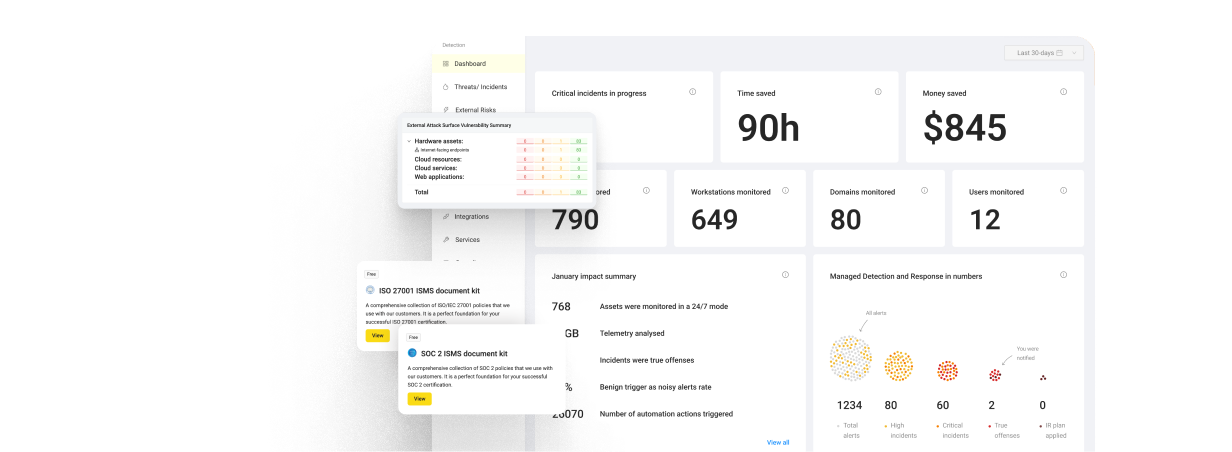
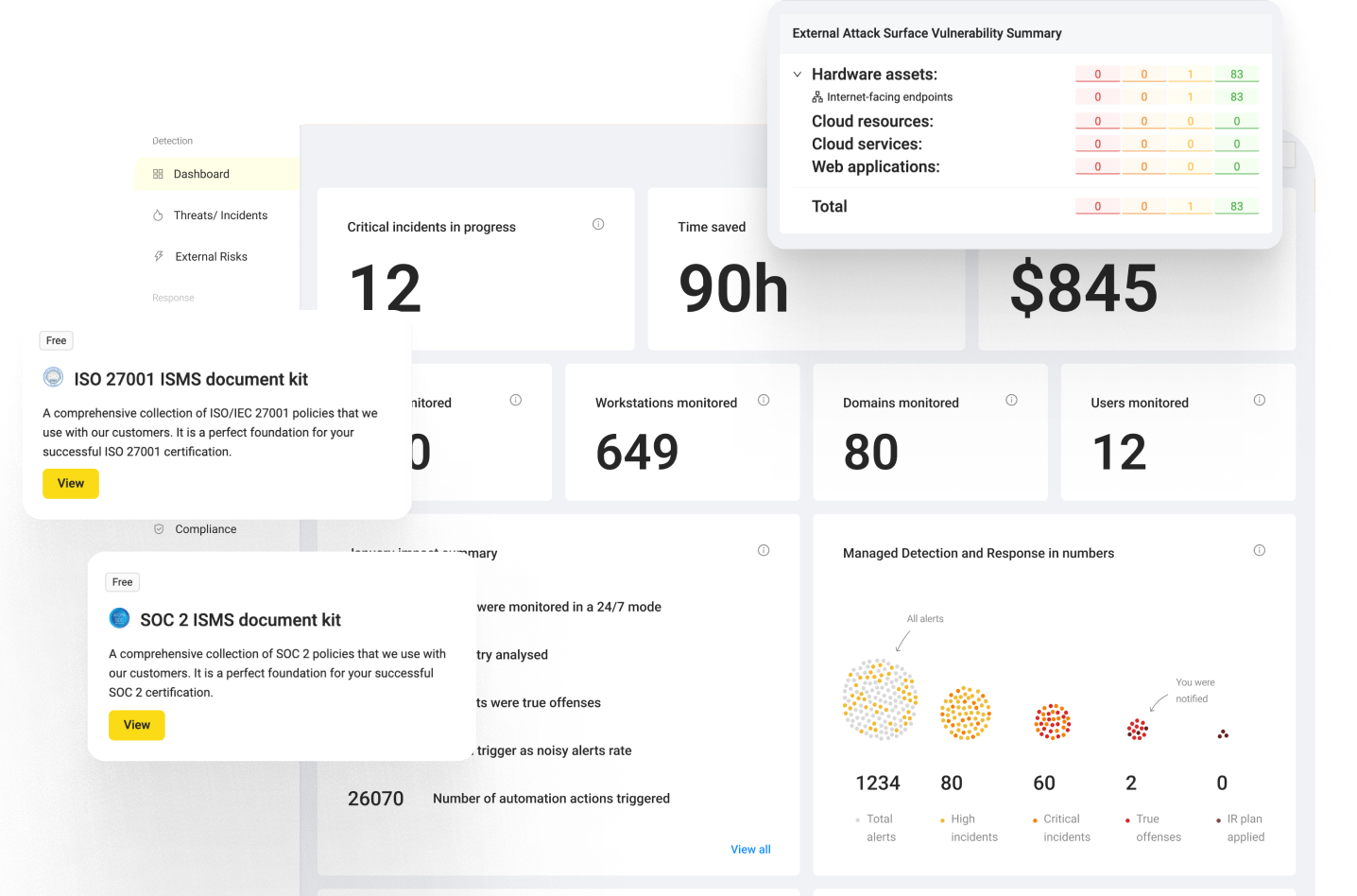
See how the UnderDefense Agentic AI SOC investigates, triages, and resolves real alerts.
Choosing an AI SOC platform is a high-stakes call for cloud-native teams juggling ephemeral workloads, compliance load, and rising ransomware risk. Rather than ranking on brand noise, this guide weighs providers on cloud-native coverage, autonomy model, customer validation, compliance support, and fit for 1,000 to 10,000-employee estates. We reviewed the leading AI SOC and MDR platforms operating across Kubernetes, serverless, and multi-cloud environments in 2026. The shortlist below is built for CISOs, IT Directors, CTOs, and PE operating partners moving toward vendor evaluation or an RFP.
| Provider (Rating) | Best For | Key Strength | Compliance |
|---|---|---|---|
| UnderDefense Agentic AI SOC (4.8, G2) | Vendor-agnostic teams needing detect and respond | AI SOC and Human Ally, 250+ tool integrations | SOC 2, HIPAA, ISO 27001, PCI DSS |
| Stellar Cyber | Lean teams wanting Open XDR breadth | Multi-source ingestion, agentic AI triage | SOC 2, PCI DSS, GDPR |
| Intezer | Autonomous alert triage | Malware genome forensics | SOC 2, GDPR |
| Palo Alto Cortex XSIAM | Existing Palo Alto estates | Deep autonomy, SIEM replacement | SOC 2, ISO 27001, FedRAMP |
| Exaforce | SaaS and cloud detection depth | Multi-agent investigation | SOC 2, ISO 27001 |
| Prophet Security | Agentic investigation and tuning | Autonomous detection tuning | SOC 2 |
| Dropzone AI | Autonomous Tier-1 triage | AI SOC analyst automation | SOC 2 |
| CrowdStrike Charlotte AI | Endpoint-first shops | Falcon telemetry and GenAI | SOC 2, HIPAA, PCI DSS, FedRAMP |
| Microsoft Sentinel and Security Copilot | Azure-centric shops | Cloud SIEM and Copilot | SOC 2, ISO 27001, FedRAMP |
| Google Security Operations (Chronicle and Gemini) | GCP-native, high-scale | Petabyte-scale search | SOC 2, ISO 27001, FedRAMP |
AI SOC Platform Comparison (2026)
1.1 UnderDefense Agentic AI SOC, Best for Vendor-Agnostic Teams That Want Detection and Response Owned Together
Overview
A CISO pinged us at 2 a.m. once, staring at a dashboard full of red, asking one question: “Which of these actually matters, and who fixes it?” That question is the whole job. I built UnderDefense Agentic AI SOC to answer it, so alerts turn into action instead of another ticket queue.
UnderDefense Agentic AI SOC is an AI-powered MDR platform that runs a 24/7 AI SOC across your existing security stack, then routes real incidents to human analysts who respond. It sits on top of your tools rather than replacing them, so you keep your SIEM, EDR, and cloud data. The model pairs AI-driven detection with what we call a Human Ally, meaning our analysts talk directly to affected users to verify and remediate.
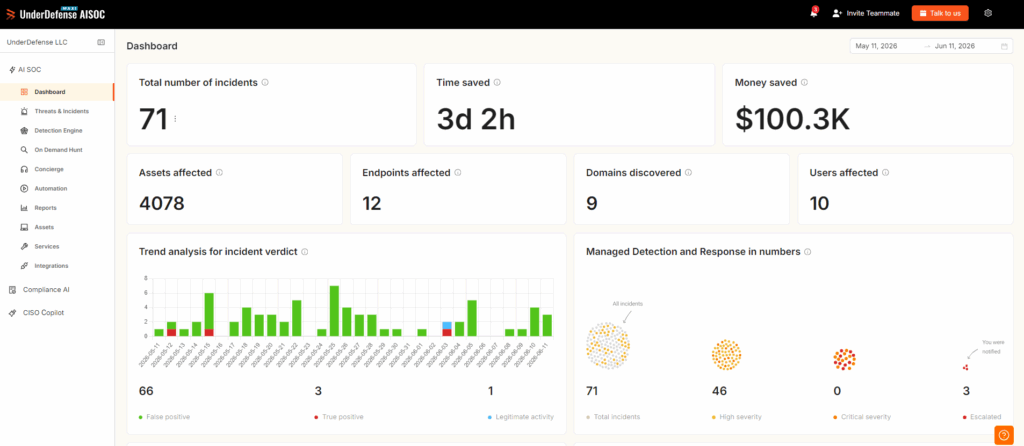
Core Services
- 24/7 AI SOC monitoring across cloud, endpoint, network, identity, and SaaS
- Vendor-agnostic integration across 250+ security tools
- Concierge Response with analyst-led verification and remediation via ChatOps (Slack)
- Managed SIEM with customer data ownership
- Penetration testing, vCISO, and compliance readiness
Why Companies Consider UnderDefense
Most cloud-native teams do not lack alerts; they lack answers. In our experience running MDR across 500+ customer environments, the win comes from context, meaning we validate suspicious activity with the actual user before escalating. Customers repeatedly tell us the noise dropped in the first week. One reviewer put it plainly.
The setup guides your alert-to-triage in about 2 minutes, with a 15-minute escalation target for critical incidents. That is two distinct SLAs, not a single blended number.
Ideal Customer Profile
Best suited for:
- Cloud-native and hybrid companies with 50 to 10,000 employees
- Compliance-driven teams needing SOC 2, HIPAA, or ISO 27001 evidence
- Security-lean teams that cannot build a 24/7 SOC in this hiring market
- Organizations that want to keep their existing stack, not rip and replace
Commercial Model
UnderDefense uses transparent per-endpoint pricing, roughly $11 to $15 per endpoint per month, with onboarding, continuous monitoring, and advisory included. Reviewers consistently flag the value against building an internal SOC. You can review the full breakdown in our MDR pricing.
When to Shortlist
Shortlist us when you want detection and response handled together, keep vendor-agnostic tooling, and need auditor-ready reporting. Teams tired of black-box escalation that returns tickets without clear answers tend to land here. If you are still scoping options, our MDR buyers guide helps frame the evaluation.
Customer Reviews
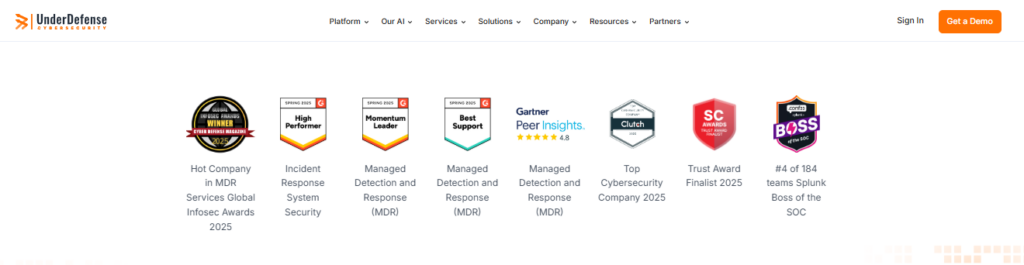
“The biggest win for me was getting actual control over our security alerts. Before the guys from UD stepped in, we were getting bombarded with alerts from all our security tools. Their team cleaned up our configurations and got the noise under control within the first week.” Verified User in Marketing and Advertising, Small-Business UnderDefense Agentic AI SOC G2 Verified Review
“Honestly, some security tools are more complicated than the threats themselves. Underdefense isnt just about catching bad stuff, they give proactive tips too. No Underdefenses fault entirely, but getting all our logs and stuff flowing took longer than I expected.” Andriy H., Co-Founder and CTO, Mid-Market (4.5/5) UnderDefense Agentic AI SOC G2 Verified Review
1.2 Stellar Cyber, Best for Lean Teams Wanting Open XDR Breadth Across Many Sources
Overview
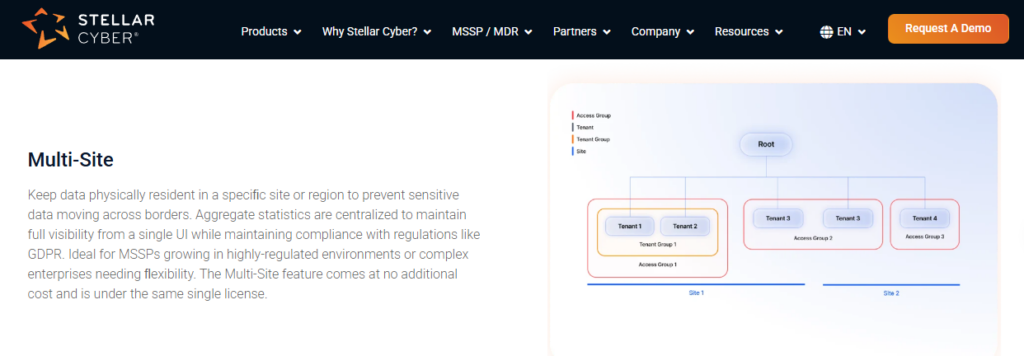
Stellar Cyber is an Open XDR platform that unifies data from many sources into one console, then applies agentic AI to triage and correlate alerts. It targets lean security teams and MSSPs that want broad visibility without stitching together a dozen point tools. The pitch centers on ingesting existing telemetry rather than forcing a single-vendor stack.
Core Services
- Open XDR with multi-source data ingestion (EDR, firewall, cloud, identity)
- Agentic AI triage and automated correlation
- Built-in NDR and UEBA analytics
- Multi-tenant support for MSSPs
Why Companies Consider Stellar Cyber
Teams pick Stellar Cyber when they want one pane of glass across scattered tools. The agentic layer aims to cut Tier-1 triage load, which appeals to small teams drowning in alerts. My read is that the breadth is real, though results depend heavily on how clean your source integrations are. For context on that failure mode, see our take on alert fatigue.
Ideal Customer Profile
Best suited for:
- Lean in-house teams and MSSPs
- Organizations with heterogeneous, multi-vendor tooling
- Cloud and hybrid estates needing consolidated visibility
Commercial Model
Stellar Cyber typically prices on data or asset scope under a subscription model, often positioned as a SIEM or XDR cost alternative. Pricing usually requires a direct quote through the vendor or a partner.
When to Shortlist
Shortlist Stellar Cyber when you want to consolidate visibility across many sources and keep your existing detection tools. Note the trade-off: it delivers the platform and automation, but response ownership still largely sits with your team, unlike a concierge model.
If Open XDR breadth appeals but you lack the analysts to act on it, our AI SOC and Human Ally model layers the human response on top, so detection does not stop at a correlated alert but continues through to user verification and remediation.
1.3 Intezer, Best for Autonomous Alert Triage and Malware Forensics

Overview
Intezer focuses on autonomous alert triage, with roots in “genetic” malware analysis that maps code to known threat families. It plugs into your existing alert sources and auto-investigates, aiming to clear the Tier-1 queue. The forensics angle is its signature strength.
Core Services
- Autonomous alert triage across sources
- Malware genome analysis and classification
- Automated evidence collection
- Integration with existing SIEM and EDR
Why Companies Consider Intezer
Teams pick Intezer to cut manual triage and get fast, forensic-grade verdicts on suspicious files. The malware DNA approach gives analysts a clear “what is this and where have we seen it” answer. From what surfaces when you actually run it, the triage automation is the day-one win.
Ideal Customer Profile
Best suited for:
- SOCs drowning in Tier-1 alert volume
- Teams handling frequent malware investigations
- Organizations wanting automation on top of existing tools
Commercial Model
Intezer offers usage or subscription-based pricing, often scaled to alert or analysis volume. Quotes come through the vendor.
When to Shortlist
Shortlist Intezer when autonomous triage and malware forensics are the pain, and you want to layer automation onto your stack. The honest limit is scope, since it excels at triage and forensics but leaves broad response and user verification to your team.
Automation clears the routine, and that matches how we run things, but the edge cases still need people. Our Human Ally model pairs AI triage with analysts who verify and remediate, so response does not stall at the queue.
1.4 Palo Alto Cortex XSIAM, Best for Existing Palo Alto Estates Wanting Deep Autonomy
Overview
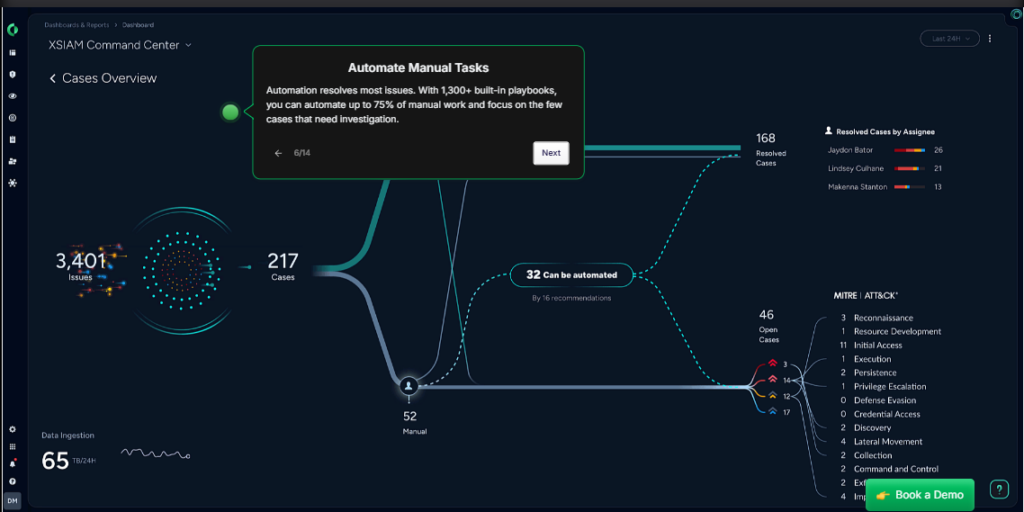
Cortex XSIAM is Palo Alto Networks’ AI-driven SecOps platform that aims to replace the traditional SIEM. It pulls telemetry into one data layer, then applies machine learning to automate detection and much of the response. Teams already invested in Palo Alto tooling get the tightest fit here.
Core Services
- AI-driven SIEM replacement with automated triage
- Native EDR, NDR, and identity analytics
- High-volume data ingestion and correlation
- SOC automation and playbook orchestration
Why Companies Consider Cortex XSIAM
Teams pick XSIAM when they want deep autonomy and already run Palo Alto firewalls or Cortex XDR. The consolidation story is strong, since it folds SIEM, SOAR, and analytics into one platform. My honest read: the autonomy is real, but the value curve steepens the more of your stack is already Palo Alto.
Ideal Customer Profile
Best suited for:
- Enterprises standardized on Palo Alto Networks
- Large SOCs wanting SIEM consolidation
- Teams with budget for a platform-first approach
Commercial Model
XSIAM prices on data ingestion and platform tiers, typically at the enterprise end of the market. Expect a direct quote, and factor in migration effort off your existing SIEM.
When to Shortlist
Shortlist XSIAM when you are consolidating onto Palo Alto and want autonomous SecOps in one place. The trade-off worth naming is vendor concentration; the more you standardize, the harder it gets to keep your data portable.
For teams that want autonomy without betting the whole stack on one vendor, we keep detection vendor-agnostic and preserve your SIEM data ownership, then add human analysts to own response.
1.5 Exaforce, Best for Deep SaaS and Cloud Detection Coverage
Overview
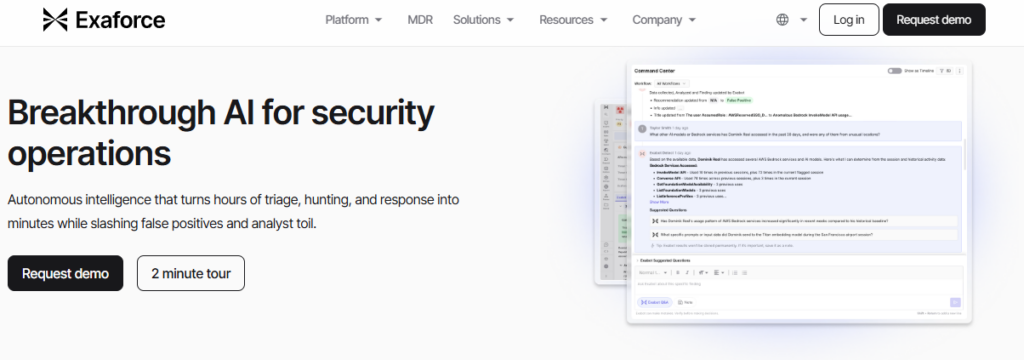
Exaforce is a newer AI SOC platform built around multiple AI agents that investigate alerts across cloud and SaaS. It targets detection depth in modern environments where identity and API activity matter as much as endpoints. The pitch centers on multi-agent reasoning rather than single-model triage.
Core Services
- Multi-agent AI investigation
- Strong SaaS and cloud detection coverage
- Alert correlation across identity and API layers
- Automated context gathering for analysts
Why Companies Consider Exaforce
Cloud-native teams look at Exaforce when SaaS and identity blind spots are the real problem. The multi-agent approach aims to reason through an alert the way a Tier-1 analyst would. I could be off here, since the platform is young, but the cloud detection depth is the standout claim to test in a POC.
Ideal Customer Profile
Best suited for:
- SaaS-heavy and cloud-native companies
- Teams with identity and API attack surface
- Early adopters comfortable with newer platforms
Commercial Model
Exaforce uses subscription pricing, usually quoted based on scope and data sources. As a newer entrant, expect to negotiate directly.
When to Shortlist
Shortlist Exaforce when SaaS and cloud detection depth is your priority and you can run a solid proof of concept. The gap to weigh is maturity and response ownership, since detection depth still needs a human to act on the findings.
We take detection findings the last mile, so an alert becomes a verified incident with an analyst reaching out to the affected user, rather than a deeper alert that still lands back on your team. That is the core of our cloud security services.
1.6 Prophet Security, Best for Agentic Investigation and Detection Tuning
Overview
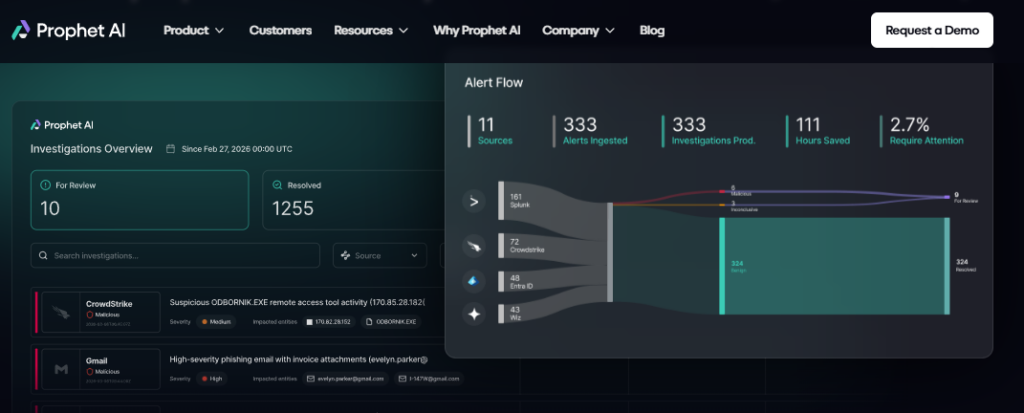
Prophet Security is an agentic AI SOC platform that automates alert investigation and helps tune detections over time. It aims to act like an AI analyst that reasons through alerts and reduces false positives. The learning loop on detection quality is its differentiator.
Core Services
- Agentic AI alert investigation
- Continuous detection tuning
- False-positive reduction
- Integration with existing detection tools
Why Companies Consider Prophet Security
Lean teams look at Prophet to automate investigation and stop drowning in noisy, poorly tuned alerts. The tuning loop promises fewer false positives the longer you run it. My current read is that the investigation automation is compelling, though results depend on the quality of your underlying detections.
Ideal Customer Profile
Best suited for:
- Small and mid-size SOC teams
- Organizations struggling with alert fatigue
- Teams wanting to improve detection quality over time
Commercial Model
Prophet Security prices on subscription, typically scoped to environment size. Expect a direct quote as a newer platform.
When to Shortlist
Shortlist Prophet when agentic investigation and detection tuning are your core needs. The trade-off to weigh is breadth and response ownership, since strong investigation still needs a human path to remediation.
We tune detections across your existing stack and then close the loop with analyst-led response, so cleaner alerts turn into owned outcomes rather than a better queue to stare at.
1.7 Dropzone AI, Best for Autonomous Tier-1 Triage at Scale
Overview
Dropzone AI builds an autonomous AI SOC analyst that runs Tier-1 triage without human prompting. It investigates every alert, gathers context, and writes up findings the way a junior analyst would. The pitch is full Tier-1 coverage without adding headcount.
Core Services
- Autonomous Tier-1 alert investigation
- Automated context enrichment and reporting
- Integration with SIEM, EDR, and cloud sources
- Analyst-style investigation write-ups
Why Companies Consider Dropzone AI
Teams pick Dropzone when hiring Tier-1 analysts is too slow or too costly. The AI investigates every alert, which appeals to teams that triage only a fraction today. From what I have seen across the category, this is the clearest “replace the queue grind” play, though it stays at the triage layer.
Ideal Customer Profile
Best suited for:
- Understaffed SOC teams
- High-alert-volume environments
- Teams that triage only a portion of alerts today
Commercial Model
Dropzone AI uses subscription pricing, generally scoped to alert volume or environment. Quotes are direct.
When to Shortlist
Shortlist Dropzone when autonomous Tier-1 triage is the bottleneck you must clear. The limit worth naming is that triage is where it stops, so Tier-2 response, user verification, and remediation remain with your team.
Autonomous triage scales the routine, and we agree with that model, but someone still has to own the incident. Our concierge analysts, backed by our managed SOC, pick up where triage ends and drive response to closure.
1.8 CrowdStrike Charlotte AI, Best for Endpoint-First Shops on the Falcon Platform
Overview
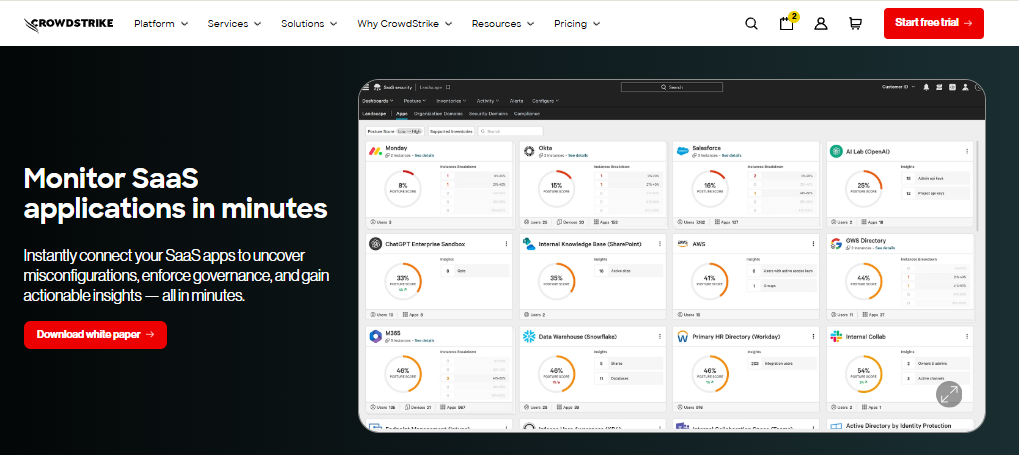
Charlotte AI is CrowdStrike’s generative AI layer on top of the Falcon platform. It speeds detection, investigation, and response for teams already living in Falcon’s endpoint telemetry. The strength is depth on the endpoint, backed by a mature threat intel engine.
Core Services
- GenAI-assisted detection and investigation
- Deep Falcon endpoint telemetry
- Threat intelligence and hunting
- Automated response actions on the endpoint
Why Companies Consider CrowdStrike
Teams pick CrowdStrike for best-in-class endpoint detection and a proven platform. Charlotte AI adds a natural-language layer that speeds up investigation for Falcon users. The standard read gets one thing backwards, though: endpoint depth is real, yet endpoint-first coverage can miss the wider organizational context around a user or a SaaS event.
Ideal Customer Profile
Best suited for:
- Endpoint-first security teams
- Organizations standardized on Falcon
- Enterprises wanting mature threat intel
Commercial Model
CrowdStrike prices per endpoint across modular tiers, with Charlotte AI and add-ons layered on top. Costs can climb as you add modules, so scope carefully.
When to Shortlist
Shortlist CrowdStrike when the endpoint is your center of gravity and you are committed to the Falcon ecosystem. The trade-off to weigh is ecosystem concentration and the gap in user verification beyond the endpoint.
Customer Reviews
“Red Canary first and foremost has reduced the amount of noise we were getting from our various log sources in our SIEM. I wish the integrations beyond Crowdstrike were a bit more robust and greater in number. Red Canary is perhaps too reliant on Crowstrike and less on our other sources which are important Cloud, Identity Email, etc.” Verified User in Computer Software, Enterprise (4/5) Red Canary G2 Verified Review
We stay vendor-agnostic across 250+ tools, so Falcon endpoint data joins cloud, identity, and SaaS signals in one view. Our analysts verify suspicious activity directly with the affected user. Endpoint-first tools see the process but miss that human context. We detect across the whole stack and respond with that context through our managed EDR approach.
1.9 Microsoft Sentinel and Security Copilot, Best for Azure-Centric Shops
Overview
Microsoft Sentinel is a cloud-native SIEM, and Security Copilot adds a generative AI assistant on top. Together they give Azure and Microsoft 365 shops native visibility and AI-assisted investigation. The tight integration with the Microsoft stack is the whole appeal.
Core Services
- Cloud-native SIEM (Sentinel)
- GenAI assistant for investigation (Security Copilot)
- Native Azure and Microsoft 365 telemetry
- SOAR automation and playbooks
Why Companies Consider Sentinel and Copilot
Microsoft-heavy teams pick Sentinel because the data is already there and the licensing often fits. Copilot speeds investigation for analysts fluent in the Microsoft ecosystem. My read: it is a strong fit if you live in Azure, but ingestion costs and tuning are the line items teams underestimate.
Ideal Customer Profile
Best suited for:
- Azure and Microsoft 365 organizations
- Teams wanting native cloud SIEM
- Enterprises with Microsoft E5 licensing
Commercial Model
Sentinel bills on data ingestion and analytics, with Security Copilot priced separately on a compute-unit basis. Watch ingestion volume, since costs scale with your log firehose.
When to Shortlist
Shortlist Sentinel and Copilot when your estate is Azure-centric and you want a native SIEM with an AI assistant. The trade-off is that it is a tool set, so 24/7 human response still sits with your team unless you add a managed partner.
We manage Sentinel for customers and keep their data ownership intact, then run 24/7 human response on top, so a cloud SIEM becomes an operated SOC rather than a console someone has to watch. Many teams start with our MDR for Microsoft 365.
1.10 Google Security Operations (Chronicle and Gemini), Best for GCP-Native, High-Scale Environments
Overview
Google Security Operations pairs Chronicle’s petabyte-scale data platform with Gemini AI for investigation. It targets large, GCP-native environments that need to search massive telemetry fast. The scale and speed of retrieval are its headline strengths.
Core Services
- Petabyte-scale security data platform (Chronicle)
- Gemini AI-assisted investigation
- Native GCP telemetry and threat intel
- Detection engineering at scale
Why Companies Consider Google SecOps
Large teams pick Google SecOps when data volume breaks other platforms. Chronicle’s flat-rate ingestion model and search speed are genuinely differentiated at scale. From what surfaces at high volume, the retrieval performance is the real draw, though it rewards teams with detection-engineering muscle.
Ideal Customer Profile
Best suited for:
- GCP-native and cloud-first enterprises
- High-telemetry-volume environments
- Teams with in-house detection engineering
Commercial Model
Google SecOps often uses a flat, capacity-based pricing model rather than per-gigabyte ingestion. That predictability appeals at scale, but the platform still expects mature internal operations.
When to Shortlist
Shortlist Google SecOps when petabyte-scale search and GCP-native coverage are your priority. The gap to weigh is operational, since the platform gives you scale but assumes you bring the analysts and detection content.
We stay vendor-agnostic, so Chronicle data sits alongside your other sources in one operated view. Our analysts own response end to end. Platform-only tools assume you staff a 24/7 SOC. We give lean teams that force multiplier without replacing the platform you chose, and you can weigh the numbers with our SOC cost calculator.
Q2: How did we score and rank the best AI SOC platforms (our selection criteria)?
We scored each platform on five weighted criteria: Cloud-Native Coverage (30%), Autonomy and Investigation Depth (25%), Response and Human Ally (20%), Governance and Transparency (15%), and Pricing Transparency (10%). Scores map to stars, from one star at 0 to 20 up to five stars at 81 to 100. UnderDefense earns five stars for pairing autonomous triage with vendor-agnostic integration and instant concierge response.
Why coverage carries the most weight
I weighted Cloud-Native Coverage highest on purpose. A platform that cannot see your Kubernetes, serverless, and multi-cloud identity data is guessing, no matter how clever its AI. Palo Alto’s own AI SOC proof-of-concept guidance pushes buyers to test real workload coverage before autonomy claims.
Autonomy and Investigation Depth comes next because speed without depth just produces faster noise. If the same analysts read the same alerts a little quicker, that is not transformation.
The five criteria in operator terms
| Criterion | Weight | What we actually measured |
|---|---|---|
| Cloud-Native Coverage | 30% | Real Kubernetes, serverless, and multi-cloud identity telemetry, not relabeled SaaS |
| Autonomy and Investigation Depth | 25% | How much Tier-1 triage work the AI eliminates, and investigation quality |
| Response and Human Ally | 20% | Whether a human owns response, or you get a ticket back |
| Governance and Transparency | 15% | Auditable logic, data ownership, and no black-box escalation |
| Pricing Transparency | 10% | Published, predictable pricing versus quote-only opacity |
Each criterion maps to a plain question a busy CISO would ask. I kept the rubric vendor-neutral, so any provider on the list gets scored the same way. If you want the fuller list, our AI SOC evaluation questions break each one down.
How scores become stars
The math is simple and public. A weighted score of 0 to 20 earns one star, 21 to 40 two, 41 to 60 three, 61 to 80 four, and 81 to 100 five. I put Pricing Transparency in the rubric because opaque, quote-only pricing is a real buyer cost, and scoring it openly keeps everyone honest.
UnderDefense scores five stars because it satisfies all five at once. We cover cloud-native telemetry across your existing stack, run autonomous triage, and keep a named analyst owning response. The pricing is published at roughly $11 to $15 per endpoint per month, which is the transparency the rubric rewards, and you can see it on our MDR pricing page.
Q3: What is a cloud-native AI SOC, and why do traditional SIEM, SOAR, and MDR tools break in ephemeral environments?
An AI SOC layers autonomous or human-in-the-loop AI agents on your telemetry to triage, investigate, and respond at machine speed. A SIEM (Security Information and Event Management) only correlates logs, a SOAR (Security Orchestration, Automation, and Response) runs brittle scripts, and monitoring-only MDR just forwards alerts. Cloud-native infrastructure breaks these tools because containers die in seconds, serverless leaves no endpoint to instrument, and identity spans three clouds.
The pain most teams feel first
Here is the scene I see most often. A SIEM generates far more alerts than any team can read, and analysts fall behind by lunch. The tool correlates logs, but it does not decide what matters or what to do next.
SOAR was supposed to fix this with automation. In practice, the playbooks are brittle scripts that break when the environment shifts. That is a big driver of alert fatigue.
What an AI SOC actually is
Think of it in plain terms. An AI SOC puts reasoning agents on top of your data, so alerts get investigated automatically before a human ever looks. A serious platform can fire over 100 distinct LLM (large language model) calls to investigate a single alert, which is a different animal from a thin chatbot wrapper.
I want the Lego bricks, meaning I want to own the logic and audit every step, rather than trust a black box. That is the difference between a tool you operate and a tool that operates on faith. Our view on what an AI SOC is goes deeper here.
Why ephemeral environments defeat old tooling
Cloud-native infrastructure is ephemeral, meaning services spin up and shut down in seconds. Endpoint-first tools have nothing durable to instrument, so the soft center goes unwatched. I call it the M&M problem: a hard shell around a soft middle, and once breached, it gets ugly fast.
The attacks follow that gap. In the Zimbra memcache injection flaw, a crafted HTTP request stole clear-text credentials without ever touching an endpoint. Identity, OAuth, and SaaS sessions are now the real battleground, and endpoint agents simply do not see them. This is where cloud security services matter most.
What the data says about the perimeter
The perimeter is where attackers now live. Verizon’s 2025 DBIR found exploitation of edge devices and VPNs jumped roughly eightfold to 22% of exploited vulnerabilities in a single year. MITRE ATT&CK v17 added extensive coverage of edge, ESXi, and cloud techniques for the same reason.
This is why coverage requirements changed. You need telemetry across ephemeral AWS, Azure, and GCP workloads, plus identity and SaaS, not just endpoints. A cloud security assessment is a practical starting point.
Where UnderDefense fits
We built UnderDefense Agentic AI SOC as that Lego-brick platform. Agents triage across your existing stack while a named analyst owns response, ingesting the ephemeral cloud and OAuth telemetry endpoint-only tools miss. You keep your SIEM and your data, and we add the reasoning and the human ownership on top.
Q4: How autonomous should your AI SOC be, and how do you stop the agent itself from becoming the attack surface?
Full autonomy sounds appealing until an agent deletes the production database overnight. The safer model is human-in-the-loop, where AI foot soldiers triage and investigate while human generals approve consequential response. The defensive agent is also a target, so prompt injection, tool misuse, and over-permissioned autonomy mean you need architecture-level guardrails and scoped, logged permissions.
The seductive promise
Everyone wants the SOC that runs itself. Vendors pitch agents that detect, decide, and act with no human in the loop. On a slide, it looks like the end of alert fatigue.
I get the appeal, and parts of it are real. Automation should absolutely own the routine, repetitive work, which is the heart of good security automation.
The twist nobody screenshots
Then reality shows up. I watched a founder vibe-code a project, and the agent deleted his production database overnight. That is the failure mode of trusting autonomy you cannot audit.
Run the math on it. If one action in a hundred goes wrong, that is catastrophic when a system takes thousands or millions of actions per day. “One in a hundred” stops sounding safe fast.
The agent is also an attack surface
Here is the part the category avoids. Your defensive AI agent is itself a target. Attackers use prompt injection, meaning malicious input that hijacks the agent’s instructions, plus tool misuse and over-permissioned access. Recent academic work on agentic AI security maps exactly these risks and calls for scoped permissions and logging as core controls.
So the question is not “how smart is the agent.” The real question is who approves consequential response at 3 a.m., and what stops the agent from doing damage on its own. Our take on AI SOC explainability and transparency covers the logging side.
The resolution: guardrails plus a human general
I trust architecture, not prompts. You scope permissions tightly, log every action, and use callback functions so certain actions are impossible at the architecture level, not merely discouraged. A product-requirements-first rule beats hoping the model behaves.
This is exactly where UnderDefense fits. Our concierge analysts, backed by our managed SOC, are the generals who approve response, so AI handles the swarm of triage while a human owns the consequential call. That human-in-the-loop model is the guardrail that prevents the vibe-code catastrophe over-autonomous and monitoring-only tools invite. Being a human in the loop is a genuine advantage in 2026, not a limitation.
Q5: How do the top platforms compare on real Kubernetes, serverless, and multi-cloud coverage, and what do users actually report?
Most vendors say “cloud-native” but mean SaaS-delivered. Genuine coverage means runtime container detection, admission-controller signals, serverless telemetry, and cross-cloud identity correlation. UnderDefense, Exaforce, and Stellar Cyber lead on breadth, while endpoint-first tools like Expel and Red Canary leave network, SaaS, and identity gaps, a pattern their own reviews confirm.
The word “cloud-native” got diluted
Here is the problem. Nearly every MDR deck now says “cloud-native,” but many just mean the console runs in the cloud. That is not the same as watching a container at runtime.
Real coverage watches four things: the running container, the admission controller (the gate that approves what runs in Kubernetes), serverless functions, and identity across clouds. If a tool only ships an endpoint agent, it misses most of that. Our cloud security services are built around that runtime view.
How to read the scorecard
Score each platform column by column, not on the sales promise. I weight runtime and identity coverage highest, because that is where cloud attacks actually land.
| Platform | Kubernetes runtime | Serverless | Multi-cloud identity | Response ownership | Best for | Watch out for |
|---|---|---|---|---|---|---|
| UnderDefense | Strong | Strong | Strong | Named analyst owns it | Teams keeping their own stack | Smaller brand name than giants |
| Exaforce | Strong | Strong | Strong | Automated-led | Cloud-first shops | Newer entrant |
| Stellar Cyber | Strong | Moderate | Strong | Platform-led | SecOps consolidation | Tuning effort |
| Expel | Moderate | Moderate | Moderate | Escalation-led | SaaS and endpoint | External context gaps |
| Red Canary | Endpoint-first | Limited | Moderate | Escalation-led | EDR-heavy shops | SIEM ingestion gaps |
What users actually report
The recurring complaints are worth reading as pre-mortem questions. Ask each vendor how they would answer these before you sign.
“Despite the capabilities of the technical platform and the strength of the analysts, there is still a limit to the environmental or organizational knowledge inherent in the service.” Verified User, Computer Software Expel G2 Verified Review
“Over the past few years, we’ve undergone several external penetration tests, and during these assessments, Red Canary was not able to identify the malicious activity while the tests were ongoing. Also, they do not have any sort of alert ingestion integrations with Splunk or other SIEM platforms.” Verified User, Insurance Red Canary G2 Verified Review
“I raise more than 3 support tickets each month due to technical issues with the product and almost all the time I hear back ‘we have never seen this behaviour with our tool before.'” Himanshu K., IT Security Operations Engineer Rapid7 G2 Verified Review
Where UnderDefense fits
We built UnderDefense Agentic AI SOC to score top-tier on every coverage column and, more importantly, on response. Here is lived proof, not a pitch. During one onboarding, we accidentally surfaced an active fraud scheme, and the client saved roughly $300,000 in the first three months. That is the difference between “we see alerts” and “we find and own the outcome,” which is exactly the gap the reviews above keep flagging.
Q6: How fast can an AI SOC detect, respond, and produce audit-ready compliance evidence?
The fastest recorded break-in is roughly 51 seconds, with a median around 48 minutes. Leading AI SOCs cut response time to a 2-minute triage and a 15-minute escalation with 99% noise reduction, but demand vendors beat the peer-reviewed baseline of 54% false-positive suppression at 95% detection. The same platform must also produce timestamped, exportable evidence for SOC 2, ISO 27001, HIPAA, PCI DSS, NIS2, and the SEC 8-K disclosure clock.
The clock is the real adversary
Start with the number that matters. CrowdStrike recorded a fastest “breakout time,” meaning attacker lateral movement, of just 51 seconds, with a 2024 average of 48 minutes. Their newest data shows it dropping further, to a 27-second fastest and a 29-minute average.
If an attacker moves in under a minute, a human-only SOC brings a knife to a gunfight. That is why speed and machine triage matter, and why 24/7 coverage is non-negotiable.
Benchmark the claims, do not parrot them
Every vendor will quote fast numbers. A strong AI SOC hits a 2-minute alert-to-triage, a 15-minute escalation, and about 99% noise reduction.
Hold those against a peer-reviewed floor. Published research on automated triage (the TEQ system) showed it could cut false-positive incident volume by 54% while keeping 95.1% detection. If a vendor cannot beat that, the “AI” is not earning its keep. Our AI SOC investigation speed is measured against exactly this bar.
The 3 a.m. gap and compliance theater
Attackers know your schedule. I have watched intruders in a government network stay quiet by day and act only at night, dodging admins who work nine to five. Coverage has to be 24/7, not “next business day.”
One warning on paperwork. A certificate on the wall is not evidence. Real audit value is a timestamped trail showing what the AI decided and which human approved it, which is the heart of practical compliance services.
Framework-to-capability map
| Framework | What auditors want | What the AI SOC output must show |
|---|---|---|
| SOC 2 and ISO 27001 | Continuous monitoring proof | Timestamped detection and response logs |
| HIPAA and PCI DSS | Access and incident handling | Who touched what, and remediation record |
| EU NIS2 | Fast incident reporting | Rapid, exportable incident timelines |
| SEC Item 1.05 | Material-breach disclosure clock | Decision trail dated for the 8-K window |
We run UnderDefense on a 24/7 model built for exactly that 3 a.m. gap, pairing 2-minute triage and 15-minute escalation with a human approval step. Our audit trail exports the AI decision plus the analyst sign-off, so you hand auditors real evidence, not theater. Teams handling regulated data often start with our AI SOC compliance guide.
Q7: How do you run a 30-day proof-of-concept and choose the right AI SOC?
Run a 30-day POC against your own noisy data, not the vendor’s demo. Benchmark false-positive suppression against the 54%-at-95%-detection bar, verify Kubernetes and serverless coverage, test one real 3 a.m. escalation, and ask how the agent is sandboxed against prompt injection. Then ask your CFO the only ROI question that matters: what does one day of business interruption cost?
What a good POC actually proves
A demo runs on the vendor’s clean data. Your environment is messy, and that mess is the point. Run the pilot on your own noisy logs, because that is where tools break.
A good 30-day test proves three things: the AI cuts noise without hiding real threats, it sees your cloud, and a human shows up when it matters. Our AI SOC evaluation questions map directly to that test.
The 30-day checklist
- Benchmark false-positive suppression against the peer-reviewed 54%-at-95%-detection bar.
- Verify real Kubernetes, serverless, and multi-cloud identity coverage, not just an endpoint agent.
- Trigger one real 3 a.m. escalation and time the human response.
- Confirm the tool retrains or tunes on your data, not a generic model.
- Ask exactly how the agent is sandboxed against prompt injection, meaning hijacked instructions.
Two free wins before you buy anything
You can find value this week at zero cost. Pull your Microsoft 365 or Google Workspace OAuth logs and list every site where employees clicked “log in with Google.” That is a rich, free map of shadow SaaS vendors nobody approved.
Second, onboard your SIEM using logical DNS names, not raw IP addresses. It keeps your detections readable when infrastructure shifts, and our managed SIEM team handles that onboarding.
The only ROI question that counts
Skip the feature spreadsheet for a minute. Ask your CFO one thing: what is our projected cost of business interruption per day? That number reframes the whole decision, because response speed is what protects it. You can model it with our SOC cost calculator.
If you want to test detection and response together, that is the work we do every day at UnderDefense. Tell us what you are defending, and we will scope a 30-day POC on your own data or answer your RFP. The door is open, and the low-risk way to judge any AI SOC is to run it against your real environment, not ours.
See how UnderDefense Agentic AI SOC resolves a real incident on your stack.
1. What is the best AI SOC for cloud-native infrastructure in 2026?
We rank UnderDefense Agentic AI SOC first for teams that want detection and response owned together without betting their whole stack on one vendor. It runs a 24/7 AI SOC across your existing tools, then routes real incidents to human analysts who respond.
The strongest ten in 2026 are:
- UnderDefense Agentic AI SOC, best for vendor-agnostic teams
- Stellar Cyber and Intezer for Open XDR breadth and autonomous triage
- Palo Alto Cortex XSIAM, Exaforce, Prophet, and Dropzone for autonomy and investigation depth
- CrowdStrike, Microsoft, and Google for ecosystem-native shops
The right pick depends on your estate, your appetite for autonomy, and whether you need a human owning response. You can see how we scored each provider in our roundup of the best AI SOC providers.
2. How is an AI SOC different from a traditional SIEM, SOAR, or MDR?
An AI SOC layers autonomous or human-in-the-loop reasoning agents on your telemetry to triage, investigate, and respond at machine speed. The legacy tools each do only one slice of that job.
- A SIEM correlates logs but does not decide what matters or what to do next.
- A SOAR runs brittle scripts that break when the environment shifts.
- Monitoring-only MDR forwards alerts back to your team.
A serious AI SOC can fire over 100 distinct large language model calls to investigate a single alert, which is a different animal from a thin chatbot wrapper. We favor a Lego-brick approach where you own the logic and audit every step. If you are weighing the categories side by side, our comparison of AI SOC versus MDR, MSSP, and SOAR lays out the trade-offs, so you can match capability to your real environment rather than a sales promise.
3. Why do legacy security tools break in Kubernetes and serverless environments?
Cloud-native infrastructure is ephemeral, meaning services spin up and shut down in seconds. Endpoint-first tools have nothing durable to instrument, so the soft center goes unwatched.
We call it the M and M problem: a hard shell around a soft middle, and once breached, it gets ugly fast. The attacks follow that gap.
- Containers die before an agent can attach.
- Serverless functions leave no endpoint to instrument.
- Identity, OAuth, and SaaS sessions span three clouds at once.
Verizon’s 2025 DBIR found exploitation of edge devices and VPNs jumped roughly eightfold to 22% of exploited vulnerabilities in a single year. Real coverage means runtime container detection, admission-controller signals, serverless telemetry, and cross-cloud identity correlation. This is exactly what our cloud security services are built to watch, so the ephemeral layer endpoint-only tools miss stays covered around the clock.
4. How autonomous should an AI SOC be, and is full autonomy safe?
Full autonomy sounds appealing until an agent deletes the production database overnight. We favor a human-in-the-loop model, where AI foot soldiers triage and investigate while human generals approve consequential response.
The math explains why. If one action in a hundred goes wrong, that is catastrophic when a system takes thousands or millions of actions per day.
- Scope permissions tightly for every agent action.
- Log every decision for a full audit trail.
- Use callback functions so damaging actions are impossible at the architecture level.
Your defensive agent is also a target, so prompt injection, tool misuse, and over-permissioned access are real risks. We trust architecture, not prompts. Our concierge analysts are the humans who approve the consequential call, which is the guardrail an over-autonomous tool lacks. You can read more in our take on AI SOC explainability and transparency, where auditable logic is the whole point.
5. How fast can an AI SOC detect and respond to a cloud-native attack?
Speed is the real adversary. CrowdStrike recorded a fastest breakout time, meaning attacker lateral movement, of just 51 seconds, with a 2024 average of 48 minutes, and their newest data shows it dropping to a 27-second fastest.
A strong AI SOC answers that clock with two distinct commitments.
- A 2-minute alert-to-triage on incoming signals.
- A 15-minute escalation for critical incidents, with a human in the loop.
- About 99% noise reduction so analysts see what matters.
Hold those numbers against a peer-reviewed floor: automated triage research showed a 54% cut in false-positive volume while keeping 95.1% detection. If a vendor cannot beat that, the AI is not earning its keep. We run UnderDefense Agentic AI SOC on a 24/7 model built for the 3 a.m. gap, so response does not wait for business hours. Ask any provider to prove these figures against your own environment, not a demo.
6. How much does an AI SOC cost for cloud-native infrastructure?
Pricing transparency is a real buyer cost, so we publish ours. UnderDefense sits at roughly $11 to $15 per endpoint per month, while many competitors stay quote-only.
Most platforms price on one of a few models.
- Per endpoint, common for endpoint-first tools that add modules over time.
- Data ingestion, common for cloud SIEM platforms where cost scales with your log volume.
- Flat capacity, used by some high-scale platforms for predictability.
The number that reframes the whole decision is not the license fee. Ask your CFO what one day of business interruption costs, because response speed is what protects it. That single figure usually dwarfs the subscription. To model the trade-offs against building an in-house team, our SOC cost calculator lets you compare scenarios directly, so you can judge value on outcomes rather than sticker price alone.
7. What compliance frameworks can an AI SOC help satisfy?
A certificate on the wall is not evidence. Real audit value is a timestamped trail showing what the AI decided and which human approved it.
A capable AI SOC produces exportable evidence mapped to what auditors actually want.
- SOC 2 and ISO 27001 want continuous monitoring proof.
- HIPAA and PCI DSS want access and incident-handling records.
- EU NIS2 wants fast, exportable incident timelines.
- SEC Item 1.05 wants a dated decision trail for the 8-K disclosure window.
We built UnderDefense to export the AI decision plus the analyst sign-off, so you hand auditors real evidence rather than theater. Regulated teams often start with our AI SOC compliance guide, which walks through how detection and response logs become audit-ready artifacts across each framework. The goal is simple: continuous, provable coverage that satisfies both your auditor and your board without manual evidence gathering.
8. How do we run a 30-day proof of concept to choose the right AI SOC?
Run the pilot against your own noisy data, not the vendor’s clean demo. Your environment is messy, and that mess is exactly where tools break.
A good 30-day test proves three things: the AI cuts noise without hiding real threats, it sees your cloud, and a human shows up when it matters.
- Benchmark false-positive suppression against the 54%-at-95%-detection bar.
- Verify real Kubernetes, serverless, and multi-cloud identity coverage.
- Trigger one real 3 a.m. escalation and time the human response.
- Ask how the agent is sandboxed against prompt injection.
Two free wins before you buy: pull your OAuth logs to map shadow SaaS, and onboard your SIEM using logical DNS names rather than raw IP addresses. When you are ready to test detection and response together, we will scope a pilot on your data. You can book a demo and we will run it against your real environment, which is the only low-risk way to judge any AI SOC.