





Q1: What does it actually cost to lose a detection engineer?
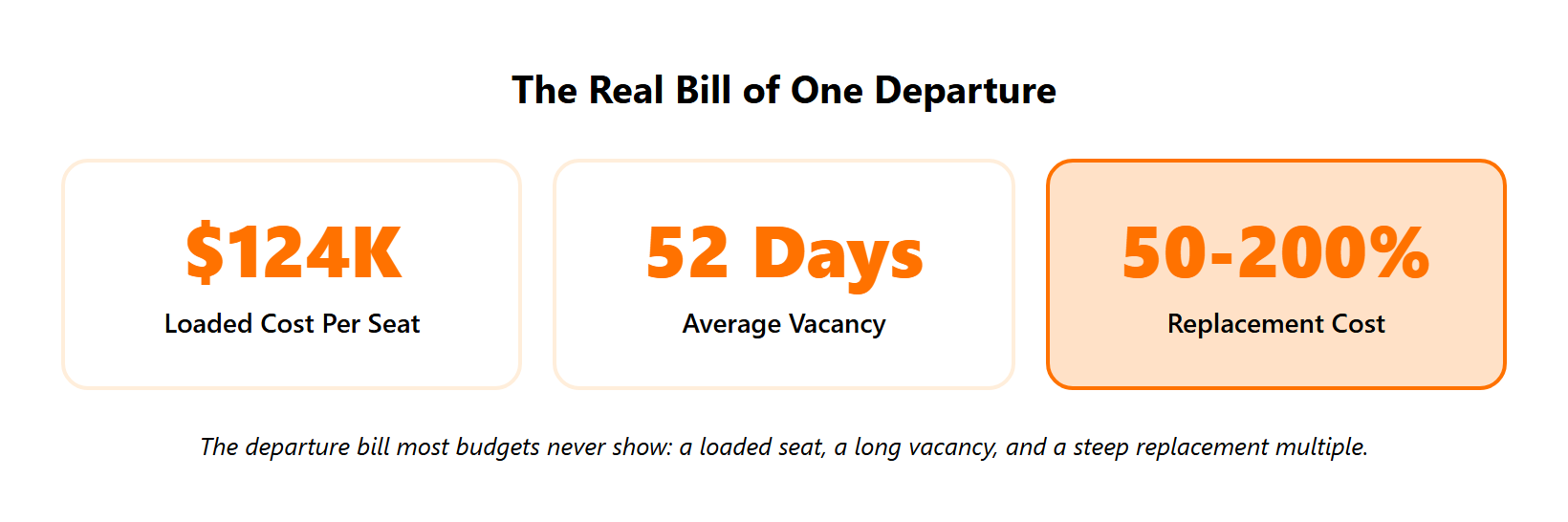
Losing a detection engineer costs far more than their salary. With a 30% overhead load, a single seat runs roughly $124,163 a year. Replacing it means about a 52-day vacancy, a roughly $4,000 recruitment spend, and offers declined by 47% of candidates. The deeper loss is the custom correlation logic and tuning that walks out the door, leaving you blind during the gap.
Just lost, or about to lose, a key detection engineer? We show you what coverage is at risk the day they leave
The number that should scare you is not the salary
I have sat on too many bridge calls where a CISO realizes the person who left was the only one who understood a key detection rule. The salary line in your budget hides the real exposure. The day that engineer gives notice, a meter starts running, and most leaders never see the full bill.
Here is the honest math. A loaded position, with administrative overhead at 30%, costs around $124,163 per year, which works out to $620,815 for a five-person team in 2017 dollars. Filling an open seat through recruitment averages about $4,000 and a 52-day vacancy, and roughly 47% of candidates decline the first offer.
Where the bill actually lands
Now layer in the replacement multiple. Industry analysis puts the cost of replacing a security analyst at 50% to 200% of annual salary once recruiting, onboarding, and lost productivity are counted. For a $160,000 engineer, that is $80,000 to $320,000 per departure.
- The recruiting and vacancy tax: roughly $4,000 plus a 52-day blind spot.
- The ramp tax: months before a new hire knows where your logs even live.
- The decline risk: nearly half of candidates say no the first time.
The loss your spreadsheet cannot see
The biggest cost never shows up as a dollar figure. When detection logic lives in one person’s head, their exit is an outage, not an HR event. As one practitioner put it, when you switch vendors the business logic, the correlation rules, and the automation rules do not come with you, so you start the tuning process over and lose years of institutional memory.
That is institutional amnesia, and it is the through-line of this whole article. At UnderDefense, we built our vendor-agnostic detection model around this exact problem, so your detection logic lives across the stack rather than locked inside one tool that resets the moment a person or a vendor changes. Keep that idea in mind, because every section ahead circles back to it.
Q2: What is a detection engineer salary in 2026, and why does the headline number mislead?
US detection engineers average roughly $156,000 to $173,000, climbing past $210,000 to $250,000 at senior levels. Bengaluru-based engineers average around 15 to 16 lakh base. Salary is the smallest part of the number that matters. The figure that should worry you is the fully loaded cost plus the years of tuning and correlation logic the salary line never captures.
The concept: what the market actually pays
Let me define the benchmark plainly, because the numbers move with the source. In the US, detection engineer pay averages about $156,000 per year by one large dataset, and roughly $173,000 base by another, reaching $210,000 and up at senior grades. In India, Glassdoor pegs the average near 16 lakh per year.
That is the headline. It is also the least useful number on the page.
The example: how $160K becomes $124K of risk per seat
Take a $160,000 engineer. By the time you add the 30% overhead load, that seat sits near the $124,163 loaded cost we covered earlier. Apply the 50% to 200% replacement multiple, and one resignation can cost up to $320,000 to undo.
So the salary is not the spend. The salary is the deposit on a much larger, hidden liability.
The application: budget for the operator, not just the engine
Early in my career, I watched a predecessor buy every shiny security tool on the market. The result was a rookie team trying to manage a fleet of Ferraris, with the engines mostly sitting idle while we begged for budget to hire people who could actually drive them. Salary debates miss this completely. A tool budget without an operator budget buys you idle horsepower.
Here is what I would benchmark instead of base salary alone:
- Fully loaded cost per seat, including the 30% overhead.
- Replacement exposure at the 50% to 200% multiple.
- The value of tuning and correlation logic that only that person holds.
This is exactly why UnderDefense publishes transparent MDR pricing. It lets a CISO compare the real dollars-for-value of an in-house seat against full coverage, without the loaded-cost surprises that surface six months later. If you are weighing the trade-off, our breakdown of outsourced versus in-house SOC walks through the same decision in detail.
Q3: Why are SOC analysts and detection engineers really quitting?
They leave because the work is repetitive drudgery, not because they lack grit. Average tenure has slipped below 18 months, around 71% report burnout, and the daily reality is hundreds of alerts no human can clear. The trigger is rarely the threats. It is babysitting dashboards and copying findings by hand until the job eats the rest of their life.
The situation: a quiet resignation you saw coming
I remember a woman we hired for a triage-heavy role. I asked her, plainly, how she would feel copying data like this all day, every day. She told me she found the zen in copying. Some people genuinely do find peace in the toil. The problem is that the toil never goes away, and most people are not her.
The data backs the pattern. Surveys put SOC analyst burnout near 71%, with average tenure under 18 to 30 months at many organizations.
The complication: the math of the job does not work
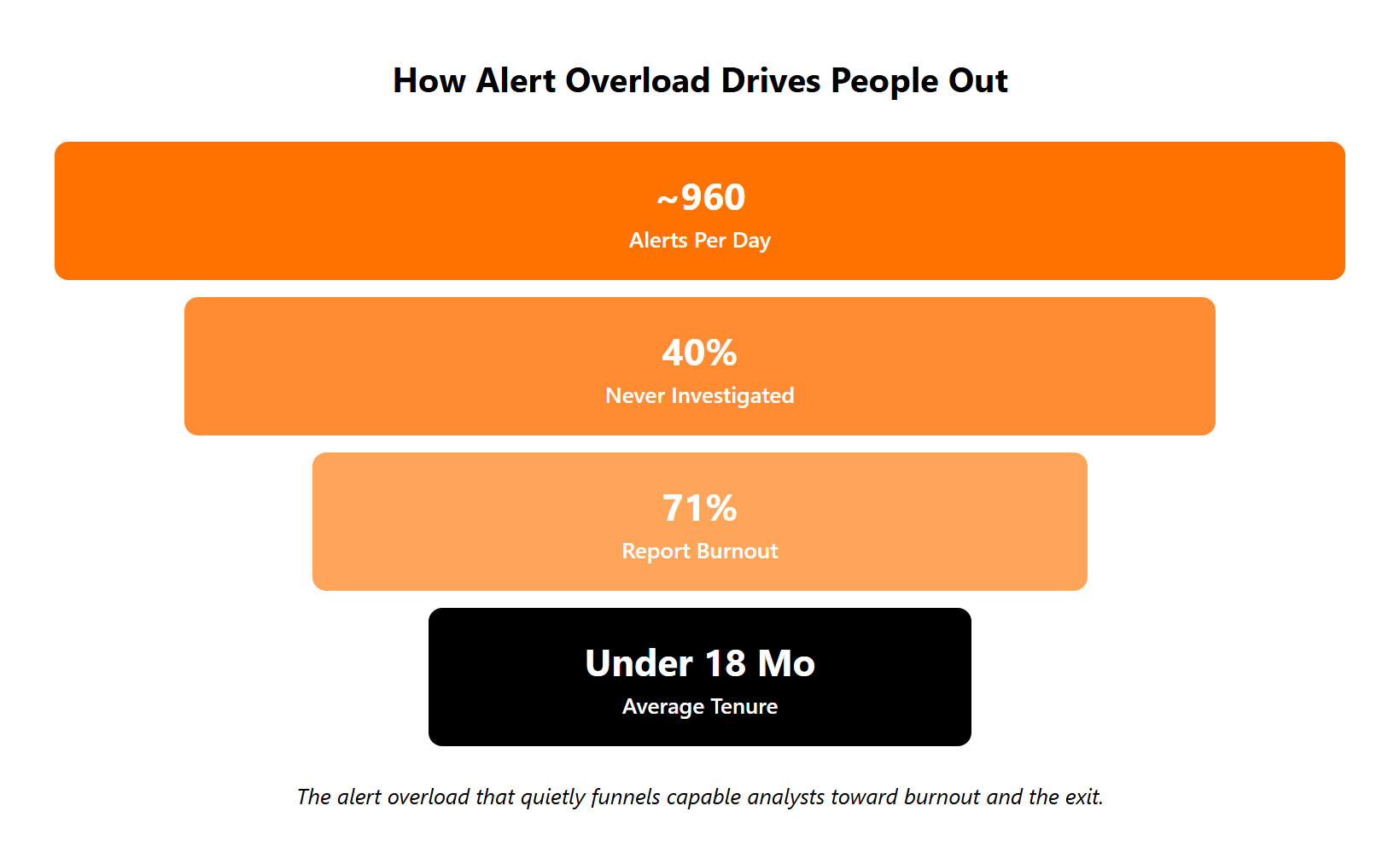
Here is the part leaders underestimate. The average SOC processes close to 960 alerts a day, and roughly 40% are never investigated at all. No human clears that queue. The work becomes a treadmill of false positives and manual copying.
I have watched this break pentesters too. Picture someone on their 17th consecutive internal test, three reports behind for clients, doing research on a new tool at midnight, and missing time with their family to stay afloat. As one pentester told me, most last two to three years, then they are gone, because the work eats you.
The proof: this is structural, not personal
This is not a motivation problem on your team. It is systemic across the field, driven by alert volume, manual process, and chronic understaffing. When the queue is impossible and the work is repetitive, your best people leave first, because they have the most options.
The resolution: change the work, not the worker
The fix is not a pep talk or a wellness webinar. It is removing the drudge work that makes the role unsurvivable. Academic research on SOC staffing reaches the same conclusion: analysts burn out when growth, autonomy, and meaningful work disappear under repetitive load. One way teams attack this directly is through SOC automation that streamlines security operations, so the next hire does not burn out on the same treadmill. That sets up the harder question in the next section.
Q4: Can you really hire your way out of SOC burnout?
No. Hiring your way out of burnout is a fallacy. When the underlying process stays manual and repetitive, every new analyst you add simply becomes the next person bored and gone within 18 months. The skills crisis is a quality and coaching problem more than a pure headcount problem, so throwing more people at unchanged toil scales the churn rather than the coverage.
The instinct everyone reaches for first
When the queue is drowning the team, the reflex is obvious: hire more analysts. I have done it. For years, our approach to taking findings, identifying the owner, and passing the information along was largely human driven, and we tried to hire our way out of it. It did not work the way we hoped.
Why the standard read gets this backwards
Here is what I might be slightly contrarian on, but I have earned the right to say it. Even as you add people, the new people get burnt out and bored doing the exact same thing. You are not buying coverage. You are growing the pool of people who will quit in 18 months.
The deeper issue is that cybersecurity has over-specialized into tool babysitting. We have built a cottage industry of experts in configuring one vendor’s dashboard, with too few people who can trace business logic and find root causes. Adding bodies to that broken process scales the problem.
- More hires, same toil, same exit timeline.
- Deep tool specialists, shallow root-cause skills.
- Coverage gaps that headcount alone never closes.
The better frame: quality and coaching over raw headcount
The skills gap is a quality and coaching problem far more than a volume problem. The win is in fixing the process first, then using automation to absorb the repetitive load, so your humans do the work only humans can do. Peer-reviewed SOC research points the same way, tying retention to growth and meaningful work rather than sheer staffing.
This is the setup for everything that follows. At UnderDefense, we built our SOC service on augmentation over endless hiring, so the repetitive triage gets carried for your team while your engineers move up to real detection engineering. For a deeper look at how this plays out, see our take on whether AI kills or saves your SOC team. Our customers feel the shift directly.
“Our IT team was overwhelmed by the sheer volume of security alerts and doesn’t have the resources for 24/7 monitoring.”
Andriy H., Co-Founder and CTO UnderDefense G2 Verified Review
“They handle a lot of the alert monitoring, which saves time. And if a real problem does happen, they react quickly, which has been a lifesaver.”
Verified User in Computer Software UnderDefense G2 Verified Review
Q5: How big is the cybersecurity talent shortage, and is it truly a numbers problem?
It is large but widely misread. Around 4 million cybersecurity roles go unfilled yearly in the US alone. Yet ISC2’s 2025 study shows skills gaps now pose the bigger risk: 95% report a skills gap, 59% call it critical or significant, and 72% say staff cuts raise breach likelihood. The scarcest skills, like AI and detection engineering, cannot be rehired fast, so retention beats recruiting.
The thesis: stop reading the gap as a headcount problem
Most leaders hear “talent shortage” and reach for a req to open. I understand the reflex. There are roughly 4 million cybersecurity jobs going unfilled every single year in the United States alone, so the instinct feels correct.
My read, after years of trying to staff teams, is that the gap is real but misdiagnosed. The shortage that actually hurts you is a skills shortage, rather than a body count.
The evidence: what the 2025 data actually says
ISC2’s 2025 Cybersecurity Workforce Study, built on more than 16,000 respondents, makes the shift hard to ignore.
- 95% of organizations report at least one skills gap on the team.
- 59% call that gap critical or significant, up sharply from prior years.
- 72% say cutting staff raises their breach likelihood.
- AI is now among the scarcest skills, wanted by roughly 41% of teams.
So the field is short on specific, hard-won capability, like detection engineering and AI fluency, far more than it is short on warm seats.
So what: retention beats the hiring sprint
Here is what this means on Monday. The skills you most need cannot be hired fast, because almost everyone wants the same scarce people. A 52-day vacancy to backfill a detection engineer is a 52-day skills gap, rather than a paperwork delay.
That is why keeping the people who hold your tribal knowledge outperforms a recruiting push. When you genuinely cannot hire the skill in time, our managed detection and response service supplies that detection and response expertise as a service, so the capability shows up now rather than after a two-month search. This is also why we put real numbers behind the cybersecurity budget conversation for mid-market firms, where the scarce-skills math reshapes the plan.
Q6: What is the “bus factor,” and how exposed is your SOC when one person leaves?
The bus factor is how many people would have to disappear before the lights go out. In most SOCs the answer is one or two, which is dangerous. Genuine 24/7/365 coverage needs at least five whole people for the barest staffing, ideally nine analysts plus a manager. When detection logic lives in one head, that person leaving becomes an outage rather than an HR event.
The concept: bus factor in plain English
“Bus factor” is a simple, blunt question. How many people would have to get hit by a bus, or more realistically change jobs, before nobody can keep your security running? If your answer is one, you do not have a resilient SOC. You have a single point of failure with a salary.
A security operations center, or SOC, is the team that watches for and responds to threats around the clock.
The example: the staffing math no one wants to hear
Real 24/7/365 coverage is brutal arithmetic. To staff one seat across nights, weekends, holidays, and vacations, you need at least five whole people for the barest model, and ideally nine analysts plus a SOC manager. A SOC of one person is not a SOC.
I have seen the alternative too many times. It is the “two guys and a dog” approach, where a tiny IT crew runs the routers, the security stack, the printers, and fetches coffee for the CEO. That is a train wreck in slow motion. If you are weighing the trade-offs, our breakdown of building a security operations center lays out the real staffing floor.
The application: run the audit today
Ask one question of your own team this week.
- If my lead detection engineer resigns this morning, can anyone else keep the lights on by tonight?
If the honest answer is no, your bus factor is one. This is exactly the risk our SOC service was built to remove, because our concierge analyst model puts an experienced team behind your stack rather than one irreplaceable hire. Customers describe the relief plainly.
“It’s reassuring to know they’re always watching for threats, and it doesn’t cost a fortune. They catch and stop problems quickly, which is a huge relief.”
Serhii B., Chief Information Security Officer UnderDefense G2 Verified Review
“They handle a lot of the alert monitoring, which saves time. And if a real problem does happen, they react quickly, which has been a lifesaver.”
Verified User in Computer Software UnderDefense G2 Verified Review
Q7: How do detection-as-code and a managed detection lifecycle stop institutional amnesia and detection decay?
Detection-as-code keeps knowledge from walking out the door. When detection rules are written like software, versioned in Git, unit-tested, and shipped via CI/CD, the logic lives in a repository instead of one engineer’s memory. A departure becomes a code handoff. It also halts detection decay, the silent erosion of MITRE ATT&CK coverage that sets in when rules lose an owner and quietly rot.
The concept: treat detections like software
Detection-as-code means you write your detection rules the way developers write applications. The rules live in a repository, get version history, and ship through a pipeline. Git is the version-control system that tracks every change, and CI/CD (continuous integration and continuous delivery) is the automated pipeline that tests and deploys them.
Forward-looking teams treat detection rules like software, written in flexible languages like Python, securely versioned, unit-tested, and deployed via CI/CD. That yields more actionable alerts, and it is also the foundation for any AI-driven SOC.
How it defeats amnesia
The magic is that the knowledge stops being tribal. When a rule lives in code with tests and comments, a new hire reads the repo instead of guessing what their predecessor meant. AI on top of that repo helps democratize the tribal knowledge inside a team, acting as a unified search layer over everything.
The decay problem most teams miss
Here is the part that surfaces only when you actually run a SOC. When an engineer leaves and their rules lose an owner, those rules quietly stop matching reality. Logs change, the rule does not, and your MITRE ATT&CK coverage erodes without a single alarm. ATT&CK is the industry knowledge base of attacker techniques.
My Monday advice is simple:
- Measure validated ATT&CK coverage, rather than just the count of enabled rules.
- Tune the noisiest detections first, since false-positive load drives the burnout we covered earlier.
- Assign every rule an owner and a test, so no detection goes feral.
The payoff: it unlocks AI
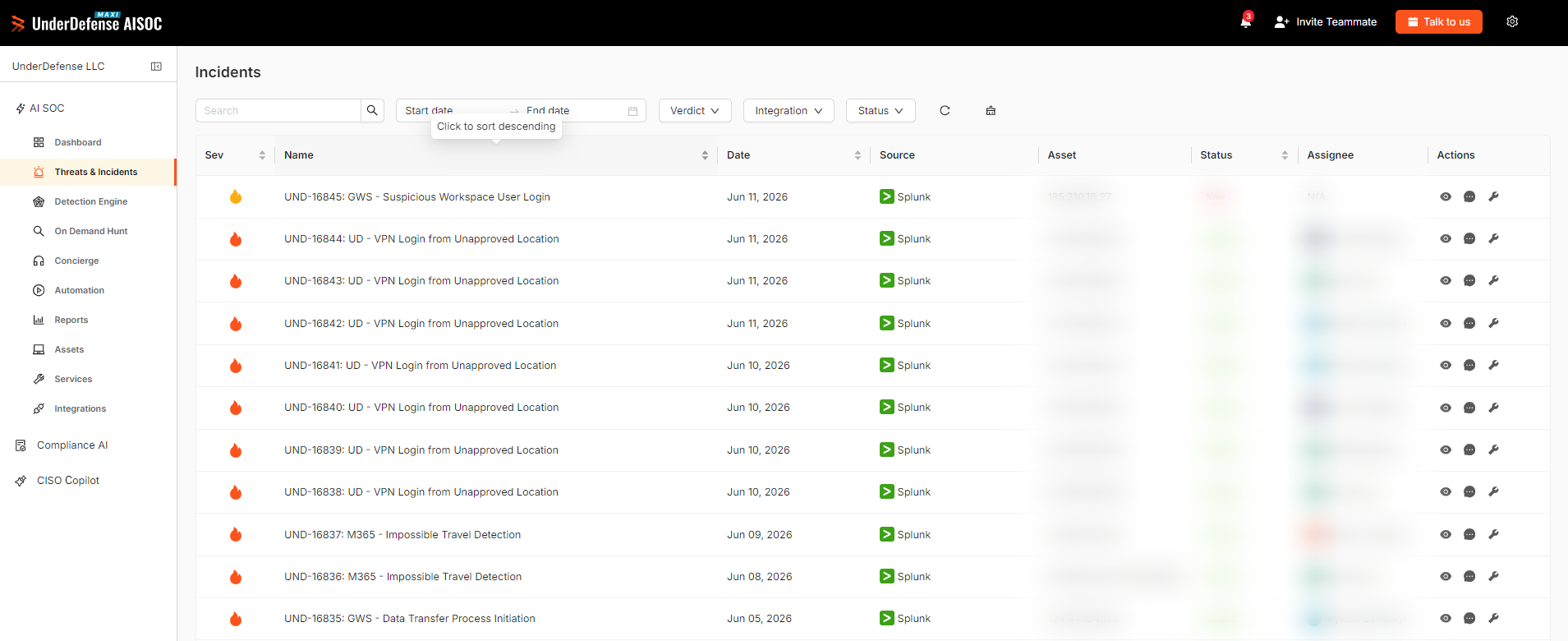
This discipline is the prerequisite for safe automation. At UnderDefense, our vendor-agnostic integration keeps detection logic portable across SIEM, EDR, and XDR, and the UnderDefense Agentic AI SOC detection engine ships a pre-built rule library mapped to MITRE ATT&CK, so coverage does not decay when one owner leaves. If you are choosing between platforms, our guide to AI SOC red flags shows what to watch for.
Q8: Does AI augment your analysts or replace them?
For most SOCs, AI augments rather than replaces. Offloading ticket work can return six to seven hours a day, time that becomes real detection engineering. Picture AI agents as foot soldiers and your engineers as the generals directing them. Some leaders go further, reporting agents that run roughly 7-minute investigations and displace two to three L1 headcount, so the honest answer depends on your maturity.
The answer: augmentation first
Let me be direct, because the hype on both sides is exhausting. For most teams, the win is augmentation, freeing humans from repetitive work so they do the work only humans can do. We are not looking to remove people. If we strip away the ticket work, that can hand an analyst back six to seven hours a day for real detection engineering.
The augment case: foot soldiers and generals
The mental model I like is military. Think of AI agents as your foot soldiers and your human engineers as the generals directing them, plus special forces for the complex missions. Recent research backs this up: multi-agent systems like CORTEX cut false positives and improve investigation quality over a single model. Co-teaming studies reach the same conclusion, that humans and AI together beat either alone.
The honest counterpoint
I might be more cautious here than some of my peers. Other operators report going further than augmentation. One leader, Dennis Chow, describes a team on the cusp of replacing L1 and L2 work with agents that run 7-minute investigations, saving two to three headcount of level-one analysts. The technology is real and patented, with autonomous investigation engines now on the books.
The recommendation
So which is true for you? It depends on your maturity.
- Early-stage teams should augment first, clearing toil before cutting roles.
- Mature, codified teams can push agents deeper into L1 investigation.
- The risk is buying a black-box tool you cannot audit or explain to an auditor.
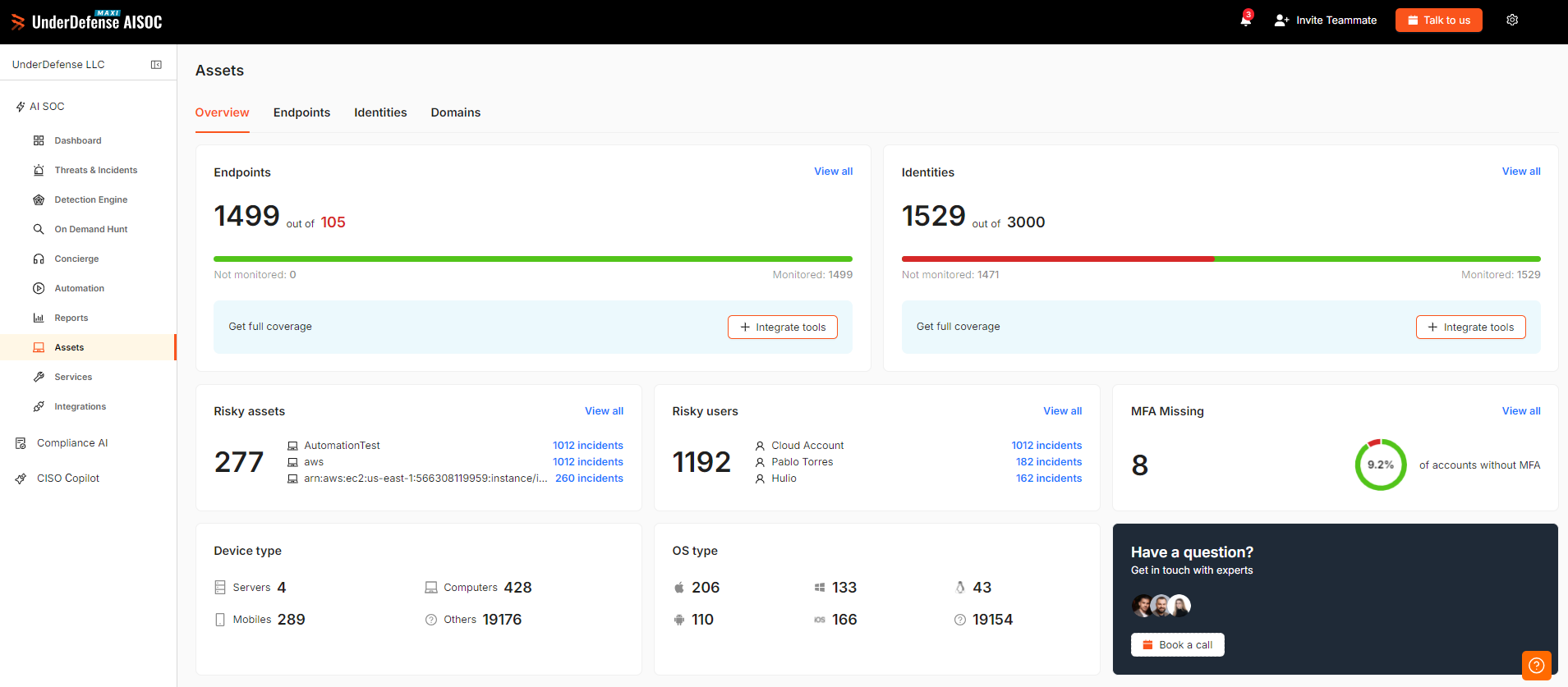
This is why our UnderDefense Agentic AI SOC platform runs the “AI SOC plus Human Ally” model. UnderDefense Agentic AI SOC delivers machine-speed investigation with a 2-minute alert-to-triage target and 15-minute escalation for critical incidents, while concierge analysts supply the context and the decision. For the deeper debate, see our analysis of whether conversational SOCs change the analyst role.
“The platform’s high-fidelity alerts and automated enrichment help us quickly identify and address threats.”
Verified User in Computer Software, Enterprise UnderDefense G2 Verified Review
“Underdefense is a great choice for teams like ours that are short on resources. It automates many tasks, plus, with 24/7 monitoring, we know we’re always protected.”
Inga M., CEO UnderDefense G2 Verified Review
Q9: Build, augment, or outsource: what is the real math on 24/7 monitoring?
The honest question is what each option costs and what value it returns. Building in-house means five-plus loaded seats (around $620K+) plus bus-factor risk. Augmenting or outsourcing trades that for predictable spend and instant coverage, with managed models delivering 2-minute alert-to-triage and 15-minute escalation on critical incidents, response speed humans alone struggle to hit against 48-minute median break-in times.
Reframe the question the right way
Every CISO I talk to eventually asks it the same way. Of my options for 24/7 monitoring, what is the dollars for each option, and what is the value I get from each option? That is the whole decision, stripped of vendor noise.
So let me lay the three paths side by side, in dollars and in value. If you want the underlying numbers, our comparison of outsourced versus in-house SOC works through them in detail, and the SOC cost calculator lets you run your own seat math.
The comparison
| Factor | Build in-house | Augment your team | Managed (outsource) |
|---|---|---|---|
| Up-front cost | ~$620K+ for five loaded seats | Partial team plus a partner | Predictable subscription |
| Time to coverage | Months of hiring, ~52-day vacancies | Weeks | Days |
| Bus factor | High, one resignation hurts | Shared | Removed, a team stands behind you |
| Critical-incident speed | Limited by your on-call | Hybrid | 2-minute alert-to-triage, 15-minute escalation |
| Institutional memory | Walks out with the person | Partly preserved | Preserved in the platform |
UnderDefense sits in the managed and augment columns, where we both detect and respond with concierge analysts. Many monitoring-only tools and legacy MSSPs (managed security service providers) forward alerts without context, which leaves your lean team doing the triage anyway. Our managed detection and response service closes that gap, and we publish the MDR pricing behind it in the open.
Why speed decides it
The attack clock is brutal. Verizon’s 2025 DBIR shows ransomware in 44% of breaches and vulnerability exploitation up 34% year over year. Adversaries now break out fast, with median break-in times measured in tens of minutes and the fastest seen near 51 seconds. A 52-day hiring gap against a 48-minute attacker is a losing trade, which is the core argument in our case for continuous security monitoring.
Which path fits you
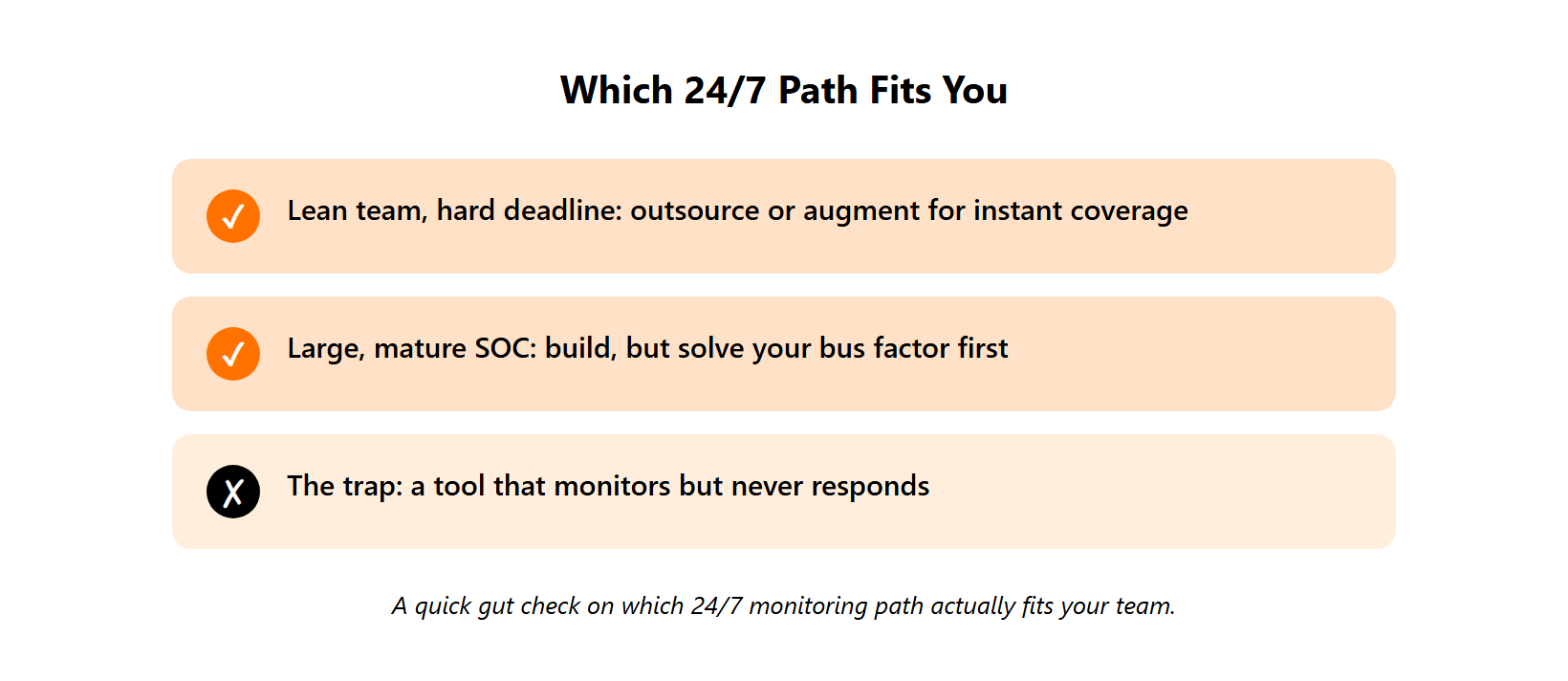
- ✅ Lean team, hard compliance deadline: outsource or augment for instant coverage.
- ✅ Large, mature SOC with depth: build, but solve your bus factor first.
- ❌ The trap: buying a tool that monitors but never responds, a pattern we flag in our look at why businesses switch providers.
“We needed round-the-clock monitoring for compliance reasons, but building our own SOC wasn’t realistic with our budget and the current hiring market. UnderDefense fills that gap without us having to hire a full team.”
Verified User in Marketing and Advertising UnderDefense G2 Verified Review
“UnderDefense is surprisingly affordable considering the level of protection we get. Their proactive threat hunting and rapid response have saved us from incidents that could have been incredibly costly.”
Verified User in Program Development UnderDefense G2 Verified Review
Q10: How do you actually retain a detection engineer, and what do you do Monday?
Retention starts by deleting the toil that drives people out. Set up a tier-one-to-tier-two deflection loop so analysts level up instead of grinding, automate ticket work to return hours to real detection engineering, codify detections so knowledge outlives any one hire, and give people human contact over dashboard babysitting. Being a human, doing work that matters with other humans, is the flex that keeps your best engineers.
The answer: remove the toil, keep the person
After everything above, the retention fix is almost simple. People stay when the work is worth doing. Delete the drudgery, and the same engineer who was halfway out the door rediscovers why they got into security.
Here is what I would do Monday, in order of leverage.
The playbook
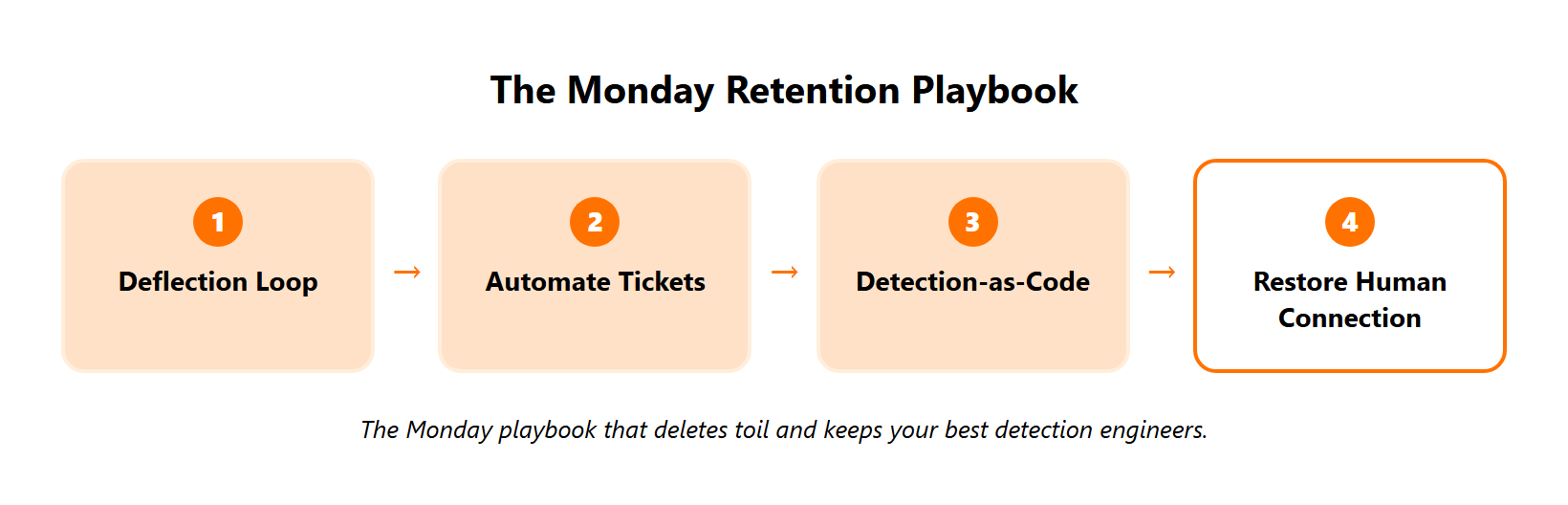
- Build a deflection loop. Set up a feedback loop where tier two coaches tier one, so junior analysts level up faster and senior people are freed to do proactive work. Tier one handles first-line triage, and tier two handles deeper investigation.
- Automate the ticket work. Hand the repetitive ticketing to SOC automation, so you give analysts back six to seven hours a day for detection engineering.
- Codify your detections. Move rules into version control with tests, so knowledge outlives any single hire and your bus factor drops.
- Restore human connection. Replace dashboard babysitting with real problem-solving alongside experienced peers.
Why each step works
Every step here traces back to the evidence in this article. The deflection loop and growth tracks attack the exact burnout drivers that academic SOC research identifies, namely growth, autonomy, and meaningful work. Automating tickets removes the manual copying that crushed the analyst who could only “find the zen in copying.” Detection-as-code kills the institutional amnesia that turns one resignation into an outage, the same risk our SOC service and view on whether AI saves your SOC team are built around.
A thought I am sitting with
Here is where my head is for 2026. Being a human is a flex now. What people want is not connecting to more information but connecting to actual people again, people who have done the work and carry real-life experience. That is the model we built UnderDefense around, machine-speed investigation paired with human allies who have sat in the chair at 2 a.m., and it is the same thesis behind our UnderDefense Agentic AI SOC platform.
“They have an exceptionally talented team who is very engaged and provides extra care. If I had to pick a single word, I would call them proactive.”
Yaroslava K., IT Project Manager UnderDefense G2 Verified Review
“SOC analysts and support team are incredibly responsive and knowledgeable. The platform’s high-fidelity alerts and automated enrichment help us quickly identify and address threats.”
Verified User in Computer Software, Enterprise UnderDefense G2 Verified Review
So here is the question I would leave you with. If your lead detection engineer handed in notice tomorrow, would you be losing a person, or losing your whole detection capability? If it is the second one, that is the conversation I would want to have with you.
Stop tying your detection to a single hire. Our Agentic AI SOC handles investigation so your analysts focus on decisions
1. What is the true cost of losing a detection engineer?
We always tell leaders the salary line hides the real bill. When one detection engineer leaves, the meter starts running across several costs at once.
- Recruiting and vacancy: roughly $4,000 in spend plus an average 52-day vacancy that leaves a blind spot.
- Replacement multiple: industry analysis puts replacing a security analyst at 50% to 200% of annual salary once onboarding and lost productivity are counted.
- Decline risk: nearly half of candidates turn down the first offer, stretching the gap further.
For a $160,000 engineer, that means $80,000 to $320,000 per departure. The cost no spreadsheet captures is institutional amnesia: the correlation rules, tuning, and business logic that live in one person’s head and do not transfer when they go.
That is exactly why we built our managed detection and response service around vendor-agnostic detection, so your logic lives across the stack rather than inside one irreplaceable hire. The bus factor, rather than the salary, is the number that should worry you.
2. What is a detection engineer salary in 2026?
We see the numbers move with the source, so let us anchor them plainly. In the United States, detection engineer pay averages roughly $156,000 to $173,000 base, climbing past $210,000 to $250,000 at senior grades. In India, the average sits near 15 to 16 lakh per year.
The headline number is also the least useful one. Once you add a 30% overhead load, a single seat sits near $124,163 fully loaded, and a five-person team approaches $620,000.
- Benchmark fully loaded cost per seat, not just base salary.
- Add replacement exposure at the 50% to 200% multiple.
- Value the tuning and correlation logic only that person holds.
A tool budget without an operator budget buys idle horsepower, which we have watched sink teams firsthand. That is why we publish transparent MDR pricing, so you can compare the real dollars-for-value of an in-house seat against full coverage without loaded-cost surprises surfacing six months later.
3. Why do SOC analysts really quit and burn out?
We have seen it up close: analysts leave because the work is repetitive drudgery, not because they lack grit. The triggers are structural rather than personal.
- Burnout sits near 71%, with average tenure often under 18 months.
- The average SOC processes close to 960 alerts a day, and roughly 40% are never investigated.
- The job becomes babysitting dashboards and copying findings by hand until it eats the rest of someone’s life.
Academic research on SOC staffing reaches the same conclusion. People burn out when growth, autonomy, and meaningful work disappear under repetitive load. We have watched this break pentesters too, where most last two to three years before the work wears them down.
The fix is not a wellness webinar. It is removing the drudge work that makes the role unsurvivable. One direct lever is SOC automation that streamlines operations, so your next hire does not burn out on the same treadmill the last one quit on.
4. Can you hire your way out of SOC burnout and turnover?
No, and we have tried. For years our process for routing findings was largely human driven, and adding people did not fix it. When the underlying process stays manual, every new analyst simply becomes the next person bored and gone within 18 months.
The deeper issue is that the field has over-specialized into tool babysitting. We have a cottage industry of experts in configuring one vendor’s dashboard, with too few people who trace business logic and find root causes.
- More hires, same toil, same exit timeline.
- Deep tool specialists, shallow root-cause skills.
- Coverage gaps headcount alone never closes.
The skills crisis is a quality and coaching problem far more than a volume problem. Fix the process first, then let automation absorb repetitive load so humans do the work only humans can do. We built our SOC service on augmentation over endless hiring, so repetitive triage gets carried while your engineers move up to real detection engineering and stay longer.
5. How big is the cybersecurity talent shortage really?
We think the shortage is real but widely misread. Roughly 4 million cybersecurity roles go unfilled yearly in the United States alone, which makes the hiring reflex feel correct. The data tells a sharper story.
ISC2’s 2025 Cybersecurity Workforce Study, built on more than 16,000 respondents, found:
- 95% of organizations report at least one skills gap.
- 59% call that gap critical or significant.
- 72% say cutting staff raises breach likelihood.
- AI now ranks among the scarcest skills, wanted by roughly 41% of teams.
So the field is short on specific, hard-won capability like detection engineering and AI fluency, far more than warm seats. A 52-day vacancy to backfill an engineer is a 52-day skills gap, not a paperwork delay.
When you genuinely cannot hire the skill in time, our MDR service supplies that detection and response expertise now rather than after a two-month search, so retention and augmentation outperform a recruiting sprint.
6. What is the bus factor, and how exposed is your SOC?
We use a blunt question: how many people would have to disappear before nobody can keep your security running? If the answer is one, you do not have a resilient SOC. You have a single point of failure with a salary.
Real 24/7/365 coverage is hard arithmetic. To staff one seat across nights, weekends, holidays, and vacations, you need at least five whole people for the barest model, and ideally nine analysts plus a SOC manager.
- A SOC of one person is not a SOC.
- The common alternative is a tiny IT crew running routers, security, printers, and everything else at once.
Ask your team this week: if my lead detection engineer resigns this morning, can anyone else keep the lights on by tonight? If the honest answer is no, your bus factor is one.
That is the precise risk our SOC service was built to remove, because a concierge analyst team stands behind your stack instead of one irreplaceable hire. For the staffing math, see our guide on building a security operations center.
7. How does detection-as-code stop institutional amnesia?
We keep knowledge from walking out the door by treating detection rules like software. The logic lives in a repository with version history and tests, so a departure becomes a code handoff rather than an outage.
Detection-as-code means rules are written in flexible languages, versioned in Git, unit-tested, and deployed through a CI/CD pipeline. A new hire reads the repo instead of guessing what a predecessor meant.
It also stops detection decay, the silent erosion of coverage that sets in when rules lose an owner. Our Monday advice is simple:
- Measure validated MITRE ATT&CK coverage, not just the count of enabled rules.
- Tune the noisiest detections first, since false positives drive burnout.
- Assign every rule an owner and a test, so no detection goes feral.
This discipline is also the prerequisite for safe automation. Our vendor-agnostic integrations keep detection logic portable across SIEM, EDR, and XDR, so your coverage survives any single engineer leaving and your knowledge stops being tribal.
8. Does AI replace SOC analysts or augment them?
We believe that for most teams the win is augmentation, not replacement. Freeing humans from repetitive work lets them do what only humans can. Strip away ticket work and you can hand an analyst back six to seven hours a day for real detection engineering.
The mental model we like is military: AI agents are foot soldiers and your engineers are the generals directing them, with special forces for complex missions. Research on multi-agent systems backs this, showing humans and AI together beat either alone.
- Early-stage teams should augment first, clearing toil before cutting roles.
- Mature, codified teams can push agents deeper into tier-one investigation.
- The real risk is a black-box tool you cannot audit or explain to an auditor.
We honestly note that some operators go further, reporting agents that run 7-minute investigations and displace two to three tier-one seats. Our MAXI AI platform runs an AI-plus-human-ally model, pairing machine-speed investigation with a 2-minute alert-to-triage target and 15-minute critical escalation alongside concierge analysts.